
Compliances

Compliances refer to the process by which an organization ensures that it follows all applicable laws, regulations, standards, and ethical practices relevant to its operations. This includes adhering to environmental laws, maintaining fair labor practices, and upholding strong governance and transparency standards. Effective compliance helps organizations reduce legal risks, build trust with stakeholders, and operate responsibly within society. It also supports long-term sustainability by aligning business activities with regulatory requirements and ethical expectations.

Showing 12/50

04 Aug 2026

Why Disability Inclusion Must Become India Inc.’s Next Boardroom ESG KPI A ramp, a recruitment drive or an annual award cannot prove inclusion. The real test is whether employees with disabilities are hired, paid fairly, retained, promoted, protected during climate shocks, and able to secure benefits and remedies without fighting the system. BY PROF. UJJWAL K. CHOWDHURY  |  MAGAZINE FEATURE  |  INDIA, AUGUST 2026 “Inclusion should not be viewed as charity.”— Rajesh Aggarwal, at the launch of the CII Award for Excellence in Disability Inclusion, December 20241Accessibility is no longer a feel-good CSR initiative. It is a test of governance maturity, workforce quality, digital competence, operational resilience and the integrity of ESG reporting.Short SummaryThis feature examines CII-style employer awards, physical and digital audits, the hiring-versus-retention gap, disability-inclusive climate resilience, and the implications of ESIC and India’s labour-code transition. Corporate cases are used to test disclosure quality—not to confer unqualified praise.KeywordsDisability inclusion; workplace accessibility; ESG metrics; BRSR; reasonable accommodation; inclusive employment; digital accessibility; climate resilience; ESIC; labour codes; corporate governance.Hashtags #DisabilityInclusion  #WorkplaceAccessibility  #ESG  #SocialSustainability  #InclusiveEmployment  #BRSR  #ClimateJustice  #BoardroomKPI  #IndiaIncEDITORIAL EVIDENCE NOTECorporate examples below rely on official releases and public sustainability disclosures. A missing metric is identified as a disclosure gap, not proof of poor performance. Disability headcounts often depend on voluntary self-disclosure and may understate actual prevalence. The evidence standard used throughout is outcomes over intentions.THE “S” IN ESG HAS A MISSING DENOMINATORIndia’s sustainability vocabulary is fluent in carbon intensity, water positivity, renewable energy and net-zero targets. It remains far less exact about who can enter a workplace, use its systems, build a career and leave with dignity. That imbalance is no longer defensible.SEBI’s Business Responsibility and Sustainability Reporting framework has created an important starting point. It asks listed companies to disclose employees and workers with disabilities, and it separately seeks information on turnover, wages, welfare benefits, accessibility and grievances. The weakness is that many outcome tables are not disability-disaggregated. A company can report a headcount while investors still cannot see whether those employees are underpaid, concentrated at junior levels, denied benefits or leaving faster than comparable colleagues.5Accessibility must therefore become a boardroom KPI: owned by the board or a designated committee, reviewed quarterly, linked to executive accountability and tested by independent evidence. The central question is not, “Do we have a disability policy?” It is, “At every stage of work, where are people being filtered out—and what did management do about it?”AWARDS CAN MOVE MARKETS—IF THEY REWARD PROOFThe Confederation of Indian Industry has worked on disability inclusion through employer sensitisation, recruitment support, workplace guidance and the India Business and Disability Network. Its Award for Excellence in Disability Inclusion, launched in December 2024, gives the market something it badly needs: a visible benchmark. The 2026 framework recognises accessibility, disability-inclusive culture, inclusive recruitment and overall “Champion Company” performance, with separate eligibility thresholds for large enterprises and MSMEs.12Awards matter because reputation affects talent, procurement and investor confidence. But they become ESG instruments only when they reward proof. A credible CII-style award should score workforce denominators; wage and promotion parity; one- and two-year retention; accommodation response times; audit closure; benefit access; disability-inclusive procurement; grievance remedies; emergency preparedness; and actual expenditure against approved budgets.CASE STUDYPersistent Systems: recognition backed by an audit trailPersistent Systems received the 2026 CII award in the “Best Employer—Physical Accessibility” category. Its public account points to independent audits, an accessibility benchmark at its Pune facility, alignment with India’s Harmonised Guidelines, digital platforms designed toward WCAG standards, and governance ownership.The next step for the awards ecosystem is tougher verification: random site visits, confidential interviews with disabled workers without managers present, public scoring bands and evidence that audit findings were closed—not merely identified. Recognition should open the evidence file, not replace it.10 AUDIT THE EMPLOYEE JOURNEY, NOT JUST THE ENTRANCEA workplace can have an accessible entrance and still be institutionally inaccessible. A physical audit must follow the full employee journey: transport and parking; security and reception; paths, doors and lifts; tactile and visual signage; workstations and factory floors; meeting rooms, canteens, washrooms and medical rooms; employee housing; and emergency exits.In industrial settings, the audit must test whether protective equipment, alarms, control panels, evacuation chairs and safety instructions work for people with mobility, visual, hearing, cognitive and neurodivergent needs. Maintenance matters as much as design: a compliant ramp blocked by motorcycles is not accessible.The digital audit begins before employment. It must test the careers page, application form, applicant-tracking system, online assessment, interview platform and document-upload process. After joining, it should cover HRMS, attendance, payroll, leave, insurance, learning, collaboration, travel booking, procurement, appraisal and grievance portals. Automated scanners can flag technical defects, but they cannot substitute for usability testing by people with varied disabilities.For the financial sector, this is now regulatory territory. SEBI’s 2025 circular suite made digital accessibility mandatory for regulated entities, placed review responsibility with the managing director, managing partner or proprietor, required a senior nodal officer, and called for accessible grievance channels and baseline ICT standards. Banks, brokers, exchanges, mutual funds and fintech firms should treat accessibility as an employee right, a customer right and a governance risk at the same time.34CASE STUDYInfosys: a number that opens the questionInfosys reported 1,075 employees with voluntarily disclosed disabilities in FY2025–26. Against a total headcount of 328,594, that is about 0.33 per cent. The company also reports accessibility learning, an InfyAbility employee network with more than 3,900 members, accessibility living labs and accommodation support.This is useful disclosure because it gives a denominator and acknowledges voluntary disclosure. It also reveals the next frontier: applicant-to-hire conversion, probation completion, 12- and 24-month retention, pay parity by comparable grade, promotions, high-value assignments, accommodation requests, and remedies after disability-related grievances. Overall attrition cannot answer whether disabled employees are leaving at a higher rate.67 CASE STUDYTata Steel: inclusion on the industrial floorTata Steel’s FY2025–26 consolidated BRSR reported 149 employees with disabilities out of 73,215 employees—about 0.20 per cent—and separately identified 118 permanent workers with disabilities. Only nine of the 149 employees were women. The company clearly stated that European subsidiaries were excluded because those operations do not collect the data under local privacy practices.That boundary note is exemplary: it prevents a partial figure from masquerading as universal coverage. Tata Steel also describes modifications to workstations and washrooms, tailored laptops and assistive software or hardware, temporary accommodation during onboarding and workplace buddies. The unanswered ESG questions concern disability-specific wages, retention, injuries, promotion, grievance remedies and representation in production, engineering, logistics, maintenance and supervisory roles.8 HIRING MAKES HEADLINES; RETENTION PROVES INCLUSIONRecruitment drives are visible and countable. Retention is quieter—and more revealing. A serious dashboard tracks the complete funnel: applications → accessible assessment → interview → offer → acceptance → joining → probation completion → 12-month retention → 24-month retention → promotion → internal mobility. Each stage should be segmented by disability category, gender, location, employment status, occupational group and grade, with privacy safeguards and minimum reporting thresholds.The most common barriers often appear after onboarding: inaccessible internal software, delayed reasonable accommodation, transport problems, shift allocation, exclusion from travel or client-facing work, weak mentorship, biased appraisal and an absence of career pathways. Disability inclusion fails through everyday management decisions long before it appears in a legal complaint.TCS offers useful architecture. Its ENABLE Disability and Allies Network, launched in 2017, creates an employee forum, while PACT brings parents, allies and caregivers into the inclusion ecosystem. TCS also publicly emphasises accessible recruitment, workplace design, assistive technology and reasonable accommodation. Wipro, ITC, JSW Steel and major banks should be evaluated against the same outcome test: not whether policies exist, but whether disabled employees remain, advance and receive comparable rewards.9THE INCLUSION INFRASTRUCTURE: FROM MITTI CAFÉ TO V-SHESHInclusive employment is not merely a placement transaction. Mitti Café’s model combines experiential training, café and catering jobs, customer interaction, visibility and dignity. It reports more than 50 cafés in institutional and public spaces and thousands of persons with disabilities skilled, while its support model includes health insurance, food and accommodation. The transferable corporate lesson is that retention may require transport, accessible housing, coaching, nutrition, family engagement or health support—not only an appointment letter.11V-Shesh represents another part of the infrastructure. It says it supports 117 leading companies through recruitment, pre- and post-hiring services, sensitisation, policy advice, accessibility services and work trials, and reports more than 2,000 jobs facilitated. Such intermediaries help employers redesign roles instead of rejecting candidates against inherited job descriptions.12National Restaurant Association of India chapters and hospitality groups could scale common accessible-recruitment protocols, model kitchens and hotels, shared trainers, accessible customer-service standards and cross-company apprenticeships. Yet every partnership must publish conversion and retention: how many people were trained, how many received paid jobs, what they earned, how many remained, which benefits they accessed and what happened when difficulties arose.THE OVERLOOKED “E”: CLIMATE RESILIENCE THAT DOES NOT ABANDON PEOPLEA heatwave, flood, cyclone, power failure or transport shutdown does not affect every worker equally. Employees using wheelchairs, hearing aids, powered mobility equipment, ventilators, screen readers, medication refrigeration or caregiver support face risks that conventional business-continuity plans often fail to see.The evidence is alarming. UNDRR’s global survey found that only a small minority of local disaster-risk-reduction plans addressed the specific needs of persons with disabilities, while most respondents reported no participation in community-level decision-making. In India, CEEW’s 2025 heat-risk assessment found 57 per cent of districts—home to 76 per cent of the population—at high to very high heat risk. CEEW’s framework explicitly treats disability and chronic conditions as vulnerability factors. WRI India’s work on industrial transition similarly warns that green transitions do not automatically deliver inclusion without structural change.131415A disability-inclusive corporate resilience plan needs multimodal warnings using sound, text, vibration, visual signals and plain language; accessible evacuation maps, exits, drills and refuge areas; evacuation chairs and trained responders; backup electricity for assistive and medical devices; accessible shelters, transport and temporary accommodation; heat-adjusted shifts and rest periods; remote-work options during severe weather; continuity of medication and caregiver access; and equal protection for contract and outsourced workers.Disabled employees must co-design and test these systems. CSE, WRI India, CEEW and Climate Policy Initiative India can widen corporate climate-risk methodologies; IiAS, InGovern and independent academics can test board ownership, disclosure integrity and incentives. The principle is unforgiving: a climate plan that cannot protect the most exposed employee is not a resilient plan.LABOUR CODES AND ESIC: COVERAGE MUST BECOME VISIBLEIndia’s four labour codes took effect on 21 November 2025, reshaping workforce classification, social-security administration, contractor governance and reporting systems. For disability inclusion, classification is material because people can disappear between the principal employer’s payroll, staffing firms, contractors, apprenticeships, fixed-term work and platform arrangements.16Boards should receive disability-disaggregated data for permanent and fixed-term employees, permanent and contract workers, apprentices, temporary and outsourced personnel, and gig or platform workers where relevant. A consolidated headcount that excludes the most precarious categories can make inclusion look stronger than it is.ESIC is an essential protection but should not be confused with an inclusion policy. Its permanent-disablement benefit can provide lifelong payments linked to loss of earning capacity after an employment injury; permanent total disablement is generally paid at 90 per cent of average daily wages. That protection does not replace accessible recruitment, reasonable accommodation, career progression or freedom from discrimination.17The ESG test is practical: among eligible workers, how many are registered for ESIC, PF and insurance; how many claims were filed and accepted; how long settlement took; whether contractors deposited contributions; whether assistance was available in accessible formats; and what remedy followed a denial. “Covered as per law” is not evidence of access.THE BOARDROOM ACCESSIBILITY SCORECARDA credible dashboard should contain eight linked measures. It should reach the board at least quarterly; material failures should enter the annual report; and remuneration committees should consider whether senior executives delivered agreed outcomes.#KPIEVIDENCE THE BOARD SHOULD SEE1REPRESENTATIONAbsolute number and percentage of persons with disabilities; voluntary-disclosure rate; segmentation by gender, grade, site, employment status and occupational category.2EMPLOYMENT OUTCOMESApplication-to-interview and interview-to-hire conversion; probation completion; 12- and 24-month retention; promotion; internal mobility; disability-specific exit reasons.3PAY & BENEFITSMedian fixed and variable remuneration against comparable work; insurance, ESIC, PF, leave, transport, assistive devices and caregiver provisions.4ACCOMMODATIONRequests received, approved, rejected and pending; median closure time; spend; employee satisfaction; independent appeal route.5PHYSICAL & DIGITAL ACCESSPercentage of sites and critical systems independently audited; barriers by severity; closure and re-test rates; overdue actions.6VOICE, GRIEVANCE & REMEDYConfidential worker interviews without management present; complaints by issue; substantiation; corrective action; compensation; non-retaliation; recurrence.7CLIMATE & EMERGENCY RESILIENCEAccessible warnings and drills; evacuation readiness; backup power; heat and severe-weather protocols; remote-work continuity; contractor coverage.8MONEY, BOUNDARIES & ASSURANCEApproved accessibility capex and opex; money actually spent; baseline year; reporting boundary; methodology; absolute and intensity results; independent assurance scope.REGULATORS, BANKS, AUDITORS: THE ACCOUNTABILITY CHAINSEBI, MCA, RBI, the Ministry of Finance and the stock exchanges can drive convergence through stronger disability-disaggregated indicators, accessible filing and investor platforms, financial-sector enforcement, public-sector-bank leadership and credible assurance standards. The BRSR architecture should evolve from “how many?” to “what happened to them?”Audit firms and ESG-data providers must stop treating a policy, a ramp or a “yes” response as sufficient evidence. Assurance should reconcile payroll, HR, grievance, procurement, facility, IT and benefits data; test a sample of sites and systems; interview workers without management; and verify both approved budgets and money actually spent. Absolute results must be shown alongside intensity measures, because a better percentage can hide a shrinking denominator.Infosys, TCS, Wipro, ITC, Tata Steel, JSW Steel and large banks have the scale to establish sector benchmarks. CII-style awards can accelerate competition. Mitti Café, V-Shesh, organisations of persons with disabilities and disability-led experts can supply implementation intelligence. But persons with disabilities must remain the primary witnesses, auditors, designers and decision-makers—not beneficiaries photographed for annual reports.ACCESSIBILITY IS ENTERPRISE QUALITYThe next phase of disability inclusion will not be won by compassionate language. It will be won by better systems: recruitment that does not reject assistive technology; software that works with a screen reader; managers who deliver accommodations on time; factories that evacuate every worker; benefits that can actually be claimed; and grievance mechanisms that produce remedy without retaliation.A truly accessible company is easier to enter, safer to work in, simpler to transact with and more resilient under stress. It identifies process defects that inconvenience everyone, protects scarce talent, strengthens customer access and exposes governance blind spots before they become litigation, reputational damage or operational failure.Accessibility is not a CSR footnote. It is a balance-sheet issue, a resilience issue and evidence of management quality. The ramp now leads to the boardroom—and the board should be accountable for whether it reaches the door.SELECTED EVIDENCE BASE1. Confederation of Indian Industry: Launch of CII Award for Excellence in Disability Inclusion, 18 December 2024. 2. CII India Business and Disability Network: Award for Excellence in Disability Inclusion—2026 categories and eligibility. 3. Securities and Exchange Board of India: Mandatory compliance by all regulated entities under the RPwD Act, circular dated 31 July 2025. 4. SEBI: Compliance Guidelines for Digital Accessibility, circular dated 25 September 2025. 5. SEBI: Business Responsibility and Sustainability Reporting by listed entities, circular dated 10 May 2021. 6. Infosys: ESG Report 2025–26: social inclusivity, accessibility and voluntary disability disclosure. 7. Infosys: Three-year IFRS data sheet, including FY2025–26 employee headcount. 8. Tata Steel: Business Responsibility and Sustainability Report 2025–26. 9. Tata Consultancy Services: DEI framework, ENABLE and PACT; disability hiring and accessibility guidance. 10. Persistent Systems: CII Award for Excellence in Disability Inclusion—official release. 11. Mitti Café: Employment, training and inclusive café model. 12. V-Shesh: Workforce and workplace inclusion services. 13. UNDRR: Global Survey Report on Persons with Disabilities and Disasters, 2023. 14. CEEW: District-level heat-risk assessment for India, May 2025. 15. WRI India: Challenges and barriers to a fair and equitable transition in India’s SME sector, April 2026. 16. Ministry of Labour & Employment: Year End Review 2025: four labour codes effective from 21 November 2025. 17. Employees’ State Insurance Corporation: ESI Scheme benefits and Permanent Disablement Benefit.   ...Read more
01 Aug 2026

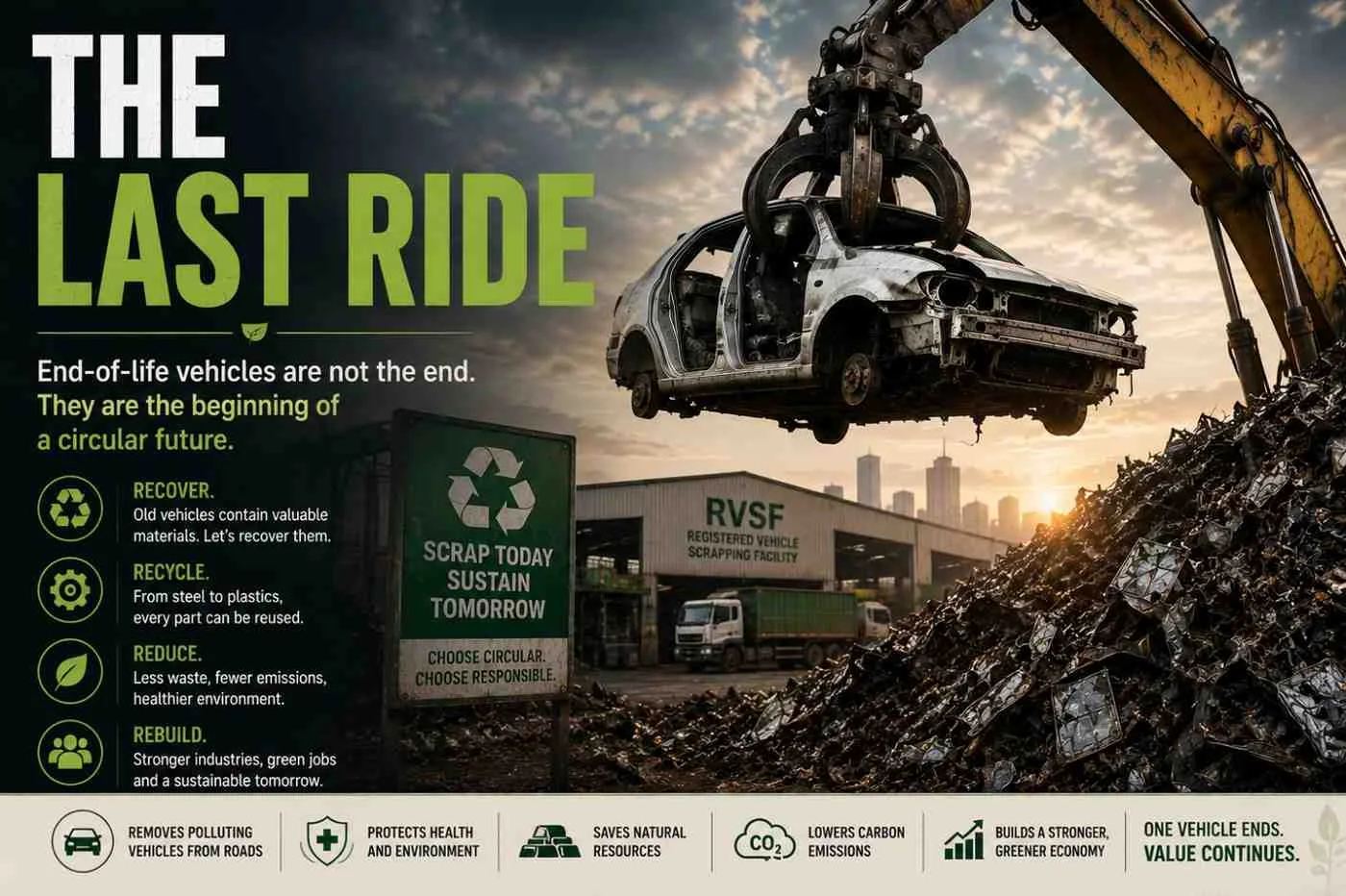
India's growing vehicle scrappage ecosystem is transforming end-of-life vehicles into valuable resources, but the success of a circular material economy will depend on formal recycling, stronger infrastructure and public participation  Kolkata | August 1, 2026:Every vehicle eventually reaches the end of its useful life. The real question is what happens next. For years, old and damaged vehicles in India were largely dismantled in informal scrapyards, where valuable materials were recovered with little environmental oversight or scientific waste management.  Today, that approach is gradually giving way to a more organised system. As India expands its vehicle scrappage programme and establishes authorised recycling facilities, end-of-life vehicles (ELVs) are beginning to play a much larger role in the country's transition towards a circular economy. The shift comes at an important moment. India is one of the world's largest automobile markets, and millions of vehicles are expected to retire from the roads over the next decade. Managing this growing volume is no longer just about disposing of ageing vehicles. It is becoming an opportunity to recover valuable resources, reduce industrial waste and strengthen sustainable manufacturing. Under the government's Vehicle Scrappage Policy, ageing and unfit vehicles are encouraged and in certain cases required- to undergo fitness assessments before being transferred to Registered Vehicle Scrapping Facilities (RVSFs). These authorised centres are designed to dismantle vehicles scientifically, safely handle hazardous components and recover reusable materials such as steel, aluminium, copper, plastics, and rubber. Experts believe this approach could significantly improve India's resource efficiency. Recovering metals from scrapped vehicles requires far less energy than extracting and processing newly mined raw materials, helping reduce both production costs and carbon emissions.Recycled steel and aluminium are also expected to become increasingly valuable as demand continues to grow across the automotive, construction and infrastructure sectors.Yet building an efficient circular material chain remains a complex task. A substantial portion of vehicle dismantling is still carried out by the informal sector, which has supported recycling activities for decades through well-established local networks. While these businesses recover a significant amount of recyclable material, environmental safeguards, worker safety standards and material traceability often remain inadequate. Integrating informal operators into a regulated recycling ecosystem is therefore seen as one of the biggest challenges facing the sector. Infrastructure presents another hurdle. Expanding the number of authorised scrapping facilities is only part of the solution. Experts say the wider ecosystem-including testing centres, dismantling capacity and supporting infrastructure- still falls short in many parts of the country.The transition also faces another obstacle: participation. Public awareness of the scrappage policy remains limited, while logistical constraints and uneven implementation across states continue to slow the growth of formal recycling systems. Experts believe that without meaningful economic incentives, encouraging wider participation from vehicle owners will remain a significant challenge. Vehicle owners are more likely to participate when scrapping offers tangible financial benefits through tax concessions, incentives or discounts on new vehicle purchases. At the same time, manufacturers stand to benefit from a more dependable supply of recycled materials, strengthening supply-chain resilience while reducing dependence on newly extracted resources. The advantages extend well beyond the automobile industry. A well-developed vehicle recycling ecosystem can reduce landfill waste, improve air quality by replacing highly polluting vehicles and create new employment opportunities across dismantling, material recovery, recycling, and secondary manufacturing. It also supports India's wider objectives of improving resource efficiency, lowering industrial emissions and promoting circular economy practices within domestic manufacturing. Environmental experts believe that transition cannot end with vehicle recycling alone.A truly circular automotive sector will require vehicles to be designed for easier recycling, valuable materials to be recovered more efficiently, battery recycling systems to expand and manufacturers to take greater responsibility for the entire life cycle of their products. As India's vehicle population continues to grow, the country's next sustainability milestone may not be measured by how many new vehicles are manufactured, but by how responsibly older ones are managed at the end of their life. The programme's success will not be measured by the number of vehicles it dismantles, but by the value it creates from them. It will be measured by how effectively yesterday's vehicles are transformed into tomorrow's resources, reducing waste, conserving raw materials and strengthening India's circular economy. The journey of a vehicle should not end at the scrapyard. In a truly sustainable economy, it should continue through the materials it leaves behind - fueling new industries, conserving natural resources and reinforcing the idea that the most valuable resources are often those already in our hands. Sources: Ministry of Road Transport and Highways (MoRTH) – Vehicle Scrapping Policy: Notifications and Ruleshttps://www.morth.gov.in/en/Circulars-Notifications-related-to-Vehicle-Scrapping-PolicyPress Information Bureau (PIB) – Vehicle Scrapping Policy: Progress of Registered Vehicle Scrapping Facilities (RVSFs)https://www.pib.gov.in/PressReleasePage.aspx?PRID=2099130&lang=2&reg=48National Government Services Portal – Registered Vehicle Scrapping Facility (RVSF) Portalhttps://services.india.gov.in/service/detail/apply-for-registered-vehicle-scrapping-facilityMinistry of Road Transport and Highways – State-wise Registered Vehicle Scrapping Facility (RVSF) Notificationshttps://www.morth.gov.in/en/rvsf-notificationsCentral Pollution Control Board (CPCB) – Environmentally Sound Management of End-of-Life Vehicleshttps://cpcb.nic.in/NITI Aayog – Reports on Circular Economy and Resource Efficiencyhttps://www.niti.gov.in/Down To Earth – Coverage on vehicle scrappage, recycling and the circular economy in Indiahttps://www.downtoearth.org.in/The Energy and Resources Institute (TERI) – Research on resource efficiency, recycling and circular economyhttps://www.teriin.org/Ministry of Steel, Government of India – Steel recycling and secondary raw materials initiativeshttps://steel.gov.in/Press Information Bureau (PIB) – Voluntary Vehicle Fleet Modernization Programme (Vehicle Scrapping Policy)https://www.pib.gov.in/newsite/erelcontent.aspx?lang=2&reg=48&relid=265928 ...Read more

01 Aug 2026

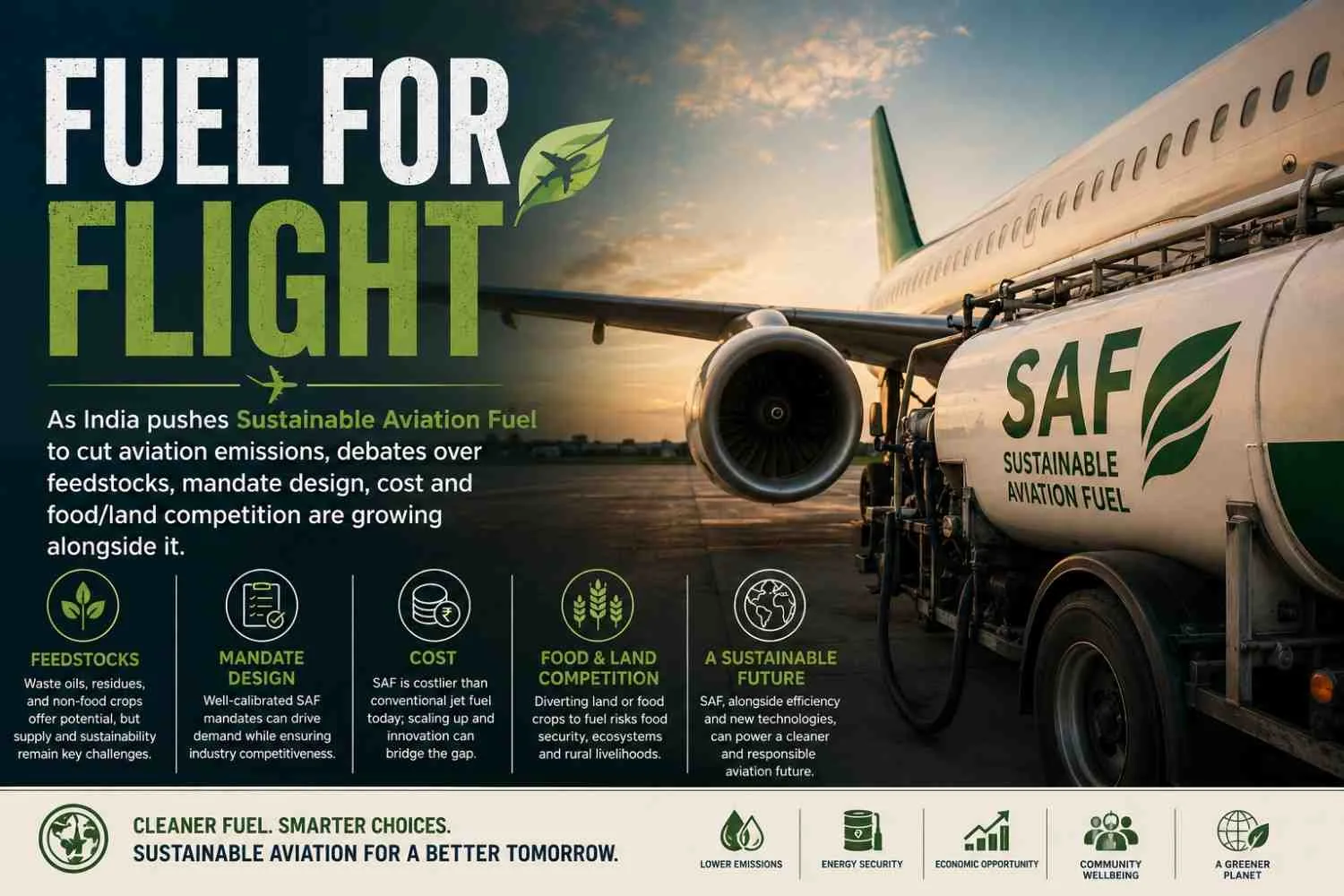
As India pushes sustainable aviation fuel to cut aviation emissions, questions over feedstocks, costs and competition for land and food are beginning to shape the debateKolkata| August 1, 2026: The future of aviation may depend not only on how aircraft are designed, but also on what powers them.Today, aviation contributes around 2–3% of global carbon dioxide emissions, and unlike road transport, long-distance flights still have limited alternatives to conventional liquid fuels. As governments and airlines look for ways to reduce emissions without disrupting air travel, Sustainable Aviation Fuel (SAF) has emerged as one of the sector's most promising solutions. For India, adopting Sustainable Aviation Fuel is not simply a question of replacing one fuel with another. It requires balancing climate ambitions with economic viability, feedstock availability and long-term sustainability. SAF is produced from renewable or waste-based feedstocks instead of conventional crude oil. Depending on the production pathway, it can substantially reduce lifecycle greenhouse gas emissions while remaining compatible with existing aircraft engines and airport infrastructure. Its compatibility with existing aircraft engines and airport infrastructure makes SAF one of the most practical and scalable solutions for reducing aviation emissions. India is gradually bringing Sustainable Aviation Fuel into the centre of its clean energy and climate strategy.Government agencies, airlines, oil marketing companies and research institutions are working to expand domestic production, support pilot projects and prepare for future blending mandates.Beyond reducing aviation emissions, these efforts are intended to strengthen energy security and help India secure a place in the emerging global SAF market. The real challenge, however, extends beyond policy ambition. It lies in ensuring a sustainable and reliable supply of feedstock that can support production on a commercial scale. Experts point to agricultural residues, used cooking oil, municipal solid waste, forestry waste and certain non-food energy crops as the most promising sources for Sustainable Aviation Fuel. Unlike food-based feedstocks, these resources can help reduce emissions without affecting food security. The challenge, however, lies in building efficient supply chains, as collecting, transporting and processing these materials remains expensive and operationally complex. The conversation becomes far more complex when cleaner fuel begins to compete with food and land resources. Using edible oils, sugar crops or fertile agricultural land as feedstocks could place additional strain on food prices, water availability and rural livelihoods. Environmental experts also warn that clearing forests or natural ecosystems to cultivate energy crops may erode many of the climate gains that Sustainable Aviation Fuel seeks to achieve. As a result, the real challenge is not simply producing cleaner aviation fuel- it is ensuring that the path to cleaner aviation does not create new environmental or social pressures along the way.  Cost remains one of the biggest hurdles for Sustainable Aviation Fuel. Production volumes are still limited, supply chains are yet to mature and, as a result, SAF continues to cost significantly more than conventional jet fuel. For airlines already operating in a highly competitive market with narrow profit margins, absorbing these additional costs will not be easy without targeted policy support and market incentives. That is why the design of future blending mandates could determine how quickly SAF moves from ambition to widespread adoption. Rather than imposing immediate large-scale adoption, many countries are introducing phased blending mandates that gradually expand the use of Sustainable Aviation Fuel while supporting domestic production and maintaining industry competitiveness. Experts argue that India will need a similar approach—one that balances climate commitments with commercial realities and gives producers, refiners and airlines the certainty and time needed to expand investments, production capacity and supporting infrastructure.Despite these challenges, experts emphasise that Sustainable Aviation Fuel is only one part of the solution. Reducing aviation emissions will also depend on more fuel-efficient aircraft, improved air traffic management, operational efficiencies and the development of future technologies such as hydrogen-powered aircraft. The future of aviation decarbonisation won’t rest on SAF alone. It will sit alongside efficiency, new aircraft, and operational changes. For India, Sustainable Aviation Fuel represents more than an alternative fuel- it offers an opportunity to reshape the future of cleaner aviation. A successful SAF ecosystem could create economic value from agricultural waste, strengthen energy security, encourage innovation and help the country move closer to its climate commitments. But lasting success will depend on ensuring that the transition protects food security, safeguards ecosystems and supports the communities that depend on them. The future of aviation will not be judged only by how much it reduces emissions, but by how responsibly it achieves that transition. Because sustainable flight truly begins long before it’s take-off - with fuel that is as sustainable in its production as it is in its purpose. Sources: International Civil Aviation Organization (ICAO) – SAF Feedstocks (CORSIA Framework)https://www.icao.int/CORSIA/feedstocksInternational Civil Aviation Organization (ICAO) – Guidance on Policy Measures for SAF Development and Deploymenthttps://www.icao.int/SAF/saf-guidance-policy-measuresInternational Civil Aviation Organization (ICAO) – SAF Rules of Thumb (Feedstocks, Costs & Production Pathways)https://www.icao.int/SAF/saf-rules-of-thumbICAO ACT-SAF Programme – India Sustainable Aviation Fuel Feasibility Studyhttps://www.icao.int/sites/default/files/environmental-protection/Documents/ACT-SAF/Feasibility_Study_India.pdfInternational Air Transport Association (IATA) – Global Feedstock Assessment for SAF Production Outlook to 2050https://www.iata.org/globalassets/iata/publications/sustainability/global-feedstock-assessment-for-saf-production-outlook-to-2050.pdfMinistry of Petroleum and Natural Gas (Government of India) – Biofuels and Sustainable Aviation Fuel policy updateshttps://mopng.gov.in/Ministry of Civil Aviation (Government of India) – Aviation sustainability initiatives and SAF developmentshttps://www.civilaviation.gov.in/NITI Aayog – Reports on biofuels, energy transition and low-carbon transporthttps://www.niti.gov.in/International Energy Agency (IEA) – Aviation and Sustainable Fuelshttps://www.iea.org/Down To Earth – Coverage on SAF, biofuels, feedstock availability and food-versus-fuel concerns in Indiahttps://www.downtoearth.org.in/ ...Read more

01 Aug 2026

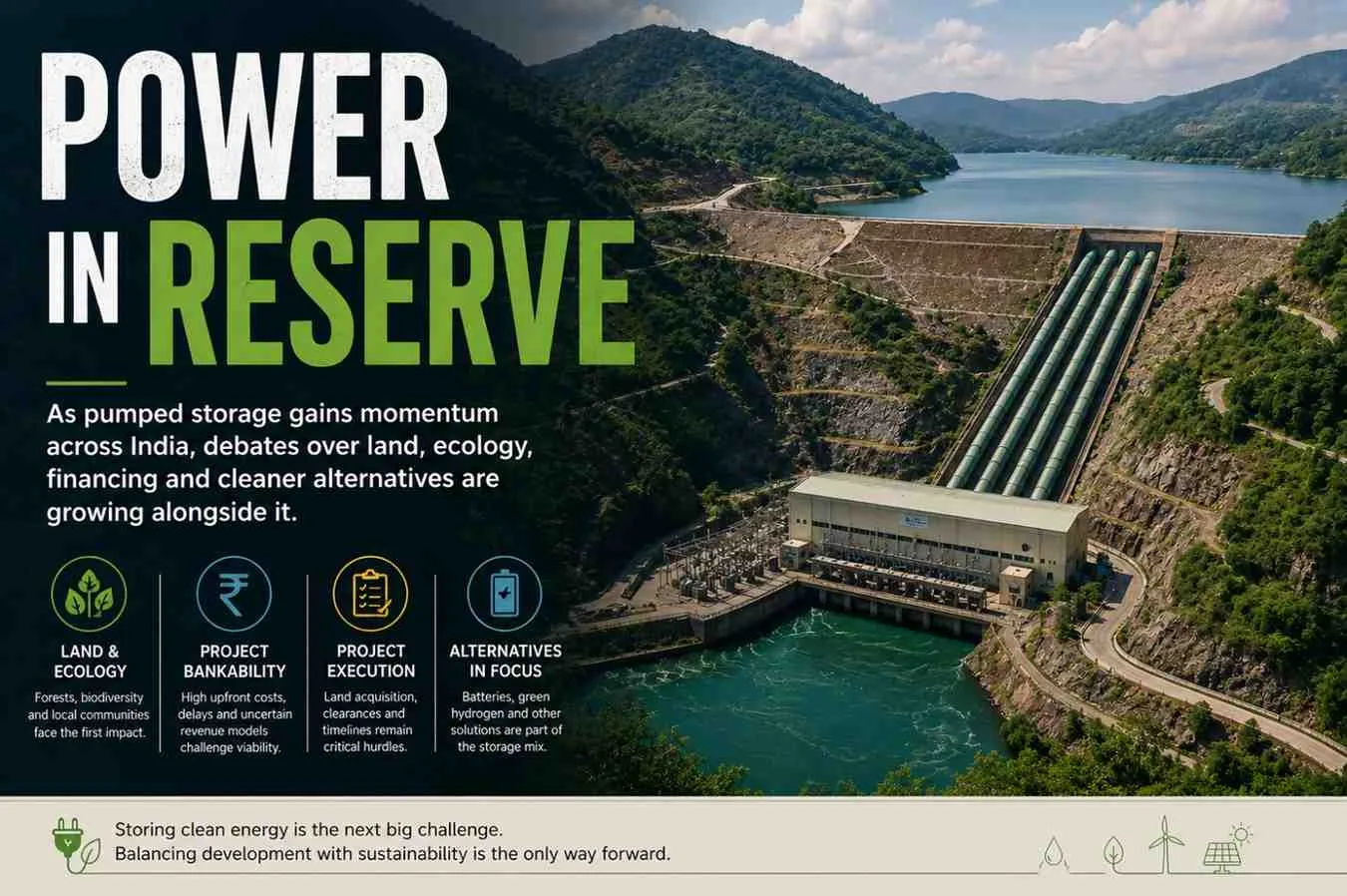
As pumped storage gains momentum across India, debates over land, ecology, financing and cleaner alternatives are growing alongside it KOLKATA | August 1, 2026: India's renewable energy capacity is expanding rapidly, but the next phase of the transition will depend on solving a critical challenge: storing clean electricity when renewable sources are not generating power. Pumped storage hydropower (PSH) has emerged as one of the country's most promising solutions and is now playing a central role in India's energy planning. However, as projects begin moving from policy announcements to on-ground development, they are also raising important questions about land, ecology, financial viability and whether alternative storage technologies can deliver the same benefits with fewer trade-offs. Pumped storage hydropower functions like a giant rechargeable battery. Surplus electricity is used to pump water from a lower reservoir to an upper one, where it is stored until demand rises. When additional power is required, the water is released back through turbines to generate electricity. Its ability to provide long-duration energy storage and stabilise the electricity grid has made pumped storage an important part of India's strategy for integrating larger amounts of solar and wind power. Pumped storage hydropower is emerging as a cornerstone of the Union government's long-term clean energy strategy. Across states such as Maharashtra, Andhra Pradesh, Madhya Pradesh, Odisha and Karnataka, a growing pipeline of projects is expected to play a vital role in integrating larger volumes of solar and wind power into the grid. Yet as development gathers pace, the conversation is expanding beyond energy storage to include questions of land, ecology, financial viability and sustainability. While pumped storage offers important benefits for the power sector, many proposed projects are located in ecologically sensitive hilly and forested areas. Developing two reservoirs often requires significant land acquisition and extensive civil works. Experts caution that large-scale construction, forest diversion and changes to natural drainage systems could have lasting impacts on biodiversity, wildlife movement and local ecosystems. In many regions, residents have also expressed concerns about displacement, water availability and the long-term effects on their livelihoods. Financial sustainability is another issue shaping the debate. The financial challenge begins long before a pumped storage project starts generating electricity. While these facilities can operate for decades with relatively low operating costs, they demand substantial upfront investment and long construction timelines. Delays in environmental clearances, land acquisition or financing can sharply increase costs and affect overall project viability. Developers also need reliable revenue mechanisms that recognise the value of energy storage and grid-balancing services, rather than compensating only for electricity generation. These constraints have led to a broader discussion on whether alternative storage technologies could offer faster or more flexible solutions.Battery Energy Storage Systems (BESS) are emerging as a promising alternative, with declining costs and faster deployment making them well suited for a wide range of energy storage applications.Yet experts believe each technology serves a different purpose. While batteries perform well for short-duration storage, pumped storage hydropower remains better suited for storing large amounts of electricity over longer periods. Other solutions, including green hydrogen and advanced battery technologies, are also making steady progress, but they are still some ways from delivering the scale and reliability needed to support India's national electricity grid. Experts argue that pumped storage and batteries should be viewed as complementary rather than competing technologies. As renewable energy expands, India's electricity system is expected to require a combination of storage solutions capable of meeting different grid requirements. At the same time, policymakers face a broader challenge. Future projects will need rigorous environmental assessments, transparent engagement with local communities, fair compensation frameworks and stronger ecological safeguards to support both sustainable development and investor confidence. As India's renewable energy capacity continues to grow, pumped storage hydropower is expected to play a defining role in keeping the power system reliable. But its legacy will not be determined by storage capacity alone. It will be defined by whether development can balance environmental responsibility, financial sustainability and public trust alongside the country's growing energy needs.In the years ahead, the clean energy transition will be judged not only by how much renewable electricity India generates, but by how responsibly it chooses to store it. Sources: Ministry of Power, Government of India – Pumped Storage Projects Guidelines & Policy Initiativeshttps://powermin.gov.in/ Central Electricity Authority (CEA) – National Electricity Plan (Volume II: Transmission & Energy Storage)https://cea.nic.in/ NITI Aayog – Energy Storage Roadmap for Indiahttps://www.niti.gov.in/ International Energy Agency (IEA) – Electricity Storage & Hydropower Analysishttps://www.iea.org/ International Hydropower Association (IHA) – Pumped Storage Hydropowerhttps://www.hydropower.org/ Central Electricity Authority (CEA) – Status of Pumped Storage Projects in Indiahttps://cea.nic.in/hydro/ Down To Earth – Reports on pumped storage projects, environmental clearances and ecological concerns in India.https://www.downtoearth.org.in/ Mongabay India – Coverage of pumped storage projects, biodiversity impacts and community concerns.https://india.mongabay.com/ The Hindu BusinessLine – Coverage on pumped storage investments, project financing and renewable integration.https://www.thehindubusinessline.com/ Ministry of Environment, Forest and Climate Change (MoEFCC) – Environmental clearance notifications and project approvals.https://moefcc.gov.in/ ...Read more

31 Jul 2026

From overseas investments to recycling and responsible mining, India's critical minerals strategy is entering a decisive phase Kolkata | July 30, 2026:Every electric vehicle, solar panel, wind turbine and battery storage system relies on a set of resources that often remain out of public view- critical minerals.    Lithium, cobalt, nickel, graphite and rare earth elements, have become indispensable to the global clean energy transition, making them strategically important today as fossil fuels were in the past. As countries accelerate efforts to decarbonise their economies, India is also strengthening its approach in securing these resources. Through overseas partnerships, investments in mineral-rich regions, domestic refining, recycling initiatives and policy reforms, the country is working to build a more resilient critical mineral supply chain. The objectives extend beyond supporting renewable energy projects. It is also about strengthening energy security, expanding domestic manufacturing and reducing dependence on imports. The urgency has grown as global competition for critical minerals continues to intensify. Much of the world's refining and processing capacity remains concentrated in a few countries, leaving supply chains vulnerable to geopolitical tensions, trade restrictions and market disruptions.In response, India is focusing on a two-pronged approach-strengthening international cooperation to secure mineral supplies while building domestic refining capacity to convert raw minerals into battery-grade materials at home.Experts say this reflects an important shift in the global conversation. Securing access to mineral deposits is no longer enough. Gradually, countries are seeking greater control over the entire value chain - from extraction and refining to manufacturing, recycling and reusing. Recycling is emerging as another key part of this transition. As electric vehicle adoption grows, used batteries and electronic waste are expected to become valuable secondary sources of lithium, cobalt and nickel. Recovering these materials can reduce pressure on fresh mining, lower environmental impacts and strengthen resource security while creating new opportunities in advanced recycling and material recovery. Although recycling alone cannot meet future demand, experts believe it will play an important role in building a more circular economy.Securing critical minerals is necessary, but far from sufficient. Mining often takes place in ecologically sensitive regions that support forests, rivers and Indigenous communities. Around the world, concerns over biodiversity loss, land acquisition, water stress and community displacement have intensified alongside expanding mineral exploration. Conservationists argue that the transition to clean energy should not come at the expense of environmental protection or local livelihoods. This has elevated responsible mining to a core priority.Experts believe every critical mineral project should include transparent environmental assessments, meaningful community consultation, fair compensation and continuous ecological monitoring. They stress on a fundamental shift: local communities must be partners in building the future, not just recipients of its consequences. The discussion reflects a broader evolution in the sustainability agenda. Climate action is no longer measured only by the number of renewable energy projects or electric vehicles on the road. It also depends on whether the resources powering these technologies are extracted responsibly, processed efficiently and managed sustainably throughout their life cycle.For India, the years ahead will determine whether industrial growth, resource security and environmental responsibility can advance together. Progress will depend not only on overseas agreements or new processing facilities, but on building a supply chain that is transparent, resilient and socially inclusive. Ultimately, the clean energy transition will be defined not just by what we build, but by how we build it. It will also be judged by the choices made long before those technologies reach consumers.   The countries that lead the future will not simply be those with the largest mineral reserves, but those that develop supply chains that are ethical, resilient and circular. For India, the real challenge is not only securing the minerals that power a greener economy, but proving that sustainable development begins with responsible decisions at every stage of the journey! The true success of the clean energy transition lies not only in its destination, but in ensuring that every step along the way is sustainable. Sources: Ministry of Mines, Government of India – National Critical Mineral Mission, policy updates and official announcements.Ministry of Mines – Critical MineralsCouncil on Energy, Environment and Water (CEEW) – Analysis on the India–US Critical Minerals Agreement, domestic processing and supply-chain resilience.India–US Critical Minerals: The Midstream Test (CEEW) Ministry of External Affairs (MEA) – Quad Critical Minerals Initiative Framework and international cooperation.Quad Critical Minerals Initiative FrameworkInternational Energy Agency (IEA) – Critical Minerals Policy Tracker covering global supply chains, recycling and responsible mineral policies.IEA Critical Minerals Policy TrackerReuters – Reporting on India's expanding critical mineral partnerships and efforts to strengthen exploration, processing and recycling.India in talks over critical minerals partnerships ...Read more

30 Jul 2026

As NCRBC 2026 approaches, the conversation is shifting from sustainability reporting to building businesses that are resilient, responsible and future-ready What if the real value of sustainability is no longer measured by the report a company publishes once a year, but by the decisions it makes every day?From managing risks and attracting investment to building customer trust and securing long-term growth, sustainability is increasingly becoming part of how businesses operate.That transformation is expected to drive discussions at the National Conference on Responsible Business Conduct (NCRBC) 2026, organised by the Indian Institute of Corporate Affairs (IICA) on 15–16 July, followed by the Business Responsibility and Sustainability Reporting (BRSR) Masterclass on 17 July.The conference comes at a time when businesses across India are under growing pressure to demonstrate that sustainability is more than a corporate commitment. Gradually, Environmental, Social and Governance (ESG) practices are moving beyond annual disclosures and becoming a core element of business strategy. Why ESG Matters Beyond BusinessESG may sound like a term reserved for corporate boardrooms, but its impact reaches far beyond them. It shapes the products people buy, the conditions in which employees work and the way businesses affect the environment and local communities. Cleaner production, ethical sourcing, responsible waste management and transparent governance, influence everyday life. Public expectations are changing as well. Consumers and investors want businesses to prove that sustainability is reflected in their actions, not just their reports. In a marketplace built on trust, companies that fail to do so risk falling behind. Why Reporting Alone Is No Longer Enough For many businesses, sustainability reporting was once viewed as a way to meet regulatory requirements. Today, it is becoming a starting point rather than the final objective. India's Business Responsibility and Sustainability Reporting (BRSR) framework has strengthened ESG disclosures, but stakeholders now expect more than transparency. Investors compare ESG performance before allocating capital, banks are incorporating sustainability risks into lending decisions, global buyers are demanding responsible sourcing, and customers are rewarding businesses that demonstrate genuine environmental and social responsibility. The result is a fundamental shift: ESG is moving from an annual reporting exercise to an integral part of business strategy, financial planning and long-term growth. What Will NCRBC 2026 Focus On? The conference is expected to bring together policymakers, corporate leaders, regulators, researchers, sustainability professionals and industry experts to discuss the future of responsible business in India. The discussions are expected to cover several key areas, including Integrating ESG into core business strategy.Strengthening Business Responsibility and Sustainability Reporting (BRSR) and its implementation.Building resilient and responsible supply chains.Advancing climate action, corporate governance and ethical leadership.Preparing businesses to adapt to evolving global sustainability standards.The Business Responsibility and Sustainability Reporting (BRSR) Masterclass, scheduled for 17 July, is also expected to help organisations strengthen their sustainability reporting while encouraging companies to use ESG information as a business planning tool rather than treating it solely as a compliance requirement. The Bigger ChallengePublishing a sustainability report may mark an important milestone, but it does not guarantee meaningful change. The real challenge lies in translating commitments into everyday business practices. Many organisations continue to struggle with collecting reliable ESG data, measuring environmental impacts, engaging suppliers and embedding sustainability across their operations. Small and medium-sized enterprises (SMEs) often face additional barriers because of limited financial resources, technical expertise and dedicated sustainability teams. Experts say that achieving broader ESG adoption will require stronger policy support, capacity-building initiatives and practical guidance, particularly for smaller businesses. They also believe that continuous monitoring will become increasingly important. Businesses will need to demonstrate measurable improvements in emissions reduction, resource efficiency, employee well-being and governance practices- not just publish sustainability reports each year. Looking AheadAs India strengthens its sustainability ambitions and keeps pace with evolving global responsible business standards, platforms like NCRBC are becoming more than places for discussion. They are helping shape a future where sustainability is no longer viewed as a corporate obligation, but as a driver of innovation, resilience and long-term growth. The true success of ESG will not be measured by the number of reports released each year. It will be measured by businesses that reduce their environmental impact, strengthen governance, build resilient supply chains and earn the trust of the communities they serve. Because the future of responsible business will not be defined by what companies say in their disclosures- it will be defined by what they change in their decisions, their operations and their culture. That is the transformation ESG is ultimately expected to deliver. Sources:Indian Institute of Corporate Affairs (IICA) – NCRBC 2026 (https://iica.nic.in/esgconference/)   NCRBC 2026 Official Conference Website (https://esgconference.iica.in/)   Press Information Bureau (PIB) – NCRBC 2026 Inaugural Press Release (https://www.pib.gov.in/PressReleasePage.aspx?PRID=2285687&lang=2&reg=48)  Press Information Bureau (PIB) – NCRBC 2026 Closing Press Release (https://www.pib.gov.in/PressReleasePage.aspx?PRID=2286148&lang=2&reg=48)   Indian Institute of Corporate Affairs (IICA) – Certified ESG Professional Programme (https://iica.nic.in/esgcsr/)   Institute of Chartered Accountants of India (ICAI) – Sustainability Reporting Standards Board (https://www.icai.org/post/sustainability-reporting-standards-board) ...Read more

30 Jul 2026

CAQM's latest inspections in Noida and Greater Noida reveal why road dust remains one of the region's biggest air pollution challenges  In Noida and Greater Noida, dust is no longer just a sign of construction- it has become part of the city's daily rhythm. It settles on vehicles, homes and streets, only to rise again as traffic moves and construction continues. For millions of residents, breathing through this haze has become an ordinary part of everyday life. For many residents, dust has become part of the daily routine. But should it also become the price of development? Fresh inspections by the Commission for Air Quality Management (CAQM) across Noida and Greater Noida suggest the answer is far from settled. Although improvements are visible in some areas, the review found that persistent gaps continue to limit the effectiveness of road dust control measures. Why Is Road Dust Under the Spotlight?Road dust is one of the most persistent sources of air pollution in Delhi-NCR. Damaged roads, construction activity, uncovered debris and constant traffic repeatedly lift fine particles into the air, adding to harmful PM10 and PM2.5 pollution.Unlike smoke from factories or exhaust from vehicles, road dust often goes unnoticed. Yet it continues to circulate with every passing vehicle.CAQM's latest inspections were intended to examine whether road-owning agencies are following dust-control norms and whether ongoing infrastructure projects are helping improve air quality instead of making it worse. A Step Forward, But the Problem Persists The inspections suggest that while progress is visible, the work is far from complete. Fully paved roads have reduced dust in some locations, but exposed shoulders, unfinished infrastructure and poorly maintained road surfaces continue to allow fine particles to spread.CAQM has asked the responsible agencies to finish pending work and treat road maintenance as a continuous responsibility rather than a one-time intervention.The message is clear: despite ongoing clean-air initiatives, road dust remains one of Delhi-NCR's most stubborn sources of pollution. The Cost of Dust Goes Beyond Dirty Roads Road dust is easy to overlook, but its impact reaches far beyond what settles on vehicles or buildings.The fine particles it releases can enter the lungs and bloodstream, increasing the risk of respiratory and cardiovascular illnesses. For children, older adults and people who work outdoors- including delivery workers, traffic police personnel, sanitation workers and street vendors- this exposure is a daily reality.When dust is left unmanaged, its effects extend beyond the roadside, reducing air quality in nearby homes, schools, parks and neighbourhoods. In that sense, controlling road dust is not only about cleaner cities- it is about protecting public health. The Real Test Comes After the Inspection Dust-control measures are not new. Mechanised sweeping, water sprinkling, paved shoulders and stricter construction norms have all been promoted as part of Delhi-NCR's clean-air efforts. Yet residents continue to encounter the same dusty roads. The question is no longer what needs to be done, but whether it is being done consistently or not. Lasting improvements will depend not just on inspections or announcements, but on effective implementation, regular monitoring and accountability long after the inspections are over. What Comes Next? Experts believe lasting improvements will come only when road dust control becomes an everyday responsibility rather than an occasional clean-air campaign. Completing road paving, expanding mechanised sweeping, regularly treating dust-prone stretches and managing construction waste more effectively can all help reduce pollution. Just as importantly, damaged roads should be repaired before they turn into permanent sources of airborne dust. Transparency is equally important Making inspection reports, action-taken reports and follow-up assessments publicly accessible would help residents understand what progress is being made while strengthening accountability among local authorities.Experts also recommend expanding green buffers along major roads, improving roadside landscaping and ensuring that construction sites consistently comply with dust-control regulations.Residents have a role to play as well. Reporting damaged roads, excessive construction dust and uncovered debris can help authorities identify pollution hotspots early and take corrective action before conditions worsen. Cleaner Roads, Healthier Cities CAQM's latest inspections serve as a reminder that cleaner air is not shaped only by what comes out of exhaust pipes or factory chimneys- it is also influenced by the condition of the roads beneath our feet.Road dust remains one of the most preventable sources of urban air pollution. With consistent maintenance, effective enforcement and long-term planning, cleaner roads can become an important step towards healthier cities. The Real Measure of Progress The challenge is no longer identifying the sources of road dust. It is ensuring that every recommendation is followed by action, every agency is held accountable and every improvement is sustained.Because the true measure of a city's progress is not just how fast it grows- but how clean and healthy it remains for the people who call it home. Here are 5 credible open-source references that align with your blog and support the information on CAQM inspections, road dust, enforcement, and air quality management. Sources:Commission for Air Quality Management (CAQM) – Official Orders, Directions & Inspection Updateshttps://caqm.nic.inMinistry of Environment, Forest and Climate Change (MoEFCC) – Air Pollution Control Policies & Environmental Regulationshttps://moef.gov.inNational Clean Air Programme (NCAP) – Government of Indiahttps://ncap.niua.orgPress Information Bureau (PIB), Government of India – Official releases on CAQM, air quality and dust mitigation initiativeshttps://pib.gov.in Central Pollution Control Board (CPCB) – Air Quality Data, PM2.5/PM10 Information & Dust Pollution Guidelineshttps://cpcb.nic.in ...Read more

29 Jul 2026

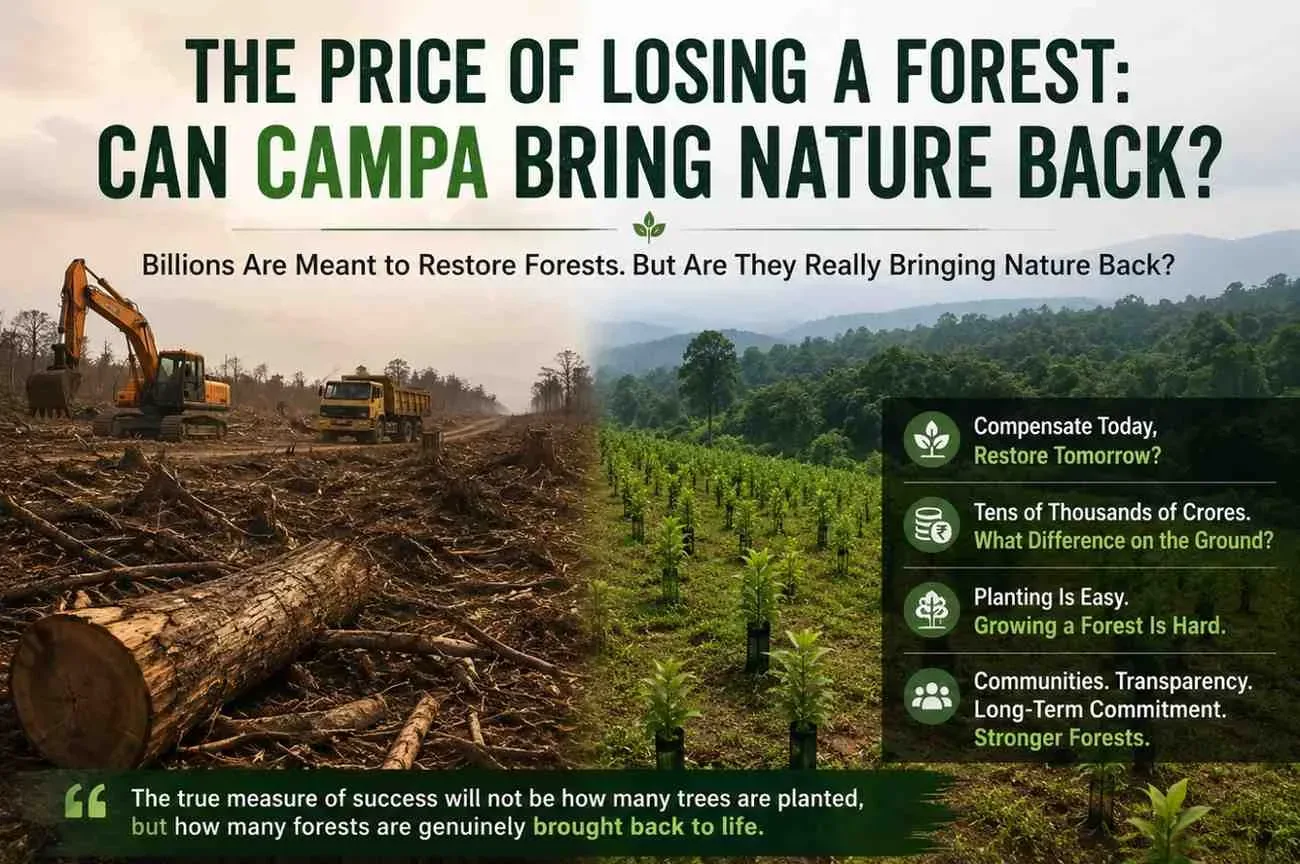
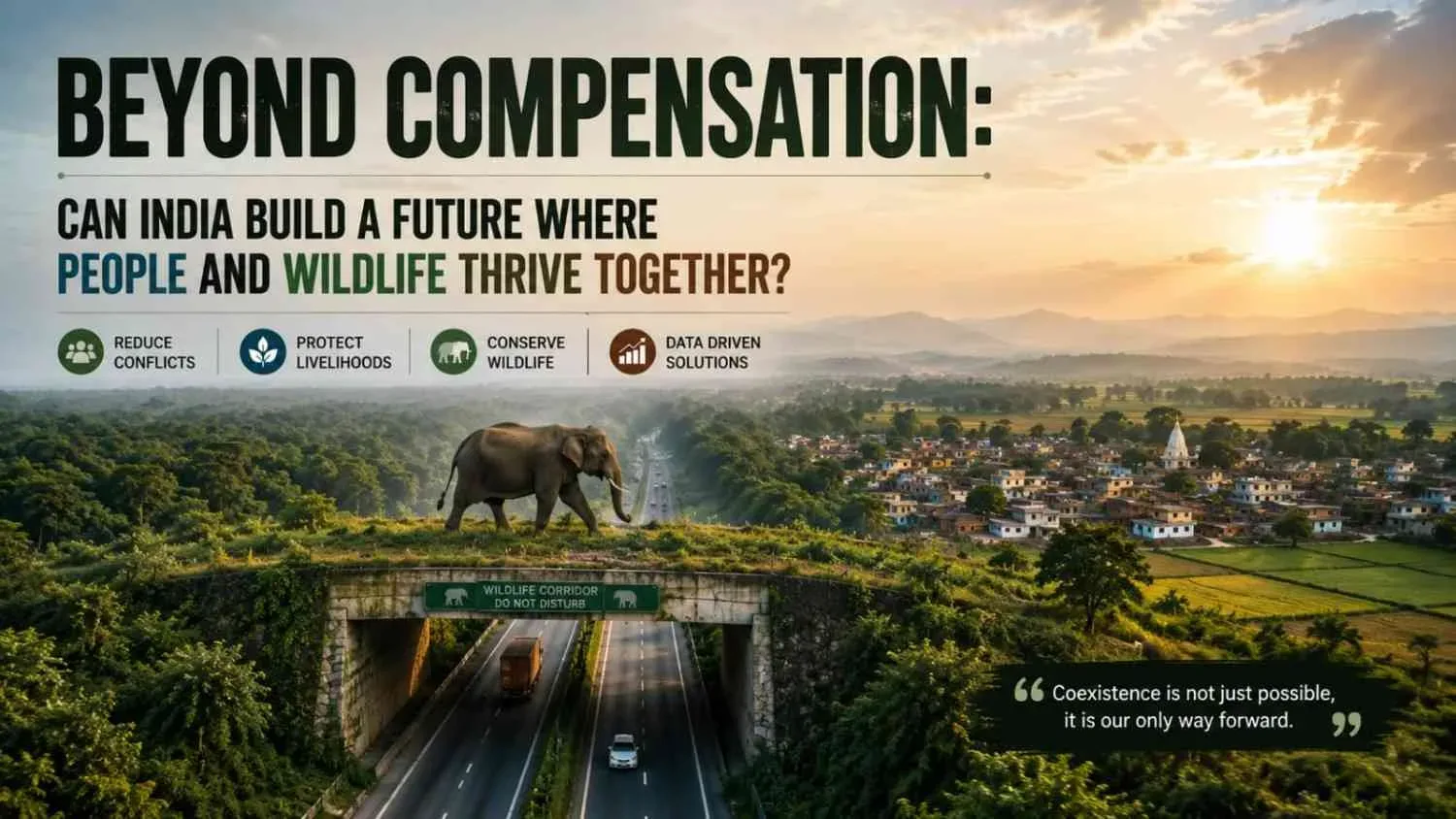
Billions Are Meant to Restore Forests. But Are They Really Bringing Nature Back?   Every time forest land is diverted for highways, railways, mines or industrial projects, developers are expected to compensate by creating forests elsewhere. On paper, the principle appears simple: replace what is lost. But the debate is no longer about whether compensation is provided- it is about whether it truly replaces what has been lost. The real test of compensatory afforestation is not the number of saplings planted, but whether lost forests are truly being restored.That question has gained renewed attention after the 10th July meeting of the National Compensatory Afforestation Fund Management and Planning Authority (CAMPA), where officials reviewed the implementation of one of India's largest ecological restoration programmes. The meeting may have focused on fund utilisation and afforestation progress, but it revived a much larger question: are CAMPA funds creating resilient forest ecosystems, or are they only measuring success through plantation numbers?  Understanding CAMPA CAMPA was created around a simple principle: when forests are lost to development, the ecological cost should be invested back into restoration. Under the mechanism, developers who divert forest land for non-forest purposes contribute funds towards rebuilding forest ecosystems elsewhere.These funds support afforestation, natural regeneration, wildlife conservation, forest protection, soil and water conservation, fire prevention and improvements in forest management infrastructure. CAMPA now represents one of India's largest environmental funding pools, with tens of thousands of crores dedicated to compensating for forest loss.The challenge, however, is not only how much money is available- it is whether that money is rebuilding forests or merely adding to plantation statistics. The Bigger Question Isn't Spending- It's Ecological Recovery Much of the attention on CAMPA revolves around fund utilisation. Rather than asking how much money has been spent, experts say the more important question is what difference those investments have made on the ground.Plantation numbers may look impressive on paper, yet forests cannot be measured by saplings alone. A healthy forest supports wildlife, stores carbon, protects water and soil, and provides livelihoods for communities that depend on it. Restoration cannot be measured by plantation numbers alone. If saplings fail to survive or diverse natural forests give way to monoculture plantations, the ecological gains may remain limited despite substantial investments. Ecologists say the conversation must move beyond how much was spent to what ecological outcomes were achieved. Planting Is Easy- Growing a Forest Is Hard One of the biggest questions surrounding compensatory afforestation is what happens after the plantation drive ends. Saplings need years of monitoring, protection and maintenance before they can grow into self-sustaining forests. Without sustained care, survival rates can fall significantly, limiting the ecological value of restoration efforts. Many environmental experts argue that public reporting should go beyond the number of saplings planted and include their survival after three, five and even ten years. Such long-term monitoring would provide a more reliable measure of whether restoration efforts are creating lasting ecological benefits. Can New Plantations Replace Natural Forests? The debate extends beyond the number of trees planted. An equally important question is whether newly created plantations can truly compensate for the loss of mature natural forests. Many researchers argue that plantation figures tell only part of the story.A natural forest is far more than a collection of trees. It develops over decades or centuries, supporting biodiversity and ecological processes that cannot be recreated overnight. Compensatory plantations, often made up of fewer species, may not fully replace these functions.That is why many conservationists argue that success should be measured by ecological restoration rather than plantation targets. Restoring degraded ecosystems, conserving existing forests and planting native species are widely considered more effective ways to rebuild resilient landscapes. Restoring Forests Requires Restoring PartnershipsForest restoration is not just an ecological exercise- it is also a community effort. Many experts argue that Indigenous communities, forest-dependent households and local residents should be treated as partners rather than participants. Their understanding of local ecosystems can improve the choice of native species, strengthen long-term management and increase plantation survival. Equally important, community involvement helps maintain accountability long after the plantation drive is over. Transparency Strengthens Accountability Many experts believe that transparency is essential to improving forest restoration. They argue that district-level information on CAMPA projects- including where funds are spent, how plantations are performing and what ecological outcomes are being achieved- should be easily accessible to the public. Greater openness would allow citizens to track progress, strengthen accountability and help governments identify restoration approaches that deliver the best results. More Than Planting TreesIndia's environmental commitments have made CAMPA a critical instrument for forest restoration. But its legacy will not be determined by financial allocations or plantation statistics alone. It will be determined by whether today's investments restore ecosystems that can withstand climate change, protect biodiversity and support future generations. In the years ahead, the true measure of success will not be how many trees are planted- it will be how many forests are genuinely brought back to life.         Sources: National Compensatory Afforestation Fund Management and Planning Authority (CAMPA) – Ministry of Environment, Forest and Climate Change (MoEFCC)https://moef.gov.in/en/division/forest-and-wildlife-division/national-campa/ Compensatory Afforestation Fund Act, 2016 (CAF Act) – Government of Indiahttps://legislative.gov.inForest Survey of India (FSI) – India State of Forest Report (ISFR)https://fsi.nic.in Down To Earth – Environment and forest restoration coverage, including CAMPA implementation and afforestation debateshttps://www.downtoearth.org ...Read more

29 Jul 2026

China's climate emergencies highlight a bigger question: Are Asian cities prepared for multiple disasters at once?  When a typhoon approaches, cities usually prepare for strong winds and heavy rain. But what happens when rivers are already overflowing before the storm even arrives? Experts say this is becoming the new reality. Instead of facing isolated disasters, countries are increasingly confronting compound events- multiple climate hazards unfolding together or in rapid succession, making their impacts far more severe and recovery more complex. China's recent climate emergencies offer a clear example of this growing challenge. Over a short span of time, several regions have experienced heavy rainfall, widespread flooding and the looming threat of typhoons. Together, these overlapping events have tested emergency response systems, disrupted transport networks, increased pressure on dams and forced thousands of people to evacuate. China's response may dominate the immediate headlines, but the larger concern reaches beyond its borders. If one of Asia's largest economies can face multiple climate disasters simultaneously, how resilient are other countries when confronted with the same threat? Across Asia, rapid urbanisation is unfolding alongside frequent climate hazards. Rising temperatures are intensifying heavy rainfall, while sea-level rise and changing weather patterns are making floods more destructive in densely populated cities.Experts say this new reality demands a shift in disaster planning- from preparing for single events to managing multiple climate risks at the same time.The challenge is no longer preparing for a single disaster in isolation. Cities are now being forced to plan for multiple hazards that can occur at the same time or trigger one another. This shift is making compound-event planning a key priority for disaster preparedness. The focus is shifting from isolated disasters to understanding how multiple hazards interact. Heavy rainfall can overwhelm drainage systems, flood roads, trigger landslides, and strain dams and reservoirs- leaving communities more vulnerable if another hazard, such as a cyclone, follows soon after. Disasters can no longer be viewed as separate emergencies, as one event often magnifies the impact of another. China's recent climate emergencies demonstrate why preparing for interconnected risks is becoming an essential part of disaster planning. Another issue moving to the forefront is dam safety.Reservoirs across Asia are vital for water storage, irrigation, hydropower and flood management.  But during extreme rainfall, operators face a difficult choice: retain more water and increase pressure on the dam, or release it quickly and risk worsening floods downstream.Experts say climate change is making these decisions more difficult, turning dam management into more than just a technical challenge.Modern dam management depends on accurate weather forecasts, river monitoring, real-time data and close coordination between multiple agencies. Strengthening these systems can help authorities act before risks escalate.The same principle applies to cities.Urban flooding is no longer caused by heavy rainfall alone. Rapid urbanisation, shrinking wetlands, expanding paved surfaces and inadequate drainage often prevent water from draining naturally, allowing intense rainfall to quickly develop into a major urban emergency. Many cities across Asia are now confronting the same challenge. Whether in China, India, Bangladesh or Southeast Asia, growing populations and expanding infrastructure are increasing exposure to climate-related risks. Experts argue that adaptation must therefore become part of everyday urban planning rather than an emergency response after disasters occur. This requires stronger drainage systems, the protection of natural flood buffers like wetlands and floodplains, more effective early-warning systems, and resilient infrastructure that can continue operating during extreme weather. Technology is becoming a powerful ally in climate adaptation. From satellite monitoring and artificial intelligence to advanced forecasting and digital flood mapping, new tools are helping authorities detect risks earlier and give communities more time to prepare. But technology cannot prevent disasters on its own. Experts say real preparedness depends on how effectively governments, engineers, emergency responders and local communities work together long before a crisis begins. For India, the lessons are particularly relevant. Recurring urban floods, powerful cyclones and rapid infrastructure expansion are increasing the country's exposure to multiple climate hazards. Experts argue that future disaster preparedness will depend not only on responding effectively to individual events but also on planning for the ways different hazards can interact. China's recent floods and typhoon threats are therefore more than a national emergency. They highlight a broader reality: climate disasters are becoming more interconnected, more complex and increasingly difficult to anticipate. China's floods and typhoon threats are more than a reminder of a changing climate- they are a reminder that the nature of disasters is changing as well. The real test of resilience will not be how well countries respond to the next disaster, but how effectively they prepare for a future where climate risks no longer arrive alone. Sources: World Meteorological Organization (WMO) – Multi-Hazard Early Warning Systems & Climate Reportshttps://wmo.intUnited Nations Office for Disaster Risk Reduction (UNDRR) – Compound Disaster Risk & Disaster Resiliencehttps://www.undrr.orgChina Meteorological Administration (CMA) – Typhoon Monitoring, Rainfall & Weather Warningshttps://www.cma.gov.cn/enReuters – Coverage of China's floods, typhoons and emergency responsehttps://www.reuters.com/world/china/ReliefWeb (OCHA) – Floods, Humanitarian Updates & Disaster Situation Reportshttps://reliefweb.int ...Read more

29 Jul 2026

A deficit monsoon that is still drowning people India's monsoon crisis of 2026 appears contradictory only from a distance. The country has received below-normal rainfall overall, farmers in several regions are confronting moisture stress, reservoirs remain worryingly depleted, and kharif sowing has fallen behind last year. Yet, at the same time, Assam has suffered one of its most damaging floods in recent years, Arunachal Pradesh has seen nearly its entire district map disrupted at once, Himalayan states are reporting landslides and blocked roads, and intense rainfall episodes are inundating cities and villages from Odisha to Uttarakhand — while Mumbai and Kolkata have each been paralysed by their own floodwaters, and Karnataka has asked farmers to simply stop sowing. By July 28, the nationwide monsoon rainfall deficit had narrowed to approximately 16 percent, after reaching nearly 40 percent at the end of June. But this apparent recovery has not come through steady, farm-friendly rain. It has largely arrived through violent, concentrated downpours separated by prolonged dry spells. This is the defining feature of the Indian monsoon of 2026: rain is falling in the wrong places, at the wrong intensity, and increasingly at the wrong time. India is not merely experiencing a weak monsoon. It is experiencing a dangerously disorganised one. Late arrival, long pause, sudden violence The southwest monsoon reached Kerala around three days later than usual. It then stalled for nearly two weeks across important agricultural regions of western and central India. June ended with a severe national rainfall shortage. The monsoon subsequently accelerated, but unevenly. Low-pressure systems and depressions delivered bursts of extreme rainfall, while large areas continued to receive substantially less rain than normal. Between June 1 and July 22, India had received 19 percent less rainfall than the long-period average. The geographical imbalance was even sharper: East and Northeast India were approximately 32 percent deficient. The southern peninsula was around 26 percent deficient. Northwest India had a deficit of about 13 percent, while central India was approximately 9 percent below normal. These regional averages conceal extraordinary local variations. A district may receive almost no meaningful rain for two weeks and then receive a month's rainfall in several hours. The monthly total may eventually approach "normal," but the agricultural, hydrological and human consequences are anything but normal. A field needs moderate rain that penetrates the soil. Instead, torrential rain often rushes away as surface runoff, eroding topsoil, flooding settlements and leaving groundwater inadequately replenished. India's two monsoons are happening together The 2026 monsoon has effectively divided India into overlapping zones of emergency. In parts of Bihar, Jharkhand, eastern Uttar Pradesh and the Gangetic agricultural belt, prolonged rainfall deficits created drought-like conditions during crucial sowing weeks. By July 10, rainfall was below normal in 397 of India's 741 districts, while the area under kharif cultivation was approximately 16 percent lower than at the corresponding point in 2025. Conditions improved later in July, but the sowing deficit did not disappear. By July 24, farmers had planted approximately 78.7 million hectares, against 82.6 million hectares a year earlier. Rice cultivation was slightly behind last year, soybean acreage was down around 3 percent, cotton acreage approximately 4 percent, and maize sowing almost 10 percent lower. Sugarcane was one of the few major crops showing an increase. Karnataka has offered the sharpest illustration of this stress in the south. The state recorded a rainfall deficit of around 30 percent up to July 11 — having received only 203 mm of rain against a normal of 292 mm — prompting Chief Minister D.K. Shivakumar to write directly to the Prime Minister seeking a central assessment team. June alone was the state's fourth-worst in fifty years, with just 116 mm of rain against a 165–190 mm normal, a 42 percent shortfall. The Malnad region, the principal catchment for the Cauvery, Tunga and Bhadra systems, recorded the state's worst deficit at 34 percent, with the coastal belt close behind at 30 percent. The Tungabhadra reservoir near Hosapete held just 9.47 TMC ft of water against 61.88 TMC ft a year earlier — an 85 percent collapse in storage that has, in comparable past seasons, forced authorities to instruct farmers in the Cauvery basin to halt further sowing altogether. At the same moment, parts of Assam and Arunachal Pradesh were underwater. This coexistence is scientifically possible because flood and drought describe different dimensions of water stress. A flood is caused by excessive rainfall or river discharge over a short period and within a particular basin. Drought reflects accumulated rainfall deficiency, reduced soil moisture, poor groundwater recharge, falling reservoir storage and agricultural stress over time. India can therefore be flooded locally while remaining rainfall-deficient nationally. Assam: an upstream deluge becomes a human disaster Assam's late-July floods exposed the terrifying speed at which a localised rainfall event can become a regional humanitarian emergency. Very heavy rainfall over neighbouring Nagaland between July 18 and July 20 generated exceptionally high river flows entering Assam. By July 23, approximately 650,000 people across 11 districts had been affected and at least 36 deaths had been reported during that phase of the disaster. The crisis subsequently expanded. At its late-July peak, reports indicated that at least 50 people had died, approximately 700,000 had been displaced, nearly 300,000 people were staying in government shelters and around 900 villages were submerged. Helicopters were used for relief drops, while police, disaster-response forces, volunteers and civil administrators conducted rescues. By July 28, Assam's cumulative flood death toll had reportedly risen to 68, while more than 445,000 people remained affected across districts including Sivasagar, Charaideo, Jorhat, Golaghat, Nagaon and Kamrup Metropolitan. These changing numbers do not represent statistical confusion. They reflect the movement of water: some areas emerge from inundation as others are submerged, displaced residents begin returning, and new deaths or missing persons are recorded. The state's flood wave first hit Dhemaji, Lakhimpur and Dibrugarh, affecting over 22,000 people and nearly 100 villages, before riverbank erosion partially collapsed a railway bridge over the Simen River at Simen Chapari, cutting off train services and isolating villages overnight. On the ground, response has been substantial: 250 NDRF personnel, 36 NDRF boats, 65 SDRF and Fire Services boats, three Indian Army boats and 82 mobilised country boats have operated around Majuli and the worst-hit districts, alongside 71 relief camps and 202 relief distribution centres. The Chief Minister's Relief Fund has directed distribution of over 4 lakh bottled water units, nearly 2 lakh biscuit packets and roughly 40,000 milk packets for infants, while Cabinet ministers have been stationed in Charaideo and Sivasagar since the floods began. Prime Minister Narendra Modi has personally reviewed relief operations and ordered a full damage assessment, even as opposition leaders have pressed for faster release of PM-CARES funds. Why does Assam flood again and again? Extreme rainfall is the immediate trigger. It is not the complete explanation. The Brahmaputra is a vast, sediment-heavy and highly dynamic river system. It receives water from intense monsoon rain, Himalayan tributaries and numerous upstream catchments. Its channels naturally shift, islands erode and floodplains absorb seasonal excess water. But human interventions have progressively reduced the landscape's capacity to live with the river. Catchment degradation and deforestation accelerate erosion. Sediment raises riverbeds and reduces channel-carrying capacity. Wetlands and natural water-retention areas are encroached upon. Roads, housing projects and commercial construction block traditional drainage channels. Urban drains are undersized, poorly connected or clogged with waste. Assam's own urban-flood planning documents acknowledge that rapid development has consumed vacant land and disrupted natural drainage. In Guwahati, the obstruction and encroachment of wetlands and beels have removed natural stormwater reservoirs, allowing even moderate rainfall to produce severe waterlogging. Embankments provide essential protection, but they can also create a false sense of permanence. When inadequately maintained embankments breach, water enters settlements with extraordinary force. Embankments may also trap rainwater inside protected areas when drainage outlets are insufficient. The result is a cycle of emergency expenditure without corresponding reduction in vulnerability. Arunachal Pradesh: the upstream disaster nobody watches closely enough If Assam is the downstream casualty, Arunachal Pradesh is where the water begins its rampage — and the state has been battered on its own terms too. In mid-July, incessant rainfall triggered flash floods in Kurung Kumey district and landslides across Pakke Kessang, West Kameng and Papum Pare districts. The State Emergency Operation Centre reported seven deaths, 29 injuries, and more than 97,000 people affected across 425 villages spanning all 26 districts of the state — nearly the entire state machinery mobilised at once. The damage inventory reads like an infrastructure ledger wiped out overnight: 150 roads damaged, 19 bridges lost, 21 culverts destroyed, 221 water supply systems disrupted, 58 government buildings hit, 156 power lines and 224 electric poles down, 10 hydel projects damaged, two hospitals and three schools affected, alongside 541.75 hectares of crop area and nearly 1,010 hectares of forest land impacted. In Kurung Kumey, flash floods from the overflowing Kumey River washed away bridges connecting the villages of Huri, Damin and Pagam; a church, an inspection bungalow, and St Thomas School in Parsi-Parlo were all damaged, halting classes. A massive landslide buried a stretch of National Highway-13 near Pakro village, and a section of the road leading to the strategically vital Sela Tunnel in West Kameng — a key route toward the China border — was washed away entirely. Downstream and around, the same monsoon has scattered damage widely: a Bailey bridge over the Phee Khola at Phidang in North Sikkim's Dzongu region was simply washed away, cutting off road connectivity, while Meghalaya's hill roads suffered fresh landslide disruptions of their own. Arunachal Pradesh illustrates, in miniature, the whole country's 2026 paradox: a state that can log both flood emergencies in its river valleys and rainfall deficits in its interior districts within the same season — sometimes the same week. The drought is hiding inside the reservoirs Flood images dominate television screens because they are immediate and dramatic. Reservoir depletion receives far less attention, although it can affect drinking water, irrigation, electricity generation and food prices for months. On July 23, the country's 166 monitored major reservoirs held approximately 70.4 billion cubic metres of water, equivalent to only about 38 percent of their combined capacity. Storage was around 36 percent lower than at the same time in 2025. More than 50 reservoirs were holding water at or below 80 percent of their normal level, while 22 were at half their normal storage or lower. Conditions were especially concerning in parts of southern India — a picture Karnataka's near-empty Tungabhadra reservoir makes vivid. This is hydrological stress, even when isolated districts are reporting floods. Much of the rain produced by cloudbursts and extreme spells runs rapidly into rivers and drains. It may cause destruction without adequately restoring groundwater or maintaining reservoir inflows. The nation receives water, but cannot retain it where and when it is needed. El Niño has disturbed the monsoon's rhythm The most prominent large-scale climate influence in 2026 is El Niño — the abnormal warming of the central and eastern equatorial Pacific Ocean. The World Meteorological Organization had assessed an approximately 80 percent probability of El Niño conditions during June–August 2026, with a very high probability that the event would continue into late autumn. By July, the India Meteorological Department reported that El Niño conditions were prevailing and strengthening, while the Indian Ocean Dipole remained neutral. El Niño often weakens India's seasonal monsoon circulation. But it does not simply switch off rainfall. It can weaken the broad flow of moisture while atmospheric disturbances, Bay of Bengal depressions, western disturbances, the movement of the monsoon trough and the Madden–Julian Oscillation still generate intense local rainfall. This year, western disturbances — normally quiet during the monsoon — have remained active and interacted directly with the monsoon current over Jammu & Kashmir and the western Himalaya, intensifying rainfall precisely where slopes are least equipped to absorb it. Research examining more than a century of observations indicates that some El Niño years can simultaneously increase the probability of seasonal rainfall deficiency and short-duration extreme rainfall over particular regions. Thus, fewer rainy days do not necessarily mean fewer disasters. They may mean that a larger proportion of the season's rain falls during a smaller number of violent events. Climate warming is loading the dice El Niño is a natural climate cycle. The background against which it now operates is no longer natural. India's average temperature increased by approximately 0.7°C between 1901 and 2018. A warmer atmosphere can hold more moisture, while rising sea-surface temperatures increase the potential supply of water vapour to monsoon systems. This produces an apparent paradox: warming can intensify both drought and flooding. Higher temperatures increase evaporation from soil, plants and reservoirs during rainless periods. But when atmospheric conditions finally trigger rain, the additional moisture can produce much heavier precipitation. The Intergovernmental Panel on Climate Change has projected increasing heavy precipitation over parts of Asia and the Himalayan region, alongside declining snow and glacier volumes. Climate change does not cause every individual flood or landslide. It multiplies the probability, intensity and consequences of extreme events occurring within already vulnerable landscapes. The Himalaya: a natural hazard turned into a construction zone The Himalaya are geologically young, steep and unstable. Their rocks are fractured, their slopes are vulnerable to erosion, and intense rain can rapidly saturate thin mountain soils. Yet natural fragility is only half the story. Road widening, uncontrolled hill cutting, blasting, hotel construction, hydropower infrastructure, poorly designed retaining walls and the dumping of excavated debris have transformed many mountain slopes. Drainage channels are frequently blocked or redirected. Buildings have expanded onto unstable slopes and river terraces without adequate geological assessment. India's Supreme Court, reviewing disaster patterns in Himachal Pradesh, has explicitly named hydroelectric power projects, four-lane road expansion, deforestation and unchecked multi-storey construction as drivers of "ecological destruction," warning that revenue "cannot be earned at the cost of the environment and ecology." India's national landslide atlas has mapped around 80,000 landslides recorded between 1998 and 2022 across 17 states and two Union Territories, and ranked 147 districts by landslide exposure. Many vulnerable corridors include major pilgrimage routes, highways and densely visited tourist centres. By July 28, rain and landslides had reportedly blocked as many as 179 roads in Himachal Pradesh, while at least 15 monsoon-related deaths had been recorded in the state. Glacial retreat compounds the risk. The Hindu Kush Himalaya region has seen glacial cover shrink 12 percent between 1990 and 2020, with a 21 percent decline in the Ganga basin alone. ISRO's Glacial Lakes Atlas has identified roughly 2,400 glacial lakes, of which 601 have doubled in size and are considered at risk of catastrophic breach. The 2023 Sikkim GLOF remains the starkest warning of what this looks like in practice: permafrost erosion triggered a landslide into South Lhonak Lake, producing a 20-metre flood surge that destroyed the Teesta-III dam, killed at least 90 people, and inundated 276 square kilometres of farmland. The 2023 Joshimath subsidence crisis and the 2025 Dharali flash flood — which buried a Himalayan village under 12–18 metres of sediment — are cut from the same cloth: tectonic stress compounded by construction, tunnelling and drainage failures that turned a natural hazard into a man-made catastrophe. The Northeast faces similar risks. Recent modelling of rain-triggered landslides in Mizoram suggests that simultaneous slope failures with little or no warning could become substantially more frequent under high-emissions warming scenarios. The study remains a modelling assessment rather than a precise forecast, but its warning is unmistakable: yesterday's engineering standards cannot be assumed to protect tomorrow's mountains. Metros drowning by design: Mumbai and Kolkata While hill states battle landslides and the Northeast battles rivers, India's two biggest western and eastern metros have spent the season proving that flooding isn't only a mountain or a river problem — it is also, unmistakably, an urban planning failure. Mumbai's stormwater drainage network was designed in the early twentieth century to handle roughly 25 mm of rainfall per hour — a fraction of what the city's monsoons now regularly deliver. The 2005 catastrophe, when the city recorded 944 mm of rain in 24 hours, was supposed to be the wake-up call; the Chitale Committee that followed recommended sweeping drainage reforms and a dedicated authority for the Mithi River. Two decades on, areas like Bandra Kurla Complex and Hindmata still flood on cue every season — 2017, 2019, 2021, 2023, 2025, and again in 2026. The city's exposure is structural and largely self-inflicted: Mumbai was built by reclaiming seven islands, leaving large portions of the metropolis below high-tide level to begin with. Its drainage outfalls discharge directly into the sea, which works fine at low tide — but when heavy rain coincides with high tide, sluice gates must be shut to stop seawater backflow, trapping rainwater inside the city with nowhere to go. Layer on decades of destroyed mangroves, blocked natural nullahs, and — as the Bombay High Court itself observed this July — citizen and civic complicity in encroaching on drains, blocking gutters, and converting footpaths and open channels into shops and parking, and you get a city whose flooding the court bluntly called "our own creation." Mumbai's open-space ratio has been measured at roughly 0.012 hectares per 1,000 people, against a desired standard of 1.67 hectares — a 140-fold shortfall that leaves almost nowhere for excess water to go except the streets. Kolkata's flooding operates on an almost identical playbook. In one recent extreme event, the city logged 252 mm of rain in seven hours — arriving at the same moment as high tide on the Hooghly, forcing the Kolkata Municipal Corporation's drainage department to shut sluice gates and trap the deluge inside the city. As Mayor Firhad Hakim put it, describing the scale of the downpour: the canals and rivers were already full, so every attempt to drain the city simply invited more water back in. The deeper story is ecological. Kolkata's eastern wetlands once functioned as the city's natural stormwater sponge — but decades of illegal landfilling along the Eastern Metropolitan Bypass have destroyed much of that buffer for construction. Combined with a colonial-era sewerage network never rebuilt for today's population density, the result is a city where a few hours of intense rain can paralyse roads, rails, the Metro, hospitals, and festival infrastructure alike. The KMC's own diagnosis has been candid: erratic weather patterns are now delivering brief, torrential downpours that simply exceed what the ageing drainage network can pump into the canals in time. In response, the corporation has begun constructing rainwater-collection reservoirs at more than 50 identified "water pocket" locations, aiming to both cut waterlogging and recharge depleting groundwater — an admission, in itself, that pumping alone can no longer keep pace with the rain. Relief is necessary. Rehabilitation must not recreate risk Governments have mobilised rescue teams, opened relief camps, distributed food and drinking water, restored communications and used helicopters in inaccessible areas. The Prime Minister and Assam's Chief Minister have reviewed the flood situation, while central assessment teams and state agencies have begun examining losses and rehabilitation needs. In Himalayan states, highway authorities have identified vulnerable locations, positioned machinery and emergency teams, and undertaken slope stabilisation, retaining-wall, drainage and erosion-control work. In Arunachal Pradesh, the State Emergency Operation Centre has coordinated restoration of roads, bridges and water systems even as damage assessments continue across all 26 districts. In Mumbai and Kolkata, municipal corporations have leaned on additional pumps, desilting drives, and new underground rainwater-storage reservoirs — tactical measures that civic officials themselves concede are stopgaps against a structurally undersized system. But relief measured only by food packets, rescue boats and compensation cheques is incomplete. Relief camps need safe water, sanitation, health surveillance, menstrual hygiene facilities, child protection, disability access and arrangements for livestock. Families losing crops, shops, fishing equipment or daily-wage employment need immediate livelihood assistance, not merely compensation for damaged houses. Rehabilitation must rebuild schools, clinics, transport links and local markets — not only physical dwellings. Most importantly, homes repeatedly destroyed by erosion or landslides should not simply be reconstructed at the same location. Stop repairing disasters. Start redesigning risk Assam already has major flood-management initiatives supported by the World Bank and the Asian Development Bank. These include institutional strengthening, better flood forecasting, embankment and river-management measures, erosion control and climate-resilient infrastructure. Their success must be judged not by money spent or embankment kilometres completed, but by lives protected, warnings delivered, evacuation time gained and repeated displacement prevented. Every major flood and landslide should trigger an independent, publicly available review examining land-use violations, wetland destruction, drainage failures, embankment maintenance, road design, debris disposal, reservoir operations and administrative response. India needs legally enforceable floodplain zoning. Urban wetlands must be mapped, protected and restored — in Guwahati's beels, Kolkata's eastern marshes and Mumbai's mangroves alike. Encroachments blocking natural watercourses cannot be regularised indefinitely and then blamed on "unprecedented rain." Each embankment should have a public asset register, pre-monsoon safety certification and clearly identified maintenance responsibility. River management must incorporate sediment and erosion control, not merely build higher walls against water. The Himalaya needs a carrying-capacity test Every road, tunnel, hydropower project, hotel cluster and township in vulnerable mountain districts should be evaluated cumulatively. A project may appear manageable in isolation. Ten projects on the same unstable slope or river valley may create an entirely different hazard. High-susceptibility zones need strict no-construction rules. Road engineering must give priority to drainage, controlled excavation, slope reinforcement and scientific disposal of debris. Pilgrimage and tourism numbers should be aligned with local carrying capacity, evacuation routes and waste-management infrastructure. Development cannot be called development when each monsoon washes it away and leaves local residents to carry the debt, debris and deaths. Forecasts must reach the last household The IMD is increasingly issuing impact-based rainfall warnings, including alerts for flash flooding, landslides, crop damage and urban inundation. During the final week of July, it warned of extremely heavy rainfall across parts of Odisha, Chhattisgarh, Madhya Pradesh and Gujarat, along with very heavy rainfall over Himalayan states. But a forecast is only as useful as the action it triggers. Warnings must be converted into local languages, cell-broadcast alerts, sirens, community announcements and pre-agreed evacuation orders. Village volunteers, schools, local health workers and elected representatives must know exactly what a red or orange warning requires them to do. Forecast accuracy cannot compensate for administrative hesitation. 2026 is not an abnormal year to be forgotten The Indian monsoon of 2026 is a warning about the future of adaptation. It demonstrates that national rainfall averages are no longer enough. Policymakers must examine rainfall intensity, dry-spell duration, soil moisture, reservoir storage, district-level crop conditions and the exposure of people living along rivers, hills and urban drains. India requires an adaptation architecture capable of responding to simultaneous scarcity and excess. Farmers need drought-resistant seeds, crop insurance that pays quickly, local water harvesting and advisories based on actual soil conditions. Cities need permeable surfaces, functioning drains and restored wetlands. Floodplains need space for rivers. Himalayan districts need enforceable geological limits. Erosion-displaced families need legal recognition, secure relocation and livelihood support. The choice is no longer between development and environmental protection. The real choice is between development that survives the monsoon and development that becomes its next casualty. India is receiving less rain than normal nationally while people are dying from too much water locally. That is not a contradiction to be explained away. It is the clearest possible signal that the climate has changed faster than the country's systems of planning, construction, agriculture and disaster governance. The rain is no longer waiting for India to adapt.   Sources referred to India Meteorological Department (IMD) — seasonal and district-wise rainfall bulletins, 2026World Meteorological Organization (WMO) — El Niño probability assessments, 2026Intergovernmental Panel on Climate Change (IPCC) — regional precipitation and glacier projectionsAssam State Disaster Management Authority / Chief Secretary review bulletins, July 2026Assam Chief Minister's Office / DRIMS (Disaster Reporting and Information Management System) bulletinsANI — "NDRF, SDRF providing special support in Assam": Union Minister Sarbananda Sonowal (July 24, 2026); "Assam flood death toll rises to 68, CM Himanta Biswa Sarma directs coordinated relief operations"Assam Tribune — "Assam plans minister-led rehabilitation in flood-hit districts after Assembly"Sentinel Assam — "Assam Chief Secretary Reviews Flood Situation, Directs Faster Relief and Restoration in Worst-Hit Districts"Asian Mirror — "Assam Floods Turn Deadly: Death Toll Reaches 62, Over 7 Lakh People Affected"The Tribune — "Kharge targets BJP over Assam floods, demands immediate PM-CARES relief"State Emergency Operation Centre (SEOC), Government of Arunachal Pradesh — disaster bulletins, July 2026India TV News — "7 killed, over 97,000 affected as heavy rains trigger landslides, flash floods in Arunachal" (July 2026)Daily Pioneer — "Fresh Floods and Landslides Hit Arunachal Pradesh, Over 97,000 Affected" (2026); "Himalayan Climate Crisis: Why India Must Rethink Mountain Development Before It's Too Late"The News Minute — "Floods and landslides batter northeast India"Union Ministry of Agriculture and Farmers Welfare — kharif sowing progress data, 2026Central Water Commission — national reservoir storage bulletins, 2026News9live — "Karnataka CM writes to PM over worsening drought after 30% rainfall deficit"; "Karnataka sees 42% June rain deficit, Tungabhadra storage drops sharply"Deccan Chronicle — "Karnataka: 'Send A Central Team...' CM Tells PM"The Hans India — "Wide deficit in southwest monsoon rainfall sparks drought concerns"Tractor For Everyone — "IMD Monsoon 2026 Forecast: Below-Normal Rains & Kharif Sowing Impact"Sunday Guardian Live — "Mumbai Monsoon Arrival 2026: Is the City Ready to Tackle Waterlogging?"Free Press Journal — "Mumbai's Flooding, 'Our Own Creation,' But Not Ours Alone" (Bombay High Court observation, July 2026)Mumbai TV — "Mumbai Monsoon 2026: Heavy Rain Floods Roads, Disrupts Traffic and Tests City's Infrastructure"India.com — "Why does Mumbai continue to face severe flooding during the monsoon despite years of infrastructure upgrades?"ETV Bharat — "KMC Will Collect Excess Rainwater To Address Inundation, Replenish Depleting Groundwater"The Federal — "What caused Kolkata floods? A near-cloudburst, outdated drainage, ecological apathy"; "Flood here, drought there: A tale of two Indias in monsoon"Millennium Post — "KMC gears up for borough-level monsoon review" (2026)Down To Earth — "India's Erratic Monsoon: Floods, Dry Spells and a 16% Rain Deficit Driven by El Niño and Global Warming"Geological Survey of India — National Landslide Susceptibility AtlasInsights on India / Drishti IAS — "Himalayan Fragility: Causes, Consequences, and the Way Ahead for Sustainable Development"; "Strengthening Himalayan Disaster Preparedness"; "Building Resilience Against Landslides"Observer Research Foundation (ORF) — "Climate Extremes and the Development Dilemma in the Himalayas"ISRO Glacial Lakes Atlas; ICIMOD Hindu Kush Himalaya assessment, 2026World Bank / Asian Development Bank — Assam flood and river-management project documentation ...Read more

28 Jul 2026

A workshop in Kolkata has sparked a larger conversation about whether restoring ecosystems can also restore livelihoods, especially for communities that have protected nature for generations. Can restoring nature also restore livelihoods? As communities revive forests, wetlands and mangroves, a new conversation is emerging around climate action, employment and long-term resilience. The discussion gained momentum following a recent climate workshop in Kolkata, where experts, researchers, community leaders and environmental practitioners explored how community-led climate action can create meaningful jobs while restoring ecosystems. While the conversations began at the local level, the ideas resonate far beyond the city.As countries invest more in climate action, a bigger opportunity is beginning to emerge. Experts believe community-led restoration can not only revive ecosystems but also create inclusive, long-term livelihoods for the people who depend on them.But an equally important question remains.Can green jobs evolve into stable, long-term careers, or will they continue to depend on short-lived projects and temporary funding? Around the world, climate action is being backed by investments in restoring nature. Whether it involves bringing forests back to life, reviving wetlands, rejuvenating urban lakes or protecting vulnerable coastlines, these efforts require skilled hands and local knowledge. Experts argue that the communities protecting these ecosystems ought to be the primary beneficiaries of the opportunities they generate.For India, this conversation is especially significant. As the country works towards expanding forest cover, restoring degraded landscapes and building climate resilience, the need for a skilled green workforce is becoming important. Experts say achieving these ambitions will depend on professionals trained in ecological restoration, biodiversity monitoring, sustainable agriculture, waste management and other nature-based solutions.Yet the workshop made one point particularly clear- green jobs cannot succeed on numbers alone. Their future will depend on skilled training, reliable career pathways and valuing the traditional knowledge that communities have passed down for generations. This made traditional ecological knowledge one of the defining themes of the discussions. For centuries, communities living closest to nature have learned how to work with it. Across India, Indigenous groups, fisherfolk, farmers and forest-dependent households have built a deep understanding of forests, wetlands, mangroves, biodiversity and changing weather through lived experience. Experts believe this traditional knowledge should play a central role in shaping restoration efforts rather than simply supporting them.Several restoration initiatives have already demonstrated the value of community participation. From mangrove conservation along India's coastlines to watershed restoration in drought-prone regions and community-managed forests across different states, these efforts show that restoration is more likely to succeed when local people are involved in planning, implementation and long-term monitoring. But training people is only the beginning! The real challenge is ensuring that green skills open the door to credible, long-term careers rather than remaining part of short-lived training programmes. Experts say the real opportunity lies in creating skills that remain valuable long after individual restoration projects are completed. Whether it is nursery management, biodiversity surveys, GIS mapping, climate-risk assessment or environmental monitoring, specialised training can help build a workforce prepared for the demands of a greener economy.They also believe stronger collaboration between governments, educational institutions, businesses and civil society organisations will be key to improving certification, creating employment opportunities and supporting continuous learning. In this transition, the private sector is expected to emerge as an equally important partner. As sustainability becomes a bigger priority for businesses, the demand for professionals who understand ecological restoration, climate resilience and environmental reporting is expected to rise. Experts believe this could create meaningful career opportunities for young people while helping India build a greener and more resilient economy.One message echoed throughout the workshop: green jobs should be valued not just for the number of people they employ, but for the livelihoods they sustain. Fair wages, long-term income security, safe working conditions and genuine community participation will decide whether restoration efforts create lasting change or simply fade with project funding. Ultimately, the discussions in Kolkata pointed to a much larger truth- building a greener future does not require choosing between climate action and economic development. A greener future will require both to move forward as one.Every restored forest, wetland, river and coastline represents more than an environmental success- it is an investment in the future of both people and nature. The real task now is ensuring that the opportunities created are inclusive, credible and long-lasting. As countries invest more in climate solutions, the focus must shift from counting projects to creating lasting opportunities for the people leading them. Building a resilient economy will require communities to be recognised not just as participants, but as long-term partners in the journey. Because if restoring nature is about protecting tomorrow, it should also help secure the livelihoods of those shaping that future today!   Sources:International Labour Organization (ILO) – Green Jobs Programme   United Nations Environment Programme (UNEP)   United Nations Development Programme (UNDP)  UN Decade on Ecosystem Restoration (2021–2030)  Ministry of Environment, Forest and Climate Change (MoEFCC), Government of India  Ministry of Skill Development and Entrepreneurship (MSDE), Government of India  National Skill Development Corporation (NSDC)  Green Skill Development Programme (GSDP), MoEFCC   National Mission for Green India   National Biodiversity Authority (NBA)   Wildlife Institute of India (WII) ...Read more

27 Jul 2026

As human-wildlife encounters become more common, the focus is shifting from compensation to prevention. But is India prepared for that change?   For many communities across India, coexisting with wildlife is becoming more challenging.A single night can see elephants destroy standing crops, leopards attacking livestock, crocodiles disrupting fishing activities, or tigers venturing closer to villages. For families who live off the land and water, one encounter can change everything. These incidents are becoming increasingly common rather than being exceptional.Across India, human-wildlife conflict is emerging as a persistent challenge, with consequences for people's lives, livelihoods, and the long-term protection of wildlife. For decades, managing human-wildlife conflict has largely meant responding after the damage is done. Forest officials assess losses, eligible claims are compensated, and affected families receive financial assistance.  Typical Compensation process followed by Indian states: Conflict Occurs       ↓ Incident Reported (Within 24 hours)       ↓ Forest Department Verification (2–7 days)       ↓ Damage Assessment (7–15 days)       ↓ Approval by Competent Authority       ↓ Compensation Released     Stage                                 Typical Timeline   Reporting                             Within 24 hours Field Verification                        2–7 days Damage Assessment                 7–15 days Approval                                Varies by State Payment                               As per State Rules Conservationists, however, argue that the focus must now shift from reacting to preventing conflicts before they occur. The conversation is now shifting towards a more important question.As human-wildlife conflicts become more frequent, the key question is no longer just how to compensate losses, but how to prevent them from happening in the first place. The discussion comes as India's wildlife conservation efforts continue to show results. Stronger protection, expanding protected areas, and stricter wildlife laws have helped several flagship species recover. But conservation success has also highlighted a growing challenge. As roads, railways, industries, farms, and settlements continue to fragment natural habitats, the boundaries between human settlements and wildlife habitats continue to blur, thus, encounters between people and wild animals are becoming more frequent. The growing interaction between people and wildlife is transforming the challenge from an environmental concern into a broader societal issue.The issue now spans environmental, social, economic, and governance domains, that demands coordinated action.The consequences extend far beyond the immediate incident. Farmers who lose crops to elephants often face prolonged financial hardship, while families whose livestock is killed by predators can experience reduced income and greater food insecurity. Fatal encounters leave lasting emotional scars and may weaken public support for wildlife conservation. Wildlife is also affected, with animals involved in repeated conflicts often facing injury, relocation and even death. In many instances, both people and wildlife are paying the price for the same pressures on shared landscapes. The more important question, then, is not just how conflicts are managed, but what meaningful success should look like. Perhaps the better measure of success is not how much compensation is paid each year, but whether human–wildlife conflicts become less frequent, communities feel safer, and wildlife populations continue to thrive. Many conservation experts believe lasting progress will come from preventing human-wildlife conflict rather than simply compensating for its consequences. But making that shift will require more than additional funding - it will demand stronger planning, better coordination, and long-term commitment. Achieving that shift will require better planning, stronger data, and closer collaboration between governments, scientists, and local communities. The challenge is that human-wildlife conflict is rarely caused by a single factor, making long-term solutions far more complex. The causes often vary from one region to another. In some areas, elephants move through villages after traditional migration routes are disrupted by highways or expanding farmland. In others, leopards are drawn into settlements by the easy availability of stray animals as prey. Crocodiles may also be seen more often near fishing communities as wetlands shrink and changing water-use patterns alter their habitats. Every landscape has its own mix of ecological and human pressures.Relying on a single compensation mechanism for all incidents may offer short-term relief, but it does little to resolve the conditions that allow these conflicts to persist.This is where real data beats paperwork!Thousands of humans-wildlife conflict incidents are reported across India each year. But experts say documenting these incidents are no longer enough. Experts say equal attention should be given to identifying recurring conflict areas, understanding the species involved, tracking where incidents are most frequent, and evaluating whether current strategies are working or not. Without this level of understanding, authorities often remain focused on responding to conflicts instead of preventing them. This is why many researchers are calling for stronger national systems to monitor and analyse human-wildlife conflict. A modern human-wildlife conflict portal could become far better than a system for recording compensation claims.If used effectively, it could identify emerging hotspots, monitor patterns across states, and help governments take preventive actions before conflicts escalate. The next question, however, is whether such information will be translated into action. Another key question is whether district-level information on human-wildlife conflict incidents and compensation payments will be made publicly accessible. Transparency matters because reliable data not only improves accountability but also helps shape more effective policies.Recurring conflict patterns can help shape more effective responses. Districts that repeatedly experience elephant-related crop damage may need greater investment in early warning systems instead of relying mainly on seasonal compensation. Similarly, an increase in leopard attacks near expanding urban areas may point to the need for improved waste management, better control of stray animal populations, and more informed land-use planning rather than treating each incident as an isolated event. Reliable public datasets can strengthen both transparency and accountability. They enable researchers to identify long-term trends, allow civil society organisations to assess the effectiveness of government interventions, and help local communities anticipate seasonal risks and prepare more effectively. Without transparent and accessible data, discussions often rely on individual incidents rather than long-term evidence. Another important challenge is determining what should be recognised as human-wildlife conflict.  Should official records include only reported cases, or also repeated crop damage that goes unreported because compensation is delayed or the claims process is too complex? Should indirect economic losses be considered?And whose experiences are ultimately reflected in official data? These questions may appear technical, but they have a direct impact on how governments understand and respond to human-wildlife conflict. When reporting systems fail to capture the full picture, the challenges faced by affected community remains underestimated. That is why experts argue that strengthening conflict data is not just a technological exercise, it is also about building trust between governments, researchers, and the communities living with wildlife. When communities trust that reporting systems are transparent, accessible, and fair, they are more likely to see themselves as partners in conservation rather than as people carrying its costs. Strengthening that trust will be critical as India's changing landscapes continue to redefine how people and wildlife share space. Highways, railway corridors, power transmission lines, and expanding urban settlements are rapidly transforming landscapes across India. While these projects are vital for economic development, they are also reshaping habitats that wildlife has relied on for generations. The conversation has therefore moved beyond choosing between development and conservation. The greater challenge is ensuring that growth is planned in a way that allows people and wildlife to share landscapes more safely. Making this shift will require moving from a reactive approach to a preventive one- supported by stronger planning, reliable data, and informed policy decisions!   Compensation may ease the impact of conflict, but it does not eliminate the causes behind it. That is why conservation experts are increasingly advocating a prevention-first approach. While financial assistance remains essential for families affected by wildlife-related losses, they argue that long-term success depends on reducing the number of conflicts in the first place. This means shifting attention from reacting to incidents towards identifying risks early and preventing them through better planning and management. They believe, the future of human-wildlife conservation, will not depend on how much compensation is paid, but on how many conflicts are prevented. A prevention-first approach is already beginning to shape conservation efforts across India. In several landscapes, communities, forest departments, and researchers are working together to reduce the risk of conflict while promoting safer coexistence between people and wildlife. Some of the strongest lessons from this approach are emerging from India's elephant landscapes. Elephants are among India's most wide-ranging mammals, relying on seasonal migration routes that have connected forests for centuries. Today, many of these natural corridors are being fragmented by expanding agriculture, highways, railway lines, mining projects, and growing settlements. As these pathways disappear, elephants are increasingly forced to move through villages while searching for food or travelling between isolated forest patches. The outcome is often repeated crop damage and, in some cases, dangerous encounters between elephant herds and nearby communities. Rather than responding only after losses occur, several states are investing in prevention. In parts of Odisha, West Bengal, and Karnataka, forest departments and local volunteers monitor elephant movements and issue advance warnings through SMS alerts, WhatsApp groups, public announcement systems, and watch towers, giving communities time to prepare before herds reach their villages. While these systems cannot prevent every incident, they demonstrate the value of acting before conflict occurs.In many situations, timely information can be more effective than responding after the damage is done. Advance warnings give farmers time to avoid entering fields at night, move livestock to safer areas, and reduce the risk of dangerous encounters with elephant herds. Technology is becoming an increasingly important part of human-wildlife conflict management. GPS collars, drones, thermal cameras, and satellite mapping are helping forest departments track wildlife movements more accurately, while artificial intelligence is beginning to identify patterns that could help predict future conflict hotspots.However, experts believe technology works best as part of a broader strategy rather than as a solution on its own.Without effective planning, community participation, and timely action on the ground, even the most advanced tools cannot prevent conflict on their own. Technology can strengthen conservation efforts, but it cannot replace the knowledge and decisions of the people who share landscapes with wildlife.That is why local communities remain at the centre of effective conservation. For generations, Indigenous communities and forest-dependent villages have observed wildlife behaviour through everyday experience, building knowledge that predates modern scientific monitoring. Many understand when elephants are likely to migrate, which streams tigers frequently use, and how shifts in weather can influence the movement of wildlife. Researchers increasingly argue that successful conservation depends not only on scientific knowledge but also on the experience of the communities that have shared these landscapes with wildlife for generations.Instead of treating local communities simply as recipients of compensation, conservation programmes can benefit from involving them as partners in planning, monitoring, and decision-making. Communities that feel heard and included are often more willing to support conservation efforts, while those who feel excluded may become less confident in wildlife protection policies. The value of this partnership is becoming equally prominent in India's tiger landscapes. India is now home to the world's largest wild tiger population, marking a significant conservation success. At the same time, recovering tiger populations are ranging beyond protected reserves into surrounding forests, buffer zones, and agricultural landscapes. This has made the protection of wildlife corridors more important than ever. These natural pathways allow tigers and other species to move safely between forests. When corridors are disrupted or disappear, animals are more likely to cross roads, railway lines, and human settlements, increasing the risk of conflict. Protecting these corridors therefore supports both wildlife conservation and human safety. Well-connected landscapes allow wildlife to move naturally between habitats, reducing the need for animals to pass through villages in search of food or new territories.Although the importance of wildlife corridors is now widely recognised, many continue to come under pressure from expanding infrastructure.  Wildlife Corridors and Infrastructure Risks  Linear Infrastructure                   Impact on Wildlife                  Recommended Mitigation   Highways                                    Blocks animal movement                    Wildlife overpasses & underpasses Railways                                            Animal collisions                        Underpasses, fencing, speed restrictions Canals                                            Animals trapped                               Escape ramps Transmission Lines                Habitat Fragmentation                            Careful route planning Expanding Settlements                   Corridor loss                               Buffer zones and corridor protectionHighways improve connectivity for people but can restrict the movement of animals. Railway lines support trade and transport, yet poorly planned crossings may increase wildlife deaths. Transmission lines, canals, and industrial development further divide habitats that were once connected. The challenge extends beyond building infrastructure- it is about planning it responsibly. Many conservation scientists argue that potential impacts on wildlife should be identified and disclosed before construction begins, allowing risks to be reduced through better design and mitigation measures. Experts argue that Environmental Impact Assessments should place greater emphasis on wildlife movement, habitat connectivity and long-term conflict risks. Where development cannot be avoided, measures such as wildlife crossings, underpasses, overpasses and fencing should become a standard part of project design. Several projects across India have shown that these interventions allow animals to move safely while reducing collisions with vehicles and trains.  Preventing conflict through better planning is often more effective and less costly than addressing it later! Leopard landscapes offer another important lesson. Their ability to survive in forests, farms and urban areas has increased interactions with people. In parts of Maharashtra, forest departments now rely on rapid-response teams that assess situations, manage crowds and prevent unnecessary capture or relocation. Experts say this reflects a broader shift in conservation, where not every wildlife sighting is treated as a crisis. In many cases, informed management and public awareness are more effective than immediate intervention. Simple practices such as securing livestock at night, managing waste responsibly and avoiding crowds around wildlife can significantly reduce risks. A similar approach is evident in India's crocodile habitats. In Gujarat and several other states, crocodiles share rivers, reservoirs and wetlands with nearby communities. Although these encounters receive less attention than conflicts involving elephants or big cats, they highlight the same challenge- coexistence depends on understanding wildlife behaviour rather than reacting out of fear. Awareness programmes promoting safe fishing practices, avoiding nesting areas during breeding seasons and recognising crocodile habitats have helped reduce incidents while protecting wildlife.Across elephant corridors, tiger landscapes, leopard habitats and crocodile wetlands, one message remains clear: the most effective conservation strategies begin not with compensation, but with understanding landscapes and preventing conflict before it occurs.  As conversations around coexistence evolve, another issue is becoming increasingly important- data. Thousands of wildlife-conflict incidents involving crop damage, livestock loss, property destruction and human casualties are reported across India every year. Yet experts say the country still lacks a clear understanding of where conflicts occur most often, which species cause the greatest losses and whether existing prevention measures are actually working. Although many states maintain their own reporting systems, differences in formats and limited public access make nationwide analysis difficult. Researchers therefore argue that India needs a transparent, standardised wildlife-conflict database that goes beyond recording compensation claims. Such a system could identify recurring hotspots, track seasonal patterns and help governments prioritise prevention instead of responding only after incidents occur.   Dataset PurposeIncident IDUnique record for each conflictDate & Time   Identify seasonal and temporal patternsDistrict & State Locate conflict hotspotsGPS Coordinates Precise mapping of incidentsSpecies Involved Elephant, Tiger, Leopard, Crocodile, etc.Type of Conflict Crop damage, livestock loss, property damage, human injury/deathCompensation Claimed  Amount requestedCompensation PaidAmount disbursedClaim Processing Time Days taken for settlementPreventive Measures Used  Fencing, SMS alerts, watch towers, etc.Incident StatusPending / Verified / Resolved However, better data also depends on deciding what counts as human–wildlife conflict. Many crop losses, livestock attacks and indirect livelihood impacts go unreported because compensation is delayed, difficult to claim or considered insufficient. As a result, official records often underestimate the true burden on affected communities.This is more than a data challenge- it is a question of trust!Communities are more likely to support conservation when reporting systems are transparent, accessible and fair. Inconsistent compensation or lengthy procedures can weaken confidence in both authorities and wildlife protection programmes. Experts therefore argue that improving compensation is important, but making it faster, more transparent and consistent is even more critical. At the same time, compensation alone cannot address repeated losses, fear or declining livelihoods. This has shifted the focus from how much people should be compensated to how conflicts can be prevented altogether. That shift also places greater emphasis on infrastructure planning. As highways, railways, renewable energy projects and industrial development expand, experts believe wildlife movement should be considered before construction begins. Measures such as wildlife crossings, underpasses, canopy bridges and connected corridors can reduce conflict while allowing development and conservation to progress together. Community participation is equally important. Local residents often possess detailed knowledge of wildlife movement and seasonal behaviour, making them valuable partners in conservation rather than passive recipients of compensation. Many successful initiatives now rely on village committees, community volunteers and rapid-response networks to strengthen coexistence. International experience reinforces the same lesson. Community-led conservation in Africa, wildlife crossings in Europe and digital monitoring systems in other regions all demonstrate that preventing conflict is more effective than responding after it has escalated.India's success in protecting tigers, elephants, rhinos, crocodiles and other wildlife mark a major conservation achievement. The next challenge is ensuring that people and wildlife can safely share the landscapes beyond protected areas. Achieving this will require better planning, stronger scientific monitoring, greater recognition of traditional ecological knowledge, fairer compensation and meaningful community participation. Ultimately, the future of conservation will depend not only on protecting wildlife, but on creating landscapes where both people and nature can thrive together!   Sources:  Ministry of Environment, Forest and Climate Change (MoEFCC), Government of India  National Tiger Conservation Authority (NTCA)  Wildlife Institute of India (WII)  National Board for Wildlife (NBWL)  Project Elephant, Ministry of Environment, Forest and Climate Change  National Biodiversity Authority (NBA)  Forest Survey of India (FSI)  State Forest Department reports (Odisha, Karnataka, Maharashtra, Gujarat, Madhya Pradesh and West Bengal)  National Wildlife Action Plan (2017–2031)  Wildlife Protection Act, 1972 (as amended)  IUCN (International Union for Conservation of Nature)  WWF-India   Open-source research papers on human-wildlife conflict, wildlife corridors and coexistence strategies  Peer-reviewed journals including Biological Conservation, Conservation Biology, People and Nature and Frontiers in Conservation Science ...Read more