
Magazine analysis | 12 September 2026
| The New Delhi BRICS summit carries the weight of a changing global order, but deep divisions over money, war, China, the West and strategic direction limit what the bloc can actually deliver. This magazine analysis examines whether BRICS can turn its growing influence into meaningful institutional power—or remain a powerful symbol with modest results. |
| Summary The 2026 BRICS summit in New Delhi brings together an increasingly influential but deeply divided grouping seeking a greater voice for the Global South. While BRICS has built institutions such as the New Development Bank and expanded cooperation across finance, health, education and development, its members remain divided over the dollar, wars, China, sanctions and the bloc's future direction. The article examines why a common BRICS currency remains unlikely and why more practical steps such as local-currency settlements and payment interoperability are more realistic. It also explores the tensions between India and China, the impact of Trump's tariff pressure and the difficulty of building EU-style institutional integration across such diverse economies and political systems. For India, the summit offers an opportunity to strengthen strategic autonomy and global influence, but bilateral diplomacy should not be mistaken for collective BRICS progress. The analysis concludes that BRICS is too important to dismiss but too divided to lead, making measurable delivery—not summit spectacle—the real test of its future. |
Keywords BRICS 2026, BRICS Summit New Delhi, BRICS India, Global South, multipolar world, BRICS currency, New Development Bank, India China relations, global geopolitics |
Can a bloc that cannot agree on money, war or strategic direction still reshape the world order?
The New Delhi summit can be a spectacular diplomatic event and still produce a modest collective result. BRICS has real weight, a real development bank and a legitimate Global South grievance. But its members remain divided over the dollar, Ukraine, West Asia, China, the United States and even the meaning of the bloc itself.
The summit arrives with more weight than cohesion
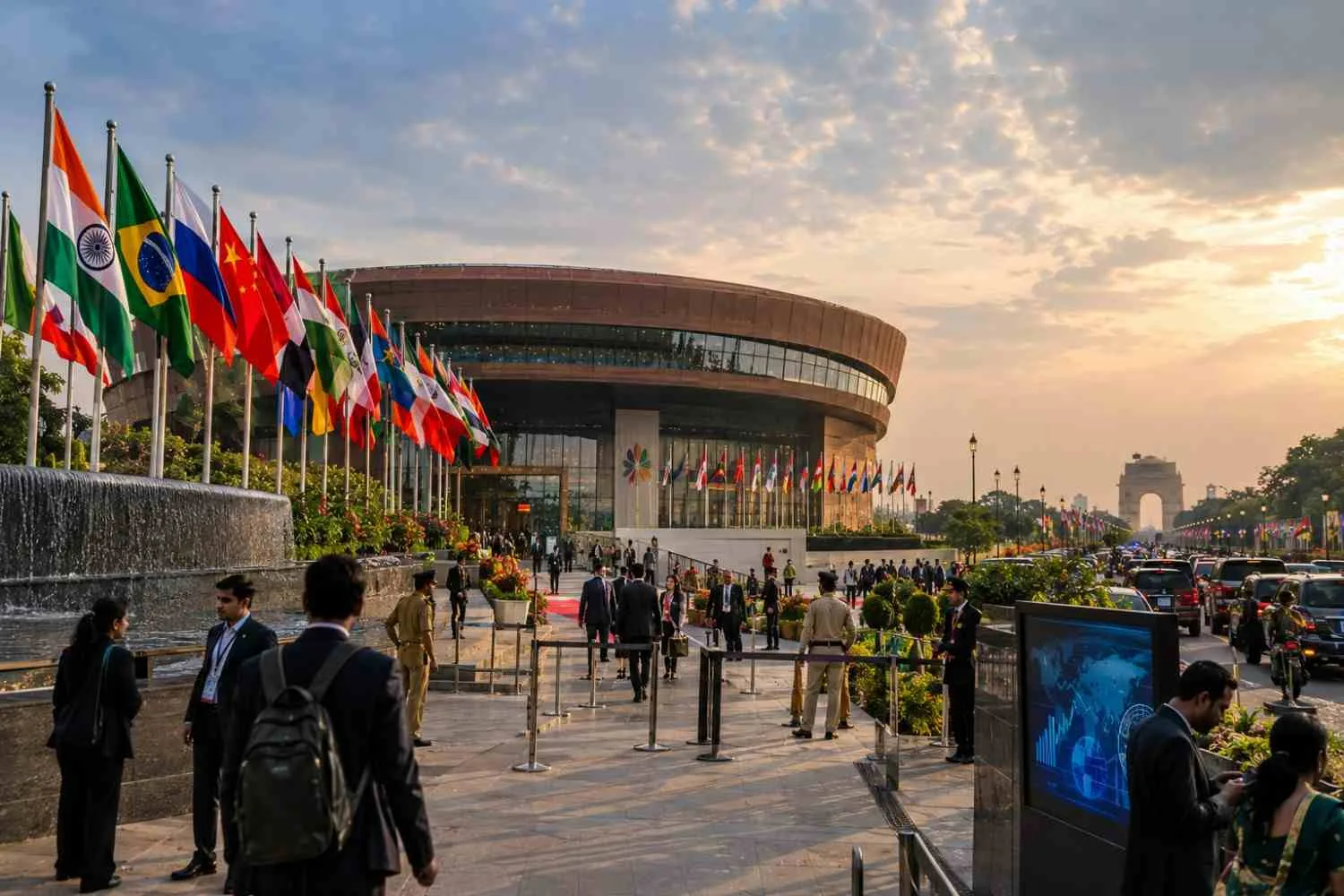
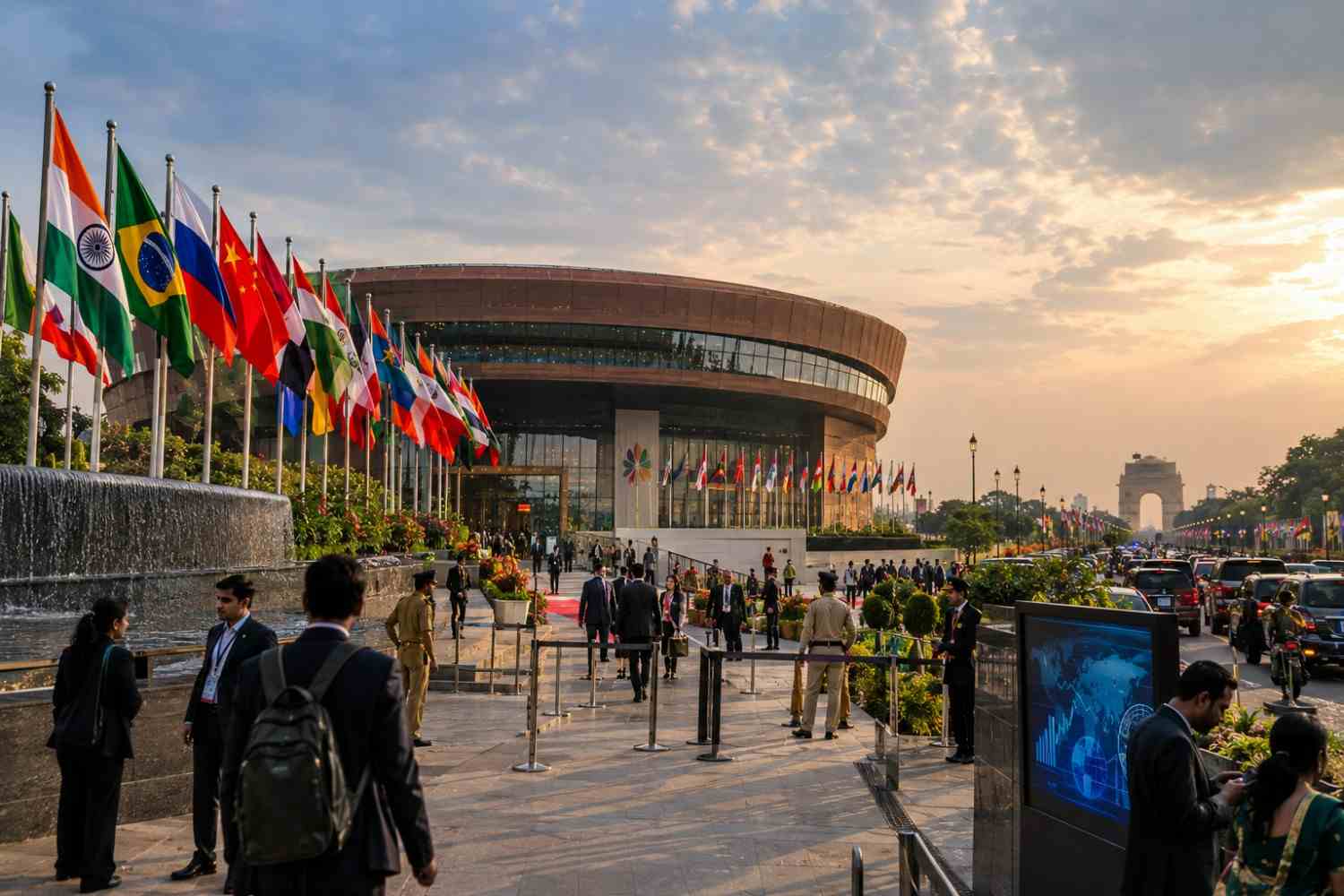
Delhi is being dressed as the capital of a changing world. Central roads are restricted, security cordons thicken around Bharat Mandapam, and the flags of the expanded BRICS are arranged to make a visual argument before the leaders make a political one. The 18th summit, on 12 and 13 September 2026, is being sold under the theme Building for Resilience Innovation Cooperation and Sustainability. The language is broad because the contradictions are broad. A group that includes China and India, Russia and Brazil, Iran and the United Arab Emirates, and countries that depend on Washington even while criticising it needs a vocabulary capacious enough to contain disagreement. [1]
The honest forecast is therefore double-edged. The New Delhi meeting can be high-octane as theatre, as a diplomatic marketplace and as a sequence of bilateral encounters. It is much less likely to be high-impact as a collective act. BRICS is not meaningless. It is a significant bargaining platform, a symbol of Global South agency and the home of a real development bank. But its aggregate weight has not become strategic cohesion. The group is large enough to matter and divided enough to disappoint.
India's official chairship material counts eleven members, including Saudi Arabia, and says the group represents 49.5 per cent of the world's population, about 40 per cent of global GDP and 26 per cent of global trade. Reuters has noted that Saudi Arabia was invited but had not formally accepted the invitation. That discrepancy is not a footnote; it is an early lesson in BRICS' institutional looseness. Even the question of who is fully inside the room can carry different answers. [1][3]
Born as an acronym became a grievance
BRICS began as an investment forecast, not a treaty. In 2001, Goldman Sachs economist Jim O'Neill coined BRIC to describe Brazil, Russia, India and China as economies whose growth could reshape the global balance. Governments then turned the acronym into a summit process in 2009; South Africa joined in 2010-11, and Egypt, Ethiopia, Iran and the UAE entered in 2024, followed by Indonesia in 2025. Expansion has made the platform more representative of the non-Western world, even as it has made consensus harder. [1][3]
The original grievance remains legitimate. The International Monetary Fund, World Bank and UN Security Council still carry institutional arrangements designed for a post-1945 distribution of power. Emerging economies want a greater voice, cheaper and more flexible development finance, less vulnerability to sanctions and a say in the rules governing trade, technology, energy and climate. BRICS gives that grievance a diplomatic address. Its importance lies partly in the fact that a country can enter the room without having to choose between Washington and Beijing.
That is why dismissing BRICS as mere anti-Americanism is analytically lazy. Yet treating it as an embryonic world government is equally misleading. Its members want a less Western-dominated system, but they do not agree on the architecture that should replace it. Russia wants a shield against sanctions and a counterweight to the West. China sees a long-term opportunity to rebalance global power. India and Brazil prefer reform without an anti-Western crusade. The Gulf states want options, not rupture. The same word multipolarity hides several incompatible projects.
One bank many declarations
BRICS has built more than its harshest critics admit. The New Development Bank is its clearest institutional achievement. Established in 2015, it finances infrastructure and sustainable development projects in emerging markets. Its own current figures show 139 approved projects and about 42.9 billion dollars in approved financing, covering clean energy, water, transport, housing and digital infrastructure. [4] The Contingent Reserve Arrangement also offers a potential liquidity backstop, while working groups have sustained cooperation in health, agriculture, science, education, culture and counter-terrorism.
But one functioning bank cannot carry the rhetorical weight of an alternative order. The NDB is still small beside the World Bank, the Asian Development Bank and the immense financing needs of its members. Its exposure to sanctions and compliance constraints, especially around Russia, shows that BRICS institutions still operate inside the financial system they seek to diversify. A bank can lend in local currencies; it cannot by itself manufacture trust, liquidity or a new reserve asset.
The deeper weakness is institutional. BRICS has no constitutive treaty, permanent secretariat with independent authority, common market, free-trade agreement, parliament, court or enforcement mechanism. It rotates the chair, generates ministerial tracks and relies on consensus. Declarations are politically useful but not legally binding. The model is flexible enough to keep rivals together, but too loose to compel delivery. The result is a familiar cycle: a grand communique, a working group, a pilot project and then a quiet transfer of attention to the next chair.
The question is not whether meetings have happened. More than 350 meetings and high-level engagements across 25 Indian cities during the 2026 chairship are evidence of activity. The question is whether activity changes behaviour. A group can be busy without becoming powerful. [1]
The currency mirage
The common BRICS currency is the bloc's most marketable fantasy and its least feasible project. A shared currency is not a coloured note or a digital token. It requires monetary coordination, exchange-rate discipline, capital-account rules, fiscal arrangements, a lender of last resort, a mechanism for settling trade imbalances and enough political trust to accept painful adjustment when economies diverge. The euro took decades of legal and economic integration, and even Europe has struggled with the consequences of one monetary policy applied to different economies.
BRICS is nowhere near that starting line. Its members have sharply different inflation histories, capital controls, exchange-rate regimes, debt profiles, financial systems and political priorities. They are separated by oceans and chokepoints rather than woven into a contiguous market. China is economically dominant inside the grouping, while India's strategic fear is straightforward: a currency designed to escape dollar dependence could become a renminbi-centred system. New Delhi does not want to exchange one asymmetry for another.
The dollar is also more than a political symbol. The IMF reported that the US dollar accounted for 56.77 per cent of disclosed global foreign-exchange reserves in the fourth quarter of 2025, while the renminbi accounted for 1.95 per cent. The Federal Reserve describes the dollar's advantage as resting on deep and liquid capital markets, global payment use, international banking and reserve-asset credibility. [8][9] A payment app cannot reproduce that ecosystem overnight.
India's more realistic proposal is to link existing systems and, eventually, central-bank digital currencies. Reuters reported that New Delhi was pushing CBDC interoperability for faster cross-border payments while explicitly distinguishing that aim from replacing the dollar. The technical obstacles are formidable: data rules, capital controls, cybersecurity, sanctions screening, currency swaps and the problem of what happens when trade is chronically unbalanced. If India imports far more from China than it exports, settling in rupees and yuan changes the plumbing without eliminating the imbalance. [6]
The answer to the common-currency question is therefore clear. No BRICS currency is likely to emerge from New Delhi, and none is close to becoming a credible euro-like alternative. What may advance is financial diversification: selected local-currency settlements, connected instant-payment systems, CBDC pilots and more NDB lending in national currencies. That is useful. It is not de-dollarisation achieved.
The wars that expose the fiction of unity
The summit's most immediate problem is not money but war. On Ukraine, Moscow wants BRICS to challenge sanctions and narrate the conflict as a struggle against NATO and Western coercion. China criticises unilateral sanctions and calls for a political settlement without fully endorsing Russia's conduct. India maintains defence and energy ties with Moscow, refuses Western sanctions, yet repeatedly calls for dialogue and respect for sovereignty. Brazil, South Africa and the newer members have their own calculations. The familiar formula of recalling national positions is diplomatic craftsmanship, but it is also a confession that the bloc has no common policy.
West Asia is even more corrosive because the conflict runs through the membership. Iran wants the group to condemn the US-Israeli attacks. The UAE rejects Tehran's allegations and insists that Iranian attacks on Gulf territory and maritime routes also be named. In May, BRICS foreign ministers failed to issue a joint statement; India released a chair's statement and outcome document that acknowledged differing views. [5] The leaders' summit must now prove that the disagreement can be managed without pretending it does not exist.
India's balancing act is unusually exposed. It needs Iranian connectivity and energy options, Gulf stability, safe sea lanes, a working relationship with Israel, access to US technology and a diplomatic relationship with Russia and China. It cannot afford a BRICS text that sounds like an Iranian communique, nor one that makes the bloc look indifferent to a member under attack. A carefully vague declaration may preserve the ritual. It will not constitute a common foreign policy.
This is the central contradiction of BRICS diplomacy: the group can agree that the global system is unequal while disagreeing about who is violating it. It can denounce unilateral sanctions without agreeing on whether sanctions should be lifted. It can call for sovereignty while its members accuse one another of attacks. Consensus language can prevent a rupture, but ambiguity is not the same thing as strategic unity.
The dragon and the elephant in the same tent
The most consequential contradiction sits inside BRICS' founding core. India and China both want a more multipolar world and a larger voice for the Global South. They are also rivals with an unresolved Himalayan boundary, a deadly 2020 Galwan clash and competing ambitions across the Indian Ocean, South Asia, technology and manufacturing. A disengagement arrangement reached in 2024 and Xi Jinping's visit to India after seven years create a diplomatic opening, but not a strategic settlement. [10]
The bilateral encounter may be the summit's most valuable event, but it should not be mislabelled as a BRICS breakthrough. If Modi and Xi stabilise patrolling, expand military communication or reduce trade friction, both governments gain. Yet a handshake cannot dissolve the border dispute, the trade deficit or the contest over regional influence. BRICS is useful here as a calendar that puts rivals in the same city. It is not a court that can bind them.
China's economic weight creates a second anxiety. Any serious BRICS payment network, reserve arrangement or infrastructure fund would require substantial Chinese participation. That can make the institution more capable, but also more China-centred. India's rational response is to stay inside, build coalitions with Brazil, South Africa, Indonesia, Egypt and the Gulf members, and prevent any one power from turning BRICS into its instrument. That is a strategy of management, not transformation.
Trump's tariffs cannot create the trust that members lack
Donald Trump's tariff threats supply BRICS with a convenient external antagonist. Washington has warned of punitive tariffs if BRICS members create a currency or back an instrument designed to replace the dollar. The threat is coercive, but its effect is not the one its authors may want. It creates pressure for payment diversification while also pushing vulnerable members toward separate bargains with the United States. [3]
The finance ministers and central bank governors meeting before the summit criticised unilateral tariff and non-tariff measures as distortive and inconsistent with WTO rules. They also called for practical progress on cross-border payment interoperability. [7] That is a common position, but it is a limited one. A statement against tariffs is easier than a collective retaliation plan.
Economic exposure is uneven. India, Brazil, Indonesia and South Africa need Western markets, technology, investment and dollar liquidity. The UAE and Saudi Arabia have deep security and financial links with Washington, and their currencies and energy markets remain closely connected to the dollar. Russia and Iran have stronger incentives to build sanctions-resistant channels, but their preferred system is not automatically acceptable to members that fear secondary sanctions or financial instability.
India's own trade diplomacy makes the contradiction visible. Reuters reported a February 2026 US-India framework that cut the US tariff on Indian goods to 18 per cent from 50 per cent in exchange for lower Indian barriers, altered energy ties and a commitment to reduce Russian-oil purchases. Whether every part of the arrangement survives unchanged is less important than the strategic signal: when real market access is at stake, New Delhi negotiates bilaterally. [11] Trump can make BRICS countries resent American pressure; he cannot make them share the same risk tolerance.
Tariffs may accelerate an incremental move away from dollar-only settlement, especially in commodities, energy and sanctioned trade. They will not create a unified BRICS trade policy. The members are not a tariff union; they are a collection of economies with different export baskets, market dependencies and red lines. Their solidarity is real in principle and conditional in practice.
The European Union analogy is a trap
BRICS is often presented as a future EU of the Global South. The analogy collapses under inspection. The European project was built among geographically contiguous countries with dense trade, shared regulatory problems, legal institutions and a history of pooling sovereignty. Its common market created interdependence before the euro attempted monetary union. The European Commission, Parliament, Court and acquis gave political promises an enforcement pathway.
BRICS spans four continents. Its supply chains are less naturally integrated; its transport corridors cross maritime chokepoints and politically contested spaces; its per-capita incomes and development stages are radically different. More important than geography, however, is the absence of convergent political trust. India and China are competitors, Iran and the UAE are security rivals, Egypt and Ethiopia have tensions around the Nile, Russia is at war and several members rely on Western security or financial systems.
Distance does not make international cooperation impossible. It does make institutional integration more expensive. The decisive difference is that Europe gradually pooled sovereignty, while BRICS members defend sovereignty as the protection against one another and against the West. BRICS can build issue-specific cooperation. It cannot simply copy the EU's route from a common market to a supranational community.
Modi and the summit that risks becoming larger than the bloc
For Narendra Modi, New Delhi is not only a BRICS chairship; it is a stage. Hosting Xi Jinping, Vladimir Putin and Masoud Pezeshkian allows the Prime Minister to appear as the intermediary who can speak to Washington, Moscow, Tehran, the Gulf and the wider Global South. The image is politically valuable because India's domestic atmosphere has become less deferential. The 2026 Gen Z and Cockroach Janta Party protests over examination failures, unemployment and institutional accountability forced the resignation of the Education Minister and punctured the aura of political invulnerability. [12]
There is nothing unusual about a leader using international diplomacy to reinforce domestic legitimacy. The danger is more specific: the host may confuse the visibility of the leader with the capacity of the institution. A motorcade, a family photograph and a carefully choreographed Delhi can project arrival. They cannot settle the India-China border, generate jobs, lower food prices or substitute for democratic accountability.
This is where the word megalomania becomes analytically useful, if used carefully. It is not a diagnosis of a person. It describes the temptation to make the summit's grandeur a proxy for its outcomes - to make the host leader's image larger than the bloc's actual capacity. The summit may be more valuable to Modi's international branding than to BRICS' collective machinery. Xi's visit, Modi's meeting with Putin and the Iran track can produce useful bilateral results, but bilateral diplomacy is not the same as institutional delivery.
The Delhi lockdown intensifies the symbolism. When commuters, vendors and workers absorb the costs of a summit built around the language of resilience and inclusiveness, the event must answer a simple question: resilience for whom? Global leadership that requires the ordinary city to disappear for the cameras can look less like public diplomacy and more like state-managed spectacle. A Tibetan protest near the security perimeter underscored the limits of total control.
What would count as a real outcome
A non-damp-squib summit does not need to create a currency or end a war. It needs to replace slogans with measurable, voluntary and reviewable delivery. The first test is payments: a named pilot corridor, published technical standards, a timetable for CBDC or instant-payment interoperability and a transparent method for managing currency swaps and trade imbalances. The second is finance: a larger and more nimble NDB pipeline, more local-currency lending, and public milestones for projects rather than only aggregate approvals.
The third is economic resilience: customs cooperation, common standards, trade documentation, supply-chain mapping and support for small businesses. These are less glamorous than a dollar-dethroning announcement, but they are where transaction costs fall and jobs can be created. The fourth is climate and disaster cooperation: shared early-warning systems, satellite data, resilient infrastructure and rapid-response protocols. A theme of sustainability becomes credible only when a village, port or city can show that the warning arrived earlier and the bridge was built safer.
The fifth is institutional honesty. BRICS should publish a clear membership list, define the partner-country category, explain whether every matter requires unanimity and report what each chair inherits from the previous one. If consensus remains the rule, members should stop describing every statement as collective policy. A platform becomes more credible when it admits the difference between a common position, a chair's summary and a national reservation.
India's most intelligent strategy is neither to abandon BRICS nor to pretend it is an alternative world government. New Delhi should use the group for what it can do: widen the bargaining space of the Global South, build practical finance and payment links among willing members, keep China from monopolising the agenda and preserve bridges to Western markets. Strategic autonomy works only when it is operational, not when it is printed on a summit banner.
The verdict high octane outside damp squib inside
Will the New Delhi summit be high-octane? Yes - in security, symbolism, bilateral meetings, media choreography and the sheer presence of leaders who represent an enormous share of humanity. Will it transform BRICS into a coherent alternative pole? No. The common currency will not happen. The dollar will not be dethroned by declaration. The wars in Ukraine and West Asia will not acquire a shared BRICS solution. The India-China rivalry will not be dissolved by a photograph. Trump's tariff threats will not produce a common economic front because every member calculates vulnerability differently.
Yet a damp squib is not the same as a complete failure. BRICS matters because it gives the Global South a room of its own, and because even imperfect institutions can change bargaining power over time. The NDB, local-currency lending, payment interoperability, climate finance, health cooperation and collective demands for IMF, World Bank and UN reform are not nothing. They are the beginnings of a more plural order - provided they are funded, measured and implemented.
The historical significance of New Delhi will therefore be diagnostic rather than revolutionary. BRICS has become too important to dismiss and too divided to lead. It is a barometer of multipolarity, not yet its engine. Its promise is representation, bargaining power and experimentation. Its poor delivery is the absence of binding rules, common strategic interests and an enforcement culture.
The final verdict is blunt. India can host a spectacular summit, and Modi can emerge from it looking like the indispensable statesman of a fractured world. But if the declaration contains only managed ambiguity, the spectacle will be bigger than the bloc. BRICS will leave Delhi with its relevance reaffirmed and its contradictions unresolved: a big promise, a modest delivery, and a warning that multipolarity without trust is merely a crowded photograph.
Sources and Further Reading
[1] Press Information Bureau Government of India BRICS Evolution Cooperation and India's Leadership (10 September 2026). https://www.pib.gov.in/PressNoteDetails.aspx?NoteId=159946&ModuleId=3®=3&lang=1 Official 2026 chairship, membership, scale and ministerial outcomes.
[2] BRICS India 2026 About Us (accessed 12 September 2026). https://www.brics2026.gov.in/about-us/ Official Indian presidency site.
[3] Reuters The evolution of BRICS and its challenges today (12 September 2026). https://www.reuters.com/business/finance/evolution-brics-its-challenges-today-2026-09-12/ History, membership uncertainty, NDB, payment initiatives and Trump tariff threats.
[4] New Development Bank Home and About NDB (accessed 12 September 2026). https://www.ndb.int/ Official project and financing figures.
[5] Reuters BRICS talks end without joint statement exposing divisions over war in Iran (15 May 2026). https://www.reuters.com/world/china/india-issues-chair-statement-after-brics-meeting-amid-differences-over-gulf-2026-05-15/ Iran UAE disagreement and the May ministerial outcome.
[6] Reuters India to push BRICS digital currency link despite hurdles (10 September 2026). https://www.reuters.com/world/china/india-push-brics-digital-currency-link-despite-hurdles-says-2026-09-10/ CBDC interoperability and political and technical constraints.
[7] Reuters BRICS finance chiefs urge reform of global development financial institutions (11 September 2026). https://www.reuters.com/business/finance/brics-finance-chiefs-urge-reform-global-development-financial-institutions-2026-09-11/ Tariffs, payment interoperability and institutional reform.
[8] International Monetary Fund Currency Composition of Official Foreign Exchange Reserves (26 March 2026). https://data.imf.org/en/news/imf%20data%20brief%20march%2027 Reserve shares for the US dollar and renminbi in 2025 Q4.
[9] Federal Reserve The International Role of the US Dollar 2025 Edition (18 July 2025). https://www.federalreserve.gov/econres/notes/feds-notes/the-international-role-of-the-us-dollar-2025-edition-20250718.html Structural foundations of dollar international use.
[10] Reuters India China relations from conflict to cautious thaw (12 September 2026). https://www.reuters.com/world/china/india-china-relations-conflict-cautious-thaw-2026-09-12/ Galwan, disengagement, trade and Xi's 2026 visit.
[11] Reuters Trump says agreed trade deal with India (2 February 2026). https://www.reuters.com/world/india/trump-says-agreed-trade-deal-with-india-2026-02-02/ Reported tariff reduction and associated bilateral concessions.
[12] Reuters India's Instagram Gen Z dents Modi's aura ahead of key state polls (25 July 2026). https://www.reuters.com/world/india/indias-instagram-gen-z-dents-modis-aura-ahead-key-state-polls-2026-07-25/ Domestic youth protests and political image context.



Add a Comment