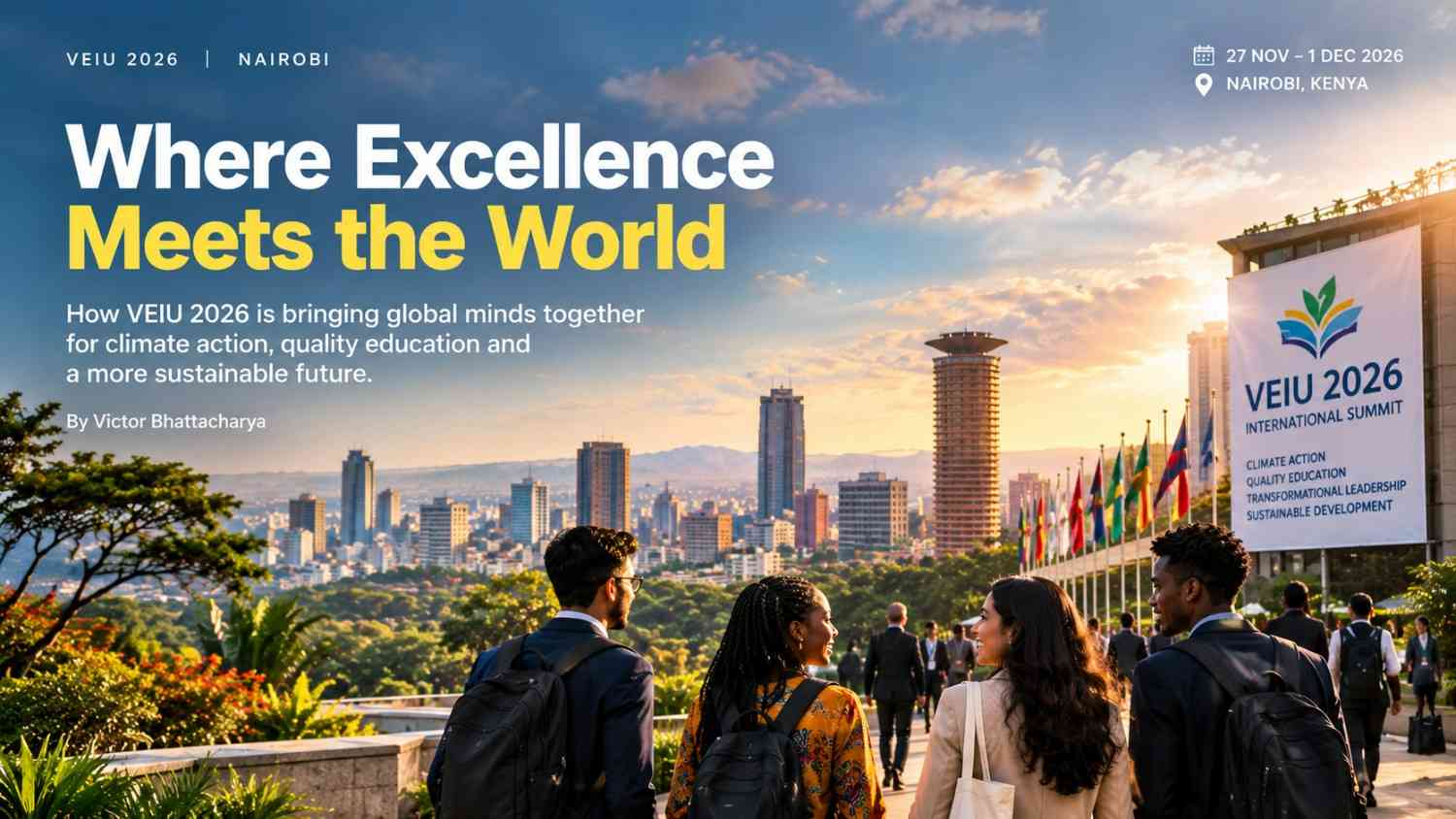
| VEIU 2026 brings educators, climate advocates, institutional leaders and change-makers from across the world to Nairobi, linking quality education, climate action, transformational leadership and sustainable development. The five-day summit aims to turn global dialogue into lasting partnerships, practical action and meaningful community impact. |
| Summary VEIU 2026 will bring global educators, researchers, leaders, businesses, NGOs and change-makers together in Nairobi from 27 November to 1 December 2026. Centred on climate action, quality education, transformational leadership and sustainable development, the summit seeks to move beyond conferences and declarations towards practical collaboration. Its programme includes international forums, graduation and recognition ceremonies, partnership and MoU signings, climate discussions, community outreach and cultural engagement. The article highlights the need for education to serve the public good and for leadership to connect global challenges with local realities. It also stresses that partnerships must produce measurable outcomes rather than remain ceremonial agreements. Ultimately, VEIU 2026 presents Nairobi as a platform where diverse perspectives can come together to build more responsible, inclusive and sustainable futures. |
Keywords VEIU 2026, VEIU International Summit, Nairobi summit, global partnerships, climate action, quality education, transformational leadership, sustainable development, Vision for Excellence International University, Nairobi Kenya |
From 27 November to 1 December 2026, Nairobi will become the meeting ground for educators, climate advocates, institutional leaders, researchers and change-makers committed to turning global conversation into meaningful action.
Nairobi Is Ready for a Different Kind of Summit
Nairobi does not merely host conversations about the future. It makes the future visible.
It is a city where technology and tradition meet, where universities, enterprises, civil society, culture and community life exist alongside the raw challenges of inequality, climate vulnerability and rapid urban transformation. It is both an African capital and a global crossroads—a fitting setting for a summit that seeks to connect excellence with responsibility.
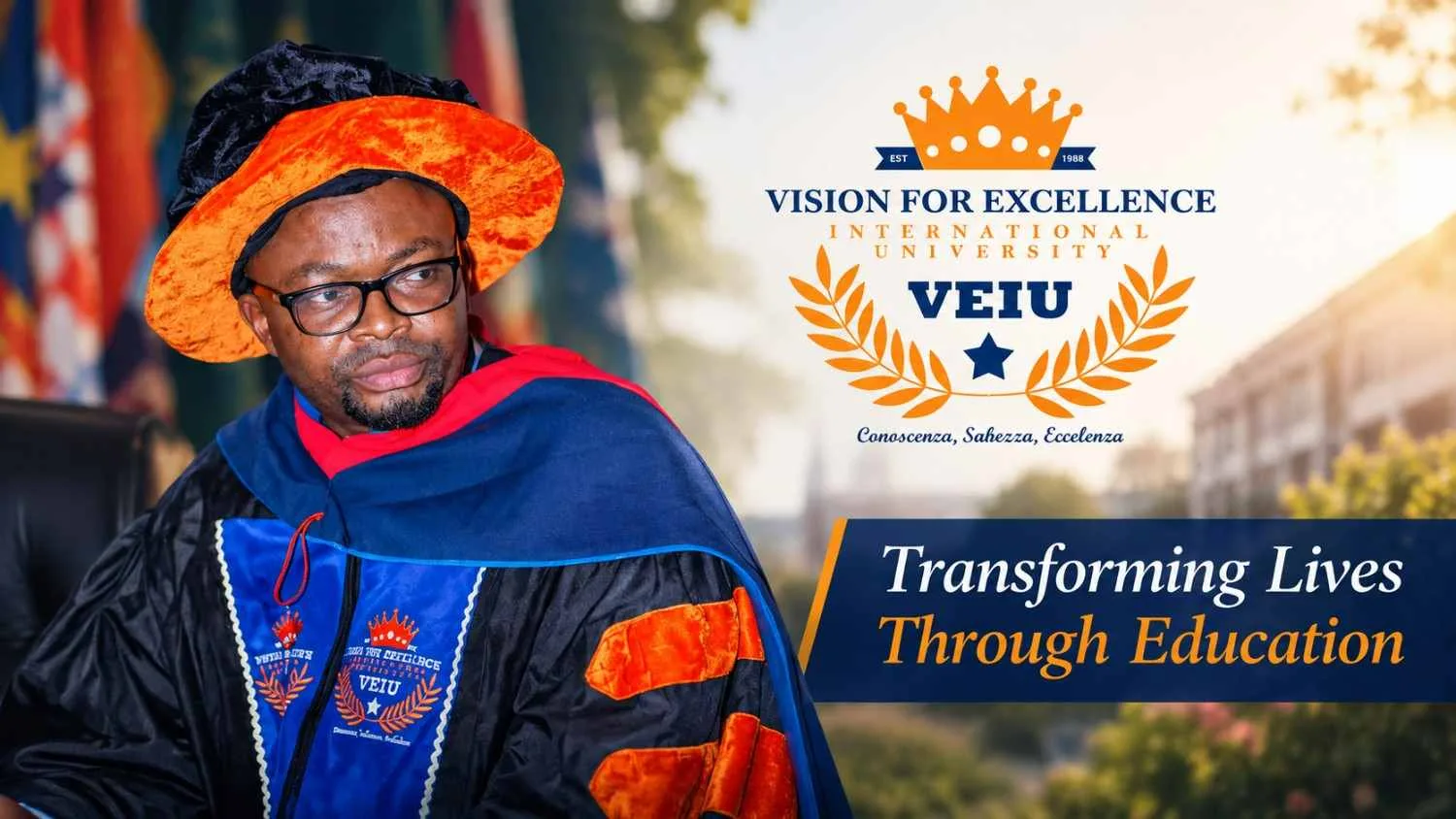
Against this vibrant backdrop, Vision for Excellence International University—VEIU—under the able leadership of its very young and dynamic Africa Chancellor, Dr James Bamwesa, will convene the VEIU 2026 International Summit from 27 November to 1 December 2026. Spread across five days and four nights, the gathering will bring together university leaders, graduates, academics, researchers, government representatives, development partners, business executives, entrepreneurs, NGOs, faith leaders, students and professionals from Africa and around the world.
Its central theme is ambitious and urgent: Building Global Partnerships for Climate Action, Quality Education, Transformational Leadership and Sustainable Development.
This is not a decorative slogan. It is a statement about how the world must now learn to work.
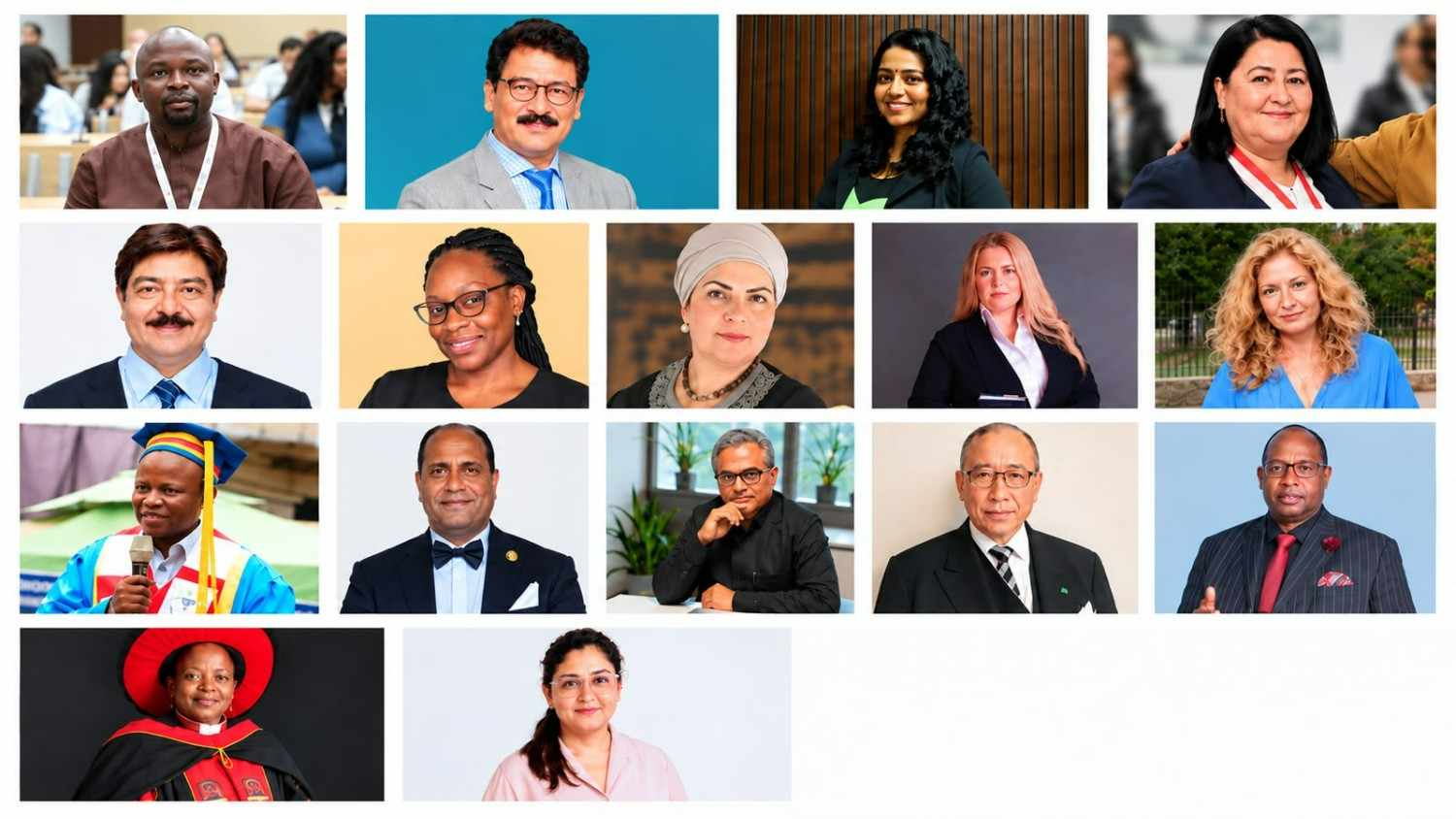
| Speakers: Prof James Bamwesa / D.R Congo Mahesh Kumar / India Dr.Malini Eaganathan Corina Sujdea / Romania Dr Rajanikant Bhatt / India Dr Susan Anjalo / Kenya Lia Rusu / Romania Dr Manuela Dan / Denmark Ermina Raescu / Romania Dr Watongoka Hubert / D.R Congo Dr Ezzat Hassan / Egypt Prof Ujjwal K. Chowdhury / India Prof. Ryo Takahashi / Japan Dr Jimmy Ambajo / Kenya Dr. Anabel A. Njiiri / Kenya Tithi Bhalla / UK |
A Summit with a Question, Not Just a Schedule
The world has no shortage of conferences. It has no shortage of declarations, photographs, ceremonial handshakes and carefully worded resolutions.
What it needs is a stronger connection between knowledge and action.
The VEIU 2026 International Summit is designed around that larger question: What happens when experts, scholars, leaders, innovators and change-makers come together with the intention not merely to speak, but to build?
The answer cannot be measured only by the number of delegates in a hall. It must be measured by the partnerships that continue after the event, the ideas that become programmes, the students who find new opportunities, the communities that receive practical support and the institutions that become more accountable to the future.
The summit programme reflects this wider ambition. It will include international conferences, leadership forums, a climate action and sustainable development forum, a graduation ceremony for VEIU students, honorary doctorate awards, international excellence awards, strategic partnership and Memorandum of Understanding signing ceremonies, a meeting of the Board Members of Together for Africa, and community outreach and cultural experiences in Kenya.
Together, these elements create something more meaningful than a conventional academic gathering. They create a leadership laboratory.
Education Must Become a Force for Public Good
Quality education is one of the summit’s four central pillars because education remains the most powerful long-term instrument of social transformation.
But education cannot be reduced to buildings, examinations, certificates or institutional rankings. Its deeper purpose is to develop people capable of thinking independently, working collaboratively, acting ethically and responding creatively to complex problems.
The summit’s international graduation ceremony will therefore carry a meaning beyond celebration. Every graduation is also a public promise. A graduate leaves not only with knowledge, but with a greater responsibility to society. The real value of a degree is demonstrated when learning improves decisions, strengthens communities and expands human possibility.
The international character of the Nairobi gathering reinforces this idea. When people from different educational systems, cultures and professional backgrounds meet, learning moves in multiple directions. A Kenyan perspective can challenge an Indian assumption. A European experience can illuminate an African priority. A Japanese approach to discipline and innovation can enrich a global conversation. A Malaysian, Egyptian or Congolese insight can reveal the limits of one-size-fits-all solutions.
That is leadership learning at its best: not the transfer of information from one expert to an audience, but the creation of new understanding between people.
Climate Action Is the True Test of Leadership
Climate action cannot remain a specialist conversation confined to environmental forums.
It is now inseparable from education, public health, food security, migration, livelihoods, urban planning, finance, technology and social justice. A community facing water stress experiences climate change differently from a corporation calculating its emissions. A student worried about employment sees sustainability through a different lens from a policymaker designing a national transition.
The climate action and sustainable development forum at VEIU 2026 has the potential to bring these perspectives into the same room.
The essential leadership question is not simply whether the world understands climate change. It is whether institutions are prepared to change their priorities because of what they understand.
Transformational leaders must be able to connect global goals with local realities. They must ask how sustainability can create dignified work, how innovation can reach underserved communities, how education can prepare young people for green economies and how partnerships can move resources towards those who need them most.
Climate action requires more than individual virtue. It requires institutional courage, financial commitment and cross-border collaboration. No university, government, NGO or business can solve the challenge alone. The summit’s emphasis on global partnerships is therefore not an accessory to climate action. It is its operating principle.
Leadership Begins Where Certainty Ends
Transformational leadership is often confused with charisma. Yet the most valuable leaders are not necessarily the loudest people in the room. They are the people who can listen deeply, absorb complexity, recognise their own limitations and still act with courage.
The Nairobi summit will place leadership alongside education and climate action because the three are inseparable. Education without leadership can remain theoretical. Leadership without ethical grounding can become domination. Climate action without imagination can become a technical exercise without social legitimacy.
The leaders of the next decade will need to work across disciplines and identities. They will need to understand data and human emotion, innovation and inequality, economic growth and ecological limits. They will need to build trust in environments where trust is increasingly fragile.
Most importantly, they will need to understand that leadership is not the possession of power. It is the responsible use of influence.
A Room Large Enough for the World
The summit’s most powerful asset may be the diversity of voices assembled in Nairobi.
At its centre will be Prof James Bamwesa, Chancellor of Vision for Excellence International University and a leading figure in the summit’s vision. The programme also brings together contributors from Africa, Asia and Europe, reflecting the belief that the world’s most urgent challenges require more than one geography or one intellectual tradition.
The international speaker group includes Dr Malini Eaganathan from Malaysia; Mr Mahesh Kumar, Prof Ujjwal Anu Chowdhury and Dr Rajanikant Bhatt from India; and Ms Corina Sujdea, President of RELTTAW, together with Ms Lia Rusu and Ms Ermina Raescu from Romania.
Kenya will be represented by Dr Susan Anjalo, Dr Anabel A Njiiri and Dr Jimmy Ambajo. The wider African presence includes Dr Ezzat Hassan from Egypt, Dr Watongoka Hubert from the Democratic Republic of Congo and Mr Jean Hubert from Cameroon. Dr Manuela Dan brings the perspective of Denmark, Prof Ryo Takahashi represents Japan, and Ms Tithi Bhalla contributes the perspective of the United Kingdom.
This is more than a list of speakers. It is a map of possibility.
The significance lies not in placing famous names on a stage, but in allowing different experiences to challenge one another. The summit can become a space where participants discover that international collaboration does not mean erasing difference. It means using difference intelligently.
Partnerships That Survive the Handshake
The main organiser is Vision for Excellence International University, Africa, with RELTTAW serving as principal partner. The summit is supported by an extensive network of partner organisations: USK-BUKAVU, the World Book of Records London, SustainVerse.org, the International University Institute of Innovation, Global Goals Connections, EDX Global, AAHAE, the International Association of Theological Institutions, FIDES Denmark and RELTTAW.
Their participation sends an important message. Global partnerships must be more than logos arranged beneath an event title. They must create pathways for shared research, student mobility, institutional development, innovation, community engagement, entrepreneurship and sustainable action.
A Memorandum of Understanding is easy to sign. The harder task is to turn it into a living relationship—with responsibilities, timelines, measurable outcomes and people committed to implementation.
The Nairobi gathering will be judged by whether its partnerships continue to produce value long after the final ceremony. The strongest collaborations will be those that connect institutions not only to one another, but also to communities that are usually excluded from international conversations.
Recognition Must Become Responsibility
Honorary doctorate awards and international excellence awards—including recognition for women in leadership—will form an important part of the summit.
In a world filled with badges, titles and public profiles, recognition must be handled with seriousness. An honorary doctorate should not be understood merely as a ceremonial distinction. It should represent a record of contribution and a renewed obligation to serve.
Similarly, excellence awards should not only celebrate achievement. They should make achievement visible as a source of inspiration for others. Recognition becomes meaningful when it encourages young people, honours public-minded work and strengthens the social value of leadership.
The summit’s recognition ceremonies can therefore become moments of reflection: What kind of excellence does the world need now? Is success measured only by personal advancement, or also by the number of lives improved, institutions strengthened and futures protected?
“Together for Africa” Must Be a Working Promise
The presence of the Together for Africa initiative gives the summit a distinctive moral and developmental centre.
The scheduled meeting of its Board Members in Nairobi suggests a focus beyond conference proceedings. It points towards an effort to build sustained cooperation around African priorities, African talent and African possibilities.
The community outreach programme and Kenya cultural and tourism experience are equally significant. A summit about Africa should not speak about Africa only from inside a conference hall. It must encounter the people, places, histories and aspirations that give the continent its meaning.
Culture is not an optional addition to development. It shapes identity, dignity, social cohesion and economic opportunity. Community engagement, likewise, reminds leaders that every grand policy ultimately reaches a real person, family, school, workplace or neighbourhood.
“Together for Africa” is therefore best understood as a working verb. It asks participants to move from speaking for communities to listening to them, working with them and investing in their future.
Five Days, One Leadership Laboratory
Across five days, VEIU 2026 will offer participants multiple entry points into leadership learning.
The graduation ceremony will underline the public purpose of education. The international leadership conference will explore how influence can be exercised ethically and effectively. The climate and sustainable development forum will connect environmental responsibility with institutional action. The partnership and MoU ceremonies will test whether cooperation can become more than symbolism. The excellence awards will ask what achievement should look like in an unequal and uncertain world. The community and cultural programmes will bring the conversation back to people and place.
A participant may arrive in Nairobi seeking a certificate, a connection, a platform or a new professional opportunity. The deeper value of the summit will be found in what that participant carries home: a more expansive understanding of leadership, a sharper awareness of global interdependence and perhaps one partnership capable of changing a community.
That is the difference between attending an event and becoming part of a movement.
Where Excellence Meets the World
The VEIU 2026 International Summit comes at a moment when the world is searching for bridges—between generations, nations, disciplines, institutions and communities.
Nairobi offers the setting. VEIU offers the platform. The speakers offer diverse experience. The partner organisations offer networks. But the final outcome will depend on the willingness of participants to learn, listen and act.
The summit’s promise can be expressed simply: together for education, together for climate action, together for leadership and together for global partnerships.
From Africa to Europe, Asia and beyond, one shared vision will come into focus—that excellence is not complete until it serves humanity.
www.SustainVerse.org is proud to be the media partner of this historic leadership summit at Nairobi
VEIU 2026 International Summit
Nairobi, Kenya | 27 November–1 December 2026
Theme: Building Global Partnerships for Climate Action, Quality Education, Transformational Leadership and Sustainable Development
Contact: info@veiuniversity.org | +40 769 266 040 | +254 759 913 318


1 Comments
Prof James Bamwesa
This is a big opportunity to miss