
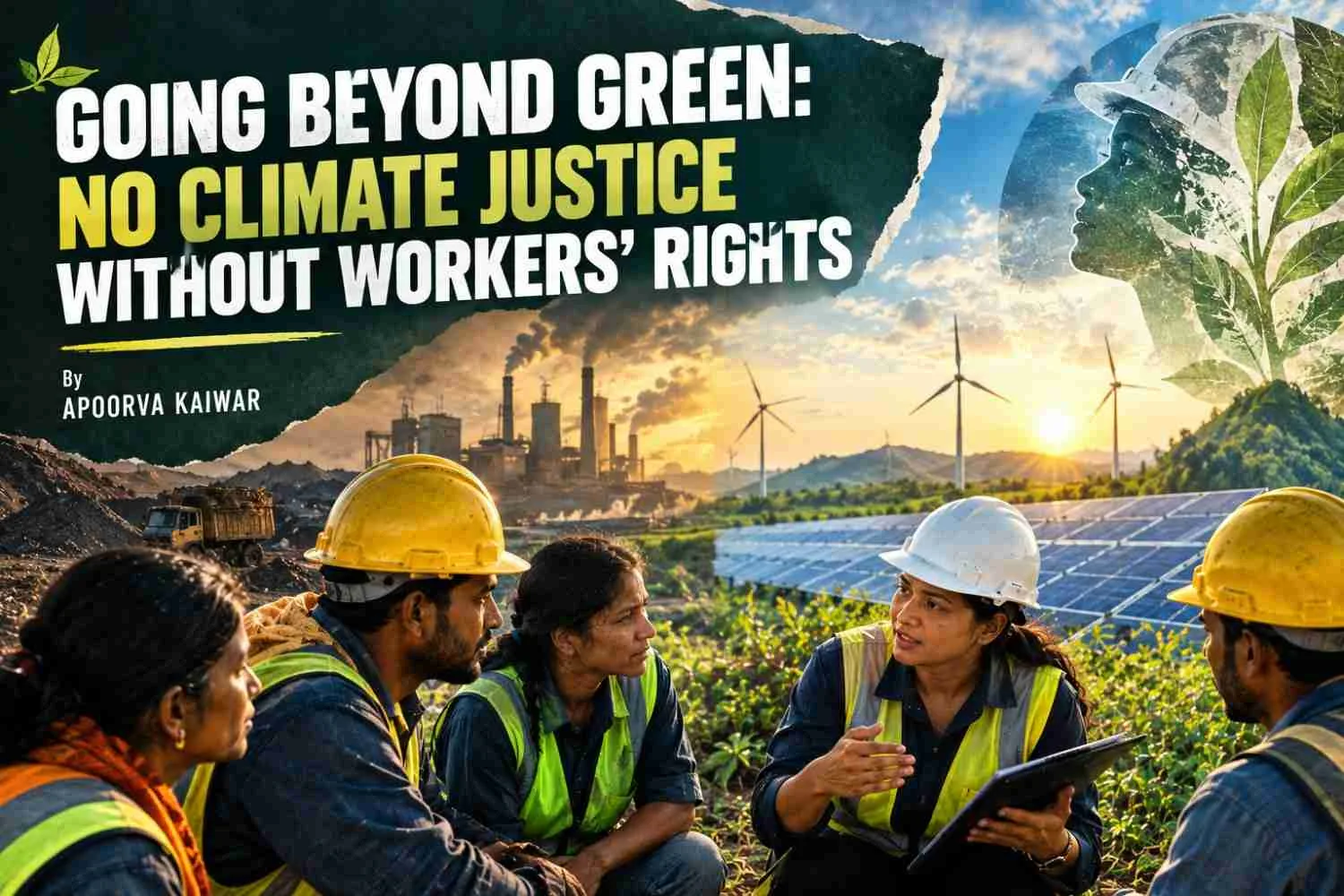
| Climate justice cannot be separated from workers’ rights. As decarbonisation, climate change and digitalisation reshape jobs and industries, a truly sustainable transition must protect livelihoods, strengthen social dialogue and ensure decent, inclusive work. |
| Summary The climate crisis is already reshaping workplaces through extreme heat, disasters, job losses and disruptions across industries, particularly in the Global South. At the same time, the shift away from fossil fuels, alongside digitalisation and automation, is changing both the number and nature of jobs, creating new challenges for workers and trade unions. The article argues that treating environmental goals and workers’ rights as separate issues creates a false conflict between jobs and climate action. A Just Transition must instead place workers and affected communities at the centre through collective bargaining, social dialogue, social protection, reskilling and gender equality. Examples such as heat agreements in Cambodia and worker-focused planning around offshore wind demonstrate how climate action and livelihood protection can work together. Ultimately, integrating labour and environmental governance is essential to ensure that the transition is not merely green, but genuinely just and inclusive. |
The climate crisis is no longer a distant threat. It is changing the world of work in real time - reshaping economies and workplaces. Heatwaves, floods, storms are disrupting work and industries, while entire communities tied to fossil fuel industries face decline as economies decarbonise. Countries in the global south are more prone to climate change induced disasters¹ and as such industries and workers here are more affected than others.
Heavy flooding seriously affected industrial production in many Asian countries including 0Bangladesh, parts of Pakistan and India, Cambodia, Myanmar, Thailand, Vietnam, Sri Lanka and China in 2023-24, particularly in the garment sector². This led to job losses as well as loss of wages for several hundreds of workers, a large number of whom are women. Heat stress is affecting workers at an unprecedented level. A 2024 report of the International Labour Organisation (ILO, 2024)³ estimated that 18,970 deaths and 22.85 million occupational injuries were attributable to excessive heat every year, with about 71% of the global workforce being exposed to excessive heat. Workers working outdoors in agriculture, construction, transport etc., bear the brunt of the heat as do workers in poorly ventilated workplaces such as foundries or even garment factories. Climate change mitigation and adaptation efforts are therefore necessary and the need is immediate, all the more so as the interests of working people are aligned with the success of climate change mitigation strategies.
Governments are in the process of implementing policies to reduce greenhouse gas emissions and move away from fossil fuels. However, the movement from fossil fuel to renewable energy has meant loss of jobs, in sectors such as coal and oil and increased informalisation of jobs that used to be permanent jobs. Job losses, especially in unionised sectors have made trade unions wary of climate change mitigation measures. Renewable energy such as solar and wind power energy, is gaining traction, even as coal is continued to be used. China, USA and India are among the top ten solar and wind energy producing countries. They are also among the top ten coal producing countries with China and India leading. Which means that the top coal producing countries are building the resources to produce more renewable energy. But, the number of jobs in these sectors is estimated to be far less than in the traditional energy sectors such as coal and oil. Most of the jobs are precarious, and are still non-unionised. For workers and unions, decarbonisation of the economy is an additional challenge as it has affected employment both in numbers and in nature.
The logical sequitur is that workers’ rights should be considered central to climate change governance – both adaptation and mitigation strategies, as workers’ jobs are being lost and as workers’ face extreme heat stress and other effects of climate change. However, this is not always the case.
Compartmentalization of workers’ rights and climate justice
Climate change is treated primarily as an environmental challenge, even though workers and people in general are affected by it. Climate governance frameworks, whether policy, law, or corporate guidelines, treat environmental goals as completely separate from workers’ rights. The recent advisory opinion of the International Court of Justice (ICJ) is a case in point.
The ICJ issued a unanimous Advisory Opinion⁴ affirming governments’ binding obligations under international law to combat climate change through measures that limit greenhouse gas emissions and foster international cooperation, to achieve the objectives of their nationally determined contributions. Although the Court recognised the binding nature of the Paris Agreement⁵ alongside the International Covenant on Economic, Social and Cultural Rights and the International Covenant on Civil and Political Rights, it notably omitted explicit reference to workers’ rights. The omission is significant because the Paris Agreement in its Preamble itself affirms “the imperative of a just transition of the workforce and the creation of decent work and quality jobs”⁶.
The ICJ’s opinion in omitting workers’ rights follows a trend in climate governance - compartmentalisation between labour rights and climate change mitigation and adaptation measures. Government policies as well as guidelines of Intergovernmental organisations such as Organisation for Economic Cooperation and Development (OECD) follow the same trend.
The Paris Agreement follows the International Labour Organisation (ILO) Guidelines⁷ for a ‘just transition towards environmentally sustainable economies and societies for all’ which identified the importance of social dialogue, social protection, fundamental principles of rights at work and gender specific policies for achieving just transition. Just transition is broadly understood to mean promoting environmentally sustainable economies in a way that is fair and inclusive to everyone concerned – workers, enterprises and communities – by creating decent work opportunities and leaving no one behind. However, government policy frameworks for climate change mitigation which are formulated as a consequence of governments’ obligations under the Paris Agreement are drawn up with little or no inputs from trade unions.
In Chile, which has taken its climate change mitigation obligations seriously, it needed a Supreme Court judgement to ensure consultation with affected workers in the closure of a coal powered thermo electric power plant. In the case of Company Workers Union of Maritima Commercial Somarco Ltd. and others vs. Ministry of Energy⁸, the obligation of governments to ensure just transition was recognised by the Supreme Court. It was held that agreements adopted by the State of Chile to achieve carbon neutrality require a just transition strategy both for the workers harmed by the loss of their direct and indirect source of employment and for the communities affected by the loss of services linked to the development of the declining thermoelectric activity. The ruling ordered the government authorities to implement a plan for the workers affected by the decarbonization process, consulting them in that process.
The 2023 update of the OECD Guidelines for Multinational Enterprises on Responsible Business Conduct⁹ includes ‘recommendations for enterprises to align with internationally agreed goals on climate change and biodiversity’ and ‘recommendations on how enterprises are expected to conduct due diligence on impacts and business relationships related to the use of their products and services’. The recommendations on climate change do not specifically mention workers’ rights except in the context of training in environment, health and safety, and hazardous waste. This compartmentalisation is also seen in policy frameworks on human rights due diligence¹⁰, where climate change mitigation and adaptation has assumed greater importance. Most of these laws and guidelines have clauses on workers’ rights and environment/ climate issues, which remain isolated from each other. Labour rights and environmental standards are treated as being in separate silos.
1. Asia and the small island nations in the Pacific are affected more than Europe/ N America. See https://wmo.int/news/media-centre/climate-change-and-extreme-weather-impacts-hit-asia-hard .Since Asia is the hub of garment production, this industry was affected disproportionately in 2023-24.
2. ILO, The Heat is On: How heat stress impacts the apparel industry, jobs, and worker health, Geneva: International Labour Office, 2025.
3. Flouris, A., Azzi, M., Graczyk, H., Nafradi, B., and Scott, N., eds. 2024. Heat at Work: Implications for Safety and Health. A Global Review of the Science, Policy and Practice. International Labour Office, Geneva, 2024.
4. Obligations of States in respect of Climate Change (Advisory Opinion) [2025] ICJ Rep.
5. The Paris Agreement is a legally binding international treaty on climate change. It was adopted at the UN Climate Change Conference (COP21) in Paris, France, on 12 December 2015 and entered into force on 4 November 2016. Its overarching goal is to hold the increase in the global average temperature to well below 2°C above pre-industrial levels and pursue efforts “to limit the temperature increase to 1.5°C above pre-industrial levels. See more here - https://unfccc.int/sites/default/files/english_paris_agreement.pdf
6. Ibid.
7. International Labour Organization, Guidelines for a Just Transition towards Environmentally Sustainable Economies and Societies for All (ILO 2015).
9. Organisation for Economic Co-operation and Development, OECD Guidelines for Multinational Enterprises on Responsible Business Conduct (OECD 2023).
10. There is an increasing number of human rights due diligence (HRDD) law and policy frameworks such as the OECD Guidelines for Multinational Enterprises on Responsible Business Conduct, the European Union’s Corporate Sustainability Due Diligence Directive, the German and French laws on corporate due diligence which are meant to deal with responsibilities of multinational corporations in their supply chains across the world.
Decarbonisation and digitalisation: a double disruption
This compartmentalisation risks creating a narrative that there is an apparent contradiction between measures to mitigate climate change and the rights of workers; that advancing climate justice would necessitate sacrificing secure employment or organised labour power. This is a wrong narrative. There is only one planet on which both jobs and the environment exist, and because there’s no economy, and no work, on a dead planet.
The climate crisis has coincided with major advances in technology, and the world of work is facing challenges brought forth by decarbonisation and digitalisation. Workplaces are changing with the introduction of newer technologies both because of advances in technology and by the need to decarbonise the economy. The changes are far more rapid than we have seen in the past, and the effect is felt in several sectors.
Technology change is not new. Technology has always changed the way industries function and therefore the way that workers have worked. The first three industrial revolutions changed manufacturing processes. The first industrial revolution transformed work with the advent of mechanization and steam power. This was also the era of child labour, forced labour and unsafe workplaces, and no workers’ rights. The second industrial revolution with greater use of electricity and mass production saw the beginnings of organized labour and trade unions across the world with workers’ rights being recognized, if not implemented everywhere. Labour laws which recognized workers’ rights, provided at least a way for trade unions to collectively bargain. The third industrial revolution with increased automation and the use of robots that changed the factory floor in a very visible manner. This phase also saw the beginnings of supply chains and weakening of workers’ rights. Trade unions were actively opposing the introduction of computers, but without much success. With the change in technology, the nature as well as number of jobs changed. In Industry 4.0 or the fourth industrial revolution which involves digitization and the deployment of cyber physical systems, the transition is in conjunction with greater automation. More sophisticated robots that require little to no human interaction are already in use in automotive factories.
The automotive sector exemplifies this double disruption. The transition from internal combustion engines to electric vehicles is decarbonisation-driven. But it also coincides with automation, robotics, and digitalisation. Workers are losing jobs, the remaining jobs are changing¹¹ and companies want to rescind from their collective bargaining agreements, as in the case of Volkswagen in Europe.¹² Trade unions in Bosch in India report that new ‘high-tech’ units are being set up without consulting existing unions, employing qualified engineers and changing the nature of the job from blue collar to white collar¹³.
Just Transition
The Just Transition Guidelines of the ILO have as far back as 2015 articulated that sustainability and justice can and should go together. ILO’s Just Transition Guidelines identified the importance of social dialogue, social protection, fundamental principles of rights at work and gender specific policies for achieving just transition.
An understanding of Just Transition and its principles is thus key to understanding that the binary of jobs versus environment is a false one. An effective implementation of the fundamental principles of rights at work particularly, freedom of association and the right to collective bargaining will ensure the full participation of workers and their unions, taking into account their priorities. This would require employers/ companies to discuss with unions what changes are coming and how it would affect the workforce. It may mean that workers’ would need to be reskilled (to do a different job) or upskilled (e.g., acquiring new skills) as needed. Unions should be able to negotiate and collectively bargain work re-organisation. This underlines the importance of both collective bargaining and social dialogue, with a focus on unions being provided information by employers and governments about the impending and planned changes of work and work organisation in the workplace. The role of governments in ensuring that the ILO’s fundamental principles of rights at work¹⁴ becomes crucial.
11. The future of work in the automotive industry, Technical meeting on the future of work in the automotive industry (Geneva, 15–19 February 2021), Note on the proceedings, International Labour Office, Sectoral Policies Department, Geneva, ILO, 2021.
12. https://www.bbc.com/news/articles/cje9kv3q94po - Previously agreed wage increases were cancelled. An agreement between the company and the union was made for ‘cutting’ 35000 jobs by 2030.
13. Discussions with Bosch India unions in Pune and Bangalore (October – November 2022).
14. The ILO’s fundamental principles of rights at work do not require ratification of specific conventions. All countries are bound by the fundamental principles by virtue of their membership in the ILO.
Making transitions ‘Just’
Trade unions are learning to deal with these challenges and are putting forward demands in order to protect workers from effects of climate change as well as digitalization. We are beginning to see examples of unions negotiating effects of climate change. The ‘Heat Agreements’ in garment factories in Cambodia¹⁵ is one such example. According to these agreements, which have been negotiated between unions and employers, if the temperature inside the factory rises above 35 C, cooling systems need to be turned on, and workers can take 5-10 minutes break. This is a very concrete example of collective bargaining being used to adapt to climate change.
Another inspiring example is the successful campaign in Maine, USA where an offshore wind energy farm was built further away from the shore so that the livelihoods of the local fishing community could be protected¹⁶.
This is a situation which could easily have been posited as workers vs. environmental groups vs. local communities. However, the importance of climate mitigation as well as the need to protect livelihoods were both prioritized and the wind farm was commissioned further away from the shore, while including collectively bargained wages for the workers employed on the wind farm.
The importance of collective bargaining in protecting workers from the effects of climate change as well as the adaptation/ mitigation measures that governments are undertaking cannot be overstated. However, these examples are too few, with concrete clauses protecting workers’ rights, not very prevalent. The recent ILO Working paper on the role of collective bargaining on promoting just transitions¹⁷ (Schmidt and Braga, 2025) analyses 512 collective bargaining agreements (CBAs) to understand the presence and scope of clauses on Just Transition. While 58 of the agreements had clauses on just transition, most of them were declarative clauses and only 12 were more of a transformative nature. Topics in the agreements included hybrid work (aimed at reducing carbon footprint), working time organisation for extreme heat and upskilling of workers and managers. In addition, the Working Paper looked at six case studies in detail, outside of the 512 CBAs, and identified that the key topics were workers’ representation, planning for job changes and skill development, education and environmental management. These issues, particularly workers’ representation, planning for job changes and skill development are very much part of the Just Transition Guidelines.
The ILO’s Just Transition guidelines are clear: climate adaptation and mitigation measures must go hand-in-hand with decent work, social dialogue, gender equality, and social protection. Just transition would mean promoting environmentally sustainable economies in a way that is fair and inclusive to everyone concerned – workers, enterprises and communities – by creating decent work opportunities and leaving no one behind. Done right, it’s a roadmap.
There needs to be a renewed commitment to the ILO’s Just Transition Principles, particularly from employers and governments. Collective bargaining and social dialogue must be institutionalized with trade unions and affected communities being part of the drafting of climate strategies and plans. A robust social protection policy including health insurance, income support and retraining for workers is needed with the government playing a strong role, making sure that employers contribute their share. Just Transition would also mean that all workers are considered equal, for nothing can be ‘just’ without the element of gender justice. Women workers, who are typically not considered qualified for jobs that involve ‘high technology’ would need to be active participants.
This requires a policy framework that includes work in the informal sectors, as well as low-waged manufacturing and services sectors where women are disproportionately concentrated. A Just Transition must dismantle these barriers, ensuring women access training and employment in green and digitalised economies. Without gender equity, no transition can be truly just. In addition, digital – driven technology requires extensive mining of minerals. This too needs to be approached within a framework of Just Transition, embedding workers’ rights and rights of communities into all policy decisions.
15. Heat Agreements in Cambodia: An interview with Somalay So and Joe Buckley, The Global Labour Rights Reporter, Vol. IV, Issue 1, 2025, p. 17-21.
16. Deedee Fitzpatrick and Hannah Sachs, “Labour leading on climate: advancing high-quality unions jobs in the emerging U.S. clean energy sector” in A Just Transition Law for Climate Justice, The Global Labour Rights Reporter, Vol. IV, Issue 1, 2025, pp 58-66.
17. Schmidt, V., Braga, C. The role of collective bargaining in promoting just transitions. ILO Working Paper 145. Geneva: International Labour International Labour Office, 2025.
Conclusion
How technology is applied and who benefits from it will determine whether the changes in the world of work is a Just Transition or only a green transition. The tools for a fairer future already exist in unions and in collective agreements. Integrating environmental and labour governance will materialise the idea that justice and sustainability can, and must, go hand in hand.
References
- Flouris, A., Azzi, M., Graczyk, H., Nafradi, B., and Scott, N., eds. 2024. Heat at Work: Implications for Safety and Health. A Global Review of the Science, Policy and Practice. International Labour Office, Geneva, 2024.
- ILO, The Heat is On: How heat stress impacts the apparel industry, jobs, and worker health, Geneva: International Labour Office, 2025.
- Deedee Fitzpatrick and Hannah Sachs, “Labour leading on climate: advancing high-quality unions jobs in the emerging U.S. clean energy sector” in A Just Transition Law for Climate Justice, The Global Labour Rights Reporter, Vol. IV, Issue 1, 2025 available here: The Global Labour Rights Reporter - ILAW Network.
- Schmidt, V., Braga, C. The role of collective bargaining in promoting just transitions. ILO Working Paper 145. Geneva: ILO Working Paper 145. Geneva: International Labour Office, 2025.
ABOUT AUTHOR





Add a Comment