Environmental Sustainability Practices

Focuses on strategies and actions that reduce environmental impact and promote sustainable use of natural resources.

Showing 12/40

09 Sep 2026

Pune’s ambitious riverfront project is facing questions over flood safety, shrinking river space, ecological damage, sewage treatment and climate resilience, with SANDRP warning that a project meant to rejuvenate the Mula-Mutha could instead increase the city’s vulnerability. SummaryPune’s River Front Development (RFD) project is being questioned by environmental researchers and urban-planning experts over its flood calculations, ecological impact and compliance with existing regulations. A technical presentation by architect and riverfront researcher Sarang Yadwadkar, discussed by SANDRP, examines the project’s Detailed Project Report, government correspondence, Water Resources Department guidelines and environmental-clearance conditions. The analysis raises five central questions: whether the flood values are accurate, whether the river’s cross-section will be maintained, whether the effect of river confluences has been considered, whether climate change has been factored into planning, and whether Indian standards for river embankments are being followed. Concerns also extend beyond flood risk to the loss of riparian vegetation, inadequate sewage treatment and the construction of structures within the riverbed. With the project already substantially advanced, the debate is increasingly about whether Pune is creating a safer riverfront or altering the river in ways that could worsen future flood and ecological risks.  KeywordsPune riverfront project, Mula-Mutha river, Pune flood risk, riverfront development India, Pune river ecology, flood safety, climate resilience, river conservation, riparian forests, sewage treatment Pune, urban river management, environmental impact, sustainable urban development, riverbed construction, Maharashtra environment, SANDRP analysis, environmental governance, floodplain protection Is Pune building a riverfront or increasing the river’s risks? Pune’s River Front Development project has been presented as an effort to transform and rejuvenate stretches of the Mula-Mutha river system. The project, designed by HCP Design, Planning and Management Pvt. Ltd., has also drawn comparisons with the Sabarmati Riverfront project in Ahmedabad. SANDRP notes that the two river systems have substantially different landscapes and hydrological conditions, raising questions about whether a similar model can safely be applied to Pune.  The technical analysis highlighted by SANDRP focuses particularly on the project's stated objective of reducing flood risk. It examines the seven upstream dams, the three major river confluences within Pune and the flood-discharge figures used in the project planning. 1. Are the flood values being used correctly? One of the most significant concerns relates to the flood values used to design the riverfront. According to the SANDRP analysis, the flood figures used in the RFD project differ substantially from figures provided by Maharashtra’s Water Resources Department. At the Mula-Mutha confluence, the RFD project reportedly uses a 100-year flood discharge of 4,760.89 cubic metres per second, while the WRD figure cited by SANDRP is 12,868.80 cubic metres per second.  The analysis argues that the project calculations do not adequately account for water released from all seven upstream dams as well as runoff from the free catchment area between the dams and Pune. Another concern is the confluence or backwater effect. When rivers meet, changes in flow and water levels can cause water to back up upstream. SANDRP says Maharashtra WRD guidelines require this effect to be considered when flood lines are determined. The analysis therefore concludes that the flood values used in the project may be significantly underestimated. 2. Will the river’s natural cross-section be maintained? The second question concerns the amount of space being left for the river itself. SANDRP's analysis points to project documents indicating changes to the river's cross-section as a result of the proposed riverfront structures and land works. It argues that reducing the available river section can have consequences during extreme flows, particularly when the city is already facing intense rainfall events. The analysis also refers to correspondence between the Pune Municipal Corporation and the Water Resources Department concerning changes to the river's cross-section. According to the presentation, these changes raise questions about whether the project complies with conditions attached to its environmental clearance and WRD guidelines.  3. Has the confluence effect been considered? The Mula-Mutha system is not simply one uninterrupted river channel. Multiple rivers meet within Pune, making the behaviour of water during extreme rainfall more complicated. SANDRP's analysis argues that the project’s flood modelling does not adequately account for these confluence effects. This matters because water moving through a river can slow or back up when it encounters another high-flow channel. During a cloudburst or major rainfall event, simultaneous releases from upstream dams could send large quantities of water towards the city within a relatively short period. The analysis therefore questions whether the project's flood calculations accurately represent what could happen during an extreme event.  4. Where is climate change in the planning? Climate change is another major concern raised by the analysis. A Maharashtra government climate assessment prepared by TERI in 2014 projected changes in rainfall patterns, including increased rainfall intensity alongside changes in the number of rainy days. SANDRP argues that such climate projections do not appear to have been adequately incorporated into the RFD's planning and flood assessment.  This becomes particularly important as Pune experiences increasingly intense rainfall events. Infrastructure designed around historical rainfall patterns may face higher risks if future rainfall becomes more extreme. For a project costing thousands of crores, the analysis argues, climate resilience should be a central part of the design rather than an afterthought. 5. Are Indian standards for river embankments being followed? The fifth question concerns the location and design of embankments. Indian standards for river embankments recommend aligning such structures with the natural banks of rivers. SANDRP's analysis argues that parts of the Pune project instead place embankments further into the riverbed. The presentation also highlights construction and debris dumping within the river area, including a road reportedly being built within the floodline. According to the analysis, information obtained through RTI indicated that the riverbed road did not have the necessary WRD clearance or studies from relevant technical agencies.  Flooding has already raised concerns The debate is not entirely theoretical. The SANDRP analysis refers to an August 2025 event when a flood level reportedly exceeded the threshold at which the riverfront was expected to remain safe. The presentation states that a discharge of 71,408 cubic feet per second resulted in flooding/submergence of parts of the riverfront, despite the project's stated threshold being considerably higher.  The analysis argues that additional construction within flood-prone areas could further restrict the river's natural capacity and potentially increase flood levels and their horizontal spread. The ecological cost Flood safety is only one side of the debate. SANDRP and environmental experts also raise concerns about the destruction of riparian forests and riverine habitats. These areas support native trees, natural vegetation, birds, aquatic organisms and the wider ecological connection between land and water.  The Pune Municipal Corporation has proposed planting around 45,000 trees, but environmentalists argue that plantations cannot simply replace naturally evolved riparian ecosystems. Jeevitnadi Foundation's Shailaja Deshpande, quoted by Counterview, argues that natural riparian species and ecosystems perform functions that conventional plantations cannot replicate, including supporting aquatic life and maintaining interconnected food chains.  A riverfront cannot be separated from sewage management Another contradiction highlighted in the Counterview report is the gap between the promise of a cleaner river and Pune's sewage-treatment capacity. The city reportedly generates around 1,634 MLD of sewage. Even after the JICA-supported sewage treatment programme is completed, Counterview reports that an estimated 629 MLD of untreated sewage could continue entering the rivers.  This raises a fundamental question: can a river be genuinely rejuvenated through landscaping and embankment construction if untreated sewage continues to enter the system? Environmentalists cited in the report have also questioned whether existing sewage-treatment plants are consistently meeting CPCB standards.  The Sabarmati comparison Ahmedabad's Sabarmati Riverfront has often been presented as an inspiration for Pune's project. But the comparison has also become controversial. Counterview notes that portions of the Sabarmati Riverfront were submerged during the monsoon, adding to questions about the suitability of replicating the model elsewhere. The SANDRP analysis argues that Pune's river basin has its own hydrological characteristics and should not simply be treated as another version of the Sabarmati.  Legal and procedural questions The project has also faced environmental and legal challenges. Counterview reports that the National Green Tribunal had previously directed the Pune Municipal Corporation to amend aspects of its environmental clearance and had halted tree-felling activity. An amended clearance issued in 2024 was subsequently challenged as well.  SANDRP's analysis further points to differences between the project's Detailed Project Report and Environment Impact Assessment, including differing descriptions of proposed changes to the riverbed.  What happens next? The project has already reached an advanced stage, with Counterview reporting that around 80% of the priority stretch has been completed and the estimated project cost at approximately ₹4,727 crore. The concern raised by SANDRP is therefore not simply whether Pune should have a riverfront. It is whether the remaining work can be reassessed against actual flood behaviour, ecological conditions, climate projections and regulatory requirements. The larger issue is whether urban river development should prioritise concrete embankments, roads and beautification, or whether the river's natural floodplain, riparian ecosystem and capacity to absorb extreme flows should remain central to planning. The SANDRP analysis ultimately calls for closer scrutiny of the project's flood calculations, environmental impacts and compliance with existing standards before further interventions alter the river irreversibly. SOURCES AND ABOUT AUTHOR Original analysis/presentation: Sarang Yadwadkar, Architect and member of the Planning Committee of the Development Plan of Pune City. Context and explanatory text: Tara Tanmayi S., SANDRP. (SANDRP) Courtesy: Counterview.net — “Riverfront or river death? SANDRP warns of ecosystem collapse.” Counterview.net article ...Read more

07 Sep 2026

India’s sugar market is facing a delicate balancing act as rising prices, duty-free imports and the rapid expansion of ethanol production put food security, farmer interests and energy goals in tension. SummaryIndia’s decision to allow duty-free imports of up to 10 lakh tonnes of raw sugar marks a major shift for a country that has traditionally been a large sugar producer and exporter. The move comes as domestic prices rise ahead of the festive season, with tighter stockholding limits also introduced to improve availability and curb hoarding. At the same time, India’s rapid expansion of ethanol blending has increased the use of sugarcane as an energy feedstock, raising questions about how the country can balance fuel production with domestic sugar requirements. The article highlights that ethanol is not solely responsible for rising sugar prices, with weather, rainfall, production, demand and stock levels also playing important roles. Climate vulnerability adds another layer, as sugarcane is water-intensive and increasingly exposed to changing rainfall and water availability. The way forward, the article argues, is not to choose between sugar and ethanol but to build a more flexible, climate-sensitive and diversified policy that can support both affordable food and sustainable fuel. For decades, India has occupied a dominant position in the global sugar economy. As one of the world's largest producers and consumers of sugar, the country has generally focused on managing domestic production, maintaining adequate stocks and, in favourable years, exporting surplus sugar. However, the recent decision of the Government of India to permit duty-free imports of 10 lakh tonnes, or one million tonnes, of raw sugar marks a significant policy development. The decision is particularly important because it represents India's first major move towards sugar imports in nearly a decade. The immediate reason for the intervention is clear: domestic sugar prices have risen sharply at a time when India is approaching the high-demand festive season. The government has therefore adopted a combination of measures, including tighter stockholding restrictions and duty-free imports, to increase availability and reduce speculative pressure in the market. However, the present situation raises a larger and more significant policy question. At a time when India has been rapidly expanding its Ethanol Blending Programme and encouraging the diversion of sugarcane-based feedstocks towards ethanol production, can the country simultaneously ensure sufficient sugar availability for domestic consumers? The decision to import sugar therefore reflects more than a temporary market intervention. It exposes an emerging tension between food availability, price stability, farmer interests and energy security. Why Is India Importing Sugar? The government's decision allows duty-free imports of up to one million tonnes of raw sugar until October 31, 2026. Normally, India imposes a high import duty on sugar, making the present zero-duty quota a significant departure from the usual policy approach. The objective is to improve domestic availability and moderate record-high prices before the period of increased festive consumption. The urgency of the situation is reflected in the other measures introduced by the government. Bulk consumers using more than 10 tonnes of sugar per month have been subjected to stricter inventory limits, with stockholding restricted to approximately 15 days' consumption during the specified period. These restrictions are intended to discourage excessive accumulation and prevent hoarding from aggravating the price rise.  The decision is also economically significant because India has historically been more closely associated with sugar exports than imports. The country's opening sugar stocks have declined considerably, while concerns over weather conditions in major sugarcane-producing regions have increased uncertainty about future production.  Thus, the import decision is essentially an attempt to address a simple but politically sensitive problem: when domestic supply becomes tight and prices rise, the burden is ultimately borne by consumers. The Festive Season and the Politics of Sugar Prices Sugar is not merely another agricultural commodity in India. It is a widely consumed household product and an essential ingredient for a large number of food-processing industries, confectionery businesses, beverage manufacturers and traditional sweet producers. Demand generally rises during the period between August and November because of major festivals and celebrations. This seasonal increase in consumption can intensify the effects of already limited supply. Reuters reported that the government considered several measures, including duty-free imports and tighter stock controls, as prices increased sharply ahead of the festive season.  The government's intervention therefore has an important consumer-protection dimension. Allowing additional sugar into the domestic market may increase supply and reduce the possibility that consumers will face even higher prices during a period of peak demand. At the same time, imports alone cannot solve the structural causes of supply pressure. If domestic production remains vulnerable to changing rainfall patterns, water availability and fluctuations in sugarcane output, India may continue to face periodic tensions between production, consumption and industrial demand. The Ethanol Blending Programme: A Major Policy Success with New Challenges India's Ethanol Blending Programme has been one of the country's major energy-policy initiatives. The programme aims to reduce dependence on imported crude oil, support cleaner fuel alternatives and create additional income opportunities within the agricultural economy. India's ethanol blending journey began with pilot initiatives in 2001 and gradually expanded through policy reforms and investment. The National Policy on Biofuels, introduced in 2018, played an important role in expanding the ecosystem for ethanol production.  The growth in ethanol blending has been particularly rapid in recent years. Government data shows that the blending percentage increased from approximately 8.1% in Ethanol Supply Year 2020–21 to 19.2% in 2024–25, while the programme reached the 20% level during the 2025–26 supply year period reported by the government.  The programme offers several important advantages. It can reduce dependence on imported petroleum, create a stable market for agricultural feedstocks, support rural investment and contribute to lower emissions. The government also argues that ethanol provides greater energy security by reducing India's exposure to fluctuations in international crude oil markets.  The Sugar-versus-Ethanol Dilemma The recent rise in sugar prices has brought this question into sharper focus. India was considering restricting the use of sugarcane for ethanol production in the upcoming season in order to increase sugar output and address concerns about tight domestic availability. This indicates that policymakers themselves recognise the possibility of a trade-off between the use of sugarcane resources for fuel production and the need to maintain sufficient sugar supplies.  This does not mean that ethanol production alone is responsible for the current increase in sugar prices. Such a conclusion would be overly simplistic. Weather conditions, rainfall shortages, expected production levels, domestic demand, market expectations and stock management can all influence sugar prices. Nevertheless, the situation demonstrates the difficulty of pursuing multiple policy objectives using the same agricultural resource. The Economic Impact of the Import Decision The immediate economic objective of the duty-free import decision is price stabilisation. Additional supplies can reduce scarcity and weaken speculative pressure in the domestic market. However, imports may also have consequences for domestic sugar mills and farmers. If imported sugar enters the market at a time when domestic producers are selling their stocks, lower prices could affect industry revenues. The government must therefore carefully manage the timing and quantity of imports. The current import quota of one million tonnes appears to represent an attempt to strike a balance rather than permanently open the domestic market to unrestricted imports. The policy is time-bound, with imports permitted until October 31, 2026.  The decision may also influence international sugar markets. Because of India's size and importance in the global sugar economy, a significant change in its import or export policy can affect global prices and trading expectations.  Climate Change and the Future of Sugarcane Production The current situation also highlights a broader concern: climate vulnerability. Sugarcane is a water-intensive crop, and production can be affected by changing rainfall patterns and water availability. Concerns regarding reduced rainfall in important sugar-producing regions have already contributed to uncertainty about future production.  In the future, India may face more frequent situations in which agricultural production is affected by climate variability. This creates a strong argument for diversifying ethanol feedstocks. Rather than depending excessively on sugarcane-based sources, India can continue expanding the use of alternative feedstocks such as maize, agricultural residues and other approved sources. The government's ethanol policy has already moved towards a broader feedstock ecosystem, reducing the need for ethanol expansion to depend entirely on sugarcane. A diversified ethanol strategy could help reduce the direct pressure on the sugar sector during years of lower production. Way Ahead India's decision to permit duty-free imports of 10 lakh tonnes of raw sugar is more than an emergency response to rising prices. It represents a significant moment in the evolution of India's agricultural, trade and energy policies. The immediate priority is understandably to increase supply and provide relief to consumers during a period of high demand. Tighter stockholding limits and temporary imports may help achieve this objective.  India's Ethanol Blending Programme remains an important achievement in the country's transition towards greater energy security. However, the recent sugar shortage demonstrates that ambitious fuel policies must remain responsive to agricultural production and consumer needs. The real challenge for India is therefore not to choose between sugar and ethanol. It is to create a policy framework capable of ensuring both affordable food and sustainable fuel. The recent import decision should thus be seen not as a policy failure, but as a warning that the next phase of India's sugar and ethanol strategy must be more flexible, climate-sensitive, data-driven and balanced. ABOUT AUTHOR Dr.S.Krishnan is an Academician and an Experienced Journalist in Jaipur.  Mr. Shasheesh Kumar Singh is a Phd Scholar, DAVV, Indore ...Read more

07 Sep 2026

Swami Vivekananda, Practical Vedanta and the Making of a Sustainable IndiaSwami Vivekananda never spoke the language of carbon budgets or net zero. Yet his most enduring ideas — on oneness, self-mastery, service, strength, education, science and renunciation — reach straight into the moral centre of the climate crisis. Read without anachronism, his Practical Vedanta offers India not a green slogan, but a demanding philosophy for prosperity without excess, spirituality without escape and development without abandonment of the vulnerable. Swami Vivekananda, Chicago-era portrait, 1893. Photograph: Thomas Harrison. AT A GLANCE BLURBSwami Vivekananda never spoke the language of carbon budgets or net zero. Yet his most enduring ideas — on oneness, self-mastery, service, strength, education, science and renunciation — reach straight into the moral centre of the climate crisis. Read without anachronism, his Practical Vedanta offers India not a green slogan, but a demanding philosophy for prosperity without excess, spirituality without escape and development without abandonment of the vulnerable. SUCCINCT SUMMARYVivekananda was not a climate theorist, and it would be historically false to make him one. His relevance is deeper. He asked India to combine spiritual confidence with scientific modernity, to conquer desire as seriously as it conquered external nature, to educate for character and capability, and to regard service to the least powerful as worship. In an era of warming, ecological disruption and hyper-consumption, these principles translate into climate justice, conscious consumption, resilient communities, ethical enterprise, green education and a daily discipline of restraint, health, attention and service. The sustainable India his thought can inspire is neither anti-development nor consumerist: it is technologically ambitious, socially just, ecologically responsible and inwardly free. “The national ideals of India are RENUNCIATION and SERVICE.”— Swami Vivekananda, Reawakening of Hinduism on a National Basis 2024India’s warmest year on record since 1901IMD2.8°CApprox. warming this century under current global policiesUNEP 202552.57%India’s installed power capacity from non-fossil sources as of 28 Feb 2026India NDC 2031–35 THE MONK WHO DID NOT PREDICT CLIMATE CHANGE — AND WHY THAT MATTERS Swami Vivekananda died in 1902. The atmospheric concentration of carbon dioxide, the language of “net zero”, the IPCC, biodiversity conventions and the Sustainable Development Goals belonged to another century. Calling him a climate scientist in saffron robes would not honour him; it would flatten history. His importance to the ecological age is more serious than retrospective prophecy. Vivekananda asked what kind of human being a civilisation should produce. He asked what freedom means, what education is for, how strength should be used, whether privilege can coexist with spiritual truth, and why religion that does not enter the suffering world is incomplete. Those questions now sit underneath climate policy. Technology can tell us how to decarbonise electricity; it cannot, by itself, decide how much consumption is enough, whose livelihood must be protected in a transition, or what we owe generations we will never meet. India’s climate reality makes that moral layer impossible to ignore. The India Meteorological Department recorded 2024 as the country’s warmest year since nationwide records began in 1901, with annual mean land temperature 0.65°C above the 1991–2020 average. UNEP’s 2025 Emissions Gap Report says current global policies still point to roughly 2.8°C of warming this century. The ecological emergency is technical, economic and political — but it is also a crisis of consciousness, appetite and solidarity. “Each soul is potentially divine.”— Swami Vivekananda, Raja-Yoga, Preface THE FIRST GREEN REVOLUTION IS INSIDE THE MIND One of Vivekananda’s most useful distinctions for our century is between external nature and internal nature. Modern civilisation is astonishingly good at manipulating the external world: we split atoms, edit genes, automate factories, mine deep seas, launch satellites and train artificial intelligence. Yet the same civilisation often treats desire as sovereign. The market can optimise delivery in ten minutes; the mind has not learned to ask whether the purchase was necessary. Vivekananda put the hierarchy differently: “It is good and very grand to conquer external nature, but grander still to conquer our internal nature.” He was speaking about spiritual freedom, not carbon emissions. But the translation into sustainability is precise. External mastery plus internal unrestraint produces efficient excess. External mastery plus self-mastery can produce a civilisation capable of abundance without waste. The IPCC has given this insight a modern empirical edge: demand-side changes in buildings, transport and food, together with new ways of providing services, can reduce end-use-sector greenhouse-gas emissions by 40–70 per cent by 2050 relative to baseline scenarios. The point is not that individual virtue replaces public policy. It is that policy, infrastructure, business models and culture all shape demand — and none can ultimately avoid the question of “enough”. A Vivekanandan environmental ethic therefore rejects two equal mistakes: compulsory austerity for the poor, and limitless consumption for the rich. Renunciation is not romanticised deprivation. A child without cooling in deadly heat, a family without clean cooking, a village without reliable electricity or a woman walking kilometres for water needs more material security, not sermons on consuming less. Restraint becomes a moral obligation precisely where consumption has crossed from dignity into display, from comfort into compulsion. “It is good and very grand to conquer external nature, but grander still to conquer our internal nature.”— Swami Vivekananda, The Necessity of Religion ADVAITA MEETS ECOLOGY — WITHOUT CONFUSING METAPHYSICS WITH SCIENCE At the heart of Vivekananda’s Vedanta is unity: the same ultimate reality appears through multiplicity. “Each soul is potentially divine,” he wrote in the Preface to Raja-Yoga, while describing the spiritual task as mastering nature, external and internal. Modern ecology arrives at interdependence through a different road — observation, measurement, systems science. Soil, pollinators, water cycles, forests, oceans, microbes, farms and cities are linked in material feedback loops. Vedanta and ecology are not interchangeable disciplines. Yet they can reinforce the same ethical refusal of separateness. The ecological crisis thrives on distance. The city sees a plastic packet, not the petrochemical chain behind it. The smartphone user sees a device, not mines, metals, labour and e-waste. The electricity consumer sees a switch, not the land, water, ash, transmission lines or communities behind generation. The river becomes “water supply”; the forest becomes “stock”; the atmosphere becomes a free waste sink. Practical Vedanta collapses that moral distance. If dignity is universal and existence is radically connected, no community can be treated as an acceptable sacrifice zone. A wetland is not sacred because we romanticise it; it is indispensable because life is relational. A mangrove is storm protection, nursery habitat, carbon store and livelihood system at once. An ethic of oneness does not replace environmental-impact assessment. It tells us why the assessment must count lives that markets routinely discount. “It is good and very grand to conquer external nature, but grander still to conquer our internal nature.”— Swami Vivekananda, The Necessity of Religion FROM “LIVE FOR OTHERS” TO CLIMATE JUSTICE Vivekananda’s spirituality was never satisfied with private illumination. “They alone live who live for others,” he wrote; elsewhere, “It is a privilege to serve mankind, for this is the worship of God.” In the Ramakrishna movement, this became organised service — education, health, relief and rural work — rather than episodic charity. The Ramakrishna Mission, founded in 1897, turned the principle of Atmano mokshartham jagat hitaya cha — one’s own liberation and the welfare of the world — into institutional practice. Climate change makes this service ethic intensely contemporary because vulnerability is unequal. A wealthy household can buy air-conditioning, insurance, purified water and mobility. A street vendor loses income when heat becomes dangerous. A marginal farmer cannot diversify risk as easily as an agribusiness. A fisher family living beside an eroding coast cannot move assets with a click. Children lose school days after floods. Women often absorb extra care work and water stress. Informal settlements face heat, drainage and air-pollution burdens together. A Vivekanandan climate policy would therefore ask four uncomfortable questions: Who benefits? Who pays? Who decides? Who is invisible? The answers must shape a just transition from coal, climate-resilient housing, heat-action plans, public transport, forest governance, disaster response and adaptation finance. Tribal and local ecological knowledge should be engaged with respect and evidence, not appropriated as picturesque folklore; likewise, conservation must not become an excuse to dispossess people whose livelihoods have long depended on forests and commons. Service also changes the tone of philanthropy and CSR. A company cannot claim the spirit of seva because it plants trees with one hand while contaminating water with the other. ESG cannot remain a reporting layer detached from procurement, product design, labour conditions, logistics, biodiversity, executive incentives and capital allocation. Vivekananda’s assault on privilege is relevant here: sustainability is credible only when responsibility runs through the institution, not merely through its charitable arm. “They alone live who live for others, the rest are more dead than alive.”— Swami Vivekananda, Our Duty to the Masses RENUNCIATION FOR THE AGE OF ONE-CLICK CONSUMPTION “The national ideals of India are RENUNCIATION and SERVICE,” Vivekananda said. Renunciation, in his world, did not mean economic stagnation; he wanted the masses educated, technically capable and materially uplifted. Its contemporary ecological meaning is freedom from being possessed by possessions. That distinction matters in a consumer culture engineered around attention, novelty and replacement. Fast fashion makes garments psychologically old before they are physically worn out. Electronics are upgraded because status expires faster than hardware. Food is discarded while millions struggle with nutrition. Festivals can become competitions in lighting, plastic, thermocol, transport and noise. Digital platforms turn desire into a continuous auction for attention. The sustainable spiritual response is not joylessness. It is a richer definition of enjoyment: use without addiction; beauty without waste; celebration without toxicity; mobility without needless emissions; technology without servitude. Repair before replacing. Borrow or share where ownership adds little. Choose durability. Prefer local and seasonal food where practical. Reduce food waste. Carry a bottle. Refuse unnecessary packaging. Use public transport, walking or cycling when the urban system makes them safe. Let the festival leave memories, not mountains of refuse. This is where Vivekananda’s inner discipline meets India’s contemporary “Lifestyle for Environment” policy vocabulary. India’s 2031–35 NDC explicitly places sustainable lifestyles and people-centric behavioural change alongside technology and policy. The philosophical contribution Vivekananda adds is motive: restraint should not be marketed as guilt. It can be experienced as freedom — swaraj over appetite. “They alone live who live for others, the rest are more dead than alive.”— Swami Vivekananda, Our Duty to the Masses STRENGTH IS NOT DOMINATION; IT IS RESILIENCE Vivekananda’s language of strength is often reduced to posters. In context, he wanted people who could stand on their own feet — physically, intellectually, morally and economically. “What we want is muscles of iron and nerves of steel,” he wrote. For the climate age, that strength can be re-read as resilience. A resilient India needs more than sea walls and drainage pumps. It needs farmers who can access climate information and diverse seeds; cities that protect outdoor workers during extreme heat; neighbourhoods with functioning local institutions; schools that can serve as safe shelters; health systems prepared for heat stress and vector-borne disease; youth trained in green skills; women with financial and decision-making power; and communities that can recover without falling permanently into debt. It also needs psychological resilience. Climate anxiety is rational when the risks are real, but paralysis is not a strategy. Vivekananda’s fearlessness, abhaya, is useful precisely because it is not denial. It asks us to look squarely at danger and still act. The climate movement needs fewer apocalyptic performances and more durable workers — scientists, engineers, farmers, teachers, entrepreneurs, civil servants, journalists and citizens capable of staying with a problem after the trending hashtag has disappeared. SCIENCE IN ONE HAND, SPIRITUAL PURPOSE IN THE OTHER Vivekananda was not anti-modern. His writings repeatedly engage scientific language and he wanted India to absorb modern knowledge, technology, organisation and productive skill without surrendering its spiritual centre. Belur Math’s account of his national vision records his emphasis on improved agriculture, village industries, education and material knowledge for the uplift of ordinary people. That synthesis is the opposite of both technophobia and techno-solutionism. Climate change will not be solved by meditation. India needs grids, storage, renewable power, electrified mobility, efficient buildings, lower-carbon industry, resilient crops, modern water systems, early-warning networks, circular manufacturing and better climate data. But technology does not decide the purpose of development. Ethics must still ask: Is a “green” mine socially just? Does an electric-vehicle transition improve public transport or simply replace one private car with another? Does a solar park respect land rights and biodiversity? Does artificial intelligence cut waste or merely accelerate consumption? India’s newest NDC makes the scale of the transition visible: by 2035 it targets a 47 per cent reduction in emissions intensity of GDP from 2005 levels, about 60 per cent of cumulative installed electric-power capacity from non-fossil sources, and a 3.5–4.0 billion tonne CO₂-equivalent carbon sink through forest and tree cover relative to 2005. As of February 2026, the NDC reported non-fossil sources at 52.57 per cent of installed power capacity. These are infrastructure numbers. Vivekananda’s challenge is to ensure that the civilisation built around that infrastructure is just, restrained and humane. “Education is the manifestation of the perfection already in man.”— Swami Vivekananda, What We Believe In WORK AS WORSHIP — AND THE GREEN ECONOMY OF DIGNITY Vivekananda’s Karma Yoga dignified work by changing its inner logic: work could become a path of freedom when performed with competence, integrity and reduced attachment to egoistic reward. For sustainability, that insight shifts the debate from the prestige of a “green” label to the quality and consequences of work itself. A job is not sustainable merely because it sits inside a renewable-energy company; it must also be safe, fairly paid, socially useful and ecologically responsible. India’s green transition will create and transform work across construction, batteries, public transport, solar installation, energy efficiency, waste recovery, ecosystem restoration, sustainable tourism, water management and climate-smart agriculture. But a circular economy cannot be morally circular if the people who sort waste remain unprotected, or if repair technicians are treated as inferior to the consumers whose products they extend. Vivekananda’s insistence on dignity and capability asks us to see the recycler, artisan, farm worker, mason, driver and technician as participants in national regeneration, not as invisible labour at the bottom of a value chain. The same applies to rural India. Vivekananda wanted practical knowledge, improved agriculture and village industries to reach ordinary people. In the climate age, that becomes a programme of local resilience: soil and water restoration, farmer-producer institutions, agroecological knowledge tested against science, decentralised clean energy, value addition close to the farm, local repair economies and enterprises that keep more income within communities. Sustainability is stronger when a village can maintain the systems installed in its name, rather than waiting for an external agency to return after the pilot project ends. This also reframes entrepreneurship. The green entrepreneur is not simply someone who finds a premium niche for affluent consumers. The deeper challenge is to make low-carbon and regenerative choices cheaper, accessible and aspirational for the majority: cooling that does not bankrupt households, mobility that works without private cars, packaging systems that genuinely circulate, clean energy for small enterprises, and finance that reaches women and first-generation entrepreneurs. Practical Vedanta, applied economically, is capability with conscience — enterprise that builds strength without manufacturing new forms of dependence. A VIVEKANANDA-INSPIRED DAILY CODE: 10 PRACTICESMind before mobile: Begin with 10–20 minutes of silence, breath, prayer or meditation before screens.Strengthen the instrument: Walk, exercise, practise yoga or play a sport; physical capacity supports public action.Eat with gratitude: Prefer nutritious, seasonal/local choices where practical; eliminate avoidable food waste.Work as Karma Yoga: Single-task, concentrate, act ethically and detach ego from applause.Need before want: Delay non-essential purchases; repair, reuse, borrow and choose durable goods.Use energy consciously: Switch off waste, moderate cooling, choose efficient devices and cleaner mobility.Re-enter nature: Spend daily time with trees, sky, soil, water or a neighbourhood park; observe, do not merely consume scenery.Serve weekly: Commit regular time to a social or ecological cause without making yourself the centre.Digital self-rule: Turn off non-essential notifications; create no-screen windows morning and night.Nightly audit: Ask: What did I waste? Whom did I help? What burden did my convenience shift to others? EDUCATION FOR EARTH CITIZENS, NOT JUST EXAM TAKERS “Education is the manifestation of the perfection already in man,” Vivekananda wrote. His idea of education was character-forming, confidence-building and life-making. Climate education needs exactly that breadth. A child who can define the greenhouse effect but cannot connect it to food, water, transport, waste or neighbourhood heat has information, not ecological agency. A Vivekananda-inspired sustainability curriculum would be experiential. Children would grow food, map trees, observe birds, test water, audit electricity, measure household waste, repair objects, interview farmers and waste workers, study indigenous practices critically, design low-waste celebrations and prepare local adaptation plans. They would learn to detect greenwashing and misinformation. Science would supply evidence; ethics would supply responsibility; teamwork would convert both into action. This is also why dignity of labour matters. A circular economy depends on people who collect, segregate, repair, refurbish and recycle. Renewable energy depends on technicians. Regenerative agriculture depends on skilled cultivators. Urban resilience depends on sanitation and water workers. The sustainable future cannot be built while the workers who maintain it remain socially invisible. Vivekananda’s “man-making” education, stated in the gendered language of his time, must become person-making education for equal citizenship and planetary stewardship. “They alone live who live for others, the rest are more dead than alive.”— Swami Vivekananda, Our Duty to the Masses THE 24-HOUR PRACTICAL VEDANTA OF SUSTAINABLE LIVING The attached idea of a Vivekananda-inspired daily discipline becomes most persuasive when stripped of rigidity and turned into principles. The goal is not to imitate a monk’s timetable. It is to train attention so that sustainability becomes character rather than an annual campaign. Begin the day without immediately surrendering the mind to the phone. Create a short interval of silence, breathing, prayer or meditation — not as an ecological act in itself, but as training in non-reactivity. Strengthen the body through walking, yoga, sport or exercise; a citizen exhausted by preventable ill-health has less capacity for long public work. Eat with attention, preferring nutritious, seasonal and locally appropriate food and wasting as little as possible. Work with concentration rather than permanent digital fragmentation. Buy with a “need versus want” pause. Spend some time outdoors, not for decorative wellness but to restore direct acquaintance with the more-than-human world. Then make service habitual. Give time each week to a civic or ecological task: tutor a child, assist during a heatwave, restore a pond, support a community kitchen, document local biodiversity, help segregate waste at an event, mentor a green enterprise or participate in a resident campaign for trees and footpaths. End the day with a small audit: Did I waste food, water or energy? Did I buy reflexively? Did my convenience shift a burden onto someone else? Did I help anyone without needing recognition? That is sustainability as sadhana — disciplined practice. Digital restraint belongs here too. The attention economy is an ecological issue because it accelerates advertising, impulse buying, device turnover and mental restlessness. Notifications are tiny claims on consciousness. To turn them off for chosen periods is not anti-technology; it is self-government. Vivekananda’s “internal nature” has acquired an algorithmic frontier. “The national ideals of India are RENUNCIATION and SERVICE.”— Swami Vivekananda, Reawakening of Hinduism on a National Basis UNIVERSALISM FOR A BORDERLESS ATMOSPHERE Vivekananda’s 1893 intervention at the World’s Parliament of Religions is remembered for interfaith fellowship. Its deeper political relevance today lies in his confidence that rootedness need not become hostility. Climate change needs precisely this combination. Carbon dioxide carries no passport. Himalayan hydrology binds countries together. Cyclones cross maritime boundaries. Air pollution travels. Oceans connect coasts. Species migrate. Climate finance, clean technology, disaster information and adaptation knowledge require cooperation even when geopolitics is difficult. India can draw strength from its own civilisational vocabulary while remaining scientifically open and globally collaborative. Vivekananda’s universalism also warns against environmental tribalism. Climate action cannot become a new purity contest in which citizens compete to appear morally cleaner than neighbours. Karma Yoga is anti-fanatical: work hard, stay unattached to ego, learn from evidence, and keep sympathy alive. The objective is not to win a lifestyle argument. It is to reduce harm and enlarge capability at scale. “It is a privilege to serve mankind, for this is the worship of God.”— Swami Vivekananda, Vedanta and Privilege ARISE, AWAKE — FROM CONSUMER TO CITIZEN “Arise, awake and stop not till the desired end is reached.”— Swami Vivekananda, Reply to the Calcutta Address “Education is the manifestation of the perfection already in man.”— Swami Vivekananda, What We Believe In The twenty-first century does not need a decorative Vivekananda framed above a stage while our economic life proceeds untouched. It needs the unsettling Vivekananda: the critic of privilege, the advocate of the masses, the organiser, the educator, the monk who demanded fearlessness and work, the Vedantin who insisted that unity must become practice. He does not give India a climate-policy manual. He gives it a theory of the human being capable of carrying a transition. That human being is inwardly freer from compulsive desire, outwardly energetic, scientifically curious, socially responsible, physically and mentally strong, respectful of difference and committed to the welfare of those with the least power. Such an India would refuse the false choice between development and ecology. It would expand electricity, housing, cooling, mobility and opportunity for those who need them while reducing wasteful luxury and pollution. It would build renewable energy without treating land and communities as expendable. It would make cities richer in public transport, shade, water, public space and clean air — not merely richer in private consumption. It would value repair workers and farmers alongside software engineers. It would judge corporations by what their core business does, not by the polish of their sustainability reports. It would make schools laboratories of stewardship. Most of all, it would change the definition of prosperity: from possession to capability, from extraction to regeneration, from status to fulfilment, from charity to justice, from ritual spirituality to responsible living. “Arise, awake and stop not till the desired end is reached,” Vivekananda urged. The words came through the Katha Upanishad and became inseparable from his public voice. In our century, the desired end cannot be national greatness on an unlivable planet. A sustainable India worthy of Vivekananda would be strong enough to restrain itself, modern enough to learn, spiritual enough to serve, and confident enough to cooperate. It would understand that the deepest climate technology is not a gadget but a civilisation’s capacity to govern desire. The green transition will be won not only in power plants, factories, farms and transport systems, but also in kitchens, classrooms, boardrooms, voting booths and the human mind. That is why Vivekananda belongs in the sustainability conversation — not as a prophet who predicted the Anthropocene, but as a seer who understood its moral anatomy. The bell has rung. Arise — not merely as consumers, but as citizens. Awake — not merely to personal ambition, but to planetary responsibility. And stop not until progress itself becomes compatible with the dignity and flourishing of life. ARISE — NOT MERELY AS CONSUMERS, BUT AS CITIZENS.AWAKE — NOT MERELY TO PERSONAL AMBITION, BUT TO PLANETARY RESPONSIBILITY. ...Read more

05 Sep 2026

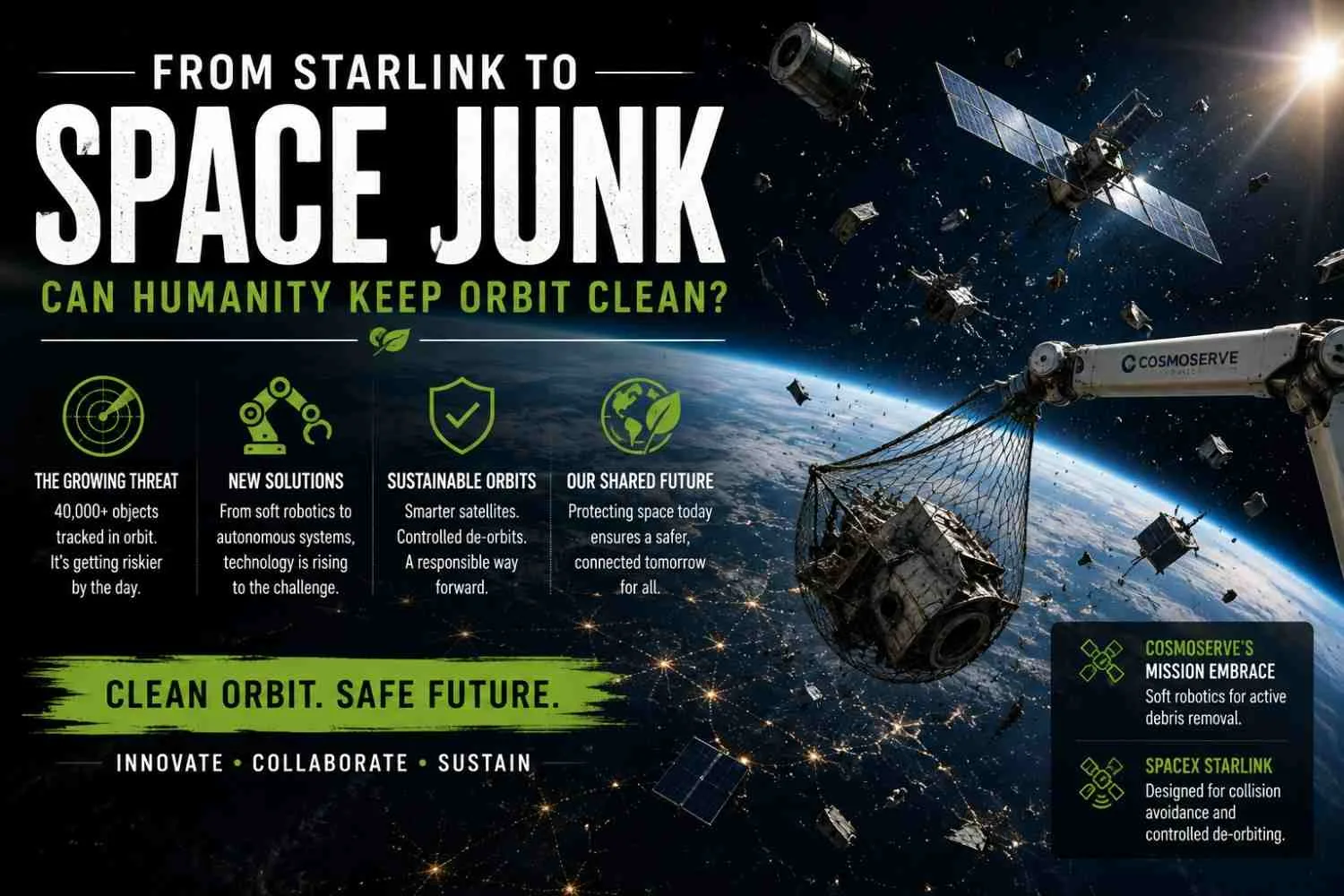
Kolkata | 7 September, 2026 Satellites may be transforming life on Earth, but their afterlife is creating a problem above it. From Cosmoserve’s robotic debris-capture technology to SpaceX’s controlled de-orbiting strategy, new approaches are emerging to keep Earth’s orbital environment sustainable. SummarySpace is no longer an empty frontier. ESA's latest figures show that about 40,000 objects are being tracked in Earth’s orbit, including around 11,000 active payloads, while the actual population of smaller debris is far larger.Cosmoserve Space is approaching the problem from the removal side. Its Mission Embrace is testing soft robotic technology that could eventually help capture inactive satellites and other objects already stranded in the orbit. SpaceX, led by Elon Musk, is approaching it differently: Starlink satellites can adjust their orbits to avoid collisions and are designed to be deliberately de-orbited when they reach the end of their operational life. Keywordsspace debris, space junk, Starlink, SpaceX, Cosmoserve Space, active debris removal, orbital debris, space sustainability, satellite sustainability, satellite de-orbiting, orbital sustainability, space debris removal, Mission Embrace, collision avoidance, satellite disposal, sustainable space technology, Earth orbit, orbital environment, space environment, responsible satellite design The two approaches point to the same larger question: Can humanity keep using space without turning its most valuable orbital zones into a dumping ground? But why does space need cleaning in the first place?Every satellite sent into orbit serves a purpose, from communication and navigation to weather forecasting, Earth observation and scientific research. As our reliance on space-based infrastructure grows, so does the amount of hardware orbiting Earth. But when satellites stop functioning, they do not simply disappear and nor do the fragments left behind by previous launches, break-ups and collisions simply disappear. ESA’s 2025 Space Environment Report estimated that around 40,000 objects were being tracked in orbit, of which only about 11,000 were active payloads. The agency also warned that the debris population continues to grow rapidly. The growing number of objects in orbit is only part of the challenge. Their extraordinary speeds make collisions far more dangerous. A collision between two spacecraft or between a satellite and a piece of debris can produce additional fragments, creating new risks for other missions. Those fragments can then trigger further collisions, potentially multiplying the problem. That means orbital debris can continue to become a greater threat even without new satellites being launched.  What counts as space debris?Active satellites Inactive satellites  Rocket remnants Smaller fragmentsCollision-risk zoneSo, what is Cosmoserve actually trying to do?This is where Hyderabad-based Cosmoserve Space enters the picture.  The company is developing Active Debris Removal (ADR) technology, which goes beyond tracking orbital debris to physically capturing objects that are no longer useful. Its Mission Embrace focuses on a soft robotic capture mechanism. Rather than relying solely on conventional docking systems, the technology uses a robotic approach to capture objects in orbit. Cosmoserve has said it took the system from concept to flight-ready hardware in about four months.  But there is an important distinction.  Mission Embrace is a technology demonstration, not proof that Cosmoserve is already removing large quantities of debris from orbit. Its significance lies in testing a technology that could eventually support debris-removal and in-orbit servicing missions. That matters because capturing a defunct satellite is far more complicated than simply locating it.  A servicing spacecraft must identify its target, approach it safely and operate around an object that may no longer be able to communicate, control its movement or manoeuvre away from the approaching spacecraft.  Then what is Elon Musk’s SpaceX doing differently?  SpaceX has built one of the world’s largest satellite constellations through Starlink. As of 27 August 2026, 11,102 Starlink satellites had been launched, with 11,087 reported as operational, according to current tracking data. That scale brings a different sustainability challenge: what happens when thousands of satellites reach the end of their useful lives?  SpaceX’s approach is largely focused on prevention, manoeuvrability and controlled disposal. Starlink satellites are designed with propulsion and manoeuvring capabilities that allow them to adjust their orbits, avoid collisions and eventually descend into the atmosphere. SpaceX’s sustainability documentation states that satellites undergoing de-orbiting retain manoeuvrability and collision-avoidance capabilities during their descent. In 2026, SpaceX also began lowering the orbits of about 4,400 Starlink satellites from approximately 550 km to 480 km. The lower altitude is intended to reduce the amount of time satellites remain in orbit after their operational lives and, in turn, limit long-term debris and collision risks. COMPARISON INFOGRAPHIC  CosmoserveSpaceX / StarlinkDeveloping active debris removalFocuses on satellite life-cycle managementBuilds technology to capture objectsSatellites are designed to manoeuvreTargets inactive or stranded objectsControls its own satellitesSoft robotic capture is a key technologyControlled de-orbiting is a key strategyStill at the technology-development stageAlready operating at constellation scale So, can prevention alone solve the space-junk problem?That is where the difference between preventing new debris and removing existing debris becomes important. SpaceX’s approach can help ensure that its own satellites do not remain in orbit indefinitely after their mission end. But controlled de-orbiting addresses future disposal; it does not remove the older, inactive objects and fragments already circling Earth. That is the gap that active debris-removal companies are trying to address. The challenge is also becoming larger as more satellites are launched. Expanding satellite networks can bring greater connectivity, communication and other services, but they also add more traffic to already crowded orbital regions. In other words, keeping new debris from accumulating is only one part of the solution. The harder question is what to do with the debris that is already there. HOW DO WE KEEP SPACE CLEAN? Design better satellites↓Track objects in orbit↓Avoid collisions↓De-orbit satellites responsibly↓Remove dangerous existing debris Is cleaning space really about Cosmoserve versus Musk?Not quite. The bigger story is not a contest between Cosmoserve and SpaceX. It is whether the space industry can develop a system in which prevention and removal work together to keep Earth’s orbit usable. SpaceX demonstrates what large-scale satellite operators can do when collision avoidance, manoeuvrability and end-of-life disposal are built into a constellation from the beginning. Cosmoserve represents a different but increasingly important need: technology that can deal with objects already left inactive in orbit and potentially difficult to control or remove. Neither approach, on its own, solves the entire space-junk problem. As launches accelerate and more companies enter the space economy, orbital sustainability will depend on several layers working together: better satellite design, accurate tracking, collision avoidance, responsible end-of-life disposal and, where necessary, active removal of high-risk debris. That changes the question at the heart of the space race. It is no longer only about who can launch the most satellites, build the biggest constellation or reach orbit the fastest. It is about who takes responsibility for what happens after those satellites stop working. True space sustainability will not be measured by how much we put into orbit, but by how responsibly we manage what remains there.Primary sources: European Space Agency — Space Environment Report 2025 — Supports the orbital-debris figures, including ~40,000 tracked objects and ~11,000 active payloads, and the need for active debris removal.  ESA Space Debris Environment Statistics — Provides updated 2026 statistics on tracked objects, satellites, debris populations and orbital mass. SpaceX / Starlink — Commitment to Space Sustainability — Supports Starlink’s collision-avoidance, controlled de-orbiting and satellite sustainability approach. SpaceX — Approach to Space Sustainability and Safety — Supports information on satellite manoeuvrability, collision avoidance, low-altitude operation, controlled de-orbiting and design-for-demise.   Cosmoserve / Mission Embrace Cosmoserve Space — Official Website — Supports Cosmoserve’s Active Debris Removal technology, orbital-debris removal mission and its “Reviver”/“Mothercraft” concepts. The New Indian Express — Mission Embrace — Supports the Mission Embrace soft-robotic capture demonstration and its development timeline. Business Standard — Cosmoserve Mission Embrace — Provides additional reporting on the soft robotic capture mechanism and its role in Active Debris Removal. ...Read more

03 Sep 2026

India’s traditional ecological wisdom reveals how communities once read changes in trees, flowers and seasonal cycles as early warnings of environmental stress.  SummaryFor generations, Indian farmers, forest dwellers and indigenous communities observed plants, animals, soils and seasonal changes to understand environmental conditions. The article explores how this knowledge became embedded in local languages, folk sayings and seasonal traditions, using trees such as jamun, mango, mahua, palash, tamarind, neem and bamboo as examples. It explains that while traditional beliefs cannot always be treated as scientifically accurate forecasts, some observations may reflect real biological responses to moisture stress, temperature changes and seasonal shifts. The discussion of bamboo flowering and the Mautam phenomenon shows how traditional observations can sometimes align closely with modern ecological research. The article argues that such knowledge should neither be accepted blindly nor dismissed as folklore, but studied alongside modern science and environmental monitoring. Ultimately, it asks whether India can preserve this biocultural knowledge as a useful way of understanding changing ecosystems. This summer, Indian orchards and fruit markets seem unusually generous. Jamuns are arriving in quantities that many people say they have not witnessed in decades. Mango orchards in several regions have yielded heavily. Only a few weeks ago, forest floors across central India were carpeted with heavenly mahua flowers, while palash transformed entire landscapes into seas of orange-red flames. In rural areas, such abundance is still not viewed merely as a gift of nature, rather It is treated as a deep-rooted message from nature. For centuries, Indian communities practiced what may be called a form of ecological forecasting. Long before satellites, meteorological models, or groundwater monitoring networks, farmers, pastoralists, forest dwellers, and indigenous communities learned to observe subtle changes in plants, animals, soils, and seasonal cycles and interpreted in their own tongue. These observations evolved into a rich body of traditional ecological knowledge through which communities attempted to anticipate droughts, floods, pest outbreaks, and other environmental disruptions. While modern science may not validate every traditional belief, many of these observations emerged from generations of intimate engagement with landscapes. The lexicon of interdependence, encoding how native communities linguistically locate themselves with material cycles of flora, water, and sustenance. The Curious Case of the Jamun  The unprecedented jamun (Syzygium cumini) productivity this year has revived an ethnoecological axiom embedded in the linguistic fabric of eastern Uttar Pradesh and Bihar that encodes an observed ecological pattern.  "Jamun phale aghaay, paani rahe ghataay."   The underlying intuition is intriguing. Whether this saying is universally true is less important than the ecological insight behind it. Language becomes diagnostic, mediating human interpretation of ecological signals, thereby marking the convergence of ecological observation with linguistic codification. Jamun has a tap root system, a deep-rooted tree capable of accessing groundwater reserves deeper beyond the reach of many plants. Traditional observers believed that unusual fruiting reflected changes occurring beneath the surface; forthcoming water stress long before it became visible to people. Modern plant science does not support the notion that trees can predict the future, yet it does show that many species allocate more energy and resources to flowers, fruits, and seeds to increase the likelihood that its lineage will survive difficult conditions.  Moisture stress, temperature anomalies, and changing climatic conditions can influence flowering and fruiting patterns. Botanists refer to related phenomena as mast seeding, stress-induced reproduction, or reproductive allocation under stress. In this sense, trees may not foresee droughts, but they often respond to environmental pressures much before even humans notice them. Mango and the Memory of Dry Winter The same ecological sensitivity is reflected in traditional observations for the national fruit, the mango (Mangifera indica), across India. Across large parts of northern and central India, farmers have long watched the intensity of mango blossom. In Bundelkhand, one still hears the saying,  “Aam ke phool ghane, garmi pade tani seene.” Dense mango flowering often heralds a severe summer. The saying is both a linguistic artifact and an environment instrument. Moreover, this can be interpreted as a case of ecological semiotics, where flora becomes the signifier and the saying acts the interpretive code. Next, Horticultural science offers an interesting parallel. Mango flowering is known to be influenced by dry conditions and moisture stress during preceding months. Thus, what villagers interpreted as a warning may actually have been an observation of the same environmental signals to which the trees themselves were responding. Mahua: The Tribal Calendar Tree  Among forest communities of central India, mahua (Madhuca longifolia) occupies a special place as both a livelihood resource and a seasonal indicator. Elders among Gond, Baiga, and Oraon communities often viewed exceptionally heavy flowering as a sign that nature was preparing for uncertain times. In the tribal heartlands the onomatopoeic phrase ‘Tipr Tapr’is use to describe the distinct sound of sweet mahua flowers raining down onto the forest floor.  Perception among the native population,"when mahua flowers profusely, the earth still remembers its thirst, captures a perception that environmental stress and reproductive abundance are somehow linked. A particularly abundant flowering season often encouraged families to store more produce, reflecting an expectation that difficult times could lie ahead.  Whether scientifically verified or not, the observation emerged from centuries of indigenous community close engagement with local ecosystems. In the same line The tamil saying  Aalai illaa oorukku iluppaip poo charkkarai  captures role of vital food safety net during stress; when primary resources or sweeteners are completely unavailable, the high natural sugar content of the mahua flower saves the community.   Palash and the memory of hot summer The flowering of palash (Butea monosperma), popularly known as the ‘Flame of the Forest’, occupies a similar place in seasonal memory. Across central and east India, the spectacular flowering of palash has long been associated with the arrival of the hottest and driest period of the year.  Palāś phūlā, garmī ā’ī The folk rendering ‘when palash sets the forest aflame, fierce heat follows’, does not predict drought so much as it marks an approaching phase of environmental stress. This environmental shift finds deeper, poetic resonance across neighbouring cultures. Bengali folk memory warns   Polash phutle phagun ashe, porei jyoishther roddur hashe  noting that while the brilliant orange introduces the spring month of Phagun, it serves as an immediate threshold to the cruel summer sun of Jyoishtha. Simultaneously, Odia rural wisdom sounds a visual alarm through the couplet  Palasha bana jalile, nai nala sukhile mapping the fiery ignition of the forest canopy directly to the drying up of local rivers and rivulets. Also, such a proverb becomes a case of environmental semiosis where the forest becomes the sign, fire becomes metaphor, and heat becomes semantic consequence. Such ethnobiological cues helped communities prepare for changing seasonal conditions long before thermometers and weather forecasts became commonplace. Cross-country wisdom Similar ecolaxicon traditions appear far beyond the Hindi-speaking belt, relying on shared community insights rather than strict, word-for-word dictums. In the Telugu region, farmers have long observed that unusually heavy fruiting of tamarind (Tamarindus indica) can precede a difficult summer; drawing on this experience, elders often summarize this intuition through paraphrased concepts like  “Chinta ekkuva kaaste, vesavi kathinam” observing that when tamarind bears excessively, the summer is bound to turn exceptionally severe. In Karnataka, a comparable piece of rural wisdom survives in the shared understanding often paraphrased as  “Hunase tumba bandre, neeru kadime” indicating that an abundant tamarind harvest naturally accompanies a sharp decline in water availability. In both regions, these localized summaries reflect a deep-rooted awareness of the hardy tree's biological survival mechanism, which accelerates seed production under acute environmental stress.  In Gujarat's Saurashtra region, indigenous weather forecasters historically regarded exceptionally heavy fruiting of neem (Azadirachta indica)as a possible indicator of drought, expressed in the saying  "Limdo ghano phale to dukaal pade." When neem fruits heavily, drought may follow. Even jackfruit, one of India's most productive seasonal trees, finds a place in local ecological memory.  In parts of Kerala and the Western Ghats, older farming communities sometimes regarded extraordinarily heavy jackfruit (Artocarpus heterophyllus) seasons as a sign of climatic irregularity, particularly when accompanied by unusual heat or delayed rainfall. Rather than a canonical proverb, these locally circulated expressions show how everyday speech can store ecological observations in compressed form. Bamboo and the Warning  Yet perhaps the most remarkable example comes from the hills of Mizoram. For centuries, Mizo communities feared an event known as Mautam. In the Mizo language, mau means bamboo (Bambusa vulgaris) and tam refers to a devastating period of famine. The term describes the mass flowering of bamboo that occurs roughly every half-century. Traditional knowledge held that bamboo flowering would be followed by food shortages. The association between bamboo productivity and rodent outbreaks appears not only in Northeast India but also in traditional forecasting compilations from western India reflected in Gujarati  "Vans vadhare phale, undar vadhe."  meaning when bamboo thrives unusually, rats increase. For many years, this belief was dismissed as folklore. Scientific research later demonstrated that bamboo flowering produces enormous quantities of seeds, triggering population explosions among rodents. Once the seeds are exhausted, rat populations move into agricultural fields and grain stores, destroying crops and causing widespread hardship.  Language encodes ethnoecological data by incorporating observed correlations between phenology and climatic outcomes into linguistically encoded transmissible knowledge.  The Ecology of Observation What is particularly striking about these diverse traditions is that they were rarely based on a single observation. Farmers and forest communities interpreted plant behaviour alongside changes in groundwater levels, bird migrations, insect activity, wind patterns, and the timing of seasonal events. Together, these formed a decentralized environmental monitoring system refined over generations. Language becomes the medium through which this decentralized system is stabilized and transmitted informally generation after generation . It does not merely record the ecology of observation; it processes, stores, and projects. It documents observation and makes vernacular speech an ecological model across generations. The observations may not always have been accurate, but they reflected a sophisticated understanding that humans are part of larger ecological networks and that environmental change often announces itself through subtle biological signals through plants. Modern science increasingly recognizes that plants are among the most sensitive responders to environmental change. Variations in groundwater, soil moisture, temperature, and seasonal timing can alter flowering and fruiting patterns long before the consequences become visible to people. This does not mean that every bumper crop predicts drought or every profuse flowering foretells crisis. Also, traditional communities noticed this early, and language formed the tool that captured the biological signals. Nature is rarely so simple. Yet it does suggest that traditional communities may have been observing real ecological relationships, even when their explanations differed from those of contemporary science. As India confronts groundwater depletion, intensifying heat waves, erratic monsoons, and growing climate uncertainty, these traditions deserve neither blind acceptance nor casual dismissal. Instead, they invite a fresh look of biocultural architecture where language, environment and people intersect and treasure the repository of our survival. They remind us that landscapes are constantly communicating through the plants, animals, and seasonal rhythms around us in the native lexicon; ecolexicon. The abundance of jamuns, mangoes, mahua flowers, jackfruits, tamarinds, or neem fruits may not provide a precise forecast of the future. But they may still be telling us something important about the environmental stresses unfolding around us. The question is whether we still know how to listen the echoes of nature?ABOUT AUTHOR                                                         Prof. Dr. Kushagra RajendraMobile: 9650913635Head of Dept. UGC-Master Trainer IKS Columnist Environmental & Sustainability -- Amity University Haryana, India   Prof. Devina Krishna (linguist) Dept. of English, Patna Women's CollegeShe mainstreams in language, ecology, and culture.  ...Read more

31 Aug 2026

Kolkata |31 August, 2026 India’s construction boom is creating a narrow window to cut emissions before new commercial and residential buildings lock in decades of energy demand. Green standards, low-carbon materials, efficient cooling and occupant wellness are becoming central to that transition. Summary India’s building sector is expanding rapidly, making construction and building operations an important part of the country’s decarbonisation challenge. Buildings already account for a significant share of India’s electricity demand, while much of the building stock that will exist in the coming decades is yet to be constructed. Green-building frameworks such as IGBC and GRIHA are pushing developers towards better energy, water, material and indoor-environment performance. BEE has also strengthened the policy framework through the Energy Conservation and Sustainable Building Code 2024 and Eco Niwas Samhita 2024. But certification alone cannot prove that a building is genuinely low-carbon. The bigger test is whether developers reduce embodied carbon in materials, improve HVAC performance, lower actual energy use and deliver measurable benefits for occupants after the building becomes operational. Keywordsgreen buildings India, net-zero buildings India, building decarbonisation, embodied carbon, construction carbon emissions, low-carbon construction, sustainable buildings, green building standards India, energy-efficient buildings, HVAC efficiency, green cement, recycled steel, building energy efficiency, occupant wellness, sustainable construction, building emissions, real estate decarbonisation, net-zero real estate, green construction India, building performance Can India’s real-estate boom become a decarbonisation opportunity instead of an emissions trap?India is entering a major phase of construction, with new offices, homes, hotels, hospitals and commercial developments expanding across its cities. Every building project makes decisions that can shape energy demand, cooling needs, material use and water consumption for decades. That creates both a challenge and an opportunity. A poorly designed building can lock in high energy consumption long after construction is complete. A well-designed one can reduce that demand from the outset through passive design, energy-efficient systems, lower-carbon materials and renewable energy. This is why the net-zero real-estate conversation is moving beyond visible measures such as solar panels and efficient lighting. The bigger question is how a building is designed, what materials go into it, how efficiently it operates and whether the people inside it actually experience healthier and more comfortable conditions. In other words, decarbonising real estate is not just about making buildings consume less electricity. It is about reducing their environmental footprint from construction and material choices through everyday operation and occupant wellbeing.   WHERE A BUILDING’S CARBON COMES FROM CONSTRUCTION Cement + steel + glass + transport↓ EMBODIED CARBON OPERATION Electricity + cooling + lighting + equipment↓ OPERATIONAL CARBON OCCUPANCY Thermal comfort + daylight + ventilation + indoor air quality↓ OCCUPANT WELLNESS NET-ZERO BUILDING Materials + energy + people + performance   Are green-building certifications enough to prove that a building is genuinely sustainable?India has developed two major voluntary green-building frameworks: the Indian Green Building Council (IGBC) and the GRIHA Council. Both assess buildings against a range of sustainability criteria, although their rating systems and approaches are not identical. IGBC offers rating systems for areas including new buildings, homes and net-zero buildings, while GRIHA evaluates factors such as energy and water use, materials, waste management, site planning and occupant-related performance. But certification should not be treated as simply a green label. It can demonstrate that a project has met a defined set of sustainability criteria. The harder test comes after the building is occupied.Does it perform as promised when it is put to real-world use?A developer may secure certification during the design or construction stage, but the building's real energy and resource performance becomes clearer only after it begins operating. Actual occupancy, cooling demand, equipment use and maintenance can all affect its performance. That makes the evidence behind the claim just as important as the certification itself. A credible assessment should establish the baseline, the performance target, the methodology used and the comparison point. It should also show how much energy the building actually consumes per square metre and whether that performance continues to be monitored after certification. This distinction becomes even more important for net-zero claims. A building may perform efficiently during operation, but its overall environmental footprint also depends on factors such as the materials used in construction and the emissions associated with producing and transporting them. Certification can show that a building meets a standard. Long-term performance data is what shows whether that standard translates into real-world sustainability.Can green cement and recycled steel cut the carbon hidden inside construction? Operational energy is only one part of a building’s carbon footprint. A building may use relatively little electricity once it is occupied and still carry significant emissions from the materials used to construct it. Those emissions are generated before the building is even ready for use, through activities such as mining, processing, manufacturing and transportation. This is why cement and steel are at the centre of the embodied-carbon debate. Developers and material manufacturers are increasingly exploring lower-carbon cement, alternative binders, recycled steel and more efficient use of construction materials to reduce emissions at this stage. But calling a material “green” is not enough. The real test is what changed compared with the conventional alternative. What material was replaced? What was its original carbon intensity? How much recycled content was actually used? Where was the material sourced from? What lifecycle boundary was used to calculate the reduction? And how much carbon was genuinely avoided? Without a clear baseline and reporting methodology, a percentage reduction can sound impressive while providing little information about its actual environmental impact. For a credible net-zero building claim, material-level emissions need to be traceable across the project's defined reporting boundary - from sourcing and manufacturing through construction and, where relevant, the building's future lifecycle. The goal is not simply to use greener materials. It is to prove how much carbon those choices actually prevent from entering the atmosphere.  THE EMBODIED-CARBON CHECKCONVENTIONAL MATERIAL Cement / steel↓BASELINE CARBON LOWER-CARBON MATERIAL Green cement / recycled steel↓ACTUAL CARBON ↓ MEASURED MATERIAL SAVING Baseline − Actual = Reduction Add: recycled content + source + lifecycle boundary + quantity used   Could HVAC design become the biggest operational test for green buildings?For India, cooling cannot be treated as an afterthought. As temperatures rise and air-conditioning becomes increasingly important across offices, homes, hospitals and commercial buildings, the way a building manages heat can have a major impact on both energy use and emissions. The Bureau of Energy Efficiency (BEE) building-efficiency framework covers areas including mechanical systems, HVAC, building envelopes, lighting, electrical systems and renewable energy. The Eco Niwas Samhita 2024 also focuses on residential building-envelope performance, with measures aimed at reducing heat gain while improving natural ventilation and daylighting. The logic is simple: a building that absorbs more heat needs more cooling, more cooling requires more electricity, and where electricity remains carbon-intensive, higher demand can mean higher operating emissions. That is why efficient HVAC systems cannot work in isolation. They need to be combined with insulation, shading, appropriate glazing, building orientation, ventilation and better envelope design. The more important question is therefore not simply: How efficient is the air-conditioner? It is: Why does the building need so much cooling in the first place?Building codes also play a crucial role. BEE's energy-efficiency standards provide a national framework, while state urban-development departments and local building authorities influence approvals, enforcement and implementation. MoHUA's urban-building policy framework and local development rules can further determine how sustainability requirements are translated into actual projects. This creates a potential implementation gap. A strong national standard can deliver limited results if compliance and enforcement remain weak at the city or project level.Does a green building still work if its occupants are uncomfortable?  This is where the human side of green construction becomes impossible to ignore. A building may report lower energy consumption while its occupants continue to experience excessive heat, poor ventilation, glare, noise or indoor-air-quality problems. Lower energy use alone therefore cannot determine whether a building is genuinely performing well. Occupant wellness needs to be treated as an outcome, not an optional feature added to a sustainability checklist. For offices, hotels, hospitals and residential buildings, relevant indicators can include: Thermal comfortIndoor air qualityDaylight accessVentilationAcoustic comfortOccupant satisfactionAccess to natural light and outdoor spaces The evidence should come from the people using the building as well as from its building-management systems. A developer's sustainability report can show energy consumption and technical performance. Occupant surveys can reveal whether those improvements actually translate into a building that is comfortable, healthy and functional for the people inside it. A building cannot be considered truly green if it saves energy on paper but compromises the people who have to live or work inside it. THE GREEN-BUILDING SCORECARD  AreaWhat should be measured?EnergykWh/m²/yearCarbonAbsolute + intensity emissionsMaterialsEmbodied carbonCementCarbon intensity + alternativesSteelRecycled content + lifecycle impactHVACEnergy performance + cooling demandWaterConsumption + reuseOccupantsComfort + air quality + satisfactionCertificationRating + post-occupancy performanceInvestmentBudget/capex + actual spendingContinuityPerformance after handover   Is India's building policy moving fast enough to match the construction boom?India already has a growing policy framework aimed at improving building efficiency and sustainability. The Energy Conservation and Sustainable Building Code 2024 and Eco Niwas Samhita 2024 provide updated approaches to energy performance and sustainable building design, while BEE also operates a voluntary star-rating programme for commercial buildings based on their actual energy performance. But a standard has value only when it moves from policy documents into real buildings. That means looking beyond whether developers have adopted a requirement on paper and examining whether it is followed through design, construction and everyday operation. State urban-development departments, municipal corporations and local building authorities also have an important role in approvals, development rules, implementation and enforcement, particularly where voluntary green-building standards overlap with mandatory regulations. The evidence should therefore separate five very different milestones: a target announced, a design approved, a certification obtained, a building completed and a building actually performing as promised. These milestones are not interchangeable, and treating them as one can make a project appear further ahead than it really is.What happens when green buildings cost more upfront? Cost remains one of the strongest arguments against more aggressive green-building requirements. Energy-efficient building envelopes, advanced HVAC systems, lower-carbon materials, smart controls and renewable-energy installations can all require greater upfront investment. That can encourage developers to prioritise measures with faster financial returns. But the calculation looks different when a building is assessed across its full operating life. Higher initial investment can potentially reduce electricity consumption, cooling requirements and maintenance costs over time. The better question is therefore not simply how much a green building costs to construct, but what environmental and financial outcomes that additional investment produces? A credible assessment should ask: How much additional capital expenditure was required? How much energy was saved? How much did annual operating costs fall? What was the payback period? And did the building continue to deliver those savings after handover? The money itself also needs to be traceable. A large sustainability commitment announced in an annual report is not the same as money actually spent on a completed project.Can India's developers move from green certification to genuine net-zero performance?Ultimately, the answer will depend on what the sector chooses to measure and disclose. The strongest projects will not stop at reporting the number of green-certified buildings. They will show baseline energy use, actual energy intensity, embodied-carbon calculations, renewable-energy generation, water consumption, occupant outcomes, capital expenditure and post-occupancy performance. The comparison point matters just as much. A claim that a building uses 30% less energy may sound significant, but 30% less than what? Was it compared with a conventional code-compliant building? An earlier version of the same project? Or a comparable building operating in the same climate? Without a credible baseline, even a large percentage reduction can be difficult to interpret. Net-zero performance is ultimately about measurable change, not simply the presence of a green label or the size of a sustainability claim.   ANNOUNCEMENT VS OUTCOME GREEN TARGET ANNOUNCED ↓ DESIGN ↓ CONSTRUCTION ↓ CERTIFICATION ↓ OCCUPANCY ↓ ACTUAL PERFORMANCE Energy ↓ | Carbon ↓ | Cooling demand ↓ | Water ↓ | Comfort ↑ The real green-building story begins after the ribbon-cutting.   So, can India's real estate sector decarbonise before the grid does?It can reduce a significant part of the demand it places on the grid. But “net-zero” requires more than efficient equipment or a green certification. It requires a clear boundary around emissions, credible assumptions, measurable reductions and transparency about renewable energy and any offset reliance. The first priority should be reducing demand. That means designing buildings that need less cooling, using efficient systems, reducing material emissions and improving water and resource efficiency. Renewable energy can then address part of the remaining electricity demand. Offsets, where used, should be clearly separated from actual emissions reductions. The strongest net-zero building is therefore not the one with the most impressive sustainability label. It is the one that can show what its baseline was, what changed, how much it cost, what occupants experienced and whether the performance continued after the project was completed. THE REAL NET-ZERO BUILDING TEST Build less carbon into the structure.Use less energy to operate it.Cool it intelligently.Measure what occupants experience.Follow the money.Report actual performance.Keep measuring after certification. India's construction boom is creating a narrow window. What gets built today will shape the country's energy demand for decades. The question is no longer whether India can build greener buildings. It is whether it can prove that those buildings stay green once people move in.   Sources:  Bureau of Energy Efficiency (BEE) — Energy Conservation and Sustainable Building Code 2024 (ECSBC 2024)Useful for: commercial/office building energy-efficiency requirements, building envelope, HVAC, lighting, electrical systems and sustainable-building provisions. BEE — ECSBC 2024 BEE — Eco-Niwas Samhita 2024Useful for: residential building energy performance, building-envelope requirements, heat gains, daylight and natural ventilation. BEE lists the 2024 ENS among its current building-efficiency resources. BEE — Eco-Niwas Samhita 2024 BEE — Building Energy Efficiency / Energy Efficiency ResourcesUseful for: India's building-sector energy-efficiency framework, commercial-building performance and retrofit/cooling resources. BEE — Building Energy Efficiency Resources Indian Green Building Council (IGBC) — Green New Buildings Rating SystemUseful for: IGBC certification, energy efficiency, water conservation, building materials, indoor environmental quality, certification levels and the transition to Version 4.0 from May 2026. IGBC — Green New Buildings IGBC — Net Zero Carbon RatingThis is especially important for your article. It supports the distinction between design/construction-stage and operations-stage certification, embodied-carbon requirements and operational-carbon requirements. It also states that the certification is valid for three years, reinforcing your argument that performance needs to be monitored rather than treated as a permanent achievement. IGBC — Net Zero Carbon Rating IGBC — Green Existing Buildings Rating SystemUseful for: operational performance, mandatory energy/water/fresh-air requirements, certification review and the importance of final documentation rather than relying only on anticipated performance. IGBC — Green Existing Buildings IGBC — Green Homes Rating SystemUseful for: the residential side of your story and current Green Homes Version 3.0 framework. IGBC — Green Homes ...Read more

27 Aug 2026

Kolkata | 27 August, 2026  India is electrifying its railway network while metro systems are adding solar power, renewable procurement and energy-efficiency measures. But as passenger numbers rise, the next challenge is deeper: making the electricity, stations and first- and last-mile connections cleaner without confusing infrastructure announcements with actual emissions cuts. SummaryIndia's railway and metro systems are undergoing a major energy transition. Indian Railways had electrified 99.6% of its broad-gauge network by July 2026, while about 1,161 MW of solar and 103 MW of wind capacity had been commissioned by June 2026. Railway electrification has also sharply reduced diesel use for traction. Delhi Metro is increasing its renewable-energy use while passenger demand continues to grow. Kolkata Metro offers another lesson through energy-efficiency improvements alongside expanding ridership. The transition therefore cannot be judged only by kilometres electrified, solar capacity installed or green-station certifications. The stronger test is whether renewable electricity is actually being used, energy consumption per passenger falls, emissions decline within a clearly defined boundary and investments deliver measurable results. Keywordsrailway decarbonisation India, green railways India, railway electrification, Indian Railways electrification, railway renewable energy, railway solar power, railway wind energy, sustainable transport India, green transportation, railway energy efficiency, metro sustainability, railway emissions reduction, low-carbon transport, railway sustainability, railway renewable electricity, green railway stations, first and last mile connectivity, sustainable mobility, railway energy transition, clean transportation India Can India’s railway system go green as fast as it electrifies?  For decades, diesel locomotives were a visible part of India’s railway emissions story. Electrification has changed that equation dramatically. Indian Railways has pushed electrification at an exceptional pace. By July 2026, Indian Railways had electrified 99.6% of its broad-gauge network, with only a small portion yet to be electrified. Between 2014 and 2026, around 48,072 route kilometres were electrified, compared with roughly 21,801 kilometres during the six decades before 2014. The transition has also reduced diesel use for railway traction. Indian Railways reported that traction-related diesel consumption fell from 293 crore litres in 2015-16 to 108 crore litres in 2024 - 25.That represents a major operational shift. But electrification raises the next question: What powers the electricity? Switching from diesel to electric locomotives reduces direct emissions, but the overall climate benefit also depends on the source of the electricity used to power them. Electrification therefore removes one major source of direct emissions, but it does not automatically make the railway system renewable or zero-carbon.That makes renewable energy the next stage of the transition. Indian Railways reported that, as of June 2026, around 1,161 MW of solar capacity and 103 MW of wind capacity had been commissioned. The solar capacity includes both rooftop and land-based projects.The numbers show that the railway’s transition is moving beyond simply replacing diesel with electricity. The next challenge is to make more of that electricity cleaner - and to measure how much renewable power actually contributes to the railway’s overall energy demand and emissions reduction. THE ELECTRIC RAILWAY TEST  DIESEL TRACTION↓RAILWAY ELECTRIFICATION↓HIGHER ELECTRICITY DEMAND↓RENEWABLE POWER↓ACTUAL CLEAN ELECTRICITY USED↓LOWER EMISSIONS PER JOURNEY Electrification is the transition. Cleaning the electricity is the deeper decarbonisation test. Can railway stations become power producers instead of just power consumers?Railway stations offer a natural opportunity for solarisation. Their rooftops, parking areas and other available spaces can support solar installations, allowing electricity to be used at the station or integrated into wider railway operations. The scale of this effort has grown rapidly. In November 2025, Indian Railways reported 898 MW of commissioned solar capacity across 2,626 railway stations. Around 629 MW was intended for traction, while the remaining capacity supported non-traction requirements such as stations, workshops, service buildings and railway quarters.That figure, however, should now be treated as a milestone rather than the latest national total. By June 2026, Indian Railways reported around 1,161 MW of commissioned solar capacity.Installed capacity alone does not tell the full story. What matters is how much renewable electricity is actually generated and used. A stronger assessment would therefore ask:•    How much electricity is the solar capacity actually generating?•    How much is being used for railway operations?•    How much is supporting traction?•    When was each plant commissioned?•    What was the capital cost?•    What is its expected operating life?•    How is its performance being monitored?•    What happens to the equipment at the end of its useful life? A station covered in solar panels may look green. Renewable capacity is only part of the picture. A station that can demonstrate actual clean-energy generation, consumption and emissions avoided offers stronger evidence of meaningful decarbonisation. What happens when more passengers choose greener transport? This is where the story becomes more complicated. A public transport system can become more efficient even as its overall electricity consumption rises. Higher energy use does not necessarily mean that the system is becoming less efficient.If more people choose a metro instead of private vehicles, the system may consume more electricity overall while producing lower emissions per passenger journey. Delhi Metro provides a useful example. DMRC’s 2025 energy case study reported that solar power contributed 32% of its total energy consumption during the period assessed. The system has also used renewable electricity procurement to reduce its dependence on conventional power.Passenger demand has also grown, with Delhi Metro recording 235.8 crore passenger journeys in 2025 compared with 223.5 crore a year earlier. The figures highlight why electricity use needs to be assessed alongside passenger demand. If ridership grows faster than energy demand, the system may become more efficient. Even if total electricity consumption increases, a decline in energy use per passenger journey can indicate improved efficiency. But if both absolute electricity consumption and emissions continue to rise, a higher renewable-energy share alone does not tell the complete story. The real measure of a greener public transport system is therefore not simply how much renewable energy it uses, but whether it can move more people with a lower environmental cost per journey. ENERGY SAVINGS VS RIDERSHIP RENEWABLE SHARE ↑RIDERSHIP ↑ENERGY EFFICIENCY ↑↓CHECKTotal energy useEnergy per passengerCarbon per passengerAbsolute emissions A greener network should be measured against the people it moves, not only the infrastructure it installs. Can Kolkata Metro cut emissions by using less electricity in the first place?Kolkata Metro offers a different lesson in decarbonisation: sometimes the cleanest unit of electricity is the one the system does not need to consume.The transition does not always require a new renewable-energy plant. Improving the efficiency of existing infrastructure can also reduce energy use and emissions.Metro Railway Kolkata has been replacing its older steel third rail with a more conductive aluminium third-rail system. The railway has stated that the upgrade can reduce energy losses by 84% on the affected system, while also reducing voltage drops and improving operational efficiency. The project highlights a simple but important principle:Electricity generated from clean sources is still wasted if it is unnecessarily lost before reaching the system that needs it. That makes energy efficiency an important part of railway and metro decarbonisation. More efficient traction systems, regenerative braking, better station cooling, energy-efficient lighting and improved energy management can all complement renewable-energy procurement. Kolkata also demonstrates why ridership needs to be part of the climate discussion.After the Green Line became fully operational in August 2025, daily ridership rose from around 78,000 to 2.04 lakh.More passengers can naturally increase a metro system’s electricity demand. But that does not automatically mean its environmental performance is worsening. If those additional passengers are shifting from private cars, motorcycles or other more carbon-intensive modes, the wider transport system could still be reducing emissions. Can a Metro Be Truly Green If Passengers Still Depend on Cars to Reach It? A metro journey does not begin when a passenger enters the station.It begins at home.That makes first- and last-mile connectivity an important part of the decarbonisation story. A passenger who walks, cycles or uses an electric feeder to reach a metro station has a very different emissions profile from someone who drives a petrol or diesel vehicle to the station. A metro’s climate benefit does not depend only on the train journey. How passengers get to and from the station matters just as much. A low-carbon metro cannot be judged only by what happens on the tracks. The entire passenger journey has to be considered. That means the transition needs to connect: Homes → Feeder transport → Metro/Railway → Feeder transport → Destination Electric buses, e-rickshaws, shared mobility, cycling infrastructure and safe pedestrian routes can extend the climate benefits of mass transit beyond the station gates. This means metro corporations need to look beyond the electricity used to run their trains. The wider question is whether the transport network makes it easy for passengers to complete their entire journey through low-emission modes. The key question is:Are metro systems making it easier for people to reach and leave stations without having to fall back on high-emission private transport?A metro may run on clean electricity, but its full environmental benefit is limited if passengers still need petrol or diesel vehicles to complete the first and last mile. THE LOW-CARBON JOURNEY HOME↓🚶 WALK / CYCLEor⚡ ELECTRIC FEEDER↓🚇 METRO / RAILWAY↓🚶 WALK / CYCLEor⚡ ELECTRIC FEEDER↓DESTINATION The train can be green. The entire journey needs to move in the same direction. Does a green railway-station certificate prove that a station is sustainable? Not by itself.Green-building and green-station certifications can provide a useful framework for improving a station’s performance across areas such as energy efficiency, renewable energy, water conservation and waste management. The IGBC Green Railway Stations rating system, for example, covers several of these areas and can help guide stations towards more sustainable design and operations.But certification and actual environmental performance are not the same thing. A stronger evidence test should ask:What was the baseline? What did the reporting boundary include? Which measures were actually commissioned? How much energy is being saved? How much water is being conserved or reused? What was budgeted, and how much was actually spent? Are the claimed savings still being measured after implementation? These questions matter because a green rating can demonstrate that specific sustainability measures have been incorporated into a project. It does not automatically prove that the station is delivering the same level of long-term carbon reduction in its day-to-day operations. Ultimately, a certificate can show what a station was designed or assessed to achieve. Actual performance data shows what it is achieving in practice. Beyond Electrification: How Green Is the Railway? THE GREEN TRANSIT SCORECARD EvidenceWhat should be measuredElectrificationRoute kilometres + commissioning dateSolarInstalled MW + actual generationWindInstalled MW + actual generationTractionRenewable electricity actually usedStationsSolar coverage + electricity consumptionEfficiencyEnergy saved + energy intensityRidershipPassenger journeys + passenger-kmEmissionsAbsolute + intensity emissionsFirst/last mileEV and public-transport connectivityCertificationBaseline + reporting boundary + performanceInvestmentBudget/capex + money actually spentOffsetsQuantity, type and relianceLifecycleConstruction, equipment and end-of-life impacts This is where corporate and government reporting needs to become much more transparent. A company supplying renewable-energy infrastructure should clearly distinguish between capacity that has been announced, installed and actually commissioned. A railway authority should separate electricity generated from electricity actually consumed. A metro corporation should demonstrate whether renewable-energy procurement is translating into measurable changes in its emissions profile. Similarly, green-station certification should be treated as one part of the sustainability assessment, not a substitute for measuring the station’s wider emissions and resource use. The distinction may sound technical, but it determines whether sustainability claims reflect what is actually happening on the ground. Can the world’s largest passenger railway network decarbonise without compromising access? There is no single technology that can answer that question. Electrification is essential, but it is only the first layer of the transition. Solar and wind power can reduce the carbon intensity of railway electricity. More efficient traction systems can reduce energy losses. Greener stations can lower energy and water demand. Metro expansion can shift passengers away from private vehicles. Electric buses and feeders can connect neighbourhoods to mass transit while keeping the wider journey cleaner. Together, these measures can move the railway and public-transport system towards lower emissions without making access to mobility more difficult. But every layer creates a new measurement challenge.The sector needs to distinguish between announced and commissioned projects, installed capacity and actual generation, renewable-energy procurement and actual renewable-energy consumption, and energy savings and measurable emissions reductions. It also needs to account for the lifecycle footprint of new tracks, stations, trains, solar equipment and other infrastructure, rather than measuring only the emissions produced during day-to-day operations. The goal is not simply to build a railway that uses more clean technology. It is to build a transport system that can demonstrate, with evidence, that it is moving more people while reducing the environmental cost of that mobility. THE REAL DECARBONISATION TEST  ELECTRIFY↓POWER WITH RENEWABLES↓REDUCE ENERGY LOSSES↓GROW RIDERSHIP↓CONNECT FIRST & LAST MILE↓MEASURE EMISSIONS PER PASSENGER↓VERIFY SPENDING & PERFORMANCE  India’s Railways Are Going Electric. But Are They Truly Low-Carbon? The evidence points to a major transition - but not a finished one.Indian Railways has reached 99.6% broad-gauge electrification, while its latest reported renewable-energy capacity stood at 1,161 MW of solar and 103 MW of wind commissioned by June 2026. Traction-related diesel consumption has also fallen substantially over the past decade. These are significant milestones. But electrification is not the finish line. It is the foundation for the next stage of decarbonisation. The harder task now is to clean the electricity powering the network, reduce energy losses, expand public-transport use and make the entire passenger journey lower-carbon - from the first mile to the last. For Indian Railways and the country’s expanding metro systems, the strongest sustainability claim will therefore not simply be:“We electrified the railway.”It will be:“We can show how much cleaner each journey has become - where the electricity came from, how much energy and carbon were actually saved, what was spent and what changed on the ground.” That means moving beyond headline numbers and proving the difference between infrastructure installed and performance achieved. Because a railway does not become truly green simply because its locomotives run on electricity. Electrifying the railway is a major step. But it is not the finish line. The transition becomes truly green when the electricity gets cleaner, energy losses fall, more people choose mass transit, and emissions per journey show a measurable decline.That is what India’s green rail transition must ultimately prove: not simply that more tracks are electrified, but that every step is making the country’s mobility cleaner and lower-carbon.  Sources: Indian Railways / Ministry of Railways — Railway Electrification & Renewable Energy, July 2026Supports the latest 99.6% broad-gauge electrification, the 1,161 MW solar + 103 MW wind commissioned by June 2026, and the fall in traction diesel consumption from 293 crore litres in 2015-16 to 108 crore litres in 2024-25. Ministry of Railways — Railway Electrification & Renewable Energy Indian Green Building Council — Green Railway Stations Rating SystemSupports the sections on green-station certification, energy and water savings, renewable energy, waste management and first-/last-mile connectivity. It also explains the performance-improvement study and third-party assessment process. IGBC Green Railway Stations Rating System Indian Green Building Council — Green High Speed Rail Rating SystemUseful for the broader low-carbon rail infrastructure, lifecycle/site boundary and first-/last-mile connectivity discussion. IGBC Green High Speed Rail Rating System Indian Railways — Renewable Energy / Solarisation milestonesUse this for the earlier 898 MW solar capacity across 2,626 stations milestone that appears in the article as historical context. For the latest figure, use the July 2026 Ministry of Railways release above. Delhi Metro Rail Corporation — Sustainability / Energy documentationThis is the source to retain for the Delhi Metro solar contribution, renewable procurement, energy efficiency and ridership portions. The official DMRC site is also the appropriate primary source for its operational and sustainability documentation. Delhi Metro Rail Corporation ...Read more

27 Aug 2026

Kolkata | 27 August, 2026   India’s higher-education campuses are becoming living laboratories for solar power, green buildings, waste reduction and water conservation, while their net-zero ambitions face a harder test from carbon-intensive grids, ageing infrastructure and rising student demand. SummaryIndian IITs, IIMs and universities are increasingly incorporating renewable energy, green buildings, energy-efficient infrastructure, waste management and water conservation into campus planning. Rooftop solar can reduce dependence on grid electricity, while retrofits can make hostels, classrooms and laboratories more efficient. Campuses can also reduce emissions through wastewater reuse, rainwater harvesting, waste segregation and better cooling systems. But a green campus is not automatically a low-carbon campus. A university must account for electricity purchased from, the grid, construction and renovation emissions, transport, water and waste systems, and the growing energy demand of laboratories, data infrastructure and air-conditioning. Students can add another layer of accountability by independently tracking whether sustainability promises translate into measurable outcomes. The real test is therefore not how many solar panels or recycling bins a campus installs, but whether its absolute emissions fall, its energy intensity improves, its investments deliver measurable outcomes and its sustainability systems continue after the initial funding cycle ends. Keywordsnet-zero universities India, green campuses India, university decarbonisation, sustainable campuses, campus sustainability, net-zero campus, green building in universities, rooftop solar universities, IIT net-zero campus, IIM sustainability, university carbon neutrality, campus carbon footprint, renewable energy in universities, sustainable higher education, green buildings India, campus waste management, campus water management, student sustainability audits, energy-efficient campuses, higher education sustainability Can a university really become greener while depending on a carbon-intensive grid?A university campus can look remarkably green from the outside. Solar panels may cover rooftops, new academic buildings may carry green-building certifications, waste may be segregated, rainwater may be harvested and students may cycle across campus instead of using cars. But these visible changes only tell part of the story.Where does the campus actually get its electricity from?Rooftop solar can reduce the amount of electricity a university buys from the grid, but most large campuses cannot rely entirely on solar power throughout the day or across every season. Laboratories, hostels, libraries, computer centres and air-conditioned classrooms can require a steady supply of electricity for long hours. This creates the central challenge of the green-campus transition. A university can reduce its dependence on grid electricity without becoming independent of it. The challenge becomes even greater as campuses expand. More cooling, digital infrastructure, research equipment and other energy-intensive facilities can push electricity demand higher, meaning that energy efficiency gains do not necessarily translate into lower overall emissions. The real test is therefore not how green a campus looks, but whether it is reducing its carbon footprint as its energy needs continue to grow. THE CAMPUS CARBON EQUATION Grid Electricity•    Campus Fuel•    Buildings & Construction•    Transport•    Water & Waste         ↓TOTAL CAMPUS FOOTPRINTSolar + Efficiency + Circular Systems          ↓EMISSIONS REDUCTION  The real test: Does the total footprint actually fall?   Are rooftop solar panels cutting emissions - or simply cutting electricity bills?Solar panels have become one of the most visible signs of a green campus. For universities, rooftop solar can deliver two benefits at the same time: lower electricity costs and lower emissions from grid power. But the number of panels installed does not, by itself, show environmental progress. A university can announce a large solar project and still rely heavily on grid electricity if the installed capacity is not fully operational or generation remains limited. The more meaningful questions are: How much solar capacity is actually operational? How much electricity does it generate each year? What share of the campus’s total electricity demand does it meet? How much grid power has it replaced? How much was invested? What is the expected payback period? And what will happen to the panels when they reach the end of their useful life? These questions become particularly important for IITs, IIMs and other institutions making carbon-neutrality or net-zero commitments. A megawatt of installed solar capacity is an activity. The electricity actually generated and the emissions demonstrably avoided are the outcomes that matter.Can old hostels become greener without rebuilding them? India’s university campuses also have a major opportunity in the buildings they already have. Many hostels, lecture halls, laboratories and administrative blocks were constructed decades ago, before energy efficiency became a central part of building design. Retrofitting these buildings can therefore deliver significant improvements without requiring complete reconstruction. Measures can include LED lighting, energy-efficient air-conditioning, building-management systems, insulation, improved windows, smart electricity controls, solar water heating, efficient pumps and better ventilation. Organisations such as IGBC and GRIHA Council have helped establish frameworks for improving the environmental performance of buildings. But achieving a green-building certification should not become the end goal. A building may receive a green rating because it meets specified design and construction requirements. How it actually performs once students, faculty and staff occupy it - is a separate question. For universities, the stronger test is simple: how much energy did the building consume before the retrofit, and how much does it consume afterwards? That comparison shows whether a green upgrade is delivering measurable energy savings rather than simply a greener label. THE GREEN-BUILDING TESTBEFORE RETROFIT Energy useWater useCooling demandMaintenance cost ↓ RETROFIT SolarEfficient coolingInsulationLightingSmart controls ↓ AFTER RETROFITEnergy saved?Water saved?Emissions reduced?Operating cost reduced? Certification shows design intent. Performance data shows what actually happened.   What happens to the waste and water a campus produces?Decarbonisation does not begin and end with electricity. A university campus functions much like a small city, with thousands of students, faculty members and staff using classrooms, hostels, laboratories, kitchens, cafeterias and other facilities every day. All of these activities create environmental pressures beyond energy use. Campuses generate solid waste, food waste, wastewater and other forms of resource demand that need to be managed alongside their carbon footprint. A campus cannot claim to be truly sustainable simply because its rooftops carry solar panels if its waste is poorly managed or its wastewater systems are inadequate. The green-campus question therefore extends beyond where electricity comes from to what happens to the resources and waste flowing through the campus every day. A serious green-campus strategy therefore needs to consider: Waste → segregation → recovery → recycling → residual disposal and Freshwater → consumption → wastewater → treatment → reuseRainwater harvesting can help reduce dependence on freshwater sources, while treated wastewater can be reused for landscaping, toilet flushing and other non-potable needs. Food waste can also be composted or sent through other recovery systems instead of being discarded. But the presence of rainwater tanks, composting units or wastewater-treatment plants does not, by itself, demonstrate environmental progress. Universities should report how much waste they generate, how much is recovered, how much is recycled or composted, and where the remaining waste ultimately goes. Water reporting should be equally transparent. Campuses should disclose freshwater withdrawals, total water consumption, the volume of wastewater treated and how much treated water is actually reused. These figures can give students, administrators and other stakeholders, a much clearer picture of how efficiently a campus uses resources - and where its environmental footprint still remains. Can students become the campus’s sustainability auditors?This could be one of the most valuable opportunities for higher education. Students do not have to remain passive beneficiaries of a greener campus; they can also become part of the system that monitors and questions its environmental performance. Engineering students can track electricity use and solar generation. Management students can examine sustainability budgets and spending. Architecture students can study how buildings perform after green upgrades. Public-health students can monitor indoor temperatures and heat exposure. Environmental studies students can track waste and water use, while journalism students can investigate whether a university’s sustainability claims match what is actually happening on campus. This approach can turn the university into a living laboratory, where sustainability is not just taught in classrooms but observed and tested in the institution itself. However, student participation should complement - not replace - professional auditing. Students can identify gaps, collect observations, analyse data and question institutional claims, while independent technical verification should remain in place wherever specialised assessment or certification is required. The goal is not to turn students into unpaid auditors. It is to give them a meaningful role in making the campus more transparent, measurable and accountable.  STUDENT SUSTAINABILITY AUDIT  ENERGY → Solar generation / grid dependence BUILDINGS → Energy intensity / cooling WATER → Freshwater / reuse WASTE → Generation / recovery / disposal TRANSPORT → Public transport / walking / cycling / EVs PROCUREMENT → Sustainable materials / suppliers ↓ STUDENT AUDIT REPORT Promise → Evidence → Gap → Recommendation   What happens when a green campus keeps expanding?There is another contradiction that net-zero plans need to confront: universities are growing, and growth itself has an environmental cost. New hostels, laboratories, classrooms and research facilities require concrete, steel, glass, cooling systems and other materials. A new green building may use less energy once it is occupied, but its construction still creates emissions and consumes resources. That means campus sustainability cannot be measured only through operational electricity use. Universities need to define a clear reporting boundary that captures the wider environmental impact of their activities. Does the footprint include new construction? Outsourced transport? Staff and student commuting? Purchased electricity? Refrigerants used in cooling systems? Or waste generated by contractors? If these sources are left outside the calculation, a university could report a smaller carbon footprint without addressing the emissions linked to its wider operations. A credible net-zero plan must therefore account for the emissions a university creates—not simply the emissions it chooses to count.Can corporate green-building partnerships create lasting change?  Corporate partnerships can play a useful role in campus decarbonisation. Companies such as Saint-Gobain, building-management firms, developers and other green-building partners can provide energy-efficient materials, cooling systems, building-management technology, solar solutions and retrofit expertise. But corporate involvement also needs to pass the same evidence test as the university’s sustainability claims. Was the intervention funded through CSR or delivered as a commercial project? Who paid for the capital investment? How much did the company contribute? What savings were expected? And who will maintain the system once the project is complete? These distinctions matter because installing a green technology is not the same as delivering a measurable and lasting reduction in emissions. Universities should therefore report the budget, actual expenditure, expected energy or emissions savings and the system’s actual performance after implementation. That makes it possible to distinguish between a partnership that simply delivers new infrastructure and one that produces a measurable environmental improvement.Can a campus measure sustainability without hiding behind percentages?This is where the evidence test becomes crucial. A reported “30% reduction in emissions” may sound impressive, but it does not tell the full story without context. Thirty per cent compared with what baseline? Over which period? Across which buildings? Was campus occupancy higher or lower? Did electricity demand change? Were construction emissions included? And was the reduction measured in absolute emissions or per student? Universities need to disclose their baseline, reporting boundary, methodology and measurement period alongside headline percentages. Absolute figures can show the scale of emissions, while intensity measures - such as emissions per student, per square metre or per unit of electricity consumed - can help compare campuses of different sizes. The same principle should apply to every major sustainability claim: solar generation, water savings, waste recovery, energy efficiency and carbon reductions should be backed by transparent data rather than isolated percentages. A green campus is not defined by the size of its sustainability claims. It is defined by whether those claims can be measured, compared and independently verified. THE GREEN CAMPUS SCORECARD  MeasureWhat should be reported?BeneficiariesStudents, faculty and staff actually coveredEnergyTotal consumption + energy intensitySolarInstalled capacity + actual generationBuildingsPre- and post-retrofit performanceWaterWithdrawal + consumption + reuseWasteTotal generated + recovered + final destinationCarbonAbsolute emissions + emissions intensityInvestmentBudgeted vs actually spentOutcomeActual reduction achievedContinuityWhat remains operational after funding ends A 20% reduction in energy intensity may sound like significant progress. But the more important question is: what happened to the university’s total electricity consumption? If a campus doubles its size while it’s energy use falls slightly per square metre, it’s overall electricity demand could still increase. That is why universities need to report both absolute and intensity-based results. Absolute figures show the total amount of energy or emissions being generated, while intensity measures show how efficiently that energy is being used relative to factors such as floor area or student population. The same principle applies to carbon emissions. Before claiming progress towards net zero, a university should clearly disclose its baseline, measurement methodology and reporting boundary. A lower percentage does not always mean a lower footprint. The numbers need context to show what has actually changed. So, what would a genuinely green campus actually look like?It would not necessarily be the campus with the most solar panels, the most green-building certificates or the longest list of sustainability initiatives. It would be a campus that can clearly account for its environmental footprint. It would know where its energy comes from, how much electricity it consumes, how its buildings perform, how much water it uses, where its waste goes and how its emissions are changing over time. It would consider lifecycle emissions when constructing new buildings instead of treating a green certification as the final measure of sustainability. It would also prioritise retrofitting older infrastructure where improvements can reduce energy and resource use, rather than focusing only on new construction. Water reuse and waste recovery would be measured through actual volumes and outcomes, not simply through the number of treatment plants, collection bins or recycling facilities installed. Students would have the opportunity to examine campus data, question sustainability claims and contribute to monitoring - while independent technical audits would provide verification where needed. And most importantly, sustainability would not depend on one CSR partnership, one university administration or one publicity campaign. A genuinely green campus is one where sustainable practice become part of how the institution operates - and continue to deliver measurable results even when the people, funding and projects behind them change. FROM GREEN CAMPUS TO NET-ZERO CAMPUS  MEASURE↓BASELINE↓REDUCE DEMAND↓RETROFIT BUILDINGS↓ADD RENEWABLE ENERGY↓CIRCULARISE WATER & WASTE↓VERIFY RESULTS↓ CONTINUE AFTER FUNDING   Can a university decarbonise faster than the grid?Yes. A university can reduce its own emissions faster than the wider electricity system changes—but it cannot simply disconnect itself from the grid. That is precisely where the opportunity lies. Universities can become living laboratories for decarbonisation: campuses where students, researchers, administrators and private partners can test technologies, measure results and learn what actually works in the real world. For CSR programmes and institutional sustainability plans, the defining question should therefore not be: “How many solar panels did the campus install?” It should be: “How much energy, water, waste and carbon did the campus actually reduce? How much did it cost? And is that improvement still delivering results?” A credible green campus should be able to show its baseline, account for its spending, disclose both absolute and intensity-based results, and explain what happens when a project or funding cycle ends. Because sustainability cannot be measured by appearances. A campus may have solar panels, green buildings, recycling bins and water-treatment systems and still struggle to reduce its overall footprint if its energy demand keeps rising or its wider emissions remain outside the reporting boundary. The real test is whether the entire campus moves towards lower resource use and lower emissions - and whether the evidence proves that progress. A university does not become sustainable simply when it looks green. It becomes sustainable when its buildings, electricity, water, waste and people move in the same direction - and the numbers can prove it. That is how a campus can become more than a demonstration of sustainability. It can become a model for how decarbonisation actually works.   Primary sources: IIT Delhi — Climate Action Plan & GHG Emission InventoryUseful for its Net Zero 2040 target, Scope 1/2/3 framework, renewable power, rooftop solar and campus sustainability measures. (IIT Delhi)IIT Delhi Climate Action PlanIIT Madras — Climate Action PlanUseful for the campus-wide climate strategy, carbon neutrality, academic buildings, hostels, laboratories, biodiversity and sustainability roadmap. (IIT Madras)IIT Madras Climate Action PlanIIT Madras — Carbon Footprint ReportParticularly important for your evidence-test section because it defines the campus boundary and explains Scope 1 and Scope 2 emissions, including purchased grid electricity. (sustainability.iitm.ac.in)IIT Madras Carbon Footprint ReportIIM Calcutta — Sustainability FrameworkThis is one of the most important sources for your article. It documents IIM Calcutta's Net Zero Campus 2036 target, carbon assessment, renewable expansion, emission reduction, energy/water/waste management and carbon audits. (IIM Calcutta)IIM Calcutta Sustainability FrameworkIIM Calcutta — Campus Transformation / Net-Zero Campus PlanUseful for the academic-block and hostel retrofit/construction angle, including its earlier plan for a Net Zero Energy, Net Zero Discharge and Net Zero Waste campus. (IIM Calcutta)IIM Calcutta Campus Transformation PlanIIT Bombay — Campus Sustainability AssessmentUseful for the campus-as-a-living-lab, sustainability assessment, resource management, student involvement and growing infrastructure-demand angle. (gesh.iitb.ac.in)IIT Bombay Campus Sustainability AssessmentIGBC — Green Campus Rating System, Version 1.0 (January 2026)Very important for your section questioning whether green certification equals actual performance. It explains documentation, third-party assessment, preliminary vs final submissions and implementation evidence required before certification. (IGBC)IGBC Green Campus Rating System 2026GRIHA Council — GRIHA for Existing BuildingsUseful for the green-building retrofit argument. It specifically discusses reducing energy and water demand in existing buildings and the importance of continuous performance monitoring. (GRIHA)GRIHA for Existing BuildingsGRIHA Council — Rated Projects 2025This gives you a concrete campus example: IIT Hyderabad's AD3 project reports a 51.25% reduction in energy performance index from the GRIHA base case, 3.5 MW solar PV, 73% reduction in building water demand and campus-level sewage-treatment infrastructure. (GRIHA)GRIHA Rated Projects 2025Bureau of Energy Efficiency — Energy Conservation Building Code (ECBC)Useful for the energy-efficient building and retrofit section. BEE's material specifically includes educational buildings such as colleges and universities within the building-energy-efficiency framework. (Bee India)BEE — Energy Conservation Building Code materialAssociation of Indian Universities — University NewsUseful for the broader higher-education sustainability framework, including sustainable buildings, reducing energy and water consumption, waste reduction, student/faculty engagement and industry/civil-society collaboration. (Association of Indian Universities)AIU University News — Sustainability in Higher Education ...Read more

20 Aug 2026

Kolkata | 20 August, 2026  Every day, millions of flowers are offered at India’s temples. Once the prayer is over, however, those flowers become part of a growing waste-management challenge. Across pilgrimage towns, municipalities, temple trusts, women’s self-help groups and private enterprises are trying to give them a second life - as incense, natural colours, compost, flower powder and other products. The bigger opportunity is not simply to prevent flowers from reaching rivers. It is to build a system where ritual waste creates reliable rural livelihoods, supports women and waste workers, and can prove every environmental claim it makes. SummaryTemple flowers can become more than biodegradable waste. They can become products, income and a reason to strengthen local circular economies. But a credible model must answer difficult questions. How much waste was actually collected? Where would it have ended up without the intervention? How much was successfully converted into usable products? Where did the remaining material go? How much did the workers earn? What did the project cost? And, most importantly, can the claimed reduction in river pollution be supported with clear evidence? The future of India’s temple economy may depend less on how many flowers are collected and more on whether the entire chain can be measured and trusted. KeywordsTemple Flower Waste, Floral Waste Management, Circular Economy India, Temple Waste Recycling, Women Self-Help Groups, Sustainable Livelihoods, Circular Economy, Waste to Wealth, River Pollution, Environmental Impact, CSR, Sustainable Communities When Devotion Becomes a Waste-Management ChallengeFor a devotee, flowers are an offering made with faith and devotion. But for temples that receive thousands of visitors every day, those offerings eventually become a large and regular source of organic waste. The problem arises when floral waste is mixed with other garbage or dumped in drains, open spaces and water bodies. Although flowers are biodegradable, that does not make them harmless when large quantities are disposed of, without proper treatment. When floral waste enters water bodies in large amounts, it can increase organic pollution, reduce dissolved oxygen and put additional stress on aquatic ecosystems. The scale of the waste can be significant. At Ujjain’s Mahakaleshwar Temple, which receives an estimated 75,000–100,000 visitors a day, around 5-6 tonnes of floral and other waste are generated daily. A processing plant with a reported capacity of three tonnes per day is part of the temple’s waste-management system, while women’s self-help groups also help turn collected floral waste into useful products. Tirupati offers another example. More than six tonnes of floral waste are reportedly handled every day, with around 150 women from self-help groups involved in recycling the material. These examples highlight an important reality: a major temple is not only a place of worship. It is also a large local ecosystem involving visitors, livelihoods, waste management and the environment. Temple floral-waste scale  Ujjain: 75,000–100,000 visitors/day | 5–6 tonnes floral + other waste/day | 3-tonne/day processing capacityTirupati: 6+ tonnes floral waste/day | 150 women involved in recyclingGulf of Mannar: 849 kg garland waste collected → 155 kg usable flower powder | 60 women involved Can Temple Flowers Become a Source of Livelihood?Floral waste is often discussed as an environmental problem, but it can also become an economic opportunity when it is collected, processed and reused properly. A model in the Gulf of Mannar Biosphere Reserve shows how this can work. Temples were used as collection points, with 15 collection drums installed across five temples, according to UNESCO. Between May and August 2025, around 849 kg of garland waste was collected and processed. After segregation and drying, 155 kg was converted into usable flower powder, while 60 women received training in processing, quality control, packaging, pricing and managing micro-enterprises. The numbers also show why waste processing cannot be measured simply by comparing what is collected with what is sold. 849 kg went into the process, while 155 kg became usable flower powder. That difference is expected. Flowers contain significant moisture, while temple offerings can also contain threads, plastic, synthetic decorations and other unwanted material. Some of the material is removed during sorting, while further losses can occur during drying and processing. Not all collected waste will necessarily be suitable for the final product. This is why credible circular-economy projects need a clear mass balance - tracking how much material enters the system, how much is recovered, how much is converted into products and how much ultimately remains as waste. Collected → segregated → processed → converted into product → sold/used → residual material → final destination. Without that chain, “X tonnes recycled” can hide what happened between collection and the final product.  Who Benefits When Temple Flowers Get a Second Life? The strongest potential of floral-waste circularity may lie in its ability to address waste while creating local livelihoods. Women’s self-help groups can take part in collection, segregation, drying, processing, packaging and sales. This can keep more of the economic value within pilgrimage centres and nearby communities, instead of sending the waste to a distant processing facility.But formalising the waste stream can also affect people who already depend on it for their livelihoods. Before a new floral-waste system is introduced, it is important to ask: Who was collecting, sorting or recovering value from this waste before the project began?Informal waste workers may already be earning an income from these activities. If a formal system replaces their work without including them, it could solve a waste-management problem while creating a new livelihood problem.A responsible circular-economy model should therefore examine whether informal workers are:included in the new system or offered alternative livelihoods;provided formal contracts or predictable payments; given appropriate protective equipment and training;included in decisions that affect their work;given opportunities to participate in higher-value stages of processing and sales; andactually, earning more or receiving a more stable income as a result.The same principle applies to women-led self-help groups. Saying that a project has “created 100 jobs” does not narrate the full story. It is important to know whether these are full-time or occasional jobs, how much workers are paid, who pays them and whether the income will continue after the pilot or CSR funding ends.A circular-economy project should create value not only from discarded flowers, but also for the people whose work keeps that system running.  VALUE-CHAIN FLOW   FLOWER OFFERED → TEMPLE COLLECTION → SEGREGATION → WOMEN/WASTE-WORKER NETWORK → PROCESSING → PRODUCT → MARKET → INCOMEWaste residue → documented destination  Can Temple Trusts Turn Faith-Based Giving into Environmental Action?India’s religious institutions already play a major role in supporting education, healthcare, food distribution, welfare and other community programmes. This gives temple trusts and endowment bodies an opportunity to extend that work into environmental management and circular-economy initiatives.Instead of leaving floral waste entirely to municipal systems, temple administrations could invest in the infrastructure needed to manage it properly, including: separate collection points;storage and transportation systems;processing equipment and facilities;training and protective equipment for workers;support for women-led enterprises;market development for products made from floral waste; andregular monitoring and independent audits. Tirumala Tirupati Devasthanams, for instance, already operates several social-service and charitable programmes through dedicated trusts and institutional structures. This established model of organised giving could be expanded to support environmental stewardship, responsible waste management and sustainable livelihood opportunities for local communities. But funding a circular-economy project is only the beginning. Temple trusts should also be able to demonstrate how that money is being used and what it is achieving. Capital expenditure, operating costs, worker payments, equipment purchases and actual programme spending should be clearly documented. A large budget announcement does not necessarily mean the money has been spent. A large processing facility does not automatically mean the system is functioning. And a finished product on a shelf does not prove that the wider floral-waste stream is being managed responsibly. The real measure of a temple’s circular-economy investment is not how much it announces or builds, but how effectively it turns waste into environmental and social value. Can Private Companies Help Take Temple-Waste Circularity to Scale?Taking temple floral-waste circularity to a larger scale will likely require more than temple trusts and municipal bodies. Private companies can bring the technology, logistics, packaging, market access, training and investment needed to build a more efficient system. Different industries can contribute in different ways. FMCG companies could support product development and distribution, while packaging companies could help create lower-impact packaging for products made from floral waste. Recyclers and producer-responsibility organisations could bring expertise in collection, traceability and material management. Companies in sectors such as automobiles, electronics and batteries could also support floral-waste initiatives through CSR funding, livelihood programmes and wider circular-economy partnerships. Businesses involved in repair and reuse can bring another useful lesson: materials retain greater value when they are kept in productive use instead of being discarded. But corporate participation should not turn floral-waste management into another branding exercise.If a company supports such a project through CSR, there should be clear answers to basic questions: How much money was committed? How much was actually spent? What was built? Who benefited? What results were achieved? And what continued after the funding ended? That transparency is what separates a CSR announcement from a functioning programme that delivers lasting environmental and social impact. Who Is Responsible for Making Temple-Waste Management Work?Temple floral waste does not exist separately from the wider urban waste-management system. In pilgrimage towns, municipal corporations are responsible for local waste collection, sanitation and supporting infrastructure. That makes coordination with temple administrations essential. Running two separate waste systems in the same town can create gaps, duplication and confusion over responsibility. The regulatory framework is equally important. The Central Pollution Control Board (CPCB) and State Pollution Control Boards play a role in pollution monitoring and environmental compliance, while the Ministry of Environment, Forest and Climate Change (MoEFCC) provides the broader policy framework. BIS may be relevant where standards apply to particular products or processes, while the Central Consumer Protection Authority (CCPA) has a role in addressing misleading environmental claims. This becomes especially important as circular-economy projects use environmental benefits as part of their public messaging. India’s 2024 Guidelines for Prevention and Regulation of Greenwashing and Misleading Environmental Claims require environmental claims to be truthful, clear and supported by evidence. Floral-waste projects should meet the same standard. If a project claims to have “saved a river,” the crucial question is whether that claim can be supported by clear, verifiable evidence. Can a Floral-Waste Project Prove Its Environmental Impact?Collecting waste does not automatically tell us how much pollution has been prevented. Suppose a project collects 1,000 kg of flowers. It cannot simply claim that 1,000 kg of waste was diverted from a river. To make that claim, the project needs to establish where that waste would have gone without the intervention. Was it entering a river or other water body? Was it being sent to a landfill? Was it already being composted? Was it being collected separately?The environmental benefit depends on the answer. A credible project should therefore report at least four things: Waste collected: How much floral waste entered the programme?Waste diverted: How much was demonstrably prevented from its documented previous disposal route?Product output: How much was converted into a usable product?Residual waste: Where did the remaining material go? The scale of the project should also be taken into account. Reporting both absolute and intensity-based results can provide a clearer picture.For example: Absolute: 10 tonnes of floral waste diverted in one year. Intensity: 10 kg of floral waste diverted per 10,000 visitors. The second measure can make comparisons between temples of very different sizes more meaningful. Is the Final Product Really the Measure of Circularity?Not necessarily.It is easy to focus on the visible end products - incense sticks, soaps, colours, compost, paper or decorative items made from flowers. But these products represent only one part of the circular-economy process.The system begins with segregation and collection and ends only when the material, money and people involved can be accounted for.That means asking: Material: Where did the collected flowers go?Money: How much was spent and how much revenue was generated?People: Who did the work, who benefited and was anyone’s existing livelihood affected?Environment: What pollution or waste was actually avoided?Market: Were the products actually sold and used, or simply produced?Longevity: Did the model continue after the initial grant, CSR funding or pilot ended?Organisations working on waste management, informal labour and environmental justice - including groups such as Chintan, Toxics Link, Waste Ventures India and Goonj - can bring an important perspective here: a circular system should not only change where waste goes; it should also improve the conditions and opportunities of the people handling it. What Would a Truly Circular Temple-Waste System Look Like?A genuinely circular temple economy would begin before the flower becomes waste.Temples would have dedicated collection systems and ensure that plastic, thread and other contaminants do not enter the floral-waste stream. Municipalities would integrate these systems into local waste-management plans. Temple trusts could support infrastructure, worker training and livelihood development. Women’s self-help groups and existing waste workers could participate across the value chain, rather than being restricted to the lowest-paid collection work. Private companies could contribute technology, logistics, packaging and market access. NGOs and waste-sector organisations could help monitor worker safety, inclusion and environmental outcomes. Regulators could ensure that environmental claims are backed by evidence. The final test is straightforward: Can the project trace the flower from the moment it is offered to its final destination? If it can, that flower becomes more than waste. It can become a product, a source of income, an opportunity for local enterprise and a measurable part of pollution prevention.But if a project cannot show where the waste went, how much became a usable product, how much workers earned, what the system actually cost or how its environmental claims were calculated, then “circularity” risks becoming little more than a label.India does not have to choose between faith and sustainability. It can build systems where faith supports environmental stewardship, environmental action creates local livelihoods and every claimed impact is supported by credible evidence. A flower offered at a shrine should not have to end its journey in a polluted river.But making that journey truly circular requires more than collecting the flowers - it requires tracking their journey and proving what happens to them at every stage.   THE CIRCULARITY TEST” SCORECARD  What a project claimWhat readers should ask“X tonnes recycled”How much was actually collected, processed and converted?“River pollution avoided”Where would the waste have gone without the project?“Women employed”How many women, doing what work, for how much income?“Waste diverted”What was the baseline disposal route?“Circular product”Where did processing residues go?“₹X crore invested”How much was actually spent and on what?“Sustainable”What evidence supports the environmental claim? Before You Call It Circular, Follow the Flower.  “849 KG → 155 KG”Use the Gulf of Mannar case as a simple mass-balance graphic:849 KG GARLAND WASTE↓SEGREGATION + DRYING + PROCESSING↓155 KG USABLE FLOWER POWDER Side panel: 60 women involved15 collection drums5 templesMay - August 2025 “Collected material ≠ final product.”   EDITORIAL EVIDENCE BOX:  For every floral-waste project studied, the reporting checklist should be:  Collection recordsWeighing/mass-balance recordsProcessing capacity vs actual throughputFinal-product quantityResidual-material destinationBaseline disposal routePollution or environmental baselineWorker numbers and actual incomeWorker safety provisionsCSR/temple/municipal budget and actual expenditureSales/market evidenceAudit or certification trailClear reporting boundaryAbsolute and intensity results  Primary sources:  PIB / Ministry of Housing & Urban Affairs — Floral Waste is boosting circularity in economy — Ujjain, Tirupati, temple trusts, SHGs, processing capacity and employment. PIB sourceUNESCO — Advancing Circular Economy and Inclusive Waste Management in the temples of Gulf of Mannar Biosphere Reserve — 5 temples, 15 collection drums, 849 kg collected/processed, 155 kg flower powder, 60 women and processing workflow. UNESCO sourcePIB — Flower Power: India’s Temple Waste Transformation — Ujjain, Siddhivinayak, Phool, HolyWaste and Aaruhi case studies. PIB featureSwachh Bharat Mission Urban — Petals to Profit — official government resource on temple floral-waste recycling and circular-economy models. Swachh Bharat Mission sourceCCPA — Guidelines/Guidance on Prevention and Regulation of Greenwashing, 2024 — substantiation, verifiable evidence and accuracy of environmental claims. CCPA sourceTirumala Tirupati Devasthanams / Andhra Pradesh Endowments material — TTD funds, donations, offerings and permitted social/institutional uses of funds. TTD Endowment Act sourceUNESCO — Phool: A Story of Change — floral waste, river-pollution context, recycling into incense and employment of marginalised women. UNESCO / Phool sourceKolkata Municipal Corporation project — 2026 — temple flowers being collected for incense and herbal aabir, with an initial employment target for 15 women. The available report quotes a senior state municipal-affairs official, so I would treat this as reported municipal information, rather than an independently audited source. Kolkata floral-waste project report ...Read more

19 Aug 2026

Kolkata|19 August, 2026 India’s tourism economy is expanding across its mountains, coasts and biodiversity-rich landscapes, but fragile destinations are reaching the limits of what they can absorb. The next test for responsible tourism is whether growth can protect the ecosystems and communities that make these places worth visiting. SummaryTourism is creating valuable economic opportunities for communities across India’s Himalayan and coastal regions. But the rapid rise in visitors is also putting growing pressure on water, waste management, natural habitats and local infrastructure. A recent carrying-capacity study of Uttarakhand’s Char Dham shows why setting clear limits on tourist numbers is becoming important. At the same time, government policy is gradually promoting carrying-capacity assessments, responsible tourism and community-based models such as homestays. Waste-management partnerships and village-led tourism offer possible alternatives to high-volume tourism, but their success depends on what happens after the initial intervention. For CSR and private tourism investment, the real test is whether ecosystems remain protected, communities retain a meaningful share of the benefits and projects continue to work after the funding cycle ends. KeywordsSustainable Tourism, Responsible Tourism, India Tourism, Fragile Ecosystems, Tourism Carrying Capacity, Himalayan Tourism, Rural Tourism, Community-Based Tourism, Eco-Tourism, Sustainable Travel How Much Tourism Is Too Much for a Fragile Destination?For popular destinations, more tourists mean more hotels, restaurants, transport services, jobs and income for local communities. But fragile destinations cannot absorb unlimited growth. Mountain region often has limited land, vulnerable water sources, difficult terrain, waste-management challenges and sensitive ecosystems. Coastal areas face their own pressures, including erosion, cyclones, mangroves, wetlands, nesting sites and changing water conditions. The growing pressure is already visible in the Himalayas. A recent study found that visitor numbers to Uttarakhand’s Char Dham reached a record 5 million in 2023.Using geoscientific, biological, socioeconomic and cultural indicators, the study estimated sustainable daily visitor limits of 15,778 for Badrinath, 13,111 for Kedarnath, 8,178 for Gangotri and 6,160 for Yamunotri. These figures are more than tourism statistics. They represent an effort to understand how much pressure a destination can take before tourism begins to damage the natural resources and local communities that support it. The ability to accommodate more visitors is not simply a question of physical space. Water resources, waste systems, forests and local communities may be under significant pressure. Can Tourism Limits Work on the Ground?India is gradually recognising that tourism growth needs to be planned at the destination level, rather than simply focusing on attracting more visitors. The Ministry of Tourism’s National Strategy for Sustainable Tourism calls for better visitor management, physical site planning and greater community participation in tourism decisions. The government is also encouraging states and Union Territories to assess carrying capacity when planning new tourism projects. But the real challenge begins once these assessments are completed. A carrying-capacity report has little value if visitor numbers continue to exceed the limits it identifies. At the same time, restricting tourist numbers is not a simple solution. Fewer visitors may reduce pressure on water, waste systems and fragile habitats, but it can also affect hotels, transport operators, guides, vendors and other local businesses that depend on tourism income. This creates an important policy challenge: how can destinations protect their environment without cutting local communities out of the tourism economy? The answer could lie in better demand management. Timed entry, seasonal visitor limits, promoting less-crowded destinations and strengthening local businesses can help spread tourism more evenly. Instead of concentrating visitors and income in a few high-footfall locations, destinations can create opportunities for more communities to benefit while reducing pressure on fragile hotspots. Absolutely. The ideas are strong, but the language can be made more reader-friendly, smoother and less repetitive, while still keeping the article professional. I’d also simplify the headers so they feel more natural and engaging. Managing Tourism’s Waste, Not Just Measuring ItWaste is often one of the most visible signs of tourism pressure. In mountain regions, poorly managed waste can find its way into water sources, attract animals and affect both wildlife and local residents. In coastal areas, plastic and other waste can pile up along beaches, wetlands and marine ecosystems. This makes waste management an important area for collaboration between travel companies, local authorities and community organisations. But simply collecting waste is not enough. If a tourism company reports collecting hundreds of tonnes of waste, it is important to ask: How much was segregated? How much was recycled or composted? How much ended up in landfills? Who managed the system? And what happened after the CSR funding ended? A more meaningful approach would also measure waste per visitor. This helps destinations understand whether their environmental impact is actually decreasing as tourist numbers increase. The numbers need to be viewed in context. Higher waste collection may simply reflect a rise in tourist arrivals, rather than an improvement in waste management.  Can Communities Lead Tourism?One way to make tourism more inclusive is to spread its economic benefits beyond large hotels and commercial operators. Homestays and community-based tourism allow local households to earn directly from visitors while keeping accommodation smaller and closer to existing communities. Government policy is supporting this model. A 2026 rural-homestay initiative under Swadesh Darshan includes plans for 1,000 homestays in tribal areas, along with financial support for village-level needs, construction and renovation, as well as technical training for homestay owners. Ladakh also launched a Holistic Homestay Support Framework in March 2026, aimed at developing village-led tourism enterprises with a focus on quality, preparedness and sustainability. These efforts point to a broader idea: tourism growth does not always have to depend on large-scale infrastructure. A well-managed homestay can turn an existing household asset into a source of income while giving visitors a more direct experience of local culture. But homestays are not automatically sustainable. A 2026 study of Himalayan homestays in Kalimpong found that their sustainability depends on factors such as infrastructure, accessibility, social conditions and environmental performance. It also highlighted how poorly planned tourism can lead to waste accumulation, environmental damage and greater pressure on local resources. Community-based tourism, too, must operate within the limits of what a destination can sustainably support.   Who Really Benefits When Tourism Grows?For local communities, the real question is not how many tourists a destination attracts, but whether tourism creates stable local incomes without making everyday life more difficult for residents. In Himalayan villages, residents can earn through homestays, guiding, transport and food services. But alongside these economic benefits, communities may also face more waste, greater demands on local water resources and changes to land use.That is why community participation cannot stop at creating jobs. Who owns the land? Who controls tourism development? Who receives and shares the revenue? Who has the authority to decide where infrastructure is built? And do local communities have a meaningful voice when development puts their resources at risk? These questions are particularly relevant in regions where forests, grazing lands and other natural resources are managed through customary systems and community institutions. A stronger community-based tourism model therefore gives residents a meaningful role in decision-making, ownership and sharing of benefits, rather than treating them only as service providers. Recent policy thinking on Himalayan tourism has also emphasised community participation, local workforce development and stronger connections between tourism, conservation and local businesses. What Does Real Community Consent Look Like? Community consent should mean more than simply holding a consultation meeting. When a project affects forests, coastal areas or resources used by local communities, companies should clearly record who was consulted, what concerns were raised and whether those concerns influenced the final plans. For example, if a proposed resort is moved away from a sensitive forest after residents and environmental assessments identify the area as important, that shows avoidance. If local residents receive a share of tourism revenue or own a stake in the business, that is benefit sharing. But if a project moves ahead despite community objections, without showing how environmental and livelihood concerns were addressed, it becomes difficult to call the project genuinely “community-based.” That is why independent community interviews are important. The people living in the destination should be able to speak freely about both the benefits and the costs of tourism, without their responses being shaped by project management.  How Green Is an “Eco-Resort” Really? Certification can help set common standards for sustainable tourism. But having a certificate should not be treated as proof that a project is environmentally responsible. India’s tourism sector is promoting sustainable practices through initiatives such as Travel for LiFE and sustainability criteria for tourism businesses gradually. However, a resort can install solar panels, reduce plastic use and market itself as “eco-friendly” while still consuming large amounts of groundwater, being built on sensitive land or producing more waste than the local system can manage. The real test lies in the evidence. Ask: Was the local ecosystem assessed before construction began? Were sensitive habitats identified and avoided? How much water does the property use per guest? How much waste does it generate per guest? Were local communities meaningfully consulted? How many employees and suppliers are from the local area? And perhaps most importantly: Are these indicators being tracked year after year? A certification may confirm that a resort meets sustainability standards when it is awarded, but long-term environmental performance requires continued monitoring.   What Makes Tourism Regenerative?  THE RESPONSIBLE TOURISM EVIDENCE TEST  Ecological Baseline↓Avoid Sensitive Habitat↓Community Consent & Tenure↓Benefit Sharing↓Waste & Water Performance↓Multi-Year Habitat Monitoring↓Actual CSR Spend & Long-Term Continuity  CSR-funded projects should be judged by more than the numbers announced. Companies should disclose the original budget, actual expenditure and scope of their reporting. If ₹5 crore is announced but only ₹2 crore is spent, the gap deserves explanation. Likewise, a waste-management initiative cannot be considered a lasting success if it works only while CSR funding is available and disappears once the funding ends. For habitat restoration, the number of saplings planted is only a starting point. What matters more is how many survive and continue to grow three or five years later. The same principle applies to community tourism. Counting homestays is useful, but tracking how many remain active, how much income they generate and how much of that income reaches local households gives a far better measure of impact. Can Tourism Grow Without Consuming the Destination Itself? India does not have to choose between tourism and conservation. But it does have to decide what kind of tourism it wants to build and what it is willing to protect along the way. Tourism can create jobs, support local businesses and bring valuable income to communities. But when growth comes without limits, the same industry can put pressure on water resources, waste systems, habitats, infrastructure and the people who call these destinations home. A more responsible approach begins by recognising that growth cannot be measured by visitor numbers alone. It means managing tourist flows, spreading demand beyond overcrowded hotspots, strengthening local businesses, involving communities in decisions and building infrastructure that reflects the ecological limits of each destination. Homestays can help keep tourism income within communities. Waste-management partnerships can reduce the environmental burden of visitors. Carrying-capacity assessments can help establish clear limits. Certification can set standards for more responsible operations. But none of these measures is a guarantee of sustainability on its own. The real test comes years later. Is the destination healthier? Are its natural resources better protected? Are local communities earning more without bearing a greater burden? And are the systems created through tourism still working after the initial funding, publicity or project period has ended? For companies, this means measuring not just what was built, funded or promised, but what continues to deliver results. For communities, it means having a genuine voice in decisions, a meaningful share of the benefits and a say in how their resources are used. For governments, it means turning carrying-capacity assessments into clear and enforceable limits, rather than leaving them as recommendations on paper. A fragile mountain, forest or coastline cannot be treated as an endlessly expandable tourism asset. Its natural resources are not infinite, and neither is its ability to absorb the pressure of visitors. The destination is the asset. And if tourism damages the ecosystem, exhausts the resources and weakens the livelihoods that make a place worth visiting in the first place, the industry is not simply harming the destination - it is undermining its own future. That is why regenerative tourism must ask a different question. Not how many more tourists can this destination accommodate? but: What will still be here, thriving and protected, long after the tourists have gone?   Sources:  Ministry of Tourism, Government of India — National Strategy for Sustainable Tourism (https://tourism.gov.in/index.php/whats-new/national-strategy-sustainable-tourism) (Tourism India)Ministry of Tourism, Government of India — National Strategy and Roadmap for Development of Rural Tourism (https://tourism.gov.in/sites/default/files/2026-02/National%20Strategy%20and%20Roadmap%20for%20Development%20of%20Rural%20Tourism.pdf) (Tourism India)PIB / Ministry of Tourism — Development of 1,000 Tribal Homestays under PM-JUGA (https://www.pib.gov.in/PressReleasePage.aspx?PRID=2212575) (Press Information Bureau)UT Ladakh Administration — Holistic Homestay Support Framework, March 2026 (https://ladakh.gov.in/secretary-tourism-launches-holistic-homestay-support-framework/) (Ladakh Government)Scientific study — Carrying capacity and strategic planning for sustainable tourism practices in the Char Dham, Uttarakhand (https://pmc.ncbi.nlm.nih.gov/articles/PMC12534453/) (PubMed Central (PMC))PubMed — Char Dham carrying-capacity study (https://pubmed.ncbi.nlm.nih.gov/41107367/) (PubMed)Scientific study — Sustainable homestay tourism in the Himalayas: A multicriteria evaluation approach (Kalimpong) (https://www.sciencedirect.com/science/article/abs/pii/S2211464525002568) (ScienceDirect)Ministry of Tourism — Travel for LiFE (https://nidhi.tourism.gov.in/home/page/travel-for-life) (NIDHI) ...Read more

13 Aug 2026

Summary: Crippled with financial stagnation and vagaries of monsoonal rainfall, Indian farmers are always on the subdued part of the see-saw ride. Enhancing this burden, here comes the most controversial pact of this year – the India-US Agricultural deal. Opening up like a free market to the corporate giants, this deal is sure to feed the corporate sharks let alone the hapless farmers of India. Exemption of import duties shall open the floodgates of American crops and food items flocking the Indian market, forcing the teeming millions to spend a lumsome on the imported items while the production at home is sure to lose it’s share in the market. Disastrous to the common people of India, this deal has opened many questions which are yet to be answered. Keywords: Monsoon, Indian agriculture, India-US Agricultural deal by Dr. Kanailal Das Farmers have small landholdings, so the mechanisation in agricultural sector is not a dominant feature. Moreover Indian agriculture is largely determined by the rainfall pattern of monsoon. As arrival, duration and departure of monsoon winds is uncertain, the production of crops is also uncertain, production varies from year to year. During weak or delayed monsoon production of crops is hampered. Indian agriculture is also highly labour intensive. Large share of the population is engaged in agricultural activities. Low productivity is also another major feature of Indian Agricultural System. Crop yields are lower than in many developed countries because of small farms,limited scope of irrigation and traditional farming practices . But the agriculture has the central role in Indian economy. Large numbers of population select their livelihood from agriculture. Indian agriculture produces essential food grains, vegetables, fruits, pulses and dairy products for India's large population. Many industries depend on agriculture produce. Agriculture supplies raw materials for jute and cotton textile industries. Sugar industry and food processing industries largely depend on the raw materials like sugarcane, fruits and food crops etc. Photo: Glimpse of agriculture in India (photo by author) The income of farmers is mostly uncertain and meagre. Crop prices fluctuate sharply, while the cost of seeds, fertilisers, diesel, pesticides and labour costs are increasing rapidly. Farmers with small and fragmented landholdings cannot use modern technology hence the production cost remain high, production remains low and the market prices are ever fluctuating. Droughts, floods, irregular rainfall and the seasonal and spatial variation of rainfall affect the production and the farmers get into trouble every now and then. 6th February 2026 saw the official announcement of India - US trade agreement by US president Donald Trump. The United States of America and India agreed on a framework under which India would reduce or eliminate tariffs on selected agricultural products, while the US would reduce its reciprocal tariff on Indian goods to 18%. The major features as stated are , 1. The Government of India will completely eliminate or significantly reduce import duties on all US industrial goods. 2. American food grains and agricultural products will be completely waived or drastically reduced in Indian markets . The major products include animal feed, sorghum, almonds, fruits, soybean and soybean oil, various types of pulses, dairy products, eggs and poultry meat. 3. India agrees to purchase increasingly more industrial goods in future, amounting to 45 to 50 lakh crore rupees over the next 5 years  4.  The US Government had imposed a 25% tariff on Indian goods exported to US markets. This amount of tariff will now be reduced to 18%. A 25% tariff had also been imposed on India as a penalty for importing oil from Russia ( effective from August 2025). Now it has been proposed to lift the tariff on the condition that India will no longer import oil from Russia and India will import oil from USA and Venezuela. American farmers comprise only 2% of the total population of the country and they get huge amount of subsidy, where as in India nearly 68% of the total population are engaged in agriculture with the traditional methods on the small and fragmented landholdings unsuitable for mechanised and commercial production . In India 84% of the landholdings are unprofitable . US agriculture is highly mechanised and modern in nature . The farmers are rich with large landholdings. The agriculture of America is highly commercial in nature . So Indian farmers are facing great problems as the farmers are not getting remunerative price for their crops . The price of fertilizer, seeds, pesticides and the cost of irrigation is rising heavily in India. So there is massive gap between income and expenditure in India . Under these circumstances Indian will definitely be in disaster after the India US trade deal . The import duty shield in India has long been a practice in the field of agriculture to protect the farmer's interest in international competition. Previously, this import duty averaged around 150%, after 1990,with the introduction of new economic and industrial policies it gradually dropped to 37%. And now import duties on US agricultural products will be eliminated. As a result, Indiast poor farmers will be thrown right in front of American rich farmers . Some examples can be provided , 1.  At present an import duty of 55% to 81% is to be paid to import foreign dairy products in india. After the agreement , American dairy products will enter without any import duty and it will destroy the country's dairy industry. 2. Until now the import duty on soybean was 55%, with the removal of the import duty nearly 5 crore farmers of India will be affected. 3. In India almost 4 crore farmers are engaged in poultry sector . Apart from chicken farmers produce 14,200 eggs annually. If the import duty on poultry sector is eliminated American cheap poultry products will capture the Indian market and this sector will be ruined. 4. According to the agreement US apples will enter the Indian markets without any import duty. At present apples from Britain are coming to the markets of India on the basis of an agreement signed few months ago . As a result already the apple farmers of Kashmir and Himachal Pradesh are facing problem. Again American apples, grapes, banana, orange will flood the Indian markets creating crisis . Huge production of fruits of India may be decomposed . 5. Cotton is the most important commercial fiber crops of India. India earns huge amount of revenue from cotton and cotton textile goods. According to the agreement if Bangladesh import cotton from America, the industrial finished products , the textile goods can be sold in American markets without any duty. Till date a major portion of cotton is exported to Bangladesh . After the agreement India will lose the cotton market in Bangladesh. Bangladesh will not import cotton from India and Indian farmers engaged in cotton cultivation will face great loss . 6. Disaster will also strike pulse production. Around 3 crore of farmers are engaged in the production of pulses . There is currently an import duty of around 30% on pulse imports . Once that is lifted the importers will bring pulses from America . Domestic pulse production will face devastating picture . Now the question is important , who will buy and bring the massive volume of US agricultural goods. Definitely giant import export agricultural business corporates will do this . Mainly Adani Group will play vital role in this sector . They will buy US agricultural products without import duty and sell in the markets by higher prices .. They will get huge amount of profit. But the producers of India , the Indian farmers will be in great dangers . They will not be able to lead an uneven fight with the corporates like Adani Groups. And what about Ambani? The India-us Trade agreement is highly profitable for Reliance Industries Limited. The recent agreement signed by the Reliance Industries with America involving a capital expenditure of 27 lakh crore rupees to set up a massive oil refinery in Texas will be immensely aided by the agreement. But what is the future of the common people? What is the future of the farmers and workers of the country? The farmers of India are protesting now against the agreement. The lowering of import tariffs of US products will flood the domestic markets with cheaper, heavily subsidized American agricultural products. Farmers groups under alliances like the Desh Bachao Morcha launched nationwide demonstration including a major Kishan Mahapanchayat in Delhi citing direct threats to their livelihoods . Indian Agricultural Policies  Bonfire for Corporate Companies Pyre for Peasants .AIKKMS Publication. Kheye pore banchar golpo , Moitrish Ghatak, Anandabazar Patrika , 22/4/2026 Biswajit Dhar , India -US Trade agreement,13/2/2026.   ABOUT AUTHOR   Dr Kanailal Das Masters in Geography from University of Calcutta, former senior research fellow, CSIR, PhD on Vulnerability of Gosaba, Basanti, Sundarban from Vidyasagar University. He has participated in many national and international seminars and has papers and book chapters to his credit.  ...Read more

13 Aug 2026

Sustainability is not only about saving the planet; it is also about changing the way we create, consume and live. Art and design can help us imagine a world where beauty and responsibility go hand in hand.    By Ankan Bandyopadhyay   At one point in human history, artists mainly created paintings around religion, mythology and stories of the divine. Art gradually changed as society changed. The Renaissance brought a greater interest in the individual and the human experience. Later, artists began to question traditional ideas about what art could be and where it could exist. This eventually led to movements such as Land Art, where nature itself became the subject, material and sometimes even the space of the artwork.    This relationship between art and nature has continued to evolve. Today, sustainability has become an important subject not only in art but also in design, architecture, fashion and everyday life.    Artists, writers, poets and designers are increasingly using their work to make people aware of environmental problems. Art has the power to make people stop, look and think. A painting about a polluted river may communicate something that a page full of statistics cannot. A sculpture made from discarded plastic can make us realise how much waste we produce every day.    This is where art and sustainability meet.   What does sustainability really mean?  In simple words, sustainability means using what we have responsibly so that future generations can also use it.    It does not mean that we have to stop making things or stop enjoying beautiful objects. It means we need to think about how things are made, what they are made from, how long they will last and what happens to them after we stop using them.    Take a simple example: a plastic bottle may be used for a few minutes, but the material can remain in the environment for hundreds of years. If millions of people use and throw away such products every day, the problem becomes enormous.    This is why sustainability has to become part of the way we think about design.   Design begins with a material  A designer makes choices every day. What material should be used? How much of it is required? Can it be repaired? Can it be reused? What happens when the product is no longer useful?    For example, many companies are replacing unnecessary plastic packaging with paper, cardboard or cloth. A cloth bag can be used repeatedly instead of receiving a new plastic bag every time we go shopping.    Even advertising materials can be reconsidered. Posters and hoardings often use materials that are difficult to reuse or recycle. Could some of these be made from cloth or other reusable materials? Such changes may seem small, but when adopted on a large scale, they can make a significant difference.    Businesses have an important role to play here. Sustainability cannot be the responsibility of individuals alone. Manufacturers, brands, designers and policymakers must also take responsibility for the materials they introduce into society.    What happens to our waste?  Look around us.    Garbage is often found along roadsides. Plastic bottles and wrappers collect in drains. Plastic waste enters rivers and eventually reaches the sea. Animals can mistake plastic for food or become trapped in it. What looks like a small piece of waste to one person can become part of a much larger environmental problem.    We often think of waste as something that disappears once it leaves our hands. But it does not disappear. It simply goes somewhere else.    This is why our everyday habits matter.   The practice of automatically giving a plastic bag with every purchase needs to change. We can carry reusable bags instead. We can use refillable bottles instead of buying disposable ones. We can repair things instead of immediately replacing them.    Even something as simple as having properly maintained waste bins at important public places can encourage better waste disposal. But infrastructure alone is not enough. People also need to be aware of why responsible waste disposal matters.    Sustainability begins with both systems and behaviour.    Can art change the way we think? Artists have a unique role in this conversation.    An artist does not always have to create a work that directly says, "Save the environment." Sometimes the material itself can communicate the message.    Imagine a large sculpture made entirely from discarded plastic bottles. The viewer does not need a long explanation to understand that the amount of plastic waste around us has become enormous.    This idea of transforming discarded objects into art is not new. Assemblage, for example, brings together everyday or discarded objects to create an artwork. Pablo Picasso's Bull's Head is a famous example. Picasso created the work by combining a bicycle seat and handlebars to suggest the head and horns of a bull. The work demonstrates how an ordinary object can be given a completely different meaning through creative thinking.    Artists such as Louise Nevelson also became known for constructing large sculptural compositions from found wooden objects. Her work shows how discarded or ordinary materials can be reorganised into something visually powerful.    The important lesson is that an object does not necessarily become useless simply because it has completed its original purpose.    From waste to creativity This idea became personal to me during the COVID-19 pandemic.    During the lockdown, it was difficult to purchase art materials, including paper, from stationery shops. Instead of stopping my practice, I began looking around me for materials that were already available.    I started painting on discarded milk cartons and sweet boxes.    Something that was originally considered waste became my canvas.    What began as a practical solution gradually became a creative process that I genuinely enjoyed. It made me look at everyday objects differently. A box was no longer simply a box. It could become a surface, a material and eventually a piece of art.    This experience made me realise that sustainability does not always require expensive technology or complicated solutions. Sometimes, it begins with looking at an ordinary object differently.    Learning sustainability through art  Education can play a major role in developing this way of thinking.    In schools, children often make crafts and objects as part of their work education. These activities may seem simple, but they teach children something important: objects can be transformed.    A torn piece of cloth can become a doormat or a bag. Old newspapers can become envelopes or decorative objects. Plastic bottles can become flower pots or vases. Waste cardboard can become models and sculptures.    Children can also learn about natural materials through traditional art practices.    In Bengal and other parts of India, traditional practices such as alpana, wall painting and various forms of folk art connect creativity with local materials, culture and surroundings. Pattachitra artists, for example, traditionally work with natural and locally available materials, including handmade surfaces and natural pigments.    These practices remind us that sustainable thinking is not necessarily a new invention. Many traditional communities have historically worked with local materials because they had limited resources and understood the value of not wasting them.    Modern design can learn from this knowledge.    Designing less: Dematerialisation  One important idea in sustainable design is dematerialisation.    The word may sound complicated, but the idea is quite simple: use less material to provide the same function.    For example, if a product can be made lighter without becoming weaker, less material may be required to manufacture it.    Think about packaging. Does a product really need three layers of packaging? Does a large box need to be used for a small object? Can the packaging itself be reused?    These are design questions.    A sustainable designer does not simply ask, "How can I make this product beautiful?"    They also ask:    How much material do I need?    Where does this material come from?    How long will the product last?    Can it be repaired?    What will happen to it after it is discarded?    This is where design becomes more responsible.    Designing for a circular economy  Another important concept is the circular economy    The traditional model is often:    Take → Make → Use → Throw Away    The circular economy tries to change this into:    Make → Use → Repair → Reuse → Remanufacture → Recycle.    For example, imagine a chair.    In a traditional system, a broken chair might simply be thrown away and replaced with a new one. In a circular system, the chair could be designed so that individual parts can be repaired or replaced. The wood or metal could potentially be reused when the chair is no longer needed.    The goal is to keep materials in use for as long as possible.    This is why durability, repair and reuse are important parts of sustainable design.    If a product lasts ten years instead of one year, fewer products need to be manufactured and discarded. If a product can be repaired instead of thrown away, its useful life increases.    Sometimes, the most sustainable product is simply the one that we do not need to replace.    Choosing better materials  Material selection is another important part of sustainability.    Designers can look for materials that are less harmful to the environment and consider their entire life cycle — from where the material comes from to how it is manufactured, transported, used and finally disposed of.   This applies to fashion as well.    The textile industry produces enormous amounts of waste. Designers and consumers can therefore explore natural fibres, recycled materials, longer-lasting garments and better ways of repairing and reusing clothes.    Traditional textile and craft practices can also provide inspiration. Many Indian craft traditions have developed around local materials, local skills and techniques passed down through generations.    Instead of always searching for something new, perhaps we should also learn to value what already exists.    Architecture and sustainability  Sustainable thinking does not stop at products and artworks. It is also changing architecture.    Today, architects are increasingly thinking about sustainability before designing a building. Instead of depending entirely on air conditioning, buildings can be designed to make better use of natural ventilation and shading. Local materials can be considered to reduce transportation requirements. Natural light can reduce the need for artificial lighting during the day.    The basic question is simple:    How can a building provide comfort while consuming fewer resources?  A sustainable house does not necessarily have to look unusual or futuristic. Sometimes it can simply use traditional knowledge more intelligently.    In hot climates, for example, architectural features such as courtyards, shaded windows, thick walls and natural ventilation have historically helped buildings remain comfortable without depending entirely on mechanical cooling.    Modern technology can work together with such traditional knowledge rather than replacing it completely.    Sustainability is everyone's responsibility  Artists and designers can create new possibilities, but they cannot solve the environmental crisis alone.    Businesses need to rethink production. Governments need to create better waste-management systems. Schools need to educate children. Communities need to support responsible practices. And ordinary people need to change their everyday habits.    A person carrying a reusable bag may seem insignificant. A designer reducing the amount of material in a product may seem insignificant. A student turning waste cardboard into an artwork may seem insignificant.    But sustainability is made up of these small decisions.    When millions of people make better choices, the impact becomes much larger.    Creating a different future  Art has always reflected the world around us. It has recorded our beliefs, our struggles, our cultures and our dreams. Today, environmental concerns are becoming an important part of that story.    Perhaps the role of the artist and designer today is not only to create something beautiful, useful or interesting. It is also to ask whether what we create is necessary, responsible and respectful of the world around us.    My own experience of painting on discarded cartons taught me something very simple: sometimes, sustainability begins when we stop seeing something as waste.   A discarded box can become a canvas.    An old piece of cloth can become a bag.    A plastic bottle can become a planter.    Scrap can become a sculpture.    A damaged product can become something repairable.    And an ordinary idea can become a movement when many people begin to believe in it.    We do not necessarily need to stop creating.    We need to learn how to create better.    The future of sustainable design may not be about choosing between creativity and the environment. It may be about understanding that the two can exist together.    Because when art learns from nature, and design learns to respect resources, creativity does not become smaller.    It becomes more meaningful.    ABOUT AUTHOR Ankan Bandyopadhyay (born 1986, in Kolkata, West Bengal) is an Indian painter. He obtained a BFA and MFA  in Painting from Rabindra Bharati University, Kolkata. His paintings intricately depict the evolving perspectives of individuals and society, reflecting changes in both psychology and societal dynamics over time.His works have been displayed at the CIMA Gallery (Kolkata), Emami Art (Kolkata),19th Asian Art Biennale (Bangladesh) , 62nd National Exhibition Lalit Kala Akademi (New Delhi) and many more.Presently he is a professor of Ecole Intuit Lab,  Techno India University he lives and works at his studio in Kolkata. ...Read more