
Kolkata | 7 September, 2026
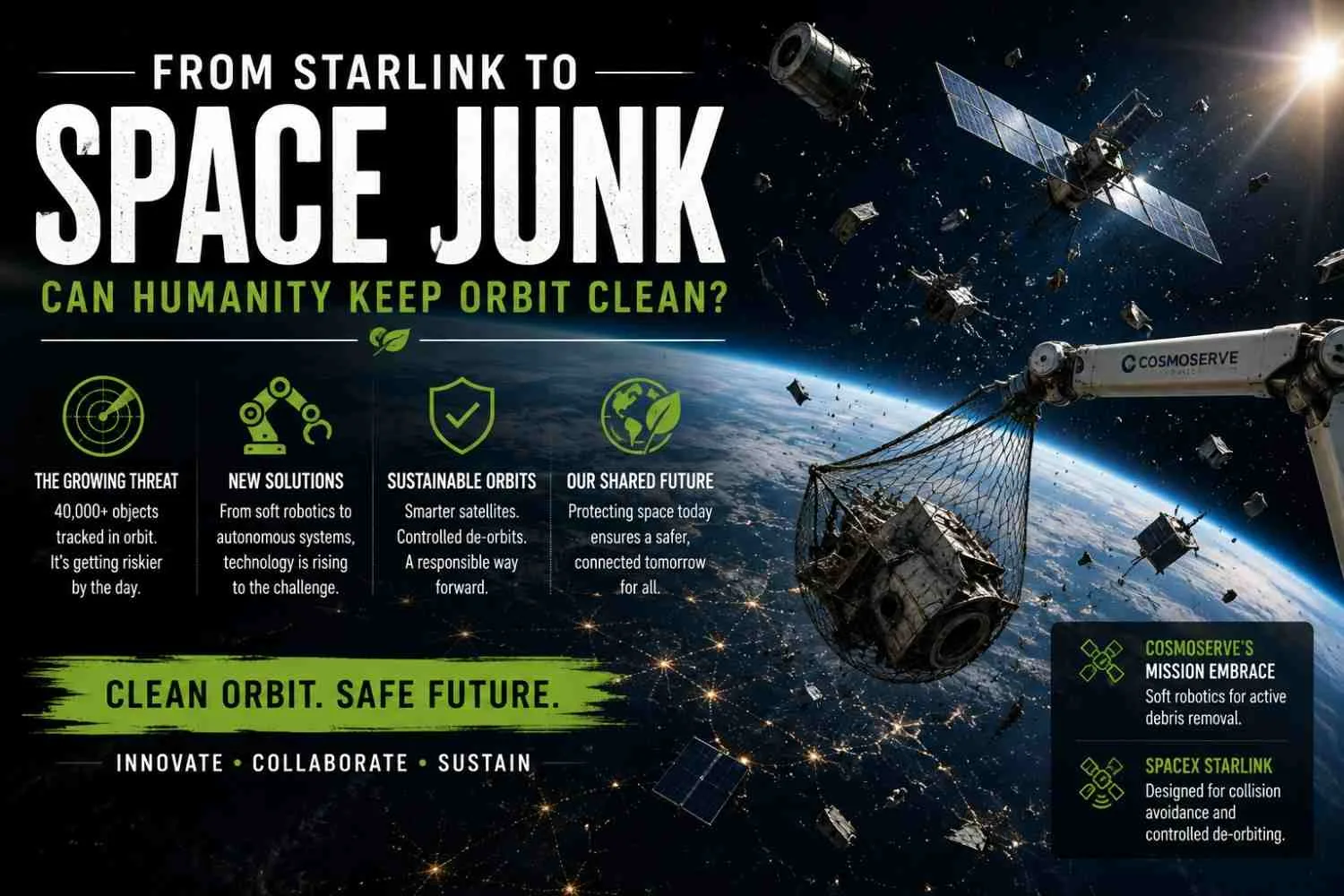
| Satellites may be transforming life on Earth, but their afterlife is creating a problem above it. From Cosmoserve’s robotic debris-capture technology to SpaceX’s controlled de-orbiting strategy, new approaches are emerging to keep Earth’s orbital environment sustainable. |
Summary Cosmoserve Space is approaching the problem from the removal side. Its Mission Embrace is testing soft robotic technology that could eventually help capture inactive satellites and other objects already stranded in the orbit. SpaceX, led by Elon Musk, is approaching it differently: Starlink satellites can adjust their orbits to avoid collisions and are designed to be deliberately de-orbited when they reach the end of their operational life. |
Keywords space debris, space junk, Starlink, SpaceX, Cosmoserve Space, active debris removal, orbital debris, space sustainability, satellite sustainability, satellite de-orbiting, orbital sustainability, space debris removal, Mission Embrace, collision avoidance, satellite disposal, sustainable space technology, Earth orbit, orbital environment, space environment, responsible satellite design |

The two approaches point to the same larger question:
Can humanity keep using space without turning its most valuable orbital zones into a dumping ground?
But why does space need cleaning in the first place?
Every satellite sent into orbit serves a purpose, from communication and navigation to weather forecasting, Earth observation and scientific research.
As our reliance on space-based infrastructure grows, so does the amount of hardware orbiting Earth.
But when satellites stop functioning, they do not simply disappear and nor do the fragments left behind by previous launches, break-ups and collisions simply disappear.
ESA’s 2025 Space Environment Report estimated that around 40,000 objects were being tracked in orbit, of which only about 11,000 were active payloads. The agency also warned that the debris population continues to grow rapidly.
The growing number of objects in orbit is only part of the challenge. Their extraordinary speeds make collisions far more dangerous.
A collision between two spacecraft or between a satellite and a piece of debris can produce additional fragments, creating new risks for other missions.
Those fragments can then trigger further collisions, potentially multiplying the problem.
That means orbital debris can continue to become a greater threat even without new satellites being launched.
What counts as space debris?
Active satellites
Inactive satellites
Rocket remnants
Smaller fragments
Collision-risk zone
So, what is Cosmoserve actually trying to do?
This is where Hyderabad-based Cosmoserve Space enters the picture.
The company is developing Active Debris Removal (ADR) technology, which goes beyond tracking orbital debris to physically capturing objects that are no longer useful.
Its Mission Embrace focuses on a soft robotic capture mechanism. Rather than relying solely on conventional docking systems, the technology uses a robotic approach to capture objects in orbit. Cosmoserve has said it took the system from concept to flight-ready hardware in about four months.
But there is an important distinction.
Mission Embrace is a technology demonstration, not proof that Cosmoserve is already removing large quantities of debris from orbit. Its significance lies in testing a technology that could eventually support debris-removal and in-orbit servicing missions.
That matters because capturing a defunct satellite is far more complicated than simply locating it.
A servicing spacecraft must identify its target, approach it safely and operate around an object that may no longer be able to communicate, control its movement or manoeuvre away from the approaching spacecraft.
Then what is Elon Musk’s SpaceX doing differently?
SpaceX has built one of the world’s largest satellite constellations through Starlink.
As of 27 August 2026, 11,102 Starlink satellites had been launched, with 11,087 reported as operational, according to current tracking data.
That scale brings a different sustainability challenge: what happens when thousands of satellites reach the end of their useful lives?
SpaceX’s approach is largely focused on prevention, manoeuvrability and controlled disposal.
Starlink satellites are designed with propulsion and manoeuvring capabilities that allow them to adjust their orbits, avoid collisions and eventually descend into the atmosphere. SpaceX’s sustainability documentation states that satellites undergoing de-orbiting retain manoeuvrability and collision-avoidance capabilities during their descent.
In 2026, SpaceX also began lowering the orbits of about 4,400 Starlink satellites from approximately 550 km to 480 km. The lower altitude is intended to reduce the amount of time satellites remain in orbit after their operational lives and, in turn, limit long-term debris and collision risks.
COMPARISON INFOGRAPHIC
| Cosmoserve | SpaceX / Starlink |
|---|---|
| Developing active debris removal | Focuses on satellite life-cycle management |
| Builds technology to capture objects | Satellites are designed to manoeuvre |
| Targets inactive or stranded objects | Controls its own satellites |
| Soft robotic capture is a key technology | Controlled de-orbiting is a key strategy |
| Still at the technology-development stage | Already operating at constellation scale |
So, can prevention alone solve the space-junk problem?
That is where the difference between preventing new debris and removing existing debris becomes important.
SpaceX’s approach can help ensure that its own satellites do not remain in orbit indefinitely after their mission end. But controlled de-orbiting addresses future disposal; it does not remove the older, inactive objects and fragments already circling Earth.
That is the gap that active debris-removal companies are trying to address.
The challenge is also becoming larger as more satellites are launched. Expanding satellite networks can bring greater connectivity, communication and other services, but they also add more traffic to already crowded orbital regions.
In other words, keeping new debris from accumulating is only one part of the solution. The harder question is what to do with the debris that is already there.
HOW DO WE KEEP SPACE CLEAN?
Design better satellites
↓
Track objects in orbit
↓
Avoid collisions
↓
De-orbit satellites responsibly
↓
Remove dangerous existing debris
Is cleaning space really about Cosmoserve versus Musk?
Not quite.
The bigger story is not a contest between Cosmoserve and SpaceX. It is whether the space industry can develop a system in which prevention and removal work together to keep Earth’s orbit usable.
SpaceX demonstrates what large-scale satellite operators can do when collision avoidance, manoeuvrability and end-of-life disposal are built into a constellation from the beginning.
Cosmoserve represents a different but increasingly important need: technology that can deal with objects already left inactive in orbit and potentially difficult to control or remove.
Neither approach, on its own, solves the entire space-junk problem.
As launches accelerate and more companies enter the space economy, orbital sustainability will depend on several layers working together: better satellite design, accurate tracking, collision avoidance, responsible end-of-life disposal and, where necessary, active removal of high-risk debris.
That changes the question at the heart of the space race.
It is no longer only about who can launch the most satellites, build the biggest constellation or reach orbit the fastest. It is about who takes responsibility for what happens after those satellites stop working.
True space sustainability will not be measured by how much we put into orbit, but by how responsibly we manage what remains there.
Primary sources:
European Space Agency — Space Environment Report 2025 — Supports the orbital-debris figures, including ~40,000 tracked objects and ~11,000 active payloads, and the need for active debris removal.
- ESA Space Debris Environment Statistics — Provides updated 2026 statistics on tracked objects, satellites, debris populations and orbital mass.
- SpaceX / Starlink — Commitment to Space Sustainability — Supports Starlink’s collision-avoidance, controlled de-orbiting and satellite sustainability approach.
- SpaceX — Approach to Space Sustainability and Safety — Supports information on satellite manoeuvrability, collision avoidance, low-altitude operation, controlled de-orbiting and design-for-demise.
Cosmoserve / Mission Embrace
- Cosmoserve Space — Official Website — Supports Cosmoserve’s Active Debris Removal technology, orbital-debris removal mission and its “Reviver”/“Mothercraft” concepts.
- The New Indian Express — Mission Embrace — Supports the Mission Embrace soft-robotic capture demonstration and its development timeline.
- Business Standard — Cosmoserve Mission Embrace — Provides additional reporting on the soft robotic capture mechanism and its role in Active Debris Removal.





Add a Comment