

| India’s sugar market is facing a delicate balancing act as rising prices, duty-free imports and the rapid expansion of ethanol production put food security, farmer interests and energy goals in tension. |
Summary India’s decision to allow duty-free imports of up to 10 lakh tonnes of raw sugar marks a major shift for a country that has traditionally been a large sugar producer and exporter. The move comes as domestic prices rise ahead of the festive season, with tighter stockholding limits also introduced to improve availability and curb hoarding. At the same time, India’s rapid expansion of ethanol blending has increased the use of sugarcane as an energy feedstock, raising questions about how the country can balance fuel production with domestic sugar requirements. The article highlights that ethanol is not solely responsible for rising sugar prices, with weather, rainfall, production, demand and stock levels also playing important roles. Climate vulnerability adds another layer, as sugarcane is water-intensive and increasingly exposed to changing rainfall and water availability. The way forward, the article argues, is not to choose between sugar and ethanol but to build a more flexible, climate-sensitive and diversified policy that can support both affordable food and sustainable fuel. |
For decades, India has occupied a dominant position in the global sugar economy. As one of the world's largest producers and consumers of sugar, the country has generally focused on managing domestic production, maintaining adequate stocks and, in favourable years, exporting surplus sugar. However, the recent decision of the Government of India to permit duty-free imports of 10 lakh tonnes, or one million tonnes, of raw sugar marks a significant policy development. The decision is particularly important because it represents India's first major move towards sugar imports in nearly a decade.
The immediate reason for the intervention is clear: domestic sugar prices have risen sharply at a time when India is approaching the high-demand festive season. The government has therefore adopted a combination of measures, including tighter stockholding restrictions and duty-free imports, to increase availability and reduce speculative pressure in the market.
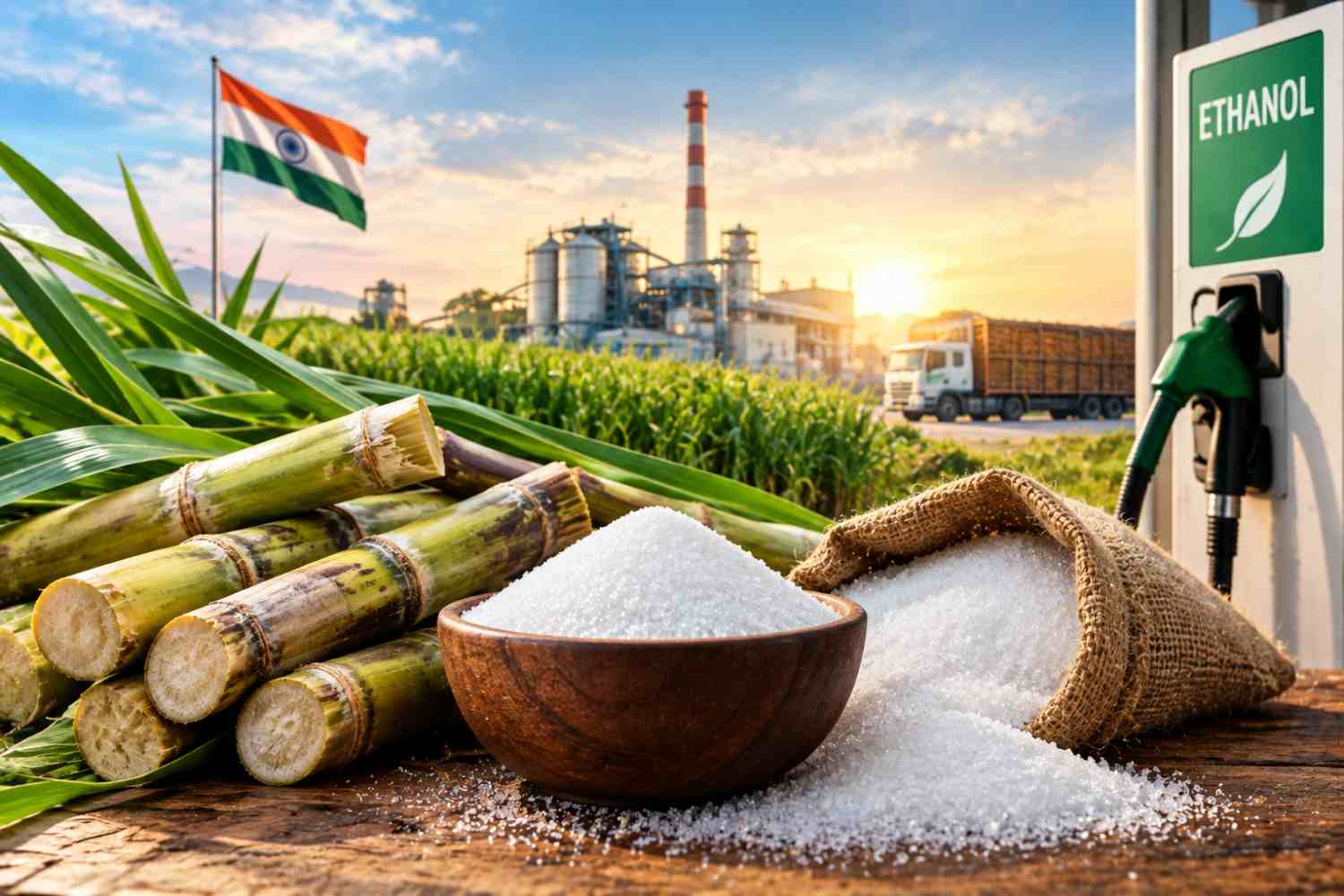
However, the present situation raises a larger and more significant policy question. At a time when India has been rapidly expanding its Ethanol Blending Programme and encouraging the diversion of sugarcane-based feedstocks towards ethanol production, can the country simultaneously ensure sufficient sugar availability for domestic consumers? The decision to import sugar therefore reflects more than a temporary market intervention. It exposes an emerging tension between food availability, price stability, farmer interests and energy security.
Why Is India Importing Sugar?
The government's decision allows duty-free imports of up to one million tonnes of raw sugar until October 31, 2026. Normally, India imposes a high import duty on sugar, making the present zero-duty quota a significant departure from the usual policy approach. The objective is to improve domestic availability and moderate record-high prices before the period of increased festive consumption.
The urgency of the situation is reflected in the other measures introduced by the government. Bulk consumers using more than 10 tonnes of sugar per month have been subjected to stricter inventory limits, with stockholding restricted to approximately 15 days' consumption during the specified period. These restrictions are intended to discourage excessive accumulation and prevent hoarding from aggravating the price rise.
The decision is also economically significant because India has historically been more closely associated with sugar exports than imports. The country's opening sugar stocks have declined considerably, while concerns over weather conditions in major sugarcane-producing regions have increased uncertainty about future production.
Thus, the import decision is essentially an attempt to address a simple but politically sensitive problem: when domestic supply becomes tight and prices rise, the burden is ultimately borne by consumers.
The Festive Season and the Politics of Sugar Prices
Sugar is not merely another agricultural commodity in India. It is a widely consumed household product and an essential ingredient for a large number of food-processing industries, confectionery businesses, beverage manufacturers and traditional sweet producers.
Demand generally rises during the period between August and November because of major festivals and celebrations. This seasonal increase in consumption can intensify the effects of already limited supply. Reuters reported that the government considered several measures, including duty-free imports and tighter stock controls, as prices increased sharply ahead of the festive season.
The government's intervention therefore has an important consumer-protection dimension. Allowing additional sugar into the domestic market may increase supply and reduce the possibility that consumers will face even higher prices during a period of peak demand.
At the same time, imports alone cannot solve the structural causes of supply pressure. If domestic production remains vulnerable to changing rainfall patterns, water availability and fluctuations in sugarcane output, India may continue to face periodic tensions between production, consumption and industrial demand.
The Ethanol Blending Programme: A Major Policy Success with New Challenges
India's Ethanol Blending Programme has been one of the country's major energy-policy initiatives. The programme aims to reduce dependence on imported crude oil, support cleaner fuel alternatives and create additional income opportunities within the agricultural economy.
India's ethanol blending journey began with pilot initiatives in 2001 and gradually expanded through policy reforms and investment. The National Policy on Biofuels, introduced in 2018, played an important role in expanding the ecosystem for ethanol production.
The growth in ethanol blending has been particularly rapid in recent years. Government data shows that the blending percentage increased from approximately 8.1% in Ethanol Supply Year 2020–21 to 19.2% in 2024–25, while the programme reached the 20% level during the 2025–26 supply year period reported by the government.
The programme offers several important advantages. It can reduce dependence on imported petroleum, create a stable market for agricultural feedstocks, support rural investment and contribute to lower emissions. The government also argues that ethanol provides greater energy security by reducing India's exposure to fluctuations in international crude oil markets.
The Sugar-versus-Ethanol Dilemma
The recent rise in sugar prices has brought this question into sharper focus. India was considering restricting the use of sugarcane for ethanol production in the upcoming season in order to increase sugar output and address concerns about tight domestic availability. This indicates that policymakers themselves recognise the possibility of a trade-off between the use of sugarcane resources for fuel production and the need to maintain sufficient sugar supplies.
This does not mean that ethanol production alone is responsible for the current increase in sugar prices. Such a conclusion would be overly simplistic. Weather conditions, rainfall shortages, expected production levels, domestic demand, market expectations and stock management can all influence sugar prices.
Nevertheless, the situation demonstrates the difficulty of pursuing multiple policy objectives using the same agricultural resource.
The Economic Impact of the Import Decision
The immediate economic objective of the duty-free import decision is price stabilisation. Additional supplies can reduce scarcity and weaken speculative pressure in the domestic market.
However, imports may also have consequences for domestic sugar mills and farmers. If imported sugar enters the market at a time when domestic producers are selling their stocks, lower prices could affect industry revenues. The government must therefore carefully manage the timing and quantity of imports.
The current import quota of one million tonnes appears to represent an attempt to strike a balance rather than permanently open the domestic market to unrestricted imports. The policy is time-bound, with imports permitted until October 31, 2026.
The decision may also influence international sugar markets. Because of India's size and importance in the global sugar economy, a significant change in its import or export policy can affect global prices and trading expectations.
Climate Change and the Future of Sugarcane Production
The current situation also highlights a broader concern: climate vulnerability. Sugarcane is a water-intensive crop, and production can be affected by changing rainfall patterns and water availability. Concerns regarding reduced rainfall in important sugar-producing regions have already contributed to uncertainty about future production.
In the future, India may face more frequent situations in which agricultural production is affected by climate variability. This creates a strong argument for diversifying ethanol feedstocks. Rather than depending excessively on sugarcane-based sources, India can continue expanding the use of alternative feedstocks such as maize, agricultural residues and other approved sources. The government's ethanol policy has already moved towards a broader feedstock ecosystem, reducing the need for ethanol expansion to depend entirely on sugarcane. A diversified ethanol strategy could help reduce the direct pressure on the sugar sector during years of lower production.
Way Ahead
India's decision to permit duty-free imports of 10 lakh tonnes of raw sugar is more than an emergency response to rising prices. It represents a significant moment in the evolution of India's agricultural, trade and energy policies. The immediate priority is understandably to increase supply and provide relief to consumers during a period of high demand. Tighter stockholding limits and temporary imports may help achieve this objective.
India's Ethanol Blending Programme remains an important achievement in the country's transition towards greater energy security. However, the recent sugar shortage demonstrates that ambitious fuel policies must remain responsive to agricultural production and consumer needs.
The real challenge for India is therefore not to choose between sugar and ethanol. It is to create a policy framework capable of ensuring both affordable food and sustainable fuel.
The recent import decision should thus be seen not as a policy failure, but as a warning that the next phase of India's sugar and ethanol strategy must be more flexible, climate-sensitive, data-driven and balanced.
ABOUT AUTHOR

Mr. Shasheesh Kumar Singh is a Phd Scholar, DAVV, Indore




Add a Comment