Environmental Sustainability Practices

Focuses on strategies and actions that reduce environmental impact and promote sustainable use of natural resources.

Showing 12/40

24 Jul 2026

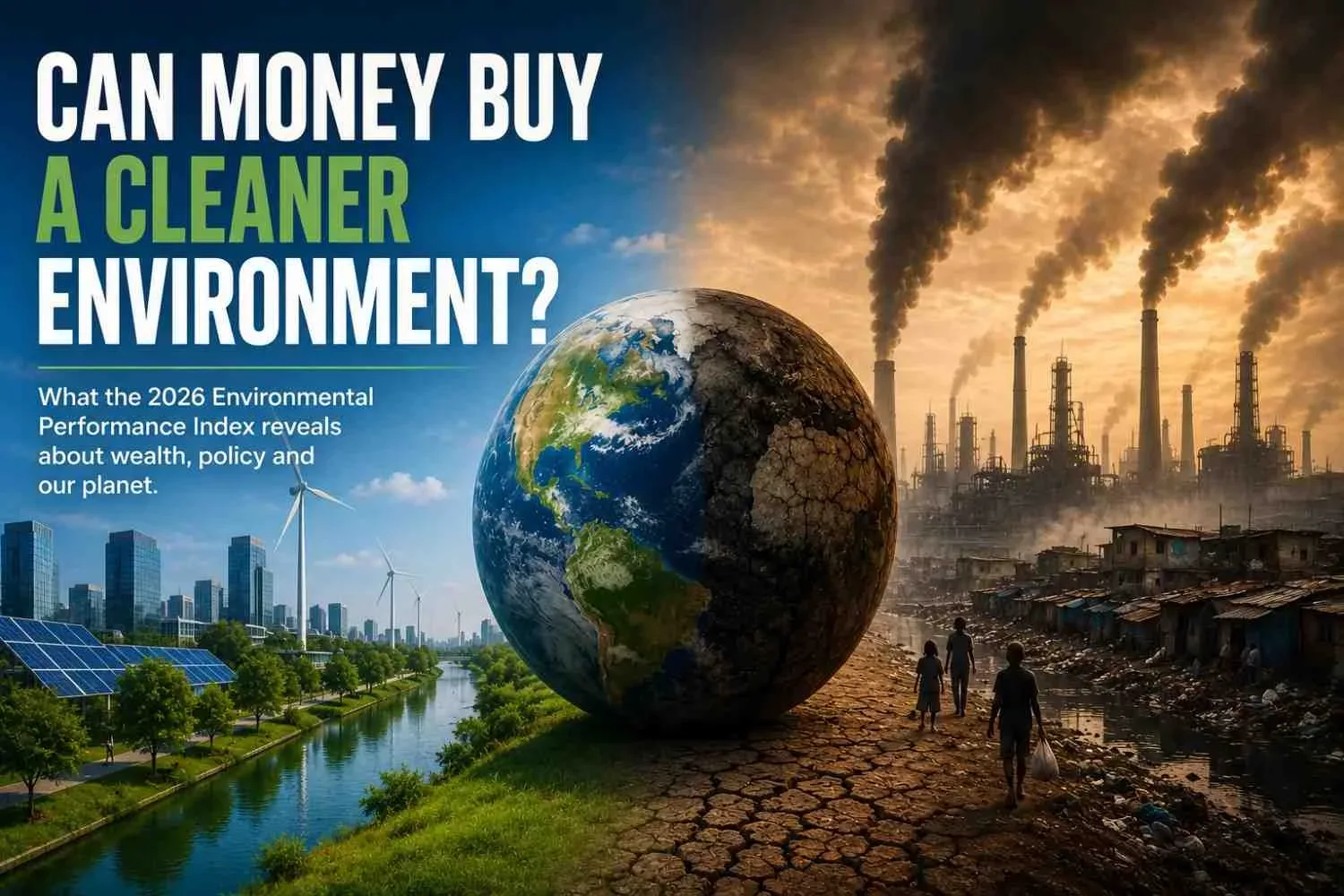
The latest Environmental Performance Index reveals global leaders and laggards, while raising important questions about wealth, policy and environmental progress.   Imagine two countries. One enjoys clean rivers, healthy forests, and fresh air. The other struggles with polluted cities, shrinking biodiversity, and rising climate risks. On the surface, the difference looks financial - richer nations simply have more means to safeguard the environment.  But is it so? The 2026 Environmental Performance Index (EPI) has once again highlighted on how nations rank on nature conservation and public health.Estonia claimed the top position this year, while European countries continued to dominate the rankings.Many lower-income countries continued to rank near the bottom, but the results raise a bigger question: Is environmental performance simply a reflection of economic wealth? It’s not a simple yes-or-no answer! Developed by Yale researchers, the Environmental Performance Index ranks countries based on dozens of environmental indicators. It evaluates factors such as air quality, sanitation, waste, biodiversity, climate policy, and ecosystem protection. The index goes beyond a single environmental measure, evaluating how effectively countries pursue economic growth while safeguarding the environment. The rankings matter every year because they tell a bigger story: not just who’s ahead or behind, but what path each country chose for development.Estonia's climb to the top is the result of long-term planning. Over the years, it has strengthened environmental policies while investing in clean energy, efficient waste management, and digital systems that support better management of natural resources.Across Europe, many countries have shown that economic growth and strong environmental standards can advance together. These results raise a further issue: if the European model is so effective, why has it not been applied globally?For many developing countries, the issue is less about ambition and more about competing priorities. With limited resources, governments must balance environmental action alongside poverty reduction, healthcare, housing, employment, and infrastructure.Many countries lack the financial resources needed to invest in clean technology or to restore degraded ecosystems. Rapid urbanisation makes it worse. Unchecked expansion of roads, housing, and industry often leads to higher pollution, shrinking green spaces, and increasing pressure on natural resources.The challenge is compounded by climate change. Countries with the lowest emissions are often among the most vulnerable to extreme weather, forcing governments to spend scarce resources on recovery instead of long-term environmental improvements. Comparing countries at different stages of economic development can therefore be misleading. A lower ranking does not necessarily indicate weak environmental commitment. It often reflects differences in income, governance, access to technology, and historical development. Similarly, a higher ranking does not mean every environmental challenge has been resolved.Experts say the bigger story lies beyond the rankings. Instead of focusing on who tops the list, they encourage a closer look at how countries are improving and where further action is needed. Ultimately, sustained progress is a better measure of success than rank alone. Countries that steadily improve air quality, expand renewable energy, strengthen waste management, or protect biodiversity are making meaningful progress, even if their rankings remain low. At the same time, top-performing countries cannot afford to be complacent, as environmental and climate challenges continue to evolve. The 2026 EPI also highlights that environmental protection cannot rest solely with governments. Businesses can reduce their environmental impact by adopting cleaner production methods and cutting emissions. Researchers help shape better policies through scientific evidence. Communities protect local ecosystems, while individuals contribute by conserving water, reducing waste, and choosing more sustainable products. Perhaps the biggest takeaway from this year's rankings is that wealth alone does not define environmental success. Lasting progress depends just as much on effective policies, strong institutions, and sustained action. Experts say lasting environmental progress is built on strong institutions, effective policies, public participation, and long-term planning. Countries that treat sustainability as a continuous priority rather than a short-term initiative are often the ones that achieve enduring results. The real value of the 2026 Environmental Performance Index lies beyond the rankings. Instead of debating who stands at the top or bottom, it should prompt every country to focus on a more meaningful challenge: What practical actions can we take today to create a cleaner, healthier, and more resilient future? At the end of the day, environmental progress is measured not by a country's position on a global index but by the difference it makes on the ground-cleaner air, healthier ecosystems, and better lives for the people who rely on them.   Sources:  Centre for Integrated Earth System InformationYale Centre for Geospatial Solutions   ...Read more

24 Jul 2026

When coastal communities get the right support, the journey from the sea to the market can become a story of resilience, livelihoods and sustainable growth.   Kolkata |24 July, 2026:   For thousands of families along India's coastline, fishing is more than a livelihood- it is a way of life.But rising sea levels, shifting weather patterns, and declining fish stocks are making it harder for coastal communities to sustain their livelihoods. As climate threats increase, communities are exploring new approaches to protect their incomes and natural resources. On July 9, 2026, three women's self-help groups (SHGs) from Maharashtra brought value-added seafood products to a national exhibition under the Enhancing Climate Resilience of India's Coastal Communities (ECRICC) project, highlighting new livelihood opportunities for coastal communities.The initiative proves climate adaptation isn’t just about resilience - it’s about new jobs and income. By backing women entrepreneurs, sustainable fisheries and better market access, it shifts climate action from cost to opportunity. Instead of selling fresh fish at modest prices, the women are creating value-added seafood products through processing, packaging, and branding, helping them earn more from every catch.According to experts, this approach boosts household incomes, raises profit margins, cuts post-harvest losses, and generates new jobs in coastal communities.It also promotes improved food safety standards and gives producers access to wider markets and new customers beyond their local communities. The process begins with seafood sourced responsibly from local fishermen, followed by cleaning, processing, packaging and labelling prior to distribution through exhibitions, retailers and local markets. This coast-to-consumer value chain generates employment at every step - from procurement and processing to packaging, branding and marketing. Experts say models like this help communities earn more from existing resources rather than adding pressure on fish stocks.  Local Fishermen         ↓ Sustainable Fish Harvest         ↓ Cleaning & Processing         ↓ Packaging & Branding         ↓ Food Safety & Licensing         ↓ Exhibitions / Retail Markets         ↓ Consumers   The initiative is supported by the Mangrove Cell, the United Nations Development Programme (UNDP), and the Green Climate Fund under the ECRICC project.The programme equipped women with skills across the entire business chain; including food processing, quality control, branding, packaging, licensing, and enterprise management, while providing financial and business support too. These skills are helping them build businesses that can withstand climate and economic shocks. Experts say the real challenge begins after the exhibition. Long-term success will depend on building reliable supply chains, maintaining food safety standards, strengthening branding, improving logistics, and expanding access to stable markets. Quality products alone are not enough. Without strong support system, community enterprises may find it difficult to compete in larger markets.   Growing coastal businesses is only a part of the solution. Experts say long-term success will depend on balancing economic opportunities with healthy marine ecosystems through sustainable fishing, responsible sourcing, and stronger mangrove conservation. Sustainable management of local fisheries will be crucial to ensuring marine resources remain available for future generations.Experts believe wider access to finance, digital sales platforms, and organised retail networks can help women's self-help groups scale their businesses. Continued institutional support will be equally important to ensure growth is environmentally sustainable and community-driven. ProductValue AdditionCommunity BenefitDried FishHygienic processing & packagingLonger shelf life and higher incomeFish PickleReady-to-eat productBetter profit marginsFish PowderNutrient-rich food ingredientReduced fish wastePrawn PicklePremium branded productAccess to urban marketsDry Fish SnacksRetail-ready packagingEmployment for women The Maharashtra initiative suggests that climate resilience is built not only by protecting the environment but also by strengthening livelihoods. Experts say supporting women-led enterprises, improving seafood value chains, and conserving coastal ecosystemscan create a future where economic development and environmental sustainability reinforce one another.   Document Support:Press Information Bureau (9 July 2026), Mangrove Cell, Government of Maharashtra, Enhancing Climate Resilience of India's Coastal Communities (ECRICC), United Nations Development Programme (UNDP), Green Climate Fund (GCF), Food Safety and Standards Authority of India (FSSAI) – Food processing and licensing guidelines (background reference) Sources: Press Information Bureau (PIB) – 9 July 2026, Mangrove Cell, Government of Maharashtra, Enhancing Climate Resilience of India's Coastal Communities (ECRICC), United Nations Development Programme (UNDP), Green Climate Fund (GCF) ...Read more

21 Jul 2026

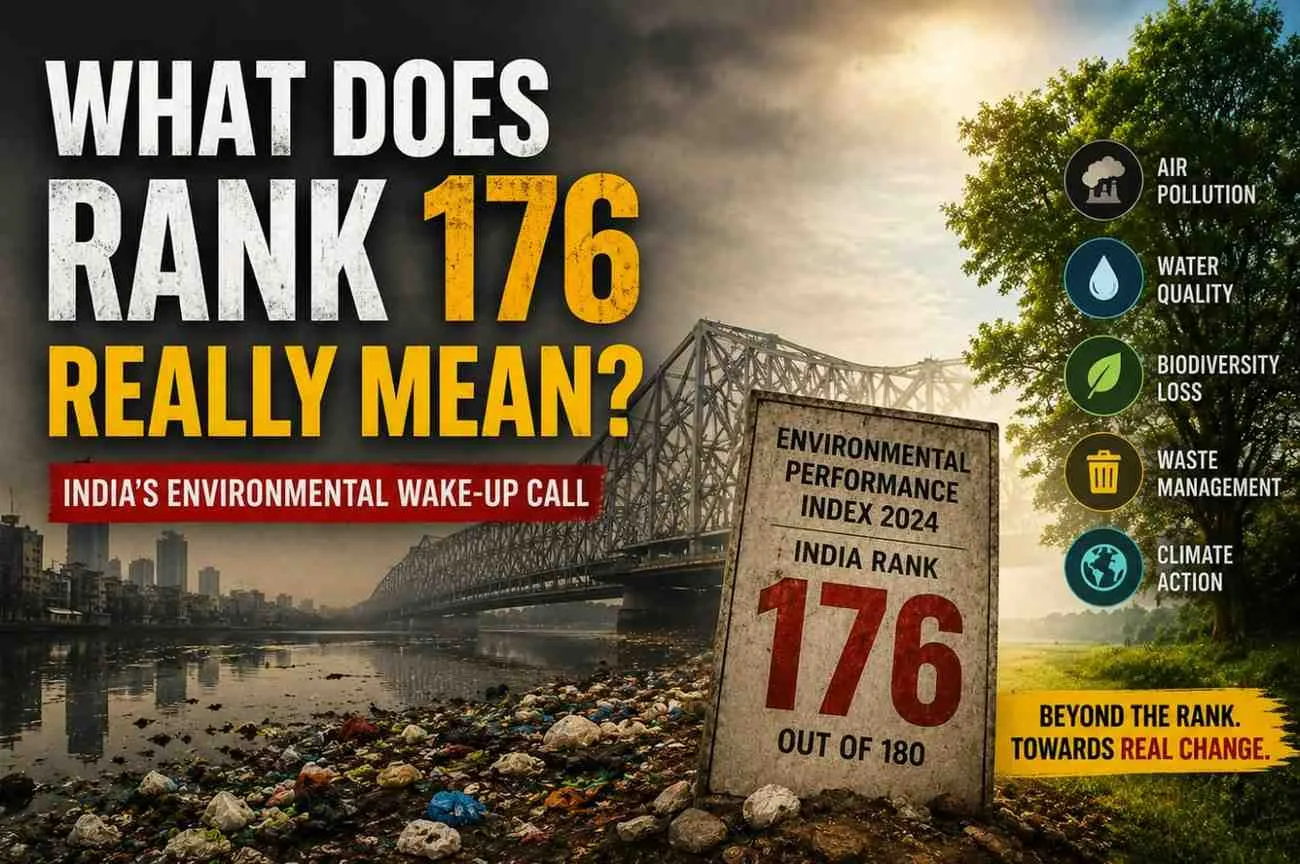
India's latest Environmental Performance Index ranking has reignited a debate that goes far beyond the final score.     Kolkata | 21 July 2026:   Another year, another low rank. India placed 176th out of 177 in the 2026 Environmental Performance Index, reigniting questions about what’s working, what isn’t, and how we measure success.  Out in July from Yale, the EPI scores 177 countries on 47 measures of health, nature, and climate. The numbers have sparked arguments, but the experts are saying not to read it as a report card but as a trend line Environmental Performance Index (2024)IndiaGlobal Rank176 / 180Overall EPI Score27.6 / 100Environmental Health Rank177Ecosystem Vitality Rank171Climate Change Rank133   The EPI measures performance across air quality, water, sanitation, waste, biodiversity, forests, emissions and more. Experts say this approach captures environmental health more broadly than climate goals or renewable capacity by themselves. Despite strong progress on renewable energy, India still lags in air pollution, waste management, water quality and biodiversity conservation. Experts note that clean power does not automatically address problems such as contaminated water bodies, waste mismanagement, depleting habitats, and urban air pollution. Since 2024, very little has changed. Until India tackles air pollution and gets serious on waste management, water management and ecosystem, the rankings won’t budge – no matter how fast renewable energy grows.The Ministry of Environment, Forest and Climate Change says environmental protection remains a priority, with programmes centred on renewable energy, afforestation, pollution control, and ecosystem conservation. Experts agree the direction is right, but real progress will depend on stronger implementation, consistent monitoring, and better coordination between the Centre and the states. Comparing rankings is only part of the picture. Each country begins its climate journey under different circumstances.Experts say that we need to look at emissions per person, total emissions, and where policy is headed. India is among the world's largest emitters largely because of its population. But on a per-person basis, its emissions remain well below those of many developed countries. India is investing in clean energy, electric mobility, green hydrogen, and forest restoration. But experts say the real measure of success lies elsewhere: cleaner air, safer water, healthier ecosystems, and less pollution. Without visible improvements on the ground, neither environmental outcomes nor EPI rankings are likely to improve. The EPI is more than a ranking- it is a reminder of where improvement is still needed. Experts say the real goal should not be a higher position on a global index, but cleaner air, healthier rivers, stronger ecosystems, and a better quality of life for millions. Source:  Yale Centre for Environmental Law & Policy, Environmental Performance Index 2024 (in partnership with Columbia University Centre for International Earth Science Information Network) ...Read more

20 Jul 2026

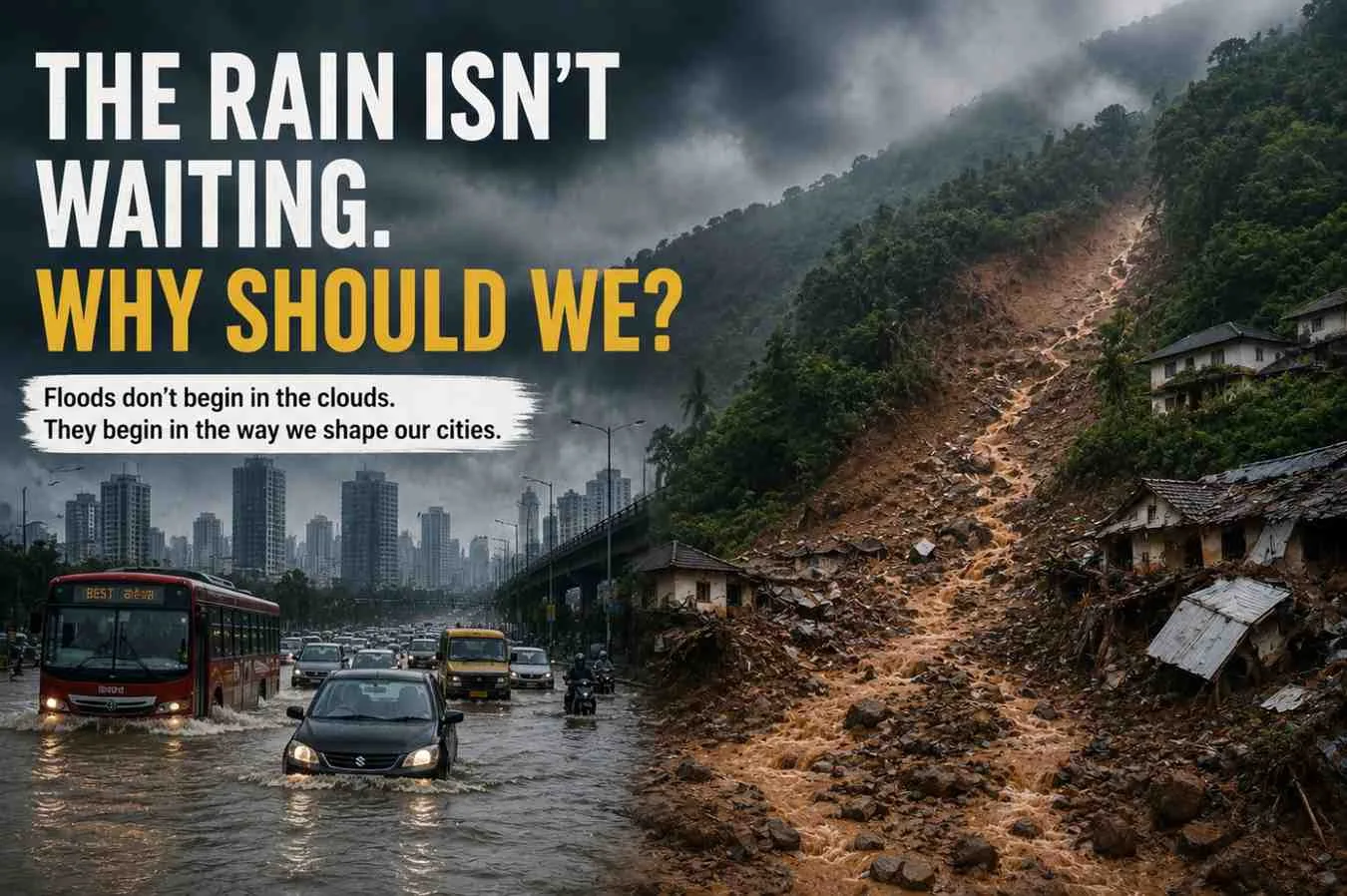
Floods don't begin in the clouds. They begin in the way we shape our cities.    By Tiyasha Ghosh    Can we keep blaming just the rain for floods? Or are our cities part of the problem even today? The monsoon arrives with hope, every year.Water for our reservoirs, life for our farms, and relief from the heat.However, every year, it leaves behind waterlogged streets, damaged infrastructure, destroyed homes and many lost lives. Two places, two disasters: Mumbai drowned, Wayanad collapsed! One is a city of skyscrapers and the other is a quiet forested district. Different locations but identical warning! The sky changed faster than the concrete below it. Our infrastructure was designed for a climate that no longer exists. We used old rainfall recording system and assumed stability. Today, climate change delivers heavier rain with no warning, everything at once.  Rain is arriving faster than we can handle. Cloudbursts are turning mountains into landslide zones. The question isn’t “how much rain this season?” But the question isn’t “how much?” It’s “how fast?” - and can our land and roads survive it? Which leaves us with one question: Whether India’s design standards use up-to-date rainfall data, or continue to rely on old IDF curves that don’t represent today’s climate.According to engineers, many drainage systems were built to handle rainfall expected once in several decades. However, climate records indicate that extreme rainfall events are occurring more frequently. Events once termed "once-in-a-century" storms may be happening much more often now.You can see the impact all over the country. Roads vanish underwater in hours. Drains can’t keep up. Buildings drown even after crores spent on their upgrades. In the hills, the ground itself gives way - mud, rocks and debris crashing into villages below. According to experts, the cause goes beyond rainfall - it points to failures in urban and infrastructure planning. Wetlands that previously stored excess rainwater have been reclaimed for development. Natural drainage channels have been constricted or obstructed. Hillsides have been cut to accommodate roads, hotels and buildings. In many vulnerable regions, declining forest cover has reduced the land’s capacity to absorb water during heavy rainfall. The cost goes far beyond concrete and steel. People lose homes and income. Kids stay out of school. Businesses close. Transport comes to a standstill. Hospitals get overcrowded. These storms are no longer just environmental problems - they hit our economy and society too. Experts argue that India needs to stop treating floods, landslides and waterlogging as separate events. They point to a larger issue like climate change, rapid urbanisation and weak planning coming all together. Unless cities plan for future rainfall instead of past records, every monsoon will bring the same question: Are we preparing for the next storm- or simply recovering from the last one? Heavy Rain       ↓ Wetlands & Lakes       ↓ Natural Streams       ↓ Rivers       ↓ Groundwater Recharge   (Current Situation)   Heavy Rain       ↓ Concrete Roads       ↓ Blocked Drains       ↓ Waterlogging       ↓ Floods & Landslides Natural drainage systems once absorbed excess rainwater. Urbanisation has disrupted these pathways, increasing flood risks The rain hasn't changed. The ground beneath it, has.Like water on concrete instead of a sponge, India's cities can no longer absorb what falls from the sky. Nature once managed the rain. Wetlands, forests, floodplains, and open land worked together to absorb, slow, and store water. Today, many of these natural safeguards have disappeared. Wetlands are disappearing beneath housing projects. Floodplains are turning into commercial hubs. Hillsides are being cut for development. And across India's cities, concrete has replaced the open ground that once soaked up rain. With heavy downpour, water becomes stagnant with no outlet for respite. It keeps flowing until it floods roads, homes, and entire neighbourhoods. Floods today are shaped as much by land use as by rainfall, experts say. Here's why. How do engineers decide how big a drain should be? They use Intensity-Duration-Frequency (IDF) curves, which estimate how much rain can fall, how quickly it may arrive, and how often such events are expected. The problem? A lot of these rules were made using old rainfall data. But climate change has changed those patterns. Cloudbursts have grown more frequent and short-duration rainfall has become more intense. For example, 100 millimetres of rain that previously fell for an entire day can now occur within two to three hours. Drainage systems have not evolved in line with changing rainfall conditions. Many continue to operate based on historical rainfall patterns that are no longer valid. Experts say India can no longer rely on yesterday's rainfall patterns. Infrastructure must be designed using today's climate realities. The challenge is even greater in the hills. Unlike cities, where water usually causes flooding, mountain regions face another danger- landslides. Cutting down forests and carving slopes for roads or buildings loosens up the soil. When heavy and long rainfall persists, water soaks in, weakens the slope, and everything collapses. The Wayanad landslide was a painful reminder: when heavy rain hits fragile hills and if we ignore the risks, it can turn deadly.Scientists say this is why climate adaptation can no longer remain separated from urban or infrastructure planning. Every new road, bridge, housing project, and drainage system must answer one question: Is it built for tomorrow's rainfall? ParameterEarlier ClimateCurrent ClimateRainfall PatternSpread over longer periodsIntense rainfall in short burstsDrainage DesignBased on historical rainfallFrequently exceededWetlandsLarger natural storageRapidly shrinkingFlood FrequencyLess frequentIncreasingClimate RiskModerateHigh Rain may trigger the disaster. But building for yesterday's climate could make it inevitable. Experts say India must rethink how it builds its cities. Instead of forcing water to adapt to development, development must adapt to water. And that begins with something many places have lost, i.e., space. Protecting floodplains, wetlands, hills, and stormwater channels isn't just about conserving nature- it's about protecting people. Because when nature's defenses disappear, concrete isn't enough. Experts say cities can't plan for tomorrow using yesterday's flood maps. Updated rainfall data should guide every development decision, and flood-prone areas must be identified before new roads, housing projects, or commercial complexes that are built. Experts also say IDF curves should be updated regularly so drainage systems are built for today's climate- not yesterday's. Technology can also make a huge difference. Floods can't always be prevented. But with accurate forecasts and real-time monitoring, their impact can be reduced through timely warnings and faster action. But technology alone is not enough; good governance is equally important. Experts say flood management shouldn't begin when the rain starts- it should begin long before. Drains need to be cleared before the monsoon, natural waterways kept free of invasions, and construction in high-risk areas are strictly regulated. Most importantly, agencies must work together before the disaster strikes. Communities also play a crucial role. Communities hold critical, lived knowledge like which streets flood first, which drains fail annually, and which areas remain mostly exposed. When local knowledge becomes part of disaster planning, warnings arrive sooner and responses become more effective. Small actions can also create a big impact. Keeping drains free of plastic waste, protecting neighbourhood ponds, planting trees, avoiding construction on natural drainage channels and following official weather advisories all help reduce flood risks. The lesson extends beyond Mumbai or Wayanad. Urban growth and climate change are colliding. One is covering the ground with concrete, the other is bringing heavier rain. What we build today will shape tomorrow's disasters. India has a choice: keep rebuilding after every disaster- or start preventing the next one. Or we can act now by investing in smarter planning, stronger natural defences, modern infrastructure and cities built for a changing climate. Because resilience is not built during an emergency. It is built way before the first raindrop falls. The cost of preparing may be high but the cost of not preparing will be higher. Mumbai and Wayanad were more than disasters - they were warnings. AspectMumbaiWayanadMain HazardUrban FloodingLandslidesPrimary CauseBlocked drainage & urbanisationFragile slopes & intense rainfallNatural Buffer LostWetlands & mangrovesForest coverMain ImpactWaterlogging & transport disruptionLoss of lives & infrastructure For decades, India has responded after the damage has been done. But experts say rebuilding after every flood and landslide is no longer enough in a climate where extreme weather is becoming the new normal. The focus must shift now from disaster response to disaster prevention. The solution begins with working alongside nature - protecting wetlands, restoring rivers, safeguarding forests, and modernizing drainage standards. It also means planning every new project around future rainfall, not outdated climate records. Climate resilience begins with collective action.Governments, businesses, planners, engineers, and citizens all have a major role to play. Because every protected wetland, every clear drain, and every preserved green space make a city stronger when the next storm arrives. The cost of acting may seem high today but the cost of doing nothing is higher. Every flooded street, every collapsed hillside, and every displaced family carry the same message: preparing before disaster is less costly than rebuilding after. Nature has always played by its own rules. Water will always find its way. Rivers will always seek their floodplains. Hills will always become unstable when forests disappear and slopes are pushed beyond their limits. The real choice is whether we build with nature- or keep building against it. Resilience isn't about rebuilding faster. It's about ensuring there's less to rebuild. As India enters a warmer and more uncertain future, every road, bridge, neighbourhood, and city will reflect the choices we make today. Because tomorrow's resilience is being built long before the next storm arrives. DOCUMENT & DATA STACK  DocumentPurposeIndia Meteorological Department (IMD) Rainfall DataCompare historical and current rainfall intensity.National Disaster Management Authority (NDMA) – Urban Flooding GuidelinesIndia's official recommendations for urban flood management.Geological Survey of India (GSI) – National Landslide Susceptibility MappingExplains why regions like Wayanad remain highly landslide-prone.IPCC Sixth Assessment Report (AR6)Scientific evidence linking climate change to increasing extreme rainfall events.Ministry of Housing & Urban Affairs (MoHUA)Urban drainage and climate-resilient infrastructure guidelines.Central Water Commission (CWC)Flood monitoring and drainage management data.ISRO National Wetland InventoryWetland loss and land-use changes across Indian cities. Key Data Points: TopicData/ObservationRainfall PatternIndia is witnessing more frequent short-duration, high-intensity rainfall events due to climate change.Urban FloodingExisting stormwater drains in many cities were designed using historical rainfall data that no longer reflects today's climate.WayanadHighly vulnerable due to steep slopes, fragile geology and extreme monsoon rainfall.WetlandsShrinking wetlands and encroached floodplains reduce natural flood storage capacity.Climate AdaptationExperts recommend updating Intensity-Duration-Frequency (IDF) curves using present-day climate observations.   ProblemSolutionUrban FloodingRestore wetlandsWaterloggingPermeable pavementsLandslidesAfforestation & slope stabilisationDrain OverflowRegular desilting & drain maintenanceClimate RiskClimate-resilient urban planning   Sources:India Meteorological Department (IMD) National Disaster Management Authority (NDMA) Geological Survey of India (GSI) Central Water Commission (CWC) Ministry of Housing & Urban Affairs (MoHUA) Intergovernmental Panel on Climate Change (IPCC AR6) ISRO National Wetland Inventory The Times of India (base report) ...Read more

19 Jul 2026

Chatbots feel weightless. The infrastructure behind them is anything but Ujjwal K Chowdhury Strapline: Every AI answer that appears instantly on a screen is the visible tip of an invisible supply chain of electricity, water, minerals and hardware — one that is expanding faster than the systems built to measure, let alone restrain, it. The illusion of weightlessness Type a question into a chatbot and the reply arrives in a second or two, apparently out of nowhere. That apparent weightlessness is the single biggest reason today’s mainstream artificial intelligence has drifted into an anti-ecological pattern: the interface hides a resource system as physical as a steel mill, while feeling as immaterial as thought itself.   Behind that reply sits a chain most users never see: a data centre drawing power from a regional grid; racks of accelerators converting electricity into heat; water or refrigerant carrying that heat away; a supply chain of mined minerals and fabricated silicon that had to exist before any of it could run; and, increasingly, an autonomous “agent” that may have quietly called the model dozens of times — planning, retrieving, verifying, retrying — before it ever answered. None of that shows up in the two seconds a user waits for a reply. That gap between visible convenience and invisible cost is where the ecological problem lives. Four ways today’s AI works against the planet 1. It treats electricity as free and infinite The scale is no longer subtle. Global data-centre electricity demand grew about 17% in 2025 — more than five times the growth rate of overall global electricity demand — while AI-specific facilities grew around 50% in the same year, according to the International Energy Agency’s most recent assessment. The agency’s satellite-tracking programme shows dedicated “AI factory” capacity has more than tripled in the past eighteen months alone. Lawrence Berkeley National Laboratory estimates that data centres already consumed 4.4% of all US electricity in 2023, on a path toward as much as 12% by 2028. This is not evenly distributed misfortune. It concentrates in specific places until local grids buckle: Ireland’s data centres now draw over a fifth of the country’s entire electricity supply, with Dublin’s local share pushing toward 80%; parts of Virginia, Arizona and the Netherlands face similar strain. AI accelerator rack density has risen roughly elevenfold since 2020 and could quadruple again within a couple of years, meaning the same floor space now demands vastly more power and cooling than it did five years ago — a physical fact that data-centre neighbourhoods, substations and transmission lines were never designed around. FACT BOX > - Data-centre electricity growth in 2025: ~17% globally (AI-specific: ~50%) > - AI-factory capacity: more than tripled in 18 months (IEA satellite tracking) > - Rack power density: up roughly 11x since 2020 > - Ireland’s data-centre electricity share: over 20% nationally, near 80% in Dublin 2. It treats water as someone else’s problem Cooling AI hardware consumes water directly, and generating the electricity that powers it consumes water indirectly, through the power plants themselves. A peer-reviewed 2025 review found that water use per AI workload can vary by more than 10,000-fold depending on the cooling system, the water intensity of the local grid, climate and utilisation — an enormous range that makes any single “AI uses X litres” headline close to meaningless without context. Earlier modelling had estimated the direct water cost of training a single large language model at roughly 700,000 litres, and projected global AI-related water withdrawal could reach several billion cubic metres by 2027. The ecological offence is not simply the volume; it is where that volume is drawn. Data centres frequently compete for water in the same watersheds as households, farms and ecosystems, often in drought-prone or rapidly urbanising regions. A company can accurately claim it “replenished” water somewhere else in the world while a local community, in the actual basin where the facility sits, faces real seasonal scarcity. Water taken from a stressed basin in July is not made whole by a replenishment project in a different river system entirely. 3. It hides its hardware and mineral footprint The environmental conversation about AI has focused heavily on electricity, but the physical hardware underneath it carries its own anti-ecological weight. Semiconductor fabrication requires high-temperature processing, fluorinated gases and ultrapure water; servers require aluminium, copper, steel and a list of critical minerals mined and processed through globally concentrated, often environmentally and socially fraught supply chains. Because the industry races to deploy ever more capable accelerators, hardware is frequently retired well before the end of its useful life — front-loading manufacturing emissions and generating electronic waste that is notoriously difficult to refurbish because of security requirements and proprietary designs. A narrow focus on data-centre electricity efficiency can therefore simply displace environmental burden upstream, onto mines and fabrication plants far from public view. 4. It multiplies itself through autonomy The newest and fastest-growing anti-ecological pattern comes from agentic AI — systems that plan, browse, write and execute code, call other software, and retry when something fails, often with limited human supervision. A single user request can silently become a “trajectory” of dozens or hundreds of underlying model and tool calls. Early research has found up to a 9.4-fold difference in energy use between agent architectures solving identical software tasks, driven mainly by unproductive loops, redundant multi-agent “debate,” and overly conservative verification steps. A 2026 study proposing an “Energy per Successful Goal” metric found agentic workflows used, on average, more than four times the energy of simpler linear approaches to reach the same outcome. Because these systems can be scheduled to run continuously, across thousands of accounts, with nobody watching each internal step, agentic AI represents autonomy without accountability — precisely the combination ecological management is built to prevent. The underlying design flaw: rebound Underneath all four patterns sits a single structural problem economists have seen before: rebound. Each time AI becomes more efficient per task, that efficiency tends to make AI cheaper and faster to deploy — which drives organisations to use far more of it, not less. A cheaper model attracts more users; a faster agent gets scheduled more often; saved computing capacity gets redirected into training an even larger model. This is a modern instance of the nineteenth-century Jevons paradox, in which more fuel-efficient steam engines led to more coal being burned overall, because efficiency expanded the ways coal could be profitably used. Today’s AI industry is repeating that pattern at digital speed: intensity per task is falling in many cases, even as total electricity, water and hardware consumption keeps climbing. HIGHLIGHT > “Efficient models can lower energy per task but may stimulate more use — a rebound effect analogous to Jevons’ paradox.” Tackling the challenge: what can actually be done The good news, according to researchers working across computer science, engineering and environmental policy, is that anti-ecological AI is a design failure, not a law of physics — and design failures can be corrected. Make lifecycle accounting mandatory, not voluntary. Model developers should be required to publish energy, water and carbon figures covering research, training, fine-tuning and expected inference use — not just the headline training run. Regulatory movement already exists: the European Union’s data-centre reporting rules and the emerging AI Act standards for general-purpose systems are early attempts to make these disclosures routine rather than exceptional. Measure outcomes, not tokens. “Energy per prompt” is a start, but a genuinely useful metric asks how much energy, water and carbon were spent per successfully completed, quality-adjusted task — capturing failed attempts, retries and wasted agent loops rather than rewarding systems that simply generate more text per watt. Treat water as a local-risk issue, not a global volume. Responsible siting means water-stress screening, seasonal operating limits, non-potable cooling sources and transparent, basin-specific disclosure — replacing vague corporate replenishment claims with site-level accountability. Put budgets and brakes on autonomous agents. Concrete engineering controls — hard limits on tool calls and reasoning steps, loop detection, model routing that defaults to the smallest sufficient model, and outcome-aware verification applied only where risk warrants it — can curb the silent multiplication effect that makes agentic AI so much more resource-hungry than a single chatbot exchange. Extend hardware life and close the supply chain loop. Modular, repairable server designs, transparent recycling, redeployment of older accelerators to less demanding tasks, and procurement rules that reward useful work per lifecycle impact — rather than peak benchmark performance alone — would blunt the upstream mineral and manufacturing burden. Impose absolute limits alongside efficiency targets. Because rebound can erase intensity gains, organisations need annual caps on total energy, water and hardware consumption — not only per-task efficiency goals — paired with an honest test of whether any given deployment is actually necessary. Who ends up paying The anti-ecological pattern is not only an environmental story; it is fast becoming a household economics story too. As data-centre campuses draw more power than entire cities, the cost of grid upgrades, new transmission lines and backup capacity has to be paid by someone — and much of it is landing on ordinary electricity ratepayers rather than the companies building the facilities. US utilities requested tens of billions of dollars in rate increases in a single recent year, with retail electricity prices climbing well ahead of inflation, and energy-policy researchers have begun openly asking whether households should be subsidising the power needs of trillion-dollar technology firms. That question — who bears the cost of AI’s physical footprint — is quietly becoming as contentious as the technology’s better-known debates over jobs, bias or misinformation. Communities near proposed data centres are pushing back for similar reasons. Objections increasingly cite not just water and electricity but noise, construction traffic, backup diesel generators and the strain that a single large campus can place on municipal services — concerns that rarely register in a corporate sustainability report measured in global percentages, because the burden is intensely local even when the company’s overall footprint looks modest on paper. Signs the pattern can be broken None of this is inevitable, and there is genuine evidence of course correction. Regulators in the European Union now require structured data-centre energy and water reporting. Some grid operators are experimenting with letting data centres act as flexible loads — absorbing surplus renewable power and throttling back during scarcity — turning a liability into a grid asset if the incentives are designed correctly. Chip-level closed-loop cooling systems, deployed by major cloud operators, are demonstrably cutting water use at the facilities where they have been installed. And a growing number of enterprises are beginning to ask, before deploying any AI feature, whether a smaller model or a simpler workflow could do the job just as well — a habit of restraint that barely existed in the industry two years ago. None of this requires abandoning AI’s genuine benefits — in climate modelling, grid management, disease research and elsewhere. It requires abandoning the pretence that those benefits are free. The technology that feels weightless on a screen is, underneath, one of the most physically demanding infrastructure projects humanity has ever built at speed. Recognising that is the first step toward building it responsibly rather than merely quickly. ...Read more

19 Jul 2026

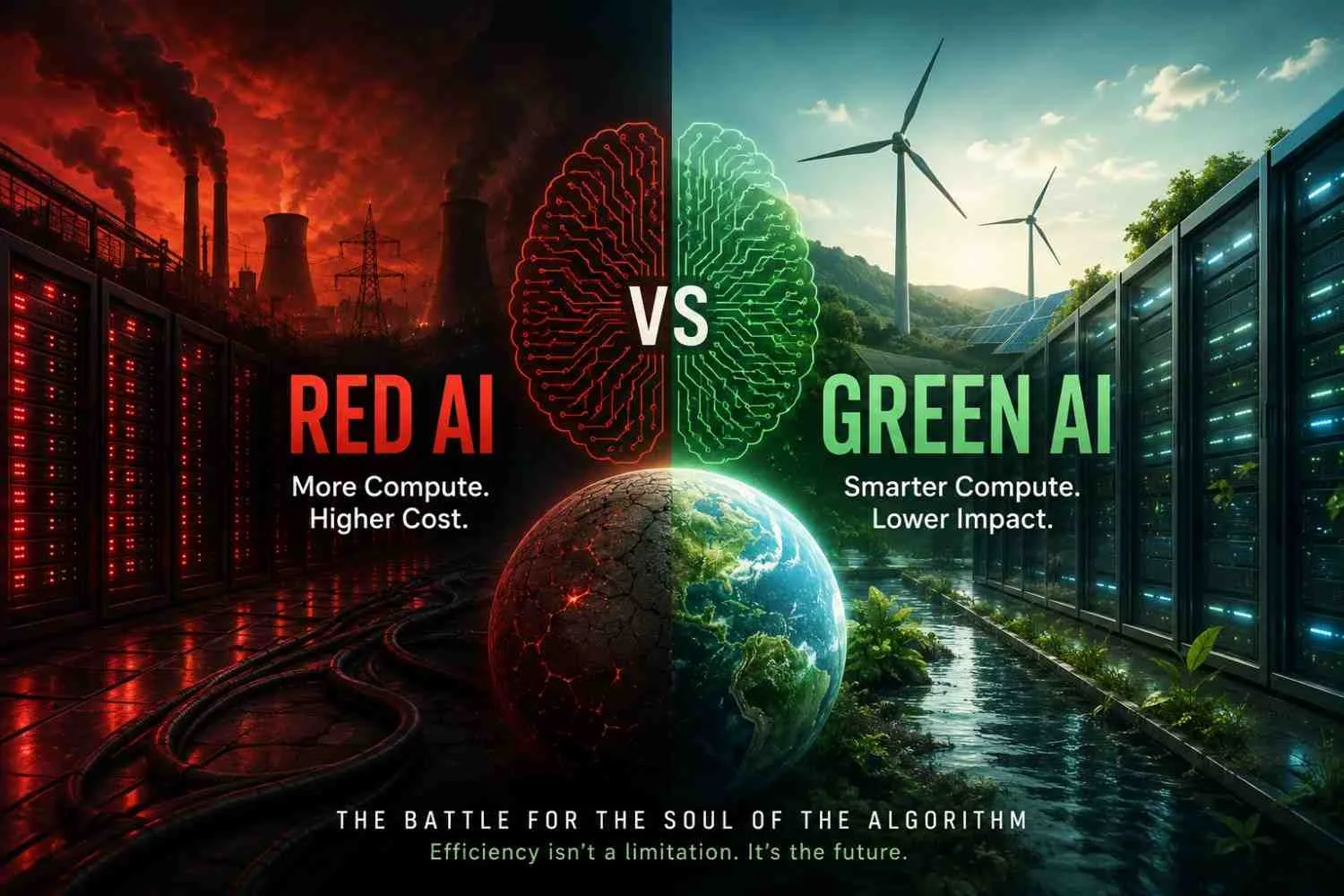
Two philosophies are fighting over how artificial intelligence should be built — one chases scale at any cost, the other asks what that cost actually is Ujjwal K Chowdhury Strapline: For a decade, AI research had one scoreboard: accuracy. A new one is forcing its way onto the field — energy, water, carbon and hardware. The contest between “Red AI” and “Green AI” is no longer academic; it is shaping how the world’s most powerful technology gets built. The paper that named the problem In 2020, a small group of computer scientists — Roy Schwartz, Jesse Dodge, Noah A. Smith and Oren Etzioni — published a short, blunt paper in the Communications of the ACM with a title that stuck: “Green AI.” It drew a line through the field. On one side sat what the authors called Red AI: research that chases state-of-the-art results by throwing ever more computation at a problem, treating accuracy as the only currency that matters. On the other side stood Green AI: research that treats efficiency — the resources spent per unit of result — as a first-class scientific goal, not an afterthought. The label was provocative on purpose. Red AI was not, the authors were careful to say, morally wrong. It had produced genuine breakthroughs. But it had also quietly normalised an arms race in which each new record-setting model consumed dramatically more compute than the last, with the environmental bill rarely itemised in the paper’s appendix, let alone its abstract. Six years on, that argument reads less like a provocation and more like a prophecy. Generative and agentic AI systems now sit inside search engines, office software, customer service lines and increasingly autonomous workflows that plan, browse, code and retry without a human in the loop. The scoreboard Schwartz and colleagues warned about has expanded from leaderboard rankings to gigawatts, litres and tonnes of carbon dioxide. Two philosophies, one industry Red AI, at its core, is a bet that more computation reliably buys more capability — bigger models, longer training runs, wider search over architectures, more parameters, more data, more reasoning steps at inference time. It is the logic behind scaling laws, and it has worked spectacularly well as a research strategy. But it has a hidden accounting problem: the “winning” run reported in a paper or press release is usually just the tip of an iceberg of failed experiments, architecture searches, ablations and evaluation runs that never make it into the final number. Recent lifecycle research — including a 2025 study led by Jacob Morrison that traced the full environmental cost of building a language-model family — found that model development contributed roughly half of the total training-related impact, not the celebrated final run alone. Green AI, by contrast, asks a different question of every architectural choice, every training run and every product feature: what is the smallest, most efficient way to achieve an acceptable outcome? It treats efficiency — measured in floating-point operations, energy, water and, increasingly, successful outcomes per unit of resource — as an evaluation criterion sitting alongside accuracy, not subordinate to it. Crucially, Green AI has matured past its original, somewhat narrow framing. In 2020 it was largely about training compute. Today, researchers describe it as the quality- and outcome-constrained minimisation of lifecycle environmental impact — a formulation that captures something Red-versus-Green rhetoric can miss: a computationally hungry model is not automatically the villain, and a lean one is not automatically virtuous. A large model solving a genuinely high-value problem in a handful of steps can outperform, environmentally, a small model that fails repeatedly and triggers costly retries. The real dividing line is not model size; it is whether computation is productive. Why the contest matters now The urgency comes from scale. According to the International Energy Agency’s most recent assessment, global data-centre electricity demand rose roughly 17% in 2025 alone — more than five times faster than overall global electricity growth — while electricity consumption specifically tied to AI-focused facilities surged around 50% in the same year. The IEA’s satellite-tracking programme, which watches construction of dedicated “AI factories” from orbit, found that their combined capacity has more than tripled in eighteen months. Data-centre electricity use worldwide, which stood at roughly 415–485 TWh depending on the estimate and year, is on a trajectory toward roughly 950 TWh to beyond 1,000 TWh by 2030 — comparable to the entire annual electricity consumption of Japan.   FAST FACTS > - Global data-centre electricity demand: ~485 TWh in 2025, heading toward ~950 TWh by 2030 (IEA) > - AI-focused data-centre demand: up ~50% in 2025 alone > - US data-centre share of national electricity: 4.4% in 2023, projected 6.7–12% by 2028 (LBNL) > - AI-rack power density: up roughly elevenfold, 2020–2025 (IEA) > - Ireland’s data centres already draw over a fifth of national electricity; Dublin’s local share runs close to 80% This is precisely the terrain Red AI was warned about: growth compounding on growth, with local grids in Ireland, Northern Virginia and parts of the Netherlands already straining, and utilities in the United States requesting billions of dollars in rate increases partly attributable to data-centre load growth. Energy-policy academics have begun asking, pointedly, whether ordinary electricity customers should effectively subsidise the power appetite of trillion-dollar technology companies — a question with no comfortable answer for regulators. Where the two camps actually clash The Red AI/Green AI split is not simply “big model bad, small model good.” It shows up in concrete engineering and business decisions: 1. Model selection. Red-style practice defaults to the most capable, largest available model for every task, regardless of whether the task warrants it. Green practice builds a portfolio: small or domain-specific models for routine work, escalating to frontier models only when complexity demands it. Systems such as FrugalGPT, which learned to route easy queries to cheaper models and reserve expensive ones for hard cases, demonstrated cost reductions of up to 98% on selected benchmarks without materially sacrificing quality. 2. Reporting practice. Red AI habitually reports only the final training run’s cost. Green AI insists on lifecycle transparency — development experimentation, fine-tuning, evaluation, and the electricity, water and embodied-hardware cost of years of subsequent inference, which can dwarf the original training bill many times over. 3. Agentic design. This is the newest and sharpest fault line. An autonomous agent can quietly multiply a single user request into dozens or hundreds of model calls, tool invocations, retries and multi-agent “debates.” Early benchmark research has found up to a 9.4-fold energy difference between agent-framework designs solving the same software-engineering tasks, driven mostly by wasted loops and redundant verification. A 2026 preprint proposing a metric called Energy per Successful Goal (EpG) found that agentic workflows consumed, on average, 4.33 times more energy per completed goal than equivalent linear, non-agentic approaches. Red AI treats agent autonomy as an unqualified upgrade; Green AI treats it as a resource-management problem requiring budgets, loop detection and outcome-based evaluation. 4. The rebound trap. Perhaps the most uncomfortable insight from Green AI research is that efficiency gains alone do not guarantee lower total impact. If a model becomes twice as cheap to run, organisations often respond by running it far more than twice as often — generating more content, running more experiments, automating tasks nobody previously bothered to automate. This is a version of the century-old Jevons paradox, in which efficiency improvements in coal-fired steam engines led, historically, to more coal consumption, not less, because cheaper power expanded its uses. Green AI researchers now argue that intensity metrics (energy per task) must be paired with absolute-impact accounting (total annual energy, water and carbon) precisely to catch this rebound before it erases hard-won efficiency gains. The measurement mess neither side can ignore Part of what makes the Red/Green debate so combustible is that reliable, comparable numbers are still scarce. A landmark 2025 measurement of Google’s production systems found a median energy cost of just 0.24 watt-hours and 0.26 millilitres of water per text prompt — a strikingly small figure. Around the same time, a separate academic benchmark estimated that complex, long-context reasoning queries on certain models could consume more than 33 watt-hours — over a hundred times more. Both figures are credible within their own scope; they simply describe different systems, different tasks and different accounting boundaries. A 2025 peer-reviewed review of data-centre water use went further, finding that water consumption per workload can vary by more than 10,000-fold depending on cooling technology, grid water intensity, climate and utilisation. This is why serious Green AI researchers are wary of single, universal “footprint per query” numbers circulating in the media — they tend to flatten an extraordinarily heterogeneous reality into a misleadingly precise soundbite. The more defensible approach, gaining traction in both research and emerging regulation such as the European Union’s data-centre reporting rules, is a layered hierarchy: from raw activity counts (tokens, model calls), up through compute energy, facility-adjusted energy, environmental impact (carbon and water, adjusted for time and place), full lifecycle impact including embodied hardware emissions, and finally outcome-normalised impact — energy and water per successfully completed task, not per token generated. Not a morality play — a design discipline It would be easy, and wrong, to read Red AI and Green AI as heroes and villains. Some of the most consequential AI applications — climate modelling, grid forecasting, drug discovery, materials science for batteries and solar cells — are legitimately compute-intensive, and restricting them to “small and frugal” would forfeit real value. The IEA itself estimates that mature AI applications could trim energy costs across several industries by 3 to 10 percentage points, and Google has reported enabling tens of millions of tonnes of avoided CO2-equivalent emissions through AI-optimised products in a single year. Green AI’s actual claim is narrower and more rigorous: that value should be measured against lifecycle cost, that claims of benefit require credible counterfactual evidence, and that scale should be earned by demonstrated necessity rather than assumed by default. HIGHLIGHT > “A Green AI system is not simply smaller or faster. It is appropriately capable, transparently measured, powered and cooled responsibly, designed to avoid waste, and deployed where its verified value exceeds its environmental cost.” What comes next Expect the Red/Green fault line to move from academic papers into contracts and regulation. Procurement teams are beginning to demand model-level energy and water disclosures before signing cloud contracts. The EU’s AI Act ecosystem is developing standards for reporting the resource performance of general-purpose AI systems. Enterprises are experimenting with model-routing rules that default to the smallest sufficient model rather than the flashiest one. And a growing chorus of researchers argues that the next frontier metric will not be accuracy, or even energy per token, but energy per successful goal — a number that punishes both wasteful agents and models that fail so often they need constant escalation. The Red AI era was not a mistake; it built the models the world now depends on. But the bill for that approach is now visible in gigawatts, litres and rising electricity tariffs, and it is arriving at a moment when climate constraints leave little room for waste. Green AI’s proposition is simple, if not easy: intelligence, at any scale, should have to justify its keep. Reading the two camps side by side  Red AIGreen AICore metricAccuracy / benchmark scoreQuality-adjusted efficiency (energy, water, carbon per successful task)Model choiceBiggest available, by defaultSmallest sufficient model, escalate only when neededReportingFinal training run onlyFull lifecycle: development, training, inference, hardwareAgentsAutonomy as unqualified upgradeAutonomy as a budgeted, monitored resourceRiskRebound erases efficiency gainsAbsolute-impact caps alongside intensity targets Framed this way, the contest is less a war between two tribes of researchers than a description of a choice every AI-building organisation now has to make, explicitly or by default, every time it ships a feature. The instinctive path — reach for the largest available model, let an agent iterate until it seems to have solved the problem, publish the headline benchmark and move on — is Red AI, whether or not anyone in the room uses the term. The alternative requires more upfront engineering discipline: measuring what a task actually needs, instrumenting the full resource cost, and being willing to report a less flattering number if that is the honest one. Neither side of the debate disputes that AI can create enormous value. The disagreement is about method — whether that value is pursued by default at maximum scale, or earned deliberately at the scale a task actually requires. As electricity bills, water permits and carbon disclosures increasingly follow AI systems out of the lab and into public scrutiny, that distinction is starting to carry real financial and regulatory weight, not just scientific interest. ...Read more

17 Jul 2026

It is not one invention but a discipline — spanning smarter models, honest measurement and hard limits on waste Prof Ujjwal K Chowdhury Strapline: Green AI will not arrive as a single breakthrough. It is being assembled, piece by piece, out of smarter algorithms, redesigned data centres, new accounting rules and a willingness to ask whether a task needed a supercomputer in the first place. Defining the term properly “Green AI” is often used loosely, as a synonym for “AI that feels less wasteful.” Researchers who work in the field define it more precisely: the quality- and outcome-constrained minimisation of the lifecycle environmental impact of an AI system. Every word in that definition is doing work. “Lifecycle” means the accounting cannot stop at a single training run — it must include research and experimentation, data preparation, fine-tuning, round-the-clock inference, agent orchestration, data-centre construction and cooling, electricity generation, and the mining, fabrication and eventual disposal of hardware. “Quality- and outcome-constrained” means Green AI is not simply “use less compute” — a model that saves energy but fails at its task, or that needs constant human correction, has not achieved anything green at all. The term traces to a 2020 paper by Roy Schwartz and colleagues that contrasted this approach with “Red AI” — the pursuit of state-of-the-art accuracy through ever-larger computation, with efficiency treated as an afterthought. Since then the field has broadened well beyond machine-learning theory into data-centre engineering, materials science, distributed systems, water science, economics and public policy. How Green AI actually reduces impact — the toolkit Researchers and engineers now have a genuine, tested toolkit for cutting AI’s resource footprint, operating at every layer of the stack. At the model level. Not every task needs a frontier-scale model. Task-specific and domain models can match performance on narrow jobs at a fraction of the memory and compute cost, and can often run on local devices rather than cloud data centres. Model cascades — systems that route easy requests to small, cheap models and escalate only genuinely difficult ones to larger models — have demonstrated dramatic savings; the research system FrugalGPT showed cost reductions of up to 98% on selected tasks while preserving output quality. Quantisation (reducing the numerical precision of a model’s internal weights) and distillation (training a smaller “student” model from a larger “teacher”) both cut deployment energy substantially, at the cost of some upfront retraining effort. Sparse or mixture-of-experts architectures activate only a fraction of a model’s total parameters for any given input, expanding capacity without proportionally expanding energy use per request. At the inference level. Because generating output token-by-token is often the most expensive part of serving a model, techniques such as speculative decoding (a small draft model proposes text that a larger model merely verifies, rather than generating from scratch), key-value caching (reusing previously computed information instead of recalculating it), and adaptive or “early-exit” reasoning (stopping once a model is confident enough, rather than always running the maximum computation) can cut energy per request without changing the underlying answer. A large 2025 study measuring more than 32,000 configurations across models and GPU hardware found that matching architecture to hardware, and tuning batching and utilisation, mattered as much as model choice itself. At the infrastructure level. Data-centre engineering has moved from generic efficiency metrics toward site-specific redesign: direct-to-chip and immersion liquid cooling, which can cut water use dramatically compared with evaporative systems in the right climate; heat-reuse schemes that feed data-centre waste heat into district heating or industrial processes; battery storage and demand-response systems that let facilities absorb the rapid power swings AI workloads create; and a shift from annual renewable-energy accounting toward genuine hour-by-hour carbon-free electricity matching, which prevents companies from claiming a “clean” annual average while still drawing fossil-heavy power at peak evening hours. At the agent level — the newest frontier. Because autonomous, tool-using agents can silently balloon a single request into dozens of model calls, Green AI research has begun proposing agent-specific controls: hard budgets on the number of steps, tokens and tool calls a workflow may use; automatic loop detection to catch agents stuck repeating unproductive cycles; routing that assigns the smallest capable model to each sub-task, escalating only when genuinely necessary; and outcome-based evaluation using a proposed metric called Energy per Successful Goal, which penalises agent designs that waste computation on retries, redundant multi-agent debate or failed verification.   Selected Efficiency Results FrugalGPT model-cascade routingUp to 98% cost reduction on selected tasksAgent-framework redesignUp to 9.4× difference in energy use for the same completed task (2025 benchmark)Direct chip-level closed-loop coolingOne major operator claims more than 125 million litres of water saved per data centre annually GoogleReports 12 GW of clean energy contracted in 2025 and 78% of freshwater consumption replenished (company-reported)   Measuring what matters — and admitting what we don’t know yet A recurring theme among Green AI researchers is that measurement itself remains immature, and that this is not a minor technical gap but a governance problem. A landmark 2025 study of Google’s production systems reported a median cost of just 0.24 watt-hours and 0.26 millilitres of water per typical text prompt, alongside large year-on-year efficiency gains. A separate academic benchmark, using different models and a different methodology, estimated more than 33 watt-hours for complex, long-context reasoning queries — over one hundred times higher. Both numbers are legitimate; they simply describe different systems and different task complexity, which is exactly the problem: without a shared functional unit and quality threshold, headline “AI footprint” figures cannot be meaningfully compared, and companies can select whichever framing flatters them. In response, researchers have proposed a seven-level hierarchy of Green AI metrics, moving from crude activity counts (tokens, model calls) through compute energy, facility-adjusted energy (including cooling and idle capacity), full environmental accounting (carbon and water adjusted for time, place and water-basin stress), lifecycle impact (including embodied hardware emissions), outcome-normalised impact (per successfully completed task), and finally absolute organisational impact — the only level capable of catching rebound effects that intensity metrics alone miss. Open measurement tools such as CodeCarbon, Carbontracker and the industry-standard MLPerf Power benchmark are improving reproducibility, but researchers caution that no measurement tool can fix a poorly defined functional unit or a missing supply-chain boundary.   The next phase of research should make energy, carbon, water and materials first-class optimisation variables. The next phase of policy should make claims auditable and local impacts visible.   The current state of progress: real, but partial How far has Green AI actually come? The honest answer is: further than five years ago, but nowhere near far enough to offset AI’s raw growth in scale. On the positive side of the ledger: efficiency per individual task is, by most credible measures, improving faster than at almost any point in computing history, driven by better model architectures, smarter serving systems and the techniques described above. Major cloud operators report substantial renewable-energy procurement and water-replenishment programmes, alongside progress on closed-loop and liquid cooling that can cut onsite water use sharply where deployed. Regulatory frameworks are catching up: the European Union now requires structured energy and water reporting from data centres, and the EU AI Act ecosystem is developing standardised resource-reporting rules for general-purpose AI models. Independent benchmarking initiatives, including the AI Energy Score project, are beginning to let outside researchers compare model efficiency on defined tasks rather than relying solely on company claims. On the other side of the ledger: global data-centre electricity demand is still climbing steeply — up roughly 17% in 2025 alone, with AI-specific facilities growing around 50% in the same year — showing that efficiency gains are, so far, being outpaced by sheer volume growth exactly as the rebound-effect research predicted. Agentic AI is expanding faster than the tools built to measure or govern its resource use, and remains, by most researchers’ assessment, in an “early-stage, high research priority” state rather than a solved problem. Water accounting remains inconsistent enough that credible studies report more than a 10,000-fold variation across otherwise comparable workloads — a sign that the industry still lacks agreed, auditable standards. And embodied hardware impact — the minerals, fabrication water and manufacturing emissions locked into every accelerator before it processes a single request — remains the least developed area of lifecycle assessment, largely because supply-chain data is scarce and closely guarded. What a genuinely green deployment looks like Researchers increasingly converge on a simple decision rule for organisations deciding whether to deploy AI at scale: proceed only when four conditions are jointly met. Necessity — the application creates material, demonstrable value. Proportionality — the model and any autonomous agent built around it are no larger or more independent than the task actually requires. Transparency — energy, carbon, water and lifecycle impacts can be measured or credibly estimated, not merely asserted. Net benefit — the quality-adjusted value delivered, socially, economically or environmentally, exceeds the lifecycle cost, with rebound effects actively monitored rather than assumed away. The opportunity for fast-growing, water-stressed economies For countries such as India — with rapid digital growth, hot climates, constrained grids and water-stressed cities — Green AI is not only a defensive necessity but an industrial opening. Policy researchers argue that fast-growing digital economies should avoid simply importing data-centre designs optimised for cooler, water-abundant regions, and instead map proposed AI capacity against transmission constraints, renewable supply and urban water plans from the outset — favouring non-potable cooling sources, dry or hybrid cooling systems and seasonal operating limits rather than defaulting to the energy- and water-intensive designs common in temperate markets. That same constraint creates a market. Efficient small models tuned for Indian languages, energy-aware edge AI that keeps processing on-device rather than in the cloud, low-water cooling technology, power electronics, and auditable sustainability software are all areas where necessity could plausibly drive genuine innovation rather than imitation. Public procurement has real leverage here: governments that require energy and water reporting as a condition of AI contracts can create demand for exactly the transparent, efficient systems Green AI research is trying to build — turning a regulatory requirement into a home-grown industry. The bottom line That rule captures what Green AI has become, seven years after the phrase was coined: not a call to make AI smaller for its own sake, but a discipline for making sure every unit of computation has to earn its keep — a shift from celebrating efficiency in isolation to managing absolute impact in full view. The technology is not yet there. But for the first time, the tools, the metrics and the regulatory appetite to get there all exist simultaneously — which is more than could be said even three years ago. ...Read more

16 Jul 2026

India's next energy challenge is bigger than simply generating more electricity.   By Tiyasha Ghosh Imagine a city all lit up today, with no future powering it tomorrow! Would you still switch on the air conditioner without even thinking once? or would you keep your phone on charge overnight? Would you leave an electric vehicle plugged in, stream a movie, or ask ChatGPT a question as casually as you do today? Probably, yes! Because electricity is not visible. We notice it only when it's gone! Behind every light, hospital, metro, factory, and data centre is a power system working 24/7 to keep the country running. That system is now gearing up for a make-or-break moment. According to a Reuters report published on 8 July 2026, Union Power Minister Manohar Lal Khattar said India's peak electricity demand could touch nearly 300 gigawatts (GW) by 2027. The surge will be driven by rapid economic growth, artificial intelligence (AI), expanding data centres, electric vehicles, industrial growth and cooling demand as temperatures keep rising. That appears to be progress on paper. More electricity powers more homes, fuels more industry, grows more businesses, and lifts more lives. With growth comes greater responsibility. Can India produce enough power without creating more pollution? Can renewable energy keep up? Is the grid ready for AI, EVs, and climate change? These are no longer questions for only policymakers because they affect every household, every business and every citizen. Because electricity is no longer just another utility. It powers education, healthcare, transport, communication, the digital economy, and nearly every aspect of modern living. The challenge, however, goes beyond generating more electricity. Electricity must be there when people need it, travel long distances without interruption, remain affordable, and steadily get cleaner. This is why India’s shift to new energy sources is at a critical stage. Today’s decisions on coal, renewables, storage, grids, and efficiency will shape India’s energy future for decades. Keeping the lights on is no longer just about producing electricity. It's about building an energy system that is reliable, resilient and ready for tomorrow. If meeting future demand is so important, why doesn't India simply build more power plants? Sounds easy, right? Need more power? Generate more power. But that’s not how it works. Electricity is different from other resources. You can’t just produce and preserve it. It has to be available 24/7, the moment people need it. That is where India's real challenge begins. Coal has powered India for decades. Coal continues to be the country’s most dependable electricity source. It operates 24/7 in any weather, and keeps delivering during heatwaves or demand peaks when other options struggles. Reliable power, real consequences. Coal is a major source of greenhouse gas emissions and air pollution. It is also water-intensive and hinders India’s climate goals. It’s a hard choice. Coal keeps us running today, but it can’t power tomorrow. The only way out is cleaner energy. Solar and wind projects are expanding rapidly across the country. Technology has become cheaper. Investments are increasing. India is already among the world's leading producers of renewable energy. Yet clean energy has one limitation that cannot be ignored. The sun sets. The wind fades. Electricity demand doesn't! Life doesn’t pause for darkness, clouds, or calm winds. Hospitals, factories, and data centres need power 24/7 - no excuses. It’s not coal vs renewables anymore. The real conversation is about maintaining the equilibrium. Coal provides stability. Renewables provide sustainability. Storage provides flexibility and transmission connects them all.  We generate solar power by day but lose its value by night because we can't store it. We produce electricity where it's abundant but struggle to deliver it where it's needed most. Every evening, rising demand pushes the grid to its limits- highlighting the urgent need for smarter energy management. Every part of the system depends on one another. India’s power system works like a chain. Generation kicks it off, storage sustains it, transmission moves it across, and efficiency makes sure nothing is lost before it reaches consumers. Even if one runner slows down, the whole system suffers. This is why experts believe that India's future energy strategy cannot just focus on building more power plants but instead on building a smarter power system. Power that doesn’t fail when demand spikes. Bills people can actually pay. Air, that’s much cleaner. And a grid flexible enough to run the future! The challenge ahead isn’t about generating more power. It’s about generating the power at the right time, delivering it when it’s needed, and doing it in the most cost-effective and environmental way. So, what can India do? The first answer is surprisingly simple. Use electricity more efficiently. Each evening, electricity demand peaks. Households turn on lights, ACs, TVs, and appliances simultaneously while offices, factories, and commercial spaces remain active. This overlap creates a sharp surge that strains the grid. This is where energy efficiency and Time-of-Day (ToD) pricing can have a real impact. ToD pricing is simple: pay less at night, pay a bit more in the evening rush. It’s not about making power costly but about getting people to charge cars, run washing machines, and run machines when the grid has room. Along with efficient appliances, LEDs, smart meters, and improved building design, these measures can greatly lower peak load. According to experts, managing demand is often the quickest, cheapest way to relieve the grid instead of building more plants. But reducing demand alone will not solve the problem. India also needs to store clean electricity to use later. Solar power is generated only during the day and wind energy depends on weather conditions. Demand, however, persists continuously. India's Electricity Demand: Current vs Future YearPeak Electricity Demand2024250 GW2025270 GW2027 (Projected)300 GW Key Takeaway:India's electricity demand is projected to increase by nearly 50 GW within three years, mainly due to AI, data centres, EVs, cooling demand and economic growth. This is driving greater reliance on Battery Energy Storage Systems (BESS) and pumped-storage hydropower. Solar in the day, batteries at night. That’s the idea. And pumped storage? It’s nature’s battery - lifts water when power is cheap and drops it when demand spikes. According to experts, India will require both daily-use battery storage and long-duration storage to ensure stable power during extreme periods of solar and wind generation. Storage is no longer an optional technology- it is becoming the backbone of a renewable energy grid. Another question, i.e., equally important, isIs power reaching the places that need it the most? Generating clean power is only one part of the solution. It should also travel efficiently across the country. Rajasthan and Gujarat’s large solar farms frequently produce surplus electricity, while demand spikes in other states. Weak transmission links mean renewable energy may stay unused despite demand elsewhere. This means transmission is as critical as power generation. Experts say building high-capacity transmission corridors and upgrading the national grid will determine how well India taps its expanding renewable capacity. Then the biggest question of the future arises. Should data centres produce their own clean energy? Artificial intelligence, cloud computing and digital services are driving a surging expansion of data centres. These facilities operate 24 hours a day and consume an enormous amount of electricity.  The energy transition isn’t just the government’s job. Big consumers need to step up too. Rooftop solar, batteries, long-term clean power deals - these don’t just take load off the grid, they also make companies more secure. India's Energy Transition Chain Renewable Energy     ↓Battery Storage     ↓Transmission Grid     ↓Smart Distribution     ↓Consumers Without any one of these links, the entire electricity system becomes less reliable. The final question is perhaps the most difficult. Which energy source offers the best balance between reliability, affordability and sustainability? There is no perfect answer! Coal remains reliable because it can generate electricity throughout the day. However, it also produces high carbon emissions and causes air pollution. Solar and wind power are clean sources of energy that are becoming more cost-effective. The biggest limitation is that they depend on weather conditions. Hydropower provides flexible electricity and helps balance renewable energy but growth is constrained by location and environmental factors. Natural gas helps meet sudden spikes in demand. However, high costs and dependence on imports make it less reliable in the long run. Battery storage improves reliability by storing renewable energy, although large-scale expansion still requires the right investment. The cheapest way to manage power isn’t to make more of it but to waste less. That’s why demand response and efficiency still win. This is why experts believe India's future will not depend on a single technology but on the right combination of many. In the short run, coal may ensure stability. Renewables will power the clean transition. Batteries will fill the gaps between supply and demand. New transmission lines will carry clean power to consumers. Energy efficiency can ease the burden on the power grid. Together, these solutions can help India meet rising electricity consumption without compromising reliability, affordability or sustainability. One thing made India's progress possible: Power you can count on. From powering factories during industrial growth to supporting today's AI revolution, electricity has become the backbone of the country's progress silently. The challenge now is no longer whether India can generate more electricity, but whether the country can generate it wisely. Every choice we make today comes with a cost. Coal ensures reliability but raises emissions. Renewables without storage can’t deliver power on demand. More transmission without more generation still won’t meet needs. Relying on just one solution won’t work. The path forward, experts say, is balance, not dependence. During the transition, coal may ensure reliability. Renewables will lead on sustainability. Storage will fill supply gaps. Smarter grids and stronger transmission will bring clean power to consumers. Comparing India's Power Options Energy SourceReliabilityEmissionsBest UseCoal★★★★★HighBase-load powerSolar★★☆☆☆Very LowDaytime electricityWind★★★☆☆Very LowSeasonal generationHydropower★★★★☆LowPeak balancingBattery Storage★★★★★ZeroEvening demandEnergy Efficiency★★★★★ZeroReducing peak demand We don’t have to wait for new plants. Smarter tech and smarter use can take pressure off the system right now. Governments won’t make it alone. Industries need to go cleaner, businesses need to be more efficient, housing societies need to cut excess use, and consumers need to make smarter choices daily Small actions may seem insignificant at first but together, they shape the future of the entire electricity system. India has already proven that ambitious targets are within reach. The next challenge is ensuring that every additional unit of electricity is cleaner, more reliable, and more resilient than the last. This isn’t just about electricity. It’s about economic growth, climate resilience, public health, energy security, and the lives of more than a billion people. The lights must stay on! The real question isn’t just electricity.  But legacy.  How India powers itself today will define tomorrow!   DATA / DOCUMENT STACK   Central Electricity Authority (CEA): Peak electricity demand and generation data (2024–2026). Ministry of New and Renewable Energy (MNRE): Monthly renewable energy capacity additions and physical progress reports. Grid India: Grid frequency, renewable integration and transmission performance data. State DISCOM Reports: Electricity demand curves, Time-of-Day (ToD) pricing pilots and Battery Energy Storage System (BESS) tenders. Reuters (8 July 2026): Union Power Minister Manohar Lal Khattar's remarks on India's projected 300 GW peak electricity demand by 2027. International Energy Agency (IEA): India Electricity Outlook and clean energy transition reports. NITI Aayog: National Energy Security and Energy Transition publications.      SOURCE: Reuters — 8 July 2026 (Remarks by Union Power Minister Manohar Lal Khattar) Ministry of New and Renewable Energy (MNRE) — Physical Progress Reports Central Electricity Authority (CEA) — Peak Demand & Generation Statistics Grid India — National Grid Performance Reports International Energy Agency (IEA) — India Energy Outlook       ...Read more

13 Jul 2026

The Shopping Bags Are Full. Why Do Our Lives Feel Empty? We own more clothes than our parents did. We replace phones faster, order food more frequently, travel farther, renovate homes more often and buy things at the tap of a screen. Our homes are fuller. Our wardrobes are overflowing. Our digital carts are permanently active. Yet many of us are more anxious, more exhausted, more indebted, more distracted and more dissatisfied than ever before. That is the central contradiction of modern consumer life: we have become extraordinarily efficient at purchasing things, but not necessarily better at creating happiness. In India, this contradiction is visible everywhere. A middle-class family may have two cars but hardly enough time to sit together. A young professional may own an expensive smartphone, smartwatch, wireless earbuds and several paid subscriptions, yet struggle to sleep peacefully. A child may receive a roomful of toys but not an hour of undivided parental attention. A household may renovate its kitchen while increasingly depending on packaged food and instant delivery. We are surrounded by products designed to save time. Strangely, we appear to have less time than before. We buy fitness watches but walk less. We purchase storage boxes because we own too many things. We install larger televisions because family conversations are becoming shorter. We take photographs of every celebration but often fail to experience the celebration itself. So the question is no longer whether we are buying more. The evidence is in our cupboards, credit-card statements, delivery notifications and dustbins. The real question is: Are we living better? Consumption Has Quietly Become a Competition There was a time when buying something new marked a genuine need or an important occasion. A refrigerator, television, scooter or festive dress would be carefully chosen, maintained and used for years. Today, consumption is increasingly shaped not by need but by comparison. Someone in the housing society buys a larger car. A colleague upgrades to the newest phone. An influencer displays a “must-have” skin-care routine involving twelve products. A wedding on social media appears more elaborate than ours. A neighbour’s child attends a more expensive school. Another family takes an international holiday. Slowly, without realising it, we begin purchasing not for comfort but for status. The object becomes a message: “I am successful.” “I am modern.” “I have arrived.” But status is a race without a finishing line. The moment we acquire one symbol of success, another appears. The phone becomes outdated. The fashion changes. The car loses its shine. The holiday photographs stop receiving attention. Consumer culture survives by making satisfaction temporary. It repeatedly whispers: You are only one purchase away from becoming happier, more attractive, more respected or more complete. But completion never arrives. The Great Indian Sale Never Really Ends India’s traditional festivals once centred on community, gratitude, food, worship, storytelling and reunion. Consumption had a place, but it was not always the centre. Today, almost every festival is converted into a sales season. Diwali becomes an electronics sale. Dhanteras becomes an obligation to purchase. Valentine’s Day becomes a test of affection through gifts. Mother’s Day becomes a promotional campaign. Independence Day becomes a discount event. Even environmentally significant occasions are used to market new “sustainable” products. The sale countdown creates urgency. “Only two hours left.” “Last chance.” “Limited stock.” “Deal expires at midnight.” We buy quickly because the platform tells us we are saving money. But spending ₹3,000 on something we did not need is not saving ₹2,000. It is spending ₹3,000. The discount may be real. The necessity may not be. Easy credit makes the temptation stronger. Buy-now-pay-later schemes, credit cards and zero-cost instalments separate the pleasure of buying from the pain of paying. The product arrives today; the financial pressure follows for months. A home can therefore look prosperous while its occupants remain financially insecure. More Convenience, Less Connection Modern consumption promises convenience, and much of that convenience is genuinely useful. Digital payments, online medicine, home delivery and accessible transportation have improved millions of lives. The problem begins when convenience replaces participation. We stop walking to the market. We stop knowing the vegetable seller. We stop repairing appliances. We stop cooking together. We stop borrowing from neighbours. We stop visiting local shops. We stop waiting, planning and improvising. Every difficulty becomes something to outsource. Food arrives in disposable containers. Groceries arrive inside multiple layers of packaging. A forgotten ingredient is delivered by a motorbike in minutes. A minor inconvenience creates fuel consumption, plastic waste, traffic and another poorly paid worker racing against a countdown clock. Convenience saves us effort, but effort is not always the enemy. Walking, cooking, repairing, sharing and waiting can create health, competence, patience and relationships. When everything becomes instantly available, we may gain speed but lose resilience. The Wardrobe Is Full. There Is Still “Nothing to Wear” Fashion provides one of the clearest examples of the consumption trap. An Indian urban wardrobe may contain clothes purchased for weddings, office meetings, holidays, festivals, gym sessions and social-media photographs. Many garments are worn only once or twice. Some are forgotten with their price tags still attached. Yet before another wedding, the familiar sentence returns: “I have nothing to wear.” What it often means is: “I have nothing new to display.” The pressure is particularly intense around Indian weddings. Families spend beyond their means because every event must look distinct, every outfit must be photographed and every photograph must appear impressive. Clothes that could have been repeated, exchanged, altered or passed between relatives are rejected because repetition is treated as embarrassment. But repetition is not poverty. Using something well is intelligence. Repairing something is responsibility. Repeating an outfit is not a failure of imagination; it may be a declaration that our worth is greater than our wardrobe. We Upgraded the Phone. Did We Upgrade the Conversation? The smartphone is perhaps the defining object of contemporary Indian life. It connects migrant workers with families, enables education, supports businesses, facilitates banking and gives citizens access to information. But it also creates an endless marketplace inside our pockets. We are shown what to buy, where to eat, how to look, where to travel and what our homes should contain. Advertising no longer waits on a billboard. It follows us into bed. The phone is upgraded because its camera is better. Yet during dinner, everyone looks at a separate screen. We purchase high-speed data but have slower conversations. We collect hundreds of contacts but may not know whom to call during a crisis. We watch motivational videos about discipline at two in the morning and wake up too tired to practise any of it. Technology is not the villain. Unconscious use is. A device should remain a tool. When it begins determining our attention, desires, relationships and self-esteem, the owner and the object quietly exchange roles. The Hidden Price Is Paid by the Planet Every object has a biography. A cotton shirt requires land, water, labour, dyeing, transportation, packaging and retail infrastructure. A smartphone contains minerals extracted from the earth, components manufactured across countries and a battery that will eventually become hazardous waste. A delivered meal carries the environmental cost of ingredients, refrigeration, cooking, transport and packaging. The price printed on the product is therefore incomplete. It rarely includes the polluted river, depleted soil, exploited worker, discarded plastic or carbon emitted during production and delivery. The environmental burden is also unequal. Those who consume least often suffer first from polluted air, rising temperatures, floods, water shortages and waste dumping. A low-income settlement beside a landfill pays for the disposable habits of neighbourhoods far wealthier than itself. Mindless consumption is therefore not merely a personal weakness. It is an ecological and social issue. A Better Life Is Not a Smaller Dream Living better does not require everyone to abandon cities, reject technology or move to a Himalayan village. Nor does sustainability mean living joylessly. It means replacing excess with sufficiency, impulse with intention and display with genuine value. The goal is not to stop buying. The goal is to stop expecting purchases to perform the work of relationships, health, purpose, community and self-respect. A better life may contain fewer objects but more experiences. Less comparison but more confidence. Less speed but more presence. Less waste but more gratitude. The transition can begin through twelve simple steps. 1. Pause Before Every Non-Essential Purchase Create a waiting period. For inexpensive items, wait twenty-four hours. For clothes, gadgets, furniture or luxury products, wait a week. Ask three questions: Do I genuinely need it? Do I already own something that serves the same purpose? Would I still buy it without the discount, advertisement or social pressure? Many desires disappear when urgency is removed. 2. Count What You Already Own Before buying another shirt, cup, bedsheet, kitchen appliance or cosmetic product, inspect what is already at home. An occasional household inventory can be startling. Five water bottles. Seven nearly identical shirts. Unopened toiletries. Duplicate chargers. Forgotten food packets. Books bought but never read. Visibility reduces unnecessary buying. We often purchase not because we have too little, but because we have lost track of how much we already possess. 3. Choose Durability Over Novelty The cheapest product is not always economical. A well-made pressure cooker used for fifteen years may be more affordable than three poor-quality replacements. A strong schoolbag can serve more than one child. A repairable wooden table may outlive several pieces of disposable furniture. Before buying, examine quality, warranty, repairability and expected lifespan. Purchase fewer things, but choose things worthy of long use. 4. Repair Before You Replace India once had a powerful repair culture: tailors altered clothes, cobblers restored shoes, technicians repaired radios, and neighbourhood mechanics kept appliances alive. That culture is disappearing under the pressure of cheap replacement. Bring it back. Stitch the torn kurta. Replace the phone battery. Polish the furniture. Repair the mixer. Resole the shoes. Repair saves money, supports local skills and prevents useful materials from entering landfills. 5. Borrow, Rent and Share Not everything needs private ownership. A drill machine may be used for ten minutes a year. Party decorations may be required once. Books, luggage, ladders, tools, children’s costumes and specialised kitchen equipment can often be borrowed or rented. Housing societies can create shared libraries of tools and reusable event materials. Extended Indian families practised this naturally for generations. Sharing was not seen as deprivation. It was a form of trust. 6. Repeat Clothes Without Apology Wear the same sari, kurta, jacket or formal suit again. Restyle it. Exchange garments within the family. Alter older clothing. Support handloom, durable fabrics and locally produced garments when practical. Most importantly, refuse the idea that every photographed occasion requires a new outfit. People who judge human worth by clothing repetition are revealing the poverty of their own imagination. 7. Reclaim Food from Convenience Cook more frequently, even when the meal is simple. Dal, rice, vegetables, roti, khichdi, poha, idli or seasonal fruit may offer more nourishment and produce less packaging than repeated restaurant orders. Plan portions. Store leftovers safely. Share excess food. Buy seasonal produce from nearby markets. Carry water and snacks when travelling. Food should nourish bodies and relationships—not routinely become waste inside refrigerators and dustbins. 8. Protect Attention from Advertising Unfollow accounts that constantly provoke comparison. Disable unnecessary shopping notifications. Remove stored card details from retail apps. Avoid browsing online marketplaces when bored. Create screen-free periods, particularly during meals and before sleep. Attention is a limited resource. Every platform competing for it is also competing to shape desire. A person who cannot protect attention will struggle to protect money, time or peace. 9. Spend on Experiences That Deepen Life Redirect some money from objects towards experiences. Take parents on a short journey. Learn music. Attend theatre. Join a nature walk. Visit a museum. Cook with children. Support a local craft workshop. Plant a community garden. Experiences are not automatically sustainable, but meaningful experiences often enrich life without permanently filling cupboards. The best memories rarely require storage space. 10. Redefine What Success Looks Like A larger car is not success if its loan creates constant anxiety. A luxury home is not success if family members barely meet. An expensive school is not success if the child feels unseen. A prestigious job is not success if it destroys health and dignity. Define success through freedom from unmanageable debt, time for loved ones, physical well-being, purposeful work, community respect and the ability to sleep peacefully. What we measure determines what we pursue. 11. Make Sustainability Social Individual discipline matters, but community action multiplies it. Start waste segregation in the housing society. Organise a clothes-exchange day. Create a shared bookshelf. Compost kitchen waste. Encourage residents to reduce single-use decorations during festivals. Support local vendors. Arrange repair camps and neighbourhood clean-ups. Sustainability becomes easier when it is normal, visible and collective. The strongest Indian traditions were built around community. Our environmental future may depend on recovering that strength. 12. Practise Enoughness Enoughness is not laziness or lack of ambition. It is the wisdom to recognise when a need has been met. Enough food. Enough clothing. Enough space. Enough celebration. Enough status. Without a sense of enough, every achievement becomes inadequate. Income rises, but desire rises faster. The house becomes larger, but peace remains outside. Gratitude interrupts this cycle. It reminds us that a good life is not created only by adding. Sometimes, it is created by removing noise, debt, clutter, comparison and unnecessary obligation. The Revolution Can Begin Inside a Shopping Cart India does not need a future in which millions of people remain deprived. People deserve secure homes, nutritious food, healthcare, education, mobility, technology and dignified opportunities. The argument against overconsumption must never become an argument against development. But development should improve human life—not merely increase the movement of products. The affluent and aspiring classes must therefore ask a difficult question: are we purchasing comfort, or are we purchasing symbols to compensate for exhaustion and insecurity? The answer will not always be comfortable. We may discover that the next phone will not repair a neglected relationship. The next holiday will not permanently cure burnout. The next outfit will not create self-worth. The next delivery will not give us more time unless we consciously decide how that saved time will be used. Living better requires more than buying differently. It requires wanting differently. Buy Less. Choose Well. Live Fully. The most sustainable product is often the one we do not buy. The most valuable possession may be time. The greatest luxury may be an unhurried meal. The best upgrade may be better health. The richest home may be the one filled not with objects, but with conversation, laughter, security and belonging. We are buying more than any generation before us could have imagined. But living better is not an automatic consequence of purchasing power. It is a conscious practice. A daily decision. A refusal to confuse price with value, convenience with happiness, abundance with fulfilment or visibility with success. The shopping bag may be full. The wardrobe may be full. The house may be full. The question is whether life itself feels full. That answer cannot be delivered in ten minutes. It cannot be purchased during a festive sale. It must be created—slowly, thoughtfully and together. ...Read more

10 Jul 2026

An ordinary breakfast leftover sparked an extraordinary idea What happens to an eggshell after breakfast? Or a dry leaf after it falls from a tree? Most of us barely have time to care! We simply throw them away. Directly into the bin without a second thought. Then it moves to a landfill. Day after day, a huge pile of waste keeps on growing. But what if that same waste had an egg-cellent second chance? That's exactly what inspired one entrepreneur to look at things differently. Instead of seeing eggshells and fallen leaves as a source of garbage, she saw hope! Things that most of the people ignored became the cornerstone of something really useful. Something sustainable and something that could make a huge difference. The idea was simple. Why to do something, that might harm the environment when nature already has a backup plan? Keeping that in mind, everyday waste found a new purpose to serve. Eggshells, usually thrown away after meals, were collected and processed into durable, eco-friendly plates. Dry leaves, often swept aside and burned, were transformed into comfortable slippers. What once ended up in landfills are now becoming products that people could make use in every day’s life. The point is not just about making unique products. But addressing a much larger issue, i.e., Waste Management. India generates waste in huge amount, every year. A generous portion is either dumped in landfills or openly burned as debris, increasing pollution and creating pressure on the surrounding. Disposable plastics only make the situation go worse. Now more than ever we need more sustainable solutions. This initiative proves that solutions does not always require expensive technology. Sometimes, they just begin with a simple change in perspective. Looking at garbage not as a problem—but as a resource, to be reused. This process reduces waste, preserves natural resources, and encourages responsible consumption. The idea comes from a 27-year-old industrial designer, Midushi Kochhar from Delhi. During the COVID-19 pandemic, she wanted to turn everyday waste into something useful. In June 2021, she launched YLEM, a project that turns waste materials into useful & eco-friendly products. What started as a simple experiment soon became a bigger mission. Eggshells became durable plates. Fallen dry leaves that are turned into comfortable slippers. Midushi proved that a small change of idea—that can inspire people to rethink and reuse. The benefits extend beyond the environment. This initiative creates opportunities for local communities engaged in collecting, processing, and manufacturing these products. It promotes sustainable production while motivating consumers to make more responsible choices in their daily life. Today, more people are getting aware of the impact their choices have on the planet. They want products that are practical, affordable, and sustainably responsible. Initiatives like these prove that sustainability does not have to be complicated. It can begin with something as simple as an eggshell or a fallen leaf. The key takeaway is— Sometimes the smallest idea makes the biggest difference. The things we throw away without a second thought may still hold high value. All it needs is someone who is willing to notice them differently. Stories like this remind us that every small effort counts. One creative idea. One conscious choice. One product at a time. One second chance is all it takes to build a cleaner and greener future! Source- This news study is adapted from a feature published by The Better India, an independent digital platform known for its inspiring stories of sustainability, innovation, and social impact. The original report encourages responsible consumption and a sustainable future. ...Read more

08 Jul 2026

  In a matter of seconds, the ground beneath northern Venezuela turned violent. The country renowned for its immense natural wealth was taken down by a rare natural calamity – a doublet earthquake on 24th June 2026. Buildings cracked, families took to the street and rescuers tirelessly combed the rubble. In the calm after the chaos, a question lingered in the debris: Can we build houses that remain unshaken when the earth moves?  Interestingly, in the highlands of India, the answer stands quietly for centuries.  Surrounded by the mountains of Himachal Pradesh, stand homes that have seen generations come and go. Withstanding extreme weather conditions and multiple earthquakes and yet hasn’t budged at all. These houses follow a traditional construction technique – Kath Kuni architecture. Locally sourced deodar wood and stone. That’s it. The secret of this architecture lies in the alternating layered combination of just two of these natural materials. Ages ago, these homes were not only designed for providing shelter but to overcome the challenges of nature. The mountain communities had already cracked the code to earthquake resistant architecture much before it became a modern engineering goal.  What exactly makes Kath Kuni architecture earthquake resistant? The simple and short answer is flexibility.  The modern concrete structures crack easily under immense geological pressure because of their rigidity. In contrast to which Kath Kuni buildings are crafted to absorb and distribute earthquake shocks. The structures may sway gently during the tremors instead of resisting them. All thanks to the wooden beams which act as the natural shock absorbers.  The stability of the structure is determined by stone layers whereas the structure is locked together with the help of the timber. Sudden structural failure decreases with this interlocking system. Hence making these Kath Kuni structures highly resilient during earthquakes.  Simple idea but a huge impact! Kath Kuni is not only admired for its resilience but for the sustainable principles it followed centuries ago. The principles that modern construction are trying to embrace.  Locally accessible materials are used to built the homes reducing the harmful emissions related to transportation. Indoor temperatures are regulated accordingly and naturally due to the thick stones. Warmer in winter and cooler during changing seasons. Since they rely on natural materials, the environmental footprint decreases a lot more than that of modern construction methods.  Kath Kuni architecture is not just a historic monument. It is a beautiful example of how native knowledge, environmental responsibility and structural resilience can unite to create such buildings that go with the nature rather than going against it.  Multiple questions arise after every natural disaster, which affect how societies prepare for the natural hazards. As technology is advancing, we are reminded how history has some of the most effective ideas standing strong till date.  The disaster in Venezuela is not just a headline; it is a reality that highlights the importance of resilient infrastructure.  There is a rapid increase in climate risks, urbanisation and the pressure of sustainability. With these on surge the future of architecture may be looked beyond concrete and steel.  The latest might not be the strongest.  Sometimes centuries-old architectural techniques of the Himalayan village remind us that resilience begins with understanding the land we build on.  Sources The Better India – Kath Kuni: The Ancient Himalayan Architecture That Has Defied Earthquakes for Centurieshttps://thebetterindia.com/sustainability/kath-kuni-architecture-himachal-pradesh-earthquake-resistant-sustainable-12030396ResearchGate – Prathaa: Kath-khuni Architecture of Himachal Pradeshhttps://www.researchgate.net/publication/236014050_Prathaa_Kath-khuni_Architecture_of_Himachal_PradeshBBC Travel – Kath Kuni: The Himalayas' Ancient Earthquake-Defying Designhttps://www.bbc.com/travel/article/20220825-kath-kuni-the-himalayas-ancient-earthquake-defying-designSahapedia – The Himalayan Vernacular: Kath Khuni Architecturehttps://www.sahapedia.org/the-himalayan-vernacular-kath-khuni-architecture  ...Read more

08 Jul 2026

Why Delhi's Air Conditioners Are Turning Into Ticking Time Bombs — And What It Reveals About India's Unfolding Climate Catastrophe A special feature by Prof Ujjwal K Chowdhury, on climate, engineering failure and urban survival, in the context of the bursting air-conditioners in Delhi. | July 2026 By late May 2026, the national capital had become a pressure cooker in more ways than one. As temperatures climbed past 45°C and the asphalt shimmered with trapped heat, Delhi's air conditioners — the very machines bought to guarantee survival — began detonating inside bedrooms, offices, police stations and apartment towers. On May 26, a split AC exploded on the fifteenth floor of a high-rise in Ghaziabad's Indirapuram. Days earlier, nine people had died in a blaze at a residential complex in East Delhi's Vivek Vihar, with investigators pointing to an AC blast and short circuit. Then came the death of retired IAS officer Dhanendra Kumar, who succumbed to smoke inhalation after an explosion in the indoor unit of his air conditioner at his Hauz Khas residence — the third, fourth and fifth such incident inside three weeks. "The Hauz Khas incident is particularly disturbing because the suspected explosion occurred in the indoor unit, which is uncommon," a Delhi Power Department official told the press. “Usually, fires occur in the outdoor compressor due to gas leakage or overheating. But when faulty wiring sparks inside a closed room with a refrigerant leak, the unit itself can become a bomb.” These are not freak accidents. They are the audible, flaming symptoms of a city being pushed past its physical and institutional limits — where a hostile climate, ageing electrical infrastructure, regulatory drift and human negligence have converged into a single, recurring hazard. Why Delhi Is Baking On April 26, 2026, Delhi's temperature crossed 42°C — 3.1°C above the long-term seasonal average. By late June, the city recorded an ambient air temperature of 41.3°C with a heat index, factoring in humidity, of a lethal 51.3°C. This is not a hot spell; it is the acceleration of a structural climatic shift. India's annual average temperature has risen 0.15°C per decade between 1951 and 2016, and the World Meteorological Organization confirms that the eleven years from 2015 to 2025 were the hottest on record globally. Delhi's dense, glass-and-concrete built form compounds this through the urban heat island (UHI) effect: a study by IIT-Delhi's Centre for Atmospheric Sciences found that night-time temperatures in densely built NCR pockets run 2–4°C above surrounding rural areas, because concrete and asphalt absorb solar radiation all day and release it slowly after dark. Consequently, minimum night temperatures have hovered around 31°C — the city never achieves a thermal reset, forcing air conditioners to run continuously against an unwinnable thermal load. A 2026 Centre for Science and Environment (CSE) assessment quantified the damage starkly: 75.78% of Delhi's area is now persistently heat-stressed, with land-surface temperatures crossing 45°C for six or more years running, and 98.72% of the city has crossed that threshold at least once in the past decade. The same study found Delhi's green cover shrinking from 25.36% in 2014 to just 14.14% in 2024, while waterbody footprint fell from 1.25% to 0.99%. "Delhi's infrastructure was not originally built to take on the kind of extreme conditions we're seeing right now," CSE's Rajneesh Sareen has observed. The electricity data mirrors this stress. On June 29, 2026, Delhi's peak power demand touched an all-time high of 8,748 MW — surpassing the previous record of 8,656 MW from June 19, 2024 — and the grid crossed 8,000 MW three times that month alone, with projections of a 9,000 MW peak if conditions persist. This is the cooling trap: rising heat drives longer AC use, which spikes demand, which strains transformers, wiring and building circuits, which in turn raises fire probability. India's national power demand told the same story, peaking at 270.73 GW on May 21, 2026, according to Reuters, even as coal-fired generation surged to 120.20 billion kWh in June — the highest since November 2023 — partly because evening air-conditioning demand outpaced battery storage capacity. The Anatomy of an AC Blast What is loosely called an "AC blast" is technically a violent rupture, arc-fault or fire in the compressor and refrigerant circuit — and Delhi Fire Services estimates that roughly 60% of all fires in the city are of electrical origin, caused by short circuits, overheating, overloading and non-standard appliances. The failure cascade typically unfolds in four stages. 1. Compressor Overheating and Pressure Build-Up The compressor squeezes refrigerant gas to pressures measured in hundreds of psi, and it must reject heat absorbed from indoors into already-scorching outdoor air. When ambient temperatures exceed 43–45°C, or when the condenser coil is clogged with dust, boxed into an unventilated balcony, or paired with a weak fan, "head pressure" climbs beyond the engineered safety threshold. If protective valves fail, the compressor shell can rupture violently, spraying hot oil and refrigerant while producing an explosion-like sound. 2. Flammable Refrigerants India's shift to eco-friendlier refrigerants has quietly introduced a new hazard. Many modern splits use R32 (difluoromethane), classified A2L — "low toxicity, lower flammability" — while some use R290 (propane), classified A3, or highly flammable. R32 has a lower flammability limit of 306 g/m³ and needs 30–100 mJ of ignition energy; R290 is far more dangerous, with a flammability limit of just 38 g/m³ and an ignition energy of only 0.25 mJ — low enough for static discharge to ignite it. When either gas leaks into a poorly ventilated room and meets a spark from faulty wiring or a failing capacitor, ignition follows almost instantly. 3. Electrical Insulation Failure Continuous operation degrades the insulation around internal wiring. Loose terminals, undersized cables, damaged insulation, incorrectly rated MCBs, absent RCCB/ELCB protection, poor earthing and overloaded extension boards generate arcing heat. Many Delhi homes — particularly in older colonies and unauthorised constructions — were wired decades ago for a ceiling fan and a single window unit; today the same panels carry three or four split ACs, refrigerators and washing machines running simultaneously through peak summer hours. 4. The Maintenance Crisis Dust-clogged filters trap heat; gas leaks, damaged insulation and worn capacitors go unnoticed because households routinely skip annual servicing. In several documented incidents, residents had already noticed burning smells, unusual noises or weakening cooling before catastrophe struck — warning signs ignored until it was too late. Industry experts also warn that "turning the AC on during servicing may cause a diesel-like explosion inside the compressor," noting technician deaths from exactly this failure during routine maintenance, often caused by residual nitrogen left in the system after leak-testing, or moisture that corrodes internal parts into acid formation. "A bursting AC is not just a machine failing. It is a city crossing its design limits." Standards, Quality Assurance and the Compliance Gap India is not short of rules. The Bureau of Indian Standards (BIS) mandates compliance under the Air Conditioner and its Related Parts, Hermetic Compressor and Temperature Sensing Controls (Quality Control) Order, 2019, with ISI marking compulsory since October 2023. Key standards include the updated IS 1391 Part 1:2023 for window/unitary ACs up to 10,500 W, IS 1391 Part 2:2023 for split ACs up to 18,000 W (5 TR), IS 8148 for ducted and packaged units, IS 10617 for hermetic compressors, and IS/IEC 60730 for temperature-sensing controls. The problem is not the absence of standards but the absence of a compliance culture stretching from the factory to the wall socket. The Bureau of Energy Efficiency (BEE) star-rating system typically tests efficiency at an ambient temperature of 35°C, yet many standard Climate Class T1 compressors are not engineered for continuous multi-day operation at 50°C — experts argue the government must strictly mandate T3 (Tropical) climate-class compressors, rated for up to 55°C, for all units sold across North India. Meanwhile the aftermarket servicing sector remains largely unorganised: uncertified imports, counterfeit capacitors and cables, incompatible refrigerant mixing, and "bypass fixes" — such as overriding a tripping breaker instead of diagnosing the fault — turn certified appliances into fire traps. As Schneider Electric's technical documentation notes, an MCB's bimetallic strip is meant to trip under overload heat; if the breaker is substandard or wrongly rated, the safety mechanism becomes "a silent accomplice to disaster." Government Response: Parameters and Their Enforcement The Delhi government has not been passive. Chief Minister Rekha Gupta unveiled the Delhi Heatwave Action Plan 2026 as temperatures crossed 42°C, operationalising National Disaster Management Authority (NDMA) guidelines that classify heatwaves as state-specific disasters eligible for State Disaster Response Fund financing. Under the plan, 339 health centres across 13 districts are on high alert, more than 30 hospitals have set up five-bed "cool rooms," 39 Quick Response Teams have been deployed, construction work is banned between noon and 3 p.m. on severe heatwave days, and satellite data has flagged thermal hotspots — Ayanagar, Najafgarh, Safdarjung, Wazirpur, Jahangirpuri, Khayala, Shastri Park and others — for targeted cooling intervention. A Cool Roof Policy 2026 is being rolled out, with reflective coatings already tested at Kashmere Gate ISBT. India's Heat Action Plan framework now covers over 250 cities and districts across 23 heat-prone states, and the Supreme Court's 2024 judgment in MK Ranjitsinh v. Union of India recognised the right to be free from adverse climate-change impacts under Article 21. Yet experts caution these remain emergency responses rather than structural adaptations. Enforcement of AC-specific safety parameters — mandatory pre-summer electrical audits, licensed installation, thermographic panel scanning — is patchy at best, particularly in informal settlements, coaching hostels and older housing societies where inspections are rare and fire NOCs are often paper rituals rather than lived safety records. Health Hazards: The Invisible Epidemic Extreme heat is a mass-casualty event long before any AC bursts. A May 2026 study in Frontiers in Environmental Health estimated that a single day of extreme heat causes approximately 3,400 excess deaths nationally, while a five-day heatwave is linked to nearly 30,000 extra deaths — figures that dwarf the 500 to 1,500 heat-related deaths officially counted by government agencies each year. The study found a two-day heatwave associated with a 14.7% rise in daily mortality across ten major Indian cities, with Delhi, Ahmedabad and Varanasi showing among the strongest heat-mortality associations. "The five states bearing the highest heatwave mortality burden account for 66% of national excess deaths while contributing only 29% of India's GDP," the study's authors noted, calling it "a profound and troubling environmental injustice." Uttar Pradesh alone recorded roughly 8,056 excess deaths in a five-day heatwave scenario. The World Health Organization has separately warned that extreme heat worsens cardiovascular and respiratory disease, exacerbates diabetes-related complications, triggers acute kidney injury, and can cause fatal heatstroke within hours — risks concentrated among the elderly, children, outdoor workers and residents of poorly ventilated homes. Once an AC unit catches fire, a second wave of harm follows: incinerated plastics, printed circuit boards and polyurethane foam release carbon monoxide and cyanide gas, and in many documented Delhi cases it is smoke inhalation — not flame — that proves fatal, as in the death of the retired IAS officer at Hauz Khas. Accident probability cannot be reduced to a single number, because it depends on unit age, refrigerant type, wiring quality, ventilation, installation standards and maintenance discipline. But the pattern is unambiguous: risk climbs sharply whenever several weak links compound — an ageing compressor, a dust-choked coil, substandard wiring and skipped servicing, all operating under 45°C-plus ambient stress. Reuters reported that Delhi Fire Services logged over 9,000 fire calls between April and June 2024 alone — more than double the previous year — with fire deaths more than tripling, and officers attributing nearly three-quarters of summer blazes to electrical failure linked to surging AC and appliance use. Preventing the Next Blast: Technical and Physical Changes Preventing AC explosions inside homes, offices and educational institutions demands a layered, non-negotiable retrofit agenda. Electrical Infrastructure Every AC installation needs a dedicated circuit from the distribution board, correctly sized copper wiring, a properly rated MCB, RCCB/ELCB leakage protection, effective earthing and a voltage stabiliser to shield compressors from summer grid fluctuations. Extension boards for high-draw appliances must be eliminated outright. Homes older than fifteen years should undergo mandatory electrical audits, and multi-AC buildings — offices, schools, hostels, hospitals — should commission annual thermographic scanning of panels and high-load circuits before peak summer. Installation Standards Outdoor units require at least 30 centimetres of clearance from walls and obstruction-free airflow zones — never boxed into a sealed balcony where hot exhaust recirculates into the intake. Indoor units must avoid confined spaces where a refrigerant leak can reach explosive concentration. For R290 systems, charge-size limits under IEC 60335-2-40 must be strictly respected, and only sealed, leak-tested components should be used. Mandatory Servicing Annual pre-summer maintenance must cover filter and coil cleaning, refrigerant-level checks, capacitor inspection for bulging or leakage, and compressor amp-draw testing, carried out only by BIS-certified technicians trained specifically in flammable-refrigerant handling. Warning signs — burning smell, repeated tripping, unusual noise, weak cooling, ice formation, hissing, socket heating or frequent on-off cycling — must trigger immediate shutdown and professional inspection, never another restart. Building-Level Fire Safety Smoke detectors should be installed near every AC-equipped room, Class-C electrical fire extinguishers must be accessible, staircases kept clear and terrace doors never locked during occupancy. Schools and colleges need documented AC maintenance logs, electrical safety certificates, evacuation drills, and automatic gas-leak detection with shutoff valves for larger centralised plants. Housing societies should maintain a summer fire register tracking servicing status, load upgrades and emergency-exit audits. Behavioural Discipline Setting the thermostat between 24°C and 26°C — rather than 18°C in a 45°C environment — prevents the compressor from running endlessly without a natural trip cycle. Smart timers that force 15–20-minute operational breaks every few hours allow compressors to cool physically rather than run continuously against thermal overload. "Cooling cannot remain a private consumer choice when heat has become a public-health emergency." The Ecological Battle: Cooling Delhi Without Burning the Planet Preventing individual AC explosions is, ultimately, a symptom-level fix. The deeper pathology is that Delhi has engineered itself into a city that cannot survive its own climate — and air conditioning, used as the sole remedy, worsens the very crisis it responds to: compressors extract indoor heat and dump it outside, adding to ambient temperature and electricity demand that, if fossil-fuel powered, deepens the warming loop. The International Energy Agency calls cooling demand one of the "critical blind spots" of the energy transition, projecting space-cooling energy use in buildings to rise nearly 4% annually through 2035 under current policy, with each 1°C of outdoor warming in India already associated with a 7 GW rise in peak electricity demand — a figure IEA analysis suggests could reach 12 GW per degree by 2030 without efficiency intervention. Urban Forestry as Thermal Infrastructure Delhi retains roughly 18,000 parks across nearly 20,000 acres and over 8.5 square kilometres of Central Ridge forest, yet an estimated 70% of this green cover is low-density and degraded, offering little real cooling. Research from the Rocky Mountain Institute finds that green cover can lower physiologically equivalent temperatures by 5–14%, urban water bodies can cool localities by up to 8°C, and a single mature tree delivers cooling equivalent to a 7-kilowatt air conditioner through shade and evapotranspiration. The Master Plan for Delhi 2041 must move beyond per-capita green-space metrics to mandate minimum patch sizes, ecological connectivity and protection of the Yamuna floodplain as a city-scale thermal regulator rather than developable real estate. Cool Roofs and Cool Pavements Delhi's Cool Roof Policy must expand from pilot projects into mandatory bylaws for all new construction and major renovation, since reflective roofing can cut indoor temperatures by 2–5°C and reduce AC load by up to 20%. Tamil Nadu's "Green Schools" initiative has already demonstrated classroom temperature reductions of 3–4°C through cool-roof coatings — a replicable model for Delhi's schools and anganwadis. Cool, permeable pavements should replace solid concrete at bus stops and pedestrian corridors to cut surface heat and allow the ground to breathe. Blue-Green Infrastructure A study in the journal Sustainability cautions that in dense megacities, "quantity-focused greening strategies are insufficient" — cooling effectiveness depends on spatial configuration and integration with urban form, and fragmented small parks deliver far less relief than consolidated green cores. Corridors along the Najafgarh drain and Shahdara belt should be retrofitted as multifunctional blue-green infrastructure, pairing vegetation with restored water features to maximise evaporative cooling across dense residential-industrial zones. Passive Cooling and Building Codes India's Cooling Action Plan (ICAP, 2019) targets a 25–40% cut in cooling demand by 2037–38 through passive design. For Delhi this must become enforceable building code: correct orientation, natural cross-ventilation, thermal mass, external shading (chhajjas, brise-soleil, jaalis), stack-effect ventilation through courtyards and atria, and high-thermal-mass or insulated materials such as AAC blocks and double glazing. Government buildings and educational institutions should lead by example, adopting cool roofs, green walls and courtyard designs that reduce mechanical-cooling dependence rather than expand it. Clean, Managed Electricity Delhi's cooling future must be powered by accelerated rooftop solar, battery storage, demand-response tariffs, 5-star inverter AC adoption, and district cooling in institutional clusters, alongside mandatory 24–26°C set-points in public buildings. Discoms should use smart-meter data to flag dangerous load spikes at the transformer and feeder level and mandate local upgrades before failure — treating grid stress as a fire-prevention measure, not merely an efficiency one. Heat Governance and Finance Because the states bearing the highest heatwave mortality burden contribute only 29% of national GDP, they cannot finance adaptation alone. Delhi, as the national capital, should anchor a Centre of Excellence for Heat Resilience and Sustainable Cooling — coordinating research, technician certification, building-compliance audits and neighbourhood-level heat shelters in schools, community halls, libraries, mohalla clinics and metro stations during red-alert days. Living in the Pressure Zone Delhi's exploding air conditioners are not merely mechanical failures. They are the audible, flaming evidence of a city where the built environment, the electrical grid, the regulatory framework and the climate itself have all entered a zone of dangerous pressure. Each explosion signals that appliances depended on for survival are being pushed beyond their engineering limits; that refrigerants designed to protect the ozone layer can burn if mishandled; that wiring installed decades ago cannot carry the electrical load of a warming world; and that the poorest citizens bear the heaviest heat burden even as the wealthy retreat into sealed, climate-controlled interiors. "We are not experiencing a series of hot summers," says Dr Vijaya Kumar, a climate resilience specialist. "We are experiencing the early normalisation of a climate regime for which our cities were never designed. Every AC blast is a signal that our technological adaptations are failing because our ecological foundations have already collapsed." Delhi cannot air-condition its way out of extreme heat: there are not enough compressors, not enough electricity, and not enough time. The only durable answer is to cool the city itself — through trees, water, reflective surfaces and buildings that breathe — while simultaneously enforcing the electrical and installation discipline that keeps individual machines from becoming ignition points. Until both fronts are engaged with equal urgency, the air conditioners will keep running, the pressure will keep building, and the explosions will keep coming. The real question is no longer whether the next unit will burst, but whether Delhi can find the political will to stop the city itself from doing the same. ...Read more