04 Sep 2026
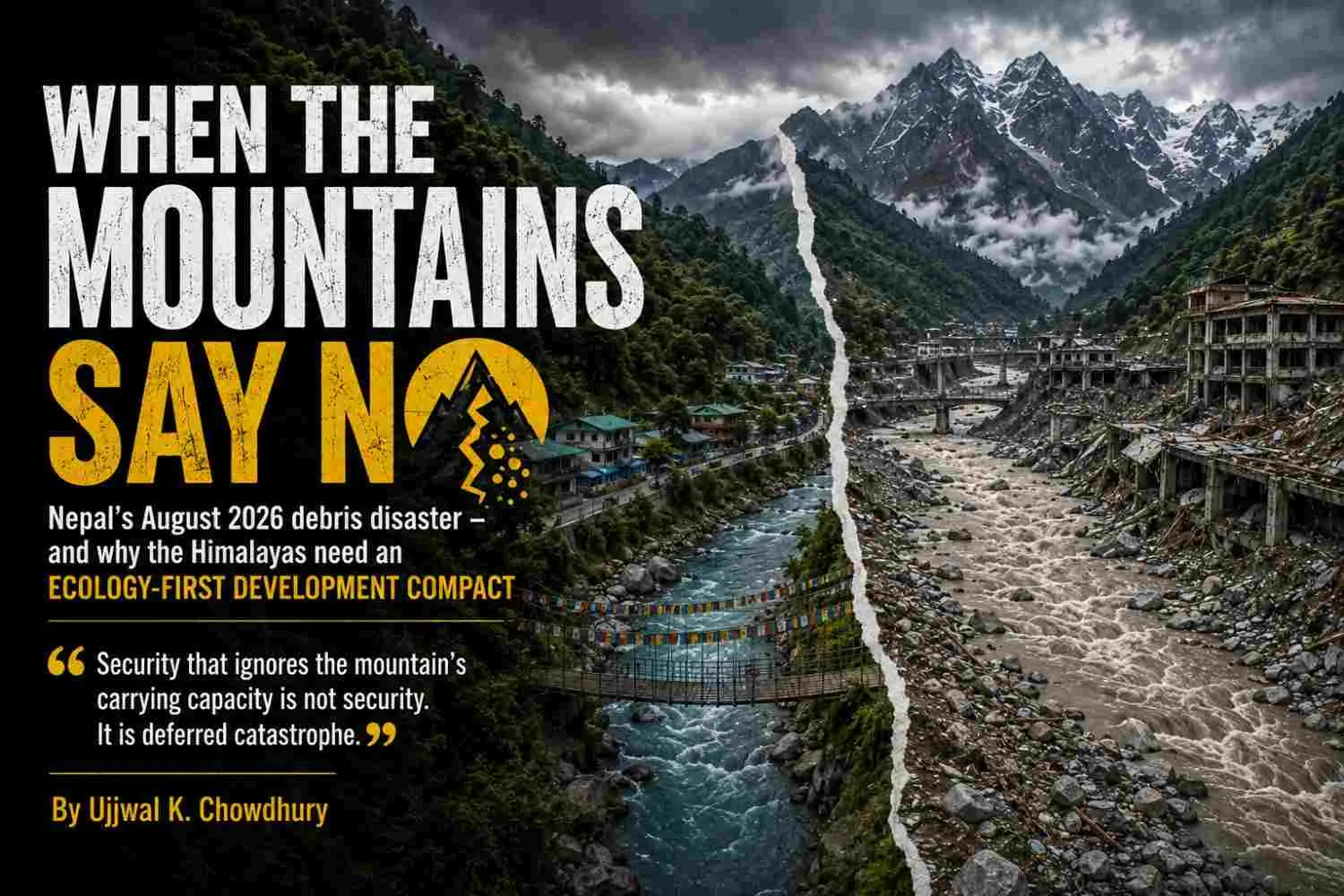
Nepal’s August 2026 debris disaster - and why the Himalayas need an ecology-first development compact
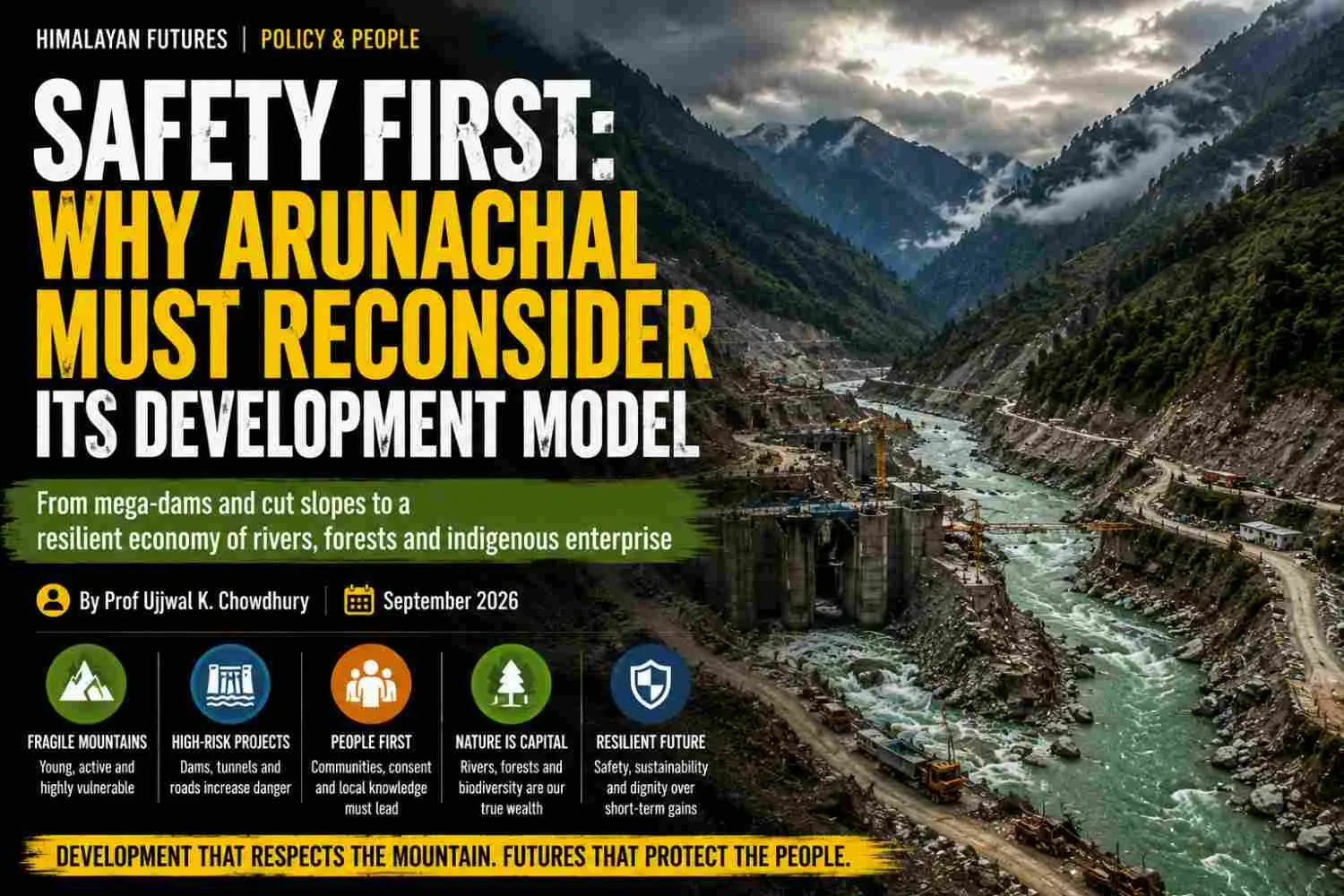
The Himalayas are not merely a development frontier—they are a living ecological system. Nepal’s 2026 debris disaster exposes the urgent need to put ecology, carrying capacity, local livelihoods and resilience at the centre of Himalayan development.
SummaryNepal’s August 2026 debris disaster shows how fragile Himalayan landscapes can turn infrastructure and human exposure into catastrophe.The article argues that climate change is increasing background risks, but poor planning, construction and weak warning systems determine the scale of damage.An ecology-first approach would prioritise restoration, responsible tourism, resilient infrastructure, local livelihoods and stronger cross-border data sharing.Examples from Bhutan and Sikkim demonstrate how tourism, conservation and community-based economies can be aligned rather than treated as competing priorities.The central message is clear: Himalayan development must protect the ecological systems that sustain security, livelihoods, water and long-term prosperity.
Security that ignores the mountain’s carrying capacity is not security. It is deferred catastrophe.A field note for the Himalayan future
The news peg: when the mountain arrived as a wave
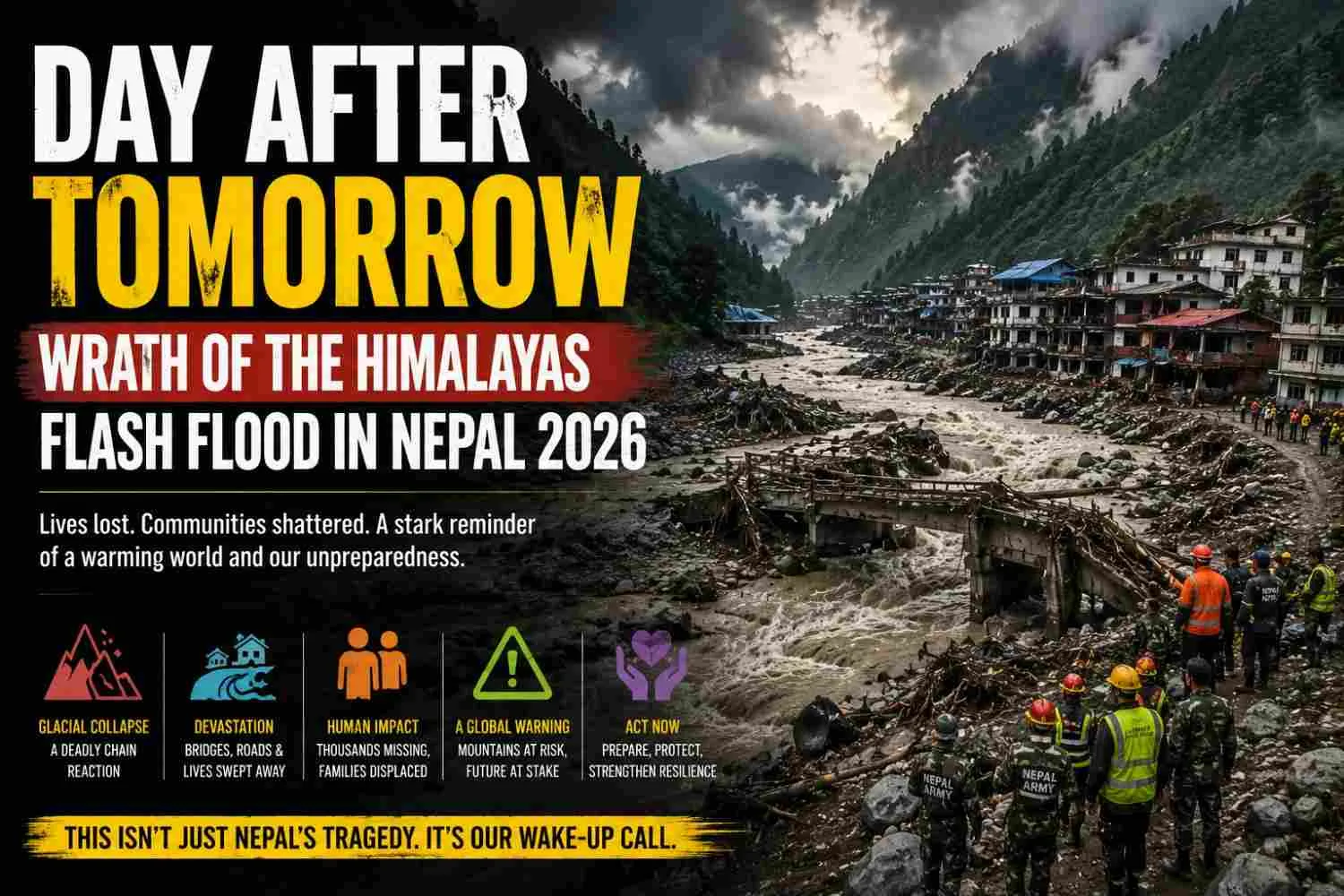
On 4 September, the most improbable image from Nepal’s Bhote Koshi disaster was also the most instructive: two hydropower workers emerged alive after more than a week trapped inside the Trishuli 3A tunnel. Their rescue came as families were still waiting for names, bodies and reliable information. It was a small return from a corridor that had become a geography of absence—washed-out settlements, severed roads, missing workers, missing tourists and a river carrying the mountain itself downstream.
The numbers were moving because the disaster crossed borders and administrative systems faster than the official lists could converge. Nepal News, citing Nepal Police, reported 1,290 recovered dead and 4,798 missing on 4 September. The Associated Press reported at least 1,259 dead and more than 5,000 missing in Nepal; Chinese authorities reported 21 deaths and 541 missing on the Tibetan side. Those figures should be read as a live accounting problem, not a settled total: unidentified remains, foreign workers, hydropower rosters and cross-border lists were being reconciled at different speeds.
The event began on the morning of 26 August near the Langtang–Gyirong border corridor. Preliminary assessments by the World Meteorological Organization and the International Centre for Integrated Mountain Development point to a large ice–rock avalanche entering the Lhende Khola, temporarily damming the channel and then releasing a violent pulse of water, sediment, boulders and ice. The leading account is not a classic glacial-lake outburst flood and not a simple rain-fed flash flood. It is a cascading cryosphere-and-geomorphology event: a mountain slope failed, the river was plugged, and the plug failed.
At Galchhi, the Trishuli reportedly rose by about nine metres in 30 minutes; at Malekhu, the rise was about seven metres. Monitoring stations were themselves damaged or swept away. Reports from the corridor described hydropower sites, highways, bridges, a border port and settlements hit by a moving wall of debris. SANDRP’s central warning is simple: design and disaster plans that model only the volume of water miss the mass and momentum of the mountain. A debris flood can choke tunnels, batter intake structures, bury machinery and carry bridges away even when a conventional flood estimate appears manageable.
This is why the news cannot be reduced to an unusually bad monsoon or to climate change as a universal explanation. Warming is thinning ice, thawing permafrost and altering snow and rainfall regimes across the high mountains; it raises the background probability of unstable slopes and cryosphere failures. But ICIMOD experts have cautioned that the specific trigger in this case remains under investigation. The honest conclusion is sharper than a slogan: a changing climate is loading the dice, while construction, exposure and weak warning systems decide how many people are sitting beneath the throw.
A flood that carries boulders and sediment is not merely a bigger flood. It is a different engineering and governance problem.The lesson running through SANDRP’s debris-event analysis
A disaster is never only natural
The useful formula is not nature versus development. It is hazard multiplied by exposure multiplied by vulnerability. A steep, young, seismically active mountain range will always produce landslides, avalanches, cloudbursts and sudden river pulses. The political question is whether a road, tunnel, hotel, dam, pilgrim camp or worker dormitory is placed where the next pulse can reach it—and whether the people in it have warning, escape routes, insurance and a voice before the project is approved.
The Himalayas have been teaching this lesson for years. The 2013 Kedarnath disaster showed how extreme rain, a glacial lake breach, river encroachment and unregulated pilgrimage exposure can combine into a catastrophe. The 2021 Rishiganga–Tapovan event in Uttarakhand turned a rock-and-ice avalanche into a debris torrent through a densely engineered valley; workers were among the principal victims. In October 2023, the South Lhonak glacial lake outburst flood in Sikkim damaged the Teesta III hydropower complex and pushed the question of early warning from specialist seminars into public grief.
The July 2025 flood in the Lhende Khola–Bhote Koshi corridor was an earlier warning in the same neighbourhood. Hydropower facilities, roads and bridges were damaged, while officials and researchers again pointed to the absence of real-time cross-border information. A warning that arrives after the river has crossed the border is not a warning system; it is a postscript. The August 2026 disaster therefore belongs to a pattern: the hazard is episodic, but the accumulation of exposure is continuous.
There is a temptation after each tragedy to demand a bigger wall, a higher road, a stronger dam or a faster evacuation vehicle. Those tools matter, but they cannot substitute for deciding where not to build. Sediment has memory. Old landslide fans, buried channels, river terraces and glacial deposits are not vacant plots. A project that ignores those form transfers its risk to the next village, the next worker shift and the next generation of taxpayers.
Before the border, there was a civilisation
It is important to name the geography correctly. The Hindu Kush Himalaya is a 3,500-kilometre arc across Afghanistan, Bangladesh, Bhutan, China, India, Myanmar, Nepal and Pakistan. Around 240 million people live in its mountains, while the ten major river systems rising there sustain water security for roughly 1.9 billion people downstream. The range is not a remote rim around national economies. It is their headwater, climate regulator, biodiversity vault and cultural archive.
Its social map is older and more intricate than the modern border map. Sherpa, Tamang, Gurung, Thakali, Newar, Lepcha, Bhutia, Bhotia, Kumaoni, Garhwali, Ladakhi, Balti, Kashmiri, Himachali, Tibetan, Arunachali and many other communities have built different ways of living with altitude, cold, slope and scarcity. Pastoralists move sheep, goats, yaks and cattle through seasonal commons. Farmers terrace fragile hills, save seed, grow barley, buckwheat, millets, pulses, potatoes, fruit and medicinal plants, and store food for a winter that no market can guarantee.
The sacred geography is equally material. Kailash and Mansarovar, the sources of the Ganga and Brahmaputra, Buddhist monasteries and highland lakes, Hindu pilgrimage routes, Muslim shrines and Sikh sites are not just attractions on a tourism map. They are systems of obligation: to a spring, a grazing ground, a forest, a deity, an ancestor and a neighbour. In Uttarakhand’s van panchayats, Nepal’s community forestry institutions, Bhutan’s village systems and Sikkim’s community-led tourism initiatives, social rules have often done the work that a distant permit office cannot do—rationing use, repairing commons and remembering who bears the cost.
Modern geopolitics has overlaid, not erased, that world. Colonial surveys and the Great Game hardened fluid frontiers. The incorporation of Tibet into the People’s Republic of China, India’s independence and partition, the 1962 India–China war, the Kashmir conflict, and the strategic anxieties of Nepal and Bhutan turned high passes into military theatres. Roads, airstrips, telecommunications and river projects now carry a double meaning: civilian connection and strategic reach. The danger begins when the second meaning cancels the first truth—that the mountain has its own operating system.
Security has built the road to the cliff edge
China’s infrastructure drive on the Tibetan Plateau is not imaginary, and it is not explained by economics alone. In 2025, a Reuters report on a Chinese state-assets regulator’s directive described infrastructure investment, the Sichuan–Tibet railway and the lower Yarlung Zangbo hydropower project as part of efforts expected to improve livelihoods and employment while contributing to border stability and security. Roads, rail, power and communications make it easier to move people, goods and state capacity. They also create a permanent footprint in a landscape where the margin between a transport corridor and a military corridor is deliberately thin.
The issue is not denying a remote community a clinic, phone signal, electricity or an all-weather route. It is that a security rationale can compress environmental review, centralise risk decisions and make dissent sound disloyal. The proposed Yarlung Zangbo mega-dam and the concentration of roads, railways and projects in seismically active terrain show how urgency can turn cumulative impacts into an accounting footnote. After the 2025 Tibet earthquake damaged reservoirs, Reuters reported expert concern about a hydropower spree where seismic risk is not a rounding error.
India has its own strategic imperative. Border roads, bridges, tunnels, airfields and forward logistics matter in a contested high-altitude frontier. But the same security vocabulary has also fused with pilgrimage and hydropower. The Char Dham all-weather road programme was designed to improve year-round access to four shrines and to support strategic mobility. The Supreme Court’s 2021 decision accepted a wider formation width for strategic roads, while requiring environmental safeguards; a High-Powered Committee had documented unscientific hill cutting, unsafe muck dumping, forest loss, landslides and threats to springs, wildlife and livelihoods.
That is the line governments keep trying to avoid: security is legitimate, but security is not a geology waiver. A road that repeatedly closes under landslides is not resilient mobility. A dam that cannot be reached safely after a debris event is not assured power. A border settlement without water, soil and slope stability is not durable national presence. In a transboundary range, ecological security is strategic security. It is the only form of security that does not become more fragile as the concrete multiplies.
The current disaster also exposes the diplomatic side of the problem. Rivers and hazard signals do not wait for a memorandum. Nepal needs timely information from the Tibetan side; India needs information from Nepal on upstream pulses; China, India, Bhutan and Pakistan all need to share observations when a watershed is under stress. Data exchange is often treated as a concession. In the Himalayas it is a form of mutual defence—a way to buy minutes that save lives and years that prevent bad projects.
India’s tourism machine is a throughput machine
On the Indian side, the fastest-growing pressure is not always a dam. It is the idea that a sacred or scenic place has failed unless it can process more vehicles, rooms, restaurants, helicopter sorties and visitors every season. The mountain is turned into a throughput machine. Arrivals become the headline; the cost of water, sewage, slope stabilisation, waste transport, traffic, noise and local housing is scattered across municipal budgets and household labour.
A 2025 Scientific Reports study of the Char Dham pilgrimage circuit tracked visitor growth from roughly one million in the early 2000s to more than three million in recent years, with a record of about five million in 2023. It estimated indicative daily capacities—not universal commandments—for Badrinath at 15,778 visitors, Kedarnath at 13,111, Gangotri at 8,178 and Yamunotri at 6,160. The important point is not the precision of any single number. It is that carrying capacity is now measurable enough to govern, yet footfall is still treated as destiny.
Joshimath offered a warning in slow motion. The town sits on old landslide debris, and in 2023 cracks appeared across homes, roads and public buildings. Residents blamed hotels, tunnelling and construction; officials said the causes were contested and linked the settlement’s vulnerability to its geological setting. That nuance matters. One cannot honestly attribute every crack to one project. One can still conclude that a town built on unstable deposits needs strict land-use control, drainage, monitoring and a moratorium on additional load until its risk is understood.
The word suicidal is not rhetorical when the model combines a changing climate, fragile slopes, mass movement, narrow roads, concentrated pilgrimage calendars and weak local capacity. It is suicidal in the systems sense: the activity that produces short-term revenue destroys the ecological asset and the public balance sheet that make future revenue possible. The choice is not between development and no development. It is between value extracted quickly and value renewed over time.
The old growth metricThe ecology-first metricThe immediate gateKilometres of roadSafe access per unit of slope disturbanceGeomorphic red lines and independent reviewTourist arrivalsNet local value per visitor; water and waste per staySeasonal booking, caps and public transportMegawatts commissionedReliable energy with sediment and river risk priced inCumulative basin assessment and retrofitsConstruction daysYear-round local skills in restoration and careLocal procurement and nature-work guaranteesFastest strategic routeResilient access, water security and warning timeEcology–security audit with public data
The table is a modest reset of ambition. Stop presenting raw scale as the only evidence of progress. A mountain district can have fewer roads and more reliable access, fewer visitors and more local income, fewer megawatts and more dependable power, and more year-round work. The better metric is value retained without erasing the conditions that produce it.
Bhutan: charge for the privilege of entering
Bhutan offers the clearest Himalayan rebuttal to the race for volume. Its sustainable development fee is a policy statement: international adult visitors currently pay US$100 per person per night, while visitors from India pay Nu/INR 1,200, with concessions for children. Bhutan’s official tourism guidance says the money supports free social services, environmental and cultural preservation, infrastructure, training and local businesses. The fee does not magically make tourism sustainable; it gives the state and communities an instrument to ration pressure and reinvest in the public goods that visitors consume.
The practical result is a different conversation. The question is not how many coaches can reach Thimphu by breakfast. It is whether a visitor stays longer, pays fairly, uses local guides and accommodation, respects a living culture and leaves behind enough revenue to maintain forests, trails, waste systems and public services. Bhutan’s model has trade-offs: a fee can feel exclusionary, and a state-led brand can hide uneven benefits. But its governing insight is powerful—scarcity can protect value when the revenue is transparent and the host community has standing.
There is also a product lesson. An ICIMOD-documented partnership between Bio Bhutan and a community group buys about 2,000 kilograms of fresh dwarf rhododendron leaves annually at Nu 160 per kilogram, processes them into essential oil and sells massage oil, perfume and herbal soap. Nine per cent of gross profit goes to the community group and two per cent to an access-and-benefit-sharing fund. It is a small enterprise, but that is exactly why it matters: biodiversity becomes income without becoming a mine, and conservation is written into the transaction.
Bhutan is not a postcard proof that every problem has been solved. Climate shocks, waste, inequality and pressure from neighbouring markets remain real. Its contribution is institutional imagination: a mountain nation can decide that tranquillity, biodiversity and cultural integrity are productive assets. It can charge for pressure, measure what the money repairs and make the visitor a participant in stewardship rather than a unit of arrival statistics.
Sikkim: a laboratory, not a postcard
Sikkim shows how an Indian Himalayan state can move in the same direction without pretending to copy Bhutan. Its Organic Mission set out to make the state fully organic, and its tourism system uses permits and group requirements for sensitive parts of North Sikkim. Community-based tourism initiatives in Darap, Pastanga and Kitam have been studied through a triple-bottom-line lens: ecological care, economic viability and social participation. Homestays, local food, village walks, guides, craft and farm experiences can keep value in the settlement rather than exporting it to a highway hotel.
The state is also learning the unglamorous side of sustainability. In 2024, tourist vehicles were required to carry large garbage bags as a condition of entering Sikkim, a small producer-responsibility rule aimed at a state receiving more than 20 lakh visitors a year. The measure will not solve waste by itself, but it makes the visitor part of the disposal chain. That kind of mundane accountability is more important than another glossy eco-label.
Sikkim should not be advertised as a finished high-value, low-footfall model. It faces rising arrivals, urban pressure, landslide exposure and the familiar gap between an organic brand and a remunerative farm. Its value is as a laboratory. The next step is to link organic production, homestays, biodiversity stewardship and public procurement so that a farmer is not asked to carry the cost of certification while hotels and intermediaries capture the premium. Sustainable tourism becomes credible when the resident can see the money, the work and the reason to protect the landscape.
The global lesson: protect the asset, price the pressure
The Himalayan debate is not trapped in Himalayan exceptionalism. Rwanda charges US$1,500 for a mountain-gorilla tracking permit in Volcanoes National Park and directs 10 per cent of permit revenue to communities around national parks. The point is not to turn a sacred mountain into a luxury club. It is to demonstrate that a rare ecological experience can be rationed, priced and linked to conservation, local services and employment. Lower-cost local access and public education can coexist with premium international experiences; the principle is that the fragile asset is not free to unlimited demand.
Costa Rica makes a different move. Its tourism board says more than 25 per cent of national territory is reserved for conservation and presents protected areas as the foundation of the visitor economy. The country’s lesson is long-term institutional alignment: forests, parks, renewable energy and tourism branding are not separate departments competing for the same landscape. Conservation is economic infrastructure because it protects the reason people come and the water and biodiversity that residents need.
New Zealand’s Great Walks show the value of refusing to confuse public access with unlimited access. Hut and campsite stays on popular tracks are booked in advance, managed by season, priced differentially and sometimes closed or restricted outside the safe period. The system is not elitist simply because a track has a cap; it is fairer than allowing the fastest, richest or most connected visitor to overwhelm a public asset. A Himalayan pilgrimage route could use the same logic: a calendar, a quota, a local guide network, transparent exemptions and a public account of where the fee goes.
The shared principle is direct: nature is the productive core, not scenery left over after development. The income must keep the gorilla, forest, trail and watershed alive. Himalayan ministries should ask what level of use lets a place renew itself—not how much can be extracted before it fails.
What an ecology-first Himalayan economy looks like
An alternative is not a return to poverty or a ban on all modern infrastructure. It is a different development grammar. The intrinsic value of the Himalayas is not a philosophical luxury: forests slow runoff, wetlands store water, soils hold slopes, biodiversity pollinates crops, snow and ice regulate rivers, and cultural landscapes organise care. The imposed value system says a mountain is useful when it is cut, dammed, paved or photographed. An ecology-first system says a mountain is already doing work before a project arrives—and the first duty of development is not to destroy that work.
First comes restoration as infrastructure. Every watershed should have paid local crews for spring revival, native forest regeneration, wetland protection, slope bioengineering, trail repair, fire management, invasive-species control and community water monitoring. Such work is not beautification. It is risk reduction, rural employment and climate adaptation. MGNREGA, state watershed programmes, forest departments, disaster funds and corporate social responsibility should be able to finance it through multi-year contracts with village institutions, not short campaigns that disappear after a photograph.
Second comes slow tourism. Put the cap at the destination, not at the district border after the road and hotel boom have already happened. Use advance bookings, differential fees, seasonal closures, walking and electric mobility, decentralised sanitation, luggage logistics, no-build zones around rivers and fans, and a ban on helicopter exceptions that make carrying capacity meaningless. Spread itineraries across villages only when the villages consent and have water, waste and emergency systems. Measure room-nights retained locally, local procurement, water use and waste recovered—not merely the number of vehicles that crossed a checkpoint.
Third comes a mountain bioeconomy. The Himalayas offer a basket with global potential: sea buckthorn, apricot, apple, walnut, pine nut, wild thyme, chamomile, bay leaf, ginger, cardamom, tea, coffee, honey, buckwheat, millets, red rice, kidney beans, pashmina, yak and sheep wool, handmade paper, bamboo and carefully managed medicinal plants. Demand exists in functional foods, ethical fashion, clean beauty, nutraceuticals and wellness. India’s AYUSH and herbal-product exports rose from $649.2 million in 2023–24 to $688.89 million in 2024–25; that is an all-India figure, not a Himalayan windfall, but it signals a market large enough to justify serious quality infrastructure.
The rule must be harvest less, earn more. Wild collection needs quotas, regeneration plots, seasonal bans and community monitoring. Cultivation should protect local genetic diversity instead of replacing it with a single export crop. Processing, drying, grading, cold storage, botanical authentication, food safety, lab testing, traceability, geographical indications and benefit-sharing are where value is added. A village that sells raw herbs to a trader remains vulnerable; a cooperative that owns a tested extract, a trusted brand and a buyer contract can finance both livelihoods and the forest.
There are already glimpses. A reported Almora project combines MGNREGA and Himalayan research institutions to cultivate rosemary, chamomile, timur, bay leaf and kapoor kachri on 5.5 hectares, with an estimated reach of 400 rural families, 268 self-help groups and 15,500 person-days of employment. In the Darma Valley, agricultural scientists and local institutions have explored processing buckwheat and kidney beans into flour and biscuits while documenting medicinal plants and indigenous practice. These are not substitutes for land rights, fair prices or public services. They are proof that value can be built at altitude without blasting a valley open.
Fourth comes a digital layer that serves local agency. A Himalayan product should be traceable to a landscape, a harvest protocol and a benefit-sharing agreement. A visitor should be able to see whether a homestay fee funded a spring, a waste system or a village school. A dam operator should publish sediment assumptions and real-time risk data. A community should own a sensor, not merely be measured by one. Technology is useful when it makes ecological limits visible and power accountable.
The employment dividend: jobs that keep the slope standing
The most damaging false choice is between a construction boom and unemployment. The Himalayas need work, especially for young people facing outmigration, but not every job must be tied to cutting a new road or pouring a new hotel. A slower economy can be labour-intensive in the right places: restoring springs, maintaining trails, running nurseries, mapping landslides, monitoring snow and wildlife, guiding visitors, hosting travellers, processing foods, repairing solar and micro-hydro systems, managing waste, caring for elderly residents and responding to disasters.
Imagine a district-level Mountain Service Corps recruited from local villages. Its members would be trained and paid for three-year cycles in first response, rope rescue, slope and stream observation, community radio, ecological restoration, trail safety, biodiversity surveys and visitor management. Some would become permanent technicians; others would return to farming or enterprises with a recognised skill and a local market. The corps would be cheaper than repeated emergency mobilisation and more dignified than treating mountain residents as casual labour for outside contractors.
Natural-product enterprises create a second ladder. Farmers can be paid for cultivation and stewardship; women’s groups can run cleaning, grading, drying and packaging; young people can handle design, digital sales, logistics, laboratory work and hospitality; monasteries and cultural institutions can curate knowledge without surrendering it. Public procurement can create a floor by buying local millets, pulses, herbal teas and certified nursery stock for schools, hospitals, army kitchens and disaster shelters. Private demand can then compete above that floor instead of forcing producers to sell raw material at distress prices.
This is also where cultural and social justice become economic design. A community should be able to say that a spring, pasture, forest patch or sacred site is not for sale. Women who carry water and fuel should help decide tourism and energy; pastoral routes must be mapped before roads cut them. Traditional knowledge should be credited and compensated, not mined by a brand with no share for the people who kept it alive. Ethics determines whether the economy can endure.
Four decisions governments can take now
The Himalayas need rules that survive political urgency, contractor pressure and the next election. Four decisions would change the incentives.
1. Make geology the first permit
Create statutory geomorphic zoning for every Himalayan basin: no-build red zones on active debris fans, old landslide toes, floodplains, unstable moraine and critical springs; conditional zones with strict load, drainage and evacuation rules; and buildable zones where cumulative risk is acceptable. Require independent basin-level assessments before a chain of roads, tunnels, dams or hotels is approved. Make muck disposal, sediment routing, worker accommodation, slope monitoring and emergency access enforceable conditions, not annexures. Every existing high-risk project should receive a retrofit or retirement plan, with a public register of overdue actions.
2. Cap the visitor and count the worker
Adopt destination-level carrying-capacity rules for pilgrimage towns, national parks, high passes and glacier valleys. Use bookings, seasonal calendars, differential entry fees, waste deposits, public transport, local guide requirements and water budgets. Publish the capacity method and the data; do not turn a number into a secret bureaucratic ceiling. The same system should count every worker in a tunnel, dam and road camp, record shifts and emergency exits, provide multilingual alerts and require a named evacuation plan. If a project cannot account for its workers, it cannot claim to be resilient.
3. Turn natural products into a public mission
Upgrade the existing National Mission for Sustaining the Himalayan Ecosystem and the National Mission on Himalayan Studies into a Himalayan Nature-Products and Restoration Mission with state, community and research partners. Finance village processing hubs, botanical and food-safety labs, cold chains, common branding, GI protection, digital traceability, access-and-benefit-sharing agreements and patient working capital. Tie subsidies to regeneration and producer ownership. Use public procurement to create stable demand for climate-resilient local foods, certified medicinal plants, wool, nursery stock and restoration services. The goal is not an extractive herbal rush; it is a diversified portfolio where the forest remains more valuable standing than stripped.
4. Make data sharing a peace dividend
Build a transboundary Himalayan risk compact under which China, India, Nepal, Bhutan and Pakistan share agreed, time-stamped observations on river levels, rainfall, snow, glacier lakes, seismic signals and major slope failures. Use satellites, automatic stations, community gauges, sirens, radio and cell broadcast; rehearse the warning chain twice a year. India already has NDMA guidelines on GLOFs, while NMSHE is tasked with assessing Himalayan vulnerability and ecosystem health. The missing step is authority, interoperability and trust. Put the data in the public domain wherever security permits, and treat minutes of warning as a regional public good rather than a diplomatic favour.
The mountain’s final warning
The rescued workers in the Trishuli 3A tunnel should not become a convenient ending—a miracle that lets the system return to business. Their survival makes the obligation harder. They were not rescued by a growth statistic. They were rescued by people, persistence, local knowledge, equipment and time. A rational Himalayan development model would invest in those capacities before the next river rises, not after the cameras arrive.
The choice before India, China, Nepal, Bhutan and the other Himalayan countries is between two futures. One treats the range as a frontier to be secured, accelerated and monetised until valleys are corridors and rivers project sites. The other treats it as a living system whose forests, snow, rivers, cultures and communities are the platform for durable prosperity.
The second future is slower, but not smaller. It can create more local ownership, stronger public services, safer pilgrimage, higher-value tourism, natural products and strategic depth that concrete alone cannot provide. It requires saying no—to a road on a debris fan, a hotel above a spring, a dam without a basin assessment, or a security argument without ecological accounting. That boundary allows development to continue.
Sunderlal Bahuguna’s old sentence remains the most modern balance sheet: ecology is permanent economy. In the Himalayas, it is also permanent security, permanent culture and permanent livelihood. The mountains are not refusing development. They are refusing to be developed as if they were dead.
Sources and further readingEditorial note: The Nepal casualty figures in the feature are time-stamped reports available on 4 September 2026 and may change as unidentified remains and cross-border missing-person lists are reconciled. The event’s precise trigger remains under investigation; the feature distinguishes preliminary scientific findings from policy inference.
1. Counterview, “India’s nuclear power fantasy: A reality check from the Western Ghats”. https://www.counterview.net/2026/09/indias-nuclear-power-fantasy-reality.html — context on development claims, risk and the Western Ghats analogy
2. Bharat Dogra, Counterview, “Beyond relief: Why the Himalayas must now choose ecology over indiscriminate development”. https://www.counterview.net/2026/09/beyond-relief-why-himalayas-must-now.html — ecology-first framing, livelihoods, forests and pilgrimage pressure
3. Counterview, “Beyond a natural disaster: Lessons from the Tibet–Nepal debris flow”. https://www.counterview.net/2026/09/beyond-natural-disaster-lessons-from.html — debris-flow and governance context
4. Counterview News, “Himalayan floods are deadly debris events, not just water surges: SANDRP”. https://www.counterview.net/2026/09/himalayan-floods-are-deadly-debris.html — summary of SANDRP’s debris-event analysis
5. World Meteorological Organization, “Flood tragedy in Nepal highlights cross-border and cascading risks”. https://wmo.int/media/news/flood-tragedy-nepal-highlights-cross-border-and-cascading-risks — preliminary event mechanism, river observations and warning-system lessons
6. ICIMOD, “Kyirong–Rasuwa flood 2026: a tsunami from the sky”. https://www.icimod.org/kyirong-rasuwa-flood-2026-nepal-china-border/ — cryosphere expertise and limits of specific climate attribution
7. Nepal News, “Bhote Koshi flood disaster: death toll reaches 1,290; over 4,700 remain missing”. https://english.nepalnews.com/s/nation/bhote-koshi-flood-disaster-death-toll-reaches-1290-over-4700-remain-missing/ — 4 September 2026 casualty bulletin
8. Nepal News, “Two trapped workers saved alive from Trishuli 3-A tunnel”. https://english.nepalnews.com/s/nation/two-trapped-workers-saved-alive-from-trishuli-3-a-tunnel/ — 4 September 2026 rescue report
9. Nepal News, “Bhote Koshi catastrophe: a 360-degree look at what happened, what went wrong and what comes next”. https://english.nepalnews.com/s/explainers/bhote-koshi-catastrophe-a-360-degree-look-at-what-happened-what-went-wrong-and-what-comes-next/ — event chronology, warning gap and hydropower exposure
10. SANDRP, “Himalayan Disaster August 2026: Bhote Koshi deluge”. https://sandrp.in/2026/08/28/himalayan-disaster-august-2026-bhote-koshi-deluge/ — debris-flood analysis and infrastructure exposure
11. SANDRP, “July 2025 GLOF disaster impact on ten HEPS in Nepal”. https://sandrp.in/2025/07/24/july-2025-glof-disaster-impact-ten-heps-in-nepal/ — earlier warning from the same transboundary corridor
12. ICIMOD, “The Hindu Kush Himalaya”. https://www.icimod.org/who-we-are/the-hindu-kush-himalaya/ — regional geography, population and river-basin context
13. ICIMOD, “The Hindu Kush Himalaya could lead the way towards nature-based solutions”. https://www.icimod.org/the-hindu-kush-himalaya-could-lead-the-way-towards-nature-based-solutions/ — biodiversity and natural-capital context
14. UNEP, “Mountains” and “New report highlights risk of global warming in the Third Pole”. https://www.unep.org/interactive/explore-ecosystems/mountains/en/index.php — mountain livelihoods, water and climate risk
15. Reuters, “China calls on state-owned firms to boost industrial aid to Tibet”. https://www.reuters.com/markets/emerging/china-calls-state-owned-firms-boost-industrial-aid-tibet-2025-08-26/ — officially stated infrastructure, livelihood and border-security rationale
16. Reuters, “Tibet quake highlights earthquake risk of dams on the roof of the world”. https://www.reuters.com/world/asia-pacific/tibet-quake-highlights-earthquake-risk-dams-roof-world-2025-01-10/ — seismic and hydropower context
17. Supreme Court of India, Char Dham road judgment, 14 December 2021. https://api.sci.gov.in/pdfdate/index1.php?dno=223692020&dt=2021-12-14&filename=supremecourt/2020/22369/22369_2020_4_1503_32125_Judgement_14-Dec-2021.pdf — strategic-road width and safeguards
18. RGICS, “Environmental cost of the Char Dham project: High Power Committee highlights”. https://www.rgics.org/environment/environmental-cost-of-the-char-dham-project-highlights-of-the-report-of-high-power-committee-appointed-by-the-honble-supreme-court/ — summary of environmental and social concerns
19. Kuniyal et al., Scientific Reports, “Carrying capacity assessment for sustainable tourism in the Char Dham pilgrimage circuit”. https://www.nature.com/articles/s41598-025-20166-8 — visitor growth and indicative daily capacities
20. Reuters, “Sinking Himalayan town puts spotlight on India’s hydropower rush”. https://www.reuters.com/world/sinking-himalayan-town-puts-spotlight-indias-hydropower-rush--trfn-2023-01-16/ — Joshimath’s geological setting and contested causal claims
21. Bhutan Tourism, official FAQs. https://bhutan.travel/faqs — sustainable development fee, public-good reinvestment and tourism policy
22. ICIMOD, “Community–enterprise partnership in Bhutan for nature-based products”. https://www.icimod.org/adaptation-solutions/communityenterprise-partnership-in-bhutan-for-nature-based-products/ — dwarf-rhododendron value chain and benefit sharing
23. Government of Sikkim, Sikkim Organic Mission. https://www.sikkim.gov.in/Mission/Mission-info/1?Mission=Sikkim+Organic+Mission — organic farming policy
24. Government of Sikkim, Protected Area Permit information. https://www.sikkimtourism.gov.in/pap — permit management in sensitive northern valleys
25. Lex Localis, “Community-based tourism in Sikkim through a Triple Bottom Line lens”. https://lex-localis.org/index.php/LexLocalis/article/view/802817/2952 — Darap, Pastanga and Kitam case comparison
26. FAO, “Agroecology at altitude: how Himalayan communities are reimagining food systems”. https://www.fao.org/agroecology/new-knowledge-module/germinate/detail/agroecology-at-altitude-------how-himalayan-communities-are-reimagining-food-systems-from-the-ground-up/en — agroecology, local food systems and the Himalayan Agroecology Initiative
27. ICIMOD, “Mountain products: a sea of opportunities”. https://www.icimod.org/mountain-products-a-sea-of-opportunities/ — natural-product basket, processing and niche-market potential
28. Press Information Bureau, “AYUSH exports rise to $688.89 million in 2024–25”. https://www.pib.gov.in/PressReleaseIframePage.aspx?PRID=2211272 — national market signal; not a Himalayan-only figure
29. Rwanda Development Board, “Increase of Gorilla Permit Tariffs”. https://rdb.rw/increase-of-gorilla-permit-tariffs/ — US$1,500 permit and 10 per cent community revenue share
30. Visit Rwanda, “Gorilla Tracking”. https://visitrwanda.com/interests/gorilla-tracking/ — permit, community revenue and local employment
31. Visit Costa Rica, “Sustainability”. https://www.visitcostarica.com/sustainability — 25 per cent of national territory in conservation
32. New Zealand Department of Conservation, “Great Walks” and pricing. https://www.doc.govt.nz/parks-and-recreation/things-to-do/walking-and-tramping/great-walks/ — advance booking, seasonality and managed visitor pressure
33. Department of Science and Technology, Government of India, Climate Change Programme. https://dst.gov.in/climate-change-programme — NMSHE mandate and national climate-science capacity
34. National Disaster Management Authority, India, Guidelines. https://ndma.gov.in/ndma-guidelines — 2020 GLOF guidelines and disaster-risk instruments
35. Times of India, “Medicinal plant project in Almora to curb migration and revive hill agriculture”. https://timesofindia.indiatimes.com/city/dehradun/medicinal-plant-project-in-almora-to-curb-migration-and-revive-hill-agriculture/articleshow/121384422.cms — reported employment and medicinal-plant pilot
36. Times of India, “Scientists promote climate-resilient farming in Darma Valley”. https://timesofindia.indiatimes.com/city/dehradun/scientists-promote-climate-resilient-farming-in-darma-valley/articleshow/121734949.cms — reported value addition and indigenous-crop work
...Read more