07 Sep 2026
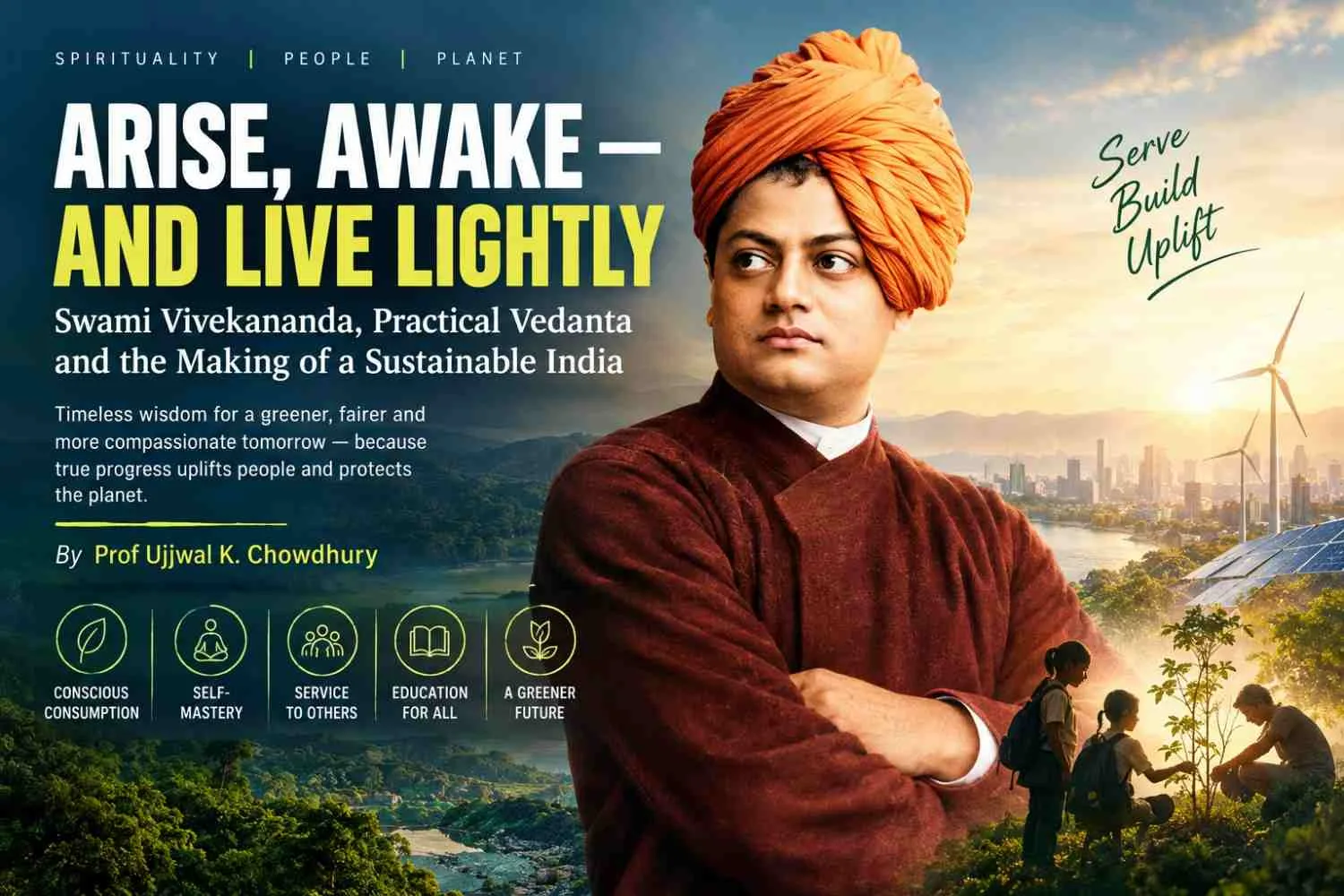
Swami Vivekananda, Practical Vedanta and the Making of a Sustainable IndiaSwami Vivekananda never spoke the language of carbon budgets or net zero. Yet his most enduring ideas — on oneness, self-mastery, service, strength, education, science and renunciation — reach straight into the moral centre of the climate crisis. Read without anachronism, his Practical Vedanta offers India not a green slogan, but a demanding philosophy for prosperity without excess, spirituality without escape and development without abandonment of the vulnerable. Swami Vivekananda, Chicago-era portrait, 1893. Photograph: Thomas Harrison. AT A GLANCE BLURBSwami Vivekananda never spoke the language of carbon budgets or net zero. Yet his most enduring ideas — on oneness, self-mastery, service, strength, education, science and renunciation — reach straight into the moral centre of the climate crisis. Read without anachronism, his Practical Vedanta offers India not a green slogan, but a demanding philosophy for prosperity without excess, spirituality without escape and development without abandonment of the vulnerable. SUCCINCT SUMMARYVivekananda was not a climate theorist, and it would be historically false to make him one. His relevance is deeper. He asked India to combine spiritual confidence with scientific modernity, to conquer desire as seriously as it conquered external nature, to educate for character and capability, and to regard service to the least powerful as worship. In an era of warming, ecological disruption and hyper-consumption, these principles translate into climate justice, conscious consumption, resilient communities, ethical enterprise, green education and a daily discipline of restraint, health, attention and service. The sustainable India his thought can inspire is neither anti-development nor consumerist: it is technologically ambitious, socially just, ecologically responsible and inwardly free. “The national ideals of India are RENUNCIATION and SERVICE.”— Swami Vivekananda, Reawakening of Hinduism on a National Basis 2024India’s warmest year on record since 1901IMD2.8°CApprox. warming this century under current global policiesUNEP 202552.57%India’s installed power capacity from non-fossil sources as of 28 Feb 2026India NDC 2031–35 THE MONK WHO DID NOT PREDICT CLIMATE CHANGE — AND WHY THAT MATTERS Swami Vivekananda died in 1902. The atmospheric concentration of carbon dioxide, the language of “net zero”, the IPCC, biodiversity conventions and the Sustainable Development Goals belonged to another century. Calling him a climate scientist in saffron robes would not honour him; it would flatten history. His importance to the ecological age is more serious than retrospective prophecy. Vivekananda asked what kind of human being a civilisation should produce. He asked what freedom means, what education is for, how strength should be used, whether privilege can coexist with spiritual truth, and why religion that does not enter the suffering world is incomplete. Those questions now sit underneath climate policy. Technology can tell us how to decarbonise electricity; it cannot, by itself, decide how much consumption is enough, whose livelihood must be protected in a transition, or what we owe generations we will never meet. India’s climate reality makes that moral layer impossible to ignore. The India Meteorological Department recorded 2024 as the country’s warmest year since nationwide records began in 1901, with annual mean land temperature 0.65°C above the 1991–2020 average. UNEP’s 2025 Emissions Gap Report says current global policies still point to roughly 2.8°C of warming this century. The ecological emergency is technical, economic and political — but it is also a crisis of consciousness, appetite and solidarity. “Each soul is potentially divine.”— Swami Vivekananda, Raja-Yoga, Preface THE FIRST GREEN REVOLUTION IS INSIDE THE MIND One of Vivekananda’s most useful distinctions for our century is between external nature and internal nature. Modern civilisation is astonishingly good at manipulating the external world: we split atoms, edit genes, automate factories, mine deep seas, launch satellites and train artificial intelligence. Yet the same civilisation often treats desire as sovereign. The market can optimise delivery in ten minutes; the mind has not learned to ask whether the purchase was necessary. Vivekananda put the hierarchy differently: “It is good and very grand to conquer external nature, but grander still to conquer our internal nature.” He was speaking about spiritual freedom, not carbon emissions. But the translation into sustainability is precise. External mastery plus internal unrestraint produces efficient excess. External mastery plus self-mastery can produce a civilisation capable of abundance without waste. The IPCC has given this insight a modern empirical edge: demand-side changes in buildings, transport and food, together with new ways of providing services, can reduce end-use-sector greenhouse-gas emissions by 40–70 per cent by 2050 relative to baseline scenarios. The point is not that individual virtue replaces public policy. It is that policy, infrastructure, business models and culture all shape demand — and none can ultimately avoid the question of “enough”. A Vivekanandan environmental ethic therefore rejects two equal mistakes: compulsory austerity for the poor, and limitless consumption for the rich. Renunciation is not romanticised deprivation. A child without cooling in deadly heat, a family without clean cooking, a village without reliable electricity or a woman walking kilometres for water needs more material security, not sermons on consuming less. Restraint becomes a moral obligation precisely where consumption has crossed from dignity into display, from comfort into compulsion. “It is good and very grand to conquer external nature, but grander still to conquer our internal nature.”— Swami Vivekananda, The Necessity of Religion ADVAITA MEETS ECOLOGY — WITHOUT CONFUSING METAPHYSICS WITH SCIENCE At the heart of Vivekananda’s Vedanta is unity: the same ultimate reality appears through multiplicity. “Each soul is potentially divine,” he wrote in the Preface to Raja-Yoga, while describing the spiritual task as mastering nature, external and internal. Modern ecology arrives at interdependence through a different road — observation, measurement, systems science. Soil, pollinators, water cycles, forests, oceans, microbes, farms and cities are linked in material feedback loops. Vedanta and ecology are not interchangeable disciplines. Yet they can reinforce the same ethical refusal of separateness. The ecological crisis thrives on distance. The city sees a plastic packet, not the petrochemical chain behind it. The smartphone user sees a device, not mines, metals, labour and e-waste. The electricity consumer sees a switch, not the land, water, ash, transmission lines or communities behind generation. The river becomes “water supply”; the forest becomes “stock”; the atmosphere becomes a free waste sink. Practical Vedanta collapses that moral distance. If dignity is universal and existence is radically connected, no community can be treated as an acceptable sacrifice zone. A wetland is not sacred because we romanticise it; it is indispensable because life is relational. A mangrove is storm protection, nursery habitat, carbon store and livelihood system at once. An ethic of oneness does not replace environmental-impact assessment. It tells us why the assessment must count lives that markets routinely discount. “It is good and very grand to conquer external nature, but grander still to conquer our internal nature.”— Swami Vivekananda, The Necessity of Religion FROM “LIVE FOR OTHERS” TO CLIMATE JUSTICE Vivekananda’s spirituality was never satisfied with private illumination. “They alone live who live for others,” he wrote; elsewhere, “It is a privilege to serve mankind, for this is the worship of God.” In the Ramakrishna movement, this became organised service — education, health, relief and rural work — rather than episodic charity. The Ramakrishna Mission, founded in 1897, turned the principle of Atmano mokshartham jagat hitaya cha — one’s own liberation and the welfare of the world — into institutional practice. Climate change makes this service ethic intensely contemporary because vulnerability is unequal. A wealthy household can buy air-conditioning, insurance, purified water and mobility. A street vendor loses income when heat becomes dangerous. A marginal farmer cannot diversify risk as easily as an agribusiness. A fisher family living beside an eroding coast cannot move assets with a click. Children lose school days after floods. Women often absorb extra care work and water stress. Informal settlements face heat, drainage and air-pollution burdens together. A Vivekanandan climate policy would therefore ask four uncomfortable questions: Who benefits? Who pays? Who decides? Who is invisible? The answers must shape a just transition from coal, climate-resilient housing, heat-action plans, public transport, forest governance, disaster response and adaptation finance. Tribal and local ecological knowledge should be engaged with respect and evidence, not appropriated as picturesque folklore; likewise, conservation must not become an excuse to dispossess people whose livelihoods have long depended on forests and commons. Service also changes the tone of philanthropy and CSR. A company cannot claim the spirit of seva because it plants trees with one hand while contaminating water with the other. ESG cannot remain a reporting layer detached from procurement, product design, labour conditions, logistics, biodiversity, executive incentives and capital allocation. Vivekananda’s assault on privilege is relevant here: sustainability is credible only when responsibility runs through the institution, not merely through its charitable arm. “They alone live who live for others, the rest are more dead than alive.”— Swami Vivekananda, Our Duty to the Masses RENUNCIATION FOR THE AGE OF ONE-CLICK CONSUMPTION “The national ideals of India are RENUNCIATION and SERVICE,” Vivekananda said. Renunciation, in his world, did not mean economic stagnation; he wanted the masses educated, technically capable and materially uplifted. Its contemporary ecological meaning is freedom from being possessed by possessions. That distinction matters in a consumer culture engineered around attention, novelty and replacement. Fast fashion makes garments psychologically old before they are physically worn out. Electronics are upgraded because status expires faster than hardware. Food is discarded while millions struggle with nutrition. Festivals can become competitions in lighting, plastic, thermocol, transport and noise. Digital platforms turn desire into a continuous auction for attention. The sustainable spiritual response is not joylessness. It is a richer definition of enjoyment: use without addiction; beauty without waste; celebration without toxicity; mobility without needless emissions; technology without servitude. Repair before replacing. Borrow or share where ownership adds little. Choose durability. Prefer local and seasonal food where practical. Reduce food waste. Carry a bottle. Refuse unnecessary packaging. Use public transport, walking or cycling when the urban system makes them safe. Let the festival leave memories, not mountains of refuse. This is where Vivekananda’s inner discipline meets India’s contemporary “Lifestyle for Environment” policy vocabulary. India’s 2031–35 NDC explicitly places sustainable lifestyles and people-centric behavioural change alongside technology and policy. The philosophical contribution Vivekananda adds is motive: restraint should not be marketed as guilt. It can be experienced as freedom — swaraj over appetite. “They alone live who live for others, the rest are more dead than alive.”— Swami Vivekananda, Our Duty to the Masses STRENGTH IS NOT DOMINATION; IT IS RESILIENCE Vivekananda’s language of strength is often reduced to posters. In context, he wanted people who could stand on their own feet — physically, intellectually, morally and economically. “What we want is muscles of iron and nerves of steel,” he wrote. For the climate age, that strength can be re-read as resilience. A resilient India needs more than sea walls and drainage pumps. It needs farmers who can access climate information and diverse seeds; cities that protect outdoor workers during extreme heat; neighbourhoods with functioning local institutions; schools that can serve as safe shelters; health systems prepared for heat stress and vector-borne disease; youth trained in green skills; women with financial and decision-making power; and communities that can recover without falling permanently into debt. It also needs psychological resilience. Climate anxiety is rational when the risks are real, but paralysis is not a strategy. Vivekananda’s fearlessness, abhaya, is useful precisely because it is not denial. It asks us to look squarely at danger and still act. The climate movement needs fewer apocalyptic performances and more durable workers — scientists, engineers, farmers, teachers, entrepreneurs, civil servants, journalists and citizens capable of staying with a problem after the trending hashtag has disappeared. SCIENCE IN ONE HAND, SPIRITUAL PURPOSE IN THE OTHER Vivekananda was not anti-modern. His writings repeatedly engage scientific language and he wanted India to absorb modern knowledge, technology, organisation and productive skill without surrendering its spiritual centre. Belur Math’s account of his national vision records his emphasis on improved agriculture, village industries, education and material knowledge for the uplift of ordinary people. That synthesis is the opposite of both technophobia and techno-solutionism. Climate change will not be solved by meditation. India needs grids, storage, renewable power, electrified mobility, efficient buildings, lower-carbon industry, resilient crops, modern water systems, early-warning networks, circular manufacturing and better climate data. But technology does not decide the purpose of development. Ethics must still ask: Is a “green” mine socially just? Does an electric-vehicle transition improve public transport or simply replace one private car with another? Does a solar park respect land rights and biodiversity? Does artificial intelligence cut waste or merely accelerate consumption? India’s newest NDC makes the scale of the transition visible: by 2035 it targets a 47 per cent reduction in emissions intensity of GDP from 2005 levels, about 60 per cent of cumulative installed electric-power capacity from non-fossil sources, and a 3.5–4.0 billion tonne CO₂-equivalent carbon sink through forest and tree cover relative to 2005. As of February 2026, the NDC reported non-fossil sources at 52.57 per cent of installed power capacity. These are infrastructure numbers. Vivekananda’s challenge is to ensure that the civilisation built around that infrastructure is just, restrained and humane. “Education is the manifestation of the perfection already in man.”— Swami Vivekananda, What We Believe In WORK AS WORSHIP — AND THE GREEN ECONOMY OF DIGNITY Vivekananda’s Karma Yoga dignified work by changing its inner logic: work could become a path of freedom when performed with competence, integrity and reduced attachment to egoistic reward. For sustainability, that insight shifts the debate from the prestige of a “green” label to the quality and consequences of work itself. A job is not sustainable merely because it sits inside a renewable-energy company; it must also be safe, fairly paid, socially useful and ecologically responsible. India’s green transition will create and transform work across construction, batteries, public transport, solar installation, energy efficiency, waste recovery, ecosystem restoration, sustainable tourism, water management and climate-smart agriculture. But a circular economy cannot be morally circular if the people who sort waste remain unprotected, or if repair technicians are treated as inferior to the consumers whose products they extend. Vivekananda’s insistence on dignity and capability asks us to see the recycler, artisan, farm worker, mason, driver and technician as participants in national regeneration, not as invisible labour at the bottom of a value chain. The same applies to rural India. Vivekananda wanted practical knowledge, improved agriculture and village industries to reach ordinary people. In the climate age, that becomes a programme of local resilience: soil and water restoration, farmer-producer institutions, agroecological knowledge tested against science, decentralised clean energy, value addition close to the farm, local repair economies and enterprises that keep more income within communities. Sustainability is stronger when a village can maintain the systems installed in its name, rather than waiting for an external agency to return after the pilot project ends. This also reframes entrepreneurship. The green entrepreneur is not simply someone who finds a premium niche for affluent consumers. The deeper challenge is to make low-carbon and regenerative choices cheaper, accessible and aspirational for the majority: cooling that does not bankrupt households, mobility that works without private cars, packaging systems that genuinely circulate, clean energy for small enterprises, and finance that reaches women and first-generation entrepreneurs. Practical Vedanta, applied economically, is capability with conscience — enterprise that builds strength without manufacturing new forms of dependence. A VIVEKANANDA-INSPIRED DAILY CODE: 10 PRACTICESMind before mobile: Begin with 10–20 minutes of silence, breath, prayer or meditation before screens.Strengthen the instrument: Walk, exercise, practise yoga or play a sport; physical capacity supports public action.Eat with gratitude: Prefer nutritious, seasonal/local choices where practical; eliminate avoidable food waste.Work as Karma Yoga: Single-task, concentrate, act ethically and detach ego from applause.Need before want: Delay non-essential purchases; repair, reuse, borrow and choose durable goods.Use energy consciously: Switch off waste, moderate cooling, choose efficient devices and cleaner mobility.Re-enter nature: Spend daily time with trees, sky, soil, water or a neighbourhood park; observe, do not merely consume scenery.Serve weekly: Commit regular time to a social or ecological cause without making yourself the centre.Digital self-rule: Turn off non-essential notifications; create no-screen windows morning and night.Nightly audit: Ask: What did I waste? Whom did I help? What burden did my convenience shift to others? EDUCATION FOR EARTH CITIZENS, NOT JUST EXAM TAKERS “Education is the manifestation of the perfection already in man,” Vivekananda wrote. His idea of education was character-forming, confidence-building and life-making. Climate education needs exactly that breadth. A child who can define the greenhouse effect but cannot connect it to food, water, transport, waste or neighbourhood heat has information, not ecological agency. A Vivekananda-inspired sustainability curriculum would be experiential. Children would grow food, map trees, observe birds, test water, audit electricity, measure household waste, repair objects, interview farmers and waste workers, study indigenous practices critically, design low-waste celebrations and prepare local adaptation plans. They would learn to detect greenwashing and misinformation. Science would supply evidence; ethics would supply responsibility; teamwork would convert both into action. This is also why dignity of labour matters. A circular economy depends on people who collect, segregate, repair, refurbish and recycle. Renewable energy depends on technicians. Regenerative agriculture depends on skilled cultivators. Urban resilience depends on sanitation and water workers. The sustainable future cannot be built while the workers who maintain it remain socially invisible. Vivekananda’s “man-making” education, stated in the gendered language of his time, must become person-making education for equal citizenship and planetary stewardship. “They alone live who live for others, the rest are more dead than alive.”— Swami Vivekananda, Our Duty to the Masses THE 24-HOUR PRACTICAL VEDANTA OF SUSTAINABLE LIVING The attached idea of a Vivekananda-inspired daily discipline becomes most persuasive when stripped of rigidity and turned into principles. The goal is not to imitate a monk’s timetable. It is to train attention so that sustainability becomes character rather than an annual campaign. Begin the day without immediately surrendering the mind to the phone. Create a short interval of silence, breathing, prayer or meditation — not as an ecological act in itself, but as training in non-reactivity. Strengthen the body through walking, yoga, sport or exercise; a citizen exhausted by preventable ill-health has less capacity for long public work. Eat with attention, preferring nutritious, seasonal and locally appropriate food and wasting as little as possible. Work with concentration rather than permanent digital fragmentation. Buy with a “need versus want” pause. Spend some time outdoors, not for decorative wellness but to restore direct acquaintance with the more-than-human world. Then make service habitual. Give time each week to a civic or ecological task: tutor a child, assist during a heatwave, restore a pond, support a community kitchen, document local biodiversity, help segregate waste at an event, mentor a green enterprise or participate in a resident campaign for trees and footpaths. End the day with a small audit: Did I waste food, water or energy? Did I buy reflexively? Did my convenience shift a burden onto someone else? Did I help anyone without needing recognition? That is sustainability as sadhana — disciplined practice. Digital restraint belongs here too. The attention economy is an ecological issue because it accelerates advertising, impulse buying, device turnover and mental restlessness. Notifications are tiny claims on consciousness. To turn them off for chosen periods is not anti-technology; it is self-government. Vivekananda’s “internal nature” has acquired an algorithmic frontier. “The national ideals of India are RENUNCIATION and SERVICE.”— Swami Vivekananda, Reawakening of Hinduism on a National Basis UNIVERSALISM FOR A BORDERLESS ATMOSPHERE Vivekananda’s 1893 intervention at the World’s Parliament of Religions is remembered for interfaith fellowship. Its deeper political relevance today lies in his confidence that rootedness need not become hostility. Climate change needs precisely this combination. Carbon dioxide carries no passport. Himalayan hydrology binds countries together. Cyclones cross maritime boundaries. Air pollution travels. Oceans connect coasts. Species migrate. Climate finance, clean technology, disaster information and adaptation knowledge require cooperation even when geopolitics is difficult. India can draw strength from its own civilisational vocabulary while remaining scientifically open and globally collaborative. Vivekananda’s universalism also warns against environmental tribalism. Climate action cannot become a new purity contest in which citizens compete to appear morally cleaner than neighbours. Karma Yoga is anti-fanatical: work hard, stay unattached to ego, learn from evidence, and keep sympathy alive. The objective is not to win a lifestyle argument. It is to reduce harm and enlarge capability at scale. “It is a privilege to serve mankind, for this is the worship of God.”— Swami Vivekananda, Vedanta and Privilege ARISE, AWAKE — FROM CONSUMER TO CITIZEN “Arise, awake and stop not till the desired end is reached.”— Swami Vivekananda, Reply to the Calcutta Address “Education is the manifestation of the perfection already in man.”— Swami Vivekananda, What We Believe In The twenty-first century does not need a decorative Vivekananda framed above a stage while our economic life proceeds untouched. It needs the unsettling Vivekananda: the critic of privilege, the advocate of the masses, the organiser, the educator, the monk who demanded fearlessness and work, the Vedantin who insisted that unity must become practice. He does not give India a climate-policy manual. He gives it a theory of the human being capable of carrying a transition. That human being is inwardly freer from compulsive desire, outwardly energetic, scientifically curious, socially responsible, physically and mentally strong, respectful of difference and committed to the welfare of those with the least power. Such an India would refuse the false choice between development and ecology. It would expand electricity, housing, cooling, mobility and opportunity for those who need them while reducing wasteful luxury and pollution. It would build renewable energy without treating land and communities as expendable. It would make cities richer in public transport, shade, water, public space and clean air — not merely richer in private consumption. It would value repair workers and farmers alongside software engineers. It would judge corporations by what their core business does, not by the polish of their sustainability reports. It would make schools laboratories of stewardship. Most of all, it would change the definition of prosperity: from possession to capability, from extraction to regeneration, from status to fulfilment, from charity to justice, from ritual spirituality to responsible living. “Arise, awake and stop not till the desired end is reached,” Vivekananda urged. The words came through the Katha Upanishad and became inseparable from his public voice. In our century, the desired end cannot be national greatness on an unlivable planet. A sustainable India worthy of Vivekananda would be strong enough to restrain itself, modern enough to learn, spiritual enough to serve, and confident enough to cooperate. It would understand that the deepest climate technology is not a gadget but a civilisation’s capacity to govern desire. The green transition will be won not only in power plants, factories, farms and transport systems, but also in kitchens, classrooms, boardrooms, voting booths and the human mind. That is why Vivekananda belongs in the sustainability conversation — not as a prophet who predicted the Anthropocene, but as a seer who understood its moral anatomy. The bell has rung. Arise — not merely as consumers, but as citizens. Awake — not merely to personal ambition, but to planetary responsibility. And stop not until progress itself becomes compatible with the dignity and flourishing of life. ARISE — NOT MERELY AS CONSUMERS, BUT AS CITIZENS.AWAKE — NOT MERELY TO PERSONAL AMBITION, BUT TO PLANETARY RESPONSIBILITY. ...Read more