
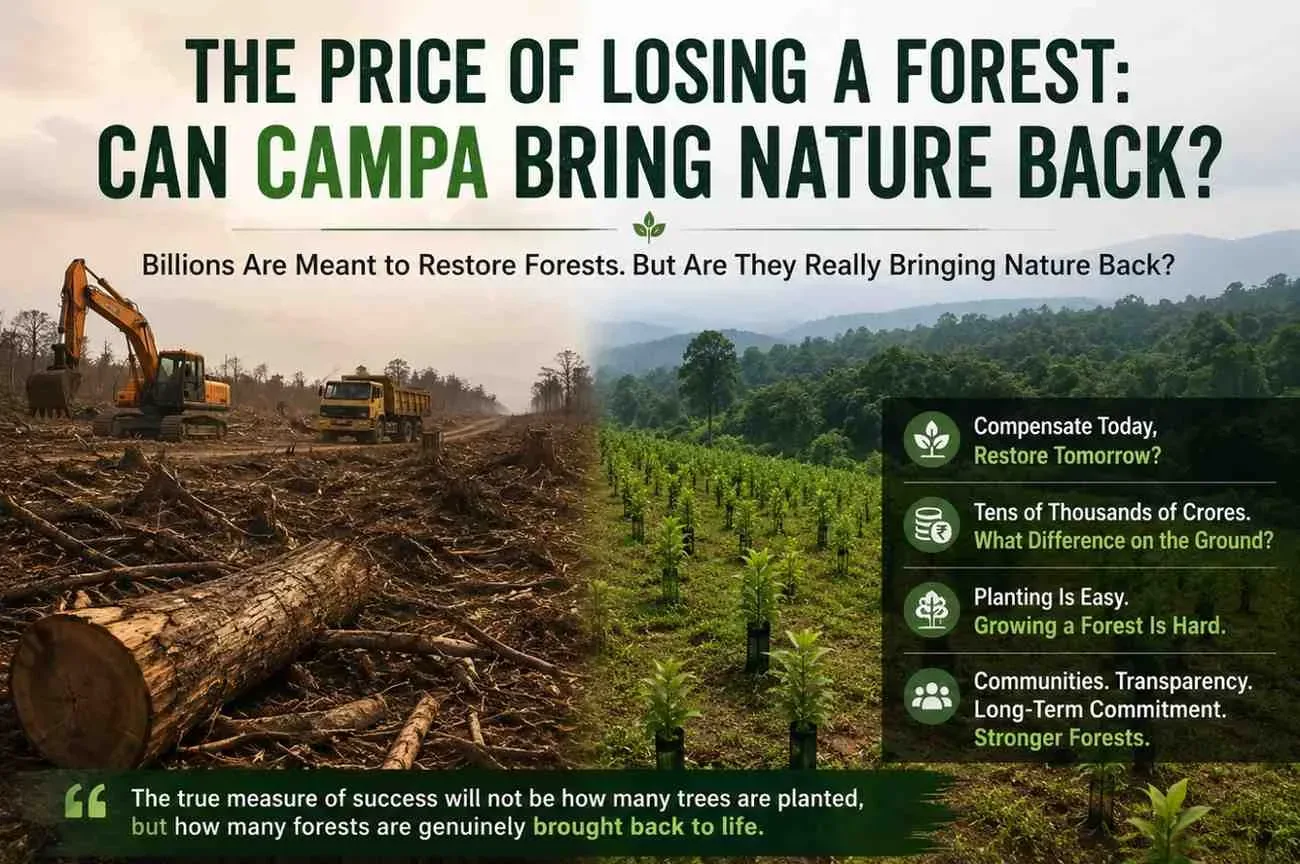
Billions Are Meant to Restore Forests. But Are They Really Bringing Nature Back?
Every time forest land is diverted for highways, railways, mines or industrial projects, developers are expected to compensate by creating forests elsewhere.
On paper, the principle appears simple: replace what is lost.
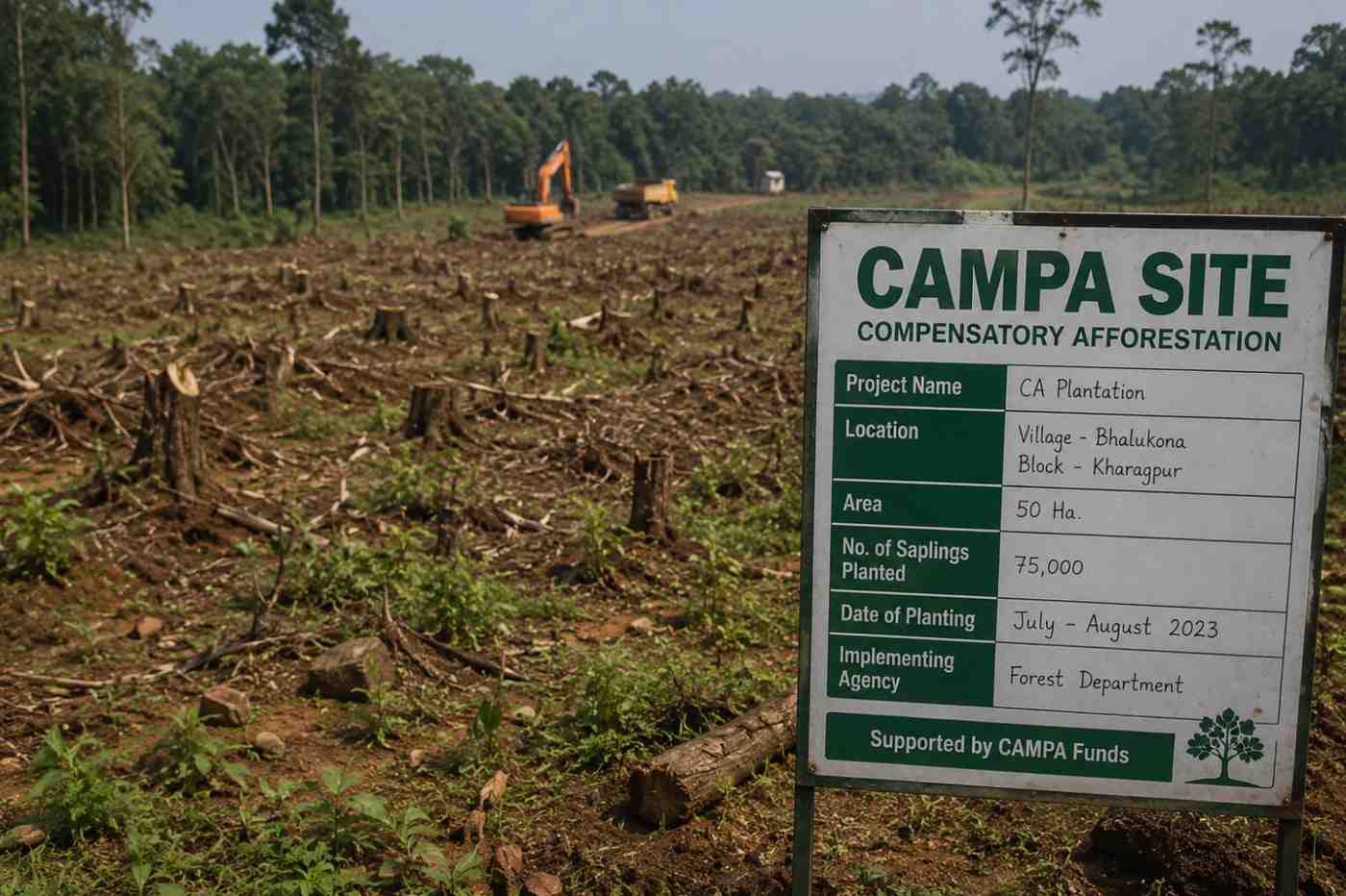
But the debate is no longer about whether compensation is provided- it is about whether it truly replaces what has been lost.
The real test of compensatory afforestation is not the number of saplings planted, but whether lost forests are truly being restored.
That question has gained renewed attention after the 10th July meeting of the National Compensatory Afforestation Fund Management and Planning Authority (CAMPA), where officials reviewed the implementation of one of India's largest ecological restoration programmes.
The meeting may have focused on fund utilisation and afforestation progress, but it revived a much larger question: are CAMPA funds creating resilient forest ecosystems, or are they only measuring success through plantation numbers?
Understanding CAMPA
CAMPA was created around a simple principle: when forests are lost to development, the ecological cost should be invested back into restoration. Under the mechanism, developers who divert forest land for non-forest purposes contribute funds towards rebuilding forest ecosystems elsewhere.
These funds support afforestation, natural regeneration, wildlife conservation, forest protection, soil and water conservation, fire prevention and improvements in forest management infrastructure.
CAMPA now represents one of India's largest environmental funding pools, with tens of thousands of crores dedicated to compensating for forest loss.
The challenge, however, is not only how much money is available- it is whether that money is rebuilding forests or merely adding to plantation statistics.
The Bigger Question Isn't Spending- It's Ecological Recovery
Much of the attention on CAMPA revolves around fund utilisation. Rather than asking how much money has been spent, experts say the more important question is what difference those investments have made on the ground.
Plantation numbers may look impressive on paper, yet forests cannot be measured by saplings alone. A healthy forest supports wildlife, stores carbon, protects water and soil, and provides livelihoods for communities that depend on it.
Restoration cannot be measured by plantation numbers alone. If saplings fail to survive or diverse natural forests give way to monoculture plantations, the ecological gains may remain limited despite substantial investments.
Ecologists say the conversation must move beyond how much was spent to what ecological outcomes were achieved.
Planting Is Easy- Growing a Forest Is Hard
One of the biggest questions surrounding compensatory afforestation is what happens after the plantation drive ends. Saplings need years of monitoring, protection and maintenance before they can grow into self-sustaining forests. Without sustained care, survival rates can fall significantly, limiting the ecological value of restoration efforts.
Many environmental experts argue that public reporting should go beyond the number of saplings planted and include their survival after three, five and even ten years.
Such long-term monitoring would provide a more reliable measure of whether restoration efforts are creating lasting ecological benefits.
Can New Plantations Replace Natural Forests?
The debate extends beyond the number of trees planted. An equally important question is whether newly created plantations can truly compensate for the loss of mature natural forests.
Many researchers argue that plantation figures tell only part of the story.
A natural forest is far more than a collection of trees. It develops over decades or centuries, supporting biodiversity and ecological processes that cannot be recreated overnight. Compensatory plantations, often made up of fewer species, may not fully replace these functions.
That is why many conservationists argue that success should be measured by ecological restoration rather than plantation targets. Restoring degraded ecosystems, conserving existing forests and planting native species are widely considered more effective ways to rebuild resilient landscapes.
Restoring Forests Requires Restoring Partnerships
Forest restoration is not just an ecological exercise- it is also a community effort.
Many experts argue that Indigenous communities, forest-dependent households and local residents should be treated as partners rather than participants.
Their understanding of local ecosystems can improve the choice of native species, strengthen long-term management and increase plantation survival. Equally important, community involvement helps maintain accountability long after the plantation drive is over.
Transparency Strengthens Accountability
Many experts believe that transparency is essential to improving forest restoration.
They argue that district-level information on CAMPA projects- including where funds are spent, how plantations are performing and what ecological outcomes are being achieved- should be easily accessible to the public.
Greater openness would allow citizens to track progress, strengthen accountability and help governments identify restoration approaches that deliver the best results.
More Than Planting Trees
India's environmental commitments have made CAMPA a critical instrument for forest restoration.
But its legacy will not be determined by financial allocations or plantation statistics alone. It will be determined by whether today's investments restore ecosystems that can withstand climate change, protect biodiversity and support future generations.
In the years ahead, the true measure of success will not be how many trees are planted- it will be how many forests are genuinely brought back to life.
Sources:
- National Compensatory Afforestation Fund Management and Planning Authority (CAMPA) – Ministry of Environment, Forest and Climate Change (MoEFCC)
https://moef.gov.in/en/division/forest-and-wildlife-division/national-campa/ - Compensatory Afforestation Fund Act, 2016 (CAF Act) – Government of India
https://legislative.gov.in - Forest Survey of India (FSI) – India State of Forest Report (ISFR)
https://fsi.nic.in - Down To Earth – Environment and forest restoration coverage, including CAMPA implementation and afforestation debates
https://www.downtoearth.org





Add a Comment