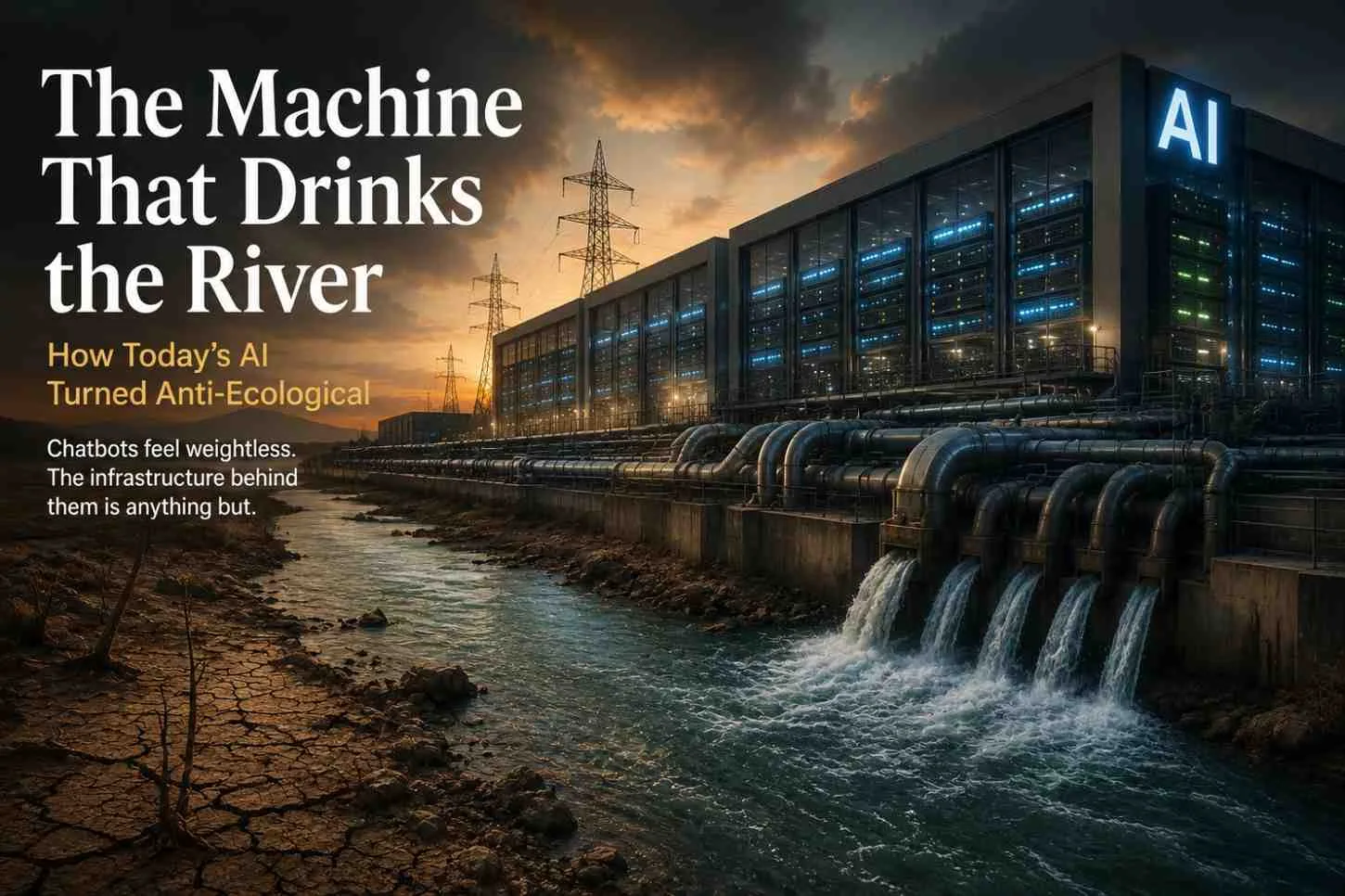
Chatbots feel weightless. The infrastructure behind them is anything but
Ujjwal K Chowdhury
Strapline: Every AI answer that appears instantly on a screen is the visible tip of an invisible supply chain of electricity, water, minerals and hardware — one that is expanding faster than the systems built to measure, let alone restrain, it.
The illusion of weightlessness
Type a question into a chatbot and the reply arrives in a second or two, apparently out of nowhere. That apparent weightlessness is the single biggest reason today’s mainstream artificial intelligence has drifted into an anti-ecological pattern: the interface hides a resource system as physical as a steel mill, while feeling as immaterial as thought itself.
Behind that reply sits a chain most users never see: a data centre drawing power from a regional grid; racks of accelerators converting electricity into heat; water or refrigerant carrying that heat away; a supply chain of mined minerals and fabricated silicon that had to exist before any of it could run; and, increasingly, an autonomous “agent” that may have quietly called the model dozens of times — planning, retrieving, verifying, retrying — before it ever answered. None of that shows up in the two seconds a user waits for a reply. That gap between visible convenience and invisible cost is where the ecological problem lives.
Four ways today’s AI works against the planet
1. It treats electricity as free and infinite
The scale is no longer subtle. Global data-centre electricity demand grew about 17% in 2025 — more than five times the growth rate of overall global electricity demand — while AI-specific facilities grew around 50% in the same year, according to the International Energy Agency’s most recent assessment. The agency’s satellite-tracking programme shows dedicated “AI factory” capacity has more than tripled in the past eighteen months alone. Lawrence Berkeley National Laboratory estimates that data centres already consumed 4.4% of all US electricity in 2023, on a path toward as much as 12% by 2028.
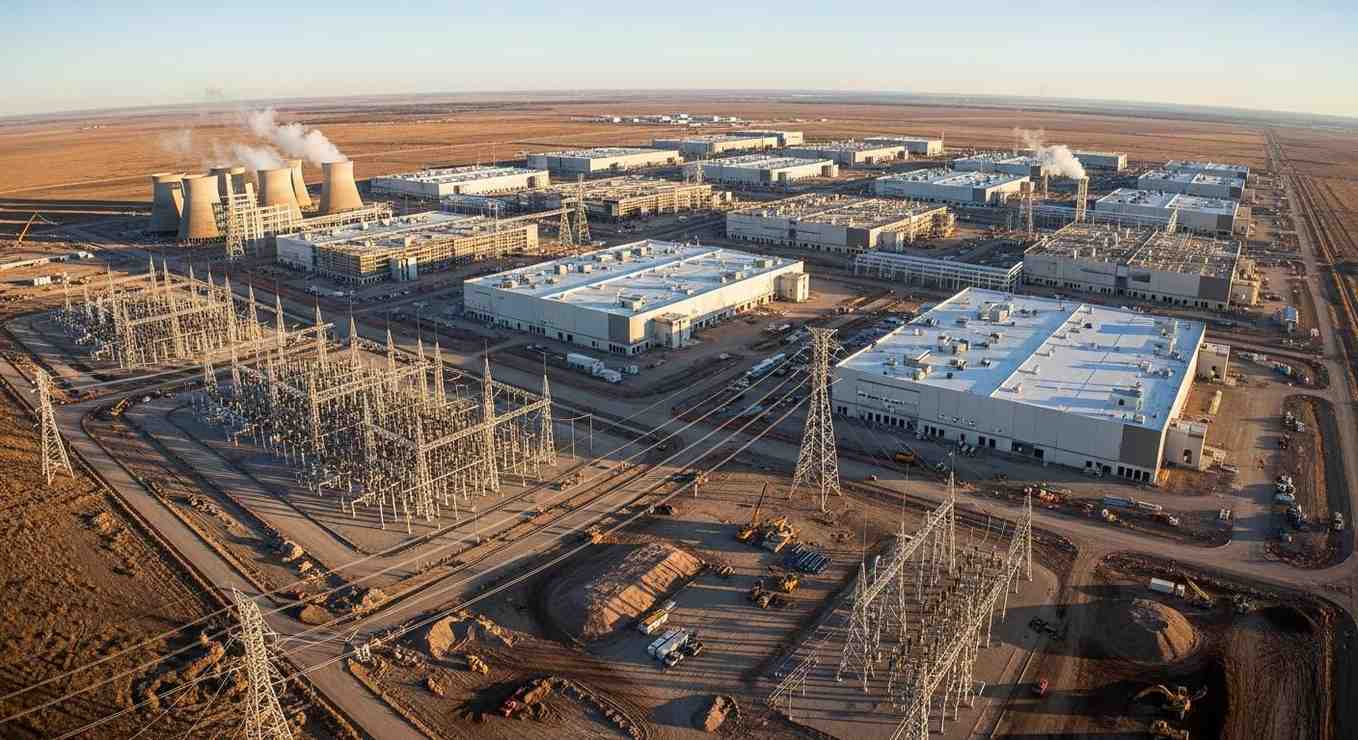
This is not evenly distributed misfortune. It concentrates in specific places until local grids buckle: Ireland’s data centres now draw over a fifth of the country’s entire electricity supply, with Dublin’s local share pushing toward 80%; parts of Virginia, Arizona and the Netherlands face similar strain. AI accelerator rack density has risen roughly elevenfold since 2020 and could quadruple again within a couple of years, meaning the same floor space now demands vastly more power and cooling than it did five years ago — a physical fact that data-centre neighbourhoods, substations and transmission lines were never designed around.
FACT BOX > - Data-centre electricity growth in 2025: ~17% globally (AI-specific: ~50%) > - AI-factory capacity: more than tripled in 18 months (IEA satellite tracking) > - Rack power density: up roughly 11x since 2020 > - Ireland’s data-centre electricity share: over 20% nationally, near 80% in Dublin
2. It treats water as someone else’s problem
Cooling AI hardware consumes water directly, and generating the electricity that powers it consumes water indirectly, through the power plants themselves. A peer-reviewed 2025 review found that water use per AI workload can vary by more than 10,000-fold depending on the cooling system, the water intensity of the local grid, climate and utilisation — an enormous range that makes any single “AI uses X litres” headline close to meaningless without context. Earlier modelling had estimated the direct water cost of training a single large language model at roughly 700,000 litres, and projected global AI-related water withdrawal could reach several billion cubic metres by 2027.

The ecological offence is not simply the volume; it is where that volume is drawn. Data centres frequently compete for water in the same watersheds as households, farms and ecosystems, often in drought-prone or rapidly urbanising regions. A company can accurately claim it “replenished” water somewhere else in the world while a local community, in the actual basin where the facility sits, faces real seasonal scarcity. Water taken from a stressed basin in July is not made whole by a replenishment project in a different river system entirely.
3. It hides its hardware and mineral footprint
The environmental conversation about AI has focused heavily on electricity, but the physical hardware underneath it carries its own anti-ecological weight. Semiconductor fabrication requires high-temperature processing, fluorinated gases and ultrapure water; servers require aluminium, copper, steel and a list of critical minerals mined and processed through globally concentrated, often environmentally and socially fraught supply chains. Because the industry races to deploy ever more capable accelerators, hardware is frequently retired well before the end of its useful life — front-loading manufacturing emissions and generating electronic waste that is notoriously difficult to refurbish because of security requirements and proprietary designs. A narrow focus on data-centre electricity efficiency can therefore simply displace environmental burden upstream, onto mines and fabrication plants far from public view.
4. It multiplies itself through autonomy
The newest and fastest-growing anti-ecological pattern comes from agentic AI — systems that plan, browse, write and execute code, call other software, and retry when something fails, often with limited human supervision. A single user request can silently become a “trajectory” of dozens or hundreds of underlying model and tool calls. Early research has found up to a 9.4-fold difference in energy use between agent architectures solving identical software tasks, driven mainly by unproductive loops, redundant multi-agent “debate,” and overly conservative verification steps. A 2026 study proposing an “Energy per Successful Goal” metric found agentic workflows used, on average, more than four times the energy of simpler linear approaches to reach the same outcome. Because these systems can be scheduled to run continuously, across thousands of accounts, with nobody watching each internal step, agentic AI represents autonomy without accountability — precisely the combination ecological management is built to prevent.
The underlying design flaw: rebound
Underneath all four patterns sits a single structural problem economists have seen before: rebound. Each time AI becomes more efficient per task, that efficiency tends to make AI cheaper and faster to deploy — which drives organisations to use far more of it, not less. A cheaper model attracts more users; a faster agent gets scheduled more often; saved computing capacity gets redirected into training an even larger model. This is a modern instance of the nineteenth-century Jevons paradox, in which more fuel-efficient steam engines led to more coal being burned overall, because efficiency expanded the ways coal could be profitably used. Today’s AI industry is repeating that pattern at digital speed: intensity per task is falling in many cases, even as total electricity, water and hardware consumption keeps climbing.
HIGHLIGHT > “Efficient models can lower energy per task but may stimulate more use — a rebound effect analogous to Jevons’ paradox.”
Tackling the challenge: what can actually be done
The good news, according to researchers working across computer science, engineering and environmental policy, is that anti-ecological AI is a design failure, not a law of physics — and design failures can be corrected.
Make lifecycle accounting mandatory, not voluntary. Model developers should be required to publish energy, water and carbon figures covering research, training, fine-tuning and expected inference use — not just the headline training run. Regulatory movement already exists: the European Union’s data-centre reporting rules and the emerging AI Act standards for general-purpose systems are early attempts to make these disclosures routine rather than exceptional.
Measure outcomes, not tokens. “Energy per prompt” is a start, but a genuinely useful metric asks how much energy, water and carbon were spent per successfully completed, quality-adjusted task — capturing failed attempts, retries and wasted agent loops rather than rewarding systems that simply generate more text per watt.
Treat water as a local-risk issue, not a global volume. Responsible siting means water-stress screening, seasonal operating limits, non-potable cooling sources and transparent, basin-specific disclosure — replacing vague corporate replenishment claims with site-level accountability.
Put budgets and brakes on autonomous agents. Concrete engineering controls — hard limits on tool calls and reasoning steps, loop detection, model routing that defaults to the smallest sufficient model, and outcome-aware verification applied only where risk warrants it — can curb the silent multiplication effect that makes agentic AI so much more resource-hungry than a single chatbot exchange.
Extend hardware life and close the supply chain loop. Modular, repairable server designs, transparent recycling, redeployment of older accelerators to less demanding tasks, and procurement rules that reward useful work per lifecycle impact — rather than peak benchmark performance alone — would blunt the upstream mineral and manufacturing burden.
Impose absolute limits alongside efficiency targets. Because rebound can erase intensity gains, organisations need annual caps on total energy, water and hardware consumption — not only per-task efficiency goals — paired with an honest test of whether any given deployment is actually necessary.
Who ends up paying
The anti-ecological pattern is not only an environmental story; it is fast becoming a household economics story too. As data-centre campuses draw more power than entire cities, the cost of grid upgrades, new transmission lines and backup capacity has to be paid by someone — and much of it is landing on ordinary electricity ratepayers rather than the companies building the facilities. US utilities requested tens of billions of dollars in rate increases in a single recent year, with retail electricity prices climbing well ahead of inflation, and energy-policy researchers have begun openly asking whether households should be subsidising the power needs of trillion-dollar technology firms. That question — who bears the cost of AI’s physical footprint — is quietly becoming as contentious as the technology’s better-known debates over jobs, bias or misinformation.
Communities near proposed data centres are pushing back for similar reasons. Objections increasingly cite not just water and electricity but noise, construction traffic, backup diesel generators and the strain that a single large campus can place on municipal services — concerns that rarely register in a corporate sustainability report measured in global percentages, because the burden is intensely local even when the company’s overall footprint looks modest on paper.
Signs the pattern can be broken
None of this is inevitable, and there is genuine evidence of course correction. Regulators in the European Union now require structured data-centre energy and water reporting. Some grid operators are experimenting with letting data centres act as flexible loads — absorbing surplus renewable power and throttling back during scarcity — turning a liability into a grid asset if the incentives are designed correctly. Chip-level closed-loop cooling systems, deployed by major cloud operators, are demonstrably cutting water use at the facilities where they have been installed. And a growing number of enterprises are beginning to ask, before deploying any AI feature, whether a smaller model or a simpler workflow could do the job just as well — a habit of restraint that barely existed in the industry two years ago.
None of this requires abandoning AI’s genuine benefits — in climate modelling, grid management, disease research and elsewhere. It requires abandoning the pretence that those benefits are free. The technology that feels weightless on a screen is, underneath, one of the most physically demanding infrastructure projects humanity has ever built at speed. Recognising that is the first step toward building it responsibly rather than merely quickly.





Add a Comment