
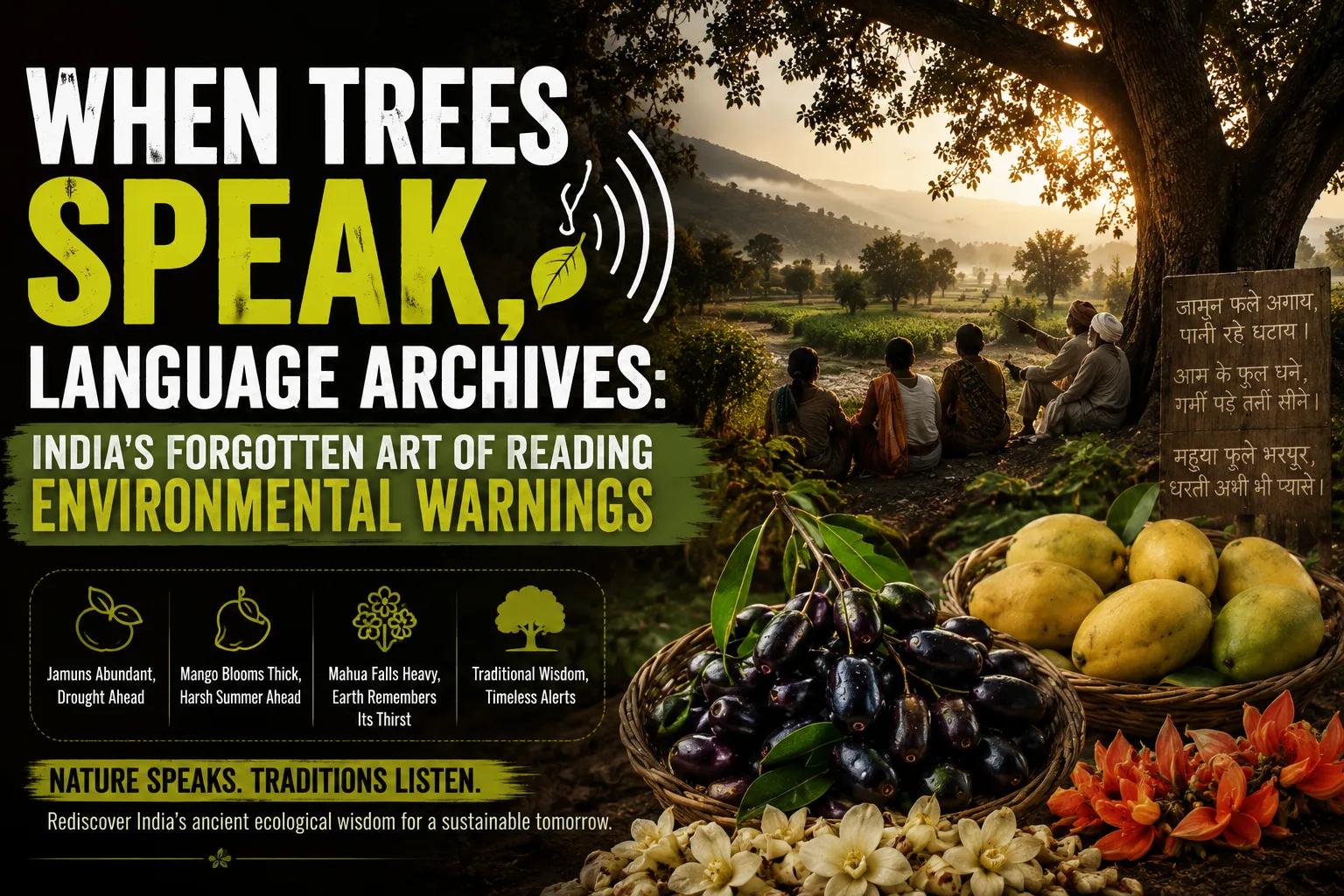
| India’s traditional ecological wisdom reveals how communities once read changes in trees, flowers and seasonal cycles as early warnings of environmental stress. |
| Summary For generations, Indian farmers, forest dwellers and indigenous communities observed plants, animals, soils and seasonal changes to understand environmental conditions. The article explores how this knowledge became embedded in local languages, folk sayings and seasonal traditions, using trees such as jamun, mango, mahua, palash, tamarind, neem and bamboo as examples. It explains that while traditional beliefs cannot always be treated as scientifically accurate forecasts, some observations may reflect real biological responses to moisture stress, temperature changes and seasonal shifts. The discussion of bamboo flowering and the Mautam phenomenon shows how traditional observations can sometimes align closely with modern ecological research. The article argues that such knowledge should neither be accepted blindly nor dismissed as folklore, but studied alongside modern science and environmental monitoring. Ultimately, it asks whether India can preserve this biocultural knowledge as a useful way of understanding changing ecosystems. |
This summer, Indian orchards and fruit markets seem unusually generous. Jamuns are arriving in quantities that many people say they have not witnessed in decades. Mango orchards in several regions have yielded heavily. Only a few weeks ago, forest floors across central India were carpeted with heavenly mahua flowers, while palash transformed entire landscapes into seas of orange-red flames. In rural areas, such abundance is still not viewed merely as a gift of nature, rather It is treated as a deep-rooted message from nature.
For centuries, Indian communities practiced what may be called a form of ecological forecasting. Long before satellites, meteorological models, or groundwater monitoring networks, farmers, pastoralists, forest dwellers, and indigenous communities learned to observe subtle changes in plants, animals, soils, and seasonal cycles and interpreted in their own tongue. These observations evolved into a rich body of traditional ecological knowledge through which communities attempted to anticipate droughts, floods, pest outbreaks, and other environmental disruptions. While modern science may not validate every traditional belief, many of these observations emerged from generations of intimate engagement with landscapes. The lexicon of interdependence, encoding how native communities linguistically locate themselves with material cycles of flora, water, and sustenance.
The Curious Case of the Jamun
The unprecedented jamun (Syzygium cumini) productivity this year has revived an ethnoecological axiom embedded in the linguistic fabric of eastern Uttar Pradesh and Bihar that encodes an observed ecological pattern.
"Jamun phale aghaay, paani rahe ghataay."
The underlying intuition is intriguing. Whether this saying is universally true is less important than the ecological insight behind it. Language becomes diagnostic, mediating human interpretation of ecological signals, thereby marking the convergence of ecological observation with linguistic codification. Jamun has a tap root system, a deep-rooted tree capable of accessing groundwater reserves deeper beyond the reach of many plants. Traditional observers believed that unusual fruiting reflected changes occurring beneath the surface; forthcoming water stress long before it became visible to people. Modern plant science does not support the notion that trees can predict the future, yet it does show that many species allocate more energy and resources to flowers, fruits, and seeds to increase the likelihood that its lineage will survive difficult conditions. Moisture stress, temperature anomalies, and changing climatic conditions can influence flowering and fruiting patterns. Botanists refer to related phenomena as mast seeding, stress-induced reproduction, or reproductive allocation under stress. In this sense, trees may not foresee droughts, but they often respond to environmental pressures much before even humans notice them.
Mango and the Memory of Dry Winter
The same ecological sensitivity is reflected in traditional observations for the national fruit, the mango (Mangifera indica), across India. Across large parts of northern and central India, farmers have long watched the intensity of mango blossom. In Bundelkhand, one still hears the saying,
“Aam ke phool ghane, garmi pade tani seene.”
Dense mango flowering often heralds a severe summer. The saying is both a linguistic artifact and an environment instrument. Moreover, this can be interpreted as a case of ecological semiotics, where flora becomes the signifier and the saying acts the interpretive code. Next, Horticultural science offers an interesting parallel. Mango flowering is known to be influenced by dry conditions and moisture stress during preceding months. Thus, what villagers interpreted as a warning may actually have been an observation of the same environmental signals to which the trees themselves were responding.
Mahua: The Tribal Calendar Tree
Among forest communities of central India, mahua (Madhuca longifolia) occupies a special place as both a livelihood resource and a seasonal indicator. Elders among Gond, Baiga, and Oraon communities often viewed exceptionally heavy flowering as a sign that nature was preparing for uncertain times. In the tribal heartlands the onomatopoeic phrase ‘Tipr Tapr’is use to describe the distinct sound of sweet mahua flowers raining down onto the forest floor.
Perception among the native population,"when mahua flowers profusely, the earth still remembers its thirst, captures a perception that environmental stress and reproductive abundance are somehow linked. A particularly abundant flowering season often encouraged families to store more produce, reflecting an expectation that difficult times could lie ahead. Whether scientifically verified or not, the observation emerged from centuries of indigenous community close engagement with local ecosystems. In the same line The tamil saying
Aalai illaa oorukku iluppaip poo charkkarai
captures role of vital food safety net during stress; when primary resources or sweeteners are completely unavailable, the high natural sugar content of the mahua flower saves the community.
Palash and the memory of hot summer
The flowering of palash (Butea monosperma), popularly known as the ‘Flame of the Forest’, occupies a similar place in seasonal memory. Across central and east India, the spectacular flowering of palash has long been associated with the arrival of the hottest and driest period of the year.
Palāś phūlā, garmī ā’ī
The folk rendering ‘when palash sets the forest aflame, fierce heat follows’, does not predict drought so much as it marks an approaching phase of environmental stress. This environmental shift finds deeper, poetic resonance across neighbouring cultures. Bengali folk memory warns
Polash phutle phagun ashe, porei jyoishther roddur hashe
noting that while the brilliant orange introduces the spring month of Phagun, it serves as an immediate threshold to the cruel summer sun of Jyoishtha. Simultaneously, Odia rural wisdom sounds a visual alarm through the couplet
Palasha bana jalile, nai nala sukhile
mapping the fiery ignition of the forest canopy directly to the drying up of local rivers and rivulets. Also, such a proverb becomes a case of environmental semiosis where the forest becomes the sign, fire becomes metaphor, and heat becomes semantic consequence. Such ethnobiological cues helped communities prepare for changing seasonal conditions long before thermometers and weather forecasts became commonplace.
Cross-country wisdom
Similar ecolaxicon traditions appear far beyond the Hindi-speaking belt, relying on shared community insights rather than strict, word-for-word dictums. In the Telugu region, farmers have long observed that unusually heavy fruiting of tamarind (Tamarindus indica) can precede a difficult summer; drawing on this experience, elders often summarize this intuition through paraphrased concepts like
“Chinta ekkuva kaaste, vesavi kathinam”
observing that when tamarind bears excessively, the summer is bound to turn exceptionally severe. In Karnataka, a comparable piece of rural wisdom survives in the shared understanding often paraphrased as
“Hunase tumba bandre, neeru kadime”
indicating that an abundant tamarind harvest naturally accompanies a sharp decline in water availability. In both regions, these localized summaries reflect a deep-rooted awareness of the hardy tree's biological survival mechanism, which accelerates seed production under acute environmental stress.
In Gujarat's Saurashtra region, indigenous weather forecasters historically regarded exceptionally heavy fruiting of neem (Azadirachta indica)as a possible indicator of drought, expressed in the saying
"Limdo ghano phale to dukaal pade."
When neem fruits heavily, drought may follow. Even jackfruit, one of India's most productive seasonal trees, finds a place in local ecological memory.
In parts of Kerala and the Western Ghats, older farming communities sometimes regarded extraordinarily heavy jackfruit (Artocarpus heterophyllus) seasons as a sign of climatic irregularity, particularly when accompanied by unusual heat or delayed rainfall. Rather than a canonical proverb, these locally circulated expressions show how everyday speech can store ecological observations in compressed form.
Bamboo and the Warning
Yet perhaps the most remarkable example comes from the hills of Mizoram. For centuries, Mizo communities feared an event known as Mautam. In the Mizo language, mau means bamboo (Bambusa vulgaris) and tam refers to a devastating period of famine. The term describes the mass flowering of bamboo that occurs roughly every half-century. Traditional knowledge held that bamboo flowering would be followed by food shortages. The association between bamboo productivity and rodent outbreaks appears not only in Northeast India but also in traditional forecasting compilations from western India reflected in Gujarati
"Vans vadhare phale, undar vadhe."
meaning when bamboo thrives unusually, rats increase. For many years, this belief was dismissed as folklore. Scientific research later demonstrated that bamboo flowering produces enormous quantities of seeds, triggering population explosions among rodents. Once the seeds are exhausted, rat populations move into agricultural fields and grain stores, destroying crops and causing widespread hardship.
Language encodes ethnoecological data by incorporating observed correlations between phenology and climatic outcomes into linguistically encoded transmissible knowledge.
The Ecology of Observation
What is particularly striking about these diverse traditions is that they were rarely based on a single observation. Farmers and forest communities interpreted plant behaviour alongside changes in groundwater levels, bird migrations, insect activity, wind patterns, and the timing of seasonal events. Together, these formed a decentralized environmental monitoring system refined over generations. Language becomes the medium through which this decentralized system is stabilized and transmitted informally generation after generation . It does not merely record the ecology of observation; it processes, stores, and projects. It documents observation and makes vernacular speech an ecological model across generations.
The observations may not always have been accurate, but they reflected a sophisticated understanding that humans are part of larger ecological networks and that environmental change often announces itself through subtle biological signals through plants.
Modern science increasingly recognizes that plants are among the most sensitive responders to environmental change. Variations in groundwater, soil moisture, temperature, and seasonal timing can alter flowering and fruiting patterns long before the consequences become visible to people. This does not mean that every bumper crop predicts drought or every profuse flowering foretells crisis. Also, traditional communities noticed this early, and language formed the tool that captured the biological signals. Nature is rarely so simple. Yet it does suggest that traditional communities may have been observing real ecological relationships, even when their explanations differed from those of contemporary science.
As India confronts groundwater depletion, intensifying heat waves, erratic monsoons, and growing climate uncertainty, these traditions deserve neither blind acceptance nor casual dismissal. Instead, they invite a fresh look of biocultural architecture where language, environment and people intersect and treasure the repository of our survival. They remind us that landscapes are constantly communicating through the plants, animals, and seasonal rhythms around us in the native lexicon; ecolexicon. The abundance of jamuns, mangoes, mahua flowers, jackfruits, tamarinds, or neem fruits may not provide a precise forecast of the future. But they may still be telling us something important about the environmental stresses unfolding around us.
The question is whether we still know how to listen the echoes of nature?
ABOUT AUTHOR


Dept. of English, Patna Women's College
She mainstreams in language, ecology, and culture.




Add a Comment