28 Jul 2026
A workshop in Kolkata has sparked a larger conversation about whether restoring ecosystems can also restore livelihoods, especially for communities that have protected nature for generations. Can restoring nature also restore livelihoods? As communities revive forests, wetlands and mangroves, a new conversation is emerging around climate action, employment and long-term resilience. The discussion gained momentum following a recent climate workshop in Kolkata, where experts, researchers, community leaders and environmental practitioners explored how community-led climate action can create meaningful jobs while restoring ecosystems. While the conversations began at the local level, the ideas resonate far beyond the city.As countries invest more in climate action, a bigger opportunity is beginning to emerge. Experts believe community-led restoration can not only revive ecosystems but also create inclusive, long-term livelihoods for the people who depend on them.But an equally important question remains.Can green jobs evolve into stable, long-term careers, or will they continue to depend on short-lived projects and temporary funding? Around the world, climate action is being backed by investments in restoring nature. Whether it involves bringing forests back to life, reviving wetlands, rejuvenating urban lakes or protecting vulnerable coastlines, these efforts require skilled hands and local knowledge. Experts argue that the communities protecting these ecosystems ought to be the primary beneficiaries of the opportunities they generate.For India, this conversation is especially significant. As the country works towards expanding forest cover, restoring degraded landscapes and building climate resilience, the need for a skilled green workforce is becoming important. Experts say achieving these ambitions will depend on professionals trained in ecological restoration, biodiversity monitoring, sustainable agriculture, waste management and other nature-based solutions.Yet the workshop made one point particularly clear- green jobs cannot succeed on numbers alone. Their future will depend on skilled training, reliable career pathways and valuing the traditional knowledge that communities have passed down for generations. This made traditional ecological knowledge one of the defining themes of the discussions. For centuries, communities living closest to nature have learned how to work with it. Across India, Indigenous groups, fisherfolk, farmers and forest-dependent households have built a deep understanding of forests, wetlands, mangroves, biodiversity and changing weather through lived experience. Experts believe this traditional knowledge should play a central role in shaping restoration efforts rather than simply supporting them.Several restoration initiatives have already demonstrated the value of community participation. From mangrove conservation along India's coastlines to watershed restoration in drought-prone regions and community-managed forests across different states, these efforts show that restoration is more likely to succeed when local people are involved in planning, implementation and long-term monitoring. But training people is only the beginning! The real challenge is ensuring that green skills open the door to credible, long-term careers rather than remaining part of short-lived training programmes. Experts say the real opportunity lies in creating skills that remain valuable long after individual restoration projects are completed. Whether it is nursery management, biodiversity surveys, GIS mapping, climate-risk assessment or environmental monitoring, specialised training can help build a workforce prepared for the demands of a greener economy.They also believe stronger collaboration between governments, educational institutions, businesses and civil society organisations will be key to improving certification, creating employment opportunities and supporting continuous learning. In this transition, the private sector is expected to emerge as an equally important partner. As sustainability becomes a bigger priority for businesses, the demand for professionals who understand ecological restoration, climate resilience and environmental reporting is expected to rise. Experts believe this could create meaningful career opportunities for young people while helping India build a greener and more resilient economy.One message echoed throughout the workshop: green jobs should be valued not just for the number of people they employ, but for the livelihoods they sustain. Fair wages, long-term income security, safe working conditions and genuine community participation will decide whether restoration efforts create lasting change or simply fade with project funding. Ultimately, the discussions in Kolkata pointed to a much larger truth- building a greener future does not require choosing between climate action and economic development. A greener future will require both to move forward as one.Every restored forest, wetland, river and coastline represents more than an environmental success- it is an investment in the future of both people and nature. The real task now is ensuring that the opportunities created are inclusive, credible and long-lasting. As countries invest more in climate solutions, the focus must shift from counting projects to creating lasting opportunities for the people leading them. Building a resilient economy will require communities to be recognised not just as participants, but as long-term partners in the journey. Because if restoring nature is about protecting tomorrow, it should also help secure the livelihoods of those shaping that future today! Sources:International Labour Organization (ILO) – Green Jobs Programme United Nations Environment Programme (UNEP) United Nations Development Programme (UNDP) UN Decade on Ecosystem Restoration (2021–2030) Ministry of Environment, Forest and Climate Change (MoEFCC), Government of India Ministry of Skill Development and Entrepreneurship (MSDE), Government of India National Skill Development Corporation (NSDC) Green Skill Development Programme (GSDP), MoEFCC National Mission for Green India National Biodiversity Authority (NBA) Wildlife Institute of India (WII) ...Read more
28 Jul 2026
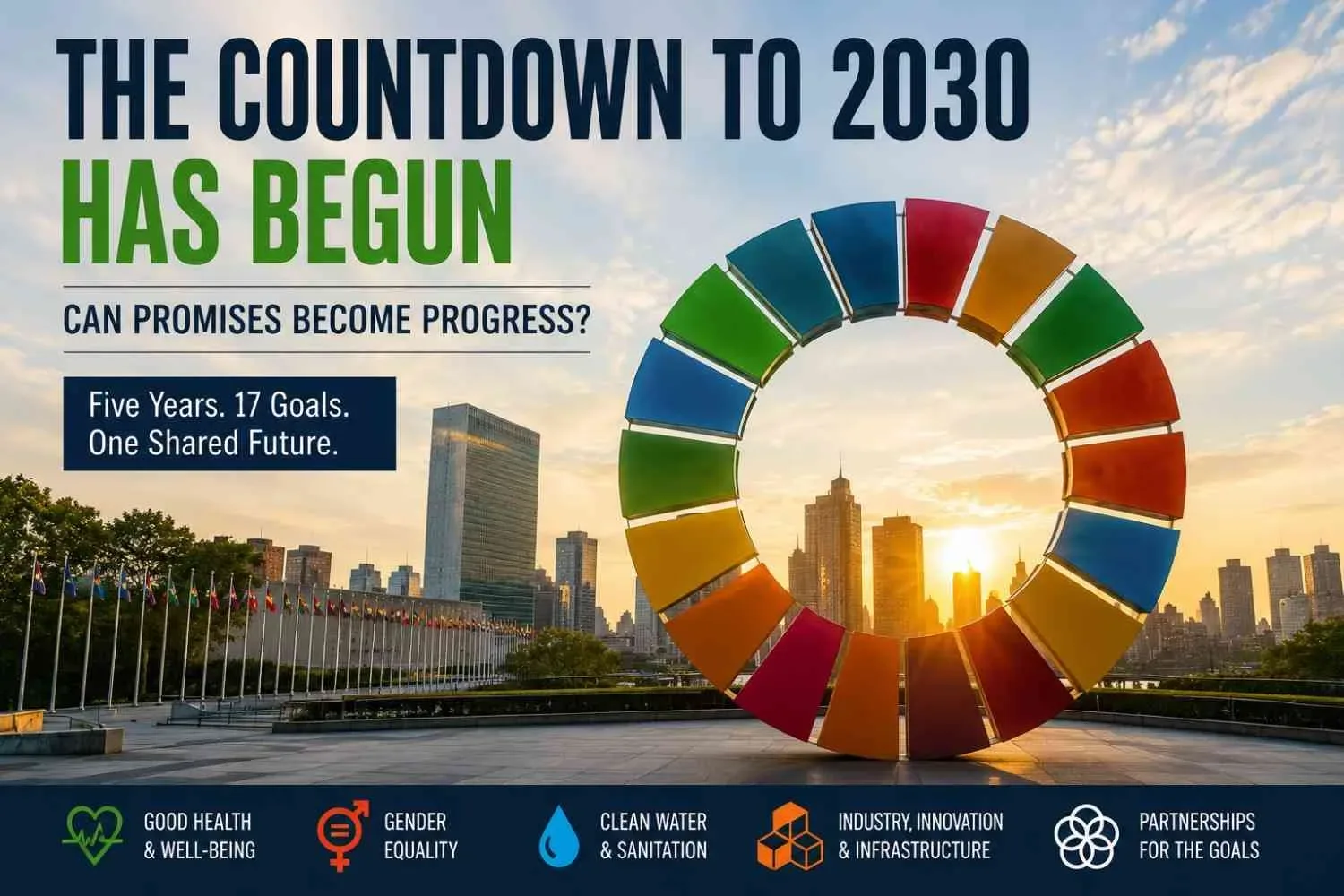
The UN's latest global review isn't just measuring progress- it is testing whether countries can still deliver on the promises they made a decade ago With only five years remaining to meet the United Nations' Sustainable Development Goals (SDGs), global attention has once again turned to the pace of progress. The High-Level Political Forum (HLPF), taking place at UN Headquarters in New York from 7 to 15 July, is assessing how countries are advancing on five key goals that directly affect billions of people. This year's forum is reviewing progress on five Sustainable Development Goals: SDG 3 (Good Health and Well-being), SDG 5 (Gender Equality), SDG 6 (Clean Water and Sanitation), SDG 9 (Industry, Innovation and Infrastructure), and SDG 17 (Partnerships for the Goals). Together, these goals shape many aspects of sustainable development, from healthcare and clean water to resilient infrastructure and global cooperation.But the discussions also raise a critical question.The final five years of the 2030 Agenda have begun, bringing renewed focus on whether countries can turn a decade of commitments into measurable results. The latest UN assessments paint a mixed picture. Progress in healthcare, clean water and digital infrastructure has been encouraging in several countries, but it has been uneven. Climate change, economic instability, conflicts and widening inequalities continue to hamper development, leaving many of the Sustainable Development Goals off track. For India, the forum serves as an opportunity to assess both achievements and unfinished priorities.The country has made steady progress by expanding access to drinking water through the Jal Jeevan Mission, strengthening digital public infrastructure, increasing renewable energy capacity and extending healthcare coverage under Ayushman Bharat. Despite these gains, India continues to face hurdles in expanding equitable healthcare, improving sanitation, increasing women's participation in the workforce and developing infrastructure that can withstand climate-related risks. Experts say the HLPF is more than just an annual review of global commitments. It provides a platform for governments to showcase national progress, share successful policies and identify areas where greater international cooperation is needed. Among the key issues expected to dominate discussions is water security. Erratic rainfall, shrinking groundwater reserves and growing urban demand are intensifying pressure on freshwater resources in many parts of the world. Experts say governments must invest not only in expanding water supplies but also in wastewater treatment, river conservation and water-use efficiency. Another key issue before the forum is gender equality. Despite gains in girls' education and women's leadership, significant inequalities persist in employment, equal pay, unpaid care work and personal safety.Experts say achieving the remaining Sustainable Development Goals will depend on ensuring that women and girls have equal access to education, healthcare, financial resources and decision-making opportunities. Health systems are another major focus. The COVID-19 pandemic exposed vulnerabilities in healthcare systems around the world, highlighting the need for stronger public health infrastructure, better disease surveillance, increased local production of medical supplies and universal health coverage. Delegates are expected to explore ways to build more resilient health systems that are better prepared for future health emergencies. Infrastructure and innovation are also expected to feature prominently in the discussions as countries work towards cleaner and more inclusive economic growth. Investments in sustainable transport, climate-resilient cities, digital connectivity and low-carbon industries are gradually increasing as immediate priorities rather than long-term goals. Experts also stress that innovation must reach underserved communities to ensure the benefits of development are shared more equitably. Despite the diversity of issues on the agenda, one message continues to stand out: achieving the Sustainable Development Goals will require collective action, as no country can accomplish them alone.Partnerships between governments, businesses, financial institutions, researchers, civil society organisations and local communities are expected to play a critical role during the final years of the 2030 Agenda. Whether it’s through technology transfer, climate finance, knowledge exchange, or capacity building, stronger global cooperation will largely determine how well countries fill the remaining development gaps.As the forum progresses, the focus is shifting from setting ambitious targets to delivering measurable results. The next five years will be crucial in determining whether global commitments can translate into real improvements in people's lives. For countries like India, the challenge now is to build on recent gains while ensuring that future development is inclusive, climate-resilient and environmentally sustainable. The countdown to 2030 has entered its final stretch. The future of the Sustainable Development Goals will be shaped not by the commitments made at international forums, but by how effectively countries turn those commitments into lasting action. Sources: United Nations – High-Level Political Forum on Sustainable Development (HLPF) 2026 United Nations Department of Economic and Social Affairs (UN DESA) United Nations Sustainable Development Goals (SDGs) Knowledge Platform UN Sustainable Development Report 2025/2026 UN Secretary-General's SDG Progress Report NITI Aayog – SDG India Index Ministry of Statistics and Programme Implementation (MoSPI), Government of India Jal Jeevan Mission, Ministry of Jal Shakti Ayushman Bharat, Ministry of Health and Family Welfare Open-source reports and official UN HLPF session documents (7–15 July 2026) ...Read more
12 May 2026
The ultimate testing ground for sustainable project management is the megaproject—large-scale infrastructure developments that have historically had massive carbon footprints and social displacement issues. Today, the focus has shifted from merely "minimizing damage" to creating Regenerative Infrastructure, where projects are designed to give back more to the environment and society than they take. A prime example of this shift is the development of energy-neutral tunnels and roadways that generate their own power through integrated renewable energy systems. These projects utilize innovative materials like "photovoltaic asphalt" and kinetic floor tiles that harvest energy from passing vehicles. By turning a passive piece of infrastructure into an active energy producer, project managers are transforming the very definition of a "public utility," moving toward a future where our built environment assists in the global transition to renewable energy rather than hindering it. Executing these projects requires a radical shift in Supply Chain Stewardship and construction techniques. Project managers are increasingly utilizing "Modular and Prefabricated Construction," where components are built in controlled factory environments to minimize on-site waste, noise pollution, and local traffic disruption. Furthermore, the use of Low-Carbon and Bio-based Materials, such as "green concrete" infused with recycled plastic or carbon-sequestering mass timber, has become the standard for high-performance infrastructure. These megaprojects also prioritize "Social License to Operate" by involving local communities in the design phase through augmented reality (AR) and virtual reality (VR) visualizations, ensuring that the infrastructure serves the people as much as it does the economy. By successfully delivering these complex, multi-billion-dollar sustainable projects, the industry is proving that the scale of a project is no longer an excuse for environmental degradation, but rather an opportunity for large-scale ecological and social restoration. This "Restorative" approach ensures that projects create a legacy of health and prosperity for future generations. ...Read more
11 May 2026
Integrating sustainability into the architecture of modern project management requires a fundamental departure from the traditional "Iron Triangle" of cost, time, and scope, evolving instead toward a holistic framework that treats environmental and social impacts as primary performance indicators. This transition is governed by the understanding that a project's success is no longer defined solely by its immediate delivery, but by its long-term viability and its ability to operate within the Earth's planetary boundaries. At the core of this evolution is the P5 Standard, which expands the project manager's focus to encompass People, Planet, Prosperity, Process, and Product, ensuring that every strategic decision—from the initial procurement of raw materials to the final decommissioning of a physical asset—is measured against its lifecycle impact. This "Cradle-to-Cradle" approach mandates that project managers move beyond short-termism, recognizing that while sustainable materials or energy-efficient technologies might incur higher upfront capital expenditures (CAPEX), they dramatically reduce long-term operational expenditures (OPEX) and de-risk the project against future regulatory shifts, carbon taxes, and resource scarcity. The operationalization of sustainability within a project lifecycle begins with the creation of a Sustainability Management Plan (SMP), a living document that identifies specific Materiality Issues relevant to the project’s unique context. For instance, in large-scale infrastructure, this involves conducting rigorous Life Cycle Assessments (LCA) to quantify the embodied carbon of materials like steel and concrete, then utilizing innovations such as Green Hydrogen-based production or carbon-sequestering aggregates to mitigate those impacts. In the realm of digital project management, this focus shifts toward the energy efficiency of data centers and the ethical implications of algorithmic bias, ensuring that the social dimension of the Triple Bottom Line—People—is upheld through fair labor practices, diversity in the workforce, and radical stakeholder engagement. By consulting with local communities and "silent stakeholders" like the local ecosystem early in the initiation phase, project managers secure a "Social License to Operate," which significantly reduces the probability of legal challenges, protests, and costly delays that often plague non-sustainable ventures. Technological innovation, particularly the integration of Artificial Intelligence and Digital Twin technology, has become the primary catalyst for achieving these technical depths of accountability and transparency. Digital Twins allow project teams to simulate a project's resource consumption and waste output in a virtual environment, enabling "what-if" scenarios that optimize efficiency before physical resources are ever committed. This data-driven approach allows for the real-time tracking of "Carbon Variance," shifting the project manager’s role from a simple task coordinator to a steward of natural and social capital. As the global economy moves toward mandatory ESG (Environmental, Social, and Governance) reporting, the project becomes the primary unit of change; companies that fail to embed these principles into their project management offices (PMO) will find themselves excluded from green financing and increasingly alienated from a climate-conscious consumer base. Ultimately, sustainability in project management is about building resilience—creating assets that are not just "less bad" for the environment, but are restorative, equitable, and capable of thriving in a volatile, resource-constrained future. This paradigm shift also necessitates a change in leadership style, moving from command-and-control to a collaborative model that prioritizes ethical transparency. The project manager must navigate complex supply chains to ensure that "Greenwashing" does not occur at the sub-contractor level, requiring the use of blockchain-based traceability to verify the origin of "green" materials. Furthermore, by aligning project goals with the UN Sustainable Development Goals (SDGs), organizations can demonstrate a clear contribution to global targets, such as climate action and reduced inequalities. This alignment not only improves brand equity but also attracts top talent who are increasingly seeking purpose-driven work. By treating every project as a micro-ecosystem, project managers can ensure that the outputs they produce today do not become the liabilities of tomorrow, effectively bridging the gap between immediate industrial progress and the long-term health of the planet. ...Read more