18 Jul 2026
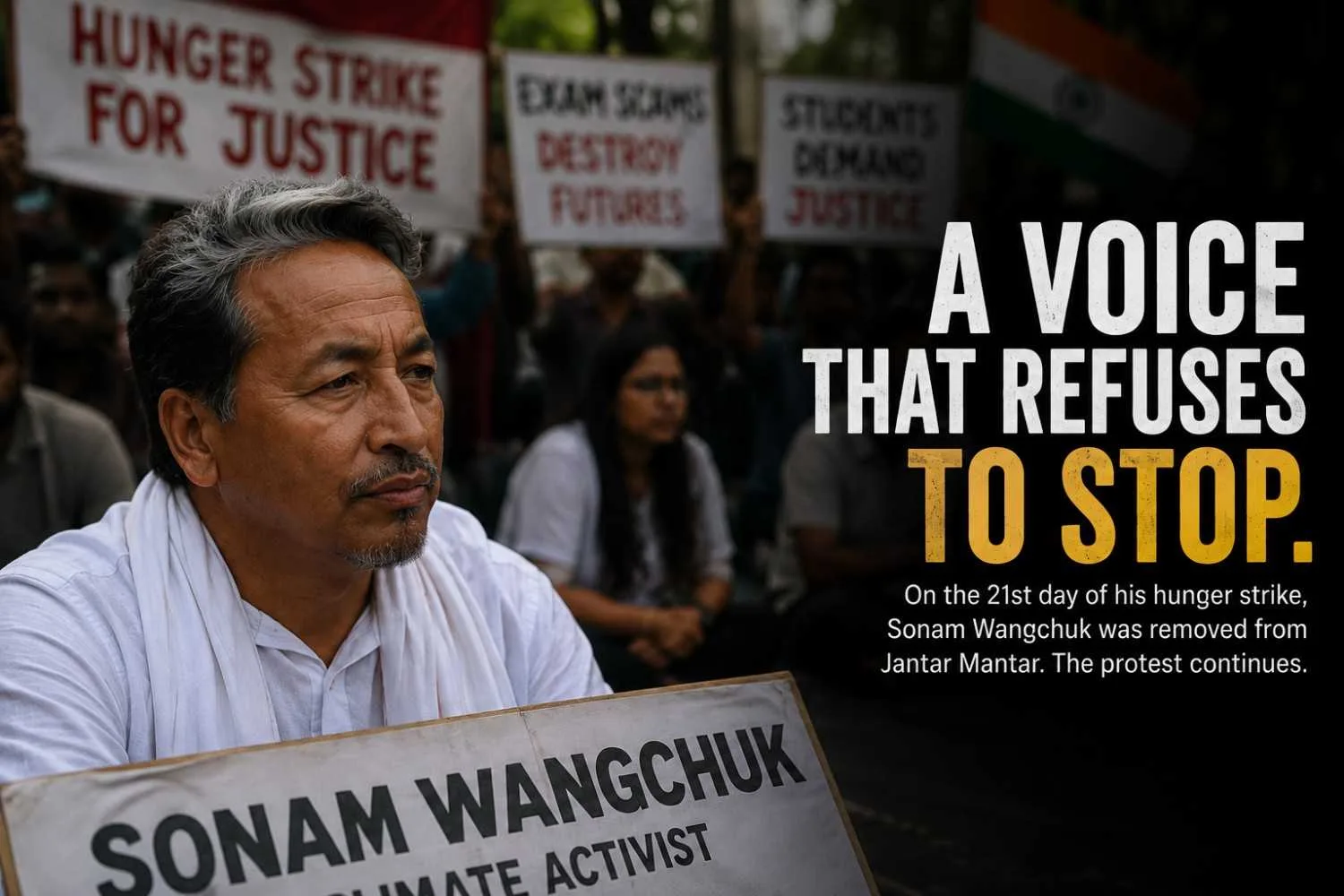
New Delhi, July 18: Environmentalist, education reformer and climate activist Sonam Wangchuk was removed from the protest site at Jantar Mantar early on Saturday morning and taken to VMMC–Safdarjung Hospital as his indefinite hunger strike entered its 21st day. Delhi Police said Wangchuk was shifted to hospital on medical advice after concerns were raised about his deteriorating health. Protest organisers, however, alleged that he was taken away against his wishes. Supporters formed a human chain and attempted to prevent the police from removing him from the site, leading to tense scenes during the early-morning operation. According to the latest available medical update, Wangchuk was conscious, alert and clinically stable, but weak and mildly dehydrated after fasting for nearly three weeks. Doctors reportedly advised continuous observation and monitoring of his electrolyte levels and other vital parameters. His wife and fellow educationist, Gitanjali J. Angmo, questioned the manner in which he was hospitalised. She said that medical intervention should be undertaken only with Wangchuk’s informed consent and in consultation with his family and the doctors who had been monitoring him during the protest. Angmo also reportedly asked that no oral or intravenous medication be administered without proper discussion. She maintained that Wangchuk remained mentally strong and continued his fast while under observation, consuming only water with salt. Protest Against Examination Irregularities The agitation at Jantar Mantar began as a youth- and student-led protest against alleged irregularities, paper leaks and failures in the country’s examination system. Wangchuk joined the movement in solidarity with students affected by repeated examination controversies and began his indefinite hunger strike on June 28. Protesters have demanded an independent investigation into examination-related scandals, greater accountability from the education authorities and structural reforms to restore transparency and credibility to the testing process. The protest has gradually expanded beyond the immediate issue of examination irregularities. It has become a wider movement seeking accountability in education, protection of students’ futures and a more responsive democratic system. Following Wangchuk’s removal, organisers said the agitation would continue and that other participants would carry forward the hunger strike and planned protest programmes. Opposition and Civil Society Extend Support The protest has received support from a wide range of opposition parties, student organisations, farmers’ groups, academics, writers, filmmakers and civil society representatives. Leaders associated with the Congress, Aam Aadmi Party, Samajwadi Party, Trinamool Congress, Shiv Sena (Uddhav Balasaheb Thackeray), Nationalist Congress Party–Sharadchandra Pawar, Communist Party of India (Marxist) and Rashtriya Janata Dal have either visited the protest site, expressed solidarity or criticised the manner in which Wangchuk was removed. Farmer representatives and student activists have also joined the mobilisation. Several civil society figures have appealed to the Union government to open a dialogue with the protesters and address the concerns being raised. Prominent academics, authors, artists and public intellectuals have urged Wangchuk to end his fast, describing his contribution to education, environmental protection and public life as invaluable. Their appeal has also placed responsibility on the government to initiate meaningful negotiations before the situation worsens. A Lifetime Dedicated to Education and Sustainability Wangchuk’s participation in the protest must be viewed in the context of his lifelong engagement with education, ecology and democratic action. In 1988, he co-founded the Students’ Educational and Cultural Movement of Ladakh, widely known as SECMOL. The initiative emerged in response to an education system that was failing many children in Ladakh because it was disconnected from their language, culture, environment and lived realities. SECMOL developed an alternative model of education centred on practical learning, community participation, environmental responsibility and self-reliance. Students are involved in managing the campus, farming, construction, renewable-energy systems and everyday decision-making. The SECMOL campus has become internationally known for its use of solar energy, passive heating, local building materials and sustainable design. It demonstrates how education can be connected with climate responsibility and community life rather than being limited to examinations and classroom instruction. Wangchuk is also known for developing the “ice stupa” concept, an innovative method of storing winter water in the form of artificial glaciers. These structures release water gradually during the spring and early summer months, when farmers in Ladakh face severe water shortages. His work has consistently focused on protecting Ladakh’s fragile high-altitude ecosystem from climate change, unregulated construction, excessive tourism and resource-intensive development. A Gandhian Method of Protest Wangchuk has repeatedly adopted peaceful and non-violent methods to draw attention to public issues. His campaigns have included climate fasts, marches, public appeals, dialogue and community mobilisation. He has also advocated constitutional safeguards for Ladakh, protection of local land and natural resources, greater democratic representation and recognition of the rights of indigenous communities. His hunger strike at Jantar Mantar is therefore consistent with his broader philosophy of public action. It reflects a Gandhian approach in which personal sacrifice, moral persuasion and non-violence are used to awaken public conscience and compel authorities to respond. His removal from the protest site and hospitalisation have intensified the political and public focus on the agitation. The immediate concern now remains his health, even as the larger questions raised by the protesters-about education, accountability, democracy and the right to peaceful dissent—continue to demand answers. ...Read more
15 Jul 2026
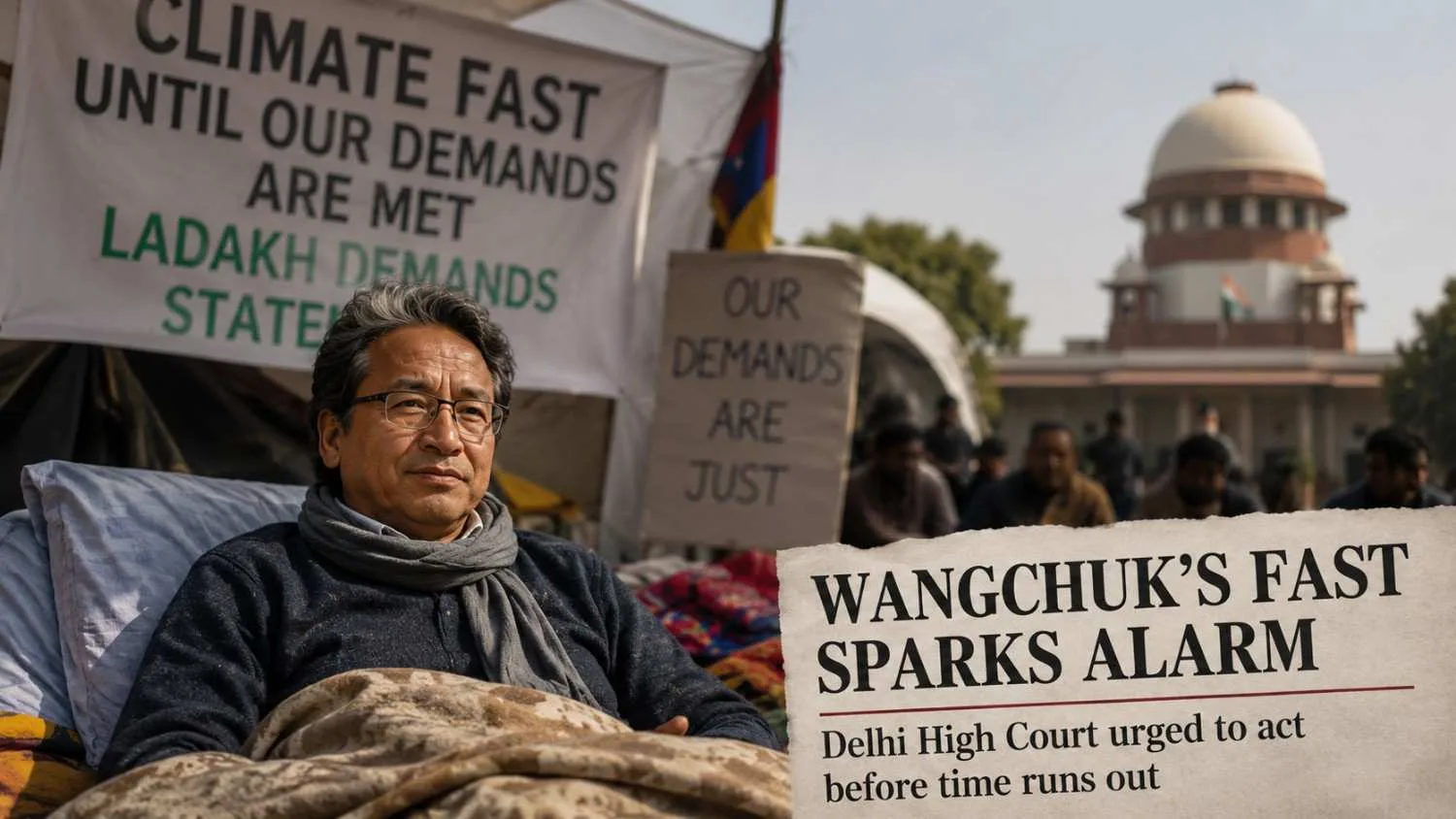
Wangchuk’s Fast Sparks Alarm Delhi High Court urged to act before time runs out By Tiyasha Ghosh How long can a person go without food before the country actually begins to listen? If the price of protest is a life, does silence become the real tragedy? And when someone's health starts deteriorating, should we focus on the protest- or on saving the person behind everything? These questions have taken over as Sonam Wangchuk, the renowned engineer, education reformer and environmental activist from Ladakh, continues his hunger strike in New Delhi. On 15 July, a Public Interest Litigation (PIL) was filed before the Delhi High Court, seeking urgent medical attention for him. The petition claimed that his condition had worsen after more than two weeks of fasting. It stated that he had lost nearly about 8.5 kilograms and alerted that further delay in treatment could put his life at stake. The court has now urged responses from the Centre and the Delhi Government, bringing the matter into the national spotlight. Sonam Wangchuk is known to millions across India. He is well-renowned for his contribution in education, sustainable development and environmental conservation in the Himalayan region. Born and raised in Ladakh, Wangchuk has spent years promoting innovative learning methods and climate-friendly solutions. His contribution also inspired the popular actor, Amir Khan who played as Phunsukh Wangdu in the Bollywood film - 3 Idiots, making him a prominent figure across the country. However, this time, it is not one of his inventions making headlines. It is His silence. As per court records, Wangchuk's health worsened significantly due to fasting. Doctors have reportedly expressed concerns over rapid weight loss, low blood sugar levels and weakness. The PIL has requested immediate medical support including hospitalisation if necessary, stating that protecting a person's life SHOULD BE the number one priority. This case has also ignited an important debate. Should authorities prioritize life over choice and treat hunger strikers? Some believe immediate involvement is necessary to prevent a tragedy. While others argue that peaceful protest is a democratic right and that any medical action should respect the consent of an individual. The Delhi High Court is expected to audit these legal and ethical questions while considering the plea. The incident has stirred emotions well beyond the courtroom. Peaceful protests have been a part of India's democracy since a long time. They have been used often to draw attention to concerns that deserves urgent solution. But when a protest reaches the point where someone's life is at stake, the focus shifts from demands to concerns over human lives. The situation warns us that dialogue delayed is dialogue denied. Early listening can often stop conflicts before it turns into an emergency. As the country waits for the next hearing, many people are hoping for two outcomes- one, Sonam Wangchuk receiving the medical aid he needs, and two, open discussions to get to the root of protesters' concerns. For now, onwards, the court will be deciding the next legal step. But the real question goes far beyond those four walls. Is this how a democracy looks like - waiting until a voice is nearly gone? Source• Reuters• NDTV• The Times of India• Hindustan Times ...Read more
13 Jul 2026
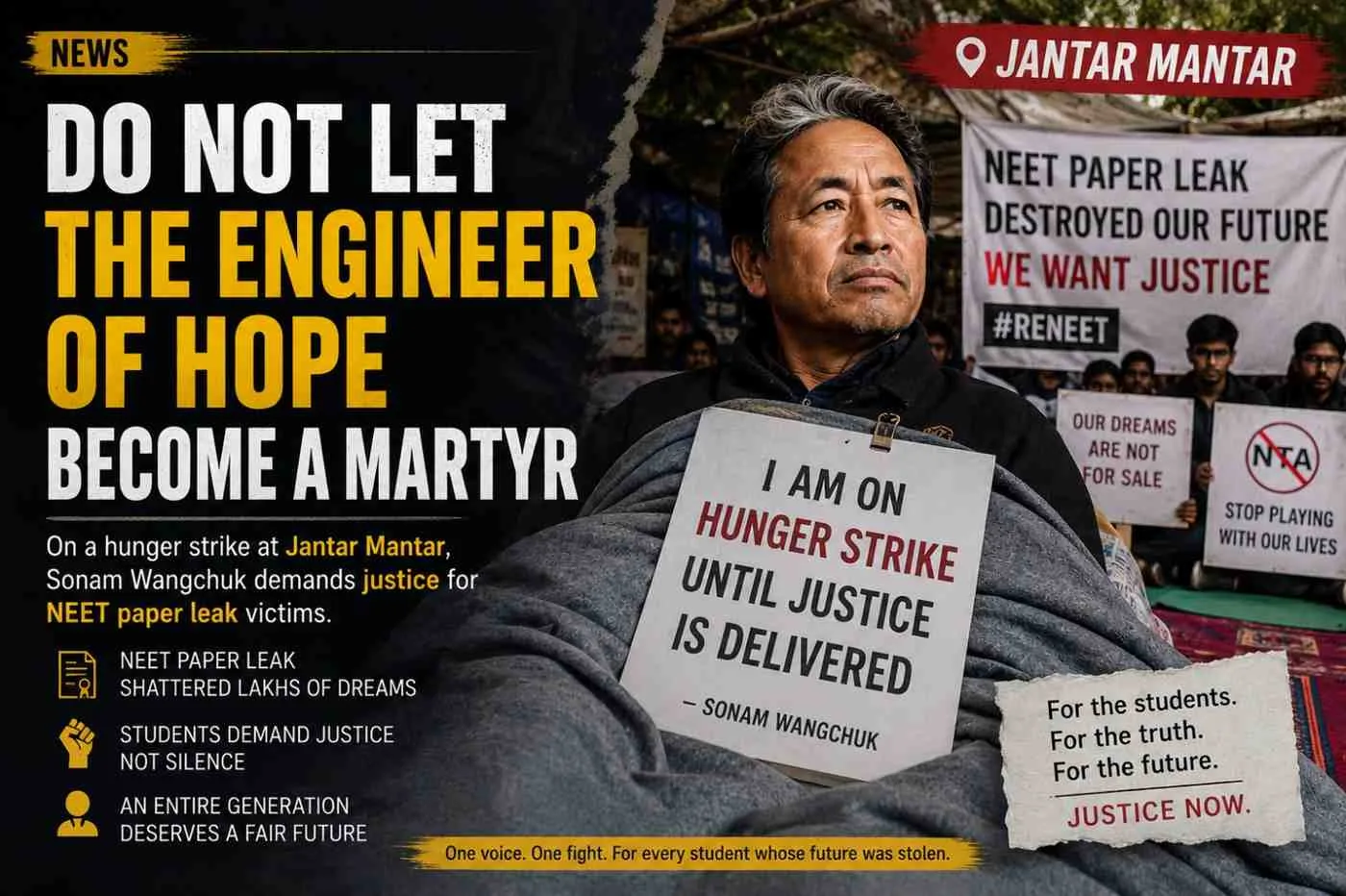
DO NOT LET THE ENGINEER OF HOPE BECOME A MARTYR An article and an appeal by Prof Ujjwal K Chowdhury The man who made ice stand upright is now placing his own body between India’s young people and a system that has failed them. As Sonam Wangchuk’s hunger strike enters its sixteenth day, the Republic must choose dialogue before obituary. UPDATED 13 JULY 2026 THIS IS NO LONGER A CONTEST OF ENDURANCE. IT IS A TEST OF DEMOCRATIC RESPONSIVENESS. A BODY BECOMES THE LAST PETITION At Jantar Mantar, in the hard heat and noise of New Delhi, Sonam Wangchuk’s shrinking body has become an expanding question for India: how much must a citizen suffer before power considers listening a democratic duty? On 13 July 2026, his indefinite hunger strike entered its sixteenth day. Wangchuk began the water-only fast on 28 June in solidarity with the youth-led Cockroach Janta Party protest over the NEET-UG paper leak, wider examination irregularities and the demand for accountability at the highest levels of the Union education establishment. He has also carried into the protest Ladakh’s unresolved demand for constitutional, ecological and democratic safeguards. The latest publicly reported medical figures, from the fifteenth day, were grave enough without exaggeration: a loss of about 7.8 kilograms and blood pressure recorded at 104/66 mm Hg. He was visibly weak. Yet he continued to speak with an almost disarming absence of self-dramatisation. A day earlier, rejecting comparisons with Mahatma Gandhi, he asked citizens not to wait for saviours but to “be your own hero.” That sentence changes the meaning of the fast. Wangchuk is not asking India merely to watch a heroic man suffer. He is asking citizens to recover their own agency. Still, no society can hide behind the striker’s courage. Prolonged fasting can lead to arrhythmia, organ injury, cognitive impairment and death. This is no longer a contest of endurance. It is a race between democratic responsiveness and physical collapse. “A sensitive government in a democracy listens to the pains of the people.”— Sonam Wangchuk, speaking to Reuters, 30 June 2026 THE CRISIS IN NUMBERS INDICATORFACT / CONTEXTDay of fast16th day on 13 July 2026; the water-only fast began on 28 June.Latest reported health dataAbout 7.8 kg weight loss and blood pressure of 104/66 mm Hg on Day 15. These are reported figures, not an independent clinical diagnosis.Scale of NEET impactApproximately 2.3 million candidates were affected by cancellation and retesting after the 2026 paper-leak scandal.Human tollThe Indian Express documented at least 12 deaths by suicide in 37 days before the retest; the Financial Times later reported at least 20 around the crisis. Individual causation requires careful verification.Core public questionWho accepts responsibility when an examination system affecting millions is compromised? Suicide figures are reported counts around the examination crisis; each case requires individual, sensitive verification. WHEN MERIT IS MADE MEANINGLESS The immediate cause of this fast is not a technical dispute about how an examination was administered. It is the collapse of trust in one of the few institutions through which young Indians are told that effort can overcome birth, geography and poverty. More than 2.3 million candidates were affected when the original NEET-UG 2026 examination was cancelled after the paper-leak scandal and a retest was ordered. Behind that number were families that had spent years paying for coaching, travel, rent, books and application fees; students who had organised adolescence around a single date; and parents who had converted savings, jewellery or debt into hope. A leaked paper does not merely compromise an answer key. It steals time from the honest and sells advantage to the connected. The human cost has been reported in devastating terms. The Indian Express documented at least 12 deaths by suicide in the 37 days between cancellation and the retest; the Financial Times later reported at least 20 student suicides around the examination crisis. Every case has its own circumstances, and no death should be reduced to a slogan or assigned a single cause without careful investigation. But the scale of distress is undeniable. It demands a response rooted in compassion, evidence and institutional responsibility—not statistical evasion. This is the principle at the heart of Wangchuk’s intervention: when a public examination affecting millions fails, accountability cannot end with a press release, a retest and promises of tighter security. It must establish how the breach occurred, who benefited, who failed in oversight, what compensation and counselling are owed to candidates, and what changes will prevent repetition. Otherwise, the state asks young people to trust a system that has offered them no reason to do so. AN EXAMINATION LEAK IS NOT A CLERICAL ERROR. IT IS THEFT FROM MILLIONS OF YOUNG LIVES. HE NEVER CALLED A CHILD A FAILURE Wangchuk’s presence gives this protest unusual moral force because education is not a theme he discovered for political convenience. It is the work of his life. A mechanical engineer by training, he co-founded the Students’ Educational and Cultural Movement of Ladakh—SECMOL—in 1988. Its founding insight was revolutionary because it was humane: perhaps Ladakhi children were not failing education; perhaps an alienating education system was failing them. Students were often taught through languages, examples and methods disconnected from the mountains, livelihoods and culture around them. Wangchuk helped replace this estrangement with learning rooted in local reality. At SECMOL, a young person could learn solar energy by running a solar-powered campus, management by helping administer it, agriculture by cultivating difficult land, and citizenship by accepting responsibility for a community. The purpose was not to romanticise poor academic performance, but to rebuild confidence and demonstrate that intelligence is wider than memory under examination pressure. His work also contributed to Operation New Hope, a collaboration among communities, civil society and public institutions to reform government schooling in Ladakh. The Ramon Magsaysay Award Foundation honoured him in 2018 for a systematic, collaborative and community-driven transformation of learning systems. The recognition mattered because Wangchuk had not created an elite island for exceptional children. He had helped redesign the relationship between school, society and the child. That history explains why he cannot treat the examination scandal as an administrative inconvenience. To Wangchuk, education is not a sorting machine that discards the many to reward the few. It is a public trust. When that trust is corrupted, the injury is moral before it is procedural. A LIFE OF PRACTICAL IDEALISM INDICATORFACT / CONTEXTEducation reformCo-founded SECMOL in 1988 and helped build culturally rooted, experiential learning for Ladakhi youth.School-system changeContributed to Operation New Hope, linking communities, civil society and government institutions in Ladakh’s education reform.Climate adaptationDeveloped and promoted Ice Stupas to store winter water for spring irrigation.Sustainable architectureDemonstrated passive-solar, earth-based construction suited to extreme Himalayan conditions.Institution buildingCo-founded the Himalayan Institute of Alternatives, Ladakh, centred on learning through real-world problem-solving.RecognitionRolex Award for Enterprise (2016) and Ramon Magsaysay Award (2018), among other honours. HE MADE ICE STAND UPRIGHT Wangchuk’s best-known invention began with a paradox. Ladakh has abundant frozen water in winter, but farmers need irrigation in spring, before natural glaciers begin to melt sufficiently. His answer was the Ice Stupa: winter stream water channelled through pipes and sprayed into sub-zero air, where it freezes into a tall conical mass. The geometry is the genius. A cone stores a large volume while exposing relatively little surface area to the sun, allowing the ice to melt slowly into the planting season. No grand dam is required, and gravity can do much of the work. The innovation earned Wangchuk the Rolex Award for Enterprise in 2016 and became an internationally recognised model of locally rooted climate adaptation. He has applied the same ethic to passive-solar buildings, earth construction and high-altitude education: begin with the lived problem, respect the ecology, use science intelligently and ensure that the community can operate the solution. His inventions do not arrive from outside demanding that the mountains adjust. They grow from the mountains’ own conditions. There is a painful symmetry in the present moment. The man who taught India how to preserve winter water for the season of need is now consuming his own physical reserves because the institutions meant to preserve public trust appear unwilling to act in time. NOT A FILM CHARACTER—A WORKING METHOD Popular culture introduced millions to Wangchuk through the widespread description of Phunsukh Wangdu, Aamir Khan’s unconventional inventor in 3 Idiots, as partly inspired by him. The comparison made his ideas accessible: curiosity over rote learning, invention over credentialism, usefulness over status. But cinema can also shrink a life into a charming eccentricity. The real Wangchuk has spent decades doing what a film resolves in three hours—building institutions, negotiating with governments, raising resources, making mistakes, testing prototypes, confronting entrenched systems and returning to work the next morning. His importance lies not in being a ‘real-life Wangdu’. It lies in offering a repeatable civic method: understand deeply, simplify intelligently, build collectively and accept responsibility for consequences. That method now indicts the state. A government that celebrates innovation in speeches cannot remain indifferent when one of the country’s most credible innovators says that the architecture of accountability is broken. “Do not wait for a hero. Be your own hero.”— Sonam Wangchuk’s appeal from the protest, 11 July 2026 THE MOUNTAIN IS NOT A POSTCARD The fast is also inseparable from Ladakh. Since the reorganisation of Jammu and Kashmir in 2019, Ladakhi organisations have demanded statehood, constitutional protection under the Sixth Schedule, safeguards for land and employment, and meaningful local authority over development. For Wangchuk, these are not abstract constitutional clauses. They determine who decides the future of a fragile cold desert: its residents, or distant institutions and commercial interests. Ladakh faces glacier retreat, water insecurity, unregulated tourism, infrastructure pressure and the possibility of large projects being imposed without sufficient ecological limits or local consent. A region celebrated as a strategic frontier and tourist paradise can still be denied an adequate democratic voice. Wangchuk undertook a 21-day climate fast in 2024 and helped lead a march towards Delhi. In September 2025, after protests in Leh turned violent and four civilians were killed, the authorities accused him of contributing to unrest through provocative statements. He denied inciting violence and appealed for peace. He was detained under the National Security Act on 26 September and remained imprisoned for roughly 170 days before the Union government revoked the detention in March 2026. Accuracy matters here. Wangchuk was detained under a preventive-detention law; he was not convicted of treason. One may debate his politics, the government’s allegations or the tactics of the movement. But disagreement does not erase the central democratic question: can a border region seek constitutional and environmental safeguards without its most recognisable voice being treated principally as a security problem? SILENCE IS ALSO A DECISION As the fast moves into its third week, the most disturbing fact is not simply Wangchuk’s medical decline. It is the absence, so far, of a publicly reported formal negotiation capable of producing an honourable resolution. Dialogue is sometimes misrepresented as capitulation. In a democracy it is often the opposite: an assertion that institutions are strong enough to hear criticism, test allegations and correct failure. A minister need not accept every accusation in order to meet protesters. A government need not concede every demand in order to establish an independent inquiry, publish a timeline, offer student relief and open structured talks. The state has greater power, greater information and greater capacity than a citizen on a mattress. That asymmetry creates a greater duty of care. To wait for the body to fail is not neutrality. Delay itself becomes policy. ANNA HAZARE: THE LESSON IS NEGOTIATION, NOT NOSTALGIA The memory of Anna Hazare’s 2011 anti-corruption fast inevitably hangs over Jantar Mantar, but the comparison must be made accurately. Hazare began an indefinite fast on 5 April 2011; the Union government constituted a joint drafting committee on 8 April, and he ended the fast on 9 April. His larger August agitation lasted 12 days and ended after Parliament expressed agreement in principle on key demands. The Lokpal and Lokayuktas Act was eventually passed in 2013—not instantly at the protest site. The relevant lesson is not that every hunger strike should dictate legislation. It is that government engagement can begin before a citizen’s health reaches an irreversible threshold. Negotiation does not make elected authority weak; it demonstrates that authority understands its constitutional purpose. Wangchuk’s sixteenth day therefore carries a stark question. If the state could open talks with a fasting anti-corruption campaigner in 2011, why can it not establish a credible channel with an educator and environmentalist in 2026—especially when millions of students have already borne the cost of an acknowledged examination breakdown? DIALOGUE DOES NOT DIMINISH ELECTED AUTHORITY. IT REVEALS WHETHER AUTHORITY REMEMBERS ITS PURPOSE. IF HE DIES, INDIA DOES NOT WIN No responsible article should romanticise Wangchuk’s death. Martyrdom is not a policy outcome, and a funeral is not institutional reform. Yet refusing to consider the consequences would be equally irresponsible. First, an examination controversy would become a moral crisis of the Republic. The defining question would no longer be only who leaked a paper, but why meaningful engagement did not begin while a nationally respected citizen’s health deteriorated in public view. Second, scattered youth anger could acquire a unifying symbol. Paper leaks, unemployment, delayed recruitment, expensive coaching and arbitrary evaluation cross state, caste, class and language. Wangchuk’s death could connect these grievances into a wider consciousness of generational injustice. Peaceful frustration may then harden into a belief that institutions respond only after catastrophe. Third, Ladakh’s constitutional movement would be transformed. A demand often treated as remote would be carried everywhere by the image of a Ladakhi educator dying in the national capital. The loss of a bridge-builder can empower voices less patient with dialogue. For a sensitive border region, alienation is not an abstract political cost. Fourth, India’s international standing would suffer. Wangchuk is globally recognised for climate adaptation and educational reform. His preventable death during a non-violent protest would be cited in debates about democratic dissent, environmental justice and the treatment of civil-society actors. Finally, the country could commit its most familiar act of evasion: mourn the man while abandoning the work. Institutions might be named after him, quotations circulated and statues proposed, while examination governance remained opaque and Ladakh’s safeguards unresolved. India has often found it easier to garland a photograph than to complete an unfinished agenda. THE COUNTRY MUST CHOOSE NEGOTIATION BEFORE OBITUARY. SAVE THE MAN—AND REPAIR THE SYSTEM The answer cannot be merely to plead with Wangchuk to eat while leaving untouched the conditions that led him to fast. Nor should supporters value the symbolic power of his suffering above his life. Both the humanitarian emergency and the institutional demands must be addressed together. The government should immediately appoint a senior, empowered interlocutor; open a recorded and time-bound dialogue with Wangchuk, student representatives and Ladakhi leaders; commission an independent investigation into the examination breach and associated administrative failures; publish a transparent reform schedule; and create psychological, academic and financial support for affected candidates and bereaved families. It should also resume credible constitutional discussions on Ladakh with ecological safeguards and local consent at the centre. At the protest site, independent medical monitoring must be protected, clinical information communicated responsibly, and every route explored for a negotiated withdrawal that preserves Wangchuk’s dignity. Saving a life is not a political favour. It is the minimum duty of a state confronted with foreseeable harm. Wangchuk has spent nearly four decades showing that apparently impossible problems can be redesigned. A student branded a failure can become a leader. Winter water can irrigate spring fields. Mud, sunlight and intelligence can keep a building warm at Himalayan temperatures. A marginal region can generate ideas for the world. The problem before India is simpler than any of those: can power cross a few kilometres in Delhi and speak to a citizen before his body is broken? The nation does not need another photograph draped in marigolds. It needs Sonam Wangchuk alive—in a classroom, on a mountain, beside an ice stupa, arguing, inventing and reminding us that public life can still be useful. The highest tribute is not to prepare an obituary. It is to create the conditions in which he can eat again. The mountains are watching. The young are waiting. The clock is not. WHAT RESPONSIBLE ACTION LOOKS LIKE A senior, empowered government interlocutor and a formal negotiation channel.An independent, time-bound inquiry into the leak, oversight failures and beneficiary networks.A published examination-security reform plan with institutional accountability.Counselling, academic relief and financial support for affected candidates and bereaved families.Renewed constitutional talks on Ladakh, with ecology, land, jobs and local consent at the centre.Independent medical monitoring and an honourable path for ending the fast. SOURCE NOTES AND FACT-CHECKING BASIS 1. Reuters, “India’s Cockroach party seeking education minister’s ouster awaits cabinet reshuffle,” 30 June 2026. 2. The Times of India, “Watch: Sonam Wangchuk looks visibly weak as hunger strike enters day 15th,” updated 12 July 2026. 3. India Today/PTI, “I am not Gandhi, be your own hero: Sonam Wangchuk urges citizens to join protest,” 11 July 2026. 4. The Indian Express, “Ahead of NEET-UG re-exam, 12 suicides in 37 days,” 20 June 2026. 5. Financial Times, “Why India’s education system gets poor marks from millions of students,” 13 July 2026. 6. Ramon Magsaysay Award Foundation, official citation for Sonam Wangchuk, 2018. 7. Rolex Awards for Enterprise, official project profile: Sonam Wangchuk and the Ice Stupa initiative, 2016. 8. Reuters, “Indian activist’s hunger strike for Ladakh autonomy draws thousands of supporters,” 23 March 2024. 9. Reuters, “Indian police arrest activist Wangchuk after deadly Ladakh protests,” 26 September 2025. 10. Press Information Bureau, Government of India, Finance Minister’s statement in Lok Sabha on the 2011 Lokpal movement, 27 August 2011; India Code, Lokpal and Lokayuktas Act, 2013. ...Read more
12 May 2026
In the 21st century, the greatest threats to corporate stability are no longer just market competitors, but "Gray Swan" events—predictable but ignored risks such as climate-driven supply chain collapses or social unrest. Governance is the mechanism through which an organization identifies, assesses, and mitigates these non-financial risks. The integration of ESG into the Enterprise Risk Management (ERM) framework is the most significant evolution in corporate governance in recent years. It requires a shift from "historical risk" (looking at what happened in the past) to "scenario-based risk" (modeling what could happen in various climate and social futures). One of the primary tools in modern risk governance is Climate Scenario Analysis. Boards use sophisticated models to stress-test their business strategies against different global warming pathways (e.g., a $1.5^\circ C$ vs. a $3^\circ C$ world). This allows them to identify "stranded assets"—investments that may lose their value prematurely due to environmental regulations or physical climate changes. By identifying these risks years in advance, governed companies can "orderly transition" their portfolios, divesting from high-risk sectors and reinvesting in resilient, low-carbon alternatives. Social risk management has also become more sophisticated through Human Rights Due Diligence (HRDD). Governance protocols now mandate that companies look beyond their direct operations to identify risks in their Tier 2 and Tier 3 suppliers. By utilizing "whistleblower" technologies and satellite monitoring, companies can detect forced labor or environmental degradation in real-time, allowing them to terminate unethical contracts before they cause reputational or legal damage. Ultimately, governance is about Resilience. A well-governed company is not one that avoids all risk, but one that has the transparency, ethical leadership, and data-driven insights to navigate a volatile world while maintaining the trust of its stakeholders. ...Read more

12 May 2026
ESG reporting was once a voluntary, narrative-heavy marketing exercise. Today, it is a rigorous, data-driven discipline that is as critical as financial auditing. The transition to mandatory disclosure frameworks, such as the Corporate Sustainability Reporting Directive (CSRD) and the IFRS Sustainability Disclosure Standards, has effectively ended the era of "Greenwashing." Transparency is no longer a choice; it is a regulatory requirement that determines a company’s access to capital markets. Investors now view a lack of ESG transparency as a sign of hidden operational risk. The innovation driving this transparency is Double Materiality. This governance concept requires companies to report not only on how sustainability issues affect their financial performance (outside-in) but also on how their operations impact the environment and society (inside-out). By adopting this dual lens, organizations provide stakeholders with a 360-degree view of their value creation. To manage the vast amounts of data required for such reporting, companies are utilizing "Sustainability ERP" (Enterprise Resource Planning) systems that automate the collection of carbon, waste, and labor data from every corner of the supply chain. Moreover, the rise of Assurance and Auditability is bridging the trust gap. Just as financial statements are audited by third-party firms, ESG reports are now undergoing "Limited" and, increasingly, "Reasonable" assurance processes. This level of scrutiny ensures that a company’s claims about its renewable energy use or gender pay gap are verified by independent experts. For the modern corporation, a high-quality ESG report is the ultimate calling card—a demonstration of transparency that attracts ESG-focused funds, lowers the cost of debt, and builds a resilient brand in a skeptical marketplace. ...Read more

12 May 2026
Diversity, Equity, and Inclusion (DEI) have moved from being a department in HR to a core component of labor compliance and corporate strategy. In the past, diversity was often treated as a "numbers game"—meeting certain quotas for gender or ethnicity. Today, the focus is on Systemic Equity, which examines the underlying structures of a company to ensure that all individuals have the same access to opportunities, regardless of their background, neurodiversity, or physical ability. The innovation in this space is the move toward Data-Driven Inclusion Audits. Instead of general surveys, companies are using AI to analyze promotion rates, pay gaps, and "Attrition Velocity" across different demographics. If the data shows that a specific group is leaving the company at twice the average rate, it signals a failure in the social environment that needs immediate intervention. This proactive compliance model helps identify "Micro-exclusions"—subtle, systemic barriers that prevent talented individuals from reaching leadership positions. Community engagement is the final pillar of this strategy. A truly compliant company in 2026 does not exist in a vacuum; it is an active participant in its local ecosystem. This means "Local Sourcing" for labor and services, investing in local education through STEM programs, and ensuring that the company’s presence does not lead to gentrification or displacement. By integrating the company into the social fabric of its community, businesses create a "Mutual Value Exchange." This not only boosts the company’s reputation but also creates a stable, skilled local labor pool, ensuring that social and labor compliance is not just an ethical duty, but a powerful engine for regional economic growth. ...Read more