
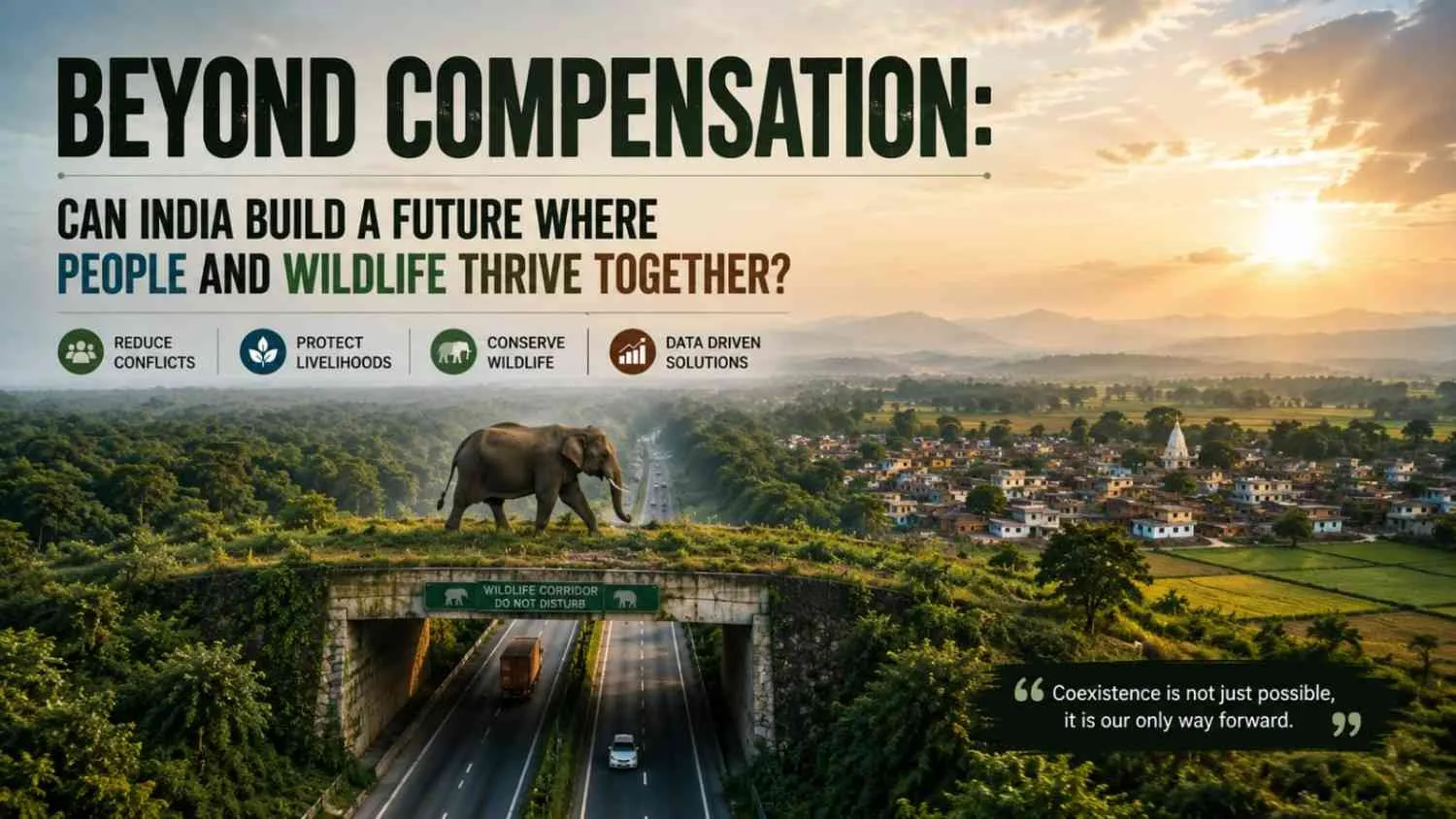
As human-wildlife encounters become more common, the focus is shifting from compensation to prevention. But is India prepared for that change?
For many communities across India, coexisting with wildlife is becoming more challenging.
A single night can see elephants destroy standing crops, leopards attacking livestock, crocodiles disrupting fishing activities, or tigers venturing closer to villages.
For families who live off the land and water, one encounter can change everything. These incidents are becoming increasingly common rather than being exceptional.
Across India, human-wildlife conflict is emerging as a persistent challenge, with consequences for people's lives, livelihoods, and the long-term protection of wildlife.
For decades, managing human-wildlife conflict has largely meant responding after the damage is done. Forest officials assess losses, eligible claims are compensated, and affected families receive financial assistance.
Typical Compensation process followed by Indian states:
Conflict Occurs
↓
Incident Reported (Within 24 hours)
↓
Forest Department Verification (2–7 days)
↓
Damage Assessment (7–15 days)
↓
Approval by Competent Authority
↓
Compensation Released
Stage Typical Timeline
Reporting Within 24 hours
Field Verification 2–7 days
Damage Assessment 7–15 days
Approval Varies by State
Payment As per State Rules
Conservationists, however, argue that the focus must now shift from reacting to preventing conflicts before they occur.
The conversation is now shifting towards a more important question.
As human-wildlife conflicts become more frequent, the key question is no longer just how to compensate losses, but how to prevent them from happening in the first place.
The discussion comes as India's wildlife conservation efforts continue to show results. Stronger protection, expanding protected areas, and stricter wildlife laws have helped several flagship species recover.
But conservation success has also highlighted a growing challenge. As roads, railways, industries, farms, and settlements continue to fragment natural habitats, the boundaries between human settlements and wildlife habitats continue to blur, thus, encounters between people and wild animals are becoming more frequent.
The growing interaction between people and wildlife is transforming the challenge from an environmental concern into a broader societal issue.
The issue now spans environmental, social, economic, and governance domains, that demands coordinated action.
The consequences extend far beyond the immediate incident. Farmers who lose crops to elephants often face prolonged financial hardship, while families whose livestock is killed by predators can experience reduced income and greater food insecurity.
Fatal encounters leave lasting emotional scars and may weaken public support for wildlife conservation. Wildlife is also affected, with animals involved in repeated conflicts often facing injury, relocation and even death.
In many instances, both people and wildlife are paying the price for the same pressures on shared landscapes.
The more important question, then, is not just how conflicts are managed, but what meaningful success should look like.
Perhaps the better measure of success is not how much compensation is paid each year, but whether human–wildlife conflicts become less frequent, communities feel safer, and wildlife populations continue to thrive.
Many conservation experts believe lasting progress will come from preventing human-wildlife conflict rather than simply compensating for its consequences. But making that shift will require more than additional funding - it will demand stronger planning, better coordination, and long-term commitment.
Achieving that shift will require better planning, stronger data, and closer collaboration between governments, scientists, and local communities.
The challenge is that human-wildlife conflict is rarely caused by a single factor, making long-term solutions far more complex.
The causes often vary from one region to another. In some areas, elephants move through villages after traditional migration routes are disrupted by highways or expanding farmland. In others, leopards are drawn into settlements by the easy availability of stray animals as prey. Crocodiles may also be seen more often near fishing communities as wetlands shrink and changing water-use patterns alter their habitats.
Every landscape has its own mix of ecological and human pressures.
Relying on a single compensation mechanism for all incidents may offer short-term relief, but it does little to resolve the conditions that allow these conflicts to persist.
This is where real data beats paperwork!
Thousands of humans-wildlife conflict incidents are reported across India each year. But experts say documenting these incidents are no longer enough.
Experts say equal attention should be given to identifying recurring conflict areas, understanding the species involved, tracking where incidents are most frequent, and evaluating whether current strategies are working or not.
Without this level of understanding, authorities often remain focused on responding to conflicts instead of preventing them.
This is why many researchers are calling for stronger national systems to monitor and analyse human-wildlife conflict.
A modern human-wildlife conflict portal could become far better than a system for recording compensation claims.
If used effectively, it could identify emerging hotspots, monitor patterns across states, and help governments take preventive actions before conflicts escalate.
The next question, however, is whether such information will be translated into action.
Another key question is whether district-level information on human-wildlife conflict incidents and compensation payments will be made publicly accessible.
Transparency matters because reliable data not only improves accountability but also helps shape more effective policies.
Recurring conflict patterns can help shape more effective responses.
Districts that repeatedly experience elephant-related crop damage may need greater investment in early warning systems instead of relying mainly on seasonal compensation. Similarly, an increase in leopard attacks near expanding urban areas may point to the need for improved waste management, better control of stray animal populations, and more informed land-use planning rather than treating each incident as an isolated event.
Reliable public datasets can strengthen both transparency and accountability.
They enable researchers to identify long-term trends, allow civil society organisations to assess the effectiveness of government interventions, and help local communities anticipate seasonal risks and prepare more effectively.
Without transparent and accessible data, discussions often rely on individual incidents rather than long-term evidence.
Another important challenge is determining what should be recognised as human-wildlife conflict.
Should official records include only reported cases, or also repeated crop damage that goes unreported because compensation is delayed or the claims process is too complex?
Should indirect economic losses be considered?
And whose experiences are ultimately reflected in official data?
These questions may appear technical, but they have a direct impact on how governments understand and respond to human-wildlife conflict.
When reporting systems fail to capture the full picture, the challenges faced by affected community remains underestimated.
That is why experts argue that strengthening conflict data is not just a technological exercise, it is also about building trust between governments, researchers, and the communities living with wildlife.
When communities trust that reporting systems are transparent, accessible, and fair, they are more likely to see themselves as partners in conservation rather than as people carrying its costs.
Strengthening that trust will be critical as India's changing landscapes continue to redefine how people and wildlife share space.
Highways, railway corridors, power transmission lines, and expanding urban settlements are rapidly transforming landscapes across India. While these projects are vital for economic development, they are also reshaping habitats that wildlife has relied on for generations.
The conversation has therefore moved beyond choosing between development and conservation. The greater challenge is ensuring that growth is planned in a way that allows people and wildlife to share landscapes more safely.
Making this shift will require moving from a reactive approach to a preventive one- supported by stronger planning, reliable data, and informed policy decisions!
Compensation may ease the impact of conflict, but it does not eliminate the causes behind it.
That is why conservation experts are increasingly advocating a prevention-first approach.
While financial assistance remains essential for families affected by wildlife-related losses, they argue that long-term success depends on reducing the number of conflicts in the first place.
This means shifting attention from reacting to incidents towards identifying risks early and preventing them through better planning and management.
They believe, the future of human-wildlife conservation, will not depend on how much compensation is paid, but on how many conflicts are prevented.
A prevention-first approach is already beginning to shape conservation efforts across India. In several landscapes, communities, forest departments, and researchers are working together to reduce the risk of conflict while promoting safer coexistence between people and wildlife.
Some of the strongest lessons from this approach are emerging from India's elephant landscapes.
Elephants are among India's most wide-ranging mammals, relying on seasonal migration routes that have connected forests for centuries. Today, many of these natural corridors are being fragmented by expanding agriculture, highways, railway lines, mining projects, and growing settlements. As these pathways disappear, elephants are increasingly forced to move through villages while searching for food or travelling between isolated forest patches.
The outcome is often repeated crop damage and, in some cases, dangerous encounters between elephant herds and nearby communities.
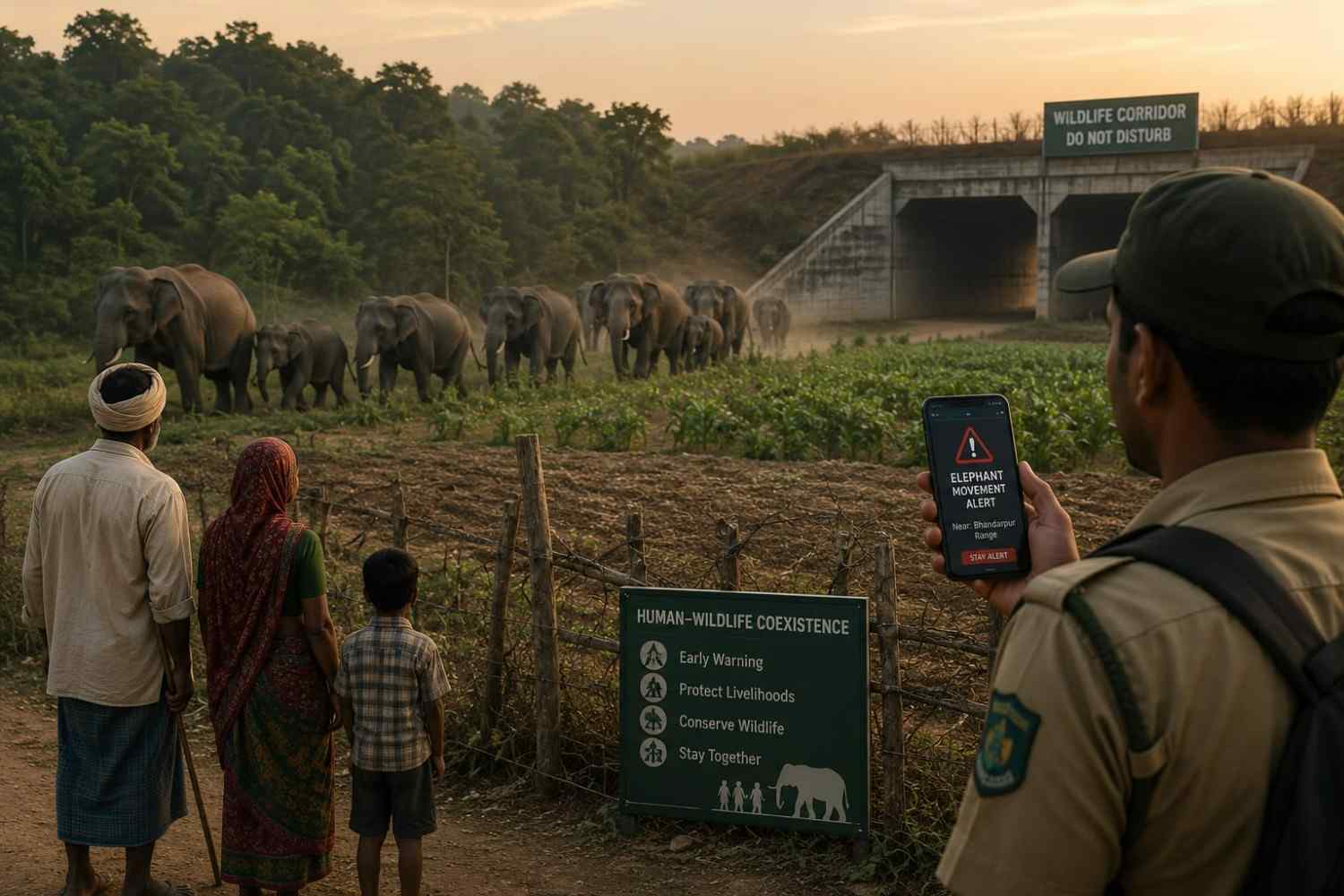
Rather than responding only after losses occur, several states are investing in prevention. In parts of Odisha, West Bengal, and Karnataka, forest departments and local volunteers monitor elephant movements and issue advance warnings through SMS alerts, WhatsApp groups, public announcement systems, and watch towers, giving communities time to prepare before herds reach their villages.
While these systems cannot prevent every incident, they demonstrate the value of acting before conflict occurs.
In many situations, timely information can be more effective than responding after the damage is done.
Advance warnings give farmers time to avoid entering fields at night, move livestock to safer areas, and reduce the risk of dangerous encounters with elephant herds.
Technology is becoming an increasingly important part of human-wildlife conflict management.
GPS collars, drones, thermal cameras, and satellite mapping are helping forest departments track wildlife movements more accurately, while artificial intelligence is beginning to identify patterns that could help predict future conflict hotspots.
However, experts believe technology works best as part of a broader strategy rather than as a solution on its own.
Without effective planning, community participation, and timely action on the ground, even the most advanced tools cannot prevent conflict on their own.
Technology can strengthen conservation efforts, but it cannot replace the knowledge and decisions of the people who share landscapes with wildlife.
That is why local communities remain at the centre of effective conservation. For generations, Indigenous communities and forest-dependent villages have observed wildlife behaviour through everyday experience, building knowledge that predates modern scientific monitoring. Many understand when elephants are likely to migrate, which streams tigers frequently use, and how shifts in weather can influence the movement of wildlife.
Researchers increasingly argue that successful conservation depends not only on scientific knowledge but also on the experience of the communities that have shared these landscapes with wildlife for generations.
Instead of treating local communities simply as recipients of compensation, conservation programmes can benefit from involving them as partners in planning, monitoring, and decision-making.
Communities that feel heard and included are often more willing to support conservation efforts, while those who feel excluded may become less confident in wildlife protection policies.
The value of this partnership is becoming equally prominent in India's tiger landscapes.
India is now home to the world's largest wild tiger population, marking a significant conservation success. At the same time, recovering tiger populations are ranging beyond protected reserves into surrounding forests, buffer zones, and agricultural landscapes.
This has made the protection of wildlife corridors more important than ever. These natural pathways allow tigers and other species to move safely between forests. When corridors are disrupted or disappear, animals are more likely to cross roads, railway lines, and human settlements, increasing the risk of conflict.
Protecting these corridors therefore supports both wildlife conservation and human safety.
Well-connected landscapes allow wildlife to move naturally between habitats, reducing the need for animals to pass through villages in search of food or new territories.
Although the importance of wildlife corridors is now widely recognised, many continue to come under pressure from expanding infrastructure.
Wildlife Corridors and Infrastructure Risks
Linear Infrastructure Impact on Wildlife Recommended Mitigation
Highways Blocks animal movement Wildlife overpasses & underpasses
Railways Animal collisions Underpasses, fencing, speed restrictions
Canals Animals trapped Escape ramps
Transmission Lines Habitat Fragmentation Careful route planning
Expanding Settlements Corridor loss Buffer zones and corridor protection
Highways improve connectivity for people but can restrict the movement of animals. Railway lines support trade and transport, yet poorly planned crossings may increase wildlife deaths. Transmission lines, canals, and industrial development further divide habitats that were once connected.
The challenge extends beyond building infrastructure- it is about planning it responsibly.
Many conservation scientists argue that potential impacts on wildlife should be identified and disclosed before construction begins, allowing risks to be reduced through better design and mitigation measures.
Experts argue that Environmental Impact Assessments should place greater emphasis on wildlife movement, habitat connectivity and long-term conflict risks.
Where development cannot be avoided, measures such as wildlife crossings, underpasses, overpasses and fencing should become a standard part of project design. Several projects across India have shown that these interventions allow animals to move safely while reducing collisions with vehicles and trains.
Preventing conflict through better planning is often more effective and less costly than addressing it later!
Leopard landscapes offer another important lesson.
Their ability to survive in forests, farms and urban areas has increased interactions with people.
In parts of Maharashtra, forest departments now rely on rapid-response teams that assess situations, manage crowds and prevent unnecessary capture or relocation.
Experts say this reflects a broader shift in conservation, where not every wildlife sighting is treated as a crisis.
In many cases, informed management and public awareness are more effective than immediate intervention.
Simple practices such as securing livestock at night, managing waste responsibly and avoiding crowds around wildlife can significantly reduce risks.
A similar approach is evident in India's crocodile habitats. In Gujarat and several other states, crocodiles share rivers, reservoirs and wetlands with nearby communities.
Although these encounters receive less attention than conflicts involving elephants or big cats, they highlight the same challenge- coexistence depends on understanding wildlife behaviour rather than reacting out of fear.
Awareness programmes promoting safe fishing practices, avoiding nesting areas during breeding seasons and recognising crocodile habitats have helped reduce incidents while protecting wildlife.
Across elephant corridors, tiger landscapes, leopard habitats and crocodile wetlands, one message remains clear: the most effective conservation strategies begin not with compensation, but with understanding landscapes and preventing conflict before it occurs.
As conversations around coexistence evolve, another issue is becoming increasingly important- data.
Thousands of wildlife-conflict incidents involving crop damage, livestock loss, property destruction and human casualties are reported across India every year.
Yet experts say the country still lacks a clear understanding of where conflicts occur most often, which species cause the greatest losses and whether existing prevention measures are actually working.
Although many states maintain their own reporting systems, differences in formats and limited public access make nationwide analysis difficult.
Researchers therefore argue that India needs a transparent, standardised wildlife-conflict database that goes beyond recording compensation claims. Such a system could identify recurring hotspots, track seasonal patterns and help governments prioritise prevention instead of responding only after incidents occur.
| Dataset | Purpose |
| Incident ID | Unique record for each conflict |
| Date & Time | Identify seasonal and temporal patterns |
| District & State | Locate conflict hotspots |
| GPS Coordinates | Precise mapping of incidents |
| Species Involved | Elephant, Tiger, Leopard, Crocodile, etc. |
| Type of Conflict | Crop damage, livestock loss, property damage, human injury/death |
| Compensation Claimed | Amount requested |
| Compensation Paid | Amount disbursed |
| Claim Processing Time | Days taken for settlement |
| Preventive Measures Used | Fencing, SMS alerts, watch towers, etc. |
| Incident Status | Pending / Verified / Resolved |
However, better data also depends on deciding what counts as human–wildlife conflict.
Many crop losses, livestock attacks and indirect livelihood impacts go unreported because compensation is delayed, difficult to claim or considered insufficient.
As a result, official records often underestimate the true burden on affected communities.
This is more than a data challenge- it is a question of trust!
Communities are more likely to support conservation when reporting systems are transparent, accessible and fair.
Inconsistent compensation or lengthy procedures can weaken confidence in both authorities and wildlife protection programmes.
Experts therefore argue that improving compensation is important, but making it faster, more transparent and consistent is even more critical.
At the same time, compensation alone cannot address repeated losses, fear or declining livelihoods.
This has shifted the focus from how much people should be compensated to how conflicts can be prevented altogether.
That shift also places greater emphasis on infrastructure planning. As highways, railways, renewable energy projects and industrial development expand, experts believe wildlife movement should be considered before construction begins.
Measures such as wildlife crossings, underpasses, canopy bridges and connected corridors can reduce conflict while allowing development and conservation to progress together.
Community participation is equally important.
Local residents often possess detailed knowledge of wildlife movement and seasonal behaviour, making them valuable partners in conservation rather than passive recipients of compensation.
Many successful initiatives now rely on village committees, community volunteers and rapid-response networks to strengthen coexistence.
International experience reinforces the same lesson. Community-led conservation in Africa, wildlife crossings in Europe and digital monitoring systems in other regions all demonstrate that preventing conflict is more effective than responding after it has escalated.
India's success in protecting tigers, elephants, rhinos, crocodiles and other wildlife mark a major conservation achievement.
The next challenge is ensuring that people and wildlife can safely share the landscapes beyond protected areas. Achieving this will require better planning, stronger scientific monitoring, greater recognition of traditional ecological knowledge, fairer compensation and meaningful community participation.
Ultimately, the future of conservation will depend not only on protecting wildlife, but on creating landscapes where both people and nature can thrive together!
Sources:
Ministry of Environment, Forest and Climate Change (MoEFCC), Government of India
National Tiger Conservation Authority (NTCA)
Wildlife Institute of India (WII)
National Board for Wildlife (NBWL)
Project Elephant, Ministry of Environment, Forest and Climate Change
National Biodiversity Authority (NBA)
Forest Survey of India (FSI)
State Forest Department reports (Odisha, Karnataka, Maharashtra, Gujarat, Madhya Pradesh and West Bengal)
National Wildlife Action Plan (2017–2031)
Wildlife Protection Act, 1972 (as amended)
IUCN (International Union for Conservation of Nature)
WWF-India
Open-source research papers on human-wildlife conflict, wildlife corridors and coexistence strategies
Peer-reviewed journals including Biological Conservation, Conservation Biology, People and Nature and Frontiers in Conservation Science



Add a Comment