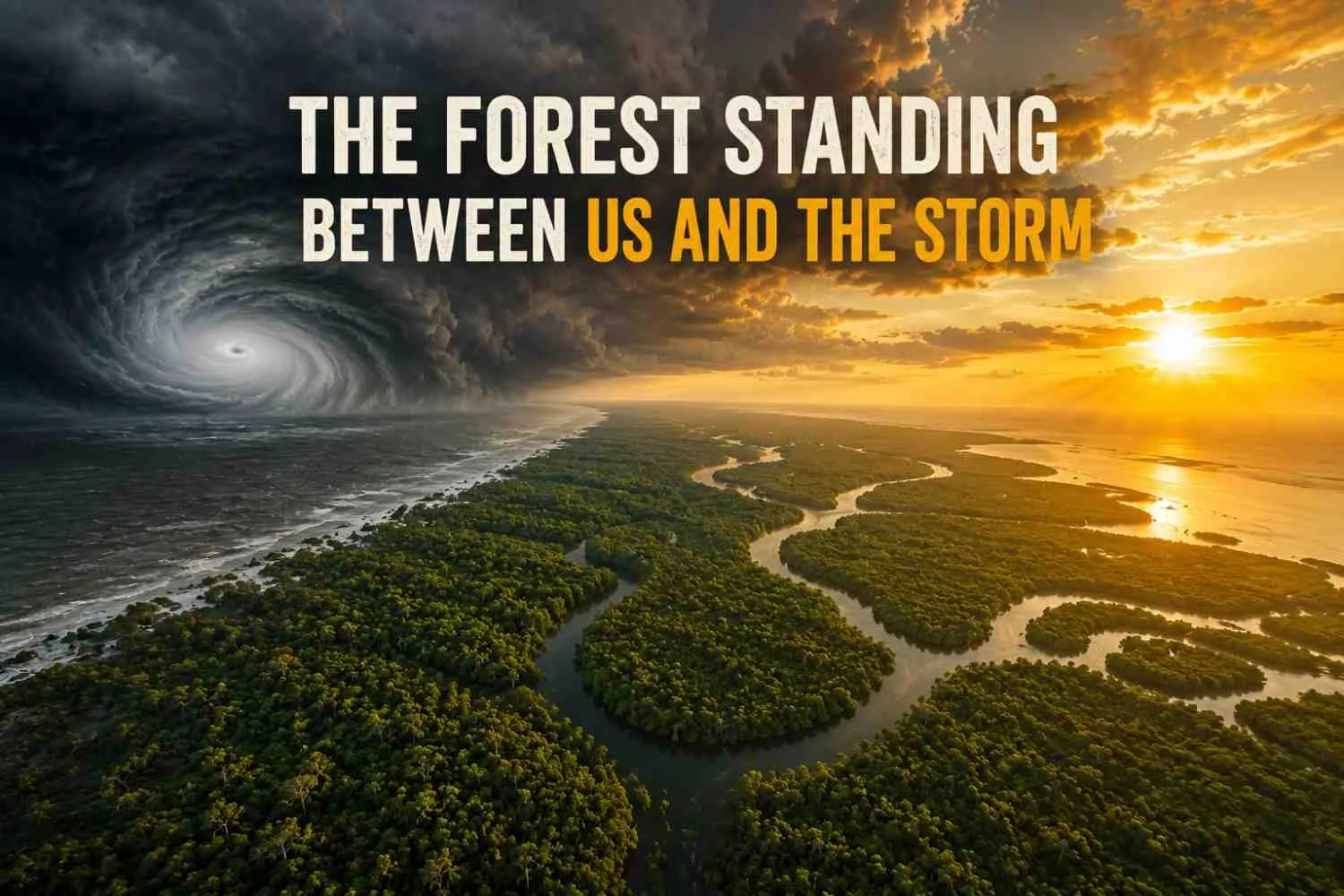
Why mangroves matter to our coasts, climate, livelihoods and future
Research-based feature by Prof Ujjwal K Chowdhury
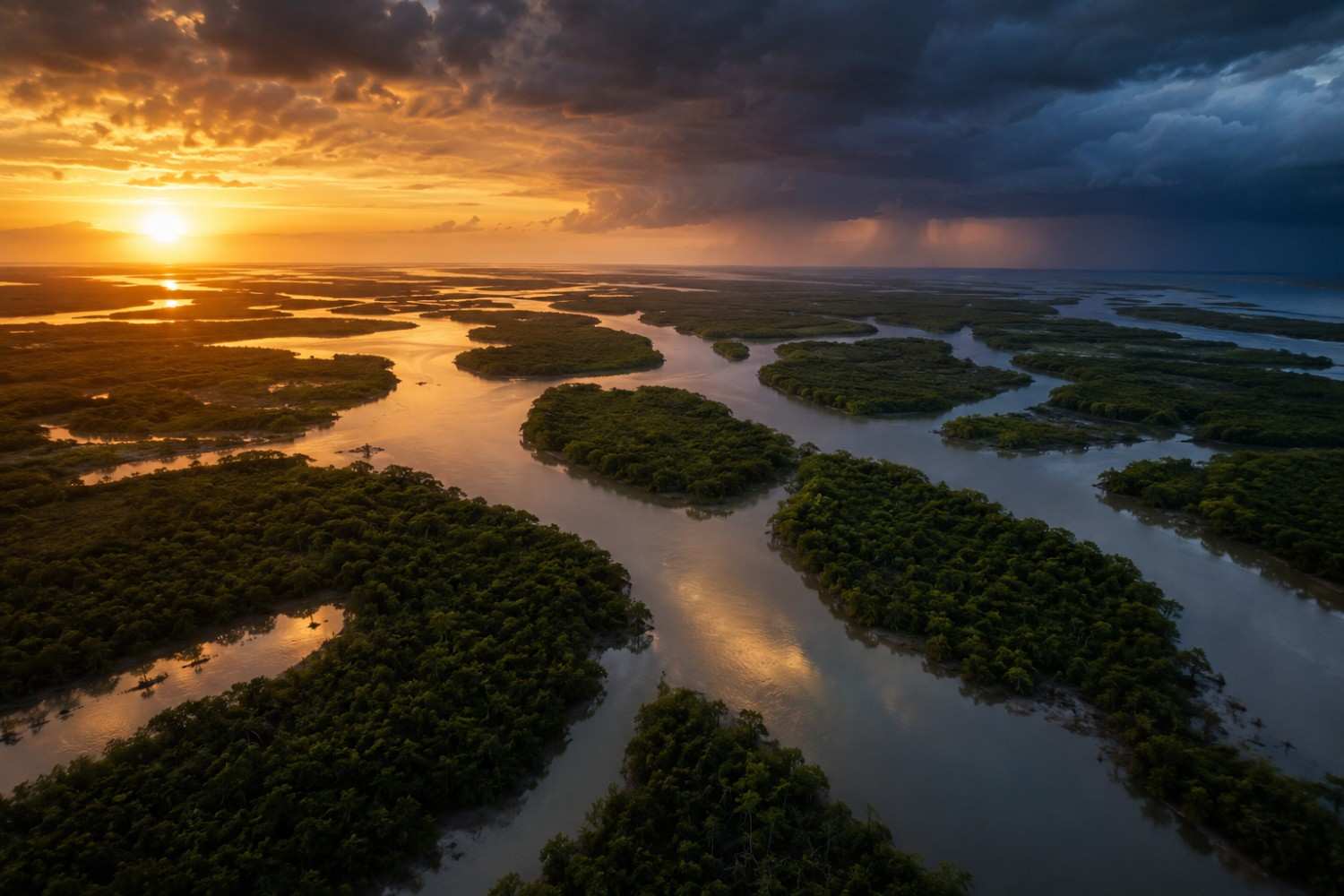
A World Mangrove Day feature | July 26, 2026
Mangroves grow where ordinary trees would die. They stand in salt water, breathe through roots, raise land with trapped sediment and protect people who may never know the full value of the forest before them. On World Mangrove Day, their story is also the story of the fisher, the honey collector, the child on an embankment and the city living behind a distant green wall. |
Where the Tide Enters Everyday Life
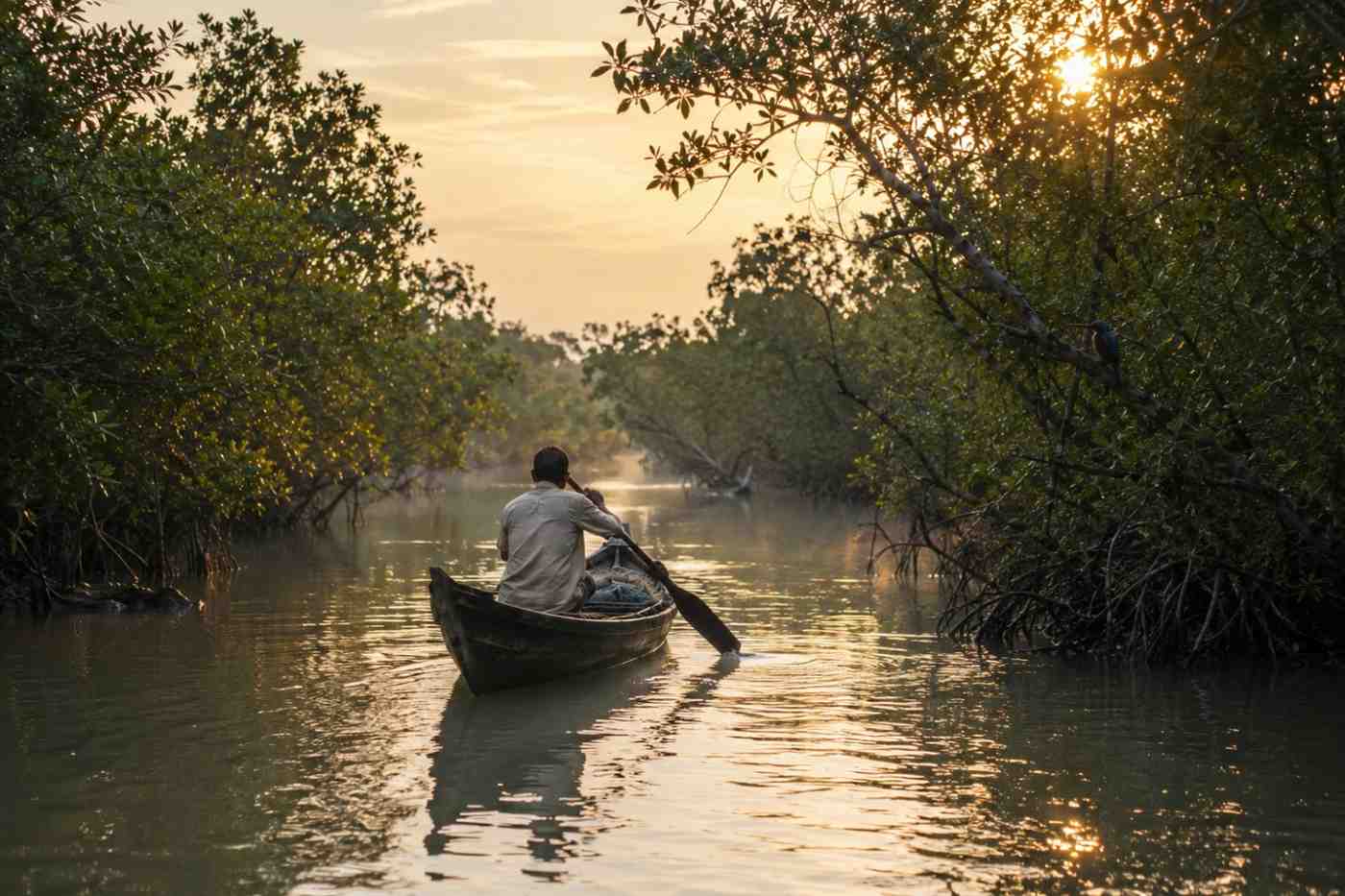
At dawn in the Sundarbans, the boundary between land and water is never still. A fisher pushes a narrow boat into a creek. A woman checks a honey basket before the heat rises. A child walks along an embankment that may have to face the next cyclone. Around them stand trees that look almost impossible: trunks in salt water, roots rising out of mud, leaves shining above a tide that comes and goes twice a day. These are mangroves, and for millions of coastal people they are not scenery. They are security.
July 26 is observed as the International Day for the Conservation of the Mangrove Ecosystem, commonly called World Mangrove Day. UNESCO established the day in 2015 to bring attention to an ecosystem that is rare, productive and deeply vulnerable. Mangroves receive less public affection than mountains, rainforests or charismatic wildlife because much of their life is hidden in muddy creeks and waterlogged soil. Yet their work is visible every time they slow a wave, hold a riverbank, shelter a young fish or protect a village before the first rescue team arrives.
This day matters because mangroves are disappearing under pressure from aquaculture, urban growth, ports, roads, pollution, dams and rising seas. It also matters because a ceremonial plantation photograph can create the false belief that the problem has been solved. A mangrove is not simply a sapling placed in wet soil. It is a complete relationship among tides, freshwater, sediment, salinity, wildlife and people. World Mangrove Day should therefore be a yearly public audit: Are existing forests safe? Are newly planted trees surviving? Are tidal channels open? Are local communities gaining rights and livelihoods? Are development projects treating mangroves as living infrastructure rather than vacant land?
A mangrove is not just a tree in mud. It is a coastal safety system built by nature. |
A Forest Built for Salt, Mud and Survival
Mangroves are groups of salt-tolerant trees, shrubs and palms that grow in the intertidal zone, the strip of coast covered at high tide and exposed at low tide. They are found around estuaries, deltas, lagoons, creeks and sheltered tropical or subtropical shores. Ordinary plants struggle in salty, waterlogged and oxygen-poor soil. Mangroves have evolved remarkable ways to live there. Some block salt at the roots. Some remove salt through their leaves. Some send pencil-like breathing roots, called pneumatophores, above the mud to take in air. Others grow arching prop roots that act like stilts, steadying the tree while slowing water and trapping sediment.
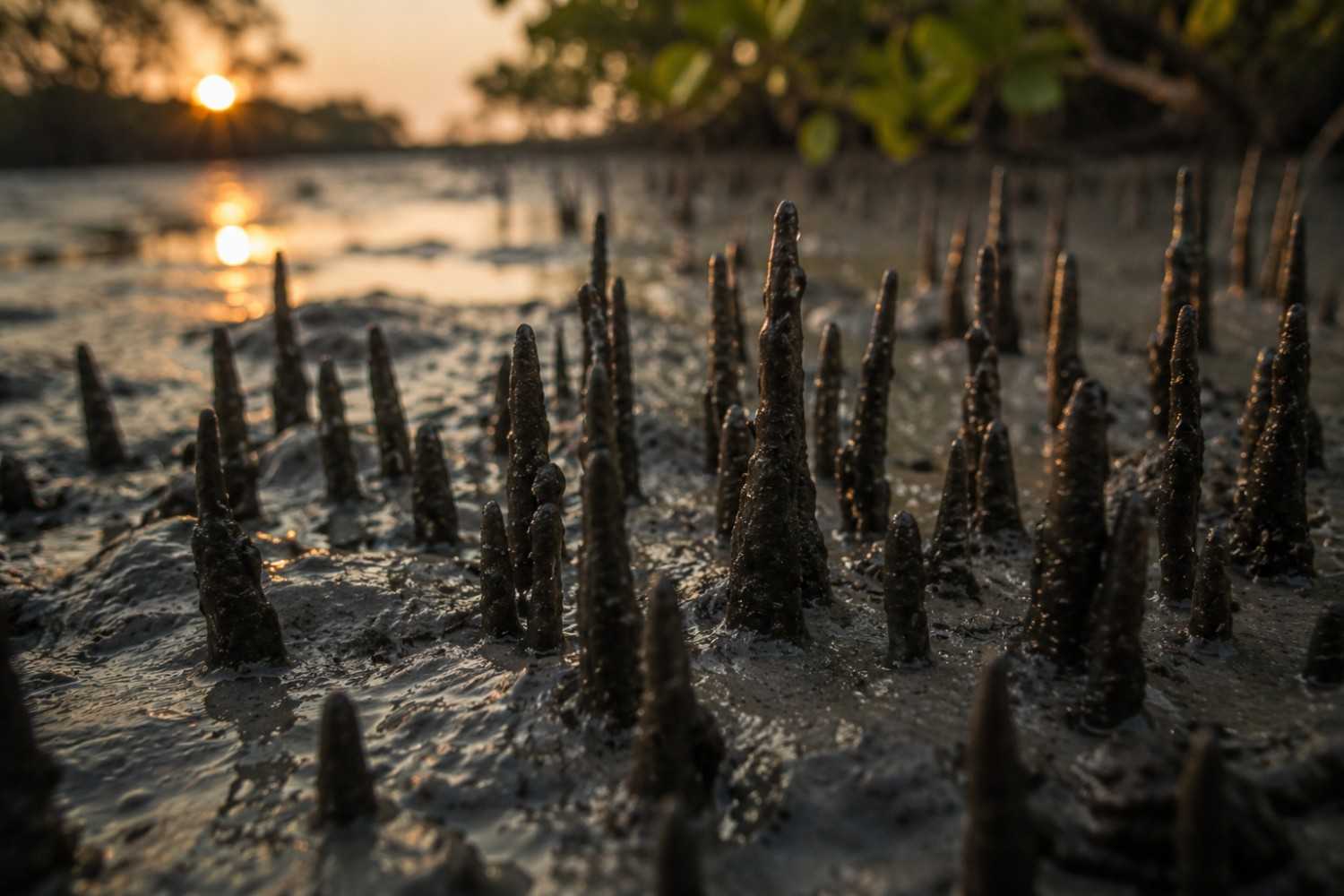
They are not one type of tree. Roughly 80 recognised mangrove tree and shrub species occupy different levels of the tidal landscape. One may tolerate stronger salinity near open water; another may need more freshwater and grow farther inland. This zonation is why a natural mangrove forest looks irregular and layered. It is also why a row of identical saplings cannot automatically replace a mature forest. Diversity is not decoration. It is the system's insurance against disease, salinity change, storms and other shocks.
A Rare Green Belt Around the World - and Bengal's Great Share
The world's mangroves covered about 14.8 million hectares in 2020 and occurred in 123 countries and territories. Nearly 44 per cent lay in South and Southeast Asia. Indonesia holds the largest area, while Brazil, Nigeria, Mexico and Australia are also major mangrove countries. Together, the five account for almost half of the global resource. Large mangrove landscapes also survive along the Amazon and Atlantic coasts of South America, the Niger Delta and West Africa, northern Australia, Papua New Guinea, the Caribbean and the coasts of South Asia.
Globally, mangroves are extensive enough to sustain fisheries and coastal settlements, but rare when compared with other forests. They cover less than one per cent of the world's tropical forest area. FAO estimates show a net global decline of about 284,000 hectares between 2000 and 2020. The rate of loss slowed in the second decade, which proves that protection can work, but the total pressure remains severe. The first global IUCN assessment found that half of assessed mangrove ecosystems are at risk of collapse and nearly one-fifth are at high risk.
India has around 5000 square kilometres of mangrove cover, according to the India State of Forest Report 2023. This is only 0.15 per cent of the country's geographical area, yet it performs a disproportionately large role in food security, disaster protection and biodiversity. The main regions are the Sundarbans in West Bengal; the Gulf of Kutch and Gulf of Khambhat in Gujarat; the Andaman and Nicobar Islands; the Krishna and Godavari deltas; Bhitarkanika and the Mahanadi delta; Pichavaram and Muthupet; and the mangrove belts around Mumbai, Thane, Raigad and Ratnagiri.
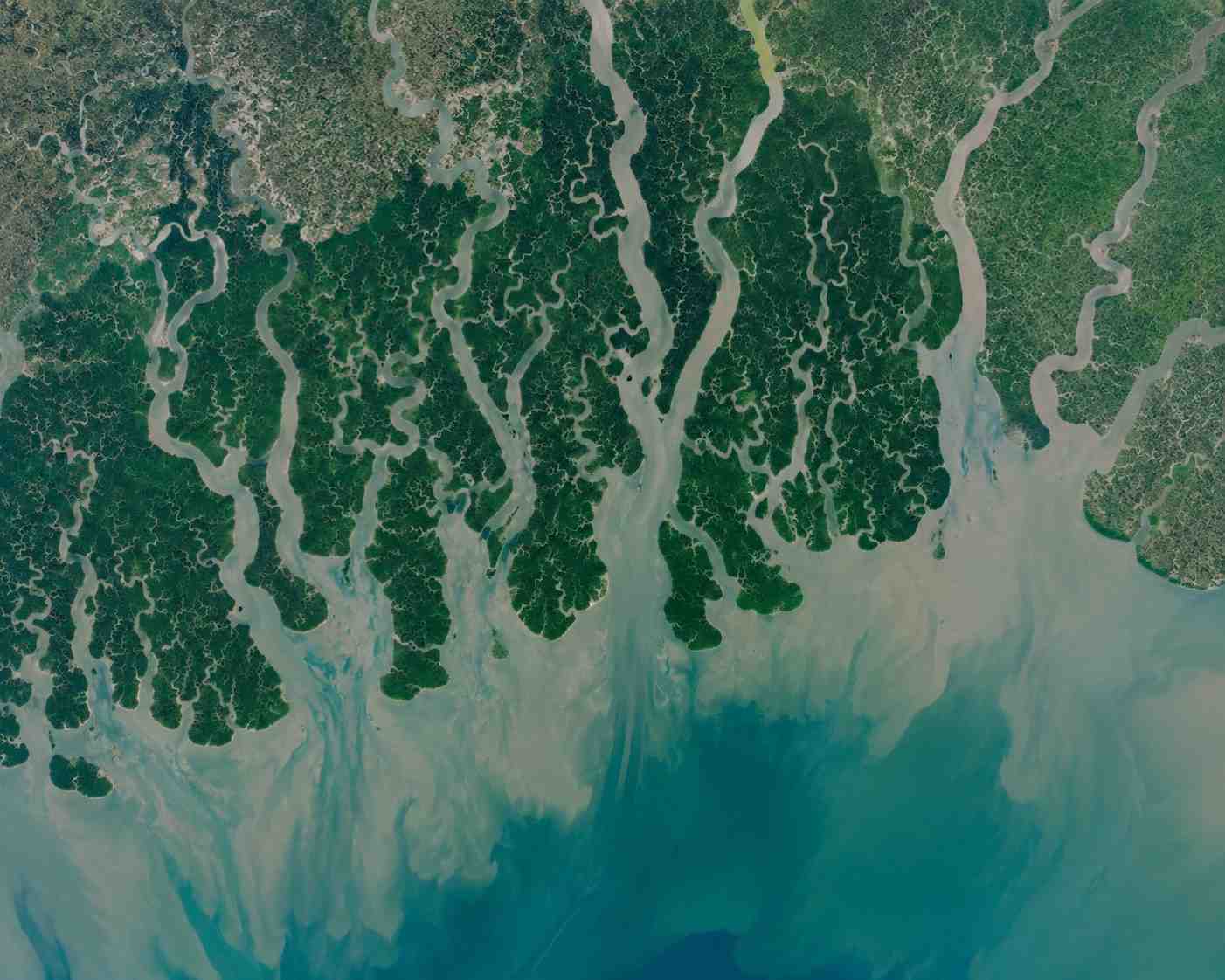
West Bengal is India's mangrove capital. Its 2,119.16 square kilometres amount to more than two-fifths of the national total. Almost all of this lies in the southern coastal districts, especially South 24 Parganas. The Sundarbans, shared by India and Bangladesh, is the world's largest mangrove forest and a vast living maze created by the Ganga, Brahmaputra and Meghna river systems. It is a tiger habitat, a fish nursery, a cyclone buffer and a human landscape of islands, farms, embankments, boats and villages. The future of the Sundarbans is therefore tied not only to remote island communities but also to the safety of Kolkata and the wider Bengal delta.
Mangroves Grow When Water Is Allowed to Move
Mangroves are hardy, but they cannot be planted anywhere that looks muddy. They grow best in warm, frost-free weather, usually in sheltered tropical and subtropical waters where waves are not continuously violent. They need regular tides that carry water, nutrients, seeds and fine sediment. They need the right balance of salt and fresh water. They need soft soil at the correct height in relation to the tide. Above all, they need a functioning water system.
There is no single best month for every Indian coastline. The monsoon and post-monsoon season may provide useful moisture and seed availability in many places, but local tides, rainfall, elevation and species matter more than the date on a plantation calendar. A sapling placed too low may drown or be washed away. One placed too high may not receive enough tidal water. A species suited to a saline outer creek may fail in a freshwater-influenced inner zone, and vice versa.
The most important human intervention is often not planting but ecological repair. Illegal pond walls may need to be breached so tides return. Blocked creeks may need to be reopened. Dams, barrages and excessive withdrawal upstream must be managed so freshwater and sediment can still reach deltas. Grazing, dumping, cutting and trampling must be controlled. Native species must be matched to the exact site. Once the hydrology is restored, floating seeds and propagules can settle naturally, creating a more diverse and resilient forest than a hurried monoculture plantation.
Mangroves also need space to move inland as sea level rises. Where roads, walls, industries or settlements block that movement, the forest becomes trapped between development and the advancing sea. Scientists call this coastal squeeze. A serious restoration policy must therefore protect migration space, not only today's tree line.
One Forest, Many Strengths
Different mangroves perform different jobs. Avicennia species are often first settlers on new mud. Their pencil-like breathing roots stabilise soft ground, tolerate considerable salinity and prepare the site for other life. Rhizophora species form dramatic prop-root walls that slow water, trap sediment and create hiding places for young fish, prawns and crabs. Sonneratia commonly grows near channels and estuaries; its roots, flowers, fruit and falling leaves feed a wide aquatic web. Excoecaria agallocha, often called gewa or blind-your-eye mangrove because its sap can irritate the eyes, grows on relatively higher ground and helps bind riverbank soil.
Bengal's signature tree is the Sundari, Heritiera fomes, from which the Sundarbans takes its name. It carries ecological and cultural meaning, but it is globally threatened and sensitive to changing salinity and disease. Nypa fruticans, known locally as golpata in parts of the delta, is a mangrove palm whose leaves have long been used for roofing and thatching; elsewhere in Asia its sap is turned into sugar and vinegar. Bruguiera, Ceriops, Aegiceras, Xylocarpus and Phoenix paludosa add further layers of habitat and protection. In some regions, fruits of Sonneratia and processed products from Avicennia are used as food, while mangrove plants remain subjects of research for antioxidant, antimicrobial and other medicinal properties. Such uses should be scientifically tested and harvested within ecological limits.
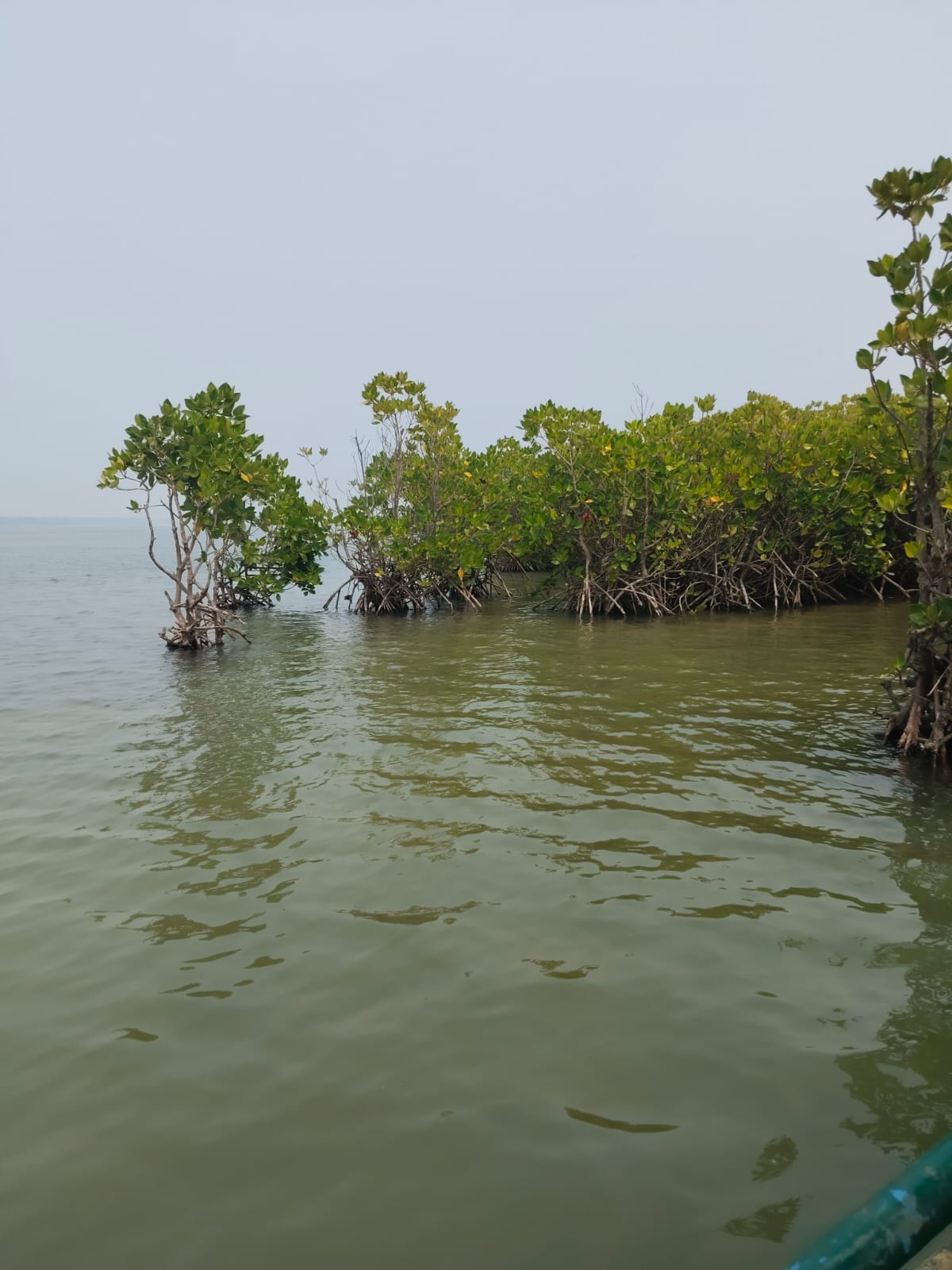
Together, these species create a living wall. The outer roots take the first force of waves. The forest slows currents. The roots hold soil. Sediment settles. Floodwater spreads with less destructive energy. Mangroves cannot stop every cyclone and should not be presented as a magical substitute for embankments, shelters, warning systems or evacuation plans. But a broad, healthy mangrove belt combined with well-designed infrastructure is often safer and more economical than concrete alone.
The forest is also a fish factory. Juvenile fish and shellfish shelter among the roots, feed on leaf litter and later move into rivers and the sea. Birds nest and feed there. Crocodiles, turtles, dolphins, fishing cats, insects and countless smaller organisms depend on the connected landscape. For people, the same forest supports fishing, crab collection, honey and beeswax, leaves, crafts, nature guiding and tourism. The commercial benefit begins with the simple fact that a living mangrove keeps producing value year after year.
The Crisis Is Not Only Cutting - It Is Bad Restoration
The old image of mangrove destruction is a chainsaw. Today's crisis is more complicated. Forests are cleared or enclosed for shrimp ponds, salt pans, ports, roads, tourism and real estate. Urban sewage, plastic, industrial chemicals and oil choke roots and poison the food web. Dams and river engineering reduce freshwater and sediment, raising salinity and weakening the delta. Climate change adds higher seas, stronger storm impacts, erosion and changing rainfall.
The second crisis is restoration that looks successful on paper but fails in the mud. Authorities may announce lakhs of planted seedlings without reporting how many remain alive after three or five years. Easy-to-grow Avicennia may be planted in straight rows everywhere, even where another species or natural mudflat should remain. Saplings may be pushed into deep water, exposed shorelines, seagrass beds or sites cut off from tides. Some projects protect the planting for a photograph but not from grazing, waves, garbage or later encroachment.
A larger green patch on a satellite image does not necessarily mean a healthier ecosystem. The patch may be a young single-species block with little fish or bird life. It may have poor water exchange or weak soil. Real success must be judged through survival, natural regeneration, species diversity, tidal flow, sediment condition, fisheries recovery, carbon accumulation and benefits to local people. The first rule should be to protect mature forests, because an old, diverse mangrove and its deep soil carbon cannot be recreated quickly by planting new saplings elsewhere.
Plantation numbers are easy to announce. A living, diverse forest is much harder to create. |
Blue Carbon - The Wealth Hidden Under the Mud
Mangroves absorb carbon dioxide while growing. Some carbon remains in trunks, branches, leaves and roots, but a very large share enters waterlogged, oxygen-poor soil where decomposition is slow. Carbon held in coastal ecosystems such as mangroves, seagrasses and salt marshes is called blue carbon. UNEP reports a global average mangrove carbon stock of around 1,000 tonnes of carbon per hectare, including soil, though the real figure varies greatly by location, age, depth and ecology. Per unit area, mangroves can hold several times more carbon than many land forests, with much of it safely buried below ground.
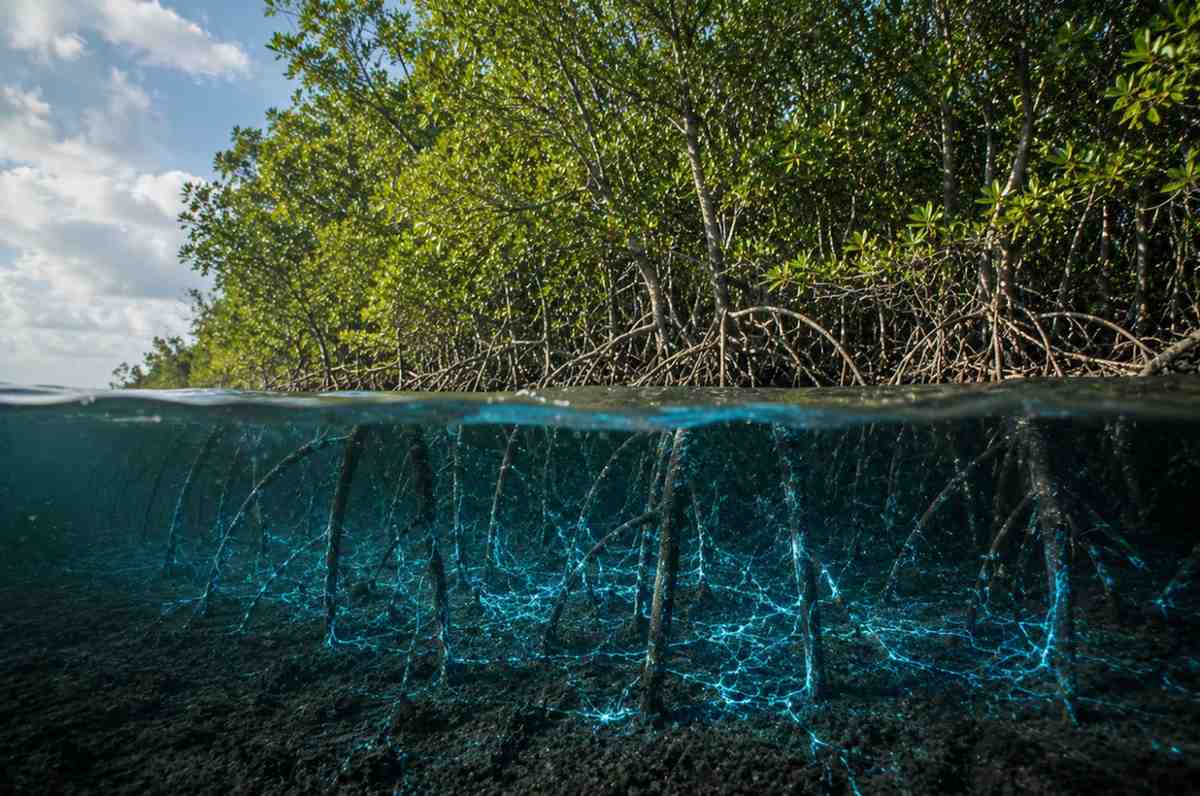
Two ideas are often confused. Carbon stock is the carbon already stored in an existing forest and its soil. Carbon sequestration is the additional carbon captured over time. Protecting an old mangrove saves a huge existing stock and prevents emissions from damaged or drained soil. Restoring a degraded site may gradually add new carbon, but it does not instantly replace what was lost.
Mangrove carbon farming means protecting, restoring or scientifically expanding mangroves in ways that increase storage or avoid emissions. A credible project must prove that the climate benefit is real and additional, meaning it would not have happened without the project. It must measure carbon through field plots, tree data, soil sampling and remote sensing. It must show permanence, prevent destruction from merely shifting elsewhere, avoid double counting and explain what happens if a cyclone damages the forest. Accounting may also need to consider methane and nitrous oxide, especially where water flow has been badly altered.
This is why blue-carbon credits are an opportunity, not free money. Measurement, reporting and verification take years. Land and carbon rights must be clear. Independent checks cost money. Carbon prices change. Claims can be exaggerated, and companies can use cheap credits as a public-relations shield while avoiding deeper cuts in their own emissions. Carbon finance should support genuine climate action, not become a licence to pollute.
A Mangrove Economy Must Reward the People Who Keep It Alive
The commercial value of mangroves is much wider than carbon credits. They support fish, prawns, crabs and shellfish; protect houses, farms, roads and businesses; reduce erosion and embankment repair; improve water quality; sustain honey, wax and plant products; and create work in nurseries, monitoring, guiding, kayaking, wildlife tourism and research. Some insurers and coastal investors are beginning to see mangroves as natural infrastructure because reducing storm and flood damage also reduces financial risk.
A World Bank study in Indonesia estimated that the combined services of mangroves average about USD 15,000 per hectare per year, with some locations approaching USD 50,000. These figures cannot be copied directly into an Indian project, because population, fisheries, land value and storm exposure differ. But they show why the standing forest may be worth far more than the one-time profit from clearing it.
West Bengal's experience with sustainable aquaculture offers another path. Models such as Sustainable Aquaculture in Mangrove Ecosystems, or SAIME, try to combine fish and shrimp production with the restoration of mangrove vegetation rather than creating closed ponds after total clearance. When carefully managed, such systems can improve water quality, reduce disease risk, diversify incomes and sell responsibly produced seafood at a better price.
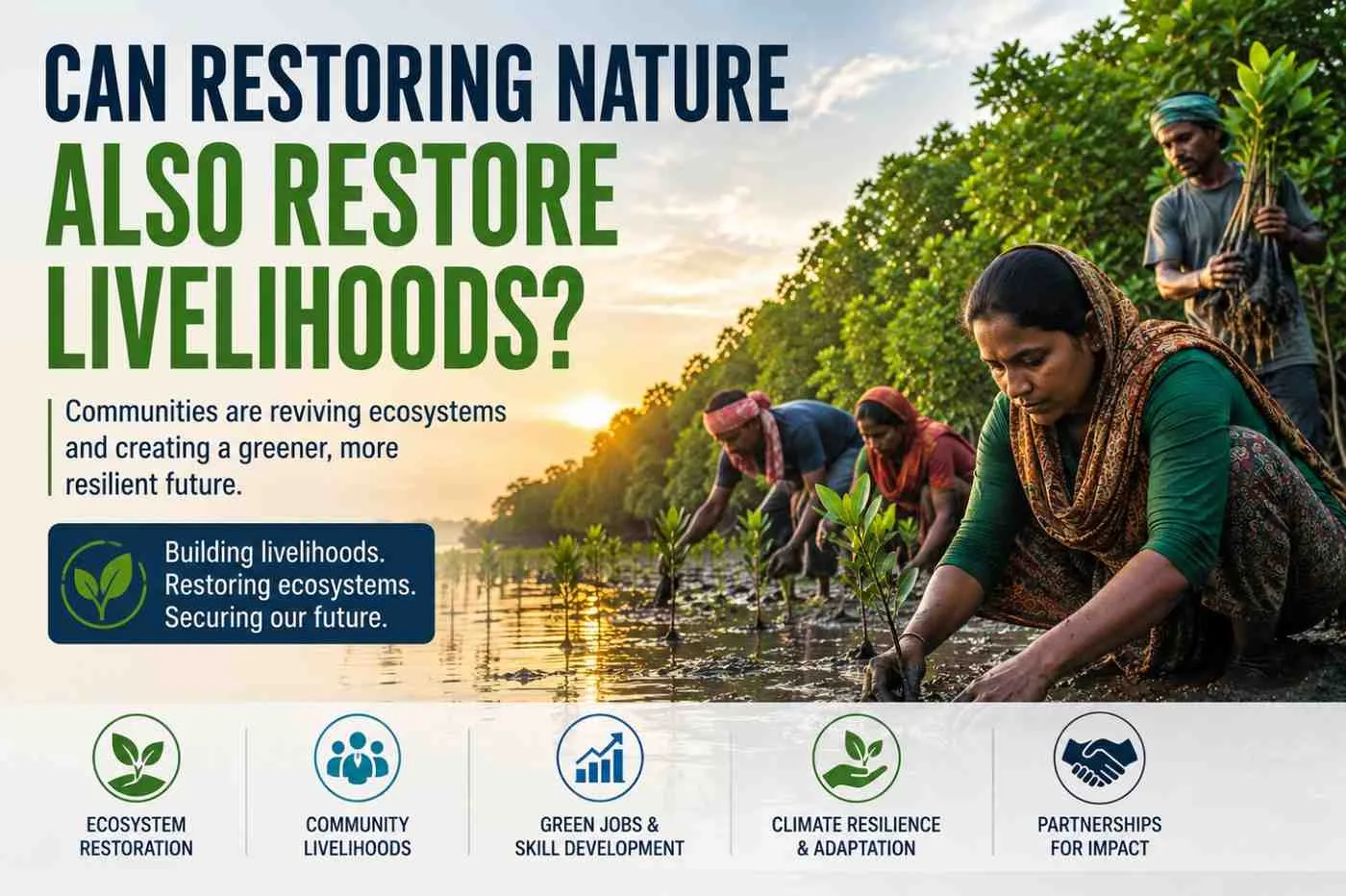
Carbon revenue can help pay for nurseries, community guards, scientific monitoring, cyclone preparedness, women's self-help groups and alternative livelihoods. Yet a project becomes unjust when outside developers own the contracts while fishers, honey collectors and island residents do the work and lose access to the forest. Every agreement should openly state who owns the carbon rights, who receives the money, who carries the risk, how long protection will continue and how customary access will be respected. The best mangrove economy is not based on fencing people out. It is based on keeping the forest alive while rewarding those who protect it.
The greatest commercial benefit of mangroves is a coast that remains alive, productive and safe. |
From a Government Scheme to a People's Movement
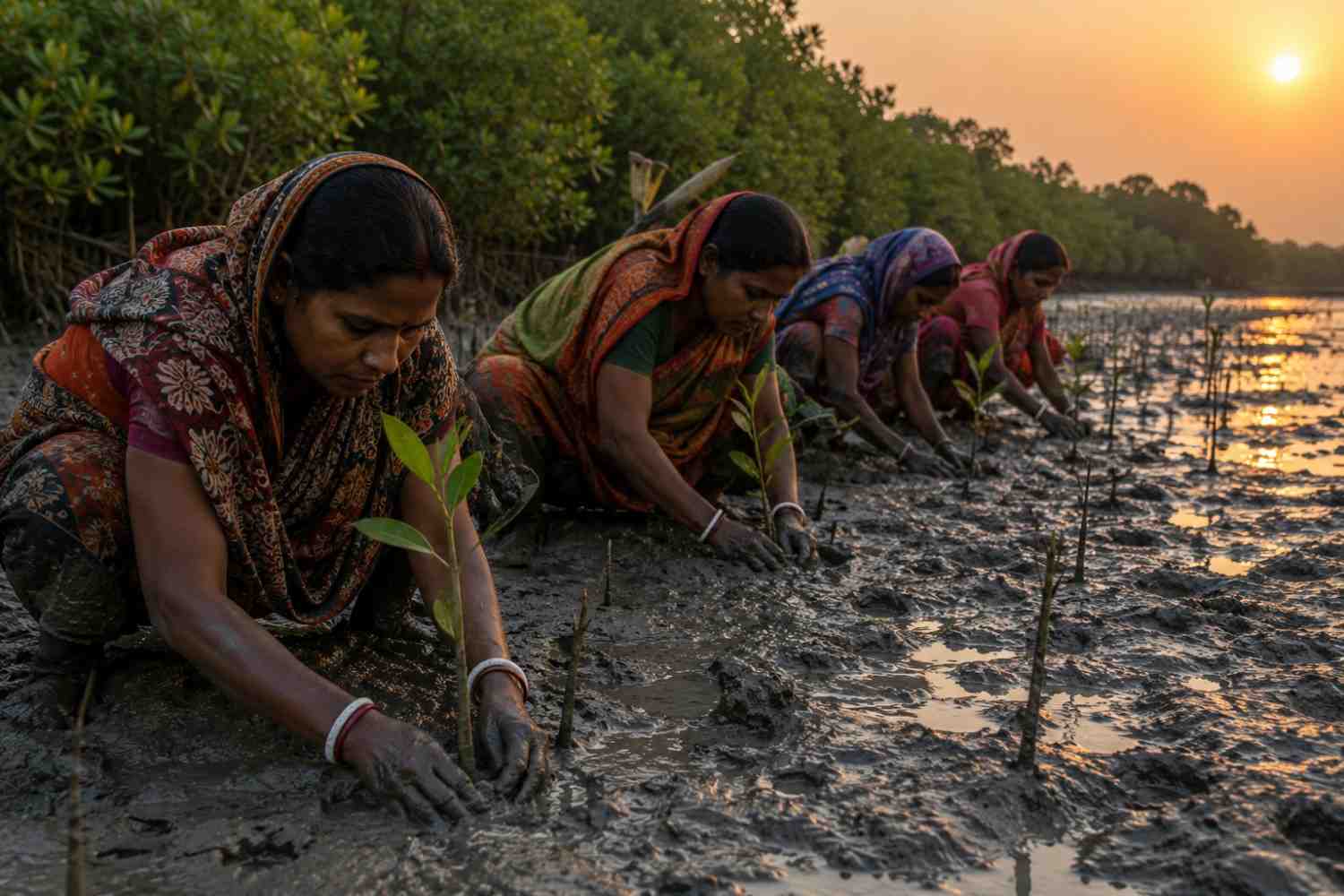
India has a policy foundation for action. The Mangrove Initiative for Shoreline Habitats and Tangible Incomes, or MISHTI, was launched on June 5, 2023. Government reporting stated that 22,560.34 hectares of degraded mangrove area had been taken up through convergence across 13 States and Union Territories by August 2025, while additional work received gap funding through National CAMPA. Reporting for 2025 cited 4,536 hectares brought under restoration during that year, and in June 2026 the Union environment minister referred to a national target of restoring 54,000 hectares by 2028.
The Coastal Regulation Zone Notification of 2019 classifies mangroves as ecologically sensitive areas and provides a 50-metre buffer where mangrove cover exceeds 1,000 square metres. Where development affects mangroves, compensatory planting at three times the number lost is required. But the ecological lesson is important: three saplings are not the same as one mature tree, and a planted patch is not the same as an old tidal forest. Regulation must prevent destruction first, not merely promise replacement later.
For mangroves to become a national environment movement, they must connect causes that are often kept separate: climate action and disaster protection, river health and coastal security, fisher rights and biodiversity, women's livelihoods and community leadership, city planning and wetland protection, science and traditional knowledge. Mumbai, Kolkata, Chennai, Kochi, Visakhapatnam, Surat and other coastal cities depend on healthy creeks and buffers even when citizens rarely see the connection.
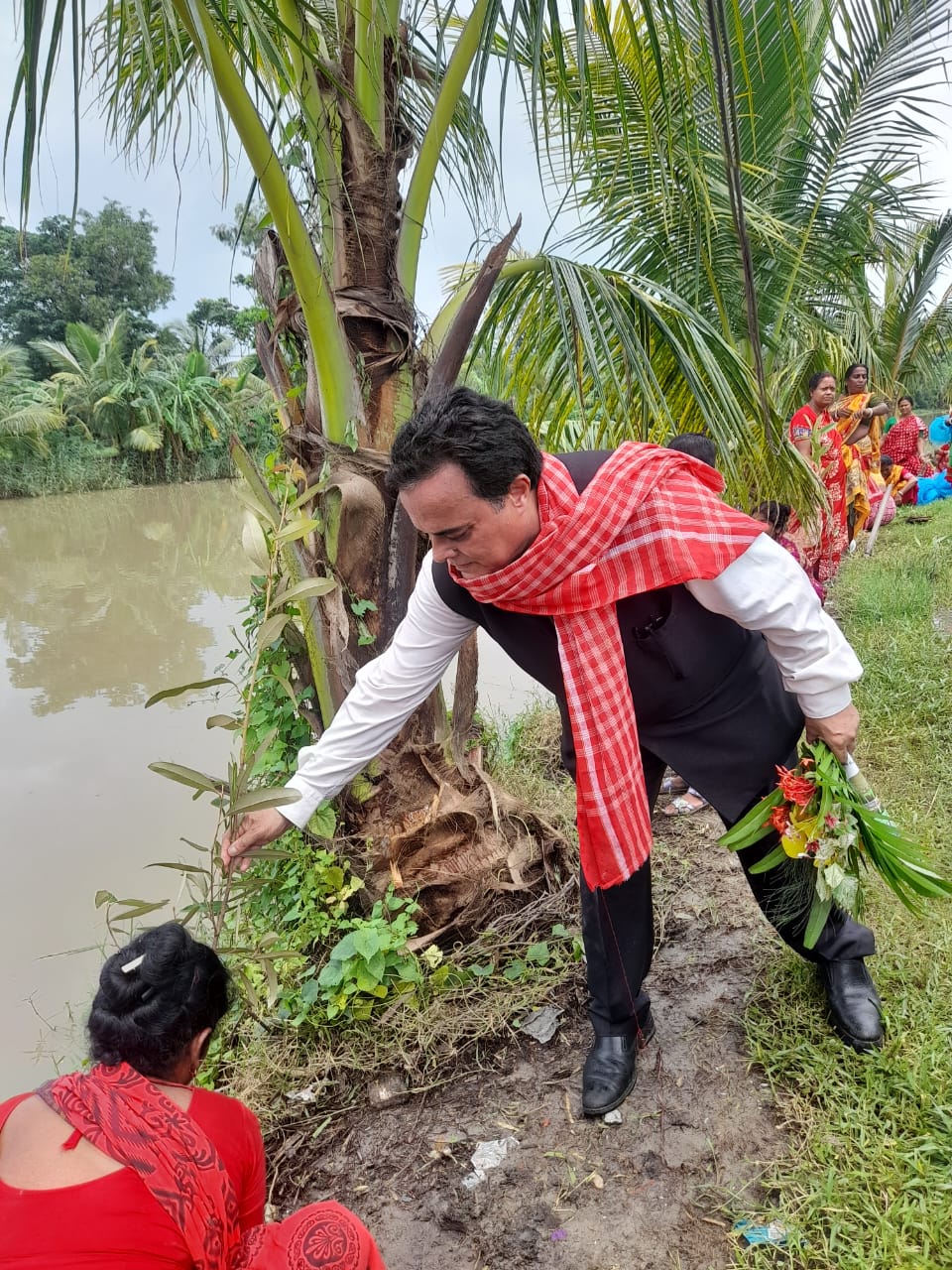
The movement needs public survival audits for every funded plantation, with locations, species, spending and three-to-five-year results placed online. It needs mangrove clubs in schools and colleges, community nurseries run by women's groups, citizen mapping of blocked creeks and pollution, and green-grey engineering that combines natural buffers with appropriate embankments. Most importantly, fishers, farmers, honey collectors and island residents must sit at the planning table and receive a fair share of benefits. Conservation becomes durable when local people are not treated as threats but as partners and knowledge holders.
Mangrove warriors like teachers Uma Shankar Mandal and Ramkrishna Sarkar of the Sundarban area have taken up this battle with the help of local women, creating mangrove armies of women, planting trees, taking care of them, and getting small support in kind for the women from the society at large. Their valiant work has created areas with more than half a million mangrove trees in various blocs of Sundarban.
What One Citizen Can Do - Even Far From the Sea
A person living hundreds of kilometres inland still sends waste towards the coast through drains and rivers. Reducing single-use plastic and chemical pollution is therefore mangrove action. So is asking where prawns and shrimp come from, because destructive aquaculture remains a major driver of clearing. Travellers can choose community homestays, local guides and responsible boat operators rather than tourism that disturbs wildlife or dumps waste.
People who donate to plantation campaigns should ask harder questions. Was the site historically a mangrove area? Is tidal water reaching it? Are native species being used? Are local residents involved? Who will protect the saplings for at least three to five years? Is the project restoring a forest or merely counting trees? Random planting is not helpful; scientific, community-based ecological restoration is.
Citizens can photograph and report illegal dumping, burning, creek blockage, land filling and cutting. Students can adopt a creek, document birds and crabs, measure plantation survival, interview coastal residents and create local-language awareness material. Consumers can support legally and sustainably produced honey, handicrafts and seafood. Social media users can make mangroves visible not only on July 26 but whenever a port, road, resort or real-estate project threatens a tidal ecosystem.
The message of World Mangrove Day is finally very simple. A mangrove is a storm barrier, fish nursery, carbon vault, wildlife home, water filter and source of work. It protects a village before a rescue vehicle arrives and supports a fishing family without appearing in a conventional balance sheet. We should not merely plant a mangrove. We must protect the water, soil, wildlife and people that allow an entire mangrove forest to live.
Research and Source Note
This feature fully synthesises the attached background document and cross-checks time-sensitive figures against official or primary institutional sources available up to July 2026. The economic values cited from Indonesia illustrate the scale of ecosystem services and should not be transferred directly to Indian sites without local valuation.
UNESCO - International Day for the Conservation of the Mangrove Ecosystem - Open official source
FAO - The World's Mangroves 2000-2020 and global distribution data - Open official source
IUCN - Red List of Mangrove Ecosystems global assessment - Open official source
Forest Survey of India - India State of Forest Report 2023 - Open official source
Press Information Bureau - Mangrove conservation and ISFR 2023 state-wise cover - Open official source
Press Information Bureau - MISHTI implementation across States and Union Territories - Open official source
UNEP - Mangrove forests and blue-carbon stocks - Open official source
IPCC AR6 Working Group III - Reducing conversion of coastal wetlands - Open official source
World Bank - Economics of large-scale mangrove conservation and restoration in Indonesia - Open official source


Add a Comment