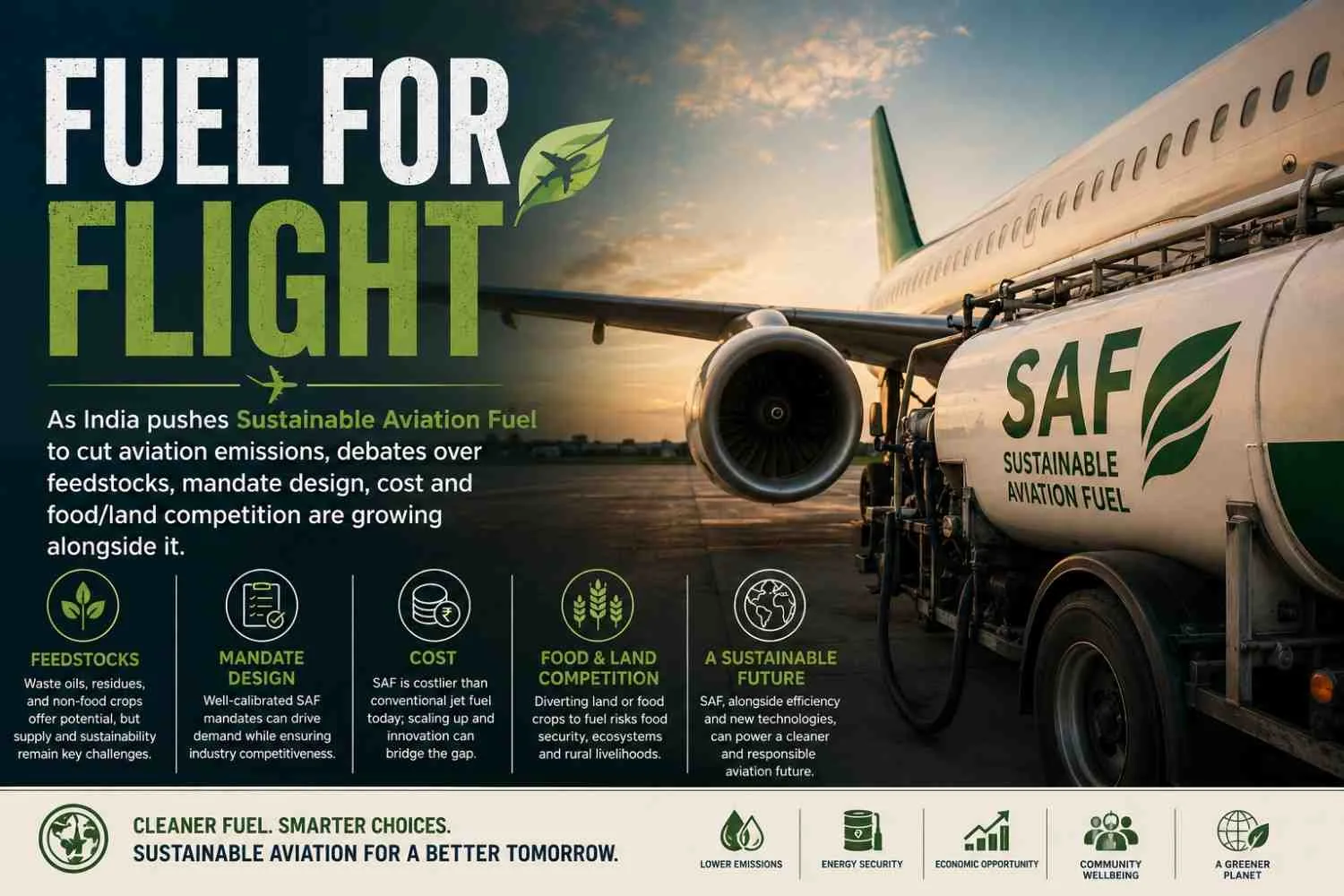
As India pushes sustainable aviation fuel to cut aviation emissions, questions over feedstocks, costs and competition for land and food are beginning to shape the debate
Kolkata| August 1, 2026:
The future of aviation may depend not only on how aircraft are designed, but also on what powers them.
Today, aviation contributes around 2–3% of global carbon dioxide emissions, and unlike road transport, long-distance flights still have limited alternatives to conventional liquid fuels.
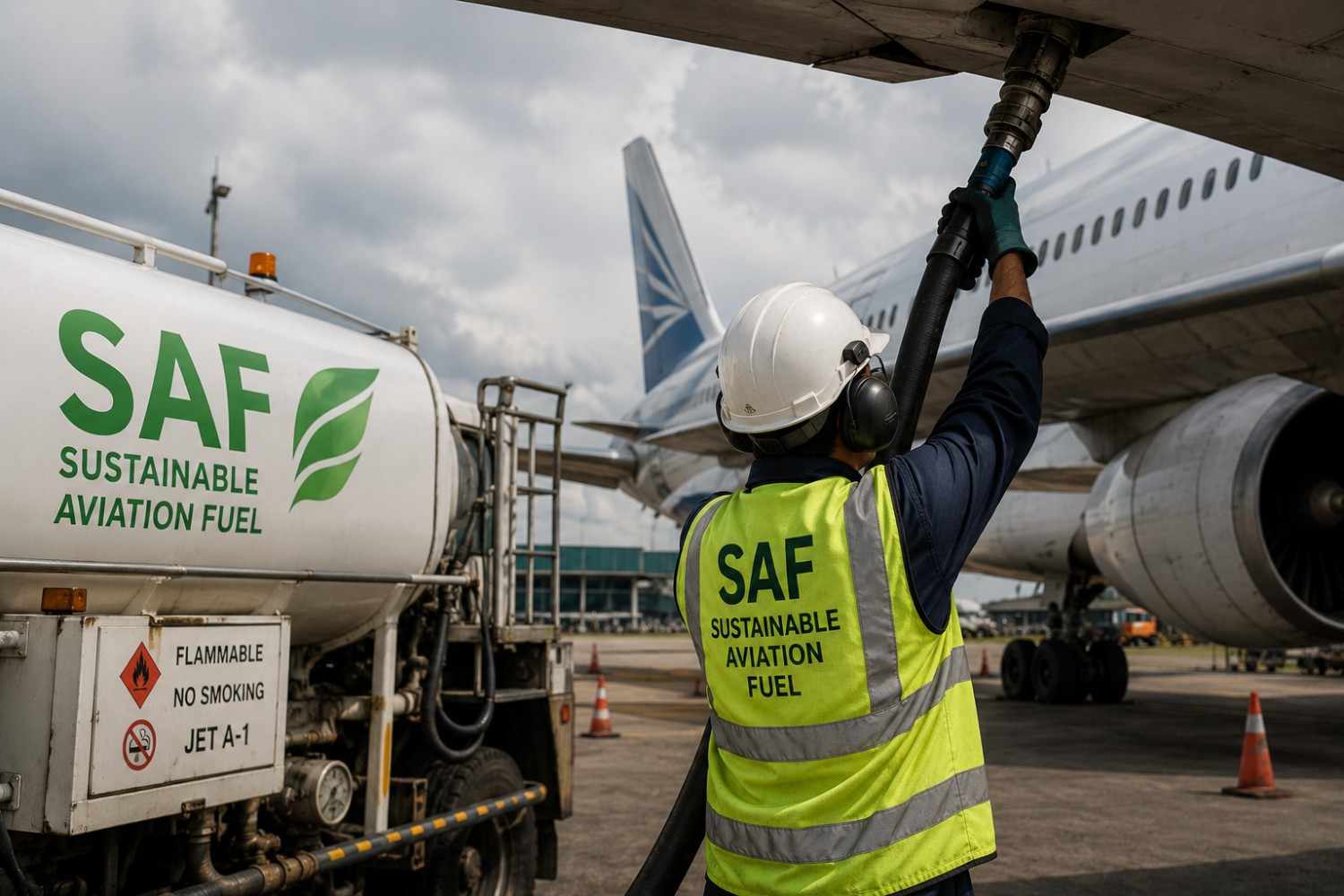
As governments and airlines look for ways to reduce emissions without disrupting air travel, Sustainable Aviation Fuel (SAF) has emerged as one of the sector's most promising solutions.
For India, adopting Sustainable Aviation Fuel is not simply a question of replacing one fuel with another. It requires balancing climate ambitions with economic viability, feedstock availability and long-term sustainability.
SAF is produced from renewable or waste-based feedstocks instead of conventional crude oil.
Depending on the production pathway, it can substantially reduce lifecycle greenhouse gas emissions while remaining compatible with existing aircraft engines and airport infrastructure.
Its compatibility with existing aircraft engines and airport infrastructure makes SAF one of the most practical and scalable solutions for reducing aviation emissions.
India is gradually bringing Sustainable Aviation Fuel into the centre of its clean energy and climate strategy.
Government agencies, airlines, oil marketing companies and research institutions are working to expand domestic production, support pilot projects and prepare for future blending mandates.
Beyond reducing aviation emissions, these efforts are intended to strengthen energy security and help India secure a place in the emerging global SAF market.
The real challenge, however, extends beyond policy ambition. It lies in ensuring a sustainable and reliable supply of feedstock that can support production on a commercial scale.
Experts point to agricultural residues, used cooking oil, municipal solid waste, forestry waste and certain non-food energy crops as the most promising sources for Sustainable Aviation Fuel.
Unlike food-based feedstocks, these resources can help reduce emissions without affecting food security.
The challenge, however, lies in building efficient supply chains, as collecting, transporting and processing these materials remains expensive and operationally complex.
The conversation becomes far more complex when cleaner fuel begins to compete with food and land resources.
Using edible oils, sugar crops or fertile agricultural land as feedstocks could place additional strain on food prices, water availability and rural livelihoods.
Environmental experts also warn that clearing forests or natural ecosystems to cultivate energy crops may erode many of the climate gains that Sustainable Aviation Fuel seeks to achieve.
As a result, the real challenge is not simply producing cleaner aviation fuel- it is ensuring that the path to cleaner aviation does not create new environmental or social pressures along the way.
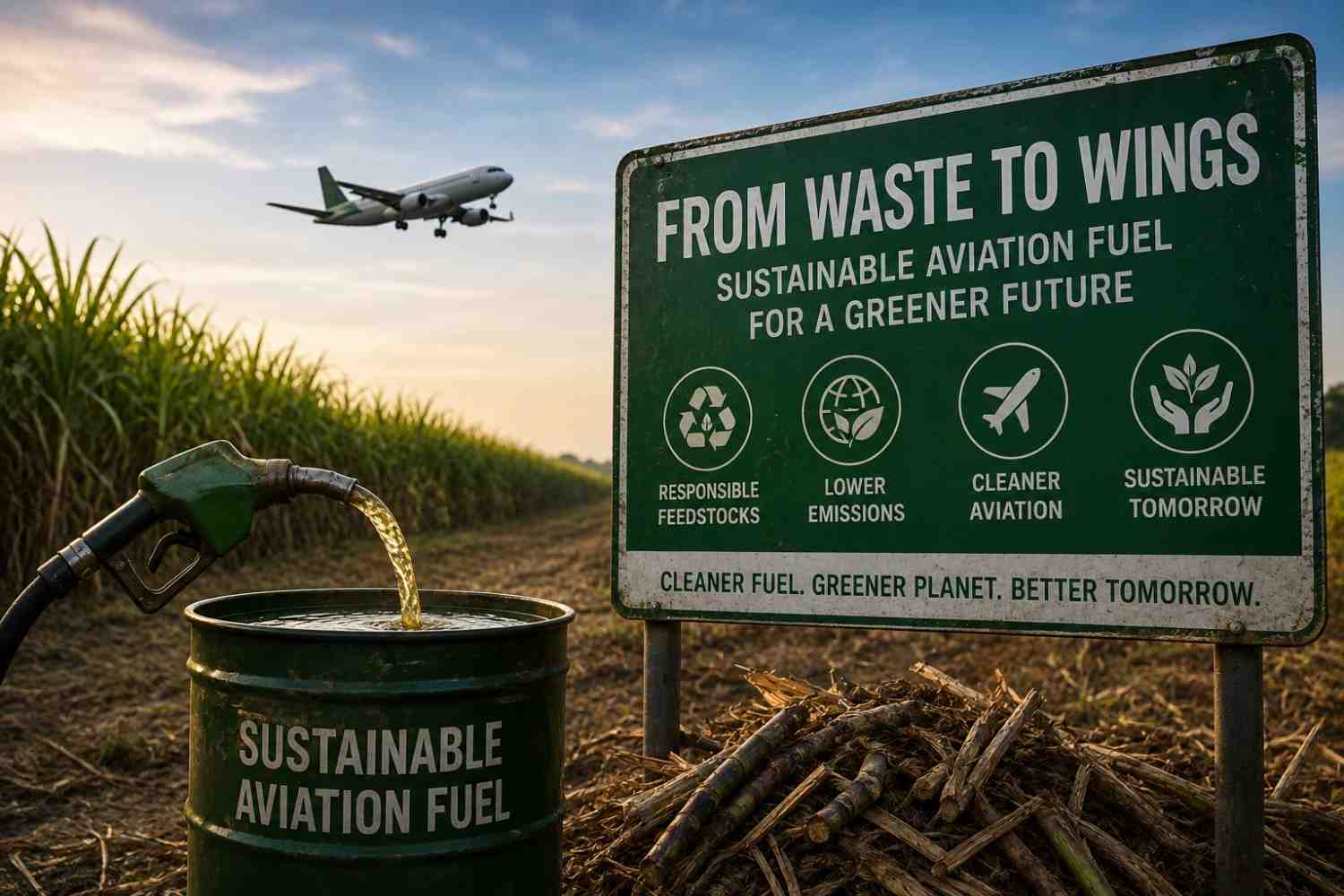
Cost remains one of the biggest hurdles for Sustainable Aviation Fuel.
Production volumes are still limited, supply chains are yet to mature and, as a result, SAF continues to cost significantly more than conventional jet fuel.
For airlines already operating in a highly competitive market with narrow profit margins, absorbing these additional costs will not be easy without targeted policy support and market incentives.
That is why the design of future blending mandates could determine how quickly SAF moves from ambition to widespread adoption.
Rather than imposing immediate large-scale adoption, many countries are introducing phased blending mandates that gradually expand the use of Sustainable Aviation Fuel while supporting domestic production and maintaining industry competitiveness.
Experts argue that India will need a similar approach—one that balances climate commitments with commercial realities and gives producers, refiners and airlines the certainty and time needed to expand investments, production capacity and supporting infrastructure.
Despite these challenges, experts emphasise that Sustainable Aviation Fuel is only one part of the solution.
Reducing aviation emissions will also depend on more fuel-efficient aircraft, improved air traffic management, operational efficiencies and the development of future technologies such as hydrogen-powered aircraft.
The future of aviation decarbonisation won’t rest on SAF alone. It will sit alongside efficiency, new aircraft, and operational changes.
For India, Sustainable Aviation Fuel represents more than an alternative fuel- it offers an opportunity to reshape the future of cleaner aviation.
A successful SAF ecosystem could create economic value from agricultural waste, strengthen energy security, encourage innovation and help the country move closer to its climate commitments.
But lasting success will depend on ensuring that the transition protects food security, safeguards ecosystems and supports the communities that depend on them.
The future of aviation will not be judged only by how much it reduces emissions, but by how responsibly it achieves that transition. Because sustainable flight truly begins long before it’s take-off - with fuel that is as sustainable in its production as it is in its purpose.
Sources:
- International Civil Aviation Organization (ICAO) – SAF Feedstocks (CORSIA Framework)
https://www.icao.int/CORSIA/feedstocks - International Civil Aviation Organization (ICAO) – Guidance on Policy Measures for SAF Development and Deployment
https://www.icao.int/SAF/saf-guidance-policy-measures - International Civil Aviation Organization (ICAO) – SAF Rules of Thumb (Feedstocks, Costs & Production Pathways)
https://www.icao.int/SAF/saf-rules-of-thumb - ICAO ACT-SAF Programme – India Sustainable Aviation Fuel Feasibility Study
https://www.icao.int/sites/default/files/environmental-protection/Documents/ACT-SAF/Feasibility_Study_India.pdf - International Air Transport Association (IATA) – Global Feedstock Assessment for SAF Production Outlook to 2050
https://www.iata.org/globalassets/iata/publications/sustainability/global-feedstock-assessment-for-saf-production-outlook-to-2050.pdf - Ministry of Petroleum and Natural Gas (Government of India) – Biofuels and Sustainable Aviation Fuel policy updates
https://mopng.gov.in/ - Ministry of Civil Aviation (Government of India) – Aviation sustainability initiatives and SAF developments
https://www.civilaviation.gov.in/ - NITI Aayog – Reports on biofuels, energy transition and low-carbon transport
https://www.niti.gov.in/ - International Energy Agency (IEA) – Aviation and Sustainable Fuels
https://www.iea.org/ - Down To Earth – Coverage on SAF, biofuels, feedstock availability and food-versus-fuel concerns in India
https://www.downtoearth.org.in/





Add a Comment