Why Disability Inclusion Must Become India Inc.’s Next Boardroom ESG KPI
A ramp, a recruitment drive or an annual award cannot prove inclusion. The real test is whether employees with disabilities are hired, paid fairly, retained, promoted, protected during climate shocks, and able to secure benefits and remedies without fighting the system.
BY PROF. UJJWAL K. CHOWDHURY | MAGAZINE FEATURE | INDIA, AUGUST 2026
“Inclusion should not be viewed as charity.” — Rajesh Aggarwal, at the launch of the CII Award for Excellence in Disability Inclusion, December 20241 |
|---|
Accessibility is no longer a feel-good CSR initiative. It is a test of governance maturity, workforce quality, digital competence, operational resilience and the integrity of ESG reporting. |
|---|
Short Summary This feature examines CII-style employer awards, physical and digital audits, the hiring-versus-retention gap, disability-inclusive climate resilience, and the implications of ESIC and India’s labour-code transition. Corporate cases are used to test disclosure quality—not to confer unqualified praise. |
Keywords Disability inclusion; workplace accessibility; ESG metrics; BRSR; reasonable accommodation; inclusive employment; digital accessibility; climate resilience; ESIC; labour codes; corporate governance. |
Hashtags #DisabilityInclusion #WorkplaceAccessibility #ESG #SocialSustainability #InclusiveEmployment #BRSR #ClimateJustice #BoardroomKPI #IndiaInc |
EDITORIAL EVIDENCE NOTE
Corporate examples below rely on official releases and public sustainability disclosures. A missing metric is identified as a disclosure gap, not proof of poor performance. Disability headcounts often depend on voluntary self-disclosure and may understate actual prevalence. The evidence standard used throughout is outcomes over intentions.
THE “S” IN ESG HAS A MISSING DENOMINATOR
India’s sustainability vocabulary is fluent in carbon intensity, water positivity, renewable energy and net-zero targets. It remains far less exact about who can enter a workplace, use its systems, build a career and leave with dignity. That imbalance is no longer defensible.
SEBI’s Business Responsibility and Sustainability Reporting framework has created an important starting point. It asks listed companies to disclose employees and workers with disabilities, and it separately seeks information on turnover, wages, welfare benefits, accessibility and grievances. The weakness is that many outcome tables are not disability-disaggregated. A company can report a headcount while investors still cannot see whether those employees are underpaid, concentrated at junior levels, denied benefits or leaving faster than comparable colleagues.5
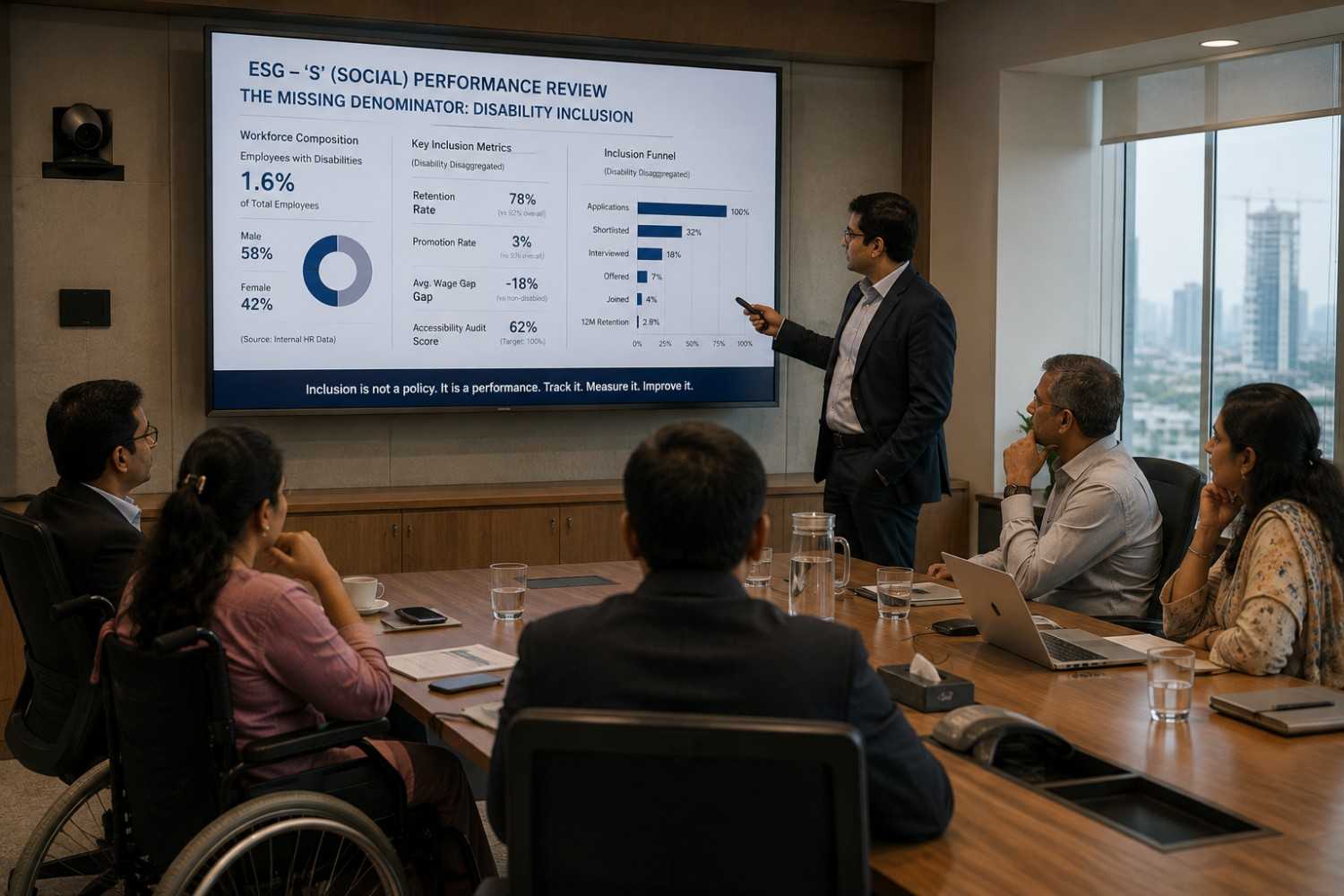
Accessibility must therefore become a boardroom KPI: owned by the board or a designated committee, reviewed quarterly, linked to executive accountability and tested by independent evidence. The central question is not, “Do we have a disability policy?” It is, “At every stage of work, where are people being filtered out—and what did management do about it?”
AWARDS CAN MOVE MARKETS—IF THEY REWARD PROOF
The Confederation of Indian Industry has worked on disability inclusion through employer sensitisation, recruitment support, workplace guidance and the India Business and Disability Network. Its Award for Excellence in Disability Inclusion, launched in December 2024, gives the market something it badly needs: a visible benchmark. The 2026 framework recognises accessibility, disability-inclusive culture, inclusive recruitment and overall “Champion Company” performance, with separate eligibility thresholds for large enterprises and MSMEs.12
Awards matter because reputation affects talent, procurement and investor confidence. But they become ESG instruments only when they reward proof. A credible CII-style award should score workforce denominators; wage and promotion parity; one- and two-year retention; accommodation response times; audit closure; benefit access; disability-inclusive procurement; grievance remedies; emergency preparedness; and actual expenditure against approved budgets.
CASE STUDY Persistent Systems: recognition backed by an audit trail Persistent Systems received the 2026 CII award in the “Best Employer—Physical Accessibility” category. Its public account points to independent audits, an accessibility benchmark at its Pune facility, alignment with India’s Harmonised Guidelines, digital platforms designed toward WCAG standards, and governance ownership. The next step for the awards ecosystem is tougher verification: random site visits, confidential interviews with disabled workers without managers present, public scoring bands and evidence that audit findings were closed—not merely identified. Recognition should open the evidence file, not replace it.10 |
|---|
AUDIT THE EMPLOYEE JOURNEY, NOT JUST THE ENTRANCE
A workplace can have an accessible entrance and still be institutionally inaccessible. A physical audit must follow the full employee journey: transport and parking; security and reception; paths, doors and lifts; tactile and visual signage; workstations and factory floors; meeting rooms, canteens, washrooms and medical rooms; employee housing; and emergency exits.
In industrial settings, the audit must test whether protective equipment, alarms, control panels, evacuation chairs and safety instructions work for people with mobility, visual, hearing, cognitive and neurodivergent needs. Maintenance matters as much as design: a compliant ramp blocked by motorcycles is not accessible.
The digital audit begins before employment. It must test the careers page, application form, applicant-tracking system, online assessment, interview platform and document-upload process. After joining, it should cover HRMS, attendance, payroll, leave, insurance, learning, collaboration, travel booking, procurement, appraisal and grievance portals. Automated scanners can flag technical defects, but they cannot substitute for usability testing by people with varied disabilities.
For the financial sector, this is now regulatory territory. SEBI’s 2025 circular suite made digital accessibility mandatory for regulated entities, placed review responsibility with the managing director, managing partner or proprietor, required a senior nodal officer, and called for accessible grievance channels and baseline ICT standards. Banks, brokers, exchanges, mutual funds and fintech firms should treat accessibility as an employee right, a customer right and a governance risk at the same time.34
CASE STUDY Infosys: a number that opens the question Infosys reported 1,075 employees with voluntarily disclosed disabilities in FY2025–26. Against a total headcount of 328,594, that is about 0.33 per cent. The company also reports accessibility learning, an InfyAbility employee network with more than 3,900 members, accessibility living labs and accommodation support. This is useful disclosure because it gives a denominator and acknowledges voluntary disclosure. It also reveals the next frontier: applicant-to-hire conversion, probation completion, 12- and 24-month retention, pay parity by comparable grade, promotions, high-value assignments, accommodation requests, and remedies after disability-related grievances. Overall attrition cannot answer whether disabled employees are leaving at a higher rate.67 |
|---|
CASE STUDY Tata Steel: inclusion on the industrial floor Tata Steel’s FY2025–26 consolidated BRSR reported 149 employees with disabilities out of 73,215 employees—about 0.20 per cent—and separately identified 118 permanent workers with disabilities. Only nine of the 149 employees were women. The company clearly stated that European subsidiaries were excluded because those operations do not collect the data under local privacy practices. That boundary note is exemplary: it prevents a partial figure from masquerading as universal coverage. Tata Steel also describes modifications to workstations and washrooms, tailored laptops and assistive software or hardware, temporary accommodation during onboarding and workplace buddies. The unanswered ESG questions concern disability-specific wages, retention, injuries, promotion, grievance remedies and representation in production, engineering, logistics, maintenance and supervisory roles.8 |
|---|
HIRING MAKES HEADLINES; RETENTION PROVES INCLUSION
Recruitment drives are visible and countable. Retention is quieter—and more revealing. A serious dashboard tracks the complete funnel: applications → accessible assessment → interview → offer → acceptance → joining → probation completion → 12-month retention → 24-month retention → promotion → internal mobility. Each stage should be segmented by disability category, gender, location, employment status, occupational group and grade, with privacy safeguards and minimum reporting thresholds.
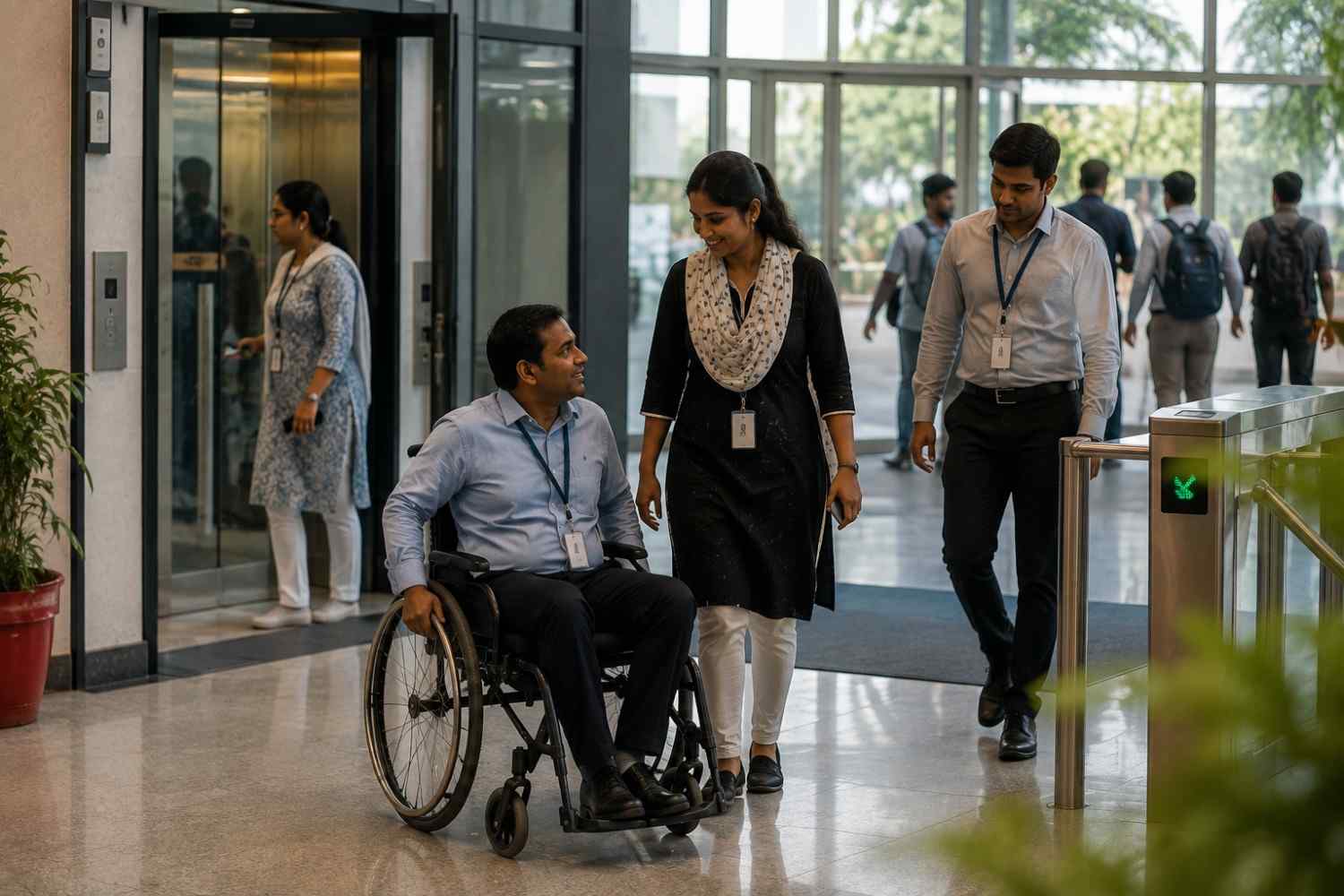
The most common barriers often appear after onboarding: inaccessible internal software, delayed reasonable accommodation, transport problems, shift allocation, exclusion from travel or client-facing work, weak mentorship, biased appraisal and an absence of career pathways. Disability inclusion fails through everyday management decisions long before it appears in a legal complaint.
TCS offers useful architecture. Its ENABLE Disability and Allies Network, launched in 2017, creates an employee forum, while PACT brings parents, allies and caregivers into the inclusion ecosystem. TCS also publicly emphasises accessible recruitment, workplace design, assistive technology and reasonable accommodation. Wipro, ITC, JSW Steel and major banks should be evaluated against the same outcome test: not whether policies exist, but whether disabled employees remain, advance and receive comparable rewards.9
THE INCLUSION INFRASTRUCTURE: FROM MITTI CAFÉ TO V-SHESH
Inclusive employment is not merely a placement transaction. Mitti Café’s model combines experiential training, café and catering jobs, customer interaction, visibility and dignity. It reports more than 50 cafés in institutional and public spaces and thousands of persons with disabilities skilled, while its support model includes health insurance, food and accommodation. The transferable corporate lesson is that retention may require transport, accessible housing, coaching, nutrition, family engagement or health support—not only an appointment letter.11
V-Shesh represents another part of the infrastructure. It says it supports 117 leading companies through recruitment, pre- and post-hiring services, sensitisation, policy advice, accessibility services and work trials, and reports more than 2,000 jobs facilitated. Such intermediaries help employers redesign roles instead of rejecting candidates against inherited job descriptions.12
National Restaurant Association of India chapters and hospitality groups could scale common accessible-recruitment protocols, model kitchens and hotels, shared trainers, accessible customer-service standards and cross-company apprenticeships. Yet every partnership must publish conversion and retention: how many people were trained, how many received paid jobs, what they earned, how many remained, which benefits they accessed and what happened when difficulties arose.
THE OVERLOOKED “E”: CLIMATE RESILIENCE THAT DOES NOT ABANDON PEOPLE
A heatwave, flood, cyclone, power failure or transport shutdown does not affect every worker equally. Employees using wheelchairs, hearing aids, powered mobility equipment, ventilators, screen readers, medication refrigeration or caregiver support face risks that conventional business-continuity plans often fail to see.
The evidence is alarming. UNDRR’s global survey found that only a small minority of local disaster-risk-reduction plans addressed the specific needs of persons with disabilities, while most respondents reported no participation in community-level decision-making. In India, CEEW’s 2025 heat-risk assessment found 57 per cent of districts—home to 76 per cent of the population—at high to very high heat risk. CEEW’s framework explicitly treats disability and chronic conditions as vulnerability factors. WRI India’s work on industrial transition similarly warns that green transitions do not automatically deliver inclusion without structural change.131415
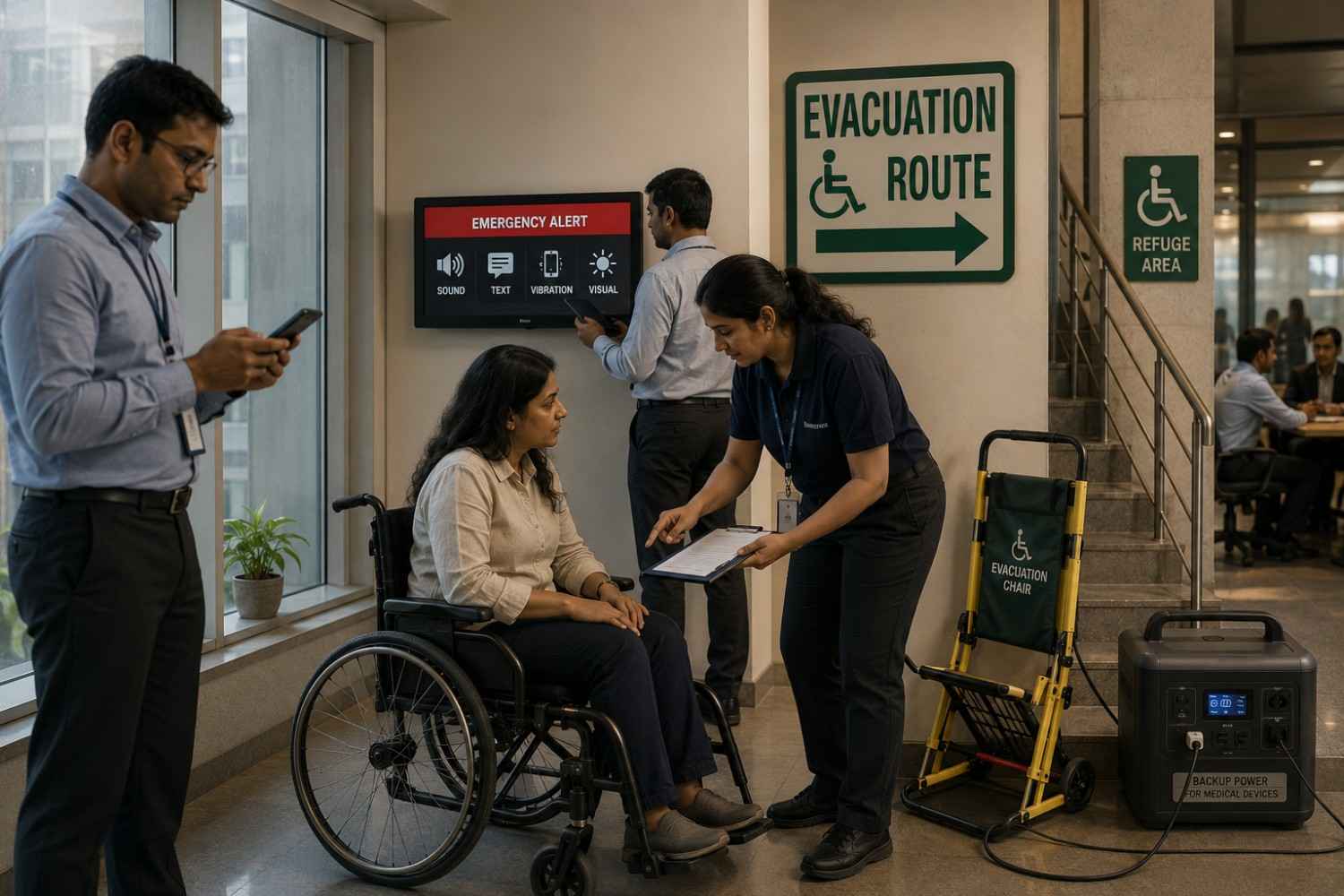
A disability-inclusive corporate resilience plan needs multimodal warnings using sound, text, vibration, visual signals and plain language; accessible evacuation maps, exits, drills and refuge areas; evacuation chairs and trained responders; backup electricity for assistive and medical devices; accessible shelters, transport and temporary accommodation; heat-adjusted shifts and rest periods; remote-work options during severe weather; continuity of medication and caregiver access; and equal protection for contract and outsourced workers.
Disabled employees must co-design and test these systems. CSE, WRI India, CEEW and Climate Policy Initiative India can widen corporate climate-risk methodologies; IiAS, InGovern and independent academics can test board ownership, disclosure integrity and incentives. The principle is unforgiving: a climate plan that cannot protect the most exposed employee is not a resilient plan.
LABOUR CODES AND ESIC: COVERAGE MUST BECOME VISIBLE
India’s four labour codes took effect on 21 November 2025, reshaping workforce classification, social-security administration, contractor governance and reporting systems. For disability inclusion, classification is material because people can disappear between the principal employer’s payroll, staffing firms, contractors, apprenticeships, fixed-term work and platform arrangements.16
Boards should receive disability-disaggregated data for permanent and fixed-term employees, permanent and contract workers, apprentices, temporary and outsourced personnel, and gig or platform workers where relevant. A consolidated headcount that excludes the most precarious categories can make inclusion look stronger than it is.

ESIC is an essential protection but should not be confused with an inclusion policy. Its permanent-disablement benefit can provide lifelong payments linked to loss of earning capacity after an employment injury; permanent total disablement is generally paid at 90 per cent of average daily wages. That protection does not replace accessible recruitment, reasonable accommodation, career progression or freedom from discrimination.17
The ESG test is practical: among eligible workers, how many are registered for ESIC, PF and insurance; how many claims were filed and accepted; how long settlement took; whether contractors deposited contributions; whether assistance was available in accessible formats; and what remedy followed a denial. “Covered as per law” is not evidence of access.
THE BOARDROOM ACCESSIBILITY SCORECARD
A credible dashboard should contain eight linked measures. It should reach the board at least quarterly; material failures should enter the annual report; and remuneration committees should consider whether senior executives delivered agreed outcomes.
# | KPI | EVIDENCE THE BOARD SHOULD SEE |
|---|---|---|
1 | REPRESENTATION | Absolute number and percentage of persons with disabilities; voluntary-disclosure rate; segmentation by gender, grade, site, employment status and occupational category. |
2 | EMPLOYMENT OUTCOMES | Application-to-interview and interview-to-hire conversion; probation completion; 12- and 24-month retention; promotion; internal mobility; disability-specific exit reasons. |
3 | PAY & BENEFITS | Median fixed and variable remuneration against comparable work; insurance, ESIC, PF, leave, transport, assistive devices and caregiver provisions. |
4 | ACCOMMODATION | Requests received, approved, rejected and pending; median closure time; spend; employee satisfaction; independent appeal route. |
5 | PHYSICAL & DIGITAL ACCESS | Percentage of sites and critical systems independently audited; barriers by severity; closure and re-test rates; overdue actions. |
6 | VOICE, GRIEVANCE & REMEDY | Confidential worker interviews without management present; complaints by issue; substantiation; corrective action; compensation; non-retaliation; recurrence. |
7 | CLIMATE & EMERGENCY RESILIENCE | Accessible warnings and drills; evacuation readiness; backup power; heat and severe-weather protocols; remote-work continuity; contractor coverage. |
8 | MONEY, BOUNDARIES & ASSURANCE | Approved accessibility capex and opex; money actually spent; baseline year; reporting boundary; methodology; absolute and intensity results; independent assurance scope. |
REGULATORS, BANKS, AUDITORS: THE ACCOUNTABILITY CHAIN
SEBI, MCA, RBI, the Ministry of Finance and the stock exchanges can drive convergence through stronger disability-disaggregated indicators, accessible filing and investor platforms, financial-sector enforcement, public-sector-bank leadership and credible assurance standards. The BRSR architecture should evolve from “how many?” to “what happened to them?”
Audit firms and ESG-data providers must stop treating a policy, a ramp or a “yes” response as sufficient evidence. Assurance should reconcile payroll, HR, grievance, procurement, facility, IT and benefits data; test a sample of sites and systems; interview workers without management; and verify both approved budgets and money actually spent. Absolute results must be shown alongside intensity measures, because a better percentage can hide a shrinking denominator.
Infosys, TCS, Wipro, ITC, Tata Steel, JSW Steel and large banks have the scale to establish sector benchmarks. CII-style awards can accelerate competition. Mitti Café, V-Shesh, organisations of persons with disabilities and disability-led experts can supply implementation intelligence. But persons with disabilities must remain the primary witnesses, auditors, designers and decision-makers—not beneficiaries photographed for annual reports.
ACCESSIBILITY IS ENTERPRISE QUALITY
The next phase of disability inclusion will not be won by compassionate language. It will be won by better systems: recruitment that does not reject assistive technology; software that works with a screen reader; managers who deliver accommodations on time; factories that evacuate every worker; benefits that can actually be claimed; and grievance mechanisms that produce remedy without retaliation.
A truly accessible company is easier to enter, safer to work in, simpler to transact with and more resilient under stress. It identifies process defects that inconvenience everyone, protects scarce talent, strengthens customer access and exposes governance blind spots before they become litigation, reputational damage or operational failure.
Accessibility is not a CSR footnote. It is a balance-sheet issue, a resilience issue and evidence of management quality. The ramp now leads to the boardroom—and the board should be accountable for whether it reaches the door.
SELECTED EVIDENCE BASE
1. Confederation of Indian Industry: Launch of CII Award for Excellence in Disability Inclusion, 18 December 2024.
2. CII India Business and Disability Network: Award for Excellence in Disability Inclusion—2026 categories and eligibility.
3. Securities and Exchange Board of India: Mandatory compliance by all regulated entities under the RPwD Act, circular dated 31 July 2025.
4. SEBI: Compliance Guidelines for Digital Accessibility, circular dated 25 September 2025.
5. SEBI: Business Responsibility and Sustainability Reporting by listed entities, circular dated 10 May 2021.
6. Infosys: ESG Report 2025–26: social inclusivity, accessibility and voluntary disability disclosure.
7. Infosys: Three-year IFRS data sheet, including FY2025–26 employee headcount.
8. Tata Steel: Business Responsibility and Sustainability Report 2025–26.
9. Tata Consultancy Services: DEI framework, ENABLE and PACT; disability hiring and accessibility guidance.
10. Persistent Systems: CII Award for Excellence in Disability Inclusion—official release.
11. Mitti Café: Employment, training and inclusive café model.
12. V-Shesh: Workforce and workplace inclusion services.
13. UNDRR: Global Survey Report on Persons with Disabilities and Disasters, 2023.
14. CEEW: District-level heat-risk assessment for India, May 2025.
15. WRI India: Challenges and barriers to a fair and equitable transition in India’s SME sector, April 2026.
16. Ministry of Labour & Employment: Year End Review 2025: four labour codes effective from 21 November 2025.
17. Employees’ State Insurance Corporation: ESI Scheme benefits and Permanent Disablement Benefit.




Add a Comment