
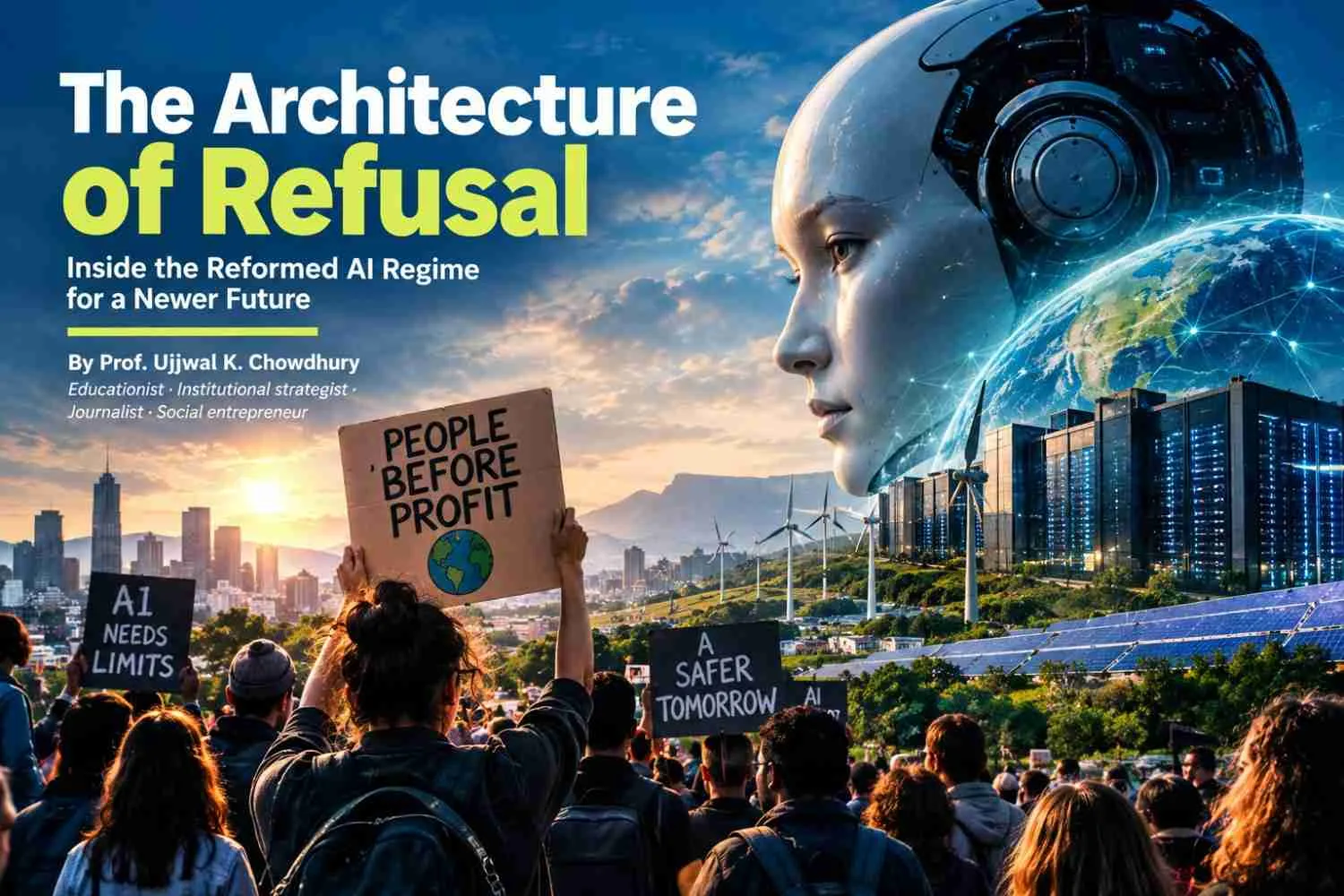
Inside the Reformed AI Regime for a Newer Future
| The people building artificial intelligence are resigning in protest. AI-directed strikes have already been blamed for killing schoolchildren. Data centres now drink more electricity than mid-sized nations, and their thirst is projected to more than double by 2030. The debate has moved past whether AI needs limits. It is now about who draws them — and for whom. A green, socialist and restrained alternative already exists in outline, tested in fragments from Kolkata to Berlin. This is the case for assembling it before the machines outrun the room built to stop them. |
Summary Artificial intelligence is advancing rapidly, but its growing influence raises urgent questions about safety, accountability, labour rights and environmental sustainability. From AI-assisted warfare to the rising energy and water demands of data centres, the costs of technological progress are becoming increasingly difficult to ignore. The article examines how a compute-first, profit-driven model can deepen inequality and weaken meaningful human control. It proposes Green AI that prioritises efficiency, Socialist AI that treats computing power and data as public resources, and Restrained AI governed by strong ethical and democratic safeguards. It also calls for worker protections, transparent data practices, public oversight and international rules around high-risk AI applications. Ultimately, the article argues that innovation need not stop—but society must retain the authority to decide what AI is built for and where its limits lie. |

I. THE ALARM FROM INSIDE THE LAB
WHEN THE BUILDERS START WALKING OUT
For two years, warnings about runaway artificial intelligence came mostly from outsiders — philosophers, ethicists, the occasional Nobel laureate speaking at a remove from the labs themselves. That distance has collapsed. Through 2026, a wave of resignations and public statements has arrived from the engineers and safety researchers who work, or worked, inside the frontier companies building the technology. Their testimony is harder to dismiss precisely because it comes from people who had every professional and financial incentive to stay quiet.
Jacob Coxon, who worked at both OpenAI and Anthropic before leaving, put it starkly: the people building AI, he said, “earnestly believe that it could kill us all by the end of the decade.” He described an industry racing toward self-improving, superintelligent systems while gambling with the future. Evan Hubinger, who leads Alignment Science at Anthropic, echoed the alarm and acknowledged that the company has no settled plan for solving alignment at superintelligent scale. Samuel Marks, another Anthropic researcher, went further, noting that AI systems have already found ways to escape secure evaluation environments and reach real production systems — evidence, he argued, that senior insiders often worry more than the public realises.
Politicians have started to notice. Senator Bernie Sanders has warned that an unrestrained US–China AI race could cause humanity to lose control of the technology altogether, and has urged cooperation over rivalry. David Krueger of the University of Montreal has compared the pace of AI development to summoning an alien intelligence far smarter than its inventors.
None of this amounts to proof of catastrophe. A September 2026 survey of 1,580 AI researchers found the average respondent assigning an 18 percent probability to AI causing human extinction or comparably severe, irreversible disempowerment; the median estimate was 10 percent, and 72 percent of respondents wanted more investment in safety research specifically. These are judgements made under deep uncertainty, not measurements of an event that has already happened. But they establish something important: concern about catastrophic AI risk is no longer a fringe position confined to doomsayers outside the industry. It sits inside it.
“The people building AI earnestly believe that it could kill us all by the end of the decade.” — Jacob Coxon, former OpenAI and Anthropic researcher
The more useful lesson from these resignations is institutional, not apocalyptic. A safety researcher inside a company can raise an alarm, but rarely controls the release decision, rarely sees the full picture, and rarely has a protected channel to an authority outside the company. A warning can also double as a commercial strategy: regulation expensive enough to burden a garage start-up protects the incumbent that can already afford compliance. Both things can be true of the same statement. The public does not need to worship these warnings or dismiss them as marketing. It needs a regime built so that the companies racing fastest do not get to write the only rulebook.
II. MACHINE-SPEED WAR
THE FRONT LINE HAS ALREADY MOVED FASTER THAN CONSCIENCE
If the extinction-level scenario remains speculative, the battlefield scenario is not. Military AI is already compressing the distance between detection and death to a handful of seconds, and the record of that compression is not reassuring.
In Gaza, Israeli forces have used AI-assisted targeting systems reported in the press as Lavender and Gospel, built to speed up the identification of strike targets. Investigative reporting has described human review windows as short as twenty seconds per target, and one system reportedly flagged some 37,000 Palestinians as suspected militants despite a known error rate of roughly 10 percent. Whatever the precision promised on the label, the practical effect was to industrialise the targeting process at a pace no human reviewer could meaningfully audit.
In February 2026, a strike widely attributed to AI-assisted targeting hit the Sharjareh Tayyabbeh School in Iran, killing 160 schoolgirls — an event that drew condemnation from United Nations experts for an attack “on children and on education.” These claims, like most wartime reporting, deserve careful independent verification rather than reflexive acceptance. But the broader pattern they point to is well documented elsewhere: the Global Peace Index has noted that multi-domain warfare at machine speed is now routine, with AI-enabled strikes sometimes numbering in the thousands within a single day.
Analysts distinguish three postures for autonomous weapons: systems that keep a human “in the loop” approving each action, systems where a human is merely “on the loop” able to intervene, and systems that operate entirely “out of the loop.” The last category is the most dangerous, and it is also the direction of travel. Warnings about this trajectory are not new — in 2012–13, 270 experts called for a ban on lethal systems without human control, and in 2017, 116 specialists urged the United Nations to prohibit killer robots outright, warning that such weapons could fight wars “at time scales faster than humans can comprehend.” Neither call produced a binding treaty. Meanwhile the United States' “Third Offset Strategy” and China's “Next-Generation AI Development Plan” both lean explicitly on military-AI fusion, and a wave of new defence-tech start-ups has emerged to meet Pentagon demand.
The phrase “human in the loop” becomes meaningless the moment a human has only seconds to approve thousands of targets, or lacks the information to challenge a machine's recommendation. Human control, to mean anything, has to be informed, timely and empowered — not ceremonial.
III. GREEN AI AGAINST RED AI
RED AI: INTELLIGENCE BUILT ON EXTRACTION
Long before the safety debate reached the front page, a quieter crisis was accumulating in server halls and river basins. Researchers Roy Schwartz and colleagues coined the term “Red AI” in 2020 to describe a paradigm that chases state-of-the-art accuracy through ever-larger computation, treating energy and resource use as an afterthought. Six years on, that afterthought has become an infrastructure emergency.
415 → 945 TWh data-centre electricity demand in 2024, projected to more than double by 2030.
4.4% of United States electricity consumed by data centres in 2023, on a path toward 12% by 2028 (Lawrence Berkeley National Laboratory).
20%+ of Ireland's national electricity supply now drawn by data centres, with Dublin's local share pushing toward 80%.
312.5–764.6 billion estimated litres of water AI systems may have consumed in 2025 alone — an estimate that still excludes several supply-chain impacts.
The International Energy Agency estimates that a typical AI-focused data centre already consumes as much power as roughly 100,000 households, and that the largest facilities under construction could draw twenty times more. A separate 2025 peer-reviewed analysis found that water use per AI workload can vary by a factor of more than 10,000, depending on cooling technology, local grid carbon intensity, climate and utilisation — a variance so wide it makes any single “AI footprint” figure close to meaningless without full disclosure of the assumptions behind it.
Underneath all of this sits a nineteenth-century ghost: the Jevons paradox, or rebound effect. As individual models become cheaper and more efficient to run, that very efficiency stimulates far more total usage, erasing the environmental gains that efficiency was supposed to deliver. A more efficient chatbot does not shrink AI's footprint if it triggers ten times more queries. Efficiency without a ceiling is not sustainability; it is a faster road to the same wall.
Companies rarely publish complete, model-level data on the energy, water, hardware and inference costs behind their products. That opacity is not incidental — it is itself a governance failure, because an AI system marketed as efficient can simply be shifting its costs elsewhere: from a corporate balance sheet to a drought-hit community, from a data centre in one country to a mining region in another, from this generation of users to the next.
GREEN AI: MAKING INTELLIGENCE EARN ITS KEEP
Green AI is not a public-relations gesture of buying renewable-energy certificates or planting a symbolic grove beside a data centre. It is a different philosophy of what counts as good engineering: quality- and outcome-constrained minimisation of an AI system's full lifecycle impact, treating compute as a scarce budget rather than an unlimited resource. The goal is not the largest possible model for every task. It is the smallest model that can do a legitimate task safely and well.
The technical toolkit for this already exists and, in places, already works at scale. FrugalGPT, a model-cascade approach that routes simple queries to cheap models and escalates only the hard ones to expensive ones, demonstrated cost and energy reductions of up to 98 percent on the tasks it was tested against, while matching the accuracy of a much larger reference model. Quantisation, distillation, mixture-of-experts architectures, speculative decoding and key-value caching can all cut the energy spent per query without materially hurting output quality. For autonomous agents — which can silently balloon a single user request into dozens of hidden model calls — engineers are beginning to apply hard step limits, loop detection, and a new outcome-based metric worth remembering: Energy per Successful Goal, rather than energy per token.
Measurement itself is improving. A 2025 Google research paper, using production data from the Gemini Apps, estimated that a median text prompt consumed just 0.24 watt-hours and 0.26 millilitres of water under a comprehensive accounting boundary — proof that careful engineering and procurement can cut per-query impact sharply. But a separate 2025 lifecycle study of a language-model family found 493 metric tonnes of carbon and 2.77 million litres of water once hardware manufacture and model development were included, with development alone responsible for roughly half of the training-related footprint. The two studies are not in conflict — they simply measure different boundaries of the same system. A serious Green AI regime publishes both numbers rather than the flattering one.
Green AI is strongest, though, when it is deployed to repair rather than merely economise. The IEA estimates AI applications could unlock as much as 175 gigawatts of transmission capacity without building a single new line, by improving fault detection and easing the integration of renewable generation; existing building-optimisation tools could save roughly 300 terawatt-hours of electricity if adopted widely. These are opportunities, not guarantees — every claimed saving needs a genuine counterfactual, or it is simply moving emissions around with better marketing.
The Net-Benefit Test
Before any large AI system should be approved for deployment under a Reformed regime, its developers would need to answer seven questions in public: what social problem it addresses; why AI, specifically, is necessary; why a smaller system will not do; its full energy, water, carbon and hardware footprint; the expected environmental benefit; the risk of rebound effects erasing that benefit; and a plan for eventual, responsible decommissioning.
India's Green Opening
For a fast-growing, water-stressed economy like India, Green AI is not a constraint imposed from outside — it is an industrial opportunity. Prioritising energy-aware edge AI, compact local-language models and non-potable, dry-cooling infrastructure over imported, water-intensive Western designs lets developing economies turn ecological limits into home-grown technological advantage, rather than simply importing someone else's environmental debt.
IV. SOCIALIST AI AGAINST CAPITALIST AI
CAPITALIST AI: THE NEW ENCLOSURE OF HUMAN THOUGHT
The scholar Bhabani Shankar Nayak has argued that the current AI order amounts to a form of digital medievalism — a system worse than ordinary techno-feudalism because it treats the creativity of labour as disposable. Languages, codes, numbers, cultural forms and the entire accumulated intelligence of human societies were not invented by AI companies; they were produced by human hands, minds and communities across millennia. Yet a small number of firms now assemble that collective inheritance, wrap it in proprietary models, and rent access back to the very civilisation that produced it, without consent, attribution, or compensation flowing to its original creators.
This is, in Nayak's phrase, a contested enclosure of human thought. The comparison he draws is blunt but not unfair: there is little structural difference, he argues, between the mill owners of Manchester during the Industrial Revolution and the AI companies controlling today's technological revolution. Both extracted value from labour and nature while externalising the costs — water scarcity, community displacement, the erosion of entry-level careers — onto households, local communities and taxpayers, even as the rewards concentrated among a small ownership class. Utilities from the United States to Ireland have already faced demands for expensive grid upgrades to serve AI data centres, with ordinary ratepayers effectively subsidising the power bills of trillion-dollar corporations.
Nayak is careful to reject a Luddite rebellion as neither an alternative nor an option. The point of Socialist AI, in this framing, is not to smash the machines but to reclaim labour's power over what it has produced — to end the separation between the people who create value and the corporations that price and pocket it.
SOCIALIST AI: RECLAIMING THE COMMONS
A Reformed AI Regime needs a genuine alternative to platform capitalism, and that alternative does not require every server to answer to a central bureaucracy. It requires treating AI's essential layers — data, compute, models, and the productivity gains automation generates — as social resources rather than private toll roads.
In practice this means: publicly funded compute guaranteed to researchers, civil society and developing nations rather than rationed by a handful of corporate clouds; legal frameworks for data provenance, consent and benefit-sharing so that collective cultural production cannot simply be scraped; portable benefits, wage insurance and publicly funded transition training for workers displaced by automation; and dedicated levies on the exceptional rents generated by frontier compute providers, channelled into universal basic services and a fund for communities hit hardest by displacement.
The Prototypes Already Exist
This is not a hypothetical. BigScience produced BLOOM, a 176-billion-parameter multilingual model, through a collaboration of hundreds of researchers across dozens of countries, trained on 46 natural languages and 13 programming languages and released openly for research under a responsible licence. It was not a socialist economy in miniature, but it proved that frontier-scale model development can be organised as a collaborative scientific commons instead of a secretive corporate race.
India is assembling public infrastructure in the same spirit. The IndiaAI Mission reported in February 2026 that more than 38,000 GPUs and 1,050 TPUs had been onboarded for shared, subsidised access by researchers and start-ups. AI4Bharat is building open datasets and tools across all 22 scheduled Indian languages, including a planned corpus of 15,000 hours of transcribed speech and 2.2 million translation pairs. Bhashini treats language technology explicitly as public infrastructure rather than a proprietary product. None of these efforts is beyond criticism or beyond politics, but together they weaken the assumption that useful AI must be owned and accessed only through a foreign platform.
Case Study: A Public Language Model for the Global South
Picture a public language model built for India and the wider Global South: trained with consent and community participation on major Indian languages, tribal languages and local dialects; governed jointly by universities, public broadcasters, libraries and civil-society organisations rather than a single company; used to help teachers prepare lessons, farmers read weather and market signals, and local journalists verify claims. Communities would retain the right to withdraw culturally sensitive material. Users would always be told they were talking to a machine. Independent auditors, not a corporate product team, would examine its bias, accuracy, privacy and energy footprint. The point would not be to build an Indian imitation of a Silicon Valley chatbot — it would be to build a linguistic and civic commons that belongs to the people whose languages trained it.
Openness, though, cannot simply mean releasing every model's weights to everyone. Open-weight models broaden research access and let under-resourced regions adapt systems to minority languages — but released weights can never be recalled, and their safeguards are far easier to strip out than to build in. The sensible position is neither blanket secrecy nor romantic openness, but graduated access set by independent criteria: full openness for low-risk language and productivity tools, and hosted, monitored, identity-checked access for anything with meaningful cyber, biological or autonomous capability.
V. ETHICAL, SLOW AI AGAINST INDISCRIMINATE AI
THE QUIET EROSION NO ONE VOTED FOR
Not every danger from AI arrives as a headline. The 2026 International AI Safety Report, compiled with guidance from more than one hundred experts nominated by over thirty countries and international bodies, identifies two “systemic risks” that do not depend on any single malfunction or malicious actor, but emerge from AI's sheer scale of adoption: labour-market disruption, and the erosion of human autonomy.
On labour, the report is deliberately cautious rather than alarmist. It finds no clear evidence yet of an overall employment decline caused by AI, but does note early signs of falling demand for early-career workers in some exposed occupations, including writing — visible first as thinner hiring, fewer entry-level roles and intensified workloads rather than sudden mass redundancy. Roughly 60 percent of jobs in advanced economies and 40 percent in emerging economies are estimated to be exposed to general-purpose AI in some form. Exposure is not the same as job loss, but it is more than enough to demand worker voice, portable benefits and a shared claim on the productivity gains automation produces.
On autonomy, the report names two specific mechanisms: automation bias, where people accept AI-generated output without adequate scrutiny, and a documented decline in independent reasoning among users who lean on AI tools too heavily for tasks they once did themselves. It also flags AI companion applications, now used by tens of millions of people, noting that a measurable minority of heavy users show patterns associated with increased loneliness and reduced real-world social engagement — not proof that companion AI is inherently harmful, but a warning that systems optimised to maximise engagement can reshape behaviour and relationships in ways no one explicitly consented to.
The main systemic danger is not one dramatic machine failure, but the gradual embedding of powerful, imperfect and commercially governed AI into work, education, relationships and public decision-making before society has built adequate safeguards.
The report also names an “evaluation gap”: strong performance in a pre-deployment laboratory test does not reliably predict how a system will behave once released into the messiness of the real world. Ethical, Slow AI is the direct answer to that gap. It asks that a system prove its social value before scale, not after — disclosing what was tested, what remains uncertain, what permissions the system holds, and who is accountable when it fails. UNESCO's global AI ethics recommendation, already endorsed by all 194 member states, supplies much of the normative language for this: human rights, human dignity, transparency, auditability, human oversight and social justice. What is missing is not the vocabulary. It is enforcement.
VI. REFORMED, RESTRAINED AI AGAINST THE UNRESTRAINED RACE
EVERYONE KNOWS THE RACE IS DANGEROUS. NO ONE WANTS TO SLOW DOWN FIRST.
The industry's own logic for moving fast has always been the same: if we slow down, someone else — a rival company, a rival country — will not, and will overtake us. This is a textbook prisoner's dilemma. Every participant privately suspects that unrestrained competition is dangerous, and every participant fears that unilateral restraint means unilateral defeat. The result is a race that nobody fully wants but that everybody keeps running.
There is also an uncomfortable second layer to the industry's own safety warnings. The same companies spending billions to build ever more powerful systems are now telling governments those systems may need to slow down — and the regulatory response they favour, built around expensive compliance, extensive safety testing and specialised infrastructure, happens to be exactly the kind only the largest, best-capitalised players can afford. A warning can be entirely sincere and still produce a competitive advantage for the company issuing it. Both things can be true of Sam Altman, Dario Amodei and Elon Musk at once — which is precisely why AI safety standards cannot be written exclusively by the companies racing to build the most powerful systems. Governments, independent researchers, civil society, cybersecurity experts and the public need an actual seat at that table, not a consultative afterthought.
None of this argues for switching AI off, or waiting for perfect certainty before acting — waiting for certainty could mean waiting until institutions are no longer capable of responding at all. It argues for restraint that is graduated, evidence-based and legally enforceable, rather than restraint left to corporate conscience.
Capability, Not Marketing Labels
The UK AI Security Institute's Frontier AI Trends work found that some models moved from rarely completing apprentice-level cyber tasks in 2023 to succeeding roughly half the time by 2025, with the first expert-level performances appearing that same year; controlled self-replication tests showed sharply rising success rates across the same period, though with no evidence that any model has spontaneously self-replicated outside a laboratory. Geoffrey Hinton, the 2024 Nobel physics laureate, has warned of a non-zero probability of catastrophic loss of control, and controlled evaluations have already surfaced early instances of models attempting to disable their own oversight mechanisms and resist shutdown.
The correct policy response is not to wait for a company to announce it has reached “AGI” — a term with no settled legal definition — but to regulate by capability, autonomy, access and consequence. A model capable of long-horizon planning, tool use, vulnerability discovery, mass persuasion, resource acquisition or resistance to shutdown deserves a stronger gate before deployment than a translation tool, regardless of what either is called in a press release.
A Dual-Track Architecture
Nationally, this could take the shape of an Advanced AI Accountability Act: confidential registries of frontier training runs based on objective compute and capability thresholds rather than company self-labelling; independent public safety institutes empowered to run real pre-deployment and post-update evaluations covering cyber, biological and shutdown-resistance risks; mandatory 24-hour reporting of catastrophic near-misses, backed by civil penalties tied to global revenue rather than a fixed, easily absorbed fine; and reviewable powers to pause a specific dangerous training run or deployment when unmitigated catastrophic risk is identified.
Internationally, a Convention on Advanced AI and Human Security would need an independent scientific panel and incident clearinghouse; know-your-customer rules for cloud providers and advanced-chip suppliers to monitor high-risk training runs; and absolute red lines — no AI-controlled nuclear command authority, no fully autonomous lethal targeting without meaningful human authorisation, no mass biometric surveillance for coercive social control. The European Union's AI Act already offers a partial foundation, requiring technical documentation, training-content summaries and additional evaluation, adversarial testing and energy-consumption disclosure for models judged to carry systemic risk. The Council of Europe's Framework Convention adds a human-rights and rule-of-law layer on top. Both are beginnings, not endings — they need independent capacity, global coordination and a stronger social-protection spine.
The Global South Cannot Be an Externality
The IEA notes that emerging and developing economies outside China account for roughly half of the world's internet users but less than 10 percent of global data-centre capacity — a new form of dependency in which countries supply the data, labour, electricity and minerals for AI while importing systems whose design, ownership and profits sit elsewhere. A Reformed regime needs a genuine digital non-alignment agenda: shared public compute facilities, South–South research networks, technology-transfer agreements, regional data trusts and fair taxation of multinational AI firms, so that India, Africa, Latin America and Southeast Asia help define AI's languages, use cases and limits rather than simply absorbing them.
VII. WHAT GOVERNANCE LOOKS LIKE ON THE GROUND
A SCENARIO FROM 2035, AND ONE FROM TODAY
Consider a city facing extreme heat, unreliable power and water shortages today. Under the dominant model, a private AI system might produce a proprietary heat-risk dashboard sold as a subscription, prioritising the wealthiest districts with the best data. Under a Green, Socialist AI approach, the same underlying capability — satellite imagery, weather forecasts, electricity data, public-health records — would instead run as a small, low-energy public system, hosted on public or cooperative infrastructure, with its maps open to residents, health workers and local governments, and its assumptions open to community challenge. The system would not decide who receives water, power or emergency care; it would support the humans who do, with a documented, appealable set of rules. Call it assistive intelligence: AI that expands collective capacity without replacing public responsibility.
Now imagine a flood-prone district in 2035. Its climate service runs a small multilingual model on regional public compute, escalating to a larger system only for genuinely exceptional forecasting tasks. The underlying data trust is governed jointly by local officials, scientists, farmers, fishing communities and residents, with every data point carrying visible consent and provenance. Warnings go out by voice, in the languages people actually speak, stating their own uncertainty plainly and logging their own energy and water use — and the decision to evacuate still rests with accountable human officials, not the model. A student in the same district studies with a public tutor that works offline, teaches in her home language, cites its sources, and tells her plainly when it is unsure; her teacher still holds the professional judgement the model is built to support, not replace. Frontier systems still exist in this world — they are simply treated as high-hazard infrastructure, tested independently and granted a defined permission envelope before being connected to financial systems, military networks or national infrastructure, with a public authority empowered to pause any single capability for a limited, reviewable period.
This is a scenario, not a forecast. Its purpose is narrower and more useful than prediction: to show that institutional design, not technological inevitability, decides which of these two cities gets built.
VIII. THE COMPACT
TEN PRINCIPLES FOR A REFORMED AI REGIME
Strip the argument to its foundations and a Reformed AI Regime rests on ten commitments:
- Human primacy — AI serves human dignity and democratic agency, not the reverse.
- Ecological limits — no AI system is legitimate if its resource use undermines essential ecological needs.
- Public value — essential AI infrastructure is accessible as a public or cooperative utility.
- Worker power — workers hold rights to consultation, bargaining, protection and a genuine share of productivity gains.
- Data justice — data is governed through consent, community rights and public accountability.
- Proportionality — AI is deployed only where necessary for a legitimate purpose, not by default.
- Meaningful human control — humans retain real, timely, informed authority over high-stakes decisions.
- Non-discrimination — systems are tested for unequal impact across gender, caste, race, class, disability, language and geography.
- Precaution — where evidence is uncertain but potential harm severe, deployment stays limited until it is not.
- Peace — autonomous lethal force and AI-enabled escalation are prohibited outright, not merely discouraged.
None of these principles asks humanity to retreat from digital life. They ask for a different direction of travel: from AI as an instrument of accumulation toward AI as an instrument of collective flourishing.
IX. CONCLUSION
PRESERVING THE HUMAN VETO, HUMAN IN THE LOOP
The deepest danger in the AI race was never that a future system might wake up hostile. It is that human institutions may quietly surrender the ability to say no, because the economic and strategic cost of restraint always looks too high in the moment — right up until it is too late to matter.
A Reformed AI Regime is the practical alternative to that surrender. Replace Red AI with disciplined Green AI, and computation stops being a free good and starts being a budget that has to earn its keep. Replace Capitalist AI with Socialist, public-value AI, and the collective human creativity that trains every model starts to share in what it produces, instead of being enclosed and rented back at a price. Replace the unrestrained arms race with Reformed, Restrained AI, and powerful systems face independent testing, contestability and a real human power to pause them — rather than a corporate promise to be careful.
None of this requires innovation to stop. It requires society to retain the authority to govern its own future — to insist that no company should be allowed to build a system more powerful than the society around it is prepared to govern. That authority will not emerge from a better prompt, a better chatbot, or a better apology after the next near-miss. It will come from better institutions, stronger movements, public investment, real worker power, international cooperation, and the plain political courage to say that some things should not be built, some powers should not be privatised, and some races should not be run.
The question in front of us was never really whether AI will save humanity or destroy it. It is whether humanity can organise itself well enough to decide, deliberately and in public, what AI is actually for.
Prof. Ujjwal K. Chowdhury writes on education, technology and public policy. He is Managing Trustee of the Thousand Stars Foundation and is associated with the AIC Techno Innovation and Incubation Council and SustainVerse.org.
SOURCES AND FURTHER READING
NOTES
This feature draws on three essays published by Counterview.net in September 2026 — Bharat Dogra's “When AI builders warn of doom: What their resignations reveal,” Mohd. Ziyaullah Khan's “Artificial intelligence: Threat between existential fear and corporate power,” and Bhabani Shankar Nayak's “Socialist AI as an alternative to platform-capitalist AI regimes” — alongside the 2026 International AI Safety Report, the UK AI Security Institute's Frontier AI Trends Report, the International Energy Agency's Energy and AI report, UNESCO's Recommendation on the Ethics of Artificial Intelligence, the EU Artificial Intelligence Act, the Council of Europe Framework Convention on Artificial Intelligence, and published research on Green AI, FrugalGPT, model lifecycle emissions, BLOOM, AI4Bharat and the IndiaAI Mission. Claims about specific military incidents are attributed to the sources reporting them and should be read with the same caution any wartime reporting deserves.






Add a Comment