
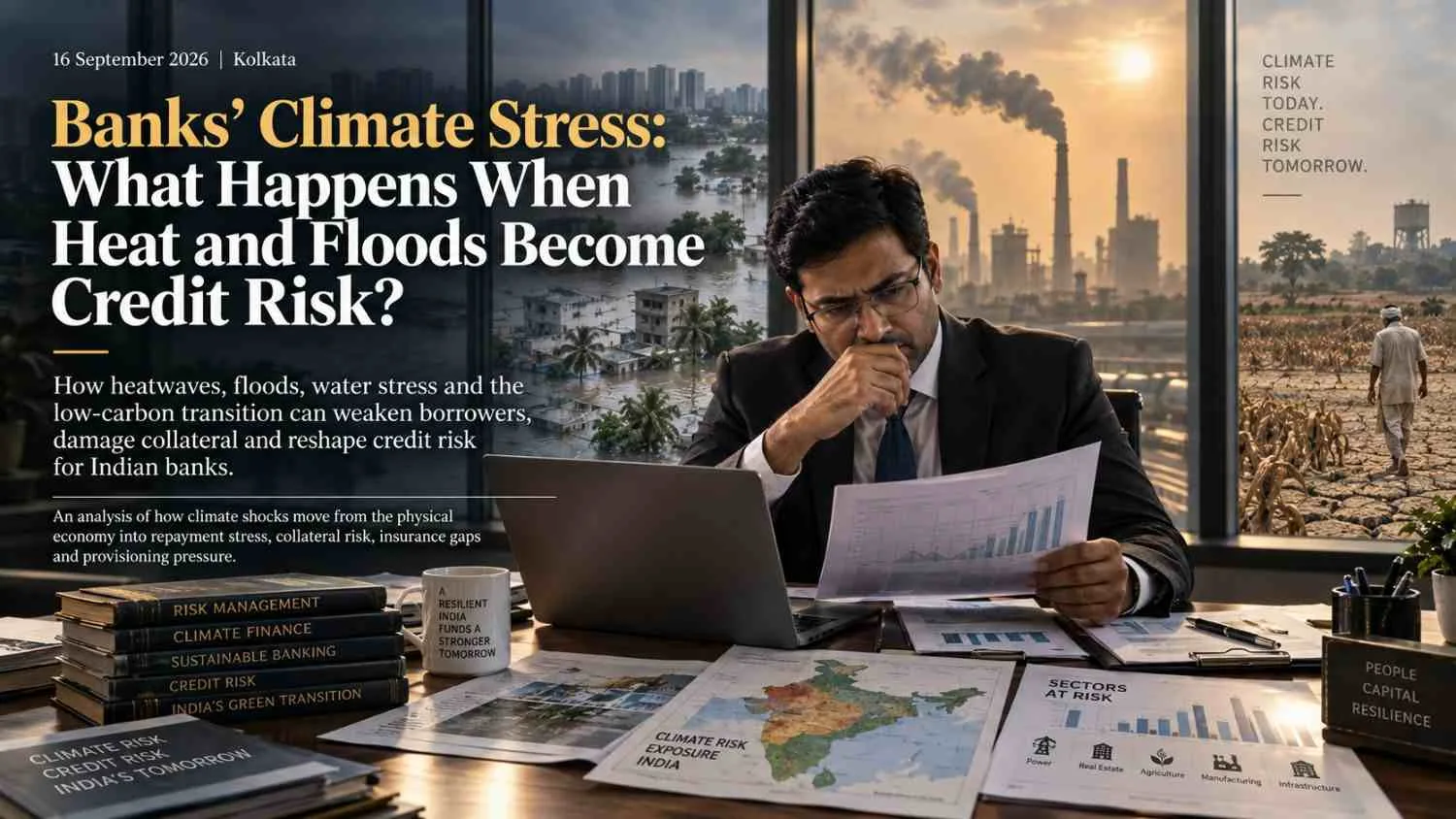
16 September 2026 | Kolkata
| Climate change is becoming a financial risk for Indian banks, not just an environmental concern. Heatwaves, floods, water stress and the shift towards a low-carbon economy can weaken borrowers, damage assets and affect loan repayments. The question is whether banks are identifying these risks early enough without making credit harder for smaller borrowers with limited capacity to adapt. |
Summary A flood can damage property used as collateral, extreme heat can disrupt industrial production, and water stress can weaken the finances of water-intensive businesses. These effects can eventually reach a bank through weaker cash flows, repayment stress and potential losses. RBI's climate-risk work has already examined how physical and transition risks could affect banks, while highlighting significant data and modelling challenges. This article looks at how those risks move from the physical economy into credit decisions, collateral, insurance and provisioning. |
| Keywords: climate risk, Indian banks, credit risk, climate stress testing, RBI climate risk, physical risk, transition risk, bank lending, collateral risk, provisioning, financial stability, climate finance, water stress, heatwaves, floods |
What happens when climate risk reaches a bank’s balance sheet?
Climate change does not appear on a bank’s books simply as an environmental concern. It can enter through the borrowers, assets, cash flows and repayment capacity connected to the loans a bank has issued.
A heatwave, for example, can disrupt industrial productivity or raise cooling costs. A flood can damage a factory, warehouse or residential property. Water shortages can interrupt production, increase operating expenses or reduce revenues. As these pressures build, businesses may face weaker cash flows and greater difficulty servicing their debt.
For a bank, the chain can therefore be direct:
Climate shock → disruption to business or assets → weaker cash flow → repayment stress → potential credit loss.
Climate-related damage can also affect the value of collateral. If a property or industrial asset securing a loan is damaged, becomes less productive or loses market value, the bank may have less protection if the borrower eventually defaults.
That is why climate exposure is not limited to loans labelled “green” or “sustainable.”
A conventional loan to a factory, farm, housing project or small business can also carry climate-related financial risks if the borrower or the underlying asset is exposed to physical hazards or to changes brought about by the transition to a lower-carbon economy.
For banks, the climate question is ultimately a financial one: how could environmental shocks change the ability of borrowers to repay and the value of the assets standing behind those loans?
Climate Risk to Credit Risk
HEAT / FLOOD / WATER STRESS / TRANSITION POLICY
→ Business or asset disruption
→ Higher costs / lower revenue
→ Weaker borrower cash flow
→ Repayment stress
→ Default / restructuring risk
→ Bank credit loss / provisioning pressure
Illustrative transmission pathway; actual impact varies by borrower, sector, location and scenario.
How does a bank measure a risk that has not happened yet?
Climate stress testing is a one-way, banks can try to answer this question.
Rather than waiting for a climate-related disaster to expose financial losses, banks can test how their portfolios might respond under severe but plausible climate scenarios. The aim is to understand where borrowers, assets and repayment capacity could come under pressure before those risks materialise.
In 2022, the RBI’s pilot Climate Vulnerability Assessment and Stress Testing exercise examined both physical risks, including floods and cyclones, and transition risks. Participating banks used information about their borrowers and collateral, along with vulnerability factors provided by the RBI, to estimate how climate scenarios could affect probabilities of default and potential credit losses.
The results showed that climate scenarios could materially increase the potential for credit losses. The RBI reported a 66.1% increase against the baseline for flood risk and a 138% increase under a short-term tail-risk scenario.
However, these figures need to be read carefully. They were scenario-based results, not forecasts of actual future losses. They indicate how losses could change under particular assumptions, rather than predicting exactly what will happen.
That makes the assumptions behind a stress test as important as the final number. The choice of climate scenario, the vulnerability factors used, the exposure of borrowers and the value of collateral can all influence the outcome.
A climate stress test, therefore, is not a prediction machine. It is a way of asking how resilient a bank’s balance sheet could be if climate risks become financial risks.
RBI Climate Stress-Test Snapshot
RBI PILOT CLIMATE VAST — 2022
15 banks assessed
Physical-risk scenarios
Flood: +66.1% credit-loss potential vs baseline
Cyclone: +65.8%
Short-term tail-risk scenario: +138%
Transition-risk scenarios
Below 2°C:
2030 +106% | 2040 +109% | 2050 +107%
Divergent Net Zero:
2030 +110% | 2040 +130% | 2050 +146%
Scenario-based results from RBI's pilot exercise, not realised losses or forecasts.
How much of the risk can banks actually see?
This is one of the biggest challenges in assessing climate-related financial risk.
Understanding climate exposure requires detailed information about where borrowers and collateral are located, what hazards they may face, how financially vulnerable they are and how well they can adapt. Without this information, a bank may know that an exposure exists without being able to accurately estimate how severe its financial impact could be.
The RBI’s pilot exercise identified several information gaps, including difficulties with geographic data, forward-looking indicators, emissions data and information from counterparties. The central bank has also highlighted the uncertainty involved in modelling climate-related risks over longer time horizons.
This creates an important distinction between known, estimated and unknown exposure.
A bank may know its overall exposure to a particular sector or geography, for example, while having limited information about how individual borrowers within that exposure would perform under a specific climate scenario. The quality and availability of data can therefore directly affect how precisely the bank can assess potential losses.
The challenge is not simply that some climate risks are difficult to predict. It is that some of the information needed to measure those risks may not yet exist, may be incomplete, or may not be comparable across borrowers.
That information gap is itself a risk-management issue. If a bank cannot clearly see where its exposure lies or how vulnerable its borrowers and collateral may be, its ability to prepare for potential losses is also limited.
“KNOWN / ESTIMATED / UNKNOWN”
KNOWN
- Disclosed sector exposure
- Disclosed geographic exposure
- Reported climate scenarios
ESTIMATED
- Future borrower vulnerability
- Potential collateral impact
- Future transition costs
UNKNOWN / NOT DISCLOSED
- Uninsured exposure
- Climate-linked default impact
- Climate-linked provisioning
- Borrower adaptation capacity
Only classify information as “unknown” after it has been requested and not provided.
What happens when climate damage affects collateral and insurance?
For housing and other asset-backed lending, physical climate damage can create another layer of financial risk.
A flood can damage a property that has been pledged as collateral for a loan. Damage to an industrial facility can reduce the value or usability of buildings, equipment and inventory. If the underlying asset loses value, the lender may also face greater exposure if the borrower struggles to repay.
Insurance can absorb part of such a loss, but simply having an insurance policy does not tell the full story.
For a lender, the key questions are:
- What is covered?
- How much is covered?
- Which risks are covered?
- What are the exclusions and deductibles?
- How quickly are claims settled?
- Who bears any uninsured loss?
For climate-exposed lending, these details can significantly influence the actual protection available to both the bank and the borrower.
The presence of insurance, therefore, should not be treated as proof that climate risk has been fully protected against. The real test is whether the coverage is adequate when the loss actually occurs.
Where does provisioning fit in?
If climate-related disruption increases the probability that a borrower will default, it can influence how banks assess expected losses and manage provisions against potential credit risks.
But identifying exactly how much of a loss is caused by climate-related factors is not always straightforward.
A borrower’s financial position can be affected by several pressures at the same time. Extreme weather may coincide with higher energy costs, weaker demand, supply-chain disruptions, regulatory changes and rising financing costs. Separating the impact of climate-related factors from these other drivers can therefore be difficult.
The challenge is not simply to identify whether a loan is exposed to climate risk. It is to understand how climate factors interact with ordinary credit risk and how that interaction could affect the borrower’s ability to repay.
This means banks need to look beyond simply attaching a “climate risk” label to a loan. The more important question is how climate-related pressures could change the underlying probability of default, expected loss and overall credit quality.
Climate risk, in other words, is not a separate category sitting outside traditional banking risk. It can become part of the credit risk already sitting on a bank’s balance sheet.
Is transition risk just as important as floods and heat?
Not all climate-related financial risks come from physical events such as floods, heatwaves or cyclones.
The transition towards a lower-carbon economy can create financial pressure of its own. Policy changes, shifts in technology, carbon-related costs, changing consumer demand and international trade measures can all affect businesses and the sectors in which banks have lent money.
For a carbon-intensive borrower, these changes can reduce profitability, require additional capital expenditure or lower the value of existing assets. A business may therefore face financial pressure even without experiencing a direct physical climate disaster.
CEEW’s work on transition-risk scenarios for India’s financial sector highlights the importance of adapting global climate scenarios to India’s own economic and financial conditions. This includes accounting for uncertainties around policy, technology, trade and the availability of climate finance.
For banks, this means assessing two sides of the climate-risk equation:
- Physical risk: What happens if climate hazards become more severe and cause greater damage to businesses, assets and borrowers?
- Transition risk: What happens as the economy changes in response to climate policy, technology, markets and the shift towards lower-carbon activity?
A bank that looks only at floods and heatwaves may therefore miss another source of financial stress: the economic transition itself.
Physical Risk vs Transition Risk
| PHYSICAL RISK | TRANSITION RISK |
|---|---|
| Heatwaves | Policy changes |
| Floods | Carbon costs |
| Water stress | Technology shifts |
| Cyclones | Changing demand |
| Asset damage | Trade measures |
| Production disruption | Stranded assets |
Both can create:
Cash-flow pressure → Credit risk
Could climate-risk pricing make credit harder for smaller borrowers?
This is where climate-risk management intersects with financial inclusion.
Large companies often have greater resources to invest in cooling systems, flood protection, water efficiency, insurance and business continuity measures. Smaller businesses, however, may have far less financial capacity to adapt to climate-related disruptions.
If banks simply classify climate-exposed borrowers as higher-risk customers, some vulnerable businesses could face tighter lending conditions precisely when they need access to capital to strengthen their resilience.
That does not mean climate exposure should be ignored. Instead, banks need to distinguish between exposure and resilience.
A borrower operating in a high-risk area but making credible investments in adaptation may present a very different financial risk from a borrower facing similar exposure with little capacity to prepare or respond.
The objective, therefore, should not be to withdraw finance from vulnerable sectors or locations. It should be to identify climate-related risks early enough to manage them while continuing to support borrowers in building greater resilience.
What should banks disclose?
RBI's climate-related financial-risk work has focused on areas including governance, strategy, risk management, metrics and targets, alongside the need for better and more granular data.
For lenders, meaningful disclosure should help answer practical questions:
Where is the exposure?
Which sectors and locations are most vulnerable?
What scenarios were tested?
What time horizon was used?
How much of the exposure is insured?
How could collateral values change?
What happens to defaults and provisioning under stress?
What adaptation measures are borrowers taking?
And, importantly:
What information remains unavailable?
Bank Climate-Risk Dashboard
PHYSICAL EXPOSURE
• Flood
• Heat
• Water
TRANSITION EXPOSURE
• Carbon-intensive sectors
• Policy sensitivity
• Technology risk
FINANCIAL EXPOSURE
• Loan exposure
• Sector concentration
• Geographic concentration
PROTECTION
• Insurance
• Adaptation spending
• Restructuring options
FINANCIAL CONSEQUENCE
• Default risk
• Collateral risk
• Provisioning
DATA STATUS
• Known
• Estimated
• Unknown
Populate only with verified bank data.
Where does this leave Indian banks?
India’s financial system is developing the tools needed to understand climate-related financial risk, but significant challenges remain in measuring that risk accurately.
RBI’s pilot exercise showed that climate scenarios can materially affect potential credit losses while also highlighting gaps in data availability and climate-risk modelling.
The next step is to move beyond broad recognition of climate risk towards a more granular understanding of which borrowers, sectors and assets are exposed, how vulnerable they are, and what that exposure could mean financially.
This requires climate risk to move beyond sustainability teams and become part of mainstream credit assessment, risk management and financial decision-making.
Ultimately, the challenge for Indian banks is not simply to recognise that climate change creates financial risk, but to understand where that risk sits, how large it could become, and how early it can be managed.
The real test: Can banks price climate risk without pricing people out?
Climate risk can enter the financial system through several interconnected routes.
Flood → damaged collateral.
Heat → disrupted production.
Water stress → higher operating costs.
Transition policy → higher costs or changing asset values.
The financial consequences may eventually appear as weaker cash flows, loan restructuring, defaults or greater provisioning pressure.
But managing these risks should not simply mean avoiding every borrower, sector or location exposed to climate hazards. That approach could protect a bank’s balance sheet in the short term while making access to finance harder for the very businesses and communities that need capital to adapt.
Banks therefore need to understand the nature of the exposure, identify areas of uncertainty, assess the borrower’s resilience and support credible adaptation where it is financially viable.
The most useful climate-risk assessment may ultimately be one that clearly separates what is known, what is estimated and what remains unknown. This distinction matters because climate-risk decisions are only as reliable as the information and assumptions behind them.
For Indian banking, the challenge is no longer simply recognising climate change as a financial risk. The real challenge is to determine where that risk sits, how large it could become, who ultimately carries it and what can be done before it turns into a balance-sheet problem.
And that is where climate-risk management must go beyond risk avoidance. The goal should not be to price vulnerable people out of finance, but to price risk accurately enough to manage it while keeping viable borrowers within the financial system.
Sources:
- Reserve Bank of India — Climate Stress Testing and Scenario Analysis: Navigating Uncharted Waters
Primary source for RBI's 2022 Climate Vulnerability Assessment and Stress Testing exercise, physical and transition-risk scenarios, results, methodology and data challenges.
RBI Climate Stress Testing and Scenario Analysis - Reserve Bank of India — Report on Climate Risk and Financial Stability
Supports the discussion of physical and transition risks, climate-related financial stability and stress testing.
RBI Climate Risk and Financial Stability material - Reserve Bank of India — Climate-related Financial Risk Disclosures
Supports the discussion of governance, strategy, risk management, metrics, targets and climate-risk data requirements.
RBI Climate-related Financial Risk Disclosure Framework - CEEW — Transition Risk Scenarios for India's Financial Sector
Supports the discussion of transition-risk scenarios and India-specific financial-sector climate modelling.
CEEW Transition Risk Scenarios for India's Financial Sector - IRDAI — Insurance Regulatory Material
To support insurance coverage, claims, exclusions and disaster-related insurance analysis once the specific case/borrower is established.
IRDAI Regulatory Material






Add a Comment