Core Review Streams

Covers key sustainability themes, analyzing practices, challenges, and innovations shaping environmental and corporate responsibility.

Showing 12/58

04 Aug 2026

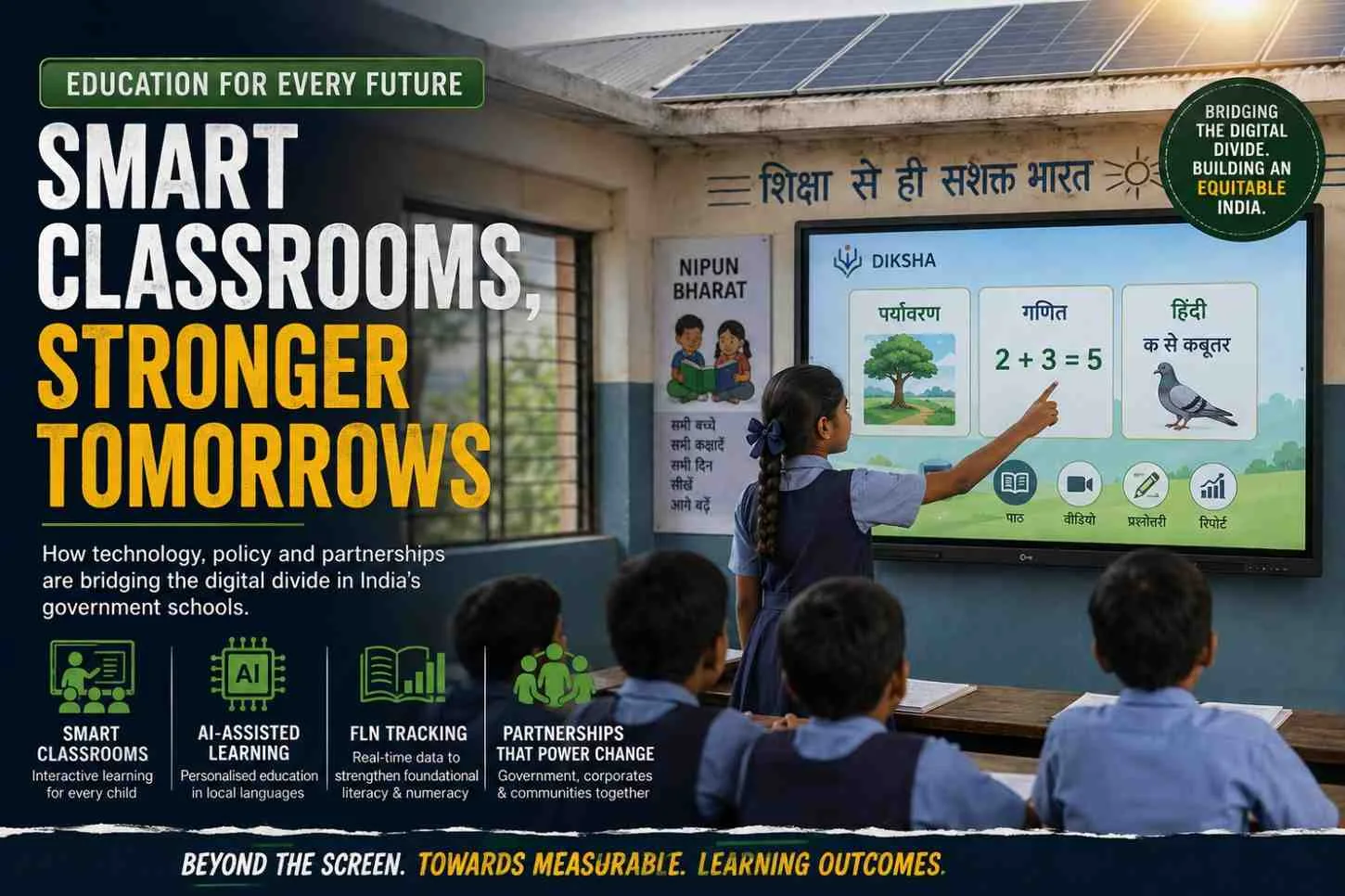
Kolkata | August 3, 2026 As India expands digital classrooms into government schools, the real challenge is no longer connecting villages to technology- but ensuring technology actually improves learning. From AI-powered lessons in regional languages to solar-powered classrooms and foundational literacy tracking, the country's digital education push is entering a decisive phase where infrastructure, teacher readiness and measurable outcomes matter more than announcements. Quick SummaryIndia's digital education journey is entering a new chapter. Classrooms are gradually moving beyond blackboards as smart technologies, AI-enabled learning platforms and digital assessment tools become part of everyday teaching. Backed by governments, private organisations and non-profits, these initiatives are expected to strengthen learning outcomes while expanding educational opportunities for students in rural and underserved communities.Yet technology alone cannot close the learning gap. Its impact depends on reliable electricity, stable internet connectivity, well-trained teachers, quality regional-language content, regular maintenance and continuous evaluation of student progress. As India works towards a more inclusive education system, the focus is moving beyond digital access to a more important goal-ensuring that every technological investment delivers measurable improvements in learning. KeywordsEdTech India, Digital Classrooms, Government Schools, Rural Education, Foundational Literacy and Numeracy, NIPUN Bharat, AI in Education, Smart Classrooms, Digital Learning, Education Technology    Can technology truly bridge India's rural education divide- or does meaningful learning still depend on everything beyond the screen? Shortly after sunrise, children begin arriving at a government primary school in a remote village of Madhya Pradesh. Some have walked several kilometres through fields, carrying well-used schoolbags and notebooks. As they settle into their classroom, a smart display comes to life, using colourful animations to explain basic mathematics in Hindi. For a moment, the familiar blackboard gives way to an entirely different way of learning. For many of these students, it is their first experience inside a digital classroom. The transformation is difficult to ignore. Government schools that once struggled with limited infrastructure are now introducing interactive lessons, AI-powered learning applications, digital attendance systems and online educational resources. Across India, digital classrooms have become a defining image of education reform and technological progress.Yet behind this visible transformation lies a far more challenging question: is digital access translating into better learning? Technology has the potential to reshape education-but only when the basics are already in place. Smart boards require electricity, AI-powered platforms depend on stable internet connectivity, and digital devices remain underutilised without confident, well-trained teachers. More importantly, no technological innovation can replace the foundational literacy and numeracy skills that every child needs to learn effectively. This is the challenge confronting India's education system today. The discussion has moved well beyond introducing technology into classrooms. The real question now is whether digital investments are improving what matters most- how well children learn or whether schools are becoming more technologically equipped without becoming more educationally effective. The reason this question matters is the sheer scale of India's digital education ambition. With more than 250 million school-going children and one of the world's largest public education systems, the country is using technology not simply to modernise schools, but to bridge educational inequalities that have existed for generations. Government initiatives such as Digital India, PM eVIDYA, DIKSHA, NIPUN Bharat and the National Education Policy (NEP) 2020 have accelerated the spread of digital learning. Alongside these efforts, corporate CSR programmes, educational foundations and technology companies are bringing smart classrooms, AI-powered learning platforms and teacher training to thousands of government schools. For millions of children in rural India, these initiatives have expanded access to educational resources that were once concentrated in better-equipped urban classrooms. The experience so far, however, points to a simple reality: technology can support education, but it cannot transform it on its own. The future of digital education will not be shaped by technology alone. Its real impact will depend on whether digital tools strengthen teaching, respond to local needs and help every child learn more effectively.As India builds more digitally enabled classrooms, the success of this transformation will not be reflected in the number of smart boards or tablets deployed. It will be seen in classrooms where learning improves, educational gaps narrow and every child is given a fairer opportunity to succeed. Government's Digital Push: From Access to Learning OutcomesThe pandemic did not introduce India to digital education, but it changed its trajectory.When classrooms fell silent in 2020, millions of students were abruptly disconnected from formal learning. The impact was especially severe in rural India, where limited access to smartphones, internet services and reliable electricity left many children without any meaningful alternative to classroom teaching. In contrast, many students in urban areas were able to continue learning online. The experience fundamentally reshaped the country's approach to digital education, turning a gradual reform into an urgent national priority. The experience of the pandemic reinforced the government's belief that digital infrastructure would become an essential part of India's education system. Rather than allowing technology to remain an emergency alternative, policymakers began embedding it into long-term classroom reforms. The National Education Policy (NEP) 2020 placed digital learning, teacher capacity building and educational technology at the centre of this transformation. Programmes such as DIKSHA and PM eVIDYA expanded digital resources for both students and teachers, while dedicated educational television channels helped extend learning to households with limited internet access. Yet one important lesson soon became clear: digital content alone could not solve India's learning challenges. Long before the pandemic, national assessments had revealed that many children in primary schools were unable to achieve basic reading and arithmetic skills despite attending school regularly. The assessments revealed that the real challenge was not simply making classrooms digital, but ensuring that every child possessed the foundational skills needed to benefit from them. This led to a greater emphasis on Foundational Literacy and Numeracy (FLN), ensuring that every child can read with understanding and perform basic mathematical operations by the end of Grade 3. To achieve this, the government launched NIPUN Bharat in 2021, placing foundational learning at the centre of education reforms. Unlike many earlier programmes that focused largely on expanding access, NIPUN Bharat prioritised measurable learning outcomes. States were encouraged to use digital tools to track student progress, identify learning gaps early and provide timely academic support instead of waiting for annual examinations. The emphasis shifted from using technology to deliver education to using it to understand, monitor and improve how students learn.Digital monitoring is gradually becoming a part of classroom teaching across several states. Teachers now use mobile applications and digital dashboards to record assessments, monitor student progress and identify children who may need extra support, while education departments rely on real-time data to guide interventions more effectively. The challenge, however, lies beyond data collection. Education researchers emphasise that digital information creates value only when it leads to timely action and measurable improvements in student learning. A digital dashboard may indicate that a child is unable to read a simple paragraph, but it cannot reveal the reasons behind that learning gap. Irregular attendance, teacher shortages, language barriers, limited classroom support and socio-economic challenges often remain hidden behind the data. Unless these underlying issues are addressed, experts warn that digital monitoring could become an exercise in collecting information rather than improving education. The challenge is even more pronounced in rural India, where conditions differ widely across districts. While some government schools have introduced smart classrooms supported by reliable internet connectivity and well-trained teachers, others continue to face irregular electricity supply, ageing equipment and inadequate technical support. In many such schools, sustaining digital infrastructure has become just as important as installing it. This is where partnerships are playing a vital role. While government initiatives have laid the foundation for digital education, their implementation is being reinforced through collaborations with corporate CSR programmes, educational technology companies and non-profit organisations. Beyond providing hardware, these partnerships are investing in teacher training, regional-language learning resources and classroom support to ensure that technology is used effectively. As India's digital education ecosystem continues to evolve, the national conversation is also changing. The focus is no longer on how many schools have smart boards or internet connectivity, but on whether these investments are improving how children learn, strengthening foundational skills and keeping students engaged in the classroom. Ultimately, the success of digital education will not be determined by the scale of technology adoption, but by its ability to deliver better learning outcomes and create meaningful opportunities for every child. Evidence Check Are digital classrooms improving learning- or simply increasing digital access? What official reporting often highlights Smart classrooms installed Digital devices distributed Teachers trained Schools connected  What independent evaluations continue to examine Reading proficiency (ASER) Foundational numeracy (NIPUN Bharat) Teacher readiness Regular classroom usage Infrastructure reliability Learning improvements over time  The key challenge: Expanding digital access is measurable. Demonstrating sustained improvements in learning outcomes is considerably more difficult. The Reality Check: Is Digital Learning Delivering Real Results? India's digital education drive is often measured by numbers- how many smart classrooms have been installed, how many tablets have been distributed or how many teachers have been trained. These milestones undoubtedly reflect progress.  But education experts argue that they reveal very little about what truly matters: whether children are learning better than before. This is where the country's digital classroom mission faces its biggest test. Over the past decade, independent learning assessments have repeatedly shown that school enrolment and classroom attendance do not necessarily translate into improved learning outcomes. Annual reports published by Pratham's Annual Status of Education Report (ASER) have consistently found that many children in rural India continue to struggle with reading age-appropriate texts and solving basic arithmetic problems, despite spending several years in school. The results highlight that lasting improvements in learning cannot be achieved through technology alone.Evidence from researchers support this view. Studies conducted by J-PAL South Asia, which has evaluated a wide range of education interventions across the country, consistently show that digital technology delivers the greatest impact when it complements effective teaching, continuous assessment and targeted support for students who are falling behind. Simply introducing computers, tablets or smart boards into classrooms rarely leads to meaningful improvements unless teachers are adequately trained and digital resources are integrated into everyday teaching practices. The experience also varies considerably across states. While some government schools have successfully incorporated digital learning into routine classroom instruction, supported by dependable electricity, internet connectivity and trained educators, others continue to face recurring obstacles. Power outages, unreliable internet services, malfunctioning equipment and limited technical support frequently disrupt implementation. In many rural schools, digital infrastructure may exist, but it often remains underutilised because teachers are unfamiliar with the technology or maintenance and repairs take months to complete. Language adds another layer of complexity. Although AI-enabled learning platforms are now available in Hindi and several regional languages, India's linguistic diversity extends across hundreds of languages and dialects. Education experts point out that language is far more than a medium of instruction- it shapes comprehension, confidence and classroom participation. Digital platforms that fail to reflect local linguistic contexts may struggle to provide the personalised learning experience they are intended to deliver. There is also growing scrutiny over how the success of digital education initiatives is measured. Many programmes report the number of devices distributed, schools covered or students enrolled, yet relatively few present independent evidence demonstrating sustained improvements in literacy, numeracy or classroom engagement. Expanding digital infrastructure is only one part of the story. Without credible baseline data, transparent reporting and regular assessments, it is difficult to know whether technology is improving how children learn or simply changing how classrooms look. The challenge, therefore, is not to justify digital classrooms, but to demonstrate that they are delivering measurable improvements in learning. Education experts believe the next stage of digital education reforms should be defined not by the spread of technology, but by the quality of learning it delivers. Progress will be reflected in stronger reading and numeracy skills, confident teachers who use digital tools effectively and classrooms where technology genuinely enhances everyday learning.Ultimately, India's rural education divide cannot be bridged through technology alone. Sustainable progress will depend on continued investment, skilled educators, dependable infrastructure and rigorous evaluation to ensure that every digital initiative creates meaningful learning opportunities and a stronger future for every child. Reality Check: Beyond the Numbers AnnouncementThe Bigger QuestionSmart boards installedAre they used every day?Tablets distributedDo students have electricity and internet?Teachers trainedHow many actively use digital tools?AI learning launchedIs it available in local languages?Schools digitisedHave reading and maths scores improved? Voices from the Ground: Where Technology Meets Reality India's digital education landscape is no longer being shaped by government initiatives alone. Corporates, non-profit organisations, academic researchers and grassroots institutions have all emerged as key stakeholders in determining how technology is introduced into classrooms and, more importantly, whether it leads to meaningful improvements in learning. For many organisations working closely with government schools, the conversation has already moved beyond simply providing digital devices. The emphasis is now on ensuring that technology addresses learning needs rather than becoming an end in itself. Pratham, one of India's largest education-focused non-profit organisations, has consistently maintained that lasting improvements in learning begin with strong foundational literacy and numeracy. Through its large-scale learning assessments and community-based programmes, the organisation has repeatedly highlighted that many children continue to struggle with basic reading and arithmetic, making foundational learning one of the country's most pressing educational priorities. A similar conclusion emerges from research conducted by J-PAL South Asia. Findings from multiple education evaluations suggest that digital tools are most effective when they strengthen good teaching practices rather than attempt to replace them. Their research indicates that technology delivers stronger outcomes when teachers actively integrate it into classroom instruction, students receive continuous feedback and schools regularly monitor learning progress beyond digital assessments. Grassroots organisations offer another important perspective. Institutions such as SEWA Bharat and Aajeevika Bureau, which work extensively with informal workers and migrant communities, argue that educational inequality often begins long before children enter the classroom. Seasonal migration, unstable household incomes and limited access to digital devices at home continue to interrupt learning for thousands of rural students. Under such circumstances, even well-equipped digital classrooms cannot fully compensate for the broader socio-economic barriers affecting children's education. Similar observations have been made by Smile Foundation through its education programmes in underserved communities. The organisation emphasises that digital inclusion is most effective when it is supported by teacher mentoring, parental engagement and sustained community participation. Without these complementary efforts, the benefits of technology are unlikely to reach every learner equally. Corporate participation has also evolved considerably in recent years. Organisations such as Infosys Foundation, HCL Foundation, Wipro Foundation, Reliance Foundation and Tata Steel Foundation have expanded their education initiatives beyond providing digital infrastructure. Many programmes now combine smart classrooms with teacher capacity building, maintenance support, digital literacy training and locally relevant educational content. At the same time, several technology companies are developing AI-enabled learning platforms designed to operate in regional languages and function effectively even in areas with limited internet connectivity. Despite these advances, educators remain cautious about viewing technology as a complete solution. Teachers involved in various digital education programmes frequently describe digital tools as valuable classroom resources rather than substitutes for effective teaching. Interactive lessons often improve student participation and sustain the attention of younger learners, but explaining concepts, encouraging discussion and supporting students with different learning abilities continue to depend largely on direct teacher engagement. Parents, too, see digital education with both optimism and realism. For many families in rural India, digital classrooms represent an opportunity for their children to access learning resources that were once available mainly in urban schools. At the same time, concerns about unreliable electricity, poor internet connectivity and limited opportunities for learning beyond school hours continue to shape their expectations. Collectively, these observations indicate that the success of digital education extends well beyond the availability of technology. It is shaped by the confidence of teachers, the engagement of students and the broader support systems that enable learning. In practice, the most effective digital classrooms are those where technology is fully integrated into everyday teaching rather than simply being available. Expert Perspectives Pratham Improving foundational literacy and numeracy remains essential before technology can deliver its full potential. J-PAL South Asia Digital interventions are most effective when they strengthen—not replace—good teaching and regular assessment. Smile Foundation Long-term impact depends on teacher support, community engagement and continued investment beyond classroom infrastructure. SEWA Bharat & Aajeevika Bureau Educational inequality is closely linked to migration, livelihoods and socio-economic barriers that technology alone cannot solve. Teachers Digital tools make lessons more engaging, but learning still depends on classroom interaction and teacher guidance. ParentsSmart classrooms offer opportunity, but reliable infrastructure and consistent teaching matter just as much as technology. From Access to ImpactIndia's digital education journey has reached an important turning point. The debate is no longer about whether technology belongs in government schools- it clearly does. The challenge now is ensuring that every digital investment leads to measurable improvements in learning rather than simply increasing the number of connected classrooms. The progress is evident. Smart classrooms are reaching remote villages, AI-powered platforms are expanding access to learning in regional languages, solar-powered schools are reducing dependence on unreliable electricity and digital FLN tracking is helping teachers identify learning gaps much earlier. Together, these initiatives represent one of India's most ambitious efforts to modernise public education. Yet the evidence points to an equally important reality. Technology cannot compensate for weak foundational learning, untrained teachers, irregular attendance or inadequate maintenance. A smart board without electricity, an AI platform that overlooks local languages or a dashboard filled with data but unsupported by timely interventions cannot, on their own, improve learning outcomes. This is why education experts argue that the next phase of reform must prioritise learning outcomes over digital expansion.Progress should be measured not by the number of devices installed or schools digitised, but by stronger literacy and numeracy, better classroom participation and improved student retention. Achieving this will require transparent evaluation, continuous teacher development and sustained investment in the systems that support learning. Corporate partnerships and CSR initiatives will also remain critical. As private investment grows, the focus must move beyond one-time infrastructure towards building long-term educational ecosystems through teacher training, equipment maintenance, local-language content and rigorous assessment of learning outcomes.Perhaps the most important lesson from India's digital education journey is that the rural education divide has never been a technology challenge alone. It is shaped by infrastructure, language, teacher capacity, socio-economic realities and community participation. Technology can help bridge these gaps, but it cannot eliminate them by itself. Ultimately, the success of digital education will depend not on how advanced classroom technology becomes, but on whether it enables every child to learn better. The future of education will be measured not by smarter classrooms, but by smarter learning. Primary Sources: Ministry of Education, Government of India – National Education Policy (NEP) 2020 & School Education Initiativeshttps://www.education.gov.in/NIPUN Bharat Mission – Foundational Literacy and Numeracy (FLN)https://nipunbharat.education.gov.in/DIKSHA – National Digital Learning Platformhttps://diksha.gov.in/ ASER Centre (Pratham) – Annual Status of Education Report (ASER)https://asercentre.org/ J-PAL South Asia – Education Research & Evidence-Based Policyhttps://www.povertyactionlab.org/south-asiaUNICEF India – Digital Learning & Education Programmeshttps://www.unicef.org/indiaNITI Aayog – Digital Public Infrastructure & Education Reportshttps://www.niti.gov.in/ Press Information Bureau (PIB) – Ministry of Education Announcements & Updateshttps://pib.gov.in/ ...Read more
01 Aug 2026

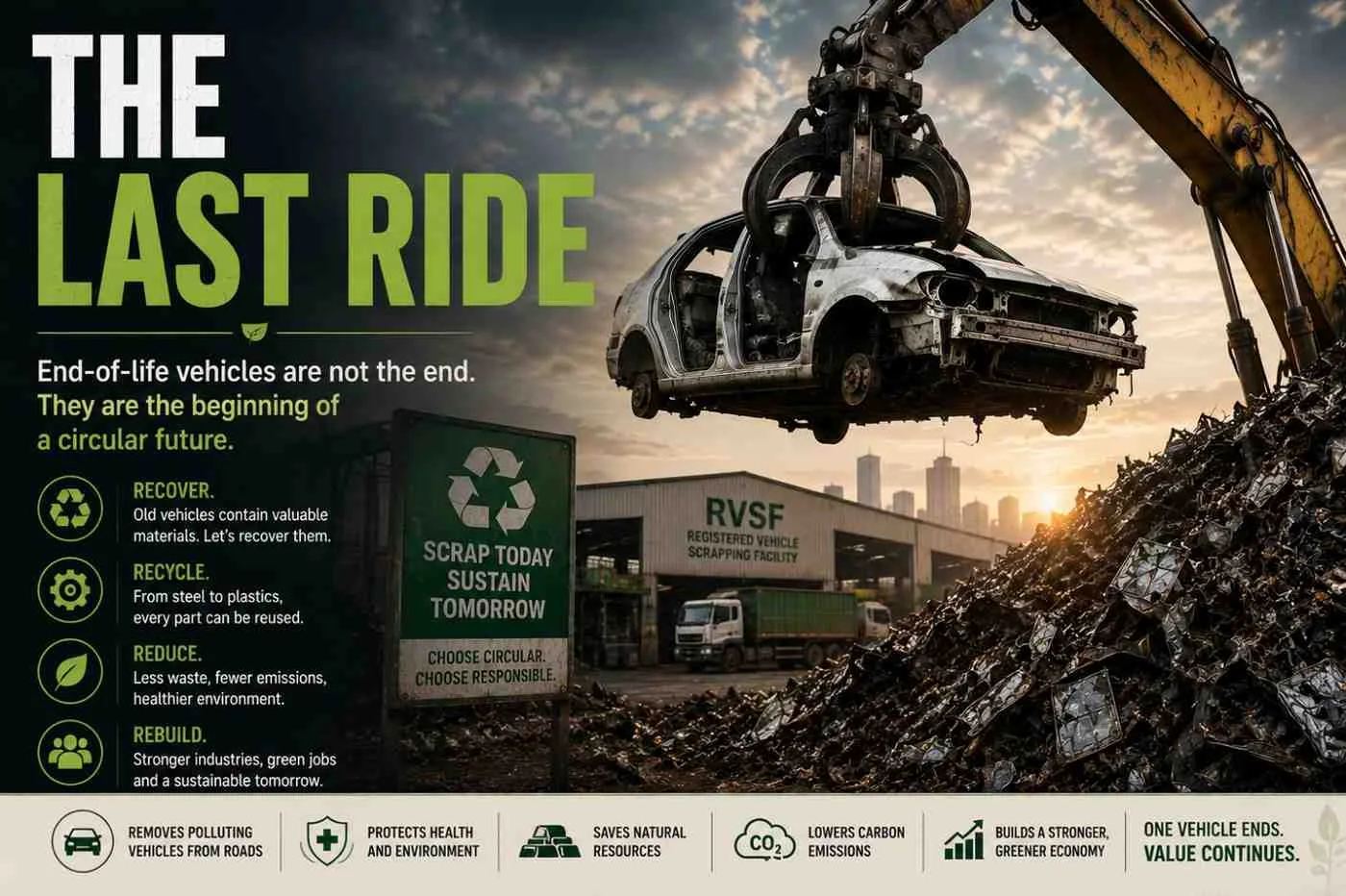
India's growing vehicle scrappage ecosystem is transforming end-of-life vehicles into valuable resources, but the success of a circular material economy will depend on formal recycling, stronger infrastructure and public participation  Kolkata | August 1, 2026:Every vehicle eventually reaches the end of its useful life. The real question is what happens next. For years, old and damaged vehicles in India were largely dismantled in informal scrapyards, where valuable materials were recovered with little environmental oversight or scientific waste management.  Today, that approach is gradually giving way to a more organised system. As India expands its vehicle scrappage programme and establishes authorised recycling facilities, end-of-life vehicles (ELVs) are beginning to play a much larger role in the country's transition towards a circular economy. The shift comes at an important moment. India is one of the world's largest automobile markets, and millions of vehicles are expected to retire from the roads over the next decade. Managing this growing volume is no longer just about disposing of ageing vehicles. It is becoming an opportunity to recover valuable resources, reduce industrial waste and strengthen sustainable manufacturing. Under the government's Vehicle Scrappage Policy, ageing and unfit vehicles are encouraged and in certain cases required- to undergo fitness assessments before being transferred to Registered Vehicle Scrapping Facilities (RVSFs). These authorised centres are designed to dismantle vehicles scientifically, safely handle hazardous components and recover reusable materials such as steel, aluminium, copper, plastics, and rubber. Experts believe this approach could significantly improve India's resource efficiency. Recovering metals from scrapped vehicles requires far less energy than extracting and processing newly mined raw materials, helping reduce both production costs and carbon emissions.Recycled steel and aluminium are also expected to become increasingly valuable as demand continues to grow across the automotive, construction and infrastructure sectors.Yet building an efficient circular material chain remains a complex task. A substantial portion of vehicle dismantling is still carried out by the informal sector, which has supported recycling activities for decades through well-established local networks. While these businesses recover a significant amount of recyclable material, environmental safeguards, worker safety standards and material traceability often remain inadequate. Integrating informal operators into a regulated recycling ecosystem is therefore seen as one of the biggest challenges facing the sector. Infrastructure presents another hurdle. Expanding the number of authorised scrapping facilities is only part of the solution. Experts say the wider ecosystem-including testing centres, dismantling capacity and supporting infrastructure- still falls short in many parts of the country.The transition also faces another obstacle: participation. Public awareness of the scrappage policy remains limited, while logistical constraints and uneven implementation across states continue to slow the growth of formal recycling systems. Experts believe that without meaningful economic incentives, encouraging wider participation from vehicle owners will remain a significant challenge. Vehicle owners are more likely to participate when scrapping offers tangible financial benefits through tax concessions, incentives or discounts on new vehicle purchases. At the same time, manufacturers stand to benefit from a more dependable supply of recycled materials, strengthening supply-chain resilience while reducing dependence on newly extracted resources. The advantages extend well beyond the automobile industry. A well-developed vehicle recycling ecosystem can reduce landfill waste, improve air quality by replacing highly polluting vehicles and create new employment opportunities across dismantling, material recovery, recycling, and secondary manufacturing. It also supports India's wider objectives of improving resource efficiency, lowering industrial emissions and promoting circular economy practices within domestic manufacturing. Environmental experts believe that transition cannot end with vehicle recycling alone.A truly circular automotive sector will require vehicles to be designed for easier recycling, valuable materials to be recovered more efficiently, battery recycling systems to expand and manufacturers to take greater responsibility for the entire life cycle of their products. As India's vehicle population continues to grow, the country's next sustainability milestone may not be measured by how many new vehicles are manufactured, but by how responsibly older ones are managed at the end of their life. The programme's success will not be measured by the number of vehicles it dismantles, but by the value it creates from them. It will be measured by how effectively yesterday's vehicles are transformed into tomorrow's resources, reducing waste, conserving raw materials and strengthening India's circular economy. The journey of a vehicle should not end at the scrapyard. In a truly sustainable economy, it should continue through the materials it leaves behind - fueling new industries, conserving natural resources and reinforcing the idea that the most valuable resources are often those already in our hands. Sources: Ministry of Road Transport and Highways (MoRTH) – Vehicle Scrapping Policy: Notifications and Ruleshttps://www.morth.gov.in/en/Circulars-Notifications-related-to-Vehicle-Scrapping-PolicyPress Information Bureau (PIB) – Vehicle Scrapping Policy: Progress of Registered Vehicle Scrapping Facilities (RVSFs)https://www.pib.gov.in/PressReleasePage.aspx?PRID=2099130&lang=2&reg=48National Government Services Portal – Registered Vehicle Scrapping Facility (RVSF) Portalhttps://services.india.gov.in/service/detail/apply-for-registered-vehicle-scrapping-facilityMinistry of Road Transport and Highways – State-wise Registered Vehicle Scrapping Facility (RVSF) Notificationshttps://www.morth.gov.in/en/rvsf-notificationsCentral Pollution Control Board (CPCB) – Environmentally Sound Management of End-of-Life Vehicleshttps://cpcb.nic.in/NITI Aayog – Reports on Circular Economy and Resource Efficiencyhttps://www.niti.gov.in/Down To Earth – Coverage on vehicle scrappage, recycling and the circular economy in Indiahttps://www.downtoearth.org.in/The Energy and Resources Institute (TERI) – Research on resource efficiency, recycling and circular economyhttps://www.teriin.org/Ministry of Steel, Government of India – Steel recycling and secondary raw materials initiativeshttps://steel.gov.in/Press Information Bureau (PIB) – Voluntary Vehicle Fleet Modernization Programme (Vehicle Scrapping Policy)https://www.pib.gov.in/newsite/erelcontent.aspx?lang=2&reg=48&relid=265928 ...Read more

01 Aug 2026

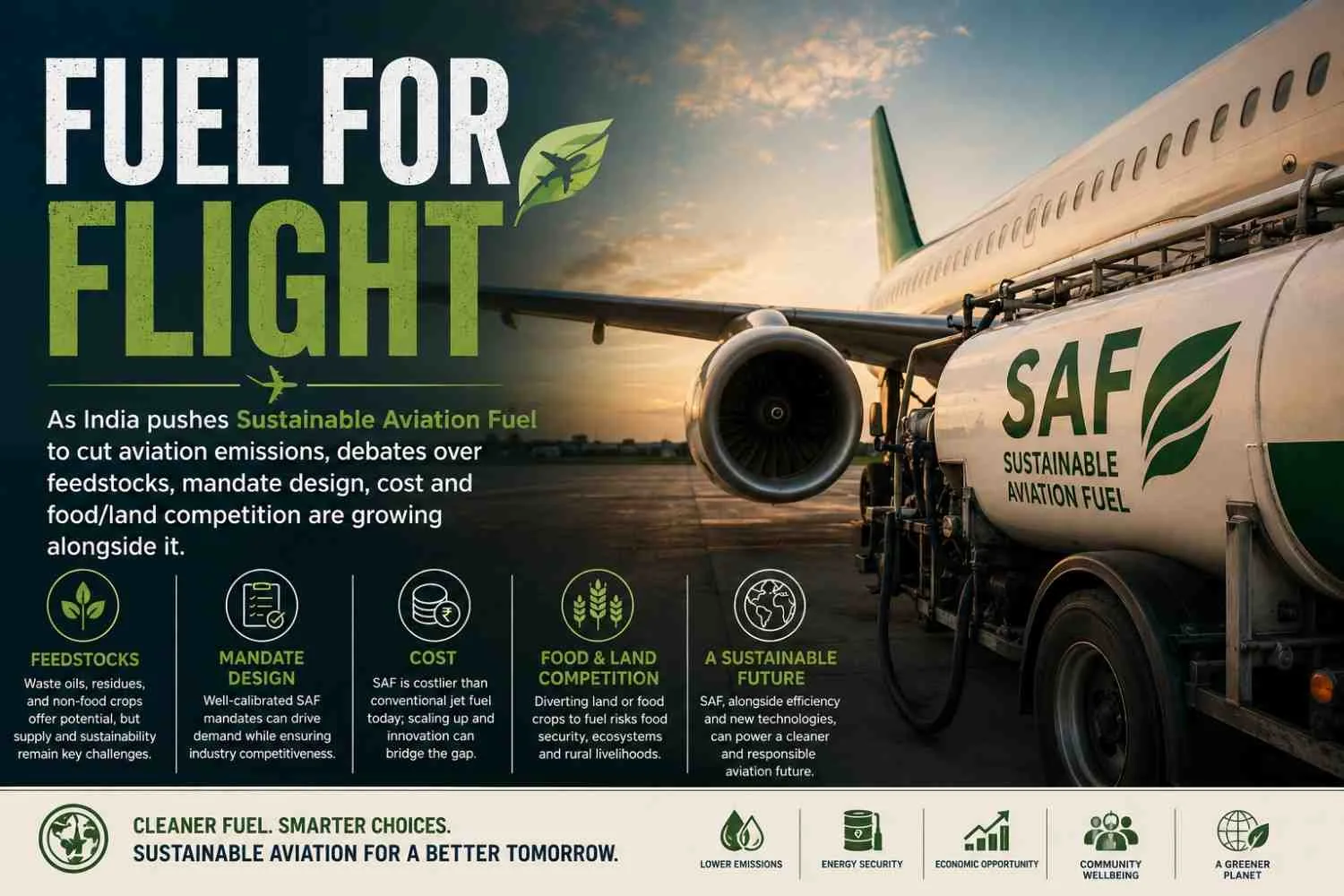
As India pushes sustainable aviation fuel to cut aviation emissions, questions over feedstocks, costs and competition for land and food are beginning to shape the debateKolkata| August 1, 2026: The future of aviation may depend not only on how aircraft are designed, but also on what powers them.Today, aviation contributes around 2–3% of global carbon dioxide emissions, and unlike road transport, long-distance flights still have limited alternatives to conventional liquid fuels. As governments and airlines look for ways to reduce emissions without disrupting air travel, Sustainable Aviation Fuel (SAF) has emerged as one of the sector's most promising solutions. For India, adopting Sustainable Aviation Fuel is not simply a question of replacing one fuel with another. It requires balancing climate ambitions with economic viability, feedstock availability and long-term sustainability. SAF is produced from renewable or waste-based feedstocks instead of conventional crude oil. Depending on the production pathway, it can substantially reduce lifecycle greenhouse gas emissions while remaining compatible with existing aircraft engines and airport infrastructure. Its compatibility with existing aircraft engines and airport infrastructure makes SAF one of the most practical and scalable solutions for reducing aviation emissions. India is gradually bringing Sustainable Aviation Fuel into the centre of its clean energy and climate strategy.Government agencies, airlines, oil marketing companies and research institutions are working to expand domestic production, support pilot projects and prepare for future blending mandates.Beyond reducing aviation emissions, these efforts are intended to strengthen energy security and help India secure a place in the emerging global SAF market. The real challenge, however, extends beyond policy ambition. It lies in ensuring a sustainable and reliable supply of feedstock that can support production on a commercial scale. Experts point to agricultural residues, used cooking oil, municipal solid waste, forestry waste and certain non-food energy crops as the most promising sources for Sustainable Aviation Fuel. Unlike food-based feedstocks, these resources can help reduce emissions without affecting food security. The challenge, however, lies in building efficient supply chains, as collecting, transporting and processing these materials remains expensive and operationally complex. The conversation becomes far more complex when cleaner fuel begins to compete with food and land resources. Using edible oils, sugar crops or fertile agricultural land as feedstocks could place additional strain on food prices, water availability and rural livelihoods. Environmental experts also warn that clearing forests or natural ecosystems to cultivate energy crops may erode many of the climate gains that Sustainable Aviation Fuel seeks to achieve. As a result, the real challenge is not simply producing cleaner aviation fuel- it is ensuring that the path to cleaner aviation does not create new environmental or social pressures along the way.  Cost remains one of the biggest hurdles for Sustainable Aviation Fuel. Production volumes are still limited, supply chains are yet to mature and, as a result, SAF continues to cost significantly more than conventional jet fuel. For airlines already operating in a highly competitive market with narrow profit margins, absorbing these additional costs will not be easy without targeted policy support and market incentives. That is why the design of future blending mandates could determine how quickly SAF moves from ambition to widespread adoption. Rather than imposing immediate large-scale adoption, many countries are introducing phased blending mandates that gradually expand the use of Sustainable Aviation Fuel while supporting domestic production and maintaining industry competitiveness. Experts argue that India will need a similar approach—one that balances climate commitments with commercial realities and gives producers, refiners and airlines the certainty and time needed to expand investments, production capacity and supporting infrastructure.Despite these challenges, experts emphasise that Sustainable Aviation Fuel is only one part of the solution. Reducing aviation emissions will also depend on more fuel-efficient aircraft, improved air traffic management, operational efficiencies and the development of future technologies such as hydrogen-powered aircraft. The future of aviation decarbonisation won’t rest on SAF alone. It will sit alongside efficiency, new aircraft, and operational changes. For India, Sustainable Aviation Fuel represents more than an alternative fuel- it offers an opportunity to reshape the future of cleaner aviation. A successful SAF ecosystem could create economic value from agricultural waste, strengthen energy security, encourage innovation and help the country move closer to its climate commitments. But lasting success will depend on ensuring that the transition protects food security, safeguards ecosystems and supports the communities that depend on them. The future of aviation will not be judged only by how much it reduces emissions, but by how responsibly it achieves that transition. Because sustainable flight truly begins long before it’s take-off - with fuel that is as sustainable in its production as it is in its purpose. Sources: International Civil Aviation Organization (ICAO) – SAF Feedstocks (CORSIA Framework)https://www.icao.int/CORSIA/feedstocksInternational Civil Aviation Organization (ICAO) – Guidance on Policy Measures for SAF Development and Deploymenthttps://www.icao.int/SAF/saf-guidance-policy-measuresInternational Civil Aviation Organization (ICAO) – SAF Rules of Thumb (Feedstocks, Costs & Production Pathways)https://www.icao.int/SAF/saf-rules-of-thumbICAO ACT-SAF Programme – India Sustainable Aviation Fuel Feasibility Studyhttps://www.icao.int/sites/default/files/environmental-protection/Documents/ACT-SAF/Feasibility_Study_India.pdfInternational Air Transport Association (IATA) – Global Feedstock Assessment for SAF Production Outlook to 2050https://www.iata.org/globalassets/iata/publications/sustainability/global-feedstock-assessment-for-saf-production-outlook-to-2050.pdfMinistry of Petroleum and Natural Gas (Government of India) – Biofuels and Sustainable Aviation Fuel policy updateshttps://mopng.gov.in/Ministry of Civil Aviation (Government of India) – Aviation sustainability initiatives and SAF developmentshttps://www.civilaviation.gov.in/NITI Aayog – Reports on biofuels, energy transition and low-carbon transporthttps://www.niti.gov.in/International Energy Agency (IEA) – Aviation and Sustainable Fuelshttps://www.iea.org/Down To Earth – Coverage on SAF, biofuels, feedstock availability and food-versus-fuel concerns in Indiahttps://www.downtoearth.org.in/ ...Read more

01 Aug 2026

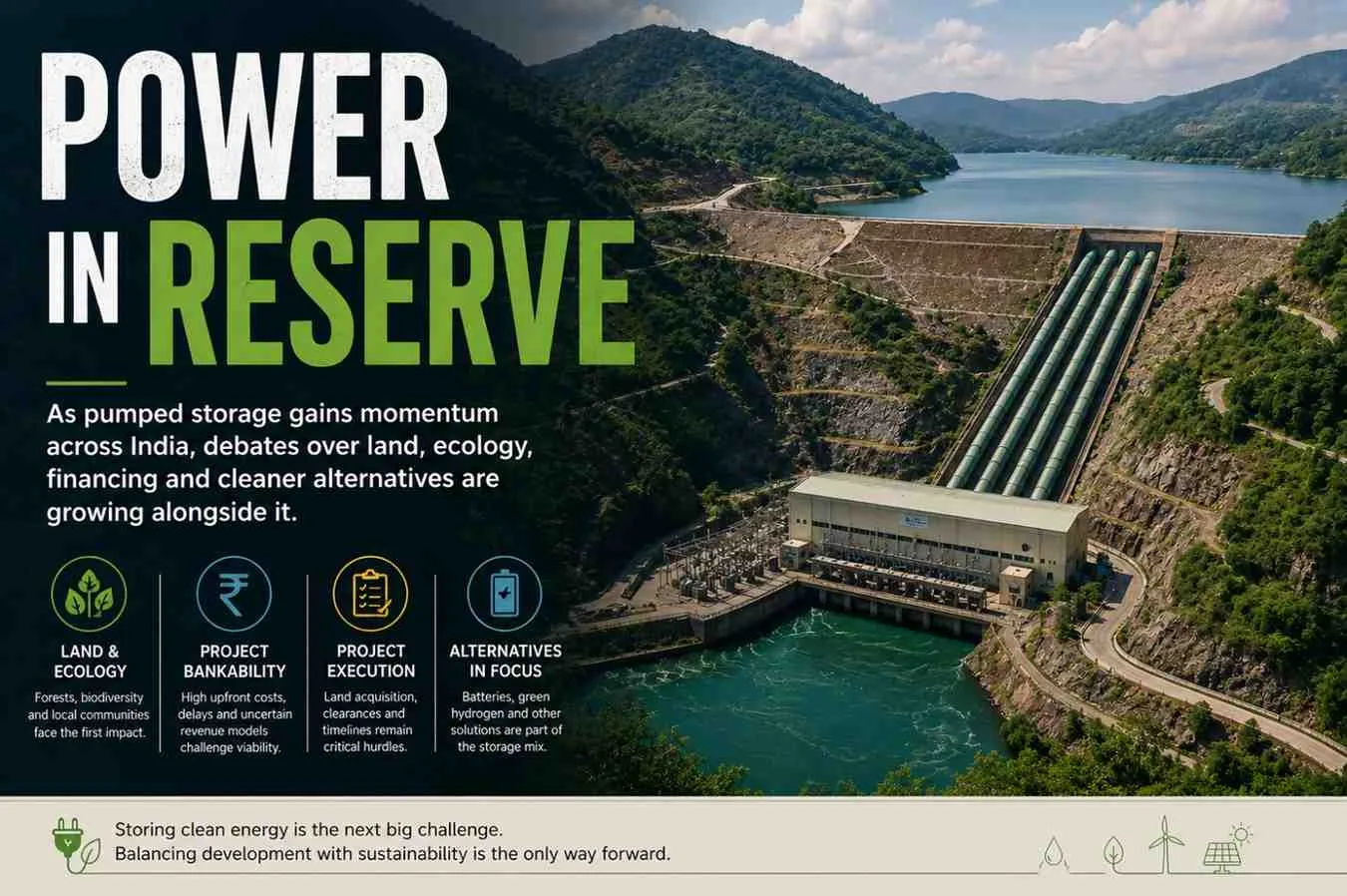
As pumped storage gains momentum across India, debates over land, ecology, financing and cleaner alternatives are growing alongside it KOLKATA | August 1, 2026: India's renewable energy capacity is expanding rapidly, but the next phase of the transition will depend on solving a critical challenge: storing clean electricity when renewable sources are not generating power. Pumped storage hydropower (PSH) has emerged as one of the country's most promising solutions and is now playing a central role in India's energy planning. However, as projects begin moving from policy announcements to on-ground development, they are also raising important questions about land, ecology, financial viability and whether alternative storage technologies can deliver the same benefits with fewer trade-offs. Pumped storage hydropower functions like a giant rechargeable battery. Surplus electricity is used to pump water from a lower reservoir to an upper one, where it is stored until demand rises. When additional power is required, the water is released back through turbines to generate electricity. Its ability to provide long-duration energy storage and stabilise the electricity grid has made pumped storage an important part of India's strategy for integrating larger amounts of solar and wind power. Pumped storage hydropower is emerging as a cornerstone of the Union government's long-term clean energy strategy. Across states such as Maharashtra, Andhra Pradesh, Madhya Pradesh, Odisha and Karnataka, a growing pipeline of projects is expected to play a vital role in integrating larger volumes of solar and wind power into the grid. Yet as development gathers pace, the conversation is expanding beyond energy storage to include questions of land, ecology, financial viability and sustainability. While pumped storage offers important benefits for the power sector, many proposed projects are located in ecologically sensitive hilly and forested areas. Developing two reservoirs often requires significant land acquisition and extensive civil works. Experts caution that large-scale construction, forest diversion and changes to natural drainage systems could have lasting impacts on biodiversity, wildlife movement and local ecosystems. In many regions, residents have also expressed concerns about displacement, water availability and the long-term effects on their livelihoods. Financial sustainability is another issue shaping the debate. The financial challenge begins long before a pumped storage project starts generating electricity. While these facilities can operate for decades with relatively low operating costs, they demand substantial upfront investment and long construction timelines. Delays in environmental clearances, land acquisition or financing can sharply increase costs and affect overall project viability. Developers also need reliable revenue mechanisms that recognise the value of energy storage and grid-balancing services, rather than compensating only for electricity generation. These constraints have led to a broader discussion on whether alternative storage technologies could offer faster or more flexible solutions.Battery Energy Storage Systems (BESS) are emerging as a promising alternative, with declining costs and faster deployment making them well suited for a wide range of energy storage applications.Yet experts believe each technology serves a different purpose. While batteries perform well for short-duration storage, pumped storage hydropower remains better suited for storing large amounts of electricity over longer periods. Other solutions, including green hydrogen and advanced battery technologies, are also making steady progress, but they are still some ways from delivering the scale and reliability needed to support India's national electricity grid. Experts argue that pumped storage and batteries should be viewed as complementary rather than competing technologies. As renewable energy expands, India's electricity system is expected to require a combination of storage solutions capable of meeting different grid requirements. At the same time, policymakers face a broader challenge. Future projects will need rigorous environmental assessments, transparent engagement with local communities, fair compensation frameworks and stronger ecological safeguards to support both sustainable development and investor confidence. As India's renewable energy capacity continues to grow, pumped storage hydropower is expected to play a defining role in keeping the power system reliable. But its legacy will not be determined by storage capacity alone. It will be defined by whether development can balance environmental responsibility, financial sustainability and public trust alongside the country's growing energy needs.In the years ahead, the clean energy transition will be judged not only by how much renewable electricity India generates, but by how responsibly it chooses to store it. Sources: Ministry of Power, Government of India – Pumped Storage Projects Guidelines & Policy Initiativeshttps://powermin.gov.in/ Central Electricity Authority (CEA) – National Electricity Plan (Volume II: Transmission & Energy Storage)https://cea.nic.in/ NITI Aayog – Energy Storage Roadmap for Indiahttps://www.niti.gov.in/ International Energy Agency (IEA) – Electricity Storage & Hydropower Analysishttps://www.iea.org/ International Hydropower Association (IHA) – Pumped Storage Hydropowerhttps://www.hydropower.org/ Central Electricity Authority (CEA) – Status of Pumped Storage Projects in Indiahttps://cea.nic.in/hydro/ Down To Earth – Reports on pumped storage projects, environmental clearances and ecological concerns in India.https://www.downtoearth.org.in/ Mongabay India – Coverage of pumped storage projects, biodiversity impacts and community concerns.https://india.mongabay.com/ The Hindu BusinessLine – Coverage on pumped storage investments, project financing and renewable integration.https://www.thehindubusinessline.com/ Ministry of Environment, Forest and Climate Change (MoEFCC) – Environmental clearance notifications and project approvals.https://moefcc.gov.in/ ...Read more

31 Jul 2026

RESEARCH + POLICY + MARKETPLACE Green products, India’s Ecomark, global ecolabels and the shift from attractive claims to verifiable product evidence A critical evaluation of the Ecomark Rules, 2024, with a six-part product-claim test, label glossary, international comparisons, market-readiness scorecard and a roadmap for a credible green marketplace in India. MATERIALSTraceable inputsUSE PHASEDurable + repairableEND OF LIFECollected + recovered Status date: 29 July 2026 Magazine-style research report | 5,000+ words | India and international evidence BOTTOM LINEIndia has moved from a largely dormant 1991 label to a more credible legal framework in 2024. But the Ecomark is still better described as institutionally re-designed than marketplace-ready: certification counts, a consumer-facing registry, procurement preference, retailer integration, repairability scores and measurable public outcomes remain the decisive missing links. Contents 1. The green-shopping problem: abundance of claims, shortage of proof 2. What a credible green-product label must establish 3. How the world built ecolabels: timeline and institutional models 4. India’s Ecomark: why the 1991 scheme failed 5. The Ecomark Rules, 2024: what changed and what did not 6. Critical evaluation: a strong rulebook with a weak market engine 7. Progress through July 2026: rules, draft criteria, claims control and repair information 8. Global lessons and cases: Blue Angel, EU Ecolabel, Nordic Swan, ENERGY STAR and France 9. Product claim test, label glossary and marketplace-readiness scorecard 10. The future: from a logo to a green trust stack 11. Ten actions that can make Ecomark work 12. Sources and further reading Research method and a necessary caution In this report, the current statistics and legal status were then rechecked against official Indian, European, German, Nordic, French and United States sources. This matters because the green-label field changes quickly: for example, current official counts for Blue Angel and the EU Ecolabel are substantially higher than older figures, and the June 2026 Indian criteria are a draft under consultation rather than final law. The phrase “green product” is itself comparative. No credible label proves that a product is environmentally harmless. At best, it establishes that a particular product or service meets stated criteria, within a stated boundary, at a stated time, using a stated method. This report therefore asks not whether a label is perfect, but whether it is specific, independently verifiable, transparent, updated, enforceable and useful at the point of purchase. 1. The Green-Shopping Problem: Plenty of Claims, Too Little Proof Walk through a supermarket, electronics store or online marketplace and the vocabulary of virtue is everywhere: natural, clean, conscious, planet-positive, carbon-neutral, recyclable, biodegradable, sustainable, responsible. The visual grammar is equally familiar—green leaves, blue globes, forests, water droplets and earthy colours. Yet the shopper is rarely told the most important facts: what exactly has improved, compared with what, across which part of the lifecycle, tested by whom, for which product model, and for how long. This is why ecolabelling has become both necessary and controversial. The abundance of labels does not automatically produce clarity. ISO distinguishes between Type I multi-criteria labels independently awarded by a third party; Type II self-declared claims made by manufacturers; and Type III environmental product declarations that disclose quantified lifecycle information. These are not interchangeable. A company’s “100% recyclable” statement is not the equivalent of a government-backed, audited, category-specific ecolabel, and neither is the same as a verified environmental product declaration. THE CENTRAL CONSUMER TESTA claim is not credible merely because it is technically possible. “Recyclable” packaging may be impossible to collect locally. “Compostable” material may require an industrial facility that does not exist nearby. “Carbon neutral” may describe purchased offsets rather than a low-carbon product. The consumer needs evidence of real-world systems, not only laboratory possibilities.   A useful label also has to survive the “quality paradox”. A lightweight product made with fewer materials may be worse for the environment if it breaks in half the time. A refill pack may reduce packaging but increase leakage or contamination. A bio-based material may come from land-intensive or poorly traced feedstock. The green-shopping question is therefore multi-dimensional: materials, performance, durability, repairability, packaging, hazardous substances, use-phase energy and water, and end-of-life responsibility must be examined together. “The future is not trust the leaf. It is verify the product.” 2. What a Credible Green-Product Label Must Establish A serious consumer system should force every important claim through six gates. Each gate answers a different question, and failure at any one can make the overall “green” story misleading. DimensionCredible evidenceRed flagsIndia market readinessMaterialsExact recycled, renewable or bio-based percentage; chain-of-custody or mass-balance method; restricted substances; supplier evidence; product/SKU scope.Vague “made with recycled material”; no percentage; company-wide data applied to one product; bio-based treated as automatically low-impact.Moderate. Mature in paper, metals and simple plastics; weaker in composites, electronics, fashion blends and informal supply chains.DurabilityRecognised stress, wear, cycle or reliability tests; stated expected life under defined use; warranty and failure-rate evidence.“Long-lasting” without test standard; a long warranty with exclusions; environmental savings calculated against unrealistic life.Emerging. Strongest where regulators require a score; otherwise usually hidden from shoppers.RepairabilityDisassembly with common tools; spare-part availability and price; manuals; diagnostic access; software/security support; non-destructive battery replacement.Parts technically available but prohibitively priced; parts paired by software; no manuals; repair voids warranty; support period unstated.Low-to-moderate in India; higher in parts of Europe. Information portals are not yet the same as comparable repair scores.PackagingPackaging-to-product ratio; recycled content; certified compostability and conditions; local recyclability; refill/reuse system; EPR registration.“Plastic-free” outer box around multilayer inner pack; recyclable in theory but not collected; biodegradable without timeframe or conditions.Moderate-to-high for basic formats, but multilayer films, small formats, inks, adhesives and collection gaps remain major barriers.CertificationIndependent, competent and accredited verifier; public criteria; certificate number, scope and expiry; audit evidence; conflict-of-interest controls.Brand-created badge; certificate for factory rather than product; expired licence; audit firm paid without safeguards; no public registry.Transitioning. Strong official schemes exist, but label proliferation and inaccessible registers weaken trust.End of lifeTake-back route; producer/EPR registration; recycler identity; actual collection and recovery rates; safe handling of hazardous residue; geographic availability.“100% recyclable” with no collection channel; take-back only in a few metros; recovery claimed from certificates rather than physical evidence.Moderate in regulated categories; weak where reverse logistics and municipal segregation are poor, especially outside large cities. The unit of truth is the exact product Environmental marketing frequently shifts between levels: a company may have a renewable-energy target, a factory may hold ISO 14001 certification, a package may contain recycled plastic, and a particular product may have none of those advantages. Credible labelling must identify the exact stock-keeping unit or model, production boundary, facility where relevant, validity period and evidence base. A sustainable company claim cannot silently substitute for product evidence; nor can a single greener attribute stand in for overall environmental preferability. 3. How the World Built Ecolabels: Who, When and Where The international history shows three broad waves. The first established visible trust marks. The second standardised claim types and laboratory methods. The third, now under way, connects labels to durability, repair, digital records and anti-greenwashing law. 1978 | GermanyBlue Angel became the first major national ecolabel. It uses product-group criteria, an independent Environmental Label Jury and public product listings.   1989 | Nordic region and JapanThe Nordic Council of Ministers created the Nordic Swan; Japan’s Eco Mark also began. Both apply category criteria and lifecycle thinking.   1991 | IndiaIndia launched Ecomark with the earthen-pot symbol, requiring environmental criteria plus relevant Indian quality standards.   1992 | European Union and United StatesThe EU Ecolabel began as a multi-country Type I scheme. ENERGY STAR began as a focused energy-efficiency label and later became one of the world’s best-known endorsement marks.   1990s–2020s | ISO systemISO 14020-series standards clarified general principles, self-declared claims, Type I labels and Type III environmental declarations.   2021 | FranceA mandatory repairability score out of 10 appeared at the point of sale for selected electronics and appliances.   2024–2026 | EuropeThe EU adopted rules against generic environmental claims, a Right to Repair directive and the Ecodesign for Sustainable Products Regulation with digital product passports.   2024–2026 | IndiaIndia replaced the 1991 scheme with the Ecomark Rules, 2024, issued anti-greenwashing guidelines, expanded repair information, and proposed tougher category criteria in June 2026.   What separated successful schemes from symbolic ones? Successful labels did not rely on the logo alone. They built a surrounding market system: clear criteria, visible product catalogues, recurring review, independent verification, public procurement, retailer display, enforcement against misuse and a consumer benefit that could be understood quickly. ENERGY STAR made operating-cost savings visible. Blue Angel connected criteria to procurement and a large searchable catalogue. France placed a comparative repair or durability score beside the price. In each case, the environmental signal became part of the buying transaction rather than a distant policy aspiration. 4. India’s Ecomark: An Early Idea That Failed to Create a Market India’s 1991 Ecomark was conceptually ahead of its time. The matka symbol represented renewable materials, low-energy production and the fragility of ecosystems. The scheme eventually covered a broad set of categories, including paper, paints, batteries, detergents, textiles, leather, coir, plastics, cosmetics, food items and packaging. Its cradle-to-grave framing was sound: the mark was intended for products that satisfied both environmental criteria and relevant quality standards. But the market barely noticed. A 2006 CUTS International assessment found that only 12 manufacturers had applied over roughly fifteen years and that even licence holders often did not use the mark prominently because it created little market benefit. A 2009 government statement recorded twenty licences awarded to fifteen companies in only three product categories. The exact historic count varies by date and measure, but the conclusion is consistent: the scheme never approached meaningful scale. Why the first Ecomark stalled No demand pull: consumers did not recognise the symbol, retailers did not differentiate it and manufacturers saw no price or volume advantage.An additional compliance layer: firms had to satisfy environmental requirements on top of BIS quality requirements, without offsetting incentives.Weak institutional ownership: fragmented committees, frequent transfers and no dedicated mission-style organisation diluted accountability.No procurement engine: government purchasing did not create a guaranteed initial market for compliant paper, paints, furniture, cleaning products or office supplies.Static or slowly updated criteria: the scheme did not keep pace with new materials, circular design, toxic-substance controls, electronics, repairability or digital traceability.Poor transparency: there was no easy public registry of applications, licences, product models, test reports, expiry dates or enforcement actions.MSME economics: testing, documentation and process upgrades were costly for smaller manufacturers, while the commercial return was uncertain.Product-heavy design: environmental performance of services—hotels, cleaning, logistics, retail, events—received little practical attention. THE ENDURING LESSON FROM 1991–2023Good criteria are necessary, but a label becomes real only when someone wants to buy it, someone can verify it, and someone is punished for misusing it. Ecomark’s first generation had a certification concept without a market-transformation strategy.   5. The Ecomark Rules, 2024: What Changed On 26 September 2024, the Ministry of Environment, Forest and Climate Change notified the Ecomark Rules, 2024 under the Environment (Protection) Act framework and rescinded the 1991 notification. The purpose is broader than branding: the rules link Ecomark to Mission LiFE, resource efficiency, conservation, circular economy, lower adverse environmental impact, consumer information and the prevention of misleading environmental claims. A stronger institutional design Administration shifts to the Central Pollution Control Board in partnership with the Bureau of Indian Standards. A product ordinarily needs the applicable BIS licence, certificate of conformity or Quality Control Order compliance, and must then meet category-specific Ecomark criteria. This two-layer test protects against a common failure of green marketing: a product should not be called environmentally preferable if it cannot also perform safely and effectively. The Steering Committee is wider than the old architecture. It includes representatives from consumer affairs, industry, information and broadcasting, chemicals, agriculture, health, MSME, power, drinking water, expenditure, external affairs, commerce, textiles, scientific institutions, BIS and CPCB, along with experts and industry. On paper, this creates the possibility of linking criteria to consumer protection, trade, public expenditure, industrial policy and communication. Lifecycle criteria—but with flexibility The rules permit category criteria to address raw-material sources, manufacturing processes, natural-resource use, environmental impacts, emissions and waste, recycled content, hazardous substances, recyclability, disposal of product and packaging, and EPR compliance. That breadth is a major improvement over one-attribute green claims. It allows Ecomark to distinguish an environmentally preferable product rather than merely certify one recycled component or one efficient factory. Verification, limited validity and post-market checks Applications are made to CPCB. Verification may be undertaken by CPCB or a registered verifier, with a report to be prepared within sixty days of verification. A granted Ecomark is valid for three years or until the criteria change, whichever is earlier; holders must file annual reports. CPCB may suspend or cancel the mark for false information or wilful concealment, and market verification may be conducted through CPCB or registered agencies. These are meaningful safeguards against the “certify once, drift forever” problem. A portal is not a side feature—it is the credibility infrastructure The rules require CPCB to develop a portal for applications, grants, annual reports and verifier registration. The portal is also expected to publish holders, certified products, the reports on which grants are based, environmental research, benefits and relevant international practices. The rules permit consideration of domestic and foreign ecolabel programmes for recognition or mutual recognition. If fully implemented, this would allow a shopper, buyer, journalist or regulator to move from a logo to auditable evidence. 6. Critical Evaluation: A Stronger Rulebook, an Incomplete Market System The 2024 rules deserve credit for rebuilding the legal and institutional foundation. They do not, however, resolve the commercial and consumer failures that defeated the first scheme. The following scorecard is an analytical assessment, not an official rating. DimensionScoreWhat worksWhat remains weakLegal foundation4/5A formal rule-based scheme under environmental law, with defined authorities, application, validity, cancellation and appeal.The rules do not themselves create a detailed Ecomark-specific penalty schedule for every misuse; effective deterrence depends on wider environmental and consumer law enforcement.Scientific breadth3/5Criteria may cover lifecycle impacts, resources, pollution, hazardous substances, recycled content, recyclability and EPR.The final 2024 framework does not require a uniform, public LCA method, functional unit or comparative “best-in-class” threshold across all product groups.Verification3/5CPCB/registered verifier review, annual reporting and post-market verification are built in.Verifier accreditation, conflict-of-interest controls, audit sampling, fees and public disclosure need operational detail and visible implementation.Transparency2/5A public portal and publication of holders, products and underlying reports are explicitly envisaged.As of this review, an easily discoverable, consumer-facing registry with current product counts and model-level reports could not be located on the main public interfaces.Consumer usability1.5/5A single government-backed mark could reduce label clutter.The rules do not provide a simple comparative score for durability, repairability, carbon, water or lifecycle cost; a static logo cannot answer every consumer question.Market pull1/5The Steering Committee includes public expenditure and multiple market-facing ministries.No automatic purchase preference, retailer display rule, e-commerce filter or fiscal incentive is created by the rules.MSME accessibility1.5/5MSME representation exists in governance.No clear fee subsidy, shared testing infrastructure, transition finance, simplified evidence pathway or small-business technical assistance is guaranteed.Circularity integration3/5EPR, recycled content, recyclability and disposal can be embedded in criteria.No cross-category repairability, spare-parts, take-back performance or digital product passport requirement appears in the final 2024 rules.Services1.5/5The legal concept could potentially evolve.The operative market emphasis remains consumer products; India has not yet matched mature ecolabel coverage of accommodation, cleaning, logistics or other services.OVERALL ASSESSMENTApproximately 2.4/5: a promising certification architecture, but not yet a complete consumer-market institution. The biggest gap is no longer the absence of legal criteria; it is the absence of visible demand, comparable information, measurable uptake and an easily verified product universe.    The BIS gate: protection and bottleneck Requiring basic quality conformity is defensible: environmentally preferable goods must not compromise safety or function. Yet the BIS/QCO gate can also become an entry barrier when no suitable Indian Standard exists, when an innovative product does not fit an established category, or when an MSME faces duplicate documentation and testing. The solution is not to abandon quality control, but to create coordinated, single-window evidence, clear category manuals, recognised test laboratories and subsidised pathways for smaller firms. The “best-in-class” question Mature Type I schemes are usually designed to identify a leading segment of a category and then tighten criteria periodically. The Ecomark Rules state desirable environmental outcomes but do not consistently define the label as the top-performing share of the Indian market. Without a comparative ambition, Ecomark risks becoming “compliant plus” rather than a mark of environmental leadership. Category rules should therefore state the market baseline, expected qualifying share and revision trigger. ISO 14001 is useful—but it is not a green-product certificate The June 2026 draft criteria often require ISO 14001 environmental-management certification. That may improve process discipline, but it certifies a management system, not the lifecycle superiority of a specific product. A factory can operate an ISO 14001 system and still produce a relatively high-impact product. Ecomark must therefore treat management-system certification as supporting evidence, never as a substitute for product-level thresholds and verified outcomes. 7. Actual Progress Through July 2026 The strongest conclusion is mixed: policy construction has accelerated, but public evidence of market penetration remains thin. Four developments matter. 1. Anti-greenwashing rules now flank Ecomark On 15 October 2024, the Central Consumer Protection Authority issued Guidelines for Prevention and Regulation of Greenwashing or Misleading Environmental Claims. They require clear, specific and substantiated claims; generic terms such as sustainable, natural, organic and regenerative need adequate qualification; comparative claims need verifiable evidence; and credible certification or scientific evidence is expected. ASCI’s environmental-claims rules similarly state that broad claims such as eco-friendly or planet-friendly require robust support and cannot be rescued by a distant disclaimer. This is a crucial complement to Ecomark. A voluntary label can reward better products, while consumer-protection rules can police misleading claims across the rest of the market. The unresolved task is enforcement integration: complaints, investigations, Ecomark misuse, advertising decisions and certificate cancellation should flow through interoperable systems and become visible in a public enforcement register. 2. June 2026 draft amendments move from principles to measurable category rules On 8 June 2026, MoEFCC published draft amendments for sixty days of public consultation, ending 6 August 2026. The proposals cover six areas—paints and coatings, batteries, paper and paper products, wood substitutes, fire extinguishers and coir products—and introduce substantially more specific requirements. Examples include QR-linked criteria and end-of-life information; chemical restrictions; renewable-energy thresholds; EPR registration; traceability; recycled-content requirements; accredited testing; ISO 14001; and lifecycle narratives in selected categories. The battery proposals are especially concrete: limits on mercury and cadmium, EPR registration, restrictions on chlorine-containing plastic/PVC, packaging conditions, rising domestic recycled-lead thresholds, collection and recycling obligations, and energy-reduction requirements. Paper criteria include high recovered-paper content for recycled products, bleaching restrictions and a cradle-to-gate LCA narrative. Coir criteria add traceability, heavy-metal testing, renewable-energy and water-management requirements, compostable packaging and QR-linked disposal information. IMPORTANT LEGAL STATUSThese June 2026 provisions are draft amendments under consultation as of 29 July 2026. They are evidence of policy direction, not completed certification outcomes. A rigorous market assessment must not count proposed QR codes, thresholds or category tests as already operating nationwide.   Where the 2026 draft still needs refinement Method consistency: some categories receive numerical limits, others rely on management systems or narrative evidence. A common hierarchy of product outcomes, facility controls and documentation is needed.Lifecycle boundary: a cradle-to-gate narrative is useful but does not capture use, durability, repair or disposal. High-impact categories need cradle-to-grave methods and declared functional units.Packaging language: “biodegradable” or “compostable” requirements must specify test standards, time, conditions, toxicity and the collection system in which the material will actually be treated.MSME transition: renewable-energy shares, laboratory testing, traceability and LCA can be costly. Shared facilities, phased deadlines and financial support are essential.Data architecture: QR codes should point to standardised, machine-readable, persistent product records—not brand marketing pages that can change or disappear.Outcome verification: EPR registration proves legal enrolment, not actual collection. Ecomark should disclose physical collection, reuse and recycling performance. 3. Right to Repair has begun as an information portal, not yet a comparative right India’s Right to Repair portal covers farming equipment, mobiles and electronic devices, consumer durables and automobile equipment, and lists participating brands. It can provide warranty, service-network and spare-part information. This is a useful foundation for extending product life. But product records vary in completeness, and the portal does not yet provide a mandatory, standardised repairability score beside the price. Information availability is therefore emerging; comparable repair performance and enforceable access remain incomplete. 4. BEE shows that Indian labelling can transform a market The Bureau of Energy Efficiency’s Standards and Labelling programme is the clearest domestic counter-example to Ecomark’s historical stagnation. It launched in 2006 with a simple 1-to-5 star comparison tied directly to electricity-bill savings. By 2025, BEE reported 38 covered appliance categories, 3,662 registered brands, 58 crore star-labelled appliances produced and 89.8 billion units of savings. In March 2026, BEE launched a mobile application that lets consumers scan a QR code for authentic model and compliance information. BEE succeeded because it combined mandatory coverage in important categories, a comparative visual language, regular ratcheting of standards, market surveillance, databases, public communication and a wallet benefit. Ecomark cannot copy the same methodology across every environmental dimension, but it can copy the institutional lesson: the consumer must understand the signal in seconds and verify it in one scan. So, how market-ready is Ecomark? As of 29 July 2026, the framework is legally and institutionally more ready than the market. MoEFCC’s 2024–25 annual report records the notification and its intended implementation. The 2026 draft shows active technical development. Yet this research did not find, through the main public CPCB, MoEFCC and BIS interfaces, a readily discoverable product registry displaying current applications, granted marks, exact models, reports, expiry dates and post-market actions. Nor was an official, current aggregate certification count located. That absence does not prove that no applications or grants exist; it does mean that a consumer or buyer cannot yet easily verify scale and availability. Marketplace readiness should therefore be described as nascent. Paints, batteries, paper, cleaning products, packaging, textiles and electronics are technically suitable categories. Retail and e-commerce systems can display the mark. Testing and EPR infrastructures exist in parts. But demand, visibility, searchable evidence, MSME participation and procurement preference have not yet combined into a self-reinforcing market. 8. Global Lessons: What Has Worked—and What Has Not Germany’s Blue Angel: credibility through longevity, criteria and catalogue Launched in 1978, Blue Angel is the foundational example of a government-backed Type I ecolabel. Its official catalogue now reports more than 70,000 products and services from over 1,800 companies. The German Environment Agency develops criteria, the independent Environmental Label Jury decides on new and revised criteria, and RAL handles certification. Product groups publish detailed Basic Award Criteria and certified items are searchable. Its strength is not perfection but institutional repetition: category selection, stakeholder hearings, evidence, award, publication, expiry and revision. Blue Angel also reaches public and institutional purchasing. A recycled-paper label becomes commercially meaningful when offices, schools and government departments buy to the standard. The broader lesson for India is that procurement can create the first reliable market before mass consumers learn the label. EU Ecolabel: scale, services and integration with consumer law The EU Ecolabel began in 1992 and operates through product-group criteria and national competent bodies under a common regulation. As of March 2026, the European Commission reported 3,541 licences covering 116,692 goods and services; 61% of licence holders were SMEs. The scheme includes detergents, paper, paints, textiles and tourist accommodation, demonstrating that ecolabelling can assess operational services as well as manufactured goods. Its influence is being strengthened by adjacent law. Directive (EU) 2024/825 applies from 27 September 2026 and restricts generic environmental claims and sustainability labels that are not based on recognised certification schemes or public authority systems. This does not make the EU Ecolabel mandatory, but it improves the competitive position of credible labels by making unsupported alternatives legally riskier. Nordic Swan: lifecycle thinking that includes service quality The Nordic Swan was created in 1989 by the Nordic Council of Ministers and remains the official ecolabel of Denmark, Finland, Iceland, Norway and Sweden. Nordic Ecolabelling describes it as an ISO 14024 Type I, independent third-party scheme with a holistic lifecycle perspective. Its reported recognition across the Nordic region is exceptionally high. Criteria extend to services and operational systems, while quality and function are treated as environmental variables because a product that lasts longer or works at a lower dose may have lower overall impact. ENERGY STAR: the power of one simple, verifiable benefit ENERGY STAR is narrower than a multi-criteria ecolabel, but its market success is instructive. It is government-backed, uses product performance specifications and third-party certification, and tells a simple story: this model uses less energy and should cost less to operate. The programme reports recognition by about nine in ten United States households and has a substantial cumulative emissions impact. The label works because the benefit is measurable, comparable and financially relevant. France: put repairability and durability beside the price France made repairability visible from 1 January 2021 through a mandatory score out of 10 for selected electrical and electronic products. The score considers documentation, disassembly, spare parts, price and product-specific factors. In 2025, a durability index replaced it for televisions from 8 January and washing machines from 8 April, adding reliability, robustness, maintenance and resistance to wear. Sellers must display the score near the price in stores and online. The French model is not foolproof: much of the calculation is manufacturer-generated and regulators must inspect supporting evidence. But it solves a problem that static ecolabels do not—the shopper can compare competing models on a specific circular-economy attribute at the exact moment of purchase. India should combine Ecomark’s holistic endorsement with mandatory comparative indices in high-impact categories. EU digital product passports: the label becomes a data layer The EU’s Ecodesign for Sustainable Products Regulation, in force since 2024, establishes a framework for durability, repairability, recycled content, environmental footprint and other product requirements. It also creates the Digital Product Passport: a structured record connected to a product through a data carrier such as a QR code. Depending on product rules, the passport can include model or batch identity, compliance documents, materials, substances of concern, repair information, environmental performance and end-of-life instructions. Online marketplaces must be able to expose relevant passport access before purchase. The decisive shift is from “trust this symbol” to “inspect this evidence”. A passport does not eliminate false data; it improves traceability, interoperability and enforcement. India’s 2026 draft QR proposals are a first step, but Ecomark should eventually define common data fields, persistent identifiers, APIs, access rights, retention rules and links to BIS, EPR, customs, ONDC, GeM and consumer-complaint systems. No scheme is foolproof: five recurring failure modes Boundary manipulation: a label covers packaging, a factory or one ingredient while advertising implies the whole product or company is green.Audit dependence: third-party verification can fail through weak sampling, conflicts of interest, competence gaps, fraud or industry capture.Criteria lag: a once-leading threshold becomes average as technology improves, but the label remains unchanged.Burden shifting: reducing carbon can increase toxicity, water stress, land pressure or waste; lifecycle and multi-attribute methods are needed.Real-world system failure: a technically recyclable or compostable product enters a market without collection, sorting, repair or treatment infrastructure. 9. Consumer Label Glossary: What the Words Should Mean TermCredible interpretationEco-friendly / greenNot a technical category by itself. Must be qualified with the specific benefit, lifecycle boundary and evidence. Broad unqualified use is a greenwashing red flag.NaturalDescribes origin, not safety or low impact. Natural substances may be toxic, scarce, land-intensive or non-renewable on the relevant timescale.OrganicShould refer to compliance with a recognised organic standard for the stated agricultural ingredient or product. It does not automatically cover packaging, labour or total carbon impact.Recycled contentThe proportion of input material recovered from pre-consumer or post-consumer waste. The percentage, method and chain of custody should be stated.RecyclableTechnically capable of being recycled under specified conditions. A credible claim should also address collection, sorting and reprocessing availability in the market of sale.Reusable / refillableDesigned for multiple use cycles for the same purpose. The system, cleaning requirement, return route and expected cycles should be disclosed.BiodegradableCapable of biological breakdown under defined conditions and time. The environment—soil, marine, home compost or industrial compost—must be specified.CompostableMeets a recognised compostability standard under stated conditions. Industrial compostability does not mean home compostability or harmless littering.Bio-basedMade wholly or partly from biomass. The percentage and feedstock should be disclosed; bio-based does not automatically mean biodegradable or low-carbon.Carbon footprintQuantified greenhouse-gas emissions for a defined product lifecycle and functional unit, usually expressed as CO2-equivalent. Method and data year matter.Carbon neutralA balance claim often involving reductions and offsets. Product-level claims should disclose gross emissions, reductions, residual emissions, offset type and claim period.Net zeroA long-term state requiring deep emissions reductions and limited neutralisation of residual emissions. It should not be used casually for a single product without a robust standard and boundary.Zero wasteShould identify the waste stream, boundary, period and destination. “Zero waste to landfill” may still include incineration or export.CircularShould demonstrate design for durability, reuse, repair, remanufacture and material recovery—not merely the presence of one recycled component.LCALife Cycle Assessment: a method for evaluating impacts across defined lifecycle stages. Results depend on system boundary, functional unit, allocation and data quality.EPDEnvironmental Product Declaration: a verified, standardised disclosure of quantified environmental data. It reports impacts; it does not necessarily certify that the product is best in class.Type I ecolabelA voluntary, multi-criteria, third-party label under ISO 14024 principles that identifies environmental preferability within a product category.Type II claimA self-declared environmental statement under ISO 14021 principles. It can be valid, but requires precise substantiation and is not independent certification.EPRExtended Producer Responsibility: legal responsibility for managing products or packaging after use. Registration is not the same as demonstrated collection performance.Digital Product PassportA structured digital identity for a product, model or batch carrying sustainability, compliance, repair and end-of-life information through a data carrier such as a QR code.   10. Marketplace Readiness: Where India Can Move First CategoryReadinessWhat must happenPaper and tissueHigh technical readinessEstablished recycled-fibre testing, public procurement potential, simple consumer use. Needs fibre traceability, chemical limits and procurement mandates.Paints and coatingsModerate-highVOC and hazardous-substance tests exist; large institutional market. Needs consumer-readable emissions classes and strong lab surveillance.BatteriesModerate-highEPR and recycler systems exist; draft recycled-lead thresholds are concrete. Needs model-level data, collection proof and safety integration.Detergents and cleanersModerateStrong global criteria examples on toxicity, biodegradability, dosage and packaging. India needs updated category rules and service-cleaning criteria.PackagingModerateEPR creates legal push. Real-world recyclability varies by format and geography; small and multilayer packaging remain difficult.Electronics and appliancesModerateBEE, BIS, e-waste EPR and Right to Repair form building blocks. Missing mandatory durability/repairability scores and unified product passports.Textiles and footwearLow-moderateExport supply chains already use certifications, but fibre blends, chemicals, microfibres, labour issues and traceability make claims complex.Hotels, cleaning and eventsLow but high opportunityGlobal schemes show services can be certified across operations. India needs service-specific audit protocols, periodic performance data and customer-facing display.E-commerce marketplacesTechnically high; institutionally lowPlatforms can filter and verify certificates quickly. They need standard APIs, liability rules, claim fields and a trusted Ecomark registry.Government procurementHigh leverage, underusedGeM and departmental tenders can create immediate demand. Ecomark preference and equivalent-performance clauses are not yet systematic. A practical marketplace product card A consumer should not have to become a lifecycle analyst. The evidence can be translated into a standard product card displayed online and, through QR, in stores. At minimum it should show: exact product/model; Ecomark licence and expiry; two or three reasons it qualified; recycled or renewable content; energy/water performance where relevant; durability or warranty; repair score and support period; packaging route; EPR/take-back link; and disposal instructions for the buyer’s location. The underlying technical report can remain available for experts and enforcement authorities. 11. The Future: A Green Trust Stack, Not One Magic Logo The next decade will not be governed by one universal green symbol. Credible consumption will depend on a layered “trust stack” in which each instrument performs a different function. LAYER 1 | MINIMUM PRODUCT LAWSafety, energy, toxic-substance, waste and ecodesign rules prevent the worst products from entering the market.   LAYER 2 | ANTI-GREENWASHING ENFORCEMENTGeneric, exaggerated or offset-only claims are restricted; scope and evidence must be disclosed.   LAYER 3 | COMPARATIVE SCORESEnergy, water, repairability, durability or carbon ratings permit fast comparison within a category.   LAYER 4 | TYPE I ECOLABELEcomark identifies multi-attribute environmental leaders that exceed minimum compliance.   LAYER 5 | DIGITAL PRODUCT PASSPORTStructured product data allows verification, repair, customs checks, marketplace display and end-of-life handling.   LAYER 6 | EPR AND REVERSE LOGISTICSProducer responsibility is connected to actual take-back, refurbishment and recycling outcomes.   LAYER 7 | PROCUREMENT AND MARKETPLACE DEMANDGovernment, companies, retailers and platforms preference verified products and expose credentials at search and checkout.   LAYER 8 | POST-MARKET ACCOUNTABILITYSampling, complaints, certificate withdrawal, penalties and public enforcement protect the label after award.   Digital does not automatically mean trustworthy QR codes and blockchain can improve traceability, but they cannot repair weak governance. A QR code that opens a marketing page adds little. A digital passport is credible only when the data fields are standardised, claims are linked to evidence, revisions are logged, certificates are signed by recognised bodies, access survives company failure, and regulators can audit the underlying physical flows. AI may identify anomalies in supplier, energy or recycling data, but human accountability and legal responsibility remain essential. Green products will compete on lifetime value The most useful future comparison may not be “green versus ordinary” but cost and impact per year of service. A more expensive appliance that lasts twice as long, consumes less electricity and can be repaired locally may be cheaper and greener over its life. Retailers and public buyers should therefore display lifetime energy cost, expected life, repair support and recovery value alongside upfront price. This also reduces the tension between affordability and sustainability. 12. Ten Actions That Can Make Ecomark Work 1. Make the registry real and searchable. Publish every holder, exact model/SKU, criteria version, verifier, report summary, issue date, expiry, annual status, complaint and enforcement action through a fast public portal and open API. 2. Create market pull through procurement. Require Ecomark or equivalent verified performance in high-impact central and state procurement where adequate supply exists, beginning with paper, paints, furniture, cleaning products, batteries and office equipment. 3. Integrate retail and e-commerce. Develop an official Ecomark data feed for GeM, ONDC and major marketplaces; require certificate validation before environmental badges appear and allow filters for repair, recycled content and end-of-life. 4. Adopt comparative indices. Build mandatory repairability and durability scores for selected electronics and appliances, drawing on France and EU ecodesign methods, while retaining Ecomark as the holistic endorsement. 5. Subsidise MSME compliance. Provide vouchers for accredited testing and LCA, cluster laboratories, shared traceability platforms, technical helpdesks and transition finance tied to verified improvements. 6. Define best-in-class ambition. For every product group, publish the market baseline, intended qualifying share, measurable thresholds, test methods, data quality rules and a three-to-four-year review cycle. 7. Connect claims law to certification. Link CCPA, ASCI, CPCB, BIS and consumer-complaint systems so that false claims, forged labels and certificate violations trigger coordinated, public action. 8. Expand to services. Develop criteria for hotels, institutional cleaning, events, logistics, retail and data centres with periodic operational audits, not one-time policy-document reviews. 9. Move from EPR registration to outcomes. Publish geographic collection coverage, verified quantities, reuse and recycling rates, leakage and recycler destinations at product or producer level where feasible. 10. Measure success publicly. Report applications, grants, processing time, certification cost, MSME share, category sales share, consumer recognition, procurement spend and quantified environmental savings each year. Conclusion: The Matka Must Become a Window, Not a Decoration India’s 2024 Ecomark reform is important. It replaces a weak, fragmented and commercially invisible scheme with clearer authority, lifecycle criteria, registered verification, limited validity, annual reporting, post-market checks and a planned public portal. The June 2026 draft indicates a welcome turn toward QR-linked disclosure, chemical restrictions, renewable energy, recycled content, traceability, EPR and lifecycle evidence. Yet a certification rule is not the same as a functioning green marketplace. The first Ecomark failed not because India lacked an environmental logo, but because consumers could not recognise value, manufacturers could not see demand, buyers did not preference certified goods, and the public could not easily verify products. Those market failures remain the test of the reboot. The most credible future will combine a strict floor for all products, comparative scores for specific attributes, a selective multi-criteria Ecomark, digital product passports, repair and take-back rights, and visible enforcement. The matka can remain the trusted front door—but behind it must sit a transparent product record, measurable environmental performance and a real system for keeping materials in use. Only then will “green” move from marketing language to consumer infrastructure. Sources and Further Reading 1. Ministry of Environment, Forest and Climate Change, Government of India. “Ecomark Rules, 2024,” G.S.R. 596(E), 26 September 2024. 2. MoEFCC. Draft Notification G.S.R. 452(E), 8 June 2026, proposing amendments to the Ecomark Rules, 2024; consultation closes 6 August 2026. 3. MoEFCC. Annual Report 2024–25, section on eco-labelling. 4. Central Consumer Protection Authority / Department of Consumer Affairs. Guidelines for Prevention and Regulation of Greenwashing or Misleading Environmental Claims, 2024, 15 October 2024. 5. Advertising Standards Council of India. Guidelines for Advertisements Making Environmental/Green Claims. 6. Right to Repair India, Department of Consumer Affairs. About, FAQs and registered brands. 7. Bureau of Energy Efficiency. Standards and Labelling Programme: design, current scope and achievements. 8. Bureau of Energy Efficiency. 2025 programme dashboard and achievements. 9. Press Information Bureau. BEE launches Star Label Mobile App, 1 March 2026. 10. CUTS International. “Establish an Independent Board on Ecolabelling in India,” 21 September 2006. 11. Press Information Bureau. “Eco Mark Scheme,” historical status and licences, 2009. 12. International Organization for Standardization. ISO 14024:2018, Type I environmental labelling; ISO 14020 and ISO 14021 family information. 13. European Commission. EU Ecolabel facts and figures, March 2026. 14. European Union. Directive (EU) 2024/825 on empowering consumers for the green transition. 15. European Union. Directive (EU) 2024/1799 on common rules promoting repair of goods. 16. European Union. Regulation (EU) 2024/1781, Ecodesign for Sustainable Products Regulation and Digital Product Passport. 17. Blue Angel. Products and services; Basic Award Criteria and governance information. 18. Nordic Ecolabelling. Official Nordic Swan Ecolabel, history, lifecycle principles and governance. 19. French Ministry for Ecological Transition. Repairability Index, updated July 2025. 20. French Ministry for Ecological Transition. Durability Index, updated June 2025. 21. United States EPA. ENERGY STAR brand, certification and impacts. 22. Global Ecolabelling Network. Type I ecolabelling principles and member programmes. Note: Web sources were checked against their publicly available status on 29 July 2026. Counts and draft legal provisions may change after that date. ...Read more

31 Jul 2026

India is generating more clean energy than ever before. The next challenge is ensuring it can be stored, transmitted and delivered when it matters most     KOLKATA | JULY 31,2026India is making notable strides in its renewable energy transition. The expansion of solar parks, the growth of wind energy projects, and the steady increase in non-fossil fuel capacity highlight the country's progress toward its climate commitments. At the same time, another fundamental question is coming into sharper focus. Can India's electricity grid and energy storage systems keep pace with the rapid expansion of renewable power? The answer will play a decisive role in determining whether India's clean energy ambitions are matched by a resilient electricity system or limited by inadequate grid and storage capacity. India has made substantial progress in scaling up its non-fossil electricity capacity through sustained investments in solar, wind, hydropower, and nuclear energy. As a result, the country is steadily advancing toward its target of 500 GW of non-fossil capacity by 2030 while emerging as one of the fastest-growing renewable energy markets globally. The greater challenge, however, lies beyond generation- it is ensuring that the grid and energy storage systems can efficiently integrate and deliver this growing supply of clean power. While renewable energy capacity continues to expand, its effective utilisation remains a major challenge. Solar generation declines after sunset, and wind power fluctuates with changing weather conditions. For clean electricity to be available whenever and wherever it is needed, sufficient energy storage and a resilient transmission network are essential. Consequently, the focus of India's energy transition is shifting from merely generating renewable power to integrating it efficiently into the electricity system. As the share of renewable energy grows, the role of Battery Energy Storage Systems (BESS), pumped hydro storage projects, and modern transmission networks becomes critical. These technologies provide the flexibility required to store excess electricity, balance demand and supply, and maintain grid stability despite the intermittent nature of solar and wind power. Recent policy initiatives indicate a growing shift towards strengthening these enabling infrastructures alongside renewable energy expansion. Recognising the need for stronger supporting infrastructure, the government has announced large-scale battery storage programmes, accelerated interstate transmission projects, and encouraged investments in flexible power systems. Several states are also co-locating energy storage facilities with new renewable energy parks, reflecting an understanding that future electricity systems must expand generation, storage, and transmission in tandem. Even with these initiatives, critical gaps continue to hinder the pace of the transition. However, the transition is far from complete. Many energy storage projects remain in the pipeline, and utility-scale battery systems continue to be costlier than conventional power alternatives. Transmission infrastructure, too, has struggled to keep pace with the rapid growth of renewable energy, especially where large solar and wind projects are situated far from major demand centres. The expansion of storage and transmission infrastructure is further constrained by delays in land acquisition, regulatory approvals, and access to finance. At the same time, integrating increasing volumes of renewable energy into the national grid requires accurate forecasting, real-time digital monitoring, and smarter grid management technologies. The consequences of these challenges extend beyond the electricity sector, influencing energy security, industrial competitiveness, and the pace of India's broader low-carbon transition. Reliable renewable electricity is becoming the foundation of India's next-generation industries. Clean manufacturing depends on a dependable supply of low-carbon power, electric mobility requires a stable electricity network, and green hydrogen production demands uninterrupted renewable energy. Without sufficient storage capacity and modern transmission infrastructure, these sectors could struggle to realise their full potential despite the country's growing renewable energy capacity. For this reason, experts increasingly argue that India's clean energy transition must now be judged not only by the number of megawatts it adds, but by its ability to build an integrated, resilient, and flexible energy ecosystem capable of delivering clean power whenever and wherever it is needed. Meeting the next phase of the energy transition will require more than expanding renewable generation. It demands greater investment in domestic battery manufacturing, faster development of pumped hydro storage, modernised grid infrastructure, wider deployment of smart grid technologies, and increased private-sector participation in energy storage. Equally vital is effective coordination among central agencies, state utilities, and renewable energy developers to accelerate project execution and strengthen grid reliability. For consumers, the impact of these measures may not be immediately visible. Over time, however, they will translate into fewer power disruptions, a more dependable electricity supply, stronger support for low-carbon industries, and the ability to deliver clean energy generated during the day whenever demand is highest. As India approaches its 2030 renewable energy targets, the real challenge is no longer generating more clean electricity-it is ensuring that every unit of that electricity can be stored, transmitted, and delivered reliably. The next chapter of the energy transition will be written not in solar parks or wind farms alone, but in batteries, transmission corridors, and smarter electricity grids. In the end, India's clean energy future will not be defined by the scale of its renewable capacity, but by the strength of the infrastructure that supports it. Because renewable energy fulfils its promise only when clean power is available - not just when it is generated, but whenever and wherever it is needed. Sources:  Ministry of New and Renewable Energy (MNRE) – Energy Storage Systems (ESS) Overview (https://mnre.gov.in/en/energy-storage-systemsess-overview/)Ministry of New and Renewable Energy (MNRE) – Energy Storage Systems Technical Reports (https://mnre.gov.in/en/document-category/energy-storage-systemsess-technical-reports/)Central Electricity Authority (CEA) – Integrated Resource Planning (https://cea.nic.in/integrated-resource-planning-division/?lang=en)Central Electricity Authority (CEA) – National Electricity Plan (Generation) (https://cea.nic.in/integrated-resource-planning-division/?lang=en)Ministry of New and Renewable Energy (MNRE) – State Resource Adequacy Planning (https://mnre.gov.in/en/state-resource-adequacy-planning/)Ministry of Power, Government of India (https://powermin.gov.in/)Press Information Bureau (PIB), Government of India (https://pib.gov.in/)NITI Aayog – India's Energy Storage Mission: A Make-in-India Opportunity for Globally Competitive Battery Manufacturing (https://mnre.gov.in/en/document-category/other-reports/)International Energy Agency (IEA) – India Energy Outlook (https://www.iea.org/countries/india)International Renewable Energy Agency (IRENA) (https://www.irena.org/) ...Read more

31 Jul 2026

India and the UAE are deepening cooperation in renewable energy, green hydrogen, logistics and sustainable finance, signalling a shift from traditional commerce to long-term clean growth KOLKATA | July 30, 2026: For years, the India-UAE partnership has been driven by trade, investment and energy cooperation. Today, it is being redefined by a new priority- building a low-carbon future together. Renewable energy, green hydrogen, sustainable finance and resilient infrastructure are increasingly moving to the centre of bilateral cooperation as both countries respond to the growing demand for cleaner energy and more sustainable economic growth. For India, the UAE is no longer just an important trading partner. It is emerging as a strategic ally in accelerating the country's clean energy transition. The partnership is no longer just about strengthening economic ties. It is about shaping the future of clean energy.This raises an important question: can India and the UAE together accelerate the transition to a low-carbon economy while creating new opportunities for trade and investment? Recent developments suggest they are moving in that direction. Renewable energy has become a cornerstone of the partnership, with UAE-based companies investing in India's solar and wind sectors and both countries exploring ambitious clean energy projects. The investments are reinforcing India's clean energy ambitions by supporting renewable energy expansion and reducing long-term dependence on fossil fuels.Green hydrogen is quickly emerging as the next frontier of cooperation. With its potential to decarbonise energy-intensive industries such as steel, fertilisers, chemicals and heavy transport, green hydrogen has become a key focus area for both India and the UAE.While India is implementing the National Green Hydrogen Mission, the UAE is positioning itself as a major global producer and exporter of clean hydrogen. As these ambitions converge, collaboration through technology partnerships, joint projects and long-term supply agreements is expected to accelerate.The partnership is also moving beyond energy generation to the infrastructure that supports global trade. Investments in ports, transport corridors, warehousing and digital logistics systems can improve the movement of industrial goods and clean energy equipment while reducing trade costs. In today’s carbon-conscious economy, efficient logistics are shifting from a speed issue to a strategic advantage. Another area witnessing growing collaboration is green finance. Sustainable investment funds, climate finance and ESG-linked capital are playing an increasingly important role in supporting renewable energy projects, resilient infrastructure and low-carbon industrial growth.For Indian businesses, access to these financial resources could accelerate technology upgrades and help meet rising global sustainability expectations. Sectors such as renewable energy manufacturing, battery storage, hydrogen technologies, sustainable construction materials and clean transport stand to gain from stronger investment flows and expanding market opportunities. Even so, translating ambition into action will not be easy. Large-scale green projects require supportive policies, timely regulatory approvals, skilled manpower and modern infrastructure. Affordable financing, technology partnerships and long-term commercial viability will also determine whether these initiatives move beyond announcements and turn into implementation. Experts say continued coordination between India and the UAE will be essential to ensure that investments deliver measurable economic growth alongside meaningful environmental progress. For most citizens, the effects of this cooperation may not be visible today, but its long-term impact could be significant. Cleaner energy investments can enhance energy security, generate employment, support technological innovation and contribute to a healthier environment. At the same time, modern logistics can strengthen supply chains and improve the competitiveness of Indian products in international markets. As climate action reshapes the global economy, the India-UAE partnership is becoming more than an economic relationship - it is emerging as a strategic collaboration for a more sustainable future. The future of the India-UAE partnership may no longer be measured by trade volumes alone, but by how effectively the two countries work together to build cleaner industries, drive innovation and lead the transition towards a more sustainable global economy. Sources: Ministry of External Affairs (Government of India) – India-UAE Bilateral Relationshttps://www.mea.gov.in/Portal/ForeignRelation/India-UAE_Bilateral_Brief.pdfMinistry of Commerce & Industry (Government of India) – India-UAE CEPAhttps://commerce.gov.in/trade/international-trade/trade-agreements/india-uae-cepa/Ministry of New and Renewable Energy (MNRE)https://mnre.gov.in/International Renewable Energy Agency (IRENA) – Green Hydrogen & Energy Transition Reportshttps://www.irena.org/Abu Dhabi Future Energy Company (Masdar)https://masdar.ae/AD Ports Group – India Investments & Logistics Projectshttps://www.adportsgroup.com/DP World – India Operations & Trade Logisticshttps://www.dpworld.com/Invest India – UAE Investment & Clean Energy Partnershipshttps://www.investindia.gov.in/Press Information Bureau (PIB), Government of Indiahttps://pib.gov.in/The Economic Times – Energy & Infrastructurehttps://energy.economictimes.indiatimes.com/ ...Read more

30 Jul 2026

Global Sustainability Forum 2026 to Bring International SDG Leaders to Tunis TUNIS: The Global Sustainability Forum 2026 will be held in Tunis, Tunisia, in October, bringing together policymakers, sustainability experts, business leaders, academics, institutional representatives and young ambassadors from across the world to advance practical action on the United Nations’ 17 Sustainable Development Goals. Designed as a platform for international dialogue, recognition and collaboration, the forum will focus on workable responses to urgent global challenges, including climate change, responsible economic growth, social inclusion, ethical leadership, innovation and cross-border partnerships. Organisers expect participation representing more than 40 nationalities, with a strong presence from Europe, Asia, Africa and the Middle East. The gathering will also serve as the concluding and recognition ceremony of the Global Goals Connections (GGC) Ambassadors 2026 programme, launched in March 2026. The programme has sought to build a multicultural network of sustainability advocates capable of translating the SDGs from global commitments into locally relevant initiatives. Public communications by GGC indicate that the Tunisia forum is scheduled for October 2026. The choice of Tunis gives the forum a strategically important location at the meeting point of Africa, the Mediterranean and the Arab world. It is expected to enable wider South–South and North–South conversations on development priorities, climate resilience, entrepreneurship, education and inclusive growth.     The RELTTAW Association has announced a strategic partnership with Global Goals Connections, World Book of Records London, Global Ethix Canada and Global Ethix International in support of the forum. The partnership is expected to widen the event’s institutional reach, encourage knowledge exchange and recognise individuals and organisations demonstrating leadership in sustainability, education, innovation and social impact. RELTTAW has previously collaborated with World Book of Records in international recognition and educational initiatives. World Book of Records London operates as a platform documenting and honouring notable achievements, while its recent international programmes have brought together participants from several countries. SustainVerse.org will provide editorial coverage of the Tunis gathering. Its Editor-in-Chief, Prof Ujjwal K. Chowdhury, will attend the Global Sustainability Forum 2026 and report directly from the venue. He will also interview leading policymakers, sustainability practitioners, innovators, academics and other prominent participants, bringing their perspectives, solutions and commitments to SustainVerse’s readers and digital audiences.  The forum is expected to underline an increasingly important message: achieving the 2030 Agenda will require more than declarations. It will demand measurable action, ethical partnerships, youth participation, institutional accountability and sustained cooperation between governments, businesses, universities, civil-society organisations and communities. Corina Sujdea, President, RELTTAW Mr. Santosh Shukla, CEO, World Book Of Records London Prof. Ujjwal K. Chowdhury, Editor-in-Chief, SustainVerse.org ...Read more

29 Jul 2026

Billions Are Meant to Restore Forests. But Are They Really Bringing Nature Back?   Every time forest land is diverted for highways, railways, mines or industrial projects, developers are expected to compensate by creating forests elsewhere. On paper, the principle appears simple: replace what is lost. But the debate is no longer about whether compensation is provided- it is about whether it truly replaces what has been lost. The real test of compensatory afforestation is not the number of saplings planted, but whether lost forests are truly being restored.That question has gained renewed attention after the 10th July meeting of the National Compensatory Afforestation Fund Management and Planning Authority (CAMPA), where officials reviewed the implementation of one of India's largest ecological restoration programmes. The meeting may have focused on fund utilisation and afforestation progress, but it revived a much larger question: are CAMPA funds creating resilient forest ecosystems, or are they only measuring success through plantation numbers?  Understanding CAMPA CAMPA was created around a simple principle: when forests are lost to development, the ecological cost should be invested back into restoration. Under the mechanism, developers who divert forest land for non-forest purposes contribute funds towards rebuilding forest ecosystems elsewhere.These funds support afforestation, natural regeneration, wildlife conservation, forest protection, soil and water conservation, fire prevention and improvements in forest management infrastructure. CAMPA now represents one of India's largest environmental funding pools, with tens of thousands of crores dedicated to compensating for forest loss.The challenge, however, is not only how much money is available- it is whether that money is rebuilding forests or merely adding to plantation statistics. The Bigger Question Isn't Spending- It's Ecological Recovery Much of the attention on CAMPA revolves around fund utilisation. Rather than asking how much money has been spent, experts say the more important question is what difference those investments have made on the ground.Plantation numbers may look impressive on paper, yet forests cannot be measured by saplings alone. A healthy forest supports wildlife, stores carbon, protects water and soil, and provides livelihoods for communities that depend on it. Restoration cannot be measured by plantation numbers alone. If saplings fail to survive or diverse natural forests give way to monoculture plantations, the ecological gains may remain limited despite substantial investments. Ecologists say the conversation must move beyond how much was spent to what ecological outcomes were achieved. Planting Is Easy- Growing a Forest Is Hard One of the biggest questions surrounding compensatory afforestation is what happens after the plantation drive ends. Saplings need years of monitoring, protection and maintenance before they can grow into self-sustaining forests. Without sustained care, survival rates can fall significantly, limiting the ecological value of restoration efforts. Many environmental experts argue that public reporting should go beyond the number of saplings planted and include their survival after three, five and even ten years. Such long-term monitoring would provide a more reliable measure of whether restoration efforts are creating lasting ecological benefits. Can New Plantations Replace Natural Forests? The debate extends beyond the number of trees planted. An equally important question is whether newly created plantations can truly compensate for the loss of mature natural forests. Many researchers argue that plantation figures tell only part of the story.A natural forest is far more than a collection of trees. It develops over decades or centuries, supporting biodiversity and ecological processes that cannot be recreated overnight. Compensatory plantations, often made up of fewer species, may not fully replace these functions.That is why many conservationists argue that success should be measured by ecological restoration rather than plantation targets. Restoring degraded ecosystems, conserving existing forests and planting native species are widely considered more effective ways to rebuild resilient landscapes. Restoring Forests Requires Restoring PartnershipsForest restoration is not just an ecological exercise- it is also a community effort. Many experts argue that Indigenous communities, forest-dependent households and local residents should be treated as partners rather than participants. Their understanding of local ecosystems can improve the choice of native species, strengthen long-term management and increase plantation survival. Equally important, community involvement helps maintain accountability long after the plantation drive is over. Transparency Strengthens Accountability Many experts believe that transparency is essential to improving forest restoration. They argue that district-level information on CAMPA projects- including where funds are spent, how plantations are performing and what ecological outcomes are being achieved- should be easily accessible to the public. Greater openness would allow citizens to track progress, strengthen accountability and help governments identify restoration approaches that deliver the best results. More Than Planting TreesIndia's environmental commitments have made CAMPA a critical instrument for forest restoration. But its legacy will not be determined by financial allocations or plantation statistics alone. It will be determined by whether today's investments restore ecosystems that can withstand climate change, protect biodiversity and support future generations. In the years ahead, the true measure of success will not be how many trees are planted- it will be how many forests are genuinely brought back to life.         Sources: National Compensatory Afforestation Fund Management and Planning Authority (CAMPA) – Ministry of Environment, Forest and Climate Change (MoEFCC)https://moef.gov.in/en/division/forest-and-wildlife-division/national-campa/ Compensatory Afforestation Fund Act, 2016 (CAF Act) – Government of Indiahttps://legislative.gov.inForest Survey of India (FSI) – India State of Forest Report (ISFR)https://fsi.nic.in Down To Earth – Environment and forest restoration coverage, including CAMPA implementation and afforestation debateshttps://www.downtoearth.org ...Read more

28 Jul 2026

A workshop in Kolkata has sparked a larger conversation about whether restoring ecosystems can also restore livelihoods, especially for communities that have protected nature for generations. Can restoring nature also restore livelihoods? As communities revive forests, wetlands and mangroves, a new conversation is emerging around climate action, employment and long-term resilience. The discussion gained momentum following a recent climate workshop in Kolkata, where experts, researchers, community leaders and environmental practitioners explored how community-led climate action can create meaningful jobs while restoring ecosystems. While the conversations began at the local level, the ideas resonate far beyond the city.As countries invest more in climate action, a bigger opportunity is beginning to emerge. Experts believe community-led restoration can not only revive ecosystems but also create inclusive, long-term livelihoods for the people who depend on them.But an equally important question remains.Can green jobs evolve into stable, long-term careers, or will they continue to depend on short-lived projects and temporary funding? Around the world, climate action is being backed by investments in restoring nature. Whether it involves bringing forests back to life, reviving wetlands, rejuvenating urban lakes or protecting vulnerable coastlines, these efforts require skilled hands and local knowledge. Experts argue that the communities protecting these ecosystems ought to be the primary beneficiaries of the opportunities they generate.For India, this conversation is especially significant. As the country works towards expanding forest cover, restoring degraded landscapes and building climate resilience, the need for a skilled green workforce is becoming important. Experts say achieving these ambitions will depend on professionals trained in ecological restoration, biodiversity monitoring, sustainable agriculture, waste management and other nature-based solutions.Yet the workshop made one point particularly clear- green jobs cannot succeed on numbers alone. Their future will depend on skilled training, reliable career pathways and valuing the traditional knowledge that communities have passed down for generations. This made traditional ecological knowledge one of the defining themes of the discussions. For centuries, communities living closest to nature have learned how to work with it. Across India, Indigenous groups, fisherfolk, farmers and forest-dependent households have built a deep understanding of forests, wetlands, mangroves, biodiversity and changing weather through lived experience. Experts believe this traditional knowledge should play a central role in shaping restoration efforts rather than simply supporting them.Several restoration initiatives have already demonstrated the value of community participation. From mangrove conservation along India's coastlines to watershed restoration in drought-prone regions and community-managed forests across different states, these efforts show that restoration is more likely to succeed when local people are involved in planning, implementation and long-term monitoring. But training people is only the beginning! The real challenge is ensuring that green skills open the door to credible, long-term careers rather than remaining part of short-lived training programmes. Experts say the real opportunity lies in creating skills that remain valuable long after individual restoration projects are completed. Whether it is nursery management, biodiversity surveys, GIS mapping, climate-risk assessment or environmental monitoring, specialised training can help build a workforce prepared for the demands of a greener economy.They also believe stronger collaboration between governments, educational institutions, businesses and civil society organisations will be key to improving certification, creating employment opportunities and supporting continuous learning. In this transition, the private sector is expected to emerge as an equally important partner. As sustainability becomes a bigger priority for businesses, the demand for professionals who understand ecological restoration, climate resilience and environmental reporting is expected to rise. Experts believe this could create meaningful career opportunities for young people while helping India build a greener and more resilient economy.One message echoed throughout the workshop: green jobs should be valued not just for the number of people they employ, but for the livelihoods they sustain. Fair wages, long-term income security, safe working conditions and genuine community participation will decide whether restoration efforts create lasting change or simply fade with project funding. Ultimately, the discussions in Kolkata pointed to a much larger truth- building a greener future does not require choosing between climate action and economic development. A greener future will require both to move forward as one.Every restored forest, wetland, river and coastline represents more than an environmental success- it is an investment in the future of both people and nature. The real task now is ensuring that the opportunities created are inclusive, credible and long-lasting. As countries invest more in climate solutions, the focus must shift from counting projects to creating lasting opportunities for the people leading them. Building a resilient economy will require communities to be recognised not just as participants, but as long-term partners in the journey. Because if restoring nature is about protecting tomorrow, it should also help secure the livelihoods of those shaping that future today!   Sources:International Labour Organization (ILO) – Green Jobs Programme   United Nations Environment Programme (UNEP)   United Nations Development Programme (UNDP)  UN Decade on Ecosystem Restoration (2021–2030)  Ministry of Environment, Forest and Climate Change (MoEFCC), Government of India  Ministry of Skill Development and Entrepreneurship (MSDE), Government of India  National Skill Development Corporation (NSDC)  Green Skill Development Programme (GSDP), MoEFCC   National Mission for Green India   National Biodiversity Authority (NBA)   Wildlife Institute of India (WII) ...Read more

28 Jul 2026

The UN's latest global review isn't just measuring progress- it is testing whether countries can still deliver on the promises they made a decade ago   With only five years remaining to meet the United Nations' Sustainable Development Goals (SDGs), global attention has once again turned to the pace of progress. The High-Level Political Forum (HLPF), taking place at UN Headquarters in New York from 7 to 15 July, is assessing how countries are advancing on five key goals that directly affect billions of people. This year's forum is reviewing progress on five Sustainable Development Goals: SDG 3 (Good Health and Well-being), SDG 5 (Gender Equality), SDG 6 (Clean Water and Sanitation), SDG 9 (Industry, Innovation and Infrastructure), and SDG 17 (Partnerships for the Goals). Together, these goals shape many aspects of sustainable development, from healthcare and clean water to resilient infrastructure and global cooperation.But the discussions also raise a critical question.The final five years of the 2030 Agenda have begun, bringing renewed focus on whether countries can turn a decade of commitments into measurable results. The latest UN assessments paint a mixed picture. Progress in healthcare, clean water and digital infrastructure has been encouraging in several countries, but it has been uneven. Climate change, economic instability, conflicts and widening inequalities continue to hamper development, leaving many of the Sustainable Development Goals off track. For India, the forum serves as an opportunity to assess both achievements and unfinished priorities.The country has made steady progress by expanding access to drinking water through the Jal Jeevan Mission, strengthening digital public infrastructure, increasing renewable energy capacity and extending healthcare coverage under Ayushman Bharat. Despite these gains, India continues to face hurdles in expanding equitable healthcare, improving sanitation, increasing women's participation in the workforce and developing infrastructure that can withstand climate-related risks. Experts say the HLPF is more than just an annual review of global commitments. It provides a platform for governments to showcase national progress, share successful policies and identify areas where greater international cooperation is needed. Among the key issues expected to dominate discussions is water security. Erratic rainfall, shrinking groundwater reserves and growing urban demand are intensifying pressure on freshwater resources in many parts of the world. Experts say governments must invest not only in expanding water supplies but also in wastewater treatment, river conservation and water-use efficiency. Another key issue before the forum is gender equality. Despite gains in girls' education and women's leadership, significant inequalities persist in employment, equal pay, unpaid care work and personal safety.Experts say achieving the remaining Sustainable Development Goals will depend on ensuring that women and girls have equal access to education, healthcare, financial resources and decision-making opportunities. Health systems are another major focus. The COVID-19 pandemic exposed vulnerabilities in healthcare systems around the world, highlighting the need for stronger public health infrastructure, better disease surveillance, increased local production of medical supplies and universal health coverage.  Delegates are expected to explore ways to build more resilient health systems that are better prepared for future health emergencies. Infrastructure and innovation are also expected to feature prominently in the discussions as countries work towards cleaner and more inclusive economic growth. Investments in sustainable transport, climate-resilient cities, digital connectivity and low-carbon industries are gradually increasing as immediate priorities rather than long-term goals. Experts also stress that innovation must reach underserved communities to ensure the benefits of development are shared more equitably. Despite the diversity of issues on the agenda, one message continues to stand out: achieving the Sustainable Development Goals will require collective action, as no country can accomplish them alone.Partnerships between governments, businesses, financial institutions, researchers, civil society organisations and local communities are expected to play a critical role during the final years of the 2030 Agenda. Whether it’s through technology transfer, climate finance, knowledge exchange, or capacity building, stronger global cooperation will largely determine how well countries fill the remaining development gaps.As the forum progresses, the focus is shifting from setting ambitious targets to delivering measurable results. The next five years will be crucial in determining whether global commitments can translate into real improvements in people's lives. For countries like India, the challenge now is to build on recent gains while ensuring that future development is inclusive, climate-resilient and environmentally sustainable. The countdown to 2030 has entered its final stretch. The future of the Sustainable Development Goals will be shaped not by the commitments made at international forums, but by how effectively countries turn those commitments into lasting action.   Sources: United Nations – High-Level Political Forum on Sustainable Development (HLPF) 2026 United Nations Department of Economic and Social Affairs (UN DESA) United Nations Sustainable Development Goals (SDGs) Knowledge Platform UN Sustainable Development Report 2025/2026 UN Secretary-General's SDG Progress Report NITI Aayog – SDG India Index Ministry of Statistics and Programme Implementation (MoSPI), Government of India Jal Jeevan Mission, Ministry of Jal Shakti Ayushman Bharat, Ministry of Health and Family Welfare Open-source reports and official UN HLPF session documents (7–15 July 2026) ...Read more

27 Jul 2026

  Human civilization has reached a decisive moment. For centuries, progress was measured by how much we could produce, construct, consume and control. Forests became timber. Rivers became resources. Land became real estate. Human beings became workers, consumers and data points. Economic growth became more important than ecological balance, and speed often became more important than wisdom. That model of progress has brought extraordinary scientific and technological advances. But it has also produced polluted air, poisoned water, exhausted soil, disappearing species, crowded cities, climate anxiety, lifestyle diseases, social isolation and widening inequality. The great challenge before humanity is no longer simply how to grow. It is how to grow without destroying the foundations of life. Sustainability is therefore not a fashionable idea, a specialised environmental subject or an optional corporate activity. It is the most important civilizational principle for the future. It is the discipline of meeting human needs without stealing resources, health and opportunities from future generations. Sustainability asks a fundamental question: Can we live well without making the planet, society or ourselves unwell? The answer to that question will shape the future of humanity. And SustainVerse will bring you this answer in myriad ways, every day, through words and visuals, videos and audios, learning and action, stories and advice, in every possible form.  Sustainability Begins with the Human Body A sustainable civilization must begin with sustainable human beings. Modern life is increasingly characterised by processed food, disturbed sleep, long working hours, screen addiction, physical inactivity and constant psychological pressure. Many people are materially connected but emotionally exhausted. They possess more devices, yet experience less peace. They have access to more information, but struggle to find meaning. Sustainable living restores balance. It encourages nutritious and locally available food, regular movement, adequate rest, preventive healthcare, clean surroundings and a healthier relationship with technology. It values moderation over excess and well-being over endless consumption. Physical health cannot be separated from environmental health. Polluted air damages the lungs. Contaminated water spreads disease. Chemical-heavy food affects the body. Extreme heat increases cardiovascular and occupational risks. Noise pollution disturbs sleep and mental stability. A healthy person requires a healthy habitat. Mental and Emotional Sustainability Matter Human beings cannot live permanently in a state of competition, comparison and anxiety. A sustainable life creates space for reflection, relationships, community, creativity and emotional recovery. It recognises that mental health is not merely an individual medical issue. It is influenced by the way our cities, workplaces, schools, digital platforms and social systems are designed. Green spaces, walkable neighbourhoods, meaningful work, supportive communities and access to art and nature can improve emotional well-being. A society that protects time, dignity and human relationships is more sustainable than one that only maximises productivity. Emotional sustainability also means learning to live with empathy. It requires us to care about people whom we may never meet and generations that have not yet been born. Sustainability is, ultimately, an act of responsibility and compassion. Ecological Preservation Is Human Preservation Forests, rivers, wetlands, oceans, mountains, grasslands and mangroves are not decorative features of the planet. They are living systems that protect and sustain civilization. Forests regulate climate and support biodiversity. Wetlands absorb floods. Mangroves protect coastlines from storms. Healthy soil produces nutritious food. Rivers sustain agriculture and settlements. Oceans regulate weather and support millions of livelihoods. When ecosystems collapse, economies and societies collapse with them. Ecological preservation must therefore move from the margins of policymaking to its centre. Development projects must be evaluated not only by the roads, buildings or revenue they generate, but also by the forests, water systems, communities and biodiversity they affect. Human beings are not outside nature. We are part of nature. To protect ecology is not to oppose development. It is to protect the conditions under which development can continue. Education Must Teach Us How to Live The education system of the future cannot remain limited to examinations, degrees and employment. Learners must understand climate change, biodiversity, water, energy, food systems, waste, health and responsible consumption. Sustainability must not be treated as one chapter in a textbook. It must become a way of learning and living. Schools and universities can become living laboratories of sustainability through rainwater harvesting, renewable energy, waste segregation, biodiversity gardens, local food systems, repair workshops and community projects. Students should learn not only how to solve equations, but also how to solve real problems. They should learn to observe nature, work with communities, question wasteful practices and design responsible alternatives. Better learning practices are experiential, interdisciplinary and connected to life. They develop curiosity, cooperation, resilience and ethical judgment. Education must prepare young people not merely to enter the existing world, but to improve it. Mobility Must Move People, Not Pollution Transport is essential to modern civilization, but poorly designed mobility systems damage health, climate and quality of life. Cities cannot remain dependent on endless private vehicles, congested roads and fossil fuels. Sustainable mobility requires reliable public transport, safe walking paths, cycling infrastructure, shared mobility, cleaner fuels and appropriately designed electric transportation. The goal should not simply be to replace every petrol vehicle with an electric vehicle. The deeper goal must be to reduce unnecessary travel, shorten distances between homes and workplaces, improve public transport and design cities around people rather than automobiles. Sustainable mobility saves fuel, lowers emissions, reduces noise, improves public health and gives citizens more time. A good city is not one where the wealthy move rapidly in private cars while others struggle. It is one where every person can move safely, affordably and with dignity. Clean Air, Water and Food Are Fundamental Rights No society can call itself advanced when its citizens must purchase clean air, depend on tankers for water or worry about toxins in everyday food. Sustainability demands that clean air, safe water and nutritious food be treated as public priorities. Cleaner energy and transport can reduce air pollution. Watershed protection, wastewater treatment, rainwater harvesting and responsible groundwater use can strengthen water security. Regenerative agriculture, reduced chemical dependence, crop diversity and shorter supply chains can improve food quality. Food systems must also become fairer. Farmers should receive dignity and viable incomes. Consumers should receive safe and nutritious food. Nature should not be forced to bear the hidden cost of excessive chemical use, packaging, transportation and waste. Every breath, every glass of water and every meal connects human life to ecological systems. Sustainability Can Enrich Art and Culture Sustainability is not only about survival. It is also about beauty. Art, architecture, fashion, design, cinema, music and public culture can help people imagine a more harmonious civilization. Natural materials, local traditions, climate-sensitive architecture and indigenous knowledge can inspire contemporary creativity. Aesthetic sustainability does not mean rejecting modernity. It means creating beauty without waste, exploitation or ecological destruction. Art can transform sustainability from a technical conversation into an emotional experience. A painting can make a forest loss visible. A film can humanise a climate disaster. A song can unite a community. A well-designed public space can restore dignity and belonging. Culture teaches us what to admire, celebrate and desire. When culture glorifies excess, waste grows. When culture celebrates care, balance, craftsmanship and connection with nature, sustainable living becomes aspirational. The future must not only be greener. It must also be more beautiful. Healthcare Must Move from Treatment to Prevention Modern medicine has achieved remarkable success, but healthcare systems are increasingly burdened by diseases linked to pollution, stress, sedentary lifestyles and unhealthy food. Sustainable healthcare begins before a patient enters a hospital. It includes clean surroundings, nutritious food, preventive screening, physical activity, mental health support and public awareness. Hospitals themselves can reduce waste, improve energy efficiency, conserve water, manage biomedical materials responsibly and adopt greener procurement systems. Technology can expand access through telemedicine, remote diagnosis and better data systems. But technology must remain humane, affordable and inclusive. A sustainable healthcare system does not merely treat disease. It creates the conditions in which fewer people fall ill. Sustainable Business Is Better Business The business world is discovering that sustainability is not charity. It is strategy. Companies depend on stable supplies of water, energy, materials, labour and social trust. Climate disruption, resource scarcity, pollution, fragile supply chains and community conflict create direct business risks. Sustainable businesses use resources efficiently, reduce waste, design durable products, protect workers and build responsible supply chains. They invest in renewable energy, circular production, ethical sourcing and innovation. They do not merely ask, “How much profit can we make?” They also ask, “How is that profit being made, and what does it leave behind?” The businesses that understand sustainability will gain consumer trust, attract talent, reduce long-term costs and remain resilient in a changing world. Those that ignore it may find their technologies outdated, their supply chains disrupted and their reputations damaged. Sustainability is not against enterprise. It is the foundation of responsible and lasting enterprise. Stability Is More Valuable Than Reckless Speed Civilizations often become vulnerable when they pursue growth faster than their ecological and social systems can sustain. Unsustainable progress creates temporary prosperity and permanent damage. It can increase production while reducing soil fertility. It can expand cities while destroying water bodies. It can raise incomes while worsening health. It can build infrastructure while displacing communities and weakening ecosystems. Real progress must be stable, inclusive and regenerative. It must create jobs without degrading workers. It must expand infrastructure without destroying natural protection systems. It must increase prosperity without concentrating all benefits in a few hands. Sustainability provides civilization with resilience—the capacity to absorb shocks, recover from disasters and adapt to change. A sustainable society may sometimes move more carefully. But it moves with greater certainty. From Extracting to Regenerating The next stage of civilization must move beyond reducing harm. We must begin repairing what has been damaged. Regenerative agriculture can restore soil. Reforestation can revive landscapes. Wetland restoration can reduce floods. Circular manufacturing can recover materials. Responsible urban planning can bring nature back into cities. Community-led conservation can protect biodiversity while strengthening livelihoods. The future cannot be built only through less pollution, less waste and less destruction. It must also produce more biodiversity, more clean energy, more public health, more dignity and more social trust. The goal is not simply to leave a smaller footprint. It is to leave the Earth healthier because we lived on it. Everyone Has a Role Governments must create strong policies and enforce environmental safeguards. Businesses must redesign products, supply chains and investment priorities. Educational institutions must prepare responsible citizens. Media and cultural organisations must make sustainability understandable and engaging. But individuals also have power. Every purchase is a signal. Every journey is a choice. Every meal has an ecological story. Every unit of electricity and every litre of water connects personal behaviour to a larger system. Individual action alone cannot solve the crisis, but collective individual action can reshape markets, culture and politics. We can consume more thoughtfully, waste less, protect local ecosystems, support responsible businesses, use public transport, conserve water, reduce disposable materials and demand accountability from institutions. Sustainability must move from conferences into kitchens, classrooms, offices, factories, hospitals, farms, streets and homes. The Defining Idea of Our Time Every age is shaped by one great civilizational idea. The industrial age was shaped by production. The digital age was shaped by information and connectivity. The age ahead must be shaped by sustainability. Without sustainability, technological progress may deepen ecological destruction. Economic growth may increase instability. Medical advances may be overwhelmed by environmental disease. Artificial intelligence may become powerful while human wisdom remains weak. With sustainability, however, technology can serve life. Business can create prosperity with responsibility. Education can nurture informed citizens. Cities can become healthier. Agriculture can protect soil. Culture can celebrate balance. Healthcare can focus on prevention. Progress can become more stable and more humane. Sustainability is not a limitation on human ambition. It is the highest expression of human intelligence. It asks us to build without destroying, consume without exhausting, travel without poisoning, create without wasting and prosper without depriving others. The future of civilization will not be decided only by how advanced our machines become. It will be decided by whether humanity learns to live within limits, share resources fairly and protect the living systems that make every economy, society and dream possible. Sustainability is not one issue among many. It is the foundation connecting health, ecology, education, mobility, culture, medicine, business and human progress. There is no lasting prosperity on a dying planet. There is no healthy society in an unhealthy environment. And there is no meaningful future unless sustainability becomes the central promise of human civilization. And this meaningful future and what are we doing for this future, shall be explored every day through words, visuals, stories, news, voices, products, services, technologies, learning, recognition, et al, on the platform of SustainVerse.  ...Read more