
Kolkata | August 3, 2026
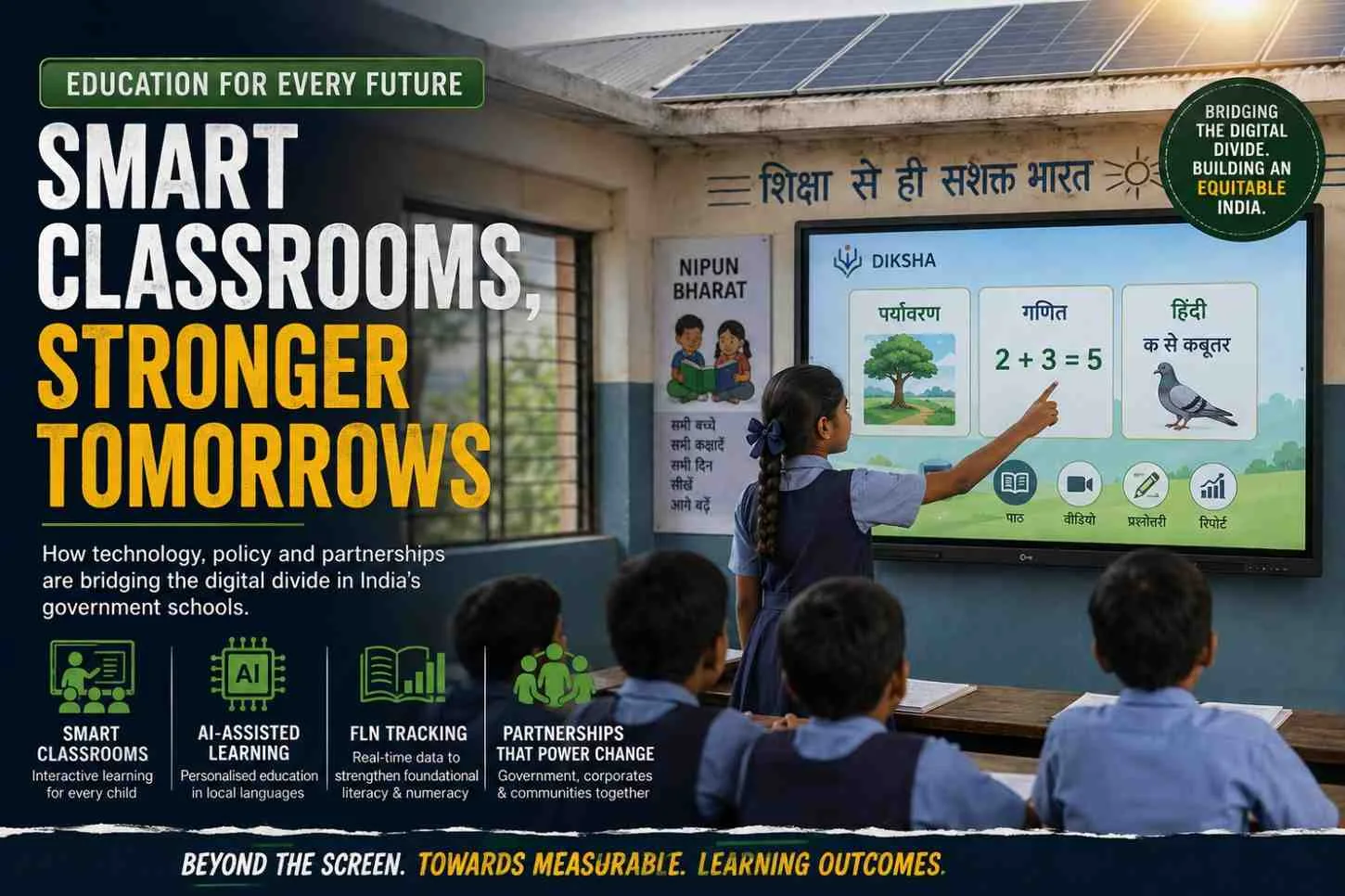
| As India expands digital classrooms into government schools, the real challenge is no longer connecting villages to technology- but ensuring technology actually improves learning. From AI-powered lessons in regional languages to solar-powered classrooms and foundational literacy tracking, the country's digital education push is entering a decisive phase where infrastructure, teacher readiness and measurable outcomes matter more than announcements. |
Quick Summary India's digital education journey is entering a new chapter. Classrooms are gradually moving beyond blackboards as smart technologies, AI-enabled learning platforms and digital assessment tools become part of everyday teaching. Backed by governments, private organisations and non-profits, these initiatives are expected to strengthen learning outcomes while expanding educational opportunities for students in rural and underserved communities. |
Keywords
|
Can technology truly bridge India's rural education divide- or does meaningful learning still depend on everything beyond the screen?
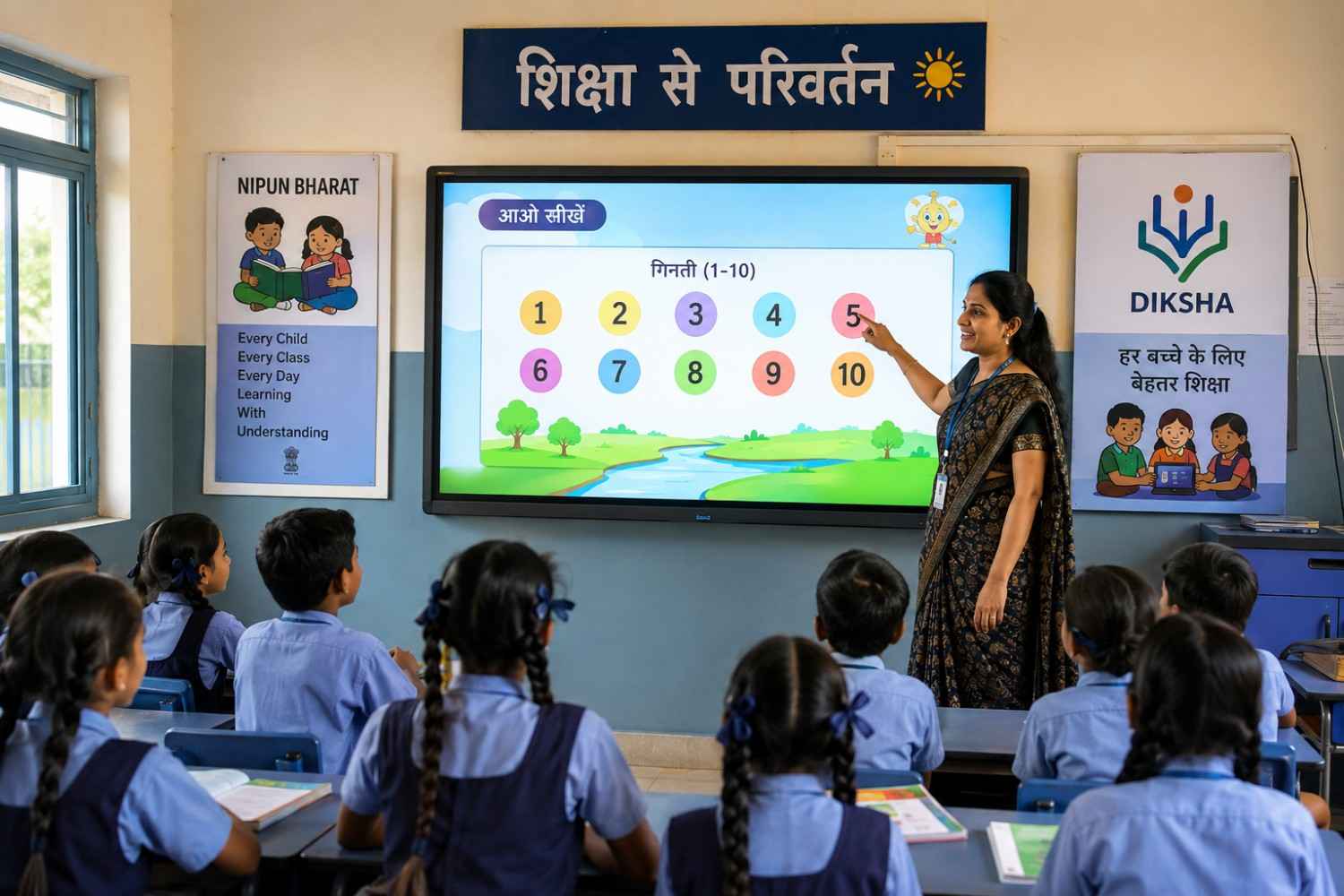
Shortly after sunrise, children begin arriving at a government primary school in a remote village of Madhya Pradesh. Some have walked several kilometres through fields, carrying well-used schoolbags and notebooks. As they settle into their classroom, a smart display comes to life, using colourful animations to explain basic mathematics in Hindi. For a moment, the familiar blackboard gives way to an entirely different way of learning.
For many of these students, it is their first experience inside a digital classroom.
The transformation is difficult to ignore. Government schools that once struggled with limited infrastructure are now introducing interactive lessons, AI-powered learning applications, digital attendance systems and online educational resources. Across India, digital classrooms have become a defining image of education reform and technological progress.
Yet behind this visible transformation lies a far more challenging question: is digital access translating into better learning?
Technology has the potential to reshape education-but only when the basics are already in place. Smart boards require electricity, AI-powered platforms depend on stable internet connectivity, and digital devices remain underutilised without confident, well-trained teachers. More importantly, no technological innovation can replace the foundational literacy and numeracy skills that every child needs to learn effectively.
This is the challenge confronting India's education system today.
The discussion has moved well beyond introducing technology into classrooms.
The real question now is whether digital investments are improving what matters most- how well children learn or whether schools are becoming more technologically equipped without becoming more educationally effective.
The reason this question matters is the sheer scale of India's digital education ambition. With more than 250 million school-going children and one of the world's largest public education systems, the country is using technology not simply to modernise schools, but to bridge educational inequalities that have existed for generations.
Government initiatives such as Digital India, PM eVIDYA, DIKSHA, NIPUN Bharat and the National Education Policy (NEP) 2020 have accelerated the spread of digital learning.
Alongside these efforts, corporate CSR programmes, educational foundations and technology companies are bringing smart classrooms, AI-powered learning platforms and teacher training to thousands of government schools.
For millions of children in rural India, these initiatives have expanded access to educational resources that were once concentrated in better-equipped urban classrooms.
The experience so far, however, points to a simple reality: technology can support education, but it cannot transform it on its own.
The future of digital education will not be shaped by technology alone. Its real impact will depend on whether digital tools strengthen teaching, respond to local needs and help every child learn more effectively.
As India builds more digitally enabled classrooms, the success of this transformation will not be reflected in the number of smart boards or tablets deployed.
It will be seen in classrooms where learning improves, educational gaps narrow and every child is given a fairer opportunity to succeed.
Government's Digital Push: From Access to Learning Outcomes
The pandemic did not introduce India to digital education, but it changed its trajectory.
When classrooms fell silent in 2020, millions of students were abruptly disconnected from formal learning.
The impact was especially severe in rural India, where limited access to smartphones, internet services and reliable electricity left many children without any meaningful alternative to classroom teaching.
In contrast, many students in urban areas were able to continue learning online.
The experience fundamentally reshaped the country's approach to digital education, turning a gradual reform into an urgent national priority.
The experience of the pandemic reinforced the government's belief that digital infrastructure would become an essential part of India's education system. Rather than allowing technology to remain an emergency alternative, policymakers began embedding it into long-term classroom reforms.
The National Education Policy (NEP) 2020 placed digital learning, teacher capacity building and educational technology at the centre of this transformation.
Programmes such as DIKSHA and PM eVIDYA expanded digital resources for both students and teachers, while dedicated educational television channels helped extend learning to households with limited internet access.
Yet one important lesson soon became clear: digital content alone could not solve India's learning challenges.
Long before the pandemic, national assessments had revealed that many children in primary schools were unable to achieve basic reading and arithmetic skills despite attending school regularly.
The assessments revealed that the real challenge was not simply making classrooms digital, but ensuring that every child possessed the foundational skills needed to benefit from them.
This led to a greater emphasis on Foundational Literacy and Numeracy (FLN), ensuring that every child can read with understanding and perform basic mathematical operations by the end of Grade 3.
To achieve this, the government launched NIPUN Bharat in 2021, placing foundational learning at the centre of education reforms.
Unlike many earlier programmes that focused largely on expanding access, NIPUN Bharat prioritised measurable learning outcomes. States were encouraged to use digital tools to track student progress, identify learning gaps early and provide timely academic support instead of waiting for annual examinations.
The emphasis shifted from using technology to deliver education to using it to understand, monitor and improve how students learn.
Digital monitoring is gradually becoming a part of classroom teaching across several states. Teachers now use mobile applications and digital dashboards to record assessments, monitor student progress and identify children who may need extra support, while education departments rely on real-time data to guide interventions more effectively.
The challenge, however, lies beyond data collection. Education researchers emphasise that digital information creates value only when it leads to timely action and measurable improvements in student learning.
A digital dashboard may indicate that a child is unable to read a simple paragraph, but it cannot reveal the reasons behind that learning gap. Irregular attendance, teacher shortages, language barriers, limited classroom support and socio-economic challenges often remain hidden behind the data.
Unless these underlying issues are addressed, experts warn that digital monitoring could become an exercise in collecting information rather than improving education.
The challenge is even more pronounced in rural India, where conditions differ widely across districts.
While some government schools have introduced smart classrooms supported by reliable internet connectivity and well-trained teachers, others continue to face irregular electricity supply, ageing equipment and inadequate technical support.
In many such schools, sustaining digital infrastructure has become just as important as installing it.
This is where partnerships are playing a vital role.
While government initiatives have laid the foundation for digital education, their implementation is being reinforced through collaborations with corporate CSR programmes, educational technology companies and non-profit organisations.
Beyond providing hardware, these partnerships are investing in teacher training, regional-language learning resources and classroom support to ensure that technology is used effectively.
As India's digital education ecosystem continues to evolve, the national conversation is also changing.
The focus is no longer on how many schools have smart boards or internet connectivity, but on whether these investments are improving how children learn, strengthening foundational skills and keeping students engaged in the classroom.
Ultimately, the success of digital education will not be determined by the scale of technology adoption, but by its ability to deliver better learning outcomes and create meaningful opportunities for every child.
Evidence Check
Are digital classrooms improving learning- or simply increasing digital access?
What official reporting often highlights
- Smart classrooms installed
- Digital devices distributed
- Teachers trained
- Schools connected
What independent evaluations continue to examine
- Reading proficiency (ASER)
- Foundational numeracy (NIPUN Bharat)
- Teacher readiness
- Regular classroom usage
- Infrastructure reliability
- Learning improvements over time
The key challenge: Expanding digital access is measurable. Demonstrating sustained improvements in learning outcomes is considerably more difficult.
The Reality Check: Is Digital Learning Delivering Real Results?
India's digital education drive is often measured by numbers- how many smart classrooms have been installed, how many tablets have been distributed or how many teachers have been trained.
These milestones undoubtedly reflect progress.
But education experts argue that they reveal very little about what truly matters: whether children are learning better than before.
This is where the country's digital classroom mission faces its biggest test.
Over the past decade, independent learning assessments have repeatedly shown that school enrolment and classroom attendance do not necessarily translate into improved learning outcomes.
Annual reports published by Pratham's Annual Status of Education Report (ASER) have consistently found that many children in rural India continue to struggle with reading age-appropriate texts and solving basic arithmetic problems, despite spending several years in school.
The results highlight that lasting improvements in learning cannot be achieved through technology alone.
Evidence from researchers support this view.
Studies conducted by J-PAL South Asia, which has evaluated a wide range of education interventions across the country, consistently show that digital technology delivers the greatest impact when it complements effective teaching, continuous assessment and targeted support for students who are falling behind.
Simply introducing computers, tablets or smart boards into classrooms rarely leads to meaningful improvements unless teachers are adequately trained and digital resources are integrated into everyday teaching practices.
The experience also varies considerably across states.
While some government schools have successfully incorporated digital learning into routine classroom instruction, supported by dependable electricity, internet connectivity and trained educators, others continue to face recurring obstacles.
Power outages, unreliable internet services, malfunctioning equipment and limited technical support frequently disrupt implementation.
In many rural schools, digital infrastructure may exist, but it often remains underutilised because teachers are unfamiliar with the technology or maintenance and repairs take months to complete.
Language adds another layer of complexity.
Although AI-enabled learning platforms are now available in Hindi and several regional languages, India's linguistic diversity extends across hundreds of languages and dialects.
Education experts point out that language is far more than a medium of instruction- it shapes comprehension, confidence and classroom participation.
Digital platforms that fail to reflect local linguistic contexts may struggle to provide the personalised learning experience they are intended to deliver.
There is also growing scrutiny over how the success of digital education initiatives is measured.
Many programmes report the number of devices distributed, schools covered or students enrolled, yet relatively few present independent evidence demonstrating sustained improvements in literacy, numeracy or classroom engagement.
Expanding digital infrastructure is only one part of the story. Without credible baseline data, transparent reporting and regular assessments, it is difficult to know whether technology is improving how children learn or simply changing how classrooms look.
The challenge, therefore, is not to justify digital classrooms, but to demonstrate that they are delivering measurable improvements in learning.
Education experts believe the next stage of digital education reforms should be defined not by the spread of technology, but by the quality of learning it delivers.
Progress will be reflected in stronger reading and numeracy skills, confident teachers who use digital tools effectively and classrooms where technology genuinely enhances everyday learning.
Ultimately, India's rural education divide cannot be bridged through technology alone.
Sustainable progress will depend on continued investment, skilled educators, dependable infrastructure and rigorous evaluation to ensure that every digital initiative creates meaningful learning opportunities and a stronger future for every child.
Reality Check: Beyond the Numbers
| Announcement | The Bigger Question |
|---|---|
| Smart boards installed | Are they used every day? |
| Tablets distributed | Do students have electricity and internet? |
| Teachers trained | How many actively use digital tools? |
| AI learning launched | Is it available in local languages? |
| Schools digitised | Have reading and maths scores improved? |
Voices from the Ground: Where Technology Meets Reality
India's digital education landscape is no longer being shaped by government initiatives alone.
Corporates, non-profit organisations, academic researchers and grassroots institutions have all emerged as key stakeholders in determining how technology is introduced into classrooms and, more importantly, whether it leads to meaningful improvements in learning.
For many organisations working closely with government schools, the conversation has already moved beyond simply providing digital devices. The emphasis is now on ensuring that technology addresses learning needs rather than becoming an end in itself.
Pratham, one of India's largest education-focused non-profit organisations, has consistently maintained that lasting improvements in learning begin with strong foundational literacy and numeracy.
Through its large-scale learning assessments and community-based programmes, the organisation has repeatedly highlighted that many children continue to struggle with basic reading and arithmetic, making foundational learning one of the country's most pressing educational priorities.
A similar conclusion emerges from research conducted by J-PAL South Asia.
Findings from multiple education evaluations suggest that digital tools are most effective when they strengthen good teaching practices rather than attempt to replace them. Their research indicates that technology delivers stronger outcomes when teachers actively integrate it into classroom instruction, students receive continuous feedback and schools regularly monitor learning progress beyond digital assessments.
Grassroots organisations offer another important perspective.
Institutions such as SEWA Bharat and Aajeevika Bureau, which work extensively with informal workers and migrant communities, argue that educational inequality often begins long before children enter the classroom.
Seasonal migration, unstable household incomes and limited access to digital devices at home continue to interrupt learning for thousands of rural students. Under such circumstances, even well-equipped digital classrooms cannot fully compensate for the broader socio-economic barriers affecting children's education.
Similar observations have been made by Smile Foundation through its education programmes in underserved communities. The organisation emphasises that digital inclusion is most effective when it is supported by teacher mentoring, parental engagement and sustained community participation.
Without these complementary efforts, the benefits of technology are unlikely to reach every learner equally.
Corporate participation has also evolved considerably in recent years.
Organisations such as Infosys Foundation, HCL Foundation, Wipro Foundation, Reliance Foundation and Tata Steel Foundation have expanded their education initiatives beyond providing digital infrastructure.
Many programmes now combine smart classrooms with teacher capacity building, maintenance support, digital literacy training and locally relevant educational content. At the same time, several technology companies are developing AI-enabled learning platforms designed to operate in regional languages and function effectively even in areas with limited internet connectivity.
Despite these advances, educators remain cautious about viewing technology as a complete solution.
Teachers involved in various digital education programmes frequently describe digital tools as valuable classroom resources rather than substitutes for effective teaching.
Interactive lessons often improve student participation and sustain the attention of younger learners, but explaining concepts, encouraging discussion and supporting students with different learning abilities continue to depend largely on direct teacher engagement.
Parents, too, see digital education with both optimism and realism. For many families in rural India, digital classrooms represent an opportunity for their children to access learning resources that were once available mainly in urban schools.
At the same time, concerns about unreliable electricity, poor internet connectivity and limited opportunities for learning beyond school hours continue to shape their expectations.
Collectively, these observations indicate that the success of digital education extends well beyond the availability of technology. It is shaped by the confidence of teachers, the engagement of students and the broader support systems that enable learning.
In practice, the most effective digital classrooms are those where technology is fully integrated into everyday teaching rather than simply being available.
Expert Perspectives
Pratham
Improving foundational literacy and numeracy remains essential before technology can deliver its full potential.
J-PAL South Asia
Digital interventions are most effective when they strengthen—not replace—good teaching and regular assessment.
Smile Foundation
Long-term impact depends on teacher support, community engagement and continued investment beyond classroom infrastructure.
SEWA Bharat & Aajeevika Bureau
Educational inequality is closely linked to migration, livelihoods and socio-economic barriers that technology alone cannot solve.
Teachers
Digital tools make lessons more engaging, but learning still depends on classroom interaction and teacher guidance.
Parents
Smart classrooms offer opportunity, but reliable infrastructure and consistent teaching matter just as much as technology.
From Access to Impact
India's digital education journey has reached an important turning point. The debate is no longer about whether technology belongs in government schools- it clearly does.
The challenge now is ensuring that every digital investment leads to measurable improvements in learning rather than simply increasing the number of connected classrooms.
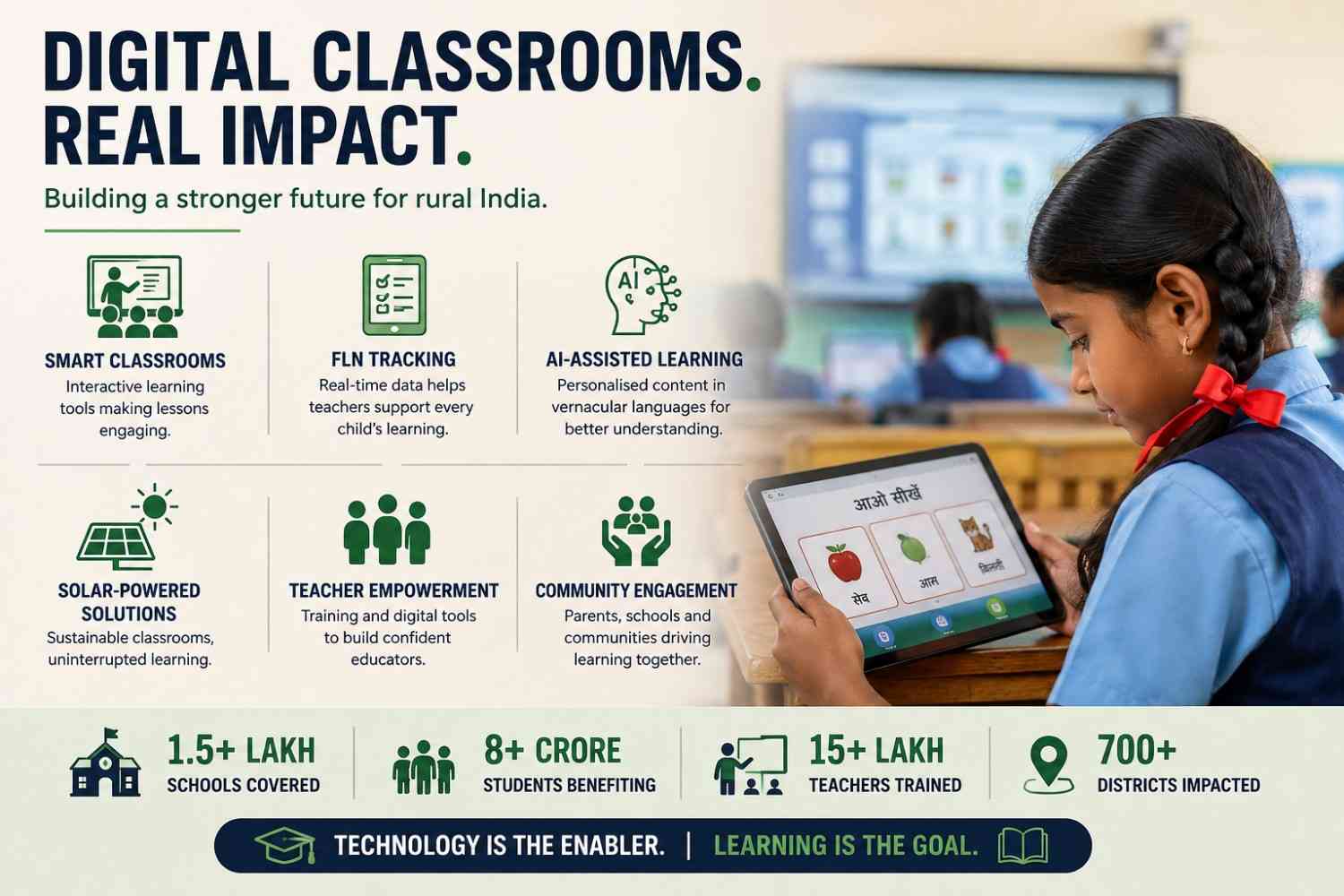
The progress is evident. Smart classrooms are reaching remote villages, AI-powered platforms are expanding access to learning in regional languages, solar-powered schools are reducing dependence on unreliable electricity and digital FLN tracking is helping teachers identify learning gaps much earlier.
Together, these initiatives represent one of India's most ambitious efforts to modernise public education.
Yet the evidence points to an equally important reality. Technology cannot compensate for weak foundational learning, untrained teachers, irregular attendance or inadequate maintenance.
A smart board without electricity, an AI platform that overlooks local languages or a dashboard filled with data but unsupported by timely interventions cannot, on their own, improve learning outcomes.
This is why education experts argue that the next phase of reform must prioritise learning outcomes over digital expansion.
Progress should be measured not by the number of devices installed or schools digitised, but by stronger literacy and numeracy, better classroom participation and improved student retention.
Achieving this will require transparent evaluation, continuous teacher development and sustained investment in the systems that support learning.
Corporate partnerships and CSR initiatives will also remain critical. As private investment grows, the focus must move beyond one-time infrastructure towards building long-term educational ecosystems through teacher training, equipment maintenance, local-language content and rigorous assessment of learning outcomes.
Perhaps the most important lesson from India's digital education journey is that the rural education divide has never been a technology challenge alone.
It is shaped by infrastructure, language, teacher capacity, socio-economic realities and community participation. Technology can help bridge these gaps, but it cannot eliminate them by itself.
Ultimately, the success of digital education will depend not on how advanced classroom technology becomes, but on whether it enables every child to learn better.
The future of education will be measured not by smarter classrooms, but by smarter learning.
Primary Sources:
- Ministry of Education, Government of India – National Education Policy (NEP) 2020 & School Education Initiatives
https://www.education.gov.in/ - NIPUN Bharat Mission – Foundational Literacy and Numeracy (FLN)
https://nipunbharat.education.gov.in/ - DIKSHA – National Digital Learning Platform
https://diksha.gov.in/ - ASER Centre (Pratham) – Annual Status of Education Report (ASER)
https://asercentre.org/ - J-PAL South Asia – Education Research & Evidence-Based Policy
https://www.povertyactionlab.org/south-asia - UNICEF India – Digital Learning & Education Programmes
https://www.unicef.org/india - NITI Aayog – Digital Public Infrastructure & Education Reports
https://www.niti.gov.in/ - Press Information Bureau (PIB) – Ministry of Education Announcements & Updates
https://pib.gov.in/







Add a Comment