13 Jul 2026
The Shopping Bags Are Full. Why Do Our Lives Feel Empty? We own more clothes than our parents did. We replace phones faster, order food more frequently, travel farther, renovate homes more often and buy things at the tap of a screen. Our homes are fuller. Our wardrobes are overflowing. Our digital carts are permanently active. Yet many of us are more anxious, more exhausted, more indebted, more distracted and more dissatisfied than ever before. That is the central contradiction of modern consumer life: we have become extraordinarily efficient at purchasing things, but not necessarily better at creating happiness. In India, this contradiction is visible everywhere. A middle-class family may have two cars but hardly enough time to sit together. A young professional may own an expensive smartphone, smartwatch, wireless earbuds and several paid subscriptions, yet struggle to sleep peacefully. A child may receive a roomful of toys but not an hour of undivided parental attention. A household may renovate its kitchen while increasingly depending on packaged food and instant delivery. We are surrounded by products designed to save time. Strangely, we appear to have less time than before. We buy fitness watches but walk less. We purchase storage boxes because we own too many things. We install larger televisions because family conversations are becoming shorter. We take photographs of every celebration but often fail to experience the celebration itself. So the question is no longer whether we are buying more. The evidence is in our cupboards, credit-card statements, delivery notifications and dustbins. The real question is: Are we living better? Consumption Has Quietly Become a Competition There was a time when buying something new marked a genuine need or an important occasion. A refrigerator, television, scooter or festive dress would be carefully chosen, maintained and used for years. Today, consumption is increasingly shaped not by need but by comparison. Someone in the housing society buys a larger car. A colleague upgrades to the newest phone. An influencer displays a “must-have” skin-care routine involving twelve products. A wedding on social media appears more elaborate than ours. A neighbour’s child attends a more expensive school. Another family takes an international holiday. Slowly, without realising it, we begin purchasing not for comfort but for status. The object becomes a message: “I am successful.” “I am modern.” “I have arrived.” But status is a race without a finishing line. The moment we acquire one symbol of success, another appears. The phone becomes outdated. The fashion changes. The car loses its shine. The holiday photographs stop receiving attention. Consumer culture survives by making satisfaction temporary. It repeatedly whispers: You are only one purchase away from becoming happier, more attractive, more respected or more complete. But completion never arrives. The Great Indian Sale Never Really Ends India’s traditional festivals once centred on community, gratitude, food, worship, storytelling and reunion. Consumption had a place, but it was not always the centre. Today, almost every festival is converted into a sales season. Diwali becomes an electronics sale. Dhanteras becomes an obligation to purchase. Valentine’s Day becomes a test of affection through gifts. Mother’s Day becomes a promotional campaign. Independence Day becomes a discount event. Even environmentally significant occasions are used to market new “sustainable” products. The sale countdown creates urgency. “Only two hours left.” “Last chance.” “Limited stock.” “Deal expires at midnight.” We buy quickly because the platform tells us we are saving money. But spending ₹3,000 on something we did not need is not saving ₹2,000. It is spending ₹3,000. The discount may be real. The necessity may not be. Easy credit makes the temptation stronger. Buy-now-pay-later schemes, credit cards and zero-cost instalments separate the pleasure of buying from the pain of paying. The product arrives today; the financial pressure follows for months. A home can therefore look prosperous while its occupants remain financially insecure. More Convenience, Less Connection Modern consumption promises convenience, and much of that convenience is genuinely useful. Digital payments, online medicine, home delivery and accessible transportation have improved millions of lives. The problem begins when convenience replaces participation. We stop walking to the market. We stop knowing the vegetable seller. We stop repairing appliances. We stop cooking together. We stop borrowing from neighbours. We stop visiting local shops. We stop waiting, planning and improvising. Every difficulty becomes something to outsource. Food arrives in disposable containers. Groceries arrive inside multiple layers of packaging. A forgotten ingredient is delivered by a motorbike in minutes. A minor inconvenience creates fuel consumption, plastic waste, traffic and another poorly paid worker racing against a countdown clock. Convenience saves us effort, but effort is not always the enemy. Walking, cooking, repairing, sharing and waiting can create health, competence, patience and relationships. When everything becomes instantly available, we may gain speed but lose resilience. The Wardrobe Is Full. There Is Still “Nothing to Wear” Fashion provides one of the clearest examples of the consumption trap. An Indian urban wardrobe may contain clothes purchased for weddings, office meetings, holidays, festivals, gym sessions and social-media photographs. Many garments are worn only once or twice. Some are forgotten with their price tags still attached. Yet before another wedding, the familiar sentence returns: “I have nothing to wear.” What it often means is: “I have nothing new to display.” The pressure is particularly intense around Indian weddings. Families spend beyond their means because every event must look distinct, every outfit must be photographed and every photograph must appear impressive. Clothes that could have been repeated, exchanged, altered or passed between relatives are rejected because repetition is treated as embarrassment. But repetition is not poverty. Using something well is intelligence. Repairing something is responsibility. Repeating an outfit is not a failure of imagination; it may be a declaration that our worth is greater than our wardrobe. We Upgraded the Phone. Did We Upgrade the Conversation? The smartphone is perhaps the defining object of contemporary Indian life. It connects migrant workers with families, enables education, supports businesses, facilitates banking and gives citizens access to information. But it also creates an endless marketplace inside our pockets. We are shown what to buy, where to eat, how to look, where to travel and what our homes should contain. Advertising no longer waits on a billboard. It follows us into bed. The phone is upgraded because its camera is better. Yet during dinner, everyone looks at a separate screen. We purchase high-speed data but have slower conversations. We collect hundreds of contacts but may not know whom to call during a crisis. We watch motivational videos about discipline at two in the morning and wake up too tired to practise any of it. Technology is not the villain. Unconscious use is. A device should remain a tool. When it begins determining our attention, desires, relationships and self-esteem, the owner and the object quietly exchange roles. The Hidden Price Is Paid by the Planet Every object has a biography. A cotton shirt requires land, water, labour, dyeing, transportation, packaging and retail infrastructure. A smartphone contains minerals extracted from the earth, components manufactured across countries and a battery that will eventually become hazardous waste. A delivered meal carries the environmental cost of ingredients, refrigeration, cooking, transport and packaging. The price printed on the product is therefore incomplete. It rarely includes the polluted river, depleted soil, exploited worker, discarded plastic or carbon emitted during production and delivery. The environmental burden is also unequal. Those who consume least often suffer first from polluted air, rising temperatures, floods, water shortages and waste dumping. A low-income settlement beside a landfill pays for the disposable habits of neighbourhoods far wealthier than itself. Mindless consumption is therefore not merely a personal weakness. It is an ecological and social issue. A Better Life Is Not a Smaller Dream Living better does not require everyone to abandon cities, reject technology or move to a Himalayan village. Nor does sustainability mean living joylessly. It means replacing excess with sufficiency, impulse with intention and display with genuine value. The goal is not to stop buying. The goal is to stop expecting purchases to perform the work of relationships, health, purpose, community and self-respect. A better life may contain fewer objects but more experiences. Less comparison but more confidence. Less speed but more presence. Less waste but more gratitude. The transition can begin through twelve simple steps. 1. Pause Before Every Non-Essential Purchase Create a waiting period. For inexpensive items, wait twenty-four hours. For clothes, gadgets, furniture or luxury products, wait a week. Ask three questions: Do I genuinely need it? Do I already own something that serves the same purpose? Would I still buy it without the discount, advertisement or social pressure? Many desires disappear when urgency is removed. 2. Count What You Already Own Before buying another shirt, cup, bedsheet, kitchen appliance or cosmetic product, inspect what is already at home. An occasional household inventory can be startling. Five water bottles. Seven nearly identical shirts. Unopened toiletries. Duplicate chargers. Forgotten food packets. Books bought but never read. Visibility reduces unnecessary buying. We often purchase not because we have too little, but because we have lost track of how much we already possess. 3. Choose Durability Over Novelty The cheapest product is not always economical. A well-made pressure cooker used for fifteen years may be more affordable than three poor-quality replacements. A strong schoolbag can serve more than one child. A repairable wooden table may outlive several pieces of disposable furniture. Before buying, examine quality, warranty, repairability and expected lifespan. Purchase fewer things, but choose things worthy of long use. 4. Repair Before You Replace India once had a powerful repair culture: tailors altered clothes, cobblers restored shoes, technicians repaired radios, and neighbourhood mechanics kept appliances alive. That culture is disappearing under the pressure of cheap replacement. Bring it back. Stitch the torn kurta. Replace the phone battery. Polish the furniture. Repair the mixer. Resole the shoes. Repair saves money, supports local skills and prevents useful materials from entering landfills. 5. Borrow, Rent and Share Not everything needs private ownership. A drill machine may be used for ten minutes a year. Party decorations may be required once. Books, luggage, ladders, tools, children’s costumes and specialised kitchen equipment can often be borrowed or rented. Housing societies can create shared libraries of tools and reusable event materials. Extended Indian families practised this naturally for generations. Sharing was not seen as deprivation. It was a form of trust. 6. Repeat Clothes Without Apology Wear the same sari, kurta, jacket or formal suit again. Restyle it. Exchange garments within the family. Alter older clothing. Support handloom, durable fabrics and locally produced garments when practical. Most importantly, refuse the idea that every photographed occasion requires a new outfit. People who judge human worth by clothing repetition are revealing the poverty of their own imagination. 7. Reclaim Food from Convenience Cook more frequently, even when the meal is simple. Dal, rice, vegetables, roti, khichdi, poha, idli or seasonal fruit may offer more nourishment and produce less packaging than repeated restaurant orders. Plan portions. Store leftovers safely. Share excess food. Buy seasonal produce from nearby markets. Carry water and snacks when travelling. Food should nourish bodies and relationships—not routinely become waste inside refrigerators and dustbins. 8. Protect Attention from Advertising Unfollow accounts that constantly provoke comparison. Disable unnecessary shopping notifications. Remove stored card details from retail apps. Avoid browsing online marketplaces when bored. Create screen-free periods, particularly during meals and before sleep. Attention is a limited resource. Every platform competing for it is also competing to shape desire. A person who cannot protect attention will struggle to protect money, time or peace. 9. Spend on Experiences That Deepen Life Redirect some money from objects towards experiences. Take parents on a short journey. Learn music. Attend theatre. Join a nature walk. Visit a museum. Cook with children. Support a local craft workshop. Plant a community garden. Experiences are not automatically sustainable, but meaningful experiences often enrich life without permanently filling cupboards. The best memories rarely require storage space. 10. Redefine What Success Looks Like A larger car is not success if its loan creates constant anxiety. A luxury home is not success if family members barely meet. An expensive school is not success if the child feels unseen. A prestigious job is not success if it destroys health and dignity. Define success through freedom from unmanageable debt, time for loved ones, physical well-being, purposeful work, community respect and the ability to sleep peacefully. What we measure determines what we pursue. 11. Make Sustainability Social Individual discipline matters, but community action multiplies it. Start waste segregation in the housing society. Organise a clothes-exchange day. Create a shared bookshelf. Compost kitchen waste. Encourage residents to reduce single-use decorations during festivals. Support local vendors. Arrange repair camps and neighbourhood clean-ups. Sustainability becomes easier when it is normal, visible and collective. The strongest Indian traditions were built around community. Our environmental future may depend on recovering that strength. 12. Practise Enoughness Enoughness is not laziness or lack of ambition. It is the wisdom to recognise when a need has been met. Enough food. Enough clothing. Enough space. Enough celebration. Enough status. Without a sense of enough, every achievement becomes inadequate. Income rises, but desire rises faster. The house becomes larger, but peace remains outside. Gratitude interrupts this cycle. It reminds us that a good life is not created only by adding. Sometimes, it is created by removing noise, debt, clutter, comparison and unnecessary obligation. The Revolution Can Begin Inside a Shopping Cart India does not need a future in which millions of people remain deprived. People deserve secure homes, nutritious food, healthcare, education, mobility, technology and dignified opportunities. The argument against overconsumption must never become an argument against development. But development should improve human life—not merely increase the movement of products. The affluent and aspiring classes must therefore ask a difficult question: are we purchasing comfort, or are we purchasing symbols to compensate for exhaustion and insecurity? The answer will not always be comfortable. We may discover that the next phone will not repair a neglected relationship. The next holiday will not permanently cure burnout. The next outfit will not create self-worth. The next delivery will not give us more time unless we consciously decide how that saved time will be used. Living better requires more than buying differently. It requires wanting differently. Buy Less. Choose Well. Live Fully. The most sustainable product is often the one we do not buy. The most valuable possession may be time. The greatest luxury may be an unhurried meal. The best upgrade may be better health. The richest home may be the one filled not with objects, but with conversation, laughter, security and belonging. We are buying more than any generation before us could have imagined. But living better is not an automatic consequence of purchasing power. It is a conscious practice. A daily decision. A refusal to confuse price with value, convenience with happiness, abundance with fulfilment or visibility with success. The shopping bag may be full. The wardrobe may be full. The house may be full. The question is whether life itself feels full. That answer cannot be delivered in ten minutes. It cannot be purchased during a festive sale. It must be created—slowly, thoughtfully and together. ...Read more
10 Jul 2026
An ordinary breakfast leftover sparked an extraordinary idea What happens to an eggshell after breakfast? Or a dry leaf after it falls from a tree? Most of us barely have time to care! We simply throw them away. Directly into the bin without a second thought. Then it moves to a landfill. Day after day, a huge pile of waste keeps on growing. But what if that same waste had an egg-cellent second chance? That's exactly what inspired one entrepreneur to look at things differently. Instead of seeing eggshells and fallen leaves as a source of garbage, she saw hope! Things that most of the people ignored became the cornerstone of something really useful. Something sustainable and something that could make a huge difference. The idea was simple. Why to do something, that might harm the environment when nature already has a backup plan? Keeping that in mind, everyday waste found a new purpose to serve. Eggshells, usually thrown away after meals, were collected and processed into durable, eco-friendly plates. Dry leaves, often swept aside and burned, were transformed into comfortable slippers. What once ended up in landfills are now becoming products that people could make use in every day’s life. The point is not just about making unique products. But addressing a much larger issue, i.e., Waste Management. India generates waste in huge amount, every year. A generous portion is either dumped in landfills or openly burned as debris, increasing pollution and creating pressure on the surrounding. Disposable plastics only make the situation go worse. Now more than ever we need more sustainable solutions. This initiative proves that solutions does not always require expensive technology. Sometimes, they just begin with a simple change in perspective. Looking at garbage not as a problem—but as a resource, to be reused. This process reduces waste, preserves natural resources, and encourages responsible consumption. The idea comes from a 27-year-old industrial designer, Midushi Kochhar from Delhi. During the COVID-19 pandemic, she wanted to turn everyday waste into something useful. In June 2021, she launched YLEM, a project that turns waste materials into useful & eco-friendly products. What started as a simple experiment soon became a bigger mission. Eggshells became durable plates. Fallen dry leaves that are turned into comfortable slippers. Midushi proved that a small change of idea—that can inspire people to rethink and reuse. The benefits extend beyond the environment. This initiative creates opportunities for local communities engaged in collecting, processing, and manufacturing these products. It promotes sustainable production while motivating consumers to make more responsible choices in their daily life. Today, more people are getting aware of the impact their choices have on the planet. They want products that are practical, affordable, and sustainably responsible. Initiatives like these prove that sustainability does not have to be complicated. It can begin with something as simple as an eggshell or a fallen leaf. The key takeaway is— Sometimes the smallest idea makes the biggest difference. The things we throw away without a second thought may still hold high value. All it needs is someone who is willing to notice them differently. Stories like this remind us that every small effort counts. One creative idea. One conscious choice. One product at a time. One second chance is all it takes to build a cleaner and greener future! Source- This news study is adapted from a feature published by The Better India, an independent digital platform known for its inspiring stories of sustainability, innovation, and social impact. The original report encourages responsible consumption and a sustainable future. ...Read more
08 Jul 2026
It's more than just a number on the weighing scale! A new study explains why Being overweight is often linked to diabetes and heart problems. But is that the whole story? NO! A new international study has raised fresh concerns. Researchers say excess body weight may result in much bigger health issues than people can actually realize. After reviewing 226 studies involving 1.5 million cancer cases, scientists found a worrying pattern. People with a higher Body Mass Index (BMI) are more likely to develop 19 types of cancer. It was published in the journal _Nature Metabolism_ on June 15, 2026. The study also linked obesity to bladder cancer, blood cancer, immune system cancer (non-Hodgkin lymphoma), and brain tumors. Why does this happen? Experts say excess body fat affects hormone levels. It can also cause long-term swelling and affect the normal body functions. These changes may help cancer cells grow with time. Researchers also found that the impact of obesity can differ from person to person. Some cancers are more common in women, while others are more common in men. It also varies across different regions of the world, suggesting that lifestyle, genetics and environment might play a role. For Example, the risk of bowel (colorectal) cancer was higher in men, while gallbladder cancer showed a stronger presence in women. This suggests that factors like gender, lifestyle, and body composition may influence the risk. Another key cause is different geographical regions. A study found that women in East Asia with a higher BMI faced nearly twice the risk of breast cancer after menopause compared to women in Europe. More studies are needed in regions of South Asia and Africa to better understand how obesity affects different populations. But the catch is - Obesity is Preventable! Eating Healthy. Staying active. Sleeping well. Also, doing health check-ups monthly lowers the risk. As obesity continues to rise, experts suggest small lifestyle changes today could make a huge difference tomorrow! This report is based on research, published in the peer-reviewed journal _Nature Metabolism_ and reported by Down to Earth, an Indian Magazine known for its storytelling technique of environment, health and science. ...Read more
08 Jul 2026
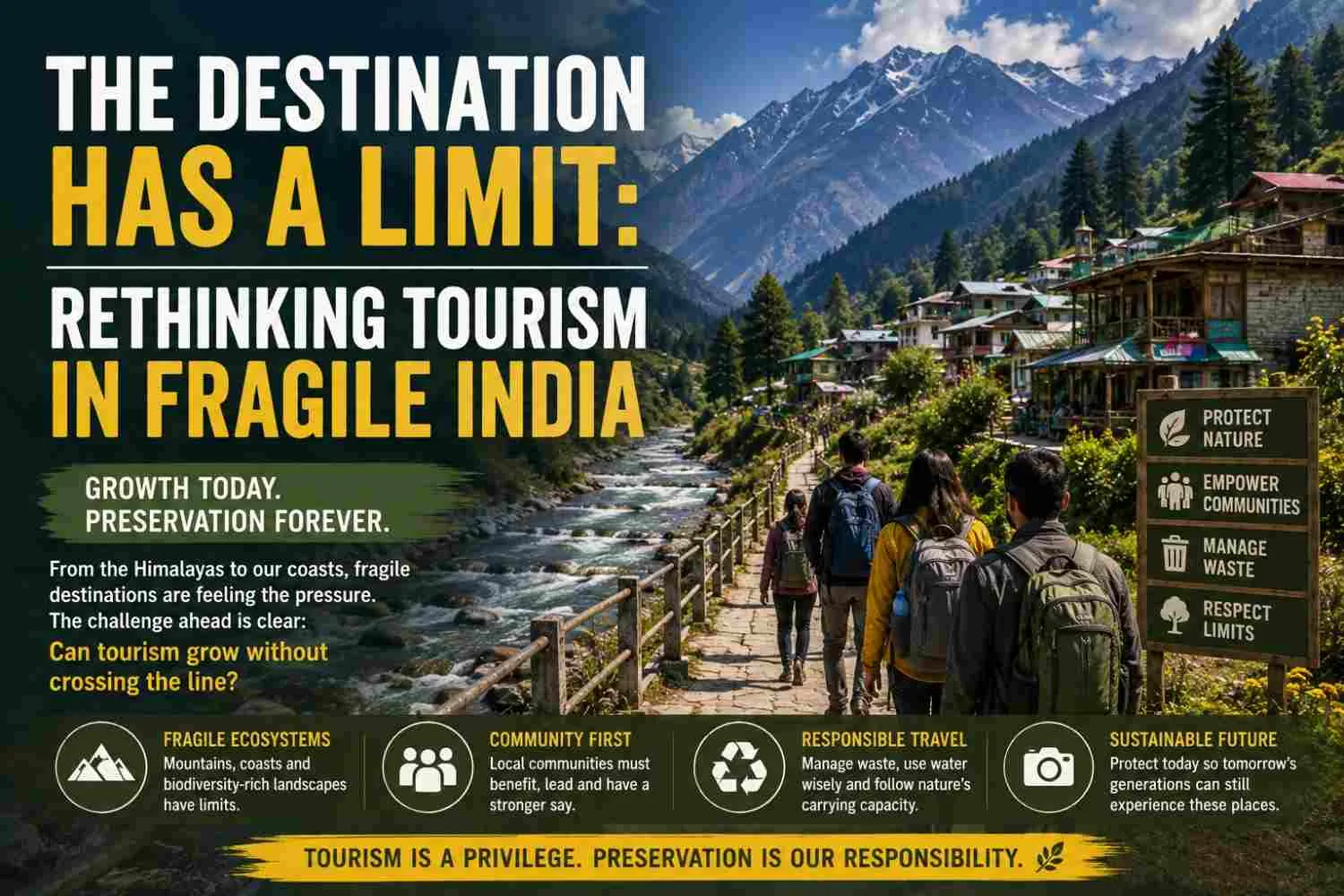
In a matter of seconds, the ground beneath northern Venezuela turned violent. The country renowned for its immense natural wealth was taken down by a rare natural calamity – a doublet earthquake on 24th June 2026. Buildings cracked, families took to the street and rescuers tirelessly combed the rubble. In the calm after the chaos, a question lingered in the debris: Can we build houses that remain unshaken when the earth moves? Interestingly, in the highlands of India, the answer stands quietly for centuries. Surrounded by the mountains of Himachal Pradesh, stand homes that have seen generations come and go. Withstanding extreme weather conditions and multiple earthquakes and yet hasn’t budged at all. These houses follow a traditional construction technique – Kath Kuni architecture. Locally sourced deodar wood and stone. That’s it. The secret of this architecture lies in the alternating layered combination of just two of these natural materials. Ages ago, these homes were not only designed for providing shelter but to overcome the challenges of nature. The mountain communities had already cracked the code to earthquake resistant architecture much before it became a modern engineering goal. What exactly makes Kath Kuni architecture earthquake resistant? The simple and short answer is flexibility. The modern concrete structures crack easily under immense geological pressure because of their rigidity. In contrast to which Kath Kuni buildings are crafted to absorb and distribute earthquake shocks. The structures may sway gently during the tremors instead of resisting them. All thanks to the wooden beams which act as the natural shock absorbers. The stability of the structure is determined by stone layers whereas the structure is locked together with the help of the timber. Sudden structural failure decreases with this interlocking system. Hence making these Kath Kuni structures highly resilient during earthquakes. Simple idea but a huge impact! Kath Kuni is not only admired for its resilience but for the sustainable principles it followed centuries ago. The principles that modern construction are trying to embrace. Locally accessible materials are used to built the homes reducing the harmful emissions related to transportation. Indoor temperatures are regulated accordingly and naturally due to the thick stones. Warmer in winter and cooler during changing seasons. Since they rely on natural materials, the environmental footprint decreases a lot more than that of modern construction methods. Kath Kuni architecture is not just a historic monument. It is a beautiful example of how native knowledge, environmental responsibility and structural resilience can unite to create such buildings that go with the nature rather than going against it. Multiple questions arise after every natural disaster, which affect how societies prepare for the natural hazards. As technology is advancing, we are reminded how history has some of the most effective ideas standing strong till date. The disaster in Venezuela is not just a headline; it is a reality that highlights the importance of resilient infrastructure. There is a rapid increase in climate risks, urbanisation and the pressure of sustainability. With these on surge the future of architecture may be looked beyond concrete and steel. The latest might not be the strongest. Sometimes centuries-old architectural techniques of the Himalayan village remind us that resilience begins with understanding the land we build on. Sources The Better India – Kath Kuni: The Ancient Himalayan Architecture That Has Defied Earthquakes for Centurieshttps://thebetterindia.com/sustainability/kath-kuni-architecture-himachal-pradesh-earthquake-resistant-sustainable-12030396ResearchGate – Prathaa: Kath-khuni Architecture of Himachal Pradeshhttps://www.researchgate.net/publication/236014050_Prathaa_Kath-khuni_Architecture_of_Himachal_PradeshBBC Travel – Kath Kuni: The Himalayas' Ancient Earthquake-Defying Designhttps://www.bbc.com/travel/article/20220825-kath-kuni-the-himalayas-ancient-earthquake-defying-designSahapedia – The Himalayan Vernacular: Kath Khuni Architecturehttps://www.sahapedia.org/the-himalayan-vernacular-kath-khuni-architecture ...Read more
08 Jul 2026
Why Delhi's Air Conditioners Are Turning Into Ticking Time Bombs — And What It Reveals About India's Unfolding Climate Catastrophe A special feature by Prof Ujjwal K Chowdhury, on climate, engineering failure and urban survival, in the context of the bursting air-conditioners in Delhi. | July 2026 By late May 2026, the national capital had become a pressure cooker in more ways than one. As temperatures climbed past 45°C and the asphalt shimmered with trapped heat, Delhi's air conditioners — the very machines bought to guarantee survival — began detonating inside bedrooms, offices, police stations and apartment towers. On May 26, a split AC exploded on the fifteenth floor of a high-rise in Ghaziabad's Indirapuram. Days earlier, nine people had died in a blaze at a residential complex in East Delhi's Vivek Vihar, with investigators pointing to an AC blast and short circuit. Then came the death of retired IAS officer Dhanendra Kumar, who succumbed to smoke inhalation after an explosion in the indoor unit of his air conditioner at his Hauz Khas residence — the third, fourth and fifth such incident inside three weeks. "The Hauz Khas incident is particularly disturbing because the suspected explosion occurred in the indoor unit, which is uncommon," a Delhi Power Department official told the press. “Usually, fires occur in the outdoor compressor due to gas leakage or overheating. But when faulty wiring sparks inside a closed room with a refrigerant leak, the unit itself can become a bomb.” These are not freak accidents. They are the audible, flaming symptoms of a city being pushed past its physical and institutional limits — where a hostile climate, ageing electrical infrastructure, regulatory drift and human negligence have converged into a single, recurring hazard. Why Delhi Is Baking On April 26, 2026, Delhi's temperature crossed 42°C — 3.1°C above the long-term seasonal average. By late June, the city recorded an ambient air temperature of 41.3°C with a heat index, factoring in humidity, of a lethal 51.3°C. This is not a hot spell; it is the acceleration of a structural climatic shift. India's annual average temperature has risen 0.15°C per decade between 1951 and 2016, and the World Meteorological Organization confirms that the eleven years from 2015 to 2025 were the hottest on record globally. Delhi's dense, glass-and-concrete built form compounds this through the urban heat island (UHI) effect: a study by IIT-Delhi's Centre for Atmospheric Sciences found that night-time temperatures in densely built NCR pockets run 2–4°C above surrounding rural areas, because concrete and asphalt absorb solar radiation all day and release it slowly after dark. Consequently, minimum night temperatures have hovered around 31°C — the city never achieves a thermal reset, forcing air conditioners to run continuously against an unwinnable thermal load. A 2026 Centre for Science and Environment (CSE) assessment quantified the damage starkly: 75.78% of Delhi's area is now persistently heat-stressed, with land-surface temperatures crossing 45°C for six or more years running, and 98.72% of the city has crossed that threshold at least once in the past decade. The same study found Delhi's green cover shrinking from 25.36% in 2014 to just 14.14% in 2024, while waterbody footprint fell from 1.25% to 0.99%. "Delhi's infrastructure was not originally built to take on the kind of extreme conditions we're seeing right now," CSE's Rajneesh Sareen has observed. The electricity data mirrors this stress. On June 29, 2026, Delhi's peak power demand touched an all-time high of 8,748 MW — surpassing the previous record of 8,656 MW from June 19, 2024 — and the grid crossed 8,000 MW three times that month alone, with projections of a 9,000 MW peak if conditions persist. This is the cooling trap: rising heat drives longer AC use, which spikes demand, which strains transformers, wiring and building circuits, which in turn raises fire probability. India's national power demand told the same story, peaking at 270.73 GW on May 21, 2026, according to Reuters, even as coal-fired generation surged to 120.20 billion kWh in June — the highest since November 2023 — partly because evening air-conditioning demand outpaced battery storage capacity. The Anatomy of an AC Blast What is loosely called an "AC blast" is technically a violent rupture, arc-fault or fire in the compressor and refrigerant circuit — and Delhi Fire Services estimates that roughly 60% of all fires in the city are of electrical origin, caused by short circuits, overheating, overloading and non-standard appliances. The failure cascade typically unfolds in four stages. 1. Compressor Overheating and Pressure Build-Up The compressor squeezes refrigerant gas to pressures measured in hundreds of psi, and it must reject heat absorbed from indoors into already-scorching outdoor air. When ambient temperatures exceed 43–45°C, or when the condenser coil is clogged with dust, boxed into an unventilated balcony, or paired with a weak fan, "head pressure" climbs beyond the engineered safety threshold. If protective valves fail, the compressor shell can rupture violently, spraying hot oil and refrigerant while producing an explosion-like sound. 2. Flammable Refrigerants India's shift to eco-friendlier refrigerants has quietly introduced a new hazard. Many modern splits use R32 (difluoromethane), classified A2L — "low toxicity, lower flammability" — while some use R290 (propane), classified A3, or highly flammable. R32 has a lower flammability limit of 306 g/m³ and needs 30–100 mJ of ignition energy; R290 is far more dangerous, with a flammability limit of just 38 g/m³ and an ignition energy of only 0.25 mJ — low enough for static discharge to ignite it. When either gas leaks into a poorly ventilated room and meets a spark from faulty wiring or a failing capacitor, ignition follows almost instantly. 3. Electrical Insulation Failure Continuous operation degrades the insulation around internal wiring. Loose terminals, undersized cables, damaged insulation, incorrectly rated MCBs, absent RCCB/ELCB protection, poor earthing and overloaded extension boards generate arcing heat. Many Delhi homes — particularly in older colonies and unauthorised constructions — were wired decades ago for a ceiling fan and a single window unit; today the same panels carry three or four split ACs, refrigerators and washing machines running simultaneously through peak summer hours. 4. The Maintenance Crisis Dust-clogged filters trap heat; gas leaks, damaged insulation and worn capacitors go unnoticed because households routinely skip annual servicing. In several documented incidents, residents had already noticed burning smells, unusual noises or weakening cooling before catastrophe struck — warning signs ignored until it was too late. Industry experts also warn that "turning the AC on during servicing may cause a diesel-like explosion inside the compressor," noting technician deaths from exactly this failure during routine maintenance, often caused by residual nitrogen left in the system after leak-testing, or moisture that corrodes internal parts into acid formation. "A bursting AC is not just a machine failing. It is a city crossing its design limits." Standards, Quality Assurance and the Compliance Gap India is not short of rules. The Bureau of Indian Standards (BIS) mandates compliance under the Air Conditioner and its Related Parts, Hermetic Compressor and Temperature Sensing Controls (Quality Control) Order, 2019, with ISI marking compulsory since October 2023. Key standards include the updated IS 1391 Part 1:2023 for window/unitary ACs up to 10,500 W, IS 1391 Part 2:2023 for split ACs up to 18,000 W (5 TR), IS 8148 for ducted and packaged units, IS 10617 for hermetic compressors, and IS/IEC 60730 for temperature-sensing controls. The problem is not the absence of standards but the absence of a compliance culture stretching from the factory to the wall socket. The Bureau of Energy Efficiency (BEE) star-rating system typically tests efficiency at an ambient temperature of 35°C, yet many standard Climate Class T1 compressors are not engineered for continuous multi-day operation at 50°C — experts argue the government must strictly mandate T3 (Tropical) climate-class compressors, rated for up to 55°C, for all units sold across North India. Meanwhile the aftermarket servicing sector remains largely unorganised: uncertified imports, counterfeit capacitors and cables, incompatible refrigerant mixing, and "bypass fixes" — such as overriding a tripping breaker instead of diagnosing the fault — turn certified appliances into fire traps. As Schneider Electric's technical documentation notes, an MCB's bimetallic strip is meant to trip under overload heat; if the breaker is substandard or wrongly rated, the safety mechanism becomes "a silent accomplice to disaster." Government Response: Parameters and Their Enforcement The Delhi government has not been passive. Chief Minister Rekha Gupta unveiled the Delhi Heatwave Action Plan 2026 as temperatures crossed 42°C, operationalising National Disaster Management Authority (NDMA) guidelines that classify heatwaves as state-specific disasters eligible for State Disaster Response Fund financing. Under the plan, 339 health centres across 13 districts are on high alert, more than 30 hospitals have set up five-bed "cool rooms," 39 Quick Response Teams have been deployed, construction work is banned between noon and 3 p.m. on severe heatwave days, and satellite data has flagged thermal hotspots — Ayanagar, Najafgarh, Safdarjung, Wazirpur, Jahangirpuri, Khayala, Shastri Park and others — for targeted cooling intervention. A Cool Roof Policy 2026 is being rolled out, with reflective coatings already tested at Kashmere Gate ISBT. India's Heat Action Plan framework now covers over 250 cities and districts across 23 heat-prone states, and the Supreme Court's 2024 judgment in MK Ranjitsinh v. Union of India recognised the right to be free from adverse climate-change impacts under Article 21. Yet experts caution these remain emergency responses rather than structural adaptations. Enforcement of AC-specific safety parameters — mandatory pre-summer electrical audits, licensed installation, thermographic panel scanning — is patchy at best, particularly in informal settlements, coaching hostels and older housing societies where inspections are rare and fire NOCs are often paper rituals rather than lived safety records. Health Hazards: The Invisible Epidemic Extreme heat is a mass-casualty event long before any AC bursts. A May 2026 study in Frontiers in Environmental Health estimated that a single day of extreme heat causes approximately 3,400 excess deaths nationally, while a five-day heatwave is linked to nearly 30,000 extra deaths — figures that dwarf the 500 to 1,500 heat-related deaths officially counted by government agencies each year. The study found a two-day heatwave associated with a 14.7% rise in daily mortality across ten major Indian cities, with Delhi, Ahmedabad and Varanasi showing among the strongest heat-mortality associations. "The five states bearing the highest heatwave mortality burden account for 66% of national excess deaths while contributing only 29% of India's GDP," the study's authors noted, calling it "a profound and troubling environmental injustice." Uttar Pradesh alone recorded roughly 8,056 excess deaths in a five-day heatwave scenario. The World Health Organization has separately warned that extreme heat worsens cardiovascular and respiratory disease, exacerbates diabetes-related complications, triggers acute kidney injury, and can cause fatal heatstroke within hours — risks concentrated among the elderly, children, outdoor workers and residents of poorly ventilated homes. Once an AC unit catches fire, a second wave of harm follows: incinerated plastics, printed circuit boards and polyurethane foam release carbon monoxide and cyanide gas, and in many documented Delhi cases it is smoke inhalation — not flame — that proves fatal, as in the death of the retired IAS officer at Hauz Khas. Accident probability cannot be reduced to a single number, because it depends on unit age, refrigerant type, wiring quality, ventilation, installation standards and maintenance discipline. But the pattern is unambiguous: risk climbs sharply whenever several weak links compound — an ageing compressor, a dust-choked coil, substandard wiring and skipped servicing, all operating under 45°C-plus ambient stress. Reuters reported that Delhi Fire Services logged over 9,000 fire calls between April and June 2024 alone — more than double the previous year — with fire deaths more than tripling, and officers attributing nearly three-quarters of summer blazes to electrical failure linked to surging AC and appliance use. Preventing the Next Blast: Technical and Physical Changes Preventing AC explosions inside homes, offices and educational institutions demands a layered, non-negotiable retrofit agenda. Electrical Infrastructure Every AC installation needs a dedicated circuit from the distribution board, correctly sized copper wiring, a properly rated MCB, RCCB/ELCB leakage protection, effective earthing and a voltage stabiliser to shield compressors from summer grid fluctuations. Extension boards for high-draw appliances must be eliminated outright. Homes older than fifteen years should undergo mandatory electrical audits, and multi-AC buildings — offices, schools, hostels, hospitals — should commission annual thermographic scanning of panels and high-load circuits before peak summer. Installation Standards Outdoor units require at least 30 centimetres of clearance from walls and obstruction-free airflow zones — never boxed into a sealed balcony where hot exhaust recirculates into the intake. Indoor units must avoid confined spaces where a refrigerant leak can reach explosive concentration. For R290 systems, charge-size limits under IEC 60335-2-40 must be strictly respected, and only sealed, leak-tested components should be used. Mandatory Servicing Annual pre-summer maintenance must cover filter and coil cleaning, refrigerant-level checks, capacitor inspection for bulging or leakage, and compressor amp-draw testing, carried out only by BIS-certified technicians trained specifically in flammable-refrigerant handling. Warning signs — burning smell, repeated tripping, unusual noise, weak cooling, ice formation, hissing, socket heating or frequent on-off cycling — must trigger immediate shutdown and professional inspection, never another restart. Building-Level Fire Safety Smoke detectors should be installed near every AC-equipped room, Class-C electrical fire extinguishers must be accessible, staircases kept clear and terrace doors never locked during occupancy. Schools and colleges need documented AC maintenance logs, electrical safety certificates, evacuation drills, and automatic gas-leak detection with shutoff valves for larger centralised plants. Housing societies should maintain a summer fire register tracking servicing status, load upgrades and emergency-exit audits. Behavioural Discipline Setting the thermostat between 24°C and 26°C — rather than 18°C in a 45°C environment — prevents the compressor from running endlessly without a natural trip cycle. Smart timers that force 15–20-minute operational breaks every few hours allow compressors to cool physically rather than run continuously against thermal overload. "Cooling cannot remain a private consumer choice when heat has become a public-health emergency." The Ecological Battle: Cooling Delhi Without Burning the Planet Preventing individual AC explosions is, ultimately, a symptom-level fix. The deeper pathology is that Delhi has engineered itself into a city that cannot survive its own climate — and air conditioning, used as the sole remedy, worsens the very crisis it responds to: compressors extract indoor heat and dump it outside, adding to ambient temperature and electricity demand that, if fossil-fuel powered, deepens the warming loop. The International Energy Agency calls cooling demand one of the "critical blind spots" of the energy transition, projecting space-cooling energy use in buildings to rise nearly 4% annually through 2035 under current policy, with each 1°C of outdoor warming in India already associated with a 7 GW rise in peak electricity demand — a figure IEA analysis suggests could reach 12 GW per degree by 2030 without efficiency intervention. Urban Forestry as Thermal Infrastructure Delhi retains roughly 18,000 parks across nearly 20,000 acres and over 8.5 square kilometres of Central Ridge forest, yet an estimated 70% of this green cover is low-density and degraded, offering little real cooling. Research from the Rocky Mountain Institute finds that green cover can lower physiologically equivalent temperatures by 5–14%, urban water bodies can cool localities by up to 8°C, and a single mature tree delivers cooling equivalent to a 7-kilowatt air conditioner through shade and evapotranspiration. The Master Plan for Delhi 2041 must move beyond per-capita green-space metrics to mandate minimum patch sizes, ecological connectivity and protection of the Yamuna floodplain as a city-scale thermal regulator rather than developable real estate. Cool Roofs and Cool Pavements Delhi's Cool Roof Policy must expand from pilot projects into mandatory bylaws for all new construction and major renovation, since reflective roofing can cut indoor temperatures by 2–5°C and reduce AC load by up to 20%. Tamil Nadu's "Green Schools" initiative has already demonstrated classroom temperature reductions of 3–4°C through cool-roof coatings — a replicable model for Delhi's schools and anganwadis. Cool, permeable pavements should replace solid concrete at bus stops and pedestrian corridors to cut surface heat and allow the ground to breathe. Blue-Green Infrastructure A study in the journal Sustainability cautions that in dense megacities, "quantity-focused greening strategies are insufficient" — cooling effectiveness depends on spatial configuration and integration with urban form, and fragmented small parks deliver far less relief than consolidated green cores. Corridors along the Najafgarh drain and Shahdara belt should be retrofitted as multifunctional blue-green infrastructure, pairing vegetation with restored water features to maximise evaporative cooling across dense residential-industrial zones. Passive Cooling and Building Codes India's Cooling Action Plan (ICAP, 2019) targets a 25–40% cut in cooling demand by 2037–38 through passive design. For Delhi this must become enforceable building code: correct orientation, natural cross-ventilation, thermal mass, external shading (chhajjas, brise-soleil, jaalis), stack-effect ventilation through courtyards and atria, and high-thermal-mass or insulated materials such as AAC blocks and double glazing. Government buildings and educational institutions should lead by example, adopting cool roofs, green walls and courtyard designs that reduce mechanical-cooling dependence rather than expand it. Clean, Managed Electricity Delhi's cooling future must be powered by accelerated rooftop solar, battery storage, demand-response tariffs, 5-star inverter AC adoption, and district cooling in institutional clusters, alongside mandatory 24–26°C set-points in public buildings. Discoms should use smart-meter data to flag dangerous load spikes at the transformer and feeder level and mandate local upgrades before failure — treating grid stress as a fire-prevention measure, not merely an efficiency one. Heat Governance and Finance Because the states bearing the highest heatwave mortality burden contribute only 29% of national GDP, they cannot finance adaptation alone. Delhi, as the national capital, should anchor a Centre of Excellence for Heat Resilience and Sustainable Cooling — coordinating research, technician certification, building-compliance audits and neighbourhood-level heat shelters in schools, community halls, libraries, mohalla clinics and metro stations during red-alert days. Living in the Pressure Zone Delhi's exploding air conditioners are not merely mechanical failures. They are the audible, flaming evidence of a city where the built environment, the electrical grid, the regulatory framework and the climate itself have all entered a zone of dangerous pressure. Each explosion signals that appliances depended on for survival are being pushed beyond their engineering limits; that refrigerants designed to protect the ozone layer can burn if mishandled; that wiring installed decades ago cannot carry the electrical load of a warming world; and that the poorest citizens bear the heaviest heat burden even as the wealthy retreat into sealed, climate-controlled interiors. "We are not experiencing a series of hot summers," says Dr Vijaya Kumar, a climate resilience specialist. "We are experiencing the early normalisation of a climate regime for which our cities were never designed. Every AC blast is a signal that our technological adaptations are failing because our ecological foundations have already collapsed." Delhi cannot air-condition its way out of extreme heat: there are not enough compressors, not enough electricity, and not enough time. The only durable answer is to cool the city itself — through trees, water, reflective surfaces and buildings that breathe — while simultaneously enforcing the electrical and installation discipline that keeps individual machines from becoming ignition points. Until both fronts are engaged with equal urgency, the air conditioners will keep running, the pressure will keep building, and the explosions will keep coming. The real question is no longer whether the next unit will burst, but whether Delhi can find the political will to stop the city itself from doing the same. ...Read more
12 May 2026
For the modern corporation, the transition toward sustainability is no longer a matter of philanthropic choice but a prerequisite for long-term viability. However, the path from "business as usual" to a truly regenerative model is fraught with structural, financial, and psychological barriers. To understand why some of the world’s largest entities struggle to adapt, one must look beyond simple corporate intent and examine the systemic friction inherent in global capital markets. The primary hurdle remains the Paradox of Quarterly Capitalism. Most publicly traded companies are beholden to short-term earnings reports, creating a misalignment between the immediate demands of shareholders and the long-term investments required for sustainable transformation. Financial barriers often manifest as the "Green Premium"—the additional cost of choosing a clean technology or sustainable raw material over a cheaper, carbon-intensive incumbent. For a manufacturing giant, switching to green hydrogen or recycled polymers can temporarily thin profit margins, leading to "fiduciary anxiety" among executives. This is compounded by Internal Siloing, where sustainability departments are treated as peripheral marketing wings rather than core strategic drivers. When the Chief Sustainability Officer (CSO) lacks the authority to influence the Chief Financial Officer (CFO) or the supply chain leads, sustainability initiatives remain surface-level, leading to the dreaded phenomenon of "Greenwashing," where a company spends more on advertising its environmental credentials than on actually improving them. Despite these barriers, a wave of Financial Innovation is beginning to bridge the gap. We are witnessing the rise of Sustainability-Linked Loans (SLLs) and Green Bonds, which tie interest rates to a company’s performance against specific Environmental, Social, and Governance (ESG) targets. If a company hits its carbon reduction goals, its cost of debt decreases. This creates a direct financial incentive for progress. Furthermore, "Internal Carbon Pricing" is becoming a standard tool for forward-thinking firms. By assigning a theoretical cost to every ton of carbon emitted by a specific department, companies can simulate a future regulatory environment and shift capital toward low-carbon projects today. Beyond finance, the barrier of Supply Chain Opacity is being dismantled by Digital Twins and Blockchain technology. Most corporations only have a clear view of their "Tier 1" suppliers, leaving them blind to the environmental degradations occurring deeper in the network. Innovation in traceability now allows companies to map their entire footprint—from the mine to the retail shelf. By using decentralized ledgers, every transaction and material movement is recorded, ensuring that "conflict-free" or "zero-deforestation" claims are backed by immutable data. This transparency doesn't just mitigate risk; it builds radical trust with an increasingly skeptical consumer base. Finally, the most profound innovation is the shift from Competitive to Collaborative Sustainability. Historically, companies kept their environmental efficiencies secret to maintain a competitive edge. Today, "Pre-competitive Collaboration" is the new norm. Competitors in the fashion, automotive, and tech industries are joining forces to build shared recycling infrastructures and standardized sustainability metrics. They have realized that the scale of the climate crisis is too large for any single entity to solve alone. By open-sourcing their sustainability patents and co-investing in new materials, corporations are effectively lowering the "Green Premium" for everyone, proving that in the race to save the planet, the only way to win is to finish together ...Read more
12 May 2026
Innovations Driving Sustainable Consumption - As the global population approaches 10 billion, the traditional methods of consumption are proving to be mathematically impossible to sustain. However, the intersection of digital technology and biological innovation is providing new pathways to satisfy human needs while minimizing the "ecological bootprint." Sustainable consumption in the modern era is increasingly defined by Dematerialization—the ability to provide the same or better utility using significantly fewer physical resources. This article explores how technological advancements and bio-based solutions are reshaping the landscape of responsible consumption and waste management. Digitalization is a primary driver of dematerialization. The shift from physical media (CDs, books, DVDs) to streaming and digital formats is a classic example of how technology reduces the need for plastic, paper, and physical logistics. However, the "Digital Revolution" goes much deeper. The Sharing Economy, powered by sophisticated algorithms, allows for the optimal utilization of existing assets. Ride-sharing, co-working spaces, and peer-to-peer tool libraries ensure that expensive, resource-intensive items do not sit idle. When we share resources, the total number of items that need to be manufactured drops significantly, leading to a massive reduction in the energy and water required for production. In the realm of food and agriculture—one of the most resource-intensive sectors—sustainable consumption is being revolutionized by Precision Agriculture and alternative proteins. Traditional livestock farming is a major contributor to greenhouse gas emissions and land degradation. Responsible consumption today involves a shift toward plant-based diets or lab-grown "cultivated" meats, which require a fraction of the land and water. Moreover, "smart" kitchens and AI-driven supply chains are tackling the global crisis of food waste. By using sensors and data to track freshness and optimize portions, we can address the fact that nearly one-third of all food produced is currently wasted, representing a colossal waste of the energy and water used to grow it. The materials science sector is also undergoing a "Green Chemistry" transformation. We are seeing the rise of Biomaterials, which are designed to mimic nature’s own cycles. Instead of petroleum-based plastics that persist in the environment for centuries, new packaging solutions are being derived from mushrooms (mycelium), seaweed, and agricultural byproducts. These materials are not only renewable but are often home-compostable, meaning they return nutrients to the soil rather than clogging oceans and landfills. For the consumer, choosing bio-based and biodegradable products is a direct way to support a "Bio-Economy" that operates in harmony with the Earth’s natural regenerative capacity. Finally, the role of data in empowering sustainable choices cannot be overstated. "Digital Product Passports" are emerging as a tool to provide consumers with real-time information about a product's carbon footprint, reparability score, and material composition via a simple QR code scan. This level of radical transparency removes the guesswork from responsible consumption, allowing individuals to make data-driven decisions that align with their values. When combined with smart grids and energy-efficient appliances, the "Internet of Things" (IoT) allows households to automate energy conservation, ensuring that consumption only happens when it is most efficient and least impactful. By leveraging these innovations, society can move toward a future where "sustainability" is not an inconvenient sacrifice, but a seamless, high-tech standard of living. ...Read more
11 May 2026
The transition toward corporate sustainability has evolved from a peripheral "greenwashing" exercise into a core strategic imperative. However, for most organizations, the path from setting ambitious Net Zero goals to achieving operational reality is fraught with systemic challenges. Understanding the friction points—and the innovations designed to overcome them—is essential for any business aiming to survive in an increasingly climate-conscious market. The Barriers to AdoptionThe most significant hurdle remains the short-term financial paradox. Publicly traded companies are often beholden to quarterly earnings reports, creating a conflict between immediate profit margins and the long-term capital expenditure required for sustainable infrastructure. Transitioning to renewable energy or ethical supply chains often carries high upfront costs with "soft" returns that are difficult to quantify on a traditional balance sheet. Beyond finance, supply chain opacity acts as a major deterrent. While a company may control its internal operations (Scope 1 emissions), it often lacks visibility into the environmental practices of third-party suppliers (Scope 3 emissions). This "blind spot" is compounded by a lack of standardized metrics. Without a single, globally recognized framework for ESG (Environmental, Social, and Governance) reporting, businesses struggle to measure their progress accurately, leading to fragmented efforts and "green-hushing"—where companies stay silent about their sustainability goals for fear of being scrutinized or accused of hypocrisy. Innovations Driving ProgressTo dismantle these barriers, a new wave of Sustainability Tech (SusTech) is providing the tools necessary for a transparent transition. Chief among these is Blockchain for Traceability. By utilizing immutable ledgers, corporations can now track raw materials from their source to the retail shelf. This ensures that claims regarding "conflict-free" minerals or "organic" cotton are verifiable, effectively eliminating supply chain ambiguity. Furthermore, Digital Twin Technology is revolutionizing industrial efficiency. By creating a virtual replica of a factory or a logistics network, companies can use AI to run "what-if" scenarios, optimizing energy consumption and waste reduction in a digital environment before committing physical resources. This significantly lowers the financial risk of sustainability experiments. Innovation is also appearing in Green Finance and Transition Bonds. New financial instruments are being designed where interest rates are tied to the company’s sustainability performance; if the firm meets its carbon reduction targets, its cost of debt decreases. This directly aligns the CFO's goals with those of the Chief Sustainability Officer. The Path ForwardThe future of corporate sustainability lies in Radical Collaboration. Innovation is no longer happening in silos; it is occurring through cross-industry partnerships where one company’s waste becomes another’s raw material. As regulatory pressure increases and consumer sentiment shifts, the businesses that view sustainability not as a compliance burden, but as a driver of operational excellence, will be the ones to lead the next industrial era. By integrating advanced data analytics with a circular economic mindset, the "barriers" of today are rapidly becoming the competitive advantages of tomorrow. ...Read more
11 May 2026
Sustainable consumption is a transformative approach to living that prioritizes resource efficiency and ethical responsibility over the traditional "take-make-waste" mindset. At its core, it challenges the linear economic model by advocating for a circular economy, where products are designed for longevity, repairability, and eventual recycling. By choosing goods that minimize environmental impact throughout their entire lifecycle—from the extraction of raw materials to their final disposal—we can significantly reduce the strain on our planet’s finite resources. This shift isn't just about individual sacrifice; it’s about demanding better standards from industries, fostering innovation in green technology, and supporting fair labor practices that ensure long-term global stability. Adopting these responsible patterns requires a conscious move toward mindful purchasing, where the focus shifts from "quantity" to "quality." This involves practicing the "5 R’s"—refusing what we don’t need, reducing what we do, and reusing, repurposing, or recycling everything else. On a broader scale, sustainable consumption lowers carbon emissions, protects biodiversity, and conserves vital energy and water supplies. Every deliberate choice, whether it's opting for seasonal local produce or supporting a brand with a transparent supply chain, acts as a vote for a more resilient and equitable future. Ultimately, by aligning our daily habits with the health of the ecosystem, we ensure that the Earth remains capable of sustaining generations to come. To deepen the impact of sustainable consumption, we must transition from a traditional linear economy—characterized by the "take-make-dispose" model—toward a circular economy that treats waste as a design flaw. In a linear system, raw materials are extracted, processed into short-lived goods, and ultimately relegated to landfills, leading to rapid resource depletion and environmental degradation. Conversely, a circular approach emphasizes resource recovery, where products are maintained, shared, repaired, refurbished, and recycled to create a closed-loop system. This transition is mathematically essential; as global populations rise, the demand for resources would eventually exceed the Earth's biocapacity if we do not decouple economic growth from environmental pressures. Beyond simple waste management, sustainable consumption involves a critical evaluation of the hidden costs and lifecycle impacts of the products we use, often referred to as "cradle-to-grave" analysis. This includes assessing the carbon footprint generated during international shipping, the water intensity required for textile production, and the ecological destruction caused by unregulated mining. By prioritizing biocompatible materials and energy-efficient manufacturing, consumers can drive market shifts that force corporations to adopt "Extended Producer Responsibility" (EPR). This policy framework holds manufacturers accountable for the entire lifecycle of their products, incentivizing them to design for durability rather than planned obsolescence. Furthermore, the social dimension of sustainability ensures that consumption patterns do not exploit vulnerable communities. This involves supporting fair trade ecosystems that guarantee living wages and safe working conditions, recognizing that environmental health is inextricably linked to social equity. On an individual level, adopting a "sufficiency" mindset—choosing "enough" over "excess"—reduces the overall metabolic rate of our society. By shifting toward collaborative consumption, such as tool-sharing cooperatives or digital subscription models for physical goods, we can maintain a high quality of life while drastically lowering the aggregate demand for new raw materials. This holistic strategy not only mitigates climate change but also fosters a more resilient and stable global economy. ...Read more
02 Apr 2026
As climate pressures grow, eco-tourism may be the country’s best chance to align livelihood, conservation and meaningful travel. At dawn in the Sundarbans, the world does not wake up all at once. It loosens itself slowly. First the tide breathes in and out like a great sleeping animal. Then the mangroves begin to take shape, dark and watchful in the half-light. Somewhere in the distance, a bird cuts across the sky. Somewhere closer, a wooden boat engine coughs into life. The river is not exactly silent, yet it feels as though silence is what holds everything together. A visitor standing on the deck, phone still forgotten in pocket, may feel for a fleeting moment that this is what travel was always meant to be: not escape, not consumption, not a checklist, but an encounter. And yet, that same visitor may, by breakfast, be inside a tourism machine that has learned to package wonder too efficiently. The boat ride becomes a product, the forest becomes a background, the village becomes a stopover, the tiger becomes a marketing device, the resort becomes a small island of urban appetite dropped into a delicate ecosystem. The traveller leaves with photographs. The land stays behind with the cost. That, in one scene, is the modern dilemma of tourism in India. Never before have more people wanted to travel. Never before has travel been so central to aspiration, identity, self-expression and leisure. Never before has tourism seemed so indispensable to local economies hungry for income, jobs and infrastructure. But never before has the ecological question been so urgent either. Mountains are more fragile than we believed. Rivers are more burdened. coasts are more vulnerable. forests are more fragmented. wetlands are more threatened. climate shocks are more severe. The old model of tourism — arrive, consume, post, leave — now looks not merely shallow, but dangerous. This is why eco-tourism matters. Not as a fashionable word. Not as a premium branding device. Not as a bamboo-decorated imitation of conscience. It matters because it offers one of the last serious opportunities to rethink what travel can mean in a country like India. It asks whether tourism can support conservation rather than quietly feeding destruction. It asks whether local communities can be central rather than ornamental. It asks whether resorts can become ecologically intelligent rather than simply luxurious in greener clothing. Above all, it asks whether the future of hospitality can be built not on denial of nature’s limits, but on respect for them. India is one of the most consequential places in the world in which to ask these questions. Few countries possess such astonishing ecological diversity compressed into one national geography. There are snow-fed mountains and hot deserts, mangrove deltas and tropical forests, coral-fringed islands and dry grasslands, high-altitude cold deserts and humid backwaters, tiger forests and bird-rich wetlands, tea slopes and riverine plains, tribal landscapes and fishing coasts. Few countries also carry such intense developmental pressure at the same time. India needs jobs, incomes, regional growth and tourism revenue. It also needs biodiversity protection, climate resilience, better land use, water security and social justice. Eco-tourism sits exactly at that crossroads where economy and ethics meet. It is easy to romanticise the term. It is harder to understand it. Harder still to practice it honestly. The truth is that eco-tourism is not merely about travelling to a forest lodge or staying in a mud cottage or eating organic food under lantern light. It is about a complete change in attitude. It is about shifting from sightseeing to stewardship, from extraction to reciprocity, from consuming a place to learning how not to injure it. India has begun speaking the language of sustainable and eco-conscious tourism with increasing seriousness. But language alone is not transformation. The real test lies in what is built, who benefits, what is protected, how water is used, how waste is treated, how much of the land is left alone, and whether the local community feels respected or displaced. The gap between promise and practice remains wide. That is where the story of eco-tourism in India truly begins. Beyond the Brochure The tourism brochure is one of the most deceptive documents of modern life. It shows water without sewage, hills without landslides, beaches without erosion, forests without pressure, villages without poverty and resorts without supply chains. Everything in it appears serene, curated and whole. But landscapes are not brochures. They are living, contested, ecological systems. They have histories, wounds, economies and thresholds. Mass tourism was built on the illusion that destinations are infinitely available for consumption. Build another hotel. Add another road. Expand another parking lot. Run more boats. Bring in more cars. Increase the seasonal rush. The destination was treated as a resource mine with a scenic face. As long as the view remained saleable, the system appeared successful. But this logic is beginning to unravel. One can see it in Indian hill towns groaning under traffic, waste and water scarcity. One can see it on beaches where dunes have been flattened for construction and plastic rides the tide line. One can see it in wetlands converted into picturesque real estate settings while birds retreat and water quality collapses. One can see it in forest-edge destinations where land speculation, noise and poorly regulated safaris have begun to affect both habitat and local social balance. Tourism, unmanaged, does not merely damage nature. It eventually damages itself. The place that loses its ecological integrity also loses the very conditions that once made it desirable. Eco-tourism emerged as a response to this failure. It proposed a different contract between visitor and destination. Travel, it argued, should conserve biodiversity, generate livelihood for local people, deepen awareness and reduce ecological harm. It should be low-impact, interpretive, community-sensitive and landscape-specific. It should not treat nature as décor. It should treat nature as the host. That sounds noble. But every noble idea is vulnerable to imitation. The word “eco” today is so widely used that it often hides more than it reveals. Many properties use the label simply because they have some greenery, some local materials, some handcrafted lighting, a few earthen pots, perhaps a message asking guests to reuse towels, maybe a nature walk, and a website filled with words like sustainable, conscious, rustic and authentic. Yet behind this performance may lie deep contradictions: high water consumption in water-scarce areas, poor sewage handling, luxury intensity imported from urban hospitality, exclusion of local communities from ownership and decision-making, ecological insensitivity in site selection, and a decorative rather than structural commitment to sustainability. That is why eco-tourism must be rescued from marketing and returned to ethics. It is not an aesthetic category. It is a discipline. The Place Must Come First A true eco-tourism vision begins with a simple but radical proposition: the place comes first. Not the investor’s dream. Not the tourist’s fantasy. Not the architecture magazine’s photo spread. The place. What does the landscape permit? What does it forbid? How much pressure can it absorb? What are its seasons, water patterns, wildlife movements, soil conditions, local cultural rhythms and climate vulnerabilities? Is it a floodplain, a slope, a mangrove edge, a nesting coast, a pastoral zone, a snow-fed watershed, a dryland ecosystem, a forest buffer? Every one of these geographies demands different tourism behaviour. This may sound obvious, but modern tourism has often proceeded as though place-specific intelligence were optional. That is why one can still find the same hospitality template copied from coast to hill, from desert to delta, from island to forest. Air-conditioned blocks, manicured lawns, imported menus, ornamental lighting, overbuilt peripheries, swimming pools in ecologically absurd locations, and generic luxury language have flattened geographical intelligence. Such a model does not adapt to landscape; it imposes itself upon it. Eco-tourism does the opposite. It begins by listening. In Ladakh, that means understanding aridity, altitude, thermal design and the preciousness of water. In Kerala’s backwaters, it means understanding wetland hydrology, sewage sensitivity, boat pressure and the pulse of village life. In the Sundarbans, it means understanding tide, cyclone risk, salinity, biodiversity and the limits of human control. In the Thar, it means learning from desert architecture, shade, water harvesting and restraint. In Sikkim or Arunachal, it means respecting slope, seismic sensitivity, drainage, forest continuity and local building traditions. In Kutch, it means recognising both ecological fragility and cultural richness. In the Andamans, it means coral, coastline, waste transport limits and freshwater scarcity. The destination is not an empty canvas. It is already a living argument about how life can be sustained there. Tourism has to enter that argument with humility or not at all. India’s Great Ecological Theatre India’s eco-tourism potential is not a matter of advertising exaggeration. It is real, immense and almost unmatched. The country’s natural range is so dramatic that it can seem like multiple continents stitched together. In one direction lie the high Himalaya, where snowlines, prayer flags, glacial streams and stone villages define a world of beauty under stress. In another stretch the western desert, where silence, wind, craft, camel paths and astonishing thermal intelligence have shaped a culture of survival. To the east lies the Sundarbans, tidal, amphibious, restless, where the land itself appears uncertain and survival depends on mangrove memory. To the south lie coasts, estuaries, lagoons, plantations, tropical forests and islands. Across central India run tiger landscapes, sal forests, tribal regions and river systems. Throughout the country lie wetlands, many underappreciated, where birds, fisheries, agriculture and water security intersect. This diversity is a civilisational asset. It also means that India can never have a single eco-tourism formula. There is no universal ecological resort language suitable for all regions. The eco-tourism model for a Himalayan hamlet cannot be transplanted into a coastal estuary. A forest lodge should not behave like a beach club. A desert property should not pretend to be an urban oasis. A mountain homestay should not imitate a city boutique hotel. The more tourism homogenises, the less ecological it becomes. This is why India’s most promising eco-tourism future lies not in replication but in rootedness. Each region must create its own tourism grammar based on ecology, climate, local economy and culture. Only then can the visitor encounter something real. Consider the Northeast. Meghalaya’s living root bridges are not simply an attraction; they are evidence of a landscape where culture has learned to collaborate with nature over time. Sikkim’s village-based tourism initiatives derive value from mountain agriculture, monasteries, biodiversity and community life rather than urban entertainment. Nagaland’s conservation narratives are intertwined with village institutions and local identity. Arunachal Pradesh’s tourism future depends not on crude scale, but on careful, limited, culturally respectful engagement. Consider Kerala. It has long been one of India’s tourism success stories, but it has also had to confront the ecological consequences of popularity. Houseboat density, waste, sewage stress and overuse in some zones have raised serious concerns. Yet Kerala has also developed important models of responsible tourism that connect visitors with local communities, cuisine, crafts and rural experiences more thoughtfully than many other states. Consider Rajasthan. The desert teaches restraint better than any sustainability manual. Traditional desert life knew how to harvest water, build for heat, travel light and create beauty without excess. The most intelligent eco-tourism in Rajasthan and Kutch is the kind that learns from this deep inheritance rather than merely exploiting desert exoticism. Consider the Sundarbans. Here eco-tourism is not simply leisure. It is education in climate fragility. A visitor who truly experiences the delta should leave understanding cyclones, erosion, salinity, embankment vulnerability, biodiversity and the heroic precarity of local life. The mangrove is not a scenic accessory. It is infrastructure for survival. When “Eco” Becomes Costume There is a quiet crisis in the tourism industry today: the moral inflation of the word “eco.” A property may use some bamboo, avoid plastic straws, employ a local performer on weekends, and serve millet at dinner, then call itself an eco-resort. Yet it may stand on damaged land, overuse groundwater, ignore carrying capacity, treat sewage inadequately, import most of its operational systems from outside, and keep local residents at the margins of ownership and decision-making. What has happened here is not sustainability. It is stagecraft. This matters because greenwashing weakens public understanding. If every attractive resort with handcrafted décor calls itself ecological, then the term loses meaning. Travellers stop asking harder questions. Investors discover that symbolism is cheaper than structural change. Real pioneers, who truly reduce impact and share value, are forced to compete with a market of pretence. An honest eco-resort must do far more than look earthy. It must answer uncomfortable questions. Where does the water come from? How much is used per guest? What happens to wastewater? How is solid waste handled? Is there composting, segregation, recycling, scientific treatment? What kind of energy use defines the property? Is construction climate-responsive or mechanically intensive? How many local people are employed, and at what levels? Are they managers, guides, entrepreneurs and partners, or only staff? What share of food is locally sourced? What proportion of the built footprint was left unbuilt because restraint was exercised? Does the property support restoration, education or conservation? Does it actively help guests understand the ecology of the region? Without such accountability, “eco” is only a costume worn by conventional tourism. The traveller, too, has to change. The modern tourist often wants moral reassurance without behavioural change. A traveller may prefer an eco-label yet still demand long showers in a dry landscape, air-conditioning where natural ventilation would suffice, imported cuisine in a regional setting, loud entertainment in a bird habitat, unnecessary jeep runs in a forest or private speed over ecological rhythm. Eco-tourism cannot survive on the supply side alone. It requires a more mature guest. The question is not whether the room looks rustic. The question is whether the stay is ethically intelligent. The Village Is Not a Backdrop No serious discussion of eco-tourism in India can avoid the question of community. This may be the line between genuine transformation and polished extraction. Many of India’s most attractive eco-tourism destinations are inhabited landscapes. They are not wilderness in the empty, romantic sense often imagined by urban travellers. They are lived spaces: village clusters near forests, pastoral belts, fishing coasts, tribal regions, wetland settlements, tea landscapes, mountain hamlets, island communities. People live there, work there, inherit memory there, and read the landscape in ways outsiders cannot. Too often tourism treats such communities as background. The village becomes a quaint stop. Local culture becomes a performance item. Traditional knowledge becomes a guided anecdote. Labour is taken. Identity is consumed. Profit flows elsewhere. That is the old pattern, and it is deeply unstable. When local people do not feel respected or included, tourism becomes socially brittle. Land conflicts rise. resentment deepens. Conservation loses local legitimacy. Young people are reduced to low-level service roles while outsiders occupy the higher value positions. Culture becomes a commodity emptied of dignity. But where communities are truly central, eco-tourism can become transformative. A homestay managed by a family can generate direct income without requiring migration. Local women’s groups can supply food products, textiles, crafts or hospitality services. Young guides can build careers around biodiversity interpretation, trekking, birding, river knowledge or cultural storytelling. Local transport providers, farmers, fishers and artisans can all be woven into a destination economy. Traditional ecological knowledge can gain new relevance and new respect. India already offers encouraging examples. In several parts of Sikkim, village-based tourism has helped create more intimate and regionally rooted visitor experiences. In some parts of Kerala, responsible tourism initiatives have consciously linked tourism with local procurement and community participation. In Ladakh, certain homestay models have enabled travellers to experience local life without the heavy infrastructure burden of large hotels. In parts of Nagaland and Meghalaya, community participation has been crucial to making nature and culture-based tourism meaningful rather than merely extractive. The village, then, is not a decorative side note. It is often the moral centre of eco-tourism. If the host community is economically and culturally strengthened, tourism has a chance of becoming regenerative. If not, it remains another form of elegant inequality. The Eco-Resort as Test Case The resort is where ideals are exposed. In public discussion, eco-tourism can sound noble and expansive. On the ground, it becomes concrete, plumbing, labour policy, architecture, procurement, waste treatment, guest behaviour and land-use choices. This is why the eco-resort is not just a business unit. It is a test case. The first test is where it stands. Some locations should not be built upon at all. Fragile slopes, wetlands, mangrove edges, dune systems, floodplains, wildlife corridors, turtle nesting beaches, high erosion zones and breeding habitats are not empty investment plots. Ecological intelligence sometimes begins with refusal. The second test is scale. Fragile destinations are often damaged less by one dramatic mistake than by cumulative excess. One extra block. One more road. A larger banquet facility. More vehicles. More ornamental landscaping. More groundwater extraction. More waste. An eco-resort understands that smallness is not a compromise. In many landscapes, it is wisdom. The third test is design. India’s traditional building cultures are among the richest climate-responsive archives in the world. From bamboo and timber systems in the Northeast to mud and lime traditions in dry regions, from shaded courtyards in hot climates to sloped roofs in rain-heavy geographies, from stone massing in mountains to woven ventilation strategies in warm zones, the country’s building intelligence is profound. The best eco-resorts draw from this legacy. They do not imitate it superficially; they adapt its logic. Buildings should breathe with the climate rather than fight it constantly. The fourth test is water, and perhaps no test is more urgent. The future of Indian hospitality will be decided as much by hydrology as by aesthetics. In a water-stressed century, the resort that behaves as though unlimited water is a birthright is not luxurious. It is irresponsible. Rainwater harvesting, greywater reuse, wastewater treatment, low-flow systems, region-appropriate planting, careful laundry policy and guest education are no longer optional extras. They are core design requirements. The fifth test is waste. Tourism is one of the great hidden generators of waste in fragile regions. Plastic bottles, packaging, food waste, disposable amenities, construction debris and untreated sewage all accumulate quietly behind the imagery of leisure. A credible eco-resort must work obsessively on reduction, reuse, segregation, composting and treatment. Cleanliness must not merely be what the guest sees; it must include what the landscape is spared. The sixth test is energy. An ecological hospitality model does not need to be puritanical, but it does need to be sober. Daylight, passive cooling, passive heating where necessary, solar integration, thermal insulation, natural ventilation and reduced dependence on mechanical excess all matter. The seventh test is food. Local food is one of the great underused pillars of meaningful tourism. A regional menu is not merely charming; it is an ecological and cultural statement. It reduces transport intensity, supports farmers and fishers, preserves culinary diversity and introduces the traveller to the logic of the land. The resort that imports generic luxury cuisine into every destination may satisfy habit, but it erases place. The eighth test is interpretation. An eco-resort must teach. It must have the confidence to slow the guest down, to tell stories about the land, the water, the people, the birds, the trees, the climate and the crises. Nature walks, village conversations, biodiversity talks, local history sessions, children’s workshops, craft interactions and guided ecological experiences can turn passive tourism into learning. The final test is fairness. Who owns? Who rises? Who decides? Who is visible only in service uniform and who sits at the management table? The eco-resort that does not answer these questions honestly may still be attractive, but it has not yet become ethical. Lessons from the Mountains There is perhaps no clearer warning for modern tourism than the Indian mountains. For decades, hill destinations were imagined primarily as relief from the plains. They offered cool air, scenic drives, honeymoon escapes and summer crowds. But that old imagination is no longer sufficient. Mountains are now sites of visible ecological stress. Landslides, erratic rainfall, water scarcity, heat anomalies, uncontrolled construction and road pressure have made it impossible to pretend that beauty alone can protect a place. A mountain is not simply an elevated version of the plains. It is a fragile water tower, a climate-sensitive zone, a slope-dependent ecosystem, a difficult infrastructure environment and, increasingly, a disaster-prone region. Tourism that ignores this becomes part of the risk. That is why mountain eco-tourism must be radically careful. Hotels cannot sprawl as though land were stable and infinite. Roads cannot keep multiplying without consequence. Water use cannot expand unchecked. Waste cannot be hidden in ravines. Architecture cannot be imported from lowland habits. Carrying capacity cannot be a bad word. In Sikkim, one sees a more thoughtful possibility. Though not without its own pressures, the state has often projected a stronger environmental consciousness than many comparable destinations. Organic agriculture, village tourism, monastery circuits, trekking discipline and a public culture of ecological sensitivity have together created a more rooted tourism identity. It is not the scale-first model of some other hill destinations. It suggests that the mountain economy need not always be a race to overbuild. In Himachal Pradesh and Uttarakhand, one also finds a contrast between older mass-tourism templates and newer, smaller, more conscious stays. In some valleys, homestays and boutique mountain lodges are beginning to show that low-density, climate-aware hospitality can offer richer experiences than crowded commercial strips. Yet the broader warning remains stark: once the mountain begins to fail, tourism will not escape the consequences. The mountain has never asked to be conquered. It has only asked to be approached with care. The Forest Is Not a Theatre Wildlife tourism occupies a powerful place in India’s eco-tourism imagination. The tiger, the elephant, the rhino, the leopard, the swamp deer, the gharial, the hornbill, the flamingo, the blackbuck, the snow leopard — these creatures and the landscapes they inhabit draw visitors from across the country and the world. Forest lodges, safari circuits and birding camps have created livelihoods, awareness and, in some cases, stronger public support for conservation. But wildlife tourism is also uniquely vulnerable to distortion. Once the forest becomes a site of spectacle, everything begins to bend toward sighting. Silence weakens. vehicle pressure rises. routes are manipulated for animal visibility. visitor expectations become aggressive. guides are pressured to deliver. Resorts compete on proximity, access and thrill. Conservation language remains, but entertainment logic begins to dominate. A genuinely ecological wildlife experience works differently. It teaches the visitor that the forest is larger than the animal they hope to see. A tiger reserve is not an arena where the tiger is obligated to appear. It is an entire web of water, prey, grass, canopy, insects, birds, tracks, alarm calls, soil, shade and time. To understand the forest is already a privilege. To reduce it to a trophy encounter is to impoverish the experience. Some of India’s better wildlife lodges and nature camps have begun to recognize this. They offer birding walks, talks on habitat, discussions on local communities, sessions on ecology for children, and an atmosphere that values stillness. In parts of central India, in birding zones of western India, in wetlands of Bharatpur, in grassland regions where the focus is not just on charisma but on ecology, one can still encounter tourism at its most educational. The challenge is to ensure that wildlife tourism does not become a high-end consumer industry wearing conservation language as camouflage. The forest should not have to perform in order to deserve respect. The Delta, the Coast, the Wetland If the mountains reveal the fragility of slope and water, India’s coasts and wetlands reveal the fragility of edges. These are transitional ecologies, where land meets water, salt meets fresh, river meets sea, tide meets settlement. They are among the most productive ecosystems on earth. They are also among the most vulnerable. Tourism, when careless, can destroy coasts very quickly. A dune flattened for construction may not return easily. Wastewater discharged into a lagoon can alter local ecology. Plastic moves through beaches, estuaries and fisheries with unforgiving persistence. Speed, noise and lighting disturb species. Real estate ambition often arrives disguised as hospitality. Yet coasts and wetlands are also some of the finest teachers of ecological interdependence. A mangrove belt is not just visually striking; it is a buffer against storm surge. A wetland is not an empty watery patch; it is habitat, flood control, water recharge, fisheries support and bird sanctuary. A fishing village is not picturesque residue; it is knowledge, labour, risk, adaptation and food economy. This is why eco-tourism along India’s blue edge must be extraordinarily sensitive. In the Sundarbans, tourism cannot be separated from climate change. Every conversation about beauty must also be a conversation about cyclone vulnerability, salinity intrusion, embankment stress and migration pressures. In Chilika, in Vembanad, in Bhitarkanika, in the estuarine stretches of Bengal and Odisha, in Kerala’s backwaters, the success of tourism depends on whether water remains alive. Kerala is a particularly fascinating case. Its backwaters became iconic, but their popularity also produced environmental stress, especially where boat density and waste handling lagged behind demand. Still, Kerala has also shown something important: tourism can be linked with local procurement, village experiences, craft, food and community more intelligently than a purely hotel-centric model allows. On island systems like the Andamans or Lakshadweep, the stakes are even higher. Freshwater is limited, waste removal is difficult, marine ecology is sensitive and the line between paradise and damage is painfully thin. Eco-tourism in islands cannot be about volume. It must be about vigilance. Desert Wisdom It is one of tourism’s strangest habits that the driest landscapes are often asked to host the wettest fantasies. Lawns in deserts, ornamental pools in fragile regions, imported greenery in ecologically inappropriate contexts — such gestures reveal how deeply hospitality can deny place. And yet the desert may be one of India’s finest classrooms for ecological intelligence. Rajasthan and Kutch have, for centuries, nurtured building forms, water practices, mobility systems, craft cultures and aesthetic languages born from scarcity and adaptation. Desert life knows how to make shade beautiful, how to harvest little rain, how to cool without extravagance, how to move with season and terrain. A true eco-tourism model in desert India does not fight these lessons. It celebrates them. Thick walls, courtyards, vernacular cooling, local textiles, pastoral food traditions, camel pathways, music, craft and night sky experiences can create deeply memorable tourism without the vulgarity of ecological excess. Some of the most evocative desert stays in India succeed not because they offer urban luxury in remote settings, but because they let the desert remain itself. They allow silence. They respect darkness. They do not flood the landscape with infrastructure. They understand that scarcity is not a flaw to be cosmetically erased; it is part of the region’s truth. The desert does not need rescue by design. It needs respect by design. Climate Change Has Entered the Lobby The old tourism industry behaved as though climate change were a background issue for governments, scientists and activists. That fiction is no longer sustainable. Climate change has entered the lobby, the kitchen, the supply chain, the water tank, the insurance desk and the destination itself. Heat alters seasonality. Rainfall unpredictability changes access and safety. coastal erosion affects land stability. cyclones damage infrastructure. forest fires alter destination perception. water scarcity disrupts operations. Biodiversity shifts affect the very ecologies पर्यटन sells. In such a century, eco-tourism becomes more than a niche. It becomes adaptation. The eco-resort of the future is not simply a low-impact holiday property. It is a demonstration of how habitation can be rethought under climatic stress. It can show how to harvest water, reduce heat load, use materials responsibly, restore vegetation, reduce emissions, shorten supply chains and educate visitors about the landscapes they are entering. This gives eco-tourism a larger public role. It can be a bridge between everyday life and ecological literacy. A family staying in a well-run eco-resort may, perhaps for the first time, understand water budgeting, composting, biodiversity, local food systems, dark skies, thermal design or the reality of climate vulnerability in a village or forest edge. Good hospitality can be a gentle teacher. This is why the future of eco-tourism in India is not merely commercial. It is civic. The Business of Restraint For years, restraint has been treated as bad business. The logic seemed simple: more rooms, more guests, more attractions, more revenue. But in ecologically sensitive destinations, this arithmetic is beginning to fail. Overcrowding, ecological decline, social conflict and degraded visitor experience eventually erode value. A place that loses water, quiet, biodiversity and dignity may still attract crowds for a while, but it is no longer building durable wealth. It is liquidating its own future. The smartest tourism entrepreneurs are beginning to understand this. Travellers increasingly want more than generic comfort. They seek story, place, meaning, texture, learning and authenticity. They want destinations that feel coherent. Families want children to return from travel with something more than photographs. Younger travellers are often willing to value experience over standardised luxury. International visitors increasingly look for immersion, not just consumption. In that context, eco-tourism is not anti-business. It is long-term business. It protects the asset by honouring it. It builds trust by being transparent. It can create niche strength, brand distinction and deeper loyalty. It can support local supply chains that are more rooted and resilient. It can open up opportunities in birding, craft tourism, farm-linked hospitality, slow travel, wellness grounded in nature, educational tourism and seasonally distributed travel rather than crush-load peaks. The real question is whether the industry has the patience to choose durability over speed. What India Could Still Become There is still time for India to build a distinctive eco-tourism future. Not perfect, not uniform, but recognisably more intelligent than the old extractive model. One can imagine restored wetlands in eastern India where guided birding, local boats, women-led food services and village interpretation centres create livelihoods while financing conservation. One can imagine forest-edge tourism in central India where local youth become expert naturalists, hospitality is low-density and interpretation-rich, and safari obsession is balanced by ecology education. One can imagine Himalayan circuits where homestays, trails, monasteries and local agriculture form the core of travel rather than unending hotel corridors. One can imagine desert tourism that honours craft, music, architecture and dark sky experience without water-hungry absurdities. One can imagine coastal stays that help restore mangroves, respect fishing communities and treat the shoreline as a living protective system rather than an open construction frontier. One can also imagine institutions stepping up. Design schools could develop climate-responsive hospitality models rooted in region. Architecture programmes could research low-impact building systems for tourism landscapes. management schools could build courses around community enterprise in ecological destinations. media and communication programmes could reshape tourism storytelling away from spectacle and toward stewardship. State governments could align tourism plans with conservation, carrying capacity, waste policy and livelihood equity. Civil society and local cooperatives could become more central. Even travellers themselves could evolve from consumers into participants. This future is not beyond reach. Pieces of it already exist in scattered form across India. The need now is integration, seriousness and courage. A Slower Ending Perhaps the finest thing about a good eco-tourism experience is that, after a while, it stops feeling like a product. The guest begins to notice smaller things: the direction of the wind, the shape of a leaf, the taste of a local grain, the timing of birdsong, the logic of a roof, the memory in a village story, the dignity of a craft, the fragility of a tide. The destination becomes less of a spectacle and more of a relationship. That is what the best Sunday journeys ought to give us: not only pleasure, but perspective. India does not lack destinations. It lacks, at many places, a sufficiently deep moral imagination about how destinations should be lived with. Eco-tourism, at its best, offers that imagination. It says that a forest is not a playground, a coast is not a blank investment zone, a mountain is not an infinite construction platform, a village is not a backdrop, and a resort is not exempt from ecological ethics merely because it serves comfort elegantly. It asks for a different kind of visitor, a different kind of entrepreneur, a different kind of planner and a different kind of dream. That dream is not austere. It is full of beauty. But it is beauty without arrogance. It is comfort without excess. It is pleasure without amnesia. It is development without ecological vandalism. It is livelihood without cultural humiliation. It is travel that understands that the world is not merely available to us; it is entrusted to us. Late at night, in a truly thoughtful eco-resort, there may be a moment when the generator is quiet, the lights are dimmed, the sky is visible, and the sounds of the land return. Insects, water, wind, maybe an owl, maybe faraway voices, maybe the hush of trees. The guest realises that nothing dramatic is happening. And yet everything important is. Because the place is no longer being smothered by hospitality. It is being allowed to breathe. That may be the finest definition of eco-tourism India can aspire to. Not travel that conquers beauty, but travel that leaves beauty alive. Not hospitality that dominates landscape, but hospitality that learns how to belong within it. Not a resort that stands against the land, but one that stands lightly enough for the land to keep speaking. And if India listens carefully — to its forests, deltas, deserts, wetlands, coasts, mountains and villages — it may yet build a tourism future worthy of its landscapes. A future in which the forest is not sold as silence and then drowned in noise. A future in which the coast is not marketed as pristine and then buried in waste. A future in which the mountain is not admired at sunrise and destabilised by afternoon construction. A future in which the village is not photographed for authenticity and then denied dignity. A future in which “eco” is no longer a decorative prefix, but a hard-earned truth. That future will not arrive through slogans. It will arrive through design, discipline, humility, regulation, community leadership, scientific seriousness and better taste. It will require the courage to say no to some kinds of development, the imagination to invent better ones, and the honesty to admit that the old tourism model is already showing its cracks. But the reward could be immense. For travellers, it would mean richer, slower, more meaningful journeys. For communities, it could mean livelihoods anchored in dignity. For landscapes, it could mean space to recover. For India, it could mean one of the rarest things in modern development: economic growth that does not arrive by quietly destroying its own foundation. The dawn will still come to the Sundarbans. The mangroves will still darken the river. The mountains will still hold the first light. The desert will still cool under stars. The wetlands will still wait for birds. The villages will still wake before the tourist does. The question is not whether these places will continue to exist. The question is how they will be visited, and what will remain of them after the visitor has gone. That, finally, is the true story of eco-tourism in India. ...Read more
26 Mar 2026
In the heat and rot of a municipal dump, nature has quietly evolved its own solution to the plastic crisis—a tiny organism shrinking centuries of decay into mere weeks of biological appetite. What This Story Is Really About: It all begins in a place we usually ignore: a landfill. Not a glossy innovation lab with infrastructure created by investing millions of dollars. It’s not even in a university incubator or a climate summit stage, where stories on sustainability can emerge. In fact the story began in an ubiquitous municipal dump site near Islamabad—layered with rot, dust, heat, and other unwanted variables. In that harsh chemistry of neglect, a fungus quietly evolved its own strategy for survival: by feasting on discarded plastic. Called Aspergillus tubingensis, this fungus was found doing what sounds impossible in everyday language: breaking down a type of plastic called polyester polyurethane. This is the polymer hiding in plain sight in modern life—foams, insulation panels, furniture cushions, car interiors, shoe soles.It is also, in waste form, one of the most difficult plastics to deal with. The story of Aspergillus tubingensis is a veritable reminder that the solutions to some of our biggest environmental problems might already exist in nature, waiting for us to discover them. Importantly, Nature plans for healing itself, and it involves a tiny, hungry fungus with an extraordinary appetite. Why This Matters Now: Plastic Has Become a Planetary Systems Crisis From time immemorial, plastic has been regarded as a curse on the whole dimension of sustainability. In fact plastic has become a planetary systemic problem, a tough polluter that spoils the water we drink and the air we breathe. Globally, plastic production and use has surged to roughly 435 million tonnes in a single year. Global plastic waste generation has crossed 350 million tonnes a year, and the share that actually gets recycled remains stubbornly low—around 9 percent once we account for losses and inefficiencies. The rest is burned, buried, dumped, or simply disappears into the environment, thus becoming a living nightmare. Every year, tens of millions of tonnes of plastic leak into aquatic ecosystems, rivers and coasts. Worse still, fisheries and food chains carry the fragments forward. And plastic is no longer merely “out there.” It has been detected inside the human body too, including in blood—an unsettling reminder that what we throw away does not stay away. Polyurethane that sits at the centre of this mess is rarely treated as a recycling priority because it is often composite-heavy, chemically stubborn, and logistically awkward. It ends up landfilled or incinerated—two methods that do not solve the problem as much as relocate it across time and geography. Landfills store it for decades. Burning can release toxic emissions. The Discovery of a fungus at the dump site: Nature’s Experiment, Not a Lab Invention The significance of the landfill discovery is not that scientists “created” a plastic-eating organism. The significance is that they noticed nature already experimenting—adapting to the world we have made. A team of researchers including Dr Sehroon Khan from the Chinese Academy of Sciences was sifting through waste, following an intuitive thought that nature in its infinite adaptability might have already started to fight back. And his hunch was correct: Among the decaying organic matter and discarded synthetic debris, the researchers found a species of fungus not just surviving but thriving on the surface of discarded plastic films. This fungus is a common black mold which has the dubious distinction of spoiling fruit. But never before was this fungi linked to the rapid degradation of such tough, man-made material called plastics. The researchers then brought samples back to the lab. Here they began a series of meticulous scientific experiments to understand the remarkable capabilities of this organism. Controlled lab conditions produced astonishing results. The fungus just didn’t nibble away at the plastic but it aggressively broke it down. The secret lay in its unique biological mechanisms: the fungus secretes powerful enzymes such as sweet-tasting esterase and lipase, that attack and break down the strong chemical bonds holding the long ploymer chains of polyurethane together. Once these bonds weaken, the fungus uses its physical strength—it’s threadlike mycelial network—to penetrate the plastic’s surface, creating racks and holes and tearing the material into smaller digestive fragments. These fragments are then absorbed and converted into simple harmless substances like carbon dioxide, water and new fungal biomass. While natural degradation takes centuries, this fungus could visibly damage and fragment a polyurethane film in a matter of weeks, and in liquid culture it can consume 90 per cent of the material in a record three weeks. Subsequent reports, some involving potential genetic modifications or highly specific pre-treatments have suggested even faster rates, in certain instances, reducing the significant amount of plastic in days. This rapid timeline, shrinking centuries into weeks and even days under optimal conditions represents a potential revolution in natural waste management. The limitation However, discovery of A.Tubingensis is not a magical wand that will instantly clean every beach and landfill. This Is because its efficiency is heavily dependent on factors like temperature, pH levels and nutrient availability. However, it offers a powerful new tool in this continuing battle against plastic pollution. Scientists are now exploring ways to leverage the natural process on a large, industrial scale. This includes the following: Bioreactors: Using this fungi in controlled, optimized environments such as large bioreactors to process plastic waste efficiently.Enzyme sprays: Isolating and synthesizing the specific enzymes the fungus produces, which could then be used in specific applications or integrated into waste treatment facilities.Decentralized solutions: The potential for small-scale, localized systems, maybe even a household or community-level composting unit that uses the fungi to process everyday yet humungous amount of plastic waste. What the Fungus cannot do Viral claims that plastic can be consumed in three hours are not supported. Actual degradation occurs over days and weeks, and in controlled studies the process for breaking down polyurethane films into smaller pieces can take on the order of two months in liquid environments, with conditions affecting speed significantly. The breakthrough is not speed-as-magic. Instead it is only a sample breakthrough to showcase a biological possibility, demonstrated strongly enough to justify serious scale-up research. Who Stands to Gain If This Moves From Nature to Lab to Life If this discovery is engineered responsibly, the circle of beneficiaries is large—and it includes people often excluded from high-tech climate solutions. Municipalities and waste managers could gain a tool for foam-heavy dumps, legacy landfills, and polyurethane fractions that today have no clear end-of-life pathway. Industries that generate polyurethane waste—construction, furniture and mattresses, automotive, footwear—could shift from disposal to treatment. Communities living near dumps and open dumping grounds could benefit from reduced burning and reduced long-term contamination. And ecosystems downstream—rivers, estuaries, coastal fisheries—could face less leakage and less accumulation over time. In fact the discovery of this fungus is about moving from eco compatible waste management systems to ushering in environmental justice. The Road to Mass Use: Turning Biology Into Infrastructure The most practical future is not dumping fungi into the wild and hoping for the best. The practical future is industrial and controlled. One route is bioreactors designed for polymer treatment—closed-loop environments where temperature, pH, oxygen, moisture, and nutrients are optimised for performance. Containment matters because Aspergillus species can pose occupational health risks if mishandled, particularly through spores and allergies. In climate solutions, safety is not optional. An even more scalable route may be enzymes rather than living organisms. If the active enzymes and genetic pathways can be isolated, enhanced, and produced at industrial scale, they can be deployed like tools—sprays, baths, treatment lines—under controlled conditions. That reduces biosafety risk, improves standardisation, and makes regulation clearer. Above all, mass adoption will depend on a host of empirical evidence. This could include concrete evidence that the products are safe and that in the process of cleaning up the environment this experiment does not end up creating more microplastic pollution.. What Comes Next: Globalising the Breakthrough Without Losing Control If the world wants to turn this into a global tool, the next steps are obvious and demanding. The findings must be replicated across labs and climates—because biology behaves differently in different temperatures, humidities, and waste compositions. Kinetics must be improved through protein engineering and process optimisation, without creating risky organisms. Pilot plants must test real-world mixed waste rather than clean laboratory films. Standards must be developed for biosafety, emissions, by-products, and claims. And deployment must prioritise the places where mismanaged waste is highest, because that is where the environmental gain is greatest. If done well, the impact could be significant: less polyurethane burned in the open, less dumped without control, less stored in landfills for decades, and a more credible circular pathway for one of the most troublesome polymer families we use daily. The Shadow Future: Profiteering, Greenwashing, and the Risk of False Salvation Every breakthrough attracts a marketplace. Sometimes that market accelerates good outcomes. Sometimes it distorts them. The first risk is over-claiming such as “three hours,” “all plastics,” “zero residue.” The important risk is psychological: the temptation to treat biodegradation as permission to continue producing plastic at ever higher volumes. Even if we perfect polymer-eating enzymes, we still must reduce unnecessary plastic, redesign materials for circularity, and build waste systems that prevent leakage in the first place. This is not a happy ending fairy tale The discovery of this fungus is not a happy ending story. It’s a credible new chapter. It suggests that nature is not passively suffering our material choices; it is responding, adapting, and experimenting in silence. ...Read more
26 Mar 2026
When forests stop being scenery, and start being survival There is a quiet lie modern life teaches us: that forests are “out there”—somewhere beyond the city edge, beyond the last market, beyond the last tower—beautiful, optional, and detachable from our everyday wellbeing. Then one year the monsoon turns vicious, or the hills slip without warning, or saltwater walks into freshwater ponds, and that lie collapses. You realise a forest is not scenery. It is infrastructure—living infrastructure—holding slopes, feeding springs, buffering storms, cooling heat, sheltering biodiversity, and keeping human settlement possible. That is why the most frightening shift in the story of forests is not only that forests are being lost. It is that forest depletion is being normalised—treated as the background condition of “development,” rather than as an emergency that should change the way we build, travel, farm, invest, and govern. In West Bengal, this normalisation looks especially stark because the state stretches between two ecological extremes: the crumbling Himalayan foothills and corridors of North Bengal, and the sinking, storm-battered mangrove delta of the Sundarbans. The pressures differ, but the pattern is the same: the forest line is being negotiated again and again—by projects, by markets, by illegal economies, by climate shocks—until the exception becomes the rule. Fire has rewritten the global forest crisis—and made “loss” faster than “repair” Across the world, a dangerous accelerant has been poured onto an already burning problem: climate-stressed landscapes are now burning more often and more intensely, turning forests into fuel and feedback loops. The old dominant image of deforestation was the blade—logging, conversion, clearance. That threat remains. But now fire is rewriting the rules, making loss sudden, vast, and harder to reverse on human timelines. In the material you shared, the global picture is framed through the shocking scale of 2024: record forest loss driven by a surge in fires, with tropical primary forest loss and overall tree cover loss rising dramatically. The argument is not merely about numbers; it is about mechanism: forests store carbon, and when they burn or are cleared, carbon pours out, the planet warms further, and forest resilience drops further—making the next fire season worse, not better. This is why comforting phrases like “net loss is slowing” can be dangerously misleading. Net loss can slow even while ecologically irreplaceable forests continue to disappear, because net metrics may include plantations and regrowth that do not replicate old, biodiverse forest function. The draft also brings in the global institutional reality: even as forest assessments note changes in net loss rates over decades, deforestation and disturbance remain too high—and disturbances like fire, pests, disease, and extreme weather are now central to the forest future. The deeper warning is unmistakable: forests are being hit both by human land-use decisions and by climate-driven shocks, and the latter increasingly magnifies the former. And so the pledge era—grand global promises to halt and reverse forest loss—collides with a credibility gap. Declarations and targets are easy to sign; forests are harder to protect when the political economy still rewards conversion, extraction, and short-term gains. The forest crisis becomes “normal” not because everyone wants forests gone, but because systems keep paying people—directly or indirectly—to treat forests as negotiable land. West Bengal’s paradox: “cover” can rise while living forest weakens West Bengal’s numbers, as presented in your attachment, carry a paradox that matters because it can lull policymakers and citizens alike into premature relief. A parliamentary reply citing the India State of Forest Report is referenced to show that West Bengal’s forest cover in ISFR 2023 was reported as 16,832.33 sq km, compared to 16,902.00 sq km in ISFR 2019; and it notes that ten districts showed a decrease compared to ISFR 2021, including Darjeeling, Cooch Behar, North 24 Parganas and South 24 Parganas, while thirteen districts showed increases. That is not a single-state collapse; it is an uneven tug-of-war. Mangroves, too, show the same tension between area and resilience. The draft cites parliamentary replies indicating West Bengal’s total mangrove cover at 2,119.16 sq km in ISFR 2023, up from 2,112 sq km in 2019, and also notes an increase over the longer arc from 2,097 sq km in 2013 to 2,119.16 sq km in 2023, crediting afforestation and eco-restoration. Yet the document insists on the sharper reality: even if mangrove area inches up, the Sundarbans can still be losing protective strength through cyclone damage, salinity stress, erosion, and fragmentation. In other words, some green can return while the living forest system becomes harder to keep intact. That is the essential analytical move your two drafts make together: they refuse the simplistic binary of “forest present” versus “forest absent.” Instead they argue that depletion must be read on three layers at once—loss of area, degradation of quality, and disconnection of landscape connectivity—because climate change and human pressure attack all three. With that lens, the Sundarbans and North Bengal become two case studies of the same civilisational question: will West Bengal treat forests as optional green decoration, or as ecological security? North Bengal: a forest carved into fragments, where corridors decide who lives In North Bengal—the districts of Darjeeling, Kalimpong, Jalpaiguri and Alipurduar—the story begins with a landscape that once held contiguous Sal and mixed tropical forests and is now increasingly a fractured mosaic, scarred by linear infrastructure and pressured by extraction and encroachment. The threat here is not only that trees fall. It is that movement fails: movement of water through soil, movement of wildlife through corridors, movement of people through livelihoods that do not force them into illegal economies. Ashok, a tea garden worker, walking forest trails as part of daily life, reminding us that forest here is not merely an “inside” protected space but also a lived “between.” People move through it, elephants move through it, and increasingly big cats move through its edges. If that “between” is broken, the entire region’s stability breaks with it. The “green” railway that shakes a young mountain Perhaps the clearest illustration of “depletion as the rule” is the Sevoke-Rangpo Railway Project, a 45-kilometre broad-gauge line pushed as a connectivity lifeline to Sikkim, cutting through the heart of Mahananda Wildlife Sanctuary. The project is branded “green” because it relies heavily on tunnelling—roughly 85% of the route—yet the draft insists the ecological bill cannot be hidden inside a tunnel. Fourteen tunnels and twenty-two bridges carved into a geologically active fold mountain landscape mean drilling, blasting, vibration, and new access “adit” roads that become channels of erosion, turning monsoon water into destructive torrents. The draft also brings in lived perception: nearly 58% of residents in local perception studies believe the project is a primary trigger for the increasing frequency of landslides. But the deeper injustice is that both wildlife and people are being forced to pay. The route slices across elephant migration patterns in the Dooars corridor complex, and the surface-level disturbance around tunnel portals—muck dumping, labour camps, machinery movement—creates a barrier effect that animals experience as fear and obstruction. At the same time, over 1,500 families across 24 forest villages face uncertainty; vibrations crack homes in villages like Riyang and Melli, and communities historically linked to forest work under the Taungya system find themselves displaced and economically cornered, sometimes pushed into the same low-wage labour pool building the infrastructure that destabilises their lives. When tourism becomes a predator—and concrete becomes a land-use policy North Bengal’s second visible scar is what the draft calls “resortification”: the transformation of forest edges into luxury backdrops, where the buffer zones around protected areas become choked with concrete. The problem is not tourism itself; it is tourism without ecological discipline. Along the Lataguri–Murti belt near Gorumara National Park, the draft describes multi-storey resorts rising inside eco-sensitive contexts, often normalising illegality through political complicity. The ecological consequences are specific, not rhetorical: high-mast lighting becomes a form of violence, blinding and disorienting nocturnal wildlife; constant noise shifts animal behaviour; fences and boundary walls block traditional paths used by elephants and rhinos to access the Murti River; and when a path is blocked by concrete, an elephant does not politely reverse—it crashes into the nearest village hut, converting “tourism development” into human-wildlife conflict. The draft notes late-2025 administrative action in Jalpaiguri demolishing the boundary walls of 30 resorts—an important signal, but also a confession that enforcement often arrives after soil compaction, tree loss, and landscape urbanisation have already occurred. The same pattern appears in other clusters: around Jayanti and Buxa Tiger Reserve, where homestays morph into commercial hotels and expansion creeps onto riverbeds; and around Chalsa–Metieli near Chapramari Wildlife Sanctuary, where encroachment on vested land and benami transfers of tribal land lead to riparian vegetation loss and fragmented habitats that push leopards into tea garden conflict zones. The silent chainsaws: a timber economy that learned to hide If railways and resorts are visible, the illegal timber trade is the invisible cancer. The draft describes a sophisticated, trans-state smuggling network with a transit hub in Kelakhera near the Uttar Pradesh border, sourcing timber deep in North Bengal. What matters is how the mafia evolves: it shifts from daylight felling to stealth, operating at night and adopting the “burn and hide” tactic—setting fire to the remaining stump after felling Sal or teak, so evidence is destroyed and undergrowth cleared for transport. This is deforestation and arson fused into one criminal innovation, and the draft links it directly to rising forest fire frequency. The “river route” adds another layer: timber floated down turbulent Dooars rivers during the monsoon to bypass checkpoints, moving large volumes with less detection. Tea’s green illusion: when “plantation” masquerades as “forest” One of the most important conceptual arguments in the attachment is that “green is green” is a seductive lie. A tea garden looks green, but ecologically, conventional tea is a monoculture system that behaves like a biological desert compared to a forest. The attachment’s North Bengal narrative turns this into a concrete driver: when the tea industry is stressed—aging bushes, rising costs, climate volatility—sick gardens become sites of canopy liquidation. Shade trees—Albizia and Grevillea—are not cosmetic; they regulate soil moisture, support bird life, and create microclimates that stabilise the plantation landscape. Yet the draft describes how, in gardens facing closure, shade trees are illegally felled and sold, exposing soil to heavy rains and triggering massive topsoil runoff. The crisis deepens with a newer extraction frontier: riverbed mining. The Putinbarie Tea Estate case, flagged by the National Green Tribunal in 2024, is presented as emblematic—heavy earthmovers mining sand and stone along the Balason and Rakti rivers, destabilising banks, intensifying floods, and threatening the very existence of the estate. Here, deforestation is not only trees being cut; it is land being hollowed out. When forest loss is measured in blood: the corridor crisis North Bengal’s depletion is not abstract. The draft calls it a “bloody metric”: as forests shrink and fragment, the interface between humans and large mammals becomes a conflict zone—especially elephants and leopards. Corridors like Reti–Moraghat and Buxa–Titi are described as critical movement systems; when blocked by railway fencing or resort infrastructure, elephants are forced into fields and settlements. They are not “raiding,” the text argues; they are surviving, because degraded forests no longer provide enough fodder. The railway dimension returns as tragedy: the conversion of tracks to broad gauge and increased speeds turn lines into slaughterhouses, with elephant deaths rising between 2022 and 2025 despite speed restrictions that are rarely enforced at night. The psychological shift is equally grave: elephants once revered as Mahakal become feared as killers; retaliatory electrocution using illegal high-voltage fences grows; and communities that should be guardians become antagonists when the state fails to protect the boundary between wild and sown. There is a national-scale that intensifies the warning: in the 2023 edition of the Elephant Corridors of India report, West Bengal is described as having the highest number of identified elephant corridors in the country—26 corridors, over 17% of the national total—making the state both a corridor stronghold and a corridor emergency. It also cites district-level tree cover loss signals—Darjiling losing about 2.1 thousand hectares of relative tree cover and Jalpaiguri about 2.8 thousand hectares between 2001 and 2024—numbers that may sound modest until you accept the draft’s core metaphor: forests weaken like immune systems, and one shock reveals how compromised they have become. Sundarbans: a forest that can drown, where storms behave like axes If North Bengal is being carved up, the Sundarbans is being washed away. The draft’s phrasing is blunt because the reality is blunt: this is the world’s largest mangrove ecosystem, a biotic shield, fighting a losing war against climate change and human greed. There is a cultural entry point that matters: a grandmother telling her grandson Rafiq the story of Bonbibi, the forest guardian spirit whose bargain is essentially ecological ethics—take what you need, not what you can; cross the forest with respect, not entitlement. The text treats myth not as folklore decoration but as a management principle that once sustained restraint. In a destabilised climate, however, the forest now “punishes” faster—through storms, erosion, and salinity intrusion. Cyclones as deforestation events: when wind becomes a chainsaw substitute The most haunting insight in your attachment is that the Sundarbans can lose forest without a single chainsaw. Cyclones have become deforestation events. The first draft names the cycle of storms—Amphan, Yaas, and most recently Cyclone Remal in 2024—and argues these are “different beasts”: slower, wetter, and more destructive. Remal is presented not merely as embankment damage but forest drowning: storm surges submerge islands for days, salinizing freshwater ponds, killing freshwater fish, and destroying wildlife drinking water. The Forest Department is described as recovering dozens of deer carcasses washed away by surge—an image that carries the weight of all the uncounted smaller lives. The draft then connects this to a slow ecological transformation. Mangroves are salt-tolerant, but not salt-invincible. The iconic Sundari (Heritiera fomes) is described as suffering “top-dying disease” when salinity spikes; reduced freshwater flow from the Ganges combined with sea-level rise pushes the ecosystem towards a scrub-mangrove state dominated by hardier but less valuable species. The second version extends the same argument into a social chain reaction: embankment breaches allow saltwater to enter fields and ponds, changing soil chemistry and livelihoods; crop loss forces households into debt and distress; and under survival pressure, land-use decisions shift in ways that increase pressure on mangroves. Here, climate shock is not just a disaster story; it is also a land-use shock that renegotiates the forest line inside household arithmetic. The shrimp economy and the “blue desert” logic In the first draft, the shrimp story is not told as a moral accusation but as a trap. After cyclones, when paddy fields are poisoned by salt, farmers face a brutal choice: starve or farm shrimp. That vulnerability, the text argues, is exploited by a “shrimp mafia,” with outside investors pushing conversion of agricultural land into brackish aquaculture ponds. The mechanism is explicitly illegal and devastating: embankments breached to let saltwater in, dooming surrounding soil. Ecologically, shrimp farming clears mangroves and creates a “blue desert”—water that supports little biodiversity beyond shrimp—while chemically-laden wastewater causes eutrophication in creeks, choking natural fisheries that poor communities depend on. This matters because it illustrates a recurring theme across both Sundarbans and North Bengal: when governance fails to protect livelihoods, the market offers destructive alternatives that appear rational in the short term and suicidal in the long term. Vanishing islands: when erosion becomes existential The draft insists the Sundarbans depletion is not only about trees; it is about land itself disappearing. Islands like Ghoramara are described as shrinking annually, with erosion accelerated by the destruction of mangrove root systems that hold silt together. As land disappears, forest disappears, and the bio-shield that protects Kolkata from Bay of Bengal fury weakens. Pollution without permission: when “protected” still gets contaminated One of the more modern—and unsettling—arguments in your attachment is that forests can be compromised even when they are not physically cut. The second version references reporting on airborne microplastics detected deep inside the Sundarbans, used to make a broader governance point: conservation boundaries do not stop pollutants. Whether it is microplastics, upstream chemical loads, or solid waste carried by tides, the forest becomes a downstream victim of upstream failures. This is why forest policy, the draft argues, must integrate river basin management, waste governance, and urban-industrial accountability—because the mangrove shield cannot be a dumping ground for the region’s collective negligence. The machinery of failure: why mitigation keeps falling short even when everyone “knows” The most scathing and necessary part of your first version is its refusal to accept the excuse of ignorance. The tragedy, it argues, is not lack of knowledge or even lack of money. It is governance failure—implementation failure—trust failure. CAMPA: money without living forests The Compensatory Afforestation Fund Management and Planning Authority was designed as a clean idea: if development destroys forests, developers pay; the state uses that money to plant new forests. In West Bengal, the draft calls the mechanism broken. Audit reports are cited in the draft to show only 39.2% achievement of compensatory afforestation targets between 2019 and 2023, a figure contrasted with states that perform far better. The deeper scandal is not only the shortfall but the phenomenon of “ghost plantations”—saplings that exist on paper, planted without care, untracked, or dead within weeks—enabled by weak monitoring and the absence of robust geo-tagging in early years. The result is a perverse image: funds accumulate while forest cover deficits widen. Joint Forest Management: the collapse of trust and the youth exit West Bengal is historically known for giving the world the Joint Forest Management model—community co-management linked to benefit-sharing. The draft argues that this social contract is now fraying, especially in North Bengal. Forest Protection Committees complain that the promised 25% share of timber revenue is rarely distributed fairly or on time, and young people—seeing no dignity or future in small, unreliable earnings—opt out. When legitimate economic stakes disappear, the “social fence” collapses, and timber mafias find it easier to infiltrate villages and recruit silence. Law without enforcement: the NGT’s limits and the penalty paradox The National Green Tribunal appears in your draft not as a villain but as a conscience with limited arms. It can order demolitions and impose fines, yet on the ground enforcement often dissolves into stays, appeals, and administrative lethargy. The draft uses the Mandarmani case as a symbol: an order to demolish over 140 illegal hotels for violating coastal regulation norms, yet many structures remain. It also highlights the “penalty paradox”: a massive fine can make headlines—like the Rs 3,500 crore fine on West Bengal in 2022 for environmental failures—yet a fine is a fiscal transfer, not ecological restoration. Mangroves do not regrow because money moved between accounts. There can be explanation of why even sincere restoration can fall behind: storms arrive faster than saplings become barriers; embankments protect and also disrupt sediment flows; pressures are not only local but upstream and coastal; and governance is fragmented across departments that treat one integrated ecosystem as separate files. This is how “we planted more” can coexist with “we are still losing ground.” Guardians of the green: proof that forests return when people can afford to protect them This feature is meant to be warnings with blueprints. And the blueprint begins with an uncomfortable truth: forests survive when people can earn without destroying them. The mangrove warriors of Mukti: resilience built, not wished for In the Sundarbans, the NGO Mukti is presented as a model of what works when restoration is local, scientific, and livelihood-linked. The draft describes Mukti mobilising communities to plant over 16 million mangroves as bio-shields—living buffers designed to blunt storm surges where concrete embankments fail. It also insists that hunger is the enemy of conservation; Mukti’s strategy includes climate-resilient agriculture such as dragon fruit cultivation on concrete poles and salt-tolerant paddy, reducing the push towards destructive shrimp conversion. The backbone, the draft emphasises, is women-run self-help groups running nurseries, patrolling embankments, and managing finances—turning mangrove work into women’s power in a patriarchal landscape. Chilapata: when tourism becomes conservation instead of colonisation In the forests of Chilapata bordering Jaldapara National Park, the draft offers a counter-narrative to resortification. Help Tourism and local visionary Raj Basu are described as rewriting tourism by employing locals rather than displacing them, retraining former smugglers and poachers as guides and staff. The logic is brutally practical: a live leopard brings recurring income, while a dead leopard pays once. When conservation becomes steady livelihood, the incentive structure flips. The draft presents this community-based tourism model as a transformation of Chilapata from a smuggling den into a conservation success story. Makaibari: the forest within the tea estate If tea’s green illusion is part of the problem, the draft also offers a tea-based solution. Makaibari Tea Estate is presented as a “green guardian” because it retains 70% of its land as forest, functioning as a watershed that secures water even when surrounding areas run dry. It uses biodynamic, permaculture approaches that protect soil microbiomes rather than chemical-strip them, and the draft points to its partnership with Taj Chia Kutir as an example of how high-end tourism can coexist with conservation when ethos is preservation, not extraction. A mission-mode roadmap: from “planting targets” to “protecting systems” The strongest integration point between your two versions is that both reject superficial greening and argue for systems-level ecological security. The goal is not more slogans; it is redesigned incentives, redesigned infrastructure, redesigned monitoring, redesigned livelihoods, and redesigned accountability. Build infrastructure that wildlife can survive In North Bengal, linear infrastructure is not negotiable unless it is wildlife-compatible. Your first draft makes this a hard proposal: no rails or roads through forests without elevated corridors, and any project passing through a wildlife corridor—like the Sevoke-Rangpo alignment—should allocate 15% of its budget to wildlife mitigation, including elevated flyovers allowing animals to pass underneath. The draft explicitly frames this as standard practice in countries like Canada and “non-negotiable for the Dooars.” One can add to the principle behind the engineering: North Bengal cannot be treated as a set of separate projects; it must be treated as a connected ecological block. Corridors are not decorative. They are the operating system of survival—for elephants, for predator-prey balance, and for reducing conflict by keeping animals in safe movement lines rather than inside villages. End the era of “ghost plantations”: pay for survival, not planting Experts converge on the idea that restoration must stop behaving like a contractor-led checklist. The first version’s CAMPA critique demands a redesign: decentralise funds, tighten monitoring, and prevent money from sitting idle while forests vanish. It proposes “direct to digital” flows and even blockchain-style tracking so every rupee is traceable and every plantation verifiable, with payments linked to tree survival verified periodically rather than to the act of planting. A perspective strengthens the ecological logic: restoration should be done like an ecologist, not like an event—native species and zonation logic in the Sundarbans, corridor widening and assisted natural regeneration in North Bengal, invasive species control where needed, and long-term maintenance as the true measure of success. It is a shift from “planted X saplings” to “restored a functioning forest system.” Make mangroves worth more standing than cleared One can propose a bold economic intervention: treat the Sundarbans’ blue carbon as a global asset and build a “conservation dividend” model, where revenue from carbon credit markets flows back to coastal families as direct support conditional on protection of local mangrove patches. The ethical point is sharp: if a shrimp farm pays faster than a mangrove, the system will keep pushing people to the blue desert; if a mangrove pays reliably, the system shifts toward protection. Even if policy chooses a different financing mechanism than carbon markets, the underlying principle remains the same: conservation needs income architecture, not just enforcement architecture. Stop the concrete invasion: a tourism policy with teeth For North Bengal, your draft’s prescription is not anti-tourism; it is anti-ecological impunity. It calls for a strict demolish-and-restore approach for illegal concrete structures near protected areas, incentives for vernacular low-impact architecture, and caps on vehicle pressure so forests do not become theme parks of stress. This is the only way tourism can be a conservation ally rather than a habitat predator. Rebuild the social fence: communities as co-owners, not as “beneficiaries” Both versions insist that communities are not optional helpers. They are the operating core. When Joint Forest Management trust collapses and youth disconnect, the forest becomes easier prey for mafias. When women’s groups run nurseries and patrol embankments, mangroves become stronger and communities become more resilient. The design implication is simple: pay communities for protection services, make benefit-sharing transparent and timely, build youth pathways into monitoring and eco-livelihoods, and treat local stewardship as a contract, not as charity. Measure integrity, not just cover A final conceptual point from the second version deserves to become public policy language: forest cover is a baseline metric, but integrity metrics tell the truth—fragmentation, canopy density, species composition, corridor functionality, pollution load, and resilience under shocks. If West Bengal measures integrity, it will be forced to govern integrity. And that is how the “rule of depletion” begins to break. The action decade: why this story must end with citizens, not only with government If you want readers to be moved into engagement, the narrative must land on a promise: forests regenerate—when society stops bargaining with destruction. In the Sundarbans, you can picture the post-storm landscape: channels calm on the surface, carrying memories of surge, and lines of new saplings tied with care, trying to become tomorrow’s shield. In North Bengal, you can picture dusk at the forest edge, when an elephant family decides whether it can still walk an ancestral route without meeting a wall of light, a fence of voltage, a line of steel. These decisions—by water, by wildlife, by communities—are now happening faster than policy cycles. And yet, your attachment also shows that change is not a fantasy. It is already happening wherever the incentive structure flips: when Mukti turns mangroves into livelihoods and women into custodians; when Chilapata turns poachers into protectors through dignified income; when Makaibari proves that tea landscapes can keep a forest within rather than strip the hills bare. For the reader, “engagement” does not have to mean grand heroism. It can mean choosing tourism operators that are community-based rather than corridor-blocking; supporting mangrove and native forest restoration work that is survival-focused rather than photo-op-focused; refusing to celebrate “plantation numbers” without asking about survival and biodiversity; amplifying local stories so enforcement cannot quietly fail; and treating forests not as a romantic cause but as a public good worth political demand. Because West Bengal’s forests are not asking for pity. They are asking for governance worthy of their value, economics worthy of their services, and citizenship worthy of the future. The depletion may have become normal. But the “guardians of the green” prove that normal can be rewritten—and that the canopy can return, if we decide the forest line is not negotiable. ...Read more