RESEARCH + POLICY + MARKETPLACE
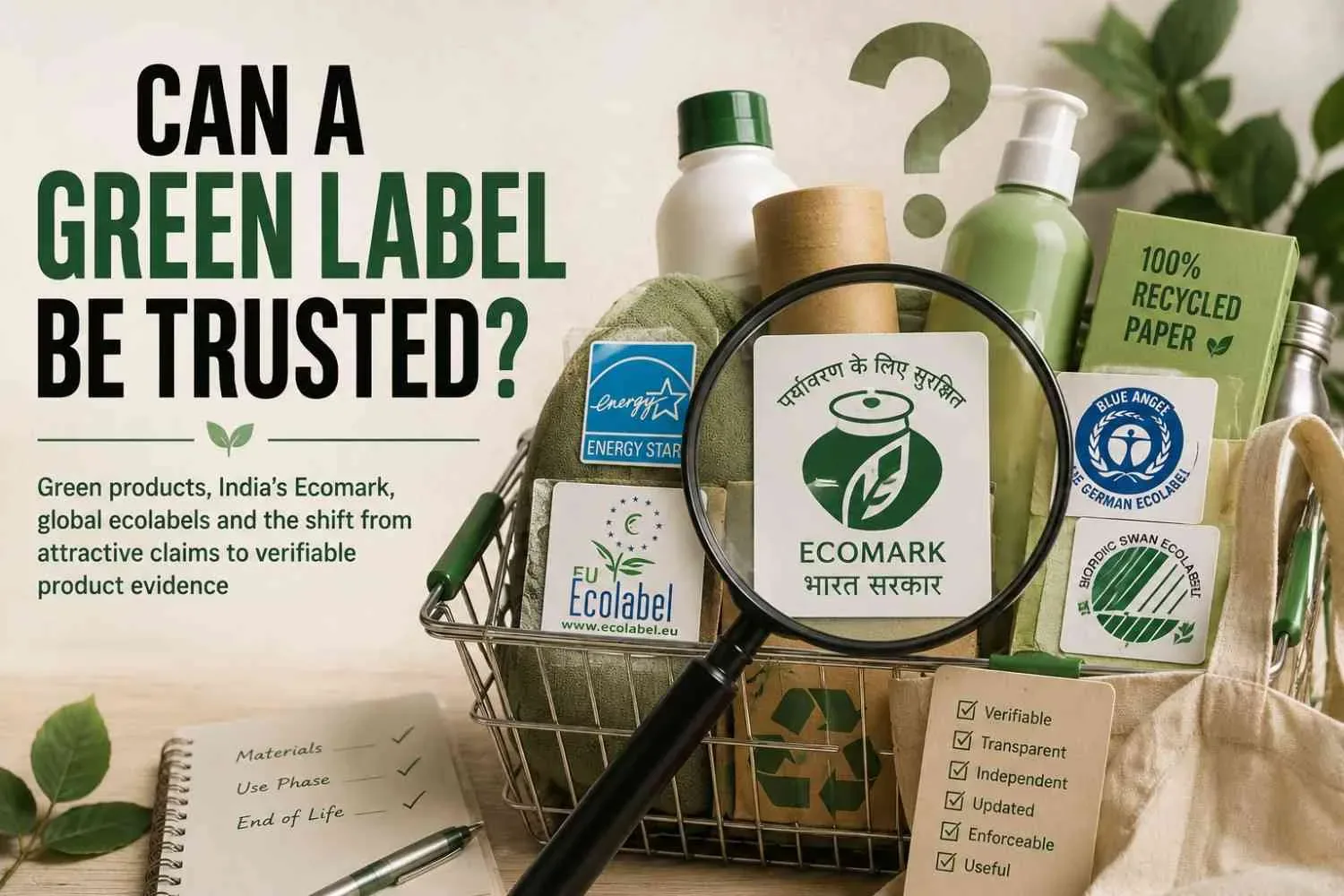
Green products, India’s Ecomark, global ecolabels and the shift from attractive claims to verifiable product evidence
A critical evaluation of the Ecomark Rules, 2024, with a six-part product-claim test, label glossary, international comparisons, market-readiness scorecard and a roadmap for a credible green marketplace in India.
MATERIALS Traceable inputs | USE PHASE Durable + repairable | END OF LIFE Collected + recovered |
Status date: 29 July 2026
Magazine-style research report | 5,000+ words | India and international evidence
BOTTOM LINE India has moved from a largely dormant 1991 label to a more credible legal framework in 2024. But the Ecomark is still better described as institutionally re-designed than marketplace-ready: certification counts, a consumer-facing registry, procurement preference, retailer integration, repairability scores and measurable public outcomes remain the decisive missing links. |
Contents
1. The green-shopping problem: abundance of claims, shortage of proof
2. What a credible green-product label must establish
3. How the world built ecolabels: timeline and institutional models
4. India’s Ecomark: why the 1991 scheme failed
5. The Ecomark Rules, 2024: what changed and what did not
6. Critical evaluation: a strong rulebook with a weak market engine
7. Progress through July 2026: rules, draft criteria, claims control and repair information
8. Global lessons and cases: Blue Angel, EU Ecolabel, Nordic Swan, ENERGY STAR and France
9. Product claim test, label glossary and marketplace-readiness scorecard
10. The future: from a logo to a green trust stack
11. Ten actions that can make Ecomark work
12. Sources and further reading
Research method and a necessary caution
In this report, the current statistics and legal status were then rechecked against official Indian, European, German, Nordic, French and United States sources. This matters because the green-label field changes quickly: for example, current official counts for Blue Angel and the EU Ecolabel are substantially higher than older figures, and the June 2026 Indian criteria are a draft under consultation rather than final law.
The phrase “green product” is itself comparative. No credible label proves that a product is environmentally harmless. At best, it establishes that a particular product or service meets stated criteria, within a stated boundary, at a stated time, using a stated method. This report therefore asks not whether a label is perfect, but whether it is specific, independently verifiable, transparent, updated, enforceable and useful at the point of purchase.
1. The Green-Shopping Problem: Plenty of Claims, Too Little Proof
Walk through a supermarket, electronics store or online marketplace and the vocabulary of virtue is everywhere: natural, clean, conscious, planet-positive, carbon-neutral, recyclable, biodegradable, sustainable, responsible. The visual grammar is equally familiar—green leaves, blue globes, forests, water droplets and earthy colours. Yet the shopper is rarely told the most important facts: what exactly has improved, compared with what, across which part of the lifecycle, tested by whom, for which product model, and for how long.
This is why ecolabelling has become both necessary and controversial. The abundance of labels does not automatically produce clarity. ISO distinguishes between Type I multi-criteria labels independently awarded by a third party; Type II self-declared claims made by manufacturers; and Type III environmental product declarations that disclose quantified lifecycle information. These are not interchangeable. A company’s “100% recyclable” statement is not the equivalent of a government-backed, audited, category-specific ecolabel, and neither is the same as a verified environmental product declaration.
THE CENTRAL CONSUMER TEST A claim is not credible merely because it is technically possible. “Recyclable” packaging may be impossible to collect locally. “Compostable” material may require an industrial facility that does not exist nearby. “Carbon neutral” may describe purchased offsets rather than a low-carbon product. The consumer needs evidence of real-world systems, not only laboratory possibilities. |
A useful label also has to survive the “quality paradox”. A lightweight product made with fewer materials may be worse for the environment if it breaks in half the time. A refill pack may reduce packaging but increase leakage or contamination. A bio-based material may come from land-intensive or poorly traced feedstock. The green-shopping question is therefore multi-dimensional: materials, performance, durability, repairability, packaging, hazardous substances, use-phase energy and water, and end-of-life responsibility must be examined together.
“The future is not trust the leaf. It is verify the product.”
2. What a Credible Green-Product Label Must Establish
A serious consumer system should force every important claim through six gates. Each gate answers a different question, and failure at any one can make the overall “green” story misleading.
| Dimension | Credible evidence | Red flags | India market readiness |
|---|---|---|---|
| Materials | Exact recycled, renewable or bio-based percentage; chain-of-custody or mass-balance method; restricted substances; supplier evidence; product/SKU scope. | Vague “made with recycled material”; no percentage; company-wide data applied to one product; bio-based treated as automatically low-impact. | Moderate. Mature in paper, metals and simple plastics; weaker in composites, electronics, fashion blends and informal supply chains. |
| Durability | Recognised stress, wear, cycle or reliability tests; stated expected life under defined use; warranty and failure-rate evidence. | “Long-lasting” without test standard; a long warranty with exclusions; environmental savings calculated against unrealistic life. | Emerging. Strongest where regulators require a score; otherwise usually hidden from shoppers. |
| Repairability | Disassembly with common tools; spare-part availability and price; manuals; diagnostic access; software/security support; non-destructive battery replacement. | Parts technically available but prohibitively priced; parts paired by software; no manuals; repair voids warranty; support period unstated. | Low-to-moderate in India; higher in parts of Europe. Information portals are not yet the same as comparable repair scores. |
| Packaging | Packaging-to-product ratio; recycled content; certified compostability and conditions; local recyclability; refill/reuse system; EPR registration. | “Plastic-free” outer box around multilayer inner pack; recyclable in theory but not collected; biodegradable without timeframe or conditions. | Moderate-to-high for basic formats, but multilayer films, small formats, inks, adhesives and collection gaps remain major barriers. |
| Certification | Independent, competent and accredited verifier; public criteria; certificate number, scope and expiry; audit evidence; conflict-of-interest controls. | Brand-created badge; certificate for factory rather than product; expired licence; audit firm paid without safeguards; no public registry. | Transitioning. Strong official schemes exist, but label proliferation and inaccessible registers weaken trust. |
| End of life | Take-back route; producer/EPR registration; recycler identity; actual collection and recovery rates; safe handling of hazardous residue; geographic availability. | “100% recyclable” with no collection channel; take-back only in a few metros; recovery claimed from certificates rather than physical evidence. | Moderate in regulated categories; weak where reverse logistics and municipal segregation are poor, especially outside large cities. |
The unit of truth is the exact product
Environmental marketing frequently shifts between levels: a company may have a renewable-energy target, a factory may hold ISO 14001 certification, a package may contain recycled plastic, and a particular product may have none of those advantages. Credible labelling must identify the exact stock-keeping unit or model, production boundary, facility where relevant, validity period and evidence base. A sustainable company claim cannot silently substitute for product evidence; nor can a single greener attribute stand in for overall environmental preferability.
3. How the World Built Ecolabels: Who, When and Where
The international history shows three broad waves. The first established visible trust marks. The second standardised claim types and laboratory methods. The third, now under way, connects labels to durability, repair, digital records and anti-greenwashing law.
| 1978 | Germany | Blue Angel became the first major national ecolabel. It uses product-group criteria, an independent Environmental Label Jury and public product listings. |
| 1989 | Nordic region and Japan | The Nordic Council of Ministers created the Nordic Swan; Japan’s Eco Mark also began. Both apply category criteria and lifecycle thinking. |
| 1991 | India | India launched Ecomark with the earthen-pot symbol, requiring environmental criteria plus relevant Indian quality standards. |
| 1992 | European Union and United States | The EU Ecolabel began as a multi-country Type I scheme. ENERGY STAR began as a focused energy-efficiency label and later became one of the world’s best-known endorsement marks. |
| 1990s–2020s | ISO system | ISO 14020-series standards clarified general principles, self-declared claims, Type I labels and Type III environmental declarations. |
| 2021 | France | A mandatory repairability score out of 10 appeared at the point of sale for selected electronics and appliances. |
| 2024–2026 | Europe | The EU adopted rules against generic environmental claims, a Right to Repair directive and the Ecodesign for Sustainable Products Regulation with digital product passports. |
| 2024–2026 | India | India replaced the 1991 scheme with the Ecomark Rules, 2024, issued anti-greenwashing guidelines, expanded repair information, and proposed tougher category criteria in June 2026. |
What separated successful schemes from symbolic ones?
Successful labels did not rely on the logo alone. They built a surrounding market system: clear criteria, visible product catalogues, recurring review, independent verification, public procurement, retailer display, enforcement against misuse and a consumer benefit that could be understood quickly. ENERGY STAR made operating-cost savings visible. Blue Angel connected criteria to procurement and a large searchable catalogue. France placed a comparative repair or durability score beside the price. In each case, the environmental signal became part of the buying transaction rather than a distant policy aspiration.
4. India’s Ecomark: An Early Idea That Failed to Create a Market
India’s 1991 Ecomark was conceptually ahead of its time. The matka symbol represented renewable materials, low-energy production and the fragility of ecosystems. The scheme eventually covered a broad set of categories, including paper, paints, batteries, detergents, textiles, leather, coir, plastics, cosmetics, food items and packaging. Its cradle-to-grave framing was sound: the mark was intended for products that satisfied both environmental criteria and relevant quality standards.
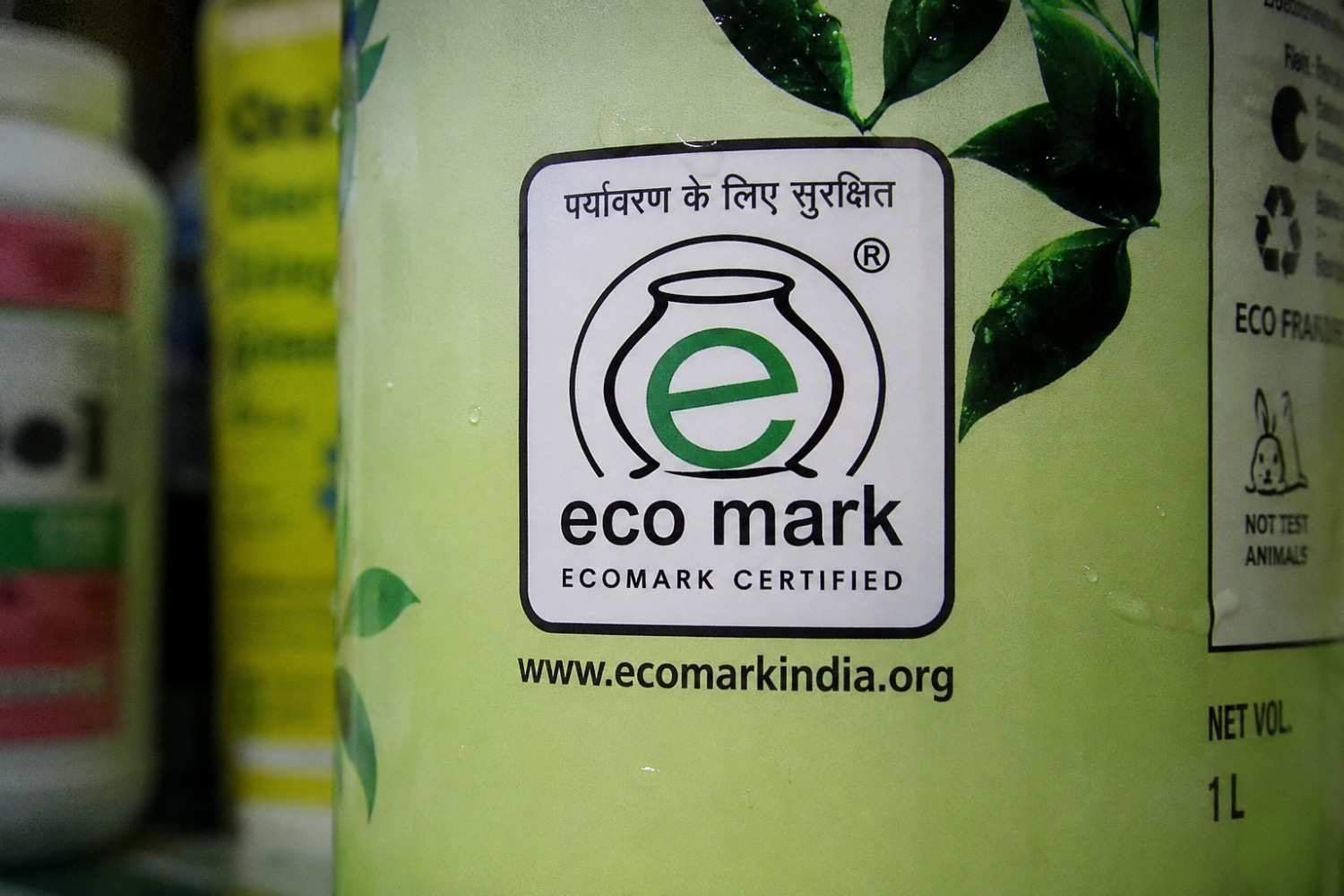
But the market barely noticed. A 2006 CUTS International assessment found that only 12 manufacturers had applied over roughly fifteen years and that even licence holders often did not use the mark prominently because it created little market benefit. A 2009 government statement recorded twenty licences awarded to fifteen companies in only three product categories. The exact historic count varies by date and measure, but the conclusion is consistent: the scheme never approached meaningful scale.
Why the first Ecomark stalled
- No demand pull: consumers did not recognise the symbol, retailers did not differentiate it and manufacturers saw no price or volume advantage.
- An additional compliance layer: firms had to satisfy environmental requirements on top of BIS quality requirements, without offsetting incentives.
- Weak institutional ownership: fragmented committees, frequent transfers and no dedicated mission-style organisation diluted accountability.
- No procurement engine: government purchasing did not create a guaranteed initial market for compliant paper, paints, furniture, cleaning products or office supplies.
- Static or slowly updated criteria: the scheme did not keep pace with new materials, circular design, toxic-substance controls, electronics, repairability or digital traceability.
- Poor transparency: there was no easy public registry of applications, licences, product models, test reports, expiry dates or enforcement actions.
- MSME economics: testing, documentation and process upgrades were costly for smaller manufacturers, while the commercial return was uncertain.
- Product-heavy design: environmental performance of services—hotels, cleaning, logistics, retail, events—received little practical attention.
THE ENDURING LESSON FROM 1991–2023 Good criteria are necessary, but a label becomes real only when someone wants to buy it, someone can verify it, and someone is punished for misusing it. Ecomark’s first generation had a certification concept without a market-transformation strategy. |
5. The Ecomark Rules, 2024: What Changed
On 26 September 2024, the Ministry of Environment, Forest and Climate Change notified the Ecomark Rules, 2024 under the Environment (Protection) Act framework and rescinded the 1991 notification. The purpose is broader than branding: the rules link Ecomark to Mission LiFE, resource efficiency, conservation, circular economy, lower adverse environmental impact, consumer information and the prevention of misleading environmental claims.
A stronger institutional design
Administration shifts to the Central Pollution Control Board in partnership with the Bureau of Indian Standards. A product ordinarily needs the applicable BIS licence, certificate of conformity or Quality Control Order compliance, and must then meet category-specific Ecomark criteria. This two-layer test protects against a common failure of green marketing: a product should not be called environmentally preferable if it cannot also perform safely and effectively.
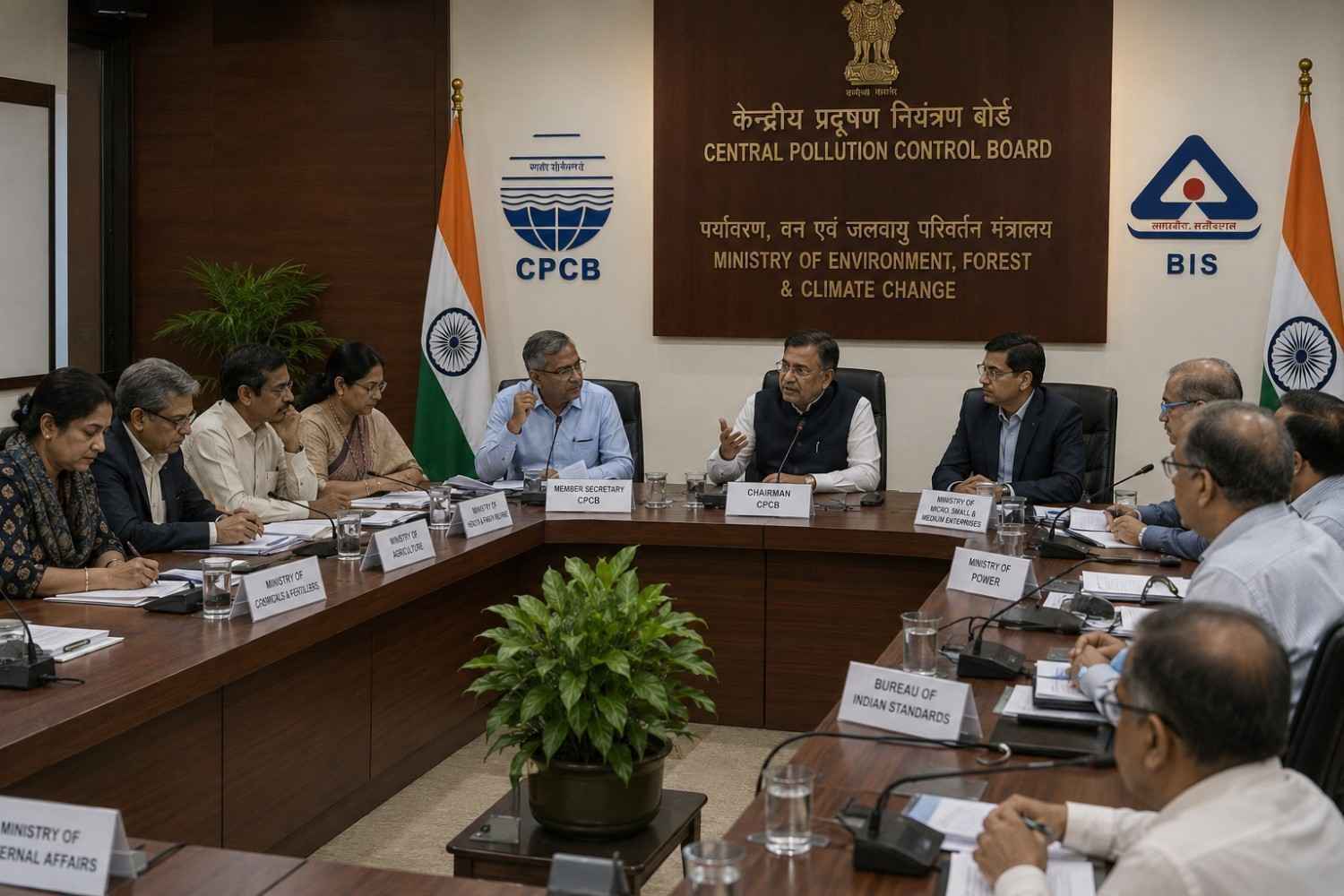
The Steering Committee is wider than the old architecture. It includes representatives from consumer affairs, industry, information and broadcasting, chemicals, agriculture, health, MSME, power, drinking water, expenditure, external affairs, commerce, textiles, scientific institutions, BIS and CPCB, along with experts and industry. On paper, this creates the possibility of linking criteria to consumer protection, trade, public expenditure, industrial policy and communication.
Lifecycle criteria—but with flexibility
The rules permit category criteria to address raw-material sources, manufacturing processes, natural-resource use, environmental impacts, emissions and waste, recycled content, hazardous substances, recyclability, disposal of product and packaging, and EPR compliance. That breadth is a major improvement over one-attribute green claims. It allows Ecomark to distinguish an environmentally preferable product rather than merely certify one recycled component or one efficient factory.
Verification, limited validity and post-market checks
Applications are made to CPCB. Verification may be undertaken by CPCB or a registered verifier, with a report to be prepared within sixty days of verification. A granted Ecomark is valid for three years or until the criteria change, whichever is earlier; holders must file annual reports. CPCB may suspend or cancel the mark for false information or wilful concealment, and market verification may be conducted through CPCB or registered agencies. These are meaningful safeguards against the “certify once, drift forever” problem.
A portal is not a side feature—it is the credibility infrastructure
The rules require CPCB to develop a portal for applications, grants, annual reports and verifier registration. The portal is also expected to publish holders, certified products, the reports on which grants are based, environmental research, benefits and relevant international practices. The rules permit consideration of domestic and foreign ecolabel programmes for recognition or mutual recognition. If fully implemented, this would allow a shopper, buyer, journalist or regulator to move from a logo to auditable evidence.
6. Critical Evaluation: A Stronger Rulebook, an Incomplete Market System
The 2024 rules deserve credit for rebuilding the legal and institutional foundation. They do not, however, resolve the commercial and consumer failures that defeated the first scheme. The following scorecard is an analytical assessment, not an official rating.
| Dimension | Score | What works | What remains weak | |
|---|---|---|---|---|
| Legal foundation | 4/5 | A formal rule-based scheme under environmental law, with defined authorities, application, validity, cancellation and appeal. | The rules do not themselves create a detailed Ecomark-specific penalty schedule for every misuse; effective deterrence depends on wider environmental and consumer law enforcement. | |
| Scientific breadth | 3/5 | Criteria may cover lifecycle impacts, resources, pollution, hazardous substances, recycled content, recyclability and EPR. | The final 2024 framework does not require a uniform, public LCA method, functional unit or comparative “best-in-class” threshold across all product groups. | |
| Verification | 3/5 | CPCB/registered verifier review, annual reporting and post-market verification are built in. | Verifier accreditation, conflict-of-interest controls, audit sampling, fees and public disclosure need operational detail and visible implementation. | |
| Transparency | 2/5 | A public portal and publication of holders, products and underlying reports are explicitly envisaged. | As of this review, an easily discoverable, consumer-facing registry with current product counts and model-level reports could not be located on the main public interfaces. | |
| Consumer usability | 1.5/5 | A single government-backed mark could reduce label clutter. | The rules do not provide a simple comparative score for durability, repairability, carbon, water or lifecycle cost; a static logo cannot answer every consumer question. | |
| Market pull | 1/5 | The Steering Committee includes public expenditure and multiple market-facing ministries. | No automatic purchase preference, retailer display rule, e-commerce filter or fiscal incentive is created by the rules. | |
| MSME accessibility | 1.5/5 | MSME representation exists in governance. | No clear fee subsidy, shared testing infrastructure, transition finance, simplified evidence pathway or small-business technical assistance is guaranteed. | |
| Circularity integration | 3/5 | EPR, recycled content, recyclability and disposal can be embedded in criteria. | No cross-category repairability, spare-parts, take-back performance or digital product passport requirement appears in the final 2024 rules. | |
| Services | 1.5/5 | The legal concept could potentially evolve. | The operative market emphasis remains consumer products; India has not yet matched mature ecolabel coverage of accommodation, cleaning, logistics or other services. | |
OVERALL ASSESSMENT Approximately 2.4/5: a promising certification architecture, but not yet a complete consumer-market institution. The biggest gap is no longer the absence of legal criteria; it is the absence of visible demand, comparable information, measurable uptake and an easily verified product universe. | ||||
The BIS gate: protection and bottleneck
Requiring basic quality conformity is defensible: environmentally preferable goods must not compromise safety or function. Yet the BIS/QCO gate can also become an entry barrier when no suitable Indian Standard exists, when an innovative product does not fit an established category, or when an MSME faces duplicate documentation and testing. The solution is not to abandon quality control, but to create coordinated, single-window evidence, clear category manuals, recognised test laboratories and subsidised pathways for smaller firms.
The “best-in-class” question
Mature Type I schemes are usually designed to identify a leading segment of a category and then tighten criteria periodically. The Ecomark Rules state desirable environmental outcomes but do not consistently define the label as the top-performing share of the Indian market. Without a comparative ambition, Ecomark risks becoming “compliant plus” rather than a mark of environmental leadership. Category rules should therefore state the market baseline, expected qualifying share and revision trigger.
ISO 14001 is useful—but it is not a green-product certificate
The June 2026 draft criteria often require ISO 14001 environmental-management certification. That may improve process discipline, but it certifies a management system, not the lifecycle superiority of a specific product. A factory can operate an ISO 14001 system and still produce a relatively high-impact product. Ecomark must therefore treat management-system certification as supporting evidence, never as a substitute for product-level thresholds and verified outcomes.
7. Actual Progress Through July 2026
The strongest conclusion is mixed: policy construction has accelerated, but public evidence of market penetration remains thin. Four developments matter.
1. Anti-greenwashing rules now flank Ecomark
On 15 October 2024, the Central Consumer Protection Authority issued Guidelines for Prevention and Regulation of Greenwashing or Misleading Environmental Claims. They require clear, specific and substantiated claims; generic terms such as sustainable, natural, organic and regenerative need adequate qualification; comparative claims need verifiable evidence; and credible certification or scientific evidence is expected. ASCI’s environmental-claims rules similarly state that broad claims such as eco-friendly or planet-friendly require robust support and cannot be rescued by a distant disclaimer.
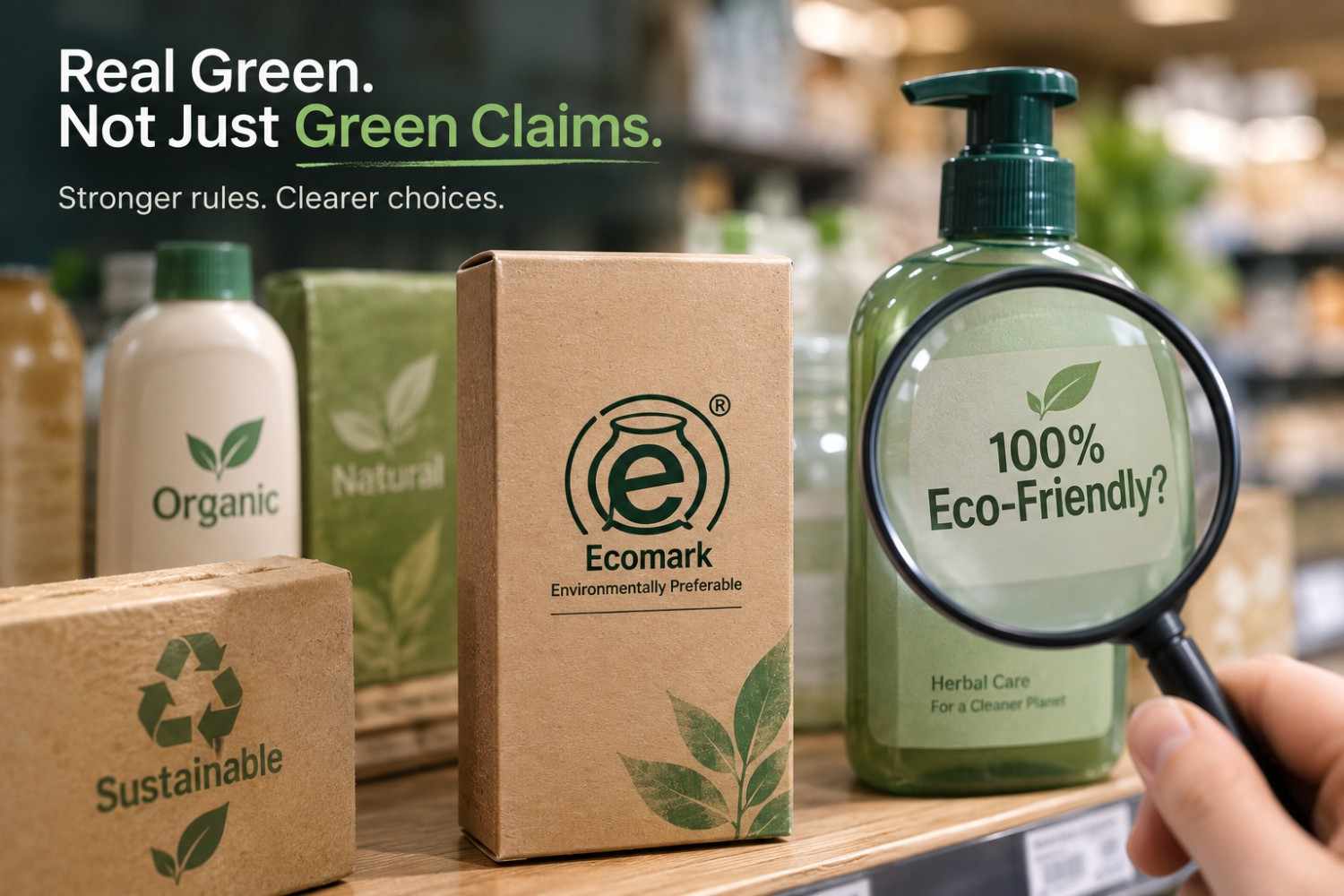
This is a crucial complement to Ecomark. A voluntary label can reward better products, while consumer-protection rules can police misleading claims across the rest of the market. The unresolved task is enforcement integration: complaints, investigations, Ecomark misuse, advertising decisions and certificate cancellation should flow through interoperable systems and become visible in a public enforcement register.
2. June 2026 draft amendments move from principles to measurable category rules
On 8 June 2026, MoEFCC published draft amendments for sixty days of public consultation, ending 6 August 2026. The proposals cover six areas—paints and coatings, batteries, paper and paper products, wood substitutes, fire extinguishers and coir products—and introduce substantially more specific requirements. Examples include QR-linked criteria and end-of-life information; chemical restrictions; renewable-energy thresholds; EPR registration; traceability; recycled-content requirements; accredited testing; ISO 14001; and lifecycle narratives in selected categories.
The battery proposals are especially concrete: limits on mercury and cadmium, EPR registration, restrictions on chlorine-containing plastic/PVC, packaging conditions, rising domestic recycled-lead thresholds, collection and recycling obligations, and energy-reduction requirements. Paper criteria include high recovered-paper content for recycled products, bleaching restrictions and a cradle-to-gate LCA narrative. Coir criteria add traceability, heavy-metal testing, renewable-energy and water-management requirements, compostable packaging and QR-linked disposal information.
IMPORTANT LEGAL STATUS These June 2026 provisions are draft amendments under consultation as of 29 July 2026. They are evidence of policy direction, not completed certification outcomes. A rigorous market assessment must not count proposed QR codes, thresholds or category tests as already operating nationwide. |
Where the 2026 draft still needs refinement
- Method consistency: some categories receive numerical limits, others rely on management systems or narrative evidence. A common hierarchy of product outcomes, facility controls and documentation is needed.
- Lifecycle boundary: a cradle-to-gate narrative is useful but does not capture use, durability, repair or disposal. High-impact categories need cradle-to-grave methods and declared functional units.
- Packaging language: “biodegradable” or “compostable” requirements must specify test standards, time, conditions, toxicity and the collection system in which the material will actually be treated.
- MSME transition: renewable-energy shares, laboratory testing, traceability and LCA can be costly. Shared facilities, phased deadlines and financial support are essential.
- Data architecture: QR codes should point to standardised, machine-readable, persistent product records—not brand marketing pages that can change or disappear.
- Outcome verification: EPR registration proves legal enrolment, not actual collection. Ecomark should disclose physical collection, reuse and recycling performance.
3. Right to Repair has begun as an information portal, not yet a comparative right
India’s Right to Repair portal covers farming equipment, mobiles and electronic devices, consumer durables and automobile equipment, and lists participating brands. It can provide warranty, service-network and spare-part information. This is a useful foundation for extending product life. But product records vary in completeness, and the portal does not yet provide a mandatory, standardised repairability score beside the price. Information availability is therefore emerging; comparable repair performance and enforceable access remain incomplete.
4. BEE shows that Indian labelling can transform a market
The Bureau of Energy Efficiency’s Standards and Labelling programme is the clearest domestic counter-example to Ecomark’s historical stagnation. It launched in 2006 with a simple 1-to-5 star comparison tied directly to electricity-bill savings. By 2025, BEE reported 38 covered appliance categories, 3,662 registered brands, 58 crore star-labelled appliances produced and 89.8 billion units of savings. In March 2026, BEE launched a mobile application that lets consumers scan a QR code for authentic model and compliance information.
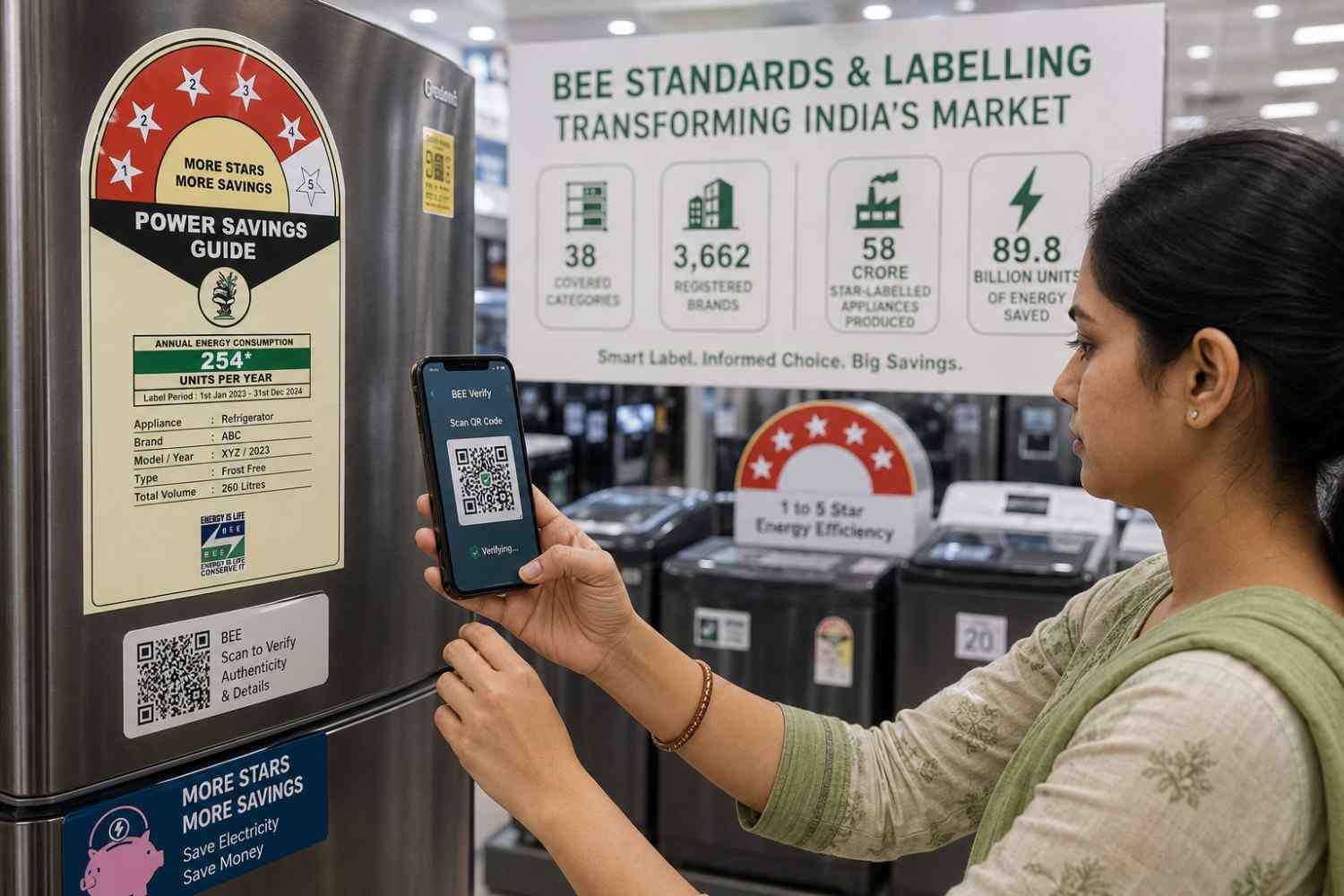
BEE succeeded because it combined mandatory coverage in important categories, a comparative visual language, regular ratcheting of standards, market surveillance, databases, public communication and a wallet benefit. Ecomark cannot copy the same methodology across every environmental dimension, but it can copy the institutional lesson: the consumer must understand the signal in seconds and verify it in one scan.
So, how market-ready is Ecomark?
As of 29 July 2026, the framework is legally and institutionally more ready than the market. MoEFCC’s 2024–25 annual report records the notification and its intended implementation. The 2026 draft shows active technical development. Yet this research did not find, through the main public CPCB, MoEFCC and BIS interfaces, a readily discoverable product registry displaying current applications, granted marks, exact models, reports, expiry dates and post-market actions. Nor was an official, current aggregate certification count located. That absence does not prove that no applications or grants exist; it does mean that a consumer or buyer cannot yet easily verify scale and availability.
Marketplace readiness should therefore be described as nascent. Paints, batteries, paper, cleaning products, packaging, textiles and electronics are technically suitable categories. Retail and e-commerce systems can display the mark. Testing and EPR infrastructures exist in parts. But demand, visibility, searchable evidence, MSME participation and procurement preference have not yet combined into a self-reinforcing market.
8. Global Lessons: What Has Worked—and What Has Not
Germany’s Blue Angel: credibility through longevity, criteria and catalogue
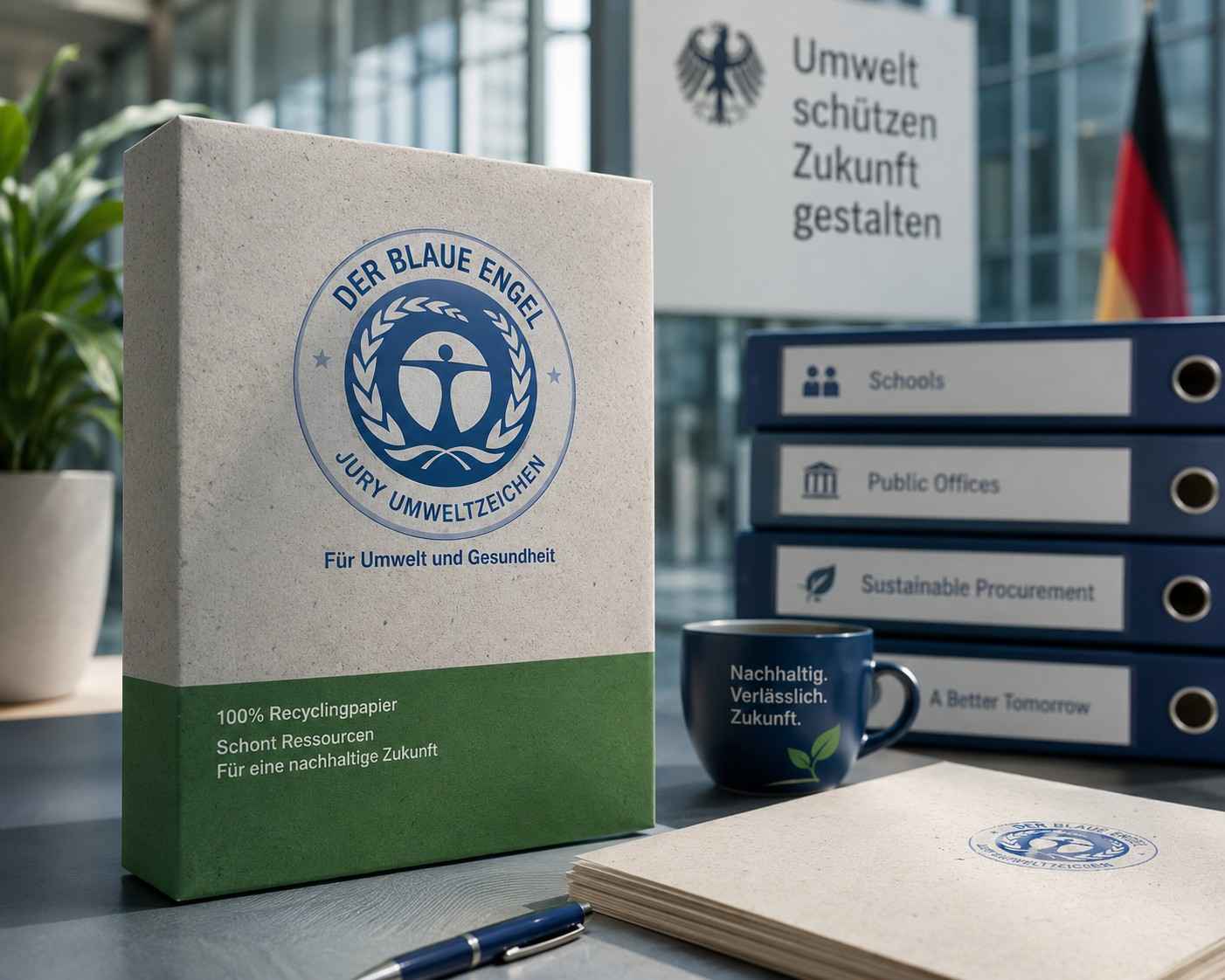
Launched in 1978, Blue Angel is the foundational example of a government-backed Type I ecolabel. Its official catalogue now reports more than 70,000 products and services from over 1,800 companies. The German Environment Agency develops criteria, the independent Environmental Label Jury decides on new and revised criteria, and RAL handles certification. Product groups publish detailed Basic Award Criteria and certified items are searchable.
Its strength is not perfection but institutional repetition: category selection, stakeholder hearings, evidence, award, publication, expiry and revision. Blue Angel also reaches public and institutional purchasing. A recycled-paper label becomes commercially meaningful when offices, schools and government departments buy to the standard. The broader lesson for India is that procurement can create the first reliable market before mass consumers learn the label.
EU Ecolabel: scale, services and integration with consumer law
The EU Ecolabel began in 1992 and operates through product-group criteria and national competent bodies under a common regulation. As of March 2026, the European Commission reported 3,541 licences covering 116,692 goods and services; 61% of licence holders were SMEs. The scheme includes detergents, paper, paints, textiles and tourist accommodation, demonstrating that ecolabelling can assess operational services as well as manufactured goods.
Its influence is being strengthened by adjacent law. Directive (EU) 2024/825 applies from 27 September 2026 and restricts generic environmental claims and sustainability labels that are not based on recognised certification schemes or public authority systems. This does not make the EU Ecolabel mandatory, but it improves the competitive position of credible labels by making unsupported alternatives legally riskier.
Nordic Swan: lifecycle thinking that includes service quality
The Nordic Swan was created in 1989 by the Nordic Council of Ministers and remains the official ecolabel of Denmark, Finland, Iceland, Norway and Sweden. Nordic Ecolabelling describes it as an ISO 14024 Type I, independent third-party scheme with a holistic lifecycle perspective. Its reported recognition across the Nordic region is exceptionally high. Criteria extend to services and operational systems, while quality and function are treated as environmental variables because a product that lasts longer or works at a lower dose may have lower overall impact.
ENERGY STAR: the power of one simple, verifiable benefit
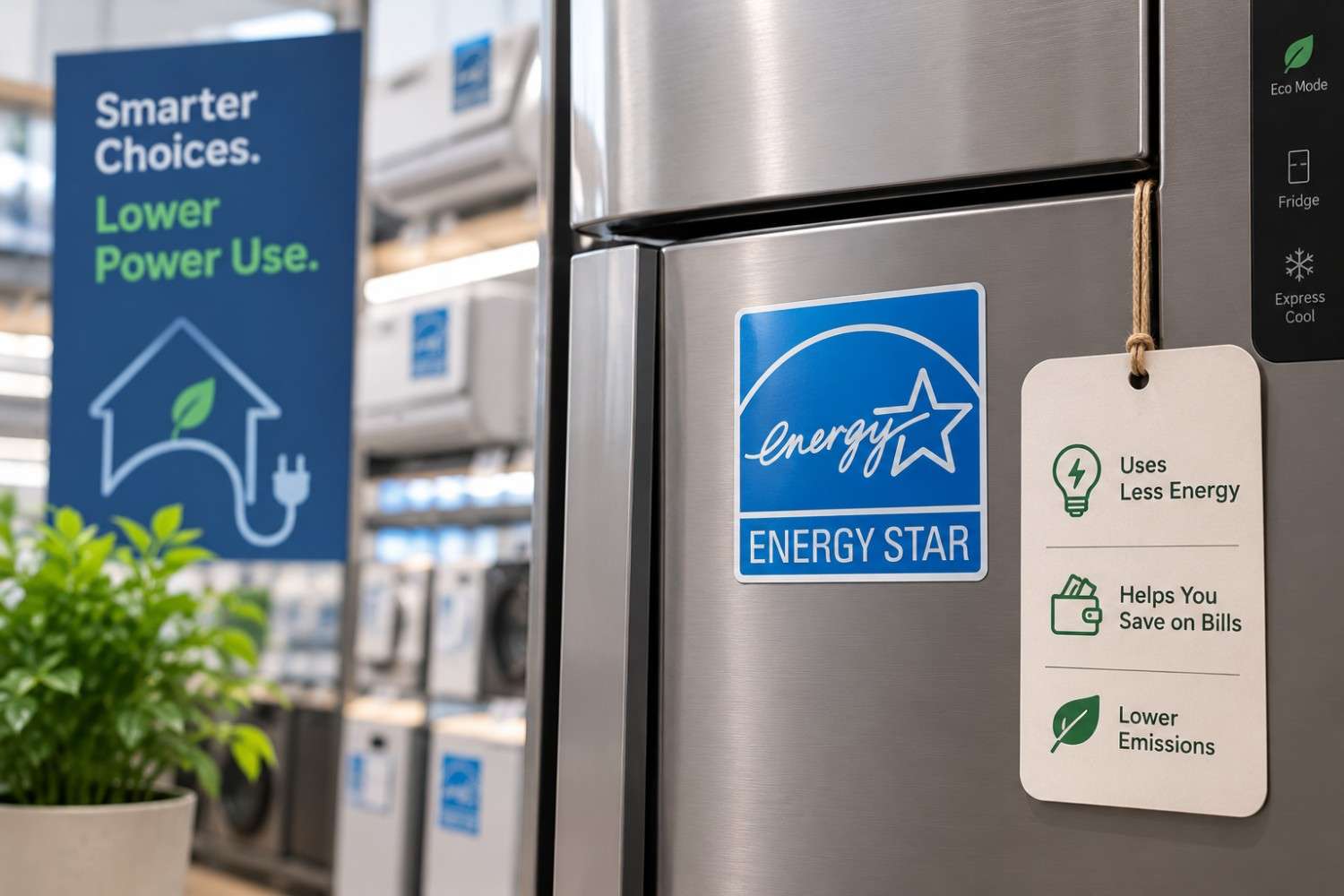
ENERGY STAR is narrower than a multi-criteria ecolabel, but its market success is instructive. It is government-backed, uses product performance specifications and third-party certification, and tells a simple story: this model uses less energy and should cost less to operate. The programme reports recognition by about nine in ten United States households and has a substantial cumulative emissions impact. The label works because the benefit is measurable, comparable and financially relevant.
France: put repairability and durability beside the price
France made repairability visible from 1 January 2021 through a mandatory score out of 10 for selected electrical and electronic products. The score considers documentation, disassembly, spare parts, price and product-specific factors. In 2025, a durability index replaced it for televisions from 8 January and washing machines from 8 April, adding reliability, robustness, maintenance and resistance to wear. Sellers must display the score near the price in stores and online.
The French model is not foolproof: much of the calculation is manufacturer-generated and regulators must inspect supporting evidence. But it solves a problem that static ecolabels do not—the shopper can compare competing models on a specific circular-economy attribute at the exact moment of purchase. India should combine Ecomark’s holistic endorsement with mandatory comparative indices in high-impact categories.
EU digital product passports: the label becomes a data layer
The EU’s Ecodesign for Sustainable Products Regulation, in force since 2024, establishes a framework for durability, repairability, recycled content, environmental footprint and other product requirements. It also creates the Digital Product Passport: a structured record connected to a product through a data carrier such as a QR code. Depending on product rules, the passport can include model or batch identity, compliance documents, materials, substances of concern, repair information, environmental performance and end-of-life instructions. Online marketplaces must be able to expose relevant passport access before purchase.
The decisive shift is from “trust this symbol” to “inspect this evidence”. A passport does not eliminate false data; it improves traceability, interoperability and enforcement. India’s 2026 draft QR proposals are a first step, but Ecomark should eventually define common data fields, persistent identifiers, APIs, access rights, retention rules and links to BIS, EPR, customs, ONDC, GeM and consumer-complaint systems.
No scheme is foolproof: five recurring failure modes
- Boundary manipulation: a label covers packaging, a factory or one ingredient while advertising implies the whole product or company is green.
- Audit dependence: third-party verification can fail through weak sampling, conflicts of interest, competence gaps, fraud or industry capture.
- Criteria lag: a once-leading threshold becomes average as technology improves, but the label remains unchanged.
- Burden shifting: reducing carbon can increase toxicity, water stress, land pressure or waste; lifecycle and multi-attribute methods are needed.
- Real-world system failure: a technically recyclable or compostable product enters a market without collection, sorting, repair or treatment infrastructure.
9. Consumer Label Glossary: What the Words Should Mean
| Term | Credible interpretation |
|---|---|
| Eco-friendly / green | Not a technical category by itself. Must be qualified with the specific benefit, lifecycle boundary and evidence. Broad unqualified use is a greenwashing red flag. |
| Natural | Describes origin, not safety or low impact. Natural substances may be toxic, scarce, land-intensive or non-renewable on the relevant timescale. |
| Organic | Should refer to compliance with a recognised organic standard for the stated agricultural ingredient or product. It does not automatically cover packaging, labour or total carbon impact. |
| Recycled content | The proportion of input material recovered from pre-consumer or post-consumer waste. The percentage, method and chain of custody should be stated. |
| Recyclable | Technically capable of being recycled under specified conditions. A credible claim should also address collection, sorting and reprocessing availability in the market of sale. |
| Reusable / refillable | Designed for multiple use cycles for the same purpose. The system, cleaning requirement, return route and expected cycles should be disclosed. |
| Biodegradable | Capable of biological breakdown under defined conditions and time. The environment—soil, marine, home compost or industrial compost—must be specified. |
| Compostable | Meets a recognised compostability standard under stated conditions. Industrial compostability does not mean home compostability or harmless littering. |
| Bio-based | Made wholly or partly from biomass. The percentage and feedstock should be disclosed; bio-based does not automatically mean biodegradable or low-carbon. |
| Carbon footprint | Quantified greenhouse-gas emissions for a defined product lifecycle and functional unit, usually expressed as CO2-equivalent. Method and data year matter. |
| Carbon neutral | A balance claim often involving reductions and offsets. Product-level claims should disclose gross emissions, reductions, residual emissions, offset type and claim period. |
| Net zero | A long-term state requiring deep emissions reductions and limited neutralisation of residual emissions. It should not be used casually for a single product without a robust standard and boundary. |
| Zero waste | Should identify the waste stream, boundary, period and destination. “Zero waste to landfill” may still include incineration or export. |
| Circular | Should demonstrate design for durability, reuse, repair, remanufacture and material recovery—not merely the presence of one recycled component. |
| LCA | Life Cycle Assessment: a method for evaluating impacts across defined lifecycle stages. Results depend on system boundary, functional unit, allocation and data quality. |
| EPD | Environmental Product Declaration: a verified, standardised disclosure of quantified environmental data. It reports impacts; it does not necessarily certify that the product is best in class. |
| Type I ecolabel | A voluntary, multi-criteria, third-party label under ISO 14024 principles that identifies environmental preferability within a product category. |
| Type II claim | A self-declared environmental statement under ISO 14021 principles. It can be valid, but requires precise substantiation and is not independent certification. |
| EPR | Extended Producer Responsibility: legal responsibility for managing products or packaging after use. Registration is not the same as demonstrated collection performance. |
| Digital Product Passport | A structured digital identity for a product, model or batch carrying sustainability, compliance, repair and end-of-life information through a data carrier such as a QR code. |
10. Marketplace Readiness: Where India Can Move First
| Category | Readiness | What must happen |
|---|---|---|
| Paper and tissue | High technical readiness | Established recycled-fibre testing, public procurement potential, simple consumer use. Needs fibre traceability, chemical limits and procurement mandates. |
| Paints and coatings | Moderate-high | VOC and hazardous-substance tests exist; large institutional market. Needs consumer-readable emissions classes and strong lab surveillance. |
| Batteries | Moderate-high | EPR and recycler systems exist; draft recycled-lead thresholds are concrete. Needs model-level data, collection proof and safety integration. |
| Detergents and cleaners | Moderate | Strong global criteria examples on toxicity, biodegradability, dosage and packaging. India needs updated category rules and service-cleaning criteria. |
| Packaging | Moderate | EPR creates legal push. Real-world recyclability varies by format and geography; small and multilayer packaging remain difficult. |
| Electronics and appliances | Moderate | BEE, BIS, e-waste EPR and Right to Repair form building blocks. Missing mandatory durability/repairability scores and unified product passports. |
| Textiles and footwear | Low-moderate | Export supply chains already use certifications, but fibre blends, chemicals, microfibres, labour issues and traceability make claims complex. |
| Hotels, cleaning and events | Low but high opportunity | Global schemes show services can be certified across operations. India needs service-specific audit protocols, periodic performance data and customer-facing display. |
| E-commerce marketplaces | Technically high; institutionally low | Platforms can filter and verify certificates quickly. They need standard APIs, liability rules, claim fields and a trusted Ecomark registry. |
| Government procurement | High leverage, underused | GeM and departmental tenders can create immediate demand. Ecomark preference and equivalent-performance clauses are not yet systematic. |
A practical marketplace product card
A consumer should not have to become a lifecycle analyst. The evidence can be translated into a standard product card displayed online and, through QR, in stores. At minimum it should show: exact product/model; Ecomark licence and expiry; two or three reasons it qualified; recycled or renewable content; energy/water performance where relevant; durability or warranty; repair score and support period; packaging route; EPR/take-back link; and disposal instructions for the buyer’s location. The underlying technical report can remain available for experts and enforcement authorities.
11. The Future: A Green Trust Stack, Not One Magic Logo
The next decade will not be governed by one universal green symbol. Credible consumption will depend on a layered “trust stack” in which each instrument performs a different function.
LAYER 1 | MINIMUM PRODUCT LAW Safety, energy, toxic-substance, waste and ecodesign rules prevent the worst products from entering the market. |
LAYER 2 | ANTI-GREENWASHING ENFORCEMENT Generic, exaggerated or offset-only claims are restricted; scope and evidence must be disclosed. |
LAYER 3 | COMPARATIVE SCORES Energy, water, repairability, durability or carbon ratings permit fast comparison within a category. |
LAYER 4 | TYPE I ECOLABEL Ecomark identifies multi-attribute environmental leaders that exceed minimum compliance. |
LAYER 5 | DIGITAL PRODUCT PASSPORT Structured product data allows verification, repair, customs checks, marketplace display and end-of-life handling. |
LAYER 6 | EPR AND REVERSE LOGISTICS Producer responsibility is connected to actual take-back, refurbishment and recycling outcomes. |
LAYER 7 | PROCUREMENT AND MARKETPLACE DEMAND Government, companies, retailers and platforms preference verified products and expose credentials at search and checkout. |
LAYER 8 | POST-MARKET ACCOUNTABILITY Sampling, complaints, certificate withdrawal, penalties and public enforcement protect the label after award. |
Digital does not automatically mean trustworthy
QR codes and blockchain can improve traceability, but they cannot repair weak governance. A QR code that opens a marketing page adds little. A digital passport is credible only when the data fields are standardised, claims are linked to evidence, revisions are logged, certificates are signed by recognised bodies, access survives company failure, and regulators can audit the underlying physical flows. AI may identify anomalies in supplier, energy or recycling data, but human accountability and legal responsibility remain essential.
Green products will compete on lifetime value
The most useful future comparison may not be “green versus ordinary” but cost and impact per year of service. A more expensive appliance that lasts twice as long, consumes less electricity and can be repaired locally may be cheaper and greener over its life. Retailers and public buyers should therefore display lifetime energy cost, expected life, repair support and recovery value alongside upfront price. This also reduces the tension between affordability and sustainability.
12. Ten Actions That Can Make Ecomark Work
1. Make the registry real and searchable. Publish every holder, exact model/SKU, criteria version, verifier, report summary, issue date, expiry, annual status, complaint and enforcement action through a fast public portal and open API.
2. Create market pull through procurement. Require Ecomark or equivalent verified performance in high-impact central and state procurement where adequate supply exists, beginning with paper, paints, furniture, cleaning products, batteries and office equipment.
3. Integrate retail and e-commerce. Develop an official Ecomark data feed for GeM, ONDC and major marketplaces; require certificate validation before environmental badges appear and allow filters for repair, recycled content and end-of-life.
4. Adopt comparative indices. Build mandatory repairability and durability scores for selected electronics and appliances, drawing on France and EU ecodesign methods, while retaining Ecomark as the holistic endorsement.
5. Subsidise MSME compliance. Provide vouchers for accredited testing and LCA, cluster laboratories, shared traceability platforms, technical helpdesks and transition finance tied to verified improvements.
6. Define best-in-class ambition. For every product group, publish the market baseline, intended qualifying share, measurable thresholds, test methods, data quality rules and a three-to-four-year review cycle.
7. Connect claims law to certification. Link CCPA, ASCI, CPCB, BIS and consumer-complaint systems so that false claims, forged labels and certificate violations trigger coordinated, public action.
8. Expand to services. Develop criteria for hotels, institutional cleaning, events, logistics, retail and data centres with periodic operational audits, not one-time policy-document reviews.
9. Move from EPR registration to outcomes. Publish geographic collection coverage, verified quantities, reuse and recycling rates, leakage and recycler destinations at product or producer level where feasible.
10. Measure success publicly. Report applications, grants, processing time, certification cost, MSME share, category sales share, consumer recognition, procurement spend and quantified environmental savings each year.
Conclusion: The Matka Must Become a Window, Not a Decoration
India’s 2024 Ecomark reform is important. It replaces a weak, fragmented and commercially invisible scheme with clearer authority, lifecycle criteria, registered verification, limited validity, annual reporting, post-market checks and a planned public portal. The June 2026 draft indicates a welcome turn toward QR-linked disclosure, chemical restrictions, renewable energy, recycled content, traceability, EPR and lifecycle evidence.
Yet a certification rule is not the same as a functioning green marketplace. The first Ecomark failed not because India lacked an environmental logo, but because consumers could not recognise value, manufacturers could not see demand, buyers did not preference certified goods, and the public could not easily verify products. Those market failures remain the test of the reboot.
The most credible future will combine a strict floor for all products, comparative scores for specific attributes, a selective multi-criteria Ecomark, digital product passports, repair and take-back rights, and visible enforcement. The matka can remain the trusted front door—but behind it must sit a transparent product record, measurable environmental performance and a real system for keeping materials in use. Only then will “green” move from marketing language to consumer infrastructure.
Sources and Further Reading
3. MoEFCC. Annual Report 2024–25, section on eco-labelling.
6. Right to Repair India, Department of Consumer Affairs. About, FAQs and registered brands.
8. Bureau of Energy Efficiency. 2025 programme dashboard and achievements.
9. Press Information Bureau. BEE launches Star Label Mobile App, 1 March 2026.
10. CUTS International. “Establish an Independent Board on Ecolabelling in India,” 21 September 2006.
11. Press Information Bureau. “Eco Mark Scheme,” historical status and licences, 2009.
13. European Commission. EU Ecolabel facts and figures, March 2026.
14. European Union. Directive (EU) 2024/825 on empowering consumers for the green transition.
15. European Union. Directive (EU) 2024/1799 on common rules promoting repair of goods.
17. Blue Angel. Products and services; Basic Award Criteria and governance information.
18. Nordic Ecolabelling. Official Nordic Swan Ecolabel, history, lifecycle principles and governance.
19. French Ministry for Ecological Transition. Repairability Index, updated July 2025.
20. French Ministry for Ecological Transition. Durability Index, updated June 2025.
21. United States EPA. ENERGY STAR brand, certification and impacts.
22. Global Ecolabelling Network. Type I ecolabelling principles and member programmes.
Note: Web sources were checked against their publicly available status on 29 July 2026. Counts and draft legal provisions may change after that date.





Add a Comment