Best Practices

Highlights proven strategies, models, and success stories that drive effective sustainability outcomes.

Showing 12/43

01 Aug 2026

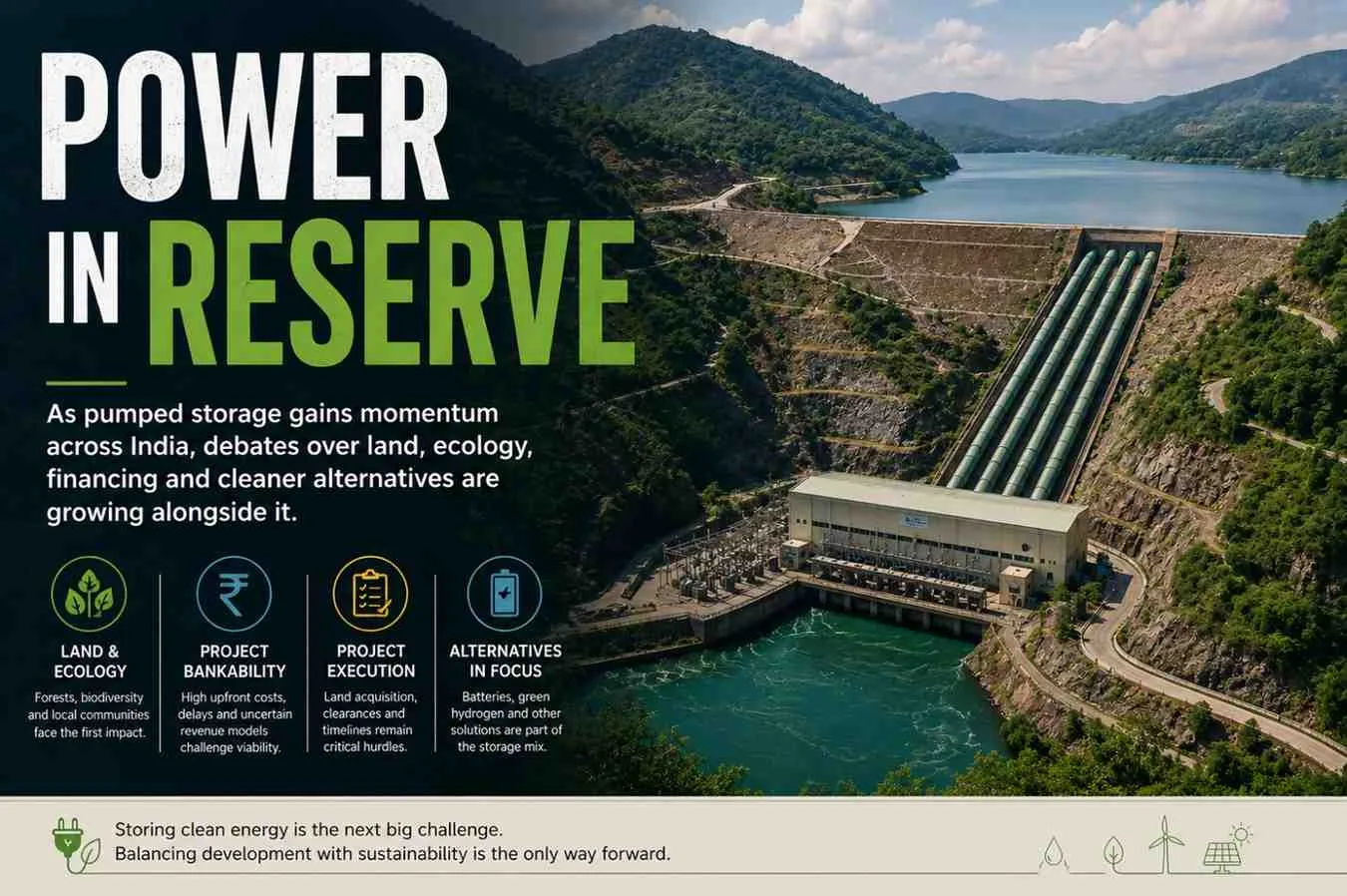
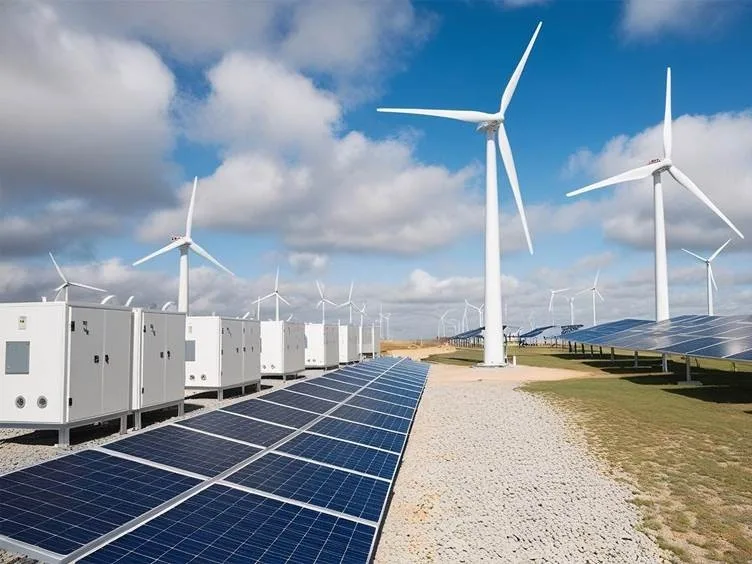
As pumped storage gains momentum across India, debates over land, ecology, financing and cleaner alternatives are growing alongside it KOLKATA | August 1, 2026: India's renewable energy capacity is expanding rapidly, but the next phase of the transition will depend on solving a critical challenge: storing clean electricity when renewable sources are not generating power. Pumped storage hydropower (PSH) has emerged as one of the country's most promising solutions and is now playing a central role in India's energy planning. However, as projects begin moving from policy announcements to on-ground development, they are also raising important questions about land, ecology, financial viability and whether alternative storage technologies can deliver the same benefits with fewer trade-offs. Pumped storage hydropower functions like a giant rechargeable battery. Surplus electricity is used to pump water from a lower reservoir to an upper one, where it is stored until demand rises. When additional power is required, the water is released back through turbines to generate electricity. Its ability to provide long-duration energy storage and stabilise the electricity grid has made pumped storage an important part of India's strategy for integrating larger amounts of solar and wind power. Pumped storage hydropower is emerging as a cornerstone of the Union government's long-term clean energy strategy. Across states such as Maharashtra, Andhra Pradesh, Madhya Pradesh, Odisha and Karnataka, a growing pipeline of projects is expected to play a vital role in integrating larger volumes of solar and wind power into the grid. Yet as development gathers pace, the conversation is expanding beyond energy storage to include questions of land, ecology, financial viability and sustainability. While pumped storage offers important benefits for the power sector, many proposed projects are located in ecologically sensitive hilly and forested areas. Developing two reservoirs often requires significant land acquisition and extensive civil works. Experts caution that large-scale construction, forest diversion and changes to natural drainage systems could have lasting impacts on biodiversity, wildlife movement and local ecosystems. In many regions, residents have also expressed concerns about displacement, water availability and the long-term effects on their livelihoods. Financial sustainability is another issue shaping the debate. The financial challenge begins long before a pumped storage project starts generating electricity. While these facilities can operate for decades with relatively low operating costs, they demand substantial upfront investment and long construction timelines. Delays in environmental clearances, land acquisition or financing can sharply increase costs and affect overall project viability. Developers also need reliable revenue mechanisms that recognise the value of energy storage and grid-balancing services, rather than compensating only for electricity generation. These constraints have led to a broader discussion on whether alternative storage technologies could offer faster or more flexible solutions.Battery Energy Storage Systems (BESS) are emerging as a promising alternative, with declining costs and faster deployment making them well suited for a wide range of energy storage applications.Yet experts believe each technology serves a different purpose. While batteries perform well for short-duration storage, pumped storage hydropower remains better suited for storing large amounts of electricity over longer periods. Other solutions, including green hydrogen and advanced battery technologies, are also making steady progress, but they are still some ways from delivering the scale and reliability needed to support India's national electricity grid. Experts argue that pumped storage and batteries should be viewed as complementary rather than competing technologies. As renewable energy expands, India's electricity system is expected to require a combination of storage solutions capable of meeting different grid requirements. At the same time, policymakers face a broader challenge. Future projects will need rigorous environmental assessments, transparent engagement with local communities, fair compensation frameworks and stronger ecological safeguards to support both sustainable development and investor confidence. As India's renewable energy capacity continues to grow, pumped storage hydropower is expected to play a defining role in keeping the power system reliable. But its legacy will not be determined by storage capacity alone. It will be defined by whether development can balance environmental responsibility, financial sustainability and public trust alongside the country's growing energy needs.In the years ahead, the clean energy transition will be judged not only by how much renewable electricity India generates, but by how responsibly it chooses to store it. Sources: Ministry of Power, Government of India – Pumped Storage Projects Guidelines & Policy Initiativeshttps://powermin.gov.in/ Central Electricity Authority (CEA) – National Electricity Plan (Volume II: Transmission & Energy Storage)https://cea.nic.in/ NITI Aayog – Energy Storage Roadmap for Indiahttps://www.niti.gov.in/ International Energy Agency (IEA) – Electricity Storage & Hydropower Analysishttps://www.iea.org/ International Hydropower Association (IHA) – Pumped Storage Hydropowerhttps://www.hydropower.org/ Central Electricity Authority (CEA) – Status of Pumped Storage Projects in Indiahttps://cea.nic.in/hydro/ Down To Earth – Reports on pumped storage projects, environmental clearances and ecological concerns in India.https://www.downtoearth.org.in/ Mongabay India – Coverage of pumped storage projects, biodiversity impacts and community concerns.https://india.mongabay.com/ The Hindu BusinessLine – Coverage on pumped storage investments, project financing and renewable integration.https://www.thehindubusinessline.com/ Ministry of Environment, Forest and Climate Change (MoEFCC) – Environmental clearance notifications and project approvals.https://moefcc.gov.in/ ...Read more

31 Jul 2026

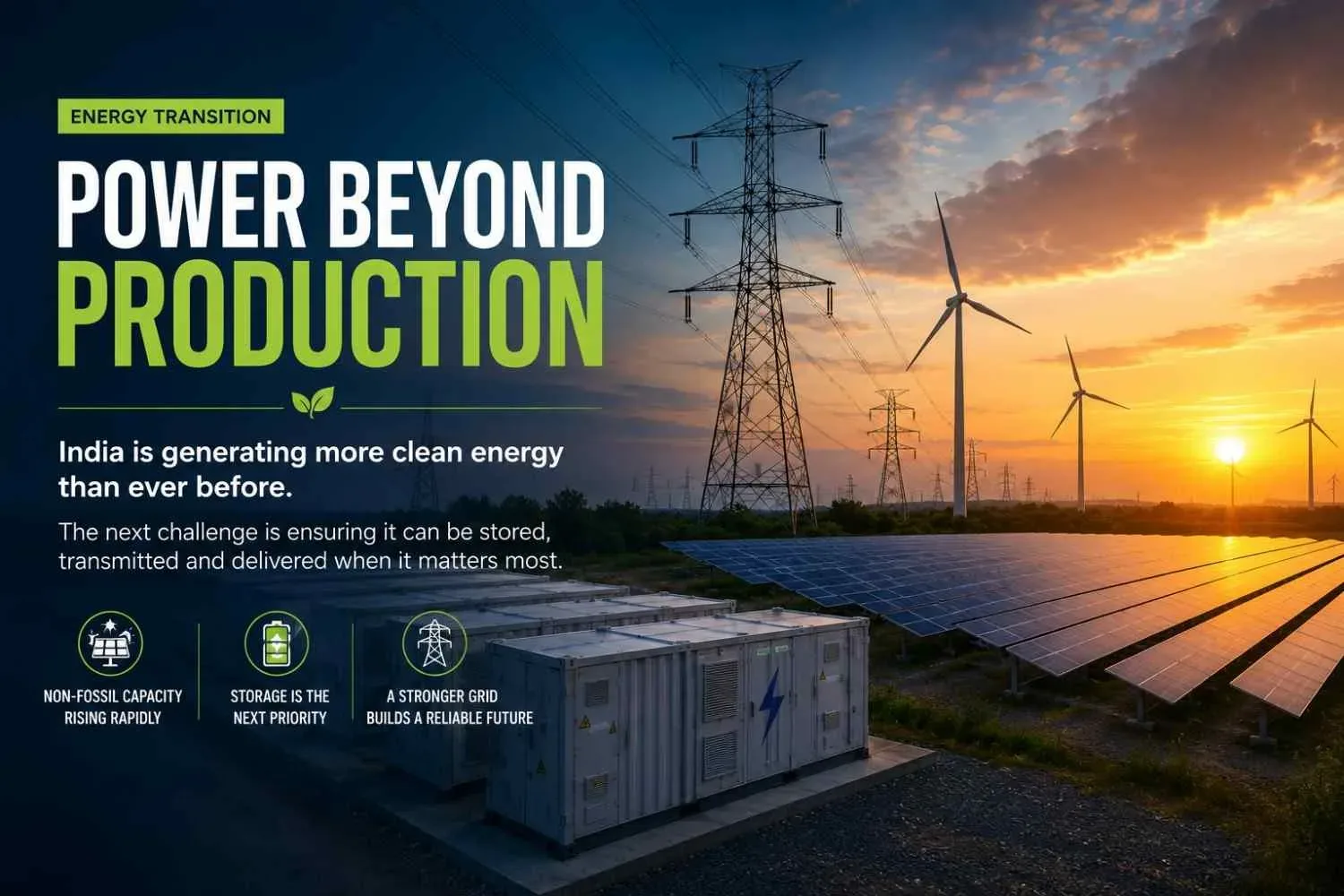
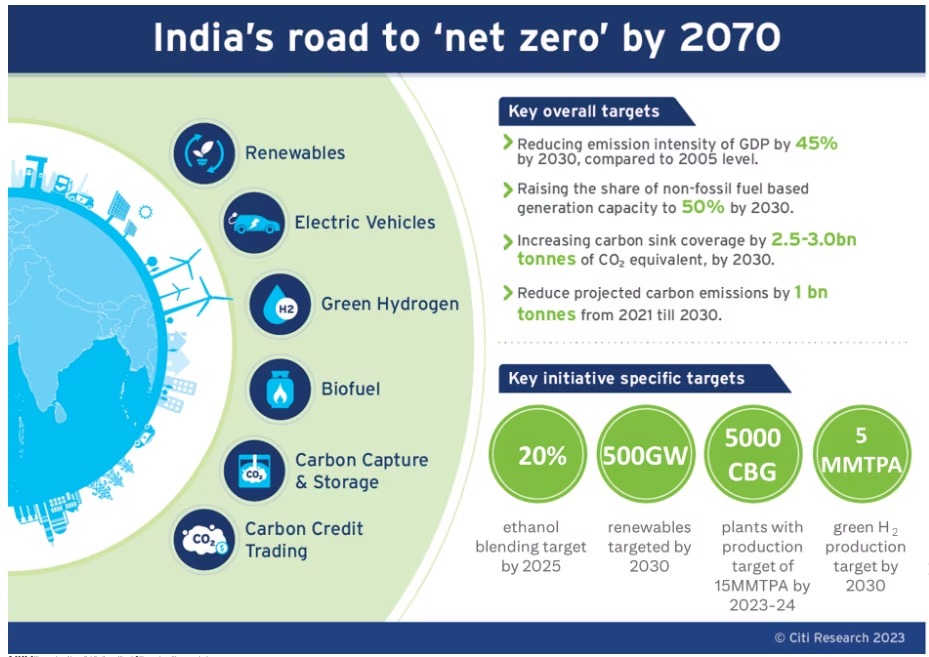
India is generating more clean energy than ever before. The next challenge is ensuring it can be stored, transmitted and delivered when it matters most     KOLKATA | JULY 31,2026India is making notable strides in its renewable energy transition. The expansion of solar parks, the growth of wind energy projects, and the steady increase in non-fossil fuel capacity highlight the country's progress toward its climate commitments. At the same time, another fundamental question is coming into sharper focus. Can India's electricity grid and energy storage systems keep pace with the rapid expansion of renewable power? The answer will play a decisive role in determining whether India's clean energy ambitions are matched by a resilient electricity system or limited by inadequate grid and storage capacity. India has made substantial progress in scaling up its non-fossil electricity capacity through sustained investments in solar, wind, hydropower, and nuclear energy. As a result, the country is steadily advancing toward its target of 500 GW of non-fossil capacity by 2030 while emerging as one of the fastest-growing renewable energy markets globally. The greater challenge, however, lies beyond generation- it is ensuring that the grid and energy storage systems can efficiently integrate and deliver this growing supply of clean power. While renewable energy capacity continues to expand, its effective utilisation remains a major challenge. Solar generation declines after sunset, and wind power fluctuates with changing weather conditions. For clean electricity to be available whenever and wherever it is needed, sufficient energy storage and a resilient transmission network are essential. Consequently, the focus of India's energy transition is shifting from merely generating renewable power to integrating it efficiently into the electricity system. As the share of renewable energy grows, the role of Battery Energy Storage Systems (BESS), pumped hydro storage projects, and modern transmission networks becomes critical. These technologies provide the flexibility required to store excess electricity, balance demand and supply, and maintain grid stability despite the intermittent nature of solar and wind power. Recent policy initiatives indicate a growing shift towards strengthening these enabling infrastructures alongside renewable energy expansion. Recognising the need for stronger supporting infrastructure, the government has announced large-scale battery storage programmes, accelerated interstate transmission projects, and encouraged investments in flexible power systems. Several states are also co-locating energy storage facilities with new renewable energy parks, reflecting an understanding that future electricity systems must expand generation, storage, and transmission in tandem. Even with these initiatives, critical gaps continue to hinder the pace of the transition. However, the transition is far from complete. Many energy storage projects remain in the pipeline, and utility-scale battery systems continue to be costlier than conventional power alternatives. Transmission infrastructure, too, has struggled to keep pace with the rapid growth of renewable energy, especially where large solar and wind projects are situated far from major demand centres. The expansion of storage and transmission infrastructure is further constrained by delays in land acquisition, regulatory approvals, and access to finance. At the same time, integrating increasing volumes of renewable energy into the national grid requires accurate forecasting, real-time digital monitoring, and smarter grid management technologies. The consequences of these challenges extend beyond the electricity sector, influencing energy security, industrial competitiveness, and the pace of India's broader low-carbon transition. Reliable renewable electricity is becoming the foundation of India's next-generation industries. Clean manufacturing depends on a dependable supply of low-carbon power, electric mobility requires a stable electricity network, and green hydrogen production demands uninterrupted renewable energy. Without sufficient storage capacity and modern transmission infrastructure, these sectors could struggle to realise their full potential despite the country's growing renewable energy capacity. For this reason, experts increasingly argue that India's clean energy transition must now be judged not only by the number of megawatts it adds, but by its ability to build an integrated, resilient, and flexible energy ecosystem capable of delivering clean power whenever and wherever it is needed. Meeting the next phase of the energy transition will require more than expanding renewable generation. It demands greater investment in domestic battery manufacturing, faster development of pumped hydro storage, modernised grid infrastructure, wider deployment of smart grid technologies, and increased private-sector participation in energy storage. Equally vital is effective coordination among central agencies, state utilities, and renewable energy developers to accelerate project execution and strengthen grid reliability. For consumers, the impact of these measures may not be immediately visible. Over time, however, they will translate into fewer power disruptions, a more dependable electricity supply, stronger support for low-carbon industries, and the ability to deliver clean energy generated during the day whenever demand is highest. As India approaches its 2030 renewable energy targets, the real challenge is no longer generating more clean electricity-it is ensuring that every unit of that electricity can be stored, transmitted, and delivered reliably. The next chapter of the energy transition will be written not in solar parks or wind farms alone, but in batteries, transmission corridors, and smarter electricity grids. In the end, India's clean energy future will not be defined by the scale of its renewable capacity, but by the strength of the infrastructure that supports it. Because renewable energy fulfils its promise only when clean power is available - not just when it is generated, but whenever and wherever it is needed. Sources:  Ministry of New and Renewable Energy (MNRE) – Energy Storage Systems (ESS) Overview (https://mnre.gov.in/en/energy-storage-systemsess-overview/)Ministry of New and Renewable Energy (MNRE) – Energy Storage Systems Technical Reports (https://mnre.gov.in/en/document-category/energy-storage-systemsess-technical-reports/)Central Electricity Authority (CEA) – Integrated Resource Planning (https://cea.nic.in/integrated-resource-planning-division/?lang=en)Central Electricity Authority (CEA) – National Electricity Plan (Generation) (https://cea.nic.in/integrated-resource-planning-division/?lang=en)Ministry of New and Renewable Energy (MNRE) – State Resource Adequacy Planning (https://mnre.gov.in/en/state-resource-adequacy-planning/)Ministry of Power, Government of India (https://powermin.gov.in/)Press Information Bureau (PIB), Government of India (https://pib.gov.in/)NITI Aayog – India's Energy Storage Mission: A Make-in-India Opportunity for Globally Competitive Battery Manufacturing (https://mnre.gov.in/en/document-category/other-reports/)International Energy Agency (IEA) – India Energy Outlook (https://www.iea.org/countries/india)International Renewable Energy Agency (IRENA) (https://www.irena.org/) ...Read more

31 Jul 2026

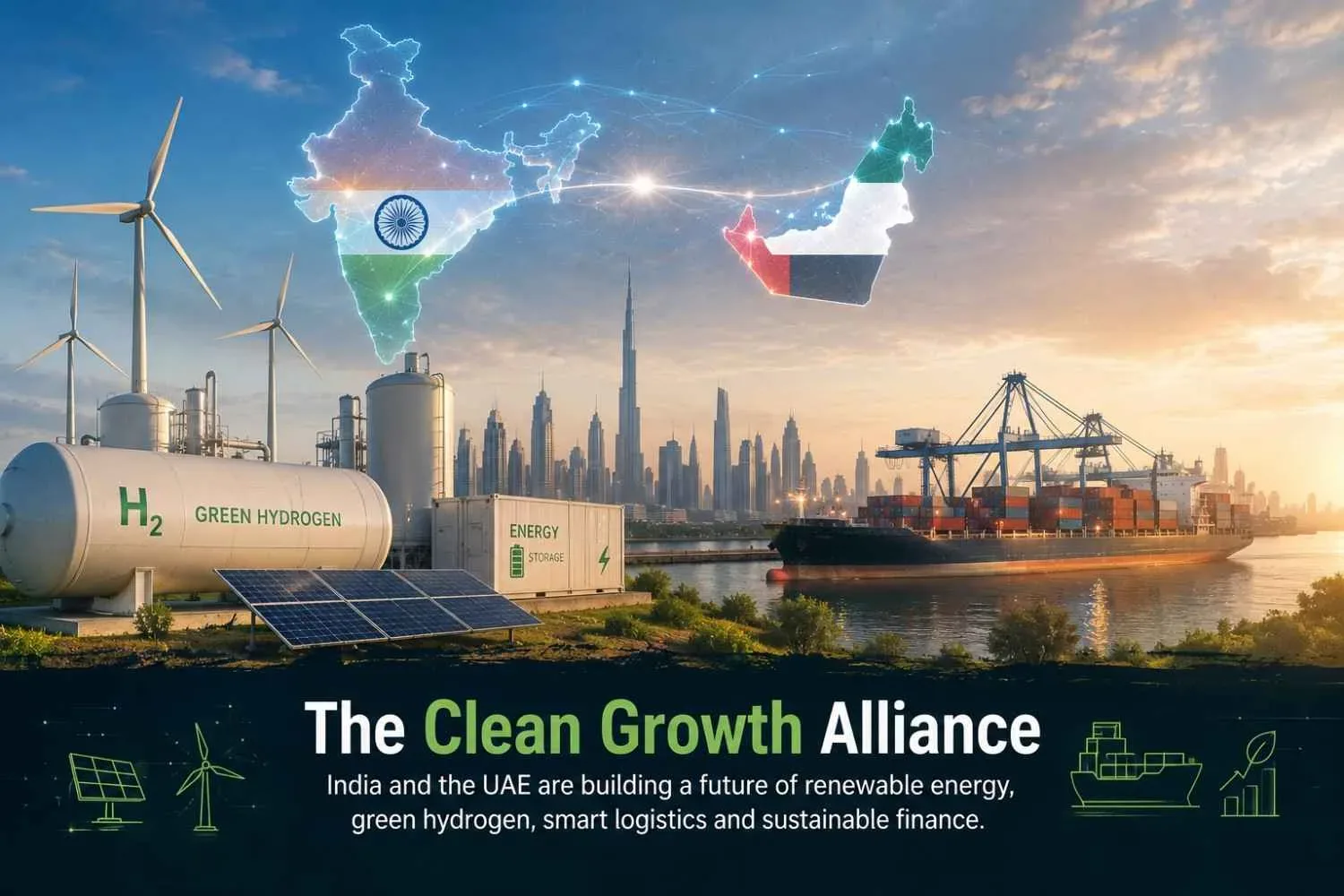
India and the UAE are deepening cooperation in renewable energy, green hydrogen, logistics and sustainable finance, signalling a shift from traditional commerce to long-term clean growth KOLKATA | July 30, 2026: For years, the India-UAE partnership has been driven by trade, investment and energy cooperation. Today, it is being redefined by a new priority- building a low-carbon future together. Renewable energy, green hydrogen, sustainable finance and resilient infrastructure are increasingly moving to the centre of bilateral cooperation as both countries respond to the growing demand for cleaner energy and more sustainable economic growth. For India, the UAE is no longer just an important trading partner. It is emerging as a strategic ally in accelerating the country's clean energy transition. The partnership is no longer just about strengthening economic ties. It is about shaping the future of clean energy.This raises an important question: can India and the UAE together accelerate the transition to a low-carbon economy while creating new opportunities for trade and investment? Recent developments suggest they are moving in that direction. Renewable energy has become a cornerstone of the partnership, with UAE-based companies investing in India's solar and wind sectors and both countries exploring ambitious clean energy projects. The investments are reinforcing India's clean energy ambitions by supporting renewable energy expansion and reducing long-term dependence on fossil fuels.Green hydrogen is quickly emerging as the next frontier of cooperation. With its potential to decarbonise energy-intensive industries such as steel, fertilisers, chemicals and heavy transport, green hydrogen has become a key focus area for both India and the UAE.While India is implementing the National Green Hydrogen Mission, the UAE is positioning itself as a major global producer and exporter of clean hydrogen. As these ambitions converge, collaboration through technology partnerships, joint projects and long-term supply agreements is expected to accelerate.The partnership is also moving beyond energy generation to the infrastructure that supports global trade. Investments in ports, transport corridors, warehousing and digital logistics systems can improve the movement of industrial goods and clean energy equipment while reducing trade costs. In today’s carbon-conscious economy, efficient logistics are shifting from a speed issue to a strategic advantage. Another area witnessing growing collaboration is green finance. Sustainable investment funds, climate finance and ESG-linked capital are playing an increasingly important role in supporting renewable energy projects, resilient infrastructure and low-carbon industrial growth.For Indian businesses, access to these financial resources could accelerate technology upgrades and help meet rising global sustainability expectations. Sectors such as renewable energy manufacturing, battery storage, hydrogen technologies, sustainable construction materials and clean transport stand to gain from stronger investment flows and expanding market opportunities. Even so, translating ambition into action will not be easy. Large-scale green projects require supportive policies, timely regulatory approvals, skilled manpower and modern infrastructure. Affordable financing, technology partnerships and long-term commercial viability will also determine whether these initiatives move beyond announcements and turn into implementation. Experts say continued coordination between India and the UAE will be essential to ensure that investments deliver measurable economic growth alongside meaningful environmental progress. For most citizens, the effects of this cooperation may not be visible today, but its long-term impact could be significant. Cleaner energy investments can enhance energy security, generate employment, support technological innovation and contribute to a healthier environment. At the same time, modern logistics can strengthen supply chains and improve the competitiveness of Indian products in international markets. As climate action reshapes the global economy, the India-UAE partnership is becoming more than an economic relationship - it is emerging as a strategic collaboration for a more sustainable future. The future of the India-UAE partnership may no longer be measured by trade volumes alone, but by how effectively the two countries work together to build cleaner industries, drive innovation and lead the transition towards a more sustainable global economy. Sources: Ministry of External Affairs (Government of India) – India-UAE Bilateral Relationshttps://www.mea.gov.in/Portal/ForeignRelation/India-UAE_Bilateral_Brief.pdfMinistry of Commerce & Industry (Government of India) – India-UAE CEPAhttps://commerce.gov.in/trade/international-trade/trade-agreements/india-uae-cepa/Ministry of New and Renewable Energy (MNRE)https://mnre.gov.in/International Renewable Energy Agency (IRENA) – Green Hydrogen & Energy Transition Reportshttps://www.irena.org/Abu Dhabi Future Energy Company (Masdar)https://masdar.ae/AD Ports Group – India Investments & Logistics Projectshttps://www.adportsgroup.com/DP World – India Operations & Trade Logisticshttps://www.dpworld.com/Invest India – UAE Investment & Clean Energy Partnershipshttps://www.investindia.gov.in/Press Information Bureau (PIB), Government of Indiahttps://pib.gov.in/The Economic Times – Energy & Infrastructurehttps://energy.economictimes.indiatimes.com/ ...Read more

31 Jul 2026

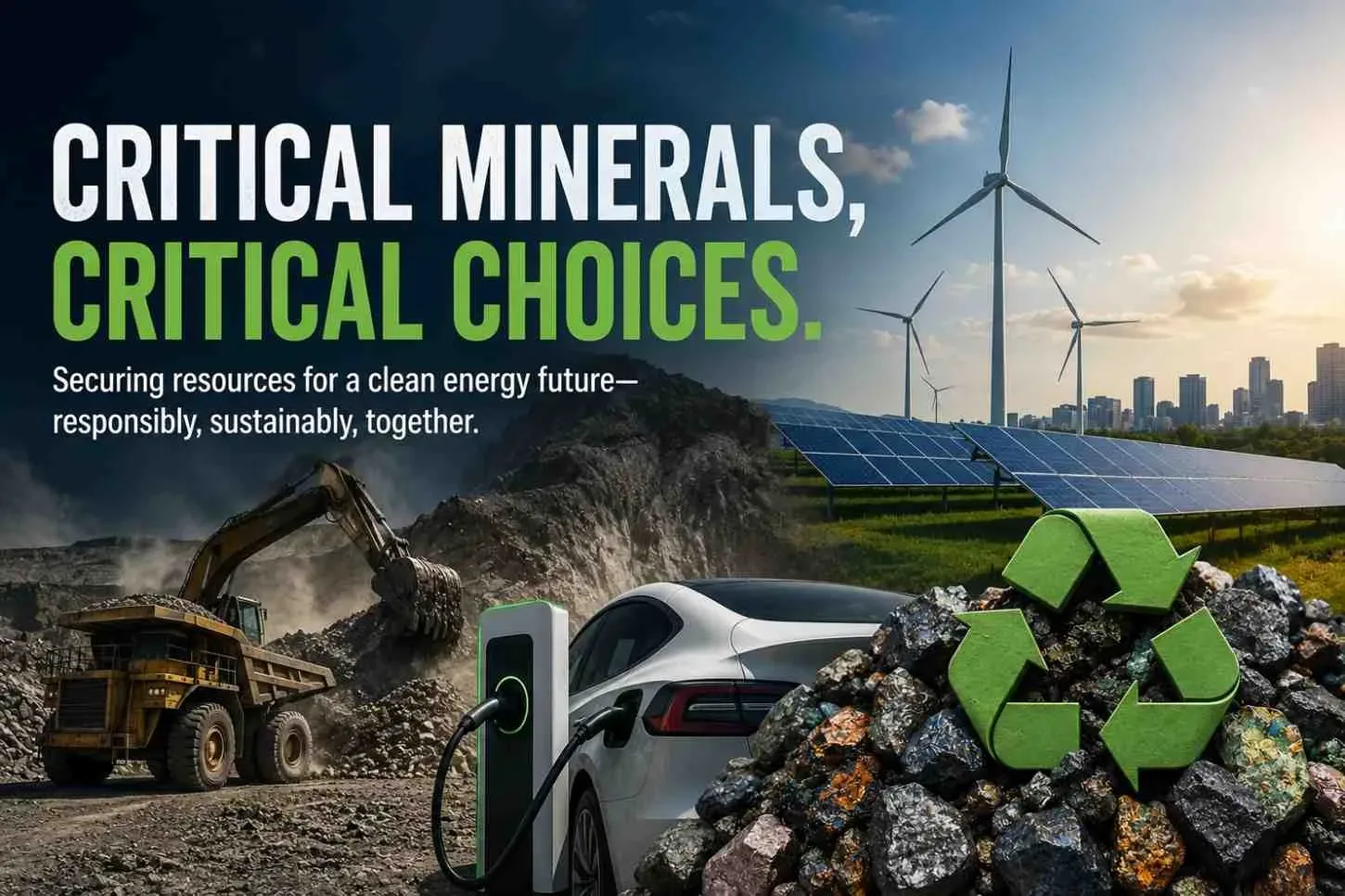
From overseas investments to recycling and responsible mining, India's critical minerals strategy is entering a decisive phase Kolkata | July 30, 2026:Every electric vehicle, solar panel, wind turbine and battery storage system relies on a set of resources that often remain out of public view- critical minerals.    Lithium, cobalt, nickel, graphite and rare earth elements, have become indispensable to the global clean energy transition, making them strategically important today as fossil fuels were in the past. As countries accelerate efforts to decarbonise their economies, India is also strengthening its approach in securing these resources. Through overseas partnerships, investments in mineral-rich regions, domestic refining, recycling initiatives and policy reforms, the country is working to build a more resilient critical mineral supply chain. The objectives extend beyond supporting renewable energy projects. It is also about strengthening energy security, expanding domestic manufacturing and reducing dependence on imports. The urgency has grown as global competition for critical minerals continues to intensify. Much of the world's refining and processing capacity remains concentrated in a few countries, leaving supply chains vulnerable to geopolitical tensions, trade restrictions and market disruptions.In response, India is focusing on a two-pronged approach-strengthening international cooperation to secure mineral supplies while building domestic refining capacity to convert raw minerals into battery-grade materials at home.Experts say this reflects an important shift in the global conversation. Securing access to mineral deposits is no longer enough. Gradually, countries are seeking greater control over the entire value chain - from extraction and refining to manufacturing, recycling and reusing. Recycling is emerging as another key part of this transition. As electric vehicle adoption grows, used batteries and electronic waste are expected to become valuable secondary sources of lithium, cobalt and nickel. Recovering these materials can reduce pressure on fresh mining, lower environmental impacts and strengthen resource security while creating new opportunities in advanced recycling and material recovery. Although recycling alone cannot meet future demand, experts believe it will play an important role in building a more circular economy.Securing critical minerals is necessary, but far from sufficient. Mining often takes place in ecologically sensitive regions that support forests, rivers and Indigenous communities. Around the world, concerns over biodiversity loss, land acquisition, water stress and community displacement have intensified alongside expanding mineral exploration. Conservationists argue that the transition to clean energy should not come at the expense of environmental protection or local livelihoods. This has elevated responsible mining to a core priority.Experts believe every critical mineral project should include transparent environmental assessments, meaningful community consultation, fair compensation and continuous ecological monitoring. They stress on a fundamental shift: local communities must be partners in building the future, not just recipients of its consequences. The discussion reflects a broader evolution in the sustainability agenda. Climate action is no longer measured only by the number of renewable energy projects or electric vehicles on the road. It also depends on whether the resources powering these technologies are extracted responsibly, processed efficiently and managed sustainably throughout their life cycle.For India, the years ahead will determine whether industrial growth, resource security and environmental responsibility can advance together. Progress will depend not only on overseas agreements or new processing facilities, but on building a supply chain that is transparent, resilient and socially inclusive. Ultimately, the clean energy transition will be defined not just by what we build, but by how we build it. It will also be judged by the choices made long before those technologies reach consumers.   The countries that lead the future will not simply be those with the largest mineral reserves, but those that develop supply chains that are ethical, resilient and circular. For India, the real challenge is not only securing the minerals that power a greener economy, but proving that sustainable development begins with responsible decisions at every stage of the journey! The true success of the clean energy transition lies not only in its destination, but in ensuring that every step along the way is sustainable. Sources: Ministry of Mines, Government of India – National Critical Mineral Mission, policy updates and official announcements.Ministry of Mines – Critical MineralsCouncil on Energy, Environment and Water (CEEW) – Analysis on the India–US Critical Minerals Agreement, domestic processing and supply-chain resilience.India–US Critical Minerals: The Midstream Test (CEEW) Ministry of External Affairs (MEA) – Quad Critical Minerals Initiative Framework and international cooperation.Quad Critical Minerals Initiative FrameworkInternational Energy Agency (IEA) – Critical Minerals Policy Tracker covering global supply chains, recycling and responsible mineral policies.IEA Critical Minerals Policy TrackerReuters – Reporting on India's expanding critical mineral partnerships and efforts to strengthen exploration, processing and recycling.India in talks over critical minerals partnerships ...Read more

29 Jul 2026

China's climate emergencies highlight a bigger question: Are Asian cities prepared for multiple disasters at once?  When a typhoon approaches, cities usually prepare for strong winds and heavy rain. But what happens when rivers are already overflowing before the storm even arrives? Experts say this is becoming the new reality. Instead of facing isolated disasters, countries are increasingly confronting compound events- multiple climate hazards unfolding together or in rapid succession, making their impacts far more severe and recovery more complex. China's recent climate emergencies offer a clear example of this growing challenge. Over a short span of time, several regions have experienced heavy rainfall, widespread flooding and the looming threat of typhoons. Together, these overlapping events have tested emergency response systems, disrupted transport networks, increased pressure on dams and forced thousands of people to evacuate. China's response may dominate the immediate headlines, but the larger concern reaches beyond its borders. If one of Asia's largest economies can face multiple climate disasters simultaneously, how resilient are other countries when confronted with the same threat? Across Asia, rapid urbanisation is unfolding alongside frequent climate hazards. Rising temperatures are intensifying heavy rainfall, while sea-level rise and changing weather patterns are making floods more destructive in densely populated cities.Experts say this new reality demands a shift in disaster planning- from preparing for single events to managing multiple climate risks at the same time.The challenge is no longer preparing for a single disaster in isolation. Cities are now being forced to plan for multiple hazards that can occur at the same time or trigger one another. This shift is making compound-event planning a key priority for disaster preparedness. The focus is shifting from isolated disasters to understanding how multiple hazards interact. Heavy rainfall can overwhelm drainage systems, flood roads, trigger landslides, and strain dams and reservoirs- leaving communities more vulnerable if another hazard, such as a cyclone, follows soon after. Disasters can no longer be viewed as separate emergencies, as one event often magnifies the impact of another. China's recent climate emergencies demonstrate why preparing for interconnected risks is becoming an essential part of disaster planning. Another issue moving to the forefront is dam safety.Reservoirs across Asia are vital for water storage, irrigation, hydropower and flood management.  But during extreme rainfall, operators face a difficult choice: retain more water and increase pressure on the dam, or release it quickly and risk worsening floods downstream.Experts say climate change is making these decisions more difficult, turning dam management into more than just a technical challenge.Modern dam management depends on accurate weather forecasts, river monitoring, real-time data and close coordination between multiple agencies. Strengthening these systems can help authorities act before risks escalate.The same principle applies to cities.Urban flooding is no longer caused by heavy rainfall alone. Rapid urbanisation, shrinking wetlands, expanding paved surfaces and inadequate drainage often prevent water from draining naturally, allowing intense rainfall to quickly develop into a major urban emergency. Many cities across Asia are now confronting the same challenge. Whether in China, India, Bangladesh or Southeast Asia, growing populations and expanding infrastructure are increasing exposure to climate-related risks. Experts argue that adaptation must therefore become part of everyday urban planning rather than an emergency response after disasters occur. This requires stronger drainage systems, the protection of natural flood buffers like wetlands and floodplains, more effective early-warning systems, and resilient infrastructure that can continue operating during extreme weather. Technology is becoming a powerful ally in climate adaptation. From satellite monitoring and artificial intelligence to advanced forecasting and digital flood mapping, new tools are helping authorities detect risks earlier and give communities more time to prepare. But technology cannot prevent disasters on its own. Experts say real preparedness depends on how effectively governments, engineers, emergency responders and local communities work together long before a crisis begins. For India, the lessons are particularly relevant. Recurring urban floods, powerful cyclones and rapid infrastructure expansion are increasing the country's exposure to multiple climate hazards. Experts argue that future disaster preparedness will depend not only on responding effectively to individual events but also on planning for the ways different hazards can interact. China's recent floods and typhoon threats are therefore more than a national emergency. They highlight a broader reality: climate disasters are becoming more interconnected, more complex and increasingly difficult to anticipate. China's floods and typhoon threats are more than a reminder of a changing climate- they are a reminder that the nature of disasters is changing as well. The real test of resilience will not be how well countries respond to the next disaster, but how effectively they prepare for a future where climate risks no longer arrive alone. Sources: World Meteorological Organization (WMO) – Multi-Hazard Early Warning Systems & Climate Reportshttps://wmo.intUnited Nations Office for Disaster Risk Reduction (UNDRR) – Compound Disaster Risk & Disaster Resiliencehttps://www.undrr.orgChina Meteorological Administration (CMA) – Typhoon Monitoring, Rainfall & Weather Warningshttps://www.cma.gov.cn/enReuters – Coverage of China's floods, typhoons and emergency responsehttps://www.reuters.com/world/china/ReliefWeb (OCHA) – Floods, Humanitarian Updates & Disaster Situation Reportshttps://reliefweb.int ...Read more

17 Jul 2026

India's Cheapest Battery Storage Deals Are Under Pressure—And Your Future Electricity Could Feel It   by Iffat Zareen   When the evening is windless and the sun goes down the horizon, our first instinct is to switch on the fans and the lights. This first instinct may slowly turn into our last. The electricity that powers them may soon be dependent on a technology facing an alarming reality check. Hailed as the backbone of the country’s clean energy future – India’s battery energy storage projects – are currently feeling the impact of rising costs, triggering concerns casting doubt on whether the lowest bids can be executed without financial strain.  A Reuters analysis issued on July 8th, 2026, has sparked fresh concerns. Against the anticipation of the developers, battery storage projects have become markedly more expensive. This is because of the rising costs of lithium, copper, and aluminium alongside changes in Chinese export incentives and the growing tensions in geopolitics, as suggested by the Reuters analysis.  This comes at a crucial juncture. Presently, solar and wind capacity are on the scale of rapid growth in India. However, renewable energy is not always available when it is most needed by the people, making it just one, but a huge drawback. This problem is solved by batteries. They store the electricity generated during sunny or windy hours and later release it. Hence, ensuring uninterrupted power delivery to hospitals, homes and businesses when renewable generation drops.  But this is where the financial equation becomes more challenging. Contracts were won by many developers based on exceptionally low storage tariffs – the price paid for storing and supplying electricity. When raw material prices were lower, only then did those tariffs look attractive. With the rising manufacturing costs of batteries, it is becoming harder to finance the same projects. Developers have cautioned that some projects may require renegotiation. Growing uncertainty over cost recovery is making lenders more cautious about financing new projects. To understand battery storage, two terms need to be understood as well: megawatts (MW) and megawatt-hours (MWh). The amount of electricity delivered by a battery at one time is represented by MW, whereas MWh indicates how long it can keep delivering that power. For instance, a 100MW/400MWh battery can supply 100 MW for 4 hours with no interruption.  Greater reliability is provided by longer-duration batteries; however, this calls for the requirement of more battery cells, resulting in a significant increase in costs.   The challenge for electricity distribution companies, is balancing affordable tariffs with dependable infrastructure. The ability to integrate new solar and wind capacity could slow down if projects are awarded at unrealistically low prices. This would leave beneficial renewable electricity unused during peak generation and create supply gaps during high-demand periods.      The story is no longer about just building more batteries – it’s about building projects that can remain financially viable. With India’s acceleration in clean-energy transition, the success of battery storage may ultimately rely less on who bids the lowest but on who can deliver when the country is in the most need of power. ...Read more

08 Jul 2026

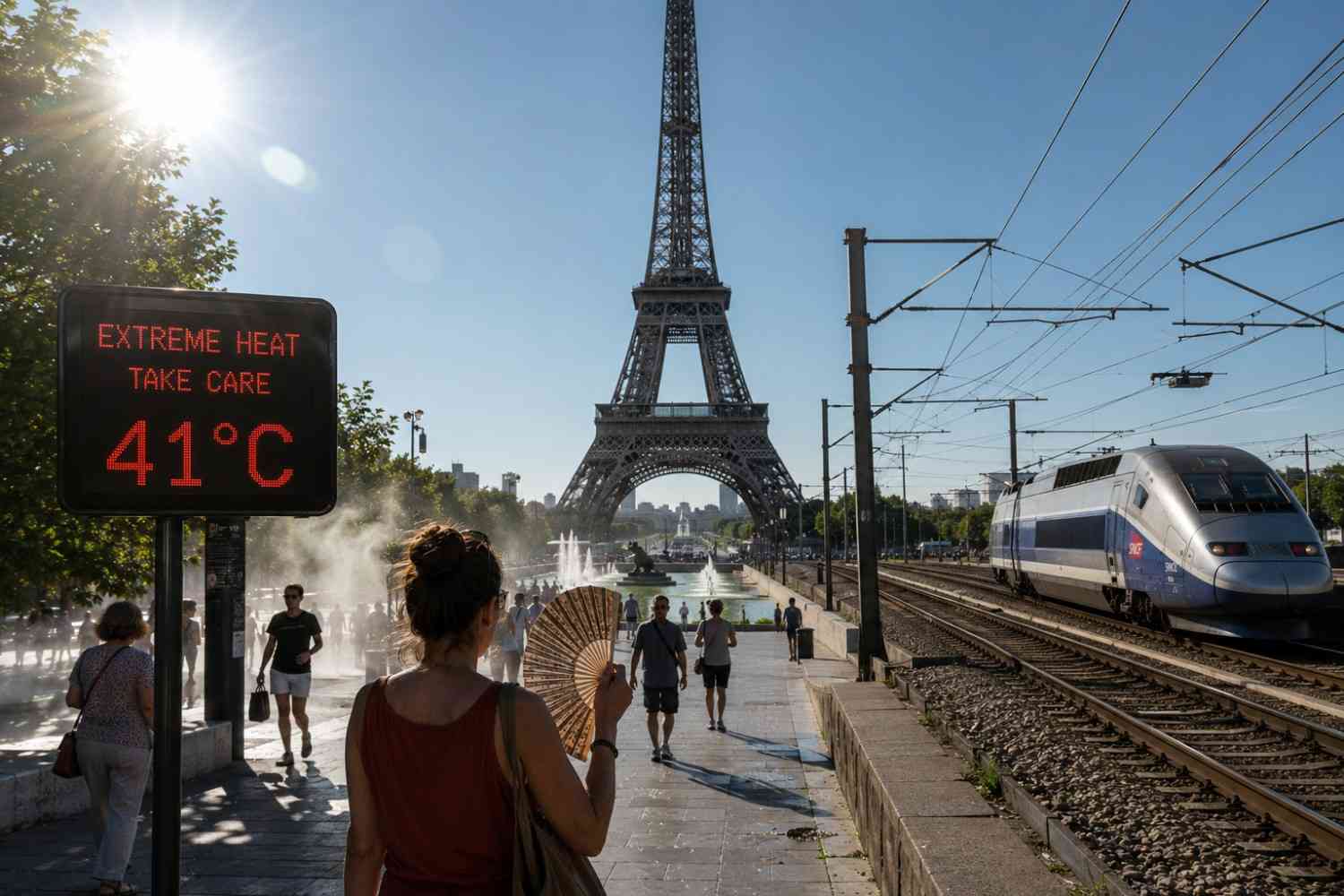
How Europe's Coldest-Built Continent Became Ground Zero for a Warming Planet — and What Its Scramble for Fans, Ambulances and Answers Tells the Rest of Us Paris residents cooling themselves at the Trocadéro fountains. Berlin police training water cannons on crowds at an open-air concert. Belgian rail managers cutting a hundred trains a day because the tracks themselves could buckle. Currys, the British electronics retailer, reporting a nearly 3,000 percent surge in fan sales in a single weekend. These are not scenes from a disaster film set in some distant, parched future. They are dispatches from Europe in the summer of 2026 — a continent famous for its temperate charm, its centuries-old stone cities, and its assumption that extreme heat was somebody else's emergency. That assumption has now collapsed. Since late May, two successive and increasingly ferocious heatwaves have swept from the Atlantic coast to the Balkans, breaking national temperature records in at least a dozen countries, killing thousands, and forcing governments to improvise a public-health response in real time. The World Health Organization's own director-general, Tedros Adhanom Ghebreyesus, has called heat Europe's "silent killer" and confirmed more than 1,300 excess deaths linked to the June episode alone, a number that kept climbing through early July as France, Belgium, Spain and the Netherlands released their own tallies. This is, by the assessment of the World Weather Attribution (WWA) network of scientists, the most severe heatwave ever recorded over the region studied — and one that would have been "virtually impossible" in a pre-industrial climate. The story of Euro Summer 2026 is not simply a story about weather. It is a story about a civilisation built for cold confronting a climate built for heat — and about what happens when decades of warnings arrive all at once, on schedule, exactly as predicted. Why Europe Is Burning: The Anatomy of a Foretold Crisis The proximate trigger has a name meteorologists use with grim regularity now: the "heat dome," or omega block, so called for the shape it traces on a weather map. A persistent zone of high pressure trapped hot, dry air pushed north from Morocco and North Africa, while low-pressure systems on either side blocked cooler Atlantic air from moving in. The first wave arrived on 24 May, delivering the earliest and most extreme spring heat on record across Western Europe. The second, beginning 17 June, was far worse. France recorded 44.3°C in Pissos and its hottest day nationally since records began in 1947, with an average national temperature of 30°C. Germany hit an all-time national high of 41.7°C at Coschen. Hungary broke its national record at 42°C. Spain touched 45.1°C. The Czech Republic recorded 41.9°C, its highest ever. The United Kingdom broke its June record three days running, and for the first time in the history of its warning system, the Met Office issued red extreme-heat alerts on consecutive days. But a heat dome is only the delivery mechanism. The underlying cause, confirmed by rapid-attribution science, is unambiguous: human-caused climate change. WWA's analysis found that a comparable weather pattern would have produced dramatically less extreme outcomes just decades ago — daytime heat like this June's was roughly ten times more likely than it would have been in 2003, and extreme night-time temperatures were more than a hundred times more likely than in 1976. Put simply, the same weather pattern that once nudged a mild day into an uncomfortable one now pushes a warm day past deadly thresholds, because it is operating on top of a baseline climate that has already warmed by roughly 1.3°C globally — and by nearly double that across Europe. The World Meteorological Organization notes that Europe has warmed by around two degrees since the historic 1976 heatwave, making it the world's fastest-warming continent, heating at roughly twice the global average rate. Crucially, this is not a story of a single freakish season. Europe's vulnerability has been accumulating for a generation. The catastrophic 2003 heatwave killed more than 14,800 people in France alone and became the reference disaster that shaped a first generation of heat policy. It was followed by damaging repeats in 2018, 2019 and 2022 — the latter killing more than 60,000 people continent-wide — and a 2023 summer that still recorded over 47,000 heat deaths despite being comparatively "cool." Academic analysis of heatwave trends between 1921 and 2021 shows a clear upward trend across most European regions, with a marked acceleration beginning in the early 1990s and the decade 2011–2021 recording the highest number of heatwaves on record. May 2026 had already broken spring records before June's crisis even began. What is unfolding this summer, in other words, is not a break from the pattern. It is the pattern, arriving earlier and hitting harder than even recent extremes suggested it would. There is also a structural reason the crisis feels so acute: much of Europe's built environment was designed to solve the opposite problem. Thick masonry walls, small windows, heavy insulation and centralised heating reflect centuries of adaptation to long, cold winters — not the cross-ventilation, shading and cooling that a hotter climate demands. Only around one in five European homes has air conditioning, a figure that in France, Germany and the UK has historically sat below five percent. That mismatch between the climate Europe built for and the climate it now has is the structural fault line beneath every headline this summer. The Nature and Extent of the Crisis: A Continent Under Strain What distinguishes 2026 is not only intensity but breadth. Temperature records fell in Austria, Belgium, Czechia, Denmark, France, Germany, Hungary, Italy, the Netherlands, Poland, Romania, Spain and the United Kingdom. By late June, WHO estimated more than 150 million people across the continent were living under extreme heat. Reuters reported at least 3,700 excess deaths across France, Belgium and the Netherlands alone during the June event, with France's figure — around 2,000 to 2,025 — the largest single-country toll; Belgium recorded roughly 1,200 excess deaths (a 39 percent surge in weekly mortality), and the Netherlands close to 480, overwhelmingly among people over 65. Spain's health authorities separately attributed more than 1,000 excess deaths to the June heat, in what was already the country's second-hottest June on record. The human toll is compounded by a cascade of infrastructure failures that reads like a stress test of a system built for a different climate. In France and the UK, rail lines buckled under thermal expansion, forcing speed restrictions and cancellations; in Germany and Belgium, tram tracks softened into the asphalt and networks suspended service; Deutsche Bahn advised against non-essential travel altogether. France's heavily nuclear grid had to throttle reactor output because river water used for cooling had itself become too warm to be safely discharged, contributing to power outages that left roughly 68,000 households without electricity precisely as demand for air conditioning spiked. Electricity prices in Belgium briefly exceeded €1 per kilowatt-hour at peak demand. Roads and traffic infrastructure literally deformed in several countries. Soil moisture fell to record seasonal lows, sharpening drought and wildfire risk; Portugal requested EU, Spanish and Moroccan support for extra firefighting aircraft as temperatures topped 40°C. The public-health burden goes well beyond heatstroke. Heat is a "silent killer" precisely because it rarely appears on a death certificate — instead it forces the cardiovascular system to work harder to push blood to the skin, straining hearts already weakened by age or illness; it accelerates dehydration and kidney strain; and it degrades cognition, contributing to a spike in drownings as people sought relief in unsupervised rivers, lakes and canals. France alone recorded more than 70 drowning deaths since mid-June, including a professional footballer, Kenzo Kies, who drowned in the Rhône; Poland recorded 17 drownings in a single day. Emergency call volumes in France rose by as much as 61 percent week-on-week. Hospitals in the UK, including East Surrey Hospital, declared critical incidents and restricted services to life-threatening cases only. Layered atop the acute crisis is a slower-burning one: the geographic redrawing of disease. The European Centre for Disease Prevention and Control has documented that Europe's climate suitability for dengue transmission has risen by nearly 300 percent over the past decade against the 1981–2010 baseline, and warns that longer, more intense mosquito-borne disease seasons — West Nile virus, chikungunya, dengue — are becoming the region's "new normal." Warmer coastal and river waters have raised the risk of Vibrio bacterial infections. Pollen seasons have lengthened by one to two weeks, aggravating respiratory conditions, while stagnant, heat-trapped air has driven ground-level ozone and smog warnings in places like the Czech Republic. Heat, in short, is not one health emergency but an amplifier of many. The Public Mind: When Summer Becomes a Season of Hazard Perhaps the most striking dimension of Euro Summer 2026 is psychological. For populations across Britain, France, Germany, the Low Countries and Scandinavia who have long regarded extreme heat as a tropical or Mediterranean problem, this summer has delivered a jarring reversal. Nights that will not cool — Vienna's minimum overnight temperature failed to drop below 27.3°C, and one German weather station recorded a night-time low of 29.4°C — have left millions unable to sleep properly for weeks, contributing to chronic exhaustion, irritability and worsening mental health. The London Underground recorded carriage and platform temperatures above 34°C, turning routine commutes into ordeals. Retailers across Britain, France and Germany report fans and portable air-conditioning units selling out within hours, with Asian appliance manufacturers reporting a European sales boom for products that were, until recently, considered unnecessary luxuries in temperate markets. This is where climate change has stopped being an abstraction debated in policy documents and become a lived, domestic experience — playing out in bedrooms, school corridors, supermarket queues and family group chats about whether to check on an elderly parent living alone. Public discourse increasingly frames this summer as a "dress rehearsal" for worse to come, a phrase the WHO itself has used. That anxiety is compounded by a visible unfairness: the burden of heat falls hardest on those least able to escape it. Roughly 60 percent of hospital admissions during the crisis involved people aged 75 and older. Outdoor labourers, migrants, the homeless, low-income tenants in poorly insulated top-floor flats, and people living alone bear disproportionate risk — a pattern that has sharpened public debate over whether cooling is becoming a luxury good rather than a basic protection. Governments Scramble: The Emergency Response So Far Faced with a crisis moving faster than policy cycles, European governments have leaned on — and in places gone well beyond — the heat-action frameworks built after 2003. France placed a record 58 departments under red alert, closed 845 schools outright and adjusted schedules at 13,500 more, restricted public alcohol sales in high-risk areas, opened rivers and canals for supervised public swimming, and installed more than 1,300 free public water fountains alongside a bottle-refill scheme spanning 1,500 shops. Prime Minister Sébastien Lecornu convened a special cabinet meeting to draw lessons even as the crisis continued, and the government has committed more than €130 million to cooling systems and renovation in schools and nurseries, according to utility EDF and lending partners. Interior Minister Laurent Nunez pushed back on opposition criticism, insisting "this is not a fiasco — we were prepared." Italy restricted outdoor construction and agricultural labour during peak afternoon hours, pairing the bans with furlough schemes so workers did not lose income. Barcelona expanded its celebrated climate-shelter network — libraries, civic centres, pharmacies and parks doubling as refuges — to more than 500 sites, building on a model launched in 2020. Belgium cancelled its annual Battle of Waterloo re-enactment on safety grounds and its rail operator cut roughly a hundred trains daily. Portugal activated the EU Civil Protection Mechanism and sought additional firefighting aircraft as wildfire risk soared. At the European level, the Commission — through figures such as executive vice-president Teresa Ribera — has framed the crisis as a decisive rebuttal to climate-policy complacency, while acknowledging that adaptation spending has lagged badly behind mitigation: Reuters reported that between 2021 and 2025, 72 percent of EU climate-related spending went to mitigation, only 18 percent to adaptation, and 9 percent to both. The WHO, for its part, launched a "KeepCool" public campaign built around four simple pillars — keep out of the heat, keep your home cool, keep your body cool and hydrated, and keep in touch with vulnerable people around you — and has repeatedly urged every European country to adopt a comprehensive heat-health action plan, noting that more than half still lack one. Beyond This Season: What Must Change The consensus among health agencies, meteorologists and urban planners is unambiguous: emergency triage cannot remain the primary strategy. Several priorities stand out for the next few years. Universal, coordinated early warning. Sophisticated monitoring exists through Copernicus and the European Centre for Medium-Range Weather Forecasts, but triggering thresholds and alert protocols still vary by country, producing uneven protection. A harmonised EU-wide framework, with automatic cross-border activation of civil protection resources, would close dangerous gaps. Heat-proofing the built environment. Passive cooling — external shutters, awnings, reflective "cool roofs," cross-ventilation, better insulation calibrated for summer as well as winter — must become standard in building codes, not an optional retrofit. Cities including Paris, Barcelona, Vienna and Amsterdam are already expanding tree canopy, converting public buildings into cooling shelters, narrowing car-dominated streets, and replacing asphalt with permeable, reflective surfaces to fight the urban heat-island effect, in which dense concrete and glass store daytime heat and release it at night, denying residents recovery. That work needs to move from pilot projects to policy default, with low-income neighbourhoods — which typically have less tree cover and older housing — prioritised first. Resilient healthcare and labour protections. Hospitals need independent, blackout-resistant cooling systems and staff trained to recognise both classic heatstroke and the newly arriving vector-borne diseases that were absent from European medical curricula a generation ago. Italy's model of restricting outdoor work during dangerous hours while protecting workers' incomes deserves wider adoption, alongside binding heat-exposure limits, mandatory rest breaks and shaded work zones for construction, delivery and agricultural workers. Smarter, cleaner cooling. Demand for air conditioning will keep rising, and that is not inherently a problem — but unmanaged, fossil-fuel-backed cooling would deepen the crisis it is meant to solve, straining grids and raising emissions. The better path runs through efficient heat pumps, strict appliance standards, solar-powered cooling (which conveniently peaks alongside the sunniest, hottest days), demand-response electricity pricing, and district cooling systems in dense cities. The Long Run: Combating Heatwaves as a Permanent Feature of European Life Beyond seasonal fixes, experts converge on a layered, long-run strategy resting on two pillars that must advance together rather than in sequence. The first is mitigation — the still-unfinished work of rapid decarbonisation. Every fraction of a degree of additional global warming worsens the frequency, duration and intensity of these extremes; the WWA's attribution science leaves little room for doubt that fossil fuel emissions are the primary driver. The EU's own 2030 target of drawing 42.5 percent of energy consumption from renewables remains, on current trends, roughly half-met, according to Lancet Countdown analysis — underscoring how much acceleration is still required even in a bloc that considers itself a climate leader. The second is deep, structural adaptation, treated not as an emergency add-on but as permanent public infrastructure. That means heat-resilient power and water systems engineered for 40°C-plus operating conditions; agricultural systems shifting toward heat-resistant crops and adjusted growing calendars as soil moisture hits record lows; nature-based solutions — urban forestry, restored wetlands, green corridors — that cool cities while improving air quality and mental health; and social protection systems explicit about the fact that low-income households already face a measurably higher risk of food insecurity during heatwaves. Disease surveillance, too, must become a permanent adaptation function: expanded entomological monitoring, coastal water testing for Vibrio bacteria, and public health messaging on now-endemic mosquito-borne risks. None of this is cheap, and none of it is optional. The WHO estimates that adaptation measures already in place — early warning, cooling spaces, outreach to isolated elderly residents — prevented heat deaths in 2023 from being roughly 80 percent higher than they were, with the reduction nearly doubling for people over 80. Prevention, in other words, demonstrably works; the cost of inaction, measured in lives and in economic disruption to transport, agriculture and labour productivity, is demonstrably higher than the cost of building resilience now. The Message for the Rest of the World Europe's 2026 summer carries lessons that travel well beyond its borders, and they arrive with unusual authority precisely because they come from a wealthy, well-governed, scientifically sophisticated part of the world that assumed — wrongly — that it had time. No region is climate-proof. If a continent with Europe's institutional capacity, healthcare infrastructure and monitoring systems can lose thousands of people to heat in a matter of weeks, no temperate or high-income region should assume immunity. For hotter, less-resourced regions of the Global South, already living closer to physiological heat limits with far less adaptive capacity, the implications are correspondingly graver. Adaptation is no longer optional alongside mitigation — it is now equally urgent. For decades the global climate conversation centred on emissions reduction as the primary lever. Europe's crisis demonstrates that severe climate impacts are not a future risk to be pre-empted but a present reality to be survived, simultaneously. Both must be pursued at full speed, not in sequence. Heat is deeply, structurally unequal. The people who died this summer were disproportionately elderly, isolated, poor, or working outdoors. Any credible national or global heat strategy has to be built around equity — ensuring cooling, shelter and early warning reach those least able to secure them privately — or it will simply reproduce climate change's existing injustices in sharper form. Infrastructure built for yesterday's climate fails fast under tomorrow's weather. Rail lines, power grids and buildings engineered for a cooler past are now operating past their thermal design limits across Europe. Rapidly urbanising regions elsewhere have a narrow window to build heat resilience into new infrastructure now, rather than retrofitting under emergency conditions later, at far greater cost. Early warning only saves lives if it triggers early action. The technical capacity to forecast heat is well advanced globally; the harder task, which Europe is still learning in real time, is converting a forecast into welfare checks, cooling centres, adjusted work hours and public trust — before hospitals fill and death tolls rise, not after. Europe's 2026 heatwave is not a freak meteorological accident, nor a one-off tragedy to be mourned and then set aside. It is the visible, measurable arrival of a trend that scientists have tracked and forecast for decades, landing precisely where models said it would. The question now facing European governments — and, by extension, every government watching from elsewhere — is whether this becomes the moment resilience is finally built into the everyday fabric of governance, housing, energy and health systems, or whether it is remembered, a few winters from now, as merely an unusually hot summer. The climate system does not offer many more rehearsals. A Continent at a Crossroads There is a version of this story Europe has told itself before, after 2003 and again after 2022: that a shocking summer would be followed by a burst of reform, and then, as memory faded and budgets tightened, by a quiet return to business as usual. The evidence so far in 2026 suggests both continuity and change. On one hand, the emergency playbook — red alerts, school closures, cooling centres, welfare checks — is more practised and better resourced than it was even five years ago, and officials are right to point out that without it, the death toll would almost certainly be higher. On the other hand, the same officials now openly concede that the playbook is being outpaced by the speed of warming itself. France's own interior ministry has had to defend its preparedness in public even as it activated red alerts across a record number of departments; that defensiveness is itself a signal that the political conversation has shifted from "was this predictable" to "were we ready," and the honest answer, in most of Europe, is only partially. What happens next will likely be decided less by any single EU directive than by thousands of local decisions: whether a municipality retrofits a school before or after the next heatwave; whether a housing authority prioritises shading and insulation for its oldest, poorest tenants or waits for market-driven air-conditioning uptake; whether a national labour ministry writes heat-exposure limits into law or leaves them to voluntary guidance. The European Commission's promised climate resilience strategy, expected later this year, will be an important signal of political intent — but the WHO's own data suggests that the interventions that actually save lives are unglamorous and local: a phone call to an elderly neighbour, a shaded bus stop, a cooling centre with its doors actually open during the hottest hours of the day. For a continent that has spent much of the past two decades debating climate change primarily in the language of targets, treaties and future scenarios, summer 2026 has forced a blunter, more immediate vocabulary: fans, ambulances, buckled rails, and body counts. That shift in language may prove to be the most consequential outcome of this season — not because it resolves the crisis, but because it makes further delay much harder to defend, to voters or to history. Sources and Attributions World Weather Attribution (WWA), "Fossil fuel emissions have rapidly worsened European heatwaves in just a few decades," rapid attribution analysis, June–July 2026World Meteorological Organization (WMO), "Record-breaking heat spreads through Europe," WMO News, June 2026World Health Organization (WHO) Regional Office for Europe, statements by Director-General Tedros Adhanom Ghebreyesus; "KeepCool" campaign guidanceReuters, reporting on excess mortality in France, Belgium and the Netherlands; energy grid and nuclear generation impacts; EU adaptation-vs-mitigation spending data (2026)Euronews, "Europe's record-breaking heatwave: what you need to know," June 2026France 24, "More than 1,300 excess deaths linked to record-breaking Europe heatwave, WHO says," June 2026Al Jazeera, "More than 1,300 deaths in Europe amid heatwave: What can countries do?" June 2026The Week, coverage of infrastructure damage and mortality figures, July 2026Wikipedia, "2026 European heatwaves," compiled contemporaneous news sourcing (Météo-France, Robert Koch Institute, BBC, The Guardian, NBC News, AP, CNN, France 24)European Centre for Disease Prevention and Control (ECDC), guidance on mosquito-borne disease trends, dengue climate suitability, and Vibrio bacterial riskThe Lancet Countdown, 2026 Europe report on health impacts of climate change and renewable energy targetsEuropean Commission and EU Mission on Adaptation to Climate Change, urban resilience and climate-shelter reportingAdditional synthesis drawn from contemporaneous reporting compiled in the "EuroHeat" background briefing, including French, German, Spanish, Belgian and UK national meteorological and health authority data This report reflects information available as of early July 2026. Excess mortality figures are preliminary in several countries and are expected to be revised as data collection continues.   ...Read more
12 May 2026

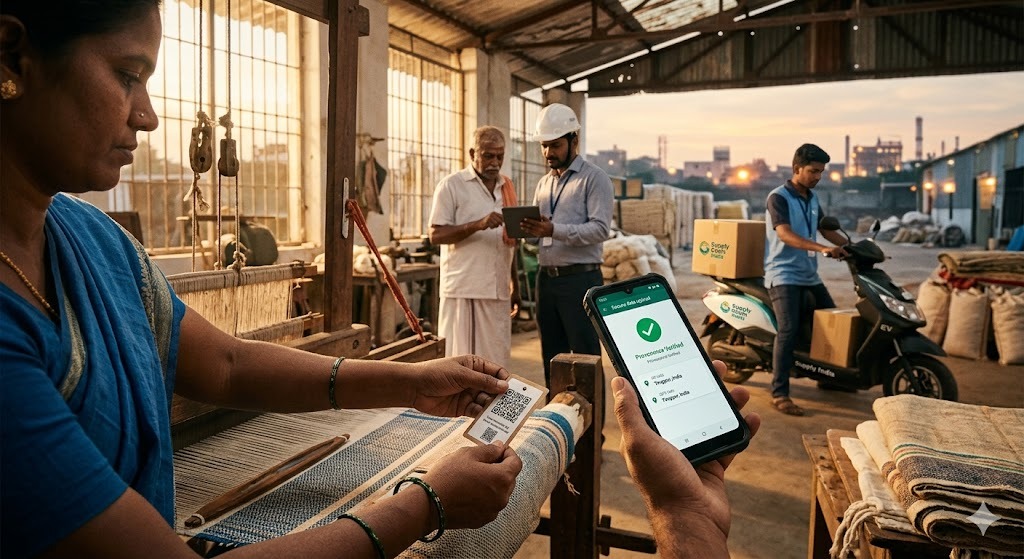
Sustainable supply chains are the new expectation. Large Indian and multinational companies are setting ambitious targets for carbon reduction, ethical sourcing, and environmental compliance. They pass these targets down to their suppliers. But here is the problem that no one likes to talk about. The suppliers who feel the weight of these demands are often small and medium enterprises. A factory with fifty workers, a modest turnover, and no dedicated sustainability team. A family owned foundry that has supplied the same component for twenty years. A textile unit in a Tier 2 city where the owner barely has time to manage production, let alone fill out carbon accounting spreadsheets. These smaller suppliers are the backbone of Indian manufacturing. They are also the most vulnerable link in the sustainability chain. If big buyers simply demand compliance without offering support, the result is not a greener supply chain. It is a hidden, unspoken crisis of supplier anxiety, falsified reports, and quietly lost business relationships. The alternative is partnership. This article explores the real story of small suppliers under pressure and offers a practical path forward for buyers who truly want to build sustainable supply chains, not just check a box. The phone call that changed everythingLet us begin with a small story. A factory owner in Coimbatore has run a small precision engineering unit for nearly two decades. He employs around seventy people. He makes metal components for an automotive company. His order book is steady. His quality is good. His delivery is reliable. One Tuesday morning, he receives a phone call from his big buyer. Not the usual purchase manager. Someone from a new department called Supplier Sustainability. The voice on the line is polite but firm. They explain that the company now requires all suppliers to complete a new sustainability assessment. There is an online portal. There are more than fifty questions. The deadline is thirty days. And by the way, a third party audit of environmental compliance will be required by the end of the quarter. The factory owner puts the phone down. He stares at the ceiling. He does not have a computer in his factory office that can comfortably run an online portal. He does not have a person who understands terms like scope one emissions or wastewater discharge limits. He has a production manager, a quality controller, and an accountant who still uses paper ledgers. He has no sustainability team. He has no budget for an audit. He has no idea where to begin. This is not a story of a bad buyer or a bad supplier. It is a story of a mismatch. The buyer has moved into a new era of supply chain accountability. The supplier is still operating in the old era, not because of laziness but because no one helped them transition. And now, the distance between them feels impossibly wide. The hidden economy of small suppliers in IndiaTo understand why this mismatch matters, we need to appreciate the scale of India's small and medium enterprise economy. There are more than six crore micro, small, and medium enterprises in India. They contribute nearly thirty percent of the country's gross domestic product. They employ more than eleven crore people. They are the second largest source of employment after agriculture. In manufacturing supply chains specifically, small and medium enterprises are everywhere. They make the components that go into larger assemblies. They provide the packaging, the fasteners, the coatings, the sub assemblies, and the specialised parts that big factories do not produce themselves. An automobile company's final vehicle might be assembled in a large plant, but that plant depends on hundreds of small suppliers for everything from seat fabric to brake pads to windshield wipers. These small suppliers are typically lean. They operate on thin margins. They reinvest most of their profits back into basic operations. They rarely have the luxury of forward planning. Their owners wake up every morning thinking about raw material prices, wage bills, power cuts, and delivery deadlines. Sustainability, in the sense that a multinational company uses the word, is simply not on their radar. And yet, these are precisely the suppliers that large buyers now want to transform. The demand that landed without a manualLet us be honest about what happens when a big buyer sends a sustainability questionnaire to a small supplier. The supplier opens the document. They see questions like these. Please provide your greenhouse gas emissions inventory for the past three financial years, broken down by scope one, scope two, and scope three categories. Please share your Science Based Targets initiative approved emission reduction targets. Please confirm that all your subcontractors comply with our supplier code of conduct. Please provide evidence of wastewater treatment meeting Central Pollution Control Board standards. Please share your occupational health and safety management system certification. Please provide a breakdown of your energy consumption by source, including the percentage from renewable sources. A small supplier reads these questions and feels a distinct emotion. Not inspiration. Not motivation. Panic. And then resentment. And then a quiet, desperate calculation about whether to ignore the request or simply lose the customer. Many small suppliers choose a different option. They hire a consultant. Not a genuine sustainability expert, but someone who knows how to fill out forms and produce documents that look acceptable. The consultant writes the answers. The supplier pays a fee. The buyer receives a completed assessment. Everyone moves on. The sustainability outcome is exactly zero. This is the tragedy of demand without support. Big buyers spend time and money creating elaborate assessment frameworks. Small suppliers spend time and money learning how to game those frameworks. The environment gains nothing. Trust erodes on both sides. The three things small suppliers actually needIf you ask small suppliers what they need to become more sustainable, they will not ask for grand visions or ambitious targets. They will ask for three simple things that big buyers rarely provide. The first thing is clarity. A small supplier needs to know what specific, measurable actions are most important. Not fifty seven questions. Not a hundred page code of conduct. Three things. This year, we want you to measure your electricity consumption. Next year, we want you to switch to LED lighting. The year after, we want you to conduct a waste audit. Clear, sequential, achievable. A small supplier can work with that framework. The second thing is capacity building. A small supplier needs training, tools, and templates. Can the buyer provide a simple spreadsheet for tracking energy use? Can the buyer offer a free webinar on basic environmental compliance? Can the buyer share examples of what good practice looks like for a factory of similar size? This is not charity. It is enlightened self interest. A supplier who knows how to improve is a supplier who will improve. The third thing is financial support. Some sustainability improvements cost money. A small supplier cannot always afford the upfront investment, even if the long term savings are clear. Can the buyer offer low interest financing, longer payment terms, or shared investment in shared infrastructure? Even modest financial support can unlock genuine change. These three things, clarity, capacity building, and financial support, are not expensive for a big buyer to offer. But they require a shift in mindset. From policing to partnership. From compliance to collaboration. The audit trap and the trust deficitLet us talk about audits, because audits have become a flashpoint in buyer supplier relationships. A big buyer wants assurance that its supply chain is sustainable. So it hires an auditing firm. The auditing firm visits the small supplier. They walk the factory floor. They review documents. They interview workers. They produce a report with findings and corrective actions. This sounds reasonable. But here is what actually happens in many cases. The audit is announced in advance. The supplier has time to prepare. A temporary file of compliance documents is created. Workers are coached on what to say. The factory floor is cleaned for the day. The auditor, who is paid by the buyer and knows that finding zero problems might look suspicious, writes up a few minor non conformances. The supplier agrees to fix them. No one checks whether the fixes actually happen. Everyone moves on. This is not because suppliers are dishonest or auditors are lazy. It is because the system is structured for performance rather than genuine transformation. A two hour audit once a year cannot possibly verify the day to day reality of a factory's operations. Real sustainability is about what happens on the other three hundred and sixty four days. A better approach exists. It is called continuous improvement partnership. Instead of a single annual audit, the buyer and supplier agree on a set of indicators that the supplier tracks and shares monthly. Energy use per unit of output. Water use per unit of output. Waste sent to landfill. Overtime hours as a proxy for worker welfare. The supplier reports honestly, and the buyer responds with support, not punishment, when numbers move in the wrong direction. Over time, trust builds. And trust, not audits, is what drives real change. A success story from the Indian textile sectorThere is a notable example of buyer supplier partnership in the Indian textile sector. A large international apparel brand realised that its small weaving and dyeing suppliers in Tamil Nadu were struggling with wastewater compliance. The brand could have simply cut them off and found new suppliers. Instead, they chose a different path. The brand invested in a common effluent treatment plant that served multiple small suppliers in the same industrial cluster. The brand paid for the design and a portion of the construction. The suppliers paid a modest user fee that was lower than what they would have paid to build their own individual treatment systems. A local non profit organisation provided training on operation and maintenance. The result was clean water, shared cost, and stronger relationships. Within two years, the entire cluster achieved compliance that no single supplier could have afforded alone. This is the model that works. Not one buyer telling one supplier what to do alone. Multiple buyers, multiple suppliers, and shared infrastructure solving a shared problem. Indian industrial clusters are perfectly suited to this approach. The geography is concentrated. The relationships are long standing. The potential for collective action is enormous. The responsible buyer's framework for small supplier engagementIf you are a large buyer reading this and you want to do better, here is a practical framework. It contains five principles that have been tested in Indian supply chains. The first principle is to segment your suppliers. Not all suppliers are the same. A large, sophisticated supplier with its own sustainability team can handle detailed questionnaires and third party audits. A small, family owned supplier cannot. Group your suppliers by size, capability, and risk. Apply different expectations to different segments. Do not treat everyone the same. The second principle is to start with materiality. What are the most significant environmental and social risks in your supply chain? For a small metal finishing unit, the answer might be wastewater. For a small packaging unit, the answer might be plastic waste. For a small textile unit, the answer might be energy efficiency. Focus on the one or two issues that truly matter. Ignore the rest until the basics are in place. The third principle is to provide tools, not just targets. A target without a tool is a wish. A target with a tool is a plan. Give your small suppliers simple, free, practical tools. A spreadsheet to track electricity. A checklist for waste segregation. A template for calculating water consumption. Make it easy for them to do the right thing. The fourth principle is to reward improvement, not perfection. A small supplier that reduces its energy intensity by ten percent this year has done something real. Acknowledge that progress in your supplier scorecard. Offer preferential sourcing or better payment terms for demonstrated improvement. Perfection is a destination. Improvement is a journey. Reward the journey. The fifth principle is to collaborate with competitors. Your small suppliers also sell to other large buyers. If you all demand different sustainability standards, the supplier is caught in an impossible web of conflicting requirements. Engage with your competitors. Agree on common standards, common tools, and common reporting formats for shared suppliers. Reduce the burden. Increase the impact. The cost of doing nothingLet us end with a sobering thought. Some big buyers will read this article and decide that helping small suppliers is too much trouble. They will simply drop suppliers who cannot comply and find larger, more sophisticated suppliers who already have sustainability systems in place. This is a losing strategy for three reasons. First, there are not enough large, sophisticated suppliers to replace the small ones. The Indian economy depends on its small and medium enterprise backbone. If every buyer only sourced from large suppliers, supply chains would struggle to meet demand. Second, dropping small suppliers does not make the world cleaner. It simply shifts the environmental and social impact elsewhere, out of sight, out of mind, but still present. A responsible buyer takes responsibility for its entire value chain, not just the visible parts. Third, the regulatory tide is turning. Soon, laws such as the European Union's Corporate Sustainability Due Diligence Directive will require buyers to actively manage sustainability in their supply chains, including the smallest suppliers. Ignoring the problem now only means scrambling to fix it later under tighter deadlines and greater pressure. The smarter path is the harder path. Engage. Train. Support. Partner. Build the sustainable supply chain together, one small factory at a time. Conclusion: A factory transformedLet us return to that factory owner in Coimbatore. His big buyer did not drop him. Instead, they sent a young sustainability associate to spend two days at his factory. Not to audit. To help. She sat with his accountant and set up a simple energy tracking sheet. She walked the floor with his production manager and identified three low cost fixes. Install an automatic shutoff for compressed air leaks. Replace old fluorescent lights with LEDs. Segregate metal scrap for recycling. One year later, the factory had reduced its electricity consumption by nearly twenty percent. Metal scrap sales had increased significantly. The workers took pride in the clean, organised floor. And the big buyer renewed the contract with a modest price premium for demonstrated improvement. The factory owner still does not know what scope three emissions are. He still does not have a sustainability team. But his factory is genuinely, measurably greener than it was. And that happened not because of a demand, but because of a partnership. That is the small factory's load. And that is how responsible buyers help carry it. ...Read more

12 May 2026

In the bustling industrial corridors, where the rhythmic hum of textile machinery provides a constant soundtrack to daily life, a profound transformation is taking place. It is a shift that is less about the speed of the looms and more about the stories they tell. For decades, the global supply chain was a black box. Raw cotton entered one end, and a finished garment emerged from the other, with very little clarity regarding what happened in between. Today, that opacity is being replaced by a digital pulse of trust, driven by the urgent need for sustainable supply chains that are ethical, transparent, and environmentally responsible. When we talk about transparency and traceability in a professional context, we often drift toward cold terminology like “decentralized ledgers” or “automated data harvesting.” But in the Indian landscape, these technologies are deeply humanized. They represent the bridge between a small-scale organic farmer in Vidarbha and a conscious consumer in a metropolitan hub like Mumbai or London. To write about this for a professional website, we must explore how India is uniquely positioned to lead the world in tech-enabled, human-centric supply chain integrity. The Human Necessity of Knowing the SourceIn a supply chain, transparency is the "what" and "how," while traceability is the "who" and "where." For a professional organization, these are no longer just "nice-to-have" ESG metrics. they are fundamental requirements for risk mitigation. In India, where supply chains are often fragmented and involve a high degree of informal labor, the challenge of traceability is significant. However, it is precisely this complexity that makes the human story so compelling. Consider the journey of a single piece of jewellry crafted in Jaipur. Traditionally, the provenance of the gemstones used might be obscured through half a dozen middle brokers. By implementing traceability tools, a professional brand can now verify that the stones were ethically mined and that the artisans were paid a fair, living wage. This isn't just about compliance with international labor laws. it is about honoring the craftsmanship and the human rights of the individuals at the very start of the value chain. Blockchain as a Tool for EmpowermentOne of the most potent tools in the professional arsenal for supply chain integrity is blockchain. While the hype around cryptocurrency has fluctuated, the underlying utility of a tamper-proof, transparent ledger remains a game-changer for Indian procurement. Empowering the First MileIn many Indian sectors, the "first mile", the point where raw materials are produced, is the most vulnerable. Blockchain allows for the creation of a digital identity for smallholder farmers or local weavers. Every time a bag of cotton or a bundle of silk changes hands, the transaction is recorded. This creates a "digital footprint" that serves two purposes. First, it provides the brand with an ironclad audit trail to prove environmental claims, such as organic certification or pesticide-free farming. Second, and perhaps more importantly, it provides the producer with a formal record of their output. For a farmer in rural India, this digital history can be life-changing, serving as proof of income that allows them to access formal banking services and credit for the first time. The technology acts as a silent advocate for the marginalized, bringing them into the formal economy with dignity. Eliminating the Information GapFor professionals in logistics and operations, blockchain solves the "information asymmetry" that often leads to inefficiency and waste. In the Indian food supply chain, where cold chain infrastructure is still maturing, real-time traceability can track the temperature and handling of perishable goods from a farm in Himachal Pradesh to a retail shelf in Delhi. By reducing spoilage through better visibility, we aren't just saving money. we are ensuring that the hard work of the farmer isn't wasted and that the environmental resources used to grow that food weren't expended in vain. AI and the Prediction of Ethical RiskWhile blockchain records the past, Artificial Intelligence (AI) is being used by Indian tech firms to predict the future of supply chain ethics. This is where the professional narrative moves from "reporting" to "proactive management." Mapping the Unseen TierMost large corporations have a decent handle on their Tier 1 suppliers—the factories they deal with directly. However, the ethical risks often hide in Tier 2 or Tier 3, the subcontractors and raw material processors. In the Indian context, AI tools are now being used to analyze vast amounts of disparate data, from satellite imagery of mining sites to local news reports and social media sentiment. If an AI algorithm detects a sudden spike in production at a Tier 1 factory that doesn't align with their known capacity, it can flag a "subcontracting risk." This allows procurement professionals to investigate whether work is being offloaded to unauthorized workshops where labor standards might be lower. This "human-in-the-loop" AI approach doesn't replace human auditors. it gives them a high-powered lens to focus their efforts where they are needed most. Climate Resilience for the Supply ChainAI is also being used to humanize environmental responsibility. By analyzing weather patterns and soil health data across different Indian regions, companies can help their suppliers adapt to climate change. If a drought is predicted in a specific cotton-growing belt, a brand can work with its suppliers to implement water-saving technologies before a crisis hits. This shifts the relationship from a transactional one to a partnership focused on mutual survival and long-term sustainability. Digital Product Passports: A New Standard for Indian ExportsAs India aims to become a global manufacturing hub, the adoption of Digital Product Passports (DPP) is becoming a strategic necessity. A DPP is essentially a "digital twin" of a physical product that contains all the information about its composition, origin, and recyclability. The Competitive Edge for Indian ManufacturersFor an Indian manufacturer exporting to Europe or North America, a DPP is a ticket to market entry. It allows a professional buyer to scan a QR code and instantly see the carbon footprint of the item, the percentage of recycled content, and instructions for how to disassemble the product at the end of its life. This level of transparency forces a "design-led" approach to the supply chain. Engineers in Pune or Chennai are no longer just designing for function. they are designing for circularity. The human element here is the pride in creating products that are built to last and designed to be reborn. It aligns the technical prowess of Indian industry with the global demand for a "cradle-to-cradle" economy. The Role of Logistics: Greening the Last MileIn the dense urban environments of Mumbai or Kolkata, the "last mile" of the supply chain is where the environmental impact is most visible. The professional shift toward electric vehicles (EVs) for delivery is a crucial part of the sustainable supply chain story, but it also has a profound human impact. Improving Urban LiveabilityWhen a major Indian e-commerce player switches its delivery fleet to electric scooters and vans, the immediate benefit is a reduction in Scope 3 emissions. However, the human benefit is the reduction in noise and air pollution in residential neighborhoods. The delivery partners themselves—often young men and women navigating stressful traffic—benefit from vehicles that are easier to maintain and cheaper to operate. The professional narrative here should focus on "co-benefits." A sustainable supply chain doesn't just improve the company's ESG score. it improves the quality of life for the communities in which it operates. It turns a logistical necessity into a social good. Overcoming the Human Resistance to TransparencyDespite the benefits, the journey toward total transparency in Indian supply chains is not without friction. There is an inherent fear among many smaller suppliers that "transparency" is just a fancy word for "more surveillance" or "lower margins." Building a Culture of CollaborationTo successfully implement these technologies, professional leaders must foster a culture of trust. Transparency cannot be a top-down mandate. it must be a collaborative effort. This involves: Incentivizing Data Sharing: Suppliers should be rewarded for transparency. This could mean better payment terms, longer-term contracts, or access to low-interest "green loans" for those who provide accurate sustainability data. Simplifying the Tech Interface: For a warehouse manager in a Tier 2 city, a traceability tool needs to be as intuitive as a messaging app. The human-centered design of supply chain software is critical for widespread adoption. Education and Training: We must move away from the "policing" model of auditing. Instead, professional organizations should invest in training their suppliers on *why* this data matters and how it can help them grow their own businesses. The Ethical Imperative: Beyond the Bottom LineAt the end of the day, a sustainable supply chain is an ethical choice. It is an acknowledgment that every dollar spent by a corporation has a ripple effect through society. In India, where the gap between the corporate boardroom and the village farm can feel immense, traceability is the thread that sews these worlds together. When a professional website discusses these topics, it must remind the reader that behind every data point on a blockchain ledger is a human being. There is a weaver who spent weeks on a handloom, a truck driver who spent nights on the highway, and a factory worker who takes pride in the quality of their output. The Power of Radical HonestyThe final frontier of the sustainable supply chain is "radical honesty." This means being transparent not just about the successes, but also about the challenges. If a company discovers a breach of its ethical code deep in its Indian supply chain, the professional response is not to hide it, but to acknowledge it, investigate the root cause, and work with the supplier to fix it. This humanized approach to "corrective action" builds much more long-term brand equity than a polished, but hollow, sustainability report. It shows that the company is committed to the *process* of improvement, recognizing that the journey toward a truly sustainable future is a marathon, not a sprint. A Vision for India’s LeadershipIndia has a historic opportunity to define what a sustainable supply chain looks like for the 21st century. We have the technical talent to build world-class traceability platforms, the industrial scale to make a global impact, and a cultural heritage that traditionally valued resourcefulness and community. As professionals, our task is to integrate these elements into a cohesive strategy. We must build supply chains that are not just efficient, but also kind. We must create systems where transparency is used to empower, not to exploit. And we must ensure that as our goods move across the globe, they carry with them the values of integrity, respect, and environmental stewardship. The digital pulse of trust is beating louder every day. From the digital payment received by a farmer to the QR code scanned by a shopper, the story of the Indian supply chain is being rewritten. It is a story of a country that is no longer content to be a "low-cost" provider, but is instead striving to be a "high-trust" partner in the global quest for a sustainable future. Call to Action for the Professional ReaderThe transition to a transparent and sustainable supply chain is no longer a futuristic concept. it is a present-day mandate. To begin this journey, professional organizations in India should: 1.Map the Human Landscape: Go beyond the Tier 1 suppliers. Use technology to understand who is really making your products and under what conditions.2. Invest in Partnerships: View your suppliers as partners in sustainability. Provide them with the tools and the training they need to join you on this journey.3. Celebrate the Stories: Use your platform to highlight the human stories of your supply chain. Let your customers see the faces and hear the voices of the people who bring your brand to life.4. Embrace Technology with a Purpose: Don't just adopt blockchain or AI because it is trendy. Use it to solve specific human and environmental challenges within your value chain. By humanizing the tech and professionalizing the ethics, we can create a supply chain that truly serves the people and the planet. This is the new standard of excellence for Indian business, and it is a journey that starts with a single, transparent step. ...Read more

12 May 2026

The modern world runs on supply chains. Every product people use in their daily lives has travelled through a long network of manufacturers, suppliers, warehouses, transport systems, retailers, and workers before reaching consumers. From a mobile phone assembled using materials sourced across multiple countries to vegetables transported from farms to urban supermarkets, supply chains form the invisible foundation of the global economy. For decades, businesses focused primarily on making supply chains faster, cheaper, and more efficient. Speed and cost reduction became major priorities in an increasingly competitive marketplace. However, this approach often overlooked the environmental and social consequences hidden behind production and distribution systems. Today, the conversation around supply chains is changing rapidly. Rising environmental concerns, climate change, resource depletion, labour rights issues, and growing consumer awareness have forced businesses to rethink how products are sourced, manufactured, packaged, and transported. As a result, sustainability is no longer viewed as a secondary corporate responsibility. It has become an essential part of long term business strategy and economic resilience. This shift has brought greater attention to the idea of sustainable supply chains. A sustainable supply chain focuses on ethical, environmentally responsible, transparent, and socially conscious practices throughout every stage of production and distribution. The goal is not only to deliver products efficiently but also to minimise environmental harm, protect worker welfare, conserve resources, and create systems that remain viable for the future. For a country like India, where manufacturing, agriculture, logistics, retail, and exports play major roles in the economy, sustainable supply chains have become increasingly important. India’s future growth will depend not only on industrial expansion but also on how responsibly that growth is managed. Understanding Sustainable Supply ChainsA supply chain includes every process involved in moving a product from raw material extraction to final consumer delivery. This includes sourcing, manufacturing, packaging, transportation, warehousing, retail operations, and waste management. A sustainable supply chain seeks to improve these processes by reducing environmental impact and promoting ethical practices at every stage. This means businesses are increasingly expected to think beyond profits alone. They are now being evaluated based on how responsibly they operate, how transparently they source materials, how fairly they treat workers, and how effectively they reduce pollution and waste. Sustainability within supply chains generally focuses on three major areas: Environmental responsibility involves reducing carbon emissions, conserving water and energy, minimising waste generation, and lowering pollution caused by manufacturing and transportation activities. Social responsibility focuses on fair wages, safe working conditions, labour rights, diversity, inclusion, and ethical sourcing practices. Economic sustainability ensures that businesses remain financially stable while investing in long term responsible growth rather than short term exploitation of resources or labour. Together, these elements create supply chains that are more resilient, trustworthy, and future ready. Why Sustainable Supply Chains Matter More Than EverThe importance of sustainable supply chains has grown significantly over the last decade due to several global challenges. Climate change has become one of the defining concerns of modern society. Industries, transportation networks, and manufacturing systems contribute heavily to greenhouse gas emissions. Global supply chains, especially those dependent on fossil fuel transportation and mass production, generate enormous environmental impact every year. At the same time, consumers have become more aware of how products are made and where they come from. Many people today want greater transparency regarding sourcing practices, environmental responsibility, and labour conditions. Businesses can no longer assume that consumers only care about price and convenience. Investors and governments are also increasing pressure on companies to adopt Environmental, Social, and Governance standards. Businesses that fail to prioritise sustainability may face reputational risks, regulatory challenges, and declining consumer trust. The COVID-19 pandemic further exposed the vulnerability of traditional global supply chains. Disruptions in manufacturing, transportation, and sourcing revealed how fragile highly centralised and unsustainable systems could become during global crises. Sustainable supply chains are increasingly viewed as more resilient because they prioritise efficiency, adaptability, local sourcing, responsible resource management, and long term planning. India’s Growing Role in Global Supply ChainsIndia has emerged as one of the world’s major manufacturing and sourcing destinations. Industries such as textiles, pharmaceuticals, agriculture, electronics, automotive production, and information technology contribute significantly to both domestic growth and international trade. Cities such as Mumbai, Bengaluru, Chennai, Hyderabad, and Kolkata play major roles in manufacturing, logistics, exports, and technology driven supply chain management. As India strengthens its position in global trade networks, sustainability is becoming increasingly important for maintaining competitiveness. International buyers and investors are placing greater emphasis on ethical sourcing, environmental responsibility, and transparency within supplier networks. Indian businesses are therefore facing growing pressure to modernise supply chain operations and align with global sustainability expectations. At the same time, India also possesses unique advantages in this transition. Traditional practices such as repairing products, minimising waste, reusing materials, and supporting local production have long existed within Indian communities. Many sustainability principles that are now being discussed globally were historically embedded in everyday life across various regions of the country. Modern sustainable supply chain strategies can build upon these cultural foundations while integrating new technologies and business practices. The Environmental Impact of Traditional Supply ChainsTraditional supply chains often create significant environmental damage at multiple stages of operation. Manufacturing facilities consume large quantities of energy and water. Transportation systems dependent on diesel and fossil fuels generate high carbon emissions. Excessive packaging creates enormous plastic waste, while poor waste management practices contribute to pollution and landfill expansion. Fast production cycles also encourage overconsumption and resource depletion. Products are often designed for short term use rather than durability, leading to higher waste generation and increased demand for raw materials. In India, environmental stress caused by industrial expansion is becoming increasingly visible. Air pollution, contaminated water bodies, overflowing landfills, and declining natural resources are affecting both urban and rural communities. Industrial zones surrounding major cities often face severe environmental challenges due to untreated waste discharge, excessive emissions, and inefficient production systems. Sustainable supply chains aim to reduce these impacts through cleaner production methods, renewable energy adoption, efficient transportation systems, sustainable packaging, and circular economy practices. Sustainable Manufacturing and Responsible ProductionManufacturing lies at the centre of most supply chains. As a result, improving sustainability within production systems has become a major priority for industries worldwide. Indian manufacturers are increasingly exploring ways to reduce environmental impact while improving operational efficiency. Many companies are adopting energy efficient machinery, water recycling systems, renewable energy infrastructure, and waste reduction programs. The textile sector provides an important example. India is one of the world’s largest textile producers, but textile manufacturing also consumes significant amounts of water and chemicals. Sustainable textile initiatives now focus on reducing water usage, improving waste treatment, promoting recycled fabrics, and supporting ethical labour practices. Similarly, the automotive industry is gradually shifting toward cleaner technologies, electric mobility, and more sustainable sourcing of materials. Sustainable manufacturing does not simply benefit the environment. It often improves long term profitability by lowering resource consumption, reducing waste management costs, and improving energy efficiency. Businesses are increasingly realising that environmental responsibility and economic performance can work together rather than against each other. Ethical Sourcing and Human ResponsibilitySustainability is not only about environmental protection. It is also deeply connected to human welfare and ethical responsibility. Supply chains often involve large networks of workers, including factory employees, farmers, transport workers, warehouse staff, and small suppliers. In some industries, poor labour conditions, unsafe workplaces, unfair wages, and exploitation remain serious concerns. Consumers today are asking more questions about who makes the products they buy and under what conditions those products are produced. Ethical sourcing focuses on ensuring fair treatment, safe working environments, and responsible labour practices throughout supply chains. In India, sectors such as textiles, agriculture, handicrafts, and manufacturing employ millions of workers, including many from economically vulnerable communities. Improving supply chain ethics can therefore have a significant social impact. Fair wages, worker safety, skill development opportunities, and responsible sourcing practices contribute not only to sustainability but also to broader social progress. Many Indian businesses are now recognising that worker welfare is closely linked to long term productivity, reputation, and operational stability. The Rise of Green LogisticsTransportation forms one of the largest sources of emissions within supply chains. Trucks, cargo ships, airplanes, and delivery vehicles consume massive amounts of fuel while moving products across regions and countries. As e commerce and online retail continue growing rapidly in India, logistics networks are becoming even more important. Green logistics focuses on reducing the environmental impact of transportation systems through cleaner technologies and more efficient operations. Companies are increasingly exploring electric delivery vehicles, route optimisation software, shared transportation systems, and fuel efficient fleets to lower emissions. Urban delivery systems are also evolving. Several businesses are introducing electric two wheelers and bicycles for last mile delivery services in congested city environments. Warehousing operations are similarly becoming more sustainable through solar powered facilities, energy efficient lighting systems, and automated inventory management technologies. These changes may appear gradual, but collectively they represent a major transformation in how supply chains operate. Technology and Supply Chain TransparencyTechnology is playing a major role in making supply chains more transparent and sustainable. Consumers and regulators increasingly expect businesses to provide clear information regarding sourcing practices, environmental performance, and production standards. Digital systems now allow companies to track products across supply chain stages more accurately. Technologies such as artificial intelligence, blockchain systems, Internet of Things devices, and data analytics are helping businesses improve visibility and efficiency. For example, companies can now monitor energy usage, transportation emissions, supplier compliance, and inventory movement in real time. This improved transparency helps businesses identify inefficiencies, reduce waste, and strengthen accountability. In India, the growth of digital infrastructure and technology startups is creating new opportunities for supply chain innovation. Logistics technology platforms, smart warehousing systems, and sustainability tracking software are becoming increasingly common across industries. Technology alone cannot solve sustainability challenges, but it provides powerful tools for supporting more responsible decision making. Consumer Awareness and Changing ExpectationsOne of the biggest drivers of sustainable supply chains is changing consumer behaviour. People today are becoming more conscious of environmental and ethical issues. Consumers increasingly notice packaging waste, excessive plastic usage, unethical sourcing practices, and environmentally harmful business operations. Younger generations especially tend to value sustainability more strongly when making purchasing decisions. This shift is encouraging businesses to rethink product design, packaging choices, and sourcing strategies. Sustainability is gradually becoming part of brand identity rather than simply a marketing trend. Companies that fail to adapt may struggle to maintain consumer trust in the future. Challenges in Building Sustainable Supply ChainsDespite growing awareness and progress, sustainable supply chains still face several challenges. One major obstacle is cost. Sustainable technologies, renewable energy systems, ethical sourcing programs, and environmentally friendly materials may require significant investment, especially for smaller businesses. Supply chains are also highly complex and interconnected. Large companies often depend on extensive supplier networks spread across multiple regions and countries. Ensuring sustainability across every level of these networks can be difficult. Infrastructure limitations also remain a challenge in many developing regions. Transportation inefficiencies, inconsistent waste management systems, and limited renewable energy access can slow progress. Additionally, sustainability standards and reporting systems are still evolving. Businesses sometimes struggle with measuring environmental impact accurately or maintaining consistent supplier compliance. However, despite these challenges, the direction of change is becoming increasingly clear. Building a Greener Future Through Sustainable Supply ChainsThe future of business will depend heavily on sustainability. Companies that invest in responsible supply chains today are likely to become more resilient, trusted, and competitive in the long term. Sustainable supply chains support a future where economic growth does not come at the cost of environmental destruction or human exploitation. For India, this transition carries enormous significance. As one of the world’s fastest growing economies, India has the opportunity to shape industrial growth differently by integrating sustainability into the foundation of development itself. This requires collaboration between businesses, governments, technology providers, workers, and consumers. Policies supporting renewable energy, ethical manufacturing, waste reduction, and green logistics will play important roles in accelerating progress. Educational institutions and training programs can also help prepare future professionals for sustainability focused industries and responsible business management. Most importantly, sustainability must become part of everyday business thinking rather than an isolated initiative. ConclusionSustainable supply chains represent a major shift in how businesses approach production, distribution, and responsibility. They reflect a growing understanding that economic success cannot be separated from environmental protection and social well being. The products people use every day carry environmental and human stories behind them. Sustainable supply chains aim to ensure those stories are built on responsibility, fairness, efficiency, and long term thinking. India’s role in this transformation will continue to grow as industries modernise and global sustainability expectations increase. Businesses that embrace cleaner technologies, ethical sourcing, transparent operations, and responsible logistics will help shape a greener and more resilient economy. The transition will not happen overnight. Challenges involving cost, infrastructure, awareness, and implementation still remain. However, the momentum toward sustainability is becoming stronger across industries and societies worldwide. Ultimately, sustainable supply chains are about more than business operations alone. They are about creating systems that respect both people and the planet while supporting future generations. A greener future will not depend only on what products are made, but also on how responsibly those products travel through the world before reaching our hands. ...Read more

12 May 2026

India has set ambitious renewable energy targets. The government aims for 500 gigawatts of non fossil fuel capacity by 2030. But for a business owner or facility manager, national targets matter less than a single practical question. How do I actually install solar panels on my factory roof or buy wind power for my office? The answer involves navigating a complex landscape of central policies, state regulations, subsidy schemes, net metering rules, open access provisions, and utility company procedures. The good news is that the framework exists and is improving. The challenging news is that it varies significantly by state. Understanding the policy pipeline is not optional for a business serious about renewable transition. It is the difference between a smooth, profitable installation and a stalled, frustrating project. The two page electricity bill and the question that started everythingLet us begin with a small scene that might feel familiar. A manufacturing company owner in Gujarat sits down with the monthly electricity bill. It is thick this year. Two pages instead of one. The tariff has gone up again. Diesel for the backup generator is more expensive too. He looks at the roof of his factory, which is flat, wide, and baking under the afternoon sun for ten months of the year. And he asks a simple question. Why is this roof not saving me money? That question, asked in a thousand boardrooms and shop floors across India, is the real engine of the renewable transition. Not climate summits. Not corporate social responsibility reports. Just a business owner looking at an unshaded roof and a rising electricity bill. But that question quickly leads to a second, more complicated question. How do I actually do this? Who do I talk to? What forms do I fill? How much will it cost upfront? When will I see savings? What happens when I generate more power than I need? What happens when I generate less? These are not technical questions. They are policy questions. And they are the subject of this guide. The three pathways. Onsite, open access, and the green choiceBefore we dive into policies, we need to understand the three basic ways a business can use renewable energy in India. Each pathway has different rules, different economics, and different paperwork. » Onsite generation. This is the most common and the most straightforward. You install solar panels on your own rooftop or on unused land within your factory premises. You use the electricity directly. Any excess can be sent back to the grid if your state allows net metering. The main policy questions here involve building permits, grid connection approvals, and metering arrangements. » Open access. This is for businesses that cannot install enough onsite capacity because their roof is too small, shaded, or structurally weak. Under open access, you buy renewable power from a solar or wind farm located elsewhere, and the utility company transmits it through the grid to your facility. You pay the generator for the power and the utility for the transmission. The main policy questions here involve interstate or intrastate transmission charges, banking provisions, and cross subsidy surcharges. » Green power option. Some discoms (distribution companies) now offer tariffs where you pay a small premium to source a portion of your power from renewable sources without installing anything yourself. This is the simplest administratively but often the least economical because the premium may not reflect the true cost savings of renewable energy. Most Indian businesses start with pathway one, move to pathway two if needed, and consider pathway three only if the first two are not feasible. The central government. The architect of the frameworkThe central government sets the broad rules. The Ministry of New and Renewable Energy is the primary agency. It designs schemes, provides subsidies, and issues guidelines. The Central Electricity Regulatory Commission sets tariffs and rules for interstate transmission. The Solar Energy Corporation of India acts as a implementing agency for many large scale schemes. For a business owner, the central government matters most for two reasons. Subsidies and basic rights. The central government offers capital subsidies for rooftop solar installations, particularly for smaller systems. For a typical business, the subsidy might cover twenty to thirty percent of the cost, though the exact percentage and eligibility criteria change over time. The subsidy is usually channeled through state nodal agencies, which means you apply at the state level even though the funding comes from Delhi. More importantly, the central government has established the basic legal right for consumers to generate their own electricity through renewable sources. This is enshrined in various regulations and has been affirmed by the Appellate Tribunal for Electricity. No state can simply ban rooftop solar. They can only regulate it. That said, the central framework is only a framework. The real detail lies with the states. The state government. Where the real decisions happenIf the central government is the architect, the state government is the builder. And every builder works a little differently. Electricity is a concurrent subject in India's constitution, which means both central and state governments have jurisdiction. But operational control over distribution lies firmly with the states. Each state has its own electricity regulatory commission, its own discoms, and its own policies on net metering, banking, cross subsidies, and open access. This is where many businesses get stuck. A policy that works beautifully in Karnataka might be nearly impossible to implement in Uttar Pradesh. A solar installation that pays for itself in three years in Tamil Nadu might take seven years in West Bengal. The technology is identical. The difference is policy. Let us break down the key state level policies you need to understand.Net metering. The policy that makes rooftop solar sing Net metering is the single most important policy for onsite solar. Here is how it works. Your solar panels generate electricity during the day. Your factory uses what it needs immediately. Any excess power flows back into the grid, and your electricity meter runs backwards. At night or on cloudy days, you draw power from the grid as usual. At the end of the billing cycle, you pay only for the net amount you consumed. If you generated more than you consumed, you get a credit on your next bill. Net metering makes rooftop solar financially attractive because it essentially uses the grid as a free battery. You do not need to buy expensive storage to use the power you generate. The grid stores it for you. However, not all states offer true net metering. Some states offer net billing instead, where excess power is purchased by the discom at a lower rate than the retail tariff. Others cap net metering capacity at a certain percentage of your sanctioned load, often at eighty or ninety percent. Others limit net metering to systems below a certain size, typically one megawatt or less for commercial consumers. Before you invest in rooftop solar, you must check your state's net metering policy. Call your discom. Ask for the latest regulations. Speak to a local solar installer who has done projects recently. The policy landscape changes frequently, and outdated information can ruin your financial model. Banking and banking charges. The hidden cost of open accessIf you are using open access to buy power from a remote solar farm, you will encounter a concept called banking. Banking allows you to send excess power generated during sunny months to the grid and withdraw it during less sunny months. This is important because solar generation varies by season. Summer months might produce a surplus. Monsoon months might produce a deficit. Banking is incredibly valuable, but discoms do not offer it for free. They charge banking fees, typically a percentage of the energy banked, often ranging from two to fifteen percent. A high banking fee can significantly reduce the financial benefit of open access solar. Some states also impose cross subsidy surcharges on open access consumers. The logic, from the discom's perspective, is that large commercial and industrial consumers pay higher tariffs that effectively subsidise residential and agricultural consumers. When a large business switches to open access renewable power, the discom loses that high paying customer. The cross subsidy surcharge is meant to recover some of that lost revenue. These charges are not unfair. Discoms have legitimate financial concerns. But they can make open access uneconomical in some states. You must factor them into your calculations. The subsidy maze. How to find your way throughThe central government offers subsidies for rooftop solar, but accessing them requires patience. The process typically works like this. 1. First, you identify an approved vendor. The Ministry of New and Renewable Energy maintains a list of approved solar panel and inverter models. Some state nodal agencies also maintain empanelled lists of installers. Using an unapproved vendor can disqualify you from the subsidy. 2. Second, you submit an application through the national portal for rooftop solar. The portal guides you through the process, connects you to your discom, and tracks your application status. Many businesses find this portal helpful, though it is still evolving. 3. Third, you receive a technical feasibility approval from your discom. They will inspect your roof, check your electrical infrastructure, and confirm that your grid connection can handle the solar system. This step can take anywhere from two weeks to three months depending on your discom. 4. Fourth, you install the system through your approved vendor. The vendor handles all electrical work, mounting structures, and grid integration. 5. Fifth, you submit a completion report and a request for inspection. The discom inspects the installation, installs a bidirectional meter if needed, and authorises interconnection. 6. Sixth, you start generating and the subsidy is released. The subsidy is typically credited to your bank account within a month or two of commissioning. The entire process can take four to eight months for a first time applicant. That sounds slow, and it is. But it has improved significantly in recent years. The national portal has reduced paperwork. Many discoms now have dedicated rooftop solar cells. And once your first system is installed, any future expansion is much faster. The virtual net metering option for smaller businessesNot every business owns its own roof. Many small enterprises, retail shops, and offices rent their premises. For them, rooftop solar is not an option because the landlord may not agree or the lease is too short. Virtual net metering is designed for exactly this situation. Under virtual net metering, a group of consumers can collectively own or subscribe to a solar installation located elsewhere, and the power generated is credited to their individual bills in proportion to their share. For example, a shopping complex with ten small shops could install solar panels on the common roof. Each shop receives a credit on its electricity bill based on its share of the investment. The shops that rent their space benefit even though they do not own the building. Virtual net metering is still in early stages in India. A few states including Delhi, Karnataka, and Tamil Nadu have active virtual net metering policies. Others are developing them. If you are a small business owner or a tenant, this is a policy to watch. The renewable purchase obligation. A hidden driver of changeThere is one more policy that indirectly affects businesses. The renewable purchase obligation requires certain categories of electricity consumers, including large commercial and industrial users, to source a minimum percentage of their power from renewable sources. The percentage is set by the central and state regulators and typically increases every year. If you meet your obligation through your own solar installation or through open access, you are compliant. If you do not, you may have to purchase renewable energy certificates from other generators who have exceeded their obligations. For most businesses, the renewable purchase obligation is not a penalty. It is simply a reinforcement of what you already want to do. But it is worth understanding because it creates a baseline demand for renewable power and gives you another reason to act. The closing thought. The roof is waitingLet us return to that factory owner in Gujarat. He asked his question. He navigated the policy maze. He found a good vendor. He filled the forms. He waited for approvals. And one morning, the discom engineer came, flipped the switch, and his meter started running backwards. He did not become an environmental activist. He did not write a sustainability report. He simply decided that paying for sunshine made more sense than paying for coal. The policies were there to help him, imperfect but functional. He used them. The roof is waiting for you too. The sun is still free. The policies, for all their complexity, are on your side. The only question is when you will start. ...Read more

12 May 2026

The global conversation around the renewable transition is frequently dominated by abstract numbers: gigawatts of installed capacity, billions of dollars in climate finance, and percentage points of carbon reduction. While these metrics are essential for policy benchmarks, they often obscure the most critical element of the entire movement: the people. In a country as vast and as complex as India, the shift from a fossil fuel-dependent economy to a renewable one is not merely a technical swap of solar panels for coal furnaces. it is a profound social evolution that touches every layer of the human experience. For India, the Renewable Transition is a deeply personal story. It is the story of a coal miner in Dhanbad wondering if his son will have a job in twenty years, a farmer in Rajasthan leasing his arid land for a solar park to pay for his daughter’s education, and a young engineer in Bengaluru designing smart grids for a future she hopes to live in. To write about this transition for a professional audience, we must look beyond the hardware and examine the Just Transition—the commitment to ensuring that as we move toward a cleaner planet, we do not leave our people behind. The Architecture of a Just Transition in the Indian ContextIndia stands in a unique position. Unlike many developed nations that built their wealth on centuries of unrestricted carbon emissions, India is attempting to industrialize and lift millions out of poverty while simultaneously decarbonizing its energy grid. This is an unprecedented historical challenge. A Just Transition in India must be defined by three pillars: economic security for legacy workers, energy equity for the underserved, and the massive undertaking of national upskilling.  1. Economic Security and the Coal HeartlandThe Indian economy has long been anchored by the coal sector. States like Jharkhand, Chhattisgarh, and Odisha are not just regions of mining. they are entire ecosystems built around the "black gold." From the formal employees of Coal India Limited to the informal workers who transport coal on bicycles, millions of livelihoods are at stake. A professional analysis of the transition must address the reality that a solar farm requires significantly fewer permanent employees than a coal mine. Therefore, the transition cannot be a "shut down and walk away" approach. It requires a repurposing strategy. We are seeing the early stages of this in discussions around Green Energy Corridors. The goal is to transform aging thermal power plants into hubs for battery storage or green hydrogen production. By doing so, we utilize existing land and grid infrastructure while providing a localized transition path for the existing workforce. 2.Energy Equity: Beyond the GridFor a professional website focusing on sustainability, it is vital to highlight that renewable does not always mean centralized. In India, the humanized version of the transition is often seen in decentralized renewable energy (DRE). In remote villages where grid stability remains a dream, solar microgrids are changing the fundamental quality of human life. When a health clinic in a rural district gets a reliable solar-powered refrigerator, it isn't just a technical achievement. it means vaccines remain viable, and lives are saved. When a woman in a village can use a solar-powered sewing machine, she moves from subsistence to entrepreneurship. The professional narrative here is one of Productive Use of Energy. We are not just giving people light. we are giving them the tools for economic agency. The Great Upskilling: Preparing the Workforce of 2030The transition is often described as a threat to jobs, but for the professional sector, it is more accurately described as a massive shift in required competencies. The skills needed to maintain a wind turbine in Tamil Nadu are vastly different from those needed to operate a boiler in a thermal plant. Bridging the Skill GapIndia’s Skill Council for Green Jobs (SCGJ) has been instrumental in identifying these gaps. However, the professional community must go further. We need to bridge the gap between academic theory and vocational reality. From Mechanical to Digital: The future renewable worker is as much a software specialist as a mechanical one. As we integrate more solar and wind, which are intermittent by nature, the human in the loop must be adept at using AI-driven forecasting tools and automated grid management systems. Localized Manufacturing:The Make in India initiative for solar modules and lithium-ion batteries is not just about reducing imports. it is a massive job creator. The human story here is the birth of a new middle class of technicians and factory floor managers who are building the components of a green future. The Role of the Private Sector: Companies like Tata Power and Adani Renewables are not just building plants. they are becoming educators. Professional articles should highlight corporate social responsibility (CSR) programs that focus on training local youth in the vicinity of renewable projects, ensuring that the local community benefits from the clean air and the green paycheck. The Social Fabric: Gender and Youth in RenewablesOne of the most humanizing aspects of India’s energy shift is its potential to dismantle old social hierarchies. Historically, the energy sector—particularly coal and heavy oil—has been heavily male-dominated due to the physical nature of the work. The renewable sector offers a cleaner, more digitized, and more inclusive entry point. Women as Energy LeadersIn rural India, the Solar Mamas program has gained international acclaim, but the professional sector needs to look at the broader integration of women in the green workforce. From assembling solar modules in factories to managing micro-finance for solar irrigation pumps, women are at the forefront. A professional website should explore how the transition provides a unique "reset button" for gender parity in the corporate energy world. It is about creating workplaces that are safe, accessible, and designed for a diverse workforce from day one. The Aspiration of the YouthIndia is one of the youngest countries in the world. For an Indian professional under the age of 30, climate change isn't a theoretical threat. it is a defining reality of their career. This generation does not want to work for companies that are part of the problem. they want to be part of the solution. This shift in sentiment is forcing traditional Indian conglomerates to accelerate their green pivots to attract top-tier talent. The human story here is the alignment of professional ambition with planetary survival. Overcoming the Human Hurdles: Culture and MindsetsOne of the least discussed barriers to the renewable transition is the human tendency to stick with what is known. In the professional world, this manifests as incumbent bias. Engineers who have spent thirty years perfecting the efficiency of a coal turbine may naturally be skeptical of solar energy's reliability. Policy makers who rely on the steady tax revenue from fossil fuel movements may be hesitant to pivot toward decentralized models. Humanizing the transition means acknowledging these fears and addressing them with data and empathy. The Reliability MythThe professional conversation must pivot from "Is renewable energy reliable?" to "How do we make the grid resilient?" This involves a shift in mindset from centralized control to distributed intelligence. By framing the transition as an upgrade rather than a replacement, we reduce the friction of change. It is not about taking away the reliable power that coal provided. it is about providing a smarter, more reliable, and ultimately cheaper alternative through a hybrid of solar, wind, and sophisticated storage. The Environmental Justice Aspect: Health as a Human RightWe cannot talk about renewables in India without talking about the air we breathe. For many professionals living in NCR, Mumbai, or Bengaluru, the transition is a matter of public health. The humanized argument for renewables is found in the pediatric wards of our hospitals. Reducing our reliance on thermal power plants directly correlates with a reduction in particulate matter and respiratory illnesses. When writing for a professional audience, it is crucial to link energy policy to healthcare costs and productivity. A healthier workforce is a more productive workforce. The renewable transition is, at its heart, a massive public health intervention. India’s Leadership on the Global StageWhen we talk about the renewable transition in India, we are talking about a global bellwether. The success of the International Solar Alliance (ISA), headquartered in Gurugram, is a testament to India’s intent to lead the Global South in this journey. The humanized professional narrative here is about Global Collaboration. It is about Indian engineers sharing best practices for high-temperature solar installations with colleagues in Africa or South America. It is about the One Sun, One World, One Grid (OSOWOG) initiative, which envisions a world where power is shared across borders, ensuring that the sun never sets on the global energy supply. This is not just a geopolitical strategy. it is a vision of human interconnectedness. The Role of Finance: Investing in People, Not Just ProjectsFor the professional reader in the financial sector, the transition is often seen through the lens of ESG (Environmental, Social, and Governance) scores. However, the humanized approach requires a "S" (Social) focus that is as rigorous as the "E" (Environmental). Capital must flow toward projects that demonstrate a clear community benefit. We are seeing the rise of Green Bonds in India, but the next step is the "Social Impact Bond" for energy transitions. These financial instruments should fund the reskilling of coal workers or the electrification of primary health centers. The human story in finance is the shift from "extraction" to "stewardship." Investors are beginning to realize that a project that ignores its local community is a risky project. Case Studies: Human Success Stories in IndiaTo truly humanize this, we must look at where it is already working. Modhera, Gujarat: India’s first round-the-clock solar-powered village. Here, the transition isn't an article. it's the fact that villagers have zero electricity bills and are actually earning money by selling excess power back to the grid. This transforms the consumer from a passive recipient of energy into an active participant in the economy. The Rewa Ultra Mega Solar Park: By providing cheap, clean power to the Delhi Metro, this project connects the rural sun of Madhya Pradesh to the daily commute of millions in the capital. It is a tangible link between rural land and urban mobility. The Road Ahead: A Call to Action for ProfessionalsAs we look toward 2030 and 2070—India’s target for net-zero—the transition will accelerate. For those writing or working in this space, the goal should be to keep the human element at the forefront of every strategy. The professional community in India has a responsibility that goes beyond the balance sheet. We are the architects of a new social contract. One where energy is a right, not a privilege, and where the air we breathe is as clean as the ambitions we hold. Key Takeaways for Professional Strategy:1. Prioritize Social Impact: Every renewable project should have a clear human ROI. How many local jobs are created? How is the local community’s energy access improved? 2. Invest in Human Capital: The hardware of the transition (panels and turbines) is a commodity. the software (the people who design, install, and maintain them) is the true asset. 3.Transparent Communication: Avoid the jargon of carbon credits and sequestration when talking to the public. Talk about cleaner air for our children, cheaper electricity for our small businesses, and a future where India is energy-independent. 4. Embrace Resilience over Perfection: The transition will be messy. There will be grid failures and policy hiccups. The human element requires us to build resilient systems that can learn and adapt, rather than seeking a perfect, static solution. Conclusion: The Legacy of the Green ShiftIn the decades to come, when history books look back at India in the early 21st century, they will not just record the number of megawatts added to the grid. They will record how a nation of over a billion people managed to redefine its relationship with the planet while lifting its people out of poverty. The Renewable Transition is the most significant industrial shift since the dawn of the steam engine. In India, it is a chance to rectify historical inequities and build a nation that is both prosperous and sustainable. By focusing on the Just Transition, we ensure that the green future we are building is a home for everyone. It is a journey from the darkness of the coal mine to the brightness of the solar-powered home, and every step of that journey is taken by a person seeking a better life. That is the story we must tell. That is the future we must build. This transition is not a destination. it is a continuous process of human improvement. As professionals, our role is to ensure that the light of this new energy era reaches every corner of our country, leaving no one in the shadows of the past. Let us build a grid that is not just made of copper and silicon, but of empathy, foresight, and unyielding hope. ...Read more