
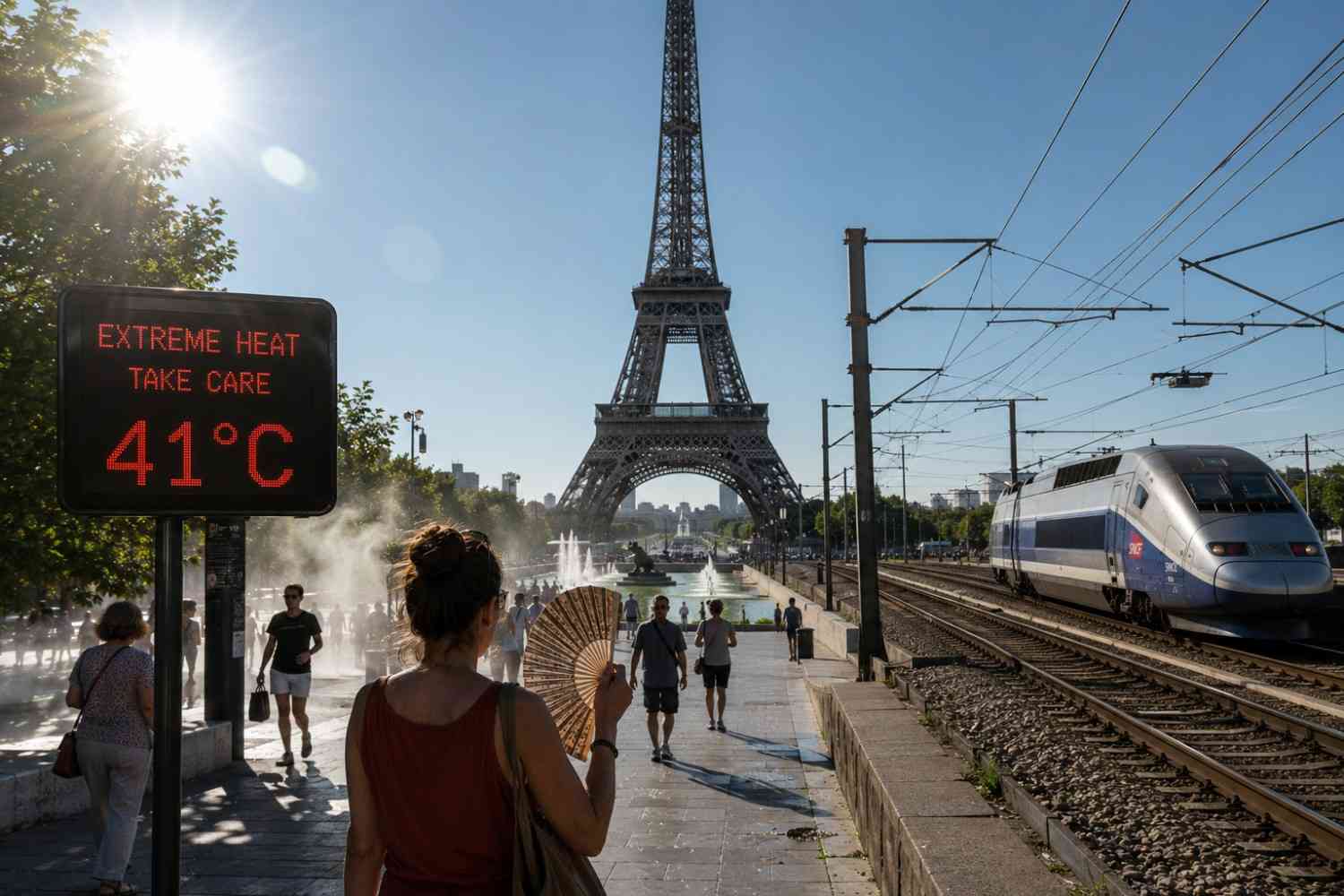
How Europe's Coldest-Built Continent Became Ground Zero for a Warming Planet — and What Its Scramble for Fans, Ambulances and Answers Tells the Rest of Us
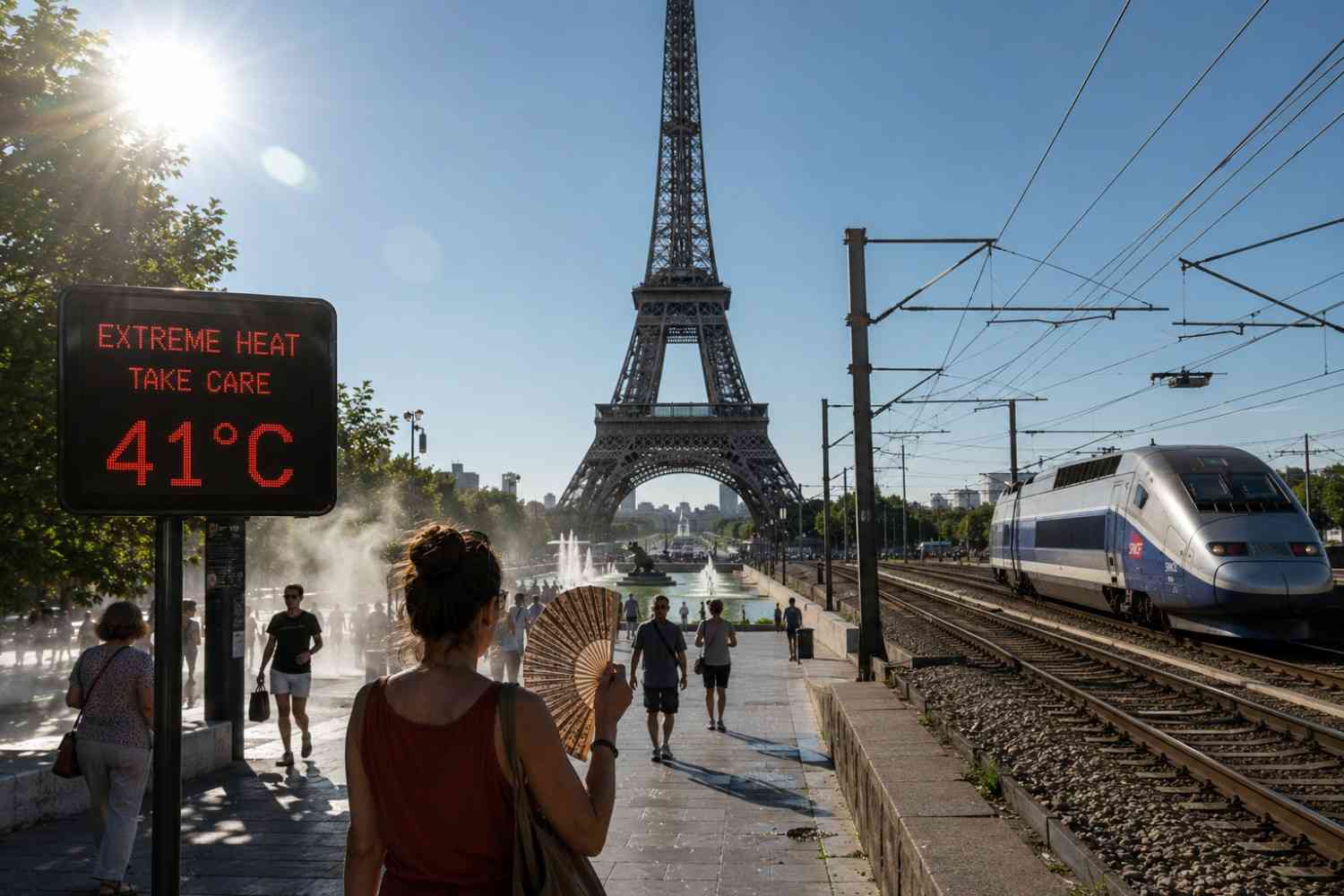
Paris residents cooling themselves at the Trocadéro fountains. Berlin police training water cannons on crowds at an open-air concert. Belgian rail managers cutting a hundred trains a day because the tracks themselves could buckle. Currys, the British electronics retailer, reporting a nearly 3,000 percent surge in fan sales in a single weekend. These are not scenes from a disaster film set in some distant, parched future. They are dispatches from Europe in the summer of 2026 — a continent famous for its temperate charm, its centuries-old stone cities, and its assumption that extreme heat was somebody else's emergency.
That assumption has now collapsed. Since late May, two successive and increasingly ferocious heatwaves have swept from the Atlantic coast to the Balkans, breaking national temperature records in at least a dozen countries, killing thousands, and forcing governments to improvise a public-health response in real time. The World Health Organization's own director-general, Tedros Adhanom Ghebreyesus, has called heat Europe's "silent killer" and confirmed more than 1,300 excess deaths linked to the June episode alone, a number that kept climbing through early July as France, Belgium, Spain and the Netherlands released their own tallies. This is, by the assessment of the World Weather Attribution (WWA) network of scientists, the most severe heatwave ever recorded over the region studied — and one that would have been "virtually impossible" in a pre-industrial climate.
The story of Euro Summer 2026 is not simply a story about weather. It is a story about a civilisation built for cold confronting a climate built for heat — and about what happens when decades of warnings arrive all at once, on schedule, exactly as predicted.
Why Europe Is Burning: The Anatomy of a Foretold Crisis
The proximate trigger has a name meteorologists use with grim regularity now: the "heat dome," or omega block, so called for the shape it traces on a weather map. A persistent zone of high pressure trapped hot, dry air pushed north from Morocco and North Africa, while low-pressure systems on either side blocked cooler Atlantic air from moving in. The first wave arrived on 24 May, delivering the earliest and most extreme spring heat on record across Western Europe. The second, beginning 17 June, was far worse. France recorded 44.3°C in Pissos and its hottest day nationally since records began in 1947, with an average national temperature of 30°C. Germany hit an all-time national high of 41.7°C at Coschen. Hungary broke its national record at 42°C. Spain touched 45.1°C. The Czech Republic recorded 41.9°C, its highest ever. The United Kingdom broke its June record three days running, and for the first time in the history of its warning system, the Met Office issued red extreme-heat alerts on consecutive days.
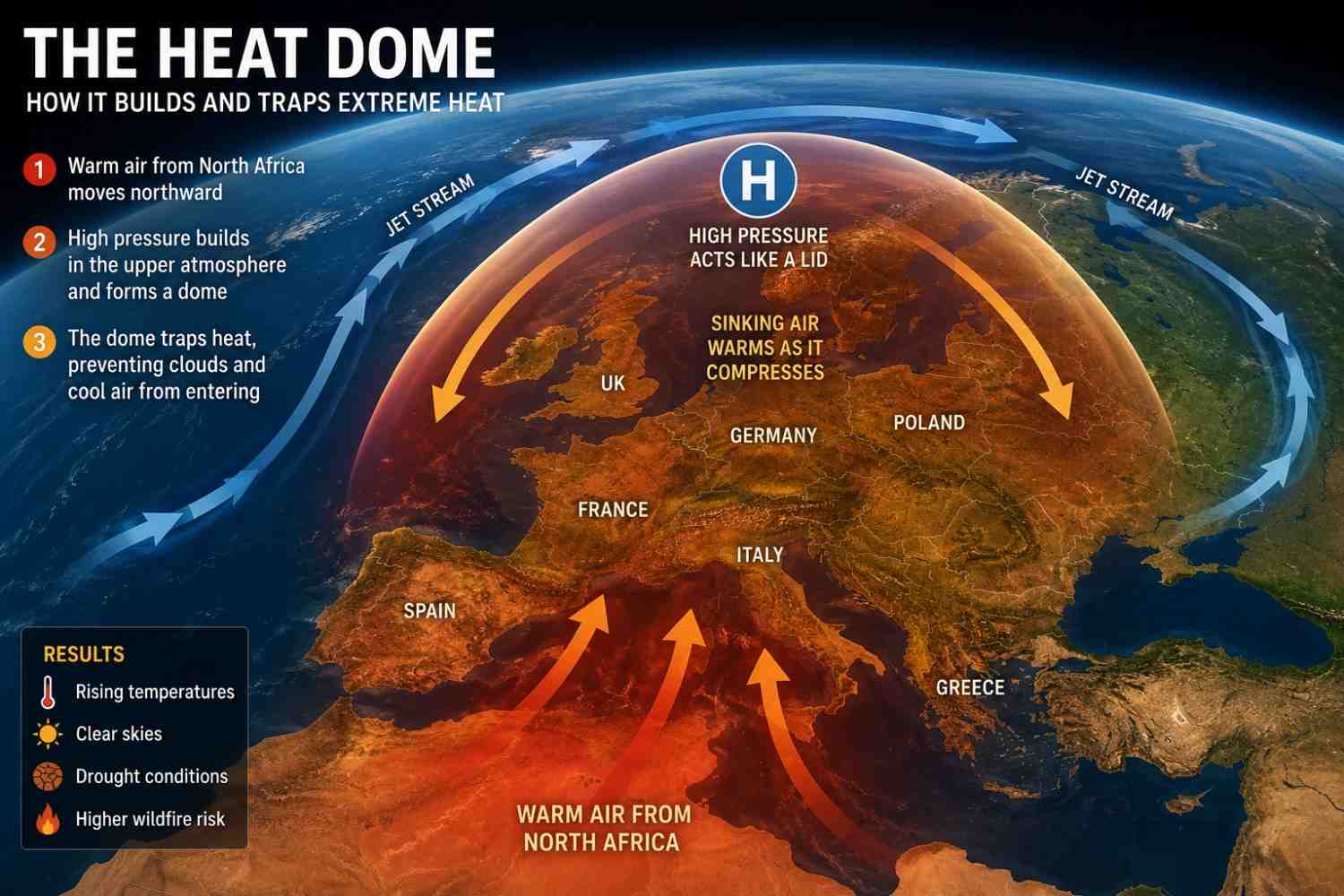
But a heat dome is only the delivery mechanism. The underlying cause, confirmed by rapid-attribution science, is unambiguous: human-caused climate change. WWA's analysis found that a comparable weather pattern would have produced dramatically less extreme outcomes just decades ago — daytime heat like this June's was roughly ten times more likely than it would have been in 2003, and extreme night-time temperatures were more than a hundred times more likely than in 1976. Put simply, the same weather pattern that once nudged a mild day into an uncomfortable one now pushes a warm day past deadly thresholds, because it is operating on top of a baseline climate that has already warmed by roughly 1.3°C globally — and by nearly double that across Europe. The World Meteorological Organization notes that Europe has warmed by around two degrees since the historic 1976 heatwave, making it the world's fastest-warming continent, heating at roughly twice the global average rate.
Crucially, this is not a story of a single freakish season. Europe's vulnerability has been accumulating for a generation. The catastrophic 2003 heatwave killed more than 14,800 people in France alone and became the reference disaster that shaped a first generation of heat policy. It was followed by damaging repeats in 2018, 2019 and 2022 — the latter killing more than 60,000 people continent-wide — and a 2023 summer that still recorded over 47,000 heat deaths despite being comparatively "cool." Academic analysis of heatwave trends between 1921 and 2021 shows a clear upward trend across most European regions, with a marked acceleration beginning in the early 1990s and the decade 2011–2021 recording the highest number of heatwaves on record. May 2026 had already broken spring records before June's crisis even began. What is unfolding this summer, in other words, is not a break from the pattern. It is the pattern, arriving earlier and hitting harder than even recent extremes suggested it would.
There is also a structural reason the crisis feels so acute: much of Europe's built environment was designed to solve the opposite problem. Thick masonry walls, small windows, heavy insulation and centralised heating reflect centuries of adaptation to long, cold winters — not the cross-ventilation, shading and cooling that a hotter climate demands. Only around one in five European homes has air conditioning, a figure that in France, Germany and the UK has historically sat below five percent. That mismatch between the climate Europe built for and the climate it now has is the structural fault line beneath every headline this summer.
The Nature and Extent of the Crisis: A Continent Under Strain
What distinguishes 2026 is not only intensity but breadth. Temperature records fell in Austria, Belgium, Czechia, Denmark, France, Germany, Hungary, Italy, the Netherlands, Poland, Romania, Spain and the United Kingdom. By late June, WHO estimated more than 150 million people across the continent were living under extreme heat. Reuters reported at least 3,700 excess deaths across France, Belgium and the Netherlands alone during the June event, with France's figure — around 2,000 to 2,025 — the largest single-country toll; Belgium recorded roughly 1,200 excess deaths (a 39 percent surge in weekly mortality), and the Netherlands close to 480, overwhelmingly among people over 65. Spain's health authorities separately attributed more than 1,000 excess deaths to the June heat, in what was already the country's second-hottest June on record.
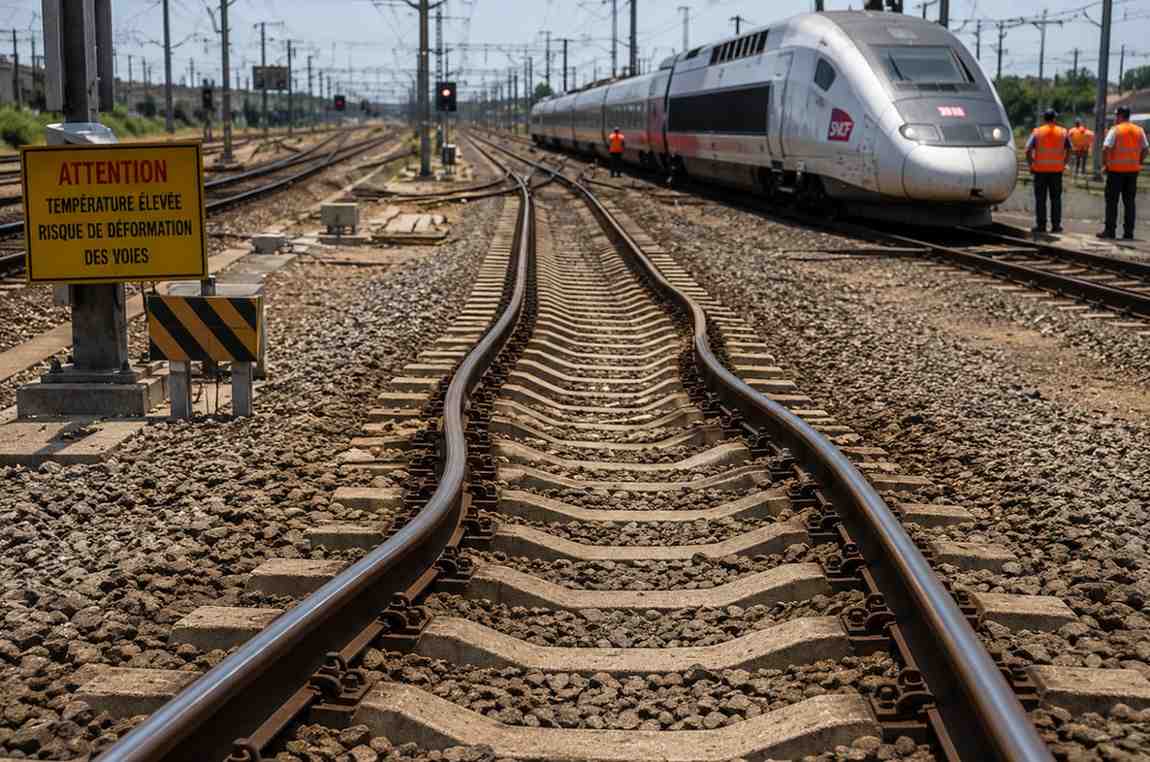
The human toll is compounded by a cascade of infrastructure failures that reads like a stress test of a system built for a different climate. In France and the UK, rail lines buckled under thermal expansion, forcing speed restrictions and cancellations; in Germany and Belgium, tram tracks softened into the asphalt and networks suspended service; Deutsche Bahn advised against non-essential travel altogether. France's heavily nuclear grid had to throttle reactor output because river water used for cooling had itself become too warm to be safely discharged, contributing to power outages that left roughly 68,000 households without electricity precisely as demand for air conditioning spiked. Electricity prices in Belgium briefly exceeded €1 per kilowatt-hour at peak demand. Roads and traffic infrastructure literally deformed in several countries. Soil moisture fell to record seasonal lows, sharpening drought and wildfire risk; Portugal requested EU, Spanish and Moroccan support for extra firefighting aircraft as temperatures topped 40°C.
The public-health burden goes well beyond heatstroke. Heat is a "silent killer" precisely because it rarely appears on a death certificate — instead it forces the cardiovascular system to work harder to push blood to the skin, straining hearts already weakened by age or illness; it accelerates dehydration and kidney strain; and it degrades cognition, contributing to a spike in drownings as people sought relief in unsupervised rivers, lakes and canals. France alone recorded more than 70 drowning deaths since mid-June, including a professional footballer, Kenzo Kies, who drowned in the Rhône; Poland recorded 17 drownings in a single day. Emergency call volumes in France rose by as much as 61 percent week-on-week. Hospitals in the UK, including East Surrey Hospital, declared critical incidents and restricted services to life-threatening cases only.
Layered atop the acute crisis is a slower-burning one: the geographic redrawing of disease. The European Centre for Disease Prevention and Control has documented that Europe's climate suitability for dengue transmission has risen by nearly 300 percent over the past decade against the 1981–2010 baseline, and warns that longer, more intense mosquito-borne disease seasons — West Nile virus, chikungunya, dengue — are becoming the region's "new normal." Warmer coastal and river waters have raised the risk of Vibrio bacterial infections. Pollen seasons have lengthened by one to two weeks, aggravating respiratory conditions, while stagnant, heat-trapped air has driven ground-level ozone and smog warnings in places like the Czech Republic. Heat, in short, is not one health emergency but an amplifier of many.
The Public Mind: When Summer Becomes a Season of Hazard
Perhaps the most striking dimension of Euro Summer 2026 is psychological. For populations across Britain, France, Germany, the Low Countries and Scandinavia who have long regarded extreme heat as a tropical or Mediterranean problem, this summer has delivered a jarring reversal. Nights that will not cool — Vienna's minimum overnight temperature failed to drop below 27.3°C, and one German weather station recorded a night-time low of 29.4°C — have left millions unable to sleep properly for weeks, contributing to chronic exhaustion, irritability and worsening mental health. The London Underground recorded carriage and platform temperatures above 34°C, turning routine commutes into ordeals. Retailers across Britain, France and Germany report fans and portable air-conditioning units selling out within hours, with Asian appliance manufacturers reporting a European sales boom for products that were, until recently, considered unnecessary luxuries in temperate markets.
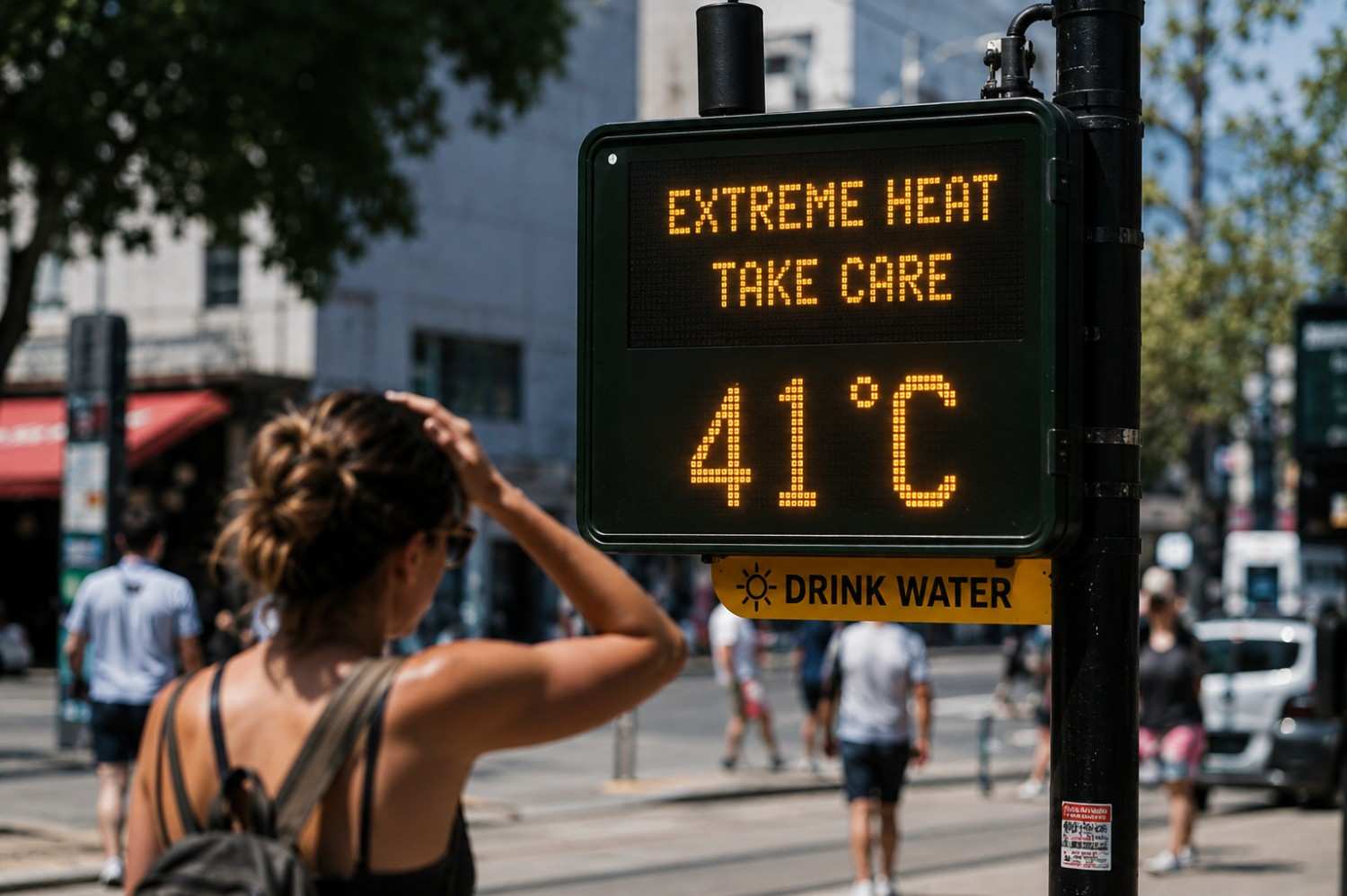
This is where climate change has stopped being an abstraction debated in policy documents and become a lived, domestic experience — playing out in bedrooms, school corridors, supermarket queues and family group chats about whether to check on an elderly parent living alone. Public discourse increasingly frames this summer as a "dress rehearsal" for worse to come, a phrase the WHO itself has used. That anxiety is compounded by a visible unfairness: the burden of heat falls hardest on those least able to escape it. Roughly 60 percent of hospital admissions during the crisis involved people aged 75 and older. Outdoor labourers, migrants, the homeless, low-income tenants in poorly insulated top-floor flats, and people living alone bear disproportionate risk — a pattern that has sharpened public debate over whether cooling is becoming a luxury good rather than a basic protection.
Governments Scramble: The Emergency Response So Far
Faced with a crisis moving faster than policy cycles, European governments have leaned on — and in places gone well beyond — the heat-action frameworks built after 2003. France placed a record 58 departments under red alert, closed 845 schools outright and adjusted schedules at 13,500 more, restricted public alcohol sales in high-risk areas, opened rivers and canals for supervised public swimming, and installed more than 1,300 free public water fountains alongside a bottle-refill scheme spanning 1,500 shops. Prime Minister Sébastien Lecornu convened a special cabinet meeting to draw lessons even as the crisis continued, and the government has committed more than €130 million to cooling systems and renovation in schools and nurseries, according to utility EDF and lending partners. Interior Minister Laurent Nunez pushed back on opposition criticism, insisting "this is not a fiasco — we were prepared."
Italy restricted outdoor construction and agricultural labour during peak afternoon hours, pairing the bans with furlough schemes so workers did not lose income. Barcelona expanded its celebrated climate-shelter network — libraries, civic centres, pharmacies and parks doubling as refuges — to more than 500 sites, building on a model launched in 2020. Belgium cancelled its annual Battle of Waterloo re-enactment on safety grounds and its rail operator cut roughly a hundred trains daily. Portugal activated the EU Civil Protection Mechanism and sought additional firefighting aircraft as wildfire risk soared. At the European level, the Commission — through figures such as executive vice-president Teresa Ribera — has framed the crisis as a decisive rebuttal to climate-policy complacency, while acknowledging that adaptation spending has lagged badly behind mitigation: Reuters reported that between 2021 and 2025, 72 percent of EU climate-related spending went to mitigation, only 18 percent to adaptation, and 9 percent to both.
The WHO, for its part, launched a "KeepCool" public campaign built around four simple pillars — keep out of the heat, keep your home cool, keep your body cool and hydrated, and keep in touch with vulnerable people around you — and has repeatedly urged every European country to adopt a comprehensive heat-health action plan, noting that more than half still lack one.
Beyond This Season: What Must Change
The consensus among health agencies, meteorologists and urban planners is unambiguous: emergency triage cannot remain the primary strategy. Several priorities stand out for the next few years.
Universal, coordinated early warning. Sophisticated monitoring exists through Copernicus and the European Centre for Medium-Range Weather Forecasts, but triggering thresholds and alert protocols still vary by country, producing uneven protection. A harmonised EU-wide framework, with automatic cross-border activation of civil protection resources, would close dangerous gaps.
Heat-proofing the built environment. Passive cooling — external shutters, awnings, reflective "cool roofs," cross-ventilation, better insulation calibrated for summer as well as winter — must become standard in building codes, not an optional retrofit. Cities including Paris, Barcelona, Vienna and Amsterdam are already expanding tree canopy, converting public buildings into cooling shelters, narrowing car-dominated streets, and replacing asphalt with permeable, reflective surfaces to fight the urban heat-island effect, in which dense concrete and glass store daytime heat and release it at night, denying residents recovery. That work needs to move from pilot projects to policy default, with low-income neighbourhoods — which typically have less tree cover and older housing — prioritised first.
Resilient healthcare and labour protections. Hospitals need independent, blackout-resistant cooling systems and staff trained to recognise both classic heatstroke and the newly arriving vector-borne diseases that were absent from European medical curricula a generation ago. Italy's model of restricting outdoor work during dangerous hours while protecting workers' incomes deserves wider adoption, alongside binding heat-exposure limits, mandatory rest breaks and shaded work zones for construction, delivery and agricultural workers.
Smarter, cleaner cooling. Demand for air conditioning will keep rising, and that is not inherently a problem — but unmanaged, fossil-fuel-backed cooling would deepen the crisis it is meant to solve, straining grids and raising emissions. The better path runs through efficient heat pumps, strict appliance standards, solar-powered cooling (which conveniently peaks alongside the sunniest, hottest days), demand-response electricity pricing, and district cooling systems in dense cities.
The Long Run: Combating Heatwaves as a Permanent Feature of European Life
Beyond seasonal fixes, experts converge on a layered, long-run strategy resting on two pillars that must advance together rather than in sequence.
The first is mitigation — the still-unfinished work of rapid decarbonisation. Every fraction of a degree of additional global warming worsens the frequency, duration and intensity of these extremes; the WWA's attribution science leaves little room for doubt that fossil fuel emissions are the primary driver. The EU's own 2030 target of drawing 42.5 percent of energy consumption from renewables remains, on current trends, roughly half-met, according to Lancet Countdown analysis — underscoring how much acceleration is still required even in a bloc that considers itself a climate leader.
The second is deep, structural adaptation, treated not as an emergency add-on but as permanent public infrastructure. That means heat-resilient power and water systems engineered for 40°C-plus operating conditions; agricultural systems shifting toward heat-resistant crops and adjusted growing calendars as soil moisture hits record lows; nature-based solutions — urban forestry, restored wetlands, green corridors — that cool cities while improving air quality and mental health; and social protection systems explicit about the fact that low-income households already face a measurably higher risk of food insecurity during heatwaves. Disease surveillance, too, must become a permanent adaptation function: expanded entomological monitoring, coastal water testing for Vibrio bacteria, and public health messaging on now-endemic mosquito-borne risks.
None of this is cheap, and none of it is optional. The WHO estimates that adaptation measures already in place — early warning, cooling spaces, outreach to isolated elderly residents — prevented heat deaths in 2023 from being roughly 80 percent higher than they were, with the reduction nearly doubling for people over 80. Prevention, in other words, demonstrably works; the cost of inaction, measured in lives and in economic disruption to transport, agriculture and labour productivity, is demonstrably higher than the cost of building resilience now.
The Message for the Rest of the World
Europe's 2026 summer carries lessons that travel well beyond its borders, and they arrive with unusual authority precisely because they come from a wealthy, well-governed, scientifically sophisticated part of the world that assumed — wrongly — that it had time.
No region is climate-proof. If a continent with Europe's institutional capacity, healthcare infrastructure and monitoring systems can lose thousands of people to heat in a matter of weeks, no temperate or high-income region should assume immunity. For hotter, less-resourced regions of the Global South, already living closer to physiological heat limits with far less adaptive capacity, the implications are correspondingly graver.
Adaptation is no longer optional alongside mitigation — it is now equally urgent. For decades the global climate conversation centred on emissions reduction as the primary lever. Europe's crisis demonstrates that severe climate impacts are not a future risk to be pre-empted but a present reality to be survived, simultaneously. Both must be pursued at full speed, not in sequence.
Heat is deeply, structurally unequal. The people who died this summer were disproportionately elderly, isolated, poor, or working outdoors. Any credible national or global heat strategy has to be built around equity — ensuring cooling, shelter and early warning reach those least able to secure them privately — or it will simply reproduce climate change's existing injustices in sharper form.
Infrastructure built for yesterday's climate fails fast under tomorrow's weather. Rail lines, power grids and buildings engineered for a cooler past are now operating past their thermal design limits across Europe. Rapidly urbanising regions elsewhere have a narrow window to build heat resilience into new infrastructure now, rather than retrofitting under emergency conditions later, at far greater cost.
Early warning only saves lives if it triggers early action. The technical capacity to forecast heat is well advanced globally; the harder task, which Europe is still learning in real time, is converting a forecast into welfare checks, cooling centres, adjusted work hours and public trust — before hospitals fill and death tolls rise, not after.
Europe's 2026 heatwave is not a freak meteorological accident, nor a one-off tragedy to be mourned and then set aside. It is the visible, measurable arrival of a trend that scientists have tracked and forecast for decades, landing precisely where models said it would. The question now facing European governments — and, by extension, every government watching from elsewhere — is whether this becomes the moment resilience is finally built into the everyday fabric of governance, housing, energy and health systems, or whether it is remembered, a few winters from now, as merely an unusually hot summer. The climate system does not offer many more rehearsals.
A Continent at a Crossroads
There is a version of this story Europe has told itself before, after 2003 and again after 2022: that a shocking summer would be followed by a burst of reform, and then, as memory faded and budgets tightened, by a quiet return to business as usual. The evidence so far in 2026 suggests both continuity and change. On one hand, the emergency playbook — red alerts, school closures, cooling centres, welfare checks — is more practised and better resourced than it was even five years ago, and officials are right to point out that without it, the death toll would almost certainly be higher. On the other hand, the same officials now openly concede that the playbook is being outpaced by the speed of warming itself. France's own interior ministry has had to defend its preparedness in public even as it activated red alerts across a record number of departments; that defensiveness is itself a signal that the political conversation has shifted from "was this predictable" to "were we ready," and the honest answer, in most of Europe, is only partially.
What happens next will likely be decided less by any single EU directive than by thousands of local decisions: whether a municipality retrofits a school before or after the next heatwave; whether a housing authority prioritises shading and insulation for its oldest, poorest tenants or waits for market-driven air-conditioning uptake; whether a national labour ministry writes heat-exposure limits into law or leaves them to voluntary guidance. The European Commission's promised climate resilience strategy, expected later this year, will be an important signal of political intent — but the WHO's own data suggests that the interventions that actually save lives are unglamorous and local: a phone call to an elderly neighbour, a shaded bus stop, a cooling centre with its doors actually open during the hottest hours of the day.
For a continent that has spent much of the past two decades debating climate change primarily in the language of targets, treaties and future scenarios, summer 2026 has forced a blunter, more immediate vocabulary: fans, ambulances, buckled rails, and body counts. That shift in language may prove to be the most consequential outcome of this season — not because it resolves the crisis, but because it makes further delay much harder to defend, to voters or to history.
Sources and Attributions
- World Weather Attribution (WWA), "Fossil fuel emissions have rapidly worsened European heatwaves in just a few decades," rapid attribution analysis, June–July 2026
- World Meteorological Organization (WMO), "Record-breaking heat spreads through Europe," WMO News, June 2026
- World Health Organization (WHO) Regional Office for Europe, statements by Director-General Tedros Adhanom Ghebreyesus; "KeepCool" campaign guidance
- Reuters, reporting on excess mortality in France, Belgium and the Netherlands; energy grid and nuclear generation impacts; EU adaptation-vs-mitigation spending data (2026)
- Euronews, "Europe's record-breaking heatwave: what you need to know," June 2026
- France 24, "More than 1,300 excess deaths linked to record-breaking Europe heatwave, WHO says," June 2026
- Al Jazeera, "More than 1,300 deaths in Europe amid heatwave: What can countries do?" June 2026
- The Week, coverage of infrastructure damage and mortality figures, July 2026
- Wikipedia, "2026 European heatwaves," compiled contemporaneous news sourcing (Météo-France, Robert Koch Institute, BBC, The Guardian, NBC News, AP, CNN, France 24)
- European Centre for Disease Prevention and Control (ECDC), guidance on mosquito-borne disease trends, dengue climate suitability, and Vibrio bacterial risk
- The Lancet Countdown, 2026 Europe report on health impacts of climate change and renewable energy targets
- European Commission and EU Mission on Adaptation to Climate Change, urban resilience and climate-shelter reporting
- Additional synthesis drawn from contemporaneous reporting compiled in the "EuroHeat" background briefing, including French, German, Spanish, Belgian and UK national meteorological and health authority data
This report reflects information available as of early July 2026. Excess mortality figures are preliminary in several countries and are expected to be revised as data collection continues.




Add a Comment