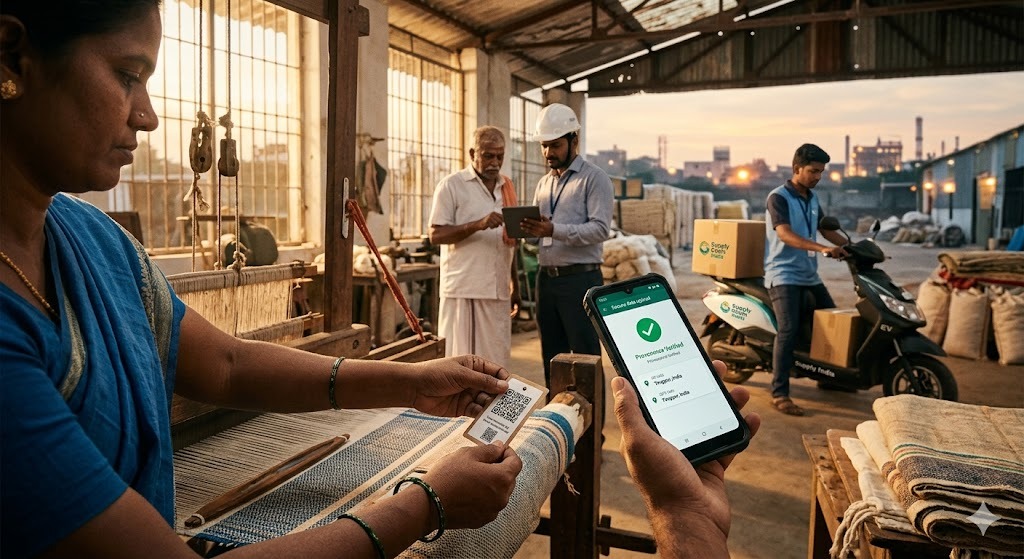
In the bustling industrial corridors, where the rhythmic hum of textile machinery provides a constant soundtrack to daily life, a profound transformation is taking place. It is a shift that is less about the speed of the looms and more about the stories they tell. For decades, the global supply chain was a black box. Raw cotton entered one end, and a finished garment emerged from the other, with very little clarity regarding what happened in between. Today, that opacity is being replaced by a digital pulse of trust, driven by the urgent need for sustainable supply chains that are ethical, transparent, and environmentally responsible.
When we talk about transparency and traceability in a professional context, we often drift toward cold terminology like “decentralized ledgers” or “automated data harvesting.” But in the Indian landscape, these technologies are deeply humanized. They represent the bridge between a small-scale organic farmer in Vidarbha and a conscious consumer in a metropolitan hub like Mumbai or London. To write about this for a professional website, we must explore how India is uniquely positioned to lead the world in tech-enabled, human-centric supply chain integrity.
The Human Necessity of Knowing the Source
In a supply chain, transparency is the "what" and "how," while traceability is the "who" and "where." For a professional organization, these are no longer just "nice-to-have" ESG metrics. they are fundamental requirements for risk mitigation. In India, where supply chains are often fragmented and involve a high degree of informal labor, the challenge of traceability is significant. However, it is precisely this complexity that makes the human story so compelling.
Consider the journey of a single piece of jewellry crafted in Jaipur. Traditionally, the provenance of the gemstones used might be obscured through half a dozen middle brokers. By implementing traceability tools, a professional brand can now verify that the stones were ethically mined and that the artisans were paid a fair, living wage. This isn't just about compliance with international labor laws. it is about honoring the craftsmanship and the human rights of the individuals at the very start of the value chain.
Blockchain as a Tool for Empowerment
One of the most potent tools in the professional arsenal for supply chain integrity is blockchain. While the hype around cryptocurrency has fluctuated, the underlying utility of a tamper-proof, transparent ledger remains a game-changer for Indian procurement.
Empowering the First Mile
In many Indian sectors, the "first mile", the point where raw materials are produced, is the most vulnerable. Blockchain allows for the creation of a digital identity for smallholder farmers or local weavers. Every time a bag of cotton or a bundle of silk changes hands, the transaction is recorded.
This creates a "digital footprint" that serves two purposes. First, it provides the brand with an ironclad audit trail to prove environmental claims, such as organic certification or pesticide-free farming. Second, and perhaps more importantly, it provides the producer with a formal record of their output. For a farmer in rural India, this digital history can be life-changing, serving as proof of income that allows them to access formal banking services and credit for the first time. The technology acts as a silent advocate for the marginalized, bringing them into the formal economy with dignity.
Eliminating the Information Gap
For professionals in logistics and operations, blockchain solves the "information asymmetry" that often leads to inefficiency and waste. In the Indian food supply chain, where cold chain infrastructure is still maturing, real-time traceability can track the temperature and handling of perishable goods from a farm in Himachal Pradesh to a retail shelf in Delhi. By reducing spoilage through better visibility, we aren't just saving money. we are ensuring that the hard work of the farmer isn't wasted and that the environmental resources used to grow that food weren't expended in vain.
AI and the Prediction of Ethical Risk
While blockchain records the past, Artificial Intelligence (AI) is being used by Indian tech firms to predict the future of supply chain ethics. This is where the professional narrative moves from "reporting" to "proactive management."
Mapping the Unseen Tier
Most large corporations have a decent handle on their Tier 1 suppliers—the factories they deal with directly. However, the ethical risks often hide in Tier 2 or Tier 3, the subcontractors and raw material processors. In the Indian context, AI tools are now being used to analyze vast amounts of disparate data, from satellite imagery of mining sites to local news reports and social media sentiment.
If an AI algorithm detects a sudden spike in production at a Tier 1 factory that doesn't align with their known capacity, it can flag a "subcontracting risk." This allows procurement professionals to investigate whether work is being offloaded to unauthorized workshops where labor standards might be lower. This "human-in-the-loop" AI approach doesn't replace human auditors. it gives them a high-powered lens to focus their efforts where they are needed most.
Climate Resilience for the Supply Chain
AI is also being used to humanize environmental responsibility. By analyzing weather patterns and soil health data across different Indian regions, companies can help their suppliers adapt to climate change. If a drought is predicted in a specific cotton-growing belt, a brand can work with its suppliers to implement water-saving technologies before a crisis hits. This shifts the relationship from a transactional one to a partnership focused on mutual survival and long-term sustainability.
Digital Product Passports: A New Standard for Indian Exports
As India aims to become a global manufacturing hub, the adoption of Digital Product Passports (DPP) is becoming a strategic necessity. A DPP is essentially a "digital twin" of a physical product that contains all the information about its composition, origin, and recyclability.
The Competitive Edge for Indian Manufacturers
For an Indian manufacturer exporting to Europe or North America, a DPP is a ticket to market entry. It allows a professional buyer to scan a QR code and instantly see the carbon footprint of the item, the percentage of recycled content, and instructions for how to disassemble the product at the end of its life.
This level of transparency forces a "design-led" approach to the supply chain. Engineers in Pune or Chennai are no longer just designing for function. they are designing for circularity. The human element here is the pride in creating products that are built to last and designed to be reborn. It aligns the technical prowess of Indian industry with the global demand for a "cradle-to-cradle" economy.
The Role of Logistics: Greening the Last Mile
In the dense urban environments of Mumbai or Kolkata, the "last mile" of the supply chain is where the environmental impact is most visible. The professional shift toward electric vehicles (EVs) for delivery is a crucial part of the sustainable supply chain story, but it also has a profound human impact.
Improving Urban Liveability
When a major Indian e-commerce player switches its delivery fleet to electric scooters and vans, the immediate benefit is a reduction in Scope 3 emissions. However, the human benefit is the reduction in noise and air pollution in residential neighborhoods. The delivery partners themselves—often young men and women navigating stressful traffic—benefit from vehicles that are easier to maintain and cheaper to operate.
The professional narrative here should focus on "co-benefits." A sustainable supply chain doesn't just improve the company's ESG score. it improves the quality of life for the communities in which it operates. It turns a logistical necessity into a social good.
Overcoming the Human Resistance to Transparency
Despite the benefits, the journey toward total transparency in Indian supply chains is not without friction. There is an inherent fear among many smaller suppliers that "transparency" is just a fancy word for "more surveillance" or "lower margins."
Building a Culture of Collaboration
To successfully implement these technologies, professional leaders must foster a culture of trust. Transparency cannot be a top-down mandate. it must be a collaborative effort. This involves:
Incentivizing Data Sharing: Suppliers should be rewarded for transparency. This could mean better payment terms, longer-term contracts, or access to low-interest "green loans" for those who provide accurate sustainability data.
Simplifying the Tech Interface: For a warehouse manager in a Tier 2 city, a traceability tool needs to be as intuitive as a messaging app. The human-centered design of supply chain software is critical for widespread adoption.
Education and Training: We must move away from the "policing" model of auditing. Instead, professional organizations should invest in training their suppliers on *why* this data matters and how it can help them grow their own businesses.
The Ethical Imperative: Beyond the Bottom Line
At the end of the day, a sustainable supply chain is an ethical choice. It is an acknowledgment that every dollar spent by a corporation has a ripple effect through society. In India, where the gap between the corporate boardroom and the village farm can feel immense, traceability is the thread that sews these worlds together.
When a professional website discusses these topics, it must remind the reader that behind every data point on a blockchain ledger is a human being. There is a weaver who spent weeks on a handloom, a truck driver who spent nights on the highway, and a factory worker who takes pride in the quality of their output.
The Power of Radical Honesty
The final frontier of the sustainable supply chain is "radical honesty." This means being transparent not just about the successes, but also about the challenges. If a company discovers a breach of its ethical code deep in its Indian supply chain, the professional response is not to hide it, but to acknowledge it, investigate the root cause, and work with the supplier to fix it.
This humanized approach to "corrective action" builds much more long-term brand equity than a polished, but hollow, sustainability report. It shows that the company is committed to the *process* of improvement, recognizing that the journey toward a truly sustainable future is a marathon, not a sprint.
A Vision for India’s Leadership
India has a historic opportunity to define what a sustainable supply chain looks like for the 21st century. We have the technical talent to build world-class traceability platforms, the industrial scale to make a global impact, and a cultural heritage that traditionally valued resourcefulness and community.
As professionals, our task is to integrate these elements into a cohesive strategy. We must build supply chains that are not just efficient, but also kind. We must create systems where transparency is used to empower, not to exploit. And we must ensure that as our goods move across the globe, they carry with them the values of integrity, respect, and environmental stewardship.
The digital pulse of trust is beating louder every day. From the digital payment received by a farmer to the QR code scanned by a shopper, the story of the Indian supply chain is being rewritten. It is a story of a country that is no longer content to be a "low-cost" provider, but is instead striving to be a "high-trust" partner in the global quest for a sustainable future.
Call to Action for the Professional Reader
The transition to a transparent and sustainable supply chain is no longer a futuristic concept. it is a present-day mandate. To begin this journey, professional organizations in India should:
1.Map the Human Landscape: Go beyond the Tier 1 suppliers. Use technology to understand who is really making your products and under what conditions.
2. Invest in Partnerships: View your suppliers as partners in sustainability. Provide them with the tools and the training they need to join you on this journey.
3. Celebrate the Stories: Use your platform to highlight the human stories of your supply chain. Let your customers see the faces and hear the voices of the people who bring your brand to life.
4. Embrace Technology with a Purpose: Don't just adopt blockchain or AI because it is trendy. Use it to solve specific human and environmental challenges within your value chain.
By humanizing the tech and professionalizing the ethics, we can create a supply chain that truly serves the people and the planet. This is the new standard of excellence for Indian business, and it is a journey that starts with a single, transparent step.




Add a Comment