Total Articles 193+

All Posts

Explore the latest sustainability news, innovations, insights, and industry stories from around the world.

Showing 12/193

08 Sep 2026

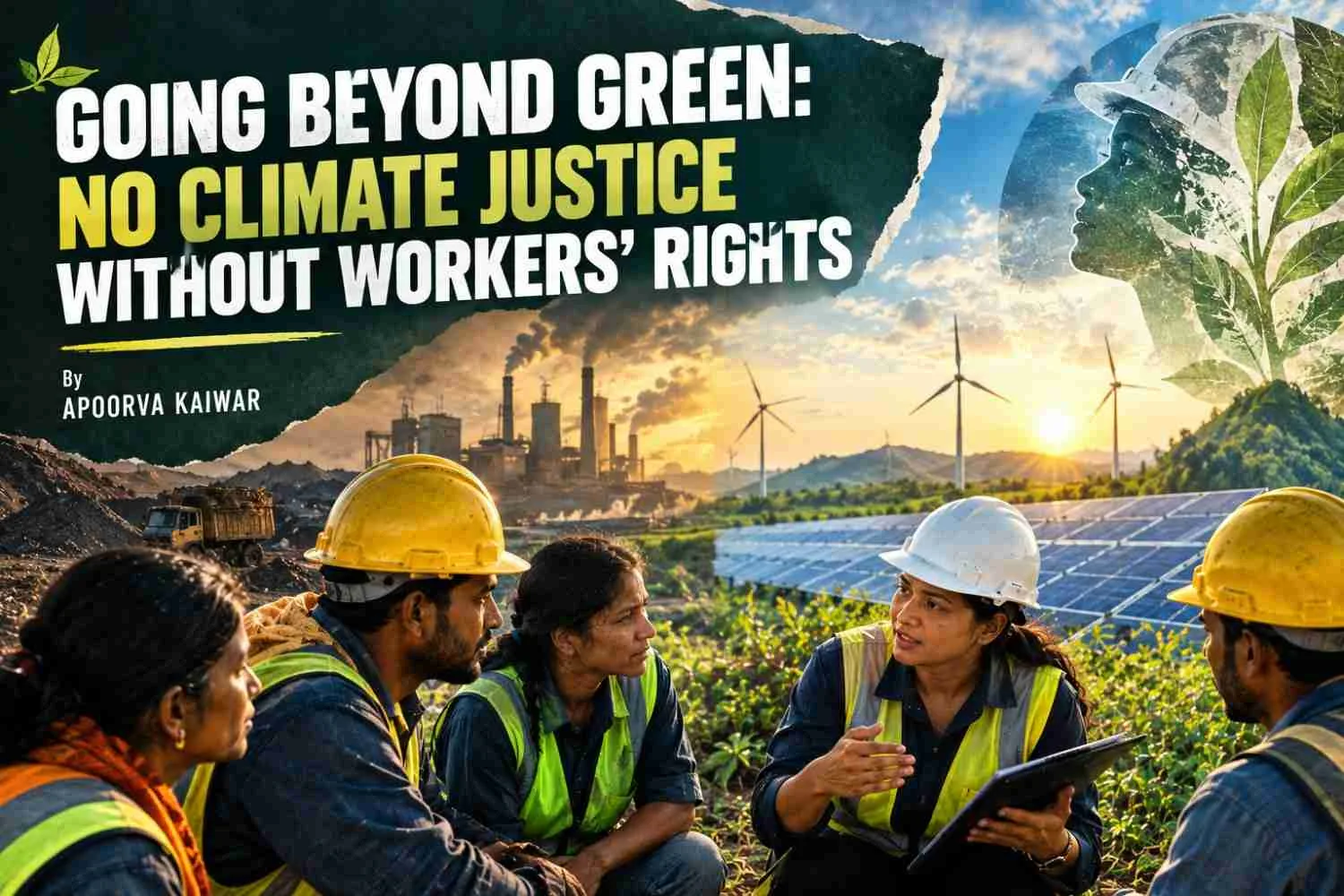
Climate justice cannot be separated from workers’ rights. As decarbonisation, climate change and digitalisation reshape jobs and industries, a truly sustainable transition must protect livelihoods, strengthen social dialogue and ensure decent, inclusive work. SummaryThe climate crisis is already reshaping workplaces through extreme heat, disasters, job losses and disruptions across industries, particularly in the Global South. At the same time, the shift away from fossil fuels, alongside digitalisation and automation, is changing both the number and nature of jobs, creating new challenges for workers and trade unions. The article argues that treating environmental goals and workers’ rights as separate issues creates a false conflict between jobs and climate action. A Just Transition must instead place workers and affected communities at the centre through collective bargaining, social dialogue, social protection, reskilling and gender equality. Examples such as heat agreements in Cambodia and worker-focused planning around offshore wind demonstrate how climate action and livelihood protection can work together. Ultimately, integrating labour and environmental governance is essential to ensure that the transition is not merely green, but genuinely just and inclusive. The climate crisis is no longer a distant threat. It is changing the world of work in real time - reshaping economies and workplaces. Heatwaves, floods, storms are disrupting work and industries, while entire communities tied to fossil fuel industries face decline as economies decarbonise. Countries in the global south are more prone to climate change induced disasters¹ and as such industries and workers here are more affected than others. Heavy flooding seriously affected industrial production in many Asian countries including 0Bangladesh, parts of Pakistan and India, Cambodia, Myanmar, Thailand, Vietnam, Sri Lanka and China in 2023-24, particularly in the garment sector². This led to job losses as well as loss of wages for several hundreds of workers, a large number of whom are women. Heat stress is affecting workers at an unprecedented level. A 2024 report of the International Labour Organisation (ILO, 2024)³ estimated that 18,970 deaths and 22.85 million occupational injuries were attributable to excessive heat every year, with about 71% of the global workforce being exposed to excessive heat. Workers working outdoors in agriculture, construction, transport etc., bear the brunt of the heat as do workers in poorly ventilated workplaces such as foundries or even garment factories. Climate change mitigation and adaptation efforts are therefore necessary and the need is immediate, all the more so as the interests of working people are aligned with the success of climate change mitigation strategies. Governments are in the process of implementing policies to reduce greenhouse gas emissions and move away from fossil fuels. However, the movement from fossil fuel to renewable energy has meant loss of jobs, in sectors such as coal and oil and increased informalisation of jobs that used to be permanent jobs. Job losses, especially in unionised sectors have made trade unions wary of climate change mitigation measures. Renewable energy such as solar and wind power energy, is gaining traction, even as coal is continued to be used. China, USA and India are among the top ten solar and wind energy producing countries. They are also among the top ten coal producing countries with China and India leading. Which means that the top coal producing countries are building the resources to produce more renewable energy. But, the number of jobs in these sectors is estimated to be far less than in the traditional energy sectors such as coal and oil. Most of the jobs are precarious, and are still non-unionised. For workers and unions, decarbonisation of the economy is an additional challenge as it has affected employment both in numbers and in nature. The logical sequitur is that workers’ rights should be considered central to climate change governance – both adaptation and mitigation strategies, as workers’ jobs are being lost and as workers’ face extreme heat stress and other effects of climate change. However, this is not always the case. Compartmentalization of workers’ rights and climate justice Climate change is treated primarily as an environmental challenge, even though workers and people in general are affected by it. Climate governance frameworks, whether policy, law, or corporate guidelines, treat environmental goals as completely separate from workers’ rights. The recent advisory opinion of the International Court of Justice (ICJ) is a case in point. The ICJ issued a unanimous Advisory Opinion⁴ affirming governments’ binding obligations under international law to combat climate change through measures that limit greenhouse gas emissions and foster international cooperation, to achieve the objectives of their nationally determined contributions. Although the Court recognised the binding nature of the Paris Agreement⁵ alongside the International Covenant on Economic, Social and Cultural Rights and the International Covenant on Civil and Political Rights, it notably omitted explicit reference to workers’ rights. The omission is significant because the Paris Agreement in its Preamble itself affirms “the imperative of a just transition of the workforce and the creation of decent work and quality jobs”⁶. The ICJ’s opinion in omitting workers’ rights follows a trend in climate governance - compartmentalisation between labour rights and climate change mitigation and adaptation measures. Government policies as well as guidelines of Intergovernmental organisations such as Organisation for Economic Cooperation and Development (OECD) follow the same trend. The Paris Agreement follows the International Labour Organisation (ILO) Guidelines⁷ for a ‘just transition towards environmentally sustainable economies and societies for all’ which identified the importance of social dialogue, social protection, fundamental principles of rights at work and gender specific policies for achieving just transition. Just transition is broadly understood to mean promoting environmentally sustainable economies in a way that is fair and inclusive to everyone concerned – workers, enterprises and communities – by creating decent work opportunities and leaving no one behind. However, government policy frameworks for climate change mitigation which are formulated as a consequence of governments’ obligations under the Paris Agreement are drawn up with little or no inputs from trade unions. In Chile, which has taken its climate change mitigation obligations seriously, it needed a Supreme Court judgement to ensure consultation with affected workers in the closure of a coal powered thermo electric power plant. In the case of Company Workers Union of Maritima Commercial Somarco Ltd. and others vs. Ministry of Energy⁸, the obligation of governments to ensure just transition was recognised by the Supreme Court. It was held that agreements adopted by the State of Chile to achieve carbon neutrality require a just transition strategy both for the workers harmed by the loss of their direct and indirect source of employment and for the communities affected by the loss of services linked to the development of the declining thermoelectric activity. The ruling ordered the government authorities to implement a plan for the workers affected by the decarbonization process, consulting them in that process. The 2023 update of the OECD Guidelines for Multinational Enterprises on Responsible Business Conduct⁹ includes ‘recommendations for enterprises to align with internationally agreed goals on climate change and biodiversity’ and ‘recommendations on how enterprises are expected to conduct due diligence on impacts and business relationships related to the use of their products and services’. The recommendations on climate change do not specifically mention workers’ rights except in the context of training in environment, health and safety, and hazardous waste. This compartmentalisation is also seen in policy frameworks on human rights due diligence¹⁰, where climate change mitigation and adaptation has assumed greater importance. Most of these laws and guidelines have clauses on workers’ rights and environment/ climate issues, which remain isolated from each other. Labour rights and environmental standards are treated as being in separate silos. 1. Asia and the small island nations in the Pacific are affected more than Europe/ N America. See https://wmo.int/news/media-centre/climate-change-and-extreme-weather-impacts-hit-asia-hard .Since Asia is the hub of garment production, this industry was affected disproportionately in 2023-24. 2. ILO, The Heat is On: How heat stress impacts the apparel industry, jobs, and worker health, Geneva: International Labour Office, 2025. 3. Flouris, A., Azzi, M., Graczyk, H., Nafradi, B., and Scott, N., eds. 2024. Heat at Work: Implications for Safety and Health. A Global Review of the Science, Policy and Practice. International Labour Office, Geneva, 2024. 4. Obligations of States in respect of Climate Change (Advisory Opinion) [2025] ICJ Rep. 5. The Paris Agreement is a legally binding international treaty on climate change. It was adopted at the UN Climate Change Conference (COP21) in Paris, France, on 12 December 2015 and entered into force on 4 November 2016. Its overarching goal is to hold the increase in the global average temperature to well below 2°C above pre-industrial levels and pursue efforts “to limit the temperature increase to 1.5°C above pre-industrial levels. See more here - https://unfccc.int/sites/default/files/english_paris_agreement.pdf 6. Ibid. 7. International Labour Organization, Guidelines for a Just Transition towards Environmentally Sustainable Economies and Societies for All (ILO 2015). 8. https://climatecasechart.com/non-us-case/company-workers-union-of-maritima-commercial-somarco-limited-and-others-with-ministry-of-energy 9. Organisation for Economic Co-operation and Development, OECD Guidelines for Multinational Enterprises on Responsible Business Conduct (OECD 2023). 10. There is an increasing number of human rights due diligence (HRDD) law and policy frameworks such as the OECD Guidelines for Multinational Enterprises on Responsible Business Conduct, the European Union’s Corporate Sustainability Due Diligence Directive, the German and French laws on corporate due diligence which are meant to deal with responsibilities of multinational corporations in their supply chains across the world. Decarbonisation and digitalisation: a double disruption This compartmentalisation risks creating a narrative that there is an apparent contradiction between measures to mitigate climate change and the rights of workers; that advancing climate justice would necessitate sacrificing secure employment or organised labour power. This is a wrong narrative. There is only one planet on which both jobs and the environment exist, and because there’s no economy, and no work, on a dead planet. The climate crisis has coincided with major advances in technology, and the world of work is facing challenges brought forth by decarbonisation and digitalisation. Workplaces are changing with the introduction of newer technologies both because of advances in technology and by the need to decarbonise the economy. The changes are far more rapid than we have seen in the past, and the effect is felt in several sectors. Technology change is not new. Technology has always changed the way industries function and therefore the way that workers have worked. The first three industrial revolutions changed manufacturing processes. The first industrial revolution transformed work with the advent of mechanization and steam power. This was also the era of child labour, forced labour and unsafe workplaces, and no workers’ rights. The second industrial revolution with greater use of electricity and mass production saw the beginnings of organized labour and trade unions across the world with workers’ rights being recognized, if not implemented everywhere. Labour laws which recognized workers’ rights, provided at least a way for trade unions to collectively bargain. The third industrial revolution with increased automation and the use of robots that changed the factory floor in a very visible manner. This phase also saw the beginnings of supply chains and weakening of workers’ rights. Trade unions were actively opposing the introduction of computers, but without much success. With the change in technology, the nature as well as number of jobs changed. In Industry 4.0 or the fourth industrial revolution which involves digitization and the deployment of cyber physical systems, the transition is in conjunction with greater automation. More sophisticated robots that require little to no human interaction are already in use in automotive factories. The automotive sector exemplifies this double disruption. The transition from internal combustion engines to electric vehicles is decarbonisation-driven. But it also coincides with automation, robotics, and digitalisation. Workers are losing jobs, the remaining jobs are changing¹¹ and companies want to rescind from their collective bargaining agreements, as in the case of Volkswagen in Europe.¹² Trade unions in Bosch in India report that new ‘high-tech’ units are being set up without consulting existing unions, employing qualified engineers and changing the nature of the job from blue collar to white collar¹³. Just Transition The Just Transition Guidelines of the ILO have as far back as 2015 articulated that sustainability and justice can and should go together. ILO’s Just Transition Guidelines identified the importance of social dialogue, social protection, fundamental principles of rights at work and gender specific policies for achieving just transition. An understanding of Just Transition and its principles is thus key to understanding that the binary of jobs versus environment is a false one. An effective implementation of the fundamental principles of rights at work particularly, freedom of association and the right to collective bargaining will ensure the full participation of workers and their unions, taking into account their priorities. This would require employers/ companies to discuss with unions what changes are coming and how it would affect the workforce. It may mean that workers’ would need to be reskilled (to do a different job) or upskilled (e.g., acquiring new skills) as needed. Unions should be able to negotiate and collectively bargain work re-organisation. This underlines the importance of both collective bargaining and social dialogue, with a focus on unions being provided information by employers and governments about the impending and planned changes of work and work organisation in the workplace. The role of governments in ensuring that the ILO’s fundamental principles of rights at work¹⁴ becomes crucial. 11. The future of work in the automotive industry, Technical meeting on the future of work in the automotive industry (Geneva, 15–19 February 2021), Note on the proceedings, International Labour Office, Sectoral Policies Department, Geneva, ILO, 2021. 12. https://www.bbc.com/news/articles/cje9kv3q94po - Previously agreed wage increases were cancelled. An agreement between the company and the union was made for ‘cutting’ 35000 jobs by 2030. 13. Discussions with Bosch India unions in Pune and Bangalore (October – November 2022). 14. The ILO’s fundamental principles of rights at work do not require ratification of specific conventions. All countries are bound by the fundamental principles by virtue of their membership in the ILO. Making transitions ‘Just’ Trade unions are learning to deal with these challenges and are putting forward demands in order to protect workers from effects of climate change as well as digitalization. We are beginning to see examples of unions negotiating effects of climate change. The ‘Heat Agreements’ in garment factories in Cambodia¹⁵ is one such example. According to these agreements, which have been negotiated between unions and employers, if the temperature inside the factory rises above 35 C, cooling systems need to be turned on, and workers can take 5-10 minutes break. This is a very concrete example of collective bargaining being used to adapt to climate change. Another inspiring example is the successful campaign in Maine, USA where an offshore wind energy farm was built further away from the shore so that the livelihoods of the local fishing community could be protected¹⁶. This is a situation which could easily have been posited as workers vs. environmental groups vs. local communities. However, the importance of climate mitigation as well as the need to protect livelihoods were both prioritized and the wind farm was commissioned further away from the shore, while including collectively bargained wages for the workers employed on the wind farm. The importance of collective bargaining in protecting workers from the effects of climate change as well as the adaptation/ mitigation measures that governments are undertaking cannot be overstated. However, these examples are too few, with concrete clauses protecting workers’ rights, not very prevalent. The recent ILO Working paper on the role of collective bargaining on promoting just transitions¹⁷ (Schmidt and Braga, 2025) analyses 512 collective bargaining agreements (CBAs) to understand the presence and scope of clauses on Just Transition. While 58 of the agreements had clauses on just transition, most of them were declarative clauses and only 12 were more of a transformative nature. Topics in the agreements included hybrid work (aimed at reducing carbon footprint), working time organisation for extreme heat and upskilling of workers and managers. In addition, the Working Paper looked at six case studies in detail, outside of the 512 CBAs, and identified that the key topics were workers’ representation, planning for job changes and skill development, education and environmental management. These issues, particularly workers’ representation, planning for job changes and skill development are very much part of the Just Transition Guidelines. The ILO’s Just Transition guidelines are clear: climate adaptation and mitigation measures must go hand-in-hand with decent work, social dialogue, gender equality, and social protection. Just transition would mean promoting environmentally sustainable economies in a way that is fair and inclusive to everyone concerned – workers, enterprises and communities – by creating decent work opportunities and leaving no one behind. Done right, it’s a roadmap. There needs to be a renewed commitment to the ILO’s Just Transition Principles, particularly from employers and governments. Collective bargaining and social dialogue must be institutionalized with trade unions and affected communities being part of the drafting of climate strategies and plans. A robust social protection policy including health insurance, income support and retraining for workers is needed with the government playing a strong role, making sure that employers contribute their share. Just Transition would also mean that all workers are considered equal, for nothing can be ‘just’ without the element of gender justice. Women workers, who are typically not considered qualified for jobs that involve ‘high technology’ would need to be active participants. This requires a policy framework that includes work in the informal sectors, as well as low-waged manufacturing and services sectors where women are disproportionately concentrated. A Just Transition must dismantle these barriers, ensuring women access training and employment in green and digitalised economies. Without gender equity, no transition can be truly just. In addition, digital – driven technology requires extensive mining of minerals. This too needs to be approached within a framework of Just Transition, embedding workers’ rights and rights of communities into all policy decisions. 15. Heat Agreements in Cambodia: An interview with Somalay So and Joe Buckley, The Global Labour Rights Reporter, Vol. IV, Issue 1, 2025, p. 17-21. 16. Deedee Fitzpatrick and Hannah Sachs, “Labour leading on climate: advancing high-quality unions jobs in the emerging U.S. clean energy sector” in A Just Transition Law for Climate Justice, The Global Labour Rights Reporter, Vol. IV, Issue 1, 2025, pp 58-66. 17. Schmidt, V., Braga, C. The role of collective bargaining in promoting just transitions. ILO Working Paper 145. Geneva: International Labour International Labour Office, 2025. Conclusion How technology is applied and who benefits from it will determine whether the changes in the world of work is a Just Transition or only a green transition. The tools for a fairer future already exist in unions and in collective agreements. Integrating environmental and labour governance will materialise the idea that justice and sustainability can, and must, go hand in hand. References Flouris, A., Azzi, M., Graczyk, H., Nafradi, B., and Scott, N., eds. 2024. Heat at Work: Implications for Safety and Health. A Global Review of the Science, Policy and Practice. International Labour Office, Geneva, 2024.ILO, The Heat is On: How heat stress impacts the apparel industry, jobs, and worker health, Geneva: International Labour Office, 2025.Deedee Fitzpatrick and Hannah Sachs, “Labour leading on climate: advancing high-quality unions jobs in the emerging U.S. clean energy sector” in A Just Transition Law for Climate Justice, The Global Labour Rights Reporter, Vol. IV, Issue 1, 2025 available here: The Global Labour Rights Reporter - ILAW Network.Schmidt, V., Braga, C. The role of collective bargaining in promoting just transitions. ILO Working Paper 145. Geneva: ILO Working Paper 145. Geneva: International Labour Office, 2025.  ABOUT AUTHOR   Apoorva Kaiwar is a women’s and workers’ rights activist ...Read more

07 Sep 2026

India’s sugar market is facing a delicate balancing act as rising prices, duty-free imports and the rapid expansion of ethanol production put food security, farmer interests and energy goals in tension. SummaryIndia’s decision to allow duty-free imports of up to 10 lakh tonnes of raw sugar marks a major shift for a country that has traditionally been a large sugar producer and exporter. The move comes as domestic prices rise ahead of the festive season, with tighter stockholding limits also introduced to improve availability and curb hoarding. At the same time, India’s rapid expansion of ethanol blending has increased the use of sugarcane as an energy feedstock, raising questions about how the country can balance fuel production with domestic sugar requirements. The article highlights that ethanol is not solely responsible for rising sugar prices, with weather, rainfall, production, demand and stock levels also playing important roles. Climate vulnerability adds another layer, as sugarcane is water-intensive and increasingly exposed to changing rainfall and water availability. The way forward, the article argues, is not to choose between sugar and ethanol but to build a more flexible, climate-sensitive and diversified policy that can support both affordable food and sustainable fuel. For decades, India has occupied a dominant position in the global sugar economy. As one of the world's largest producers and consumers of sugar, the country has generally focused on managing domestic production, maintaining adequate stocks and, in favourable years, exporting surplus sugar. However, the recent decision of the Government of India to permit duty-free imports of 10 lakh tonnes, or one million tonnes, of raw sugar marks a significant policy development. The decision is particularly important because it represents India's first major move towards sugar imports in nearly a decade. The immediate reason for the intervention is clear: domestic sugar prices have risen sharply at a time when India is approaching the high-demand festive season. The government has therefore adopted a combination of measures, including tighter stockholding restrictions and duty-free imports, to increase availability and reduce speculative pressure in the market. However, the present situation raises a larger and more significant policy question. At a time when India has been rapidly expanding its Ethanol Blending Programme and encouraging the diversion of sugarcane-based feedstocks towards ethanol production, can the country simultaneously ensure sufficient sugar availability for domestic consumers? The decision to import sugar therefore reflects more than a temporary market intervention. It exposes an emerging tension between food availability, price stability, farmer interests and energy security. Why Is India Importing Sugar? The government's decision allows duty-free imports of up to one million tonnes of raw sugar until October 31, 2026. Normally, India imposes a high import duty on sugar, making the present zero-duty quota a significant departure from the usual policy approach. The objective is to improve domestic availability and moderate record-high prices before the period of increased festive consumption. The urgency of the situation is reflected in the other measures introduced by the government. Bulk consumers using more than 10 tonnes of sugar per month have been subjected to stricter inventory limits, with stockholding restricted to approximately 15 days' consumption during the specified period. These restrictions are intended to discourage excessive accumulation and prevent hoarding from aggravating the price rise.  The decision is also economically significant because India has historically been more closely associated with sugar exports than imports. The country's opening sugar stocks have declined considerably, while concerns over weather conditions in major sugarcane-producing regions have increased uncertainty about future production.  Thus, the import decision is essentially an attempt to address a simple but politically sensitive problem: when domestic supply becomes tight and prices rise, the burden is ultimately borne by consumers. The Festive Season and the Politics of Sugar Prices Sugar is not merely another agricultural commodity in India. It is a widely consumed household product and an essential ingredient for a large number of food-processing industries, confectionery businesses, beverage manufacturers and traditional sweet producers. Demand generally rises during the period between August and November because of major festivals and celebrations. This seasonal increase in consumption can intensify the effects of already limited supply. Reuters reported that the government considered several measures, including duty-free imports and tighter stock controls, as prices increased sharply ahead of the festive season.  The government's intervention therefore has an important consumer-protection dimension. Allowing additional sugar into the domestic market may increase supply and reduce the possibility that consumers will face even higher prices during a period of peak demand. At the same time, imports alone cannot solve the structural causes of supply pressure. If domestic production remains vulnerable to changing rainfall patterns, water availability and fluctuations in sugarcane output, India may continue to face periodic tensions between production, consumption and industrial demand. The Ethanol Blending Programme: A Major Policy Success with New Challenges India's Ethanol Blending Programme has been one of the country's major energy-policy initiatives. The programme aims to reduce dependence on imported crude oil, support cleaner fuel alternatives and create additional income opportunities within the agricultural economy. India's ethanol blending journey began with pilot initiatives in 2001 and gradually expanded through policy reforms and investment. The National Policy on Biofuels, introduced in 2018, played an important role in expanding the ecosystem for ethanol production.  The growth in ethanol blending has been particularly rapid in recent years. Government data shows that the blending percentage increased from approximately 8.1% in Ethanol Supply Year 2020–21 to 19.2% in 2024–25, while the programme reached the 20% level during the 2025–26 supply year period reported by the government.  The programme offers several important advantages. It can reduce dependence on imported petroleum, create a stable market for agricultural feedstocks, support rural investment and contribute to lower emissions. The government also argues that ethanol provides greater energy security by reducing India's exposure to fluctuations in international crude oil markets.  The Sugar-versus-Ethanol Dilemma The recent rise in sugar prices has brought this question into sharper focus. India was considering restricting the use of sugarcane for ethanol production in the upcoming season in order to increase sugar output and address concerns about tight domestic availability. This indicates that policymakers themselves recognise the possibility of a trade-off between the use of sugarcane resources for fuel production and the need to maintain sufficient sugar supplies.  This does not mean that ethanol production alone is responsible for the current increase in sugar prices. Such a conclusion would be overly simplistic. Weather conditions, rainfall shortages, expected production levels, domestic demand, market expectations and stock management can all influence sugar prices. Nevertheless, the situation demonstrates the difficulty of pursuing multiple policy objectives using the same agricultural resource. The Economic Impact of the Import Decision The immediate economic objective of the duty-free import decision is price stabilisation. Additional supplies can reduce scarcity and weaken speculative pressure in the domestic market. However, imports may also have consequences for domestic sugar mills and farmers. If imported sugar enters the market at a time when domestic producers are selling their stocks, lower prices could affect industry revenues. The government must therefore carefully manage the timing and quantity of imports. The current import quota of one million tonnes appears to represent an attempt to strike a balance rather than permanently open the domestic market to unrestricted imports. The policy is time-bound, with imports permitted until October 31, 2026.  The decision may also influence international sugar markets. Because of India's size and importance in the global sugar economy, a significant change in its import or export policy can affect global prices and trading expectations.  Climate Change and the Future of Sugarcane Production The current situation also highlights a broader concern: climate vulnerability. Sugarcane is a water-intensive crop, and production can be affected by changing rainfall patterns and water availability. Concerns regarding reduced rainfall in important sugar-producing regions have already contributed to uncertainty about future production.  In the future, India may face more frequent situations in which agricultural production is affected by climate variability. This creates a strong argument for diversifying ethanol feedstocks. Rather than depending excessively on sugarcane-based sources, India can continue expanding the use of alternative feedstocks such as maize, agricultural residues and other approved sources. The government's ethanol policy has already moved towards a broader feedstock ecosystem, reducing the need for ethanol expansion to depend entirely on sugarcane. A diversified ethanol strategy could help reduce the direct pressure on the sugar sector during years of lower production. Way Ahead India's decision to permit duty-free imports of 10 lakh tonnes of raw sugar is more than an emergency response to rising prices. It represents a significant moment in the evolution of India's agricultural, trade and energy policies. The immediate priority is understandably to increase supply and provide relief to consumers during a period of high demand. Tighter stockholding limits and temporary imports may help achieve this objective.  India's Ethanol Blending Programme remains an important achievement in the country's transition towards greater energy security. However, the recent sugar shortage demonstrates that ambitious fuel policies must remain responsive to agricultural production and consumer needs. The real challenge for India is therefore not to choose between sugar and ethanol. It is to create a policy framework capable of ensuring both affordable food and sustainable fuel. The recent import decision should thus be seen not as a policy failure, but as a warning that the next phase of India's sugar and ethanol strategy must be more flexible, climate-sensitive, data-driven and balanced. ABOUT AUTHOR Dr.S.Krishnan is an Academician and an Experienced Journalist in Jaipur.  Mr. Shasheesh Kumar Singh is a Phd Scholar, DAVV, Indore ...Read more

05 Sep 2026

Kolkata | 7 September, 2026 Satellites may be transforming life on Earth, but their afterlife is creating a problem above it. From Cosmoserve’s robotic debris-capture technology to SpaceX’s controlled de-orbiting strategy, new approaches are emerging to keep Earth’s orbital environment sustainable. SummarySpace is no longer an empty frontier. ESA's latest figures show that about 40,000 objects are being tracked in Earth’s orbit, including around 11,000 active payloads, while the actual population of smaller debris is far larger.Cosmoserve Space is approaching the problem from the removal side. Its Mission Embrace is testing soft robotic technology that could eventually help capture inactive satellites and other objects already stranded in the orbit. SpaceX, led by Elon Musk, is approaching it differently: Starlink satellites can adjust their orbits to avoid collisions and are designed to be deliberately de-orbited when they reach the end of their operational life. Keywordsspace debris, space junk, Starlink, SpaceX, Cosmoserve Space, active debris removal, orbital debris, space sustainability, satellite sustainability, satellite de-orbiting, orbital sustainability, space debris removal, Mission Embrace, collision avoidance, satellite disposal, sustainable space technology, Earth orbit, orbital environment, space environment, responsible satellite design The two approaches point to the same larger question: Can humanity keep using space without turning its most valuable orbital zones into a dumping ground? But why does space need cleaning in the first place?Every satellite sent into orbit serves a purpose, from communication and navigation to weather forecasting, Earth observation and scientific research. As our reliance on space-based infrastructure grows, so does the amount of hardware orbiting Earth. But when satellites stop functioning, they do not simply disappear and nor do the fragments left behind by previous launches, break-ups and collisions simply disappear. ESA’s 2025 Space Environment Report estimated that around 40,000 objects were being tracked in orbit, of which only about 11,000 were active payloads. The agency also warned that the debris population continues to grow rapidly. The growing number of objects in orbit is only part of the challenge. Their extraordinary speeds make collisions far more dangerous. A collision between two spacecraft or between a satellite and a piece of debris can produce additional fragments, creating new risks for other missions. Those fragments can then trigger further collisions, potentially multiplying the problem. That means orbital debris can continue to become a greater threat even without new satellites being launched.  What counts as space debris?Active satellites Inactive satellites  Rocket remnants Smaller fragmentsCollision-risk zoneSo, what is Cosmoserve actually trying to do?This is where Hyderabad-based Cosmoserve Space enters the picture.  The company is developing Active Debris Removal (ADR) technology, which goes beyond tracking orbital debris to physically capturing objects that are no longer useful. Its Mission Embrace focuses on a soft robotic capture mechanism. Rather than relying solely on conventional docking systems, the technology uses a robotic approach to capture objects in orbit. Cosmoserve has said it took the system from concept to flight-ready hardware in about four months.  But there is an important distinction.  Mission Embrace is a technology demonstration, not proof that Cosmoserve is already removing large quantities of debris from orbit. Its significance lies in testing a technology that could eventually support debris-removal and in-orbit servicing missions. That matters because capturing a defunct satellite is far more complicated than simply locating it.  A servicing spacecraft must identify its target, approach it safely and operate around an object that may no longer be able to communicate, control its movement or manoeuvre away from the approaching spacecraft.  Then what is Elon Musk’s SpaceX doing differently?  SpaceX has built one of the world’s largest satellite constellations through Starlink. As of 27 August 2026, 11,102 Starlink satellites had been launched, with 11,087 reported as operational, according to current tracking data. That scale brings a different sustainability challenge: what happens when thousands of satellites reach the end of their useful lives?  SpaceX’s approach is largely focused on prevention, manoeuvrability and controlled disposal. Starlink satellites are designed with propulsion and manoeuvring capabilities that allow them to adjust their orbits, avoid collisions and eventually descend into the atmosphere. SpaceX’s sustainability documentation states that satellites undergoing de-orbiting retain manoeuvrability and collision-avoidance capabilities during their descent. In 2026, SpaceX also began lowering the orbits of about 4,400 Starlink satellites from approximately 550 km to 480 km. The lower altitude is intended to reduce the amount of time satellites remain in orbit after their operational lives and, in turn, limit long-term debris and collision risks. COMPARISON INFOGRAPHIC  CosmoserveSpaceX / StarlinkDeveloping active debris removalFocuses on satellite life-cycle managementBuilds technology to capture objectsSatellites are designed to manoeuvreTargets inactive or stranded objectsControls its own satellitesSoft robotic capture is a key technologyControlled de-orbiting is a key strategyStill at the technology-development stageAlready operating at constellation scale So, can prevention alone solve the space-junk problem?That is where the difference between preventing new debris and removing existing debris becomes important. SpaceX’s approach can help ensure that its own satellites do not remain in orbit indefinitely after their mission end. But controlled de-orbiting addresses future disposal; it does not remove the older, inactive objects and fragments already circling Earth. That is the gap that active debris-removal companies are trying to address. The challenge is also becoming larger as more satellites are launched. Expanding satellite networks can bring greater connectivity, communication and other services, but they also add more traffic to already crowded orbital regions. In other words, keeping new debris from accumulating is only one part of the solution. The harder question is what to do with the debris that is already there. HOW DO WE KEEP SPACE CLEAN? Design better satellites↓Track objects in orbit↓Avoid collisions↓De-orbit satellites responsibly↓Remove dangerous existing debris Is cleaning space really about Cosmoserve versus Musk?Not quite. The bigger story is not a contest between Cosmoserve and SpaceX. It is whether the space industry can develop a system in which prevention and removal work together to keep Earth’s orbit usable. SpaceX demonstrates what large-scale satellite operators can do when collision avoidance, manoeuvrability and end-of-life disposal are built into a constellation from the beginning. Cosmoserve represents a different but increasingly important need: technology that can deal with objects already left inactive in orbit and potentially difficult to control or remove. Neither approach, on its own, solves the entire space-junk problem. As launches accelerate and more companies enter the space economy, orbital sustainability will depend on several layers working together: better satellite design, accurate tracking, collision avoidance, responsible end-of-life disposal and, where necessary, active removal of high-risk debris. That changes the question at the heart of the space race. It is no longer only about who can launch the most satellites, build the biggest constellation or reach orbit the fastest. It is about who takes responsibility for what happens after those satellites stop working. True space sustainability will not be measured by how much we put into orbit, but by how responsibly we manage what remains there.Primary sources: European Space Agency — Space Environment Report 2025 — Supports the orbital-debris figures, including ~40,000 tracked objects and ~11,000 active payloads, and the need for active debris removal.  ESA Space Debris Environment Statistics — Provides updated 2026 statistics on tracked objects, satellites, debris populations and orbital mass. SpaceX / Starlink — Commitment to Space Sustainability — Supports Starlink’s collision-avoidance, controlled de-orbiting and satellite sustainability approach. SpaceX — Approach to Space Sustainability and Safety — Supports information on satellite manoeuvrability, collision avoidance, low-altitude operation, controlled de-orbiting and design-for-demise.   Cosmoserve / Mission Embrace Cosmoserve Space — Official Website — Supports Cosmoserve’s Active Debris Removal technology, orbital-debris removal mission and its “Reviver”/“Mothercraft” concepts. The New Indian Express — Mission Embrace — Supports the Mission Embrace soft-robotic capture demonstration and its development timeline. Business Standard — Cosmoserve Mission Embrace — Provides additional reporting on the soft robotic capture mechanism and its role in Active Debris Removal. ...Read more

07 Sep 2026

India has an opportunity to move beyond attracting climate finance and help shape how Asia finances its climate transition. By combining its economic scale, financial innovation, clean-technology capabilities and regional partnerships, India can turn climate finance into a powerful engine for sustainable growth and resilience.SummaryIndia faces the dual challenge of sustaining economic growth while accelerating decarbonisation and adapting to intensifying climate risks.The article argues that this challenge also creates an opportunity for India to influence how climate finance is mobilised across emerging economies in Asia.India can lead through blended finance, guarantees, green bonds, South-South cooperation, climate-resilient infrastructure and clean-technology investment.However, financing gaps, high costs of capital, weak project bankability and fragmented institutional coordination remain significant barriers.The next step is to convert India’s domestic climate-finance experience into models that can be replicated through regional partnerships, technology sharing and stronger investment mechanisms.Ultimately, India can demonstrate that climate action and economic development are not competing goals, but can be integrated into a regional pathway for investment, innovation, resilience and sustainable growth.KeywordsIndia climate finance, Asia climate finance, climate finance architecture, climate investment India, climate finance leadership, sustainable finance India, green finance, climate investment Asia, blended finance, green bonds India, climate-resilient infrastructure, clean technology investment, South-South cooperation, climate finance mechanisms, renewable energy investment, green infrastructure, sustainable investment, climate resilience, ESG finance, India climate strategy, climate finance Global South, Asian climate transition, climate finance mobilization, sustainable growth, climate investment opportunitiesIndia stands at a critical point in its economic and climate transformation. As one of the world’s largest and fastest-growing major economies, the country must finance infrastructure, energy, industry, cities, and employment while responding to intensifying climate risks. Unlike many advanced economies, India must expand development and accelerate decarbonization at the same time.This creates an opportunity that extends beyond India’s national borders. How India mobilizes climate finance can influence how emerging economies across Asia finance clean energy, resilience, industrial transformation, and sustainable growth. The question is no longer simply how much climate finance India can attract, but whether India can help shape the financial architecture through which Asia’s climate transition will be financed.India therefore has an opportunity to move from being a major destination for climate investment to becoming a force in designing, mobilizing, and scaling climate finance across Asia.From Climate Commitments to Financial PowerThe Paris Agreement provides the global framework for climate action, but commitments alone cannot deliver transformation. Countries need capital to build renewable energy systems, modernize electricity grids, develop clean transportation, decarbonize industries, strengthen agriculture, protect natural resources, and adapt infrastructure to a changing climate.For India, this means translating climate ambition into financial and investment strategies. Climate policy cannot remain the responsibility of environmental institutions alone. It must increasingly be integrated into economic planning, financial regulation, infrastructure investment, industrial strategy, and private-sector decision-making.India’s contribution to global climate action can therefore extend beyond reducing the carbon intensity of its own economy. Its larger contribution could be demonstrating how a major developing economy can mobilize capital while pursuing economic growth, energy security, industrial development, and climate resilience.This is particularly important for the Global South. Many developing countries cannot simply replicate financing models from advanced economies. They need approaches that recognize higher financing costs, limited fiscal space, infrastructure deficits, and competing development priorities.India can help demonstrate that climate finance can become a development engine, rather than an additional constraint on development.Where India Can Lead Asia?India has several potential areas of regional leadership.The first is mobilizing private capital. Asia’s climate investment requirements cannot be met by government budgets or concessional finance alone. Public finance must increasingly reduce risk and unlock much larger pools of private capital.Blended finance, guarantees, green bonds, sustainability-linked instruments, concessional lending, and public-private partnerships can turn climate priorities into investable opportunities. India’s large domestic market provides an environment in which these mechanisms can be developed, tested, and scaled.The second opportunity is South-South cooperation. Asian developing economies often face similar challenges in accessing long-term and affordable capital. India can share experience in project preparation, financial innovation, policy development, institutional capacity, and technology deployment with countries seeking practical pathways for their own transitions.The third is climate-resilient infrastructure. Asia’s climate challenge is not limited to mitigation. Floods, droughts, heatwaves, cyclones, water stress, and other hazards increasingly threaten infrastructure, agriculture, cities, and supply chains. India can help promote financial models that integrate adaptation and resilience into mainstream infrastructure investment.The fourth is clean-technology investment. India’s growing capabilities in renewable energy, electric mobility, green hydrogen, digital technologies, and sustainable infrastructure can support regional technology partnerships and investment flows.India’s leadership opportunity therefore lies not in controlling Asia’s climate-finance system, but in building mechanisms that enable countries to mobilize capital, share technology, and accelerate implementation.India’s Climate Finance Drive: What Is Already Working?India’s climate-finance experience offers important lessons for other emerging economies.One is the integration of climate action with economic development. Renewable energy investment, for example, can simultaneously support emissions reduction, energy security, industrial development, employment, and reduced dependence on imported fuels. Climate investment thus becomes part of economic strategy rather than simply environmental expenditure.Another strength is scale. India’s large domestic market can create demand for clean technologies and provide investors with opportunities to develop projects and business models that can later be replicated elsewhere.India has also developed growing experience with sustainable financial instruments and institutional participation. Green bonds, sustainable finance initiatives, public-private investment structures, and greater involvement of financial institutions can channel capital toward climate-related activities. India is also advancing work on a national climate-finance taxonomy, strengthening the foundations for more consistent sustainable investment.The International Solar Alliance provides another important example. It demonstrates how India can use its domestic experience and diplomatic capacity to create platforms for international cooperation around a shared climate objective.India is also developing catalytic-finance approaches. The India Green Finance Facility, supported by the Asian Development Bank and Green Climate Fund, illustrates how multilateral finance can help mobilize investment for India’s clean-energy transition.These experiences point to a broader lesson: successful climate finance requires more than money. Policies, institutions, investment pipelines, technology, financial markets, and implementation capacity must work together.India’s opportunity is to turn this experience into models that can be adapted across Asia.The Barriers to India’s Climate Finance LeadershipIndia’s opportunity to lead should not be confused with automatic leadership. Several structural challenges must be addressed.The first is the financing gap. India’s climate transition requires investment at a scale that cannot be met by public resources alone. The country must therefore deepen its ability to mobilize institutional investors, commercial banks, corporations, international investors, and development finance.The second is the cost of capital. Climate infrastructure often requires large upfront investment and long repayment periods, while developing economies can face higher financing costs and currency risks. These conditions can reduce the attractiveness of otherwise viable projects.The third is project bankability. The challenge is not always a shortage of capital. It can also be a shortage of well-prepared projects that meet investors’ financial, technical, regulatory, and risk requirements. Stronger project preparation and risk-sharing mechanisms will therefore be essential.Institutional coordination is another challenge. Governments, regulators, banks, investors, corporations, development institutions, and technology providers must work toward coherent transition priorities rather than fragmented programs.India must also continue strengthening its domestic climate-finance architecture, including regulatory consistency, climate-related disclosure, financial-sector capacity, climate-risk assessment, and credible investment standards.The energy transition itself requires careful management. India must balance decarbonization with energy security, affordability, industrial competitiveness, and employment. Climate finance must also support workers and communities affected by economic transition.Finally, regional leadership requires more than domestic scale. India must develop cross-border cooperation, replicable investment models, shared standards, technology partnerships, and financial mechanisms that other Asian countries can actually use.These constraints do not diminish India’s opportunity. They define the leadership challenge.From National Drive to Asian LeadershipThe next stage of India’s climate-finance journey should be about converting national capability into regional influence.India can work with ASEAN, Japan, Australia, China, European partners, multilateral development banks, climate funds, institutional investors, and development agencies to strengthen investment connections across Asia. The objective should be practical: improve project preparation, reduce investment risks, expand access to capital, accelerate technology deployment, and strengthen climate resilience.Multilateral development banks can provide long-term finance, guarantees, technical assistance, and risk-sharing mechanisms. But their larger value lies in using development capital to mobilize substantially greater volumes of commercial investment.India can also develop investment models that other developing economies can adapt to their own circumstances. Its leadership will be stronger if its experience becomes transferable rather than remaining exclusively domestic.This is where India’s climate drive can become strategically important for Asia. India does not need to impose a single model. It can lead by demonstrating what works, sharing capabilities, convening partnerships, and building financial mechanisms that expand opportunity across the region.Other countries can learn from India that climate leadership does not require choosing between development and sustainability. It requires connecting climate objectives with energy security, industrial competitiveness, innovation, employment, investment, and resilience.For emerging economies, this may be India’s most valuable contribution: showing that climate action can be embedded within development strategy rather than treated as a separate environmental agenda.Conclusion: India’s Opportunity to Lead Asia’s Climate Finance ArchitectureAsia’s climate transition will require unprecedented investment, innovation, and cooperation. No country can finance this transformation alone. Yet some countries will have greater capacity to shape the systems through which that finance is mobilized.India is one of them.Its economic scale, growing financial ecosystem, clean-technology ambitions, large domestic market, institutional experience, and international partnerships provide a strong foundation for greater leadership.The opportunity now is to move beyond attracting climate finance toward shaping how climate finance works across Asia.If India can convert its scale and momentum into regional influence, its climate-finance journey can become more than a national development story. It can become a model for how emerging economies turn climate ambition into investment, innovation, resilience, and sustainable growth—and help build an Asian climate-finance architecture capable of financing the region’s next transformation.ABOUT AUTHORCHOEN KRAINARADr Choen Krainara is a Thailand-based sustainability strategist, specialising in climate policy, ESG and regional cooperation across Asia ...Read more

07 Sep 2026

Swami Vivekananda, Practical Vedanta and the Making of a Sustainable IndiaSwami Vivekananda never spoke the language of carbon budgets or net zero. Yet his most enduring ideas — on oneness, self-mastery, service, strength, education, science and renunciation — reach straight into the moral centre of the climate crisis. Read without anachronism, his Practical Vedanta offers India not a green slogan, but a demanding philosophy for prosperity without excess, spirituality without escape and development without abandonment of the vulnerable. Swami Vivekananda, Chicago-era portrait, 1893. Photograph: Thomas Harrison. AT A GLANCE BLURBSwami Vivekananda never spoke the language of carbon budgets or net zero. Yet his most enduring ideas — on oneness, self-mastery, service, strength, education, science and renunciation — reach straight into the moral centre of the climate crisis. Read without anachronism, his Practical Vedanta offers India not a green slogan, but a demanding philosophy for prosperity without excess, spirituality without escape and development without abandonment of the vulnerable. SUCCINCT SUMMARYVivekananda was not a climate theorist, and it would be historically false to make him one. His relevance is deeper. He asked India to combine spiritual confidence with scientific modernity, to conquer desire as seriously as it conquered external nature, to educate for character and capability, and to regard service to the least powerful as worship. In an era of warming, ecological disruption and hyper-consumption, these principles translate into climate justice, conscious consumption, resilient communities, ethical enterprise, green education and a daily discipline of restraint, health, attention and service. The sustainable India his thought can inspire is neither anti-development nor consumerist: it is technologically ambitious, socially just, ecologically responsible and inwardly free. “The national ideals of India are RENUNCIATION and SERVICE.”— Swami Vivekananda, Reawakening of Hinduism on a National Basis 2024India’s warmest year on record since 1901IMD2.8°CApprox. warming this century under current global policiesUNEP 202552.57%India’s installed power capacity from non-fossil sources as of 28 Feb 2026India NDC 2031–35 THE MONK WHO DID NOT PREDICT CLIMATE CHANGE — AND WHY THAT MATTERS Swami Vivekananda died in 1902. The atmospheric concentration of carbon dioxide, the language of “net zero”, the IPCC, biodiversity conventions and the Sustainable Development Goals belonged to another century. Calling him a climate scientist in saffron robes would not honour him; it would flatten history. His importance to the ecological age is more serious than retrospective prophecy. Vivekananda asked what kind of human being a civilisation should produce. He asked what freedom means, what education is for, how strength should be used, whether privilege can coexist with spiritual truth, and why religion that does not enter the suffering world is incomplete. Those questions now sit underneath climate policy. Technology can tell us how to decarbonise electricity; it cannot, by itself, decide how much consumption is enough, whose livelihood must be protected in a transition, or what we owe generations we will never meet. India’s climate reality makes that moral layer impossible to ignore. The India Meteorological Department recorded 2024 as the country’s warmest year since nationwide records began in 1901, with annual mean land temperature 0.65°C above the 1991–2020 average. UNEP’s 2025 Emissions Gap Report says current global policies still point to roughly 2.8°C of warming this century. The ecological emergency is technical, economic and political — but it is also a crisis of consciousness, appetite and solidarity. “Each soul is potentially divine.”— Swami Vivekananda, Raja-Yoga, Preface THE FIRST GREEN REVOLUTION IS INSIDE THE MIND One of Vivekananda’s most useful distinctions for our century is between external nature and internal nature. Modern civilisation is astonishingly good at manipulating the external world: we split atoms, edit genes, automate factories, mine deep seas, launch satellites and train artificial intelligence. Yet the same civilisation often treats desire as sovereign. The market can optimise delivery in ten minutes; the mind has not learned to ask whether the purchase was necessary. Vivekananda put the hierarchy differently: “It is good and very grand to conquer external nature, but grander still to conquer our internal nature.” He was speaking about spiritual freedom, not carbon emissions. But the translation into sustainability is precise. External mastery plus internal unrestraint produces efficient excess. External mastery plus self-mastery can produce a civilisation capable of abundance without waste. The IPCC has given this insight a modern empirical edge: demand-side changes in buildings, transport and food, together with new ways of providing services, can reduce end-use-sector greenhouse-gas emissions by 40–70 per cent by 2050 relative to baseline scenarios. The point is not that individual virtue replaces public policy. It is that policy, infrastructure, business models and culture all shape demand — and none can ultimately avoid the question of “enough”. A Vivekanandan environmental ethic therefore rejects two equal mistakes: compulsory austerity for the poor, and limitless consumption for the rich. Renunciation is not romanticised deprivation. A child without cooling in deadly heat, a family without clean cooking, a village without reliable electricity or a woman walking kilometres for water needs more material security, not sermons on consuming less. Restraint becomes a moral obligation precisely where consumption has crossed from dignity into display, from comfort into compulsion. “It is good and very grand to conquer external nature, but grander still to conquer our internal nature.”— Swami Vivekananda, The Necessity of Religion ADVAITA MEETS ECOLOGY — WITHOUT CONFUSING METAPHYSICS WITH SCIENCE At the heart of Vivekananda’s Vedanta is unity: the same ultimate reality appears through multiplicity. “Each soul is potentially divine,” he wrote in the Preface to Raja-Yoga, while describing the spiritual task as mastering nature, external and internal. Modern ecology arrives at interdependence through a different road — observation, measurement, systems science. Soil, pollinators, water cycles, forests, oceans, microbes, farms and cities are linked in material feedback loops. Vedanta and ecology are not interchangeable disciplines. Yet they can reinforce the same ethical refusal of separateness. The ecological crisis thrives on distance. The city sees a plastic packet, not the petrochemical chain behind it. The smartphone user sees a device, not mines, metals, labour and e-waste. The electricity consumer sees a switch, not the land, water, ash, transmission lines or communities behind generation. The river becomes “water supply”; the forest becomes “stock”; the atmosphere becomes a free waste sink. Practical Vedanta collapses that moral distance. If dignity is universal and existence is radically connected, no community can be treated as an acceptable sacrifice zone. A wetland is not sacred because we romanticise it; it is indispensable because life is relational. A mangrove is storm protection, nursery habitat, carbon store and livelihood system at once. An ethic of oneness does not replace environmental-impact assessment. It tells us why the assessment must count lives that markets routinely discount. “It is good and very grand to conquer external nature, but grander still to conquer our internal nature.”— Swami Vivekananda, The Necessity of Religion FROM “LIVE FOR OTHERS” TO CLIMATE JUSTICE Vivekananda’s spirituality was never satisfied with private illumination. “They alone live who live for others,” he wrote; elsewhere, “It is a privilege to serve mankind, for this is the worship of God.” In the Ramakrishna movement, this became organised service — education, health, relief and rural work — rather than episodic charity. The Ramakrishna Mission, founded in 1897, turned the principle of Atmano mokshartham jagat hitaya cha — one’s own liberation and the welfare of the world — into institutional practice. Climate change makes this service ethic intensely contemporary because vulnerability is unequal. A wealthy household can buy air-conditioning, insurance, purified water and mobility. A street vendor loses income when heat becomes dangerous. A marginal farmer cannot diversify risk as easily as an agribusiness. A fisher family living beside an eroding coast cannot move assets with a click. Children lose school days after floods. Women often absorb extra care work and water stress. Informal settlements face heat, drainage and air-pollution burdens together. A Vivekanandan climate policy would therefore ask four uncomfortable questions: Who benefits? Who pays? Who decides? Who is invisible? The answers must shape a just transition from coal, climate-resilient housing, heat-action plans, public transport, forest governance, disaster response and adaptation finance. Tribal and local ecological knowledge should be engaged with respect and evidence, not appropriated as picturesque folklore; likewise, conservation must not become an excuse to dispossess people whose livelihoods have long depended on forests and commons. Service also changes the tone of philanthropy and CSR. A company cannot claim the spirit of seva because it plants trees with one hand while contaminating water with the other. ESG cannot remain a reporting layer detached from procurement, product design, labour conditions, logistics, biodiversity, executive incentives and capital allocation. Vivekananda’s assault on privilege is relevant here: sustainability is credible only when responsibility runs through the institution, not merely through its charitable arm. “They alone live who live for others, the rest are more dead than alive.”— Swami Vivekananda, Our Duty to the Masses RENUNCIATION FOR THE AGE OF ONE-CLICK CONSUMPTION “The national ideals of India are RENUNCIATION and SERVICE,” Vivekananda said. Renunciation, in his world, did not mean economic stagnation; he wanted the masses educated, technically capable and materially uplifted. Its contemporary ecological meaning is freedom from being possessed by possessions. That distinction matters in a consumer culture engineered around attention, novelty and replacement. Fast fashion makes garments psychologically old before they are physically worn out. Electronics are upgraded because status expires faster than hardware. Food is discarded while millions struggle with nutrition. Festivals can become competitions in lighting, plastic, thermocol, transport and noise. Digital platforms turn desire into a continuous auction for attention. The sustainable spiritual response is not joylessness. It is a richer definition of enjoyment: use without addiction; beauty without waste; celebration without toxicity; mobility without needless emissions; technology without servitude. Repair before replacing. Borrow or share where ownership adds little. Choose durability. Prefer local and seasonal food where practical. Reduce food waste. Carry a bottle. Refuse unnecessary packaging. Use public transport, walking or cycling when the urban system makes them safe. Let the festival leave memories, not mountains of refuse. This is where Vivekananda’s inner discipline meets India’s contemporary “Lifestyle for Environment” policy vocabulary. India’s 2031–35 NDC explicitly places sustainable lifestyles and people-centric behavioural change alongside technology and policy. The philosophical contribution Vivekananda adds is motive: restraint should not be marketed as guilt. It can be experienced as freedom — swaraj over appetite. “They alone live who live for others, the rest are more dead than alive.”— Swami Vivekananda, Our Duty to the Masses STRENGTH IS NOT DOMINATION; IT IS RESILIENCE Vivekananda’s language of strength is often reduced to posters. In context, he wanted people who could stand on their own feet — physically, intellectually, morally and economically. “What we want is muscles of iron and nerves of steel,” he wrote. For the climate age, that strength can be re-read as resilience. A resilient India needs more than sea walls and drainage pumps. It needs farmers who can access climate information and diverse seeds; cities that protect outdoor workers during extreme heat; neighbourhoods with functioning local institutions; schools that can serve as safe shelters; health systems prepared for heat stress and vector-borne disease; youth trained in green skills; women with financial and decision-making power; and communities that can recover without falling permanently into debt. It also needs psychological resilience. Climate anxiety is rational when the risks are real, but paralysis is not a strategy. Vivekananda’s fearlessness, abhaya, is useful precisely because it is not denial. It asks us to look squarely at danger and still act. The climate movement needs fewer apocalyptic performances and more durable workers — scientists, engineers, farmers, teachers, entrepreneurs, civil servants, journalists and citizens capable of staying with a problem after the trending hashtag has disappeared. SCIENCE IN ONE HAND, SPIRITUAL PURPOSE IN THE OTHER Vivekananda was not anti-modern. His writings repeatedly engage scientific language and he wanted India to absorb modern knowledge, technology, organisation and productive skill without surrendering its spiritual centre. Belur Math’s account of his national vision records his emphasis on improved agriculture, village industries, education and material knowledge for the uplift of ordinary people. That synthesis is the opposite of both technophobia and techno-solutionism. Climate change will not be solved by meditation. India needs grids, storage, renewable power, electrified mobility, efficient buildings, lower-carbon industry, resilient crops, modern water systems, early-warning networks, circular manufacturing and better climate data. But technology does not decide the purpose of development. Ethics must still ask: Is a “green” mine socially just? Does an electric-vehicle transition improve public transport or simply replace one private car with another? Does a solar park respect land rights and biodiversity? Does artificial intelligence cut waste or merely accelerate consumption? India’s newest NDC makes the scale of the transition visible: by 2035 it targets a 47 per cent reduction in emissions intensity of GDP from 2005 levels, about 60 per cent of cumulative installed electric-power capacity from non-fossil sources, and a 3.5–4.0 billion tonne CO₂-equivalent carbon sink through forest and tree cover relative to 2005. As of February 2026, the NDC reported non-fossil sources at 52.57 per cent of installed power capacity. These are infrastructure numbers. Vivekananda’s challenge is to ensure that the civilisation built around that infrastructure is just, restrained and humane. “Education is the manifestation of the perfection already in man.”— Swami Vivekananda, What We Believe In WORK AS WORSHIP — AND THE GREEN ECONOMY OF DIGNITY Vivekananda’s Karma Yoga dignified work by changing its inner logic: work could become a path of freedom when performed with competence, integrity and reduced attachment to egoistic reward. For sustainability, that insight shifts the debate from the prestige of a “green” label to the quality and consequences of work itself. A job is not sustainable merely because it sits inside a renewable-energy company; it must also be safe, fairly paid, socially useful and ecologically responsible. India’s green transition will create and transform work across construction, batteries, public transport, solar installation, energy efficiency, waste recovery, ecosystem restoration, sustainable tourism, water management and climate-smart agriculture. But a circular economy cannot be morally circular if the people who sort waste remain unprotected, or if repair technicians are treated as inferior to the consumers whose products they extend. Vivekananda’s insistence on dignity and capability asks us to see the recycler, artisan, farm worker, mason, driver and technician as participants in national regeneration, not as invisible labour at the bottom of a value chain. The same applies to rural India. Vivekananda wanted practical knowledge, improved agriculture and village industries to reach ordinary people. In the climate age, that becomes a programme of local resilience: soil and water restoration, farmer-producer institutions, agroecological knowledge tested against science, decentralised clean energy, value addition close to the farm, local repair economies and enterprises that keep more income within communities. Sustainability is stronger when a village can maintain the systems installed in its name, rather than waiting for an external agency to return after the pilot project ends. This also reframes entrepreneurship. The green entrepreneur is not simply someone who finds a premium niche for affluent consumers. The deeper challenge is to make low-carbon and regenerative choices cheaper, accessible and aspirational for the majority: cooling that does not bankrupt households, mobility that works without private cars, packaging systems that genuinely circulate, clean energy for small enterprises, and finance that reaches women and first-generation entrepreneurs. Practical Vedanta, applied economically, is capability with conscience — enterprise that builds strength without manufacturing new forms of dependence. A VIVEKANANDA-INSPIRED DAILY CODE: 10 PRACTICESMind before mobile: Begin with 10–20 minutes of silence, breath, prayer or meditation before screens.Strengthen the instrument: Walk, exercise, practise yoga or play a sport; physical capacity supports public action.Eat with gratitude: Prefer nutritious, seasonal/local choices where practical; eliminate avoidable food waste.Work as Karma Yoga: Single-task, concentrate, act ethically and detach ego from applause.Need before want: Delay non-essential purchases; repair, reuse, borrow and choose durable goods.Use energy consciously: Switch off waste, moderate cooling, choose efficient devices and cleaner mobility.Re-enter nature: Spend daily time with trees, sky, soil, water or a neighbourhood park; observe, do not merely consume scenery.Serve weekly: Commit regular time to a social or ecological cause without making yourself the centre.Digital self-rule: Turn off non-essential notifications; create no-screen windows morning and night.Nightly audit: Ask: What did I waste? Whom did I help? What burden did my convenience shift to others? EDUCATION FOR EARTH CITIZENS, NOT JUST EXAM TAKERS “Education is the manifestation of the perfection already in man,” Vivekananda wrote. His idea of education was character-forming, confidence-building and life-making. Climate education needs exactly that breadth. A child who can define the greenhouse effect but cannot connect it to food, water, transport, waste or neighbourhood heat has information, not ecological agency. A Vivekananda-inspired sustainability curriculum would be experiential. Children would grow food, map trees, observe birds, test water, audit electricity, measure household waste, repair objects, interview farmers and waste workers, study indigenous practices critically, design low-waste celebrations and prepare local adaptation plans. They would learn to detect greenwashing and misinformation. Science would supply evidence; ethics would supply responsibility; teamwork would convert both into action. This is also why dignity of labour matters. A circular economy depends on people who collect, segregate, repair, refurbish and recycle. Renewable energy depends on technicians. Regenerative agriculture depends on skilled cultivators. Urban resilience depends on sanitation and water workers. The sustainable future cannot be built while the workers who maintain it remain socially invisible. Vivekananda’s “man-making” education, stated in the gendered language of his time, must become person-making education for equal citizenship and planetary stewardship. “They alone live who live for others, the rest are more dead than alive.”— Swami Vivekananda, Our Duty to the Masses THE 24-HOUR PRACTICAL VEDANTA OF SUSTAINABLE LIVING The attached idea of a Vivekananda-inspired daily discipline becomes most persuasive when stripped of rigidity and turned into principles. The goal is not to imitate a monk’s timetable. It is to train attention so that sustainability becomes character rather than an annual campaign. Begin the day without immediately surrendering the mind to the phone. Create a short interval of silence, breathing, prayer or meditation — not as an ecological act in itself, but as training in non-reactivity. Strengthen the body through walking, yoga, sport or exercise; a citizen exhausted by preventable ill-health has less capacity for long public work. Eat with attention, preferring nutritious, seasonal and locally appropriate food and wasting as little as possible. Work with concentration rather than permanent digital fragmentation. Buy with a “need versus want” pause. Spend some time outdoors, not for decorative wellness but to restore direct acquaintance with the more-than-human world. Then make service habitual. Give time each week to a civic or ecological task: tutor a child, assist during a heatwave, restore a pond, support a community kitchen, document local biodiversity, help segregate waste at an event, mentor a green enterprise or participate in a resident campaign for trees and footpaths. End the day with a small audit: Did I waste food, water or energy? Did I buy reflexively? Did my convenience shift a burden onto someone else? Did I help anyone without needing recognition? That is sustainability as sadhana — disciplined practice. Digital restraint belongs here too. The attention economy is an ecological issue because it accelerates advertising, impulse buying, device turnover and mental restlessness. Notifications are tiny claims on consciousness. To turn them off for chosen periods is not anti-technology; it is self-government. Vivekananda’s “internal nature” has acquired an algorithmic frontier. “The national ideals of India are RENUNCIATION and SERVICE.”— Swami Vivekananda, Reawakening of Hinduism on a National Basis UNIVERSALISM FOR A BORDERLESS ATMOSPHERE Vivekananda’s 1893 intervention at the World’s Parliament of Religions is remembered for interfaith fellowship. Its deeper political relevance today lies in his confidence that rootedness need not become hostility. Climate change needs precisely this combination. Carbon dioxide carries no passport. Himalayan hydrology binds countries together. Cyclones cross maritime boundaries. Air pollution travels. Oceans connect coasts. Species migrate. Climate finance, clean technology, disaster information and adaptation knowledge require cooperation even when geopolitics is difficult. India can draw strength from its own civilisational vocabulary while remaining scientifically open and globally collaborative. Vivekananda’s universalism also warns against environmental tribalism. Climate action cannot become a new purity contest in which citizens compete to appear morally cleaner than neighbours. Karma Yoga is anti-fanatical: work hard, stay unattached to ego, learn from evidence, and keep sympathy alive. The objective is not to win a lifestyle argument. It is to reduce harm and enlarge capability at scale. “It is a privilege to serve mankind, for this is the worship of God.”— Swami Vivekananda, Vedanta and Privilege ARISE, AWAKE — FROM CONSUMER TO CITIZEN “Arise, awake and stop not till the desired end is reached.”— Swami Vivekananda, Reply to the Calcutta Address “Education is the manifestation of the perfection already in man.”— Swami Vivekananda, What We Believe In The twenty-first century does not need a decorative Vivekananda framed above a stage while our economic life proceeds untouched. It needs the unsettling Vivekananda: the critic of privilege, the advocate of the masses, the organiser, the educator, the monk who demanded fearlessness and work, the Vedantin who insisted that unity must become practice. He does not give India a climate-policy manual. He gives it a theory of the human being capable of carrying a transition. That human being is inwardly freer from compulsive desire, outwardly energetic, scientifically curious, socially responsible, physically and mentally strong, respectful of difference and committed to the welfare of those with the least power. Such an India would refuse the false choice between development and ecology. It would expand electricity, housing, cooling, mobility and opportunity for those who need them while reducing wasteful luxury and pollution. It would build renewable energy without treating land and communities as expendable. It would make cities richer in public transport, shade, water, public space and clean air — not merely richer in private consumption. It would value repair workers and farmers alongside software engineers. It would judge corporations by what their core business does, not by the polish of their sustainability reports. It would make schools laboratories of stewardship. Most of all, it would change the definition of prosperity: from possession to capability, from extraction to regeneration, from status to fulfilment, from charity to justice, from ritual spirituality to responsible living. “Arise, awake and stop not till the desired end is reached,” Vivekananda urged. The words came through the Katha Upanishad and became inseparable from his public voice. In our century, the desired end cannot be national greatness on an unlivable planet. A sustainable India worthy of Vivekananda would be strong enough to restrain itself, modern enough to learn, spiritual enough to serve, and confident enough to cooperate. It would understand that the deepest climate technology is not a gadget but a civilisation’s capacity to govern desire. The green transition will be won not only in power plants, factories, farms and transport systems, but also in kitchens, classrooms, boardrooms, voting booths and the human mind. That is why Vivekananda belongs in the sustainability conversation — not as a prophet who predicted the Anthropocene, but as a seer who understood its moral anatomy. The bell has rung. Arise — not merely as consumers, but as citizens. Awake — not merely to personal ambition, but to planetary responsibility. And stop not until progress itself becomes compatible with the dignity and flourishing of life. ARISE — NOT MERELY AS CONSUMERS, BUT AS CITIZENS.AWAKE — NOT MERELY TO PERSONAL AMBITION, BUT TO PLANETARY RESPONSIBILITY. ...Read more

07 Sep 2026

India can land a spacecraft on the Moon and still mistake freezer ice for a divine visitation. The next science mission is not only to communicate achievements, but to build citizens who can question, verify and use technology without surrendering judgment. India’s scientific progress means little if citizens stop questioning evidence. The article calls for a stronger culture of scientific temper—one that can confront superstition, misinformation and AI-driven certainty while keeping human judgment at the centre. SummaryIndia has demonstrated remarkable scientific and technological capabilities, from lunar missions to digital public infrastructure, yet scientific achievement does not automatically create scientific temper.The article examines how faith, charisma, misinformation and AI can encourage people to accept claims without questioning, verifying or understanding the evidence.It argues for a shift from simply communicating scientific achievements to building “scientific citizenship,” where people learn to evaluate evidence, understand uncertainty and challenge harmful claims.Schools, teachers, media, public institutions and local communities should make inquiry, verification and critical thinking part of everyday life.Ultimately, the next mission for India is not only to build advanced technology, but to build citizens capable of asking what is true, what is uncertain, who bears the risk and what must change. Keywordsscientific temper in India, science communication India, scientific citizenship, scientific temper, critical thinking, evidence-based thinking, superstition and science, misinformation in India, AI misinformation, AI and society, responsible AI, public reasoning, science literacy, technology communication, science education, evidence verification, digital misinformation, human judgment, AI literacy, scientific thinking, science and society, civic agency, public trust in science, critical thinking education, responsible technology A freezer, a foot bath, and a warning In July 2026, an ordinary household refrigerator in Agra became an extraordinary destination. An ice formation inside the freezer took on a shape that some residents read as a Shivling. News spread, people arrived, flowers and belpatra were offered, water was poured in jalabhishek, and devotional chants filled a private home. The reports also recorded the obvious alternative explanation: freezing conditions had produced a naturally formed shape. No religious authority had authenticated it. No laboratory was needed to see the basic fact. Ice can take suggestive forms. The episode would be comic if it ended as a neighbourhood curiosity. It becomes revealing when a resemblance is promoted into revelation before anyone asks a simple question: what else could explain this? Around the same time, reports from Pune described videos in which women followers of a self-styled godman, Radhamohan Mishra, washed his feet and drank milk poured over them. The visuals surfaced amid a police investigation into allegations of exploitation and psychological manipulation at an ashram. In late 2024, visitors at the Banke Bihari temple in Vrindavan were filmed drinking water dripping from an elephant-shaped outlet as charan amrit. Reports later identified it as air-conditioning discharge, and said some continued despite warnings. These are not interchangeable cases. A freezer is not an ashram, reverence is not coercion, and a viral video is not a completed investigation. Together, however, they pose a larger question: why does a society that celebrates scientific achievement suspend ordinary standards of evidence when a claim is wrapped in sanctity, charisma or collective excitement? The answer cannot be that Indians are irrational, or that religion itself is the enemy. That lazy conclusion would be both unjust and strategically useless. The harder truth is that India has built considerable capacity to communicate science when there is a mission, a benefit, a government programme or a spectacular event. It has been less successful at cultivating the everyday civic habit of asking how we know, what we do not know, who is accountable, and what harm may follow if a claim is wrong. That gap is no longer a cultural curiosity. In an age of deepfakes, generative AI, miracle cures, climate shocks and mass digital persuasion, it is a public-safety problem. Faith is not on trial. Unaccountable certainty is. India's Constitution does not ask citizens to become joyless calculators. Article 51A(h) asks for scientific temper, humanism, and the spirit of inquiry and reform. Scientific temper is not a demand to abandon prayer, ritual or imagination. It is a civic capability: keeping claims about health, safety, nature, public policy and another person's rights open to evidence and correction. A person may find meaning in a sacred symbol and still know that frost is frost. A family may respect a guru and still refuse an unsafe cure. The line is not between the religious and the secular, but between meaning and manipulation, private devotion and public harm, humility before mystery and obedience to a human being who claims immunity from questions. The disturbing part of a foot-washing spectacle is the hierarchy it can normalize. When a leader's body is treated as a source of healing or supernatural authority, followers may surrender dignity, bodily autonomy and medical judgment. In Maharashtra in 2025, a self-styled godman was reported to have beaten people, forced shoes into their mouths and made them drink urine in the name of exorcism. In Damoh, an OBC man was allegedly compelled to wash a Brahmin man's feet and drink the water as atonement after an AI-generated image triggered a caste dispute; the Madhya Pradesh High Court took suo motu cognisance. The stakes can become lethal at scale. The 2024 Hathras stampede killed 121 people at a gathering associated with Bhole Baba, after a crowd vastly exceeded the permitted number. Reuters described the conditions that make godmen attractive: illness, insecurity, deprivation, discrimination, loneliness and the need for hope. Mockery misses the need. A humanist response asks who profits from vulnerability, who provides safe alternatives, and why public institutions are absent when desperation arrives. India already knows how to make science visible The irony is that India has a remarkable science-communication inheritance. CSIR popular science and Vigyan Pragati, museums in Kolkata and Bengaluru, radio, mobile exhibitions, NCSTC, university outreach, community radio and people's science movements have all tried to bring knowledge out of laboratories and examination halls. The country has also shown what communication can do when joined to delivery. Smallpox eradication, polio elimination, HIV/AIDS communication, immunization campaigns and COVID-19 risk messaging each offered lessons in trust, repetition and local adaptation. Polio did not succeed because of one poster. It combined house-to-house work, vaccine booths, surveillance, local leaders, health workers, repeated rounds and responses to rumours. The message travelled because the service was present and people had someone nearby to ask. Space communication has given India its most visible public language of science. Aryabhata, Chandrayaan-1, the Mars Orbiter Mission, Chandrayaan-2, Chandrayaan-3, Aditya-L1 and XPoSat have made engineering and research part of popular culture. A launch can turn a complex national investment into shared wonder. Chandrayaan-2 offered a rare lesson in failure and iteration; Chandrayaan-3 showed how teams, software, materials, navigation and testing convert a difficult attempt into a successful landing. Digital India demonstrates a different strength. UPI, DigiLocker, online public services and digital public infrastructure show that technology can be adopted at enormous scale when useful, supported and woven into daily routines. A 2019-20 Pew survey found that 53 percent of Indian adults considered it very important for India to be a world leader in scientific achievements, and 75 percent considered government investment in research worthwhile. The public appetite is real. But support for science is not the same as scientific temper. A person can admire a rocket, scan a QR code and use an AI assistant while unable to test a health claim, read a graph, identify a manipulated video or challenge an automated decision. The next step is to convert admiration into reasoning. The SWOT verdict: powerful, partial, precarious Strength: when the chain is complete, India can move millions India's greatest strength is not one agency but distributed institutional memory. DST-NCSTC, CSIR-NIScPR, NCSM, ISRO, ICMR, DBT, ICAR, universities, IISERs, museums and civil-society networks possess expertise, channels and public legitimacy. Jathas, street theatre, science clubs, demonstrations and local-language campaigns add a participatory tradition no central publicity office can manufacture. When the chain is complete, India communicates at scale: a clear problem, credible action, reliable delivery, trusted intermediaries, repetition and feedback. That is a formidable foundation. Weakness: we celebrate the mission and skip the method The central weakness is a publicity bias toward what the state or a state-funded institution has announced, launched or achieved. Public institutions must explain their work. The problem begins when achievement crowds out method, uncertainty, failure, independent verification, social cost and affected voices. A rocket launch is visible; calibration, data analysis and the labour behind it are not. A medical study is exciting; its sample size, comparator, adverse effects, cost and limits are harder to narrate. This is where technology communication is confused with science communication. Technology communication teaches use. Science communication teaches judgment: how to evaluate evidence and deliberate about consequences. The distinction is simple: technology communication enables use; science communication enables judgment. The weakness is amplified by language inequality, rote schooling, fragmented media beats and weak professional pathways. The 2024 FAST India SciComm ThinkLabs report, based on a small, non-representative practitioner sample, found that 54 percent had no formal training, while about 95 percent used English in their current work. India does not lack enthusiasm. It lacks continuity, translation, evaluation and safety. The closure of Vigyan Prasar, completed on 21 October 2024 after a Union Cabinet winding-up decision, sharpens the institutional gap. It is not a case for romanticising one organisation or creating another official voice. It is a warning that archives, networks, professional memory and public-interest production disappear unless protected. Opportunity: build scientific citizenship, not just science fans The opportunity is to make scientific thinking a design requirement of public life. Every major public technology or research initiative should have two deliverables: the immediate service or achievement, and a lasting increase in public capacity to question, verify, use safely and participate. This requires a Scientific Citizenship Charter for ministries, regulators, universities, schools, hospitals and publicly funded projects. It should require plain-language evidence, methods where possible, uncertainty, conflicts, risks, consequences, a public question log and a visible correction route. Transparency should be part of scientific excellence, not an insult to institutional prestige. The opportunity also lies in local scale. A national evidence pack can be translated into Bengali, Marathi, Tamil, Hindi, Assamese or a tribal language, but translation alone is not enough. A community needs an explanation in its idiom, a demonstration, a trusted facilitator and a chance to answer back. Scientific citizenship grows where people observe water, heat, crops, waste, disease, air or biodiversity and see institutions respond. Threat: the age of AI can industrialise credulity The threat is not only false claims, but the industrialisation of the conditions that make them believable. Algorithms reward speed, certainty, outrage and identity. Synthetic images and cloned voices make a lie intimate. Climate stress and insecurity make miracle promises attractive. A high-consumption model hides the energy, water, minerals, labour and waste behind devices and data centres. AI intensifies the old problem because fluency looks like intelligence. An instant, confident answer can acquire authority. A model can invent a citation, reproduce bias, expose private information or give dangerous medical advice while sounding helpful. The newest godman may sit inside a chat window, surrounded by the assumption that computation is neutral and omniscient. The answer is not to become anti-technology. It is to make limits, provenance, uncertainty, accountability and human choice visible. A society that can identify a fake miracle should also be able to identify a fake AI certainty. Make the classroom a laboratory for doubt Scientific temper will not be installed by a slogan, a National Science Day speech or an AI awareness week. It has to be rehearsed until ordinary. The school is the most important site because it can change what children know and how they relate to being wrong. Inquiry must cross the timetable. History can teach source criticism; civics, evidence in public decisions; geography, local mapping; mathematics, estimation and uncertainty; biology, health, ecology and misinformation; language, argument and revision; computer science, data, models, bias and human oversight. The question is not whether a child remembers the scientific method, but whether the child can design a fair test, explain an anomaly, compare sources and change an answer without shame. Teachers are the hinge. They need recurring professional learning, low-cost experiment kits, local datasets, libraries, mentors and permission to spend time on questions. Assessment must reward question quality, method, uncertainty and improvement after feedback. A polished AI answer should score less than a modest answer that shows where the learner checked, doubted and decided. The best projects can begin with local problems: Does shade reduce classroom heat? What is the quality of neighbourhood water? How does a vaccination rumour travel? What happens to a phone after disposal? Students observe, measure, interview, test, analyse, present and revise. They learn that evidence is not a foreign authority. It is a shared practice. Put the human being back in the AI loop AI literacy should be compulsory, but not as prompt training. It should teach when a system should be used, when it should not, and who remains responsible after it answers. A practical Human-in-the-Loop routine can be taught from school to the workplace: frame the question; check data, permissions and privacy; use AI for a bounded task; record the prompt and output; verify against trusted sources; explain what the system could not establish; accept, revise, reject or escalate the result; disclose assistance; and record a bias, an uncertainty and a condition under which AI must not be used. This applies to an essay, translation, health answer, recruitment ranking, classroom tool or synthetic image. In a newsroom, AI can transcribe while a journalist verifies. In a public office, a model can draft while a human preserves the record and answers an appeal. In medicine, education, law and welfare, anyone affected by automation must be able to know the basis, correct an error and seek review. Human-in-the-loop is not a ceremonial click after the machine has decided. It is responsibility before, during and after the system acts: use the tool, interrogate the output, own the consequence. Build a public-reasoning grid, not a propaganda machine India needs a ten-year National Mission for Scientific Temper and Public Reasoning, supported by an independent observatory. Its work should be coordination and capacity building, not narrative control. It should map assets, track language and access gaps, fund independent evaluations, monitor misinformation, preserve the Vigyan Prasar archive and publish an annual report on reasoning, trust, safety and equity. The architecture should be federated. NCSTC can provide a backbone; NIScPR, research communication; NCSM, hands-on learning. Universities, IISERs, state councils, community radio, civil-society organisations, journalists and creators can supply local capacity. District nodes can connect science centres, colleges, hospitals, libraries, Krishi Vigyan Kendras, teacher-resource centres and NGOs. The news media need their own investment. A public-interest fund with editorial firewalls can support science, health, climate and technology reporting in regional languages. Newsrooms need primary papers and data, specialist training, expert networks, visible corrections and time for follow-up. A high-quality science story should state the claim, evidence, uncertainty, limits, affected people and a route to the source or help. Climate and nature should be the permanent spine. A heatwave story needs exposure, work, housing, cooling and health services; a river story, ecology, livelihoods, pollution, infrastructure and governance; an AI story, data, labour, energy, water, privacy and recourse. Sustainable prosperity means more well-being with less waste. The public must ask not only, "Does this technology work?" but also, "For whom, for how long, at what cost, and what happens after disposal?" Protect the people who ask inconvenient questions Scientific temper cannot be a public duty if its practitioners are disposable. Narendra Dabholkar was murdered in Pune in 2013 after campaigning against exploitative superstition and black magic. A 2024 special-court conviction brought some accountability, but the lesson is institutional: rationality work needs protection, not applause after tragedy. Anti-superstition work should connect rationalist groups, teachers, doctors, journalists, fact-checkers, psychologists, lawyers, police, public-health officials and community leaders. A response should identify harm, explain evidence, offer a safer alternative, connect people to services and protect the person speaking up. Respect for dignity must not become surrender to deception. The state must also guard against a different danger: a national mission becoming a censorship machine, or AI monitoring becoming surveillance. Pluralism, dissent, privacy, due process and independent evaluation are conditions of scientific temper. Stop counting applause. Measure agency. India's communication system often counts events, impressions, clicks, downloads and views. Those numbers matter, but do not show whether anyone became more capable. A campaign with a million views and no change in understanding should not outrank a local programme with 5,000 participants who can identify a rumour, demonstrate a method or demand a correction. A National Scientific Temper and Public Reasoning Index should measure comprehension of evidence and uncertainty, source checking, willingness to revise a belief, trust calibrated to evidence rather than status, safe AI use and civic agency. It should ask whether institutions answer questions, publish corrections and include affected communities. Results should be disaggregated by language, geography, gender, caste, disability, age, education and income; a national average can hide a thousand exclusions. Progress is not louder applause for science. It is the ability to disagree without violence, refuse a fraudulent cure, recognize a deepfake, ask a public office for evidence, appeal an automated decision, protect dignity and choose within ecological limits. The next mission is ordinary The Agra freezer did not reveal a divine crisis. It revealed a civic one: how quickly resemblance becomes certainty when a crowd, a camera and sacred vocabulary meet. The Pune videos did not prove every allegation about a godman, but showed how devotion can be staged as submission. Vrindavan showed how a pipe, an architectural design and a story can turn contaminated water into a sacrament when no one checks. India should not respond with ridicule. It needs better institutions, journalism, classrooms, public-health systems, local networks and a more honest relationship with uncertainty. It has shown that it can communicate a polio campaign, a digital service and a lunar landing to millions. Now it must communicate the method and the limits. A rocket landing can give a nation a shared moment of wonder. Scientific citizenship gives it a shared capacity to decide. The next mission is to make that capacity ordinary: in the classroom, clinic, newsroom, village meeting, public office, family WhatsApp group and AI tab open at midnight. The future of science communication in India will be decided not only by how brilliantly the country explains what it can build, but by whether citizens can ask what is true, what is uncertain, who bears the risk and what must change. In the era of blind faith and intelligent machines, that is the infrastructure of freedom. ...Read more

07 Sep 2026

Why volunteering — for nature, for the hungry, for the sick — is not capitalism's alibi but the slow architecture of the world after it A recent critique argued that volunteering doesn't save the world — it saves capitalism, laundering unpaid labour into résumé lines while the state quietly disappears. The charge is largely true. But the verdict is premature. In an age of total surveillance, monopolised violence and algorithmic war, the old grammar of revolution — barricades, arms, the seizure of the state in a single dramatic rupture — has been rendered nearly unusable. What remains is the slower, less cinematic work of building, person by person and meal by meal, the institutions of a different world inside the shell of this one. This essay accepts the critique in full and then asks the harder question it declines to ask: if not volunteering, what?AT A GLANCE▸  Bhabani Shankar Nayak's recent critique in Counterview.net — that institutionalised volunteering has become a subsidy to capital, laundering unpaid labour as “employability” — is correct as a diagnosis of the NGO-industrial complex and the résumé-internship economy.▸  But the critique conflates two different things: volunteering-as-labour-arbitrage (CSR days, unpaid internships, service-learning credit) and volunteering-as-mutual-aid (feeding, teaching, healing, restoring land in solidarity, without a market intermediary).▸  Classical revolutionary rupture — armed seizure of state power — is not a live option for most movements today. States hold overwhelming and increasingly automated coercive capacity: mass surveillance, predictive policing, drones, and information-warfare infrastructures that can pre-empt, infiltrate or discredit any organised threat before it matures.▸  Under these conditions, a Gramscian “war of position” — the patient construction of counter-institutions, counter-culture and counter-common-sense — is not a consolation prize for the defeated Left. It is the only strategy structurally available.▸  Mutual-aid volunteering in nature restoration, food and education access, and care for the sick is precisely this kind of counter-institution-building — provided it is organised on solidarity rather than charity logic, is politically self-aware, and refuses NGO-isation and capture.▸  The article proposes four conditions that separate insurgent volunteering from the captured variety Nayak rightly condemns, and argues for a 10X scaling of solidarity infrastructure as the realistic evolutionary path to a post-capitalist order.KEYWORDSvolunteering and capitalism, mutual aid vs charity, NGO-isation, Gramsci war of position, dual power, prefigurative politics, community mutual aid, surveillance state and revolution, solidarity economy, commons restoration, community health workers, food sovereignty, informal education movements, counter-hegemony, post-capitalist infrastructureThis essay is written in direct response to, and in substantial agreement with, Bhabani Shankar Nayak's critique “Why volunteering won't save the world, it will save capitalism” (Counterview, September 2026), which is quoted and characterised, not reproduced, throughout.  01  THE CHARGE SHEET, AND WHY IT STICKS Start by conceding the case, because it deserves to be conceded. When a food bank is staffed by unpaid graduates instead of paid workers, when a university calls an internship a “learning opportunity” to avoid paying minimum wage, when a bank sends five hundred employees to paint a school for one afternoon and issues a press release about “giving back” while lobbying against the taxes that would have funded that school properly — this is not solidarity. It is what the critique names it: a hidden ledger, in which goodwill is logged as free labour and the state's retreat from public provision is disguised as civic virtue. The mechanism is not subtle once you see it. Governments cut welfare, education and health budgets under fiscal-discipline doctrines. The resulting gaps are real, visible, and morally urgent — hungry children, unlettered adolescents, the uninsured sick. Into that gap steps the third sector: NGOs, charities, university “service learning” offices, corporate CSR departments — each chronically underfunded, each therefore structurally dependent on a rotating supply of free or underpaid labour. The worker who might otherwise have organised for better wages instead donates evenings to patch the hole the state was supposed to fill. Capitalism gets a twofer: the crisis it produces is contained just enough to prevent political combustion, and the very people most likely to be angry about it are kept exhausted, credentialed, and grateful. This is an old trick with a new interface. Empires have always known how to convert the instinct to help into a supply of foot soldiers — for war, for missions, for “development.” What is new is the scale and the software: LinkedIn endorsements, gamified volunteer-hour trackers, university dashboards that convert compassion into a line on a CV. The critique is right that this is, in the most literal economic sense, a subsidy — free labour transferred from citizens to institutions that could, in nearly every case, afford to pay for it. None of what follows disputes any of this. What follows disputes the conclusion drawn from it. 02  THE CONFLATION AT THE HEART OF THE ARGUMENT The critique's fatal move is a quiet one: it treats “volunteering” as a single, uniform category, and then diagnoses the whole category by its worst instance. But a corporate CSR day and a community health worker walking eight kilometres to check on a diabetic neighbour are not the same act wearing different clothes. They are opposite acts that happen to share a word. Call the first kind extractive volunteering: unpaid labour performed for an institution, under that institution's control, producing value the institution captures — a cleaner riverbank the municipality didn't have to pay to clean, a tutored child whose school didn't have to hire a teacher, a “portfolio” the intern built for a company that never intended to hire them. Extractive volunteering has an employer, even when it pretends not to. It has a hierarchy, a beneficiary that is not the volunteer, and an exit that leaves the underlying system exactly as it was — indeed, reinforced, because the pressure that might have forced structural reform has been vented. Call the second kind insurgent mutual aid: reciprocal, horizontally organised solidarity performed by people with each other, not for an institution — the tradition Kropotkin described a century before the term “volunteering” existed, the one that fed New Orleans after Katrina when the state failed to, that vaccinated Sundarbans hamlets when no ambulance would cross the river, that has, in Rojava and in the Zapatista caracoles, built entire education and health systems outside the state and the market simultaneously. Insurgent mutual aid has no employer. Its beneficiary and its performer are the same class of people, sometimes literally the same people on different days. It does not vent pressure for reform — it builds, in miniature, the alternative that the reform was supposed to deliver and never did. These two things can look identical from a satellite photograph: people showing up to feed other people. They are not identical in political function. One reproduces the system it patches. The other rehearses the system that will replace it. The critique is entirely correct about the first. It has almost nothing to say about the second — and the second is where the real argument for volunteering has always lived. 03  WHY THE BARRICADES ARE CLOSED It is worth stating plainly why this distinction matters more now than at any point in the last century. For most of modern history, the theory of change available to anyone serious about transforming an unjust order ran, in the end, through rupture — the strike that becomes an uprising, the uprising that seizes the arsenal, the arsenal that makes the old state ungovernable until it falls or negotiates. That theory was never comfortable, and it was rarely bloodless, but it was at least structurally available: the state's monopoly on violence was real but not absolute, information moved slowly enough that organisation could outrun suppression, and a determined mass could, in the right conditions, out-manoeuvre the guns. That structural availability has been quietly withdrawn. Contemporary states — and the corporations increasingly indistinguishable from them in surveillance capacity — hold instruments no nineteenth- or twentieth-century revolutionary faced. Predictive policing flags organisers before they finish organising. Facial recognition and telecom metadata make anonymous assembly nearly extinct. Drones and precision weapons have widened the asymmetry between state violence and any conceivable popular counter-force to a gap that cannot be closed by courage alone. And information warfare — troll farms, deepfakes, algorithmically amplified disinformation — can discredit, divide or simply drown out a movement before it reaches the size at which rupture becomes even theoretically conceivable. This is not a counsel of despair; it is a description of terrain. A general who tells her army to charge a machine-gun nest because charging worked at Agincourt is not being brave, she is being obsolete. The insistence on rupture as the only serious politics, in 2026, in a world of biometric ID and networked drones, is that same obsolescence dressed as radicalism. It is precisely because the war of manoeuvre is closed that the war of position — Antonio Gramsci's phrase for the slow contest over institutions, culture and common sense that precedes and enables any real transfer of power — stops being the fallback for the defeated and becomes the only strategy left standing. The war of position is not merely propaganda or “awareness.” Gramsci meant something closer to what the Right, in fact, understood and executed with terrifying patience over the last forty years: build the schools, the media, the think-tanks, the churches and the community organisations that produce a population which finds your worldview simply obvious before a single vote is cast or a single law is changed. The Left's equivalent has no reason to look like pamphlets and everything to do with clinics, food networks, seed banks, tutoring circles and cooperative workshops that produce, generation by generation, a population that has already experienced — not merely imagined — a different way of meeting human need. 04  FEEDING THE POOREST IS NOT CHARITY — IT IS PREFIGURATION Consider what it actually means, politically, for a community kitchen to feed a hundred families a week using donated, gleaned or collectively grown food, distributed without means-testing, run by a rotating roster of neighbours rather than paid staff answerable to a donor. Nayak's critique would ask: does this let the state off the hook for its failure to guarantee food security? In the short run, marginally, yes — exactly as it would for a corporate soup kitchen. But the resemblance ends at the ladle. A corporate or NGO feeding programme is designed to be efficient, scalable and fundable — which means it is designed to be legible to donors and unthreatening to the order that produced the hunger. A mutual-aid kitchen, organised by and answerable to the people who eat there, is designed to be replicable by anyone with a stove and a network — which means it is a working demonstration that food security does not require a market, a means test, or a state that has to be lobbied into caring. Every family that eats there for a year has lived, concretely, one year inside a small post-scarcity economy. That is not a subsidy to capitalism. That is muscle memory for what comes after it. The same logic runs through informal education. A free evening tuition circle for children whose government school has forty students to a teacher is, on Nayak's terms, patching a hole the state cut. It is also, simultaneously, something the state audit will never capture: a demonstration, repeated thousands of times across thousands of neighbourhoods, that knowledge does not require a fee, a rank or a market credential to be transmitted — that teaching is a thing neighbours can simply do for each other. Kerala's mass literacy campaigns of the 1980s were volunteer-run, politically organised, and explicitly framed by their organisers not as charity but as a rehearsal for a more democratic distribution of knowledge; they are widely credited with reshaping the state's own subsequent commitments. The volunteering did not let the state off the hook. It changed what citizens believed the state — and themselves — were capable of, which is a precondition for the hook ever being applied. 05  NATURE, RESTORED IN COMMON, IS A REHEARSAL FOR PROPERTY UNDONE Environmental volunteering draws a particularly sharp version of Nayak's charge: the corporate “tree-plantation day,” timed for the annual sustainability report, is almost a parody of extractive volunteering — a fossil-fuel-adjacent company photographing its interns beside saplings that a monitoring report six months later will quietly note as mostly dead. This is worth naming with contempt, not softened language. It is greenwashing with a spade. But set beside it a different practice: a Sundarbans village collectively restoring a mangrove belt that a shrimp-farming lease had stripped, using traditional knowledge of which species hold a riverbank against a cyclone, governing the replanted commons through a village council rather than a forest department, and defending it, later, against the next lease application. This is not volunteering in Nayak's sense at all — there is no employer, no CSR budget, no résumé line. It is commoning: the direct, collective re-assertion that a resource belongs to the community that depends on it and not to whoever holds the paper title. Every hectare restored this way is simultaneously an ecological repair and a small, concrete defeat for the enclosure logic that produced the degradation in the first place — a logic that is, at bottom, the same logic Nayak is indicting. This is the pattern across the domain: river-cleaning volunteering organised by and for a fishing community that depends on the river is not the same act, dressed differently, as a bank's staff photographed picking up plastic for an afternoon. The first builds a durable local capacity for self-governance of a shared resource — the precise capacity that a genuinely post-capitalist ecology would require everywhere, at scale. The second builds a slide for an annual report. Confusing them, in either direction, empties the word “volunteering” of the only meaning worth arguing about. 06  CARING FOR THE SICK: DECOMMODIFYING THE BODY Nowhere is the market's colonisation of human need more complete than in health, and nowhere, correspondingly, is solidarity-based volunteering more politically charged. A community health worker network — trained volunteers who monitor pregnant women, manage basic chronic-disease follow-up, and connect the acutely ill to formal care across the last mile that ambulances and clinics cannot reach — does not simply fill a staffing gap, though it does that too. It re-establishes, in practice, the proposition that a person's survival should not depend on their capacity to pay: the single proposition the market in health care exists to deny. Every hour spent this way is doubly subversive. It denies the insurance industry, the private hospital chain and the pharmaceutical distributor a transaction that would otherwise have occurred, or would otherwise have gone unmet and become a statistic. And it demonstrates — to the volunteer, to the patient, to everyone watching — that care is a thing human beings are simply able to give each other directly, without a bill. This is precisely the demonstration that a market order most needs suppressed, because markets survive on the manufactured belief that need can only be met through exchange. Every unpaid hour of nursing a neighbour is a small, stubborn refutation of that belief, repeated until it becomes, again, common sense. This is not to romanticise the exhaustion of volunteer caregivers, disproportionately women, who are too often expected to absorb infinite unpaid emotional and physical labour precisely because it is naturalised as “what women do.” That exploitation is real, and any serious politics of care volunteering must name and resist it as sharply as it resists corporate CSR — through rotation, through collective rather than individual burden, through refusing the guilt-trip that keeps any one person's labour infinite. Insurgent mutual aid that reproduces gendered exploitation is not insurgent. It is merely extraction with a different manager. 07  FOUR CONDITIONS THAT SEPARATE INSURGENCY FROM CAPTURE If the same physical act — feeding, teaching, healing, restoring — can be either a subsidy to capital or a rehearsal for its supersession, the difference cannot be found in the act itself. It has to be found in how the act is organised. Four conditions, drawn from the movements that have actually managed to hold this line — the Zapatista health promoters, Cooperation Jackson's solidarity economy in Mississippi, the Rojava communes, Kerala's literacy volunteers, India's own community-forest movements — mark the border. First, horizontal governance. The people served must also govern the effort — deciding what is needed, how it is run, who is accountable — rather than receiving a service designed elsewhere by a donor, a board or a corporate CSR committee. The moment a funder's priorities override a community's own, the effort has re-entered extractive territory regardless of anyone's intentions. Second, refusal of NGO-isation. This is the hardest and most counter-intuitive condition, because NGO status brings real resources. But registered-charity dependence on donor cycles reliably re-imposes donor priorities, donor timelines and donor-legible metrics — the precise machinery Nayak's critique is describing — onto what began as autonomous solidarity. Movements that have held their edge longest are the ones that diversified funding away from any single institutional donor, kept a base of dues-paying or barter-contributing members, or simply stayed small and federated rather than scaling into a single fundable organisation. Third, explicit politicisation. A feeding programme that never discusses why people are hungry will, almost by default, drift into the charity logic the critique condemns — because charity, unlike solidarity, does not require an analysis of causes, only of symptoms. The mutual-aid tradition that has actually built power has always paired the material act with political education: the Black Panther Party's free breakfast programme was never separable from the political meetings that surrounded it; Kerala's literacy volunteers were, to a person, also cadre of a mass political movement. Depoliticised service is charity in solidarity's clothing. Fourth, federation over scale. Extractive volunteering wants to scale — bigger NGOs, bigger CSR budgets, more standardised metrics — because scale is what makes it fundable and fundability is what makes it controllable from above. Insurgent mutual aid should not try to become one large organisation; it should try to become ten thousand small, similar, loosely federated ones, sharing method and solidarity but retaining local governance. A single large structure can be captured, regulated, or defunded in one stroke. Ten thousand small ones, linked by shared practice rather than shared hierarchy, cannot. 08  THE HONEST OBJECTIONS, ANSWERED RATHER THAN BURIED Three objections deserve to be met head-on rather than waved away. The first: doesn't even insurgent mutual aid still let the state avoid its obligations, whatever its internal politics? Partially, yes — any unmet need that gets met by anyone, anywhere, marginally reduces the immediate political pressure for state provision. But the alternative is not a choice between mutual aid and state provision; in the world as it actually exists, for the hundreds of millions the state has already abandoned, the choice is between mutual aid and nothing. Refusing to feed a hungry child today because feeding her might theoretically delay a parliamentary reform is not solidarity. It is a wager placed with someone else's hunger. The second: is “war of position” simply a comforting story that lets the Left avoid ever confronting power directly? It can become that, and often has — this is a real risk, not a straw man. The safeguard is not to abandon institution-building but to insist, as a matter of discipline, on the fourth condition above: politicisation. Mutual aid that never names the system it is compensating for, never links its members into wider movements, and never uses its accumulated trust and organisation to support strikes, land defence, or electoral and legal fights when those openings appear, has indeed gone soft. The war of position is not pacifism; it is patience with a purpose — the purpose being to arrive, eventually, at moments of genuine confrontation with a base that is organised, fed, educated and healthy enough to hold the line, rather than exhausted, isolated and dependent. The third, and the sharpest: can this really add up to “all-out social change,” or is it destined to remain a thousand admirable local projects that never dent the aggregate structure of capital? Here the honest answer is that scale and time are doing real work in the argument, and the case would be dishonest to pretend otherwise. No single feeding programme or river-restoration project transforms a national economy. But counter-hegemony has never worked by single projects; it works by density and duration — enough parallel institutions, sustained over enough decades, that they begin to constitute a genuine alternative infrastructure that people can step into, exactly as neoliberalism itself did not win in a single election but through fifty years of capturing universities, courts, media and common sense before it ever captured a parliament. There is no guarantee this works faster, or works at all. There is only the observation that it is, at present, the only lever within reach that is not already broken in our hands. 09  THE 10X ASK: FROM SCATTERED KINDNESS TO PARALLEL INFRASTRUCTURE What would it mean to take this seriously at ten times the current scale, rather than as a scattering of admirable local exceptions? It would mean treating solidarity infrastructure — food networks, tutoring circles, community health worker corps, commons-restoration collectives — not as a supplement to political organising but as its foundation and its training ground: the place where a movement's actual base is built, tested and trusted, long before any ballot, strike or negotiation. It would mean federating these efforts deliberately across regions and issues, so that a mangrove-restoration collective in the Sundarbans and a free-tutoring circle in a northern industrial town and a community health-worker network in a drought belt understand themselves as nodes of a single, if loosely joined, project — sharing method, mutual reinforcement and, when the moment calls for it, coordinated action — rather than as unconnected acts of individual virtue. It would mean measuring success not by the donor-legible metrics that extractive volunteering optimises for — beneficiaries served, hours logged, photographs taken — but by the metrics that matter to the war of position: how many people have directly experienced provisioning without a market, how many local leaders have been trained who owe nothing to any funder, how resilient the network proves the next time a state or corporate actor tries to co-opt, license or shut it down. And it would mean an unsentimental honesty about the difference this essay has tried to hold onto throughout: that showing up is not, by itself, virtuous, that the same gesture can subsidise the machine or undermine it depending entirely on who governs it and why, and that the volunteer who wants to matter has to ask not only “am I helping?” but the harder question Nayak's critique forces into the open — “helping whom, on whose terms, and toward what world?front” Capitalism, as the original critique rightly says, is extremely good at monetising even our best impulses. But it is good at that only when those impulses remain individual, depoliticised and institutionally captured. Organised differently — horizontally, politically, federally, at scale, over time — the same impulse to feed a stranger, teach a child, nurse the sick and restore a river becomes something capitalism has never yet learned to buy back: a population that has already, in practice, unlearned its dependence on capitalism to meet the most basic facts of a human life. That unlearning, repeated across enough kitchens, classrooms, clinics and riverbanks for long enough, is not a substitute for revolution. In an age when the old revolution's tools have been taken out of our hands, it may be the only version of one still standing.HASHTAGS #Volunteering  #MutualAid  #SocialChange  #Capitalism  #Solidarity  #WarOfPosition  #Commons  #CivilSociety  #DualPower  #Gramsci  #ClimateAction  #FoodJustice  #CommunityHealth  #EnvironmentalRestoration  #EvolutionarySocialChange ...Read more

05 Sep 2026

How schools and universities can use AI to deepen learning - without outsourcing the learner  September 2026 AI can transform education, but it should never replace the learner. The future of learning lies in keeping students thinking, questioning, verifying and taking responsibility while using AI as a tool for deeper understanding. SummaryAI is reshaping education by making it possible for students to produce polished work before they have truly understood the underlying ideas.The article argues for a human-led learning loop in which AI provides support, while learners and teachers retain purpose, judgement, verification and accountability. Its proposed “AI Sandwich” puts the human first, AI in the middle and the human last—ensuring students attempt, question, verify, revise and explain their work themselves. Teachers, meanwhile, must become learning architects who use AI to strengthen teaching rather than substitute for human guidance and relationships. Ultimately, sustainable AI-enabled education should be measured not by how polished the final output looks, but by what the learner can still think, explain, apply and do when the screen goes dark. KeywordsAI in education, artificial intelligence in education, AI and learning, human-centred AI, sustainable education, AI literacy, responsible AI, human-in-the-loop learning, AI-assisted learning, education technology, EdTech, future of education, student learning, teacher AI, AI assessment, AI ethics, active learning, learning sustainability, digital education, AI in schools, AI in universities, learner agency, AI and teachers, responsible use of AI in education Education is entering a strange new phase: a student can hand in a fluent essay, working program or persuasive presentation before understanding the ideas inside it. The answer is not to ban AI or surrender to it. The sustainable path is a human-led learning loop in which AI expands reach, while teachers and learners retain purpose, judgement, verification and responsibility. THE NON-NEGOTIABLE  AI may raise the quality of a learner's output. It must never hide whether the learner can formulate, think, verify, explain, transfer and take responsibility. A polished answer can be a learning failure At 10:15 on a Tuesday morning, a Class 10 mathematics teacher asks a student to change one number in a problem she has just submitted. The answer on the screen is flawless: neat steps, correct notation, a confident conclusion. The student stares at the altered problem. The path has disappeared. She remembers the answer, not the reasoning. This is the new educational anxiety in miniature. A learner can move from a vague prompt to a polished essay, presentation, image, translation, spreadsheet or program before building the mental model that the work seems to prove. The problem is not simply that a student may have cheated. The deeper problem is that the artefact has outrun the learner. The OECD's Digital Education Outlook 2026 makes the distinction plainly: generative AI can support learning when guided by sound teaching principles; when it merely takes over tasks, it can improve performance without producing real learning gains. [1] A large field experiment in high-school mathematics reached an equally uncomfortable conclusion: unguarded access helped students while the tool was present but weakened later unaided performance. Guardrails changed the result, but access alone did not. [5] That is why sustainable education must be defined more seriously than "education with more devices". It is learning that lasts after the screen goes dark; relationships that keep a learner curious and accountable; access that does not depend on a premium account or perfect English; privacy that protects dignity; and a teaching system in which time saved by automation is reinvested in human attention. The target is not less AI. It is more learner. The bargain must change: AI for leverage, humans for meaning AI can do useful work in education. It can produce extra examples, translate a difficult explanation, simulate a debate, suggest a counterargument, generate code tests, organise observations or give a learner a second chance to ask the same question without embarrassment. Those are real gains in reach and access. But AI cannot decide what a particular learner needs to understand, what a community considers fair, which uncertainty matters or what a student is ready to do alone. It cannot replace the teacher who notices the pause before a child answers, the confidence that is slipping, the misconception hidden inside a correct sentence or the ethical consequence of a proposed solution. Human-in-the-loop therefore cannot mean that a teacher sees the final file and clicks "approved". That is a rubber stamp. A real loop puts human purpose, dialogue and accountability before, during and after AI use. The better learning chain is: question, attempt, AI dialogue, evidence, demonstration and reflection. UNESCO's student framework gives this idea a global vocabulary. It describes 12 competencies across a human-centred mindset, ethics of AI, AI techniques and applications, and AI system design, progressing from understanding to applying to creating. Its teacher framework names 15 competencies across human-centred thinking, ethics, AI foundations, AI pedagogy and professional learning. Both frameworks place human agency, inclusion and sustainability at the centre. [2] [3] AI literacy cannot be an isolated workshop on clever prompts. It must sit inside science, languages, history, mathematics, design, engineering, medicine, business and the arts. The subject still supplies the questions and standards; AI is one instrument in a larger human practice. Why deep learning needs friction Learning is not the same as recognition. A student may recognise a good explanation on a screen and still be unable to retrieve the concept, connect it to prior knowledge, detect an error, explain a choice or use the idea in a new situation. Durable learning needs carefully designed effort. Learning research gives schools and universities a practical spine: retrieve before reviewing; engage actively instead of only listening; plan, monitor and evaluate one's thinking; act on feedback; and return to the idea later in a different context. Retrieval practice helps across subjects and levels, while a major PNAS review found that active learning improves performance and reduces failure in undergraduate STEM compared with traditional lecturing. [6] [7] AI is powerful precisely because it can remove effort. Sometimes that is the point: accessibility tools, language support and a simulation can open a door that was previously closed. But when the learner has not yet made the first attempt, instant completion removes productive friction - the small struggle through which a mental model is built. A robust learning loop has seven moves. The learner retrieves, frames the problem, struggles productively, stress-tests an idea, rebuilds the work, explains it to someone else, and transfers it to a new problem. AI can support every move, but it must not silently perform every move. The critical question is: what changed in the learner's thinking because of the interaction? THE REVEAL RULE  AI should reveal the next useful step only after the learner has shown the current step. If a complete answer is necessary for accessibility or safety, the learner must still reconstruct, explain and apply the essential idea independently afterwards. The sandwich method: think, ask, own The most memorable classroom rule is the AI Sandwich: human first, AI in the middle, human last. It is not a fixed percentage of human and machine work. The layers grow or shrink with age, subject, risk and expertise. Its purpose is to keep thinking visible. Human first means that the learner starts. The student recalls what she knows, makes a prediction, draws a diagram, writes a rough thesis, attempts the equation, sketches the code architecture, or names the people affected by a policy decision. This first move gives the teacher something to teach and gives the learner something to compare. AI in the middle means that the tool receives one clear job. It may ask a question, offer a hint, translate, simulate an opposing viewpoint, generate a counterexample, critique structure, vary practice problems or organise raw observations. It should not automatically become the ghostwriter, ghost coder or ghost researcher. Human last means that the learner verifies, revises in an authentic voice, explains the result, defends a choice and tries a new version. The teacher, tutor, peer, supervisor or community member sees the reasoning. A human owns the judgement, the grade, the safeguarding decision and the appeal. The sandwich in practice LayerLearner doesAI may doHuman safeguardHuman firstAsk, recall, predict, sketch, plan and name constraints.After the first attempt, offer examples, clarifying questions or a checklist.Teacher checks the starting model.AI middleChoose, question, test, interpret, collaborate and revise.Give hints, counterexamples, translation, simulation or structure feedback.Teacher listens for active reasoning.Human lastVerify, rebuild, explain, defend and transfer.Suggest tests, gaps, rival explanations or a challenge case.Learner signs off; human judges.Human accountableSet boundaries, protect data, support the learner and own consequences.Triage, cluster, translate and flag patterns for review.Named human owns grade and appeals. The method changes the questions learners ask. "Solve this" becomes "I tried X; give me one hint, ask me one question and wait." "Write my essay" becomes "Interrogate my thesis, identify a counterclaim and suggest sources I can verify; do not write the paragraphs." "Fix my code" becomes "Read the failing test, point to the likely concept error and give me a diagnostic question." The prompt is a learning decision. The questions that keep the learner awake Every learner should carry a small internal checklist before opening an AI tool. These questions turn AI use from consumption into a conversation with purpose. Ask yourselfWhy it mattersWhat am I trying to learn, not just submit?Names the capability that must remain after the task.What is my first attempt or current idea?Protects retrieval, ownership and productive struggle.What exact job am I giving AI?Prevents a vague request from becoming total delegation.What could be wrong in this output?Starts verification instead of rewarding fluency.Which sources, data, calculations, code, images or assumptions must I check?Turns a plausible answer into evidence.Can I explain, defend and redo the essential part without the same support?Tests ownership, transfer and responsible confidence. Teachers must become learning architects The teacher of the AI era is not a proctor with a chatbot. The teacher is a learning architect: someone who chooses the right challenge, sees how a learner is thinking, builds confidence without lowering standards, connects a concept to lived context and decides when technology must step back. A practical teacher workflow has five moves. First, design: use AI privately to generate misconceptions, examples, alternative explanations and question sequences, then reject anything inaccurate, tone-deaf or misaligned. Second, diagnose: use retrieval tasks, exit tickets and student talk; AI may cluster patterns, but the teacher interprets them. Third, facilitate: allow hint-first practice while the teacher circulates, listens and asks follow-ups. Fourth, demonstrate verification and uncertainty. Fifth, reflect on which AI move helped and which human exchange was indispensable. This is not a romantic argument for ignoring scale. It is a better use of scale. In the Tutor CoPilot randomized trial, 900 tutors worked with about 1,800 K-12 students. Students whose tutors had access to AI guidance were four percentage points more likely to master topics; the gain rose to nine points for students paired with lower-rated tutors. The tool did not replace the tutor. It nudged tutors toward guiding questions and away from giving away the answer. [8] A separate randomized study of 194 undergraduates compared a purpose-built AI physics tutor with an active-learning class. The AI group achieved higher post-test scores, but the tutor was carefully sequenced, grounded in teacher-provided content and designed around active engagement. The authors explicitly warn against treating the result as proof that a generic chatbot is a teacher. [9] The lesson is simple: pedagogy first, tool second. MENTORING RULE  Teachers should teach students how to integrate AI into a task, not merely tell them whether AI is allowed. Demonstrate the prompt, the pause, the verification and the refusal - then ask the learner to do the same. From Class 5 to the capstone The human loop becomes more independent as learners grow, but it never disappears. A four-year-old needs conversation, play and motor activity; a sixteen-year-old needs source judgement and ethical reasoning; a university student needs method and professional judgement. The cases below show what this looks like on an ordinary Monday. Class 5: the school water audit Children begin with a local question: which taps in the school waste the most water? Before AI appears, teams observe, count, measure where possible, interview the caretaker, draw a map and make a prediction. AI can organise observations, translate interview questions and offer possible explanations. Children label each claim as observed, reported, calculated or proposed, make a graph, explain it and test one low-cost change for a week. The teacher blocks invented local facts and asks, "What did you actually see?" The assessment is evidence that a child can observe, reason, communicate and act. Class 7: the source duel in history Students compare a textbook passage, a primary source and an AI-generated summary of a local or national event. They first write what they think happened and what they are unsure about. AI then plays a confident but fallible debate partner: it makes a claim, while students search for supporting passages, missing voices, loaded words and contradictions. In a live rebuttal, one student defends the interpretation and another challenges it. Marks reward evidence and revision, teaching that fluent language is not automatically neutral or accurate. Class 9 or 10: hint-first mathematics A student spends seven minutes attempting an algebra or geometry problem and submits a trace of the first approach. Only then may an approved tutor give one hint, ask one question or show a related example. The evidence stack contains the first attempt, hint history, corrected solution, explanation of one error and a new problem attempted without AI the next day. The child learns to ask for help without asking for substitution. Class 11 or 12: AI versus the field In biology or environmental science, teams ask why a nearby pond, crop or public-health indicator is changing. AI proposes hypotheses, variables, a sampling plan and confounders; students reject suggestions that do not fit local access, ethics, equipment or consent. They compare predictions with field data, graph uncertainty and answer, "What would change your mind?" The lab notebook, data provenance and oral method defence matter more than a smooth slide deck. Undergraduate engineering: code that can be defended A student team building a sensor workflow or data pipeline begins with an architecture sketch and a manually written acceptance test. AI may suggest code, comments, tests and alternative designs. Each member owns a module, records accepted and rejected suggestions, and completes a short live debugging task with the tool restricted. Assessment covers version history, edge cases, security, data flow and a post-mortem on one wrong AI suggestion. Engineers must know why it works, when it fails and who could be harmed. Law, public policy and communication: the memo meets the citizen Students draft a policy memo on transport, housing, water or campus safety. AI can structure the memo, generate counterarguments or test clarity, but students verify every legal or empirical claim, speak to a stakeholder or use a local evidence pack, and defend one value choice in person. They revise after new evidence arrives, showing they can update a judgement rather than protect a paragraph a machine has made sound. Teacher education and doctoral research A trainee teacher may ask AI for likely misconceptions and language supports, then select what fits this class, teach the lesson, review student talk with a mentor and identify one child who was still not reached. A doctoral researcher may map terminology, translate abstracts, stress-test a protocol or propose rival explanations, but must check every paper, citation, data trail and limitation. In both cases, the human professional owns the judgement and the supervisor asks: why does this method answer this question? Assessment: stop chasing the chatbot When AI can produce plausible prose, code, images, calculations and presentations, a detector is the wrong centre of gravity. The useful question is not, "Can we prove a machine touched this file?" It is, "What evidence shows what this learner can do?" The Australian regulator TEQSA has argued for assessment built around active learning, authentic engagement, contextualised evidence, fairness, accessibility, transparency, equity and privacy. Its implementation resource turns those principles into examples. The common thread is triangulation: use several kinds of evidence instead of trusting one take-home artefact or an AI detector. [10] A workable programme has two lanes. The open lane permits AI for ambitious creation, iteration, research, collaboration or accessibility, with disclosure, a process log, verification and reflection. The secure lane uses supervised exams, practicals, oral defences, live debugging or observed performances when a programme must assure core knowledge and independent capability. The University of Sydney has made this two-lane logic explicit: open assessments teach students to participate responsibly in an AI-saturated society, while secure assessments validate learning at selected points in the programme. It does not attempt to turn every assignment into a viva, nor does it pretend that every take-home product can be secured. [11] [12] Process + artefact + demonstration + reflection = trustworthy evidence in the age of AI. A three-to-five-minute micro-viva can be attached to a milestone, presentation, laboratory, studio critique, placement or rotating oral sample. The same six questions work across subjects: What problem did you choose? What was your first attempt? Where did AI help, and what did you accept, change or reject? Show me one error. Change one condition: what would you do now? What do you still not know? A balanced rubric might give 20 percent each to problem formulation, domain understanding, and reasoning/verification; 15 percent each to AI judgement and communication; and 10 percent to reflection and transfer. The exact weights can change. The principle cannot: grade the evidence stack, not surface polish. Every open submission should carry a short declaration: "I used [tool] for [role]. I first contributed [question, attempt or plan]. I accepted, changed or rejected [key outputs]. I verified [sources, tests or observations]. My final decision is mine because [reason]. I can explain and reproduce the essential work without the tool." Transparency should be taught as a normal academic practice, not used as a confession booth. Sustainability is more than screen time Calling digital expansion sustainable because it reduces paper or enables distance learning is too shallow. A sustainable AI-enabled education system must pass five tests. Learning lasts. Students retain, explain and transfer more after support is removed.Relationships remain. Teachers, peers, mentors, families and practitioners still supply belonging, challenge, care and ethical context.Access is fair. No essential outcome depends on a premium subscription, high bandwidth, one language, one device or a student's ability to buy private tutoring.Dignity is protected. Sensitive personal, health, family or disciplinary data do not enter unapproved systems; bias and harmful outputs have a reporting route and a human response.Teachers can sustain it. AI removes low-value administrative friction, but the time saved is visibly reinvested in small-group instruction, conferencing, practical supervision and feedback. UNESCO's guidance urges human-centred regulation, data privacy, age-appropriate use and ethical validation. [4] There is also an environmental inference: do not make more compute, devices or data the automatic answer to every classroom problem. Purpose-built tools, low-bandwidth modes, local resources and offline alternatives matter, especially in rural or low-income settings. India already has a policy opening. The National Education Policy 2020 calls for understanding, inquiry, experiential learning and competency-based assessment. CBSE's 2026-27 AI curriculum asks Class IX students to consider bias and access, scope problems, find reliable sources, visualise data and understand generative AI; its Classes 3 to 8 curriculum emphasises problem solving, collaboration, ethics and activity-based learning. [13] [14] The human loop implements these priorities. What institutions can do on Monday A school or university does not need to redesign every subject in one term. It needs one visible, measured success. The first 100 days can begin with five moves: Name the independent capability. Write what the learner must know or do without delegation before selecting a tool.Set the AI role. Classify the task as AI encouraged for low-stakes practice, AI permitted with disclosure, or AI absent or tightly controlled for high-stakes capability checks.Capture a baseline. Let learners attempt a comparable task without AI so later claims are about learning, not just faster completion.Build the human checkpoints. Require a first attempt, process trace, source or test audit, teacher or mentor dialogue and a short demonstration.Measure what survives. Check delayed retrieval, novel transfer, explanation quality, equity, privacy incidents, teacher workload and learner voice. Pause or redesign if output quality rises while unaided capability or wellbeing falls. A REALISTIC MINIMUM GUARANTEE  Every learner receives at least one substantive human conversation at each major learning unit; every high-stakes AI-permitted submission includes a demonstration or defence; and every programme includes delayed or unaided transfer checks. Staffing ratios may vary. The evidence obligation cannot. Leaders should publish the rules in language a fifteen-year-old can understand. Teachers need time to practise hint-first prompts, source checking, micro-vivas and inclusive alternatives. Learners need a safe way to disclose mistakes, while families and communities should know what data are collected and who can challenge a machine-assisted decision. These are the operating system of trust. The final test: when the screen goes dark The future worth building is not a classroom where AI speaks more and people speak less. It is a learning ecosystem where students can access more examples, languages, simulations, feedback and ambitious problems, while teachers, peers, mentors, families and communities remain the source of meaning, challenge, trust and responsibility. The assignment of the future is not a lonely hand-in. It is a small intellectual journey: a question rooted in context; a first attempt that makes thinking visible; an AI interaction that expands what is possible; a human conversation that tests sense; a revision that belongs to the learner; and a new problem that proves whether the learning stuck. The final test is disarmingly simple. After AI has helped, can the learner still think, speak, make, collaborate, care and act responsibly with another human? If yes, AI is serving education. If no, the system has optimised the artefact and undereducated the person. Responsible AI use is therefore not a warning printed at the bottom of an assignment. It is a design choice made at the beginning, a mentoring habit practised in the middle and a human judgement demanded at the end. Sources and further reading This feature expands the supplied reference document AIHumanCollab.docx and integrates current research and guidance available in September 2026. Research findings are context-specific; institutions should reproduce the core tests locally: retention, explanation, verification, transfer, equity and meaningful human contact. [1] OECD Digital Education Outlook 2026: Exploring Effective Uses of Generative AI in Education - OECD synthesis on pedagogical intent, cognitive offloading, teacher agency and equity. [2] AI Competency Framework for Students - UNESCO framework: 12 competencies, four dimensions and Understand-Apply-Create progression. [3] AI Competency Framework for Teachers - UNESCO framework: 15 competencies across five dimensions and Acquire-Deepen-Create progression. [4] Guidance for Generative AI in Education and Research - Human-centred guidance on privacy, age-appropriate use and ethical validation. [5] Generative AI without guardrails can harm learning: Evidence from high school mathematics - Bastani et al., PNAS, 2025; field evidence on unguarded assistance and unaided learning. [6] Active learning increases student performance in science, engineering, and mathematics - Freeman et al., PNAS, 2014; large synthesis of active learning in undergraduate STEM. [7] Retrieval Practice Consistently Benefits Student Learning - Agarwal, Nunes and Blunt, 2021; systematic review of applied classroom research. [8] Tutor CoPilot: A Human-AI Approach for Scaling Real-Time Expertise - Randomized trial with 900 tutors and about 1,800 K-12 students. [9] AI tutoring outperforms in-class active learning: an RCT introducing a novel research-based design - Kestin et al., Scientific Reports, 2025; purpose-built, sequentially scaffolded physics tutor. [10] Assessment reform for the age of artificial intelligence - TEQSA guidance on authentic, fair, transparent and evidence-rich assessment. [11] Program level assessment design and the two-lane approach - University of Sydney model for open AI-supported and secure human-demonstrated assessment. [12] University of Sydney's AI assessment policy: protecting integrity and empowering students - Institutional implementation of the two-lane approach. [13] National Education Policy 2020 - Government of India; inquiry, experiential learning and competency-based education. [14] Artificial Intelligence: Secondary Curriculum 2026-27, Class IX - CBSE learning outcomes on ethics, bias, problem scoping, data sources and generative AI. ...Read more

04 Sep 2026

Nepal’s August 2026 debris disaster - and why the Himalayas need an ecology-first development compact The Himalayas are not merely a development frontier—they are a living ecological system. Nepal’s 2026 debris disaster exposes the urgent need to put ecology, carrying capacity, local livelihoods and resilience at the centre of Himalayan development. SummaryNepal’s August 2026 debris disaster shows how fragile Himalayan landscapes can turn infrastructure and human exposure into catastrophe.The article argues that climate change is increasing background risks, but poor planning, construction and weak warning systems determine the scale of damage.An ecology-first approach would prioritise restoration, responsible tourism, resilient infrastructure, local livelihoods and stronger cross-border data sharing.Examples from Bhutan and Sikkim demonstrate how tourism, conservation and community-based economies can be aligned rather than treated as competing priorities.The central message is clear: Himalayan development must protect the ecological systems that sustain security, livelihoods, water and long-term prosperity. Security that ignores the mountain’s carrying capacity is not security. It is deferred catastrophe.A field note for the Himalayan future The news peg: when the mountain arrived as a wave On 4 September, the most improbable image from Nepal’s Bhote Koshi disaster was also the most instructive: two hydropower workers emerged alive after more than a week trapped inside the Trishuli 3A tunnel. Their rescue came as families were still waiting for names, bodies and reliable information. It was a small return from a corridor that had become a geography of absence—washed-out settlements, severed roads, missing workers, missing tourists and a river carrying the mountain itself downstream. The numbers were moving because the disaster crossed borders and administrative systems faster than the official lists could converge. Nepal News, citing Nepal Police, reported 1,290 recovered dead and 4,798 missing on 4 September. The Associated Press reported at least 1,259 dead and more than 5,000 missing in Nepal; Chinese authorities reported 21 deaths and 541 missing on the Tibetan side. Those figures should be read as a live accounting problem, not a settled total: unidentified remains, foreign workers, hydropower rosters and cross-border lists were being reconciled at different speeds. The event began on the morning of 26 August near the Langtang–Gyirong border corridor. Preliminary assessments by the World Meteorological Organization and the International Centre for Integrated Mountain Development point to a large ice–rock avalanche entering the Lhende Khola, temporarily damming the channel and then releasing a violent pulse of water, sediment, boulders and ice. The leading account is not a classic glacial-lake outburst flood and not a simple rain-fed flash flood. It is a cascading cryosphere-and-geomorphology event: a mountain slope failed, the river was plugged, and the plug failed. At Galchhi, the Trishuli reportedly rose by about nine metres in 30 minutes; at Malekhu, the rise was about seven metres. Monitoring stations were themselves damaged or swept away. Reports from the corridor described hydropower sites, highways, bridges, a border port and settlements hit by a moving wall of debris. SANDRP’s central warning is simple: design and disaster plans that model only the volume of water miss the mass and momentum of the mountain. A debris flood can choke tunnels, batter intake structures, bury machinery and carry bridges away even when a conventional flood estimate appears manageable. This is why the news cannot be reduced to an unusually bad monsoon or to climate change as a universal explanation. Warming is thinning ice, thawing permafrost and altering snow and rainfall regimes across the high mountains; it raises the background probability of unstable slopes and cryosphere failures. But ICIMOD experts have cautioned that the specific trigger in this case remains under investigation. The honest conclusion is sharper than a slogan: a changing climate is loading the dice, while construction, exposure and weak warning systems decide how many people are sitting beneath the throw. A flood that carries boulders and sediment is not merely a bigger flood. It is a different engineering and governance problem.The lesson running through SANDRP’s debris-event analysis A disaster is never only natural The useful formula is not nature versus development. It is hazard multiplied by exposure multiplied by vulnerability. A steep, young, seismically active mountain range will always produce landslides, avalanches, cloudbursts and sudden river pulses. The political question is whether a road, tunnel, hotel, dam, pilgrim camp or worker dormitory is placed where the next pulse can reach it—and whether the people in it have warning, escape routes, insurance and a voice before the project is approved. The Himalayas have been teaching this lesson for years. The 2013 Kedarnath disaster showed how extreme rain, a glacial lake breach, river encroachment and unregulated pilgrimage exposure can combine into a catastrophe. The 2021 Rishiganga–Tapovan event in Uttarakhand turned a rock-and-ice avalanche into a debris torrent through a densely engineered valley; workers were among the principal victims. In October 2023, the South Lhonak glacial lake outburst flood in Sikkim damaged the Teesta III hydropower complex and pushed the question of early warning from specialist seminars into public grief. The July 2025 flood in the Lhende Khola–Bhote Koshi corridor was an earlier warning in the same neighbourhood. Hydropower facilities, roads and bridges were damaged, while officials and researchers again pointed to the absence of real-time cross-border information. A warning that arrives after the river has crossed the border is not a warning system; it is a postscript. The August 2026 disaster therefore belongs to a pattern: the hazard is episodic, but the accumulation of exposure is continuous. There is a temptation after each tragedy to demand a bigger wall, a higher road, a stronger dam or a faster evacuation vehicle. Those tools matter, but they cannot substitute for deciding where not to build. Sediment has memory. Old landslide fans, buried channels, river terraces and glacial deposits are not vacant plots. A project that ignores those form transfers its risk to the next village, the next worker shift and the next generation of taxpayers. Before the border, there was a civilisation It is important to name the geography correctly. The Hindu Kush Himalaya is a 3,500-kilometre arc across Afghanistan, Bangladesh, Bhutan, China, India, Myanmar, Nepal and Pakistan. Around 240 million people live in its mountains, while the ten major river systems rising there sustain water security for roughly 1.9 billion people downstream. The range is not a remote rim around national economies. It is their headwater, climate regulator, biodiversity vault and cultural archive. Its social map is older and more intricate than the modern border map. Sherpa, Tamang, Gurung, Thakali, Newar, Lepcha, Bhutia, Bhotia, Kumaoni, Garhwali, Ladakhi, Balti, Kashmiri, Himachali, Tibetan, Arunachali and many other communities have built different ways of living with altitude, cold, slope and scarcity. Pastoralists move sheep, goats, yaks and cattle through seasonal commons. Farmers terrace fragile hills, save seed, grow barley, buckwheat, millets, pulses, potatoes, fruit and medicinal plants, and store food for a winter that no market can guarantee. The sacred geography is equally material. Kailash and Mansarovar, the sources of the Ganga and Brahmaputra, Buddhist monasteries and highland lakes, Hindu pilgrimage routes, Muslim shrines and Sikh sites are not just attractions on a tourism map. They are systems of obligation: to a spring, a grazing ground, a forest, a deity, an ancestor and a neighbour. In Uttarakhand’s van panchayats, Nepal’s community forestry institutions, Bhutan’s village systems and Sikkim’s community-led tourism initiatives, social rules have often done the work that a distant permit office cannot do—rationing use, repairing commons and remembering who bears the cost. Modern geopolitics has overlaid, not erased, that world. Colonial surveys and the Great Game hardened fluid frontiers. The incorporation of Tibet into the People’s Republic of China, India’s independence and partition, the 1962 India–China war, the Kashmir conflict, and the strategic anxieties of Nepal and Bhutan turned high passes into military theatres. Roads, airstrips, telecommunications and river projects now carry a double meaning: civilian connection and strategic reach. The danger begins when the second meaning cancels the first truth—that the mountain has its own operating system. Security has built the road to the cliff edge China’s infrastructure drive on the Tibetan Plateau is not imaginary, and it is not explained by economics alone. In 2025, a Reuters report on a Chinese state-assets regulator’s directive described infrastructure investment, the Sichuan–Tibet railway and the lower Yarlung Zangbo hydropower project as part of efforts expected to improve livelihoods and employment while contributing to border stability and security. Roads, rail, power and communications make it easier to move people, goods and state capacity. They also create a permanent footprint in a landscape where the margin between a transport corridor and a military corridor is deliberately thin. The issue is not denying a remote community a clinic, phone signal, electricity or an all-weather route. It is that a security rationale can compress environmental review, centralise risk decisions and make dissent sound disloyal. The proposed Yarlung Zangbo mega-dam and the concentration of roads, railways and projects in seismically active terrain show how urgency can turn cumulative impacts into an accounting footnote. After the 2025 Tibet earthquake damaged reservoirs, Reuters reported expert concern about a hydropower spree where seismic risk is not a rounding error. India has its own strategic imperative. Border roads, bridges, tunnels, airfields and forward logistics matter in a contested high-altitude frontier. But the same security vocabulary has also fused with pilgrimage and hydropower. The Char Dham all-weather road programme was designed to improve year-round access to four shrines and to support strategic mobility. The Supreme Court’s 2021 decision accepted a wider formation width for strategic roads, while requiring environmental safeguards; a High-Powered Committee had documented unscientific hill cutting, unsafe muck dumping, forest loss, landslides and threats to springs, wildlife and livelihoods. That is the line governments keep trying to avoid: security is legitimate, but security is not a geology waiver. A road that repeatedly closes under landslides is not resilient mobility. A dam that cannot be reached safely after a debris event is not assured power. A border settlement without water, soil and slope stability is not durable national presence. In a transboundary range, ecological security is strategic security. It is the only form of security that does not become more fragile as the concrete multiplies. The current disaster also exposes the diplomatic side of the problem. Rivers and hazard signals do not wait for a memorandum. Nepal needs timely information from the Tibetan side; India needs information from Nepal on upstream pulses; China, India, Bhutan and Pakistan all need to share observations when a watershed is under stress. Data exchange is often treated as a concession. In the Himalayas it is a form of mutual defence—a way to buy minutes that save lives and years that prevent bad projects. India’s tourism machine is a throughput machine On the Indian side, the fastest-growing pressure is not always a dam. It is the idea that a sacred or scenic place has failed unless it can process more vehicles, rooms, restaurants, helicopter sorties and visitors every season. The mountain is turned into a throughput machine. Arrivals become the headline; the cost of water, sewage, slope stabilisation, waste transport, traffic, noise and local housing is scattered across municipal budgets and household labour. A 2025 Scientific Reports study of the Char Dham pilgrimage circuit tracked visitor growth from roughly one million in the early 2000s to more than three million in recent years, with a record of about five million in 2023. It estimated indicative daily capacities—not universal commandments—for Badrinath at 15,778 visitors, Kedarnath at 13,111, Gangotri at 8,178 and Yamunotri at 6,160. The important point is not the precision of any single number. It is that carrying capacity is now measurable enough to govern, yet footfall is still treated as destiny. Joshimath offered a warning in slow motion. The town sits on old landslide debris, and in 2023 cracks appeared across homes, roads and public buildings. Residents blamed hotels, tunnelling and construction; officials said the causes were contested and linked the settlement’s vulnerability to its geological setting. That nuance matters. One cannot honestly attribute every crack to one project. One can still conclude that a town built on unstable deposits needs strict land-use control, drainage, monitoring and a moratorium on additional load until its risk is understood. The word suicidal is not rhetorical when the model combines a changing climate, fragile slopes, mass movement, narrow roads, concentrated pilgrimage calendars and weak local capacity. It is suicidal in the systems sense: the activity that produces short-term revenue destroys the ecological asset and the public balance sheet that make future revenue possible. The choice is not between development and no development. It is between value extracted quickly and value renewed over time. The old growth metricThe ecology-first metricThe immediate gateKilometres of roadSafe access per unit of slope disturbanceGeomorphic red lines and independent reviewTourist arrivalsNet local value per visitor; water and waste per staySeasonal booking, caps and public transportMegawatts commissionedReliable energy with sediment and river risk priced inCumulative basin assessment and retrofitsConstruction daysYear-round local skills in restoration and careLocal procurement and nature-work guaranteesFastest strategic routeResilient access, water security and warning timeEcology–security audit with public data The table is a modest reset of ambition. Stop presenting raw scale as the only evidence of progress. A mountain district can have fewer roads and more reliable access, fewer visitors and more local income, fewer megawatts and more dependable power, and more year-round work. The better metric is value retained without erasing the conditions that produce it. Bhutan: charge for the privilege of entering  Bhutan offers the clearest Himalayan rebuttal to the race for volume. Its sustainable development fee is a policy statement: international adult visitors currently pay US$100 per person per night, while visitors from India pay Nu/INR 1,200, with concessions for children. Bhutan’s official tourism guidance says the money supports free social services, environmental and cultural preservation, infrastructure, training and local businesses. The fee does not magically make tourism sustainable; it gives the state and communities an instrument to ration pressure and reinvest in the public goods that visitors consume. The practical result is a different conversation. The question is not how many coaches can reach Thimphu by breakfast. It is whether a visitor stays longer, pays fairly, uses local guides and accommodation, respects a living culture and leaves behind enough revenue to maintain forests, trails, waste systems and public services. Bhutan’s model has trade-offs: a fee can feel exclusionary, and a state-led brand can hide uneven benefits. But its governing insight is powerful—scarcity can protect value when the revenue is transparent and the host community has standing. There is also a product lesson. An ICIMOD-documented partnership between Bio Bhutan and a community group buys about 2,000 kilograms of fresh dwarf rhododendron leaves annually at Nu 160 per kilogram, processes them into essential oil and sells massage oil, perfume and herbal soap. Nine per cent of gross profit goes to the community group and two per cent to an access-and-benefit-sharing fund. It is a small enterprise, but that is exactly why it matters: biodiversity becomes income without becoming a mine, and conservation is written into the transaction. Bhutan is not a postcard proof that every problem has been solved. Climate shocks, waste, inequality and pressure from neighbouring markets remain real. Its contribution is institutional imagination: a mountain nation can decide that tranquillity, biodiversity and cultural integrity are productive assets. It can charge for pressure, measure what the money repairs and make the visitor a participant in stewardship rather than a unit of arrival statistics. Sikkim: a laboratory, not a postcard  Sikkim shows how an Indian Himalayan state can move in the same direction without pretending to copy Bhutan. Its Organic Mission set out to make the state fully organic, and its tourism system uses permits and group requirements for sensitive parts of North Sikkim. Community-based tourism initiatives in Darap, Pastanga and Kitam have been studied through a triple-bottom-line lens: ecological care, economic viability and social participation. Homestays, local food, village walks, guides, craft and farm experiences can keep value in the settlement rather than exporting it to a highway hotel. The state is also learning the unglamorous side of sustainability. In 2024, tourist vehicles were required to carry large garbage bags as a condition of entering Sikkim, a small producer-responsibility rule aimed at a state receiving more than 20 lakh visitors a year. The measure will not solve waste by itself, but it makes the visitor part of the disposal chain. That kind of mundane accountability is more important than another glossy eco-label. Sikkim should not be advertised as a finished high-value, low-footfall model. It faces rising arrivals, urban pressure, landslide exposure and the familiar gap between an organic brand and a remunerative farm. Its value is as a laboratory. The next step is to link organic production, homestays, biodiversity stewardship and public procurement so that a farmer is not asked to carry the cost of certification while hotels and intermediaries capture the premium. Sustainable tourism becomes credible when the resident can see the money, the work and the reason to protect the landscape. The global lesson: protect the asset, price the pressure The Himalayan debate is not trapped in Himalayan exceptionalism. Rwanda charges US$1,500 for a mountain-gorilla tracking permit in Volcanoes National Park and directs 10 per cent of permit revenue to communities around national parks. The point is not to turn a sacred mountain into a luxury club. It is to demonstrate that a rare ecological experience can be rationed, priced and linked to conservation, local services and employment. Lower-cost local access and public education can coexist with premium international experiences; the principle is that the fragile asset is not free to unlimited demand. Costa Rica makes a different move. Its tourism board says more than 25 per cent of national territory is reserved for conservation and presents protected areas as the foundation of the visitor economy. The country’s lesson is long-term institutional alignment: forests, parks, renewable energy and tourism branding are not separate departments competing for the same landscape. Conservation is economic infrastructure because it protects the reason people come and the water and biodiversity that residents need. New Zealand’s Great Walks show the value of refusing to confuse public access with unlimited access. Hut and campsite stays on popular tracks are booked in advance, managed by season, priced differentially and sometimes closed or restricted outside the safe period. The system is not elitist simply because a track has a cap; it is fairer than allowing the fastest, richest or most connected visitor to overwhelm a public asset. A Himalayan pilgrimage route could use the same logic: a calendar, a quota, a local guide network, transparent exemptions and a public account of where the fee goes. The shared principle is direct: nature is the productive core, not scenery left over after development. The income must keep the gorilla, forest, trail and watershed alive. Himalayan ministries should ask what level of use lets a place renew itself—not how much can be extracted before it fails. What an ecology-first Himalayan economy looks like An alternative is not a return to poverty or a ban on all modern infrastructure. It is a different development grammar. The intrinsic value of the Himalayas is not a philosophical luxury: forests slow runoff, wetlands store water, soils hold slopes, biodiversity pollinates crops, snow and ice regulate rivers, and cultural landscapes organise care. The imposed value system says a mountain is useful when it is cut, dammed, paved or photographed. An ecology-first system says a mountain is already doing work before a project arrives—and the first duty of development is not to destroy that work. First comes restoration as infrastructure. Every watershed should have paid local crews for spring revival, native forest regeneration, wetland protection, slope bioengineering, trail repair, fire management, invasive-species control and community water monitoring. Such work is not beautification. It is risk reduction, rural employment and climate adaptation. MGNREGA, state watershed programmes, forest departments, disaster funds and corporate social responsibility should be able to finance it through multi-year contracts with village institutions, not short campaigns that disappear after a photograph. Second comes slow tourism. Put the cap at the destination, not at the district border after the road and hotel boom have already happened. Use advance bookings, differential fees, seasonal closures, walking and electric mobility, decentralised sanitation, luggage logistics, no-build zones around rivers and fans, and a ban on helicopter exceptions that make carrying capacity meaningless. Spread itineraries across villages only when the villages consent and have water, waste and emergency systems. Measure room-nights retained locally, local procurement, water use and waste recovered—not merely the number of vehicles that crossed a checkpoint. Third comes a mountain bioeconomy. The Himalayas offer a basket with global potential: sea buckthorn, apricot, apple, walnut, pine nut, wild thyme, chamomile, bay leaf, ginger, cardamom, tea, coffee, honey, buckwheat, millets, red rice, kidney beans, pashmina, yak and sheep wool, handmade paper, bamboo and carefully managed medicinal plants. Demand exists in functional foods, ethical fashion, clean beauty, nutraceuticals and wellness. India’s AYUSH and herbal-product exports rose from $649.2 million in 2023–24 to $688.89 million in 2024–25; that is an all-India figure, not a Himalayan windfall, but it signals a market large enough to justify serious quality infrastructure. The rule must be harvest less, earn more. Wild collection needs quotas, regeneration plots, seasonal bans and community monitoring. Cultivation should protect local genetic diversity instead of replacing it with a single export crop. Processing, drying, grading, cold storage, botanical authentication, food safety, lab testing, traceability, geographical indications and benefit-sharing are where value is added. A village that sells raw herbs to a trader remains vulnerable; a cooperative that owns a tested extract, a trusted brand and a buyer contract can finance both livelihoods and the forest. There are already glimpses. A reported Almora project combines MGNREGA and Himalayan research institutions to cultivate rosemary, chamomile, timur, bay leaf and kapoor kachri on 5.5 hectares, with an estimated reach of 400 rural families, 268 self-help groups and 15,500 person-days of employment. In the Darma Valley, agricultural scientists and local institutions have explored processing buckwheat and kidney beans into flour and biscuits while documenting medicinal plants and indigenous practice. These are not substitutes for land rights, fair prices or public services. They are proof that value can be built at altitude without blasting a valley open. Fourth comes a digital layer that serves local agency. A Himalayan product should be traceable to a landscape, a harvest protocol and a benefit-sharing agreement. A visitor should be able to see whether a homestay fee funded a spring, a waste system or a village school. A dam operator should publish sediment assumptions and real-time risk data. A community should own a sensor, not merely be measured by one. Technology is useful when it makes ecological limits visible and power accountable. The employment dividend: jobs that keep the slope standing The most damaging false choice is between a construction boom and unemployment. The Himalayas need work, especially for young people facing outmigration, but not every job must be tied to cutting a new road or pouring a new hotel. A slower economy can be labour-intensive in the right places: restoring springs, maintaining trails, running nurseries, mapping landslides, monitoring snow and wildlife, guiding visitors, hosting travellers, processing foods, repairing solar and micro-hydro systems, managing waste, caring for elderly residents and responding to disasters. Imagine a district-level Mountain Service Corps recruited from local villages. Its members would be trained and paid for three-year cycles in first response, rope rescue, slope and stream observation, community radio, ecological restoration, trail safety, biodiversity surveys and visitor management. Some would become permanent technicians; others would return to farming or enterprises with a recognised skill and a local market. The corps would be cheaper than repeated emergency mobilisation and more dignified than treating mountain residents as casual labour for outside contractors. Natural-product enterprises create a second ladder. Farmers can be paid for cultivation and stewardship; women’s groups can run cleaning, grading, drying and packaging; young people can handle design, digital sales, logistics, laboratory work and hospitality; monasteries and cultural institutions can curate knowledge without surrendering it. Public procurement can create a floor by buying local millets, pulses, herbal teas and certified nursery stock for schools, hospitals, army kitchens and disaster shelters. Private demand can then compete above that floor instead of forcing producers to sell raw material at distress prices. This is also where cultural and social justice become economic design. A community should be able to say that a spring, pasture, forest patch or sacred site is not for sale. Women who carry water and fuel should help decide tourism and energy; pastoral routes must be mapped before roads cut them. Traditional knowledge should be credited and compensated, not mined by a brand with no share for the people who kept it alive. Ethics determines whether the economy can endure. Four decisions governments can take now The Himalayas need rules that survive political urgency, contractor pressure and the next election. Four decisions would change the incentives. 1. Make geology the first permit Create statutory geomorphic zoning for every Himalayan basin: no-build red zones on active debris fans, old landslide toes, floodplains, unstable moraine and critical springs; conditional zones with strict load, drainage and evacuation rules; and buildable zones where cumulative risk is acceptable. Require independent basin-level assessments before a chain of roads, tunnels, dams or hotels is approved. Make muck disposal, sediment routing, worker accommodation, slope monitoring and emergency access enforceable conditions, not annexures. Every existing high-risk project should receive a retrofit or retirement plan, with a public register of overdue actions. 2. Cap the visitor and count the worker Adopt destination-level carrying-capacity rules for pilgrimage towns, national parks, high passes and glacier valleys. Use bookings, seasonal calendars, differential entry fees, waste deposits, public transport, local guide requirements and water budgets. Publish the capacity method and the data; do not turn a number into a secret bureaucratic ceiling. The same system should count every worker in a tunnel, dam and road camp, record shifts and emergency exits, provide multilingual alerts and require a named evacuation plan. If a project cannot account for its workers, it cannot claim to be resilient. 3. Turn natural products into a public mission Upgrade the existing National Mission for Sustaining the Himalayan Ecosystem and the National Mission on Himalayan Studies into a Himalayan Nature-Products and Restoration Mission with state, community and research partners. Finance village processing hubs, botanical and food-safety labs, cold chains, common branding, GI protection, digital traceability, access-and-benefit-sharing agreements and patient working capital. Tie subsidies to regeneration and producer ownership. Use public procurement to create stable demand for climate-resilient local foods, certified medicinal plants, wool, nursery stock and restoration services. The goal is not an extractive herbal rush; it is a diversified portfolio where the forest remains more valuable standing than stripped. 4. Make data sharing a peace dividend Build a transboundary Himalayan risk compact under which China, India, Nepal, Bhutan and Pakistan share agreed, time-stamped observations on river levels, rainfall, snow, glacier lakes, seismic signals and major slope failures. Use satellites, automatic stations, community gauges, sirens, radio and cell broadcast; rehearse the warning chain twice a year. India already has NDMA guidelines on GLOFs, while NMSHE is tasked with assessing Himalayan vulnerability and ecosystem health. The missing step is authority, interoperability and trust. Put the data in the public domain wherever security permits, and treat minutes of warning as a regional public good rather than a diplomatic favour. The mountain’s final warning The rescued workers in the Trishuli 3A tunnel should not become a convenient ending—a miracle that lets the system return to business. Their survival makes the obligation harder. They were not rescued by a growth statistic. They were rescued by people, persistence, local knowledge, equipment and time. A rational Himalayan development model would invest in those capacities before the next river rises, not after the cameras arrive. The choice before India, China, Nepal, Bhutan and the other Himalayan countries is between two futures. One treats the range as a frontier to be secured, accelerated and monetised until valleys are corridors and rivers project sites. The other treats it as a living system whose forests, snow, rivers, cultures and communities are the platform for durable prosperity. The second future is slower, but not smaller. It can create more local ownership, stronger public services, safer pilgrimage, higher-value tourism, natural products and strategic depth that concrete alone cannot provide. It requires saying no—to a road on a debris fan, a hotel above a spring, a dam without a basin assessment, or a security argument without ecological accounting. That boundary allows development to continue. Sunderlal Bahuguna’s old sentence remains the most modern balance sheet: ecology is permanent economy. In the Himalayas, it is also permanent security, permanent culture and permanent livelihood. The mountains are not refusing development. They are refusing to be developed as if they were dead. Sources and further readingEditorial note: The Nepal casualty figures in the feature are time-stamped reports available on 4 September 2026 and may change as unidentified remains and cross-border missing-person lists are reconciled. The event’s precise trigger remains under investigation; the feature distinguishes preliminary scientific findings from policy inference. 1. Counterview, “India’s nuclear power fantasy: A reality check from the Western Ghats”. https://www.counterview.net/2026/09/indias-nuclear-power-fantasy-reality.html — context on development claims, risk and the Western Ghats analogy 2. Bharat Dogra, Counterview, “Beyond relief: Why the Himalayas must now choose ecology over indiscriminate development”. https://www.counterview.net/2026/09/beyond-relief-why-himalayas-must-now.html — ecology-first framing, livelihoods, forests and pilgrimage pressure 3. Counterview, “Beyond a natural disaster: Lessons from the Tibet–Nepal debris flow”. https://www.counterview.net/2026/09/beyond-natural-disaster-lessons-from.html — debris-flow and governance context 4. Counterview News, “Himalayan floods are deadly debris events, not just water surges: SANDRP”. https://www.counterview.net/2026/09/himalayan-floods-are-deadly-debris.html — summary of SANDRP’s debris-event analysis 5. World Meteorological Organization, “Flood tragedy in Nepal highlights cross-border and cascading risks”. https://wmo.int/media/news/flood-tragedy-nepal-highlights-cross-border-and-cascading-risks — preliminary event mechanism, river observations and warning-system lessons 6. ICIMOD, “Kyirong–Rasuwa flood 2026: a tsunami from the sky”. https://www.icimod.org/kyirong-rasuwa-flood-2026-nepal-china-border/ — cryosphere expertise and limits of specific climate attribution 7. Nepal News, “Bhote Koshi flood disaster: death toll reaches 1,290; over 4,700 remain missing”. https://english.nepalnews.com/s/nation/bhote-koshi-flood-disaster-death-toll-reaches-1290-over-4700-remain-missing/ — 4 September 2026 casualty bulletin 8. Nepal News, “Two trapped workers saved alive from Trishuli 3-A tunnel”. https://english.nepalnews.com/s/nation/two-trapped-workers-saved-alive-from-trishuli-3-a-tunnel/ — 4 September 2026 rescue report 9. Nepal News, “Bhote Koshi catastrophe: a 360-degree look at what happened, what went wrong and what comes next”. https://english.nepalnews.com/s/explainers/bhote-koshi-catastrophe-a-360-degree-look-at-what-happened-what-went-wrong-and-what-comes-next/ — event chronology, warning gap and hydropower exposure 10. SANDRP, “Himalayan Disaster August 2026: Bhote Koshi deluge”. https://sandrp.in/2026/08/28/himalayan-disaster-august-2026-bhote-koshi-deluge/ — debris-flood analysis and infrastructure exposure 11. SANDRP, “July 2025 GLOF disaster impact on ten HEPS in Nepal”. https://sandrp.in/2025/07/24/july-2025-glof-disaster-impact-ten-heps-in-nepal/ — earlier warning from the same transboundary corridor 12. ICIMOD, “The Hindu Kush Himalaya”. https://www.icimod.org/who-we-are/the-hindu-kush-himalaya/ — regional geography, population and river-basin context 13. ICIMOD, “The Hindu Kush Himalaya could lead the way towards nature-based solutions”. https://www.icimod.org/the-hindu-kush-himalaya-could-lead-the-way-towards-nature-based-solutions/ — biodiversity and natural-capital context 14. UNEP, “Mountains” and “New report highlights risk of global warming in the Third Pole”. https://www.unep.org/interactive/explore-ecosystems/mountains/en/index.php — mountain livelihoods, water and climate risk 15. Reuters, “China calls on state-owned firms to boost industrial aid to Tibet”. https://www.reuters.com/markets/emerging/china-calls-state-owned-firms-boost-industrial-aid-tibet-2025-08-26/ — officially stated infrastructure, livelihood and border-security rationale 16. Reuters, “Tibet quake highlights earthquake risk of dams on the roof of the world”. https://www.reuters.com/world/asia-pacific/tibet-quake-highlights-earthquake-risk-dams-roof-world-2025-01-10/ — seismic and hydropower context 17. Supreme Court of India, Char Dham road judgment, 14 December 2021. https://api.sci.gov.in/pdfdate/index1.php?dno=223692020&dt=2021-12-14&filename=supremecourt/2020/22369/22369_2020_4_1503_32125_Judgement_14-Dec-2021.pdf — strategic-road width and safeguards 18. RGICS, “Environmental cost of the Char Dham project: High Power Committee highlights”. https://www.rgics.org/environment/environmental-cost-of-the-char-dham-project-highlights-of-the-report-of-high-power-committee-appointed-by-the-honble-supreme-court/ — summary of environmental and social concerns 19. Kuniyal et al., Scientific Reports, “Carrying capacity assessment for sustainable tourism in the Char Dham pilgrimage circuit”. https://www.nature.com/articles/s41598-025-20166-8 — visitor growth and indicative daily capacities 20. Reuters, “Sinking Himalayan town puts spotlight on India’s hydropower rush”. https://www.reuters.com/world/sinking-himalayan-town-puts-spotlight-indias-hydropower-rush--trfn-2023-01-16/ — Joshimath’s geological setting and contested causal claims 21. Bhutan Tourism, official FAQs. https://bhutan.travel/faqs — sustainable development fee, public-good reinvestment and tourism policy 22. ICIMOD, “Community–enterprise partnership in Bhutan for nature-based products”. https://www.icimod.org/adaptation-solutions/communityenterprise-partnership-in-bhutan-for-nature-based-products/ — dwarf-rhododendron value chain and benefit sharing 23. Government of Sikkim, Sikkim Organic Mission. https://www.sikkim.gov.in/Mission/Mission-info/1?Mission=Sikkim+Organic+Mission — organic farming policy 24. Government of Sikkim, Protected Area Permit information. https://www.sikkimtourism.gov.in/pap — permit management in sensitive northern valleys 25. Lex Localis, “Community-based tourism in Sikkim through a Triple Bottom Line lens”. https://lex-localis.org/index.php/LexLocalis/article/view/802817/2952 — Darap, Pastanga and Kitam case comparison 26. FAO, “Agroecology at altitude: how Himalayan communities are reimagining food systems”. https://www.fao.org/agroecology/new-knowledge-module/germinate/detail/agroecology-at-altitude-------how-himalayan-communities-are-reimagining-food-systems-from-the-ground-up/en — agroecology, local food systems and the Himalayan Agroecology Initiative 27. ICIMOD, “Mountain products: a sea of opportunities”. https://www.icimod.org/mountain-products-a-sea-of-opportunities/ — natural-product basket, processing and niche-market potential 28. Press Information Bureau, “AYUSH exports rise to $688.89 million in 2024–25”. https://www.pib.gov.in/PressReleaseIframePage.aspx?PRID=2211272 — national market signal; not a Himalayan-only figure 29. Rwanda Development Board, “Increase of Gorilla Permit Tariffs”. https://rdb.rw/increase-of-gorilla-permit-tariffs/ — US$1,500 permit and 10 per cent community revenue share 30. Visit Rwanda, “Gorilla Tracking”. https://visitrwanda.com/interests/gorilla-tracking/ — permit, community revenue and local employment 31. Visit Costa Rica, “Sustainability”. https://www.visitcostarica.com/sustainability — 25 per cent of national territory in conservation 32. New Zealand Department of Conservation, “Great Walks” and pricing. https://www.doc.govt.nz/parks-and-recreation/things-to-do/walking-and-tramping/great-walks/ — advance booking, seasonality and managed visitor pressure 33. Department of Science and Technology, Government of India, Climate Change Programme. https://dst.gov.in/climate-change-programme — NMSHE mandate and national climate-science capacity 34. National Disaster Management Authority, India, Guidelines. https://ndma.gov.in/ndma-guidelines — 2020 GLOF guidelines and disaster-risk instruments 35. Times of India, “Medicinal plant project in Almora to curb migration and revive hill agriculture”. https://timesofindia.indiatimes.com/city/dehradun/medicinal-plant-project-in-almora-to-curb-migration-and-revive-hill-agriculture/articleshow/121384422.cms — reported employment and medicinal-plant pilot 36. Times of India, “Scientists promote climate-resilient farming in Darma Valley”. https://timesofindia.indiatimes.com/city/dehradun/scientists-promote-climate-resilient-farming-in-darma-valley/articleshow/121734949.cms — reported value addition and indigenous-crop work ...Read more

04 Sep 2026

The Himalayas are not merely a development frontier. They are a living ecological system. Nepal’s 2026 debris disaster exposes the urgent need to put ecology, carrying capacity, local livelihoods and resilience at the centre of Himalayan development.SummaryNepal’s August 2026 debris disaster shows how fragile Himalayan landscapes can turn infrastructure and human exposure into catastrophe. The article argues that climate change is increasing background risks, but poor planning, construction and weak warning systems determine the scale of damage. An ecology-first approach would prioritise restoration, responsible tourism, resilient infrastructure, local livelihoods and stronger cross-border data sharing. Examples from Bhutan and Sikkim demonstrate how tourism, conservation and community-based economies can be aligned rather than treated as competing priorities. The central message is clear: Himalayan development must protect the ecological systems that sustain security, livelihoods, water and long-term prosperity.How creativity, technology and local knowledge can help mountain communities.The devastating disaster in Rasuwa and surrounding areas of Nepal has left lives lost, families grieving, people missing and communities facing a difficult journey towards recovery. Nepal needs the prayers and support. But it also needs something that must begin before the next disaster: PREPAREDNESS.Following the tragedy, I wrote an appeal asking the Global Advertising, Branding, Marketing, Media and Technology Communities to help protect Mountain Communities. The response from friends and colleagues around the world reminded me that compassion has no borders.But compassion must now lead to collaboration.Our Prime Minister Balendra Shah has also called upon the international community to recognise the growing risks facing the Himalayan region. He described the Rasuwa disaster as a serious indication that these risks are increasing alongside climate change and stressed that managing the effects of a global crisis must be a shared international responsibility.This is an important global appeal. My appeal is to our community: The people who understand attention, behaviour, communication, storytelling, design, media and technology. It is an appeal to our creative and technology ecosystem.Climate risk is also a Communication Challenge. Mountain communities are living with increasing uncertainty. Glacial instability, flash floods, landslides, extreme rainfall and unpredictable weather are placing lives, livelihoods and infrastructure at risk. What happens in the mountains does not remain in the mountains. The Himalayas feed river systems that support drinking water, agriculture, energy, tourism, trade and economies beyond national borders. When mountain ecosystems become unstable, the human consequences travel far downstream. Yet mountain communities often live in places where communication is most difficult. Internet access may be limited. Mobile networks may become unavailable. Messages may need to cross different languages, cultures and different levels of literacy.Important scientific knowledge exists. Risk assessments are produced. Weather and environmental data are collected. But information does not save lives simply because it exists. It must reach people in time. It must be understood. It must be trusted. It must help people know what to do next. A warning filled with technical language may be accurate but still fail to create action. A mobile alert may arrive but mean little if a family does not understand the level of danger. An evacuation route may exist but remain unknown to the community expected to use it.The challenge therefore, is not only to predict danger. It is to transform information into Preparedness. Our industry solves communication problems every day. We simplify complex messages and communicate across cultures. We use design to guide behaviour, storytelling to create emotional understanding and media technology to reach people at scale. We study audiences, identify barriers and create messages intended to move people from awareness to action.What if we applied those abilities to one of the most urgent challenges facing the world? How can creativity, communication, media and technology help mountain communities understand risk, prepare earlier and act faster? This is not a traditional advertising brief. There is no product launch, sales target or market share objective. The desired response is not simply an advertising campaign about climate change. It is a practical system of ideas that can help people before and during an emergency. The work might help answer questions such as:How can an early warning be understood immediately, regardless of literacy?How can alerts reach people in areas with limited internet access?How can families know where to go and what to carry during an evacuation?How can schools, tourism businesses, transport operators and community leaders become part of a local warning network?How can verified information travel faster than rumours during a crisis?How can preparedness become part of everyday life?Technology companies can help build location-based, multilingual and low-bandwidth warning systems. Telecommunication companies can help urgent information reach people quickly, including those without smartphones. Brands can contribute through their distribution networks, packaging, retail relationships and presence in remote communities. Media organisations and creators can amplify verified information, reduce confusion and ensure that mountain communities remain visible after the immediate headlines disappear. Creative agencies can transform scientific information into clear visual guidance, memorable messages and culturally relevant tools. Creative festivals, award programs and industry associations can introduce open briefs focused on mountain resilience and disaster preparedness. Instead of recognising ideas only after they have become campaigns, they can help create the partnerships from which useful solutions emerge. Climate scientists, disaster specialists, government institutions and humanitarian organisations must provide the knowledge and technical guidance behind these efforts.Mountain communities must help lead the process. People living in mountain regions possess generations of knowledge about their landscapes, rivers, weather patterns and local warning signs. They must be partners in defining the problem, shaping the communication and testing whether an idea works in real life. Technology can strengthen local knowledge but it should not replace it. Data may help anticipate danger but trust determines whether people act. The best creative response may not be the most technologically sophisticated. It will be the one people can access, understand, trust and use at the moment it matters most.An open invitation from NepalI would like to invite Creative Agencies, Brands, Technology Platforms, Media Organisations, Industry Bodies, Climate Experts and Humanitarian Partners to explore an open collaboration for mountain preparedness.Could we create a shared creative brief?Could we bring regional and global creative talent together with scientists and mountain communities?Could we develop open-source solutions that different communities can adapt?Could our industry platforms create space for this conversation?Rasuwa is the immediate reason for this appeal. But Rasuwa must not become another tragedy that receives global attention for a few days and is then forgotten. It should become a warning and perhaps the beginning of a new kind of collaboration. Our industry has always responded to briefs about growth, reputation, engagement and transformation. We have used our creativity to sell products, build brands and shape culture. Today, we must ask whether some of our greatest abilities can also be used to build Preparedness.Because the next important brief may not ask us to make people buy something.It is asking us to help people understand something. It is asking us to help communities act sooner. It is asking us to help protect lives.About the writer:Ujaya Shakya is First Vice President of the Advertising Association of Nepal (AAN), Founder of Outreach and author of Brandsutra (2015) and Brandsutra 2.0 (2026) ...Read more

03 Sep 2026

India’s traditional ecological wisdom reveals how communities once read changes in trees, flowers and seasonal cycles as early warnings of environmental stress.  SummaryFor generations, Indian farmers, forest dwellers and indigenous communities observed plants, animals, soils and seasonal changes to understand environmental conditions. The article explores how this knowledge became embedded in local languages, folk sayings and seasonal traditions, using trees such as jamun, mango, mahua, palash, tamarind, neem and bamboo as examples. It explains that while traditional beliefs cannot always be treated as scientifically accurate forecasts, some observations may reflect real biological responses to moisture stress, temperature changes and seasonal shifts. The discussion of bamboo flowering and the Mautam phenomenon shows how traditional observations can sometimes align closely with modern ecological research. The article argues that such knowledge should neither be accepted blindly nor dismissed as folklore, but studied alongside modern science and environmental monitoring. Ultimately, it asks whether India can preserve this biocultural knowledge as a useful way of understanding changing ecosystems. This summer, Indian orchards and fruit markets seem unusually generous. Jamuns are arriving in quantities that many people say they have not witnessed in decades. Mango orchards in several regions have yielded heavily. Only a few weeks ago, forest floors across central India were carpeted with heavenly mahua flowers, while palash transformed entire landscapes into seas of orange-red flames. In rural areas, such abundance is still not viewed merely as a gift of nature, rather It is treated as a deep-rooted message from nature. For centuries, Indian communities practiced what may be called a form of ecological forecasting. Long before satellites, meteorological models, or groundwater monitoring networks, farmers, pastoralists, forest dwellers, and indigenous communities learned to observe subtle changes in plants, animals, soils, and seasonal cycles and interpreted in their own tongue. These observations evolved into a rich body of traditional ecological knowledge through which communities attempted to anticipate droughts, floods, pest outbreaks, and other environmental disruptions. While modern science may not validate every traditional belief, many of these observations emerged from generations of intimate engagement with landscapes. The lexicon of interdependence, encoding how native communities linguistically locate themselves with material cycles of flora, water, and sustenance. The Curious Case of the Jamun  The unprecedented jamun (Syzygium cumini) productivity this year has revived an ethnoecological axiom embedded in the linguistic fabric of eastern Uttar Pradesh and Bihar that encodes an observed ecological pattern.  "Jamun phale aghaay, paani rahe ghataay."   The underlying intuition is intriguing. Whether this saying is universally true is less important than the ecological insight behind it. Language becomes diagnostic, mediating human interpretation of ecological signals, thereby marking the convergence of ecological observation with linguistic codification. Jamun has a tap root system, a deep-rooted tree capable of accessing groundwater reserves deeper beyond the reach of many plants. Traditional observers believed that unusual fruiting reflected changes occurring beneath the surface; forthcoming water stress long before it became visible to people. Modern plant science does not support the notion that trees can predict the future, yet it does show that many species allocate more energy and resources to flowers, fruits, and seeds to increase the likelihood that its lineage will survive difficult conditions.  Moisture stress, temperature anomalies, and changing climatic conditions can influence flowering and fruiting patterns. Botanists refer to related phenomena as mast seeding, stress-induced reproduction, or reproductive allocation under stress. In this sense, trees may not foresee droughts, but they often respond to environmental pressures much before even humans notice them. Mango and the Memory of Dry Winter The same ecological sensitivity is reflected in traditional observations for the national fruit, the mango (Mangifera indica), across India. Across large parts of northern and central India, farmers have long watched the intensity of mango blossom. In Bundelkhand, one still hears the saying,  “Aam ke phool ghane, garmi pade tani seene.” Dense mango flowering often heralds a severe summer. The saying is both a linguistic artifact and an environment instrument. Moreover, this can be interpreted as a case of ecological semiotics, where flora becomes the signifier and the saying acts the interpretive code. Next, Horticultural science offers an interesting parallel. Mango flowering is known to be influenced by dry conditions and moisture stress during preceding months. Thus, what villagers interpreted as a warning may actually have been an observation of the same environmental signals to which the trees themselves were responding. Mahua: The Tribal Calendar Tree  Among forest communities of central India, mahua (Madhuca longifolia) occupies a special place as both a livelihood resource and a seasonal indicator. Elders among Gond, Baiga, and Oraon communities often viewed exceptionally heavy flowering as a sign that nature was preparing for uncertain times. In the tribal heartlands the onomatopoeic phrase ‘Tipr Tapr’is use to describe the distinct sound of sweet mahua flowers raining down onto the forest floor.  Perception among the native population,"when mahua flowers profusely, the earth still remembers its thirst, captures a perception that environmental stress and reproductive abundance are somehow linked. A particularly abundant flowering season often encouraged families to store more produce, reflecting an expectation that difficult times could lie ahead.  Whether scientifically verified or not, the observation emerged from centuries of indigenous community close engagement with local ecosystems. In the same line The tamil saying  Aalai illaa oorukku iluppaip poo charkkarai  captures role of vital food safety net during stress; when primary resources or sweeteners are completely unavailable, the high natural sugar content of the mahua flower saves the community.   Palash and the memory of hot summer The flowering of palash (Butea monosperma), popularly known as the ‘Flame of the Forest’, occupies a similar place in seasonal memory. Across central and east India, the spectacular flowering of palash has long been associated with the arrival of the hottest and driest period of the year.  Palāś phūlā, garmī ā’ī The folk rendering ‘when palash sets the forest aflame, fierce heat follows’, does not predict drought so much as it marks an approaching phase of environmental stress. This environmental shift finds deeper, poetic resonance across neighbouring cultures. Bengali folk memory warns   Polash phutle phagun ashe, porei jyoishther roddur hashe  noting that while the brilliant orange introduces the spring month of Phagun, it serves as an immediate threshold to the cruel summer sun of Jyoishtha. Simultaneously, Odia rural wisdom sounds a visual alarm through the couplet  Palasha bana jalile, nai nala sukhile mapping the fiery ignition of the forest canopy directly to the drying up of local rivers and rivulets. Also, such a proverb becomes a case of environmental semiosis where the forest becomes the sign, fire becomes metaphor, and heat becomes semantic consequence. Such ethnobiological cues helped communities prepare for changing seasonal conditions long before thermometers and weather forecasts became commonplace. Cross-country wisdom Similar ecolaxicon traditions appear far beyond the Hindi-speaking belt, relying on shared community insights rather than strict, word-for-word dictums. In the Telugu region, farmers have long observed that unusually heavy fruiting of tamarind (Tamarindus indica) can precede a difficult summer; drawing on this experience, elders often summarize this intuition through paraphrased concepts like  “Chinta ekkuva kaaste, vesavi kathinam” observing that when tamarind bears excessively, the summer is bound to turn exceptionally severe. In Karnataka, a comparable piece of rural wisdom survives in the shared understanding often paraphrased as  “Hunase tumba bandre, neeru kadime” indicating that an abundant tamarind harvest naturally accompanies a sharp decline in water availability. In both regions, these localized summaries reflect a deep-rooted awareness of the hardy tree's biological survival mechanism, which accelerates seed production under acute environmental stress.  In Gujarat's Saurashtra region, indigenous weather forecasters historically regarded exceptionally heavy fruiting of neem (Azadirachta indica)as a possible indicator of drought, expressed in the saying  "Limdo ghano phale to dukaal pade." When neem fruits heavily, drought may follow. Even jackfruit, one of India's most productive seasonal trees, finds a place in local ecological memory.  In parts of Kerala and the Western Ghats, older farming communities sometimes regarded extraordinarily heavy jackfruit (Artocarpus heterophyllus) seasons as a sign of climatic irregularity, particularly when accompanied by unusual heat or delayed rainfall. Rather than a canonical proverb, these locally circulated expressions show how everyday speech can store ecological observations in compressed form. Bamboo and the Warning  Yet perhaps the most remarkable example comes from the hills of Mizoram. For centuries, Mizo communities feared an event known as Mautam. In the Mizo language, mau means bamboo (Bambusa vulgaris) and tam refers to a devastating period of famine. The term describes the mass flowering of bamboo that occurs roughly every half-century. Traditional knowledge held that bamboo flowering would be followed by food shortages. The association between bamboo productivity and rodent outbreaks appears not only in Northeast India but also in traditional forecasting compilations from western India reflected in Gujarati  "Vans vadhare phale, undar vadhe."  meaning when bamboo thrives unusually, rats increase. For many years, this belief was dismissed as folklore. Scientific research later demonstrated that bamboo flowering produces enormous quantities of seeds, triggering population explosions among rodents. Once the seeds are exhausted, rat populations move into agricultural fields and grain stores, destroying crops and causing widespread hardship.  Language encodes ethnoecological data by incorporating observed correlations between phenology and climatic outcomes into linguistically encoded transmissible knowledge.  The Ecology of Observation What is particularly striking about these diverse traditions is that they were rarely based on a single observation. Farmers and forest communities interpreted plant behaviour alongside changes in groundwater levels, bird migrations, insect activity, wind patterns, and the timing of seasonal events. Together, these formed a decentralized environmental monitoring system refined over generations. Language becomes the medium through which this decentralized system is stabilized and transmitted informally generation after generation . It does not merely record the ecology of observation; it processes, stores, and projects. It documents observation and makes vernacular speech an ecological model across generations. The observations may not always have been accurate, but they reflected a sophisticated understanding that humans are part of larger ecological networks and that environmental change often announces itself through subtle biological signals through plants. Modern science increasingly recognizes that plants are among the most sensitive responders to environmental change. Variations in groundwater, soil moisture, temperature, and seasonal timing can alter flowering and fruiting patterns long before the consequences become visible to people. This does not mean that every bumper crop predicts drought or every profuse flowering foretells crisis. Also, traditional communities noticed this early, and language formed the tool that captured the biological signals. Nature is rarely so simple. Yet it does suggest that traditional communities may have been observing real ecological relationships, even when their explanations differed from those of contemporary science. As India confronts groundwater depletion, intensifying heat waves, erratic monsoons, and growing climate uncertainty, these traditions deserve neither blind acceptance nor casual dismissal. Instead, they invite a fresh look of biocultural architecture where language, environment and people intersect and treasure the repository of our survival. They remind us that landscapes are constantly communicating through the plants, animals, and seasonal rhythms around us in the native lexicon; ecolexicon. The abundance of jamuns, mangoes, mahua flowers, jackfruits, tamarinds, or neem fruits may not provide a precise forecast of the future. But they may still be telling us something important about the environmental stresses unfolding around us. The question is whether we still know how to listen the echoes of nature?ABOUT AUTHOR                                                         Prof. Dr. Kushagra RajendraMobile: 9650913635Head of Dept. UGC-Master Trainer IKS Columnist Environmental & Sustainability -- Amity University Haryana, India   Prof. Devina Krishna (linguist) Dept. of English, Patna Women's CollegeShe mainstreams in language, ecology, and culture.  ...Read more

03 Sep 2026

From mega-dams and cut slopes to a resilient economy of rivers, forests and indigenous enterpriseSeptember 2026 Arunachal Pradesh faces a critical development choice as hydropower, roads and large infrastructure projects expand across a fragile Himalayan landscape. The article calls for a safer model built around resilient communities, local livelihoods and ecological limits. SummaryArunachal Pradesh’s rapid infrastructure development is bringing roads, hydropower and other projects into a landscape shaped by steep slopes, seismic activity, intense rainfall and growing climate risks. The article argues that development cannot be judged only by megawatts generated, kilometres of roads built or investment attracted, but also by safety, ecological impact and community well-being. It examines concerns around projects such as Upper Siang and Etalin, including displacement, forest diversion, biodiversity loss and the risks of building in vulnerable river basins. At the same time, it presents alternatives centred on community tourism, value-added agriculture, local energy systems and indigenous enterprise. The proposed approach places local communities, customary institutions and ecological resilience at the centre of development decisions. Ultimately, the article calls for an Arunachal model that delivers stronger livelihoods and public services without increasing long-term exposure to environmental and climate risks. THE PROPOSITIONArunachal Pradesh does not have to choose between poverty and peril. It has to choose whether its rivers, forests and cultures will be treated primarily as national inputs, or as the living capital of a safer, higher-value local economy. The glacier-and-rock collapse reported in Nepal, the warning from Sikkim and Arunachal's own contested hydropower trajectory make that choice urgent. The Himalayas do not announce a disaster only when a dam breaks. They announce it through a spring that disappears after a tunnel is drilled, a road that slips every monsoon, a river whose sediment no longer reaches downstream fields, a village whose consent is counted only after the map is final. Arunachal Pradesh is at the point where these signals have to become policy. The mountain is not an empty balance sheet The most important fact about Arunachal Pradesh is also the fact most development plans suppress: it is a young mountain system still being made. Steep slopes, fractured rock, intense monsoon rainfall, active faults, fragile soils and a changing cryosphere respond to every road cut, tunnel, quarry, reservoir, settlement and drainage alteration. The three Counterview articles place this reality beside the August 26, 2026 glacier-and-rock collapse reported along the Nepal-Tibet border. A high-mountain failure became a debris flow, flood, infrastructure destroyer and humanitarian crisis downstream. The trigger was geological and cryospheric; the scale of loss was shaped by what had been built in the path of risk. Climate change changed the structure of risk by weakening ice, destabilising slopes, altering rainfall and making old design assumptions unreliable. Arunachal shares the conditions that make the Nepal event a warning: high seismicity, steep river valleys, expanding glacial lakes, cloudbursts, landslides and difficult emergency access. It has also experienced its own cloudbursts, road failures and district isolations. A road celebrated at inauguration but not maintained through the monsoon is not durable connectivity. A dam that multiplies a debris surge is not automatically a resilience asset. The question, therefore, cannot remain: how quickly can Arunachal add megawatts, kilometres of road and concrete? It must become: developed for whom, with what exposure, and at what price to the families who will live on these slopes fifty years from now? When infrastructure becomes exposure For two decades, Arunachal's development story has been narrowed into a familiar template: large hydropower projects for the national grid, strategic roads across unstable terrain, tunnelling through mountains and the rapid conversion of rivers into infrastructure corridors. The needs are genuine - roads, hospitals, schools, communications, jobs, energy and border security. But genuine needs do not make every engineering response wise. Upper Siang and Etalin are the clearest tests of that wisdom. The proposed Siang Upper Multipurpose Project, often described as an approximately 11,000 MW project, and the 3,097 MW Etalin project in the Dibang basin sit in landscapes that are seismically active, biodiverse and socially sensitive. Their proponents may present national power, flood moderation or strategic value; critics see high-consequence exposure in valleys where evacuation, rescue and compensation would be extraordinarily difficult. Project-by-project clearance is not enough when the river basin is the real unit of impact. A dam, access road, transmission corridor, tunnel, quarry and downstream cascade operate as one system. Blasting disturbs slopes and springs; hill-cutting changes drainage; a landslide can block a river, send an impulse wave into a reservoir or sever a village road. A GLOF or debris flow can breach a large structure and magnify the downstream disaster. Tofu-dreg infrastructure - built too quickly or cheaply for its setting - is a governance warning. The ecological bill is equally serious. Reservoirs submerge forests, fragment habitat, trap sediment and alter fisheries, riverine agriculture and downstream geomorphology. High-head barriers obstruct migratory fish; decaying biomass can release greenhouse gases. A centralised plant is also a single point of failure: if its powerhouse, transmission line or bridge is cut, the distant grid and the local community may lose power together. Sikkim offers a caution that Arunachal should not dismiss. The third Counterview article notes that the National Remote Sensing Centre assessed a 42 per cent probability of a South Lhonak Lake breach in 2013. On October 3-4, 2023, the lake breached; the Teesta III dam at Chungthang was destroyed, 55 people died, 74 went missing, more than 7,000 people from 1,756 families lost their homes, and thousands of houses were damaged across Sikkim. The reported proposal to rebuild at the same location, with a structure almost twice as high, illustrates the danger of treating a known risk as a reason for taller concrete rather than better land-use decisions. The missing people in the numbers The Upper Siang debate reveals why displacement cannot be reduced to a compensation spreadsheet. Project-side accounts cited in the dossier speak of around 16 villages and roughly 10,000 people directly affected. Community organisations and researchers speak of at least 27 villages, a 40-300 village impact zone and more than 150,000 people, depending on whether farmland, forest access, fisheries, grazing, sacred sites and downstream livelihoods count. The disagreement asks who is visible to the state. For the Adi people, the Siang is not an empty channel with a calculable flow. Ane Siang, the Mother Siang, is a cultural and ecological relationship. A village contains homes, terraces, orchards, fishing grounds, mithun routes, burial places, ritual spaces, memories and kinship networks. A resettlement colony can reproduce houses, not a river's meaning or the social geography through which knowledge travels. Compensation cannot restore a place-based civilisation. Etalin presents a smaller numerical footprint with the same principle. Project documents cited in the dossier indicate about 265 families in eight affected villages, with around 95 families facing involuntary displacement, while the project requires diversion of roughly 1,175 hectares of forest land. The project's environmental clearance has also faced legal challenge. Whether one supports or opposes the project, the lesson is clear: the burden of proof must rise when the cost is irreversible. Indigenous resistance to Upper Siang and Etalin is not an obstacle that publicity can remove. Adi institutions, farmers' forums, youth groups and human-rights advocates question consent, cultural survival, safety and benefit-sharing. Some affected families and village groups support the projects for expected flood protection or economic opportunity. That diversity makes independent deliberation essential. A signature after the design is fixed is not free, prior and informed consent. WHAT THE UPPER SIANG NUMBERS REVEALOfficial or project-side accounts cited in the dossier: about 16 villages and roughly 10,000 people directly affected. Community and civil-society accounts: at least 27 villages, a wider 40-300 village impact zone and more than 150,000 people. The gap is not a licence to choose the largest figure; it is evidence that the definition of 'affected' must include land, forests, rivers, culture and downstream livelihoods. A moratorium is a responsibility, not a rejection of development Arunachal should declare a time-bound moratorium on new large storage dams and high-risk cascades in the most vulnerable basins. This would create space for independent, cumulative assessments that model earthquakes, GLOFs, landslide impulse waves, sediment, extreme rainfall, upstream operations and failure of roads and communications together. The state needs a public hazard atlas. No-go zones should cover the highest landslide and GLOF susceptibility areas, irreplaceable biodiversity corridors and sites where evacuation is implausible. Low-no zones should permit only light, reversible or strictly conditioned activity. Settlements and critical assets already at risk need voluntary relocation or retrofitting, with land, services, transport and livelihoods planned together. Early warning is a social system, not a dashboard. Satellite and AI tools, weather radar, rain gauges, glacial-lake sensors, river gauges and slope monitors matter only if a village receives a clear alert, knows the safe route and practises the drill. Data-sharing across the India-Bhutan-China-Nepal Himalayan arc should be pursued wherever diplomacy allows. Roads and bridges should follow mountain behaviour: drainage first, slope bioengineering, vegetation reinforcement, controlled spoil disposal, spring protection, geotechnical inspection and dedicated maintenance. Vetiver, alder, bamboo and hydroseeding should complement engineering. The most strategic road may be the one that remains open and repairable, not the widest on inauguration day. Quality of life is the unit of progress A safer development model must answer everyday questions: can a child study during a monsoon outage, can a pregnant woman reach care, can a farmer sell without distress, can an elder remain in a familiar community, can a young person earn without leaving, and can a family sleep without fearing the next slope failure? These are the real measures of resilience. A safe home is infrastructure: Retrofit vulnerable homes and support voluntary, culturally appropriate relocation from the highest-risk zones. Promote earthquake-resilient construction using bamboo, cane, timber and local design knowledge wherever technically suitable.A reachable service is development: Combine district hospitals with telemedicine, mobile health units, emergency transport protocols and digital classrooms, so people need not be concentrated in unsafe places simply to reach a service.A maintained road is better than a grand road: Use geotechnical routing, drainage, bioengineering and slope monitoring. Limit widening, protect springs and accept seasonal or low-capacity routes where necessary. Budget maintenance as a core asset, not a post-disaster appeal.Local energy is strategic energy: Combine safe micro-hydro, rooftop solar, storage and islandable microgrids so border villages, schools, clinics, communication nodes and emergency centres remain powered when landslides cut the main line.  Tourism that pays the village The alternative to mega-project dependence is an economy that earns more from each unit of landscape without consuming it. Tourism can be a pillar, but Arunachal should avoid the familiar sequence in which roads arrive, hotels multiply, waste and water stress follow, and the host community receives the least value. Build high-value, low-density tourism around certified homestay clusters and community lodges regulated by village institutions or Kebangs. Publish carrying-capacity studies before scaling visitors, and use permits, seasonal quotas and route zoning for high-altitude lakes, glacial passes, sacred sites and wildlife corridors. Access must fit slope stability, water availability, cultural dignity and emergency capacity. The product should be experiential: Eaglenest birding, alpine botany, high-altitude treks, monastery and living-heritage circuits in Tawang and West Kameng, cultural and culinary immersion, river interpretation, farm stays, harvests and festivals. Tawang, Ziro, Mechuka, Namdapha and Pasighat can develop distinct identities. Kaimoi's Best Tourism Village recognition and work in Namsai show that cultural revival can be an economic asset. Room revenue, guide fees, permits, conservation fees and craft sales should flow to village committees and households. Cooks, drivers, porters, performers, farmers and artisans should be named beneficiaries. Training should cover hospitality, first aid, rescue, waste, digital booking, language and storytelling. Homestays need water, sanitation, fire, waste and structural standards without being forced to imitate urban hotels. The Lower Subansiri pondage proposal - a controlled tourism, adventure, cultural and inland-fisheries hub - deserves a transparent feasibility test. Reusing an altered site may be preferable to opening new upstream valleys, if safety, carrying capacity, fish ecology and community ownership are secured. Tourism must be a conservation contract: visitors receive meaning, communities receive income and ecosystems receive limits. Agriculture must leave as a product, not a truckload Agriculture should not leave Arunachal only as a truckload of unprocessed produce. Its microclimates can support a premium basket of kiwi, mandarin oranges, pineapple, apples, persimmon, walnuts, large cardamom, ginger, turmeric, chillies, buckthorn, medicinal plants, millets, Khamti rice, yak churpi and distinctive beverages. APEDA's buyer-seller work at Tawang points toward FPOs, FPCs, women's Self-Help Groups, branding, exports and value addition. The missing layer is a distributed system that lets farmers retain more value. Each producing cluster should have small solar-powered processing and packing capacity: grading, pulping, juicing, drying, pickling, fermentation, spice processing, safe packaging and traceability. Five- to ten-tonne community cold rooms can prevent distress sales when landslides block roads. A brand such as Arunachal Organic Himalaya can sit above district and tribal brands only if certification, quality control and producer ownership are real. Geographical indications should protect and premiumise distinctive products, not merely decorate packaging. Farmer Producer Companies should negotiate directly with urban retailers, hotels, institutions and exporters. Digital catalogues can show harvest windows, volumes and quality; public procurement can place local produce in schools, hospitals and tourism kitchens. Finance must cover working capital, cold chains and packaging. Women-led processing, food entrepreneurship and local logistics can create jobs without forcing young people to leave. Climate-smart agriculture should strengthen, not erase, local knowledge. Jhum should not be eliminated by decree; improved fallows, contour planting, water harvesting, agroforestry and community fire management can reduce erosion while preserving food cultures. Nitrogen-fixing alder, Alnus nepalensis, can be integrated with heirloom tea and black pepper. Success is a productive hillside that keeps soil, water, biodiversity and income together. Healing landscapes, not resort landscapes Arunachal's forests, clean air, hot springs, highland climates and spiritual traditions can support a careful nature-wellness economy. This is not a licence for large resorts. It is an invitation to design small, regulated experiences: forest-bathing or Shinrin-yoku trails, meditation retreats, monastery stays, nature-therapy walks, restorative food and hot-spring facilities with strict water and waste limits. Guides should be trained in ecology, mental-health first response, visitor safety and the limits of therapeutic claims. Indigenous dietary, herbal and healing knowledge must be documented with consent and benefit-sharing. Cooperative processing of managed non-timber products such as Mishmi teeta, wild turmeric or Taxus-related resources must prevent overharvesting and bio-piracy. Wellness should complement, never replace, public healthcare. Craft and local design as a living economy The cultural economy should be a productive sector, not an annual festival display. Apatani, Adi, Nyishi, Monpa and other weaving traditions; bamboo, cane and beadwork; Monpa paper; thangka and Buddhist art; and Wancho wood carving carry design intelligence. The challenge is repeatable income without flattening distinct identities into one generic Northeast aesthetic. District craft and design hubs can provide shared tools, natural-dye research, photography, packaging, e-commerce, accounting and market access. Partnerships with design institutes, fashion labels, architects and responsible retailers must protect attribution, intellectual property, fair prices and artisan control. A digital maker passport can connect each product to its maker, village, technique and material story; tourism circuits can add demonstrations, workshops and direct sales. Bamboo and cane bridge heritage with climate resilience. Bamboo anchors soil and can support homeware, furniture, structural alternatives and earthquake-conscious vernacular housing when engineered properly. Documentation and apprenticeships are vital: if craft is poorly paid, the state loses both a livelihood and an irreplaceable knowledge archive. A VILLAGE POWER TEMPLATEIllustrative 500 kW community-owned run-of-the-river model: 800-1,200 households and local institutions served; about Rs 4.5-5.5 crore capital cost; roughly 2.6 million kWh annually at 60 per cent capacity factor; customary council as trustee; Village Energy Management Society with women and youth representation; 35 per cent of revenue for O&M, 25 per cent for debt and 40 per cent for capital reserve, social dividend and watershed protection. Final feasibility, tariff and safety decisions must remain site-specific. Power where people live Arunachal's energy security does not require every river to become a gigawatt corridor. Safe run-of-the-river micro-hydro units, generally 10 kW to 2 MW, combined with solar and storage, can provide power close to where people live. Lower head, negligible storage and small civil footprints can reduce the scale of failure compared with a large reservoir, while allowing community ownership. No micro-hydro site is automatically safe; every site needs hydrology and geotechnical review. An illustrative 500 kW community-owned project could serve 800 to 1,200 households, schools, clinics and micro-enterprises. The dossier models a capital cost of Rs 4.5-5.5 crore and, at a 60 per cent capacity factor, around 2.6 million kWh a year. A customary council - Kebang, Tsumok or equivalent - can hold the land and water-use trust. A Village Energy Management Society can run the plant, with elders, a technical representative, local youth technicians and at least 50 per cent women and youth representation. Local operators should flush abrasive silt traps during the monsoon; four village youths can become primary and apprentice 'barefoot engineers'; the turbine maker can provide an annual maintenance contract; and prepaid smart metering can remove billing friction. A workable financing stack could blend 60 per cent public subsidy, 20 per cent CSR or green-climate finance, 15 per cent concessional debt and 5 per cent community land and labour. Tariffs can protect dignity and reliability: a lifeline domestic rate, a higher commercial rate for homestays and processing, and a regulated feed-in price for surplus. The illustrative revenue waterfall allocates 35 per cent to O&M, 25 per cent to debt service and 40 per cent to resilience - 15 per cent capital reserve, 15 per cent village social dividend and 10 per cent catchment protection. Energy then runs dryers, kiwi sorting lines, grain mills, five- to ten-tonne cold rooms and local EV charging hubs. The ten decisions that can change Arunachal's trajectory The state government can turn the argument into a social contract through ten decisions over the next 24 months. The sequence matters: first reduce irreversible exposure, then build the institutions and markets that make safer livelihoods credible. Pause new large storage dams and high-risk cascades while independent basin studies examine seismicity, GLOFs, landslides, sediment, climate projections and dam-break cascades.Create a public hazard atlas with no-go and low-no zones for heavy infrastructure, biodiversity corridors and high-risk settlements.Install real-time glacier, lake, rainfall, river and slope sensors in districts including Tawang, Dibang Valley and Anjaw, linked to village sirens, drills and last-mile communication.Make cumulative impact assessment and public disclosure mandatory for roads, tunnels, quarries, transmission lines and hydropower.Create a permanent Mountain Maintenance and Resilience Fund for drainage, bioengineering, bridge inspection, road restoration, emergency stocks and local responders.Launch district missions for community tourism, organic value chains, craft, design and nature wellness, with low-interest finance, procurement and ecological standards.Give FPOs, FPCs, women's SHGs, artisan guilds and tourism committees direct access to markets, digital systems, training and working capital.Adopt an enforceable FPIC-like protocol: disclose alternatives, recognise customary institutions, record dissent and share risks and benefits before decisions are final.Build decentralised energy around safe micro-hydro, solar, storage and islandable microgrids, with community, women and youth governance.Measure progress through disaster losses, forest cover, water quality, green-sector income, youth retention, service access and community satisfaction alongside GDP and capacity.  A future measured in more life per unit of concrete Arunachal does not face a binary choice between dams and poverty. It faces two theories of development. One treats the state as a resource warehouse whose rivers are exported, slopes cut faster than they heal and people compensated after decisions. The other treats mountains as the foundation of a local economy: forests that protect water, rivers that sustain culture and fisheries, farms that earn through processing, villages that host visitors on their terms, crafts that carry identity and energy systems that keep communities resilient. National security is not weakened by this second theory. A village with safe housing, a clinic, a digital classroom, a community microgrid, trained responders, maintained roads and dignified livelihoods is stronger than a landscape tied to one vulnerable transmission corridor. Ecological protection and strategic presence can reinforce each other when people are custodians and partners. The Nepal disaster, the Sikkim precedent and Arunachal's monsoon failures are not prophecies. They are choices made visible in advance. The government can still pause, listen, map, maintain and diversify. The goal is more safety, income, health, culture and possibility with less ecological damage. In a fragile Himalaya, that is the only progress that can endure.  Sources and editorial note Wangchuk Tsering. Safety first: Why reconsider hydropower in fragile Arunachal. Read online Neha Desai. Why the Nepal disaster is a warning Arunachal Pradesh cannot ignore. Read online Raj Kumar Sinha. Rising climate risks demand a new Himalayan development model. Read online APEDA / Press Information Bureau. APEDA and Government of Arunachal Pradesh host International Conclave cum Buyer-Seller Meet at Tawang. Read online APEDA. Arunachal Pradesh: GI and agricultural products profile. Read online Shiv Nadar University, Centre of Excellence for Himalayan Studies. Dams in the discourse of development: vulnerabilities and systematic barriers to communities-inclusive policies in Arunachal. Read online ...Read more