CSR • ESG MAGAZINE FEATURE | INDIA | AUGUST 2026
by Prof Ujjwal K Chowdhury
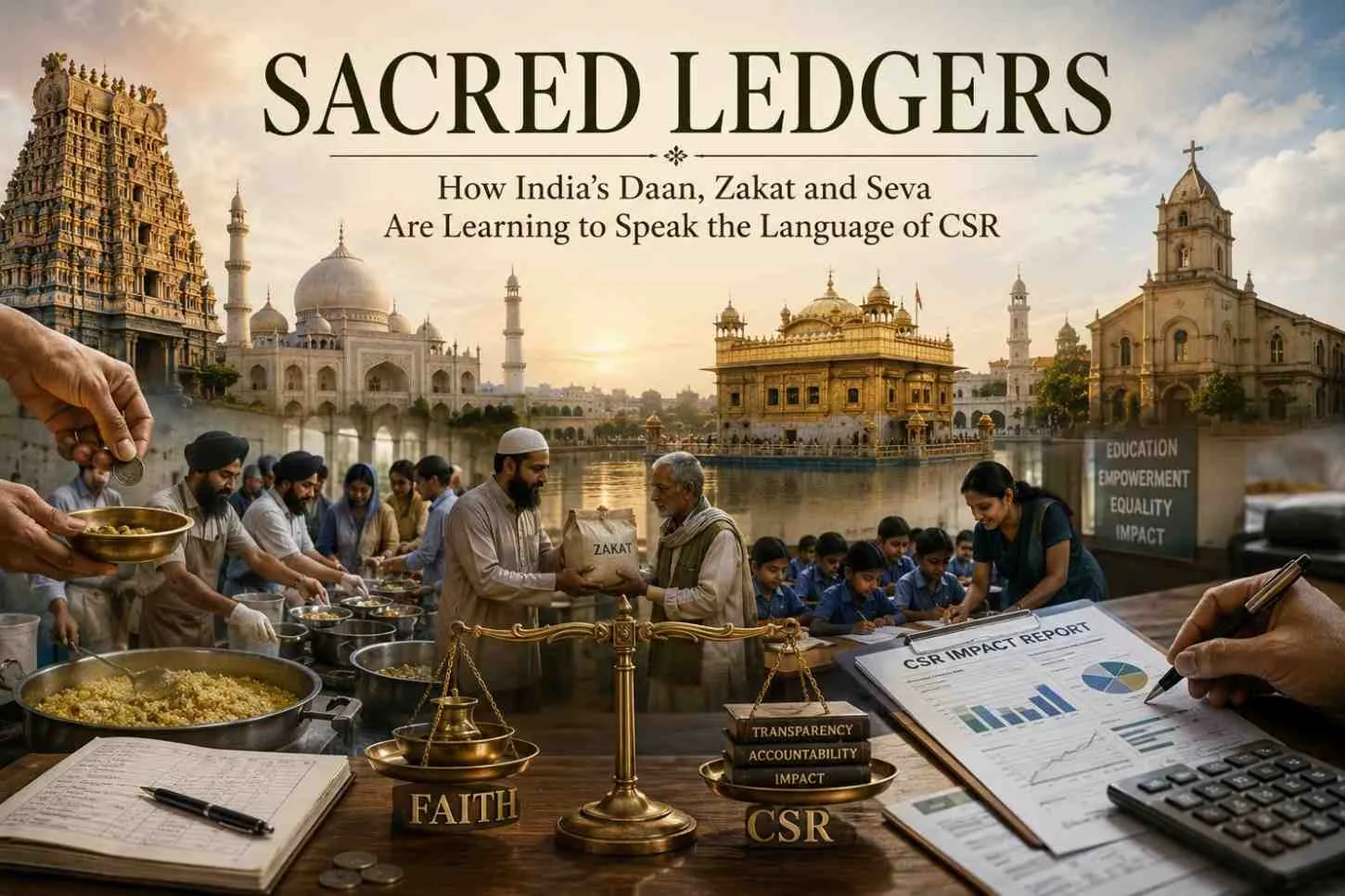
| India's oldest philanthropy tradition is getting a modern accounting. Across temples, mosques, gurdwaras and community trusts, the ancient imperatives of Daan, Zakat, Seva and Dasvandh are being rewired for an age of Theory of Change documents, third-party audits and Schedule VII compliance. This is the story of how sacred duty and spreadsheet discipline are converging to build India's most under-leveraged social infrastructure — and what it will take to get the merger right. |
SHORT SUMMARY This feature examines the collision between India's faith-based giving traditions and the formal Corporate Social Responsibility regime under Section 135 of the Companies Act, 2013. It traces how religious and community trusts — from Zakat Center India and the AMP Zakat Fund to the Akshaya Patra Foundation, the Delhi Sikh Gurudwara Management Committee, Tirumala Tirupati Devasthanams and India's Waqf Boards — are professionalising governance, adopting outcome tracking and navigating FCRA, tax and ESG requirements to qualify as credible CSR implementing partners. It closes with a practical playbook for corporates and trusts seeking to build partnerships that honour spiritual intent while meeting the non-negotiable standard of arm's-length, auditable, non-discriminatory delivery. |
KEYWORDS Faith-based philanthropy India, CSR Section 135, Daan Zakat Seva, religious trusts CSR compliance, FCRA compliance, outcome tracking, Zakat modernisation, temple trusts, Waqf CSR, ESG religious institutions, Schedule VII, Akshaya Patra governance, arm's-length transactions, Viksit Bharat philanthropy. |
HASHTAGS #FaithBasedGiving #CSRIndia #Zakat #Daan #Seva #ESG #Philanthropy #ReligiousTrusts #FCRA #Section135 #ScheduleVII #SocialImpact #ViksitBharat #SacredCapital |
The Invisible Giant: India's Faith Economy Before CSR
Long before Parliament wrote a rulebook for corporate giving, India had already perfected the art of giving. A steel plate placed before a hungry stranger. Grain offered at a shrine. A day spent washing utensils in a community kitchen. A fixed share of annual wealth set aside for the poor. Daan, rooted in Vedic and Jain thought, treats selfless giving as a purifying duty. Zakat, one of the Five Pillars of Islam, mandates that eligible Muslims redistribute 2.5 per cent of accumulated wealth every year to the poor, the indebted and the marginalised. Seva and Dasvandh, institutionalised by Guru Nanak Dev Ji, fuse physical service with the tithing of one-tenth of income, expressed daily through the Langar — a communal kitchen that erases caste and class at the threshold of the door. Annadanam, Utsarg and a dozen other regional practices round out a philanthropic vocabulary that predates the modern NGO by centuries.
The scale of this giving remains largely invisible to formal statistics. Recent household-giving research estimates India's annual informal giving market at roughly ₹54,000 crore, with religious organisations the most frequently cited recipients. Set beside this is India's formal CSR economy — companies reported close to ₹34,900 crore in CSR spending in FY 2023-24 under the mandatory 2 per cent regime created by Section 135 of the Companies Act. The two pools are not directly comparable, but the message is unmistakable: India's compassion economy may rival, and in places exceed, its statutory CSR economy. The challenge has never been a shortage of generosity. It is the leakage between good intention and measurable public benefit.
Why the Wall Existed — and Why It Is Coming Down
For the first several years of India's CSR mandate, faith and formal philanthropy occupied separate worlds. Schedule VII of the Companies Act explicitly excludes activities "concerned with religion," and corporate legal teams treated that clause as a blanket prohibition on anything smelling of temple, mosque or gurdwara. The 2022 CSR Amendment Rules changed the geometry. Public charitable trusts and societies — provided they carry tax-exempt status under Section 10(23C) or hold valid 12A and 80G registrations, and register on the MCA portal via Form CSR-1 — became eligible implementing agencies. The door opened; through it walked India's oldest philanthropic tradition, blinking in the fluorescent light of modern compliance.
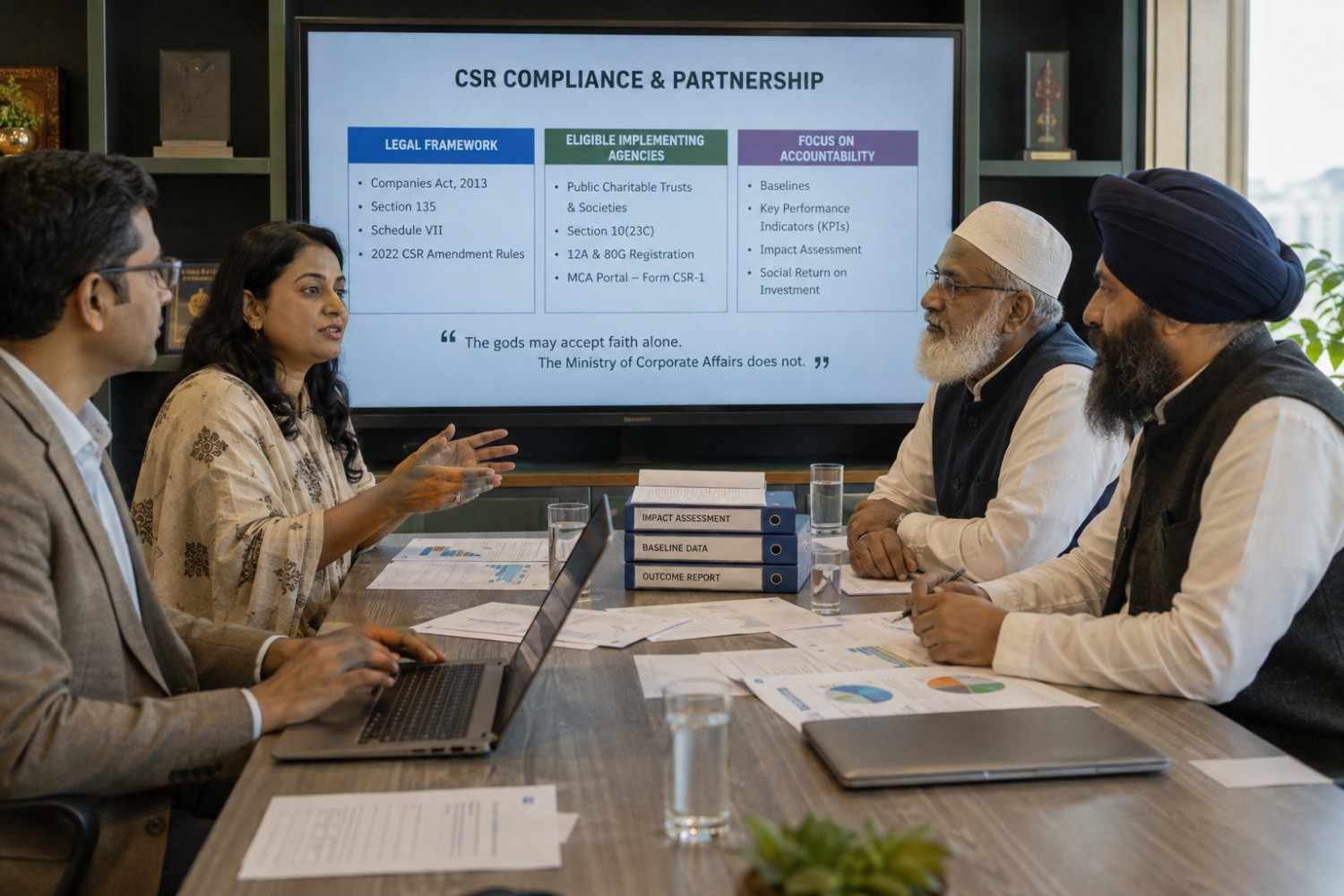
"The gods may accept faith alone. The Ministry of Corporate Affairs does not."
What changed was not the spirit of giving but its accountability. Traditional daan was measured by the act itself — the giving was the merit. Modern CSR demands evidence of change: how many children stayed in school, how many families escaped debt, what the social return on every rupee actually was. Faith-based institutions that wish to access this ₹30,000-crore-plus CSR pool must now speak in baselines, Key Performance Indicators and independent impact assessments — or risk watching the capital flow instead to secular NGOs that already do.
Three Pillars of the New Faith-Based CSR
Pillar One — Structured Governance
Traditional giving ran on trust, literally: a donor gave to a temple or community leader and funds were distributed by need, religious calendar or community consensus. That model built deep social capital but little institutional architecture. Today's professionalised trusts are changing that by publishing annual impact reports, maintaining project-wise accounting, conducting internal FCRA reviews, and keeping trust deeds strictly aligned with actual activity — audit-ready documentation that can withstand a corporate CSR committee's scrutiny.
Pillar Two — Outcome Tracking
The defining shift is from output to outcome. It is no longer enough to state how much was distributed; the question is what changed. Structured Zakat platforms now report exact counts of students funded, self-employment grants disbursed and families supported with food assistance — specific, countable outcomes that can be tracked year over year, mapped directly onto the UN Sustainable Development Goals, and defended in an ESG disclosure.
Pillar Three — Regulatory Compliance
The most complex pillar is regulation itself. Religious and charitable trusts operate under a dense web of law: the Indian Trusts Act, the Charitable and Religious Trusts Act of 1920, Sections 12A and 80G of the Income Tax Act, and — for those receiving funds from abroad — the Foreign Contribution (Regulation) Act. Tightened FCRA rules now require trusts to specify their purpose from a government-notified schedule, exclude proselytisation, and route foreign contributions through designated accounts. The stakes are real: license revocations, high-profile investigations into the political use of CSR funds, and courts clarifying the boundary between cultural and religious activity have all made compliance a survival imperative rather than a formality.
Case Study: Zakat Platforms — Scaling Faith with Systems
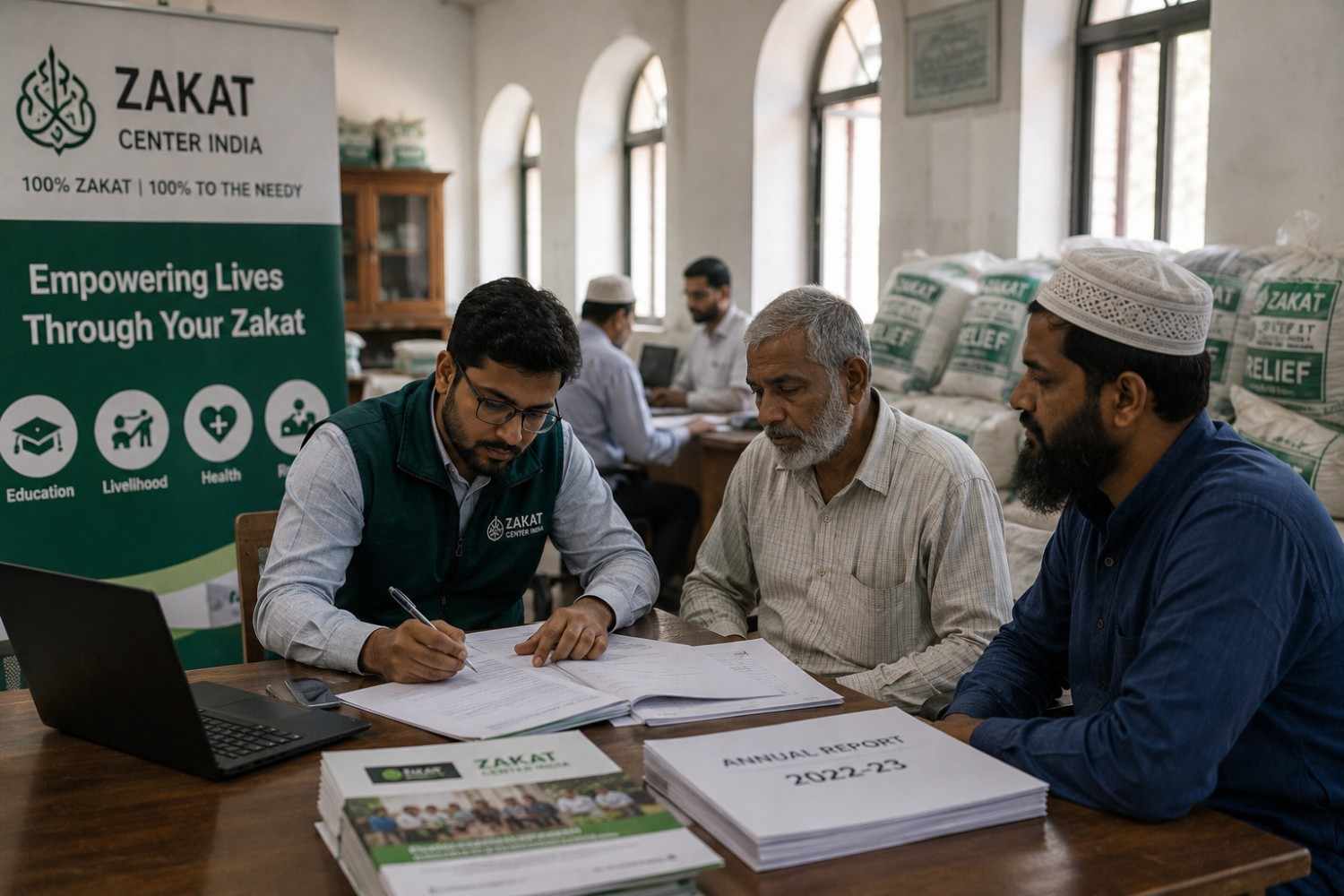
Structured Zakat platforms such as Zakat Center India and the AMP Zakat Fund illustrate how mandatory religious giving is being converted from a cash handout into what practitioners call an empowerment capital engine. Zakat Center India has built a verified-cause database spanning thousands of documented causes across education, medical assistance, livelihood support and disaster relief, allowing donors to choose recipients and locations while honouring the Islamic principle that Zakat must reach specific categories of beneficiaries. The AMP Zakat Fund's annual impact report goes further, breaking distribution down by category — education and scholarships, livelihoods and self-employment, orphan support and compassionate relief — with named outcome counts for students funded and entrepreneurs seeded, alongside cumulative multi-crore impact tracked since inception. For corporations seeking to partner with Muslim communities on CSR, these platforms offer a template: professionally managed, jurisprudentially sound, and legible to a corporate audit committee.
Case Study: Akshaya Patra — The Bridge That Almost Collapsed
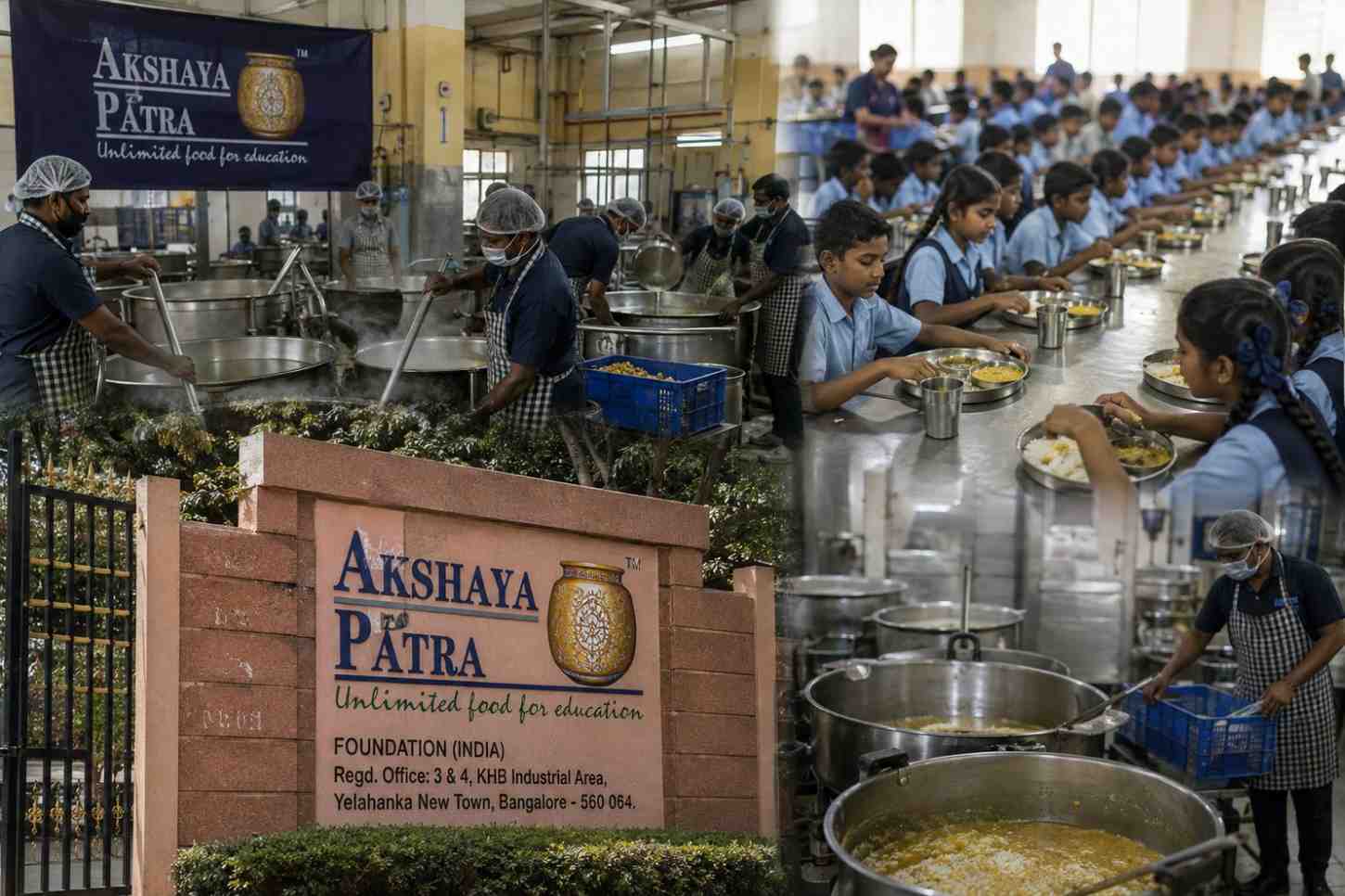
No case illustrates the peril of faith-CSR convergence better than the Akshaya Patra Foundation. Born from an ISKCON Bangalore kitchen in 2000, it grew into the world's largest NGO-run mid-day meal programme, feeding millions of children across tens of thousands of schools, with major corporate CSR partners covering the overwhelming majority of relief costs. Then came the reckoning: internal audit findings, later reported widely in the press, alleged that the line between the charitable Foundation and its parent religious trust had blurred — kitchens built with CSR and government funds allegedly used for temple purposes, and donations meant for meals reportedly diverted toward religious construction.
The lesson is not that faith-based organisations are unfit for CSR. It is that related-party transactions between a religious trust and its charitable arm are fatal. Where the arm's-length principle is violated, tax exemptions come under scrutiny and CSR funds become effectively contaminated. Akshaya Patra has since undergone governance restructuring, but the episode remains a mandatory case study for any CSR head evaluating a faith-rooted partner: compassion without accountability breeds corruption.
Case Study: The Gurdwara Model — Faith as Healthcare Infrastructure
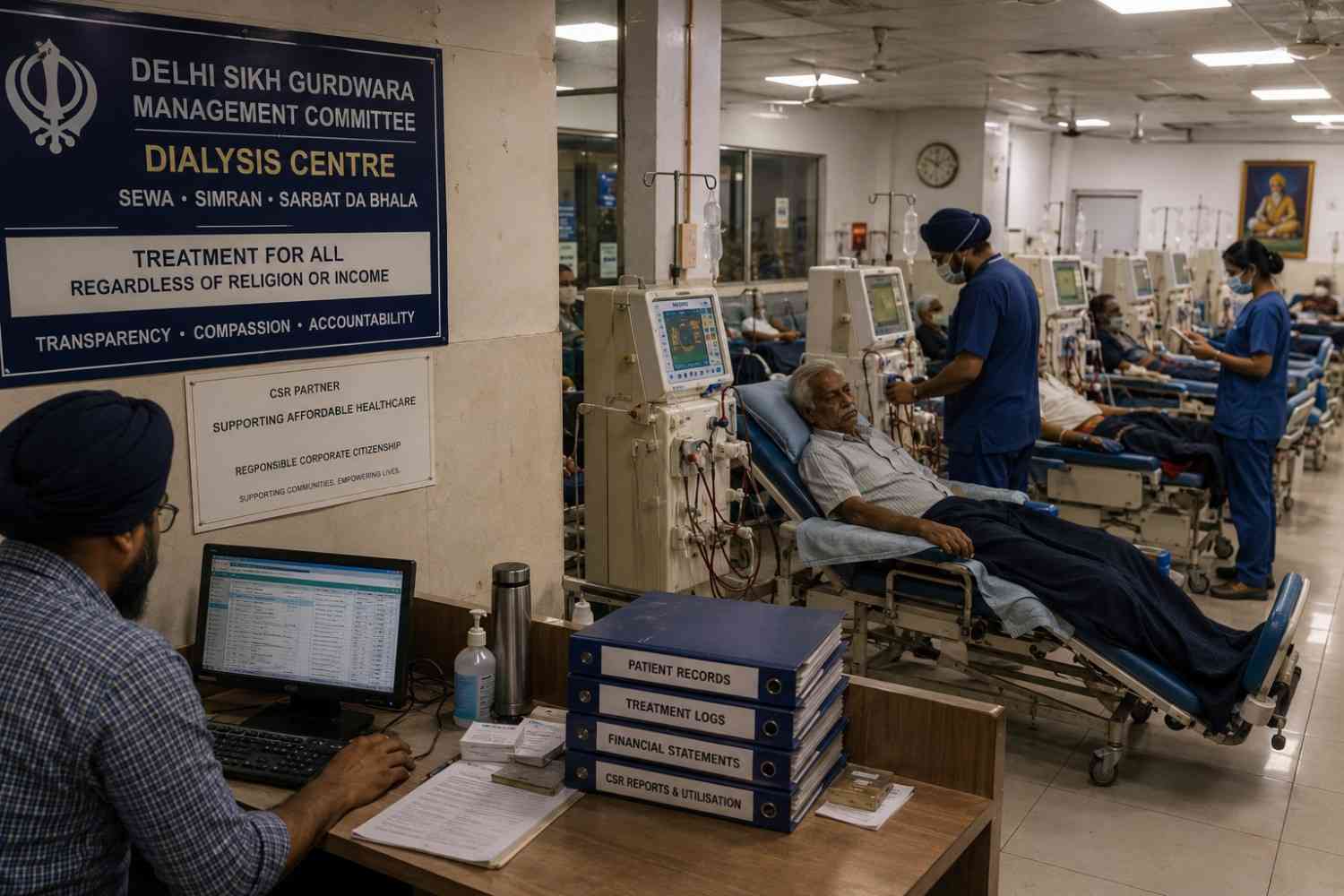
If Akshaya Patra is the cautionary tale, the Delhi Sikh Gurudwara Management Committee is closer to the blueprint. Its kidney dialysis centre treats patients regardless of religion or income, and — critically — operates with enough financial transparency and programme documentation to qualify as a CSR implementing agency. A multinational chemical company has directed CSR funds to this dialysis service for three consecutive years, alongside partnerships with other established implementing agencies. The model works because the Gurudwara has built what amounts to a secular membrane around its healthcare delivery: the Langar remains sacred, but the dialysis unit maintains clinical records, follows medical protocols, and bills or waives patients through a transparent accounting system that satisfies corporate auditors.
Case Study: TTD and the Waqf Opportunity
The Tirumala Tirupati Devasthanams manages one of the world's richest religious institutions, receiving hundreds of crores in devotional offerings annually. Beneath the gold-plated domes sits a social-services architecture — free schools, subsidised hospitals, oncology and paediatric care, rehabilitation centres — that many state governments would envy. What TTD has not yet fully exploited is its potential as a CSR magnet: with independent trustees for its social wing and formal impact frameworks, the temple's existing infrastructure could channel far larger CSR sums into surrounding tribal belts, provided hundi receipts and CSR receipts never share the same voucher.
India's Waqf Boards present a parallel, largely dormant opportunity. Controlling over six lakh properties, they are among the country's largest landowners, yet poor record-keeping and weak professional management have left much of this wealth spiritually blessed but economically idle. Corporate-waqf development models have already succeeded elsewhere in Asia, turning waqf land into hospitals, universities and microfinance institutions. In India, the Waqf mandate — education, healthcare, women's empowerment, skill development — aligns almost perfectly with Schedule VII. What is missing is the bridge: CSR-1 registration, trained professional trustees, and outcome frameworks that satisfy a corporate audit committee.
The ESG Lens: Faith as Environmental, Social and Governance Capital
As ESG disclosure becomes the currency of investor trust, faith-based programmes are proving relevant to all three pillars. On the Social side, education, healthcare, livelihood and relief work map directly onto goals such as No Poverty, Quality Education and Decent Work. On Governance, professionalised trusts with transparent accounting and board oversight demonstrate exactly the standards ESG investors demand. And on the Environmental side, a quieter revolution is underway: solar-powered ashrams and pilgrimage kitchens, circular-economy ventures that convert daily flower offerings into bio-fertiliser and incense rather than dumping them into rivers, and temple-led watershed restoration around ancient stepwells and tanks. Faith networks, it turns out, possess an asset money cannot buy — deep-seated social capital and moral authority that can unlock last-mile trust no corporate campaign can purchase outright.
The Governance Gap: Why Arm's-Length Is Non-Negotiable
The single biggest threat to faith-based CSR is not regulatory rejection — it is conflict of interest. A temple trustee who also controls the receiving charitable trust, a mosque committee that collects Zakat and CSR funds into the same account, a church NGO sharing undocumented premises with its seminary: none of these are minor technical lapses. They are existential risks that can unwind an entire partnership. The 2022 CSR Amendment Rules demand arm's-length relationships between implementing agencies and related parties, which in practice means separate legal entities for the charitable arm, independent professional board members alongside religious leadership, ring-fenced bank accounts with no cross-subsidisation of ritual activity, and documentation that translates faith language into development metrics — replacing "we feed the hungry because God commands it" with "we served fifty thousand meals and reduced absenteeism by twelve per cent."
A Practical Playbook Before Anyone Signs an MoU
- Verify active 12A, 80G and CSR-1 registration, and review Form FC-4 returns where foreign funds are involved.
- Insist on a written Theory of Change with baseline data, clear KPIs and a multi-year project plan aligned to Schedule VII.
- Require ring-fenced, dedicated bank accounts that keep CSR capital entirely separate from ritual or unrestricted donations.
- Build in independent third-party impact verification and public, board-level annual reporting rather than one-off photo-op distributions.
- Diversify partnerships across faiths, regions and themes to avoid over-concentration and reputational risk.
- Invest in capacity building for trusts that have grassroots trust but not yet the technical muscle for rigorous reporting.
These are not bureaucratic hurdles imposed on the sacred. They are the price of admission to formal capital — and, done well, they protect the very donors and beneficiaries the tradition was built to serve.
The Road Ahead: Viksit Bharat Needs Both Mandir and Monitor
India's ambition to become a developed nation by 2047 requires social-sector funding that government spending alone cannot supply, with the development funding gap estimated in the tens of lakh crores. Faith-based institutions bring three assets no corporate campaign can replicate at that scale: trust capital built over generations in villages where the state feels distant; fixed infrastructure — kitchens, halls, land — that does not need to be built, only upgraded; and volunteer networks of sevadars, Zakat collectors and congregation teachers who serve without a payroll.
None of this is worth anything without an audit trail. The winning model is neither a cheque handed unconditionally to a shrine nor a CSR department dictating spirituality to a trust. It is a principled partnership in which faith supplies purpose, community supplies trust, professional management supplies execution, law supplies boundaries, and evidence supplies credibility. When Daan is tracked with data, when Zakat fuels scalable livelihoods, and when Seva powers audited healthcare and disaster response, philanthropy becomes more than charity. It becomes Sacred Capital — a force multiplying inclusive, transparent and lasting national growth.



Add a Comment