By Ashlen
| Summary: Sustainable design is more than eco-friendly labels or recycled materials—it is about creating products, buildings and systems that use fewer resources, last longer and minimise environmental impact throughout their entire life cycle. From repairable smartphones and circular manufacturing to passive architecture and low-energy digital design, this article explores how thoughtful design decisions can reduce waste, challenge planned obsolescence and replace today's linear "take-make-dispose" economy with a truly regenerative future. |
Key Topics #SustainableDesign #CircularEconomy #CradleToCradle #PlannedObsolescence #RightToRepair #Greenwashing #CircularDesign #RepairEconomy #EcoInnovation #SustainableArchitecture #Biomimicry #PassiveDesign #ProductLifecycle #LowCarbonDesign #SustainVerse |
Here’s a small con you’ve probably paid for. You buy a cheap printer, and within a year the replacement ink costs more than the printer did. Or you buy a phone, and around year three the battery swells, and because it’s glued in, there’s nothing to do but buy a new one. Feels like bad luck. It isn’t. Somebody designed those things to work exactly that way, because a product that quietly dies on schedule sells more of itself. That decision, made in a room long before the thing hit a shelf, is where sustainable design either happens or doesn’t.
None of this is new. Back in the 1920s, the biggest lightbulb companies in the world got in a room together and agreed to make their bulbs worse. They capped the lifespan at around 1,000 hours, on purpose, so you’d keep buying. They could already build one that lasted far longer, and the proof is still burning: a fire station in Livermore, California, has a hand-blown bulb lit since 1901. Making something die early so people rebuy it has a name, planned obsolescence, and it’s the exact thing good sustainable design sets out to kill.
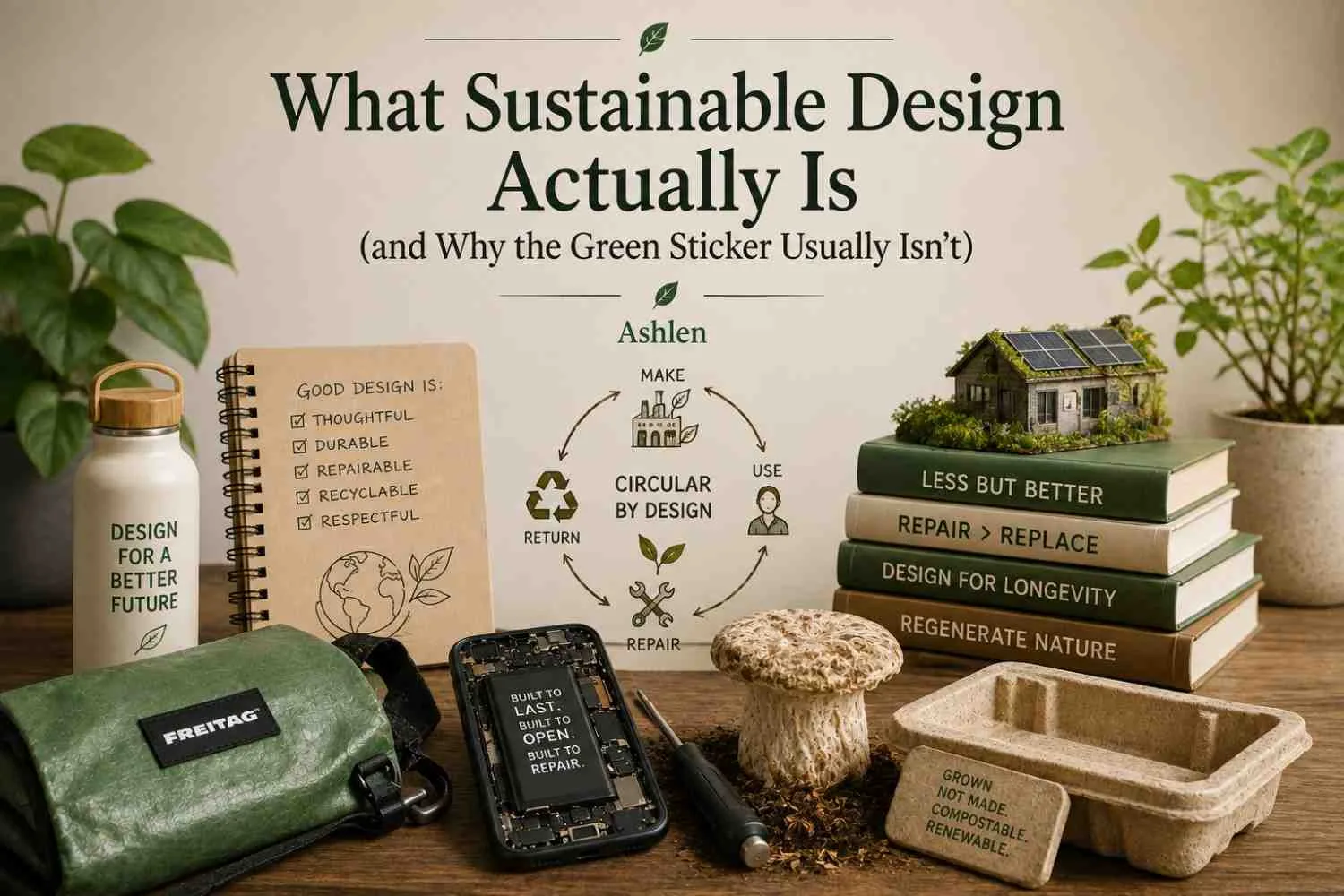
So what is it, really? Stripped of the marketing, sustainable design is the practice of making things (products, buildings, packaging, even websites) so they use less, last longer, and do less damage across their whole life, from raw material to the day you’re done with them. The green leaf on the shampoo bottle isn’t it. Neither are the recycling arrows stamped on plastic that no facility near you will actually take. The real work is invisible, because it happens at the sketch stage, in choices you never see.
And here’s the part the brochures skip: the honest choice almost always costs something. A phone you can open is a little thicker than one sealed shut. Recycled paper has faint flecks in it instead of a perfect white. A building designed to cool itself can’t always sit where the best view is. Sustainable design is mostly the discipline of picking the slightly less convenient, slightly less pretty option because it’s the right one, then living with that. Which is why most products don’t bother, and just paint a leaf on the box instead.
From a straight line to a loop

Most of what we own runs in a straight line. Dig up materials, build a thing, use it, bin it. Take, make, waste. Your morning coffee cup is a perfect example: alive for twenty minutes, then landfill for decades, because that thin plastic lining leaves it neither recyclable nor compostable in most places. Sustainable design tries to bend the line into a circle, so the end of one thing feeds the start of the next.
Two designers, William McDonough and Michael Braungart, called this “cradle to cradle,” as opposed to cradle to grave. It clicks the moment you picture a forest. A leaf falls, rots, and feeds the tree that dropped it. Nothing gets loaded onto a truck and driven to a dump. Every output is somebody’s input. That’s the target: make things that either go safely back to the soil or get pulled apart and rebuilt into something new, with no poisonous dead end.
[Illustration 1: the closed loop]
Stuff you can actually buy
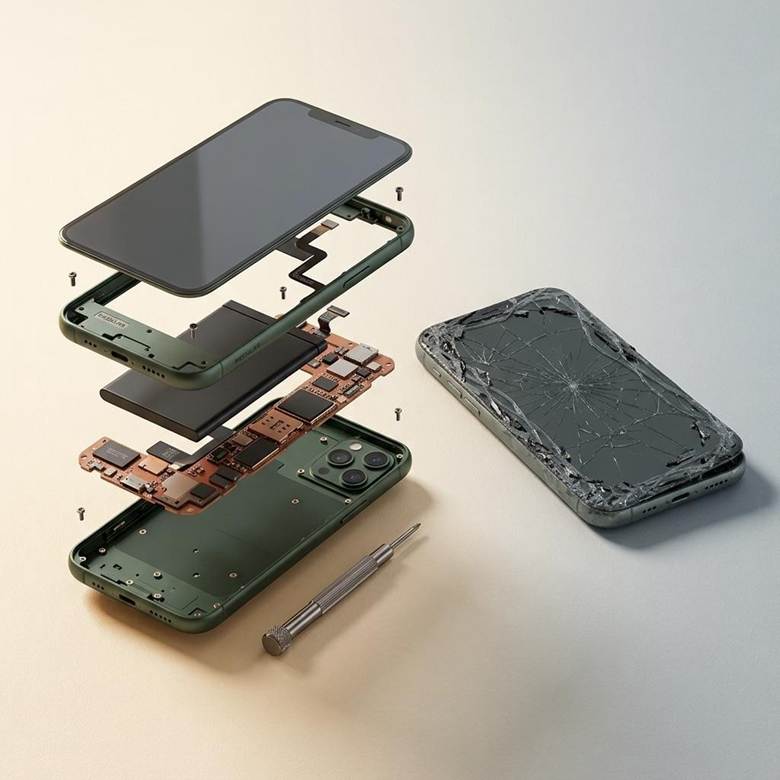
Watch how this plays out in things you can hold. Fairphone makes a smartphone you open with a tiny screwdriver. Battery, screen, camera, all of it comes apart, so when one bit fails you replace that one bit for cheap instead of junking the whole phone. Framework does it with laptops: swap the ports, upgrade the memory, follow a repair guide for every part. Yes, the Fairphone is a touch chunkier than the sealed slab in the shop window. That extra couple of millimetres is the price of a battery you can reach, and somebody decided it was worth paying. Set it against a laptop with the memory soldered down and the battery glued under the case, where one dead component turns the whole machine into e-waste, and you can see the choice for what it is.
The best version of this story is a carpet company, of all things. In 1994 the founder of Interface, Ray Anderson, read a book about the environment and had what he later called a spear-in-thechest moment. He looked at his own hugely successful business, which turned oil into carpet tiles and sold them by the millions, and decided he’d been running, in his own words, a plunderer of the earth. Most people would have felt bad and moved on. He turned the company inside out. Interface stopped selling one glued-down carpet you rip up and throw away, and started selling tiles, so a stain in one spot means you swap that single tile, not the whole floor. They kept pulling oil and waste out of how the tiles get made until some of their products now trap more carbon than they release. One man reading one book redirected a global manufacturer. That’s what a decision looks like when someone actually means it.
Materials matter as much as lifespan. A Swiss outfit called Freitag makes bags out of used truck tarpaulins, dead seatbelts, and old bike inner tubes, each one unique because it’s cut from a tarp that already did years of hard road time. The rubbish is the material. Packaging is having its own moment: a company called Ecovative grows a styrofoam replacement out of mushroom roots, packed into a mould with farm scraps, that protects the product just fine and then composts in your garden in weeks. Dell and IKEA have both shipped in it. Another, Notpla, makes packaging from seaweed, down to little edible blobs of water handed to London Marathon runners so the race didn’t leave a plastic graveyard behind.
Then there’s the quietest move of all: designing things people just keep. Patagonia runs repair workshops, sells the patches, and once ran a full-page ad telling people not to buy its jacket unless they actually needed it. Sounds like a death wish, until you do the maths. One jacket worn fifteen years replaces the four cheap ones you’d have bought and binned in the same span. They lose one sale and keep a customer for life.
The repair economy you already live in
You don’t need a Swiss brand or a mission statement to see this working. Walk down almost any street in an Indian city and the whole philosophy is already running, for free. The phonerepair stall that swaps a cracked screen while you wait. The cobbler resoling shoes people in richer countries would have thrown out. The tailor taking in a shirt instead of letting you buy another. It’s a repair economy that never stopped existing, keeping millions of objects alive for years past the point a throwaway culture would have dumped them. The fashionable word is “circular.” The older word is just not being wasteful, and a lot of the world has been doing it the whole time, without a hashtag.
What we ship
Moving things around is its own hidden cost, and design can cut it before a truck even starts. Flat-pack furniture, the kind you build yourself on the floor swearing at an Allen key, does more than save you money. A chair shipped fully built is mostly air; the box is huge and half empty.
Flatten it into a slim carton and one truck carries a crowd of them, burning less fuel per chair. Small design call, enormous saving once you multiply it by every delivery.
Mumbai has a better example, and it’s a hundred-odd years old. Every working day, a network of dabbawalas collects thousands of home-cooked lunches from thousands of houses, delivers each to the right office across a sprawling city, and carries the empty tins home the same afternoon. Reusable steel tins, no packaging waste, barely any fuel, run on trains and bicycles and a colour code you can read without being able to read. Silicon Valley would call it a logistics platform. It’s mostly an old idea done extremely well.
One rule worth carrying around: refilling beats recycling, and recycling beats the bin. More shops now let you bring your own container for rice or detergent or shampoo, so the packaging never gets made. And when packaging can’t be avoided, aluminium can be melted and reborn again and again with almost no loss in quality, which makes a can a smarter container than most plastics, which degrade a little each time and usually become waste within a cycle or two.
Buildings that breathe
Buildings are the giants here, gulping huge amounts of energy to stay warm, cool, and lit. But long before air conditioning, builders in hot places beat the heat with the shape of the building itself. In India, the jaali (that carved stone lattice) lets a breeze through while blocking the hard sun, cooling a room on zero electricity. Courtyard homes pull hot air up and out through the open middle. Thick lime walls soak up the night’s cool and release it slowly through the day. Stepwells went further, sinking whole flights of stone stairs down to the water table so a village had cool water and a cool place to sit through the worst of summer. None of it needed a power grid. Some of the smartest sustainable design ever done is centuries old, and it ran on nothing.
One architect built a career out of remembering this. Laurie Baker worked across Kerala with local brick and local labour, and got obsessed with waste, right down to a brickwork method full of small gaps that used fewer bricks, cost less, and let air through at once. His houses came out cheaper and cooler than the concrete boxes going up around them, because he refused to waste anything. Today’s architects are relearning all of it under names like passive design: keeping a building comfortable through where it faces, how it’s insulated, and where the shade falls, instead of a wall of humming machines. Some go further and swap concrete and steel, which both belch carbon when they’re made, for engineered timber that stores carbon instead.
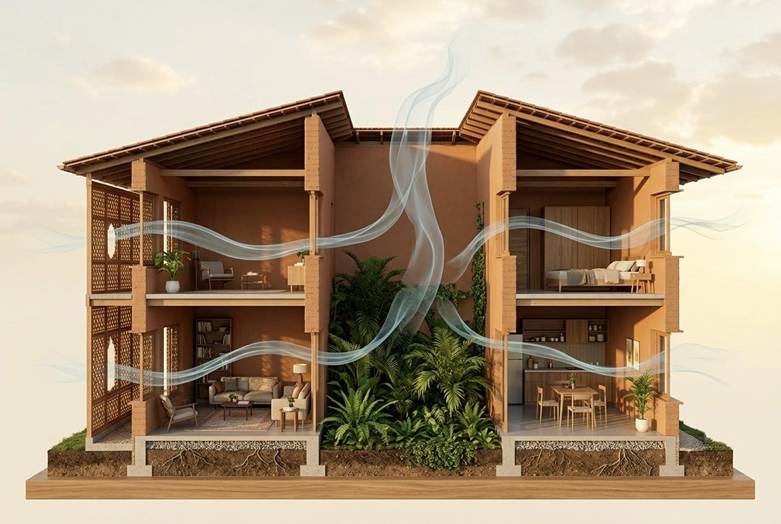
A few designers skip the theory and copy nature outright, which has a name, biomimicry. An office block in Harare called the Eastgate Centre stays far cooler than a normal glass tower on a fraction of the air conditioning, using a ventilation trick lifted from termite mounds: cool air drawn in low, warm air pushed out high. Copying a few billion years of nature’s trial and error tends to work, because nature is merciless about waste. Anything wasteful died out long ago.
The footprint you can’t see
Here’s the one almost everybody forgets, and it’s closest to a designer’s actual desk. The website you’re reading this on has a footprint too. Every site, app, and streaming video runs on data centres, warehouses full of computers pulling real electricity every second of the day, and added up, the internet burns roughly as much as the entire airline industry. A heavy, bloated page (autoplay video, a dozen trackers, a pile of fonts) draws more power every time someone loads it, times millions of loads.
This is where design choices most people never think about start to bite. Load a page with four custom fonts and every visitor downloads all four before reading a word, which is prettier and heavier. Stick to the fonts already on their device and it loads lighter and faster on less energy, and almost nobody notices. Same with the tricks built to make you consume more: the one-tap reorder, the “buy it again” nudge, the feed with no bottom that keeps you scrolling and buying. Those are design decisions too, aimed the opposite way, and a designer who cares about any of this has to notice when their own craft is pointed at the wrong target. One site takes the idea to its logical, slightly mad end: Low-tech Magazine runs off a small solar panel, and when the sky stays grey for days and the battery drains, it simply goes offline until the sun returns. A stubborn reminder that “always available” has a bill attached, and somebody pays it in energy.
[Illustration 4: the weight of the web]
How to spot the fakes
Because “green” sells, loads of companies fake it, and the fakery has a name, greenwashing. A bottle bragging “made with 30% recycled plastic” is still a single-use plastic bottle. A brand dropping a tiny “conscious collection” while cranking out millions of throwaway clothes the rest of the year is buying applause, not changing anything. A few tells that rarely fail: fuzzy words like “eco” and “natural” with no numbers behind them, a green colour scheme doing all the persuading, and a big song and dance about one small feature while the core product stays exactly as wasteful. Real sustainable design shows its working. It tells you what the thing is made of, how to fix it, and what to do with it when you’re done. If a company won’t tell you those three things, the leaf on the label is decoration.
What you can do with any of this
None of this needs you to design a thing. You buy stuff and you use stuff, and that alone hands you more power than the marketing wants you to feel. A few habits that genuinely count:
- Buy less, and pick the one built to last. The cheap option is almost never the cheap option five years out.
- Fix before you replace. A shocking number of “dead” things need a new battery, a cable, or a ten-minute video and a bit of nerve.
- Go second-hand first, especially furniture, clothes, and electronics. The greenest product on earth is the one that already exists.
- Read past the front of the label. Find out what it’s made of and whether the maker tells you how to repair or recycle it.
- Back the right to repair. Get behind the brands and laws that let you mend what you own instead of forcing you to throw it out and buy again.
Strip away the leaves and the labels, and sustainable design comes down to one plain question asked in a quiet room before anything gets built: where does this end up, and who pays for it?
Ask it honestly and you tend to end up with something a little chunkier, a little plainer, a little less convenient, and far better for everyone downstream. Once you start seeing objects that way, the throwaway ones stop looking like convenience. They start looking like a bill somebody quietly forgot to mention.
About Author

Ashlen is a Product Designer and an educator specializing in Deep tech, enterprise and front-end user experiences.






Add a Comment