
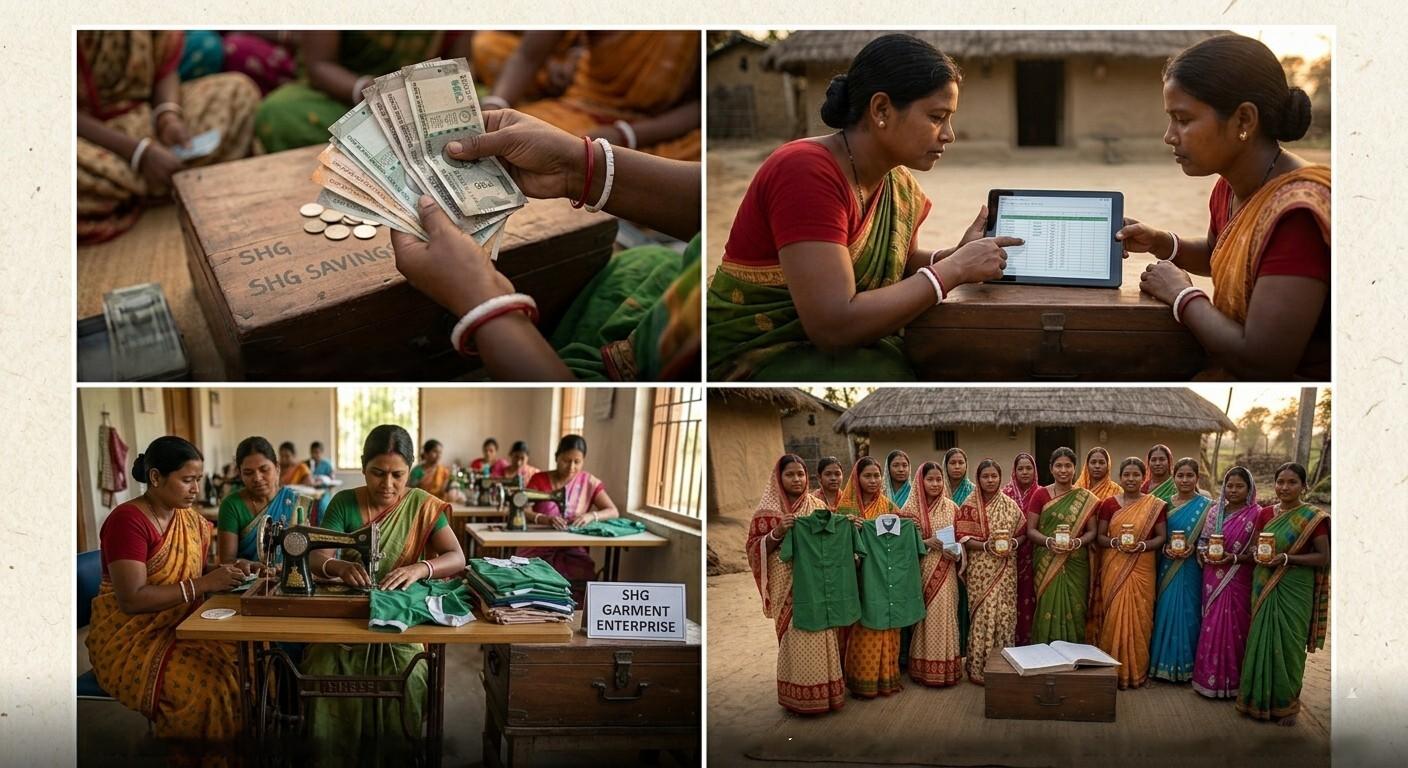
From Bengal’s sewing rooms to Rajasthan’s deserts, women are rewriting the rules of survival, leadership and livelihood—one small saving at a time.
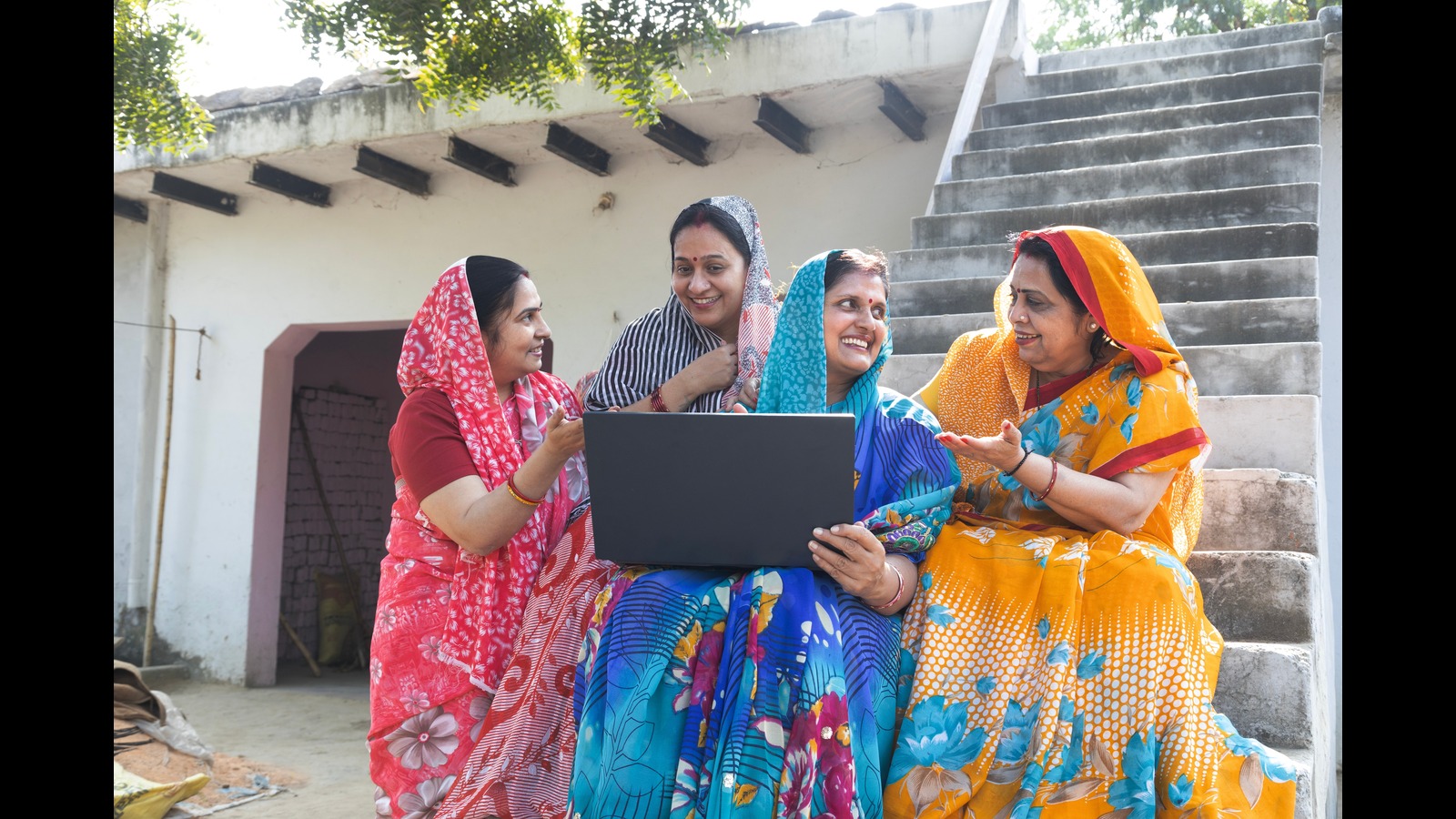
Across rural India, change does not always arrive with speeches, slogans, or spectacular announcements. Sometimes it comes quietly, in a circle of women sitting on mats, counting coins, sharing worries, and deciding that their lives will not remain the same forever. That quiet turning point is at the heart of your note on Self-Help Groups, which I have reimagined here as a magazine-style longform feature. The original note’s central spirit—women building strength through solidarity—runs through this retelling.
The Revolution Nobody Saw Coming
India has often spoken the language of development through highways, factories, digital platforms, and policy missions. Yet one of the most transformative movements in the country has unfolded away from the cameras, in villages where women once had little money, less mobility, and almost no say over household or community decisions. The Self-Help Group, or SHG, changed that equation.
At one level, an SHG is simple. A small number of people, usually women, come together regularly, save small amounts, keep records, build trust, and support one another through loans and collective action. But in practice, SHGs do something far bigger than pooling savings. They create a moral and economic commons. They help women move from isolation to association, from dependence to decision-making, and from silence to public voice.
India’s institutional support for this movement did not emerge by accident. The SHG-Bank Linkage Programme, supported by NABARD, helped connect women’s groups to formal banking, while the Deendayal Antyodaya Yojana–National Rural Livelihoods Mission built a wider architecture for organizing poor rural women into institutions that can support livelihoods, credit, enterprise, and social development.
But the deeper story is not administrative. It is human. It is about what happens when a woman who never handled money begins signing loan papers, managing accounts, negotiating with traders, speaking in public meetings, and telling her daughter, with new conviction, that life can be different.
A Bengal Evening, a Small Contribution, a New Beginning
Imagine a village in West Bengal at the edge of a paddy landscape. The day is ending. Smoke curls up from kitchens. Children chase each other in dusty lanes. A woman named Madhabi, like so many women around her, has spent years inside a routine of unpaid labour—cooking, cleaning, caring, stretching every rupee, and making sure everyone else survives.
Then comes an invitation to join a Self-Help Group.
At first, it feels almost absurd. What can a woman with no formal education and no independent income contribute? Yet she goes. Ten women begin meeting. They save ten rupees each. Ten rupees is not much. It buys almost nothing in today’s economy. But that is not the point. The saving is economic, yes, but it is also psychological. It says: I belong to a circle. I can contribute. I can plan. I can participate.
Soon the group begins lending among themselves. A sewing machine is purchased. Blouses and school uniforms are stitched. A little money starts coming in. Then confidence follows. That is how many SHG stories begin—not with a miracle, but with rhythm. Small saving, regular meetings, internal lending, shared discipline, and the first taste of economic agency.
In Bengal, this pattern has repeated itself in thousands of forms—through tailoring, food processing, poultry, agarbatti-making, mushroom cultivation, jute crafts, and local service enterprises. The earnings may begin modestly, but the identity shift is profound. A homemaker becomes an earner. An earner becomes a decision-maker. A decision-maker becomes, sometimes, a community leader.
When the Desert Starts Yielding Possibility
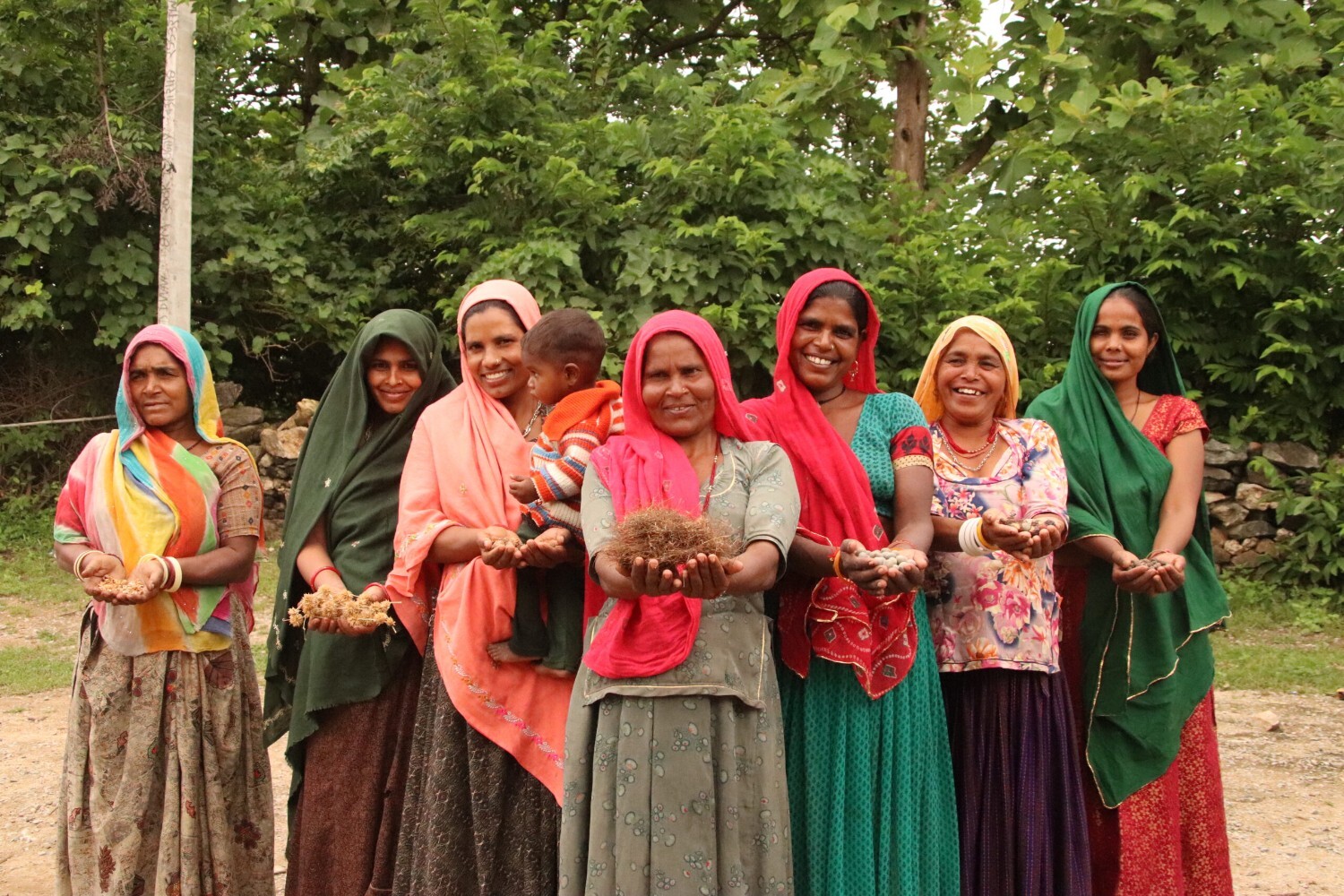
Travel west to Rajasthan, to a district where water is scarce, heat is unforgiving, and women often spend hours every day fetching what urban India takes for granted. Here, poverty is not just about income. It is about time, geography, and social hierarchy. For a widow like Rekha, the burden is heavier still.
That is where the SHG becomes more than a savings club. It becomes social insurance in a place where formal systems often feel distant. A group of women saves together, learns together, borrows together, and begins investing in something suited to the local ecology—goat rearing. The choice matters. Good SHGs do not impose random enterprise models. They grow around what the land, climate, skill base, and market can realistically support.
Goat rearing in Rajasthan is not glamorous. It does not appear on startup panels or investment decks. But it is resilient, practical, and rooted in local knowledge. Women learn breeding, animal care, vaccination schedules, and basic bookkeeping. Within a couple of years, incomes rise. Debt pressure falls. Respect grows.
And respect is a currency of its own.
In many parts of rural South Asia, one of the most radical outcomes of women’s collectives is not simply income growth but social legitimacy. A widow once pitied or ignored becomes a person others consult. This transition—from being acted upon to becoming an actor—is one of the most important dimensions of empowerment.
Cutting Out the Middleman, Restoring the Maker
In Tamil Nadu, the story takes a different texture. Here the issue may not be the absence of skill but the unfairness of the market. A weaver can be deeply talented and still remain poor if the chain between craft and customer is controlled by middlemen.
For women like Lakshmi, the SHG becomes a platform of collective bargaining. That phrase may sound technical, but its meaning is simple: alone, a woman can be underpaid; together, women can negotiate. They can buy raw materials directly. They can compare rates. They can explore exhibitions, cooperatives, digital marketplaces, and NGO-supported channels. They can learn branding, packaging, pricing, and customer presentation.
Across India and South Asia, this is one of the defining battles of rural livelihoods. The poor often do not suffer from lack of effort. They suffer from weak market power. The farmer does not control the mandi. The fisherwoman does not control the cold chain. The artisan does not control the retail shelf. The home-based worker does not control the platform. SHGs help close that gap, not perfectly, but significantly.
This is especially visible in craft regions of India, in handloom clusters of Assam, in kantha and jute work in Bengal, in embroidery collectives in Gujarat, in coir and fish-processing units in Kerala, and in hill produce groups in Uttarakhand. Once women organize, the value chain begins to look different. What was once “helping out” becomes recognized as labour. What was once “traditional work” becomes an enterprise.
The Mountain Learns to Speak
In Uttarakhand, the terrain itself teaches patience and fragility. Landslides, poor connectivity, limited employment, and ecological vulnerability make rural life difficult. Women bear much of that weight. They collect firewood, manage the household economy, care for children and elders, and often absorb the consequences of male migration or unemployment.
Here, SHGs often evolve around organic farming, medicinal herbs, local food products, and ecological enterprises. These are not just livelihood choices; they are place-based responses. A well-functioning group learns to align enterprise with geography. Organic vegetables, local pulses, herbs, pickles, and natural products can fetch better prices if the group has enough training, some market access, and a basic understanding of quality and branding.
But there is another layer. SHGs in many parts of India do not stop at economics. Once women start meeting regularly, a new public culture emerges. They talk not only about savings and loans but also about alcoholism, domestic violence, sanitation, school dropouts, nutrition, and access to schemes. The circle widens. What begins as thrift becomes citizenship.
That is when the village changes most deeply.
From the Coast to the Forest: Different Geographies, One Pattern
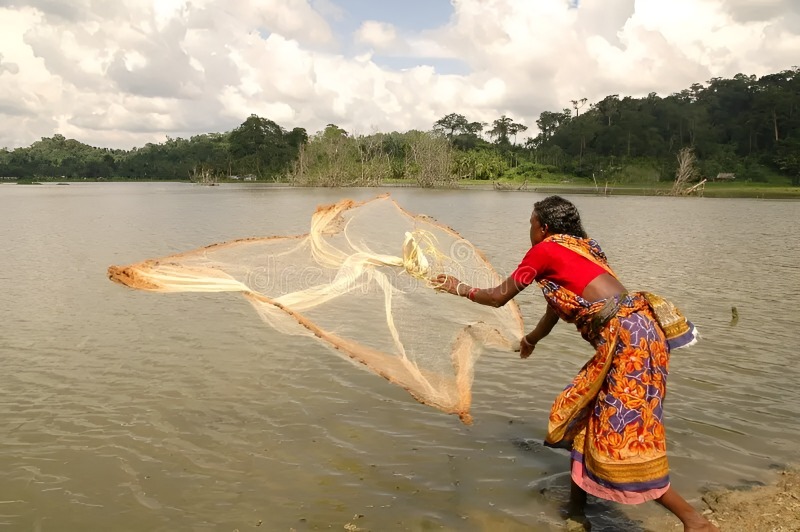
On the Kerala coast, fisherwomen have long done hard work in fish sorting, drying, selling, and household management, often without proportionate control over earnings. SHGs help shift that balance when women move into small processing units, hygienic packaging, dried products, pickles, ready-to-cook items, and collective marketing. One major gain is stability. Daily uncertainty gives way, at least partly, to planned income.
In Jharkhand, among tribal communities, the challenge may be less about markets alone and more about access—to finance, training, institutions, and recognition. When women organize around lac cultivation, forest produce, leaf plates, minor agro-processing, or local crafts, the first breakthrough is often financial literacy itself. Opening a bank account, understanding repayment, keeping group records, and interacting with officials can be revolutionary acts.
In Bihar, where male migration has shaped rural family life for decades, SHGs have often helped women build local income streams through dairy, poultry, food processing, and small livestock. The emotional consequence is significant. A woman who once waited for remittances begins generating her own earnings. This changes not just her financial position but her standing inside the household.
In Assam and the wider North-East, SHGs have played an important role in linking women’s skills in weaving, food products, and handicrafts to wider markets. Here too, the future depends not merely on production but on design, visibility, and fair market access.
Different state, different product, different language, different landscape. Yet the pattern remains strikingly similar. Women organize. They save. They learn. They borrow. They build trust. They earn. They speak. They lead.
The Law Is Not the Whole Story, But It Matters
No movement of this scale can thrive on goodwill alone. It needs legal and policy ecosystems that protect dignity, participation, and access.
Globally, the moral architecture is clear. The Convention on the Elimination of All Forms of Discrimination against Women recognizes the rights of rural women to participate in development, access credit, and benefit from rural progress. The UN’s Sustainable Development Goal 5 places gender equality and women’s empowerment at the center of sustainable development. The ILO’s framework on moving workers from the informal to the formal economy also matters because so much of women’s rural labour remains invisible, insecure, and poorly protected.
In India, the legal ecosystem around rural women’s empowerment is spread across several domains rather than a single SHG law. The 73rd Constitutional Amendment gave constitutional status to Panchayati Raj and mandated reservation for women in local governance, helping create a generation of rural women with a public role in decision-making. Several states have increased that reservation to 50 percent, and the scale of women’s participation in local bodies is now enormous.
Then there are laws that protect the social conditions within which empowerment must happen. The Protection of Women from Domestic Violence Act, 2005 provides a legal framework against abuse inside the family. The Prohibition of Child Marriage Act, 2006 is crucial because child marriage cuts short education, mobility, health, and economic agency. Without confronting these realities, economic empowerment remains incomplete.
Government programmes also matter. India’s women’s empowerment architecture includes support systems under the Ministry of Women and Child Development and rural livelihood systems under the Ministry of Rural Development. Together, these create channels through which women’s groups can access training, credit, social support, and local institutional recognition. The law, of course, cannot create courage. But it can make courage more survivable.
The Real Issues Beneath the Success Stories:
It is tempting to tell SHG stories only as success narratives. But that would make the feature emotionally satisfying and intellectually incomplete.
The truth is that SHGs operate in a landscape of persistent structural barriers. Many groups struggle to move beyond savings into sustainable enterprise. Credit may be available, but profitable market access remains weak. Women may produce well but sell poorly. They may have skills but lack logistics, branding, storage, transport, or digital literacy.
Some groups suffer from poor bookkeeping or overdependence on one or two stronger members. In conservative settings, women may still face resistance from families unhappy with their mobility or public visibility. The burden of unpaid care work remains huge. A woman may be an entrepreneur at noon and still be expected to perform all domestic labour at dawn and dusk.
Then there is the challenge of informality. Large numbers of women’s enterprises operate at the edge of the formal economy—without stable contracts, social protection, strong legal recourse, or reliable business development services. That makes them vulnerable to shocks, especially illness, climate disruption, market downturns, or household crisis.
Climate change is emerging as a particularly serious concern. For women dependent on agriculture, livestock, fisheries, forests, or local natural resources, changing rainfall, floods, droughts, salinity, and heat stress can wipe out fragile gains. In South Asia, empowerment can no longer be discussed separately from ecological resilience.
And yet, despite all this, the movement endures. Why? Because the social capital created by SHGs often outlasts the immediate economic cycle. Even when an enterprise struggles, the group remains a support system. It carries knowledge, confidence, and collective memory.
This Is About Society, Not Just Savings:
One of the biggest mistakes outsiders make is to treat SHGs as miniature banks. They are much more than that.
A functioning SHG changes the social architecture of a village. It improves the circulation of information. Women learn about health services, school entitlements, insurance, pensions, local schemes, sanitation campaigns, and grievance processes. They start attending gram sabha meetings. They question why a road was not built, why the anganwadi is irregular, why the school lacks toilets, why alcohol abuse is rising, why girls are being pulled out of school. In this sense, SHGs are democratic schools.
This is why they matter so much in India and South Asia. In societies where hierarchy often decides who speaks and who stays silent, regular group meetings teach deliberation. Women learn to listen, disagree, record decisions, monitor repayments, and settle conflicts. They acquire procedural confidence. That confidence later travels into public life.
A woman who can run a group ledger can often run a village committee. A woman who can question a defaulting borrower can question a negligent official. A woman who can bargain with a trader can bargain with the state .That is why the SHG story is not small. It is one of the grassroots foundations of a more participatory republic.
What Activists, Citizens, Government and Business Must Do Next:
If SHGs are to become engines of deeper transformation rather than islands of inspiring struggle, different actors have to step up with seriousness.
Activists must stop romanticizing rural women and start strengthening their negotiating power. That means sustained training in legal literacy, financial literacy, leadership, digital tools, enterprise planning, climate resilience, and rights awareness. It also means helping women confront uncomfortable issues such as domestic violence, unpaid labour , property exclusion, and caste-based barriers, not merely celebrating entrepreneurship in abstract language.
Citizens, especially in towns and cities, need to rethink consumption. Too often, we speak of empowerment and then buy the cheapest thing from the most exploitative supply chain. If urban consumers, resident groups, schools, universities, and community networks consciously source products and services from credible women’s collectives, they can help build fairer local markets. Respect also matters. SHG-made products should not be treated as charity purchases but as value-bearing goods and services.
Government has the heaviest responsibility. It must ensure that SHGs are not reduced to targets on paper. What they need is deeper last-mile support: strong field facilitators, reliable bookkeeping systems, easier access to affordable credit, better market intelligence, procurement opportunities, digital infrastructure, transport support, quality certification pathways, and social protection buffers. Governments also need to integrate SHGs more intelligently with agriculture, nutrition, skilling, climate adaptation, panchayats, and local value chains.
The private sector, meanwhile, must move beyond symbolic CSR. Companies can help by investing in design, packaging, market access, e-commerce onboarding, logistics, quality systems, climate-smart production, and fair procurement from women-led collectives. Banks and fintech players can build products that reflect rural realities rather than urban assumptions. Retail chains can create shelf space. Platforms can reduce onboarding friction. Agribusiness and food companies can build ethical sourcing partnerships. Media firms can tell better stories that do not flatten women into stereotypes of either victimhood or miracle success.
Most importantly, all four actors must understand one core principle: empowerment is not a one-time intervention. It is a process. It takes years for confidence to grow, institutions to mature, and livelihoods to stabilize. SHGs thrive where support is patient, relational, and rooted in local context.
The Future Is Already Sitting in a Village Meeting:
The next phase of the SHG movement in India will not look exactly like the first. It will be more digital, more networked, more market-aware, and, one hopes, more ambitious. Women’s collectives are beginning to use mobile banking, digital records, e-commerce channels, and platform-based learning. Younger women are entering these spaces with new aspirations. Traditional livelihoods are being reimagined through branding, design, sustainability, and niche markets.
But the soul of the movement remains unchanged. It still begins with women coming together. It still depends on trust before transaction. It still grows from the smallest act of shared discipline. And it still proves one of the oldest truths in development: that people change fastest when they are not treated as beneficiaries alone, but as agents.
From Bengal’s sewing circles to Rajasthan’s goat herders, from Tamil Nadu’s weavers to Uttarakhand’s organic growers, from Kerala’s fisherwomen to Jharkhand’s tribal collectives, the lesson is the same. Real transformation often begins below the radar of national attention. It begins where women who were told to endure begin instead to organize.
India’s villages are full of such circles. Inside them are ledgers, loans, laughter, disputes, recipes, worries, repayment schedules, and plans for the future. But inside them also lies something larger: a new social imagination of who rural women can be.
Not dependents. Not shadows. Not “helpers.” Builders Earners Negotiators Leaders and perhaps that is the most powerful part of the story. The SHG is not merely helping poor women survive at its best, it is helping remake the meaning of citizenship, dignity, and development in rural India itself.



Add a Comment