ESG has become a business imperative in India. Environmental, Social, and Governance factors now influence access to capital, regulatory compliance, customer preferences, and risk management. As more companies publish ESG reports and make sustainability claims, two distinct but complementary services have emerged. ESG advisory helps companies build their strategy, collect data, and prepare reports. ESG assurance independently verifies that the reported information is accurate, complete, and credible. Many companies confuse these two services. Some seek only advisory and skip assurance, leaving their reports unverified and vulnerable to greenwashing accusations. Others seek assurance before they have built the underlying systems needed to produce reliable data. Both approaches fail. This article explains the critical difference between advisory and assurance, why both are necessary, and how Indian companies can use them effectively to build trust with investors, regulators, and the public.
The two questions every ESG journey must answer
Every company that commits to ESG reporting eventually faces two fundamental questions. The first question is strategic. What should we measure, how should we measure it, and how do we present our performance credibly? The second question is verification. Can we prove that what we have reported is true?
These two questions require two different kinds of expertise. The first question is the domain of ESG advisory. The second question is the domain of ESG assurance. They are related but distinct. They involve different skill sets, different methodologies, and different relationships with the company. Understanding the distinction is essential for any company serious about ESG.
ESG advisory is a collaborative, forward looking service. An advisor works with the company to build systems, improve processes, and prepare reports. The advisor is a partner in the company's ESG journey. The relationship is trusting and constructive.
ESG assurance is an independent, backward looking service. An assurer examines the company's reported information, tests its accuracy, and provides an independent opinion. The assurer is not a partner but an evaluator. The relationship is professional and arms length.
Neither service is better than the other. They serve different purposes. A credible ESG program requires both. Advisory without assurance leaves the company with unverified claims. Assurance without advisory leaves the company with no reliable system for producing accurate data in the first place.
ESG advisory. Building the foundations
Let us begin with ESG advisory. This is the service that helps companies establish the infrastructure for credible ESG reporting.
An ESG advisory engagement typically begins with a gap assessment. Where is the company today relative to where it needs to be? What data is already being collected? What data is missing? What systems are in place? What systems need to be built? The advisor maps the current state and identifies the gaps.
The next phase is strategy development. Which ESG topics are material to this company?
Materiality means the issues that have the most significant impact on the company's business performance or on its stakeholders. For a manufacturing company, the E in ESG might be dominant. Energy efficiency, water management, and waste reduction. For a financial services company, the G in ESG might be more important. Board diversity, executive compensation, and anti corruption controls. The advisor helps the company identify its material topics and focus its efforts where they matter most.
The third phase is system building. An ESG report is only as reliable as the systems that produce the underlying data. An advisor helps the company design and implement data collection processes. This might involve setting up spreadsheets, implementing software tools, training staff, and defining roles and responsibilities. The goal is to ensure that data is collected consistently, accurately, and on a regular schedule.
The fourth phase is report preparation. The advisor helps the company draft its ESG report, structure its disclosures, and align with applicable frameworks. The most common frameworks in India include the Business Responsibility and Sustainability Report (BRSR) required by the Securities and Exchange Board of India, the Global Reporting Initiative standards, and the Sustainability Accounting Standards Board standards. Each framework has different requirements. The advisor helps the company navigate them.
The fifth phase is continuous improvement. ESG is not a one time project. It is an ongoing process. The advisor helps the company track performance over time, benchmark against peers, and identify opportunities for improvement. This might include setting targets, developing action plans, and monitoring progress.
Throughout the advisory engagement, the relationship between the advisor and the company is collaborative. The advisor is on the company's side. They share the same goal. A credible, effective ESG program.
ESG assurance. Verifying the claims
Now let us turn to ESG assurance. This is the service that provides independent verification of the company's reported information.
An ESG assurance engagement is structured differently from an advisory engagement. The assurer must be independent. They cannot have been involved in preparing the report or designing the data collection systems. Independence is essential for credibility. An assurer who also advises cannot provide an objective opinion.
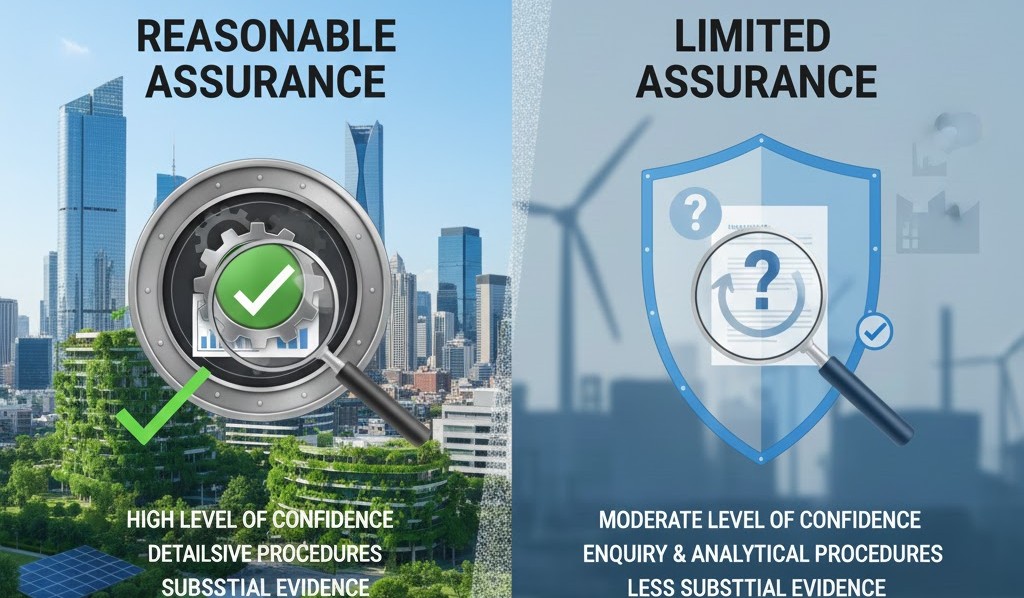
The assurance process begins with an engagement agreement. The company and the assurer agree on the scope of the assurance. Which parts of the ESG report will be verified? Which locations or business units are included? What is the period covered by the assurance? The agreement also specifies the level of assurance. Reasonable assurance or limited assurance.
Reasonable assurance is the higher level. It is comparable to the assurance provided in a financial statement audit. The assurer performs detailed testing, examines evidence, and provides a high degree of confidence that the information is accurate. Reasonable assurance engagements are more rigorous, more time consuming, and more expensive.
Limited assurance is a lower level. The assurer performs fewer procedures, primarily inquiries and analytical reviews, and provides less confidence. Limited assurance is often sufficient for companies that are early in their ESG journey or for information that is difficult to verify precisely.
Once the scope and level are agreed, the assurer begins their work. They interview the people responsible for collecting and reporting ESG data. They inspect documentation and evidence. They test the accuracy of calculations. They assess whether the data collection systems are designed appropriately and operating effectively. They confirm that the report includes all required disclosures and that the disclosures are presented fairly.
At the conclusion of the engagement, the assurer issues an opinion. The opinion states whether the information is accurate, complete, and presented fairly. The opinion is included in the company's ESG report or issued as a separate letter. It provides stakeholders with confidence that the company's claims have been independently verified.
Throughout the assurance engagement, the relationship between the assurer and the company is arms length. The assurer is not the company's partner. They are an independent evaluator. This independence is what gives the assurance opinion its value.
The common confusion. Why companies mix them up
Despite the clear distinction between advisory and assurance, many companies confuse the two. This confusion has several causes.
➣Unfamiliarity. ESG is still new to many Indian companies. The language, the frameworks, and the services are unfamiliar. It is easy to assume that one service covers everything. It does not.
➣Similarity in names. Both advisory and assurance start with the same letter. Both are offered by consulting firms and professional services firms. A company might hire a firm to help with ESG and not realise that the same firm should not both advise and assure.
➣ Cost pressure. Advisory and assurance both cost money. A company looking to save might try to combine them or skip one. This is a false economy. Skipping advisory leads to poor data quality. Skipping assurance leads to unverified claims. Both damage credibility.
➣ Overconfidence. Some companies believe they can handle advisory internally. They design their own systems and prepare their own reports. Then they seek assurance. The assurer finds that the underlying systems are inadequate. The assurance engagement fails or produces a negative opinion. The company has wasted time and money.
The correct sequence is clear. Advisory first. Build the systems. Collect the data. Prepare the report. Then assurance. Verify the accuracy. Obtain the independent opinion. Publish the verified report. This sequence works. Skipping steps does not.
Why both are necessary. Three compelling reasons
A company might ask why both advisory and assurance are truly necessary. Why cannot we just do one? Here are three compelling reasons.
1. Credibility requires independent verification.
An ESG report that has not been assured is just a collection of claims. The company is essentially asking stakeholders to trust it. In today's skeptical environment, trust is scarce. Independent assurance provides evidence that the claims have been tested. It converts a promise into a verified statement. For investors, regulators, and customers, that difference is decisive.
2.Data quality requires systems.
Assurance cannot create good data out of bad systems. If the underlying data collection is inconsistent, incomplete, or inaccurate, the assurer will identify those problems. The best possible assurance opinion on bad data is still an opinion on bad data. The company needs advisory to build the systems that produce good data in the first place. Then assurance can verify that the good data is accurate.
3.Continuous improvement requires both working together.
The best ESG programs use advisory and assurance in an ongoing cycle. Advisory helps the company improve its systems and performance. Assurance independently verifies the results. The findings from assurance inform the next round of advisory. What weaknesses were identified? Where did the data fail testing? Those become priorities for the next improvement cycle. Together, advisory and assurance drive a virtuous cycle of continuous improvement.
The Indian context. BRSR and the growing demand for assurance
India's ESG landscape has been transformed by the introduction of the Business Responsibility and Sustainability Report, or BRSR. The Securities and Exchange Board of India now requires the top 1000 listed companies to include a BRSR in their annual reports.
The BRSR covers a wide range of ESG topics. Energy consumption, water usage, waste management, greenhouse gas emissions, employee safety, human rights, community engagement, and governance practices. The reporting requirements are detailed and specific. Companies must provide quantitative data, not just qualitative descriptions.
The BRSR does not currently require assurance, but the direction is clear. The Securities and Exchange Board of India has indicated that assurance will become mandatory in the future. Some leading companies are already obtaining voluntary assurance to demonstrate leadership and build investor confidence.
This regulatory trajectory creates both a challenge and an opportunity for Indian companies. The challenge is to build the systems necessary to produce reliable BRSR data. The opportunity is to get ahead of the curve by engaging advisory services now and preparing for mandatory assurance later. Companies that wait will scramble. Companies that act now will be ready.
Choosing an advisor. What to look for
When selecting an ESG advisory firm, companies should consider several factors.
➣ Relevant experience. Does the advisor have experience in your industry? ESG priorities differ significantly between manufacturing, financial services, technology, and healthcare. An advisor who understands your specific context will provide more valuable guidance.
➣ Framework expertise. Does the advisor understand the BRSR, the Global Reporting Initiative standards, the Sustainability Accounting Standards Board standards, and other relevant frameworks? Your advisor should be able to help you navigate the framework landscape and choose the most appropriate approach for your company.
➣ Practical orientation. Is the advisor focused on building systems that work in the real world, or are they focused on producing a glossy report? A good advisor cares about data quality, not just presentation. Ask about their approach to system design and staff training.
➣ Independence from assurance. Does the advisor also offer assurance services? If so, the same firm cannot both advise and assure you. The conflict of interest would be unacceptable. It is fine to hire a firm that offers both services, but you must ensure that the advisory team and the assurance team are completely separate and that the firm has robust policies to manage independence.
➣ Cultural fit. ESG advisory involves close collaboration. You will share sensitive information and work through complex problems. Choose an advisor you trust and feel comfortable with.
Choosing an assurer. What to look for
When selecting an ESG assurance provider, the criteria are different.
➣ Independence. The assurer must be independent of the company and independent of any advisory work performed for the company. If the same firm provided advisory services, the assurance engagement must be conducted by a separate team with no involvement in the advisory work. Many companies prefer to use different firms for advisory and assurance to avoid even the appearance of a conflict.
➣ Technical competence. ESG assurance requires knowledge of assurance standards, particularly the International Standard on Assurance Engagements 3000. The assurer should be able to explain the standard, the procedures they will perform, and the level of assurance they will provide.
➣ ESG knowledge. The assurer does not need to be an ESG expert in the same way an advisor does, but they must understand the topics they are assuring. They need to know what good evidence looks like for each metric. They need to understand the common pitfalls and errors in ESG data collection.
➣ Reputation. The value of assurance depends on the credibility of the assurer. A well known, respected assurance provider adds more value than an unknown one. Look for firms with established assurance practices and a track record of quality work.
➣ Clear communication. A good assurer explains their findings clearly, including any limitations or qualifications. They do not hide behind technical language. They help the company understand what the assurance opinion means and how to improve.
The path forward for Indian companies
For companies ready to begin or strengthen their ESG journey, here is a clear path forward.
✓ Start with a diagnostic. Engage an advisor to assess your current state. What data do you already collect? What systems do you have in place? What gaps need to be filled?
✓ Build the foundations. Work with your advisor to design and implement data collection systems. Train your staff. Establish roles and responsibilities. Start collecting data consistently.
✓ Prepare a report. Draft your first ESG report. Use the BRSR framework if you are a listed company, or another appropriate framework if you are not.
✓ Commission assurance. Before you publish your report, engage an assurer to verify the information. Start with limited assurance if reasonable assurance seems too ambitious. Even limited assurance adds credibility.
✓ Publish and improve. Release your assured report. Use the findings from the assurance engagement to identify areas for improvement. Work with your advisor to address those areas. Repeat the cycle next year.
This path is not quick. Building a credible ESG program takes time. But every step builds on the last. And each year, your program becomes stronger, your data becomes more reliable, and your credibility becomes more solid.
Closing thought
ESG is not a trend. It is a fundamental shift in how businesses are evaluated. Access to capital, regulatory standing, customer trust, and employee engagement all depend increasingly on credible ESG performance.
Advisory and assurance are the two pillars of credible ESG reporting. Advisory helps you build the systems and prepare the report. Assurance helps you verify that the report is accurate. Neither pillar can stand alone. Build then verify. That is the sequence. That is the standard.
Indian companies that embrace both will lead. Those that confuse them or skip one will struggle to be believed. The choice is clear. Build the foundations. Verify the results. Earn the trust.




Add a Comment