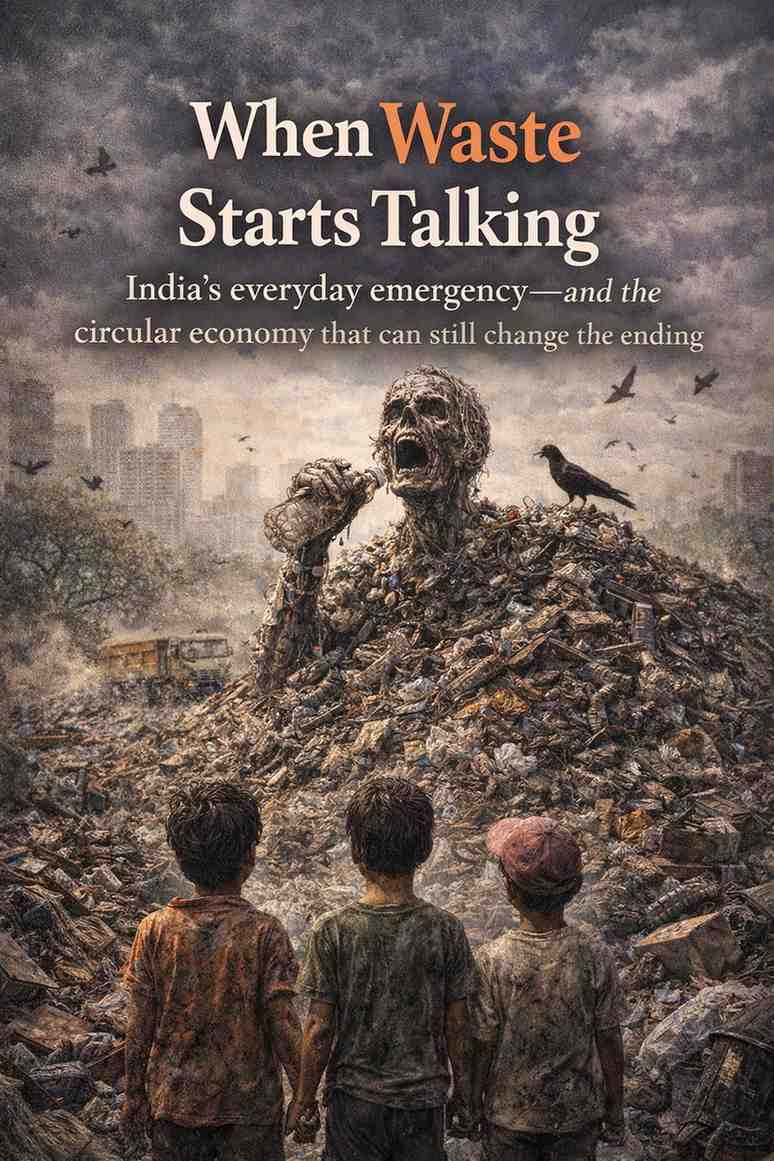
India’s everyday emergency—and the circular economy that can still change the ending
5:07 a.m. in Dharavi, where the city’s secrets are sorted by hand
At 5:07 a.m., Mumbai is not yet fully awake, but Dharavi is already at work. Priya ties her hair, folds a sari pallu over her head, and steps into a lane that smells like yesterday’s dinner, today’s hurry, and the quiet panic of “where will this go?”. She carries two sacks because she has learned—through hands, not through policy—that if everything is mixed, nothing is valuable. Even before the first school bell rings, she is touching the material truth of the city: plastic that can be sold, paper that can be rescued, metal that still has worth, and the rest that will rot, burn, or travel to a mountain of decay.
Priya does not speak in the language of conferences. She does not say “material recovery facility” or “post-consumer packaging” or “behavioural nudges”. She speaks in weight and smell and price. She knows which plastic fetches money and which plastic becomes a curse. She knows that a little food stuck inside a bottle can ruin a batch, and that one careless household can contaminate what ten careful households tried to segregate. She knows the truth that India often avoids saying aloud: the country’s recycling, for decades, has been carried by informal workers who were treated as if they were untouchable shadows rather than essential service providers.
A few kilometres away, Arjun watches a line of garbage trucks move like a slow procession. He works with the city, and the work has a way of changing a person. At first, he believed waste was a technical problem: collection, transport, processing, disposal. Then he started noticing the human geography of it. He began to see who lived closest to dump yards, who breathed the worst air, who worked without gloves, and who could afford to pretend the problem ended at the bin.
In Delhi, the skyline has its own unwanted monument—Ghazipur. When people say landfill, they imagine a contained place. Ghazipur is a mountain that should not exist, made of decades of what the city refused to look at. When methane pockets shift and refuse smoulders, it is not a “local nuisance”. It becomes a public-health event, a climate event, a dignity event. Waste, in India, has a way of refusing to stay in its lane.
The smell that follows people home
In the public imagination, waste management is still too often treated like a cleanliness campaign—something cosmetic, something to show visitors. But waste does not behave like a poster. It behaves like a force.
When plastics choke drains, a brief shower becomes knee-deep flooding. Streets turn into stagnant pools and traffic becomes an emergency; ambulances slow down; children splash through grey water; shopkeepers lift goods onto stools and pray the water stops rising. When mixed garbage sits at a street corner, it does not remain “a pile”. It becomes a breeding ground for flies and disease, a feast for animals, an invitation for open burning. When a landfill burns, its smoke does not politely stop at the boundary of poverty. It drifts into apartments and schools, into lungs that had no say in the matter.
Waste is also a time thief. It steals hours from women who manage household sanitation, from sanitation workers who spend a day around rot and sharp edges, from citizens who lose working days to illness that began with contaminated surroundings. It is not merely a matter of aesthetics. It is the everyday infrastructure of health, and when that infrastructure fails, public life weakens.
And yet, India’s most important waste lesson is also its most hopeful one: the same system that makes waste a disaster can make waste a resource—if it is redesigned.
Circular economy: a hard idea with a simple moral
The phrase “circular economy” is fashionable now, but the core idea is not complicated. It says: stop designing products and cities as if “away” exists. Reduce what is unnecessary. Reuse what still works. Recycle what can be recycled safely and economically. Recover value from what remains. Regenerate what has been depleted.
A circular economy is not an invitation to romanticise “waste-to-wealth” as a magic trick. It is a demand for discipline: at source, in collection, in separation, in markets, in law, and in the ethics of who bears the burden of our convenience. It challenges a society to ask a harder question than “how do we dispose?” It asks, “why did we create this waste in the first place, and who is paying for it with their lungs, their rivers, and their labour?”
For Priya, circular economy is not a seminar. It is a future in which her work becomes safer, steadier, and respected—because the city finally admits that the people who keep materials circulating deserve rights, not pity.
India’s policy engine: big intent, uneven execution
India has, without question, moved waste management from the margins to the centre of governance language. The Government of India’s initiatives in this sector have created momentum that did not exist a decade ago, and in many cities, that momentum has translated into real improvement. But the story is not a simple success narrative; it is a story of strong frameworks meeting uneven capacities.
Swachh Bharat Mission–Urban 2.0 signalled that Indian cities are expected to move towards “garbage-free” outcomes, with emphasis on source segregation, scientific processing, and the remediation of legacy dumpsites. The mission’s scale and funding architecture matter because waste management is capital-intensive: vehicles, transfer stations, sorting infrastructure, composting and biomethanation units, material recovery facilities, and the unglamorous systems of monitoring and enforcement that keep operations from collapsing into chaos.
India’s Solid Waste Management Rules, 2016 placed source segregation and scientific management at the heart of municipal responsibility. In the years that followed, the country’s regulatory posture sharpened further in areas that had long been treated as “too hard”, particularly plastics and e-waste. Extended Producer Responsibility frameworks—strengthened through amendments and rules in 2022—attempted to move part of the financial and operational burden from municipalities to producers, especially for plastic packaging and electronics. That shift is structurally important. It signals a policy understanding that a city cannot be forced to clean up an economy’s design failures forever.
There is also an organic-waste story that is sometimes underappreciated. Through programmes such as GOBARdhan, the policy intent is to turn wet waste and animal waste into value streams—biogas, compressed biogas, compost—so that the most abundant portion of municipal waste does not become methane in landfills. In parallel, India’s role in regional and multilateral conversations, including hosting the Regional 3R and Circular Economy Forum and the Jaipur Declaration, indicates that circularity is being framed not merely as sanitation, but as resource efficiency and economic resilience.
This is the strength of India’s approach: it has built a policy canopy wide enough to cover cities, industries, and citizens. It has signalled that waste is not a low-status municipal chore; it is economic governance.
The weakness is not the absence of policy. The weakness is the daily struggle to convert policy into habit and infrastructure into performance. Source segregation remains inconsistent across many cities, and when waste is mixed, it contaminates everything downstream. Composting plants receive plastics; recycling units receive organic sludge; processing economics collapse; and landfills remain the ultimate destination. Urban Local Bodies often operate under capacity constraints—staffing, budgets, enforcement powers, procurement quality, contract management—and waste management is precisely the kind of system that fails when daily discipline is missing. Even where rules exist, enforcement is often sporadic and politically sensitive, particularly when it requires confronting citizens and businesses who have grown used to dumping costs onto the public.
Perhaps the most ethically urgent weakness is the inconsistent integration of the informal sector. India’s recycling reality has historically been driven by waste pickers and small aggregators, but formalisation, when done poorly, can displace them rather than protect them. The circular economy cannot become a corporate compliance theatre in which paperwork improves while livelihoods collapse. The transition must be designed to include informal workers as rights-bearing partners, not as disposable intermediaries.
Indore’s discipline: what “clean” looks like when it becomes routine
Indore’s story is often invoked because it demonstrates a simple truth: systems change when daily compliance becomes normal. In Indore, the shift has been credited to door-to-door collection, citizen engagement mechanisms, complaint systems such as “311”, and an administrative culture that insisted on segregation and feedback loops. The point is not that Indore is perfect. The point is that the city treated waste management as a continuous operational system rather than a campaign.
Indore’s deeper lesson is social. Waste is managed not only by trucks and plants but by collective behaviour. When a city builds a culture in which households separate waste, institutions follow protocols, and penalties and incentives are consistent, the system becomes less fragile. When a city relies on occasional cleanliness drives and enforcement spikes, it becomes a theatre—and waste, like water, always finds the cracks.
India’s circular pioneers: where innovation meets daily reality
The phrase “waste-to-wealth” can easily become a slogan used to avoid uncomfortable questions about reduction and responsibility. But India does have an emerging ecosystem of enterprises and models that are turning circular economy from an idea into supply chains.
In Kanpur, Phool is often cited as an example of how an urban cultural habit—temple offerings—can be redirected from rivers and drains into products such as incense and other compostable or bio-based outputs. It is a story that connects faith, waste, livelihood, and pollution in a single loop. It is also a reminder that circular economy is not only about plastics and machinery; it is also about designing systems around human behaviour.
In the energy and mobility transition, companies such as Lohum represent another crucial frontier: batteries. As India accelerates electric mobility, the end-of-life story of batteries becomes central to resource security and environmental safety. Recycling and repurposing batteries is not merely an environmental service; it is an industrial necessity in a world where critical minerals are geopolitically sensitive.
In plastics, the efforts of organisations such as Banyan Nation and Lucro underscore how difficult “recycling” becomes when quality standards, contamination, and market acceptance are not addressed. Turning post-consumer plastics back into usable raw material is the hard work of circularity—less glamorous than awareness campaigns, more impactful than occasional clean-ups.
In organic waste management, organisations such as GPS Renewables highlight the logic that the most abundant waste stream—wet waste—should not be transported long distances to become landfill methane. Converting organic waste into biogas and energy is a step toward treating cities as resource ecosystems rather than consumption sinks.
Then there are decentralised models such as Saahas Zero Waste’s work in places like Marsur, Karnataka, which illustrates that circularity often performs better when systems are local, community-aligned, and designed to reduce transport and leakage. Decentralisation is not always easy, but it can be more resilient: fewer kilometres travelled by waste, fewer chances for mixing, and more visible accountability.
The significance of these Indian cases is not that they are “feel-good stories”. Their significance is that they answer the sceptic’s question: can circularity work in India’s conditions? They show that it can—when the system is designed around segregation, logistics, market linkage, and community participation.
Civil society: the bridge between policy and behaviour
In the Indian waste ecosystem, civil society is often the difference between policy that exists on paper and practice that exists in lanes.
Models such as SWaCH in Pune are frequently referenced because they attempt to integrate waste pickers into structured service delivery, acknowledging that the people who recover value from waste deserve recognition, identity, and stable work structures. Organisations such as Hasiru Dala in Bengaluru have worked on inclusion, livelihoods, and formal recognition for waste pickers, pushing against the tendency to treat informal workers as a temporary embarrassment rather than a permanent asset. In Delhi, groups such as Chintan have long engaged with waste picker rights, informal recycling systems, and public advocacy for safer and more equitable waste management.
These organisations do more than collect waste. They build trust, organise labour, and create the social legitimacy without which segregation collapses. They show that the circular economy is not only about materials; it is about people. A truly circular city cannot run on invisible labour.
What other nations did that India can adapt without pretending to be them
International examples matter not because India must imitate them, but because they clarify what “works” looks like when translated into incentives and systems.
Deposit-return systems in countries such as Denmark and Germany illustrate a powerful behavioural truth: people return bottles when it is easy, when there are return points everywhere, and when the deposit value makes throwing away feel irrational. The brilliance is not cultural; it is systemic. The design makes the responsible action the convenient action.
Japan’s reputation for disciplined sorting, and the example of places such as Kamikatsu, show how far community norms can go when a society decides that waste is not someone else’s problem. Sweden’s approach to waste-to-energy, often cited for its ability to reduce landfilling, reveals both potential and risk: energy recovery can reduce landfill dependence, but it must not become an excuse to continue producing wasteful products.
Other cited examples, such as smart bins and sensors used in cities like Prague to optimise collection and reduce overflow, highlight an operational dimension: when cities measure waste, they manage it better. When they do not measure, waste becomes a fog.
The transferable lesson from all these examples is not a technology. It is governance design: predictable rules, infrastructure that supports compliance, market mechanisms that reward correct behaviour, and enforcement that is consistent enough to shape habit.
The UAE: circular economy as national competitiveness and city branding
If India’s waste story is shaped by scale, informality, and uneven capacity, the UAE’s story is shaped by rapid infrastructure delivery, policy coherence, and a strong linkage between environmental performance and global-city reputation.
The UAE Circular Economy Policy 2021–2031, led by the Ministry of Climate Change and Environment, frames circularity across priority sectors such as sustainable infrastructure, transport, manufacturing, and food. This matters because it places circular economy within national economic planning rather than leaving it as a municipal sanitation function. It signals that resource efficiency and waste reduction are part of how the UAE imagines future competitiveness.
The UAE has also articulated national waste diversion ambitions, including high diversion targets for municipal waste away from landfills. In practical terms, one of the most visible components of UAE strategy has been investment in waste-to-energy infrastructure, supported by public-private partnerships and high-capex execution.
Sharjah’s waste-to-energy project—linked to BEEAH and Masdar—has been highlighted as a regional landmark, with a narrative that combines landfill diversion, energy generation, and recovery of metals from residual streams. Dubai’s Warsan waste-to-energy plant is another flagship project, described as operating at very large scale, processing thousands of tonnes of waste per day, generating significant electricity, and integrating metal recovery and ash handling into broader industrial loops.
Alongside these infrastructure plays, Dubai Municipality’s Circle Dubai initiative has been positioned as a community-driven push aligned with the Dubai Integrated Waste Management Strategy 2041, reflecting an understanding that infrastructure alone cannot deliver circularity unless citizen behaviour and segregation improve.
The strengths of the UAE approach are clear. Policy direction tends to translate into projects rapidly. Infrastructure is delivered at speed. Partnerships mobilise capital. The public narrative ties waste management to liveability and global competitiveness.
The risks are also clear, and they are not unique to the UAE. Waste-to-energy, while useful for residual waste, can become a convenience trap if reduction, reuse, and recycling do not grow with equal seriousness. If an economy becomes dependent on feeding incinerators, it can lose appetite for upstream redesign. A mature circular economy must eventually move beyond processing waste to preventing it.
Masdar City: a brief case-study in “designing sustainability into a place”
Masdar City in Abu Dhabi is often presented as an urban laboratory where sustainability is designed into systems rather than bolted on later. Its sustainability reporting has highlighted ongoing efforts to improve waste diversion through composting and recycling, positioned as part of a broader approach that includes energy efficiency and low-carbon urban planning.
Masdar City’s most important relevance to the waste conversation is conceptual: a circular city is not built by a single waste plant. It is built by design choices that reinforce each other—materials selection, procurement standards, reuse culture, convenient segregation infrastructure, and operational accountability. When circularity is designed into the city’s DNA, waste management becomes a predictable function rather than an emergency response.
For India, the Masdar City lesson is not “build a new city”. It is “treat circularity as design, not as cleanup”.
The oldest circular economy: indigenous and tribal lessons we ignore at our own cost
Long before circular economy became fashionable, many tribal and indigenous communities lived circularity as a survival ethic. The Maria tribe in Bastar, Chhattisgarh is cited as one example in the broader reflection that such communities used biodegradable materials, repaired and reused, and treated “waste” as something that should safely return to nature.
Across India’s diverse indigenous cultures—and in indigenous cultures elsewhere—there is a recurring logic that modern consumption often forgets. Materials are not cheap because they are “available”; they are precious because they are borrowed from ecosystems. When communities treat the environment as kin rather than a warehouse, waste becomes morally unacceptable, not merely inconvenient.
This is not about romanticising poverty or pretending traditional life was perfect. It is about recognising that indigenous circularity offers design principles that modern economies can translate: use local and biodegradable materials where possible, build repair culture, share resources, reduce unnecessary packaging, and treat disposal as a last resort. The circular economy, at its best, is modern science meeting ancient restraint.
What must happen next, if this story is to end differently
The next phase of India’s waste transition must move beyond grand announcements and convert into daily reliability. That transformation will not come from one miracle technology. It will come from a series of interconnected shifts that keep the system from leaking.
Source segregation has to become non-negotiable, not only encouraged. Without it, the economics and safety of almost every downstream solution collapses. Wet waste must be treated as a resource stream through local composting and biogas pathways, because transporting rotting waste long distances is both inefficient and hazardous. Material recovery facilities must be built and operated like core public infrastructure, with skilled staffing and transparent monitoring. Extended Producer Responsibility must be enforced as real accountability, not as paperwork, because producers must share the cost of the waste their products generate. Informal workers must be integrated as formal partners with protection, recognition, and stable livelihoods, because a circular economy without dignity is exploitation dressed up as sustainability.
Waste-to-energy should be used wisely, as a solution for residual waste that cannot be recycled or composted, not as a shortcut that undermines reduction and reuse. Public procurement should be used strategically, because when government buys circular products and insists on recycled content and repairable designs, markets shift. Measurement and transparent dashboards should become routine, because what is not measured is not managed, and citizens will not trust what they cannot see. Education must treat circularity as a life skill, so that children learn repair, reuse, and segregation as normal behaviour rather than moral preaching.
Above all, the cultural idea of “modernity” must be redefined. Modernity cannot mean a life designed around disposability. A truly modern society is one that can enjoy comfort without exporting its costs to landfills, rivers, and invisible workers.
The last image: a lane that smells different
Imagine Priya again, in the same lane, months from now. The bin is not overflowing because collection is predictable. Two streams remain separate because households learned that segregation is not charity; it is civic discipline. Wet waste is processed locally, turning into biogas or compost instead of methane and stench. Dry waste is channelled into recovery pathways that treat materials as assets. Priya’s work becomes safer, more dignified, less dependent on luck and exploitation. Her child coughs less. The drain does not choke during the first heavy rain. The lane begins to smell like a place people can live in, not merely survive in.
This is the real promise of waste management and circular economy. It is not a slogan. It is a redesign of public life.
Waste is what a society produces when it refuses to take responsibility for its own habits. Circularity is what a society builds when it finally decides to grow up.
And if India and the UAE—two places with very different contexts—are pointing to a shared lesson, it is this: infrastructure matters, policy matters, innovation matters, and culture matters. But the decisive shift is moral. It is the moment a city stops saying, “throw it away,” and begins asking, “where does it go, who pays for it, and how do we keep it in use?”
When waste starts talking, the question is whether we will finally listen—and redesign the story before the ending is written in smoke.






Add a Comment