
Prof Ujjwal K Chowdhury
How a faraway conflict in West Asia is tightening household budgets, rattling markets, testing diplomacy and forcing India to confront the cost of global dependence
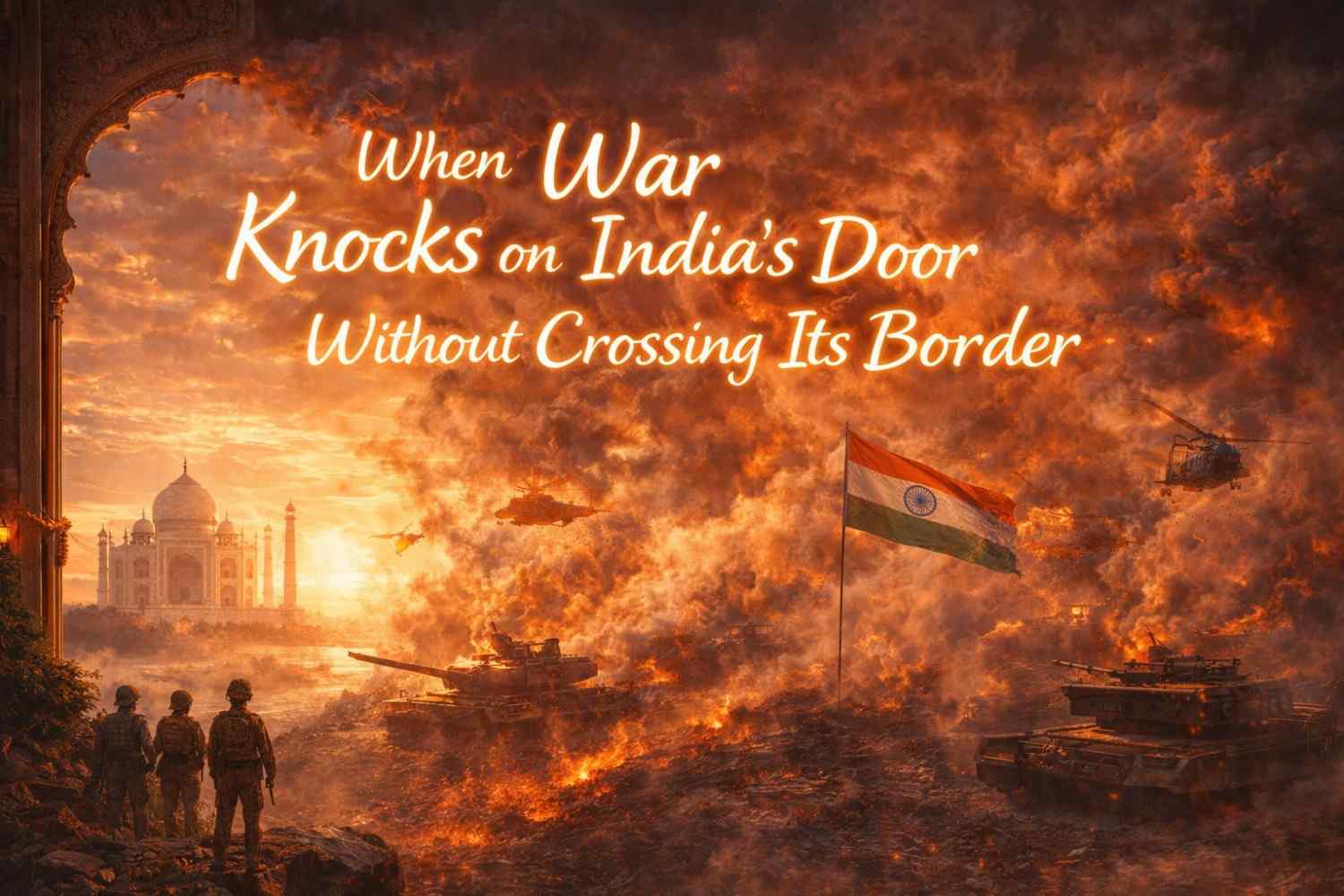
War used to arrive with warning.
It came with the rumble of tanks, the scream of sirens, the grainy urgency of radio announcements, the sudden darkening of city lights, the long lines outside ration shops and the whispered fear that the border had moved closer. People knew when war had begun because it had a visible geography. It had fronts, trenches, uniforms, maps and marching orders. It had a place.
That certainty has collapsed.
In the twenty-first century, war does not always need to cross your border to enter your life. It can remain geographically distant and still alter what you pay for fuel, what you spend on food, how much your currency holds, whether your export order arrives on time, whether your son working in the Gulf feels safe, whether your government can keep inflation under control, and whether tomorrow feels stable enough to plan for.
That is the deeper Indian story of the ongoing US-Israel-Iran war.
The missiles may be streaking across West Asian skies. The strategic calculations may be unfolding in Washington, Tel Aviv and Tehran. The fire may be burning around oil routes, military bases, diplomatic red lines and maritime chokepoints. But the consequences are travelling much farther than the battlefield. They are moving through crude markets, shipping lanes, insurance premiums, investor nerves, exchange rates, airline routes, labour flows and public psychology. They are arriving in places that will never appear on a war map.
They are arriving in India.
In a modest apartment in Kolkata, a family sits down for dinner and does the arithmetic that millions of Indian households know too well. Petrol has become dearer. The LPG refill feels heavier than before. The price of vegetables has shifted again. The son who works in the Gulf has called twice this week instead of once. The father, who runs a small trading operation, has started hearing the words that businessmen dread because they sound mild but mean danger: delay, risk, hold, uncertain. Nobody at the table says the word war. Nobody needs to. War is already there, seated quietly between the dal and the rice.
That is how modern conflict works. It enters not only through armies but through costs. Not only through destruction but through disruption. Not only through headlines but through habits.
And for India, this is not a side story in foreign affairs. It is a test of economic resilience, social stability, diplomatic agility and developmental maturity. This war, though not India’s in authorship, is already India’s in consequence.
A Battlefield With No Frontline in India, Yet No Escape Either
There was a time when distance offered emotional comfort. A war far away was tragic, certainly, but still far away. Today distance has lost much of its protective value. In an interconnected world, geography is no longer a sufficient shield. Energy flows across oceans. Financial sentiment crosses continents in seconds. Supply chains depend on multiple jurisdictions. Labour migrates. Capital reacts instantly. Rumour itself can move markets before a single official announcement is made.
India’s rise has brought many benefits from this interdependence. It has also increased exposure to external shocks. The same networks that carry growth also carry panic. The same integration that helps a country expand also makes it more vulnerable to geopolitical aftershocks. India has become too large to remain isolated from global turmoil, but not yet insulated enough to absorb it without strain.
That is the paradox of a rising power in a turbulent world. Success deepens entanglement. Entanglement enlarges risk.
A war involving Iran was always likely to matter to India because West Asia is not a distant theatre in the Indian imagination. It is an energy lifeline, a labour corridor, a diplomatic zone of delicate balancing, a maritime space of strategic concern and a region woven into the everyday survival of millions of Indian households. The Gulf is not just abroad. It is economically intimate. Its tremors echo in Indian kitchens, markets, ports, ministries and bank accounts.
So when the conflict escalates there, India cannot watch as a detached spectator. It has to count the likely costs almost immediately. How will oil react? Will shipping be affected? Will remittances come under stress? Will aviation routes become longer and costlier? Will markets punish emerging economies? Will the rupee weaken? Will inflation become harder to contain? Will the state have to spend more on cushioning the blow? Will growth lose speed just when jobs are desperately needed?
These are not theoretical questions. They are the real domestic vocabulary of a distant war.
Oil Speaks First, and India Hears It Loudly
In every major West Asian conflict, oil becomes the first language of anxiety.
This is neither new nor surprising. Oil remains one of the world economy’s most politically sensitive commodities, and the Gulf remains one of its most combustible regions. Iran’s location gives it outsized strategic importance because any threat to the Strait of Hormuz immediately disturbs global calculations. One does not even need a total closure of energy routes to trigger consequences. In today’s nervous markets, fear is enough. Speculation can do the rest.
For India, this matters with almost punishing immediacy. The country imports the bulk of its crude oil. That dependence means global volatility becomes domestic discomfort very quickly. A spike in crude prices is not confined to corporate balance sheets or ministerial briefings. It enters the bloodstream of everyday life. Fuel costs rise. Transport becomes more expensive. Logistics firms recalibrate. Food prices feel the pressure. Fertilizer costs shift. Industrial input costs move upward. Households begin adjusting before policymakers even finish their internal meetings.
A tea seller in North Kolkata does not need to study geopolitical analysis to understand the shock. He only needs to notice that milk costs more, transport costs more, cooking fuel is no longer easy to absorb, and the customers who once bought two rounds of tea now pause after one. He hesitates before raising the price by a rupee. That hesitation is the human face of global conflict. It is the moment when a war thousands of kilometres away becomes an ethical question in a local business decision.
A truck owner moving produce from a wholesale market sees diesel as destiny. A restaurateur cannot ignore the rising cost of edible supplies that arrive by road. A construction firm knows that petroleum-linked inputs affect margins. Even a household that rarely thinks about oil discovers that oil has been invisibly present in almost everything it buys.
That is because oil is not one commodity among many. It is an underlying cost embedded inside transportation, production, distribution and movement itself. When oil becomes uncertain, the economy does not merely pay more for fuel. It pays more for normalcy.
The Price Rise That Does Not Explode but Slowly Occupies Life
Bombs terrify because they are dramatic. Inflation weakens society because it is relentless.
If this war continues to keep energy markets on edge, India’s greatest domestic challenge may not be a single sudden shock but the slower erosion caused by rising prices. Inflation is a quieter violence. It does not arrive with flames. It accumulates through weekly purchases, monthly bills, postponed expenses and shrinking comfort. It does not wound all at once. It wears down.
The burden is not evenly shared. The affluent can reorganize. The poor are forced to absorb. The lower middle class, perhaps India’s most economically anxious social category, is squeezed from both sides. It is too proud to call itself distressed and too pressured to feel secure. It is precisely this class that experiences war most intimately through inflation.
In an ordinary urban household, the signs begin small. The petrol bill grows. The grocery basket costs more than expected. Gas cylinder refills are no longer shrugged off. Eating out becomes occasional. The replacement of a broken appliance is delayed. A school-related purchase is postponed. The monthly budget starts resembling a battlefield of subtractions.
In rural India, the story is harsher. A farmer does not experience inflation as an abstract number debated on television. He experiences it as a question of diesel, transport, fertilizer, pesticide, crop viability and debt. If fuel prices rise and agricultural inputs become costlier, the burden travels quickly through cultivation decisions. Produce may become dearer to transport. Margins narrow. Borrowing becomes riskier. Households that are already vulnerable become more fragile.
This is how distant war reshapes the social atmosphere of a country. It makes citizens more cautious, more defensive, more tired. They may not know the exact contours of the conflict, but they know life has become more expensive and more uncertain. That knowledge alone can change the emotional rhythm of an economy.
When millions of people begin spending less freely, the economy itself turns hesitant. Consumption slows. Small businesses feel the pinch. Inventories remain unsold for longer. Job creation loses pace. Growth starts acquiring a layer of anxiety.
Inflation, then, is not only a monetary phenomenon. It is a social mood. It teaches a population to think in terms of survival rather than aspiration. And for a developing country that still needs confidence, appetite and mobility to grow, that psychological change can be as damaging as the price rise itself.
Trade Routes Are Not Just Lines on Maps. They Are India’s Daily Bread.
The global economy spent decades preaching the virtues of seamless movement. Goods would move efficiently, cheaply and on time. Production would be optimized across continents. Inputs would arrive when needed. Consumers would benefit from speed. Distance, we were told, had been defeated.
War has exposed the arrogance of that assumption.
All modern supply chains are built on a hidden faith in predictability. Not perfect stability, but enough stability to permit planning. The moment war injects uncertainty into strategic corridors, shipping lanes and regional security calculations, that predictability begins to unravel. Even without total closure, trade can become slower, costlier and more complicated. Insurance premiums rise. Freight becomes more expensive. Routes get re-evaluated. Delivery timelines lose credibility. Traders begin inserting caution into contracts. Manufacturers begin worrying about components that were once taken for granted.
A manufacturer in Chennai waiting for imported parts does not need a missile to land nearby to feel the war. A delay notification is enough. An exporter in Mumbai who finds buyers suddenly more tentative is already living with the conflict’s consequences. A logistics planner recalculating timelines because a route has become risk-prone is doing the invisible work of adapting to war.
India’s ambitions in manufacturing and exports make this especially significant. The country wants to become a major global production base, a reliable alternative in uncertain times, a node in restructured supply chains. Yet that aspiration depends on the world believing that India can offer dependability amid chaos. A wider regional war complicates the broader environment in which such confidence is built.
And yet, buried inside that challenge lies an opportunity. Whenever conflict disturbs existing channels, businesses begin searching for alternatives. That search can favour countries that combine scale, political stability and execution capacity. India has long argued that it can be one such country. But moments like this demand proof, not rhetoric. They require functioning ports, efficient customs, energy reliability, transport infrastructure, skilled labour and policy coherence.
A war elsewhere can therefore do two things at once. It can disrupt India’s present flows while also inviting India to become more important in future flows. Whether India captures that possibility depends not on external sympathy but on domestic preparedness.
When the Rupee Becomes a Barometer of Fear
Currencies are among the first instruments through which geopolitical fear announces itself.
Investors facing uncertainty move toward what they perceive as safer assets. Emerging market currencies often come under pressure. The US dollar strengthens. The rupee feels the strain. Once that happens, imports become more expensive, especially imported fuel. A weaker rupee therefore has a cruel multiplier effect. It does not merely reflect external instability. It amplifies its domestic consequences.
In Mumbai’s dealing rooms and on countless phone screens across India, the war becomes visible through numbers before many citizens fully grasp the strategic context. Markets begin fluctuating. Equities react. Bond sentiment shifts. Foreign investors grow cautious. Business plans are rethought. Expansion decisions are delayed.
Financial volatility is often treated as a concern of the wealthy. That is too narrow a reading. Markets shape business confidence. Business confidence shapes investment. Investment shapes hiring. Hiring shapes household security. What begins as investor nervousness can travel steadily toward employment anxiety.
A young professional checking a mutual fund statement may only see temporary loss. A company considering a new plant may see reason to wait. A startup hoping to raise capital may find the room suddenly colder. A mid-sized exporter may worry about currency risk. The chain is long, but its effects are real.
War, therefore, alters not only commodity prices but the atmosphere in which economic decisions are made. It changes the willingness to take risks. It makes caution look rational. And when caution becomes the dominant instinct in finance and enterprise, economies lose energy even without entering formal crisis.
The State Must Cushion the Blow Without Losing Its Balance
In such moments, the state becomes the ultimate site of expectation. Citizens look to government not merely for statements but for insulation. They expect some kind of shield against price rise, against panic, against wider instability. The challenge is that governments facing an imported shock do not control the original source of the problem. They can only manage the transmission.
That is harder than it sounds.
If fuel prices rise sharply, should taxes be cut? That eases pressure but reduces revenue. Should subsidies expand? That may protect households but strain public finances. Should strategic reserves be used? That offers temporary relief but cannot be a permanent solution. Should monetary policy stay tight to contain inflation? That may slow growth. Should it soften to support demand? That may allow price pressures to spread.
Every option has a cost. Every intervention solves one problem while creating another. Governance in wartime spillovers is therefore an art of incomplete choices.
At the Union government level, such a conflict rapidly becomes a whole-of-government challenge. Finance officials worry about inflation and deficits. Petroleum officials monitor crude. Commerce officials study trade implications. External affairs tracks diplomatic fallout. Civil aviation watches routes. Shipping follows maritime risk. Defence watches strategic spillovers. Agriculture feels the pressure through input costs. No ministry can treat the issue as external once the economic ripples begin.
The deeper difficulty is developmental. India is still a country with immense welfare needs, infrastructure ambitions and employment pressures. When external conflict forces additional fiscal cushioning or strategic expenditure, there is always a silent question in the background: what developmental priorities will have to wait?
That is one of war’s least discussed cruelties. It often compels states far from the battlefield to spend political attention and public money on emergency stabilization rather than long-term human advancement.
Guns in the Distance, Pressure on Development at Home
Every major geopolitical shock sharpens security thinking. For India, that has obvious logic. The country sits in a contested region, has difficult borders, significant maritime interests and expanding strategic aspirations. A major West Asian war cannot be viewed simply through the lens of oil and trade. It also raises questions about naval security, intelligence readiness, regional alliances, defence procurement and strategic autonomy.
That almost inevitably means a stronger security orientation.
There is practical sense in that. No serious state can ignore a turbulent geopolitical climate. But there is also a moral tension. In developing countries, every rise in strategic expenditure occurs in the shadow of unfinished social justice. Education needs money. Public health needs money. Climate adaptation needs money. Rural transformation needs money. Urban infrastructure needs money. Employment generation needs money.
War, even distant war, can shift the grammar of public spending from human development toward security preparedness.
And yet, as always, there is a paradox. Greater security awareness can also spur domestic industrial opportunity. Defence manufacturing may receive more attention. Indigenous capability may be accelerated. Strategic industries may gain orders. Certain segments of the economy may actually expand under geopolitical tension.
That is the bitter duality of war economics. It depresses society broadly while rewarding select industries sharply. The question is whether a nation can use the industrial opportunities without becoming captive to a militarized imagination.
India’s real challenge is not choosing between security and development. It is refusing to let one devour the other.
The Gulf Is Not Abroad for India. It Is Family.
Few regions are as emotionally and economically linked to India as the Gulf.
For decades, millions of Indians have worked across Gulf countries in construction, healthcare, retail, hospitality, logistics, domestic work, engineering, energy, services and management. Their remittances have sustained families, built homes, funded education, paid for treatment, enabled weddings, lifted social status and injected money into local economies far from metropolitan India. In many districts across the country, the Gulf is not an abstract region. It is a recurring presence in family history and daily aspiration.
This is why any major West Asian war produces a uniquely Indian kind of anxiety. It is not just about oil. It is about people.
As news of escalation spreads, Indian families begin watching events not as distant spectators but as households with someone at stake. A worker in Dubai, Doha, Muscat, Riyadh, Kuwait City, Abu Dhabi or elsewhere becomes the focal point of emotional calculation. Is the situation worsening? Will travel become difficult? Could jobs be affected? Will salaries continue on time? Is there panic on the ground? Will evacuation be needed? Should money be sent home more quickly?
Remittances are usually described in macroeconomic language, but at the household level they are deeply personal. They are the difference between debt and relief, between dropping out and staying in school, between untreated illness and care, between a leaking roof and a repaired one. Any threat to that flow creates fear well beyond the formal labour market.
There is another layer of risk. If economic uncertainty or regional instability begins affecting employment in Gulf economies, India could face returning workers at a difficult time. Reintegration is not easy. Skills are not always portable. Local labour markets are already under pressure. The emotional prestige of overseas work can collapse into domestic insecurity very quickly.
So when West Asia burns, India does not only think about barrels and shipping lanes. It thinks about its people. It thinks about voices on late-night calls saying, “Everything is fine for now,” with the kind of pause that tells families everything may not be fine at all.
Even the Sky Becomes More Expensive in Wartime
Modern war does not remain on land or sea. It redraws the sky as well.
As regional risk grows, air routes can lengthen, airspaces can become restricted and operational decisions can turn cautious. Flights take longer routes. Fuel consumption rises. Costs go up. Schedules become more fragile. Passengers pay more. Airlines absorb or pass on the burden. Aviation-linked cargo becomes less predictable.
For a country like India, where aviation is central not only to business and tourism but also to labour mobility and family continuity, this matters more than it may first appear. A migrant worker returning home may find fares unaffordable. A family emergency may become harder to navigate. Corporate travel costs increase. Logistics related to air cargo face disruption.
What appears on paper as route adjustment can become, in lived reality, a delayed reunion, a postponed journey, a missed connection or a higher debt.
This is another way modern war enters civilian life. It lengthens not only flight time but uncertainty itself.
India’s Diplomacy Walks a Tightrope
If economics is the immediate domestic story, diplomacy is the strategic drama behind it.
India’s foreign policy has, over the years, tried to preserve strategic autonomy in an increasingly polarized world. It has deepened ties with the United States, maintained close defence relations with Israel, retained an interest in connectivity and engagement involving Iran, relied on Gulf countries for energy and labour linkages, and sought to navigate the multipolar order without becoming trapped in rigid blocs.
A war among actors central to India’s external relationships tests this approach severely.
To tilt too visibly toward one side could alienate another important partner. To remain too passive could make India appear timid or opportunistic. To speak in moral language without strategic calculation would be naive. To act only in strategic language without moral clarity would diminish credibility.
This is not diplomacy in comfortable times. It is diplomacy performed on a narrow ledge above multiple consequences.
India’s task is to preserve relationships, protect access, support de-escalation, defend its interests and maintain flexibility all at once. It must talk peace without appearing powerless. It must guard national interest without sounding cynical. It must protect energy and labour linkages without sacrificing its image as a responsible global actor.
That is particularly difficult at a time when the wider world itself is changing. The international system is more fragmented, more transactional and more unstable than it was a decade ago. Old certainties are fading. Power is diffusing. Middle powers have greater room in some moments and less in others. For India, this means diplomacy is no longer merely a matter of prestige. It is increasingly a matter of domestic economic security.
A country that mishandles external balancing may pay the price internally through fuel, trade, remittances and market sentiment.
The First Casualty Nobody Mentions Enough: Sustainability
War does not only threaten peace. It also undermines the future.
Whenever major conflict drives energy insecurity, long-term climate goals are among the first casualties. Governments under pressure prioritize immediate access to fuel. Fossil energy regains strategic urgency. Environmental transitions slow. Public debate shifts from sustainability to survival.
India, which has tried to position itself as both a developing economy and a responsible climate actor, faces a difficult contradiction here. On the one hand, it needs affordable and reliable energy to protect growth and shield citizens from external shocks. On the other hand, every return to conventional dependency deepens future vulnerability.
This is not just about global warming as an abstract future danger. It is about present resilience. A country overexposed to imported fossil turbulence is a country permanently vulnerable to external conflict. Clean energy, domestic generation, storage capacity, transport electrification and diversified supply are not merely ecological aspirations. They are strategic defences.
Yet war makes that argument harder in the short term. When prices surge, governments are tempted to prioritize immediate relief over structural transition. Citizens facing inflation naturally think first about affordability, not carbon intensity. Industries under pressure resist new environmental costs. Political attention moves toward firefighting.
That is how sustainability becomes the invisible casualty of conflict.
The danger for India is clear. If each geopolitical crisis pushes the country back toward old energy insecurities, it will remain trapped in a cycle of dependence. It will spend the future reacting to shocks rather than outgrowing them.
True resilience requires using crisis as a reason to accelerate transition, not postpone it.
Could Crisis Also Create a New Opening for India?
History rarely offers clean opportunities. It offers troubled openings.
This conflict may expose India’s vulnerabilities, but it also reveals where India could grow stronger. As companies rethink geopolitical concentration, as supply chains seek diversification, as investors look for large and relatively stable destinations, India could gain. It has scale, market depth, talent and strategic relevance. In a world hungry for dependable alternatives, those are powerful assets.
But opportunity in geopolitics is never automatic. It belongs to countries that are ready when disorder creates space. India must therefore prove that it can convert external uncertainty into internal reliability. That means ports that move faster, policies that remain stable, infrastructure that works, logistics that improve, and industrial ecosystems that can respond quickly.
There is also an opportunity at the level of national strategy. A war-induced energy scare can become the argument for faster renewable deployment, better storage systems, stronger strategic reserves, more resilient public transport, local manufacturing in key sectors and a deeper understanding that economic sovereignty in the twenty-first century is not autarky but resilient interdependence.
India’s future advantage will not come from pretending it can detach from the world. It will come from becoming less breakable within it.
The Most Powerful Economic Force in a War Is Fear
In the end, perhaps the most significant consequence of a distant war is not any one commodity spike or market reaction. It is fear.
Fear changes consumer behaviour. Fear delays investment. Fear weakens demand. Fear spreads through rumour. Fear makes families save instead of spend. Fear makes firms postpone recruitment. Fear causes traders to become conservative. Fear teaches society to live defensively.
At a tea stall, a customer decides against an extra order. In a wholesale market, a trader reduces the scale of a purchase. In a small office, an owner delays a new hire. In a village, a family postpones repairing the house. In a city, a salaried couple postpones travel or an appliance purchase. None of these decisions looks historic on its own. Together they become the social economy of war.
This is why modern conflict is so insidious. It does not only destroy what exists. It freezes what might otherwise have become possible.
It reduces momentum. It narrows imagination. It makes a society that was moving forward start walking more carefully, then more slowly.
India’s Real Question Is Not Whether It Can Survive This Shock
India has survived many shocks. It has endured wars, oil crises, financial distress, sanctions, pandemics and climatic disasters. It has repeatedly demonstrated a capacity to absorb trauma and continue. That resilience is real and important.
But survival alone is no longer enough. The more urgent question is whether India can use each shock to reduce the next one’s power over it.
The ongoing US-Israel-Iran war is a warning in that sense. It reveals how vulnerable a large developing nation remains to energy dependence, maritime insecurity, currency pressure, trade fragility and external labour exposure. It also reminds India that economics, security, diplomacy and sustainability are no longer separate policy silos. They are different names for the same national challenge: resilience.
The lesson is not withdrawal from the world. India cannot and should not retreat into isolation. Its future depends on deep global engagement. But engagement without buffers is exposure. And exposure without preparation is risk.
So the real task before India is larger than crisis management. It is structural strengthening. It means diversifying energy sources, deepening strategic reserves, accelerating clean transition, protecting overseas workers, enhancing logistics resilience, building stronger manufacturing ecosystems, improving fiscal flexibility and practicing diplomacy with both intelligence and nerve.
This war is not merely asking India how it will respond today. It is asking what kind of country India is trying to become by the next crisis.
When the Headlines Move On, the Costs Will Remain
The headlines will eventually change. They always do. Another summit, another election, another domestic controversy, another spectacle will push this conflict downward in the news cycle. But ordinary people will continue to live with its consequences long after television studios lose interest.
The tea seller will still be adjusting his prices. The farmer will still be recalculating input costs. The migrant family will still be waiting anxiously for steady news from abroad. The exporter will still be watching freight. The policymaker will still be balancing inflation against growth. The young investor will still be reading uncertainty in markets. The middle-class household will still be deciding what to postpone.
This may be the defining image of our age: a war without visible proximity but with intimate consequences, a battlefield without maps inside India and yet no Indian life fully outside its economic reach.
The missiles are not falling on Indian cities. Yet the war has entered Indian homes.
It has entered through the fuel bill, the kitchen budget, the remittance call, the freight delay, the stock market swing, the weak rupee, the uneasy ministry note, the longer flight path and the shrinking confidence with which families plan the future.
And perhaps that is the hardest truth modern geopolitics has forced upon us. No war is truly distant anymore. Not when oil is strategic, trade is fragile, labour is transnational, capital is nervous and climate transition is unfinished. Not when the world is this connected and this combustible at the same time.
India stands at a serious moment, not because it controls this conflict, but because it must now demonstrate how a large, ambitious democracy responds to the instability of others without losing its own developmental direction.
That requires calm, not denial. Preparation, not panic. Strategic imagination, not short-term patchwork. It requires a country that does not merely endure shocks but learns from them with discipline.
The question is no longer whether a distant war can touch India. It already has.
The real question is whether India will allow that touch to remain a recurring wound, or turn it into the reason to build a stronger, more self-assured and less vulnerable future.
That choice, unlike the war itself, is still ours.
Top of Form
Bottom of Form





Add a Comment