What This Story Is Really About
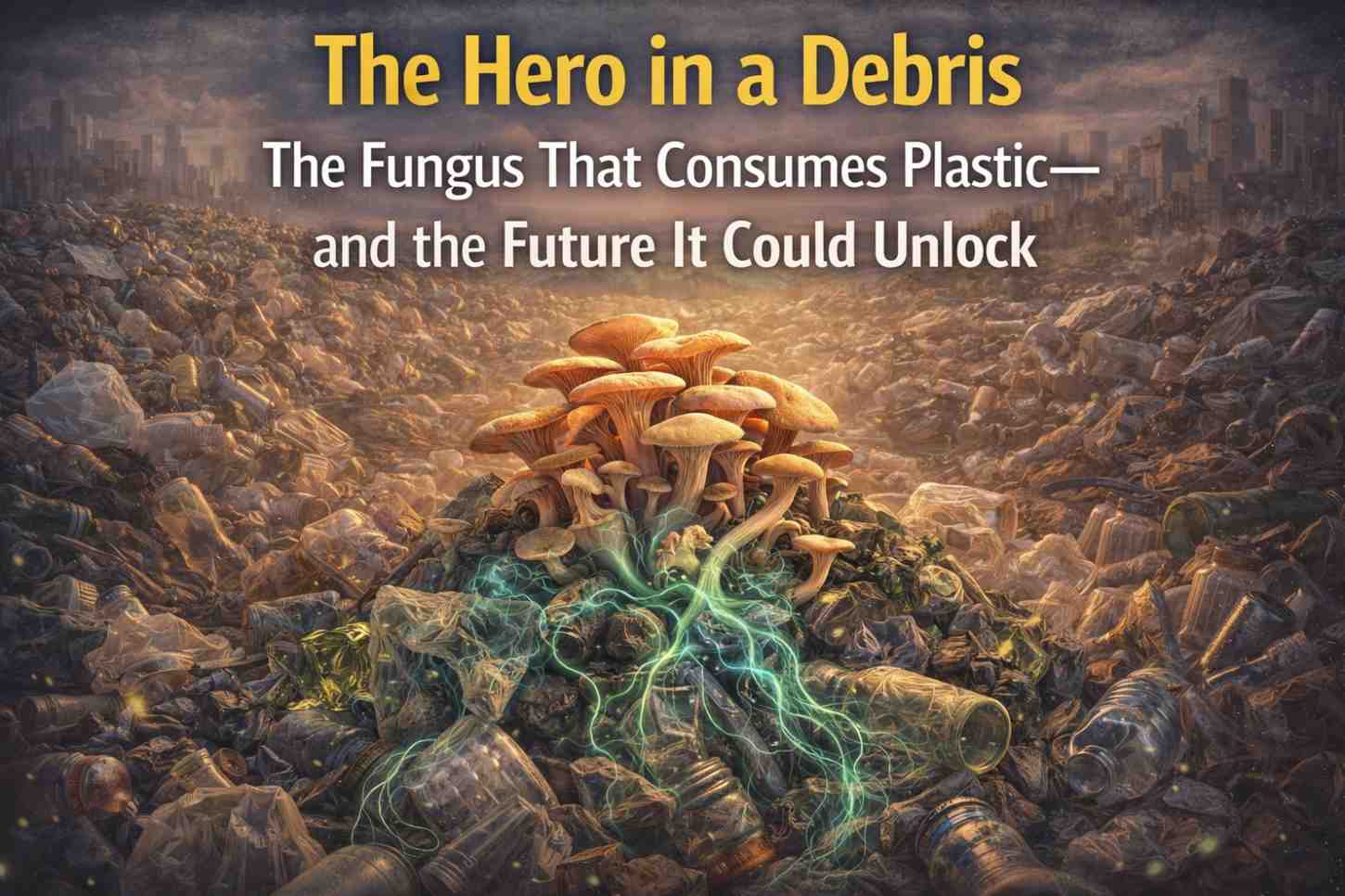
It all begins in a place we usually ignore: a landfill. Not a glossy innovation lab with infrastructure created by investing millions of dollars. It’s not even in a university incubator or a climate summit stage, where stories on sustainability can emerge. In fact the story began in an ubiquitous municipal dump site near Islamabad—layered with rot, dust, heat, and other unwanted variables. In that harsh chemistry of neglect, a fungus quietly evolved its own strategy for survival: by feasting on discarded plastic.
Called Aspergillus tubingensis, this fungus was found doing what sounds impossible in everyday language: breaking down a type of plastic called polyester polyurethane. This is the polymer hiding in plain sight in modern life—foams, insulation panels, furniture cushions, car interiors, shoe soles.It is also, in waste form, one of the most difficult plastics to deal with.
The story of Aspergillus tubingensis is a veritable reminder that the solutions to some of our biggest environmental problems might already exist in nature, waiting for us to discover them.
Importantly, Nature plans for healing itself, and it involves a tiny, hungry fungus with an extraordinary appetite.
Why This Matters Now: Plastic Has Become a Planetary Systems Crisis
From time immemorial, plastic has been regarded as a curse on the whole dimension of sustainability. In fact plastic has become a planetary systemic problem, a tough polluter that spoils the water we drink and the air we breathe.
Globally, plastic production and use has surged to roughly 435 million tonnes in a single year. Global plastic waste generation has crossed 350 million tonnes a year, and the share that actually gets recycled remains stubbornly low—around 9 percent once we account for losses and inefficiencies. The rest is burned, buried, dumped, or simply disappears into the environment, thus becoming a living nightmare.
Every year, tens of millions of tonnes of plastic leak into aquatic ecosystems, rivers and coasts. Worse still, fisheries and food chains carry the fragments forward. And plastic is no longer merely “out there.” It has been detected inside the human body too, including in blood—an unsettling reminder that what we throw away does not stay away.
Polyurethane that sits at the centre of this mess is rarely treated as a recycling priority because it is often composite-heavy, chemically stubborn, and logistically awkward. It ends up landfilled or incinerated—two methods that do not solve the problem as much as relocate it across time and geography. Landfills store it for decades. Burning can release toxic emissions.
The Discovery of a fungus at the dump site: Nature’s Experiment, Not a Lab Invention
The significance of the landfill discovery is not that scientists “created” a plastic-eating organism. The significance is that they noticed nature already experimenting—adapting to the world we have made.
A team of researchers including Dr Sehroon Khan from the Chinese Academy of Sciences was sifting through waste, following an intuitive thought that nature in its infinite adaptability might have already started to fight back.
And his hunch was correct: Among the decaying organic matter and discarded synthetic debris, the researchers found a species of fungus not just surviving but thriving on the surface of discarded plastic films. This fungus is a common black mold which has the dubious distinction of spoiling fruit. But never before was this fungi linked to the rapid degradation of such tough, man-made material called plastics.
The researchers then brought samples back to the lab. Here they began a series of meticulous scientific experiments to understand the remarkable capabilities of this organism.
Controlled lab conditions produced astonishing results. The fungus just didn’t nibble away at the plastic but it aggressively broke it down. The secret lay in its unique biological mechanisms: the fungus secretes powerful enzymes such as sweet-tasting esterase and lipase, that attack and break down the strong chemical bonds holding the long ploymer chains of polyurethane together.
Once these bonds weaken, the fungus uses its physical strength—it’s threadlike mycelial network—to penetrate the plastic’s surface, creating racks and holes and tearing the material into smaller digestive fragments.
These fragments are then absorbed and converted into simple harmless substances like carbon dioxide, water and new fungal biomass.
While natural degradation takes centuries, this fungus could visibly damage and fragment a polyurethane film in a matter of weeks, and in liquid culture it can consume 90 per cent of the material in a record three weeks.
Subsequent reports, some involving potential genetic modifications or highly specific pre-treatments have suggested even faster rates, in certain instances, reducing the significant amount of plastic in days.
This rapid timeline, shrinking centuries into weeks and even days under optimal conditions represents a potential revolution in natural waste management.
The limitation
However, discovery of A.Tubingensis is not a magical wand that will instantly clean every beach and landfill. This Is because its efficiency is heavily dependent on factors like temperature, pH levels and nutrient availability.
However, it offers a powerful new tool in this continuing battle against plastic pollution.
Scientists are now exploring ways to leverage the natural process on a large, industrial scale.
This includes the following:
What the Fungus cannot do
Viral claims that plastic can be consumed in three hours are not supported. Actual degradation occurs over days and weeks, and in controlled studies the process for breaking down polyurethane films into smaller pieces can take on the order of two months in liquid environments, with conditions affecting speed significantly. The breakthrough is not speed-as-magic. Instead it is only a sample breakthrough to showcase a biological possibility, demonstrated strongly enough to justify serious scale-up research.
Who Stands to Gain If This Moves From Nature to Lab to Life
If this discovery is engineered responsibly, the circle of beneficiaries is large—and it includes people often excluded from high-tech climate solutions.
Municipalities and waste managers could gain a tool for foam-heavy dumps, legacy landfills, and polyurethane fractions that today have no clear end-of-life pathway. Industries that generate polyurethane waste—construction, furniture and mattresses, automotive, footwear—could shift from disposal to treatment. Communities living near dumps and open dumping grounds could benefit from reduced burning and reduced long-term contamination. And ecosystems downstream—rivers, estuaries, coastal fisheries—could face less leakage and less accumulation over time.
In fact the discovery of this fungus is about moving from eco compatible waste management systems to ushering in environmental justice.
The Road to Mass Use: Turning Biology Into Infrastructure
The most practical future is not dumping fungi into the wild and hoping for the best. The practical future is industrial and controlled. One route is bioreactors designed for polymer treatment—closed-loop environments where temperature, pH, oxygen, moisture, and nutrients are optimised for performance. Containment matters because Aspergillus species can pose occupational health risks if mishandled, particularly through spores and allergies. In climate solutions, safety is not optional.
An even more scalable route may be enzymes rather than living organisms. If the active enzymes and genetic pathways can be isolated, enhanced, and produced at industrial scale, they can be deployed like tools—sprays, baths, treatment lines—under controlled conditions. That reduces biosafety risk, improves standardisation, and makes regulation clearer.
Above all, mass adoption will depend on a host of empirical evidence. This could include concrete evidence that the products are safe and that in the process of cleaning up the environment this experiment does not end up creating more microplastic pollution..
What Comes Next: Globalising the Breakthrough Without Losing Control
If the world wants to turn this into a global tool, the next steps are obvious and demanding.
The findings must be replicated across labs and climates—because biology behaves differently in different temperatures, humidities, and waste compositions. Kinetics must be improved through protein engineering and process optimisation, without creating risky organisms. Pilot plants must test real-world mixed waste rather than clean laboratory films. Standards must be developed for biosafety, emissions, by-products, and claims. And deployment must prioritise the places where mismanaged waste is highest, because that is where the environmental gain is greatest.
If done well, the impact could be significant: less polyurethane burned in the open, less dumped without control, less stored in landfills for decades, and a more credible circular pathway for one of the most troublesome polymer families we use daily.
The Shadow Future: Profiteering, Greenwashing, and the Risk of False Salvation
Every breakthrough attracts a marketplace. Sometimes that market accelerates good outcomes. Sometimes it distorts them.
The first risk is over-claiming such as “three hours,” “all plastics,” “zero residue.” The important risk is psychological: the temptation to treat biodegradation as permission to continue producing plastic at ever higher volumes.
Even if we perfect polymer-eating enzymes, we still must reduce unnecessary plastic, redesign materials for circularity, and build waste systems that prevent leakage in the first place.
This is not a happy ending fairy tale
The discovery of this fungus is not a happy ending story. It’s a credible new chapter. It suggests that nature is not passively suffering our material choices; it is responding, adapting, and experimenting in silence.







Add a Comment