
When forests stop being scenery, and start being survival
There is a quiet lie modern life teaches us: that forests are “out there”—somewhere beyond the city edge, beyond the last market, beyond the last tower—beautiful, optional, and detachable from our everyday wellbeing. Then one year the monsoon turns vicious, or the hills slip without warning, or saltwater walks into freshwater ponds, and that lie collapses. You realise a forest is not scenery. It is infrastructure—living infrastructure—holding slopes, feeding springs, buffering storms, cooling heat, sheltering biodiversity, and keeping human settlement possible.
That is why the most frightening shift in the story of forests is not only that forests are being lost. It is that forest depletion is being normalised—treated as the background condition of “development,” rather than as an emergency that should change the way we build, travel, farm, invest, and govern. In West Bengal, this normalisation looks especially stark because the state stretches between two ecological extremes: the crumbling Himalayan foothills and corridors of North Bengal, and the sinking, storm-battered mangrove delta of the Sundarbans. The pressures differ, but the pattern is the same: the forest line is being negotiated again and again—by projects, by markets, by illegal economies, by climate shocks—until the exception becomes the rule.
Fire has rewritten the global forest crisis—and made “loss” faster than “repair”
Across the world, a dangerous accelerant has been poured onto an already burning problem: climate-stressed landscapes are now burning more often and more intensely, turning forests into fuel and feedback loops. The old dominant image of deforestation was the blade—logging, conversion, clearance. That threat remains. But now fire is rewriting the rules, making loss sudden, vast, and harder to reverse on human timelines. In the material you shared, the global picture is framed through the shocking scale of 2024: record forest loss driven by a surge in fires, with tropical primary forest loss and overall tree cover loss rising dramatically. The argument is not merely about numbers; it is about mechanism: forests store carbon, and when they burn or are cleared, carbon pours out, the planet warms further, and forest resilience drops further—making the next fire season worse, not better.
This is why comforting phrases like “net loss is slowing” can be dangerously misleading. Net loss can slow even while ecologically irreplaceable forests continue to disappear, because net metrics may include plantations and regrowth that do not replicate old, biodiverse forest function. The draft also brings in the global institutional reality: even as forest assessments note changes in net loss rates over decades, deforestation and disturbance remain too high—and disturbances like fire, pests, disease, and extreme weather are now central to the forest future. The deeper warning is unmistakable: forests are being hit both by human land-use decisions and by climate-driven shocks, and the latter increasingly magnifies the former.
And so the pledge era—grand global promises to halt and reverse forest loss—collides with a credibility gap. Declarations and targets are easy to sign; forests are harder to protect when the political economy still rewards conversion, extraction, and short-term gains. The forest crisis becomes “normal” not because everyone wants forests gone, but because systems keep paying people—directly or indirectly—to treat forests as negotiable land.
West Bengal’s paradox: “cover” can rise while living forest weakens
West Bengal’s numbers, as presented in your attachment, carry a paradox that matters because it can lull policymakers and citizens alike into premature relief. A parliamentary reply citing the India State of Forest Report is referenced to show that West Bengal’s forest cover in ISFR 2023 was reported as 16,832.33 sq km, compared to 16,902.00 sq km in ISFR 2019; and it notes that ten districts showed a decrease compared to ISFR 2021, including Darjeeling, Cooch Behar, North 24 Parganas and South 24 Parganas, while thirteen districts showed increases. That is not a single-state collapse; it is an uneven tug-of-war.
Mangroves, too, show the same tension between area and resilience. The draft cites parliamentary replies indicating West Bengal’s total mangrove cover at 2,119.16 sq km in ISFR 2023, up from 2,112 sq km in 2019, and also notes an increase over the longer arc from 2,097 sq km in 2013 to 2,119.16 sq km in 2023, crediting afforestation and eco-restoration. Yet the document insists on the sharper reality: even if mangrove area inches up, the Sundarbans can still be losing protective strength through cyclone damage, salinity stress, erosion, and fragmentation. In other words, some green can return while the living forest system becomes harder to keep intact.
That is the essential analytical move your two drafts make together: they refuse the simplistic binary of “forest present” versus “forest absent.” Instead they argue that depletion must be read on three layers at once—loss of area, degradation of quality, and disconnection of landscape connectivity—because climate change and human pressure attack all three.
With that lens, the Sundarbans and North Bengal become two case studies of the same civilisational question: will West Bengal treat forests as optional green decoration, or as ecological security?
North Bengal: a forest carved into fragments, where corridors decide who lives
In North Bengal—the districts of Darjeeling, Kalimpong, Jalpaiguri and Alipurduar—the story begins with a landscape that once held contiguous Sal and mixed tropical forests and is now increasingly a fractured mosaic, scarred by linear infrastructure and pressured by extraction and encroachment.
The threat here is not only that trees fall. It is that movement fails: movement of water through soil, movement of wildlife through corridors, movement of people through livelihoods that do not force them into illegal economies.
Ashok, a tea garden worker, walking forest trails as part of daily life, reminding us that forest here is not merely an “inside” protected space but also a lived “between.” People move through it, elephants move through it, and increasingly big cats move through its edges. If that “between” is broken, the entire region’s stability breaks with it.
The “green” railway that shakes a young mountain
Perhaps the clearest illustration of “depletion as the rule” is the Sevoke-Rangpo Railway Project, a 45-kilometre broad-gauge line pushed as a connectivity lifeline to Sikkim, cutting through the heart of Mahananda Wildlife Sanctuary. The project is branded “green” because it relies heavily on tunnelling—roughly 85% of the route—yet the draft insists the ecological bill cannot be hidden inside a tunnel. Fourteen tunnels and twenty-two bridges carved into a geologically active fold mountain landscape mean drilling, blasting, vibration, and new access “adit” roads that become channels of erosion, turning monsoon water into destructive torrents. The draft also brings in lived perception: nearly 58% of residents in local perception studies believe the project is a primary trigger for the increasing frequency of landslides.
But the deeper injustice is that both wildlife and people are being forced to pay. The route slices across elephant migration patterns in the Dooars corridor complex, and the surface-level disturbance around tunnel portals—muck dumping, labour camps, machinery movement—creates a barrier effect that animals experience as fear and obstruction. At the same time, over 1,500 families across 24 forest villages face uncertainty; vibrations crack homes in villages like Riyang and Melli, and communities historically linked to forest work under the Taungya system find themselves displaced and economically cornered, sometimes pushed into the same low-wage labour pool building the infrastructure that destabilises their lives.
When tourism becomes a predator—and concrete becomes a land-use policy
North Bengal’s second visible scar is what the draft calls “resortification”: the transformation of forest edges into luxury backdrops, where the buffer zones around protected areas become choked with concrete.
The problem is not tourism itself; it is tourism without ecological discipline.
Along the Lataguri–Murti belt near Gorumara National Park, the draft describes multi-storey resorts rising inside eco-sensitive contexts, often normalising illegality through political complicity. The ecological consequences are specific, not rhetorical: high-mast lighting becomes a form of violence, blinding and disorienting nocturnal wildlife; constant noise shifts animal behaviour; fences and boundary walls block traditional paths used by elephants and rhinos to access the Murti River; and when a path is blocked by concrete, an elephant does not politely reverse—it crashes into the nearest village hut, converting “tourism development” into human-wildlife conflict. The draft notes late-2025 administrative action in Jalpaiguri demolishing the boundary walls of 30 resorts—an important signal, but also a confession that enforcement often arrives after soil compaction, tree loss, and landscape urbanisation have already occurred.
The same pattern appears in other clusters: around Jayanti and Buxa Tiger Reserve, where homestays morph into commercial hotels and expansion creeps onto riverbeds; and around Chalsa–Metieli near Chapramari Wildlife Sanctuary, where encroachment on vested land and benami transfers of tribal land lead to riparian vegetation loss and fragmented habitats that push leopards into tea garden conflict zones.
The silent chainsaws: a timber economy that learned to hide
If railways and resorts are visible, the illegal timber trade is the invisible cancer. The draft describes a sophisticated, trans-state smuggling network with a transit hub in Kelakhera near the Uttar Pradesh border, sourcing timber deep in North Bengal. What matters is how the mafia evolves: it shifts from daylight felling to stealth, operating at night and adopting the “burn and hide” tactic—setting fire to the remaining stump after felling Sal or teak, so evidence is destroyed and undergrowth cleared for transport. This is deforestation and arson fused into one criminal innovation, and the draft links it directly to rising forest fire frequency. The “river route” adds another layer: timber floated down turbulent Dooars rivers during the monsoon to bypass checkpoints, moving large volumes with less detection.
Tea’s green illusion: when “plantation” masquerades as “forest”
One of the most important conceptual arguments in the attachment is that “green is green” is a seductive lie. A tea garden looks green, but ecologically, conventional tea is a monoculture system that behaves like a biological desert compared to a forest.
The attachment’s North Bengal narrative turns this into a concrete driver: when the tea industry is stressed—aging bushes, rising costs, climate volatility—sick gardens become sites of canopy liquidation.

Shade trees—Albizia and Grevillea—are not cosmetic; they regulate soil moisture, support bird life, and create microclimates that stabilise the plantation landscape. Yet the draft describes how, in gardens facing closure, shade trees are illegally felled and sold, exposing soil to heavy rains and triggering massive topsoil runoff.
The crisis deepens with a newer extraction frontier: riverbed mining. The Putinbarie Tea Estate case, flagged by the National Green Tribunal in 2024, is presented as emblematic—heavy earthmovers mining sand and stone along the Balason and Rakti rivers, destabilising banks, intensifying floods, and threatening the very existence of the estate. Here, deforestation is not only trees being cut; it is land being hollowed out.
When forest loss is measured in blood: the corridor crisis
North Bengal’s depletion is not abstract. The draft calls it a “bloody metric”: as forests shrink and fragment, the interface between humans and large mammals becomes a conflict zone—especially elephants and leopards. Corridors like Reti–Moraghat and Buxa–Titi are described as critical movement systems; when blocked by railway fencing or resort infrastructure, elephants are forced into fields and settlements. They are not “raiding,” the text argues; they are surviving, because degraded forests no longer provide enough fodder.
The railway dimension returns as tragedy: the conversion of tracks to broad gauge and increased speeds turn lines into slaughterhouses, with elephant deaths rising between 2022 and 2025 despite speed restrictions that are rarely enforced at night. The psychological shift is equally grave: elephants once revered as Mahakal become feared as killers; retaliatory electrocution using illegal high-voltage fences grows; and communities that should be guardians become antagonists when the state fails to protect the boundary between wild and sown.
There is a national-scale that intensifies the warning: in the 2023 edition of the Elephant Corridors of India report, West Bengal is described as having the highest number of identified elephant corridors in the country—26 corridors, over 17% of the national total—making the state both a corridor stronghold and a corridor emergency. It also cites district-level tree cover loss signals—Darjiling losing about 2.1 thousand hectares of relative tree cover and Jalpaiguri about 2.8 thousand hectares between 2001 and 2024—numbers that may sound modest until you accept the draft’s core metaphor: forests weaken like immune systems, and one shock reveals how compromised they have become.
Sundarbans: a forest that can drown, where storms behave like axes
If North Bengal is being carved up, the Sundarbans is being washed away. The draft’s phrasing is blunt because the reality is blunt: this is the world’s largest mangrove ecosystem, a biotic shield, fighting a losing war against climate change and human greed.
There is a cultural entry point that matters: a grandmother telling her grandson Rafiq the story of Bonbibi, the forest guardian spirit whose bargain is essentially ecological ethics—take what you need, not what you can; cross the forest with respect, not entitlement. The text treats myth not as folklore decoration but as a management principle that once sustained restraint. In a destabilised climate, however, the forest now “punishes” faster—through storms, erosion, and salinity intrusion.
Cyclones as deforestation events: when wind becomes a chainsaw substitute
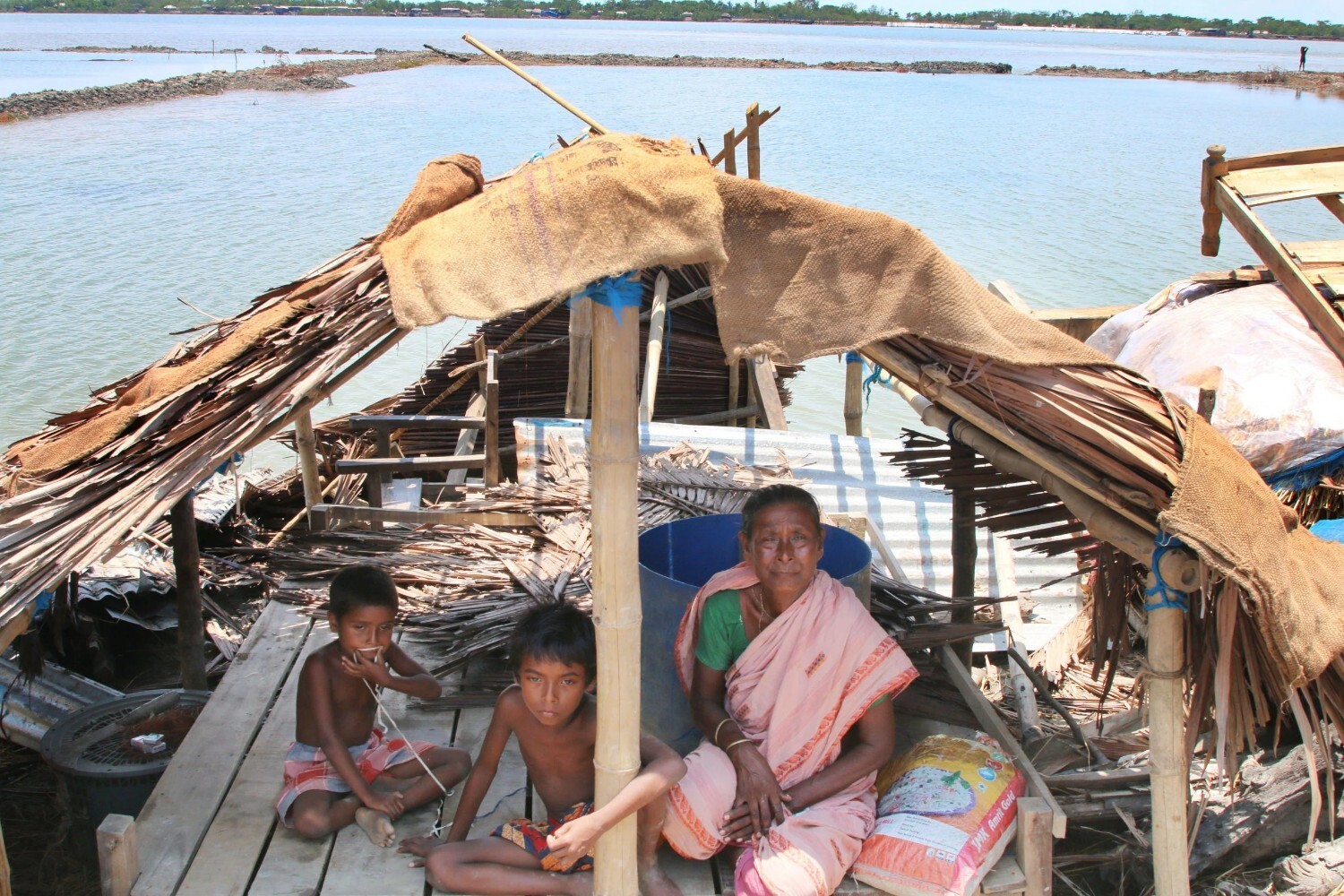
The most haunting insight in your attachment is that the Sundarbans can lose forest without a single chainsaw. Cyclones have become deforestation events. The first draft names the cycle of storms—Amphan, Yaas, and most recently Cyclone Remal in 2024—and argues these are “different beasts”: slower, wetter, and more destructive. Remal is presented not merely as embankment damage but forest drowning: storm surges submerge islands for days, salinizing freshwater ponds, killing freshwater fish, and destroying wildlife drinking water. The Forest Department is described as recovering dozens of deer carcasses washed away by surge—an image that carries the weight of all the uncounted smaller lives.
The draft then connects this to a slow ecological transformation. Mangroves are salt-tolerant, but not salt-invincible. The iconic Sundari (Heritiera fomes) is described as suffering “top-dying disease” when salinity spikes; reduced freshwater flow from the Ganges combined with sea-level rise pushes the ecosystem towards a scrub-mangrove state dominated by hardier but less valuable species.
The second version extends the same argument into a social chain reaction: embankment breaches allow saltwater to enter fields and ponds, changing soil chemistry and livelihoods; crop loss forces households into debt and distress; and under survival pressure, land-use decisions shift in ways that increase pressure on mangroves. Here, climate shock is not just a disaster story; it is also a land-use shock that renegotiates the forest line inside household arithmetic.
The shrimp economy and the “blue desert” logic
In the first draft, the shrimp story is not told as a moral accusation but as a trap. After cyclones, when paddy fields are poisoned by salt, farmers face a brutal choice: starve or farm shrimp. That vulnerability, the text argues, is exploited by a “shrimp mafia,” with outside investors pushing conversion of agricultural land into brackish aquaculture ponds. The mechanism is explicitly illegal and devastating: embankments breached to let saltwater in, dooming surrounding soil. Ecologically, shrimp farming clears mangroves and creates a “blue desert”—water that supports little biodiversity beyond shrimp—while chemically-laden wastewater causes eutrophication in creeks, choking natural fisheries that poor communities depend on.
This matters because it illustrates a recurring theme across both Sundarbans and North Bengal: when governance fails to protect livelihoods, the market offers destructive alternatives that appear rational in the short term and suicidal in the long term.
Vanishing islands: when erosion becomes existential
The draft insists the Sundarbans depletion is not only about trees; it is about land itself disappearing. Islands like Ghoramara are described as shrinking annually, with erosion accelerated by the destruction of mangrove root systems that hold silt together. As land disappears, forest disappears, and the bio-shield that protects Kolkata from Bay of Bengal fury weakens.
Pollution without permission: when “protected” still gets contaminated
One of the more modern—and unsettling—arguments in your attachment is that forests can be compromised even when they are not physically cut. The second version references reporting on airborne microplastics detected deep inside the Sundarbans, used to make a broader governance point: conservation boundaries do not stop pollutants. Whether it is microplastics, upstream chemical loads, or solid waste carried by tides, the forest becomes a downstream victim of upstream failures. This is why forest policy, the draft argues, must integrate river basin management, waste governance, and urban-industrial accountability—because the mangrove shield cannot be a dumping ground for the region’s collective negligence.
The machinery of failure: why mitigation keeps falling short even when everyone “knows”
The most scathing and necessary part of your first version is its refusal to accept the excuse of ignorance. The tragedy, it argues, is not lack of knowledge or even lack of money. It is governance failure—implementation failure—trust failure.
CAMPA: money without living forests
The Compensatory Afforestation Fund Management and Planning Authority was designed as a clean idea: if development destroys forests, developers pay; the state uses that money to plant new forests. In West Bengal, the draft calls the mechanism broken. Audit reports are cited in the draft to show only 39.2% achievement of compensatory afforestation targets between 2019 and 2023, a figure contrasted with states that perform far better. The deeper scandal is not only the shortfall but the phenomenon of “ghost plantations”—saplings that exist on paper, planted without care, untracked, or dead within weeks—enabled by weak monitoring and the absence of robust geo-tagging in early years. The result is a perverse image: funds accumulate while forest cover deficits widen.
Joint Forest Management: the collapse of trust and the youth exit
West Bengal is historically known for giving the world the Joint Forest Management model—community co-management linked to benefit-sharing. The draft argues that this social contract is now fraying, especially in North Bengal. Forest Protection Committees complain that the promised 25% share of timber revenue is rarely distributed fairly or on time, and young people—seeing no dignity or future in small, unreliable earnings—opt out. When legitimate economic stakes disappear, the “social fence” collapses, and timber mafias find it easier to infiltrate villages and recruit silence.
Law without enforcement: the NGT’s limits and the penalty paradox
The National Green Tribunal appears in your draft not as a villain but as a conscience with limited arms. It can order demolitions and impose fines, yet on the ground enforcement often dissolves into stays, appeals, and administrative lethargy. The draft uses the Mandarmani case as a symbol: an order to demolish over 140 illegal hotels for violating coastal regulation norms, yet many structures remain. It also highlights the “penalty paradox”: a massive fine can make headlines—like the Rs 3,500 crore fine on West Bengal in 2022 for environmental failures—yet a fine is a fiscal transfer, not ecological restoration. Mangroves do not regrow because money moved between accounts.
There can be explanation of why even sincere restoration can fall behind: storms arrive faster than saplings become barriers; embankments protect and also disrupt sediment flows; pressures are not only local but upstream and coastal; and governance is fragmented across departments that treat one integrated ecosystem as separate files. This is how “we planted more” can coexist with “we are still losing ground.”
Guardians of the green: proof that forests return when people can afford to protect them
This feature is meant to be warnings with blueprints. And the blueprint begins with an uncomfortable truth: forests survive when people can earn without destroying them.
The mangrove warriors of Mukti: resilience built, not wished for
In the Sundarbans, the NGO Mukti is presented as a model of what works when restoration is local, scientific, and livelihood-linked. The draft describes Mukti mobilising communities to plant over 16 million mangroves as bio-shields—living buffers designed to blunt storm surges where concrete embankments fail. It also insists that hunger is the enemy of conservation; Mukti’s strategy includes climate-resilient agriculture such as dragon fruit cultivation on concrete poles and salt-tolerant paddy, reducing the push towards destructive shrimp conversion. The backbone, the draft emphasises, is women-run self-help groups running nurseries, patrolling embankments, and managing finances—turning mangrove work into women’s power in a patriarchal landscape.
Chilapata: when tourism becomes conservation instead of colonisation
In the forests of Chilapata bordering Jaldapara National Park, the draft offers a counter-narrative to resortification. Help Tourism and local visionary Raj Basu are described as rewriting tourism by employing locals rather than displacing them, retraining former smugglers and poachers as guides and staff. The logic is brutally practical: a live leopard brings recurring income, while a dead leopard pays once. When conservation becomes steady livelihood, the incentive structure flips. The draft presents this community-based tourism model as a transformation of Chilapata from a smuggling den into a conservation success story.
Makaibari: the forest within the tea estate
If tea’s green illusion is part of the problem, the draft also offers a tea-based solution. Makaibari Tea Estate is presented as a “green guardian” because it retains 70% of its land as forest, functioning as a watershed that secures water even when surrounding areas run dry. It uses biodynamic, permaculture approaches that protect soil microbiomes rather than chemical-strip them, and the draft points to its partnership with Taj Chia Kutir as an example of how high-end tourism can coexist with conservation when ethos is preservation, not extraction.
A mission-mode roadmap: from “planting targets” to “protecting systems”
The strongest integration point between your two versions is that both reject superficial greening and argue for systems-level ecological security. The goal is not more slogans; it is redesigned incentives, redesigned infrastructure, redesigned monitoring, redesigned livelihoods, and redesigned accountability.
Build infrastructure that wildlife can survive
In North Bengal, linear infrastructure is not negotiable unless it is wildlife-compatible. Your first draft makes this a hard proposal: no rails or roads through forests without elevated corridors, and any project passing through a wildlife corridor—like the Sevoke-Rangpo alignment—should allocate 15% of its budget to wildlife mitigation, including elevated flyovers allowing animals to pass underneath. The draft explicitly frames this as standard practice in countries like Canada and “non-negotiable for the Dooars.”
One can add to the principle behind the engineering: North Bengal cannot be treated as a set of separate projects; it must be treated as a connected ecological block. Corridors are not decorative. They are the operating system of survival—for elephants, for predator-prey balance, and for reducing conflict by keeping animals in safe movement lines rather than inside villages.
End the era of “ghost plantations”: pay for survival, not planting
Experts converge on the idea that restoration must stop behaving like a contractor-led checklist. The first version’s CAMPA critique demands a redesign: decentralise funds, tighten monitoring, and prevent money from sitting idle while forests vanish. It proposes “direct to digital” flows and even blockchain-style tracking so every rupee is traceable and every plantation verifiable, with payments linked to tree survival verified periodically rather than to the act of planting.
A perspective strengthens the ecological logic: restoration should be done like an ecologist, not like an event—native species and zonation logic in the Sundarbans, corridor widening and assisted natural regeneration in North Bengal, invasive species control where needed, and long-term maintenance as the true measure of success. It is a shift from “planted X saplings” to “restored a functioning forest system.”
Make mangroves worth more standing than cleared
One can propose a bold economic intervention: treat the Sundarbans’ blue carbon as a global asset and build a “conservation dividend” model, where revenue from carbon credit markets flows back to coastal families as direct support conditional on protection of local mangrove patches. The ethical point is sharp: if a shrimp farm pays faster than a mangrove, the system will keep pushing people to the blue desert; if a mangrove pays reliably, the system shifts toward protection.
Even if policy chooses a different financing mechanism than carbon markets, the underlying principle remains the same: conservation needs income architecture, not just enforcement architecture.
Stop the concrete invasion: a tourism policy with teeth
For North Bengal, your draft’s prescription is not anti-tourism; it is anti-ecological impunity. It calls for a strict demolish-and-restore approach for illegal concrete structures near protected areas, incentives for vernacular low-impact architecture, and caps on vehicle pressure so forests do not become theme parks of stress. This is the only way tourism can be a conservation ally rather than a habitat predator.
Rebuild the social fence: communities as co-owners, not as “beneficiaries”
Both versions insist that communities are not optional helpers. They are the operating core. When Joint Forest Management trust collapses and youth disconnect, the forest becomes easier prey for mafias.
When women’s groups run nurseries and patrol embankments, mangroves become stronger and communities become more resilient.
The design implication is simple: pay communities for protection services, make benefit-sharing transparent and timely, build youth pathways into monitoring and eco-livelihoods, and treat local stewardship as a contract, not as charity.

Measure integrity, not just cover
A final conceptual point from the second version deserves to become public policy language: forest cover is a baseline metric, but integrity metrics tell the truth—fragmentation, canopy density, species composition, corridor functionality, pollution load, and resilience under shocks. If West Bengal measures integrity, it will be forced to govern integrity. And that is how the “rule of depletion” begins to break.
The action decade: why this story must end with citizens, not only with government
If you want readers to be moved into engagement, the narrative must land on a promise: forests regenerate—when society stops bargaining with destruction.
In the Sundarbans, you can picture the post-storm landscape: channels calm on the surface, carrying memories of surge, and lines of new saplings tied with care, trying to become tomorrow’s shield. In North Bengal, you can picture dusk at the forest edge, when an elephant family decides whether it can still walk an ancestral route without meeting a wall of light, a fence of voltage, a line of steel. These decisions—by water, by wildlife, by communities—are now happening faster than policy cycles.
And yet, your attachment also shows that change is not a fantasy. It is already happening wherever the incentive structure flips: when Mukti turns mangroves into livelihoods and women into custodians; when Chilapata turns poachers into protectors through dignified income; when Makaibari proves that tea landscapes can keep a forest within rather than strip the hills bare.
For the reader, “engagement” does not have to mean grand heroism. It can mean choosing tourism operators that are community-based rather than corridor-blocking; supporting mangrove and native forest restoration work that is survival-focused rather than photo-op-focused; refusing to celebrate “plantation numbers” without asking about survival and biodiversity; amplifying local stories so enforcement cannot quietly fail; and treating forests not as a romantic cause but as a public good worth political demand.
Because West Bengal’s forests are not asking for pity. They are asking for governance worthy of their value, economics worthy of their services, and citizenship worthy of the future. The depletion may have become normal. But the “guardians of the green” prove that normal can be rewritten—and that the canopy can return, if we decide the forest line is not negotiable.




Add a Comment