
THE ISSUE IN BRIEF (FACT BOX)
Organic farming in India is moving from “alternative” to “strategic” because soil fatigue, input-cost inflation, pesticide-residue anxiety, and climate volatility are colliding at the same time. Organic farming is not simply “chemical-free”; it is a system that rebuilds soil fertility through compost, crop diversity, biological pest control, and closed-loop nutrient cycles, and it must be verified through credible standards if farmers are to earn stable premiums. India’s landscapes complicate the story: in the Sundarbans delta, farming fights salinity, storms, and tidal flooding; in Sikkim’s mountains, it fights slope, erosion, and cold-season logistics. Both regions show why organic is increasingly framed as climate resilience plus rural economy, not just a consumer preference.
Two mornings, two Indias—and one question that won’t go away
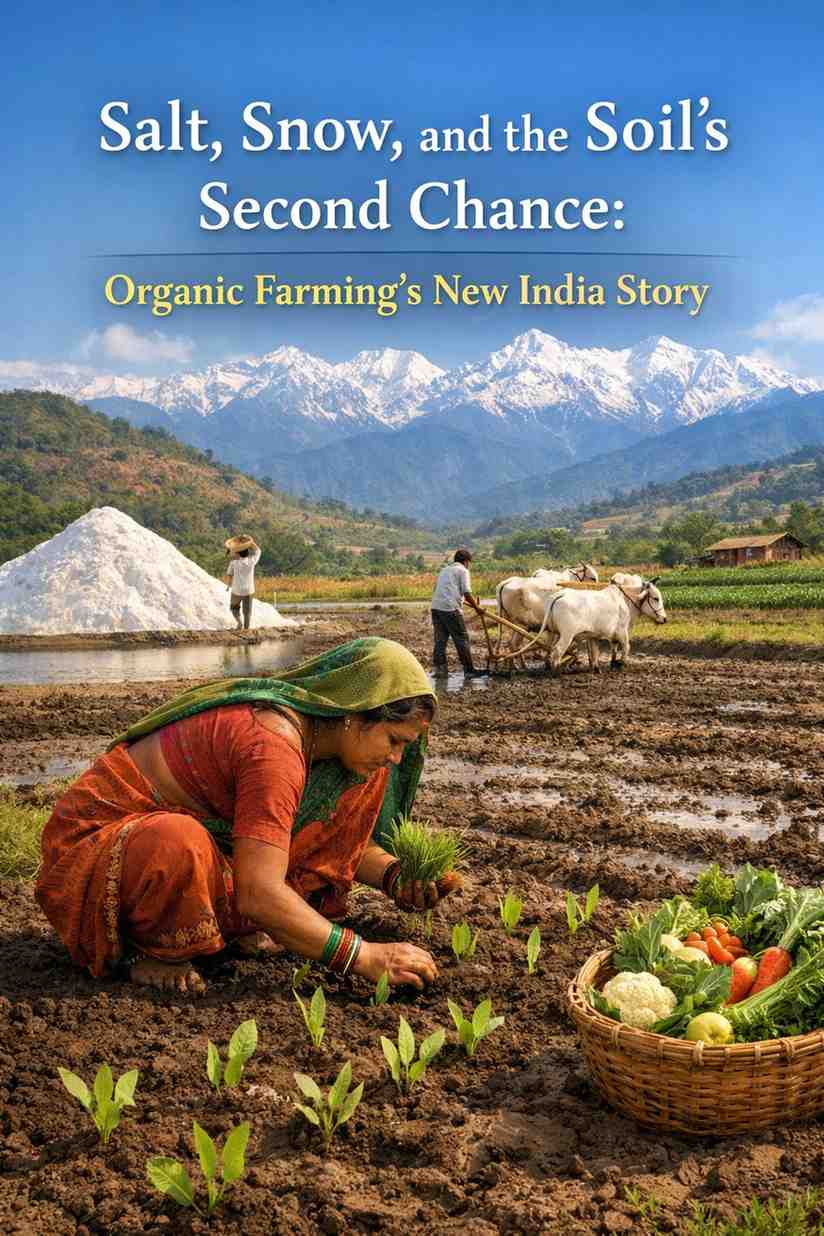
At daybreak in the Sundarbans, the air is wet and brackish, and the land feels like it is breathing. Creeks narrow into mud-lined channels. Mangroves stand like sentries. The soil here is never far from the sea, and every farmer knows that a “good season” can be rewritten overnight by saltwater, wind, and tide. In this delta, farming is not simply about yield; it is about staying on the land.
At daybreak in Sikkim, the air is thin and cold, and the land feels like it is climbing. Terraces step up the mountain like staircases made of earth. In winter districts, farmers lift potatoes and harvest turmeric; higher up, communities keep faith with buckwheat and barley that have survived altitude and history. Here, farming is not simply about survival against water; it is survival against slope, cold, and distance.
And yet, both mornings are now linked by the same question: what kind of agriculture can feed people without exhausting the very ecology that makes food possible? Organic farming—once seen as a niche—has entered India’s mainstream debate because it offers a different promise: not “more inputs for more output,” but “healthier soil for stable output,” and, over time, a more resilient rural economy.
This is not a sentimental return to the past. It is a practical negotiation with the future.
Organic farming is not a slogan. It is a discipline.
In everyday conversation, organic farming gets reduced to one line: “no chemicals.” The truth is both stricter and broader.
Organic farming is a structured method of production that avoids synthetic fertilisers and most synthetic pesticides, and builds fertility through living processes—composting, green manures, crop rotation, mixed cropping, biological pest regulation, and careful stewardship of soil organisms. The farm is treated as a living system where soil biology is not an accessory but the engine.
That is why organic farming is fundamentally different from conventional, chemical-intensive agriculture. Conventional systems depend heavily on external inputs and soluble nutrients, often delivering short-term yield but gradually risking soil organic matter decline, pest resistance cycles, and a rising cost of cultivation. Organic flips the incentive: it tries to make the farm less dependent on purchased inputs, more dependent on internal cycles.
It is also why organic differs from “natural farming” as used in Indian policy language. Natural farming typically emphasises minimal external purchase and relies strongly on on-farm preparations and local microbial cultures. Organic, depending on the standard, may allow certain approved bio-inputs purchased from outside, but still insists on a defined certification logic.
And organic differs again from “regenerative” farming, which is often outcome-led rather than input-ban-led. Regenerative farming focuses on soil carbon, biodiversity, water retention, and resilience outcomes, sometimes allowing certain inputs depending on the framework. Organic is tighter on what can and cannot be used, but it is not automatically regenerative unless it is practiced intelligently, with diversity and soil-building at the centre.
In short, organic is not just a label. It is a grammar of farming.
Why organic is considered nature-friendly—and why the nutrition debate needs honesty
Organic farming earns its reputation as nature-friendly when it reliably does what it is designed to do: rebuild soil organic matter, reduce toxic load in ecosystems, and strengthen biodiversity on and around farms. When synthetic pesticide dependence drops, beneficial insects often return; when composting and mulching increase, microbial life strengthens; when crop diversity rises, risk spreads across seasons.
In fragile landscapes, this “nature-friendly” claim becomes visible. In the Sundarbans, for instance, reducing chemical runoff matters because agriculture and fisheries share the same watery geography. Cleaner farm practices protect creeks where fish breed; healthier landscapes protect mangrove-linked biodiversity; and soil that holds structure better is less likely to collapse into a seasonal cycle of degradation.
But the nutrition claim needs precision. Organic produce is widely associated with lower pesticide residue exposure compared to conventional produce, and that matters for public health trust. On nutrients—minerals, vitamins, antioxidants—the evidence tends to be mixed because nutrient density is influenced by many factors beyond “organic vs non-organic”: variety, soil condition, harvest time, post-harvest storage, and water management. What can be said responsibly is this: organic farming can improve nutrient quality indirectly when it improves soil biology and micronutrient cycling, but it requires competent nutrient management. Organic is not the absence of fertiliser; it is the presence of smarter fertility.
That difference—between absence and intelligence—is where the future of organic will be won or lost.
The real contemporary story: the credibility war over “organic”
Organic farming is rising in India, but the word “organic” is also being diluted by confusion, marketing shortcuts, and weak verification. This is the contemporary hinge-point: people want chemical-free food, but they also want proof. Farmers want premium prices, but markets want traceability. States want adoption, but consumers want trust.
This is why certification, residue testing capacity, and traceability systems are becoming the new battleground. Without credible verification, genuine organic farmers get punished because “fake organic” drags down prices and trust. Without farmer-friendly certification routes, smallholders remain stuck in informal “organic-like” practice without market reward.
In other words, the new organic debate is not only agronomy. It is infrastructure of trust.
Sundarbans: organic farming as coastal resilience, not boutique agriculture
To understand why organic matters in the Sundarbans, you have to stop thinking of farming as a flat-land activity. Here, farming is coastal engineering in slow motion.
The delta’s most persistent enemy is salt—salt in the water, salt in the soil, salt in the wind after storms. Conventional chemical-intensive farming can deepen vulnerability because it may improve yield for a time but also increases input dependence and can worsen soil structure over years. In a region where one cyclone can erase a season, high-cost dependence is dangerous.
That is why the Sundarbans story often begins with a small, stubborn experiment. In Kultali block, a farmer named Rina Mondal chooses to revive older fertility practices: composting cow dung and leaves, using vermicompost, shifting to neem-based pest control, and working with the logic of local ecology rather than against it. Over time, the soil softens; earthworms reappear; paddy that had been weakening under salinity begins to behave like paddy again. What looks like “traditional” is actually a highly modern act: rebuilding the farm’s biological foundation so it can tolerate shocks.
Organic farming in the delta also tends to evolve as a community practice rather than an individual project, because the problems are too large for one household. Women’s groups preparing organic manure are not merely making inputs; they are creating a micro-economy of soil health. Seed banks preserving salt-tolerant varieties are not merely conserving heritage; they are building climate insurance in seed form. Raised-bed vegetable cultivation is not merely a technique; it is an adaptation to waterlogging and tidal flooding. When youth collect mangrove leaves for compost, they are participating in a circular economy that converts local biomass into fertility.
What emerges is not just organic farming, but a delta model of organic livelihood: agriculture linked to fisheries health, honey and non-timber forest livelihoods, and even eco-tourism narratives where visitors taste food grown without harming the ecosystem.
In the Sundarbans, the logic is simple and severe: if farming does not become ecologically compatible, farming will become economically impossible.
Sikkim: organic farming as policy identity—and as a mountain value chain
Sikkim’s organic story has a different rhythm. It is not primarily a story of coastal survival; it is a story of state-scale choice. The state is widely recognised as India’s first fully organic state, and its shift to organic has become a symbol of what governance-led agroecology can look like when policy, extension systems, and community practice align.
In winter, the mountain economy reveals organic’s real test: continuity across seasons. Farmers harvest potatoes and turmeric in lower winter districts; higher altitude communities hold onto buckwheat and barley as staples. Over the years, confidence has grown not only because of ecological benefits but because of value chain improvements—better cooperative marketing, stronger linkages to premium markets in peak demand seasons, and improved storage and cold-chain capacity where possible. Organic in Sikkim is not merely “grown differently”; it is increasingly “moved and sold differently.”
Tourism amplifies this advantage. Farm-to-table homestays and eco-travel experiences convert organic food into a cultural product, not just an agricultural commodity. When a traveller eats an organic meal in a mountain homestay, they are paying for trust, landscape, and story, not only calories. That additional income layer matters in a hill economy where agriculture alone often cannot sustain households year-round.
Environmentally, organic matters in Sikkim because slopes are unforgiving. Chemical runoff can affect springs; soil erosion can rise when land is not managed carefully; biodiversity can decline when farming becomes uniform. Organic systems that emphasise composting, mulching, and diversity can support soil structure and moisture retention—particularly important in fragile hill hydrology.
Sikkim still has challenges—winter transport disruptions, processing limitations, and price volatility—but it demonstrates what the delta is still building: organic becomes viable when ecology is matched by market systems.
The same principle, two different engineering problems
Organic farming is often presented as one national narrative. In reality, India contains many “organics,” because the ecology of risk changes from region to region.
In the Sundarbans, the central stress is salinity and flooding. The organic farm must behave like a sponge and a filter: holding structure, retaining fertility, and recovering quickly after shock. It must work with water. In Sikkim, the central stress is slope and erosion. The organic farm must behave like an anchor and a sponge: holding soil in place and managing nutrient cycles that would otherwise wash downhill.
In the Sundarbans, pests surge after humidity spikes and floods; in Sikkim, weeds, temperature shifts, and weather-linked diseases shape the calendar. In the Sundarbans, market access is constrained by fragmentation and fragile logistics; in Sikkim, market access is boosted by branding but threatened by distance and winter disruptions.
Even the “organic promise” differs. For a Sundarbans farmer, the first reward is resilience; premium pricing is often a later hope. For a Sikkim farmer, premium branding and tourism-linked demand are more immediate, while resilience arrives as a powerful co-benefit.
This contrast matters because it exposes a key truth: organic farming succeeds when it is designed like local engineering, not imported like a uniform package.
The hardest part of organic: the conversion years and the economics of patience
Organic farming asks farmers to invest in the long-term health of their land, but farmers often live in short-term cash realities. This is why the conversion period becomes the cliff-edge.
In the early years of conversion, yields can fluctuate and sometimes dip before stabilising. Labour often increases because weeding and diversified management demand attention. Bio-input production, composting, and learning new pest management methods take time. If the farmer is already struggling, the transition looks risky even when the long-term logic is sound.
In the Sundarbans, conversion risk is magnified by climate shocks. One storm can wipe out the patient work of soil recovery and push households back into debt. In Sikkim, policy support and established organic identity can cushion the transition, but market volatility and logistics costs still cut into the premium farmers expect.
This is why organic adoption is rarely only a technical decision. It is an economic gamble, and policy must recognise it as such.
Technology and knowledge: organic is “precision ecology,” not low-tech farming
A common misconception is that organic farming is low-tech. The truth is the opposite: organic is knowledge-intensive.
Compost quality determines nutrient availability. Timing determines pest outbreaks. Crop diversity determines risk distribution. Soil testing determines what the land actually lacks. Botanical extracts require correct preparation and application. Biological pest control requires understanding of beneficial insects and habitat.
In the Sundarbans, precision ecology must include salinity science and water management. Farmers need practical methods to prevent salt concentration, manage drainage, and choose cropping calendars that reduce exposure to peak-risk periods. In Sikkim, precision ecology must include slope management, erosion control, and post-harvest handling suited to cold-weather logistics.
The next decade of organic will depend on whether India builds “organic intelligence” at scale: extension workers trained in soil biology, local bio-input labs for quality checks, and decision-support systems that turn weather and soil data into farmer guidance.
Finance, insurance, and the mismatch that silently kills adoption
Organic farming often struggles not because farmers don’t believe in it, but because financial systems don’t know how to support it.
Conventional agriculture has standard credit packages: fertiliser, pesticide, seed, irrigation. Organic needs different finance: compost units, bio-input production, storage upgrades, aggregation, certification costs, and working capital to cover transition years. Insurance models also struggle to value ecological resilience, even though resilient systems may reduce risk in the long run.
This mismatch is deadly in regions like the Sundarbans, where climate risk already makes finance fragile. If organic is to become mainstream, India needs green credit products, transition support instruments, and climate insurance that recognises ecological practices as risk reduction rather than as uncertainty.
Awareness and market access: why “organic” fails without aggregation
Even when farmers succeed agronomically, organic fails commercially if marketing systems do not reward them.
Premium buyers want consistency, grading, packaging, and traceability. Individual smallholders cannot supply this alone. That is why Farmer Producer Organisations and cooperative aggregation are not optional; they are structural. Sikkim’s progress shows what happens when market linkages improve: organic becomes visible as income, not merely ideology. The Sundarbans still needs stronger aggregation, more reliable cold-chain access, and delta-specific value addition for products like rice, vegetables, and honey.
If organic remains scattered, it stays weak. When organic becomes organised, it becomes a rural industry.
Government policy: strong intent, but still too fragmented to scale
India’s policy ecosystem has multiple pathways supporting chemical-free agriculture, including organic cluster schemes and natural farming missions. The intent is clear: reduce chemical dependence, improve soil health, and create sustainable rural incomes. Yet the experience on the ground often feels fragmented. Farmers hear different vocabularies—organic, natural, regenerative—without a single simple market language. Certification pathways exist, but many smallholders find them complex. Support exists, but it may not cover the most painful phase: the transition years.
The next policy leap is not merely more schemes. It is clearer architecture and stronger last-mile design.
India needs a consumer-facing national clarity that distinguishes organic-by-standard from natural-by-practice, while ensuring both are validated through credible, farmer-friendly systems. It needs transition-year income protection mechanisms that treat conversion as a public good, because soil health is national infrastructure. It needs certification and residue testing as a public utility, not an elite service. It needs procurement policies that create stable demand for verified organic produce through institutions such as schools, hospitals, and government supply chains—especially in regions where market access is fragile.
Most importantly, India needs landscape missions. The Sundarbans needs a coastal organic resilience mission that integrates organic practices with drainage, embankment safety, salinity management, climate calendars, and seed systems. Sikkim needs value addition and logistics strengthening so organic premiums are not lost to transport disruptions and limited processing.
Policy must stop treating organic as a single national template. It must treat it as climate-smart regional engineering.
Organic 2036: what the next decade should build in India
If India is serious about organic farming’s future, the next decade will not be about slogans. It will be about systems.
The first system is decentralised bio-input infrastructure. Every region needs quality composting, bio-stimulant production, and farmer-accessible testing capacity so “organic” is not guesswork. When bio-input quality becomes reliable, yields stabilise; when yields stabilise, farmer confidence rises; when confidence rises, adoption scales.
The second system is precision advisory. Low-cost soil testing, local nutrient mapping, weather intelligence, and practical pest forecasting can make organic farming less dependent on trial-and-error and more like dependable agronomy. Digital tools can help, but only if they are grounded in local realities—salinity in the delta, slope and springs in the hills.
The third system is traceability that does not punish the small farmer. The future organic market will increasingly demand proof, but proof must be made simple: cluster-level verification, digital batch tracking, and community labs that lower the cost of compliance.
The fourth system is climate-linked finance. Organic farms should be eligible for green credit, transition buffers, and climate insurance incentives because ecological farming is risk reduction. In high-risk geographies like the Sundarbans, this is not merely helpful; it is essential.
The fifth system is ecosystem payments. Organic and regenerative practices deliver public goods—clean water, biodiversity, carbon storage, healthier soils. Over the next decade, India can design payments for ecosystem services so farmers earn not only from produce but from ecological outcomes, especially in climate frontlines where those outcomes protect entire regions.
And the sixth system is the most human one: dignity through rural employment. Organic farming can create skilled local jobs in composting, bio-input preparation, certification support, grading and packing, processing, and eco-tourism integration. That is how organic stops being “small farming” and starts becoming a sustainable rural economy.
The closing contrast: the tide and the terrace
In the Sundarbans, the tide returns each day like a reminder that the land is borrowed from the sea. The farmer’s dream is not only yield, but control—control over salinity, over soil collapse, over sudden loss. Organic farming here becomes a strategy of staying rooted: building soil that can absorb shock and recover.
In Sikkim, the terraces hold their shape because generations learned how to make the mountain farmable. Organic farming here becomes a strategy of value and identity: protecting springs, strengthening soil structure, and turning the landscape into a premium story that markets and tourists understand.
Two landscapes. Two risks. One conclusion: India’s agricultural future cannot be built only on inputs. It must be built on living soil.
Organic farming will not replace every form of farming overnight, and it should not be romanticised as effortless. But as climate volatility rises and input economics tighten, organic is increasingly the method that treats nature not as a resource to be extracted, but as a partner to be managed intelligently.
Because in the end, whether it is salt in the delta or snow in the hills, the most advanced technology in Indian agriculture remains the same: a healthy soil that can hold life.







Add a Comment