A Different Kind of Light
In the sun-baked village of Kardapal, Odisha, the rhythm of life used to follow the flicker of electricity. For Kuni Dehury, a silk reeler, every power cut meant another hour stolen from her already long day. The kerosene lamp filled the room with smoke, her eyes with tears, and her lungs with pain. Yet the work had to go on.
Today, that same house hums with a quiet, steady sound: a solar-powered silk reeling machine. The light no longer burns kerosene. It glows clean and constant. Kuni’s story is not just about one woman’s improved livelihood—it is about how India’s clean energy transition is transforming lives, one household at a time.
This is no longer a policy story. It is a people’s story—a story of work, health, and dignity, of how the government, civil society, and citizens together are powering a billion dreams.
The Solar Shift: From Fields to Factories—and Kitchens
India, blessed with over 300 sunny days a year, is now the world’s third-largest producer of solar energy. But the most transformative stories are not about vast solar parks—they are about rooftops, fields, and small enterprises.
Take Munita Devi, a farmer from Jharkhand. For years, she depended on costly diesel pumps to irrigate her fields, spending over ₹10,000 annually on fuel. The pumps were noisy, unreliable, and polluting. When supply faltered, her crops withered. Everything changed in 2020 when she switched to a solar pump. Her fuel costs vanished, her yields grew, and her savings helped send her children to better schools. For her, clean energy means more than power—it means progress.
Government schemes like PM-KUSUM aim to solarise agricultural pumps and make farmers “prosumers”—both producers and consumers of energy. The PM Surya Ghar Muft Bijli Yojana targets rooftop solar for one crore households, bringing independence from unreliable grids and relief from rising bills. Together, these initiatives mark a shift—from energy access to energy agency.
When Energy Becomes Women’s Power
In India’s rural homes, energy poverty has always carried a gendered burden. Women bear the time cost of collecting fuel, the health cost of smoky kitchens, and the safety cost of poorly lit streets. But clean energy is rewriting that script.
In Rajasthan’s Alwar district, Meera Jatt leads a women-run dairy cooperative. For years, spoilage from unreliable refrigeration ate into profits. Now, solar-powered chillers keep milk fresh longer, reducing waste and increasing income. The women no longer depend on erratic power; they control it.
Further west, Arti ben used to spend nearly sixty hours a month collecting firewood. A biogas unit in her backyard cut that to fifteen. With time saved, she joined a local handicraft collective, doubling her income. Across India, women are training as solar technicians, managing repairs, and earning independent incomes. Each story adds up to a quiet revolution: energy that gives women their time back, and their power too.
The Heat Test: When Cooling Becomes Survival
Every summer, heat waves test India’s power grid—and people’s resilience. In 2025, Delhi crossed 40°C in early April. Nights offered no respite, and electricity demand for cooling soared. Hospitals opened special heat wards, filling tubs with ice for patients collapsing from exhaustion.
For millions, air-conditioning remains a luxury. But as global temperatures rise, cooling has become a necessity. Two-thirds of Indian households still experience some form of energy poverty, with outages disrupting lives daily. The poor suffer first and longest, relying on smoky stoves and dark nights. The wealthy, meanwhile, switch on diesel generators—solving their problem, but worsening the collective one.
The heat crisis shows that energy is not just an economic issue—it is a public health imperative. A reliable, clean power supply is as vital to survival as water and food.
The $400 Billion Challenge
India’s clean-energy mission is vast—and expensive. Estimates suggest that $400 billion will be needed by 2030 to build capacity, expand transmission, and develop storage. The government has moved decisively, but challenges remain.
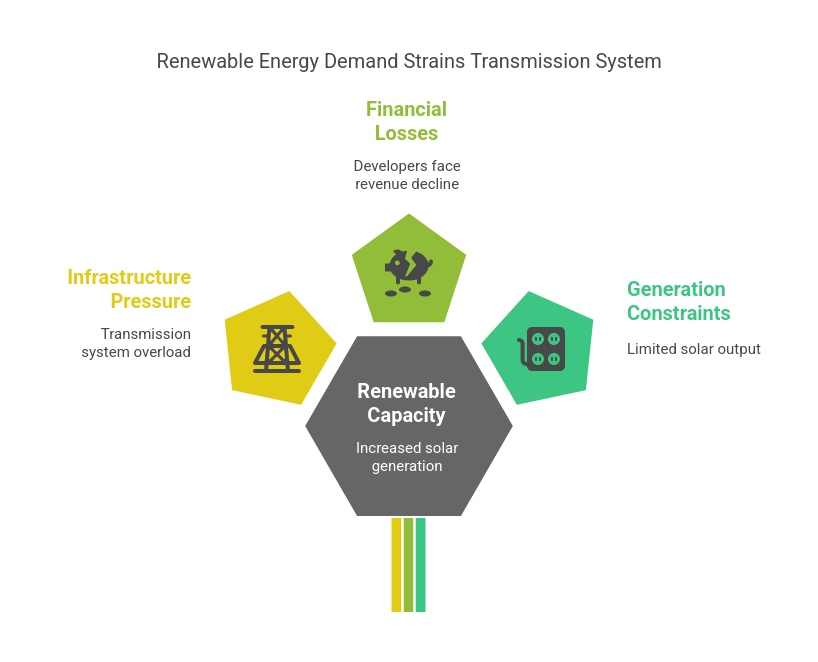
One bottleneck lies in plain sight: the financial health of state power distribution companies, or DISCOMs. Their chronic losses and delayed payments stall private investment and slow project momentum. Even when capacity grows—India added 44.5 GW in 2025—transmission lags behind. Nearly 60 GW of renewable projects remain stuck because the grid cannot yet carry their power.
The Green Energy Corridor, now in its second phase, aims to fix this gap. A major new line from Ladakh will transmit solar power from the high deserts to the national grid. But progress must quicken. Without strong transmission and storage, clean energy risks becoming a stranded asset.
Coal’s Shadow—and the Health Cost We Ignore
Coal still powers roughly 70% of India’s electricity. It is cheap, local, and reliable. For decades, it was the fuel that built modern India. But it also darkened the air. Some of the world’s most polluted cities are Indian. In the coal belts of Jharkhand and Chhattisgarh, children cough through school days while the mines hum around them.
This is not merely an environmental problem; it is a moral one. Burning fossil fuels undermines the right to health and the right to development. Indoor pollution from firewood kills more Indians every year than road accidents. Outdoor pollution, from coal plants and vehicles, cuts millions of lives short. The transition, therefore, is not about guilt—it is about survival.
Phasing down coal will take time. Heavy industries still need steady, base-load power. Gas imports are too expensive for large-scale substitution. But the direction is clear. The government is investing in nuclear, hydro, green hydrogen, and renewables. Coal will fade—not because the world demands it, but because India’s people need clean air.
The Equity Argument: India and the World
Internationally, critics say India is not moving fast enough on climate action. But the numbers tell a different story. While India is the third-largest emitter in absolute terms, its per-capita emissions remain less than half the global average.
At global climate summits, India argues from principle: those who polluted most must do most to fix it. This idea of “common but differentiated responsibilities,” enshrined in the 1992 Rio Earth Summit, remains the foundation of India’s stance. Developed nations grew rich on fossil fuels; developing ones should not be punished for wanting light, mobility, and growth.
Yet India is not shirking its duty. It has exceeded its COP26 target of 50% non-fossil capacity five years early. It leads coalitions like the International Solar Alliance, launched to help other nations harness clean energy. And it has invested billions from domestic budgets—often without waiting for global finance that never arrives.
As one negotiator said at COP30, “We are buying time—and doing things on our own.”
Lessons from the Global South
India does not have to reinvent the wheel. Across the Global South, nations have built models that combine innovation with equity.
Bangladesh scaled solar home systems through smart finance. Its IDCOL programme combined microcredit with after-sales service, installing over four million systems and reaching 18 million people. The lesson: finance and trust matter as much as technology.
Kenya’s pay-as-you-go solar firms, such as M-KOPA, used mobile money to make solar affordable for low-income families. Households pay small instalments, building ownership over time. For India’s rooftop solar push, this could be game-changing.
Vietnam grew too fast, adding solar capacity without planning grid expansion. The result: curtailment and wasted power. It’s a cautionary tale India is already heeding as it accelerates the Green Energy Corridor.
South Africa used competitive bidding through its REIPPPP programme to attract private investment and drive down prices. India’s transparent procurement models can build on that.
Brazil and Morocco leveraged blended finance to fund large renewable parks, while Uruguay achieved near-total renewable electricity through policy stability and long-term planning. The message for all of us is simple: the transition is not about speed alone—it’s about structure, continuity, and credibility.

From Supply-Centric to People-Centric
For years, India’s approach to energy was supply-driven: add capacity, build plants, extend grids. That mindset built scale—but now the focus must shift to people.
We need to view energy as a development enabler, not just a sector. Hospitals, schools, small industries, and homes depend on reliable power. Energy reform must therefore include distribution reforms, demand management, and consumer engagement.
Prime Minister Narendra Modi has spoken of “energy independence” as a pillar of India@2047. Ambitious goals—like expanding nuclear capacity tenfold and producing five million tonnes of green hydrogen by 2030—show intent. But civil society, academia, and state governments must align to turn these numbers into realities.
Environmental and social safeguards also matter. When renewable projects displace communities or degrade ecosystems, they lose legitimacy. A people’s transition must listen to those it aims to uplift.
What We Must Do—Together
The next decade is decisive. To build a clean, reliable energy future, we need a strategy that combines scale with sensitivity, and for the policy makers have a big role:
- Fix distribution reform: Strengthen DISCOMs to ensure that renewable power is financially viable.
- Build transmission first: Expand grids before adding generation, to avoid bottlenecks.
- Invest in flexibility: Develop battery storage, demand response, and time-of-use pricing.
- Empower decentralised systems: Treat mini-grids and rooftop solar as mainstream, not marginal.
- Include women: Energy access must also mean gender equity in training, employment, and ownership.
- Cool smarter: Make efficiency the first line of defence against rising heat.
- Secure materials: Develop circular supply chains for lithium, cobalt, and rare earths.
- Plan a just transition: Support coal-dependent regions with retraining and economic diversification.
- Protect the social contract: Prioritise transparency and consultation in clean-energy projects.
- Embed climate in development: Power hospitals, schools, and public transport as part of climate action.
Each of these requires cooperation among government, industry, civil society, and citizens. The transition is not one ministry’s job—it is everyone’s mission.
The Light in Kardapal
Coal will not disappear overnight. Bureaucracy will slow some moves. Finance will remain a constraint. But the direction is irreversible. The will to change is now embedded in the country’s moral and economic DNA.
If we want to measure success, we should not start with national dashboards or global rankings. We should start in Kardapal.
Start with a woman whose silk work no longer stops when the grid fails. Start with a farmer whose pump runs on sunlight. Start with a family whose kitchen no longer fills with smoke. Start with a clinic that keeps the lights on through the heat.
That is what powering a billion dreams means: an India where energy is not a privilege but a right, not an aspiration but an assurance—and where the light that shines in one village shows the path for us all.



Add a Comment