
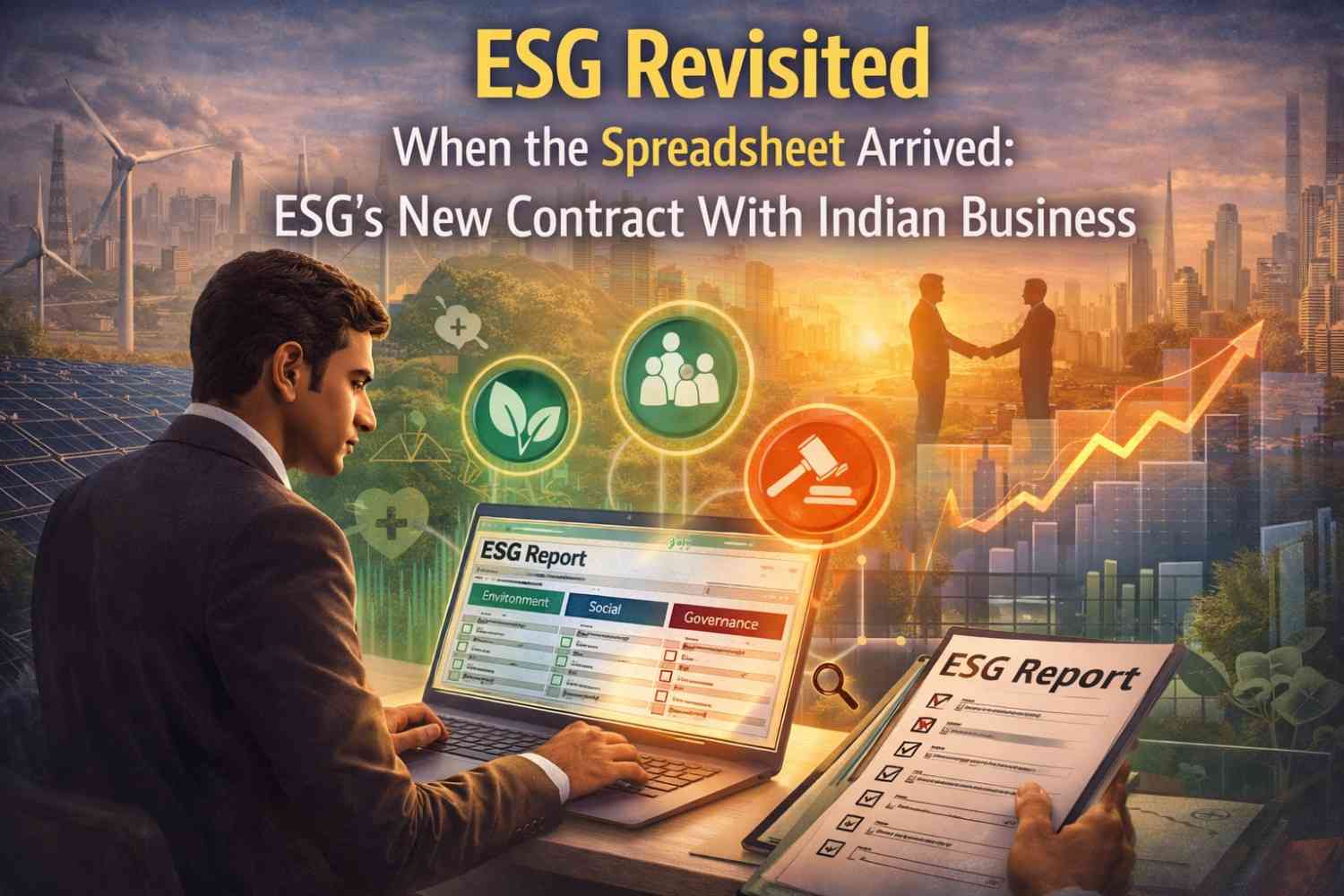
A single email, two report cards, and the moment “sustainability” became operations
The email that changed the week
It begins the way most modern disruptions begin: not with a protest, not with a policy speech, but with an email that looks harmless until you open the attachment.
A mid-sized manufacturer—supplying components to a large listed company—receives a message addressed with polite corporate warmth: “Dear Partner, we require your ESG data for the upcoming reporting cycle.” The attachment reads like a quiet audit of life inside the factory: electricity consumption, water use, waste handling, worker safety incidents, gender representation, grievance mechanisms.
The owner reads it twice and mutters the line that has become India’s most honest ESG definition: “We make parts. Since when did we become a climate report?”
That sentence matters because it captures the real arrival of ESG in India. Not as philosophy. Not as a corporate “initiative.” As procurement. As an operational demand that travels down the supply chain with the force of a purchase order.
Not CSR 2.0—an entirely different species
India understands CSR. It is familiar, mandated, and often visible: projects, schools, sanitation drives, community initiatives. ESG is different, and the difference is not cosmetic.
CSR is largely about what a company contributes outward—money and projects for social good. ESG is about how the company operates inward—its environmental footprint, how it treats people, and how it governs itself.
CSR can be meaningful even if the core business remains unchanged. ESG pushes on the core business by design. That is why ESG feels intrusive to many promoters and plant heads: it is not asking for generosity; it is asking for systems.
Why ESG became unavoidable: the three pressures that converged
ESG did not rise because corporations suddenly became kinder. It rose because three forces converged—investors, regulators, and a generation that treats transparency as the minimum price of trust.
Investor pressure came first. Global capital began asking an unforgiving question: what risks will break this business over ten years? Climate risk, labour risk, governance risk. ESG scores became shorthand for long-term resilience.
Regulatory pressure followed. Countries started pushing sustainability disclosure out of the voluntary “good news” genre and into standardised reporting.
And generational pressure grew louder: employees and consumers increasingly expect purpose, transparency, and ethical conduct—especially where talent and trust are strategic assets.
Put together, ESG became a new language of risk, capital, and legitimacy.
The world’s ESG machinery: one destination, different routes
If you look across major democratic economies, the direction is broadly shared: less storytelling, more standardisation; fewer glossy claims, more audit trails. The routes, however, differ sharply.
Europe: the strict school that is now rewriting its homework
The European Union built the world’s most comprehensive ESG architecture: corporate reporting rules, financial product disclosure rules, and a shared definition of what counts as “green.”
On corporate reporting, the European Commission notes that the first companies subject to the CSRD apply the new rules for the first time in the 2024 financial year, with reports published in 2025. On financial markets, SFDR has been in application since March 2021. And then there is the EU Taxonomy, a common definition meant to scale sustainable investment and protect against greenwashing.
But even Europe is adjusting. Reuters has reported on EU proposals to loosen or cut back parts of sustainability rules to reduce regulatory burden and improve competitiveness.
That recalibration matters for India because it underlines a practical truth: ESG frameworks succeed when measurement capacity keeps pace with disclosure ambition.
The UK: climate-first discipline, then alignment to global standards
The UK approach has been pragmatic: start with climate-related disclosure discipline, then build toward broader sustainability reporting alignment. The UK’s FCA has outlined its TCFD-aligned approach, and the UK government has published guidance on UK Sustainability Reporting Standards rooted in the evaluation and potential endorsement of IFRS Sustainability Disclosure Standards (IFRS S1 and IFRS S2).
In plain terms, the UK is translating sustainability into the language of financial reporting culture—risk, governance, disclosure controls.
The United States: a market that wants disclosure, and a system that litigates it
In the US, ESG has been shaped as much by courts and politics as by investor demand. The text notes that in March 2025 the US SEC stated it had voted to end its defense of climate disclosure rules requiring disclosure of climate-related risks and greenhouse gas emissions, and Reuters reported a US appeals court pausing challenges while awaiting clarity on the agency’s stance.
The lesson for India here is operational, not ideological: when ESG becomes politically contested, compliance certainty suffers, even as market pressure continues through global customers and overseas regulations that still force disclosures through supply chains.
Japan: disclosure as muscle memory
Japan’s ESG movement has leaned heavily on disciplined corporate disclosure norms. The document cites a Financial Stability Board note that Japan enhanced sustainability disclosure requirements in annual securities reports, applied starting with reports for the financial year ended March 2023.
Japan’s advantage is cultural and institutional: systems and governance are treated as core business hygiene, not side projects.
Australia and Canada: standards, laws, and a staged runway
Australia has moved into sustainability standards infrastructure, including climate disclosure standards issued by the AASB, and policy/professional guidance describing a mandatory climate-related disclosure regime beginning from 1 January 2025 under Corporations Act amendments. Canada has issued CSDS 1 and CSDS 2 aligned with ISSB standards, with an effective date of 1 January 2025 on a voluntary basis, as reflected in the IFRS jurisdictional snapshot.
Together, these models reinforce one steady truth: ESG becomes real when it is connected to standards, enforcement, and assurance pathways—not merely encouraged.
The baseline that keeps showing up: IFRS S1 and IFRS S2
Behind all this is an effort to converge. IFRS S1 and IFRS S2—issued by the ISSB—are positioned as a global baseline for sustainability and climate-related financial disclosures, effective for annual reporting periods beginning on or after 1 January 2024.
The implication is blunt: India does not need to copy the EU or the US, but Indian disclosures must be credible, comparable, and investment-grade.
India’s ESG turning point: when BRSR changed the rules of the room
If ESG is a global language, India’s most important translator has been SEBI’s Business Responsibility and Sustainability Report (BRSR).
The document notes that SEBI introduced BRSR through a circular in May 2021, positioning it as a replacement for older reporting formats and setting the stage for standardised ESG disclosure for listed entities. Over time, BRSR became mandatory for the top 1,000 listed companies (by market capitalisation), beginning with the FY 2022–23 reporting cycle—shifting ESG reporting from “best practice” to “market expectation.”
Then came BRSR Core: a subset of key metrics paired with assurance requirements and, crucially, an expanding expectation of value-chain disclosures. It is worth pausing here because this is how ESG becomes operational in the real world: not by speeches, but by templates, metrics, and assurance.
The hidden twist: ESG refuses to stay inside the listed company
On paper, the obligation begins with listed entities—especially the top 1,000. In practice, ESG behaves like an ink spill: it spreads outward into suppliers, logistics partners, contractors, and service providers.
That is why value-chain ESG disclosure is such a sensitive issue. It effectively pushes reporting burdens onto smaller firms that may lack the systems to respond. This is not a minor detail. It is the frontline tension in ESG implementation: transparency is necessary, but the capacity to measure accurately is uneven.
In this context, the “polite email” is not a request; it is the supply chain being converted into a data system. The text notes that Reuters has reported SEBI’s plan to review ESG disclosure requirements with particular attention to supply chain transparency, after concerns that obligations can be too burdensome for smaller firms and risk producing “paper disclosures,” while SEBI documentation has reflected adjustments to timelines for value-chain disclosures and assurance.
India, in other words, is running ESG on two tracks at once: acceleration for large firms, capacity constraints for the rest.
How ESG is actually implemented inside companies
Strip away the slogans and ESG implementation looks like a sequence of internal changes.
A company has to decide what it will measure—emissions, water, waste, safety, diversity, board oversight—and how those data will be collected across plants, offices, and subsidiaries. It must define responsibility: who owns the data, who verifies it, who signs it. It must build governance: board-level oversight, policies, grievance systems, and internal controls that make reported numbers auditable. And increasingly, it must obtain external assurance—particularly for BRSR Core under the glide path SEBI has outlined.
This is why ESG can feel heavy. It requires companies to build measurement muscle, not just publish ambition.
The ratings problem: when the report cards do not agree
As ESG gained popularity, ratings multiplied. Then they began disagreeing—often dramatically—because methodologies vary.
India’s regulatory response, as captured in the text, has been to move toward greater oversight. SEBI has issued a Master Circular for ESG Rating Providers (ERPs), embedding them within a regulated framework. The document notes that even rating withdrawal—when and how an ESG rating can be withdrawn—has attracted attention, signalling that India is treating ESG as a market integrity issue, not a marketing trend.
When ESG becomes tangible: cases that make the theory sweat
The best way to understand ESG is to see it where it becomes operational.
Consider a major airport setting measurable sustainability targets, shifting energy sourcing, and publicly reporting performance highlights. The text points to Mumbai’s international airport ecosystem highlighting milestones such as achieving renewable electricity use and carbon neutrality claims for specific scopes, showing how large infrastructure operators integrate ESG into operations and disclosure.
Consider a major engineering and construction group reporting reductions in greenhouse gas emission intensity and embedding disclosures in formal sustainability reporting—turning ESG into year-on-year operational discipline rather than one-time messaging.
Consider energy firms building decentralised renewable solutions—such as rural microgrids—where the “E” intersects directly with livelihoods and enterprise.
And then consider the “G” that changes behaviour fastest: governance practices where ESG goals influence leadership incentives. When executive compensation is linked to ESG outcomes, ESG stops being an “initiative” and becomes part of how power is rewarded.
These are not just good stories. They are signals that ESG is becoming institutional practice in parts of corporate India.
How ESG is performing now: progress with friction
The progress, as your document frames it, is real. BRSR has institutionalised disclosure. Assurance norms are expanding. ESG funds and products are becoming more structured, and SEBI has issued frameworks for ESG investing and related disclosures by mutual funds.
Capital is also being aligned with sustainability through instruments such as sovereign green bonds, with government disclosures noting issuances and expenditure alignment under eligible categories.
But performance is mixed, and the friction points are serious. One friction is data quality and cost: many MSMEs struggle with data collection, compliance costs, and a lack of standardised frameworks.
A second is greenwashing risk—the gap between narrative and reality. The more ESG becomes reputational currency, the stronger the incentive to polish rather than transform.
A third is the value-chain burden: recent reporting indicates SEBI has been reviewing ESG disclosure requirements, including supply-chain transparency, in response to concerns that obligations may be too burdensome for smaller firms and may produce “paper disclosures” rather than honest measurement.
So ESG today is both a leap forward and a stress test: it is forcing transparency, while exposing measurement inequality.
ESG does not sit alone: India’s national trajectory is the background weather
The document makes a critical connection that companies sometimes forget: ESG is not a corporate island. India’s broader sustainability agenda—net-zero by 2070, increasing renewables, expanding carbon sinks—forms the national context within which corporate ESG strategies evolve.
Public systems are also building comparability through frameworks like the SDG India Index, which reports an overall national score and tracks progress across goals—reminding companies that sustainability is not only corporate; it is systemic.
This matters because ESG is ultimately about resilience in the same terrain where public policy, climate risk, and social inclusion operate together.
Three futures for ESG in India—and the one question that decides which future we get
The current scenario is disclosure-driven acceleration: ESG is spreading because markets and regulators have made it difficult for large companies to ignore.
The possible scenario is capacity-building at scale: simplified tools for MSMEs, common measurement standards, phased reporting that prioritises accuracy over speed, and assurance ecosystems that do not become a compliance cartel.
The long-term scenario is structural transformation: ESG becomes a driver of industrial competitiveness. Companies that decarbonise early, manage water risk, improve workforce stability, and govern transparently will likely win cheaper capital, stronger partnerships, and more resilient supply chains.
But the roadblocks are real. If ESG becomes a documentation race, it produces fatigue, not transformation. If value-chain requirements arrive without measurement capacity, they invite unreliable reporting. If rating systems remain inconsistent or conflicted, they can distort incentives rather than improve behaviour.
So the next phase of ESG in India must answer one hard question honestly: are we building the ability to measure, or merely the ability to narrate?
The operational close: who must do what, now, without hiding behind jargon
The document closes with a practical compliance reality: ESG execution is not a motivational poster. It is category-specific work that differs depending on what you are.
If you are a listed entity—especially a large-cap—the first discipline is to confirm whether you fall within the cohort where ESG disclosure through BRSR has become a market mandate, and to align your reporting calendar accordingly. From there, you must implement the BRSR Core framework and plan for assurance in line with SEBI’s framework direction, while building board-level ESG governance that assigns owners, approvers, and internal controls so ESG numbers are auditable, not ornamental. If you sit within the top cohort relevant to value-chain disclosures, you must also align supplier data processes to value-chain disclosure expectations and the revised timeline adjustments reflected in SEBI documentation—because, for you, “ESG” includes how your supply chain behaves, not only how your own facilities behave.
If you are a supplier to a listed entity, you must assume the procurement reality will repeat: ESG data requests will arrive as part of doing business, not as a special initiative. Your defensible position is to maintain a basic ESG data pack—energy, water, waste, safety incidents, workforce demographics, grievance mechanisms—so you are not improvising every reporting cycle. And you must negotiate timelines and scope realistically, because the system itself is acknowledging the risk of “paper disclosures” when measurement capacity is thin.
If you are an ESG Rating Provider, your responsibilities rise sharply because your outputs influence investment decisions. The text makes clear that SEBI has brought ERPs under a regulated framework through its Master Circular, and that withdrawal practices are being treated as a market integrity issue, not a marketing accessory.
If you are a mutual fund or AMC offering ESG schemes, the expectation is compliance with SEBI’s circular establishing the ESG scheme category and related disclosures—because ESG, in finance, is judged not only by intent but also by disclosure discipline.
Across all categories, the document insists on one grounding truth: ESG is not only reporting. It is also compliance mapping. Companies must map the “E” and “S” into Indian law and operational practice—updating workforce compliance systems in light of the four Labour Codes (as referenced in the text), and mapping obligations under E-Waste (Management) Rules, 2022 and the EPR regime where applicable.
Finally, if your investors or customers operate globally, you cannot treat ESG as a local paperwork exercise. You must track convergence to global baselines such as IFRS S1 and IFRS S2, and if you operate in or export into the EU ecosystem, you must understand that frameworks like CSRD, SFDR, and the EU Taxonomy shape what your European partners will ask you to prove.
And this brings us back to the factory owner and the spreadsheet. The first email feels like an annoyance. The second feels like a new cost. By the fifth, the company realises the truth ESG has been trying to say without slogans: the future belongs to businesses that can prove how they operate—not only explain what they believe. If India gets measurement right, ESG can become more than a reporting regime. It can become a competitiveness and justice framework—one that rewards businesses not for sounding responsible, but for operating responsibly.







Add a Comment