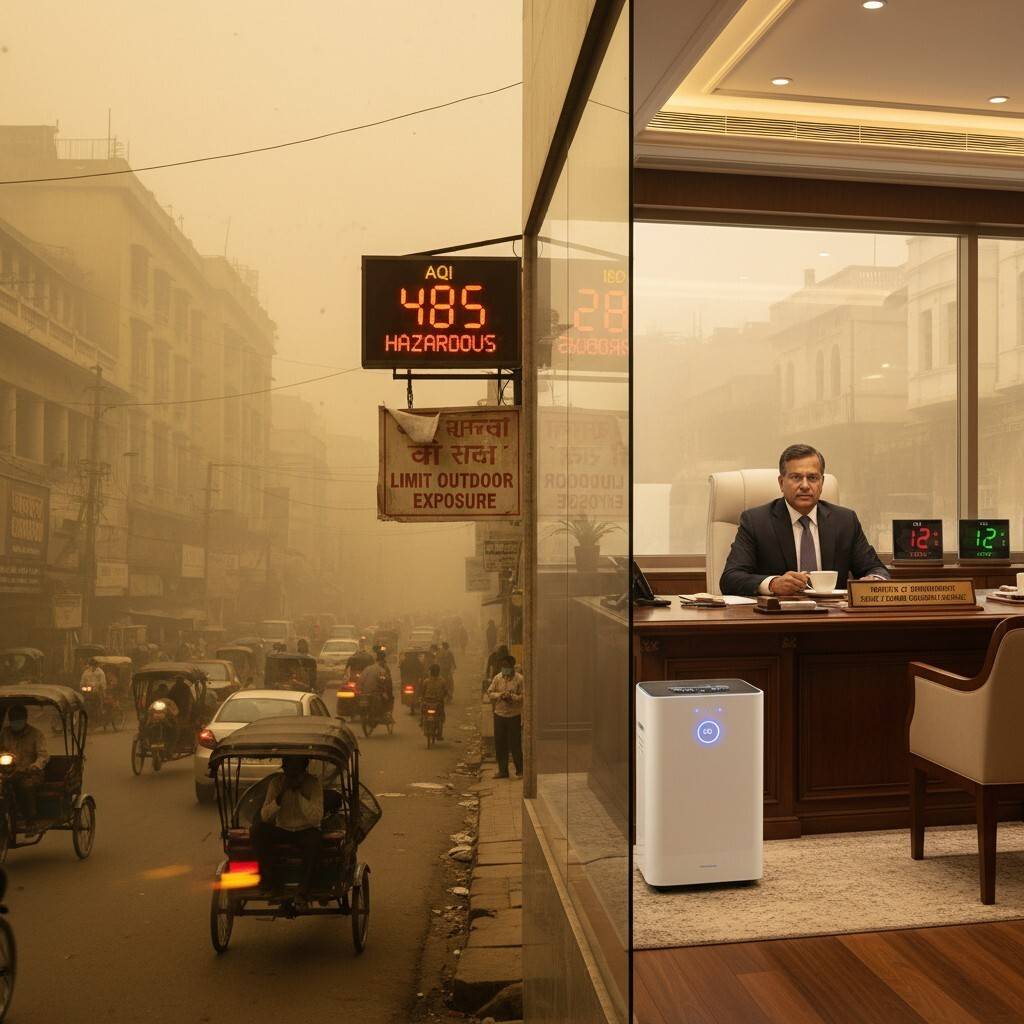
Delhi’s winter air emergency is predictable: the haze returns, the AQI spikes, and advisories urge people to limit exposure. What the city cannot predict is whether the institutions tasked with prevention will act early enough. RTI documents cited by Newslaundry suggest the Union Ministry of Environment, Forest and Climate Change (MoEFCC) held only three meetings focused on Delhi’s air pollution through most of 2025—on September 16, October 10 and November 11. That schedule meant the first dedicated meeting came only weeks before peak winter pollution, despite the crisis following a year-after-year pattern.
Decisions on paper, delays in the field
The September 16 meeting produced 19 decisions. But later minutes, as reported by Newslaundry, show that several core measures were still incomplete even as winter approached.
Industrial emissions monitoring was a case in point. Officials discussed installing Online Continuous Emission Monitoring Systems (OCEMS) across 2,433 polluting industries, with procedures to be finalised in September and a monitoring mechanism expected by October 2. Yet by the November 11 meeting, only 179 installations—about 7 percent—were recorded as completed. The remaining units were pushed to a December 31, 2025 deadline, and the RTI material cited in the story does not clearly state whether that deadline was ultimately met.
On emission standards, the timeline also slid. A key IIT Kanpur study on industrial emissions was expected by October 15, with revised industrial norms to be notified by October 31. The October 10 minutes instead recorded that reports for several sectors were still pending. Even by November 11, the norms were not finalised; the Central Pollution Control Board was asked to constitute another expert committee and draft action points by November 25. The RTI responses described by Newslaundry do not clarify what followed after that date.
The minutes also show familiar ground-level contributors—road dust and construction dust—cycling through discussion without firm closure. In September, the ministry decided to convene officials across departments to address pothole-related dust, but the October minutes reportedly did not mention road repairs. By November, the Delhi government was asked for a report on pothole repair work. Construction and demolition waste saw repeated discussion too: in September, Delhi was told to prepare an integrated waste management plan without a deadline; in October, CAQM was asked to hold another meeting; and in November, municipal commissioners were instructed to prepare a “comprehensive plan” and submit it to CAQM before implementation.
Stubble burning was mentioned in all three meetings, with plans to engage Punjab and Haryana. But the RTI responses, as presented in the report, offer no clear confirmation of whether such engagements happened or translated into measurable action.
Filtered air for the few
If the RTI minutes portray slow decision-making, a separate RTI reply highlights something faster and more concrete: protection for the ministry itself. Newslaundry reports that six air purifiers costing Rs 2.65 lakh were installed across MoEFCC offices. Five were purchased in February 2025, during the previous winter’s pollution peak, and five of the six were installed in the office of Minister of State for Environment Kirtivardhan Singh.
The contrast lands in a city where winter AQI often crosses 400—levels the report describes as hazardous and linked to severe respiratory and cardiovascular harms. The story cites the World Health Organization estimate that air pollution causes 7 million premature deaths globally each year, and references India-wide estimates exceeding 1.7 million annually—figures the Modi government disputes.
Independent assessments continue to underline how widespread the exposure remains. A Centre for Research on Energy and Clean Air analysis—based on CPCB monitoring data available till December 30, 2025—found most NCR cities breached India’s annual PM2.5 standards in 2025, with Delhi emerging as the most polluted major metro. The Delhi government points to improvement, with environment minister Manjinder Singh Sirsa calling 2025 the capital’s cleanest year in eight years; at the time of publication, Delhi’s average AQI was still in the “poor” category.
Newslaundry says it sent detailed questions to MoEFCC, CPCB, CAQM and the Delhi government, and would update the story if responses arrive.
Courtesy: Newslaundry.



Add a Comment