
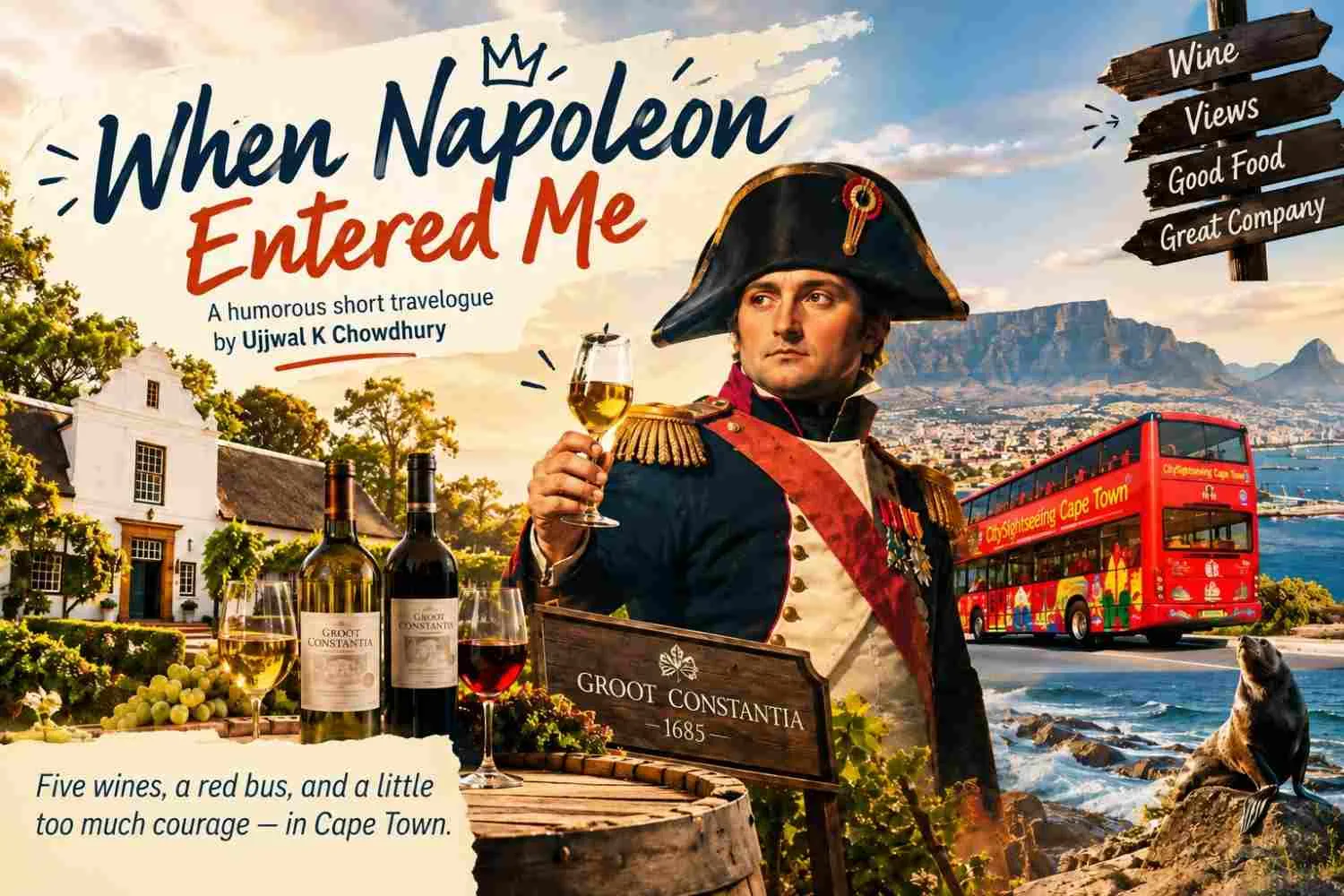
A humorous short travelogue by Ujjwal K Chowdhury.
| A day in Cape Town turns unexpectedly epic as wine, history, food and friendship send a simple sightseeing trip into a very small Napoleon-inspired adventure. |
Summary A day off in Cape Town becomes an adventurous city tour through Constantia, Hout Bay and Camps Bay. The journey begins at Groot Constantia, where centuries of wine history connect the estate to figures such as Napoleon, Jane Austen and Charles Dickens. A wine tasting, including the celebrated Grand Constance, turns an ordinary afternoon into a memorable experience. The trip continues through Hout Bay, where seafood, conversations and the harbour add a more local flavour to the day. By Camps Bay, the combination of wind, waves and an ambitious attempt to confront the Atlantic provides the day's comic climax. By the time the red bus returns to Long Street, the temporary sense of imperial courage has disappeared, leaving behind a funny and unforgettable Cape Town memory. |
Cape Town had given us a day off after two intense days at the Global Entrepreneurship Network’s Africa Congress. Mathew and I, exhausted but unwilling to behave like exhausted men, decided to explore the city on the red hop-on hop-off bus. After breakfast, we boarded at Long Street, armed with cameras, curiosity and the dangerous confidence of two visitors who believed the timetable would obey them.
Our first major stop was Constantia, Cape Town’s green wine country—part vineyard, part living museum, and part very successful argument for postponing work. Groot Constantia dates back to 1685, when Simon van der Stel established what is regarded as South Africa’s oldest wine-producing farm. Cape Dutch buildings, ancient trees and orderly vineyards rolled down the slopes as though history itself had been landscaped. Its fame travelled across Europe. Frederick the Great of Prussia and Louis Philippe were among the celebrated buyers of Constantia wine. Jane Austen mentioned it in Sense and Sensibility as a remedy for a broken heart, while Charles Dickens gave it a supporting role in The Mystery of Edwin Drood. Napoleon, too, was served Constantia during his exile on St Helena.
At the cellar, our guide Thabesa gave us a detailed dekho of the winemaking process. Red wine, we learnt, is fermented at a warmer temperature, while white wine prefers a cooler and more delicate arrangement—rather like guests at a Bengali wedding. The estate’s old bottles, labels and stories made the centuries feel as if they were still resting quietly inside the walls.
Then came the official tasting: five wines, some red, some white, some dry, some sweet, some slightly bitter and all presented with the solemnity usually reserved for a diplomatic treaty. After the stipulated five, Mathew launched a diplomatic campaign for a sixth—the famous Grand Constance, the modern naturally sweet wine made from Muscat de Frontignan and associated with the old Constantia legend.
I assumed the request would be politely rejected. But Thabesa was kind. Perhaps Mathew’s sincerity helped. Perhaps my video of her and the promise of a good still photograph had quietly strengthened our case. She brought out an empty case and bottle for a picture, followed by two cut-glass wine glasses containing a small serving each.
The wine was smooth, rich and almost dangerously friendly. It slipped down like a gentleman and arrived in the bloodstream like a military commander.
Within ten minutes, I felt Napoleon enter me.
My walking speed increased. My laughter became louder. My voice rose into a patriotic high pitch. I began speaking casually about doing difficult things immediately, efficiently and preferably before lunch. Mathew watched me with the amused concern of a man travelling with a newly self-appointed emperor.
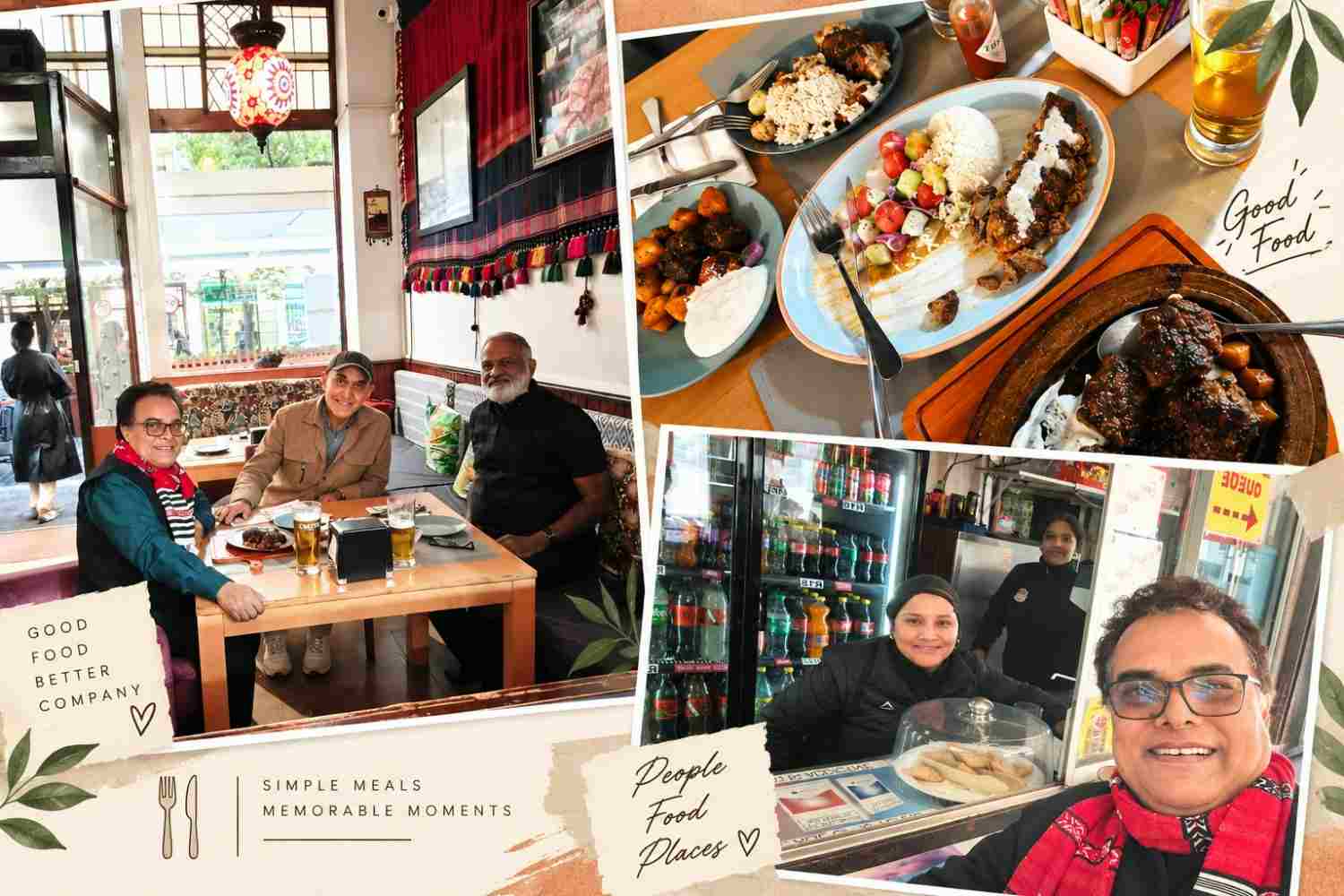
At Hout Bay, we stopped at Mariner’s Wharf for beer, chips and fried snoek. I jumped off the bus as though disembarking from a victorious campaign. A sea lion was being displayed by a man charging visitors for photographs. I ignored the commercial negotiations and clicked my own pictures. Then I wandered across the ramp into the port, speaking randomly to seamen and workers repairing, loading and unloading boats.
Over lunch, I got into conversation with the two women serving us. The senior server was wonderfully talkative. We discussed three generations of her family—their education, jobs, habits and, naturally, the behaviour of their husbands. She declared that she and the other women tolerated no nonsense from their men; consequently, the men behaved with suitable caution. I laughed so heartily that even the snoek seemed to be enjoying the conversation.
At Camps Bay, Napoleon attempted his grandest manoeuvre. I marched towards the rocks, determined to stand on the largest one, Vivekananda-style, and confront the Atlantic. The wind, however, had other plans. Waves roared, sand flew into my face like airborne needles, and my heroic expedition ended at the roadside—after several dozen photographs and selfies.
As the red bus moved past the ocean, Table Mountain and the city, the Emperor gradually withdrew. By the time we reached Long Street, six hours after departure, I had returned to my sombre self.
Mathew looked at me and pronounced, “Napoleon has left.”
The lesson was unforgettable: five small wine tastings can create a cocktail of courage, but the sixth—Grand Constance—does not merely enter the bloodstream. It appoints a field marshal, gives him a cape and sends him marching towards the Atlantic.


4 Comments
Mahesh Mishra
Great humour! Loved reading it. Five wine tasting and a beer later on must have been sufficient to create a Napoleon ( power plus). Ha Ha Ha !
Visited South Africa free of cost.
Brilliant. Enjoyed your sharp sense of humor 👍
Chitralekha ghosh
Marvellous....what such humour!!! Hahaha
Chitralekha ghosh
Marvellous....what such humour!!! Hahaha