
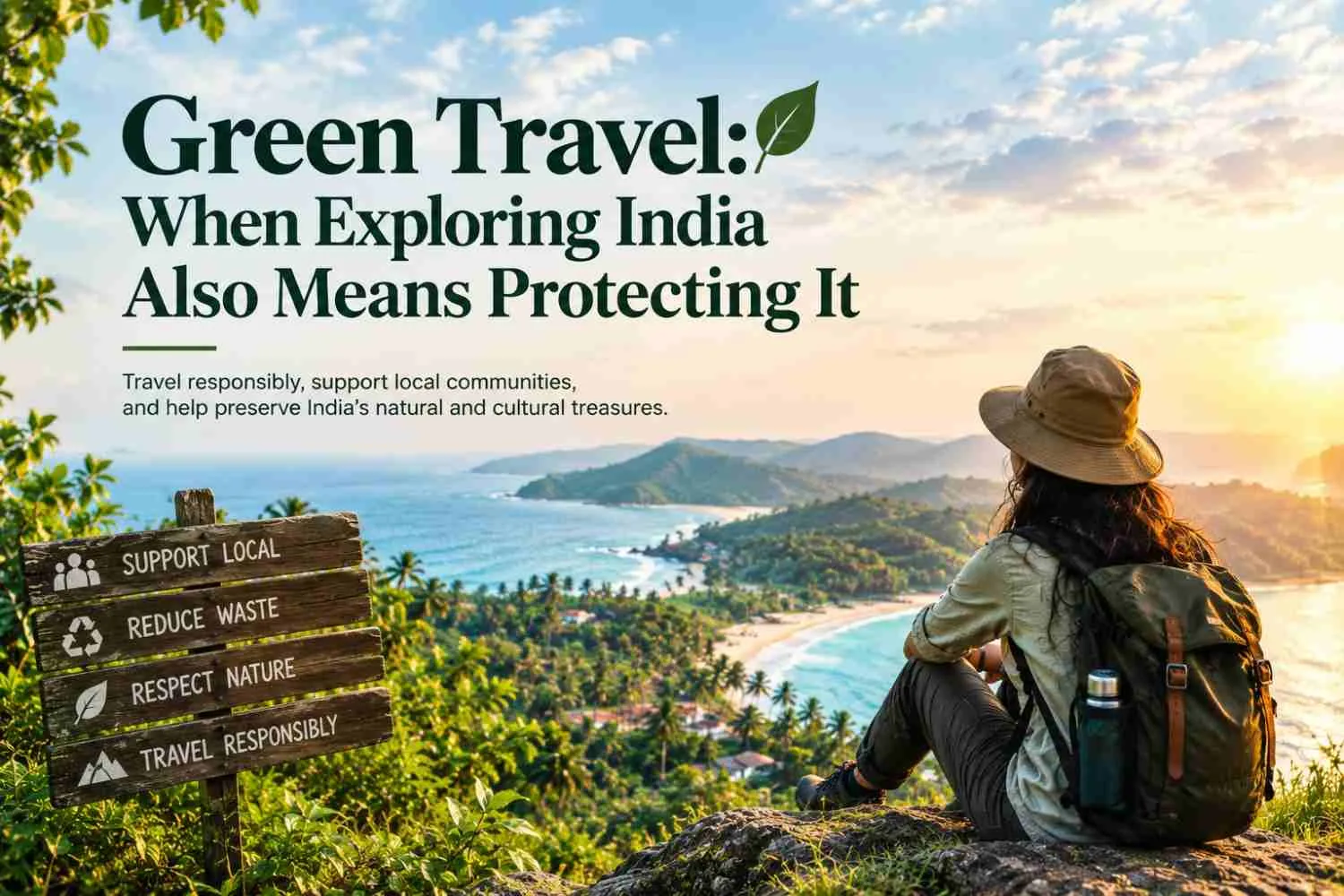
| What does it mean to travel responsibly in a country as diverse as India? Taking a trip from the Himalayas to the beaches of Goa may be fun, but this kind of tourism takes a toll not only on the environment but also on the local community. In this article, the author focuses on green travel and its importance in supporting ecosystems and boosting the local economy. Learn more about how to be a mindful tourist in this article. |
Summary The article addresses the importance of responsible and green travel and tourism in India. It also focuses on the influence of tourism on the country’s environment, community, and culture. This article raises awareness of tourist activities that have negative effects on the environment and cultural heritage of the country and offers workable solutions. The author uses Kerala, Ladakh, and popular Indian destinations as examples. The problems of overcrowding, use of resources, and impact of social media are discussed. The solutions offered by the author of the article include sustainable tourism practices in other countries like Bhutan, Costa Rica, and Venice. However, the author claims that sustainable travel requires a balance to ensure that tourism has a positive impact on the local community, environment, and culture. The main message of this article is that travellers should consider the impact of their travel and follow responsible tourism practices when discovering the country. Green travel is presented as the best way to explore India while conserving it for future generations. |
Introduction: Can We Travel Without Leaving a Mess Behind?
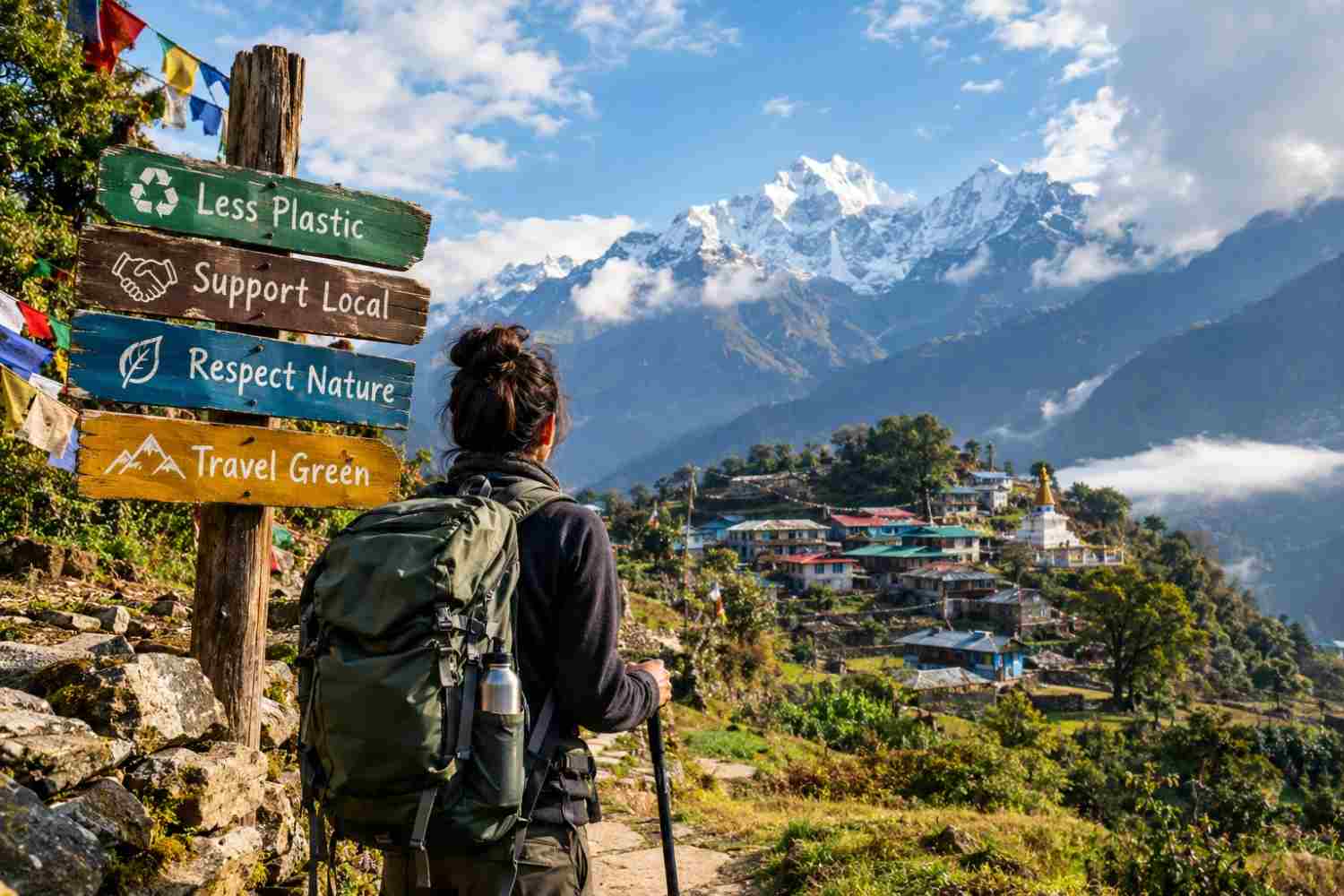
Imagine we are standing in the middle of a beautiful Himalayan village. The air is fresh, the mountains are covered with snow, and everything feels untouched. We take a few photographs, buy a bottle of water, eat at a local cafe, and continue we journey. But what happens after we leave? The plastic bottle stays behind. The food waste goes somewhere. The village must deal with more traffic, more water consumption, and more waste than it had before. Meanwhile, the people who have lived there for generations may slowly find their homes and traditions changing to accommodate tourists. This raises an important question: Can we really call travel sustainable if the destination pays the price for our experience?
This is where the idea of green travel comes in.
Green travel is not simply about taking a train instead of a flight or carrying a reusable water bottle. It is about thinking about the environmental and social impact of our journeys and making choices that allow both people and places to receive help from tourism.
India is an especially interesting country in this context. From the mountains of Ladakh and Sikkim to the beaches of Goa and Kerala, from the deserts of Rajasthan to the forests of the Northeast, every region has its own environment, traditions, food, crafts, and communities.
So, the real question is not “Where should we travel?” It is: “How should we travel?”
What Exactly Is Green Travel?
Green travel, also called sustainable travel or responsible tourism, means travelling in a way that tries to minimise environmental damage while supporting local people and respecting the culture of the destination. At first, this might sound complicated. But the idea is quite simple. It means using fewer resources, producing less waste, respecting nature, supporting local businesses and being considerate towards the people who live in the places we visit.
For example, staying in a locally owned homestay instead of an international hotel can keep more money within the local community. Eating local food instead of always choosing familiar fast-food chains can support farmers, cooks, and small businesses. Buying directly from an artisan can help traditional crafts survive. And sometimes, green travel can be as simple as not treating a beautiful place like a disposable tourist attraction.
Green Travel Is More Than the Journey
Green travel doesn't end with choosing a less polluting mode of transport; it includes almost every decision taken during the journey such as where the traveller stays, how much water and electricity they use, what they eat, what they buy, how they get rid of their waste, and the way they interact with local communities and wildlife. Even if a trip begins by taking a train rather than a flight, it can still not be regarded as sustainable if the traveller stays in a hotel that wastes a large amount of water, uses a great deal of disposable products, and contributes little to the local economy.
Accommodation is a significant element of the situation. Hotels and resorts use electricity for lighting and air conditioning, water for showers, laundry, cooking, swimming pools, and the gardens, and produce a great deal of food and packaging waste. If an accommodation business is to be genuinely responsible it must go beyond superficial environmental signs and minor actions; solar energy, the collection of rainwater, the treatment of wastewater, waste sorting, the use of energy-efficient appliances, and the provision of locally sourced food and employment for local people are better signs of sustainability.
India has already started to apply these ideas to its tourism planning. The National Strategy for Sustainable Tourism issued by the Ministry of Tourism is placed alongside the national strategies concerning rural tourism, home-stays, and ecotourism. An example of this is Kerala's Responsible Tourism model, in which environmental protection is considered together with local employment, community participation and economic benefits.
When a Destination Has More Tourists Than It Can Handle
When the number of visitors grows faster than a destination can cope with, tourism becomes a complicated matter. A place may be beautiful enough to draw in thousands of tourists, but that does not mean that its roads, water supply, waste disposal systems, or natural environment are able to deal with having thousands of people there every day. That is when the concept of carrying capacity becomes relevant. Simply put, it means the amount of tourism a place can handle before environmental or social harm reaches unacceptable levels. When too many people visit, it can cause traffic, lead to shortages of water, result in overflowing waste, create noise, cause damage to natural areas and increase the pressure on residents.
In India, this matter is currently under consideration. The Tourism Department of Kerala has arranged for capacity assessments for various hill stations, such as Munnar and Wayanad, considering environmental, social, and economic factors. The problem is not merely one of limiting the number of tourists but involves working out how many can be accommodated without harming the residents and the environment.
A similar issue can be seen in places like Manali, Shimla, Goa, and certain areas of Ladakh since seasonal tourism can have a major effect on the local infrastructure.
This leads to a significant question—should a destination always aim to draw in more tourists or should it at times concentrate on managing tourism more effectively?
The Local Economy Behind a Green Trip
Green travel also concerns the places where the traveller's money is spent. Although tourism can create jobs for hotel staff, drivers, guides, farmers, artisans, cooks and small business owners, these jobs are not necessarily shared among the people who live in the destination.
Opting for a homestay that is owned by locals rather than one that is part of a big chain, having a meal at a local restaurant rather than at an international chain, and hiring a local guide as well as buying directly from an artisan can all contribute to making sure that a greater portion of the tourist's money stays in the destination. Sustainability is not only an environmental issue but also an economic one.
Ladakh has likewise been promoting community-based tourism and homestay schemes which aim to have the villages take part in tourism. The concept is that tourists get the opportunity to experience everyday life in the area while the income from tourism flows to the households in the community. The concept of a "green trip" is altered in that it does not merely involve leaving less waste but also raises the question of who receives help from my visit.
When a Beautiful Place Becomes Too Popular
The way in which destinations are discovered has been fundamentally altered by social media; a waterfall, a village road or a mountain viewpoint which was previously known to local people can now attract thousands of visitors after one reel goes viral.
The issue is that visibility can increase faster than infrastructure.
A place that is fragile might not have sufficient parking, toilets, waste collection facilities, or public transport to deal with a sudden rise in the number of visitors. Additionally, more tourists can also disturb the local wildlife, the vegetation, and the normal way of life in local communities. That is the reason responsible travel in the Instagram era also demands digital responsibility. When travellers and influencers share a location with their thousands of followers, they should think about the consequences of doing so. It is not always harmful to share a beautiful place, but not taking care when revealing the precise location of a fragile ecosystem can in fact lead to the kind of damage which has caused the site to be worth visiting.
We should not aim at preventing people from finding out about new destinations but rather at distributing tourism over different places and times, and we should get tourists to follow the local rules and, where possible, avoid the sensitive areas.
What can India pick up from the rest of the world?
India is by no means the only nation which is trying to cope with the environmental and social effects of tourism; various destinations worldwide have tried out different methods of making tourism more responsible.
For instance, Bhutan has created a tourism strategy based on the concept of high-value, low-volume tourism rather than just aiming to increase the number of visitors. The wider takeaway is that a destination does not have to become more successful just because it constantly raises the number of tourists.
Costa Rica is also a good example since its tourism sector is closely connected with ecotourism, protected areas, and biodiversity; experience in this country demonstrates that natural environments can form part of a nation's tourism economy and thus provide a motive for protecting them.
There is also the case of Venice, which presents the contrary problem: the effects of excessive tourism. The city has had to try out various methods for dealing with the pressure from visitors since tourism affects the infrastructure and daily life.
They illustrate the fact that a single formula cannot be applied to green travel. While some places concentrate on restricting the number of visitors, others stress conservation, some emphasise community involvement and others deal with the problem of overcrowding. The key point for India is that tourism should be designed about the capacity and nature of each destination rather than using the number of visitors as the only criterion for measuring success.
India Is Not Just a Destination
One of the biggest mistakes we make while travelling is thinking of places as destinations rather than homes. For us, Varanasi may be a travel destination. For someone else, it is home.
For us, a village in Himachal Pradesh may be a peaceful holiday location. For the people living there, it is where their families, farms, temples, and traditions have existed for generations. The same applies to Rajasthan, Kerala, Assam, Sikkim, Ladakh and hundreds of other places across India.
When tourists arrive, they bring money, employment, and opportunities. But they can also bring traffic, waste, noise, rising prices, and pressure on natural resources. Therefore, green travel should not only ask: “Did I enjoy my trip?”
It should also ask: “Did the place benefit from my visit?” And even more importantly: “Would the people living there want tourists like me to come back?”
When Tourism Helps and When It Hurts
Tourism can be extremely valuable to local communities.
A tourist staying in a homestay provides income to a family. A traveller buying a handwoven shawl supports an artisan. A local guide earns a living by sharing knowledge about their region. A small restaurant gets customers. A taxi driver gets work.
In this way, tourism can help communities become economically stronger.
But tourism can also create problems when it grows without planning.
Think about a popular hill station during peak season. Hundreds or thousands of tourists arrive within a few days. Roads become crowded, hotels consume massive amounts of water and electricity, waste increases and local infrastructure become overwhelmed.
The irony is that people often travel to such places because they want to escape crowded cities, only to make the destination look like another crowded city.
This is one of the biggest challenges of modern tourism: how do we enjoy a place without slowly destroying the very thing that attracted us to it?
Green Travel Is Also About Culture
Environmental sustainability is only one side of the story. India's culture is deeply connected to its environment. Our food, clothing, architecture, festivals, crafts, and lifestyles have developed around local geography and available resources. A traditional house in Kerala is different from one in Rajasthan because the climate is different. Food in Bengal is different from food in Punjab because local agriculture and culture are different. Himalayan communities have developed ways of living suited to their mountains.
When we travel responsibly, we are not only protecting forests, beaches, and mountains. We are also protecting ways of life. Imagine visiting Rajasthan and buying a locally made handicraft directly from the artisan who created it. Or staying in a family-run homestay in Sikkim and eating food prepared with locally sourced ingredients.
These experiences do more than provide tourists with souvenirs and photographs.
They give local traditions an economic reason to survive.
The Problem With “Tourist Culture”
There is nothing wrong with tourism changing over time. Cultures naturally evolve.
The problem begins when local culture is changed entirely to satisfy what tourists expect to see.
A village may start replacing traditional food with dishes designed specifically for tourists. Local shops may sell mass-produced “traditional” souvenirs imported from somewhere else. Traditional performances may become short shows performed only because tourists expect them. Eventually, the culture being sold to tourists may have extraordinarily little connection with the culture of the people themselves. This is why responsible travel should encourage authenticity rather than performance. Travellers should be curious about local traditions, but they should also respect that not every cultural practice exists for entertainment.
Sometimes the most respectful thing a tourist can do is simply see, listen, and learn.
So, How Can We Travel Greener?
Green travel does not require us to stop travelling. It simply requires us to make better choices. We can begin with transportation. Whenever practical, trains and public transport can be better choices than short flights or multiple private vehicles. India has one of the world's largest railway networks, making train travel an important choice for domestic tourism.
We can also reduce waste by carrying *reusable* bottles and bags instead of constantly buying disposable ones. But the most important choice is where our money goes. Instead of automatically choosing large chains, travellers can consider locally owned hotels, home-stays, restaurants, guides and shops. Because every rupee spent by a tourist is also a vote for the kind of tourism they want to support.
What About Food?
Food is one of the easiest ways to experience a culture and one of the easiest ways to support it.
India has an extraordinary variety of regional cuisines. Yet tourists sometimes travel thousands of kilometres only to eat the same food they could have ordered at home.
If we are travelling to Kerala, why not try a local meal? In Rajasthan, why not explore traditional dishes? In Bengal, why not eat at a small local restaurant? In the Northeast, why not learn about regional ingredients and cooking traditions? Eating locally can support farmers, small restaurants, home cooks, and local food producers. And there is another benefit:
We might discover that the most memorable part of our trip was not the monument we photographed, but the meal we shared with someone.
Green Travel in the Age of Instagram
Social media has completely changed the way we travel. Today, many people discover destinations through Instagram reels, YouTube videos, and travel influencers. A beautiful photograph can turn an unknown location into a tourist hotspot overnight. But there is a problem- A-place can become famous much faster than its infrastructure can handle. A quiet village suddenly receives thousands of visitors. A secluded waterfall becomes a selfie spot. A small mountain road becomes filled with cars.
And then the same social media that made the place famous starts showing photographs of overflowing bins and overcrowding.
This is why travellers and influencers have a responsibility. Not every beautiful location needs to become the next viral destination. Sometimes, responsible travel means not revealing a fragile location to millions of people simply for views.
The People Behind Our Holidays
There is another side of tourism that we often forget. The hotel employee who cleans our room. The driver who takes us through unfamiliar roads. The local guide who explains the history of a monument. The woman who makes the handicraft we buy.
The street-food seller who prepares our evening snack.
The family that opens its home as a homestay. Tourism is not only about places. It is about people.
Green travel should therefore also mean treating tourism workers with dignity and respect. Pay fairly. Do not bargain aggressively with small artisans just to save a few rupees. Follow local rules. Ask before photographing people, especially during religious or cultural activities.
A sustainable holiday should not be enjoyable for the tourist at the expense of someone else's dignity.
A Different Kind of Luxury
For a long time, luxury travel has been associated with five-star hotels, private cars, and extravagant experiences. But our definition of luxury needs to change. What if luxury meant waking up in a quiet village where the air is clean? What if it meant eating food grown locally? What if it meant staying in a beautiful homestay where our money directly supports a family?
What if it meant travelling slowly enough to understand a place? In that sense, green travel is not about having less of an experience. It can mean having more of an experience.
Instead of rushing through ten tourist attractions, we might spend an afternoon talking to a local artisan. Instead of taking a quick photograph, we might learn the story behind a centuries-old tradition. The journey becomes less about collecting places and more about understanding them.
Green Travel in India: From Tourists to Travellers
The biggest difference is in the mindset. A tourist may ask: “What can I get from this place?”
A responsible traveller might ask: “What can I learn from this place and what can I give back?”
This does not mean every traveller needs to plant a tree, volunteer for a week or become an environmental activist. Sometimes responsible travel is much simpler- carry our waste, respect local customs, use water carefully, avoid disturbing wildlife, support local businesses, use public transport, when possible, buy genuine local products, don't damage monuments, don't litter, don't treat local people as part of the scenery.
Small actions may seem insignificant individually, but millions of travellers making better choices can create a significant difference.
Green Travel in India: Who Is Walking the Talk?
India’s attitude towards tourism is as controversial as ever, although a record-breaking influx of visitors creates a significant positive impact on the local economy, generating employment and awareness about the country’s overall attractiveness. However, the potential adverse effect on the environment should not be understated. What are the responsible travel practices in India, and which should be promoted?
There are some promising ideas at the state level that serve as an inspiration for other regions, aiming to create ecological friendliness. For example, Sikkim, a state in India, has taken remarkable steps towards encouraging an organic lifestyle and reducing plastic waste. Although this step may seem a minor issue, it has the potential to address a significant threat to food waste while also redirecting the attention from hard-to-control mass tourism to arranging more personalised and business-like cooperation between locals and visitors. It can serve as a model for similar projects in other areas.
At the same time, one should be cautious about “green” labels that often conceal no actions. A hotel that positions itself as an eco-friendly accommodation can have saving water and electricity at the heart of its operations.
However, the fact that the resort is built in the middle of rice terraces and tea plantations does not necessarily mean that it is an eco-resort. The use of certain words (eco-, nature-friendly) and the presence of green elements may be misleading if the seller does not really care about the environment. In this situation, the responsibility lies with the tourist to research the hallmarks of sustainable travel in India.
The Future of Travel: Should We Travel Less or Travel Better?
The answer may not be that we should stop travelling. Travel has enormous value. It allows people to understand cultures different from their own, creates employment and brings communities together. The challenge is to make tourism more responsible. India is likely to see more domestic and international tourism in the coming years. More people will travel, more destinations will become popular, and more businesses will depend on tourism. Therefore, the question is not whether tourism will grow.
It is whether it will grow responsibly.
Conclusion: Travel the World, But Leave Room for It to Breathe
Travel gives us something extraordinary. We get to temporarily step outside our own lives and enter someone else's world. We see different landscapes, taste unfamiliar food, hear different languages, and discover traditions that may be completely different from our own. But with that privilege comes responsibility. A beautiful mountain is not just a photograph. A beach is not just a place for a sunset reel. A village is not just a backdrop. A monument is not just an Instagram location. They are homes, ecosystems, histories, and livelihoods. Green travel asks us to remember this. It tells us that the best traveller is not necessarily the one who visits the most places, takes the most photographs, or spends the most money. The best traveller is the one who leaves a place as beautiful as they found it and leaves the people there better off because they came.
So, the next time we plan a holiday, don't only ask: “Where do you want to go?” Ask: “How do you want to travel?” Because travelling sustainably is not about seeing less of India. It is about seeing India more responsibly- and leaving enough of it for the people who will come after us.
References / Sources
Ministry of Tourism, Government of India — National Strategy for Sustainable Tourism (2022)
Press Information Bureau, Government of India — Sustainable Tourism Initiatives
https://www.pib.gov.in/indexm.aspx?reg=48&lang=2
Administration of the Union Territory of Ladakh — Holistic Homestay Support Framework


Add a Comment