13 October, 2026 | Kolkata
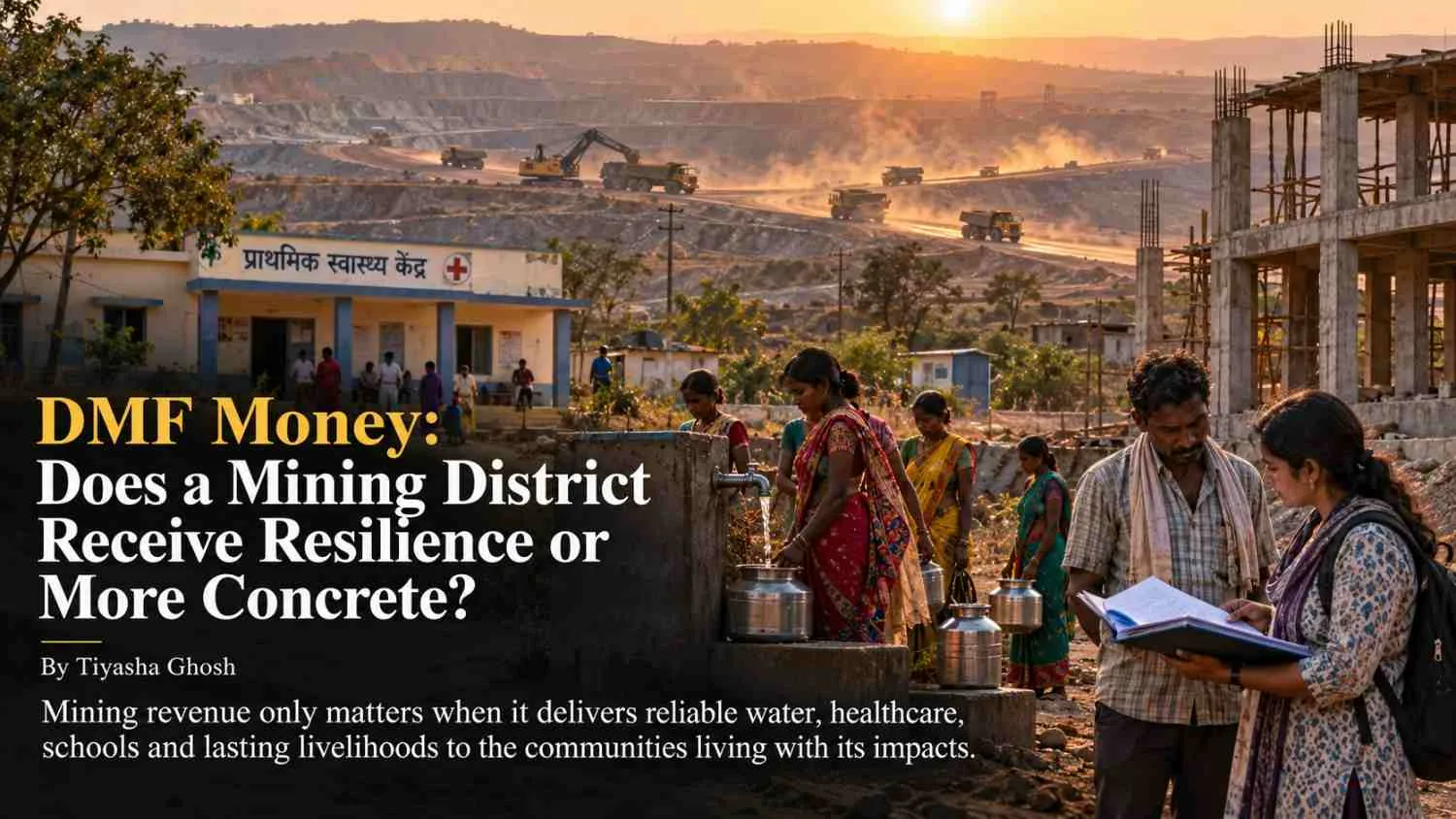
| Mining generates public revenue, but the real test is whether that money delivers reliable water, better healthcare, stronger schools and lasting livelihoods for the communities living with its impacts. |
Summary District Mineral Foundation (DMF) funds are meant to improve the lives of people affected by mining. Yet money sanctioned for a project does not automatically mean that the project is complete, functional or benefiting the intended community. Starting with Keonjhar, Odisha, this investigation traces public records from fund collection and approvals to expenditure, completed work and services on the ground. |
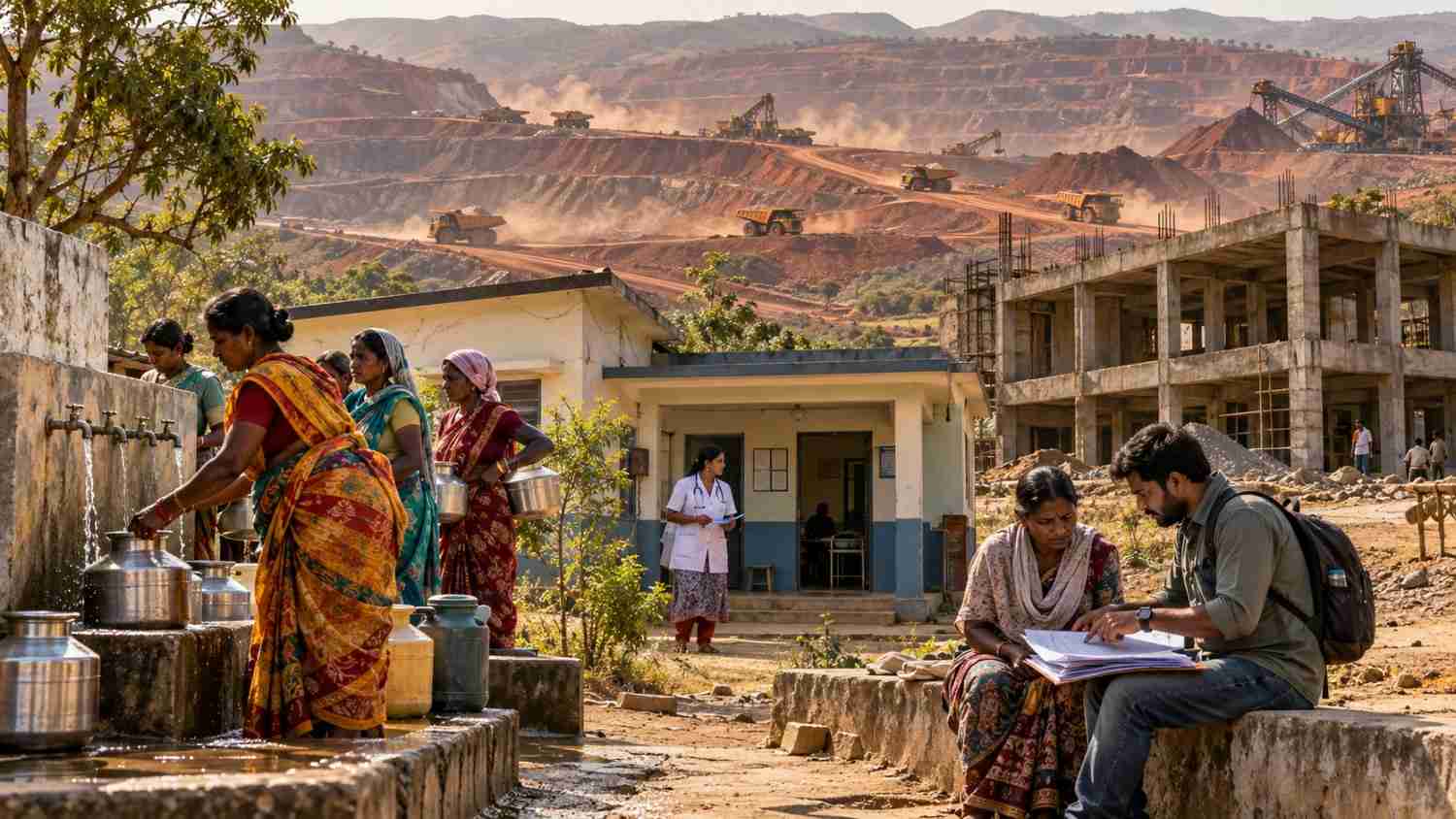
If a district receives mining revenue, how can residents know whether it is improving their lives?
The money is collected. What happens next?
Mining brings revenue to the government, but it can also place pressure on local water resources, land, health and livelihoods. For communities living close to mining operations, the benefits of mineral wealth should therefore extend beyond the value extracted from the ground.
The District Mineral Foundation was created under the Mines and Minerals (Development and Regulation) Act, 1957, through its 2015 amendment. DMFs are non-profit trusts established in mining-affected districts to work for the benefit of affected people and areas. Their funds come from statutory contributions by mining leaseholders. The Pradhan Mantri Khanij Kshetra Kalyan Yojana (PMKKKY) provides the framework for using this money for development and welfare.
The intended priorities include drinking water, healthcare, education, environmental protection, sanitation, support for women and children, skills and livelihoods. Under the revised 2024 guidelines, at least 70% of DMF funds must be directed towards directly affected areas and high-priority sectors.
But a policy commitment is only the starting point. To understand whether DMF spending is delivering its intended benefits, the financial trail must be followed beyond the approval stage.
A large fund, but what does the spending show?
The scale of DMF funding makes public scrutiny important. According to the Ministry of Mines, by November 2024, DMFs across India had collected ₹1,02,083.03 crore. Of this, ₹87,357.28 crore had been sanctioned for 3.60 lakh projects, while ₹54,892 crore had been spent. The ministry also reported that 2.01 lakh projects had been completed. These figures are a dated national snapshot, not a current total for every district.
Each number answers a different question. Collections show how much money has entered the system. Sanctions indicate the amount approved for projects. Releases show how much has been transferred to implementing agencies, while expenditure records indicate reported spending. Completion records show whether a project has been declared finished.
None of these figures, on its own, proves that a service is working or that the intended beneficiaries are receiving it.
For example, a sanctioned water-supply scheme may still be awaiting construction. A completed facility may lack electricity, staff, maintenance or a dependable water source. A livelihood programme may report participants trained without showing whether they secured sustained income.
The investigation must therefore distinguish money approved, money released, money spent, work completed and outcomes achieved.
Why Keonjhar is the starting point
Keonjhar has a public-facing DMF website with project-level information, including project names, locations, sanctioned amounts, released amounts and status. Its records provide a starting point for matching financial documents with individual projects.
The portal is a useful discovery tool, but its existence does not settle the accountability question. The reporting task is to test whether the information is sufficiently complete, current and consistent with supporting documents—and whether the projects listed can be verified on the ground.
The first step is to select one project in a high-priority area, such as drinking water, healthcare, education or livelihoods. Its approval should be matched with the annual action plan, administrative sanction, tender, work order, release records, expenditure statements and completion certificate. Dates and amounts must be reconciled rather than assumed to match.
The next step is physical verification. If the project is a water-supply scheme, for example, the investigation should check whether the infrastructure exists, whether water is available reliably, whether the equipment works and who can access the service. If it is a health or education project, the relevant checks may include operating hours, staffing, facilities and maintenance.
This is where the difference between a project being built and a public service being delivered becomes visible.
The accountability question is bigger than construction
DMF spending can produce visible infrastructure, including roads, buildings and water pipelines. These may be necessary, but the presence of concrete structures does not establish that the spending has addressed the most urgent needs of mining-affected communities.
In a 2025 assessment, iFOREST reported that DMFs had collected more than ₹1.03 lakh crore over their first decade and argued that weak planning, implementation and community participation were limiting their potential. Its analysis raised concerns about underutilised funds and investments that may not adequately address the needs of affected people. These are findings and arguments from an independent research organisation; they should be examined alongside district records and the government’s account.
There are also questions about who decides which projects receive funding. The revised PMKKKY guidelines provide for Gram Sabhas and local bodies to contribute to planning, while requiring stronger monitoring and accountability measures. The investigation should establish whether affected communities had a meaningful role in identifying priorities, rather than simply being counted as beneficiaries after a project was selected.
An official response may point to the number of projects approved, completed or funded. That information matters, but it must be tested against expenditure documents, the condition of the assets and evidence of who benefits. An independent expert may identify gaps in planning or participation, but such claims should also be checked against the relevant records.
The purpose is not to assume that every project has failed—or that every official figure is misleading. It is to establish what the evidence supports.
From public spending to public benefit
The final assessment should follow one project from its financial approval to its actual use. Where records agree and the service functions, that should be reported clearly. Where money has been released but work remains incomplete, the ledger should show the gap. Where a project is marked complete but its functionality cannot be established, that distinction should remain visible.
Missing records also matter. If a release order, expenditure statement or completion certificate cannot be found, the investigation should document the gap, ask the responsible authority for clarification and avoid treating an unanswered question as proof of wrongdoing.
A district-level spending ledger can make this process repeatable. Each entry should include the project name, location, sector, sanctioned amount, amount released, reported expenditure, completion status, on-site functionality, beneficiary evidence, source documents and date of last verification.
The wider lesson is straightforward: mining-affected communities should be able to see not only how much money their district receives, but also what that money delivers. A project list is useful; a verified account of spending, functioning services and community benefit is far more meaningful.
The real measure of DMF money is not how much concrete a district can show. It is whether the people meant to benefit can rely on the services the money was supposed to provide.
Sources:
- Ministry of Mines, Government of India — District Mineral Foundation and PMKKKY overview, including the revised 2024 guidelines
- Press Information Bureau, Ministry of Mines — National DMF collection, sanction, expenditure and project figures up to November 2024
- DMF Keonjhar, Odisha — District Mineral Foundation portal
- DMF Keonjhar, Odisha — Phase-wise project details, including sanctions, releases and status
- iFOREST — Assessment and discussion on the first decade of District Mineral Foundations
- iFOREST — “A missed opportunity for social justice in mining regions”


Add a Comment