14 October 2026 | Kolkata, West Bengal
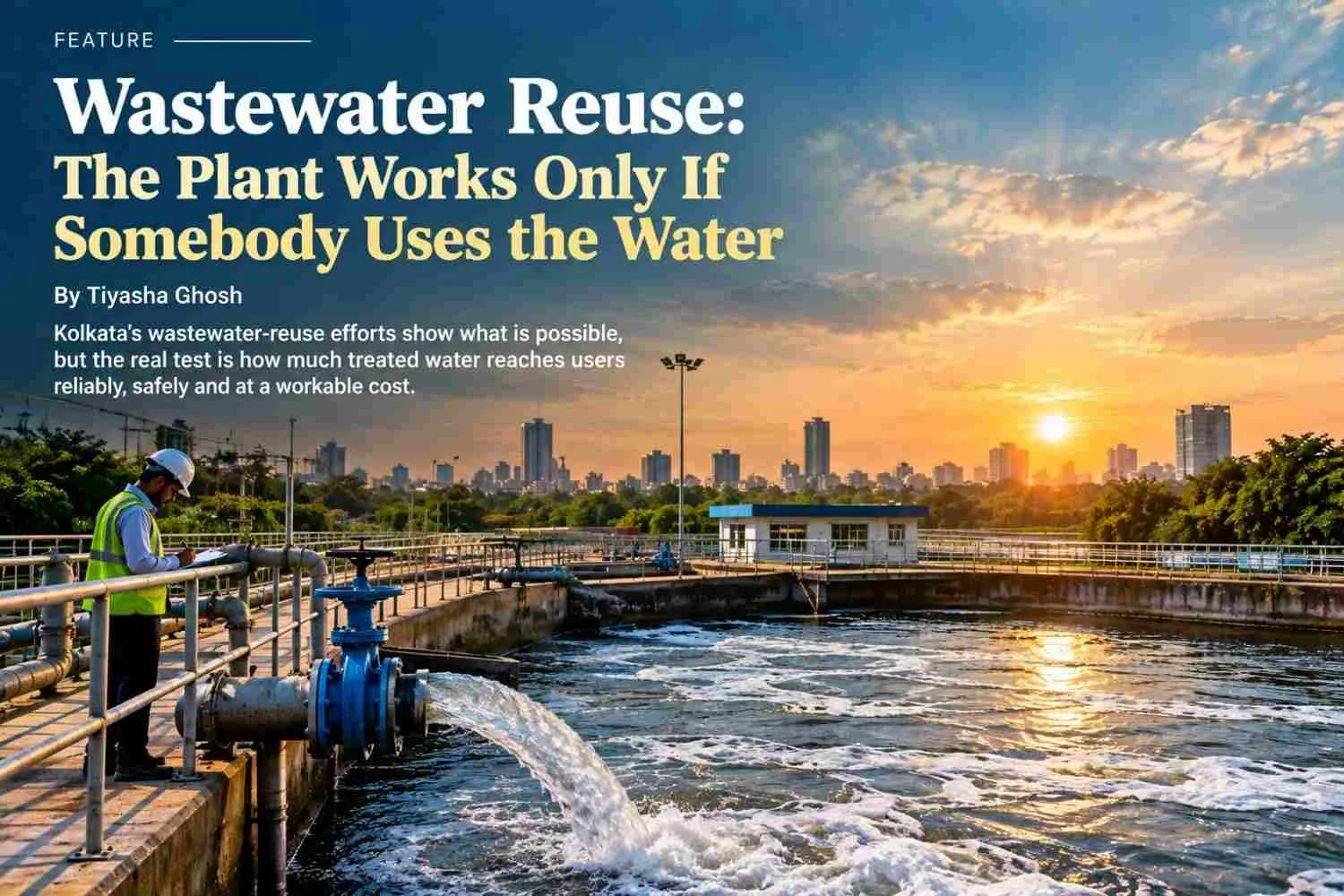
| Kolkata’s wastewater-reuse efforts show what is possible, but the real test is how much treated water reaches users reliably, safely and at a workable cost. |
| Summary: Treated wastewater can reduce pressure on freshwater supplies, but a treatment plant’s capacity does not prove that its water is being reused. Public records point to reuse in Kolkata’s Sector V and the East Kolkata Wetlands, while gaps in published data make it difficult to assess actual volumes, costs and reliability. As West Bengal moves towards its 2030 reuse target, the question is whether the water is reaching users and delivering measurable benefits. |
If a City Can Treat Wastewater, What Stops It from Reusing More of It?
A wastewater treatment plant may appear to offer a practical solution to water scarcity. It collects sewage, treats it and produces water that can be used for certain non-drinking purposes. But treatment is only one part of the process. What happens afterwards matters just as much. Does the treated water reach an actual user? Does it meet the required quality standards? Can the supply remain reliable without making the water too expensive?
These questions are central to Kolkata’s water-security challenge. Reusing treated wastewater can reduce dependence on freshwater, but only when treatment, distribution and actual use work together.
What Do Kolkata’s Records Reveal?
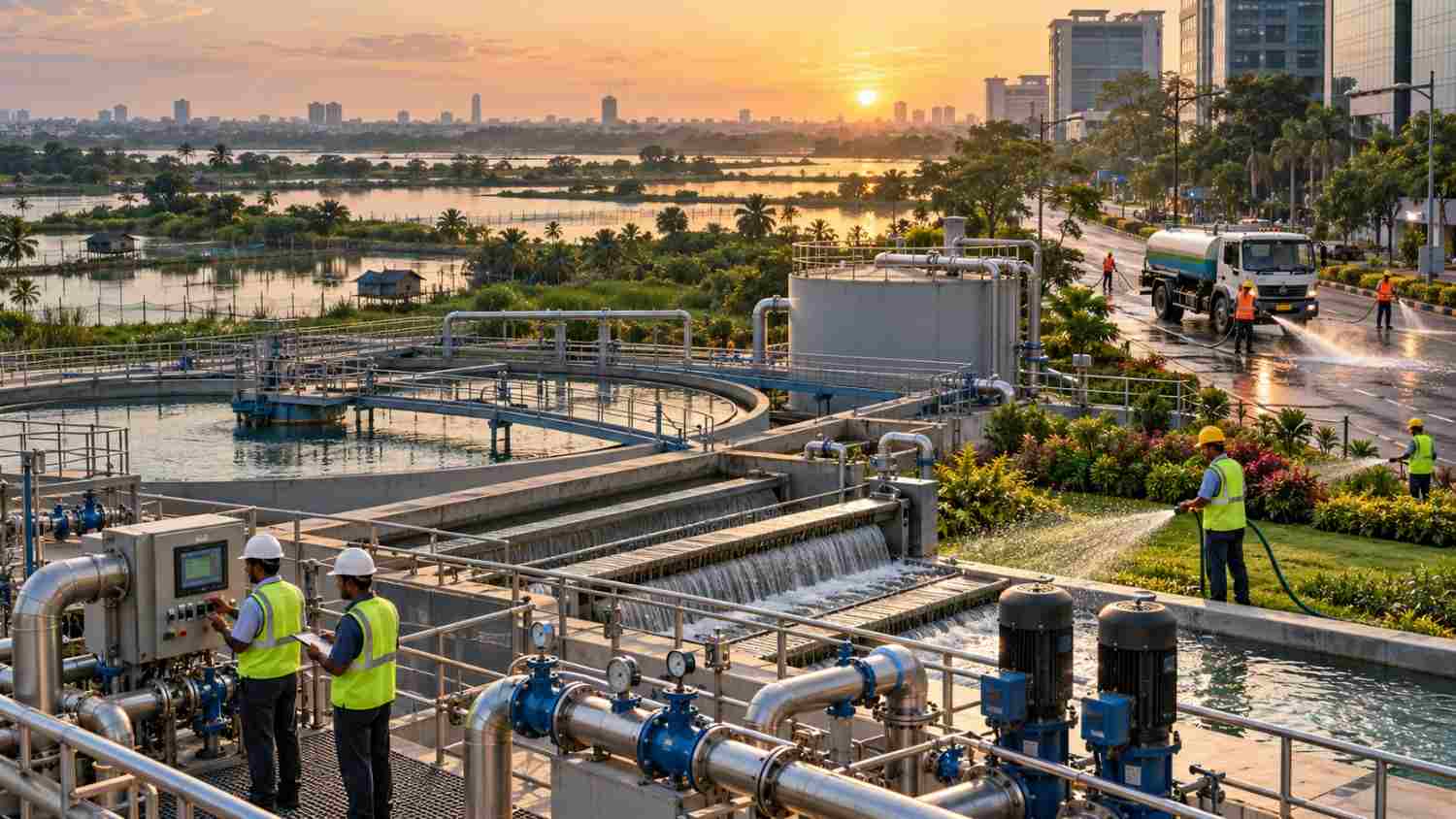
One documented example comes from Sector V in Salt Lake, where the Nabadiganta Industrial Township Authority (NDITA) manages water and civic services. A report published by The Times of India on 13 November 2025 stated that treated wastewater from Sector V’s sewage treatment plants was being reused for gardening and road washing. The report also noted that NDITA received close to three million gallons of filtered water daily from Tala to supply the township.
These are two separate water streams. The filtered water supplied from Tala should not be confused with the treated wastewater reused locally.
The example establishes that treated-water reuse has been reported in a real urban setting. However, the publicly available report does not specify the daily volume of wastewater reused, its operating cost, the energy required for treatment and distribution, or the latest laboratory results. It therefore cannot, on its own, establish how efficiently the system operates or how much freshwater it saves.
The wider picture in Kolkata is more complex. A Kolkata Municipal Corporation progress report for August 2025, submitted in a matter related to the National Green Tribunal, estimated that the city generated around 1,400 million litres of sewage per day (MLD). It reported that approximately 910 MLD received natural treatment through the East Kolkata Wetlands and was used for activities including pisciculture, mixed farming and animal husbandry. The report also listed five operational sewage treatment plants with a combined capacity of 179 MLD, while provisions for reusing their treated water were still under consideration.
Kolkata’s District Environment Plan for 2025–26 also recorded 910 MLD associated with the East Kolkata Wetlands, 179 MLD of capacity across five existing treatment plants, and 311 MLD of untreated or partially treated sewage. These figures describe different parts of the city’s sewage system. They should not be interpreted as a current measurement of how much treated water is actually being reused by end users.
The East Kolkata Wetlands are an important part of this story. They support fisheries and other livelihoods while naturally treating wastewater. However, this process is not identical to a conventional treatment plant supplying reclaimed water through a controlled distribution system. Both approaches have a role to play, but each must be assessed according to its own water-quality, environmental and operational requirements.
West Bengal’s 2030 Target Raises the Stakes
On 14 July 2026, West Bengal notified its State Policy on Safe Reuse of Treated Wastewater. The policy sets a target for at least 20% of the state’s overall industrial water requirement to be met through municipal wastewater by 2030. It also promotes reuse for non-drinking purposes in eligible residential developments, public buildings and commercial establishments.
This is a future policy target, not a measure of current achievement.
Meeting it will require more than increasing treatment capacity. Industries need a dependable supply that meets their quality requirements and fits their budgets. Treatment operators need sufficient funds for electricity, chemicals, testing, equipment and maintenance. Municipal authorities must also establish distribution systems that connect treatment plants with users who can consistently consume the reclaimed water.
These priorities can come into conflict. Operators need to recover treatment and pumping costs, while buyers may be unwilling to pay more than they currently spend on water. Some industrial processes may require additional treatment before reclaimed water can be used. If the supply becomes unreliable or its quality fluctuates, users may hesitate to depend on it.
Health and environmental safeguards are equally important. Water suitable for road washing or certain landscaping activities may not be appropriate for every industrial process or agricultural use. Treatment and testing must match the intended purpose. Reuse cannot be considered successful if it simply transfers pollution risks to workers, land or water bodies.
The Numbers That Should Accompany Every Reuse Claim
A credible assessment must distinguish between the volume a treatment plant is designed to handle, the volume it actually treats and the amount ultimately reused. A supply agreement is useful evidence, but it does not prove that the contracted volume is consistently delivered. Similarly, treatment records cannot establish how much freshwater has been displaced unless the end user’s consumption is also examined.
What Is Known - and What Remains Unclear
| Investigation point | What the public record establishes |
| Sector V reuse | Public reporting describes treated wastewater being reused for gardening and road washing. |
| Daily reuse volume | No verified daily reuse volume was established from the sources reviewed. |
| Water quality | The latest project-specific laboratory results were not available in the reviewed material. |
| Electricity and operating costs | No verified project-level figures were located. |
| Reliability and downtime | Current operating and interruption records were not established. |
| Citywide context | Kolkata’s 2025 records document sewage generation, treatment capacity and the role of the East Kolkata Wetlands, but do not provide a current, complete account of reuse across all facilities. |
This is the evidence gap that matters. A project can be operational while still lacking publicly accessible information about its performance. Without records of output, delivery, testing, costs and downtime, readers cannot independently assess whether a system is reliable or whether it achieves the expected freshwater savings.
From Infrastructure to Water Security
SustainVerse’s Kolkata summit, scheduled for 19–21 November 2026, includes water security, wastewater reuse and circular sanitation among its planned themes. The event offers an opportunity to move the discussion beyond announcements and towards measurable outcomes.
A practical next step would be to publish regular performance records for each reuse project. These should include daily treated output, the volume supplied and reused, water-quality test results, downtime, electricity consumption, maintenance costs and the terms of supply agreements. Wherever possible, these figures should be cross-checked against delivery receipts and the user’s own consumption records.
Kolkata already has examples of wastewater being put to use. The challenge is to establish how consistently these systems operate, what they cost and how much freshwater they actually replace.
A treatment plant is an important starting point, but its existence alone does not guarantee water security. The real measure of success is whether treated water reaches users safely and reliably—and whether the evidence proves that it is being used.
Sources:
1. Nabadiganta Industrial Township Authority (NDITA) — Official website and civic information. https://ndita.org/
2. The Times of India, 13 November 2025 — “Sec V ranks 3rd in country in water conservation.” Reports NDITA’s water-management recognition and claimed reuse of treated wastewater for gardening and road washing. https://timesofindia.indiatimes.com/city/kolkata/sec-v-ranks-3rd-in-country-in-water-conservation/articleshow/125284135.cms
3. National Mission for Clean Ganga / Kolkata Municipal Corporation, August 2025 — Monthly progress report in the National Green Tribunal-related matter OA No. 673 of 2018. Provides city sewage generation, East Kolkata Wetlands and STP capacity figures. https://udma.wb.gov.in/public/uploads/file_doc/mpr16oct25oa673.pdf
4. Kolkata Municipal Corporation — District Environment Plan 2025–26. Records sewage generation, treatment capacity and untreated or partially treated sewage estimates. https://www.kmcgov.in/KMCPortal/downloads/DISTRICT%20ENVIRONMNET%20PLAN%202025-26.pdf
5. Government of West Bengal, Department of Urban Development and Municipal Affairs — Official listing of the West Bengal State Policy on Safe Reuse of Treated Wastewater, notified 14 July 2026. https://udma.wb.gov.in/page/cms/ngt_policy_ae3077
6. The Times of India, 30 July 2026 — “State mandates wastewater recycle in condos, sets 20% industrial reuse target by 2030.” https://timesofindia.indiatimes.com/city/kolkata/state-mandates-wastewater-recycle-in-condos-sets-20-industrial-reuse-target-by-2030/articleshow/132747241.cms
7. SustainVerse — SustainVerse Summit Series 2026 India. https://sustainverse.org/events-community/sv-summit-india


Add a Comment