16 October 2026 | Kolkata, India
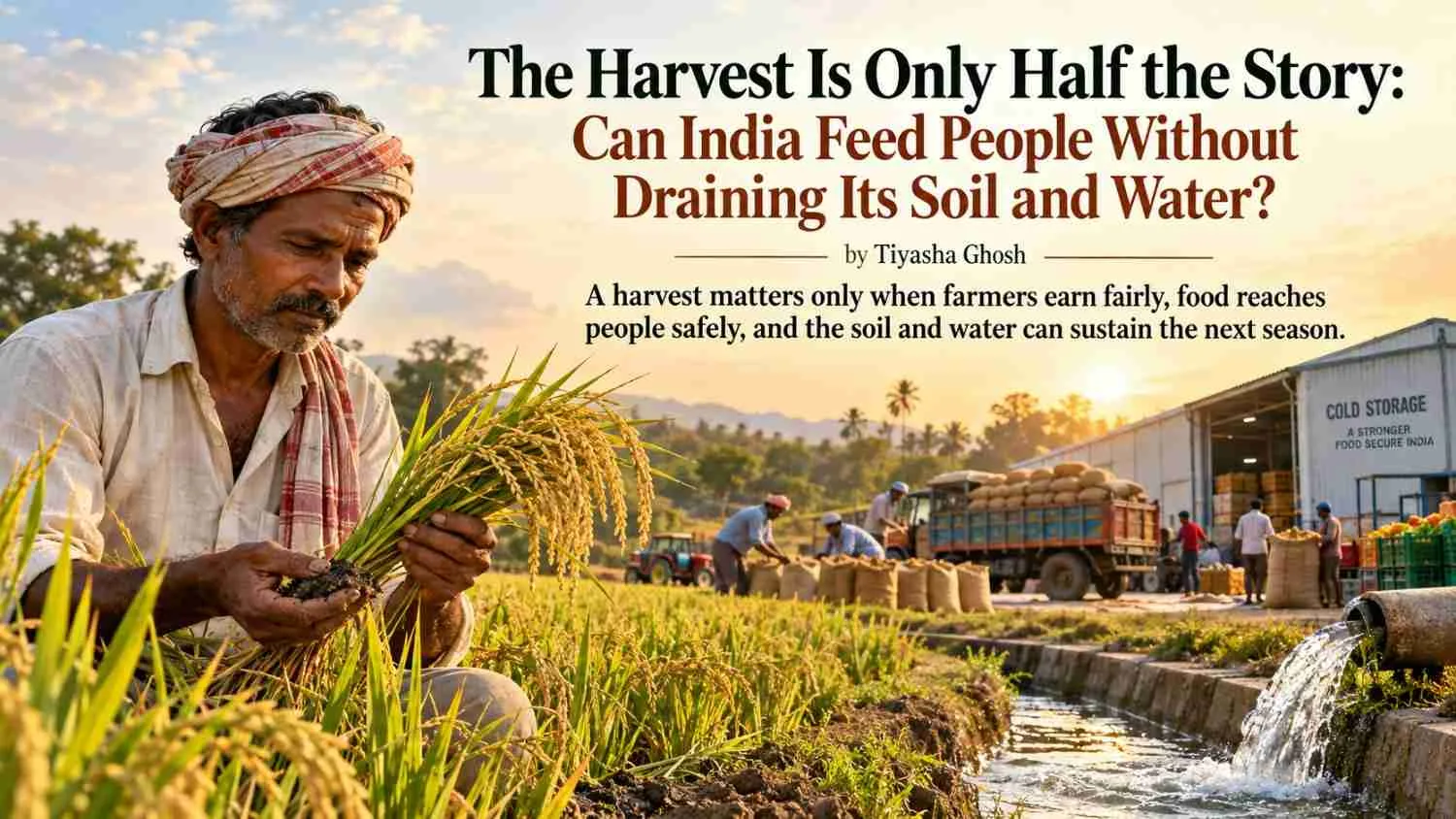
| A successful harvest is not measured by crop output alone. Farmers must earn enough, food must survive the journey to market, and farming must protect the resources future harvests depend on. |
| Summary: This World Food Day, the Kharif season raises a bigger question than how much rice and other crops India can produce. Weather risks, rising cultivation costs, uncertain selling prices and food losses can weaken both farmer incomes and household food security. Climate-resilient crops and better storage may help, but their real value depends on field performance, affordability and access. |
Can Today’s Harvest Feed Us Without Exhausting Tomorrow’s Soil and Water?
If the harvest feeds today’s market, will the soil and water still support tomorrow’s crop?
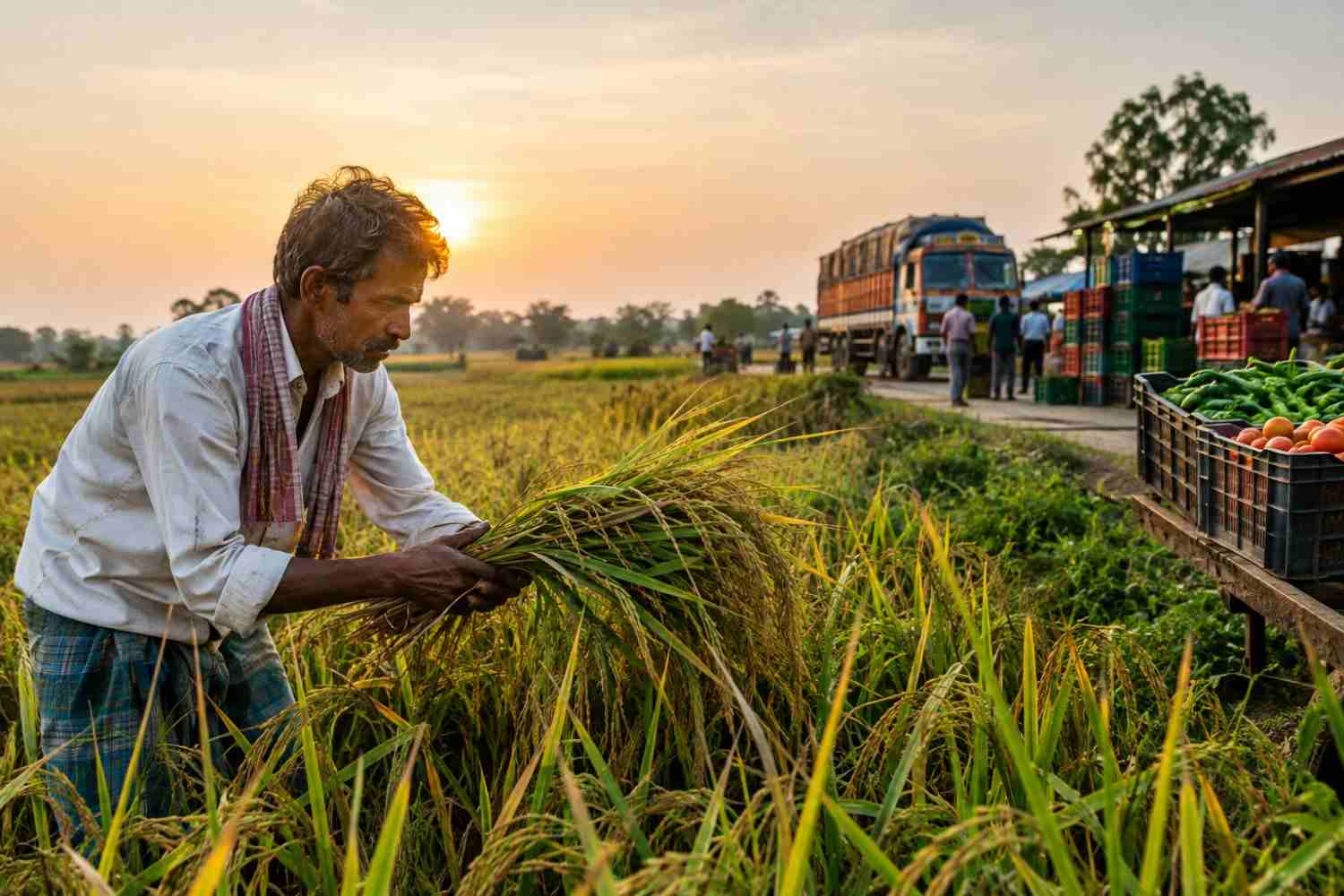
A full field does not always guarantee a secure livelihood. A farmer may harvest a good crop but earn less than expected because of high input costs or falling market prices. Another may lose part of the crop to floods, extreme heat or irregular rainfall before it reaches the market. Both situations affect the food available to households and the resources needed to grow it again.
These risks are not evenly distributed. A review by the Agriculture Ministry, published in July 2026, reported that eastern and northeastern India received 36% less rainfall than normal between 1 June and 15 July. This was an early-season figure, not a final assessment of the monsoon. However, it highlighted why local crop conditions and dated weather records are essential when assessing agricultural risks, rather than relying on a single national prediction.
Odisha offers a documented example of how farmers and agricultural institutions are responding to these challenges. In July, the Indian Council of Agricultural Research (ICAR) reported demonstrations of the paddy varieties Pooja, Kalachampa and Swarna Sub-1 across 16 acres in flood-prone areas of Khordha district. It also reported green manuring on four acres of paddy fields to support soil health. These initiatives illustrate possible approaches to agricultural adaptation. However, the available public report does not establish their final yields, costs or net returns. Such outcomes must be measured before these interventions can be considered successful across different farming conditions.
The financial test is equally important. For the 2026–27 marketing season, the government’s minimum support price (MSP) is ₹2,441 per quintal for common paddy and ₹2,461 per quintal for Grade A paddy. On 15 October, a market listing for Khatra in Bankura showed a modal price of ₹2,441 per quintal. However, a price recorded in one market cannot represent the entire state. Nor does the MSP guarantee that every farmer can sell every quintal at that rate. Cultivation expenses, transportation costs, quality requirements and access to procurement all influence how much a farmer ultimately earns.
From Field to Food Plate: Where Can Food Lose Value?
Food security depends on more than the amount harvested. Produce must also be stored, transported and sold efficiently before it reaches consumers. At every stage, losses or additional costs can reduce the value of the harvest.
| Stage | What to track | Key question |
| 1. Field and harvest | Rainfall, heat, soil health, water use, crop varieties, input costs and yield | Did the crop grow well without placing excessive pressure on soil and water? |
| 2. Farm gate | Harvest quality, quantity sold, transport costs and realised price | How much does the farmer actually earn after cultivation costs? |
| 3. Storage and transport | Produce damaged or spoiled, access to cold storage, storage costs, electricity and maintenance | How much produce is lost before reaching the market, and could better storage reduce these losses? |
| 4. Market and mandi | Wholesale prices, supply levels and movement of produce | Do farmers receive a fair price, and does sufficient produce reach buyers? |
| 5. Household and food plate | Retail food prices, affordability, dietary diversity and kitchen waste | Can households afford nutritious food, and how much food is wasted after purchase? |
Data note: Farm-to-market losses and household kitchen waste must be measured separately. National estimates should not be presented as figures for a specific district.
A government-reported study covering 2020–22 estimated post-harvest losses of 6.02–15.05% for fruits and 4.87–11.61% for vegetables across the assessed commodities and regions. These national ranges are not estimates for any particular district. However, they demonstrate why harvesting practices, handling, storage and transportation deserve attention alongside agricultural production.
Cold storage can give farmers more time to sell perishable produce instead of accepting a distress price when supply is high. Solar-powered storage systems may also reduce dependence on unreliable electricity. However, installation costs, maintenance, suitable storage conditions and access to buyers determine whether these technologies are practical. Government assistance is available for certain cold-storage projects, but the existence of such support does not establish that affordable facilities are accessible to small farmers in their local areas.
Food security also cannot be measured by grain production alone. Families need food that is affordable, diverse and nutritious. Even a strong paddy harvest may not prevent households from cutting back on other foods if prices rise or vegetables spoil before reaching local markets. Household kitchen waste is another concern, but it must be assessed separately from losses occurring between the farm gate and the market.
These challenges connect directly to the theme of World Food Day 2026: “Innovate today. Nourish tomorrow.” Innovation can involve improved crop varieties and solar-powered storage, but it also includes better water management, soil conservation, market information and stronger farmer organisations. The important question is not simply whether a technology appears promising. It is whether it improves yields, reduces losses or strengthens farm incomes without placing an unaffordable burden on farmers.
India’s food security will depend on connecting these decisions across the entire food system. The next harvest must be judged not only by how much grows, but also by how much farmers earn, how much food reaches consumers, what households can afford to eat, and whether the soil and water remain productive for the seasons ahead.
Sources:
- FAO — World Food Day 2026: “Innovate today. Nourish tomorrow.”
- Press Information Bureau — Agriculture Ministry’s Kharif 2026 and monsoon review, 21 July 2026
- ICAR — Climate-resilient paddy demonstrations in Khordha, Odisha, 29 July 2026
- Department of Food and Public Distribution — MSP for wheat and rice
- West Bengal paddy market listing — Khatra, Bankura, 15 October 2026
- Press Information Bureau — Post-harvest losses and government schemes, 25 July 2025
- NITI Aayog Frontier Tech — Solar-powered cold storage and the Pusa-Farm SunFridge

Add a Comment