Total Articles 231+

Travelogues

Explore places through the lens of sustainability. Our Travelogues bring together inspiring journeys, diverse cultures, natural landscapes, and local stories, highlighting meaningful travel experiences and our connection with people and the planet.

Showing 4

06 Oct 2026

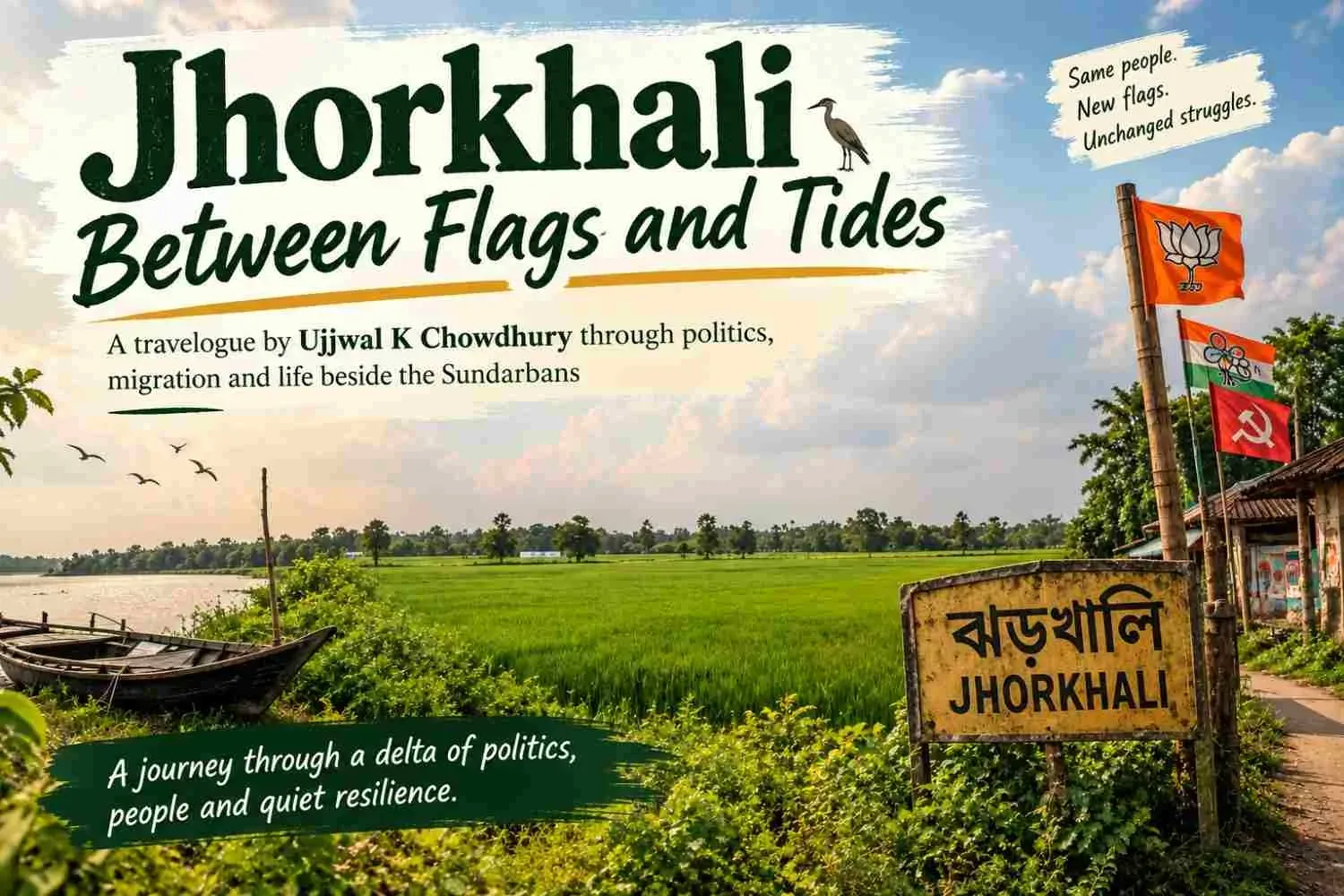
  Jhorkhali is a place where political flags change, but everyday struggles remain. In this travelogue, the author journeys through the village beside the Sundarbans, looking beyond its green fields and waterways to the lives shaped by migration, farming and limited opportunities. The journey traces how families adapt when work takes men away, while women and older people keep homes and farms going. It also explores how salinity, tides, changing livelihoods and tourism are reshaping the local economy. Encounters with people living with the risks of the forest bring a more personal dimension to the journey. Jhorkhali emerges as a place caught between political change, environmental uncertainty and the quiet resilience of its people. SummaryA travelogue through Jhorkhali explores the intersection of politics, migration, agriculture and life beside the Sundarbans. From changing political landscapes and shrinking local opportunities to salinity, tides, tourism and forest-related risks, the journey captures the everyday realities of its people. At its heart, the article asks whether the next generation can build a sustainable life in Jhorkhali without having to leave. The First Sign Was Political My Sundarbans visit began with party flags, not a tiger. For several hours our car moved through Jhorkhali, where waterways seemed to wait just beyond each bend. On the stretch I crossed, BJP flags and offices dominated the roadside; BMS flags appeared in some market places. That was one traveller’s view from a moving car, not an election survey. Still, it stayed with me: a place’s public colours can change faster than the private worries of the people who live beneath them. Ramprasad Sarkar, who told me he had lived there for more than twenty years, had watched local party offices shift from CPI(M) to Trinamool Congress and then BJP. “Parties change, colours of the flags change, people are the same,” he said. His sentence held a joke and a warning. Party offices can repaint their walls; families cannot repaint a lost season or a missing wage. In village politics, the signboard is sometimes the fastest public notice. Ordinary people still have to open the shop the next morning. The Road After School In the 2011 Census, the place people know as Jhorkhali appears in the village register as Lot No 126, under Jharkhali Gram Panchayat in Basanti Block: 15,695 residents—8,142 males and 7,553 females—in 3,820 households, spread across 4,500 plus hectares, or roughly 45 square kilometres. Its literacy rate was 81%, above West Bengal’s 2011 average of 76%; but that neat total conceals a divide, with male literacy at 88% and female literacy at 72%, a gap of 16 percentage points. By both population and area, Lot No 126 is Basanti Block’s largest village. A census is a photograph, not a live headcount; still, this one catches Jhorkhali at scale. Tables are wonderfully tidy. Opportunities seldom are. Local figures shared during my visit, fifteen years after the last census, however, put roughly 12,000 families and about 42,000 people across this area, perhaps greater Jhorkhali including nearby hamlets. The school tally in my notes was one higher secondary school, two secondary schools, 17 primary schools and four small private schools, but no college. A nearby NGO in Joygopalpur runs vocational training linked to a Krishi Vigyan Kendra. For young people the hurdle after school is not ambition; it is the next rung. A course in Canning or Kolkata requires fare, time and often a place to stay, costs that rarely appear in a prospectus. The settlement also carries the memory of families displaced during and after the 1971 war in Bangladesh. Some Hindu refugee families came here after years of hardship elsewhere, and began again on land; farmers’ cooperatives and fishermen’s bodies once helped organize production and income during the Left Front rule. People told me that many of those collective arrangements later weakened under the TMC. Land was divided into small private holdings. The shift changed more than paperwork: it left many households with little scale or bargaining power. Work Leaves Home Before Dawn Migration has become a household plan. Men often head to South India for work and may be gone for years. A 2026 farmer survey in Basanti reported higher migration rates than in Hasnabad, alongside greater female participation in farming. That fits the human picture I saw: when wage-earners leave, women and older people keep the home, school routine and sometimes the fields going. A composite local voice puts it this way: “The money comes home; the work never left.”   The River Runs Through the Ledger The Matla and Vidyadhari are close companions here. The Jhorkhali and Balikhal jetties remind a visitor that water is infrastructure as well as scenery: it carries fish, goods, commutes and the day’s plans. Fields are still planted with rice and vegetables, but the delta asks for constant adjustment. Salinity, rain, tidal inundation and market access make “two crops a year” an aspiration earned plot by plot. Jhorkhali’s economy has acquired a new shoreline. In recent years, people from Kolkata have bought land and built homestays and eco-resorts; tourists arrive for a few quiet days by the forest and river. At Jhorey Joley Jangaley, a Techno India Group venture, I found the newer grammar of this economy in a conference hall and a well-kept swimming pool. The visitor can take a dip while the delta outside negotiates with salt, water and work. Even a resort pool cannot persuade a tide to respect check-out time. UNESCO describes the Sundarbans as the world’s largest mangrove forest and a natural buffer against cyclones. A 2026 study of Basanti reports rain-season freshwater limits, saline dry-season water and weak market infrastructure [2]. That is the background to my own notes: rice and vegetables in the fields, with saline water threatening crops after heavy rain. A composite farmer might say, “We plan the crop; the tide keeps the last appointment.” The Forest Has Names The most arresting encounters were not with wildlife but with people marked by its danger. I met a woman known as a tiger widow, whose husband had entered the forest and never returned, and a man whose face bore a tiger’s attack. He did not want a photograph. I put my camera away. UNESCO notes that fishing, honey gathering and other forest livelihoods bring people into contact with tiger habitat. A loss here is never just a dramatic story for a visitor; it reshapes a household’s work, income and future. The local musical Banabibir Pala keeps the Lady of the Forest in memory. Across the Sundarbans, Bonbibi is revered by Hindus and Muslims, a shared devotion documented by religious scholars. The story belongs to people who know that the forest can feed them and frighten them in the same season. There is an irony in a place where different faiths can share a guardian while families must still face danger with too few choices. A Farmhouse at the End of the Drive The air felt so clean that I began composing a farmhouse plan in my head: a vegetable plot, a few animals, integrated farming, mornings beside the water. My plan required no maintenance, which is how I knew it was still a visitor’s fantasy. I can admire the river and drive away; the people who stay must budget for salinity, school choices, jobs and the risks of the forest. Jhorkhali remains with me as a place where changing flags, a short school list, wages sent home and the tides all appeared in the same frame. The journey began with politics, but ended with a man who declined a photograph and a woman whose loss was more than an anecdote. The question after the visit is simple: can the next generation build a life here without having to leave? ...Read more
23 Sep 2026

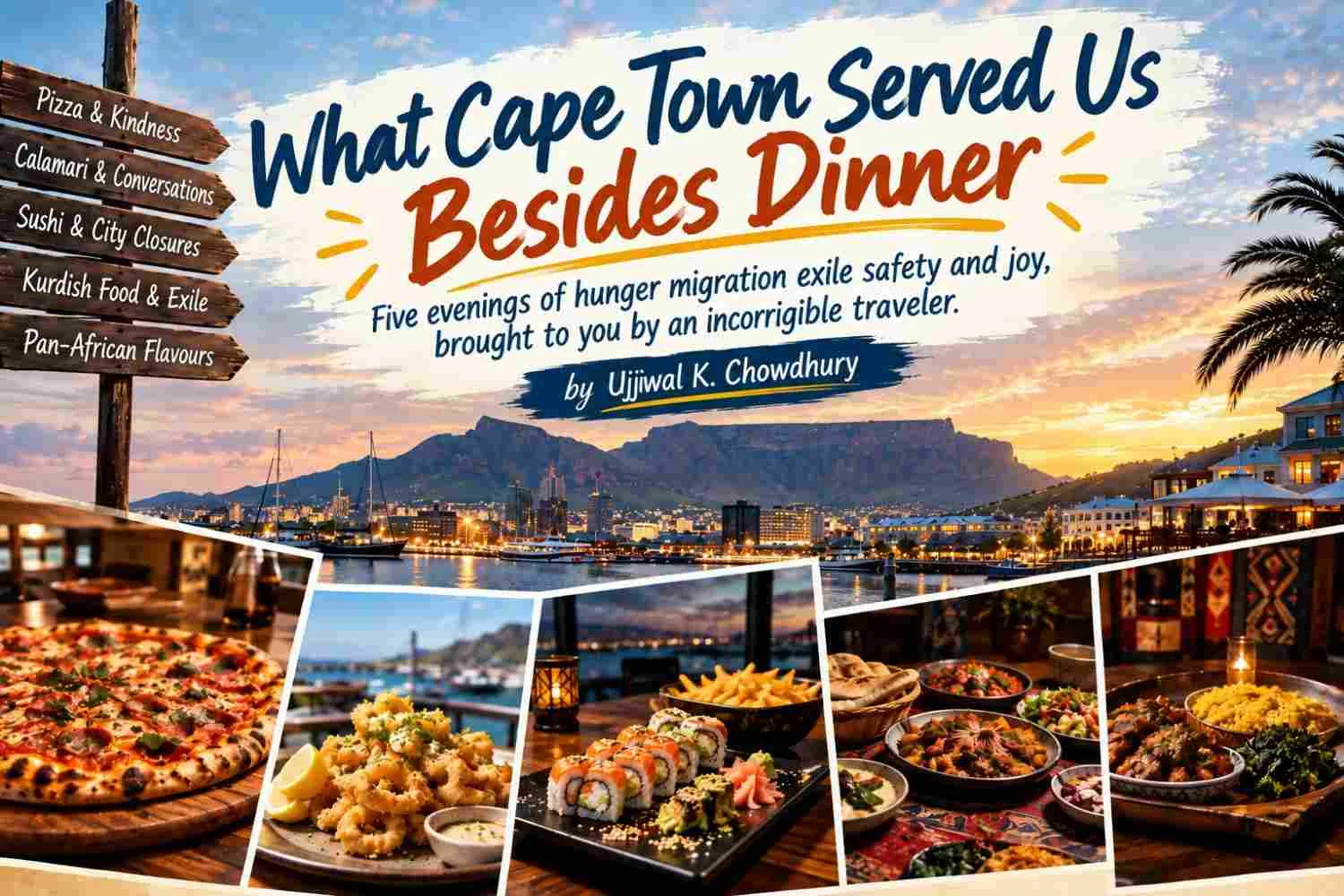
Five dinners across Cape Town become five unexpected windows into hunger, migration, safety, exile and joy—proving that sometimes a city reveals itself most honestly around the dinner table. SummaryA five-night dinner trail across Cape Town becomes an unexpected way of understanding the city beyond its food. The first evening, two slices of pizza offered to a hungry man turn dinner into a reflection on hunger, housing and inequality. A conversation with Rashid, a Bengali-speaking migrant from Barisal, reveals how migration can be shaped by skill, family networks, risk and hope. A rushed meal of sushi and chips highlights how business hours, transport and safety influence who can experience the city after dark. Kurdish food opens a conversation about exile, cultural identity and the experience of a people without a sovereign state. The final evening at Mama Africa brings music, food and celebration, leaving the larger lesson that Cape Town's dinner tables can reveal stories of struggle, movement, memory and joy. Five evenings of hunger migration exile safety and joy, brought to you by an incorrigible traveler, Ujjwal K ChowdhuryI came to Cape Town for an official programme. After a day of listening and speaking, the body keeps its own score. For five nights, Mathew and I ate in five different rooms. The food changed, but so did the city around it. By the end, dinner had become a way of reading Cape Town through hunger, migration, safety, exile and joy. Night One: Pizza and the Two Pieces That Changed the Table The first dinner was near Cape Town Station, in a modest single-storey pizza shop. We sat beside the glass wall and ordered a double-meat pizza that arrived with the confidence of a dish that had never met a small appetite. It was huge. Halfway through, a man over sixty came to the other side of the glass. Visibly hungry, he asked to be fed. He did not ask for money. He asked for food.Mathew went outside and gave him two slices. The man did not eat them. He ran to a younger man waiting nearby and handed over the pieces. Hunger had made him a messenger before it made him a diner. I have seen hunger in India all my life, so it is never abstract. Yet the scene unsettled us. Cape Town is praised for beauty and administration, but recent reporting based on city data describes a housing divide: 18.8 percent live in informal housing and more than 400,000 were on the social-housing waiting list in 2024. No urban success story is complete when a meal must pass through glass. Night Two: Calamari and a Bengali Voice After the first day of the Global Entrepreneurship Network Congress at the Cape Town International Convention Centre, we wanted a simple dinner. We found a smaller restaurant and ordered chips, calamari and a drink. Halfway through, I heard the man at the cash counter speaking in a Bengali dialect close to Bangladesh.His name was Rashid, from Barisal. He had arrived in Cape Town four years earlier after eight years in Dubai. In his early twenties he had gone there with his elder brother-in-law and started as a waiter in an Indian restaurant. He learnt English and Arabic, understood the business from kitchen to counter, and grew into management.A childhood neighbour from Bangladesh had taken this restaurant on lease from an African owner and brought Rashid in on profit share. He said he earned more than twice what he had in Dubai. His family remained in Bangladesh, and he returned around Ramadan and Eid. The calamari was pleasant, but Rashid was the real meal. His journey showed me that migration travels through language, kinship, skill, risk and hope. Night Three: Sushi and Chips Before the City Shut The third evening was less dramatic, which is also a travel lesson. At seven, we went to a food mall expecting dinner and found shutters coming down. We hurriedly bought sushi, chips and whatever else could be packed, then carried it to the Holiday Inn Express. Sushi and chips made an accidental marriage, but hunger is a generous matchmaker.Cape Town does have late bars and restaurants around Long and Bree streets, but its evening life is not one continuous festival. It is shaped by location, transport, business hours and safety. Homeless people were gathering outside as shops closed, and we felt uneasy about petty theft. But I also had to correct my first impression: a person without a home is not automatically a criminal. Homelessness and crime may share an urban geography, yet they are not the same thing.We learnt that nightlife is also a map of who feels safe enough to stay outside. Cape Town can have a mountain for a backdrop while inequality and violent crime remain awake after the shutters come down. Night Four: Kurdish Food and a People Without a State By the fourth night, dinner became a question. We went to a large Mesopotamian Kurdish restaurant, described as the only Kurdish restaurant in town. It was run by Baran Kalay, a Kurdish man living in exile. I asked to meet him. He joined us, and the plates became a map.My background in International Relations education made me curious about Kurdish life and the Yazidis. Baran spoke of Kurdish communities across Turkey, Iraq, Iran and Syria, and of a diaspora beyond the region. The numbers vary, but the broad reality is clear: Kurds are one of the world's largest peoples without a sovereign state. Their language and cultural rights have been caught between nationalism, war and stronger powers.Yazidis are a distinct ethno-religious minority, many of Kurdish heritage. The 2014 ISIS assault in northern Iraq was recognised by a United Nations inquiry as genocide. Hundreds of thousands were displaced, and thousands of women and children were abducted or enslaved. The facts are unbearable; Baran's quiet way of carrying them made them heavier.He felt that attention to Palestine had been justified, while Kurdish claims for self-determination and cultural-linguistic autonomy received less sustained notice. That was his judgement. We had entered for Kurdish food and found an exile's small embassy. Every restaurant run by a displaced people serves memory without a passport. Night Five: Mama Africa and the Evening That Refused to Sit Still The last dinner was the most colourful, theatrical and expensive of the five. Mama Africa on Long Street has served Pan-African food since 1995, with live marimba, drumming and dance. Its menu crosses the continent, from Cape Malay flavours to Moroccan and Mozambican influences, with game meats such as springbok, kudu, ostrich and crocodile. I chose a fish fillet, one of the best I had eaten in a very long time.The restaurant was managed largely by African women. One young woman, younger than my daughter, came to paint my face. A marine-sciences graduate working evenings, she created a design that reminded me of birthday face painting in Bengali families. For a few minutes, she turned my face into a small festival, drawing a bright shore across my forehead.Then the marimba began, dancers entered and performers pulled the audience into the room. We ate, laughed and danced among mostly foreign patrons. The evening did package Africa as dinner, music and movement, but the warmth was genuine. People were working, creating and hosting, not performing a museum piece. The bill made us wince, but some evenings charge for memory as much as fish. Five dinners, five recognitions The pizza taught me that food can become a moral choice before it becomes culinary. Rashid showed me that a restaurant may be an immigration story with a cash counter. The closed food mall revealed how safety shapes a city's hours. Baran reminded me that cuisine can carry a people through exile. Mama Africa restored the right to end a serious journey with music and colour. I left with conference notes, but remember the people who appeared when the plates arrived. A city is often more honest at dinner than Hashtags#CapeTown, #CapeTownTravel, #CapeTownTravelogue, #SouthAfricaTravel, #CapeTownFood, #FoodAndTravel, #TravelStories, #TravelWriting, #CapeTownLife, #CapeTownCulture, #AfricanCuisine, #MigrationStories, #UrbanInequality, #HumanStories, #TravelAndCulture, #LongStreetCapeTown, #HoutBay, #KurdishCulture, #MamaAfrica, #GlobalEntrepreneurship, #CulturalExchange, #ResponsibleTravel, #TravelExperiences, #ExploreCapeTown ...Read more

22 Sep 2026

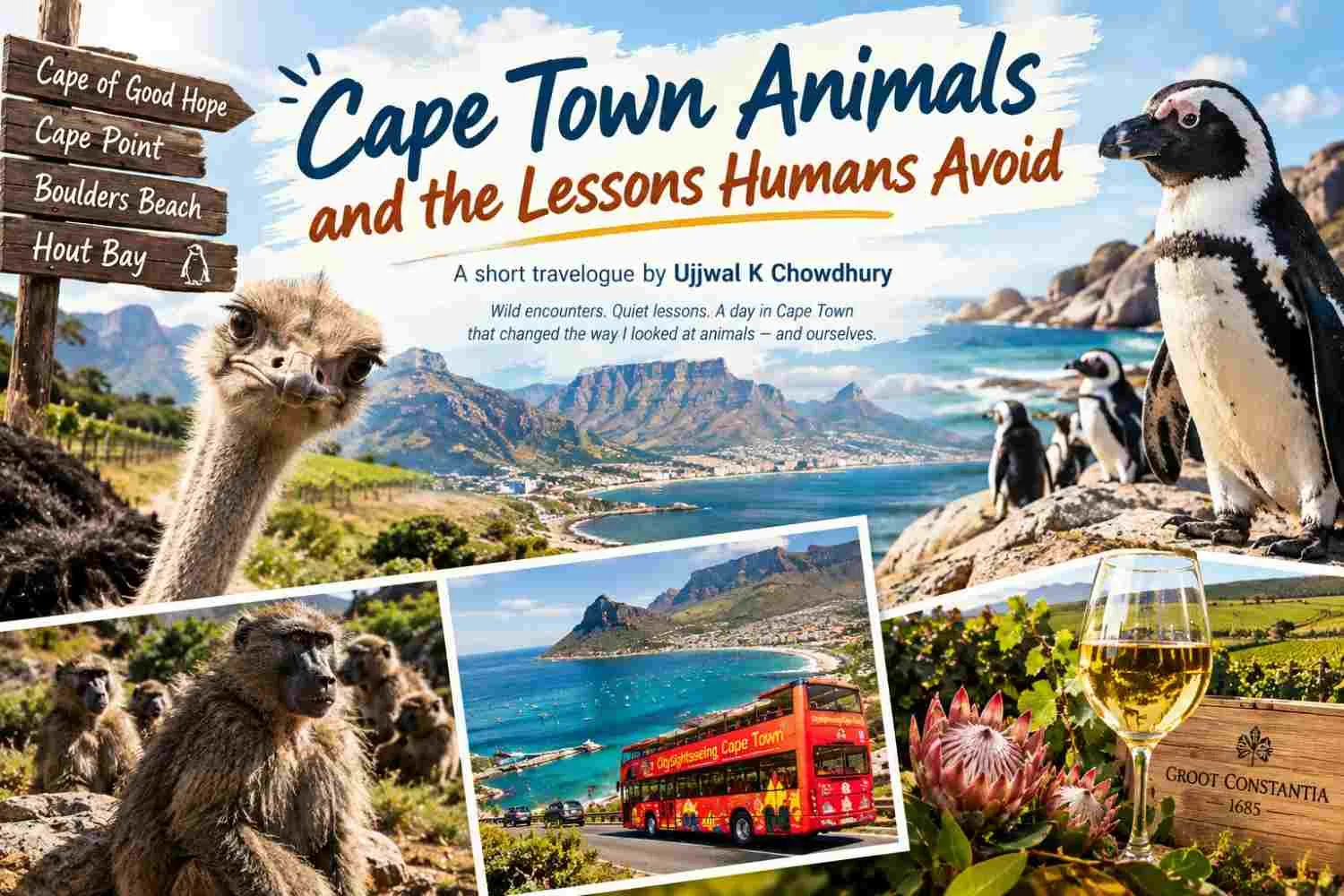
From ostriches and baboons to seals and endangered African penguins, a day around Cape Town's wildlife becomes an unexpected lesson in humility, conservation and the limits of human entitlement. SummaryA journey across the Cape Peninsula turns into a series of close encounters with Cape Town's remarkable wildlife. At an ostrich farm, the birds' unusual behaviour and division of breeding responsibilities offer an amusing reminder that nature has its own systems of survival. The journey continues through Table Mountain National Park, where baboons, antelope and a snake reveal a landscape that does not exist simply for human entertainment. At Duiker Island, Cape fur seals demonstrate the difference between observing wildlife and treating it as a performance for tourists. The final encounter at Boulders introduces African penguins, whose declining numbers highlight the pressures created by food scarcity, overfishing, pollution, habitat loss and climate change. The day ultimately becomes a reflection on responsible wildlife tourism and the uncomfortable truth that animals are living beings first, not attractions created for human itineraries. People travel thousands of miles to meet people, admire architecture and photograph nature. On my last full day in Cape Town, nature reversed the arrangement: it gave me appointments with animals, and I arrived with a camera and the usual confidence that the world was arranged for our inspection. A short date with animals that Ujjwal K Chowdhury will remember for a long time. The Peninsula at the Edge We set out for the Cape Peninsula, toward the Cape of Good Hope and Cape Point. The names sound interchangeable, but they are not. The Cape of Good Hope is the celebrated southwestern promontory; Cape Point is the nearby headland with two lighthouses. The real southernmost point is Cape Agulhas, a fact geography supplies whenever tourism gets too poetic. Bartolomeu Dias called this coast the Cape of Storms in 1488; Portugal's King John II later gave it the hopeful name that survived. All of it lies within Table Mountain National Park, stretching roughly 70 kilometres from Signal Hill to Cape Point. This is not merely a mountain reserve but part of the Cape Floral Kingdom, a UNESCO World Heritage landscape where fynbos - fine, tough, fire-adapted vegetation - produces abundance from stingy soil. Proteas, ericas and restios fill the slopes, while the King Protea, South Africa's national flower, announces that elegance need not be delicate. The road also offered a lesson in Cape Town's social geography. Hout Bay and Chapman's Peak carry the glamour of sea-facing homes and high property values. In the same wider valley stands Imizamo Yethu, an informal settlement whose isiXhosa name means "our common effort." Beauty and inequality share the same view. The mountain does not hide who lives beside it and who crosses it for work. The Ostrich with the Night Shift At an ostrich farm, a few birds came close to the wire, not quite tame and not interested in our passports. The males wore black with white wing feathers; the females a quieter grey. The largest living bird cannot fly, but it can run at extraordinary speed, pivot on two toes and look at a tourist with the authority of a creature that knows the tourist cannot keep up. Ostriches eat mostly plants, along with insects and other small items, and can go for long periods without drinking. During breeding, a male may court several females and scrape a communal nest. The female incubates by day, blending into the earth; the male takes the night shift, disappearing into darkness. Even the ostrich has a practical division of labour. Humans, with our committees and relationship podcasts, still negotiate who will answer the message. The guide asked whether Indians eat ostrich meat. Ostrich farming is an established Western Cape economy, linked to meat, leather, feathers and tourism, especially around Oudtshoorn. I understand that livelihoods are complicated. Still, after a bird tilted its head at me with comic dignity, I could not imagine lunching on it. I claim no saintliness - human food systems are full of contradictions - but that bird had become a person in my travel story, and people are difficult to order medium rare. A Landscape that Refused to Be One Country We drove through long stretches of the reserve, where fynbos lay low beneath the wide sky. The hills, sea and sharp light made the landscape feel like a meeting between the Andes and the Himalayas, with a South African accent. In the distance, eland and other antelope moved across the ground. The park includes bontebok, red hartebeest and zebra, but I was denied the cinematic herd I wanted. Instead, a large snake crossed the road. It was dark, marked with gold, and unimpressed by our vehicle. I could not identify it, so I will not pretend to be a field biologist after one glance through a windscreen. It slid away with the confidence of a citizen who had not requested a road. Humans name everything and behave as if naming grants ownership. The snake needed neither label nor applause. The Bay that Was Named by Mistake At Mariner's Wharf in Hout Bay, we took a boat toward Duiker Island, a rocky haul-out for Cape fur seals. This was the Atlantic side; False Bay lies beyond the peninsula, toward Simon's Town and warmer waters. Its name is an old navigational joke: sailors returning from the East mistook Cape Hangklip for Cape Point and confused False Bay with Table Bay. A human error became a permanent label - proof that our mistakes receive official signage. The seals were the stars. Some lay in heaps on the rocks, some rolled into the water, and others surfaced with whiskers twitching as if mildly interested. They were Cape fur seals, not plush toys: social, vocal divers that rest on land and hunt fish and squid at sea. Their eyes looked gentle, but gentleness is not consent and wildness is not an invitation to touch. Tourists were offered fish to throw to the seals for a fee. The transaction was entertaining and revealing: humans had travelled to an animal's home, charged one another for access, then bought a snack to make the animal perform near the boat. I watched without feeding them. They were capable of being magnificent without our hospitality package. The Abundant Baboons with a Streak of a Memory The baboons seemed to be everywhere in the Nature Reserve Park—along the roadside, on the rocky slopes and near the bends where our vehicle slowed to watch them. At first glance, they reminded me of the Indian monkeys familiar from towns, temples and childhood stories, though these animals were a little larger, heavier and more powerfully built. Still, resemblance is not identity: these were baboons, not the Indian monkeys, with their own families, calls, hierarchies and unruly intelligence. Their presence also brought back my childhood name, “Babun,” a name my mother and her side of the family used with affection. My maternal elder cousin mischievously turned it into “Baboon” and would explain that I resembled the real animals because of my restlessness and occasional flashes of anger. Looking at them now, I could not dismiss his diagnosis entirely. The baboons at least seemed honest about their moods; when annoyed, they showed it openly. Humans, by contrast, often hide their irritation behind polite smiles, official emails and the remarkable claim that they are “fine.” Penguins at the Edge The day's final encounter came at Boulders in Simon's Town. First there was one African penguin, then two, then a procession from the rocks, sand and sea. They were small, upright and determined, with the comic seriousness of officials arriving late to a meeting. Their braying calls explain the old nickname "jackass penguin," though the birds have done nothing to deserve it. African penguins are the only penguin species breeding on the African continent, along the coasts of South Africa and Namibia. The Boulders colony began in 1983 and is one of the few land-based colonies visitors can see from boardwalks. The boards keep fingers, shoes and selfie sticks away from birds already under pressure. The signs say do not touch or feed them; for once, a tourist instruction is also a moral philosophy. Their bodies are marvels of adaptation. They eat sardines and anchovies, dive through cold water, then return to rest. Salt glands above their eyes remove excess salt. Once a year they moult completely, staying ashore for roughly three weeks while replacing feathers on stored fat. They sleep in short spells between feeding, guarding and colony negotiations. It is a demanding life, made harder by food scarcity, overfishing, pollution, habitat loss and climate change. The African penguin is globally Critically Endangered, with fewer than 10,000 breeding pairs remaining. That statistic sat uneasily beside the tourists' delight. The colony supports conservation work, guides, restaurants and guesthouses, but the penguins are not a tourism product first. They are trying to survive the consequences of human appetite. People often say that penguins choose one partner for life and die soon after a partner dies. The truth is less sentimental: many pairs remain together across breeding seasons and share incubation and chick-rearing, but a survivor can re-pair. Nature does not need romantic exaggerations. The real lesson is harder. Penguins keep returning, feeding, moulting and raising young while the sea changes. Humans, who write poems about loyalty, are often less reliable with the planet that feeds us. By evening, I had not automatically become a better human. I had been reminded that animals do not exist to decorate our itineraries. We travel thousands of miles to see them while they remain busy living, feeding, resting and surviving. Their patience is not permission. Their beauty is not property. Cape Town gave me a day with animals; they returned the gift as embarrassment. They were trying to stay alive. We were making captions and clicking photographs. ...Read more

22 Sep 2026

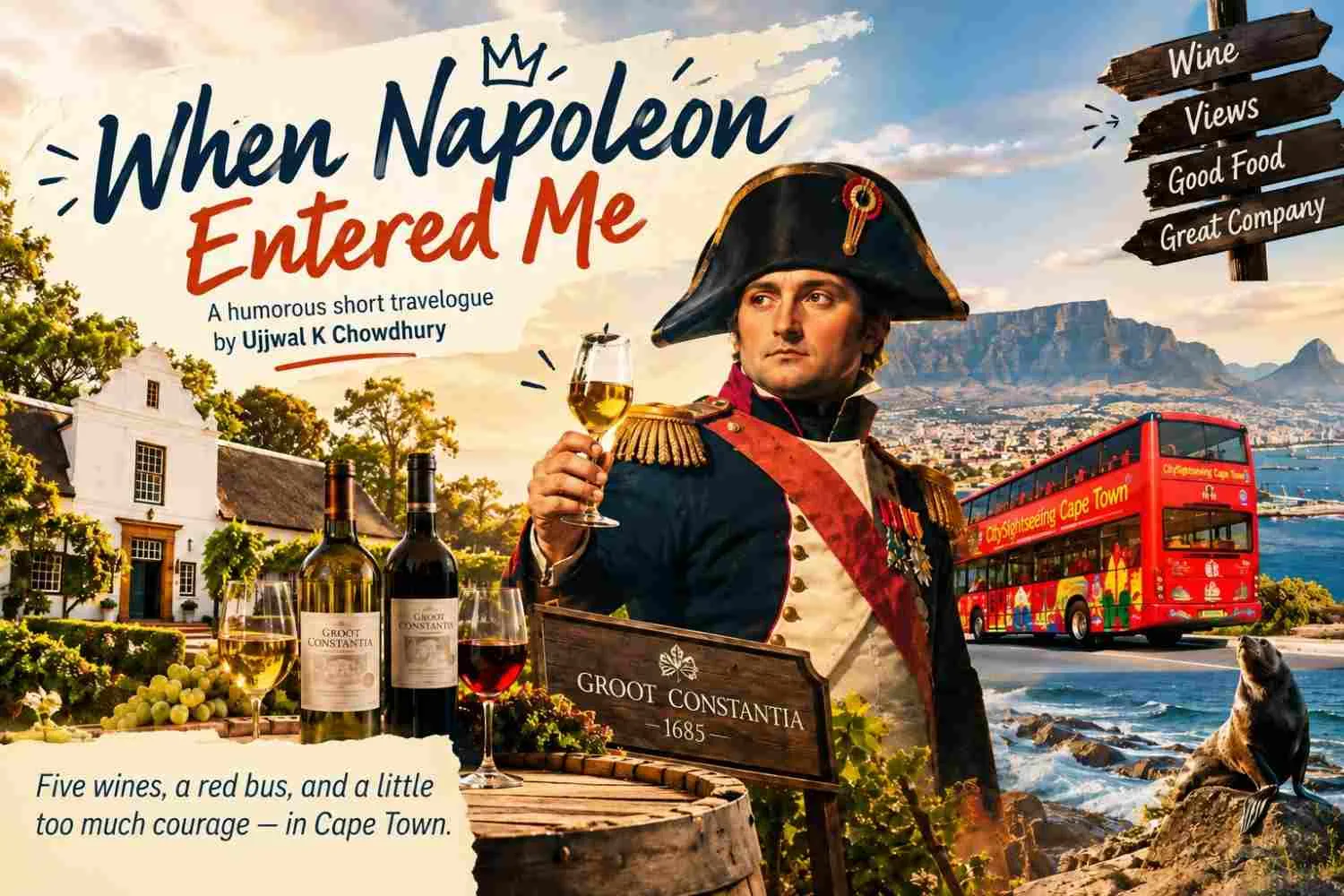
A humorous short travelogue by Ujjwal K Chowdhury. A day in Cape Town turns unexpectedly epic as wine, history, food and friendship send a simple sightseeing trip into a very small Napoleon-inspired adventure. SummaryA day off in Cape Town becomes an adventurous city tour through Constantia, Hout Bay and Camps Bay. The journey begins at Groot Constantia, where centuries of wine history connect the estate to figures such as Napoleon, Jane Austen and Charles Dickens. A wine tasting, including the celebrated Grand Constance, turns an ordinary afternoon into a memorable experience. The trip continues through Hout Bay, where seafood, conversations and the harbour add a more local flavour to the day. By Camps Bay, the combination of wind, waves and an ambitious attempt to confront the Atlantic provides the day's comic climax. By the time the red bus returns to Long Street, the temporary sense of imperial courage has disappeared, leaving behind a funny and unforgettable Cape Town memory. Cape Town had given us a day off after two intense days at the Global Entrepreneurship Network’s Africa Congress. Mathew and I, exhausted but unwilling to behave like exhausted men, decided to explore the city on the red hop-on hop-off bus. After breakfast, we boarded at Long Street, armed with cameras, curiosity and the dangerous confidence of two visitors who believed the timetable would obey them. Our first major stop was Constantia, Cape Town’s green wine country—part vineyard, part living museum, and part very successful argument for postponing work. Groot Constantia dates back to 1685, when Simon van der Stel established what is regarded as South Africa’s oldest wine-producing farm. Cape Dutch buildings, ancient trees and orderly vineyards rolled down the slopes as though history itself had been landscaped. Its fame travelled across Europe. Frederick the Great of Prussia and Louis Philippe were among the celebrated buyers of Constantia wine. Jane Austen mentioned it in Sense and Sensibility as a remedy for a broken heart, while Charles Dickens gave it a supporting role in The Mystery of Edwin Drood. Napoleon, too, was served Constantia during his exile on St Helena.  At the cellar, our guide Thabesa gave us a detailed dekho of the winemaking process. Red wine, we learnt, is fermented at a warmer temperature, while white wine prefers a cooler and more delicate arrangement—rather like guests at a Bengali wedding. The estate’s old bottles, labels and stories made the centuries feel as if they were still resting quietly inside the walls. Then came the official tasting: five wines, some red, some white, some dry, some sweet, some slightly bitter and all presented with the solemnity usually reserved for a diplomatic treaty. After the stipulated five, Mathew launched a diplomatic campaign for a sixth—the famous Grand Constance, the modern naturally sweet wine made from Muscat de Frontignan and associated with the old Constantia legend.  I assumed the request would be politely rejected. But Thabesa was kind. Perhaps Mathew’s sincerity helped. Perhaps my video of her and the promise of a good still photograph had quietly strengthened our case. She brought out an empty case and bottle for a picture, followed by two cut-glass wine glasses containing a small serving each. The wine was smooth, rich and almost dangerously friendly. It slipped down like a gentleman and arrived in the bloodstream like a military commander. Within ten minutes, I felt Napoleon enter me. My walking speed increased. My laughter became louder. My voice rose into a patriotic high pitch. I began speaking casually about doing difficult things immediately, efficiently and preferably before lunch. Mathew watched me with the amused concern of a man travelling with a newly self-appointed emperor. At Hout Bay, we stopped at Mariner’s Wharf for beer, chips and fried snoek. I jumped off the bus as though disembarking from a victorious campaign. A sea lion was being displayed by a man charging visitors for photographs. I ignored the commercial negotiations and clicked my own pictures. Then I wandered across the ramp into the port, speaking randomly to seamen and workers repairing, loading and unloading boats. Over lunch, I got into conversation with the two women serving us. The senior server was wonderfully talkative. We discussed three generations of her family—their education, jobs, habits and, naturally, the behaviour of their husbands. She declared that she and the other women tolerated no nonsense from their men; consequently, the men behaved with suitable caution. I laughed so heartily that even the snoek seemed to be enjoying the conversation. At Camps Bay, Napoleon attempted his grandest manoeuvre. I marched towards the rocks, determined to stand on the largest one, Vivekananda-style, and confront the Atlantic. The wind, however, had other plans. Waves roared, sand flew into my face like airborne needles, and my heroic expedition ended at the roadside—after several dozen photographs and selfies. As the red bus moved past the ocean, Table Mountain and the city, the Emperor gradually withdrew. By the time we reached Long Street, six hours after departure, I had returned to my sombre self. Mathew looked at me and pronounced, “Napoleon has left.” The lesson was unforgettable: five small wine tastings can create a cocktail of courage, but the sixth—Grand Constance—does not merely enter the bloodstream. It appoints a field marshal, gives him a cape and sends him marching towards the Atlantic. ...Read more