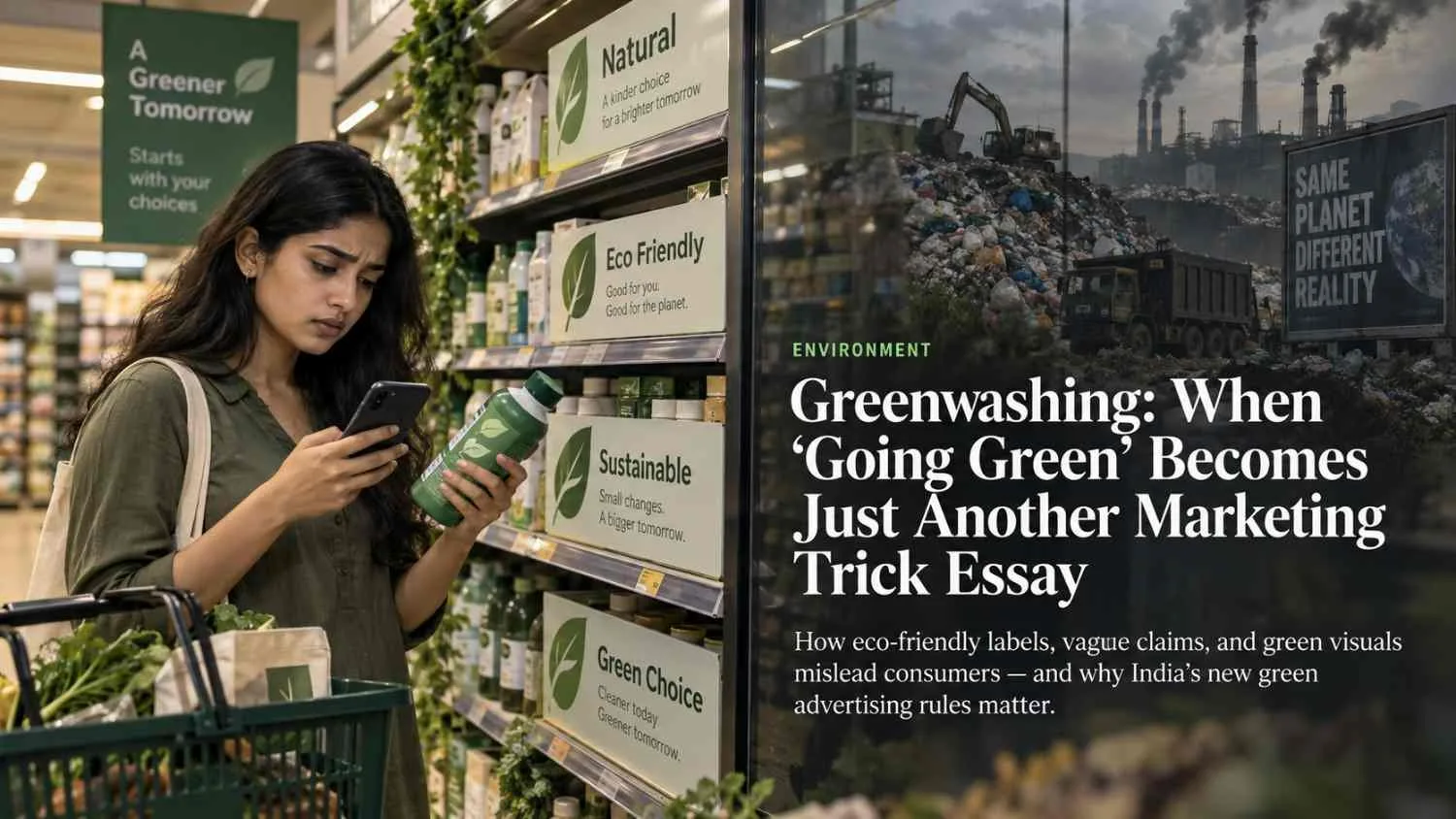
| Green labels and statements about being eco-friendly can be seen anywhere. But what if they are not as green as they claim? Explore this article to understand how environmentalism can be used as a marketing tool by companies and analyse how consumers are affected by such actions. Learn about greenwashing and how it can be avoided while shopping and how people are misled into buying products that are not worth the money. |
| Summary This article discusses the concept of greenwashing and how companies are using terms like “eco-friendly” and “natural” to mislead consumers into buying their products. The article gives examples from various industries, such as food packaging, clothing, cosmetics, and hotels, showing how easy it is to confuse customers with false claims and images. It also looks at why greenwashing is on the rise in India, what companies, advertisers, influencers, and customers themselves should do to stop it, and what changes can be expected in 2024 – in particular, what new rules have been developed in India (CCPA) concerning “green advertising.” |
Introduction
Is Everything Green Really Green?
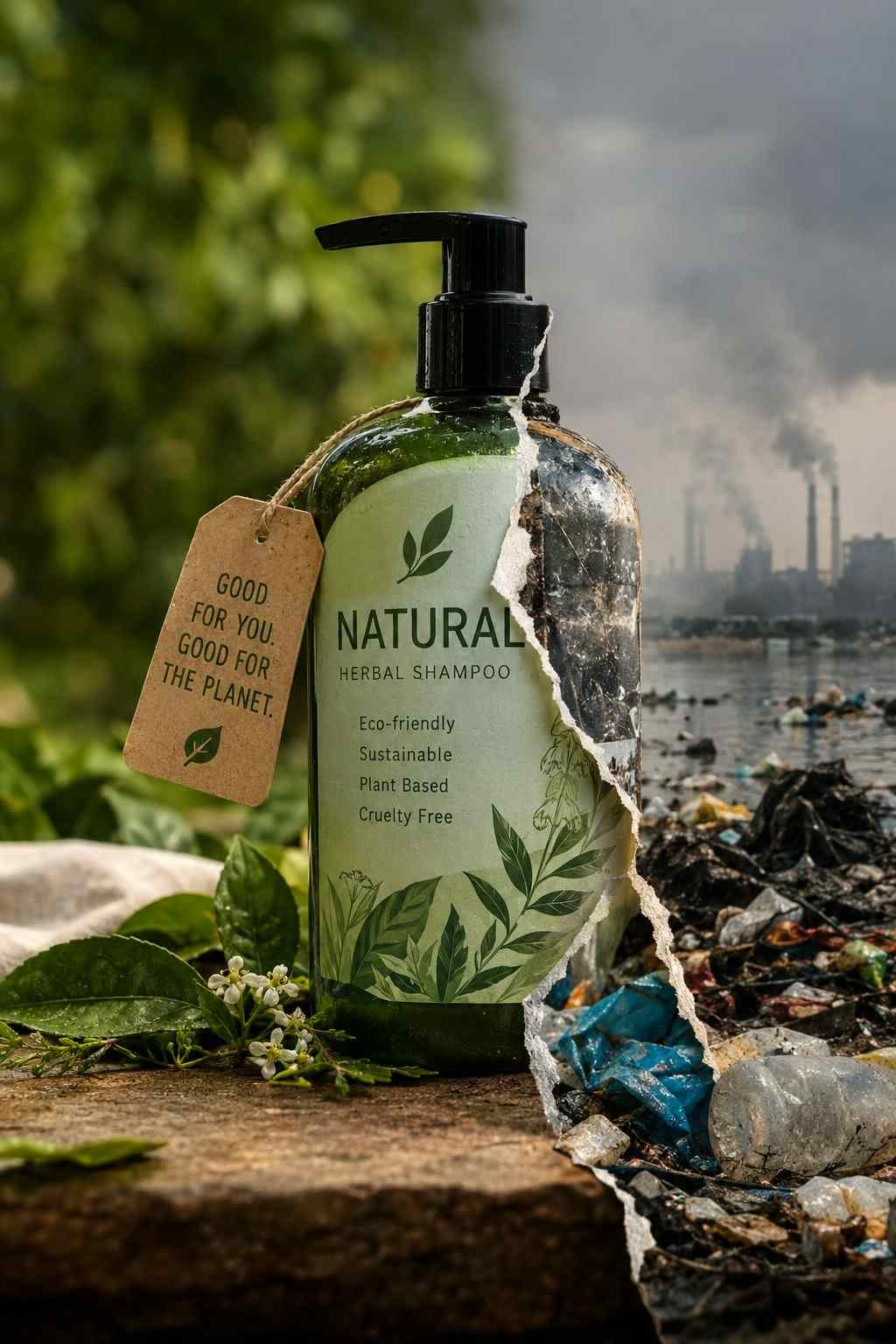
Suppose we go to the store to buy a bottle of shampoo. We look at two similar ones, but the second one has pretty leaves and pictures of plants, and words like natural, eco-friendly, sustainable and earth friendly. Our unconscious brain at once tells us that the second possibility is better for the environment. But is it really? This is where the dubious concept of greenwashing comes into play. We live in an age where environmentalism has crossed the threshold from a niche to mainstream. Climate change, plastic waste, deforestation, carbon footprint, and sustainable living are now terms that are not only discussed by environmental activists, but also by the youth who are much more concerned with checking brands’ sustainability than before.
As a result, many companies jumped on the bandwagon – realising that the modern customer wants to support those who care for the environment, and therefore, all products now seem to have a green label, use recycled paper for packaging, and mention something about preserving the earth in their marketing.
But What If the Greenest Choice Isn’t Actually Green?
Think about the last time we tried to buy something that was better for the environment. We picked a bottle because it had “eco-friendly” written on it, chose a product with minimal-looking packaging, or noticed a clothing brand promoting a new “conscious” collection. At that moment, it feels like we are making the right choice.
But then comes the question: how do we really know?
Just because a product looks green, uses words like “natural” or “sustainable,” or talks about saving the planet, does that make it environmentally friendly? Most of us do not have the time to investigate every product we buy. We see the label, trust what the brand tells us, and move on. And that’s exactly where things can get complicated. Sometimes, the image of sustainability can be much bigger than the actual effort behind it. That is where greenwashing comes in.
What Is Greenwashing?
Greenwashing is when a company, product, or service is more environmentally friendly than it is. The term was first coined by environmentalist “Jay Westerveld” in the 1980s, when he noticed that many hotels were encouraging guests to reuse towels to save the environment – even though they continued to engage in other destructive behaviours. Since then, this concept has evolved and now covers a wide range of manipulative practices by businesses.
For example, if a company produces a plastic bottle labeled as ‘made with natural materials,’ this can be considered greenwashing. Yes, if some of the components are natural, the statement is not false. However, it does not tell us which ones, which raises more questions than answers. Consequently, any product that has misleading environmental claims, vague statements, unsubstantiated information, questionable certificates, misleading comparisons, unproven sustainability, irrelevant environmental statements, or even an overestimated positive impact can be greenwashed.
The main problem with greenwashing is that the appearance of environmental friendliness rarely correlates with reality.
Why Is Greenwashing Difficult to Spot in India?
Greenwashing is not always as obvious as when a company is making a false claim. Sometimes it is hidden behind words that sound good but tell us little. Words such as “natural,” “eco-friendly,” “sustainable,” “green” and “conscious” have become so ubiquitous in advertising and packaging that the actual meaning could be lost in translation. In India, these green claims are found everywhere. They can be found on a supermarket shelf, clothing websites, food products, hotel websites, social media advertisements, and e-commerce platforms. While a product can write down that their packaging is recyclable, for example, it does not necessarily tell us anything about the actual product itself.
This is where the confusion begins for an ordinary consumer who does not have the time or technical knowledge to figure out how a company arrived at their environmental claim. We see the packaging and stop for the day. That does not mean that every environmental claim is misleading. Some companies do indeed make efforts to cut down on their waste, use recycled materials, or lower emissions. We should focus on whether a claim is specific or has evidence behind it. Greenwashing should therefore not only be about green words but asking what is behind those words.
When One Green Word Hides a Bigger Picture
One of the best ways to spot greenwashing is to look beyond one positive feature of a product. For example, imagine a product that writes down that their packaging is made from recycled plastic. This might be a positive and genuine environmental effort, but the claim does not write down that the entire product is sustainable. The same goes for clothing that is made from recycled or organic fibres or hotels promoting a “green stay” that has cut down their plastic bottle use.
While these are indeed positive steps, they are only certain aspects of a larger whole. Instead of asking “Is this product green?” we should be asking “Which aspect of this product or service is being highlighted as green?”
This switch in perspective is key.
The Three Questions We Should Be Asking Before Believing a Green Claim
Whenever we come across an environmental claim, we like to ask three simple questions that make it easier to process.
What exactly is being claimed?
Is the company saying that the product itself is sustainable, or only its packaging? Is “recyclable” referring to the entire product or just one part? Compared with what? A claim such as “uses less plastic” does not say anything about what it is being compared to. Less than the company’s earlier packing? Less than a conventional product? And by how much?
Where is the evidence?
This is the most important question for me. A claim should ideally have some form of supporting evidence such as a study, certification, data, or a clearly explained method of measurement. These are simple questions without the need to become an environmental scientist. These questions simply help us slow down before we accept a claim at face value. A green word is not evidence. The evidence is what makes the claim meaningful.
India’s Greenwashing Rulebook
India has also begun to pay more attention to how environmental claims are communicated to a group of consumers. The Central Consumer Protection Authority (CCPA) introduced guidelines in 2024 specifically dealing with the prevention and regulation of greenwashing and misleading environmental claims. These guidelines are important because they reframe the conversation from simply using environmental words to explaining what those words actually mean.
For instance, if a company uses terms such as “sustainable,” “natural,” “recyclable,” “carbon neutral” or similar environmental descriptions, consumers should be able to understand what the claim refers to. Environmental claims should not create a misleading impression through vague wording, incomplete information or visuals that suggest environmental benefits without proper explanation.
The most useful way to look at this is through a simple chain:
Claim → Evidence → Explanation
First, what is the company claiming?
Second, what evidence supports that claim?
And third, has the company clearly explained the limitations or conditions behind it?
This is important because the communication around environmental claims is no longer limited to traditional advertisements. The same claim can appear on a product label, Instagram post, website, marketplace listing or even inside a sustainability report. The responsibility therefore lies not only with consumers to question claims but also with companies to communicate them clearly.
The Boundary Problem
Another important aspect of an environmental claim is its boundary. A product does not appear magically on a supermarket shelf. Its environmental impact can include several stages from sourcing raw materials, manufacturing and packaging to transportation, use and finally disposal. This becomes important when companies make claims about things such as carbon neutrality or recyclability.
For example, saying that packaging is recyclable tells us something about the packaging. It does not necessarily mean that the entire product has a low environmental impact. Similarly, a carbon-related claim needs to explain what emissions have been included in the calculation and what method has been used. This is why the question “What does the claim cover?” becomes so important. Without knowing the boundary, a consumer may assume that a claim applies to the whole product when it applies to only one part of it.
From the Supermarket Shelf to the Shopping Cart
Greenwashing is not only seen in big advertisements but can also appear in everyday situations. Imagine walking through a supermarket and seeing a product that is covered in green colours, leaves, and words such as “natural” or “eco-friendly.” Imagine shopping online and finding a product that is described as “sustainable” without much explanation. The same thing can happen while booking a hotel. A website may highlight an environmentally friendly initiative, such as reducing plastic bottles or encouraging guests to reuse towels. These actions may be genuine, but a consumer may still wonder what exactly makes the entire stay sustainable.
The growing use of e-commerce makes this even more relevant. A product description can influence a buying decision just as much as physical packaging can. This means that checking environmental claims should not stop at advertisements. We should also take a closer look at packaging, websites, social media, product descriptions, and marketplace listings. The green message follows the consumer all the way from the advertisement to the shopping cart.
India Under the Green Lens
Looking at Indian examples makes the issue easier to understand because environmental claims are now becoming a part of many different industries.
For instance, in the fashion industry, we increasingly come across terms such as “conscious,” “responsible,” “organic” and “recycled.” These terms can point towards genuine improvements, but we still need to understand what they refer to. If a garment is made using recycled fibres, for example, we know something about the material used, but we may not know about the environmental impact of its manufacturing, transportation, packaging, or disposal. Similarly, in the packaging sector, claims such as “100% recyclable” can sound quite straightforward. But when we look closer, recyclability can depend on the material, the design of the packaging and whether suitable collection and recycling facilities are available.
The travel and hospitality sector gives us another example. Hotels and travel platforms increasingly talk about initiatives such as reducing plastic use, saving energy, or conserving water. These can certainly be useful steps, but we need to distinguish between one specific environmental initiative and a much broader claim about sustainability.
These examples show us why the aim should not simply be to label a company as “good” or “bad.” Instead, we need to look at the specific claim, what it covers and what evidence supports it.
After all, a company can make a genuine environmental improvement and still need to communicate that improvement more clearly. For us as consumers, understanding the difference is what makes it possible to make more informed choices.
Who Is Responsible for Greenwashing?
Well, this depends on who exactly we ask, but everyone plays their part in greenwashing, from big companies to social media influencers. Companies are naturally responsible for what they write on their product packaging and in their marketing materials. After all, they are the ones who decide what to write and what not to, and if they are intentionally exaggerating their sustainability, they should fix it. However, advertising agencies are also guilty because they are the ones who produce ideas and present them to the public.
Meanwhile, influencers and celebrities should do more factchecking before posting a product that they position as eco-friendly. As for the consumer, we handle encouraging companies by buying their products.
However, in my opinion, this is where the illusion ends. Because there is no motivation for companies to become genuinely sustainable — only to look good, gain points with customers, and increase sales through manipulative marketing. While it works fine on an emotional level, it does little to help the environment.
Why Do Companies Greenwash?
So, now we know what greenwashing is and how it works. But why do companies do it? Well, as I mentioned above, companies greenwash to increase sales, attract customers, and look good. But to understand why this happens, we need to look at the bigger picture: the fact that being sustainable is now cool and desirable, not only among the youth, but also among other companies. And the companies that want to compete in terms of sustainability have two options: to genuinely become sustainable and transparent or to resort to greenwashing to make themselves look better without really changing anything.
In addition, companies often have an advantage over the competition if they mention sustainability in their marketing, since customers increasingly prefer to buy from organisations that care about the environment. Therefore, even if the company is only ‘a little bit green,’ it still has a good chance to attract customers who are just looking for eco-friendliness in the products.
So, why not greenwash?
When Did Greenwashing Become Such a Big Problem?
Greenwashing has always been around and, unfortunately, it is not going anywhere. The reason for this is simple: companies want to be profitable and popular and therefore find ways to make themselves look better than they are. However, recently, this problem has grown significantly due to two reasons: social media and growing awareness of environmental problems.
On the one hand, organisations now have more opportunities to promote their products and services, so they use them extensively to spread information about their ‘eco-friendliness.’On the other hand, people are now much more aware of environmental issues and therefore are better able to identify greenwashing. Consequently, it is now much easier for both companies and consumers to take part in and combat greenwashing.
How Does Greenwashing Work?
Greenwashing usually works by appealing to consumers’ emotions and presenting information in an attractive way rather than providing specific facts. The most common greenwashing techniques include vague language, green visuals, and misleading comparisons. For example, a company that wants to promote its new product as eco-friendly can do so by writing vague statements like ‘better for the planet.’ Better for whom? For what? There is no specific information – only general, unsubstantiated praise.
Another example is using leaf-shaped logos, placing images of forests and fields on the packages, and other tricks to attract the attention of eco-conscious customers. Finally, many organisations try to hide the fact that they are not as sustainable as they would like us to believe by emphasising one positive trait (such as reforestation) while ignoring the rest (such as mass production). Thus, when evaluating an advertised product, it is essential to go beyond the superficial and analyse the facts carefully.
Greenwashing in India
India is home to hundreds of millions of consumers who are eager to keep up with the latest global trends. Sustainability is now a popular concept not only among environmental activists but also among the youth and influencers. Moreover, social media has made it much easier to spread information – so companies are now competing to be the first to introduce sustainable practices and label their products as eco-friendly. However, as in the rest of the world, this has led to the proliferation of greenwashing in India.
On the one hand, this is logical: companies want to increase sales and profits, so they will do everything possible to attract the attention of customers. On the other hand, India is a huge market with many different players, so companies often resort to manipulation to stand out from the competition. Consequently, it is now becoming increasingly difficult for Indian consumers to distinguish between genuinely sustainable companies and those that only want to sell their products by labelling them as eco-friendly.
Examples That Help Understanding Greenwashing Better
Let us take a closer look at some simple but striking examples of greenwashing.
Case 1: Eco-Friendly Bottle
Suppose a company produces a bottle made of plastic and markets it as eco-friendly.
However, they do not provide any specific information about what makes it sustainable. Meanwhile, we can assume that the bottle contains a certain amount of recycled material, the production of which is less harmful to the environment. If this is not mentioned, it may be an example of greenwashing.
Case 2: Made with Natural Ingredients
A cosmetic company markets one of its creams as 100% natural. This seems like a safe and eco-friendly choice. However, suppose our curiosity exceeds our trust in the company, and we start looking for information – and we find that the term ‘natural’ means nothing because no specific ingredients are shown.
If so, it might be an example of greenwashing: not false advertising, per se, but a statement that is too vague to be considered reliable.
How Can India Combat Greenwashing?
India has long been taking steps to regulate advertising and hold companies accountable for false or unsubstantiated claims. For example, the Advertising Standards Council of India (ASCI) keeps a set of guidelines for advertisers that cover environmental advertising and prohibit deceptive practices.
Meanwhile, the Central Consumer Protection Authority (CCPA) has issued guidelines banning false and deceptive advertising, including misleading environmental claims. Therefore, in India, we will not see unsubstantiated statements on product packaging, such as ‘100% natural’ or ‘eco-friendly’, because companies can be fined for making these claims without providing sufficient evidence. This is a step towards combating greenwashing, because now companies must be much more honest and specific in their statements.
Conclusion: We Need Green Action, Not Green Advertising
So, what can we take away from this discussion of greenwashing?
The main idea is that while a company can look eco-friendly on the outside, it may be doing extraordinarily little to help the environment. Green labels on product packaging, eco-words in marketing, and statements about sustainability may seem nice, but they often conceal a lack of real action. However, it is important to understand that companies may resort to such tactics for many reasons some of which are completely honest.
Therefore, instead of judging companies too harshly, we should encourage those who are genuinely striving for sustainability to improve and be transparent about their actions. We should support initiatives that have a real impact on the environment, such as reducing emissions or cutting down on plastic use, rather than rewarding vague statements with our money. In addition, I believe that regulators should continue to impose stricter regulations on those who resort to greenwashing and manipulate consumers.
Remember that environmentalism should inspire us to do our part and when we interact with companies, we should ask ourselves what that part might be. We should not reward those who only want to make money by manipulating us and call out those who do not follow through on their promises. After all, the planet needs honest and transparent companies and so do we.
References/ Sources :
Department of Consumer Affairs, Government of India
https://consumeraffairs.gov.in/
Advertising Standards Council of India (ASCI)
United Nations Environment Programme (UNEP)
Federal Trade Commission (FTC), United States




Add a Comment