17 Jul 2026
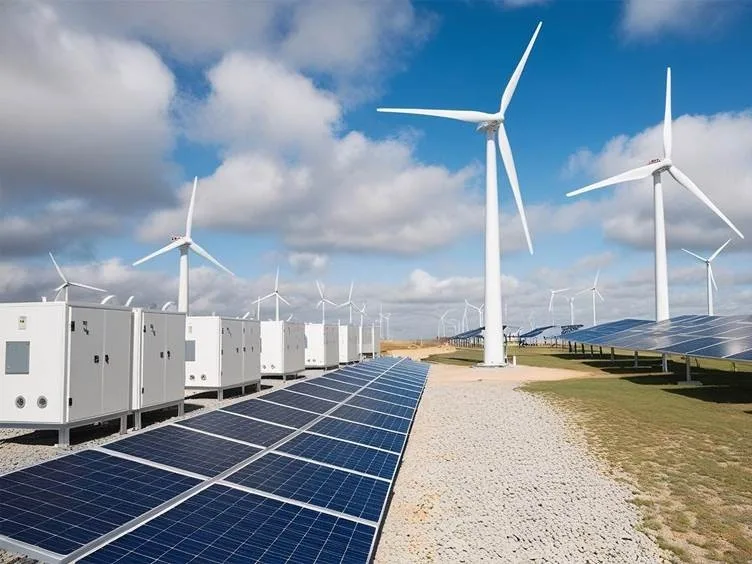
India's Cheapest Battery Storage Deals Are Under Pressure—And Your Future Electricity Could Feel It by Iffat Zareen When the evening is windless and the sun goes down the horizon, our first instinct is to switch on the fans and the lights. This first instinct may slowly turn into our last. The electricity that powers them may soon be dependent on a technology facing an alarming reality check. Hailed as the backbone of the country’s clean energy future – India’s battery energy storage projects – are currently feeling the impact of rising costs, triggering concerns casting doubt on whether the lowest bids can be executed without financial strain. A Reuters analysis issued on July 8th, 2026, has sparked fresh concerns. Against the anticipation of the developers, battery storage projects have become markedly more expensive. This is because of the rising costs of lithium, copper, and aluminium alongside changes in Chinese export incentives and the growing tensions in geopolitics, as suggested by the Reuters analysis. This comes at a crucial juncture. Presently, solar and wind capacity are on the scale of rapid growth in India. However, renewable energy is not always available when it is most needed by the people, making it just one, but a huge drawback. This problem is solved by batteries. They store the electricity generated during sunny or windy hours and later release it. Hence, ensuring uninterrupted power delivery to hospitals, homes and businesses when renewable generation drops. But this is where the financial equation becomes more challenging. Contracts were won by many developers based on exceptionally low storage tariffs – the price paid for storing and supplying electricity. When raw material prices were lower, only then did those tariffs look attractive. With the rising manufacturing costs of batteries, it is becoming harder to finance the same projects. Developers have cautioned that some projects may require renegotiation. Growing uncertainty over cost recovery is making lenders more cautious about financing new projects. To understand battery storage, two terms need to be understood as well: megawatts (MW) and megawatt-hours (MWh). The amount of electricity delivered by a battery at one time is represented by MW, whereas MWh indicates how long it can keep delivering that power. For instance, a 100MW/400MWh battery can supply 100 MW for 4 hours with no interruption. Greater reliability is provided by longer-duration batteries; however, this calls for the requirement of more battery cells, resulting in a significant increase in costs. The challenge for electricity distribution companies, is balancing affordable tariffs with dependable infrastructure. The ability to integrate new solar and wind capacity could slow down if projects are awarded at unrealistically low prices. This would leave beneficial renewable electricity unused during peak generation and create supply gaps during high-demand periods. The story is no longer about just building more batteries – it’s about building projects that can remain financially viable. With India’s acceleration in clean-energy transition, the success of battery storage may ultimately rely less on who bids the lowest but on who can deliver when the country is in the most need of power. ...Read more
16 Jul 2026
India's next energy challenge is bigger than simply generating more electricity. By Tiyasha Ghosh Imagine a city all lit up today, with no future powering it tomorrow! Would you still switch on the air conditioner without even thinking once? or would you keep your phone on charge overnight? Would you leave an electric vehicle plugged in, stream a movie, or ask ChatGPT a question as casually as you do today? Probably, yes! Because electricity is not visible. We notice it only when it's gone! Behind every light, hospital, metro, factory, and data centre is a power system working 24/7 to keep the country running. That system is now gearing up for a make-or-break moment. According to a Reuters report published on 8 July 2026, Union Power Minister Manohar Lal Khattar said India's peak electricity demand could touch nearly 300 gigawatts (GW) by 2027. The surge will be driven by rapid economic growth, artificial intelligence (AI), expanding data centres, electric vehicles, industrial growth and cooling demand as temperatures keep rising. That appears to be progress on paper. More electricity powers more homes, fuels more industry, grows more businesses, and lifts more lives. With growth comes greater responsibility. Can India produce enough power without creating more pollution? Can renewable energy keep up? Is the grid ready for AI, EVs, and climate change? These are no longer questions for only policymakers because they affect every household, every business and every citizen. Because electricity is no longer just another utility. It powers education, healthcare, transport, communication, the digital economy, and nearly every aspect of modern living. The challenge, however, goes beyond generating more electricity. Electricity must be there when people need it, travel long distances without interruption, remain affordable, and steadily get cleaner. This is why India’s shift to new energy sources is at a critical stage. Today’s decisions on coal, renewables, storage, grids, and efficiency will shape India’s energy future for decades. Keeping the lights on is no longer just about producing electricity. It's about building an energy system that is reliable, resilient and ready for tomorrow. If meeting future demand is so important, why doesn't India simply build more power plants? Sounds easy, right? Need more power? Generate more power. But that’s not how it works. Electricity is different from other resources. You can’t just produce and preserve it. It has to be available 24/7, the moment people need it. That is where India's real challenge begins. Coal has powered India for decades. Coal continues to be the country’s most dependable electricity source. It operates 24/7 in any weather, and keeps delivering during heatwaves or demand peaks when other options struggles. Reliable power, real consequences. Coal is a major source of greenhouse gas emissions and air pollution. It is also water-intensive and hinders India’s climate goals. It’s a hard choice. Coal keeps us running today, but it can’t power tomorrow. The only way out is cleaner energy. Solar and wind projects are expanding rapidly across the country. Technology has become cheaper. Investments are increasing. India is already among the world's leading producers of renewable energy. Yet clean energy has one limitation that cannot be ignored. The sun sets. The wind fades. Electricity demand doesn't! Life doesn’t pause for darkness, clouds, or calm winds. Hospitals, factories, and data centres need power 24/7 - no excuses. It’s not coal vs renewables anymore. The real conversation is about maintaining the equilibrium. Coal provides stability. Renewables provide sustainability. Storage provides flexibility and transmission connects them all. We generate solar power by day but lose its value by night because we can't store it. We produce electricity where it's abundant but struggle to deliver it where it's needed most. Every evening, rising demand pushes the grid to its limits- highlighting the urgent need for smarter energy management. Every part of the system depends on one another. India’s power system works like a chain. Generation kicks it off, storage sustains it, transmission moves it across, and efficiency makes sure nothing is lost before it reaches consumers. Even if one runner slows down, the whole system suffers. This is why experts believe that India's future energy strategy cannot just focus on building more power plants but instead on building a smarter power system. Power that doesn’t fail when demand spikes. Bills people can actually pay. Air, that’s much cleaner. And a grid flexible enough to run the future! The challenge ahead isn’t about generating more power. It’s about generating the power at the right time, delivering it when it’s needed, and doing it in the most cost-effective and environmental way. So, what can India do? The first answer is surprisingly simple. Use electricity more efficiently. Each evening, electricity demand peaks. Households turn on lights, ACs, TVs, and appliances simultaneously while offices, factories, and commercial spaces remain active. This overlap creates a sharp surge that strains the grid. This is where energy efficiency and Time-of-Day (ToD) pricing can have a real impact. ToD pricing is simple: pay less at night, pay a bit more in the evening rush. It’s not about making power costly but about getting people to charge cars, run washing machines, and run machines when the grid has room. Along with efficient appliances, LEDs, smart meters, and improved building design, these measures can greatly lower peak load. According to experts, managing demand is often the quickest, cheapest way to relieve the grid instead of building more plants. But reducing demand alone will not solve the problem. India also needs to store clean electricity to use later. Solar power is generated only during the day and wind energy depends on weather conditions. Demand, however, persists continuously. India's Electricity Demand: Current vs Future YearPeak Electricity Demand2024250 GW2025270 GW2027 (Projected)300 GW Key Takeaway:India's electricity demand is projected to increase by nearly 50 GW within three years, mainly due to AI, data centres, EVs, cooling demand and economic growth. This is driving greater reliance on Battery Energy Storage Systems (BESS) and pumped-storage hydropower. Solar in the day, batteries at night. That’s the idea. And pumped storage? It’s nature’s battery - lifts water when power is cheap and drops it when demand spikes. According to experts, India will require both daily-use battery storage and long-duration storage to ensure stable power during extreme periods of solar and wind generation. Storage is no longer an optional technology- it is becoming the backbone of a renewable energy grid. Another question, i.e., equally important, isIs power reaching the places that need it the most? Generating clean power is only one part of the solution. It should also travel efficiently across the country. Rajasthan and Gujarat’s large solar farms frequently produce surplus electricity, while demand spikes in other states. Weak transmission links mean renewable energy may stay unused despite demand elsewhere. This means transmission is as critical as power generation. Experts say building high-capacity transmission corridors and upgrading the national grid will determine how well India taps its expanding renewable capacity. Then the biggest question of the future arises. Should data centres produce their own clean energy? Artificial intelligence, cloud computing and digital services are driving a surging expansion of data centres. These facilities operate 24 hours a day and consume an enormous amount of electricity. The energy transition isn’t just the government’s job. Big consumers need to step up too. Rooftop solar, batteries, long-term clean power deals - these don’t just take load off the grid, they also make companies more secure. India's Energy Transition Chain Renewable Energy ↓Battery Storage ↓Transmission Grid ↓Smart Distribution ↓Consumers Without any one of these links, the entire electricity system becomes less reliable. The final question is perhaps the most difficult. Which energy source offers the best balance between reliability, affordability and sustainability? There is no perfect answer! Coal remains reliable because it can generate electricity throughout the day. However, it also produces high carbon emissions and causes air pollution. Solar and wind power are clean sources of energy that are becoming more cost-effective. The biggest limitation is that they depend on weather conditions. Hydropower provides flexible electricity and helps balance renewable energy but growth is constrained by location and environmental factors. Natural gas helps meet sudden spikes in demand. However, high costs and dependence on imports make it less reliable in the long run. Battery storage improves reliability by storing renewable energy, although large-scale expansion still requires the right investment. The cheapest way to manage power isn’t to make more of it but to waste less. That’s why demand response and efficiency still win. This is why experts believe India's future will not depend on a single technology but on the right combination of many. In the short run, coal may ensure stability. Renewables will power the clean transition. Batteries will fill the gaps between supply and demand. New transmission lines will carry clean power to consumers. Energy efficiency can ease the burden on the power grid. Together, these solutions can help India meet rising electricity consumption without compromising reliability, affordability or sustainability. One thing made India's progress possible: Power you can count on. From powering factories during industrial growth to supporting today's AI revolution, electricity has become the backbone of the country's progress silently. The challenge now is no longer whether India can generate more electricity, but whether the country can generate it wisely. Every choice we make today comes with a cost. Coal ensures reliability but raises emissions. Renewables without storage can’t deliver power on demand. More transmission without more generation still won’t meet needs. Relying on just one solution won’t work. The path forward, experts say, is balance, not dependence. During the transition, coal may ensure reliability. Renewables will lead on sustainability. Storage will fill supply gaps. Smarter grids and stronger transmission will bring clean power to consumers. Comparing India's Power Options Energy SourceReliabilityEmissionsBest UseCoal★★★★★HighBase-load powerSolar★★☆☆☆Very LowDaytime electricityWind★★★☆☆Very LowSeasonal generationHydropower★★★★☆LowPeak balancingBattery Storage★★★★★ZeroEvening demandEnergy Efficiency★★★★★ZeroReducing peak demand We don’t have to wait for new plants. Smarter tech and smarter use can take pressure off the system right now. Governments won’t make it alone. Industries need to go cleaner, businesses need to be more efficient, housing societies need to cut excess use, and consumers need to make smarter choices daily Small actions may seem insignificant at first but together, they shape the future of the entire electricity system. India has already proven that ambitious targets are within reach. The next challenge is ensuring that every additional unit of electricity is cleaner, more reliable, and more resilient than the last. This isn’t just about electricity. It’s about economic growth, climate resilience, public health, energy security, and the lives of more than a billion people. The lights must stay on! The real question isn’t just electricity. But legacy. How India powers itself today will define tomorrow! DATA / DOCUMENT STACK Central Electricity Authority (CEA): Peak electricity demand and generation data (2024–2026). Ministry of New and Renewable Energy (MNRE): Monthly renewable energy capacity additions and physical progress reports. Grid India: Grid frequency, renewable integration and transmission performance data. State DISCOM Reports: Electricity demand curves, Time-of-Day (ToD) pricing pilots and Battery Energy Storage System (BESS) tenders. Reuters (8 July 2026): Union Power Minister Manohar Lal Khattar's remarks on India's projected 300 GW peak electricity demand by 2027. International Energy Agency (IEA): India Electricity Outlook and clean energy transition reports. NITI Aayog: National Energy Security and Energy Transition publications. SOURCE: Reuters — 8 July 2026 (Remarks by Union Power Minister Manohar Lal Khattar) Ministry of New and Renewable Energy (MNRE) — Physical Progress Reports Central Electricity Authority (CEA) — Peak Demand & Generation Statistics Grid India — National Grid Performance Reports International Energy Agency (IEA) — India Energy Outlook ...Read more
16 Jul 2026
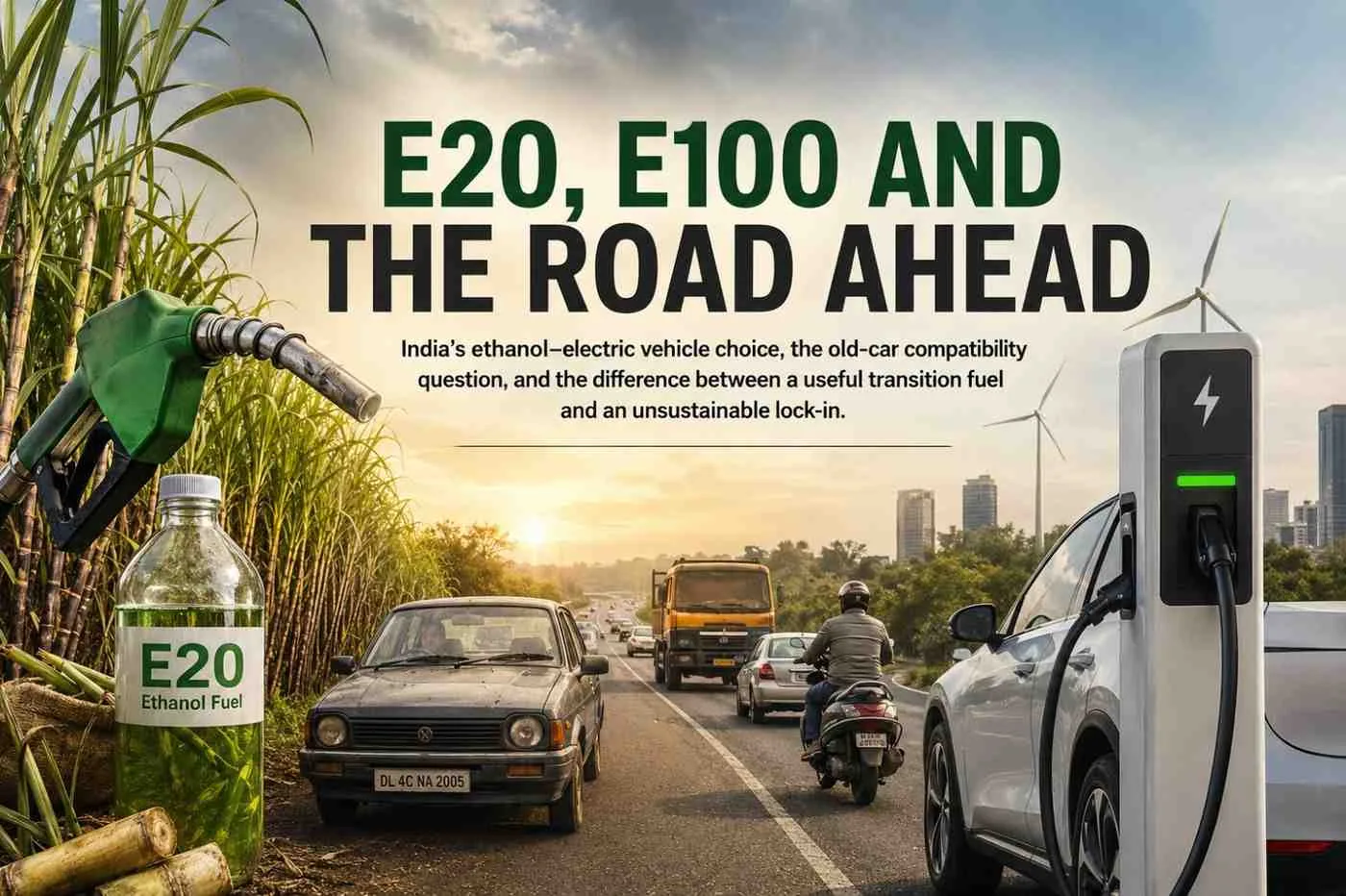
India’s ethanol–electric vehicle choice, the old-car compatibility question, and the difference between a useful transition fuel and an unsustainable lock-in Prof Ujjwal K Chowdhury THE VERDICT IN ONE SENTENCEEthanol can reduce oil imports and clean up the existing petrol fleet, but India should not treat ever-higher blends as a substitute for electrification: protect legacy vehicles, cap first-generation crop pressure, accelerate waste-based ethanol, and electrify every road-transport segment where electrons work better than liquid fuel. Research note: Vehicle compatibility is model-, market- and certification-specific. The owner’s manual, fuel-lid label and written OEM guidance override general timelines in this report. The Debate at a Glance India has moved from a modest ethanol-blending programme to a petrol market centred on E20 with exceptional speed. The achievement is material: the Petroleum Planning and Analysis Cell reported 20.00% blending for November 2025–March 2026, while the country simultaneously expanded charging facilities at oil-company retail outlets. [3] Yet success has created a second-order policy problem. Millions of vehicles were designed in the E5/E10 era; E10 has largely disappeared as a consumer choice; motorists report lower mileage; and an ethanol industry built for rapid expansion is pressing for demand beyond E20. The argument is no longer simply ‘renewable versus fossil’. It is about who bears transition costs, which feedstocks deserve public support, and whether India is building a bridge to electric mobility or a new combustion lock-in. 20.00%India’s official blending level for Nov 2025–Mar 2026.April 2023New Indian petrol vehicles were scheduled to become E20 material-compliant and E10-tuned.April 2025New petrol vehicles were scheduled to become E20 engine-tuned/compliant.2–3%ARAI-observed fuel-economy decline for tested four-wheelers using E20 instead of E10.5–6%ARAI-observed decline for tested two-wheelers.E30Mandatory regular Brazilian petrol blend from 1 August 2025—not E100. First, Decode the Pump: E10 Is Not E100 The ‘E-number’ normally indicates ethanol’s volumetric share in a petrol–ethanol blend. It says nothing by itself about sustainability, engine compatibility or lifecycle carbon. Those depend on feedstock, production energy, vehicle design, calibration, storage and regulation. LabelWhat it meansWhat a driver should understandE0Nominally ethanol-free petrolLegacy/special applications; increasingly difficult to obtain in India.E5Up to 5% ethanolLow blend; historically common in many markets.E1010% ethanol + 90% petrolThe broad compatibility baseline for much of India’s E10-era fleet.E2020% ethanol + 80% petrolIndia’s current mainstream grade; best used in E20-certified/tuned vehicles.E27/E3027%/30% anhydrous ethanol in petrolBrazilian regular petrol was E27 and became E30 in August 2025.E85Typically 51–85% ethanol depending on season/specificationRequires a flex-fuel vehicle; not for an ordinary petrol car.“E100”Commercial hydrous ethanol in BrazilUsed in flex-fuel or dedicated ethanol vehicles. It contains regulated water and is not laboratory-pure ethanol. The most dangerous misconception is linear extrapolation: “If E10 works, E20 must be twice as good, and E100 must be perfect.” Engines do not work that way. A high-ethanol fuel needs compatible elastomers, metals, pumps and injectors, different cold-start strategy, greater fuel flow, oxygen-sensor control and calibration that exploit ethanol’s octane while compensating for its lower energy per litre. Old Car, New Fuel: The Compatibility Answer India Needs There is no scientifically defensible single cut-off, such as “all cars before year X are unsafe” or “all cars after year Y are safe”. A model launched in one year may continue with older fuel-system parts; a manufacturer may revise calibration mid-cycle; imported vehicles may follow a different standard; and aftermarket hoses or pumps may be the weakest link. Nevertheless, India’s policy and industry timeline provides a practical risk map. [2][5] Vehicle cohortPractical fuel positionPrincipal risk or nuanceWhat the owner should doPre-E10-era / vintage / carburetted vehiclesE5 or the blend explicitly approved by the OEM. E10 may work in some vehicles, but should not be presumed.Ethanol may loosen old deposits; aged cork, nitrile rubber, plastics, zinc/aluminium components and vented systems may be vulnerable. E20 or higher should not be used without specialist conversion and written approval.Inspect hoses, seals, tank and carburettor; avoid long storage with ethanol fuel; seek marque-specialist advice.Indian vehicles built from 2008 through the E10 eraThe NITI roadmap stated vehicles made since 2008 were material-compatible with E10, while fuel-economy optimisation lagged. [2]Many are not E20-certified or tuned. Short-term operation is not equivalent to lifetime compatibility. Expect possible mileage loss and monitor elastomers, pump, injector and warning lights.Check manual/fuel lid/VIN bulletin. Obtain written OEM guidance. Preserve service records and fuel bills.Vehicles sold before 1 April 2023 but carrying explicit E20 approvalE20 within the manufacturer’s stated conditions.Approval is model-specific; do not infer from registration year alone.Follow normal maintenance and software updates.Vehicles manufactured from 1 April 2023Designed under the transition plan to be E20 material-compliant and E10 engine-tuned.“Material-compliant” means the fuel system can tolerate E20; it does not necessarily mean the engine achieves best mileage or performance on it.Confirm the fuel-lid label and manual; E20 is generally the intended market fuel.Vehicles manufactured from 1 April 2025New gasoline vehicles were scheduled to be fully E20-tuned/compliant.They should manage E20 as the normal grade, subject to proper fuel quality.Use E20 as specified; any E20-related fault should be handled under normal warranty rules.Flex-fuel vehicleThe certified range, potentially E20–E85/E100 depending on design.Sensors and software detect blend; fuel system and cold-start design differ materially from ordinary cars.Never assume “flex” without OEM certification. A useful distinction is therefore between three claims: “the car starts and runs”, “the fuel system is materially compatible”, and “the engine is optimised and warranted for the blend”. Public debate often collapses these into one. It should not. What the Indian Tests Actually Found—and What They Did Not ARAI, working with Indian Oil and SIAM, tested new and in-use E10-compatible two- and four-wheelers on E20. It reported similar changes in selected plastics under E20 and E10; all tested vehicles met their original mass-emission compliance; and measured fuel-economy losses were 5–6% for two-wheelers and 2–3% for four-wheelers. [4] This is meaningful reassurance against claims that every older vehicle will immediately fail. But it is not a lifetime warranty for every model, every replacement part, every climate and every storage condition. Fleet testing samples cannot eliminate low-frequency failures, ageing interactions or vehicle-specific calibration issues. The fair consumer position is neither panic nor dismissal. An E10-era vehicle may operate acceptably on E20, yet the owner should not be forced to treat an aggregate test as a substitute for an OEM compatibility statement. Where a manual limits ethanol to E10, the manufacturer and regulator should issue a VIN-specific clarification, retrofit schedule or fuel alternative—not ask the owner to infer safety from a press release. “Compatibility is a certification question, not a slogan—and absence of immediate failure is not proof of lifetime optimisation.” The Chemistry Gives Ethanol Both Its Halo and Its Headaches High octane, lower energy Ethanol is oxygenated and highly knock-resistant. Its high octane can support higher compression, turbocharging and more efficient combustion when an engine is designed for it. In an E20-tuned engine, this can improve response and partly recover efficiency. Yet ethanol carries substantially less energy per litre than petrol. Without compensating efficiency gains, more liquid must be injected to travel the same distance. That is why a lower kilometres-per-litre figure is not evidence of adulteration; it is an expected physical consequence whose size depends on calibration, driving conditions and the base petrol. Water-loving fuel in a monsoon country Ethanol is hygroscopic: it attracts and mixes with water. In a sealed, well-managed modern fuel system this is controllable. In poorly maintained underground tanks, boats, farm equipment, seasonal vehicles or old vented tanks, water ingress can trigger phase separation, corrosion and hard starting. The correct diagnosis is usually “water management and fuel-quality failure”, not “all ethanol is inherently bad”. India’s humid coast, heavy monsoon and vast retail network make tank integrity, drainage, sampling and traceability unusually important. A solvent that exposes old weakness Ethanol can clean varnish and deposits accumulated over years. The cleaned material may then clog filters or injectors. It can also swell, harden or embrittle incompatible elastomers and interact with certain metals. New E20 systems use appropriate polymers and coatings; old vehicles and low-quality aftermarket components may not. A sensible transition programme therefore includes compatible service parts, not merely a change at the refinery gate. Cleaner does not mean emission-free Ethanol can reduce carbon monoxide, aromatics and particulate formation, especially in older combustion systems. However, aldehydes such as acetaldehyde and some evaporative organic compounds can increase; nitrogen-oxide outcomes vary with engine and after-treatment calibration. Tailpipe carbon dioxide from ethanol is biogenic, but the climate account must include farming, fertiliser nitrous oxide, irrigation, distillation heat, transport and possible land-use change. The phrase “zero-carbon ethanol” is therefore misleading unless lifecycle boundaries and feedstock are stated. India’s Leap: From Sugar Surplus Fix to Energy-Security Strategy India’s Ethanol Blended Petrol programme began as a modest blending and sugar-sector instrument. The National Policy on Biofuels, 2018 originally placed the 20% ambition farther out; its 2022 amendment advanced E20 availability and set the ESY 2025–26 target. It also broadened eligible feedstocks to molasses, sugarcane juice and syrup, maize, cassava, damaged grain, agricultural residues and industrial wastes. [1] The policy logic combined five objectives: reduce crude-oil imports, absorb agricultural surplus, support farmer and distillery income, lower selected emissions, and create a domestic biofuel industry. The scale-up was extraordinary. The NITI roadmap estimated ethanol demand for blending would rise from about 173 crore litres in 2019–20 to around 1,016 crore litres in 2025–26 and called for capacity of roughly 1,500 crore litres. [2] PPAC now reports the 20% blend. [3] By mid-2026, industry estimates cited in the press suggested installed capacity had grown beyond immediate blending and industrial demand, producing a notional surplus. [18] That changes political economy: once factories and loans depend on expanding ethanol sales, “go beyond E20” can become an industrial demand as much as a climate conclusion. The Genuine Gains: Why Ethanol Is Not a Fraud Every litre of domestic ethanol displaces part of a volatile imported petroleum barrel. This improves energy diversification even when ethanol is not always cheaper litre-for-litre.It creates a second revenue stream for sugar mills and grain processors and can move money into rural districts. Co-products such as distillers’ dried grains with solubles can return protein feed to livestock markets, partly offsetting grain diversion.Ethanol’s octane value can reduce dependence on some petroleum-derived octane components and enables efficient engine designs when the vehicle is tuned for it.Blending gives a near-term emissions benefit across the enormous existing combustion fleet; an EV policy affects only vehicles as they are replaced.Waste- and residue-based 2G ethanol can address crop-residue burning and deliver much better sustainability—provided residue extraction does not rob soils or livestock of needed biomass. The Hidden Bill: When “Green” Fuel Becomes Resource-Hungry Food versus fuel is not a conspiracy theory When maize, rice or sugar are diverted to fuel, the impact depends on genuine surplus, stocks, yields, trade, co-products and market response. Using damaged or unfit grain is easier to justify than creating a permanent fuel pull on edible grain during a poor harvest. A procurement price attractive enough to build distilleries can alter sowing decisions, feed costs and food inflation. “Farm income” and “food security” are both legitimate public interests; neither should erase the other. The water problem can dwarf the carbon claim The NITI roadmap cited an estimate of roughly 2,860 litres of water for one litre of sugarcane-based ethanol when cultivation water is counted, while recommending less water-intensive feedstocks and 2G routes. [2] The figure varies sharply by rainfall, irrigation efficiency, yield and accounting method, but the policy message is robust: water-stressed districts should not be rewarded for producing a water-intensive transport fuel. Sugarcane ethanol from rain-fed, high-yield regions with bagasse-powered distillation is a different environmental product from cane grown with groundwater and coal-fired process heat. A national average can hide a bad litre Ethanol’s lifecycle greenhouse-gas performance ranges widely. A residue-based refinery using renewable process heat may be deeply beneficial. Grain ethanol powered by coal, fertilised intensively and linked to land expansion may deliver a much smaller reduction. Policy should therefore purchase verified carbon intensity, water performance and soil safeguards—not pay the same environmental premium for every litre merely because it is called bioethanol. The consumer-choice deficit India’s rapid nationwide move effectively removed E10 from many pumps before every legacy owner received an unambiguous compatibility route. This is the strongest procedural criticism of the programme. A transition can be technically defensible yet unfairly administered. Owners whose manuals specify E10 should have access to a clearly labelled compatible grade during a sunset period, an OEM-backed retrofit, or explicit warranty protection. Higher-priced premium petrol is not an adequate solution if it is unavailable, unaffordable or still contains ethanol. Use and Abuse: Seven Claims That Need a Reality Check ClaimEvidence-based reading“E20 will destroy every old car.”Unsupported as a universal claim. ARAI testing did not find general catastrophic failure, but model-specific material and calibration risks remain.“If it runs, it is compatible.”False. Immediate drivability does not prove long-term seal, pump, injector or warranty compatibility.“Ethanol always makes petrol cheaper.”False. Delivered cost depends on feedstock, administered procurement prices, crude prices, taxes, logistics and the extra litres consumed per kilometre.“Bioethanol is carbon-neutral.”Incomplete. Biogenic carbon recycling is only one part of lifecycle emissions.“Brazil uses E100, so India can do it tomorrow.”Misleading. Brazil built decades of flex-fuel vehicles, hydrous-ethanol logistics, consumer choice and sugarcane productivity.“EVs have zero emissions.”False on a lifecycle basis. Battery and electricity emissions matter, although Indian BEVs still show a substantial lifetime advantage over petrol cars in major assessments.“Ethanol and EVs are rivals; one must win.”Poor policy framing. Ethanol addresses the existing liquid-fuel fleet; EVs can eliminate combustion and dramatically improve energy efficiency in new vehicles. Brazil: A Powerful Lesson—and a Dangerous Shortcut Brazil is the world’s most important real-world demonstration of high-ethanol road transport, but the slogan “Brazil runs on E100” strips away the engineering and institutional system that makes it possible. Brazilian petrol is E30 Brazil’s regular petrol, gasolina C, contained 27% anhydrous ethanol for years. From 1 August 2025, the mandatory share rose to 30%, and the regulator ANP simultaneously tightened the petrol specification and increased the minimum research octane number from 93 to 94. [10] That is a regulated E30 petrol system—not a decision to put neat ethanol into every old petrol vehicle. Brazilian “E100” is hydrous fuel ethanol At Brazilian stations, drivers can also buy etanol hidratado combustível. It is colloquially labelled E100 because it is sold as the ethanol option rather than as a petrol blend. Yet ANP guidance specifies ordinary automotive hydrous ethanol at about 92.5–95.4% alcohol by mass, with premium hydrous ethanol higher. [11] The remaining water is intentional and regulated. Calling it “100% ethanol” is a market shorthand, not a chemical specification. The vehicle, not the pump, is the secret Brazil introduced modern flex-fuel cars in 2003 after decades of Proálcool experience. Flex vehicles use ethanol-compatible materials, wide-range fuel control, sensors or adaptive software, larger effective fuel flow and cold-start strategies. They can take petrol blend, hydrous ethanol or mixtures of the two. An EPE study estimated flex vehicles were already 74% of the light fleet in 2017 and projected about 90% by 2030. [12] Brazil also gives motorists a visible pump choice, allowing the relative price of ethanol and petrol to influence demand. What India can copy—and what it cannot India can copy Brazil’s long-term standards, pump labelling, flex-fuel engineering, quality enforcement and consumer choice. It cannot copy-paste Brazil’s feedstock geography. Brazilian centre-south sugarcane is often rain-fed, highly productive, mechanised and integrated with bagasse energy. Indian cane frequently grows under different water stress, smallholder and power-subsidy conditions. Nor should India create a large new flex-fuel passenger-car market without asking whether those vehicles will still be economically rational as batteries and charging improve. Ethanol Route Versus EV Route: Molecules or Electrons? The cleanest strategic principle is: electrify what can be electrified efficiently; reserve sustainable molecules for the existing fleet and for transport that is genuinely hard to electrify. The two routes solve different time horizons. Ethanol reduces fossil content in vehicles already on the road. EVs replace the combustion chain itself. TestEthanol / combustion routeBattery-electric routeEnergy efficiencyCombustion rejects most fuel energy as heat; high blends do not change that basic architecture.Electric drivetrains deliver a far larger share of input energy to the wheels.Legacy-fleet effectImmediate: E20 changes every litre burned by compatible petrol vehicles.Slow at first: benefit arrives as vehicles are replaced, but compounds over the fleet life.Urban airCan reduce some pollutants but retains exhaust, cold-start emissions and brake/tyre pollution.No tailpipe pollution; brake dust can fall through regenerative braking, though tyre and road dust remain.ClimateHighly feedstock-specific; first-generation crop ethanol gives limited-to-moderate reductions at blend level.Battery manufacturing matters, but major lifecycle studies still find Indian BEVs lower-emitting than petrol cars, even on a coal-heavy grid. [13]InfrastructureUses much of the liquid-fuel network but requires blend-compatible tanks, quality control and ethanol logistics.Needs home/depot/public charging and distribution upgrades; PPAC reported charging at 29,047 OMC outlets by April 2026. [3]Resource pressureLand, water, fertiliser, biomass and distillation energy.Minerals, batteries, electricity generation, grid capacity and recycling.Rural developmentCan create farm, aggregation and biorefinery income when safeguards are real.Creates manufacturing, charging, service and renewable-power jobs; rural benefit is less directly tied to crops.Best Indian fitExisting petrol fleet, carefully limited flex-fuel niches, 2G ethanol, and eventually aviation/chemical pathways.Two- and three-wheelers, city buses, delivery fleets and a growing share of passenger cars; depot charging is especially attractive. Why EVs Usually Win the New-Vehicle Carbon Contest A combustion car must grow or extract a fuel, process it, transport it, burn it and discard most of its energy as heat. An EV converts electricity to motion far more efficiently and becomes cleaner automatically as the grid adds renewables. The ICCT’s lifecycle assessment estimated that BEVs registered in India in 2021 produced about 19–49% lower lifetime greenhouse-gas emissions than gasoline cars, with the range reflecting future grid pathways; for 2030 vehicles the estimated advantage widened to 30–63%. [13] The study also concluded that expected changes in biofuel blends have a low-to-negligible influence on total lifecycle emissions of average gasoline cars because only a fraction of the fuel changes and upstream emissions remain. Why Ethanol Still Matters During the Transition India cannot scrap its petrol fleet overnight. A litre blended today can reduce petroleum use today, whereas an EV purchased today replaces only one future vehicle. Ethanol also offers resilience in liquid-fuel supply and a route for residues that are otherwise burned. The mistake is to convert this bridge function into an argument for indefinite expansion of crop-based combustion. A bridge is valuable because it leads somewhere. India’s Better Route: Ten Guardrails for Sustainable Mobility 1. Protect the installed fleet. Maintain E10 or another clearly compatible grade during a defined sunset period in regions with substantial legacy demand; publish a transparent end date only after OEM mapping. 2. Create a national VIN-level compatibility database. Every manufacturer should state maximum blend, material compatibility, tuning status, retrofit parts and warranty position for each model and model year. 3. Make the weakest claim illegal. Do not permit “E20 safe” advertising where the vehicle is only material-compatible but not calibrated, certified or warranted for normal E20 use. 4. Pay for carbon and water performance, not litres alone. Procurement should reward verified lifecycle greenhouse-gas reduction, renewable process heat, low irrigation stress and low land-use risk. 5. Cap food-grain exposure. Use dynamic safeguards tied to stocks, food inflation, fodder markets and harvest conditions. Damaged grain is not a blank cheque for permanent edible-grain diversion. 6. Move public support decisively toward 2G ethanol. Agricultural residue, municipal biogenic waste and industrial off-gases deserve technology support, while recognising residue’s soil and fodder value. 7. Fix the monsoon quality chain. Require water detection, tank-integrity audits, digital batch traceability, sealed sampling and rapid compensation for contaminated fuel. 8. Do not subsidise combustion lock-in. Beyond-E20 or flex-fuel deployment should pass a full cost test against EVs, including vehicle lifetime, fuel volume, land, water and charging alternatives. 9. Electrify high-utilisation fleets first. Two-wheelers, three-wheelers, buses, taxis and delivery fleets produce rapid oil and pollution savings because they travel many kilometres and can use predictable charging. 10. Reserve scarce sustainable molecules for hard cases. Over time, low-carbon ethanol may be more valuable as a chemical feedstock or aviation-fuel intermediate than as a routine fuel for urban cars that can run on electricity. A Practical Checklist for the Motorist Read the owner’s manual and fuel-lid label. Search for the exact words “up to E10”, “E20 material-compatible”, “E20 compliant”, “flex fuel” or a maximum ethanol percentage.Ask the manufacturer or authorised dealer for written, VIN-specific guidance—not an oral assurance that “all cars are fine”.For a rarely used, vintage, marine or seasonal vehicle, avoid months of storage with ethanol fuel; keep the tank and fuel system dry and inspect before recommissioning.Watch for fuel smell, seepage, swollen hoses, hard starting, unstable idle, warning lights, unusual pump noise or a sudden mileage change. Stop and diagnose rather than repeatedly replacing parts.Use reputable stations, retain receipts and report suspected water contamination immediately. One bad tank can imitate an “ethanol compatibility” failure.Never put E85, hydrous ethanol or “E100” into an ordinary petrol vehicle merely because Brazil uses it. Only a certified flex-fuel or dedicated ethanol vehicle can safely manage such fuel. The Bottom Line: A Bridge, Not a Destination E10 is the conservative compatibility ceiling for many older Indian petrol vehicles; E20 is the appropriate normal fuel for vehicles explicitly certified and preferably tuned for it; blends above E20 require purpose-designed flex-fuel engineering; and E100 is categorically not a universal petrol substitute. The precise answer for any car remains the manufacturer’s documented approval for that vehicle, not a broad political reassurance or social-media warning. India’s ethanol programme has delivered real energy-security, rural-income and fuel diversification benefits. Its next phase will be judged less by how quickly the blend number rises than by whether it protects consumers, avoids food and water damage, verifies lifecycle carbon, and prevents industrial overcapacity from writing national transport policy. Brazil proves that high ethanol can work—but only with the right vehicles, institutions, agronomy, quality control and consumer choice. The durable sustainable-fuel strategy is therefore plural but not directionless: E20 as a managed transition for the compatible legacy fleet; rapidly improving 2G ethanol for genuinely valuable liquid-fuel uses; and an accelerating EV pathway for new road vehicles. India should not choose between farmers and batteries, or between energy security and consumer protection. It should choose the right energy carrier for the right transport task—and measure sustainability across the whole system, not at the pump alone. Sources and References Numbered references correspond to bracketed citations in the text. Government statements are identified as official positions; lifecycle and sustainability conclusions should be read with their stated system boundaries. 1. Ministry of Petroleum and Natural Gas, Government of India. (2022). National Policy on Biofuels–2018 Amendment, 2022. Gazette notification, 15 June 2022. Source 2. NITI Aayog & Ministry of Petroleum and Natural Gas. (2021). Roadmap for Ethanol Blending in India 2020–25. Source 3. Petroleum Planning & Analysis Cell, Ministry of Petroleum and Natural Gas. (2026). National dashboard: ethanol blending and alternative-fuel retail infrastructure; accessed 16 July 2026. Source 4. Automotive Research Association of India. (2023). Annual Report 2022–23, “Impact of E20 Fuel on E10 Compatible Vehicles”, p. 28. Source 5. Society of Indian Automobile Manufacturers. (2023–2025). Industry transition communications and annual-report material on E20 material-compliant vehicles from April 2023 and E20-tuned vehicles from April 2025. Source 6. Press Information Bureau, Government of India. (20 March 2025). Parliamentary response on ethanol blending levels, vehicle effects and policy beyond E20. Source 7. Press Information Bureau / Ministry of Petroleum and Natural Gas. (2025–2026). Official responses to concerns over E20 petrol, vehicle safety, octane, pricing and energy security. Source 8. Bureau of Indian Standards. (2022). IS 17943:2022—E20 reference fuel specification; read with IS 15464 for anhydrous ethanol. Source 9. Reuters. (8 July 2026; 29 August 2025). Reports on Indian E20 backlash, legacy-vehicle compatibility, consumer choice and automaker responses. Source 10. Agência Nacional do Petróleo, Gás Natural e Biocombustíveis—ANP, Brazil. (12 August 2025). Regulatory hearing and specification changes for E30 gasoline, effective 1 August 2025. Source 11. ANP, Brazil. (2024). Combustíveis líquidos: 10 orientações—consumer guidance on hydrous ethanol alcohol content and fuel quality. Source 12. Empresa de Pesquisa Energética—EPE, Brazil. (2018; updated projections 2025–2034). Demand for light-vehicle energy and the role of flex-fuel vehicles, gasoline C and hydrous ethanol. Source 13. Bieker, G. (2021). A Global Comparison of the Life-Cycle Greenhouse Gas Emissions of Combustion Engine and Electric Passenger Cars. International Council on Clean Transportation. Source 14. International Council on Clean Transportation. (2021). The potential for cellulosic ethanol production in India and sustainability considerations for crop- and residue-based fuels. Source 15. Ministry of Heavy Industries, Government of India. (2024). Operational Guidelines for the PM Electric Drive Revolution in Innovative Vehicle Enhancement (PM E-DRIVE) Scheme. Source 16. Center for Study of Science, Technology and Policy. (2025). Towards Long-Term Sustainability of Ethanol Use in India. Source 17. U.S. Department of Energy, Alternative Fuels Data Center; U.S. Energy Information Administration. Ethanol fuel basics, energy content and flex-fuel definitions. Source 18. India Today. (16 July 2026). “India has ended up with 700 crore litres of extra ethanol capacity. What now?”—reporting industry estimates of installed and notional surplus capacity. Source ...Read more
15 Jul 2026
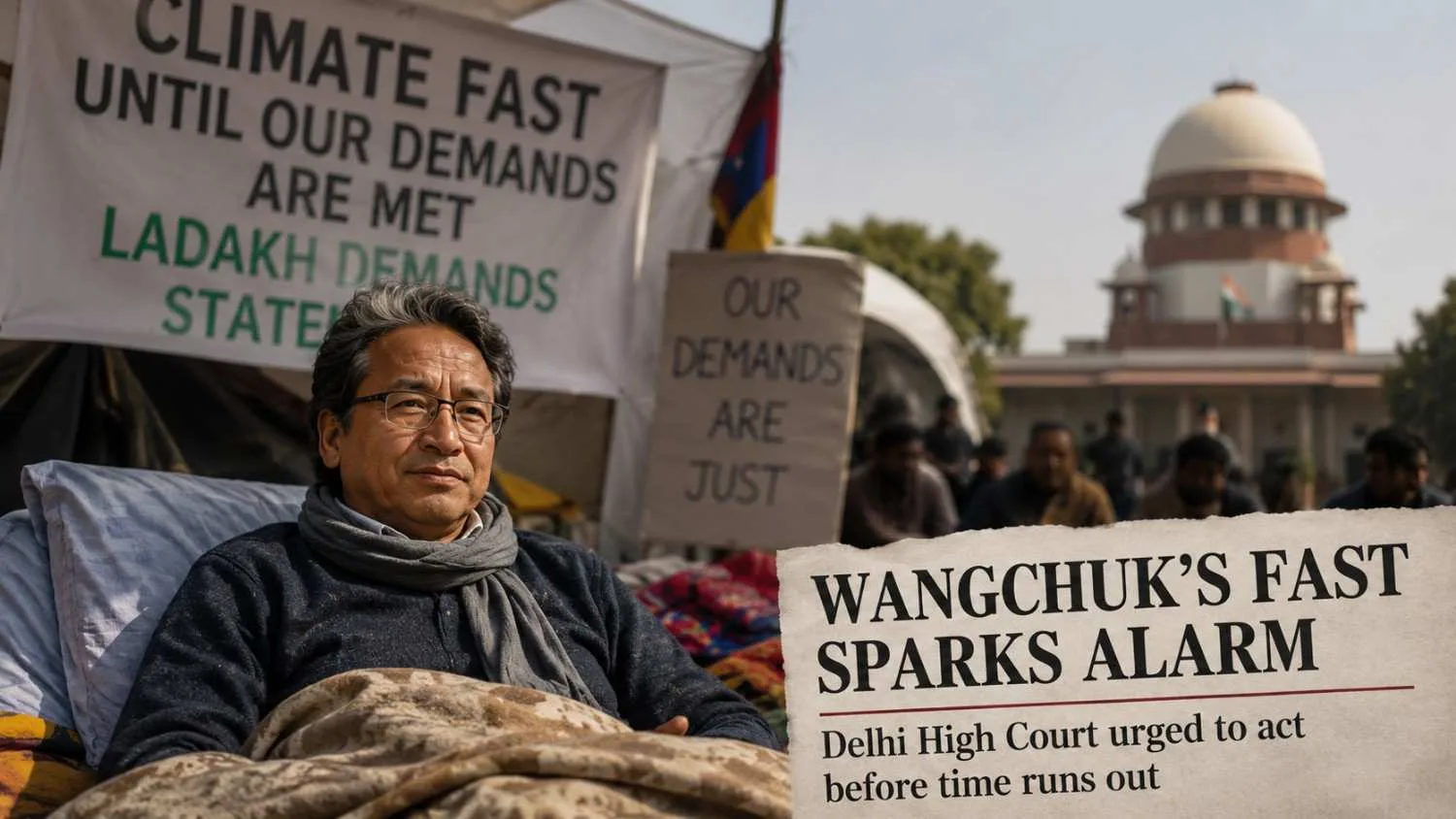
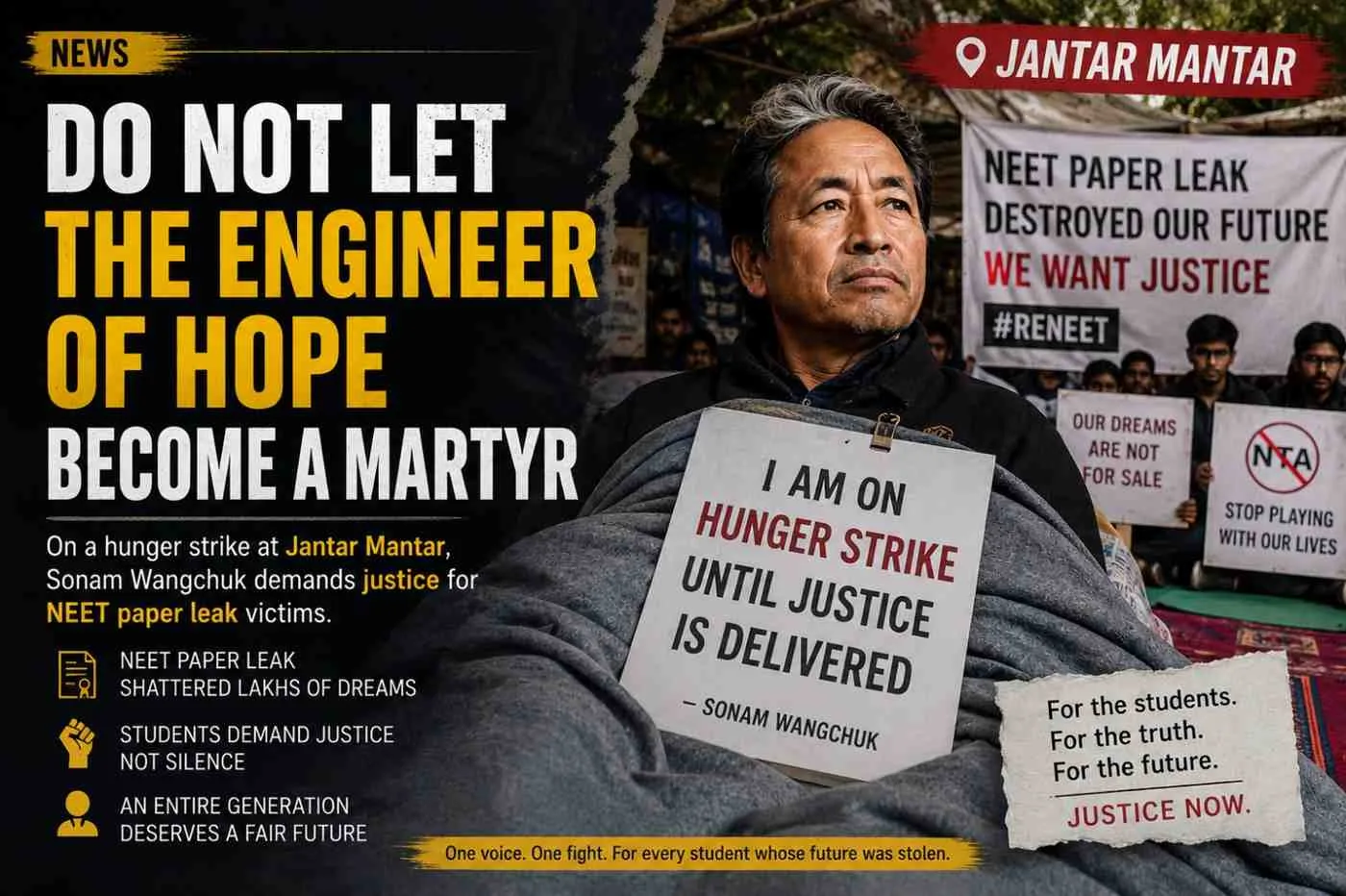
Wangchuk’s Fast Sparks Alarm Delhi High Court urged to act before time runs out By Tiyasha Ghosh How long can a person go without food before the country actually begins to listen? If the price of protest is a life, does silence become the real tragedy? And when someone's health starts deteriorating, should we focus on the protest- or on saving the person behind everything? These questions have taken over as Sonam Wangchuk, the renowned engineer, education reformer and environmental activist from Ladakh, continues his hunger strike in New Delhi. On 15 July, a Public Interest Litigation (PIL) was filed before the Delhi High Court, seeking urgent medical attention for him. The petition claimed that his condition had worsen after more than two weeks of fasting. It stated that he had lost nearly about 8.5 kilograms and alerted that further delay in treatment could put his life at stake. The court has now urged responses from the Centre and the Delhi Government, bringing the matter into the national spotlight. Sonam Wangchuk is known to millions across India. He is well-renowned for his contribution in education, sustainable development and environmental conservation in the Himalayan region. Born and raised in Ladakh, Wangchuk has spent years promoting innovative learning methods and climate-friendly solutions. His contribution also inspired the popular actor, Amir Khan who played as Phunsukh Wangdu in the Bollywood film - 3 Idiots, making him a prominent figure across the country. However, this time, it is not one of his inventions making headlines. It is His silence. As per court records, Wangchuk's health worsened significantly due to fasting. Doctors have reportedly expressed concerns over rapid weight loss, low blood sugar levels and weakness. The PIL has requested immediate medical support including hospitalisation if necessary, stating that protecting a person's life SHOULD BE the number one priority. This case has also ignited an important debate. Should authorities prioritize life over choice and treat hunger strikers? Some believe immediate involvement is necessary to prevent a tragedy. While others argue that peaceful protest is a democratic right and that any medical action should respect the consent of an individual. The Delhi High Court is expected to audit these legal and ethical questions while considering the plea. The incident has stirred emotions well beyond the courtroom. Peaceful protests have been a part of India's democracy since a long time. They have been used often to draw attention to concerns that deserves urgent solution. But when a protest reaches the point where someone's life is at stake, the focus shifts from demands to concerns over human lives. The situation warns us that dialogue delayed is dialogue denied. Early listening can often stop conflicts before it turns into an emergency. As the country waits for the next hearing, many people are hoping for two outcomes- one, Sonam Wangchuk receiving the medical aid he needs, and two, open discussions to get to the root of protesters' concerns. For now, onwards, the court will be deciding the next legal step. But the real question goes far beyond those four walls. Is this how a democracy looks like - waiting until a voice is nearly gone? Source• Reuters• NDTV• The Times of India• Hindustan Times ...Read more
14 Jul 2026
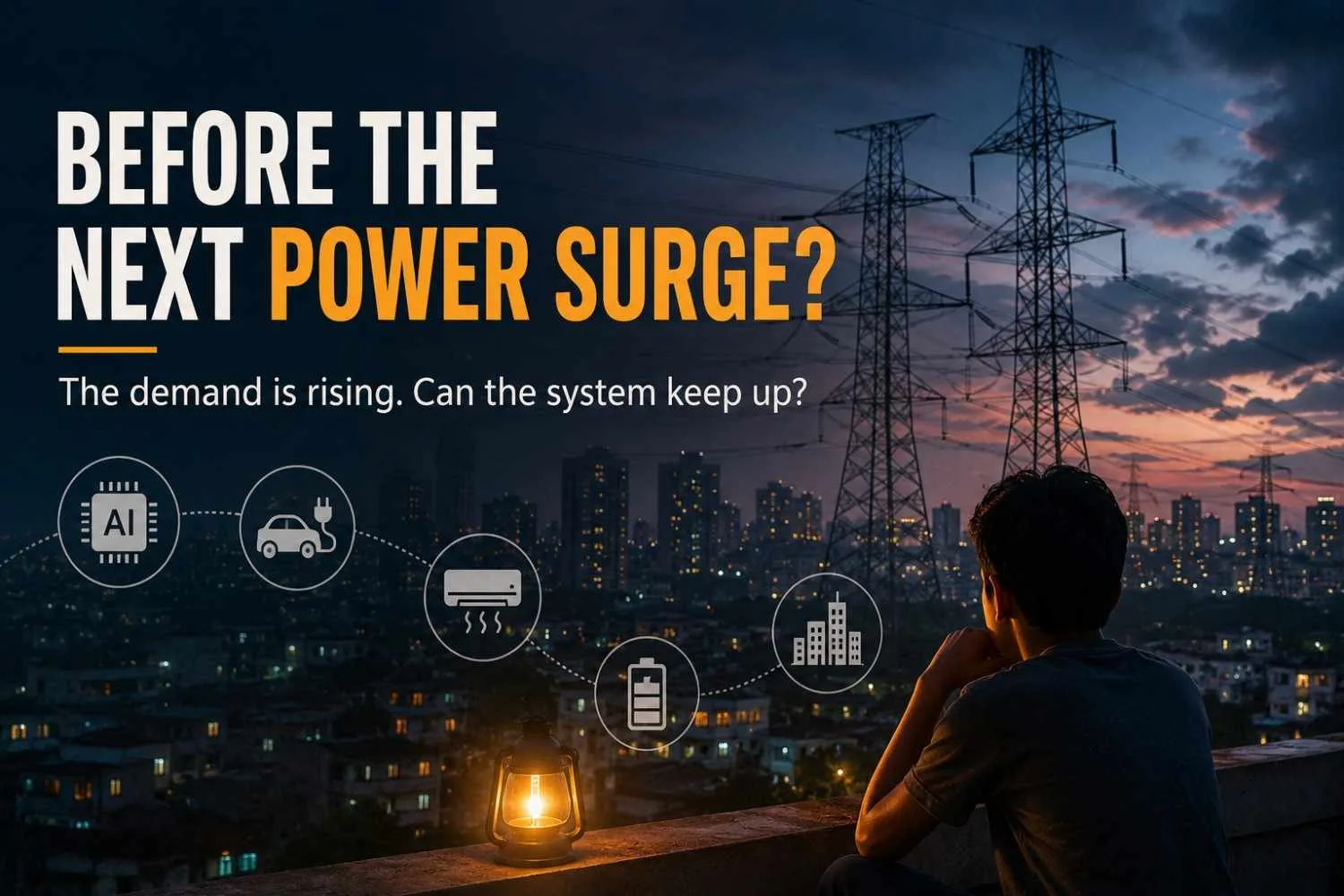
The demand is rising. Can the system keep up? Have you ever thought about a day when your phone won't charge, your office loses its electric supply, or your electric car has nowhere to charge? That seems unlikely. But as India is racing towards a digital future, one important question is still arising in the background, i.e., Will our power supply be sufficient when demand increases? The concern is no longer about using more electricity. It is about whether India can produce, store, and deliver sufficient power to support a rapidly evolving nation or not. According to a Reuters report published on 8 July 2026, India has been preparing for a peak electricity demand of nearly 300 gigawatts (GW) by 2027. This estimate is based on remarks made by the Union Power minister, who highlighted the urgent need to strengthen the country's clean-energy ecosystem before the demand reaches record levels. IndicatorCurrent StatusProjected / Future OutlookPeak Electricity DemandCurrent peak demand continues to rise annually.Expected to reach ~300 GW by 2027.Renewable Energy CapacityIndia has added significant solar and wind capacity in recent yearsFurther expansion is needed to meet rising electricity demand.Major Demand DriversIndustries, households, and urban growth. AI, data centres, electric vehicles, cooling needs, and economic growth.Key ChallengesGrid expansion, storage, and land acquisition.Faster transmission, battery storage, domestic manufacturing, and project approvals will be crucial. So, why is electricity demand rising so quickly? The answer lies in the way India is growing. Artificial Intelligence (AI) is growing fast. Data centres run 24/7. People are switching to electric vehicles more often. As the temperature rises, the use of air conditioners and coolers increases. At the same time, industries, businesses, and cities continue to grow, driving power consumption to record levels. This rising demand is often seen as a sign of economic progress. But every action has its own consequences. The question is- Can India expand its utility infrastructure fast enough to keep up with it? Experts believe that just generating more electricity will not solve the problem. The country must focus on three key pillars—power generation, energy storage and transmission networks. Just like how a water supply system works. Generating electricity is just the first step. It should also be stored even when demand is low. And then seamlessly transported to homes, industries, hospitals, and businesses when there’s a sudden shift in demand. Without stronger transmission lines and storage facilities, sufficient electricity generation might not be enough to prevent shortages during peak hours. Another important factor is domestic production. According to the Union Power Minister, India needs to boost domestic manufacturing of solar panels, batteries, and clean-energy gear. This would reduce dependence on imports, strengthen energy security, create employment opportunities, and support long-term industrial growth. However, the journey towards 300 GW cannot be achieved without obstacles. According to the Reuters report, there are several issues that may slow the progress. Expanding transmission networks requires time and investment. For renewable energy projects, land acquisition remains a challenge. Delays in getting supplies, financial problems, and global supply chain issues can also slow down clean-energy development. These challenges must be addressed if India hopes to build a reliable and next-gen power grid. The report also points towards another emerging market of electricity, i.e., digital infrastructure. Technologies like AI, cloud computing and big data centres use huge amounts of electricity every day. As India's digital economy continues to expand, the electric infrastructure must grow along with it. Okay, but how does this affect us? The electricity we use every day without noticing will play an even more crucial role while going forward. Reliable power supports homes, schools, hospitals, public transport and businesses. A stronger renewable energy network can reduce dependency on fossil fuels, improve air quality, boost EV adoption and help India build a more sustainable future. But this transition cannot happen overnight! It requires smart planning, faster execution, continuous investment, and cooperation between governments, industries, developers, and citizens. For India, the biggest energy challenge is no longer in the future tense, as it is happening now. The road to 300 GW is not just about generating more electricity. It's about creating an energy system that powers future growth while protecting the environment. India’s road to 300 GW Projected peak demand~300 GW by 2027Main demand driversAI, data centres, EVs, cooling, economic growthKey focus areasGeneration, storage, transmissionMajor bottlenecks Land, procurement, financing, supply chainsNeeded responseStronger grid, storage, and domestic manufacturing The real question isn't about whether India will need more power or not. Instead, the question is: Will India be prepared in time? Source Adapted from a Reuters report (8 July 2026) based on remarks by the union Power Minister, with supporting reference from MNRE physical progress updates. ...Read more
14 Jul 2026
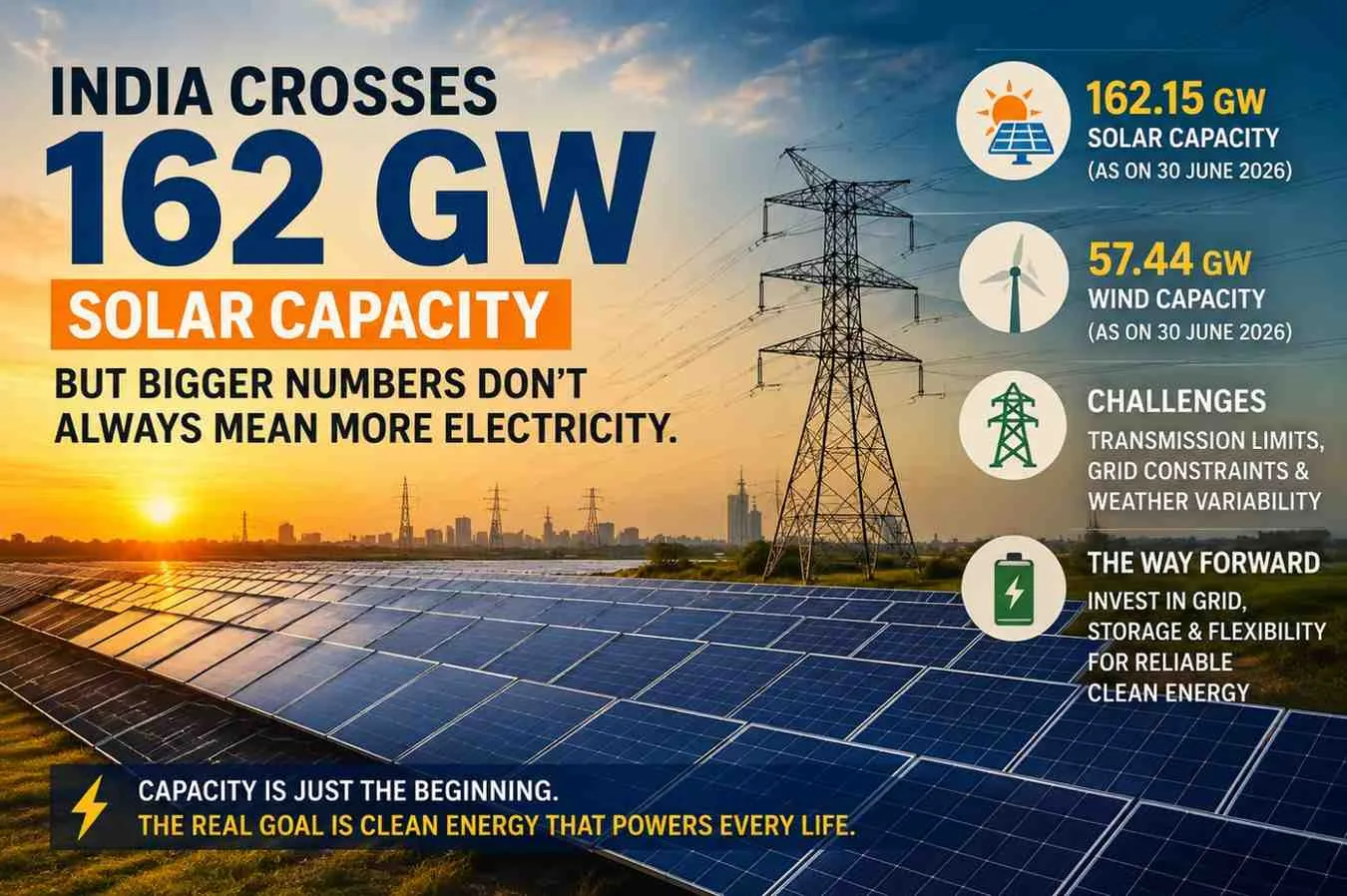
India’s renewable energy dashboard grows a little greener every month. In its latest achievement, it has reached another milestone. According to the latest physical progress update issued on 8th July by the Ministry of New and Renewable Energy (MNRE), India’s cumulative solar capacity has surged to 162.15 GW. Driven by the addition of over 5.1 GW in June alone. Wind Capacity currently stands at 57.44 GW. Highlighting Solar's progressive increase as the nation's fastest-growing source of renewable energy. At first glance, the remarkable advancement is the main focus of the picture. Yet beneath this huge milestone lies a very important question: Is the addition of renewable capacity directly proportional to the generation of more electricity? Not necessarily. The installed capacity simply measures the maximum amount of electricity produced by a power plant under ideal conditions. The real-world challenges are not accounted for. Power is generated by the Solar panels only when the sun is shining. Wind turbines depend on favourable weather. Both of which can face transmission constraints preventing the full absorption of the electricity generated. Installed CapacityElectricity GenerationIndicates the maximum power generation capability of a power plant under ideal conditions.Indicates the actual electricity produced and supplied over a period of time.Measured in MW or GW.Measured in MWh, GWh or Billion Units (BU).Represents infrastructure that has been built.Represents electricity actually delivered to consumers.Does not account for weather, maintenance, curtailment or transmission bottlenecks.Depends on sunshine, wind availability, grid capacity, storage, and electricity demand. The latest June figures unveil another clear trend. With the steady increase in solar, other renewable technologies struggle to keep up. Following this, Wind recorded decent additions, but other technologies such as biomass, small hydro, and waste-to-energy have seen little to no significant growth. Resulting in a renewable energy portfolio progressively driven by a single technology. The sector continues to gain momentum, especially as India works towards its goal of accomplishing 500 GW of non-fossil electricity capacity by 2030. Experts note that capacity additions alone cannot ensure a successful energy transition, even with the rapid expansion of solar capacity. To ensure reliable and efficient delivery of renewable electricity, the investments in transmission infrastructure, battery storage, and grid flexibility are no less critical. TechnologyAddition in June 2026 (MW)FY 2026–27 Addition (Apr–Jun) (MW)Installed Capacity (30 June 2026)Solar Power5,105.5611,891.30162,152.00 MW (162.15 GW)Wind Power636.351,348.5557,443.39 MW (57.44 GW)Biomass (Bagasse)0.000.009,821.32 MWBiomass (Non-Bagasse)0.000.001,048.84 MWWaste-to-Energy0.000.00324.24 MWWaste-to-Energy (Off-grid)0.001.04554.16 MWSmall Hydro Power2.4010.405,181.76 MWTotal RE (Excluding Large Hydro)5,744.3113,251.29236,524.72 MW Source: MNRE Physical Progress Report (as on 30 June 2026). The latest MNRE data reflects the fast mobility of the country towards a cleaner energy future. However, it highlights the next challenge: to ensure the transition of every newly installed megawatt into usable and dependable power for millions of people. At the end of the day, a gigawatt installed is only the beginning. The ultimate benchmark of success is the amount of clean electricity that powers everyday life. ...Read more
13 Jul 2026
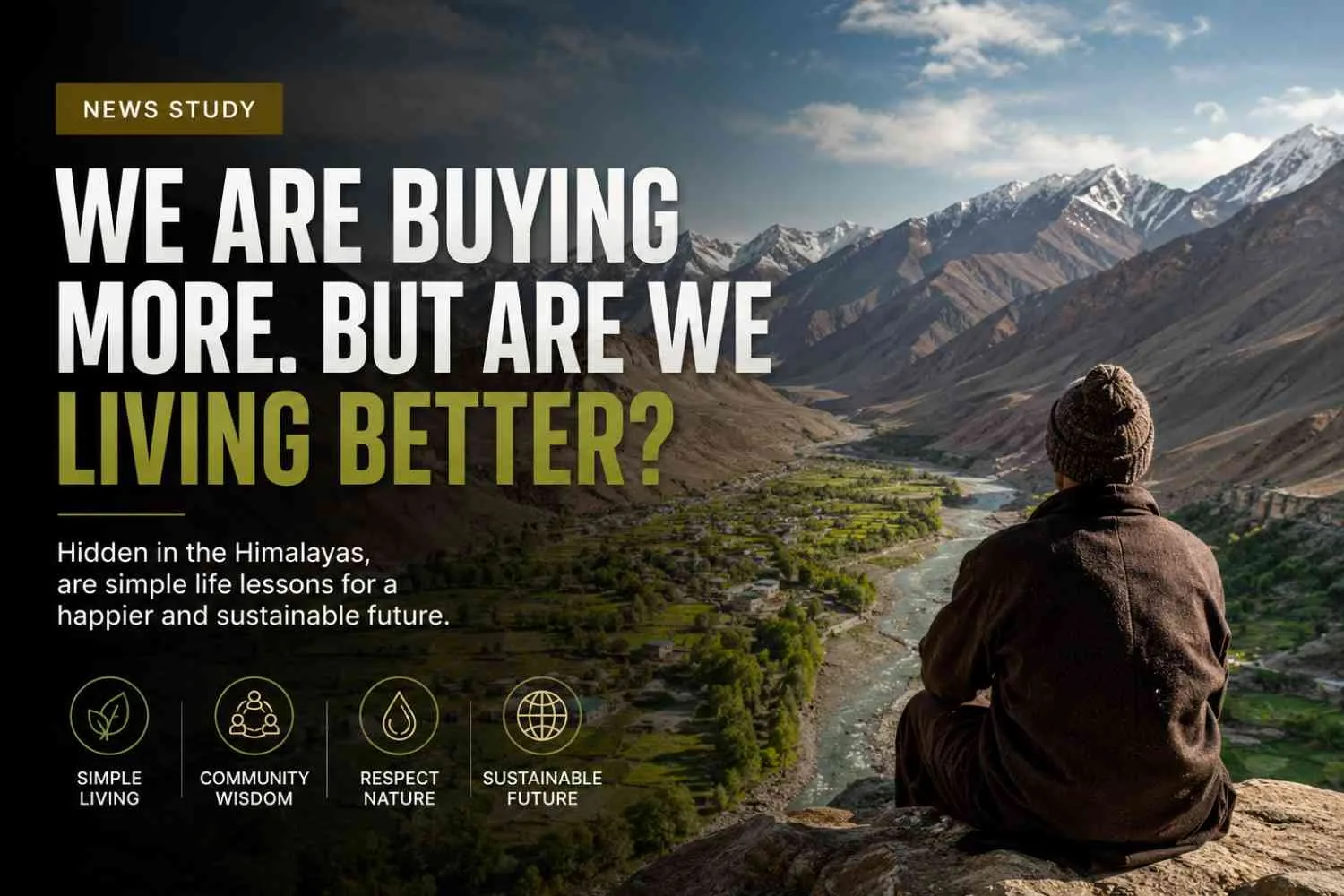
The Shopping Bags Are Full. Why Do Our Lives Feel Empty? We own more clothes than our parents did. We replace phones faster, order food more frequently, travel farther, renovate homes more often and buy things at the tap of a screen. Our homes are fuller. Our wardrobes are overflowing. Our digital carts are permanently active. Yet many of us are more anxious, more exhausted, more indebted, more distracted and more dissatisfied than ever before. That is the central contradiction of modern consumer life: we have become extraordinarily efficient at purchasing things, but not necessarily better at creating happiness. In India, this contradiction is visible everywhere. A middle-class family may have two cars but hardly enough time to sit together. A young professional may own an expensive smartphone, smartwatch, wireless earbuds and several paid subscriptions, yet struggle to sleep peacefully. A child may receive a roomful of toys but not an hour of undivided parental attention. A household may renovate its kitchen while increasingly depending on packaged food and instant delivery. We are surrounded by products designed to save time. Strangely, we appear to have less time than before. We buy fitness watches but walk less. We purchase storage boxes because we own too many things. We install larger televisions because family conversations are becoming shorter. We take photographs of every celebration but often fail to experience the celebration itself. So the question is no longer whether we are buying more. The evidence is in our cupboards, credit-card statements, delivery notifications and dustbins. The real question is: Are we living better? Consumption Has Quietly Become a Competition There was a time when buying something new marked a genuine need or an important occasion. A refrigerator, television, scooter or festive dress would be carefully chosen, maintained and used for years. Today, consumption is increasingly shaped not by need but by comparison. Someone in the housing society buys a larger car. A colleague upgrades to the newest phone. An influencer displays a “must-have” skin-care routine involving twelve products. A wedding on social media appears more elaborate than ours. A neighbour’s child attends a more expensive school. Another family takes an international holiday. Slowly, without realising it, we begin purchasing not for comfort but for status. The object becomes a message: “I am successful.” “I am modern.” “I have arrived.” But status is a race without a finishing line. The moment we acquire one symbol of success, another appears. The phone becomes outdated. The fashion changes. The car loses its shine. The holiday photographs stop receiving attention. Consumer culture survives by making satisfaction temporary. It repeatedly whispers: You are only one purchase away from becoming happier, more attractive, more respected or more complete. But completion never arrives. The Great Indian Sale Never Really Ends India’s traditional festivals once centred on community, gratitude, food, worship, storytelling and reunion. Consumption had a place, but it was not always the centre. Today, almost every festival is converted into a sales season. Diwali becomes an electronics sale. Dhanteras becomes an obligation to purchase. Valentine’s Day becomes a test of affection through gifts. Mother’s Day becomes a promotional campaign. Independence Day becomes a discount event. Even environmentally significant occasions are used to market new “sustainable” products. The sale countdown creates urgency. “Only two hours left.” “Last chance.” “Limited stock.” “Deal expires at midnight.” We buy quickly because the platform tells us we are saving money. But spending ₹3,000 on something we did not need is not saving ₹2,000. It is spending ₹3,000. The discount may be real. The necessity may not be. Easy credit makes the temptation stronger. Buy-now-pay-later schemes, credit cards and zero-cost instalments separate the pleasure of buying from the pain of paying. The product arrives today; the financial pressure follows for months. A home can therefore look prosperous while its occupants remain financially insecure. More Convenience, Less Connection Modern consumption promises convenience, and much of that convenience is genuinely useful. Digital payments, online medicine, home delivery and accessible transportation have improved millions of lives. The problem begins when convenience replaces participation. We stop walking to the market. We stop knowing the vegetable seller. We stop repairing appliances. We stop cooking together. We stop borrowing from neighbours. We stop visiting local shops. We stop waiting, planning and improvising. Every difficulty becomes something to outsource. Food arrives in disposable containers. Groceries arrive inside multiple layers of packaging. A forgotten ingredient is delivered by a motorbike in minutes. A minor inconvenience creates fuel consumption, plastic waste, traffic and another poorly paid worker racing against a countdown clock. Convenience saves us effort, but effort is not always the enemy. Walking, cooking, repairing, sharing and waiting can create health, competence, patience and relationships. When everything becomes instantly available, we may gain speed but lose resilience. The Wardrobe Is Full. There Is Still “Nothing to Wear” Fashion provides one of the clearest examples of the consumption trap. An Indian urban wardrobe may contain clothes purchased for weddings, office meetings, holidays, festivals, gym sessions and social-media photographs. Many garments are worn only once or twice. Some are forgotten with their price tags still attached. Yet before another wedding, the familiar sentence returns: “I have nothing to wear.” What it often means is: “I have nothing new to display.” The pressure is particularly intense around Indian weddings. Families spend beyond their means because every event must look distinct, every outfit must be photographed and every photograph must appear impressive. Clothes that could have been repeated, exchanged, altered or passed between relatives are rejected because repetition is treated as embarrassment. But repetition is not poverty. Using something well is intelligence. Repairing something is responsibility. Repeating an outfit is not a failure of imagination; it may be a declaration that our worth is greater than our wardrobe. We Upgraded the Phone. Did We Upgrade the Conversation? The smartphone is perhaps the defining object of contemporary Indian life. It connects migrant workers with families, enables education, supports businesses, facilitates banking and gives citizens access to information. But it also creates an endless marketplace inside our pockets. We are shown what to buy, where to eat, how to look, where to travel and what our homes should contain. Advertising no longer waits on a billboard. It follows us into bed. The phone is upgraded because its camera is better. Yet during dinner, everyone looks at a separate screen. We purchase high-speed data but have slower conversations. We collect hundreds of contacts but may not know whom to call during a crisis. We watch motivational videos about discipline at two in the morning and wake up too tired to practise any of it. Technology is not the villain. Unconscious use is. A device should remain a tool. When it begins determining our attention, desires, relationships and self-esteem, the owner and the object quietly exchange roles. The Hidden Price Is Paid by the Planet Every object has a biography. A cotton shirt requires land, water, labour, dyeing, transportation, packaging and retail infrastructure. A smartphone contains minerals extracted from the earth, components manufactured across countries and a battery that will eventually become hazardous waste. A delivered meal carries the environmental cost of ingredients, refrigeration, cooking, transport and packaging. The price printed on the product is therefore incomplete. It rarely includes the polluted river, depleted soil, exploited worker, discarded plastic or carbon emitted during production and delivery. The environmental burden is also unequal. Those who consume least often suffer first from polluted air, rising temperatures, floods, water shortages and waste dumping. A low-income settlement beside a landfill pays for the disposable habits of neighbourhoods far wealthier than itself. Mindless consumption is therefore not merely a personal weakness. It is an ecological and social issue. A Better Life Is Not a Smaller Dream Living better does not require everyone to abandon cities, reject technology or move to a Himalayan village. Nor does sustainability mean living joylessly. It means replacing excess with sufficiency, impulse with intention and display with genuine value. The goal is not to stop buying. The goal is to stop expecting purchases to perform the work of relationships, health, purpose, community and self-respect. A better life may contain fewer objects but more experiences. Less comparison but more confidence. Less speed but more presence. Less waste but more gratitude. The transition can begin through twelve simple steps. 1. Pause Before Every Non-Essential Purchase Create a waiting period. For inexpensive items, wait twenty-four hours. For clothes, gadgets, furniture or luxury products, wait a week. Ask three questions: Do I genuinely need it? Do I already own something that serves the same purpose? Would I still buy it without the discount, advertisement or social pressure? Many desires disappear when urgency is removed. 2. Count What You Already Own Before buying another shirt, cup, bedsheet, kitchen appliance or cosmetic product, inspect what is already at home. An occasional household inventory can be startling. Five water bottles. Seven nearly identical shirts. Unopened toiletries. Duplicate chargers. Forgotten food packets. Books bought but never read. Visibility reduces unnecessary buying. We often purchase not because we have too little, but because we have lost track of how much we already possess. 3. Choose Durability Over Novelty The cheapest product is not always economical. A well-made pressure cooker used for fifteen years may be more affordable than three poor-quality replacements. A strong schoolbag can serve more than one child. A repairable wooden table may outlive several pieces of disposable furniture. Before buying, examine quality, warranty, repairability and expected lifespan. Purchase fewer things, but choose things worthy of long use. 4. Repair Before You Replace India once had a powerful repair culture: tailors altered clothes, cobblers restored shoes, technicians repaired radios, and neighbourhood mechanics kept appliances alive. That culture is disappearing under the pressure of cheap replacement. Bring it back. Stitch the torn kurta. Replace the phone battery. Polish the furniture. Repair the mixer. Resole the shoes. Repair saves money, supports local skills and prevents useful materials from entering landfills. 5. Borrow, Rent and Share Not everything needs private ownership. A drill machine may be used for ten minutes a year. Party decorations may be required once. Books, luggage, ladders, tools, children’s costumes and specialised kitchen equipment can often be borrowed or rented. Housing societies can create shared libraries of tools and reusable event materials. Extended Indian families practised this naturally for generations. Sharing was not seen as deprivation. It was a form of trust. 6. Repeat Clothes Without Apology Wear the same sari, kurta, jacket or formal suit again. Restyle it. Exchange garments within the family. Alter older clothing. Support handloom, durable fabrics and locally produced garments when practical. Most importantly, refuse the idea that every photographed occasion requires a new outfit. People who judge human worth by clothing repetition are revealing the poverty of their own imagination. 7. Reclaim Food from Convenience Cook more frequently, even when the meal is simple. Dal, rice, vegetables, roti, khichdi, poha, idli or seasonal fruit may offer more nourishment and produce less packaging than repeated restaurant orders. Plan portions. Store leftovers safely. Share excess food. Buy seasonal produce from nearby markets. Carry water and snacks when travelling. Food should nourish bodies and relationships—not routinely become waste inside refrigerators and dustbins. 8. Protect Attention from Advertising Unfollow accounts that constantly provoke comparison. Disable unnecessary shopping notifications. Remove stored card details from retail apps. Avoid browsing online marketplaces when bored. Create screen-free periods, particularly during meals and before sleep. Attention is a limited resource. Every platform competing for it is also competing to shape desire. A person who cannot protect attention will struggle to protect money, time or peace. 9. Spend on Experiences That Deepen Life Redirect some money from objects towards experiences. Take parents on a short journey. Learn music. Attend theatre. Join a nature walk. Visit a museum. Cook with children. Support a local craft workshop. Plant a community garden. Experiences are not automatically sustainable, but meaningful experiences often enrich life without permanently filling cupboards. The best memories rarely require storage space. 10. Redefine What Success Looks Like A larger car is not success if its loan creates constant anxiety. A luxury home is not success if family members barely meet. An expensive school is not success if the child feels unseen. A prestigious job is not success if it destroys health and dignity. Define success through freedom from unmanageable debt, time for loved ones, physical well-being, purposeful work, community respect and the ability to sleep peacefully. What we measure determines what we pursue. 11. Make Sustainability Social Individual discipline matters, but community action multiplies it. Start waste segregation in the housing society. Organise a clothes-exchange day. Create a shared bookshelf. Compost kitchen waste. Encourage residents to reduce single-use decorations during festivals. Support local vendors. Arrange repair camps and neighbourhood clean-ups. Sustainability becomes easier when it is normal, visible and collective. The strongest Indian traditions were built around community. Our environmental future may depend on recovering that strength. 12. Practise Enoughness Enoughness is not laziness or lack of ambition. It is the wisdom to recognise when a need has been met. Enough food. Enough clothing. Enough space. Enough celebration. Enough status. Without a sense of enough, every achievement becomes inadequate. Income rises, but desire rises faster. The house becomes larger, but peace remains outside. Gratitude interrupts this cycle. It reminds us that a good life is not created only by adding. Sometimes, it is created by removing noise, debt, clutter, comparison and unnecessary obligation. The Revolution Can Begin Inside a Shopping Cart India does not need a future in which millions of people remain deprived. People deserve secure homes, nutritious food, healthcare, education, mobility, technology and dignified opportunities. The argument against overconsumption must never become an argument against development. But development should improve human life—not merely increase the movement of products. The affluent and aspiring classes must therefore ask a difficult question: are we purchasing comfort, or are we purchasing symbols to compensate for exhaustion and insecurity? The answer will not always be comfortable. We may discover that the next phone will not repair a neglected relationship. The next holiday will not permanently cure burnout. The next outfit will not create self-worth. The next delivery will not give us more time unless we consciously decide how that saved time will be used. Living better requires more than buying differently. It requires wanting differently. Buy Less. Choose Well. Live Fully. The most sustainable product is often the one we do not buy. The most valuable possession may be time. The greatest luxury may be an unhurried meal. The best upgrade may be better health. The richest home may be the one filled not with objects, but with conversation, laughter, security and belonging. We are buying more than any generation before us could have imagined. But living better is not an automatic consequence of purchasing power. It is a conscious practice. A daily decision. A refusal to confuse price with value, convenience with happiness, abundance with fulfilment or visibility with success. The shopping bag may be full. The wardrobe may be full. The house may be full. The question is whether life itself feels full. That answer cannot be delivered in ten minutes. It cannot be purchased during a festive sale. It must be created—slowly, thoughtfully and together. ...Read more
13 Jul 2026
DO NOT LET THE ENGINEER OF HOPE BECOME A MARTYR An article and an appeal by Prof Ujjwal K Chowdhury The man who made ice stand upright is now placing his own body between India’s young people and a system that has failed them. As Sonam Wangchuk’s hunger strike enters its sixteenth day, the Republic must choose dialogue before obituary. UPDATED 13 JULY 2026 THIS IS NO LONGER A CONTEST OF ENDURANCE. IT IS A TEST OF DEMOCRATIC RESPONSIVENESS. A BODY BECOMES THE LAST PETITION At Jantar Mantar, in the hard heat and noise of New Delhi, Sonam Wangchuk’s shrinking body has become an expanding question for India: how much must a citizen suffer before power considers listening a democratic duty? On 13 July 2026, his indefinite hunger strike entered its sixteenth day. Wangchuk began the water-only fast on 28 June in solidarity with the youth-led Cockroach Janta Party protest over the NEET-UG paper leak, wider examination irregularities and the demand for accountability at the highest levels of the Union education establishment. He has also carried into the protest Ladakh’s unresolved demand for constitutional, ecological and democratic safeguards. The latest publicly reported medical figures, from the fifteenth day, were grave enough without exaggeration: a loss of about 7.8 kilograms and blood pressure recorded at 104/66 mm Hg. He was visibly weak. Yet he continued to speak with an almost disarming absence of self-dramatisation. A day earlier, rejecting comparisons with Mahatma Gandhi, he asked citizens not to wait for saviours but to “be your own hero.” That sentence changes the meaning of the fast. Wangchuk is not asking India merely to watch a heroic man suffer. He is asking citizens to recover their own agency. Still, no society can hide behind the striker’s courage. Prolonged fasting can lead to arrhythmia, organ injury, cognitive impairment and death. This is no longer a contest of endurance. It is a race between democratic responsiveness and physical collapse. “A sensitive government in a democracy listens to the pains of the people.”— Sonam Wangchuk, speaking to Reuters, 30 June 2026 THE CRISIS IN NUMBERS INDICATORFACT / CONTEXTDay of fast16th day on 13 July 2026; the water-only fast began on 28 June.Latest reported health dataAbout 7.8 kg weight loss and blood pressure of 104/66 mm Hg on Day 15. These are reported figures, not an independent clinical diagnosis.Scale of NEET impactApproximately 2.3 million candidates were affected by cancellation and retesting after the 2026 paper-leak scandal.Human tollThe Indian Express documented at least 12 deaths by suicide in 37 days before the retest; the Financial Times later reported at least 20 around the crisis. Individual causation requires careful verification.Core public questionWho accepts responsibility when an examination system affecting millions is compromised? Suicide figures are reported counts around the examination crisis; each case requires individual, sensitive verification. WHEN MERIT IS MADE MEANINGLESS The immediate cause of this fast is not a technical dispute about how an examination was administered. It is the collapse of trust in one of the few institutions through which young Indians are told that effort can overcome birth, geography and poverty. More than 2.3 million candidates were affected when the original NEET-UG 2026 examination was cancelled after the paper-leak scandal and a retest was ordered. Behind that number were families that had spent years paying for coaching, travel, rent, books and application fees; students who had organised adolescence around a single date; and parents who had converted savings, jewellery or debt into hope. A leaked paper does not merely compromise an answer key. It steals time from the honest and sells advantage to the connected. The human cost has been reported in devastating terms. The Indian Express documented at least 12 deaths by suicide in the 37 days between cancellation and the retest; the Financial Times later reported at least 20 student suicides around the examination crisis. Every case has its own circumstances, and no death should be reduced to a slogan or assigned a single cause without careful investigation. But the scale of distress is undeniable. It demands a response rooted in compassion, evidence and institutional responsibility—not statistical evasion. This is the principle at the heart of Wangchuk’s intervention: when a public examination affecting millions fails, accountability cannot end with a press release, a retest and promises of tighter security. It must establish how the breach occurred, who benefited, who failed in oversight, what compensation and counselling are owed to candidates, and what changes will prevent repetition. Otherwise, the state asks young people to trust a system that has offered them no reason to do so. AN EXAMINATION LEAK IS NOT A CLERICAL ERROR. IT IS THEFT FROM MILLIONS OF YOUNG LIVES. HE NEVER CALLED A CHILD A FAILURE Wangchuk’s presence gives this protest unusual moral force because education is not a theme he discovered for political convenience. It is the work of his life. A mechanical engineer by training, he co-founded the Students’ Educational and Cultural Movement of Ladakh—SECMOL—in 1988. Its founding insight was revolutionary because it was humane: perhaps Ladakhi children were not failing education; perhaps an alienating education system was failing them. Students were often taught through languages, examples and methods disconnected from the mountains, livelihoods and culture around them. Wangchuk helped replace this estrangement with learning rooted in local reality. At SECMOL, a young person could learn solar energy by running a solar-powered campus, management by helping administer it, agriculture by cultivating difficult land, and citizenship by accepting responsibility for a community. The purpose was not to romanticise poor academic performance, but to rebuild confidence and demonstrate that intelligence is wider than memory under examination pressure. His work also contributed to Operation New Hope, a collaboration among communities, civil society and public institutions to reform government schooling in Ladakh. The Ramon Magsaysay Award Foundation honoured him in 2018 for a systematic, collaborative and community-driven transformation of learning systems. The recognition mattered because Wangchuk had not created an elite island for exceptional children. He had helped redesign the relationship between school, society and the child. That history explains why he cannot treat the examination scandal as an administrative inconvenience. To Wangchuk, education is not a sorting machine that discards the many to reward the few. It is a public trust. When that trust is corrupted, the injury is moral before it is procedural. A LIFE OF PRACTICAL IDEALISM INDICATORFACT / CONTEXTEducation reformCo-founded SECMOL in 1988 and helped build culturally rooted, experiential learning for Ladakhi youth.School-system changeContributed to Operation New Hope, linking communities, civil society and government institutions in Ladakh’s education reform.Climate adaptationDeveloped and promoted Ice Stupas to store winter water for spring irrigation.Sustainable architectureDemonstrated passive-solar, earth-based construction suited to extreme Himalayan conditions.Institution buildingCo-founded the Himalayan Institute of Alternatives, Ladakh, centred on learning through real-world problem-solving.RecognitionRolex Award for Enterprise (2016) and Ramon Magsaysay Award (2018), among other honours. HE MADE ICE STAND UPRIGHT Wangchuk’s best-known invention began with a paradox. Ladakh has abundant frozen water in winter, but farmers need irrigation in spring, before natural glaciers begin to melt sufficiently. His answer was the Ice Stupa: winter stream water channelled through pipes and sprayed into sub-zero air, where it freezes into a tall conical mass. The geometry is the genius. A cone stores a large volume while exposing relatively little surface area to the sun, allowing the ice to melt slowly into the planting season. No grand dam is required, and gravity can do much of the work. The innovation earned Wangchuk the Rolex Award for Enterprise in 2016 and became an internationally recognised model of locally rooted climate adaptation. He has applied the same ethic to passive-solar buildings, earth construction and high-altitude education: begin with the lived problem, respect the ecology, use science intelligently and ensure that the community can operate the solution. His inventions do not arrive from outside demanding that the mountains adjust. They grow from the mountains’ own conditions. There is a painful symmetry in the present moment. The man who taught India how to preserve winter water for the season of need is now consuming his own physical reserves because the institutions meant to preserve public trust appear unwilling to act in time. NOT A FILM CHARACTER—A WORKING METHOD Popular culture introduced millions to Wangchuk through the widespread description of Phunsukh Wangdu, Aamir Khan’s unconventional inventor in 3 Idiots, as partly inspired by him. The comparison made his ideas accessible: curiosity over rote learning, invention over credentialism, usefulness over status. But cinema can also shrink a life into a charming eccentricity. The real Wangchuk has spent decades doing what a film resolves in three hours—building institutions, negotiating with governments, raising resources, making mistakes, testing prototypes, confronting entrenched systems and returning to work the next morning. His importance lies not in being a ‘real-life Wangdu’. It lies in offering a repeatable civic method: understand deeply, simplify intelligently, build collectively and accept responsibility for consequences. That method now indicts the state. A government that celebrates innovation in speeches cannot remain indifferent when one of the country’s most credible innovators says that the architecture of accountability is broken. “Do not wait for a hero. Be your own hero.”— Sonam Wangchuk’s appeal from the protest, 11 July 2026 THE MOUNTAIN IS NOT A POSTCARD The fast is also inseparable from Ladakh. Since the reorganisation of Jammu and Kashmir in 2019, Ladakhi organisations have demanded statehood, constitutional protection under the Sixth Schedule, safeguards for land and employment, and meaningful local authority over development. For Wangchuk, these are not abstract constitutional clauses. They determine who decides the future of a fragile cold desert: its residents, or distant institutions and commercial interests. Ladakh faces glacier retreat, water insecurity, unregulated tourism, infrastructure pressure and the possibility of large projects being imposed without sufficient ecological limits or local consent. A region celebrated as a strategic frontier and tourist paradise can still be denied an adequate democratic voice. Wangchuk undertook a 21-day climate fast in 2024 and helped lead a march towards Delhi. In September 2025, after protests in Leh turned violent and four civilians were killed, the authorities accused him of contributing to unrest through provocative statements. He denied inciting violence and appealed for peace. He was detained under the National Security Act on 26 September and remained imprisoned for roughly 170 days before the Union government revoked the detention in March 2026. Accuracy matters here. Wangchuk was detained under a preventive-detention law; he was not convicted of treason. One may debate his politics, the government’s allegations or the tactics of the movement. But disagreement does not erase the central democratic question: can a border region seek constitutional and environmental safeguards without its most recognisable voice being treated principally as a security problem? SILENCE IS ALSO A DECISION As the fast moves into its third week, the most disturbing fact is not simply Wangchuk’s medical decline. It is the absence, so far, of a publicly reported formal negotiation capable of producing an honourable resolution. Dialogue is sometimes misrepresented as capitulation. In a democracy it is often the opposite: an assertion that institutions are strong enough to hear criticism, test allegations and correct failure. A minister need not accept every accusation in order to meet protesters. A government need not concede every demand in order to establish an independent inquiry, publish a timeline, offer student relief and open structured talks. The state has greater power, greater information and greater capacity than a citizen on a mattress. That asymmetry creates a greater duty of care. To wait for the body to fail is not neutrality. Delay itself becomes policy. ANNA HAZARE: THE LESSON IS NEGOTIATION, NOT NOSTALGIA The memory of Anna Hazare’s 2011 anti-corruption fast inevitably hangs over Jantar Mantar, but the comparison must be made accurately. Hazare began an indefinite fast on 5 April 2011; the Union government constituted a joint drafting committee on 8 April, and he ended the fast on 9 April. His larger August agitation lasted 12 days and ended after Parliament expressed agreement in principle on key demands. The Lokpal and Lokayuktas Act was eventually passed in 2013—not instantly at the protest site. The relevant lesson is not that every hunger strike should dictate legislation. It is that government engagement can begin before a citizen’s health reaches an irreversible threshold. Negotiation does not make elected authority weak; it demonstrates that authority understands its constitutional purpose. Wangchuk’s sixteenth day therefore carries a stark question. If the state could open talks with a fasting anti-corruption campaigner in 2011, why can it not establish a credible channel with an educator and environmentalist in 2026—especially when millions of students have already borne the cost of an acknowledged examination breakdown? DIALOGUE DOES NOT DIMINISH ELECTED AUTHORITY. IT REVEALS WHETHER AUTHORITY REMEMBERS ITS PURPOSE. IF HE DIES, INDIA DOES NOT WIN No responsible article should romanticise Wangchuk’s death. Martyrdom is not a policy outcome, and a funeral is not institutional reform. Yet refusing to consider the consequences would be equally irresponsible. First, an examination controversy would become a moral crisis of the Republic. The defining question would no longer be only who leaked a paper, but why meaningful engagement did not begin while a nationally respected citizen’s health deteriorated in public view. Second, scattered youth anger could acquire a unifying symbol. Paper leaks, unemployment, delayed recruitment, expensive coaching and arbitrary evaluation cross state, caste, class and language. Wangchuk’s death could connect these grievances into a wider consciousness of generational injustice. Peaceful frustration may then harden into a belief that institutions respond only after catastrophe. Third, Ladakh’s constitutional movement would be transformed. A demand often treated as remote would be carried everywhere by the image of a Ladakhi educator dying in the national capital. The loss of a bridge-builder can empower voices less patient with dialogue. For a sensitive border region, alienation is not an abstract political cost. Fourth, India’s international standing would suffer. Wangchuk is globally recognised for climate adaptation and educational reform. His preventable death during a non-violent protest would be cited in debates about democratic dissent, environmental justice and the treatment of civil-society actors. Finally, the country could commit its most familiar act of evasion: mourn the man while abandoning the work. Institutions might be named after him, quotations circulated and statues proposed, while examination governance remained opaque and Ladakh’s safeguards unresolved. India has often found it easier to garland a photograph than to complete an unfinished agenda. THE COUNTRY MUST CHOOSE NEGOTIATION BEFORE OBITUARY. SAVE THE MAN—AND REPAIR THE SYSTEM The answer cannot be merely to plead with Wangchuk to eat while leaving untouched the conditions that led him to fast. Nor should supporters value the symbolic power of his suffering above his life. Both the humanitarian emergency and the institutional demands must be addressed together. The government should immediately appoint a senior, empowered interlocutor; open a recorded and time-bound dialogue with Wangchuk, student representatives and Ladakhi leaders; commission an independent investigation into the examination breach and associated administrative failures; publish a transparent reform schedule; and create psychological, academic and financial support for affected candidates and bereaved families. It should also resume credible constitutional discussions on Ladakh with ecological safeguards and local consent at the centre. At the protest site, independent medical monitoring must be protected, clinical information communicated responsibly, and every route explored for a negotiated withdrawal that preserves Wangchuk’s dignity. Saving a life is not a political favour. It is the minimum duty of a state confronted with foreseeable harm. Wangchuk has spent nearly four decades showing that apparently impossible problems can be redesigned. A student branded a failure can become a leader. Winter water can irrigate spring fields. Mud, sunlight and intelligence can keep a building warm at Himalayan temperatures. A marginal region can generate ideas for the world. The problem before India is simpler than any of those: can power cross a few kilometres in Delhi and speak to a citizen before his body is broken? The nation does not need another photograph draped in marigolds. It needs Sonam Wangchuk alive—in a classroom, on a mountain, beside an ice stupa, arguing, inventing and reminding us that public life can still be useful. The highest tribute is not to prepare an obituary. It is to create the conditions in which he can eat again. The mountains are watching. The young are waiting. The clock is not. WHAT RESPONSIBLE ACTION LOOKS LIKE A senior, empowered government interlocutor and a formal negotiation channel.An independent, time-bound inquiry into the leak, oversight failures and beneficiary networks.A published examination-security reform plan with institutional accountability.Counselling, academic relief and financial support for affected candidates and bereaved families.Renewed constitutional talks on Ladakh, with ecology, land, jobs and local consent at the centre.Independent medical monitoring and an honourable path for ending the fast. SOURCE NOTES AND FACT-CHECKING BASIS 1. Reuters, “India’s Cockroach party seeking education minister’s ouster awaits cabinet reshuffle,” 30 June 2026. 2. The Times of India, “Watch: Sonam Wangchuk looks visibly weak as hunger strike enters day 15th,” updated 12 July 2026. 3. India Today/PTI, “I am not Gandhi, be your own hero: Sonam Wangchuk urges citizens to join protest,” 11 July 2026. 4. The Indian Express, “Ahead of NEET-UG re-exam, 12 suicides in 37 days,” 20 June 2026. 5. Financial Times, “Why India’s education system gets poor marks from millions of students,” 13 July 2026. 6. Ramon Magsaysay Award Foundation, official citation for Sonam Wangchuk, 2018. 7. Rolex Awards for Enterprise, official project profile: Sonam Wangchuk and the Ice Stupa initiative, 2016. 8. Reuters, “Indian activist’s hunger strike for Ladakh autonomy draws thousands of supporters,” 23 March 2024. 9. Reuters, “Indian police arrest activist Wangchuk after deadly Ladakh protests,” 26 September 2025. 10. Press Information Bureau, Government of India, Finance Minister’s statement in Lok Sabha on the 2011 Lokpal movement, 27 August 2011; India Code, Lokpal and Lokayuktas Act, 2013. ...Read more

10 Jul 2026
An ordinary breakfast leftover sparked an extraordinary idea What happens to an eggshell after breakfast? Or a dry leaf after it falls from a tree? Most of us barely have time to care! We simply throw them away. Directly into the bin without a second thought. Then it moves to a landfill. Day after day, a huge pile of waste keeps on growing. But what if that same waste had an egg-cellent second chance? That's exactly what inspired one entrepreneur to look at things differently. Instead of seeing eggshells and fallen leaves as a source of garbage, she saw hope! Things that most of the people ignored became the cornerstone of something really useful. Something sustainable and something that could make a huge difference. The idea was simple. Why to do something, that might harm the environment when nature already has a backup plan? Keeping that in mind, everyday waste found a new purpose to serve. Eggshells, usually thrown away after meals, were collected and processed into durable, eco-friendly plates. Dry leaves, often swept aside and burned, were transformed into comfortable slippers. What once ended up in landfills are now becoming products that people could make use in every day’s life. The point is not just about making unique products. But addressing a much larger issue, i.e., Waste Management. India generates waste in huge amount, every year. A generous portion is either dumped in landfills or openly burned as debris, increasing pollution and creating pressure on the surrounding. Disposable plastics only make the situation go worse. Now more than ever we need more sustainable solutions. This initiative proves that solutions does not always require expensive technology. Sometimes, they just begin with a simple change in perspective. Looking at garbage not as a problem—but as a resource, to be reused. This process reduces waste, preserves natural resources, and encourages responsible consumption. The idea comes from a 27-year-old industrial designer, Midushi Kochhar from Delhi. During the COVID-19 pandemic, she wanted to turn everyday waste into something useful. In June 2021, she launched YLEM, a project that turns waste materials into useful & eco-friendly products. What started as a simple experiment soon became a bigger mission. Eggshells became durable plates. Fallen dry leaves that are turned into comfortable slippers. Midushi proved that a small change of idea—that can inspire people to rethink and reuse. The benefits extend beyond the environment. This initiative creates opportunities for local communities engaged in collecting, processing, and manufacturing these products. It promotes sustainable production while motivating consumers to make more responsible choices in their daily life. Today, more people are getting aware of the impact their choices have on the planet. They want products that are practical, affordable, and sustainably responsible. Initiatives like these prove that sustainability does not have to be complicated. It can begin with something as simple as an eggshell or a fallen leaf. The key takeaway is— Sometimes the smallest idea makes the biggest difference. The things we throw away without a second thought may still hold high value. All it needs is someone who is willing to notice them differently. Stories like this remind us that every small effort counts. One creative idea. One conscious choice. One product at a time. One second chance is all it takes to build a cleaner and greener future! Source- This news study is adapted from a feature published by The Better India, an independent digital platform known for its inspiring stories of sustainability, innovation, and social impact. The original report encourages responsible consumption and a sustainable future. ...Read more

08 Jul 2026
It's more than just a number on the weighing scale! A new study explains why Being overweight is often linked to diabetes and heart problems. But is that the whole story? NO! A new international study has raised fresh concerns. Researchers say excess body weight may result in much bigger health issues than people can actually realize. After reviewing 226 studies involving 1.5 million cancer cases, scientists found a worrying pattern. People with a higher Body Mass Index (BMI) are more likely to develop 19 types of cancer. It was published in the journal _Nature Metabolism_ on June 15, 2026. The study also linked obesity to bladder cancer, blood cancer, immune system cancer (non-Hodgkin lymphoma), and brain tumors. Why does this happen? Experts say excess body fat affects hormone levels. It can also cause long-term swelling and affect the normal body functions. These changes may help cancer cells grow with time. Researchers also found that the impact of obesity can differ from person to person. Some cancers are more common in women, while others are more common in men. It also varies across different regions of the world, suggesting that lifestyle, genetics and environment might play a role. For Example, the risk of bowel (colorectal) cancer was higher in men, while gallbladder cancer showed a stronger presence in women. This suggests that factors like gender, lifestyle, and body composition may influence the risk. Another key cause is different geographical regions. A study found that women in East Asia with a higher BMI faced nearly twice the risk of breast cancer after menopause compared to women in Europe. More studies are needed in regions of South Asia and Africa to better understand how obesity affects different populations. But the catch is - Obesity is Preventable! Eating Healthy. Staying active. Sleeping well. Also, doing health check-ups monthly lowers the risk. As obesity continues to rise, experts suggest small lifestyle changes today could make a huge difference tomorrow! This report is based on research, published in the peer-reviewed journal _Nature Metabolism_ and reported by Down to Earth, an Indian Magazine known for its storytelling technique of environment, health and science. ...Read more
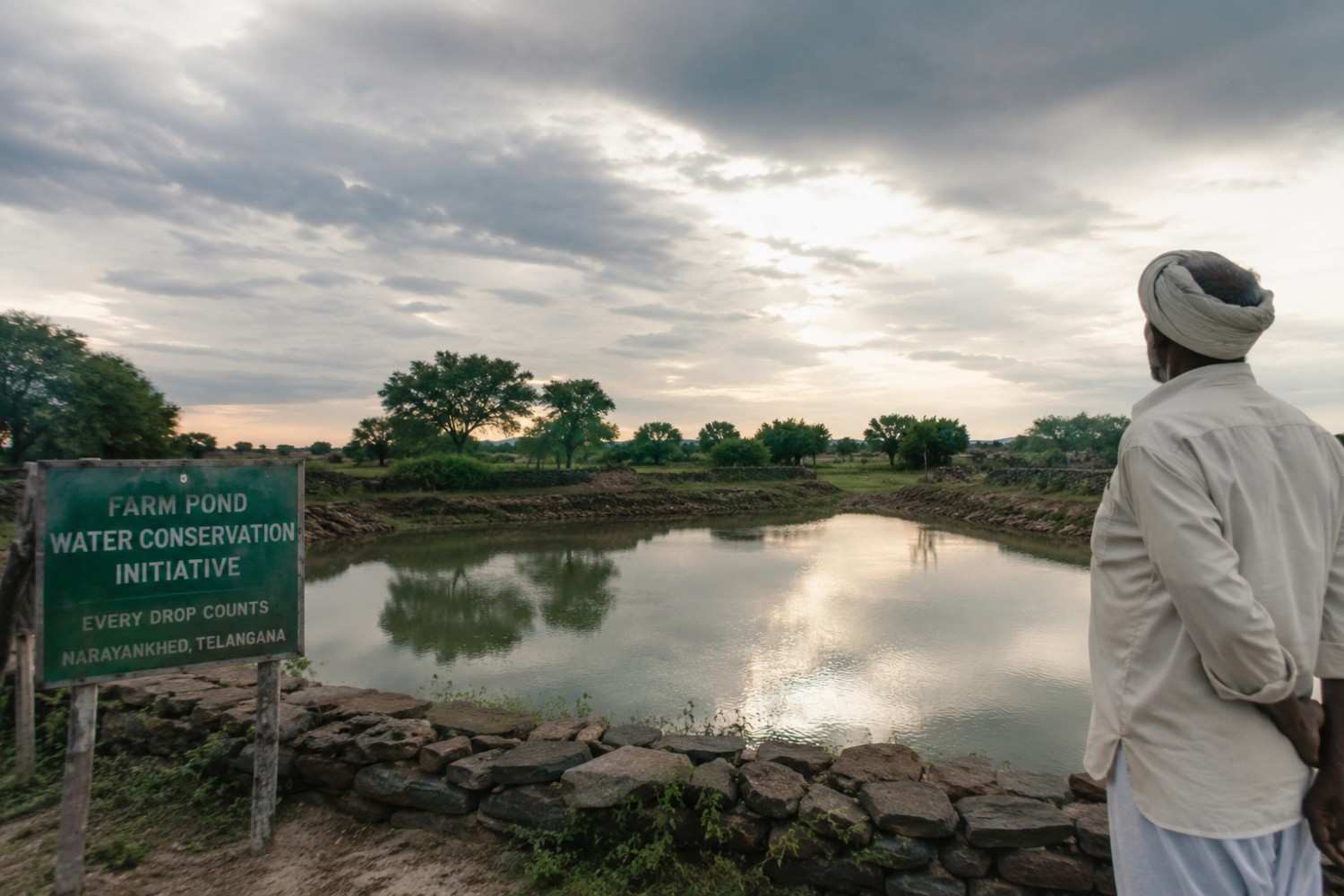
08 Jul 2026
An unexpected initiative is helping villages make every drop of rain count. How can a village receive rainfall every year and still struggle for water? It’s a question – many parts of India continue to face. Wells run dry. Crops suffer. And by the summer season, lack of water becomes a major reason to worry! This is a real-life story covering a small town - Narayankhed, Telangana. The problem wasn’t lack of rain. It was lack of water conservation. Most of the rainwater flowed away before it could reach the roots of the ground. Years passed, and this cycle continued. Farmers were aware of the problem. But addressing the problem wasn’t easy. Till someone showed up unexpectedly from an unexpected place as their ray of hope. Every Friday night, Dr P. Sudhakar Naik, an IRS officer posted in Mumbai, boarded a bus to Telangana. For seven consecutive weekends, he travelled about 600 kilometres to work with the villagers facing the crisis. Environmentalist Paladugu Gnaneshwar, along with the local officials and residents, came together with him and helped him build farm ponds, soak pits and stone barriers. Simple structures. Simpler Ideas. But ones that could preserve rainwater and stop it from being wasted. And the cost? JUST 2 LAKHS! The impact? Water that was nowhere to be seen now has a chance to stay. Groundwater levels are improving gradually. Farmers are becoming hopeful. And villages that suffered miserably due to lack of rain are now learning how to make every drop count. The story carries a larger and more impactful message. Water scarcity isn’t always caused by less rainfall. Sometimes, it’s about how we conserve the rain we already receive. SOURCE- This report is based on a real-life story published by The Better India, an independent digital media platform known for reporting grassroots innovations and addressing positive social changes across India. ...Read more
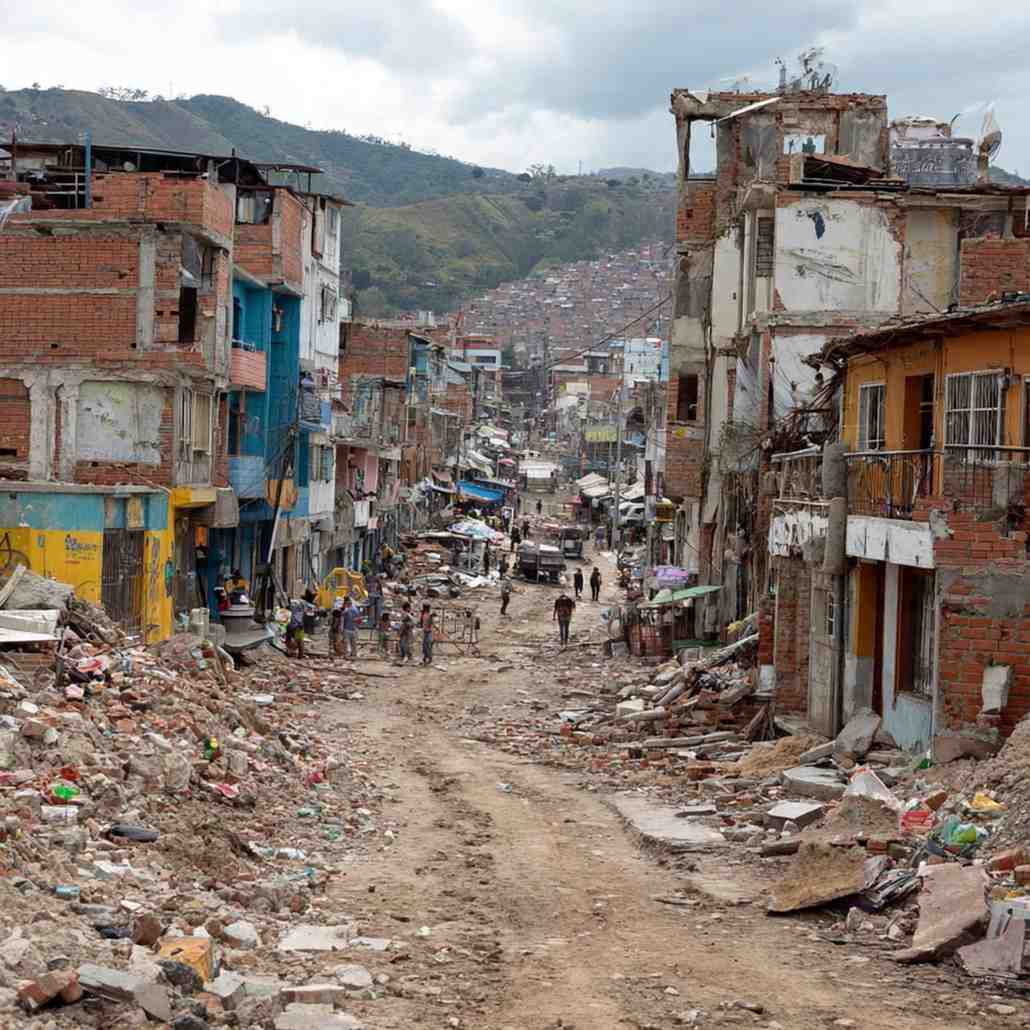
08 Jul 2026
In a matter of seconds, the ground beneath northern Venezuela turned violent. The country renowned for its immense natural wealth was taken down by a rare natural calamity – a doublet earthquake on 24th June 2026. Buildings cracked, families took to the street and rescuers tirelessly combed the rubble. In the calm after the chaos, a question lingered in the debris: Can we build houses that remain unshaken when the earth moves? Interestingly, in the highlands of India, the answer stands quietly for centuries. Surrounded by the mountains of Himachal Pradesh, stand homes that have seen generations come and go. Withstanding extreme weather conditions and multiple earthquakes and yet hasn’t budged at all. These houses follow a traditional construction technique – Kath Kuni architecture. Locally sourced deodar wood and stone. That’s it. The secret of this architecture lies in the alternating layered combination of just two of these natural materials. Ages ago, these homes were not only designed for providing shelter but to overcome the challenges of nature. The mountain communities had already cracked the code to earthquake resistant architecture much before it became a modern engineering goal. What exactly makes Kath Kuni architecture earthquake resistant? The simple and short answer is flexibility. The modern concrete structures crack easily under immense geological pressure because of their rigidity. In contrast to which Kath Kuni buildings are crafted to absorb and distribute earthquake shocks. The structures may sway gently during the tremors instead of resisting them. All thanks to the wooden beams which act as the natural shock absorbers. The stability of the structure is determined by stone layers whereas the structure is locked together with the help of the timber. Sudden structural failure decreases with this interlocking system. Hence making these Kath Kuni structures highly resilient during earthquakes. Simple idea but a huge impact! Kath Kuni is not only admired for its resilience but for the sustainable principles it followed centuries ago. The principles that modern construction are trying to embrace. Locally accessible materials are used to built the homes reducing the harmful emissions related to transportation. Indoor temperatures are regulated accordingly and naturally due to the thick stones. Warmer in winter and cooler during changing seasons. Since they rely on natural materials, the environmental footprint decreases a lot more than that of modern construction methods. Kath Kuni architecture is not just a historic monument. It is a beautiful example of how native knowledge, environmental responsibility and structural resilience can unite to create such buildings that go with the nature rather than going against it. Multiple questions arise after every natural disaster, which affect how societies prepare for the natural hazards. As technology is advancing, we are reminded how history has some of the most effective ideas standing strong till date. The disaster in Venezuela is not just a headline; it is a reality that highlights the importance of resilient infrastructure. There is a rapid increase in climate risks, urbanisation and the pressure of sustainability. With these on surge the future of architecture may be looked beyond concrete and steel. The latest might not be the strongest. Sometimes centuries-old architectural techniques of the Himalayan village remind us that resilience begins with understanding the land we build on. Sources The Better India – Kath Kuni: The Ancient Himalayan Architecture That Has Defied Earthquakes for Centurieshttps://thebetterindia.com/sustainability/kath-kuni-architecture-himachal-pradesh-earthquake-resistant-sustainable-12030396ResearchGate – Prathaa: Kath-khuni Architecture of Himachal Pradeshhttps://www.researchgate.net/publication/236014050_Prathaa_Kath-khuni_Architecture_of_Himachal_PradeshBBC Travel – Kath Kuni: The Himalayas' Ancient Earthquake-Defying Designhttps://www.bbc.com/travel/article/20220825-kath-kuni-the-himalayas-ancient-earthquake-defying-designSahapedia – The Himalayan Vernacular: Kath Khuni Architecturehttps://www.sahapedia.org/the-himalayan-vernacular-kath-khuni-architecture ...Read more