Total Articles 231+

Economic Complexity & Sustainability Transitions

Explores how diverse and advanced economies adapt and evolve toward sustainable and low-carbon systems.

Showing 9

24 Sep 2026

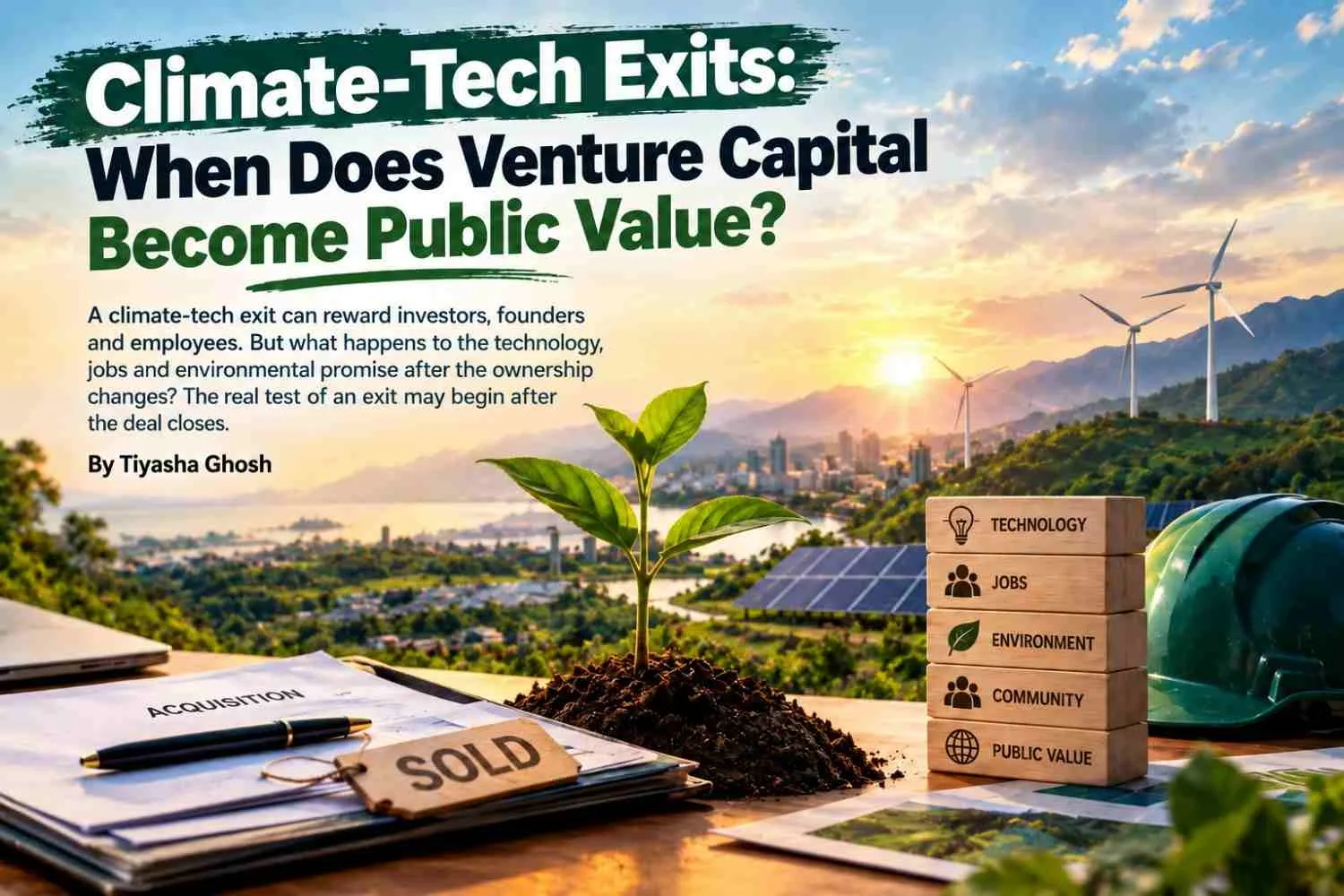
September 24, 2026 | Kolkata A climate-tech exit can reward investors, founders and employees. But what happens to the technology, jobs and environmental promise after the ownership changes? The real test of an exit may begin after the deal closes. SummaryIndia's climate-tech sector is attracting increasingly large pools of capital, but the money is becoming concentrated in fewer, more mature companies. Tracxn data reported in June 2026 showed that Indian climate-tech startups had raised about $12.8 billion across 1,583 startups over 17 years, while the first five months of 2026 alone saw $791 million across 74 funding rounds. Yet $524 million of that 2026 funding went into just five late-stage deals, while 44 seed-stage rounds together raised only $61 million. That makes exits important. A successful acquisition or secondary sale can return capital and create a pathway for new investment. But a deal can also transfer intellectual property, change product priorities, reduce jobs, alter customer access or leave publicly supported technology underused. A shutdown can be even more revealing: the financial investment may disappear while the climate problem remains. The question, therefore, is not simply whether investors made money. It is whether the climate solution continued to create public value after the term sheet changed hands. What Does a Climate-Tech Exit Really Mean? For venture capital, an exit is typically the point at which an investment becomes liquid. A fund invests in a company, the company grows, and eventually another investor, a strategic buyer or the public market provides a route for the original investor to sell its stake and realise returns. That, in itself, is not a problem. In fact, exits are an essential part of a functioning investment ecosystem. If investors cannot eventually return capital to their limited partners, they have less incentive to keep backing young companies that carry high levels of risk. This matters even more in climate technology, where the path from innovation to commercial viability can be long and expensive. A climate-tech company may spend years developing batteries, carbon-removal systems, energy-efficiency solutions, waste-management platforms, sustainable materials or agricultural technologies before generating reliable revenue. Unlike conventional software businesses, many of these technologies require significant research, physical infrastructure, testing and deployment before they can reach scale. India’s current funding pattern shows why the exit question matters. The country has attracted $12.8 billion in climate-tech funding across 1,583 startups, according to Tracxn data reported in June 2026. But between January and May 2026, just $791 million was raised across 74 funding rounds. Late-stage companies accounted for $524 million across only five deals, while 44 seed-stage rounds together raised just $61 million. The figures point to a clear tension: capital is available, but access to it is becoming increasingly concentrated as companies move through the startup lifecycle. Against this backdrop, a successful exit can reasonably be seen by investors as evidence that climate technology is becoming commercially investable. It can return capital to early investors, bring new money into the company and potentially create the conditions for further investment in the sector. But financial success is only one measure of an exit. The harder public-interest question begins after the deal closes: What happens to the climate solution once the investor leaves? Can Exits Keep Climate Capital Moving? There is a strong argument that they can. For the climate-tech ecosystem, a successful exit can do more than reward an early investor. It can create a pathway for capital to move from one generation of companies to the next. Consider Battery Smart. Green Frontier Capital invested in the EV battery-swapping company at an early stage and exited during its $65-million Series B in 2024. The round included both primary and secondary capital and was led by LeapFrog Investments. Inc42 reported that Green Frontier achieved roughly an 18x return, while Orios Venture Partners also made a partial exit. For an early-stage fund, this is essentially how the venture-capital cycle is designed to work. An investor takes on the risk at an early stage, the company grows, a growth-stage investor enters, and the original investor eventually gets liquidity. The company, meanwhile, gains access to new capital that can support its next phase of expansion. The returns generated by the early investment can then be deployed into another young company. Green Frontier Capital has itself described the Battery Smart exit as part of its broader climate-investment strategy, while its investment activity in 2026 indicates that it continues to back Indian climate businesses. This represents the more optimistic version of the exit story. An exit does not necessarily have to mark the end of a climate investment. It can act as a capital-recycling mechanism, allowing money, experience and confidence to move back into the sector. That recycling can have wider effects. Successful exits can strengthen investor confidence, make more capital available to emerging companies, give experienced founders and employees the financial resources to support or build new ventures, and make strategic buyers more willing to acquire climate technologies. Over time, they can also provide evidence that businesses addressing environmental problems can become commercially viable. Climate Policy Initiative’s work highlights the importance of financial instruments that help climate technologies cross difficult stages of development and reach commercialisation. Its Clean Economy Fund, for example, was designed around first-of-a-kind climate technologies and the financing gap faced by companies seeking roughly $1 million to $10 million at the early-growth stage. Under this interpretation, a successful exit can create public value indirectly. The investor receives a return, the company receives fresh capital, and the broader ecosystem potentially gains another source of funding for future climate solutions. But there is an important condition. Capital recycling only creates a stronger climate-tech ecosystem if the capital, expertise and opportunity actually get recycled. When Ownership Changes, Does the Climate Mission Change Too? This is where the standard exit narrative becomes incomplete. A strategic acquisition is not simply a financial transaction; it can also change who owns the technology, who controls the product roadmap, where the intellectual property sits, which customers are prioritised and whether a previously climate-focused product remains strategically important. Take Scorpius Trackers. In February 2025, Gensol Engineering said it had agreed to sell its US subsidiary, Scorpius Trackers, for ₹350 crore to a US renewable-energy company. The transaction included exclusive global intellectual property rights, except in India. Financially, the transaction can be viewed as an asset monetisation and a strategic move. But from an accountability perspective, the more important questions begin after the sale: Does the technology continue to be developed and deployed? What happens to the employees and customers who depend on it? And does the new ownership expand access to the solution or simply consolidate its intellectual property? The answers matter because an acquisition cannot be measured only by its price or the returns it generates. Whether the technology continues to deliver its intended climate impact is what determines whether the transaction creates value beyond the shareholders. What Does Regulation Protect When Climate-Tech Changes Hands? India already has regulatory frameworks governing certain acquisitions and mergers, but these frameworks do not necessarily address whether a climate-focused technology continues to deliver its intended environmental purpose after ownership changes. The Competition Commission of India (CCI) requires qualifying combinations to be notified before they are completed, subject to applicable thresholds and exemptions. Its framework covers acquisitions of control, shares, voting rights and assets, and allows the Commission to modify or prohibit transactions that are likely to cause an appreciable adverse effect on competition. For listed companies, SEBI’s takeover regulations also govern matters related to acquisitions and disclosures. But these mechanisms address questions that are different from the climate-tech accountability question. Competition law focuses on whether a transaction could harm competition. Securities regulation focuses on disclosure and investor protection. Corporate law deals with whether a transaction has been legally structured and approved. The climate-tech question is different: Will the technology continue to deliver what it was developed to deliver? That question becomes particularly relevant because climate technologies often receive public support before they become commercially mature. The Department of Science and Technology’s NIDHI-PRAYAS programme, for instance, supports innovators in converting ideas into prototypes and commercial products, with grants of up to ₹10 lakh. Other public innovation programmes similarly connect government support with technology development and commercialisation. In some government-supported R&D programmes, the conditions go further. MeitY funding terms include provisions relating to intellectual property and commercialisation, including circumstances in which public-interest considerations may allow intervention if technology is not commercialised or national or public interests require it. The point is not that every startup receiving public money should be protected from acquisition. It is that when public funding helps build a technology, there is a legitimate accountability question about what happens to that technology when private ownership changes.  When an Exit Changes More Than Ownership For investors, an exit usually means liquidity. For employees, it can mean something very different. An acquisition can bring ESOP wealth, retention bonuses or new employment opportunities, but it can also lead to restructuring, relocation, layoffs or changes in pay and benefits. Employees may also lose the sense of purpose that drew them to the company in the first place. This distinction matters particularly in climate-tech, where people often join young companies for a combination of salary, equity and purpose. An acquisition may preserve the business while fundamentally changing that relationship between the company and its workforce. A shutdown can be even more disruptive. BluSmart illustrates the other side of the equation. The electric mobility company had raised more than $150 million, operated thousands of EVs and reached significant ride volumes before its business began to unwind in 2025. As its funding problems deepened, the company suspended operations, leaving thousands of vehicles as stranded assets or potential recovery targets for lenders and lessors. Reuters later reported that BluSmart entered insolvency proceedings after operations were suspended, with the crisis also intertwined with governance concerns involving its listed affiliate, Gensol. The case highlights an important distinction: a company can be built around a climate-positive business proposition and still fail as an institution. When that happens, the environmental value created by the business does not automatically move to another owner or operator. The cars may remain. The charging infrastructure may remain. The software may remain. The workers remain. The underlying mobility problem remains. But the company that connected all of these pieces can disappear. That is why shutdowns belong in the climate-tech exit conversation. An exit is not only about who receives the financial returns. It is also about what happens to the technology, people and climate value left behind when the company can no longer carry its mission forward. When a Successful Exit Fails the Climate Test A climate-tech exit can be financially successful and still fall short of its environmental promise. That is the central tension an accountability-focused assessment needs to examine. Consider a hypothetical climate startup that receives government grants, venture capital and corporate pilot contracts to develop a new technology. A large company eventually acquires it. Investors make strong returns, founders gain financially and employees receive value through their ESOPs. The acquisition is announced as a success. But two years later, the picture could look very different. The product may no longer be deployed. Pilot customers may have disappeared. The original team may have been dissolved, while the technology has been absorbed into another platform. The emissions reductions promised during the company’s growth may never have been properly measured, and intellectual property developed with public support may no longer be accessible to the users it was intended to benefit. Financially, the transaction may have worked. Environmentally, the outcome may not have. That is why valuation, investor returns or the headline acquisition price cannot be the only evidence used to judge the success of a climate-tech exit. The real measure is whether the technology continues to create the environmental and public value it was developed to deliver. What Evidence Should Prove a Climate-Tech Exit Worked? An acquisition announcement can tell us who bought the company and how much the deal was worth. It cannot, on its own, tell us what happened to the technology, employees or climate impact afterwards. For that, reporters need a much wider evidence trail. 1. The Deal Start with the terms of the transaction. Were there any impact covenants, deployment targets or commitments to protect jobs? If the company received public funding, were any grant conditions or obligations transferred to the new owner? Was there a commitment to maintain access to the technology? 2. The Technology Establish what the company had actually built before the exit. What technology or intellectual property changed hands? Who were its customers, and how many pilot projects had become paying deployments? These details help distinguish a functioning climate solution from a technology that exists mainly on paper. 3. The Money Follow the capital. How much had the company raised, and how much of the exit involved primary versus secondary capital? How much went to existing shareholders, and how much had actually been invested in product development and deployment? 4. The People An exit can change the workforce as much as it changes ownership. Report how many employees were there before the transaction and how many remain afterwards. Check whether workers received ESOP payouts, were retained or transferred, or faced layoffs. The fate of founders and technical teams can also reveal how much of the original expertise remains with the business. 5. The Public Support Check whether the company received government grants, concessional finance, incubator support or publicly funded R&D. If it did, reporters should examine what obligations or conditions came with that support and what happens to them after ownership changes. 6. The Climate Result Finally, measure the actual environmental outcome. What was the baseline? What changed after deployment? Was the result measured in absolute terms or only as an intensity metric? What methodology was used, and was the result independently verified? Above all, one question should remain central: Was the technology actually deployed and delivering its intended impact after the exit? This follows the SustainVerse evidence standard: every number should have a unit, period, boundary, denominator and source, while announced, contracted, commissioned, operational and measured outcomes must not be treated as interchangeable. A climate-tech exit should therefore be investigated not just through the deal document, but through the evidence of what the deal left behind. Whose Definition of Success Matters After an Exit? “Public value” does not mean the same thing to everyone involved in a climate-tech exit. Investors, founders, employees, customers and public institutions can all look at the same transaction and measure its success differently. Those competing perspectives need to be taken seriously. For investors, a successful exit can itself be seen as part of the value created. Capital needs to be recycled, and a fund that cannot eventually return money to its limited partners may find it harder to raise and deploy new capital. An acquisition can also generate the confidence and financial returns needed to back the next generation of climate startups. For founders, an acquisition may be the most realistic route from a promising pilot to large-scale deployment. A large industrial company may already have factories, customers, procurement networks and international distribution that a startup would struggle to build on its own. From this perspective, selling the company could help a climate solution reach more users rather than weaken its purpose. For employees, the questions are more personal: What happens to their jobs, their equity and the product they spent years building? An exit can create financial gains through ESOPs, but it can also bring restructuring, new ownership terms or changes to the work and mission that attracted them. For customers, the acquisition price may matter less than whether the technology continues to work, whether support and spare parts remain available, and whether the promised savings or environmental benefits actually materialise. For the public-interest side, the concern is whether public support helped create something that continues to be accessible and useful after private ownership changes. If taxpayers helped fund the technology through grants, public R&D or other forms of support, what happens to that value after the exit becomes an important accountability question. These perspectives do not necessarily contradict one another. An exit can generate returns for investors, opportunities for founders and employees, and greater scale for a climate solution at the same time. The real test is whether the claims made by each stakeholder can be matched against the documents, the outcomes and what actually happens after the deal. Why the early-stage funding gap makes this question more urgent The exit debate cannot be separated from the funding pipeline. CPI's Clean Economy Fund identifies a financing gap for Indian climate companies seeking roughly $1 million to $10 million, particularly asset-heavy and IP-led businesses that are too risky for conventional lenders, too capital-intensive for early-stage investors and too small for growth equity. (CPI) That is precisely the stage at which future climate technologies can stall. Meanwhile, India's first five months of 2026 showed the opposite pattern: a large share of climate-tech funding was concentrated in a handful of late-stage deals. (The Economic Times) Rainmatter offers one contrasting philosophy. Its climate investment strategy explicitly describes a 10–15 year lens and says it is not built around quick exits. (mint) Green Frontier Capital presents another model: early-stage investors need realistic exit routes, and its leadership has argued that trade sales or sales to growth-stage investors may be more practical than waiting a decade for an IPO. (YourStory.com) These are not necessarily contradictory. They reveal a genuine debate over the architecture of climate capital: Should climate investors optimise for faster recycling of capital, or for longer holding periods that allow difficult technologies to mature? The answer may depend on the technology. A software-enabled climate platform may scale quickly. A new battery chemistry, industrial decarbonisation process or carbon-removal system may require years of testing, infrastructure and regulatory approval. One exit model cannot fit all of them. What would a better climate-tech exit actually look like? A better exit would not necessarily mean stopping acquisitions. It would mean making the consequences visible. For a company receiving public grants, the exit file could record: Grant → IP → Commercialisation obligation → Acquisition → New owner → Deployment → Outcome For an employee: Joining → ESOP → Exit → Payout/retention → New ownership terms For a community: Pilot → Public support → Technology deployment → Acquisition → Continued access → Measured benefit For an investor: Entry valuation → Capital deployed → Follow-on funding → Exit → Return → Reinvestment And for the climate: Baseline → Technology → Deployment → Emissions/resource outcome → Verification → Post-exit performance That is the timeline the article's visual should eventually show. Not a rising valuation curve. A capital-product-outcome timeline. So, When Does Venture Capital Become Public Value? Venture capital becomes public value when the value created by an investment does not end when the investor exits. An exit matters beyond the transaction itself when financial success continues to produce something useful in the real world. It may mean a climate technology reaches millions of users. It may mean an acquisition gives a promising solution the manufacturing capacity, infrastructure or distribution network it previously lacked. It may mean employees gain financial security through ESOPs and use that experience and capital to build the next generation of climate ventures. It may mean an early-stage investor recycles its returns into another difficult technology that still needs patient capital. These are the ways an exit can extend value beyond the deal. But the opposite must remain just as visible. An exit can concentrate technology. A shutdown can strand valuable assets. A sale can eliminate jobs. A grant-funded innovation can become inaccessible. A high valuation can coexist with weak deployment. And a climate label can survive long after the climate outcome itself has disappeared. This is why the success of a climate-tech exit cannot be understood through valuation, acquisition price or investor returns alone. India’s climate-tech market is growing and its funding base is expanding, but capital is also becoming more selective and increasingly concentrated in later-stage opportunities. As the funding pipeline becomes more selective, the quality and consequences of exits become increasingly important—not simply the number of deals completed. The next phase of India’s green investment story therefore needs a broader definition of success. Not just: How much capital went in? Not just: How much did the investor make? But what happened to the technology? What happened to the people? What happened to the public support behind it? What happened to the promised deployment? And, most importantly, what happened to the climate impact? Because the real measure of an exit is not what the investor takes out of the company. It is what remains after they leave. So, the real exit test is this: What did the world inherit after the investor left?References : Economic Times / ETtech. “India's climate-tech funding reaches $12.8 billion across 1,583 startups & 17 years.” 8 June 2026. Based on Tracxn’s India Climate Tech 2026 Report. Inc42. “Exclusive: Green Frontier Capital Exits Battery Smart With About 18X Returns.” 18 June 2024. Green Frontier Capital. “Battery Smart.” Company portfolio profile and reported deployment/scale data. Reuters. “Indian e-cab provider BluSmart enters insolvency amid corporate governance challenges.” 29 July 2025. ETEnergyWorld. “Gensol signs ₹350 crore agreement to monetize US solar tracker business.” 25 February 2025. Gensol Engineering / National Stock Exchange filing. “Gensol Engineering Unlocks Value with INR 350 Crore Strategic Deal for Scorpius Trackers' US Subsidiary.” 25 February 2025. Climate Policy Initiative (CPI). “Clean Economy Fund.” Information on climate-tech commercialisation and early-growth financing in India. ...Read more

17 Sep 2026

17 September 2026, Cape Town GEC+Africa 2026 brings Africa’s entrepreneurial ecosystem together in Cape Town, connecting startups, investors, policymakers and support networks around a shared vision of inclusive, innovation-led growth. SummaryGEC+Africa 2026 in Cape Town brought together entrepreneurs, investors, policymakers and ecosystem-support organisations from across Africa to strengthen continental connections. The congress focused on turning a fragmented entrepreneurial landscape into a more connected system for capital, knowledge, markets and opportunities. A key development was the launch of KUMii, an AI-powered platform designed to connect businesses with investors, mentors, policymakers and other ecosystem partners. Discussions also highlighted gaps in investment, skills and support for MSMEs, while exploring the role of AI, creative industries, renewable energy and digital innovation in Africa’s growth. The congress placed particular emphasis on inclusive access to finance and the need to strengthen sectors such as agriculture, manufacturing, healthcare and education. Its longer-term impact will depend on whether the conversations and partnerships formed in Cape Town translate into practical pathways that help African businesses scale. Cape Town became a meeting point for Africa’s economic imagination as the Global Entrepreneurship Congress Africa (GEC+Africa) 2026 opened at the Cape Town International Convention Centre under the theme “Connecting Africa”. Hosted by the Global Entrepreneurship Network (GEN) Africa and 22 On Sloane, the 16–17 September congress brings together approximately 2,000 delegates, including more than 1,500 startups and MSMEs, 150 investors, 150 policymakers and 200 ecosystem-support organisations from over 43 African countries. Yet its importance lies not in its scale alone. GEC+Africa is an attempt to turn a fragmented entrepreneurial landscape into a connected continental growth system.  A striking feature of any African get-together from various African nations has a striking pan-African spirit and expression. Global Entrepreneurship Network organized GEC+ for Africa in the Cape Town International Convention Centre in South Africa is no different. Hence it starts with South African anthem and the anthem of the Organization of African Unity. African solidarity song, dance, expression are resplendent in the inaugural session.  The opening carried a distinctly pan-African spirit: local music and dance, the language of solidarity and the insistence that Africa’s future cannot be built through isolated national efforts. Kizito Okechukwu, Co-Chair of GEN Africa and Executive Head of 22 On Sloane, set the direction, while GEN Founder and President Jonathan Ortmans placed African entrepreneurship within a global network of opportunity. Edna Sathekga-Montse, Group Executive for Transformation and Sustainability at African Bank, underlined the financial sector’s responsibility to widen access to capital and support inclusive growth. The GEN Global President Jonathan Ortmans went down the memory lane recollecting the GEC journey in Africa and the remarkable response it has got in the continent in general, and South Africa in particular.  Former South African President Kgalema Motlanthe gave the congress its moral and political centre. Access to finance for African businesses, he argued, must be treated as a right rather than a privilege. Africa’s next transformation, he suggested, will be driven by innovation in the digital, green and social sectors, but only if countries strengthen agriculture, manufacturing, healthcare and education and give practical force to the African Continental Free Trade Area. His message was unmistakable: Ubuntu must become an economic practice of sharing knowledge, markets and resources. The most concrete expression of that idea was the launch of KUMii by 22 On Sloane. An AI-powered ecosystem platform, KUMii is designed to connect entrepreneurs, investors, policymakers, mentors, professional service providers and ecosystem partners in one digital environment. Led by KUMii CEO Noma Ngubane, with Zinhle Kubheka and other ecosystem specialists, it seeks to connect businesses to capital, markets, knowledge, expertise, tools and opportunities. Its ambition is not to create another isolated portal, but to reduce the friction that leaves valuable programmes scattered, founders invisible and support providers working in silos. KUMii could become the connective tissue of Africa’s MSME economy.  The congress also confronted the investment gap. Sessions involving Priyansh Dhawan, Amina El Zayat of the International Finance Corporation, Nkosikhona Mbatha of SEDFA, Maxwell Gomera of UNDP and Oluwatoyin Ahmed Edu of Nigeria’s Bank of Industry examined how angel finance, venture capital, blended finance and stronger local funds can move enterprises beyond pilots. At the same time, Phuthi Mahanyele-Dabengwa of Naspers & Prosus and Emmanuel Lubanzadio, Africa Lead at OpenAI, explored how AI, data and skills can drive industrialisation rather than deepen exclusion. GEC+Africa’s vision is broad enough to include creative industries, renewable energy, township ventures, fintech, healthcare, food systems and cross-border trade. The “Made in Africa” conversation, featuring leaders such as Sylvester Chauke, Eyram Tawia and Zama Phakathi, affirmed that culture and storytelling are also engines of jobs, identity and global competitiveness. The Road to GEC+Africa pitch competitions, culminating in a continental showcase of 15 finalists, gave that vision an entrepreneurial face. Various sessions highlighted the role of venture capital in African MSME businesses, and noted that the angel investment ecosystem of the continent, which is just 20% of that of India, needs a major push forward before VC funding comes into play.  A session on the creative industries highlighted recent achievements of the sector noting that by 2030 the sector is expected to cross USD 200 billion in gross turnover. It did also note that AI is a cautious enabling factor in creativity in the continent, and a formal structured learning in this sector was still missing by and large in most African nations. The content creating and selling eco-system is still in its infancy and needs capital infusion, along with procedural, technological and policy-wise major push ahead.  The congress therefore matters beyond two days in Cape Town. Its real test will be whether conversations become partnerships, partnerships become pathways and pathways help ordinary African businesses scale. GEC+Africa has named the challenge. With KUMii, it has begun building the infrastructure to answer it. The YouthAid Entrepreneurs’ Federation of India is being represented here by the founder Mathew Mattam and Board Member Prof Ujjwal K Chowdhury (also the editor-in-chief of SustainVerse.org).  ...Read more

14 Sep 2026

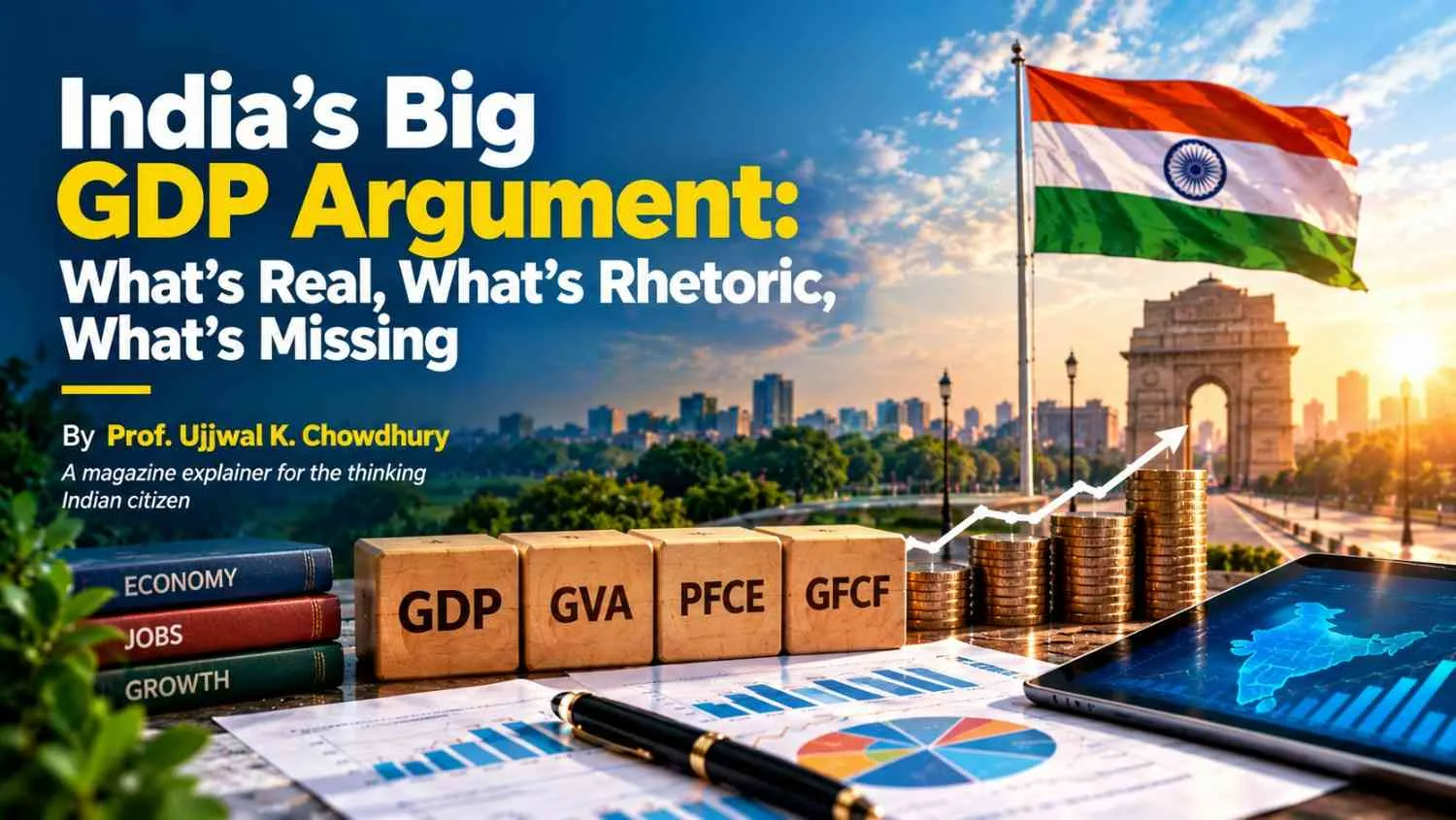
India’s 7.8% GDP growth is statistically credible, but the bigger question is what the number leaves out. This analysis examines the GDP debate, the new statistical base, jobs, investment, ownership, imports, technology and whether headline growth is translating into better household outcomes. SummaryIndia’s Q1 FY2026–27 GDP growth of 7.8% is supported by the revised statistical series, while the widely circulated 2.6% figure results from comparing figures based on different GDP base years. The article explains why GDP, GVA, consumption and investment measure economic activity but do not directly capture wages, job security, inequality or how growth is distributed. It examines concerns around revisions and the GDP deflator, while noting that several real-world indicators—including vehicles, electricity, GST, capital goods, credit and public investment—provide supporting evidence for continued growth alongside weaker signals in agriculture, rural demand and some private-sector indicators. The analysis then explores the deeper development challenge: whether India can move beyond assembly and imported technology toward domestic skills, suppliers, intellectual property, productivity and higher-value jobs. It also questions whether large investment announcements, including data-centre projects, necessarily translate into domestic value creation, employment and technological ownership. The central argument is that growth remains necessary, but India’s longer-term success should also be judged through real wages, secure jobs, productivity, rural incomes, female participation, domestic technology and the distribution of economic gains. A magazine explainer for the thinking Indian citizen  Somewhere between a WhatsApp forward claiming India "faked" 7.8% growth and a government press release calling it a triumph, most Indians have quietly given up trying to understand their own economy's report card. That's a problem, because GDP arguments aren't abstract — they decide whether your child's first job is secure, whether the rupee buys less petrol next year, and whether "India growing" means you growing. This piece takes twenty-two of the sharpest questions Indians have been asking about the Q1 FY2026-27 GDP number — 7.8% real growth, a rival "2.6%" claim, a mysterious base-year change — and answers them one at a time, in plain language, with Indian examples and a look at how other countries have wrestled with the same demons: rebased economies, doctored statistics, jobless booms, and technology built at home but owned abroad. The one-line verdict up front: the 7.8% figure is a legitimate number from a recent (if badly communicated) statistical overhaul; the rival 2.6% figure is valid only for an earlier base. But both camps are arguing past the real question — not "did the economy grow?" but "who is the growth for, and who owns what it built?" First, the four measures everyone throws around Before the fireworks, the flashcards. Four numbers get quoted in every GDP story, and mixing them up is where half the confusion begins. GDP — Gross Domestic Product. The total market value of everything final that got produced in the country in a period. It answers: how big and how fast is the economy? GVA — Gross Value Added. What producers and sectors actually add, once you strip out the inputs they bought. If a Tiruppur garment unit sells ₹100 crore of clothes made from ₹60 crore of fabric and yarn, its GVA is ₹40 crore. GVA tells you which sectors are creating value — agriculture, manufacturing, services — and India's GDP and GVA growth rates can diverge because of taxes and subsidies sitting between the two. PFCE — Private Final Consumption Expenditure. What households actually spend — food, rent, school fees, phone bills, the works. It answers: how much are people consuming? It's the single largest slice of India's GDP, so a good PFCE print usually means a confident consumer — though inflation alone can inflate it too. GFCF — Gross Fixed Capital Formation. Money sunk into things that will keep producing for years: factories, machines, roads, software. It answers: how much is the economy investing in tomorrow? "Gross" means depreciation hasn't been subtracted yet, and it excludes financial punts like buying shares. None of these four numbers directly measures your salary, your job security, or how evenly the gains are shared. Keep that sentence in your back pocket — you'll need it by the end of this piece. What exactly are we even fighting about? Before deciding whether 7.8% is impressive or a scam, is this a dispute about economic activity, methodology, inflation adjustment, or outcomes? All four, but they don't deserve equal airtime. The much-shared 2.6% number is simply not a valid calculation — more on that in a moment. The genuine live argument is a technical one: do India's new price deflators measure real activity accurately? The bigger, more consequential argument is developmental: does this output turn into jobs, wages, private investment, and technology India actually owns? Treat arithmetic, measurement, and development as three separate courts, or you'll convict the wrong defendant. Round 1 — Doing the Maths Honestly "2.6% growth" — the viral number that isn't a number Is the claim that India grew only 2.6% based on a fair comparison? The 2.6% figure compares Q1 FY27 nominal GDP of ₹88.27 lakh crore, measured under India's new 2022-23-base series, against Q1 FY26 nominal GDP of ₹86.05 lakh crore measured under the old 2011-12-base series. That's like comparing your height measured in centimetres this year against your height measured in inches last year and calling the difference "growth." The valid comparison — new series against new series — is ₹88.27 lakh crore against a revised ₹80.00 lakh crore: 10.3% nominal growth and 7.8% real growth. The 2.6% figure is a useful red flag about how large the revision was; it is not an alternative official growth rate. Why can't figures from two different base-year series simply be combined? Because a base-year change resets sector weights, data sources, price indices and estimation methods all at once. Combining old-series and new-series numbers treats a statistical redesign as if it were real economic change — it's not a conservative estimate, it's an invalid ratio, full stop. Indian context: This isn't India's first base-year change — the country moved from a 2004-05 base to a 2011-12 base in 2015, and that revision also sparked confusion when it retrospectively lifted growth estimates for 2013-14. Base revisions are a recurring ritual in Indian GDP-watching, not a one-off scandal. Global comparison: Nigeria offers the most dramatic version of this confusion. When it rebased its GDP from a 1990 base year to a 2010 base year in April 2014, its estimated economy leapt by 89% overnight — instantly making it Africa's largest economy, ahead of South Africa. The updated figures did reflect genuinely under-measured sectors, like telecom and the Nollywood film industry, but they also sat alongside the country's real, unchanged problems — low fiscal revenue, weak job creation, persistent poverty. No Nigerian became 89% richer that morning — the ruler changed, not the country. India's much smaller revision provoked outsized panic partly because nobody drew that Nigerian-style picture for the public in plain language. Once you compare like-with-like, how much should we trust the 7.8%? Moderate confidence, not blind faith. The number is internally consistent — it's backed by 8.2% real GVA growth, 9.2% manufacturing growth, 10.0% services growth, 7.1% consumption growth (PFCE) and a strong 11.9% investment growth (GFCF). But it remains provisional and sensitive to the deflator (see Round 2), so transparency and independent replication still matter before anyone chisels it into stone. Has the debate confused nominal GDP, real GDP, and revisions? Yes, constantly. Nominal GDP is value at today's prices; real GDP strips out inflation to show volume; a revision changes the estimate of an earlier period using better data. A lower revised base can mathematically raise this year's growth rate without any manipulation — but the statistics office owes the public a clear explanation of exactly why the earlier number changed, not just a new number dropped without a bridge. Was India's real growth actually close to zero this quarter? Not as any defensible national-accounts estimate — that reading only survives if you deliberately compare mismatched series and then bolt on an assumed inflation adjustment. But here's the honest caveat: a household's felt growth can be close to zero even when the national number is genuinely 7.8%, if wages, job security, and purchasing power for that household haven't moved. That's a distributional judgment about who's benefiting, not a rival estimate of total output. Both things can be true at once — remember this, because it becomes the spine of the whole article. Round 2 — Why Last Year's GDP Suddenly Got Smaller Is a revision this size normal? Revisions are routine whenever base years, data sources, weights and deflators change — but a jump this large demands unusually clear communication, even though "unusual" doesn't mean "illegitimate." The entire historical series has to be rebuilt from scratch for old and new numbers to stay comparable. Does the new methodology genuinely improve accuracy? In principle, yes. It draws on broader administrative and enterprise data (GST filings, corporate ministry records, e-Vahan vehicle registrations), updated household surveys, over 300 price indicators, better informal-sector coverage, and "double deflation" in manufacturing (explained below). But "in principle better" is not the same as "proven better" — that requires the back series, source notes and replication files to be made public, which as of this writing they largely haven't been. Has the scale of revision, even if legitimate, created a trust problem? Yes — and this is where India's statisticians have genuinely fumbled the ball. The public first saw an ₹86.05 lakh crore figure, then a revised figure near ₹80 lakh crore, then a fresh ₹88.27 lakh crore figure — with no immediate, plain-language bridge explaining the jumps. Being technically correct doesn't erase a communication failure. Credibility needs a visible paper trail, not a black box. Global comparison — the cautionary tale: Argentina shows what happens when a statistics office loses that trust entirely. After its national statistics agency, INDEC, was politically overhauled in 2007, its officials were widely accused of tampering with inflation figures, and Argentina went on to become the first country the IMF ever formally censured for submitting inaccurate inflation and growth data. Independent economists ended up running their own private price-tracking websites just so ordinary Argentines had numbers they could trust — down to things as mundane as adjusting a divorce settlement for real inflation. India's MoSPI is nowhere near that credibility crisis, but the lesson stands: once citizens stop trusting the referee, no number — however honestly calculated — will be believed. India's fix is cheap by comparison: publish the revision ledger. Why did the new series make earlier years look smaller? Reweighted sectors, revised informal-sector estimates, new industrial and price data, different price treatments, and improved statistical-discrepancy adjustments can all lower a historical estimate. It means the ruler changed — not that the economy physically shrank in hindsight. What should MoSPI publish so outsiders can check its homework? A machine-readable comparable back series, a vintage-by-vintage revision ledger, sector weights, granular deflators, source-coverage notes for GST/MCA/PLFS/PFMS/e-Vahan data, and reconciliation tables — with independent review built into the release process itself, not bolted on after controversy erupts. Round 3 — The Deflator: India's Real Technical Fault Line This is the one genuinely wonky bit worth understanding, because it's where honest critics have their strongest point. Is a GDP deflator of around 2.3% believable right now? It's possible, because the GDP deflator prices a different, broader basket than retail inflation (CPI) or wholesale inflation (WPI) — but it looks unusually low next to both. That makes it a candidate for audit, not an automatic disproof of the growth number. The real test is whether the underlying output and input prices reflect actual transactions across sectors, not guesswork. Why shouldn't the GDP deflator track CPI or WPI anyway? CPI tracks what households buy at retail; WPI tracks wholesale goods. The GDP deflator is an implicit, economy-wide price measure covering investment, government services, exports and imports too — it can legitimately diverge from both. But a persistent, large gap needs an explanation, not a shrug. How does "double deflation" let real growth beat nominal growth? It deflates a sector's output prices and its input prices separately, instead of applying one blanket index to everything. If input costs (say, steel and energy for a factory) rise faster than what the factory can charge for its products, nominal value added gets squeezed even while the physical volume of goods produced keeps climbing. So real GVA can genuinely outpace nominal GVA — the arithmetic is sound, but its reliability rides entirely on how good the underlying price data is. Does double deflation make things more accurate, or more fragile? Both, honestly. It's more accurate when input and output prices are well measured, because it stops one broad index from being force-fitted onto unlike items. But it's also more sensitive — an error in either price series distorts the "residual" value added, so India needs granular, transparent price data to make this method trustworthy rather than a black box that quietly produces flattering numbers. Is 9.2% manufacturing growth real, or a methodology artefact? The wider evidence — corporate sales, electricity use, GST collections, capital-goods output — points to genuine industrial expansion. But the exact 9.2% figure, sitting alongside 7.7% nominal growth and an unusually low deflator, is a gap large enough to deserve item-level cross-checks against real-world indicators before being taken as gospel. Real growth with an uncertain precise magnitude is the honest verdict — not fraud, not full confidence either. Round 4 — Does the Rest of the Economy Back Up the Headline? What independent, real-world signals support 7.8%? Vehicle registrations, capital-goods production, cement and steel output, electricity consumption, bank credit growth, GST collections, corporate capex announcements, payroll additions, and a strong 12.0% real export growth all point the same direction. No single indicator is decisive, but together they make a "zero real growth" story implausible. What contradicts or complicates the story? Agriculture grew only 3.6%; mining actually contracted 2.4%. Rural demand, real wages, informal enterprises, private capex intentions, and some manufacturing-sentiment surveys remain patchy, and declining foreign investment plus currency pressure complicate any tidy "boom" narrative. These don't erase the growth — they narrow its width and question its quality. What's actually driving growth — consumption, government spending, investment, or exports? A mixed bag tilted toward public capital spending, formal services, and select manufacturing clusters, rather than one broad-based private investment wave. Consumption (PFCE) grew 7.1%, investment (GFCF) 11.9%, exports 12.0% — but whether private capex and rural demand can carry the baton is still the real test of durability. How broad-based is the boom across sectors, regions and incomes? Uneven, by design of the numbers themselves. Urban formal services, listed companies, and specific manufacturing clusters are running hot; agriculture, informal businesses and lower-income households are lagging. Premium consumption — SUVs, five-star weddings, iPhones — can surge even as mass-market purchasing power stays flat, producing what analysts call a K-shaped recovery: two diverging lines on the same chart, not one rising tide. Can GDP boom while ordinary households feel stuck? Yes, unavoidably. GDP measures total production, not median wages, job security, household debt, or how gains are shared. Employment can technically "rise" through gig work or casual labour even while secure, well-paid jobs stay scarce. Both a genuinely valid 7.8% output number and real public frustration can be true in the same country, in the same quarter. This is the crux the entire rest of this article now turns to. Round 5 — Rajan vs. Vembu: Two Diagnoses, One Patient Two of India's sharpest public voices — economist Raghuram Rajan and technology entrepreneur Girish Mathrubootham/Zoho's Sridhar Vembu — have been read as contradicting each other in recent months. They aren't. They're examining two different organs of the same patient. Are Rajan and Vembu really disagreeing? Not fundamentally. Rajan's question is: why isn't growth producing enough decent jobs, private investment, and human capital? Vembu's question is: why does India capture so little of the technology, intellectual property, and profit margin from the work actually done here? One diagnoses the employment outcome; the other diagnoses who owns the value chain. Complementary, not competing. Can low-paying assembly jobs become a ladder to something better, the way they did in East Asia? Yes — but only when assembly is deliberately used as a learning platform, not treated as the finished product. South Korea and Taiwan didn't stay content-to-assemble; they used early low-value assembly contracts to build domestic suppliers, engineering talent, export capability and eventually world-beating firms of their own (think Samsung's leap from assembling foreign electronics to designing its own chips, or TSMC becoming the company Apple and Nvidia depend on rather than the other way round). Without those deliberate conditions, assembly work becomes a permanent low-wage enclave — a treadmill, not a ladder. What makes an assembly ecosystem actually build local suppliers, skills and IP? Time-bound incentives tied to rising local content, supplier development, apprenticeships, R&D spending, domestic patents, export sophistication and productivity — with firms required to publish capability milestones and lose their support if they miss them. Support without a scoreboard just becomes permanent subsidy. How long should India accept lower wages while companies "climb the value chain"? Only as a clearly defined transition — never an open-ended promise. A five-to-ten-year support envelope, reviewed every three to five years, with subsidies tapering automatically if wages, skills, local suppliers and R&D fail to improve, is the discipline that separates genuine industrial policy from indefinite corporate welfare. Does India need millions of ordinary jobs, or fewer high-productivity ones? Both, simultaneously. India needs accessible jobs now for workers still moving out of low-productivity farming, and a parallel expansion of high-productivity careers in engineering, design, digital services and advanced manufacturing. Picking only one horn of this dilemma leaves the other problem — mass employment or national productivity — permanently unresolved. Can high-value services and startups alone create enough jobs? They can generate excellent, high-paying, export-earning employment — but not at the scale India needs. Roughly 11 million people are expected to enter India's workforce every year for the next two decades. Manufacturing, construction, logistics, tourism, and care work will have to carry much of that load; software unicorns cannot absorb a labour force that size on their own. What does a real career pathway from a ₹20,000 factory job actually look like? Apprenticeship → portable certification → process and quality training → promotion to technician or supervisor → movement into supplier engineering → eventually design or R&D roles. It requires employers who actually run engineering functions in India, continuous upskilling, basic social protection, and wages tied to measured productivity gains — not just tenure. Round 6 — Who Actually Owns the Value? This is the section every Indian techie, founder, and policymaker should read twice. Does hosting global R&D automatically mean India captures the value? No. Global Capability Centres (GCCs) in Bengaluru, Hyderabad and Pune generate real wages, local procurement, tax revenue, and genuine skill-building — all valuable — but the parent multinational typically retains the intellectual property, the licensing income, the platform rents, and the commercial profit, booked abroad. A GCC's headcount is not the same thing as ownership of the technology those employees built. How much of the value Indian engineers create shows up in India's GDP? There's no single reliable percentage — that's precisely the problem. Indian GDP captures wages, domestic profit, local inputs and taxes; the IP royalties, equity gains, and profits recognised in a parent company's home country are largely not counted as Indian value-added. Getting a precise number would need firm-level accounts and detailed supply-chain data that mostly don't exist publicly yet. Is comparing Indian headcount to a multinational's global profit meaningful? Too simplistic to use as an accounting argument, though the direction of the comparison is a fair provocation. Profit also depends on IP ownership, capital, risk-taking, transfer pricing, and global market control — not labour input alone. The asymmetry it illustrates is real; the specific ratio isn't rigorous. Does owning IP matter more than manufacturing volume for wages? For sustained wage growth, yes — ownership of scarce technology and commercial rights is usually more decisive than sheer manufacturing volume. High-volume assembly without design ownership or supplier power tends to keep both margins and wages anchored close to bare labour-cost competition. Global illustration: This is exactly the trap South Korea and Taiwan escaped and many other assembly-hub economies haven't. A country can host enormous manufacturing volume — think of the "world's factory" label applied at different times to Mexico's maquiladoras or Vietnam's electronics-assembly boom — without ever owning the brand, the chip design, or the software stack that captures the lion's share of the final retail price. What would encourage more India-owned, India-commercialised IP? R&D tax credits tied specifically to domestic patenting and commercialisation (not patent-filing alone), stronger university-industry technology transfer, patient deep-tech capital, government acting as an anchor customer for homegrown tech, and better standards, procurement and IP enforcement. Domestic champions, technology transfer, or MNC incentives — which does India need? All three at once. Domestic champions create genuine Indian ownership; better technology-transfer mechanisms build capability; predictable incentives can persuade multinationals to locate real decision-making and IP functions inside India rather than just assembly lines. No single lever closes this gap alone. Can India capture more value without scaring off the MNCs that employ Indian engineers? Yes — through predictable rules, strong IP protection, deep skilled talent, deep capital markets, and incentives for local R&D, rather than punitive restrictions. The goal is parallel ecosystem-building: keep attracting multinationals while simultaneously making Indian firms capable of owning, financing and commercialising their own technology. Round 7 — Does India Need a Sharper Industrial Policy? Is industrial policy necessary for a developing country to build technological capability? Usually, yes. Late developers face coordination failures — in skills, suppliers, finance, technology — that markets alone often can't solve fast enough. But industrial policy has to be disciplined, transparent and temporary; its job is to buy capability, not protect inefficiency forever. Is India's current industrial policy building competitive firms, or subsidising assembly? A mixed picture, with a genuine risk of subsidising assembly for its own sake — rewarding output volume more than R&D, local components, exports, or productivity gains. The real test isn't the size of the incentive announcement; it's whether domestic supplier depth, patents, engineering decision-making, wages, and export sophistication are actually rising over time. What separates good East Asian industrial policy from protectionism and cronyism? Successful programmes tied support to exports, productivity, local capability-building and technology learning; exposed firms to genuine competition; reviewed performance regularly; and withdrew support on a pre-announced schedule. Protectionism shelters firms without demanding results; cronyism picks beneficiaries without any public performance test at all. Should support require R&D, local IP, exports and productivity — not just production? Yes. Production should be an entry condition, not the finish line. Support should also demand R&D intensity, domestic patents, local suppliers, export complexity, worker training, rising productivity and wages, and energy efficiency. How long before an industry is expected to compete on its own? A pre-announced five-to-ten-year window, with milestone reviews every three to five years and automatic tapering — varying by sector, but with the discipline that missing capability milestones triggers withdrawal of support, not renewal through lobbying. Is India's real choice "become Mexico" or "become East Asia"? Too narrow a frame. India can combine labour-intensive manufacturing for mass jobs, high-value services for exports, digital public infrastructure (UPI, Aadhaar, ONDC) for productivity, and entrepreneurship for innovation — a genuinely hybrid Indian model rather than a copy of any single country's playbook. Round 8 — Growth, Imports, and the Rupee Can strong GDP growth coexist with pressure on the rupee and the current account? Yes, routinely. Catch-up growth raises demand for imported energy, machinery, semiconductors, software and capital goods. If imports outpace exports, the current account and the currency can come under pressure even while real GDP is growing rapidly — India has lived this cycle before, notably around 2012-13. Does faster growth deepen import dependence before domestic capability catches up? Yes, especially in data centres, semiconductors, renewable-energy hardware and advanced machinery. That's not automatically bad — productive imports can build future capacity — but it becomes a genuine risk if domestic suppliers, R&D and skills never scale up to replace them. How much domestic value does India actually retain from import-heavy exports? It varies too much by product for a single number to be honest. Domestic value is wages, local services, logistics, taxes and Indian profit; imported components and foreign-owned technology largely pass through with limited retention. India's supply-and-use tables should publish sector-specific domestic value-added shares rather than leaving this to guesswork. Is telling citizens to cut foreign travel, weddings abroad, and gold buying meaningful, or symbolic? Mostly symbolic at the macro scale — though not entirely irrelevant. The decisive foreign-exchange pressures come from energy, capital goods, and technology imports, not household discretionary spending. Policy shouldn't offload a structural, national-level responsibility onto individual moral appeals. Should the burden fall on households, or on energy and technology policy? Policy has to lead. Energy diversification, domestic capital-goods manufacturing, technology capability-building, export upgrading and stable trade rules matter far more than broad appeals asking households to tighten their belts. Targeted restraint can help at the margins — it cannot substitute for industrial and energy strategy. Which imports are wasteful, and which are investments in the future? Luxury consumption and non-essential gold generally add little productive capacity. Machinery, semiconductors, software, renewable-energy equipment and R&D tools may worsen the near-term trade balance but count as investment if they raise productivity, capability, or future exports. The test is future learning value, not the import label itself. How long before India's tech and energy import dependence meaningfully shrinks? Technology dependence is roughly a 10-to-15-year project if R&D, skills, and manufacturing scale up consistently. Energy dependence will likely take longer — 15 to 20 years — because it involves transport, storage, grids, and industrial fuel substitution all moving together. These are planning horizons, not guarantees. Round 9 — Big Investment Announcements vs. Real Transformation Are giant investment announcements being mistaken for actual value creation? Often, yes. An announcement is a commitment, not proof of money spent, domestic value added, jobs created, or technology transferred. Data centres may be strategically important, but their direct GDP and employment effects can be modest relative to the headline capex numbers splashed across newspapers. How much spending on a new data centre flows straight back out through imported GPUs, servers and cooling systems? A significant share can leak abroad, though the exact proportion depends entirely on project design and procurement choices. GPUs, servers, cooling and networking equipment are import-intensive, so the domestic value of the construction phase shouldn't be mistaken for the value of the entire investment. Real answers need project-level bills of materials, not press-release arithmetic. Can data centres still deliver big second-order benefits? Yes — through cloud services, home-grown AI companies, and digital exports — but only if Indian firms actually build products and services on top of that infrastructure. Without domestic platforms, skills, data governance and genuine customer demand, India risks hosting foreign digital workloads while retaining mainly construction, power, and facility-management jobs. What needs to be built around this infrastructure to capture more value? Domestic cloud and server capability, chip and component supply chains, reliable green power, AI and cybersecurity skills, data governance frameworks, compute credits for startups, public procurement support, and export channels. The goal is Indian firms owning the models, applications and customer relationships — not merely renting out imported compute. Should capital-heavy infrastructure be judged by different metrics than mass-employment sectors? Yes. Data centres deserve to be judged on strategic resilience, productivity spillovers, digital exports, energy use, and technology ownership. Textiles, food processing, tourism, and care work should be judged far more heavily on jobs created. A single "jobs-per-rupee" test would undervalue infrastructure investment; a single capex test would quietly hide weak employment outcomes. What separates "hosting compute" from building a genuine indigenous AI economy? An indigenous AI economy has Indian-owned models, datasets, applications, patents, firms and export revenues — built on top of domestic compute and talent. Simply hosting foreign hyperscalers' servers, without local ownership, builds infrastructure capacity while leaving the highest rents and strategic control sitting elsewhere. Round 10 — GDP vs. Lived Reality Can the 7.8% number be statistically sound while public frustration is equally legitimate? Yes. GDP measures the volume of production; it says nothing about median wages, job security, household debt, inequality, or public confidence. A valid national number and a genuinely weak household economy can coexist in the very same quarter, in the very same country. Has India put too much political weight on one single number? Yes. A quarterly GDP print has become an all-purpose proxy for national welfare, even though it was never designed to measure welfare in the first place. It deserves to sit as one indicator on a public dashboard — not stand as a verdict on every household's life. What indicators should accompany every GDP release? Employment, real wages, private investment, household consumption by income group, productivity, and per-capita income — alongside labour-force participation, female workforce participation, payrolls, vacancies, hours worked, rural incomes, private capex, external balance and emissions. Quantity of growth and quality of growth need to be reported together, every single quarter. Does the new series capture informal workers, gig workers and household enterprises properly? Better than the old series — through GST data, enterprise surveys, the Periodic Labour Force Survey, e-Vahan and other administrative sources — but still imperfectly. Informal and gig activity is often estimated indirectly, and small household enterprises can slip through the gaps between survey rounds. More frequent surveys and anonymised microdata would close this gap. What should "quality growth" mean for a country at India's stage of development? Rising productivity accompanied by rising real wages, secure and formalising jobs, stronger rural incomes, higher female workforce participation, domestic technology and IP ownership, export competitiveness, and resilience to energy and climate shocks. Growth has to widen opportunity — not just expand output inside a handful of capital-intensive enclaves. How do we stop legitimate scrutiny from collapsing into partisan denial of the whole economy? Separate technical adjudication from political theatre. Publish methods and revision ledgers, allow independent replication, clearly flag what remains provisional, and always read GDP alongside jobs, wages and investment data. Criticising a method should never be twisted into denying real economic activity; celebrating activity should never be used to silence legitimate scrutiny either. Closing Question — Measurement Problem, or Development Model Problem? Suppose the 7.8% figure is methodologically sound. If India keeps growing fast while staying dependent on imported energy and technology, capturing limited value from work done here, and struggling to create better-paying jobs — is that a measurement problem, or a development-model problem? And ten years from now, will it matter more how fast GDP grew, or how much technology, IP, productive capacity and prosperity India actually kept? Primarily a development-model problem, with a continuing measurement-and-credibility problem sitting at the margins. Accurate GDP growth can perfectly well coexist with weak value capture, import dependence, and poor job quality — India's own recent history is proof of concept. Ten years out, the decisive scoreboard won't be a quarterly growth print; it will be domestic IP, supplier depth, productive skills, real wages, energy resilience, and how broadly prosperity actually spread. The growth rate is necessary evidence of India's story. It is nowhere near sufficient evidence of India's development. A note on statistical honesty, for the record None of this is unique paranoia. For years, China's own provincial GDP figures, added together, ran higher than the national total the central government reported — a gap widely traced to local officials whose careers depended on flattering growth numbers, most visibly when Liaoning province's governor publicly admitted in 2017 that city and county officials there had fabricated growth and fiscal data for three straight years. India's episode is nowhere near that scale of deliberate fraud — this is a genuine base-year revision with a communication failure, not a cover-up. But the comparison is a useful reminder of what real data manipulation looks like, so citizens can tell the difference between a badly explained methodology and an actually rigged number. This explainer synthesises MoSPI's official Q1 FY2026-27 GDP release and base-year FAQ, RBI and World Bank commentary, and the public debate involving Raghuram Rajan, Sanjeev Sanyal, Subhash Garg, Arvind Subramanian and K.V. Subramanian, among others. All Q1 figures remain provisional pending revision. ...Read more

03 Sep 2026

From mega-dams and cut slopes to a resilient economy of rivers, forests and indigenous enterpriseSeptember 2026 Arunachal Pradesh faces a critical development choice as hydropower, roads and large infrastructure projects expand across a fragile Himalayan landscape. The article calls for a safer model built around resilient communities, local livelihoods and ecological limits. SummaryArunachal Pradesh’s rapid infrastructure development is bringing roads, hydropower and other projects into a landscape shaped by steep slopes, seismic activity, intense rainfall and growing climate risks. The article argues that development cannot be judged only by megawatts generated, kilometres of roads built or investment attracted, but also by safety, ecological impact and community well-being. It examines concerns around projects such as Upper Siang and Etalin, including displacement, forest diversion, biodiversity loss and the risks of building in vulnerable river basins. At the same time, it presents alternatives centred on community tourism, value-added agriculture, local energy systems and indigenous enterprise. The proposed approach places local communities, customary institutions and ecological resilience at the centre of development decisions. Ultimately, the article calls for an Arunachal model that delivers stronger livelihoods and public services without increasing long-term exposure to environmental and climate risks. THE PROPOSITIONArunachal Pradesh does not have to choose between poverty and peril. It has to choose whether its rivers, forests and cultures will be treated primarily as national inputs, or as the living capital of a safer, higher-value local economy. The glacier-and-rock collapse reported in Nepal, the warning from Sikkim and Arunachal's own contested hydropower trajectory make that choice urgent. The Himalayas do not announce a disaster only when a dam breaks. They announce it through a spring that disappears after a tunnel is drilled, a road that slips every monsoon, a river whose sediment no longer reaches downstream fields, a village whose consent is counted only after the map is final. Arunachal Pradesh is at the point where these signals have to become policy. The mountain is not an empty balance sheet The most important fact about Arunachal Pradesh is also the fact most development plans suppress: it is a young mountain system still being made. Steep slopes, fractured rock, intense monsoon rainfall, active faults, fragile soils and a changing cryosphere respond to every road cut, tunnel, quarry, reservoir, settlement and drainage alteration. The three Counterview articles place this reality beside the August 26, 2026 glacier-and-rock collapse reported along the Nepal-Tibet border. A high-mountain failure became a debris flow, flood, infrastructure destroyer and humanitarian crisis downstream. The trigger was geological and cryospheric; the scale of loss was shaped by what had been built in the path of risk. Climate change changed the structure of risk by weakening ice, destabilising slopes, altering rainfall and making old design assumptions unreliable. Arunachal shares the conditions that make the Nepal event a warning: high seismicity, steep river valleys, expanding glacial lakes, cloudbursts, landslides and difficult emergency access. It has also experienced its own cloudbursts, road failures and district isolations. A road celebrated at inauguration but not maintained through the monsoon is not durable connectivity. A dam that multiplies a debris surge is not automatically a resilience asset. The question, therefore, cannot remain: how quickly can Arunachal add megawatts, kilometres of road and concrete? It must become: developed for whom, with what exposure, and at what price to the families who will live on these slopes fifty years from now? When infrastructure becomes exposure For two decades, Arunachal's development story has been narrowed into a familiar template: large hydropower projects for the national grid, strategic roads across unstable terrain, tunnelling through mountains and the rapid conversion of rivers into infrastructure corridors. The needs are genuine - roads, hospitals, schools, communications, jobs, energy and border security. But genuine needs do not make every engineering response wise. Upper Siang and Etalin are the clearest tests of that wisdom. The proposed Siang Upper Multipurpose Project, often described as an approximately 11,000 MW project, and the 3,097 MW Etalin project in the Dibang basin sit in landscapes that are seismically active, biodiverse and socially sensitive. Their proponents may present national power, flood moderation or strategic value; critics see high-consequence exposure in valleys where evacuation, rescue and compensation would be extraordinarily difficult. Project-by-project clearance is not enough when the river basin is the real unit of impact. A dam, access road, transmission corridor, tunnel, quarry and downstream cascade operate as one system. Blasting disturbs slopes and springs; hill-cutting changes drainage; a landslide can block a river, send an impulse wave into a reservoir or sever a village road. A GLOF or debris flow can breach a large structure and magnify the downstream disaster. Tofu-dreg infrastructure - built too quickly or cheaply for its setting - is a governance warning. The ecological bill is equally serious. Reservoirs submerge forests, fragment habitat, trap sediment and alter fisheries, riverine agriculture and downstream geomorphology. High-head barriers obstruct migratory fish; decaying biomass can release greenhouse gases. A centralised plant is also a single point of failure: if its powerhouse, transmission line or bridge is cut, the distant grid and the local community may lose power together. Sikkim offers a caution that Arunachal should not dismiss. The third Counterview article notes that the National Remote Sensing Centre assessed a 42 per cent probability of a South Lhonak Lake breach in 2013. On October 3-4, 2023, the lake breached; the Teesta III dam at Chungthang was destroyed, 55 people died, 74 went missing, more than 7,000 people from 1,756 families lost their homes, and thousands of houses were damaged across Sikkim. The reported proposal to rebuild at the same location, with a structure almost twice as high, illustrates the danger of treating a known risk as a reason for taller concrete rather than better land-use decisions. The missing people in the numbers The Upper Siang debate reveals why displacement cannot be reduced to a compensation spreadsheet. Project-side accounts cited in the dossier speak of around 16 villages and roughly 10,000 people directly affected. Community organisations and researchers speak of at least 27 villages, a 40-300 village impact zone and more than 150,000 people, depending on whether farmland, forest access, fisheries, grazing, sacred sites and downstream livelihoods count. The disagreement asks who is visible to the state. For the Adi people, the Siang is not an empty channel with a calculable flow. Ane Siang, the Mother Siang, is a cultural and ecological relationship. A village contains homes, terraces, orchards, fishing grounds, mithun routes, burial places, ritual spaces, memories and kinship networks. A resettlement colony can reproduce houses, not a river's meaning or the social geography through which knowledge travels. Compensation cannot restore a place-based civilisation. Etalin presents a smaller numerical footprint with the same principle. Project documents cited in the dossier indicate about 265 families in eight affected villages, with around 95 families facing involuntary displacement, while the project requires diversion of roughly 1,175 hectares of forest land. The project's environmental clearance has also faced legal challenge. Whether one supports or opposes the project, the lesson is clear: the burden of proof must rise when the cost is irreversible. Indigenous resistance to Upper Siang and Etalin is not an obstacle that publicity can remove. Adi institutions, farmers' forums, youth groups and human-rights advocates question consent, cultural survival, safety and benefit-sharing. Some affected families and village groups support the projects for expected flood protection or economic opportunity. That diversity makes independent deliberation essential. A signature after the design is fixed is not free, prior and informed consent. WHAT THE UPPER SIANG NUMBERS REVEALOfficial or project-side accounts cited in the dossier: about 16 villages and roughly 10,000 people directly affected. Community and civil-society accounts: at least 27 villages, a wider 40-300 village impact zone and more than 150,000 people. The gap is not a licence to choose the largest figure; it is evidence that the definition of 'affected' must include land, forests, rivers, culture and downstream livelihoods. A moratorium is a responsibility, not a rejection of development Arunachal should declare a time-bound moratorium on new large storage dams and high-risk cascades in the most vulnerable basins. This would create space for independent, cumulative assessments that model earthquakes, GLOFs, landslide impulse waves, sediment, extreme rainfall, upstream operations and failure of roads and communications together. The state needs a public hazard atlas. No-go zones should cover the highest landslide and GLOF susceptibility areas, irreplaceable biodiversity corridors and sites where evacuation is implausible. Low-no zones should permit only light, reversible or strictly conditioned activity. Settlements and critical assets already at risk need voluntary relocation or retrofitting, with land, services, transport and livelihoods planned together. Early warning is a social system, not a dashboard. Satellite and AI tools, weather radar, rain gauges, glacial-lake sensors, river gauges and slope monitors matter only if a village receives a clear alert, knows the safe route and practises the drill. Data-sharing across the India-Bhutan-China-Nepal Himalayan arc should be pursued wherever diplomacy allows. Roads and bridges should follow mountain behaviour: drainage first, slope bioengineering, vegetation reinforcement, controlled spoil disposal, spring protection, geotechnical inspection and dedicated maintenance. Vetiver, alder, bamboo and hydroseeding should complement engineering. The most strategic road may be the one that remains open and repairable, not the widest on inauguration day. Quality of life is the unit of progress A safer development model must answer everyday questions: can a child study during a monsoon outage, can a pregnant woman reach care, can a farmer sell without distress, can an elder remain in a familiar community, can a young person earn without leaving, and can a family sleep without fearing the next slope failure? These are the real measures of resilience. A safe home is infrastructure: Retrofit vulnerable homes and support voluntary, culturally appropriate relocation from the highest-risk zones. Promote earthquake-resilient construction using bamboo, cane, timber and local design knowledge wherever technically suitable.A reachable service is development: Combine district hospitals with telemedicine, mobile health units, emergency transport protocols and digital classrooms, so people need not be concentrated in unsafe places simply to reach a service.A maintained road is better than a grand road: Use geotechnical routing, drainage, bioengineering and slope monitoring. Limit widening, protect springs and accept seasonal or low-capacity routes where necessary. Budget maintenance as a core asset, not a post-disaster appeal.Local energy is strategic energy: Combine safe micro-hydro, rooftop solar, storage and islandable microgrids so border villages, schools, clinics, communication nodes and emergency centres remain powered when landslides cut the main line.  Tourism that pays the village The alternative to mega-project dependence is an economy that earns more from each unit of landscape without consuming it. Tourism can be a pillar, but Arunachal should avoid the familiar sequence in which roads arrive, hotels multiply, waste and water stress follow, and the host community receives the least value. Build high-value, low-density tourism around certified homestay clusters and community lodges regulated by village institutions or Kebangs. Publish carrying-capacity studies before scaling visitors, and use permits, seasonal quotas and route zoning for high-altitude lakes, glacial passes, sacred sites and wildlife corridors. Access must fit slope stability, water availability, cultural dignity and emergency capacity. The product should be experiential: Eaglenest birding, alpine botany, high-altitude treks, monastery and living-heritage circuits in Tawang and West Kameng, cultural and culinary immersion, river interpretation, farm stays, harvests and festivals. Tawang, Ziro, Mechuka, Namdapha and Pasighat can develop distinct identities. Kaimoi's Best Tourism Village recognition and work in Namsai show that cultural revival can be an economic asset. Room revenue, guide fees, permits, conservation fees and craft sales should flow to village committees and households. Cooks, drivers, porters, performers, farmers and artisans should be named beneficiaries. Training should cover hospitality, first aid, rescue, waste, digital booking, language and storytelling. Homestays need water, sanitation, fire, waste and structural standards without being forced to imitate urban hotels. The Lower Subansiri pondage proposal - a controlled tourism, adventure, cultural and inland-fisheries hub - deserves a transparent feasibility test. Reusing an altered site may be preferable to opening new upstream valleys, if safety, carrying capacity, fish ecology and community ownership are secured. Tourism must be a conservation contract: visitors receive meaning, communities receive income and ecosystems receive limits. Agriculture must leave as a product, not a truckload Agriculture should not leave Arunachal only as a truckload of unprocessed produce. Its microclimates can support a premium basket of kiwi, mandarin oranges, pineapple, apples, persimmon, walnuts, large cardamom, ginger, turmeric, chillies, buckthorn, medicinal plants, millets, Khamti rice, yak churpi and distinctive beverages. APEDA's buyer-seller work at Tawang points toward FPOs, FPCs, women's Self-Help Groups, branding, exports and value addition. The missing layer is a distributed system that lets farmers retain more value. Each producing cluster should have small solar-powered processing and packing capacity: grading, pulping, juicing, drying, pickling, fermentation, spice processing, safe packaging and traceability. Five- to ten-tonne community cold rooms can prevent distress sales when landslides block roads. A brand such as Arunachal Organic Himalaya can sit above district and tribal brands only if certification, quality control and producer ownership are real. Geographical indications should protect and premiumise distinctive products, not merely decorate packaging. Farmer Producer Companies should negotiate directly with urban retailers, hotels, institutions and exporters. Digital catalogues can show harvest windows, volumes and quality; public procurement can place local produce in schools, hospitals and tourism kitchens. Finance must cover working capital, cold chains and packaging. Women-led processing, food entrepreneurship and local logistics can create jobs without forcing young people to leave. Climate-smart agriculture should strengthen, not erase, local knowledge. Jhum should not be eliminated by decree; improved fallows, contour planting, water harvesting, agroforestry and community fire management can reduce erosion while preserving food cultures. Nitrogen-fixing alder, Alnus nepalensis, can be integrated with heirloom tea and black pepper. Success is a productive hillside that keeps soil, water, biodiversity and income together. Healing landscapes, not resort landscapes Arunachal's forests, clean air, hot springs, highland climates and spiritual traditions can support a careful nature-wellness economy. This is not a licence for large resorts. It is an invitation to design small, regulated experiences: forest-bathing or Shinrin-yoku trails, meditation retreats, monastery stays, nature-therapy walks, restorative food and hot-spring facilities with strict water and waste limits. Guides should be trained in ecology, mental-health first response, visitor safety and the limits of therapeutic claims. Indigenous dietary, herbal and healing knowledge must be documented with consent and benefit-sharing. Cooperative processing of managed non-timber products such as Mishmi teeta, wild turmeric or Taxus-related resources must prevent overharvesting and bio-piracy. Wellness should complement, never replace, public healthcare. Craft and local design as a living economy The cultural economy should be a productive sector, not an annual festival display. Apatani, Adi, Nyishi, Monpa and other weaving traditions; bamboo, cane and beadwork; Monpa paper; thangka and Buddhist art; and Wancho wood carving carry design intelligence. The challenge is repeatable income without flattening distinct identities into one generic Northeast aesthetic. District craft and design hubs can provide shared tools, natural-dye research, photography, packaging, e-commerce, accounting and market access. Partnerships with design institutes, fashion labels, architects and responsible retailers must protect attribution, intellectual property, fair prices and artisan control. A digital maker passport can connect each product to its maker, village, technique and material story; tourism circuits can add demonstrations, workshops and direct sales. Bamboo and cane bridge heritage with climate resilience. Bamboo anchors soil and can support homeware, furniture, structural alternatives and earthquake-conscious vernacular housing when engineered properly. Documentation and apprenticeships are vital: if craft is poorly paid, the state loses both a livelihood and an irreplaceable knowledge archive. A VILLAGE POWER TEMPLATEIllustrative 500 kW community-owned run-of-the-river model: 800-1,200 households and local institutions served; about Rs 4.5-5.5 crore capital cost; roughly 2.6 million kWh annually at 60 per cent capacity factor; customary council as trustee; Village Energy Management Society with women and youth representation; 35 per cent of revenue for O&M, 25 per cent for debt and 40 per cent for capital reserve, social dividend and watershed protection. Final feasibility, tariff and safety decisions must remain site-specific. Power where people live Arunachal's energy security does not require every river to become a gigawatt corridor. Safe run-of-the-river micro-hydro units, generally 10 kW to 2 MW, combined with solar and storage, can provide power close to where people live. Lower head, negligible storage and small civil footprints can reduce the scale of failure compared with a large reservoir, while allowing community ownership. No micro-hydro site is automatically safe; every site needs hydrology and geotechnical review. An illustrative 500 kW community-owned project could serve 800 to 1,200 households, schools, clinics and micro-enterprises. The dossier models a capital cost of Rs 4.5-5.5 crore and, at a 60 per cent capacity factor, around 2.6 million kWh a year. A customary council - Kebang, Tsumok or equivalent - can hold the land and water-use trust. A Village Energy Management Society can run the plant, with elders, a technical representative, local youth technicians and at least 50 per cent women and youth representation. Local operators should flush abrasive silt traps during the monsoon; four village youths can become primary and apprentice 'barefoot engineers'; the turbine maker can provide an annual maintenance contract; and prepaid smart metering can remove billing friction. A workable financing stack could blend 60 per cent public subsidy, 20 per cent CSR or green-climate finance, 15 per cent concessional debt and 5 per cent community land and labour. Tariffs can protect dignity and reliability: a lifeline domestic rate, a higher commercial rate for homestays and processing, and a regulated feed-in price for surplus. The illustrative revenue waterfall allocates 35 per cent to O&M, 25 per cent to debt service and 40 per cent to resilience - 15 per cent capital reserve, 15 per cent village social dividend and 10 per cent catchment protection. Energy then runs dryers, kiwi sorting lines, grain mills, five- to ten-tonne cold rooms and local EV charging hubs. The ten decisions that can change Arunachal's trajectory The state government can turn the argument into a social contract through ten decisions over the next 24 months. The sequence matters: first reduce irreversible exposure, then build the institutions and markets that make safer livelihoods credible. Pause new large storage dams and high-risk cascades while independent basin studies examine seismicity, GLOFs, landslides, sediment, climate projections and dam-break cascades.Create a public hazard atlas with no-go and low-no zones for heavy infrastructure, biodiversity corridors and high-risk settlements.Install real-time glacier, lake, rainfall, river and slope sensors in districts including Tawang, Dibang Valley and Anjaw, linked to village sirens, drills and last-mile communication.Make cumulative impact assessment and public disclosure mandatory for roads, tunnels, quarries, transmission lines and hydropower.Create a permanent Mountain Maintenance and Resilience Fund for drainage, bioengineering, bridge inspection, road restoration, emergency stocks and local responders.Launch district missions for community tourism, organic value chains, craft, design and nature wellness, with low-interest finance, procurement and ecological standards.Give FPOs, FPCs, women's SHGs, artisan guilds and tourism committees direct access to markets, digital systems, training and working capital.Adopt an enforceable FPIC-like protocol: disclose alternatives, recognise customary institutions, record dissent and share risks and benefits before decisions are final.Build decentralised energy around safe micro-hydro, solar, storage and islandable microgrids, with community, women and youth governance.Measure progress through disaster losses, forest cover, water quality, green-sector income, youth retention, service access and community satisfaction alongside GDP and capacity.  A future measured in more life per unit of concrete Arunachal does not face a binary choice between dams and poverty. It faces two theories of development. One treats the state as a resource warehouse whose rivers are exported, slopes cut faster than they heal and people compensated after decisions. The other treats mountains as the foundation of a local economy: forests that protect water, rivers that sustain culture and fisheries, farms that earn through processing, villages that host visitors on their terms, crafts that carry identity and energy systems that keep communities resilient. National security is not weakened by this second theory. A village with safe housing, a clinic, a digital classroom, a community microgrid, trained responders, maintained roads and dignified livelihoods is stronger than a landscape tied to one vulnerable transmission corridor. Ecological protection and strategic presence can reinforce each other when people are custodians and partners. The Nepal disaster, the Sikkim precedent and Arunachal's monsoon failures are not prophecies. They are choices made visible in advance. The government can still pause, listen, map, maintain and diversify. The goal is more safety, income, health, culture and possibility with less ecological damage. In a fragile Himalaya, that is the only progress that can endure.  Sources and editorial note Wangchuk Tsering. Safety first: Why reconsider hydropower in fragile Arunachal. Read online Neha Desai. Why the Nepal disaster is a warning Arunachal Pradesh cannot ignore. Read online Raj Kumar Sinha. Rising climate risks demand a new Himalayan development model. Read online APEDA / Press Information Bureau. APEDA and Government of Arunachal Pradesh host International Conclave cum Buyer-Seller Meet at Tawang. Read online APEDA. Arunachal Pradesh: GI and agricultural products profile. Read online Shiv Nadar University, Centre of Excellence for Himalayan Studies. Dams in the discourse of development: vulnerabilities and systematic barriers to communities-inclusive policies in Arunachal. Read online ...Read more

31 Jul 2026

As Europe tightens its carbon border rules, Indian steel, cement and aluminium exporters face a new test of competitiveness   Kolkata | July 31, 2026: What if the next barrier to global trade is not tariffs or product standards, but carbon emissions? As the European Union moves closer to fully implementing its Carbon Border Adjustment Mechanism (CBAM), that question is becoming relevant. The policy is expected to redefine trade in carbon-intensive products, with Indian exports of steel, cement and aluminium among those likely to feel its impact. The Carbon Border Adjustment Mechanism is designed to tackle "carbon leakage"- the practice of shifting production to countries with weaker climate regulations while continuing to supply European markets. Under the new system, importers into the EU will have to pay a carbon price on products manufactured in countries that do not have comparable carbon pricing measures.For Indian exporters, the policy marks a significant shift in the rules of global trade.For India, the stakes are particularly high. The country is among the world's largest producers of steel and aluminium, with the European Union representing an important export market for both. As CBAM moves into its next phase, exporters will need to provide verified emissions data and may face additional carbon-related costs if their products are produced through carbon-intensive processes.Experts say the debate is no longer confined to climate policy. It is rapidly becoming a question of who remains competitive in global markets and who risks being left behind. Steel, cement and aluminium form the backbone of India's industrial economy, but they are also among its most carbon-intensive sectors. Coal-based steelmaking, clinker production in cement manufacturing and electricity-dependent aluminium production all contribute significantly to greenhouse gas emissions. If these industries are unable to reduce their carbon footprint, Indian exports could face higher costs in the European market, making them less competitive than products manufactured using lower-emission technologies. The transition to CBAM is no longer a future concern- it has already begun. Exporters are now required to submit emissions data, while carbon-related costs are expected to rise as the mechanism becomes fully operational over the coming years. Recognising the changing trade landscape, many Indian manufacturers have already started adapting their operations.Industry response is already beginning to take shape. Steel manufacturers are investing in renewable energy, energy-efficient technologies and cleaner production methods such as hydrogen-based steelmaking and electric arc furnaces. Cement companies are reducing emissions through alternative fuels, blended cement and waste-heat recovery systems, while aluminium producers are increasing renewable energy use and improving efficiency throughout their operations. The government is supporting this transition through initiatives aimed at expanding green hydrogen, renewable energy and industrial decarbonisation. At the same time, discussions on carbon markets and green manufacturing standards are gaining momentum as India prepares its industries for evolving global trade requirements.However, significant challenges remain. Experts believe CBAM could also redefine global trade patterns. With European buyers placing greater emphasis on products with lower embedded emissions, sustainability is rapidly emerging as a key factor- alongside price, quality and delivery, in determining who remains competitive in international markets. For businesses, the rules of global trade are beginning to change. Reducing emissions is no longer only about supporting climate action- it is becoming a decisive factor in securing future markets.As carbon costs gradually become important part of global trade, India's steel, cement and aluminium industries are entering a defining phase.  The companies that move early towards cleaner technologies, lower emissions and transparent reporting could strengthen their global competitiveness. Those that wait may discover that in tomorrow's marketplace, the cost of inaction is far greater than the cost of transition. The next chapter of India's export story may be written not only by its factories, but by the carbon footprint they leave behind! Sources: European Commission – Carbon Border Adjustment Mechanism (CBAM)Official overview of CBAM, covered sectors (including steel, cement and aluminium), reporting requirements, and the definitive regime from 2026.European Commission – CBAM Definitive RegimeInternational Energy Agency (IEA) – Carbon Border Adjustment Mechanism (CBAM)Explains the purpose of CBAM, its link with the EU Emissions Trading System (EU ETS), and its role in industrial decarbonisation.IEA – Carbon Border Adjustment Mechanism (CBAM)Economic Survey 2024–25, Government of IndiaDiscusses India's exposure to CBAM, sector-wise export dependence, and the likely impact on iron & steel, aluminium and cement exports. (Invest India)Economic Survey 2024–25 (Government of India)Ministry of Statistics & Programme Implementation (MoSPI) – CBAM: An Opportunity for Generating Higher Revenue from Indian Steel Export through Market DiversificationReviews how CBAM may affect Indian steel exports and explores strategies to maintain export competitiveness. (Ministry of Statistics)MoSPI – CBAM and Indian Steel Exports ReportThe Economic Times – India-EU FTA Includes Dedicated Framework to Address CBAM ConcernsCovers recent developments on how India and the EU are addressing CBAM through ongoing trade negotiations. (m.economictimes.com)India-EU FTA and CBAM Framework ...Read more

31 Jul 2026

From overseas investments to recycling and responsible mining, India's critical minerals strategy is entering a decisive phase Kolkata | July 30, 2026:Every electric vehicle, solar panel, wind turbine and battery storage system relies on a set of resources that often remain out of public view- critical minerals.    Lithium, cobalt, nickel, graphite and rare earth elements, have become indispensable to the global clean energy transition, making them strategically important today as fossil fuels were in the past. As countries accelerate efforts to decarbonise their economies, India is also strengthening its approach in securing these resources. Through overseas partnerships, investments in mineral-rich regions, domestic refining, recycling initiatives and policy reforms, the country is working to build a more resilient critical mineral supply chain. The objectives extend beyond supporting renewable energy projects. It is also about strengthening energy security, expanding domestic manufacturing and reducing dependence on imports. The urgency has grown as global competition for critical minerals continues to intensify. Much of the world's refining and processing capacity remains concentrated in a few countries, leaving supply chains vulnerable to geopolitical tensions, trade restrictions and market disruptions.In response, India is focusing on a two-pronged approach-strengthening international cooperation to secure mineral supplies while building domestic refining capacity to convert raw minerals into battery-grade materials at home.Experts say this reflects an important shift in the global conversation. Securing access to mineral deposits is no longer enough. Gradually, countries are seeking greater control over the entire value chain - from extraction and refining to manufacturing, recycling and reusing. Recycling is emerging as another key part of this transition. As electric vehicle adoption grows, used batteries and electronic waste are expected to become valuable secondary sources of lithium, cobalt and nickel. Recovering these materials can reduce pressure on fresh mining, lower environmental impacts and strengthen resource security while creating new opportunities in advanced recycling and material recovery. Although recycling alone cannot meet future demand, experts believe it will play an important role in building a more circular economy.Securing critical minerals is necessary, but far from sufficient. Mining often takes place in ecologically sensitive regions that support forests, rivers and Indigenous communities. Around the world, concerns over biodiversity loss, land acquisition, water stress and community displacement have intensified alongside expanding mineral exploration. Conservationists argue that the transition to clean energy should not come at the expense of environmental protection or local livelihoods. This has elevated responsible mining to a core priority.Experts believe every critical mineral project should include transparent environmental assessments, meaningful community consultation, fair compensation and continuous ecological monitoring. They stress on a fundamental shift: local communities must be partners in building the future, not just recipients of its consequences. The discussion reflects a broader evolution in the sustainability agenda. Climate action is no longer measured only by the number of renewable energy projects or electric vehicles on the road. It also depends on whether the resources powering these technologies are extracted responsibly, processed efficiently and managed sustainably throughout their life cycle.For India, the years ahead will determine whether industrial growth, resource security and environmental responsibility can advance together. Progress will depend not only on overseas agreements or new processing facilities, but on building a supply chain that is transparent, resilient and socially inclusive. Ultimately, the clean energy transition will be defined not just by what we build, but by how we build it. It will also be judged by the choices made long before those technologies reach consumers.   The countries that lead the future will not simply be those with the largest mineral reserves, but those that develop supply chains that are ethical, resilient and circular. For India, the real challenge is not only securing the minerals that power a greener economy, but proving that sustainable development begins with responsible decisions at every stage of the journey! The true success of the clean energy transition lies not only in its destination, but in ensuring that every step along the way is sustainable. Sources: Ministry of Mines, Government of India – National Critical Mineral Mission, policy updates and official announcements.Ministry of Mines – Critical MineralsCouncil on Energy, Environment and Water (CEEW) – Analysis on the India–US Critical Minerals Agreement, domestic processing and supply-chain resilience.India–US Critical Minerals: The Midstream Test (CEEW) Ministry of External Affairs (MEA) – Quad Critical Minerals Initiative Framework and international cooperation.Quad Critical Minerals Initiative FrameworkInternational Energy Agency (IEA) – Critical Minerals Policy Tracker covering global supply chains, recycling and responsible mineral policies.IEA Critical Minerals Policy TrackerReuters – Reporting on India's expanding critical mineral partnerships and efforts to strengthen exploration, processing and recycling.India in talks over critical minerals partnerships ...Read more

27 Jul 2026

Why mangroves matter to our coasts, climate, livelihoods and future Research-based feature by Prof Ujjwal K Chowdhury A World Mangrove Day feature | July 26, 2026 Mangroves grow where ordinary trees would die. They stand in salt water, breathe through roots, raise land with trapped sediment and protect people who may never know the full value of the forest before them. On World Mangrove Day, their story is also the story of the fisher, the honey collector, the child on an embankment and the city living behind a distant green wall. Where the Tide Enters Everyday Life At dawn in the Sundarbans, the boundary between land and water is never still. A fisher pushes a narrow boat into a creek. A woman checks a honey basket before the heat rises. A child walks along an embankment that may have to face the next cyclone. Around them stand trees that look almost impossible: trunks in salt water, roots rising out of mud, leaves shining above a tide that comes and goes twice a day. These are mangroves, and for millions of coastal people they are not scenery. They are security. July 26 is observed as the International Day for the Conservation of the Mangrove Ecosystem, commonly called World Mangrove Day. UNESCO established the day in 2015 to bring attention to an ecosystem that is rare, productive and deeply vulnerable. Mangroves receive less public affection than mountains, rainforests or charismatic wildlife because much of their life is hidden in muddy creeks and waterlogged soil. Yet their work is visible every time they slow a wave, hold a riverbank, shelter a young fish or protect a village before the first rescue team arrives. This day matters because mangroves are disappearing under pressure from aquaculture, urban growth, ports, roads, pollution, dams and rising seas. It also matters because a ceremonial plantation photograph can create the false belief that the problem has been solved. A mangrove is not simply a sapling placed in wet soil. It is a complete relationship among tides, freshwater, sediment, salinity, wildlife and people. World Mangrove Day should therefore be a yearly public audit: Are existing forests safe? Are newly planted trees surviving? Are tidal channels open? Are local communities gaining rights and livelihoods? Are development projects treating mangroves as living infrastructure rather than vacant land? A mangrove is not just a tree in mud. It is a coastal safety system built by nature. A Forest Built for Salt, Mud and Survival Mangroves are groups of salt-tolerant trees, shrubs and palms that grow in the intertidal zone, the strip of coast covered at high tide and exposed at low tide. They are found around estuaries, deltas, lagoons, creeks and sheltered tropical or subtropical shores. Ordinary plants struggle in salty, waterlogged and oxygen-poor soil. Mangroves have evolved remarkable ways to live there. Some block salt at the roots. Some remove salt through their leaves. Some send pencil-like breathing roots, called pneumatophores, above the mud to take in air. Others grow arching prop roots that act like stilts, steadying the tree while slowing water and trapping sediment. They are not one type of tree. Roughly 80 recognised mangrove tree and shrub species occupy different levels of the tidal landscape. One may tolerate stronger salinity near open water; another may need more freshwater and grow farther inland. This zonation is why a natural mangrove forest looks irregular and layered. It is also why a row of identical saplings cannot automatically replace a mature forest. Diversity is not decoration. It is the system's insurance against disease, salinity change, storms and other shocks. A Rare Green Belt Around the World - and Bengal's Great Share The world's mangroves covered about 14.8 million hectares in 2020 and occurred in 123 countries and territories. Nearly 44 per cent lay in South and Southeast Asia. Indonesia holds the largest area, while Brazil, Nigeria, Mexico and Australia are also major mangrove countries. Together, the five account for almost half of the global resource. Large mangrove landscapes also survive along the Amazon and Atlantic coasts of South America, the Niger Delta and West Africa, northern Australia, Papua New Guinea, the Caribbean and the coasts of South Asia. Globally, mangroves are extensive enough to sustain fisheries and coastal settlements, but rare when compared with other forests. They cover less than one per cent of the world's tropical forest area. FAO estimates show a net global decline of about 284,000 hectares between 2000 and 2020. The rate of loss slowed in the second decade, which proves that protection can work, but the total pressure remains severe. The first global IUCN assessment found that half of assessed mangrove ecosystems are at risk of collapse and nearly one-fifth are at high risk. India has around 5000 square kilometres of mangrove cover, according to the India State of Forest Report 2023. This is only 0.15 per cent of the country's geographical area, yet it performs a disproportionately large role in food security, disaster protection and biodiversity. The main regions are the Sundarbans in West Bengal; the Gulf of Kutch and Gulf of Khambhat in Gujarat; the Andaman and Nicobar Islands; the Krishna and Godavari deltas; Bhitarkanika and the Mahanadi delta; Pichavaram and Muthupet; and the mangrove belts around Mumbai, Thane, Raigad and Ratnagiri. West Bengal is India's mangrove capital. Its 2,119.16 square kilometres amount to more than two-fifths of the national total. Almost all of this lies in the southern coastal districts, especially South 24 Parganas. The Sundarbans, shared by India and Bangladesh, is the world's largest mangrove forest and a vast living maze created by the Ganga, Brahmaputra and Meghna river systems. It is a tiger habitat, a fish nursery, a cyclone buffer and a human landscape of islands, farms, embankments, boats and villages. The future of the Sundarbans is therefore tied not only to remote island communities but also to the safety of Kolkata and the wider Bengal delta. Mangroves Grow When Water Is Allowed to Move Mangroves are hardy, but they cannot be planted anywhere that looks muddy. They grow best in warm, frost-free weather, usually in sheltered tropical and subtropical waters where waves are not continuously violent. They need regular tides that carry water, nutrients, seeds and fine sediment. They need the right balance of salt and fresh water. They need soft soil at the correct height in relation to the tide. Above all, they need a functioning water system. There is no single best month for every Indian coastline. The monsoon and post-monsoon season may provide useful moisture and seed availability in many places, but local tides, rainfall, elevation and species matter more than the date on a plantation calendar. A sapling placed too low may drown or be washed away. One placed too high may not receive enough tidal water. A species suited to a saline outer creek may fail in a freshwater-influenced inner zone, and vice versa. The most important human intervention is often not planting but ecological repair. Illegal pond walls may need to be breached so tides return. Blocked creeks may need to be reopened. Dams, barrages and excessive withdrawal upstream must be managed so freshwater and sediment can still reach deltas. Grazing, dumping, cutting and trampling must be controlled. Native species must be matched to the exact site. Once the hydrology is restored, floating seeds and propagules can settle naturally, creating a more diverse and resilient forest than a hurried monoculture plantation. Mangroves also need space to move inland as sea level rises. Where roads, walls, industries or settlements block that movement, the forest becomes trapped between development and the advancing sea. Scientists call this coastal squeeze. A serious restoration policy must therefore protect migration space, not only today's tree line. One Forest, Many Strengths Different mangroves perform different jobs. Avicennia species are often first settlers on new mud. Their pencil-like breathing roots stabilise soft ground, tolerate considerable salinity and prepare the site for other life. Rhizophora species form dramatic prop-root walls that slow water, trap sediment and create hiding places for young fish, prawns and crabs. Sonneratia commonly grows near channels and estuaries; its roots, flowers, fruit and falling leaves feed a wide aquatic web. Excoecaria agallocha, often called gewa or blind-your-eye mangrove because its sap can irritate the eyes, grows on relatively higher ground and helps bind riverbank soil. Bengal's signature tree is the Sundari, Heritiera fomes, from which the Sundarbans takes its name. It carries ecological and cultural meaning, but it is globally threatened and sensitive to changing salinity and disease. Nypa fruticans, known locally as golpata in parts of the delta, is a mangrove palm whose leaves have long been used for roofing and thatching; elsewhere in Asia its sap is turned into sugar and vinegar. Bruguiera, Ceriops, Aegiceras, Xylocarpus and Phoenix paludosa add further layers of habitat and protection. In some regions, fruits of Sonneratia and processed products from Avicennia are used as food, while mangrove plants remain subjects of research for antioxidant, antimicrobial and other medicinal properties. Such uses should be scientifically tested and harvested within ecological limits. Together, these species create a living wall. The outer roots take the first force of waves. The forest slows currents. The roots hold soil. Sediment settles. Floodwater spreads with less destructive energy. Mangroves cannot stop every cyclone and should not be presented as a magical substitute for embankments, shelters, warning systems or evacuation plans. But a broad, healthy mangrove belt combined with well-designed infrastructure is often safer and more economical than concrete alone. The forest is also a fish factory. Juvenile fish and shellfish shelter among the roots, feed on leaf litter and later move into rivers and the sea. Birds nest and feed there. Crocodiles, turtles, dolphins, fishing cats, insects and countless smaller organisms depend on the connected landscape. For people, the same forest supports fishing, crab collection, honey and beeswax, leaves, crafts, nature guiding and tourism. The commercial benefit begins with the simple fact that a living mangrove keeps producing value year after year. The Crisis Is Not Only Cutting - It Is Bad Restoration The old image of mangrove destruction is a chainsaw. Today's crisis is more complicated. Forests are cleared or enclosed for shrimp ponds, salt pans, ports, roads, tourism and real estate. Urban sewage, plastic, industrial chemicals and oil choke roots and poison the food web. Dams and river engineering reduce freshwater and sediment, raising salinity and weakening the delta. Climate change adds higher seas, stronger storm impacts, erosion and changing rainfall. The second crisis is restoration that looks successful on paper but fails in the mud. Authorities may announce lakhs of planted seedlings without reporting how many remain alive after three or five years. Easy-to-grow Avicennia may be planted in straight rows everywhere, even where another species or natural mudflat should remain. Saplings may be pushed into deep water, exposed shorelines, seagrass beds or sites cut off from tides. Some projects protect the planting for a photograph but not from grazing, waves, garbage or later encroachment. A larger green patch on a satellite image does not necessarily mean a healthier ecosystem. The patch may be a young single-species block with little fish or bird life. It may have poor water exchange or weak soil. Real success must be judged through survival, natural regeneration, species diversity, tidal flow, sediment condition, fisheries recovery, carbon accumulation and benefits to local people. The first rule should be to protect mature forests, because an old, diverse mangrove and its deep soil carbon cannot be recreated quickly by planting new saplings elsewhere. Plantation numbers are easy to announce. A living, diverse forest is much harder to create. Blue Carbon - The Wealth Hidden Under the Mud Mangroves absorb carbon dioxide while growing. Some carbon remains in trunks, branches, leaves and roots, but a very large share enters waterlogged, oxygen-poor soil where decomposition is slow. Carbon held in coastal ecosystems such as mangroves, seagrasses and salt marshes is called blue carbon. UNEP reports a global average mangrove carbon stock of around 1,000 tonnes of carbon per hectare, including soil, though the real figure varies greatly by location, age, depth and ecology. Per unit area, mangroves can hold several times more carbon than many land forests, with much of it safely buried below ground. Two ideas are often confused. Carbon stock is the carbon already stored in an existing forest and its soil. Carbon sequestration is the additional carbon captured over time. Protecting an old mangrove saves a huge existing stock and prevents emissions from damaged or drained soil. Restoring a degraded site may gradually add new carbon, but it does not instantly replace what was lost. Mangrove carbon farming means protecting, restoring or scientifically expanding mangroves in ways that increase storage or avoid emissions. A credible project must prove that the climate benefit is real and additional, meaning it would not have happened without the project. It must measure carbon through field plots, tree data, soil sampling and remote sensing. It must show permanence, prevent destruction from merely shifting elsewhere, avoid double counting and explain what happens if a cyclone damages the forest. Accounting may also need to consider methane and nitrous oxide, especially where water flow has been badly altered. This is why blue-carbon credits are an opportunity, not free money. Measurement, reporting and verification take years. Land and carbon rights must be clear. Independent checks cost money. Carbon prices change. Claims can be exaggerated, and companies can use cheap credits as a public-relations shield while avoiding deeper cuts in their own emissions. Carbon finance should support genuine climate action, not become a licence to pollute. A Mangrove Economy Must Reward the People Who Keep It Alive The commercial value of mangroves is much wider than carbon credits. They support fish, prawns, crabs and shellfish; protect houses, farms, roads and businesses; reduce erosion and embankment repair; improve water quality; sustain honey, wax and plant products; and create work in nurseries, monitoring, guiding, kayaking, wildlife tourism and research. Some insurers and coastal investors are beginning to see mangroves as natural infrastructure because reducing storm and flood damage also reduces financial risk. A World Bank study in Indonesia estimated that the combined services of mangroves average about USD 15,000 per hectare per year, with some locations approaching USD 50,000. These figures cannot be copied directly into an Indian project, because population, fisheries, land value and storm exposure differ. But they show why the standing forest may be worth far more than the one-time profit from clearing it. West Bengal's experience with sustainable aquaculture offers another path. Models such as Sustainable Aquaculture in Mangrove Ecosystems, or SAIME, try to combine fish and shrimp production with the restoration of mangrove vegetation rather than creating closed ponds after total clearance. When carefully managed, such systems can improve water quality, reduce disease risk, diversify incomes and sell responsibly produced seafood at a better price. Carbon revenue can help pay for nurseries, community guards, scientific monitoring, cyclone preparedness, women's self-help groups and alternative livelihoods. Yet a project becomes unjust when outside developers own the contracts while fishers, honey collectors and island residents do the work and lose access to the forest. Every agreement should openly state who owns the carbon rights, who receives the money, who carries the risk, how long protection will continue and how customary access will be respected. The best mangrove economy is not based on fencing people out. It is based on keeping the forest alive while rewarding those who protect it. The greatest commercial benefit of mangroves is a coast that remains alive, productive and safe. From a Government Scheme to a People's Movement India has a policy foundation for action. The Mangrove Initiative for Shoreline Habitats and Tangible Incomes, or MISHTI, was launched on June 5, 2023. Government reporting stated that 22,560.34 hectares of degraded mangrove area had been taken up through convergence across 13 States and Union Territories by August 2025, while additional work received gap funding through National CAMPA. Reporting for 2025 cited 4,536 hectares brought under restoration during that year, and in June 2026 the Union environment minister referred to a national target of restoring 54,000 hectares by 2028. The Coastal Regulation Zone Notification of 2019 classifies mangroves as ecologically sensitive areas and provides a 50-metre buffer where mangrove cover exceeds 1,000 square metres. Where development affects mangroves, compensatory planting at three times the number lost is required. But the ecological lesson is important: three saplings are not the same as one mature tree, and a planted patch is not the same as an old tidal forest. Regulation must prevent destruction first, not merely promise replacement later. For mangroves to become a national environment movement, they must connect causes that are often kept separate: climate action and disaster protection, river health and coastal security, fisher rights and biodiversity, women's livelihoods and community leadership, city planning and wetland protection, science and traditional knowledge. Mumbai, Kolkata, Chennai, Kochi, Visakhapatnam, Surat and other coastal cities depend on healthy creeks and buffers even when citizens rarely see the connection. The movement needs public survival audits for every funded plantation, with locations, species, spending and three-to-five-year results placed online. It needs mangrove clubs in schools and colleges, community nurseries run by women's groups, citizen mapping of blocked creeks and pollution, and green-grey engineering that combines natural buffers with appropriate embankments. Most importantly, fishers, farmers, honey collectors and island residents must sit at the planning table and receive a fair share of benefits. Conservation becomes durable when local people are not treated as threats but as partners and knowledge holders. Mangrove warriors like teachers Uma Shankar Mandal and Ramkrishna Sarkar of the Sundarban area have taken up this battle with the help of local women, creating mangrove armies of women, planting trees, taking care of them, and getting small support in kind for the women from the society at large. Their valiant work has created areas with more than half a million mangrove trees in various blocs of Sundarban. What One Citizen Can Do - Even Far From the Sea A person living hundreds of kilometres inland still sends waste towards the coast through drains and rivers. Reducing single-use plastic and chemical pollution is therefore mangrove action. So is asking where prawns and shrimp come from, because destructive aquaculture remains a major driver of clearing. Travellers can choose community homestays, local guides and responsible boat operators rather than tourism that disturbs wildlife or dumps waste. People who donate to plantation campaigns should ask harder questions. Was the site historically a mangrove area? Is tidal water reaching it? Are native species being used? Are local residents involved? Who will protect the saplings for at least three to five years? Is the project restoring a forest or merely counting trees? Random planting is not helpful; scientific, community-based ecological restoration is. Citizens can photograph and report illegal dumping, burning, creek blockage, land filling and cutting. Students can adopt a creek, document birds and crabs, measure plantation survival, interview coastal residents and create local-language awareness material. Consumers can support legally and sustainably produced honey, handicrafts and seafood. Social media users can make mangroves visible not only on July 26 but whenever a port, road, resort or real-estate project threatens a tidal ecosystem. The message of World Mangrove Day is finally very simple. A mangrove is a storm barrier, fish nursery, carbon vault, wildlife home, water filter and source of work. It protects a village before a rescue vehicle arrives and supports a fishing family without appearing in a conventional balance sheet. We should not merely plant a mangrove. We must protect the water, soil, wildlife and people that allow an entire mangrove forest to live.   Research and Source Note This feature fully synthesises the attached background document and cross-checks time-sensitive figures against official or primary institutional sources available up to July 2026. The economic values cited from Indonesia illustrate the scale of ecosystem services and should not be transferred directly to Indian sites without local valuation. UNESCO - International Day for the Conservation of the Mangrove Ecosystem - Open official source FAO - The World's Mangroves 2000-2020 and global distribution data - Open official source IUCN - Red List of Mangrove Ecosystems global assessment - Open official source Forest Survey of India - India State of Forest Report 2023 - Open official source Press Information Bureau - Mangrove conservation and ISFR 2023 state-wise cover - Open official source Press Information Bureau - MISHTI implementation across States and Union Territories - Open official source UNEP - Mangrove forests and blue-carbon stocks - Open official source IPCC AR6 Working Group III - Reducing conversion of coastal wetlands - Open official source World Bank - Economics of large-scale mangrove conservation and restoration in Indonesia - Open official source ...Read more

26 Mar 2026

It started with a harmless email, but SEBI’s BRSR and global procurement shifts have turned sustainability into a survival metric—forcing India’s supply chains to choose between measurement and irrelevance. The email that changed the week It begins the way most modern disruptions begin: not with a protest, not with a policy speech, but with an email that looks harmless until you open the attachment. A mid-sized manufacturer—supplying components to a large listed company—receives a message addressed with polite corporate warmth: “Dear Partner, we require your ESG data for the upcoming reporting cycle.” The attachment reads like a quiet audit of life inside the factory: electricity consumption, water use, waste handling, worker safety incidents, gender representation, grievance mechanisms.  The owner reads it twice and mutters the line that has become India’s most honest ESG definition: “We make parts. Since when did we become a climate report?”  That sentence matters because it captures the real arrival of ESG in India. Not as philosophy. Not as a corporate “initiative.” As procurement. As an operational demand that travels down the supply chain with the force of a purchase order.  Not CSR 2.0—an entirely different species India understands CSR. It is familiar, mandated, and often visible: projects, schools, sanitation drives, community initiatives. ESG is different, and the difference is not cosmetic.  CSR is largely about what a company contributes outward—money and projects for social good. ESG is about how the company operates inward—its environmental footprint, how it treats people, and how it governs itself.  CSR can be meaningful even if the core business remains unchanged. ESG pushes on the core business by design. That is why ESG feels intrusive to many promoters and plant heads: it is not asking for generosity; it is asking for systems.  Why ESG became unavoidable: the three pressures that converged ESG did not rise because corporations suddenly became kinder. It rose because three forces converged—investors, regulators, and a generation that treats transparency as the minimum price of trust.  Investor pressure came first. Global capital began asking an unforgiving question: what risks will break this business over ten years? Climate risk, labour risk, governance risk. ESG scores became shorthand for long-term resilience. Regulatory pressure followed. Countries started pushing sustainability disclosure out of the voluntary “good news” genre and into standardised reporting.  And generational pressure grew louder: employees and consumers increasingly expect purpose, transparency, and ethical conduct—especially where talent and trust are strategic assets. Put together, ESG became a new language of risk, capital, and legitimacy.  The world’s ESG machinery: one destination, different routes: If you look across major democratic economies, the direction is broadly shared: less storytelling, more standardization; fewer glossy claims, more audit trails. The routes, however, differ sharply.  Europe: the strict school that is now rewriting its homework: The European Union built the world’s most comprehensive ESG architecture: corporate reporting rules, financial product disclosure rules, and a shared definition of what counts as “green.”  On corporate reporting, the European Commission notes that the first companies subject to the CSRD apply the new rules for the first time in the 2024 financial year, with reports published in 2025. On financial markets, SFDR has been in application since March 2021. And then there is the EU Taxonomy, a common definition meant to scale sustainable investment and protect against greenwashing.  But even Europe is adjusting. Reuters has reported on EU proposals to loosen or cut back parts of sustainability rules to reduce regulatory burden and improve competitiveness. That recalibration matters for India because it underlines a practical truth: ESG frameworks succeed when measurement capacity keeps pace with disclosure ambition.  The UK: climate-first discipline, then alignment to global standards: The UK approach has been pragmatic: start with climate-related disclosure discipline, then build toward broader sustainability reporting alignment. The UK’s FCA has outlined its TCFD-aligned approach, and the UK government has published guidance on UK Sustainability Reporting Standards rooted in the evaluation and potential endorsement of IFRS Sustainability Disclosure Standards (IFRS S1 and IFRS S2). In plain terms, the UK is translating sustainability into the language of financial reporting culture—risk, governance, disclosure controls.  The United States: a market that wants disclosure, and a system that litigates it: In the US, ESG has been shaped as much by courts and politics as by investor demand. The text notes that in March 2025 the US SEC stated it had voted to end its defense of climate disclosure rules requiring disclosure of climate-related risks and greenhouse gas emissions, and Reuters reported a US appeals court pausing challenges while awaiting clarity on the agency’s stance. The lesson for India here is operational, not ideological: when ESG becomes politically contested, compliance certainty suffers, even as market pressure continues through global customers and overseas regulations that still force disclosures through supply chains.  Japan: disclosure as muscle memory: Japan’s ESG movement has leaned heavily on disciplined corporate disclosure norms. The document cites a Financial Stability Board note that Japan enhanced sustainability disclosure requirements in annual securities reports, applied starting with reports for the financial year ended March 2023. Japan’s advantage is cultural and institutional: systems and governance are treated as core business hygiene, not side projects.  Australia and Canada: standards, laws, and a staged runway: Australia has moved into sustainability standards infrastructure, including climate disclosure standards issued by the AASB, and policy/professional guidance describing a mandatory climate-related disclosure regime beginning from 1 January 2025 under Corporations Act amendments. Canada has issued CSDS 1 and CSDS 2 aligned with ISSB standards, with an effective date of 1 January 2025 on a voluntary basis, as reflected in the IFRS jurisdictional snapshot.  Together, these models reinforce one steady truth: ESG becomes real when it is connected to standards, enforcement, and assurance pathways—not merely encouraged.  The baseline that keeps showing up: IFRS S1 and IFRS S2 Behind all this is an effort to converge. IFRS S1 and IFRS S2—issued by the ISSB—are positioned as a global baseline for sustainability and climate-related financial disclosures, effective for annual reporting periods beginning on or after 1 January 2024.  The implication is blunt: India does not need to copy the EU or the US, but Indian disclosures must be credible, comparable, and investment-grade.  India’s ESG turning point: when BRSR changed the rules of the room If ESG is a global language, India’s most important translator has been SEBI’s Business Responsibility and Sustainability Report (BRSR).  The document notes that SEBI introduced BRSR through a circular in May 2021, positioning it as a replacement for older reporting formats and setting the stage for standardised ESG disclosure for listed entities. Over time, BRSR became mandatory for the top 1,000 listed companies (by market capitalisation), beginning with the FY 2022–23 reporting cycle—shifting ESG reporting from “best practice” to “market expectation.”  Then came BRSR Core: a subset of key metrics paired with assurance requirements and, crucially, an expanding expectation of value-chain disclosures. It is worth pausing here because this is how ESG becomes operational in the real world: not by speeches, but by templates, metrics, and assurance.  The hidden twist: ESG refuses to stay inside the listed company On paper, the obligation begins with listed entities—especially the top 1,000. In practice, ESG behaves like an ink spill: it spreads outward into suppliers, logistics partners, contractors, and service providers.  That is why value-chain ESG disclosure is such a sensitive issue. It effectively pushes reporting burdens onto smaller firms that may lack the systems to respond. This is not a minor detail. It is the frontline tension in ESG implementation: transparency is necessary, but the capacity to measure accurately is uneven.  In this context, the “polite email” is not a request; it is the supply chain being converted into a data system. The text notes that Reuters has reported SEBI’s plan to review ESG disclosure requirements with particular attention to supply chain transparency, after concerns that obligations can be too burdensome for smaller firms and risk producing “paper disclosures,” while SEBI documentation has reflected adjustments to timelines for value-chain disclosures and assurance.  India, in other words, is running ESG on two tracks at once: acceleration for large firms, capacity constraints for the rest.  How ESG is actually implemented inside companies Strip away the slogans and ESG implementation looks like a sequence of internal changes. A company has to decide what it will measure—emissions, water, waste, safety, diversity, board oversight—and how those data will be collected across plants, offices, and subsidiaries. It must define responsibility: who owns the data, who verifies it, who signs it. It must build governance: board-level oversight, policies, grievance systems, and internal controls that make reported numbers auditable. And increasingly, it must obtain external assurance—particularly for BRSR Core under the glide path SEBI has outlined.  This is why ESG can feel heavy. It requires companies to build measurement muscle, not just publish ambition.  The ratings problem: when the report cards do not agree As ESG gained popularity, ratings multiplied. Then they began disagreeing—often dramatically—because methodologies vary.  India’s regulatory response, as captured in the text, has been to move toward greater oversight. SEBI has issued a Master Circular for ESG Rating Providers (ERPs), embedding them within a regulated framework. The document notes that even rating withdrawal—when and how an ESG rating can be withdrawn—has attracted attention, signaling that India is treating ESG as a market integrity issue, not a marketing trend.  When ESG becomes tangible: cases that make the theory sweat The best way to understand ESG is to see it where it becomes operational.  Consider a major airport setting measurable sustainability targets, shifting energy sourcing, and publicly reporting performance highlights. The text points to Mumbai’s international airport ecosystem highlighting milestones such as achieving renewable electricity use and carbon neutrality claims for specific scopes, showing how large infrastructure operators integrate ESG into operations and disclosure.  Consider a major engineering and construction group reporting reductions in greenhouse gas emission intensity and embedding disclosures in formal sustainability reporting—turning ESG into year-on-year operational discipline rather than one-time messaging.  Consider energy firms building decentralized renewable solutions—such as rural microgrids—where the “E” intersects directly with livelihoods and enterprise.  And then consider the “G” that changes behaviour fastest: governance practices where ESG goals influence leadership incentives. When executive compensation is linked to ESG outcomes, ESG stops being an “initiative” and becomes part of how power is rewarded.  These are not just good stories. They are signals that ESG is becoming institutional practice in parts of corporate India.  How ESG is performing now: progress with friction The progress, as your document frames it, is real. BRSR has institutionalized disclosure. Assurance norms are expanding. ESG funds and products are becoming more structured, and SEBI has issued frameworks for ESG investing and related disclosures by mutual funds.  Capital is also being aligned with sustainability through instruments such as sovereign green bonds, with government disclosures noting issuances and expenditure alignment under eligible categories.  But performance is mixed, and the friction points are serious. One friction is data quality and cost: many MSMEs struggle with data collection, compliance costs, and a lack of standardized frameworks. A second is greenwashing risk—the gap between narrative and reality. The more ESG becomes reputational currency, the stronger the incentive to polish rather than transform.  A third is the value-chain burden: recent reporting indicates SEBI has been reviewing ESG disclosure requirements, including supply-chain transparency, in response to concerns that obligations may be too burdensome for smaller firms and may produce “paper disclosures” rather than honest measurement.  So ESG today is both a leap forward and a stress test: it is forcing transparency, while exposing measurement inequality.  ESG does not sit alone: India’s national trajectory is the background weather The document makes a critical connection that companies sometimes forget: ESG is not a corporate island. India’s broader sustainability agenda—net-zero by 2070, increasing renewables, expanding carbon sinks—forms the national context within which corporate ESG strategies evolve.  Public systems are also building comparability through frameworks like the SDG India Index, which reports an overall national score and tracks progress across goals—reminding companies that sustainability is not only corporate; it is systemic.  This matters because ESG is ultimately about resilience in the same terrain where public policy, climate risk, and social inclusion operate together.  Three futures for ESG in India—and the one question that decides which future we get The current scenario is disclosure-driven acceleration: ESG is spreading because markets and regulators have made it difficult for large companies to ignore.  The possible scenario is capacity-building at scale: simplified tools for MSMEs, common measurement standards, phased reporting that prioritises accuracy over speed, and assurance ecosystems that do not become a compliance cartel.  The long-term scenario is structural transformation: ESG becomes a driver of industrial competitiveness. Companies that decarbonize early, manage water risk, improve workforce stability, and govern transparently will likely win cheaper capital, stronger partnerships, and more resilient supply chains.  But the roadblocks are real. If ESG becomes a documentation race, it produces fatigue, not transformation. If value-chain requirements arrive without measurement capacity, they invite unreliable reporting. If rating systems remain inconsistent or conflicted, they can distort incentives rather than improve behavior.  So the next phase of ESG in India must answer one hard question honestly: are we building the ability to measure, or merely the ability to narrate?  The operational close: who must do what, now, without hiding behind jargon The document closes with a practical compliance reality: ESG execution is not a motivational poster. It is category-specific work that differs depending on what you are. If you are a listed entity—especially a large-cap—the first discipline is to confirm whether you fall within the cohort where ESG disclosure through BRSR has become a market mandate, and to align your reporting calendar accordingly. From there, you must implement the BRSR Core framework and plan for assurance in line with SEBI’s framework direction, while building board-level ESG governance that assigns owners, approvers, and internal controls so ESG numbers are auditable, not ornamental. If you sit within the top cohort relevant to value-chain disclosures, you must also align supplier data processes to value-chain disclosure expectations and the revised timeline adjustments reflected in SEBI documentation—because, for you, “ESG” includes how your supply chain behaves, not only how your own facilities behave.  If you are a supplier to a listed entity, you must assume the procurement reality will repeat: ESG data requests will arrive as part of doing business, not as a special initiative. Your defensible position is to maintain a basic ESG data pack—energy, water, waste, safety incidents, workforce demographics, grievance mechanisms—so you are not improvising every reporting cycle. And you must negotiate timelines and scope realistically, because the system itself is acknowledging the risk of “paper disclosures” when measurement capacity is thin.  If you are an ESG Rating Provider, your responsibilities rise sharply because your outputs influence investment decisions. The text makes clear that SEBI has brought ERPs under a regulated framework through its Master Circular, and that withdrawal practices are being treated as a market integrity issue, not a marketing accessory.  If you are a mutual fund or AMC offering ESG schemes, the expectation is compliance with SEBI’s circular establishing the ESG scheme category and related disclosures—because ESG, in finance, is judged not only by intent but also by disclosure discipline.  Across all categories, the document insists on one grounding truth: ESG is not only reporting. It is also compliance mapping. Companies must map the “E” and “S” into Indian law and operational practice—updating workforce compliance systems in light of the four Labour Codes (as referenced in the text), and mapping obligations under E-Waste (Management) Rules, 2022 and the EPR regime where applicable.  Finally, if your investors or customers operate globally, you cannot treat ESG as a local paperwork exercise. You must track convergence to global baselines such as IFRS S1 and IFRS S2, and if you operate in or export into the EU ecosystem, you must understand that frameworks like CSRD, SFDR, and the EU Taxonomy shape what your European partners will ask you to prove.  And this brings us back to the factory owner and the spreadsheet. The first email feels like an annoyance. The second feels like a new cost. By the fifth, the company realises the truth ESG has been trying to say without slogans: the future belongs to businesses that can prove how they operate—not only explain what they believe. If India gets measurement right, ESG can become more than a reporting regime. It can become a competitiveness and justice framework—one that rewards businesses not for sounding responsible, but for operating responsibly.    ...Read more

26 Mar 2026

The Cartography of the Invisible Where the Mangroves End and the Map Begins In the delta, water is not a backdrop. It is road, market, workplace, weather, and fate—sometimes all in the same afternoon. The tide slides in and out through a maze of creeks, and the mangroves of the Sundarbans rise like an old, stubborn barricade against storms that have grown meaner with time. Beyond that green tangle lies the open pull of the Bay of Bengal, where fishermen have always followed fish the way farmers follow rain: by instinct, by memory, by inherited knowledge that is more lived than taught. But the sea’s indifference is also its cruelty. It does not acknowledge flags, check passports, or pause at a boundary line drawn by diplomats. A boat can drift the way a leaf drifts—one current, one gust, one fog bank, and the crew is suddenly “foreign,” not by intention but by coordinates. In the winter of 2025–26, that invisible arithmetic of latitude and longitude turned ordinary fishing trips into legal crises, and families into waiting rooms. The Bay of Bengal, a vast triangular basin of the northeastern Indian Ocean, has historically functioned as a fluid conduit for culture, commerce, and climate. For centuries, the tangled mangrove roots served not as a hard border but as a shared ecological frontier between the polities of Bengal. Here, the tide does not recognize the Westphalian distinctions of sovereignty; saltwater flows freely, inundating mudflats and receding with a rhythm that dictates the lives of millions. Yet, by late 2025, this indifferent tide had transformed into a rigid theatre of conflict, surveillance, and geopolitical friction. This report offers an exhaustive analysis of the maritime crisis that unfolded between September 2025 and January 2026. Anchored by the specific case of the Indian trawler Subhajatra and the reciprocal seizure of the Bangladeshi vessels FB Ruposi Sultana and FB Sabina, the investigation dissects the systemic drivers of these transgressions. It argues that these incidents are not mere navigational errors but the inevitable output of a complex system involving ecological collapse in the Hooghly estuary, the exploitative Dadni debt structures, technological obsolescence, and the hardening of diplomatic postures following the political upheavals in Dhaka in August 2024. The International Maritime Boundary Line (IMBL) The International Maritime Boundary Line (IMBL) is not a fence you can see. There is no buoy chain you can follow like a lane marker. The demarcation, settled by the Permanent Court of Arbitration in 2014, resolved the legal ambiguity of the waters but could not resolve the ecological and economic realities of the communities living on its fringe. The coordinates defining this line—such as 21° 36' 49.1" N, 89° 01' 37.4" E—are abstract concepts that do not correspond to any physical landmark in the open Bay. For a fisherman on deck, looking out at a horizon of uniform grey-blue, the transition from "sovereign India" to "sovereign Bangladesh" is visually non-existent. The water color does not change; the waves do not break differently. Yet, the consequences of crossing this invisible threshold are concrete and devastating: seizure, incarceration, and financial ruin. In the winter of 2025–26, the maritime space south of the Sundarbans became the stage for a recurring tragedy. As the early winter sun set in December 2025, patrols stepped up to deter illegal fishing, intensifying the frequency of interceptions. In mid-December 2025, for instance, the Indian Coast Guard detained Bangladeshi fishermen after intercepting trawlers found fishing inside Indian waters, a reminder that the boundary is actively policed and that boats can be seized along with crews. 1.3 The Sociology of the Periphery: Sankijahan To understand the trajectory of the Subhajatra, one must understand its point of origin. Sankijahan is a village situated in the Kultali Block of the South 24 Parganas district, falling under the jurisdiction of the Kultali Police Station. It is a place where land is constantly negotiated with water; plot numbers in government records (e.g., JL No. 27, KH No. 403) denote a landscape constantly subject to survey and re-survey due to shifting deltaic soil. Sankijahan operates on the margins of the state's infrastructure. Records from disaster management departments indicate that land in Sankijahan is frequently requisitioned or designated for "Multipurpose Cyclone Shelters" (MPCS), such as the one constructed on the land of the Sankijahan FP School. This highlights the primary existential threat to the village: climate-induced displacement. The latitude (22.05°N) and longitude (88.58°E) place it squarely in the path of cyclonic depressions forming in the Bay of Bengal. For the men of Sankijahan, fishing is not a job you "choose." It is lineage. A boy learns the sea the way he learns language—first by listening, then by repeating, then by doing it without thinking. But the village is under siege. The failure of local agriculture due to salinity intrusion leaves the "silver crop" of the ocean as the only viable cash source. Historically, the community in Sankijahan relied on the Matla River for sustenance. Hydrographic surveys of the Matla River (National Waterway 97) describe the right bank near Sankijahan as "fairly populated," with fishing and rain-fed farming as the primary sources of livelihood. However, the ecological carrying capacity of the Matla has been breached. The "Economic Rehabilitation of the Resourceless Fishermen of Sankijahan" projects, dating back decades, have systematically pushed fishermen away from traditional estuarine fishing toward mechanized deep-sea trawling. This transition converted the fisherman from a riverine subsistence worker to a deep-sea labourer, necessitating higher capital investment, higher risk, and consequently, higher debt. Government and NGO interventions provided mechanized trawlers to groups of 12–14 fishermen—exactly the crew size of the Subhajatra—to enable them to access marine resources. This shift was intended to alleviate poverty but paradoxically exposed these communities to the geopolitical risks of the open ocean. The Ecology of Desperation The Hilsa: A Migrating Fish in National Arguments The conflict in the Bay of Bengal is, at its core, a resource conflict centred on Tenualosa ilisha. The Hilsa is more than a fish; it is the "silver diamond" of the delta, a cultural icon, and the primary economic motivator for the risky voyages undertaken by trawlers like the Subhajatra. The Hilsa does not belong neatly to any one coastline. It is anadromous, migrating from the sea to freshwater rivers to spawn, threading together ecosystems that politics divides. Yet Hilsa also sits at the centre of intense national emotions and economic stakes. Bangladesh’s Hilsa fishery is widely documented as a backbone species—supporting millions and carrying deep cultural value—while contributing a significant share of national fish production and catch. The Production Asymmetry The fundamental driver of cross-border intrusion is the stark asymmetry in Hilsa availability between Indian and Bangladeshi waters. Bangladesh has successfully conserved and managed its Hilsa stocks, positioning itself as the world's largest producer. Table 1: Comparative Hilsa Fishery Statistics (2021-2025) MetricBangladeshWest Bengal (India)Annual ProductionGlobal ShareFishery TypeEconomic ValueSpawning Ground Health The data indicates that the "Marine Catch" associated with West Bengal is a fraction of Bangladesh's output. While Bangladesh's total catch exceeds 600,000 tonnes annually, West Bengal's Hilsa catch in the Hooghly estuary has collapsed to a few thousand tonnes in recent seasons. This scarcity creates a powerful economic vacuum that pulls Indian trawlers eastward. The Farakka Effect and the Sinking Hooghly The collapse of the Indian Hilsa fishery is not an accident of nature but a consequence of infrastructure. The construction of the Farakka Barrage in India in 1975 has had a profound, long-term impact on the hydrology of the Ganges system. By diverting water, the barrage has led to heavy siltation in the Hooghly-Bhagirathi river system in West Bengal. Scientific analysis reveals that the landing of Hilsa in the middle stretch of the Ganga (Farakka to Prayagraj) decreased by over 83% to 98% post-barrage. The obstruction of migration routes and the alteration of flow and salinity patterns have degraded the spawning grounds in Indian waters. The Hooghly estuary, once a thriving nursery, has seen its productivity collapse. The "sandy char islands" that now block migration routes are a direct result of this altered flow. The Meghna Magnet In contrast, the nutrient-rich outflow of the Meghna and Padma rivers in Bangladesh supports high primary productivity (phytoplankton abundance), which acts as a magnet for the Hilsa shoals. The major spawning areas have shifted eastward to the lower estuarine regions of Hatia, Sandwip, and Bhola in Bangladesh. This ecological reality creates a "magnet effect." Indian fishermen, finding their traditional grounds in the Hooghly barren, are forced to chase the shoals eastward. The fish do not recognize the IMBL, and in following the fish, the fishermen inevitably follow them into the "fairway area" of the Bangladesh maritime zone. The "Gujarat Hilsa" Substitution The scarcity of local Hilsa in West Bengal has led to a market distortion known as the "Gujarat Hilsa" phenomenon. With the collapse of the Bengal fishery and the erratic nature of imports from Bangladesh (which are often restricted by the Dhaka government), West Bengal traders have turned to the Narmada and Tapti estuaries on India's west coast. In 2025, over 4,000 metric tonnes of Hilsa were transported from Gujarat to Kolkata to meet the demand during the Durga Puja season. However, this substitute is culturally inferior; the Gujarat variety is described as "bland" compared to the oily, sweet taste of the Padma Hilsa. This consumer preference maintains a high black-market demand for Bangladeshi Hilsa, incentivizing Indian trawlers to poach in Bangladeshi waters or engage in illicit mid-sea transshipments. The export of Hilsa is strictly regulated by the Bangladesh Ministry of Commerce. In 2024, the government approved the export of 3,000 tonnes to India for Durga Puja, but logistical and bureaucratic hurdles meant only a fraction (approx. 144-577 tonnes) actually reached West Bengal. The erratic nature of this legal trade—often used as a diplomatic signal of goodwill or displeasure—exacerbates the economic pressure on Indian fishermen to bypass legal channels and harvest the fish directly from the source, regardless of the sovereignty of the waters. Climate Change and Shifting Salinity Beyond the barrage, climate change is altering the fundamental chemistry of the delta. Rising sea levels and reduced freshwater flow have led to increased salinity intrusion in the Indian Sundarbans. Hilsa, sensitive to salinity gradients during their spawning migration, are pushing further into the freshwater-heavy discharge of the Bangladesh rivers. As a result, the "old knowledge" of fishing grounds—passed down through generations in villages like Sankijahan—is becoming obsolete. The "safe waters" of the past are now barren, while the fish teem just across the invisible line. The boundary becomes not a political concept but a practical trap: cross it and you might eat; cross it and you might be arrested. The Architecture of Debt The Dadni System: A Historic Trap Behind every trawler that crosses the IMBL is a shadow structure of finance known as the Dadni system. This institution, deeply embedded in the agrarian and maritime history of Bengal, transforms economic desperation into navigational risk. The term Dadni derives from the Persian word Dadan, meaning "advance." It dates back to the 18th century, where it was used by the British East India Company to procure salt and textiles. Historically, merchants provided advances to producers, binding them to sell their output exclusively to the creditor at fixed rates. The system was briefly abolished in 1753 due to corruption but was reinstated because the company could not procure goods without the leverage of debt. In the modern context of the Sundarbans fisheries, the Dadni system functions as a mechanism of debt bondage. Fishermen receive cash advances from Mahajans (moneylenders) or Aratdars (commission agents) to cover the high costs of deep-sea expeditions—diesel, ice, net repairs, and rations. A single season's capital requirement can range between BDT 70,000 – 80,000 ($640 – $732), a sum impossible for a subsistence fisher to save. This advance is not a loan in the traditional banking sense but a lien on the future catch. The fisherman is obligated to sell his entire haul to the Aratdar at a price determined by the creditor, often significantly below the open market rate. The "books" kept by the Aratdars are legendary for their opacity; as one fisherman noted, "If I borrow a handful of rice, he writes it down. I sometimes think my entire fate is written in that book". The Risk Multiplier The Dadni system fundamentally alters the risk calculus of the fisherman. Because the catch is already "sold" to the creditor at a predetermined rate to service the debt, the fisherman must catch a significantly higher volume of fish to break even. If a trawler like the Subhajatra spends days in Indian waters with empty nets, the mounting pressure of the Dadni debt forces the captain to make a critical decision: return with a loss and face financial ruin and the loss of the boat, or cross the IMBL into the fish-rich waters of Bangladesh. The debt bond effectively incentivizes the violation of maritime sovereignty. A seized boat is not just a vessel; it is an asset, a loan, a mortgage, a child’s school fees, and a family’s standing with moneylenders. The "operable vessel"—the primary capital asset pledged against the debt—is removed from the equation upon seizure, plunging the family back in Sankijahan into intergenerational poverty. Superstition as Armour Facing the dual threats of the sea and the debt, the fishermen of the Sundarbans armour themselves with ritual. Before they set out, they perform specific pujas to the forest goddess Bonbibi or the water deities. There are strict taboos: no whistling on board (it calls the wind), no opening cans upside down (it risks overturning the boat), and crucially, no women on the fishing vessels. These rituals are not merely quaint traditions; they are psychological defences against a chaotic environment. They represent an attempt to impose order on a world—both ecological and economic—that feels increasingly out of their control. The Subhajatra, named "Auspicious Departure," carried this hope in its very letters. But in the winter of 2025, neither the name nor the rituals could ward off the radar of the Bangladesh Navy. The Geopolitical Freeze The Shadow of August 2024 The detention of the 151 fishermen occurred against a backdrop of severe diplomatic strain between India and Bangladesh, triggered by the political collapse of the Sheikh Hasina government on August 5, 2024. For fifteen years, the Hasina administration had cultivated close ties with New Delhi. Her ouster by a mass uprising led to the installation of an interim government and a surge in anti-India sentiment. The "July Oikya" (July Unity) movement, which spearheaded the protests, maintained a strong rhetoric accusing New Delhi of supporting the previous "authoritarian" regime. The movement's leaders framed India not just as a neighbour but as a patron of the deposed government, complicating every interaction from trade to border management. The "July Oikya" Protests of December 2025 By December 2025, just as the Subhajatra crew sat in Bagerhat jail and the Ruposi Sultana crew in Kakdwip, tensions on the streets of Dhaka reached a boiling point. Following the killing of a young activist, Sharif Osman Hadi, violent protests erupted. On December 17, 2025, hundreds of demonstrators under the banner of "July Oikya" attempted to march on the Indian High Commission in Dhaka. The marchers chanted slogans like "Delhi na, Dhaka; Dhaka, Dhaka" ("Not Delhi, but Dhaka") and demanded the extradition of Sheikh Hasina from India. The protests turned violent, with reports of vandalism against Indian diplomatic premises, including the Assistant High Commission in Chittagong. In response, India summoned the Bangladeshi High Commissioner and temporarily shut down visa services in some missions due to security concerns. This political volatility meant that the maritime border was no longer just a resource boundary; it was a security perimeter. The "unwritten understanding" regarding fishermen—a tradition of leniency for accidental crossings—was replaced by strict application of the law. The Indian Ministry of External Affairs noted the "growing absence of understanding" and the "stricter" application of laws by Bangladesh. Maritime Fallout and Hardened Lines This hostility spilled over into the maritime domain. Reports surfaced of Bangladeshi vessels ramming Indian trawlers, and the Indian Coast Guard was forced to induct new air-cushion vessels and interceptors into the Sundarbans Creek to deter "illegal intrusions". In this environment, a fishing boat was no longer seen as a civilian vessel seeking livelihood but potentially as a security threat or a pawn in a diplomatic leverage game. The "July Oikya" movement's pressure on the interim government meant that any perceived leniency toward Indian "intruders" could be politically costly in Dhaka. Conversely, New Delhi felt compelled to protect its citizens and assert its territorial integrity. The fishermen were caught in the gears of this grinding geopolitical machine. The Voyage and the Violation Subhajatra’s September Dawn They left before dawn in the first week of September, when the delta’s mornings can feel deceptively calm—cool air, a pale sky, the first clink of tea glasses in riverside huts. From Sankijahan, the crew of Subhajatra pushed off with nets stacked like folded cloth and fuel measured carefully. The crew of 14 men was a mix of generations. The older crew read the wind and colour of waves with a kind of quiet confidence; the younger ones were learning the trade, driven by the lack of alternatives onshore. They spoke of Hilsa the way others speak of harvest: the "silver diamond," the fish that can lift a season’s earnings—or ruin them if the catch fails. The boat moved northward, then south into the deep Bay. As they chased the elusive shoals, they entered the "grey zone" of navigational uncertainty. While industrial trawlers are mandated to carry Automatic Identification Systems (AIS) and Vessel Monitoring Systems (VMS), small mechanized boats like the Subhajatra often lack robust GPS or dependable devices. Even when they have them, the crew may lack the training to interpret coordinates under stress. The "Fairway" Trap The Subhajatra inadvertently entered the "fairway area" near the Mongla port in Bangladesh. This zone is marked by buoys for commercial shipping (often red and white vertical stripes for fairway buoys) , but for a fisherman without a digital chart, the open water looks invitingly empty. The technological divide was stark. The Bangladesh Navy had deployed 17 warships and patrol helicopters to enforce fishing bans. In October 2025, reports indicated that the Bangladesh Navy had begun using drones for aerial surveillance to enforce these bans and protect Hilsa breeding grounds. Against this aerial and digital panopticon, the Subhajatra was flying blind. The Intercept: October 18, 2025 On October 18, 2025, the Subhajatra’s luck ran out. The Bangladesh Navy ship BNS Shaheed Akhtar Uddin, a Padma-class patrol vessel equipped with modern sensors and armament, detected the intruder. The intercept was procedural but terrifying. The sound of the patrol boat's engine cut through the hum of the fishing trawler. The command to stop was issued. The boat was boarded. The hold was inspected and found to contain a significant haul of Hilsa and other marine species. Under the Territorial Waters and Maritime Zones Act, 1974 of Bangladesh, this was sufficient evidence of illegal entry and resource theft. The doctrine of "Innocent Passage"—which allows vessels to traverse waters if they are not fishing—was nullified by the presence of the catch and the wet nets. The crew was detained, and the boat—the family's livelihood—was seized. They were handed over to the Mongla Police Station and subsequently processed through the Bagerhat court. Reciprocity: The Seizure of Ruposi Sultana and Sabina The dynamic of transgression was not one-sided. On December 16, 2025, the Indian Coast Guard (ICG) intensified its patrols in the northern Bay of Bengal. Radar blips identified two unauthorized vessels moving within India’s Exclusive Economic Zone (EEZ). These were the Bangladeshi trawlers FB Ruposi Sultana and FB Sabina. Unlike the solitary interception of Subhajatra, this was a coordinated operation involving multiple Indian fishing trawlers aiding the Coast Guard. The Bangladeshi boats were surrounded, seized, and the 35 crew members were detained. They were transported to the Indian coast and produced before the Kakdwip Sub-Divisional Court. This reciprocity—Indians held in Bangladesh, Bangladeshis held in India—created a de facto hostage situation. The simultaneous incarceration of fishing crews created a diplomatic imperative for exchange, complicating the bilateral relations already strained by the "July Oikya" fallout. The Law and the Cage Life in Detention Back onshore, news travels faster than official letters. In riverine villages like Sankijahan, rumours become provisional truth. Families gathered near jetties, phones pressed to ears, measuring time by the tide and the absence of their men. Detention is not only confinement; it is dislocation. Men used to sleeping under open sky were suddenly thrust into the regimented misery of foreign jails. For the crew of Subhajatra, this meant the Bagerhat District Jail. Reports on the conditions varied significantly. Official statements from the Indian Ministry of External Affairs (MEA) claimed the High Commission provided "warm jackets and essentials" and monitored their well-being. However, other accounts painted a grimmer picture. West Bengal Chief Minister Mamata Banerjee alleged that released fishermen had been "stripped, tied up, and beaten," a claim the Bangladeshi Department of Prisons vehemently denied, citing health certificates and the presence of Indian consular officials during release. One released fisherman, Rajesh Das, described the subtle psychological pressure: "On days when beef was cooked for the jail inmates, we were given egg curry. No one tortured us... but we were advised not to discuss political matters". The fear of the volatile political climate outside the prison walls added a layer of dread to their incarceration. They were pawns in a country that was currently burning with anti-India sentiment. The Legal Labyrinth The legal frameworks governing these detentions are draconian, reflecting the securitization of marine resources. In Bangladesh: The crew faced charges under the Territorial Waters and Maritime Zones Act, 1974 and potentially the Marine Fisheries Bill, 2020. The latter prescribes severe penalties: foreign nationals fishing illegally can face up to three years of rigorous imprisonment and fines up to Tk 5 crore (approx. ₹3.8 crore INR). Section 22 prescribes "rigorous imprisonment," a harsh condition for artisanal fishermen.In India: The Maritime Zones of India (Regulation of Fishing by Foreign Vessels) Act, 1981 is equally punitive. Section 3 explicitly prohibits foreign vessels from using Indian maritime zones for fishing without a license. Penalties under Sections 9 & 10 include the confiscation of the vessel and catch, along with fines exceeding ₹10 lakhs. Table 2: Legal Penalties Comparison JurisdictionStatutePenalty for Illegal FishingIndiaMaritime Zones Act 1981BangladeshMarine Fisheries Bill 2020 For the families, the legal process is a black box. They faced the "double dread": not knowing when the men would return, and not knowing how to repay the Dadni debt that continued to accrue interest while the boat sat impounded in a foreign dock. A wife in Sankijahan put it in words that carried the weight of generations: "The sea gives life, but today it has taken ours into its depths". The Diplomacy of Release Breaking the Deadlock Despite the "July Oikya" tensions and the frozen diplomatic channels, a quiet channel of humanitarian cooperation remained open. The simultaneous holding of 23 Indian fishermen (including the Subhajatra crew) and 128 Bangladeshi fishermen (including the Ruposi Sultana and Sabina crews) created a unique opportunity for a reciprocal exchange. The Indian High Commission in Dhaka played a proactive role, ensuring the welfare of the detainees and negotiating their release. This "compartmentalization" strategy allowed both governments to address a humanitarian crisis without conceding ground on the larger political disputes. The exchange was framed not as a political concession but as a humanitarian necessity, acknowledging the "livelihood concerns" of the coastal communities.     January 29, 2026: The Handover On the morning of January 29, 2026, the sea offered a different kind of scene—an act of coordinated release. The operation took place along the International Maritime Boundary Line, the very line that had caused the crisis. The Indian Coast Guard ships Samudra Paheredar and Vijaya met with the Bangladesh Coast Guard ships Kamaruzzaman and Sonar Bangla. The atmosphere was one of disciplined procedure, a stark contrast to the chaotic protests in Dhaka weeks earlier. Table 3: The Repatriation Matrix (January 29, 2026) ParameterIndian Action (Repatriation to Bangladesh)Bangladeshi Action (Repatriation to India)Fishermen ReleasedVessels ReturnedSubhajatraNaval Assets InvolvedSamudra PaheredarVijayaKamaruzzamanSonar BanglaLocation of ExchangeLegal Outcome The return of the "operable vessels" was the most significant aspect of this exchange. In many previous instances, seized trawlers were impounded indefinitely, rotting in police custody and leading to total capital loss for the owners. The return of the Subhajatra meant that the families in Sankijahan had a chance to restart the arithmetic of survival—to catch the fish that would pay the Dadni debt. The Human Moment The official figures were stark, but the village reality was visceral. It was breath returning to lungs. It was children seeing a father step off a boat. It was the end of the waiting room. But the exchange also carried a quiet warning: humanitarian releases are a bandage, not a cure. If the structural drivers—overfishing, poor navigation access, weak cross-border fisheries coordination—remain, then the same story will replay with new names, new boats, and the same tears. The Subhajatra had returned, but the conditions that sent it across the line in the first place had not changed. Toward a Blue Border From Conflict to Co-Management If sustainability is the goal, then the border cannot be treated only as a security theatre. It must be treated as an ecological seam—one living system stitched to another. Fish do not "reset" at the IMBL. Mangroves do not change species composition because a line exists offshore. The crisis of 2025–26 demonstrates that the "hard border" approach creates a cycle of violation and punishment that solves nothing. The first step toward sustainable border fishing is admitting the difference between deliberate illegal fishing and accidental drift. Treating every fisher as an offender may satisfy a hardline narrative, but it corrodes cooperation and pushes vulnerable communities into riskier behaviour. A smarter model is a graded response: strict action against repeat, organized, high-impact illegal fishing; but rapid administrative handling for first-time or low-risk boundary mistakes, especially by small-scale crews. Technology as a Shield Preventive safety begins with navigation capability. Many small fishers still cannot afford robust GPS or dependable devices, and even when they have them, they may not have training to interpret coordinates under stress. A practical, scalable solution is the deployment of subsidized, tamper-resistant GPS units paired with "geo-fence" alerts. These devices could warn a boat captain in their local dialect as they approach the IMBL. Global fisheries work increasingly discusses vessel monitoring tools—even for small-scale fleets—as essential not just for enforcement, but for sustainability planning, search and rescue readiness, and reducing accidental violations. India has experimented with Distress Alert Transmitters (DATs) and "Fisher Friend" mobile applications developed by ISRO and INCOIS. However, implementation failure remains high because fishermen often disable trackers to hide their location from competitors or authorities when they intentionally enter restricted zones to chase fish. Incentivizing the use of these tools—perhaps by linking them to fuel subsidies or debt relief—is crucial. Shared Governance for Shared Stocks The Bay of Bengal is distinct in ecology and politics, but the principles of successful shared fisheries elsewhere apply. The Barents Sea cooperation between Norway and Russia offers a global mirror: shared stocks demand shared governance. For the Sundarbans, a "blue border" approach could mean: Joint Stock Assessments: Scientists from India and Bangladesh monitoring the Hilsa population as a single biological unit rather than two competing national resources.Coordinated Bans: Aligning seasonal fishing bans (e.g., the 22-day October ban in Bangladesh) so that one side isn't fishing while the other is conserving.Institutionalized Repatriation: Establishing a standard protocol for rapid repatriation of artisanal fishers, ensuring they are not held as geopolitical pawns. Conclusion: The Horizon of Shared Responsibility The tale of the Subhajatra, lost between the mangroves and the deep sea, is a microcosm of the larger crisis in the Bay of Bengal. It reveals that the maritime border is not just a line of defence but a fault line where ecology, economy, and sovereignty collide. The repatriation of 151 fishermen in January 2026 was a logistical success and a humanitarian relief for the village of Sankijahan. The return of the "operable vessels" saved dozens of families from the crushing weight of Dadni debt. However, the structural drivers of the conflict remain unaddressed. Ecological collapse in the Hooghly will continue to push Indian fishermen eastward. The Dadni system will continue to force them to take risks to service their debts. And without modern navigation aids, the "invisible line" will continue to trap the unwary. The sea does not care for borders, but the law does. Until a cooperative framework for a "Blue Economy" is established—one that allows for regulated, shared access to the Hilsa fishery or joint management of the Sundarbans ecosystem—the tide will continue to be a theatre of conflict. The fishermen of Sankijahan will continue to read the sea like scripture, but they will be judged by the prose of the law. The horizon will remain vast and shared. The question is whether policy can become equally spacious: firm enough to protect nature, wise enough to protect people, and modern enough to keep an invisible line from destroying visible lives.   ...Read more